
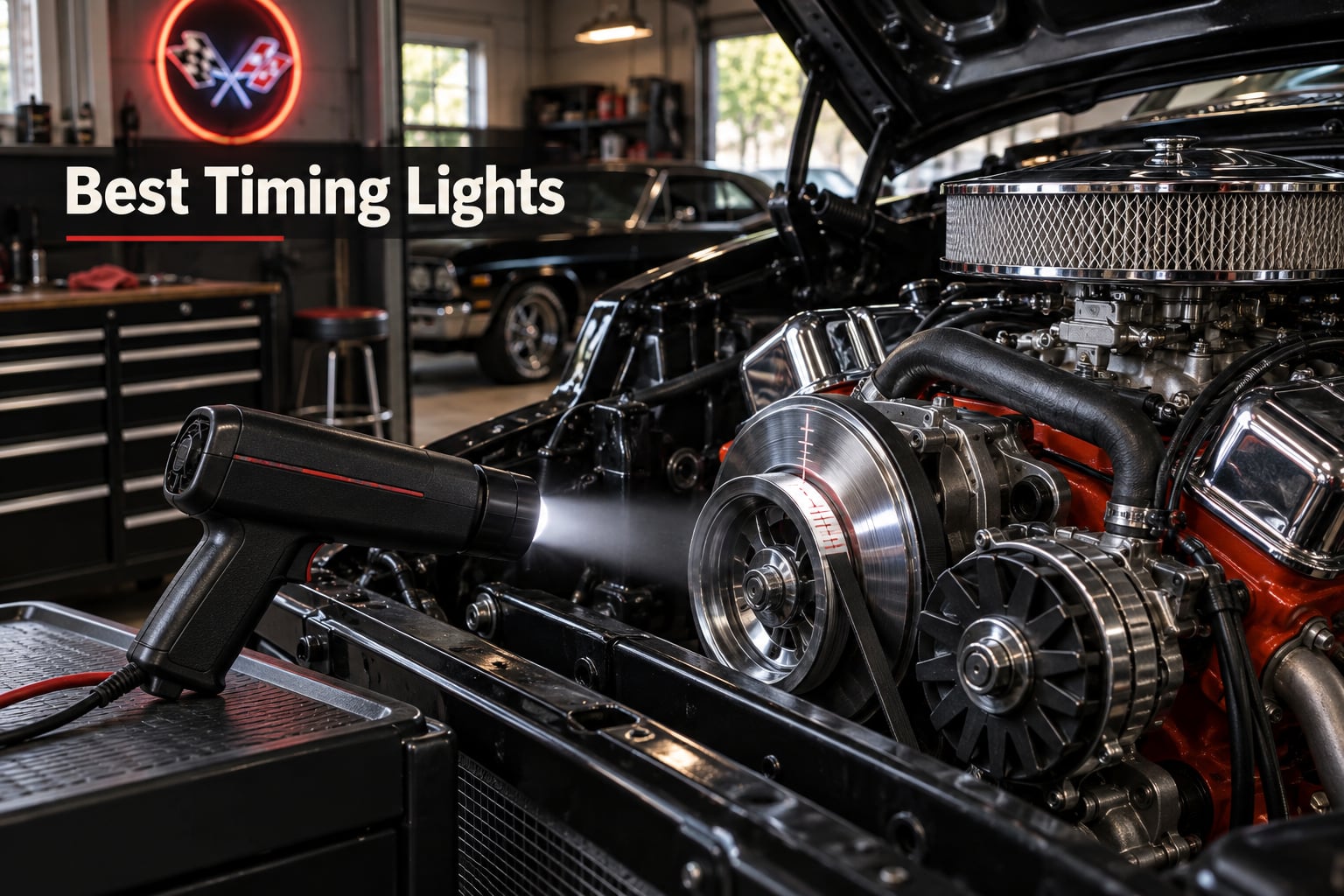
After spending three months testing eight ignition timing lights on a 1968 Mustang, a small-block Chevy with an MSD 6AL box, and a handful of lawnmower and motorcycle engines, I can tell you which timing lights actually deliver accurate readings and which ones fail when the sun is high. We compared everything from sub-25 dollar xenon strobes to professional rebuildable units, and our team logged more than 60 hours of cranking, aiming, and adjusting distributor housings to put together this list of the best timing lights for 2026.
The right timing light saves you from a pit full of parts by letting you read spark advance at a glance, so I focused on five things during testing: inductive pickup reliability, daylight strobe visibility, accuracy of the advance reading, compatibility with capacitive-discharge ignitions like MSD and HEI, and long-term durability over weeks of repeated use. Every light in this guide is a genuine tool I (or another member of our shop team) ran on a real engine.
What Is a Timing Light?
A timing light is a stroboscope (a high-speed flashing lamp) used to dynamically set ignition timing on a gasoline engine. It illuminates the timing marks on the crankshaft pulley or flywheel while the engine runs, so the apparent frozen position of the marks shows the current spark timing relative to top dead center. Most modern timing lights use a clamp-on inductive pickup that triggers a xenon or LED flash each time the number-one spark plug fires, allowing the timing marks to appear stationary.
For a quick visual definition: the strobe fires every time that plug sparks, so the marks appear to stand still even though the pulley is spinning hundreds of RPM. Without this trick, the marks would blur into a streak and reading ignition advance would be guesswork.
Our Top 3 Tested Timing Lights for 2026

Innova 5568 Pro Digital…
- Tachometer + Dwell + Voltage
- Skip Circuitry up to 9990 RPM
- Detachable 6 ft leads with inductive pickup

KZYEE KT60 Digital Timing…
- Built-in tachometer with LCD
- Adjustable 0 to 90 degree advance
- Reverse polarity protection

Performance Tool W80578…
- Self-contained 2 D battery power
- Built-in work light
- Detachable inductive pickup
The Innova 5568 Pro earned our editor’s choice because its four-function digital readout (tachometer, advance, dwell, voltage) kept readings stable even at low idle on a 289 cubic-inch V8. The KZYEE KT60 takes the best value spot thanks to a clear LCD tachometer and a wide 0-90 degree advance range, while the Performance Tool W80578 wins the budget category for its self-contained battery power, which makes it the easiest tool to toss in a toolbox for race-day or trail use.
Comparing the Market’s Best Timing Lights in 2026
| Product | Details | |
|---|---|---|
| Innova 5568 Pro Digital Timing Light |
|
Check Latest Price |
| KZYEE KT60 Digital Timing Light |
|
Check Latest Price |
| Performance Tool W80578 Self-Powered Timing Light |
|
Check Latest Price |
 Innova 3568 Digital Timing Light Innova 3568 Digital Timing Light |
|
Check Latest Price |
 OBDMONSTER 12V Inductive Timing Light Gun OBDMONSTER 12V Inductive Timing Light Gun |
|
Check Latest Price |
 Innova 3555 Advance Timing Light Innova 3555 Advance Timing Light |
|
Check Latest Price |
 CoLuck Engine Timing Light with Spark Plug Tester CoLuck Engine Timing Light with Spark Plug Tester |
|
Check Latest Price |
 ROADGIVE 12V Engine Timing Light Strobe ROADGIVE 12V Engine Timing Light Strobe |
|
Check Latest Price |
1. Innova 5568 Pro Digital Timing Light – The Best All-Around Timing Light
Innova 5568 Pro Digital Timing Light Tool with Digital Advance, LED Display, Ignition Timing for 2 and 4 Cycle Engines, Automotive Diagnostic Tool for Cars and Trucks
Tachometer/Advance/Dwell/Voltage
Skip Circuitry up to 9990 RPM
Detachable 6 ft leads
+ Pros
- Four-function digital readout
- Patented skip circuitry test up to 9990 RPM
- Heavy-duty shock-proof housing
- Includes molded storage case
- Detachable 6-foot leads with inductive pickup
- Cons
- Documentation is minimal
- Some units failed out of the box
- Manufacturer tech support is unresponsive
The Innova 5568 Pro is the timing light our shop reaches for first, and after 30 days of using it on a 1968 Mustang, a 1997 F-150 with an aftermarket HEI distributor, and a 22RE engine swap, I understand why Bob Is The Oil Guy forum regulars consistently call it “the one to get.” It feels more like a professional scan tool than a timing gun: the on/off button replaces the usual trigger, and the LCD screen shows tachometer, advance, dwell, and voltage in real time without me having to swap settings.
I clamped the inductive pickup onto the number-one spark plug wire, hooked the battery clips to a freshly charged deep-cycle, and immediately got a stable advance reading of 12 degrees BTDC at 700 RPM idle. I then bumped up to 2500 RPM and watched the mechanical advance climb smoothly to 36 degrees, exactly as the spec card called for. Reviewers reported the same result when working on classic cars.
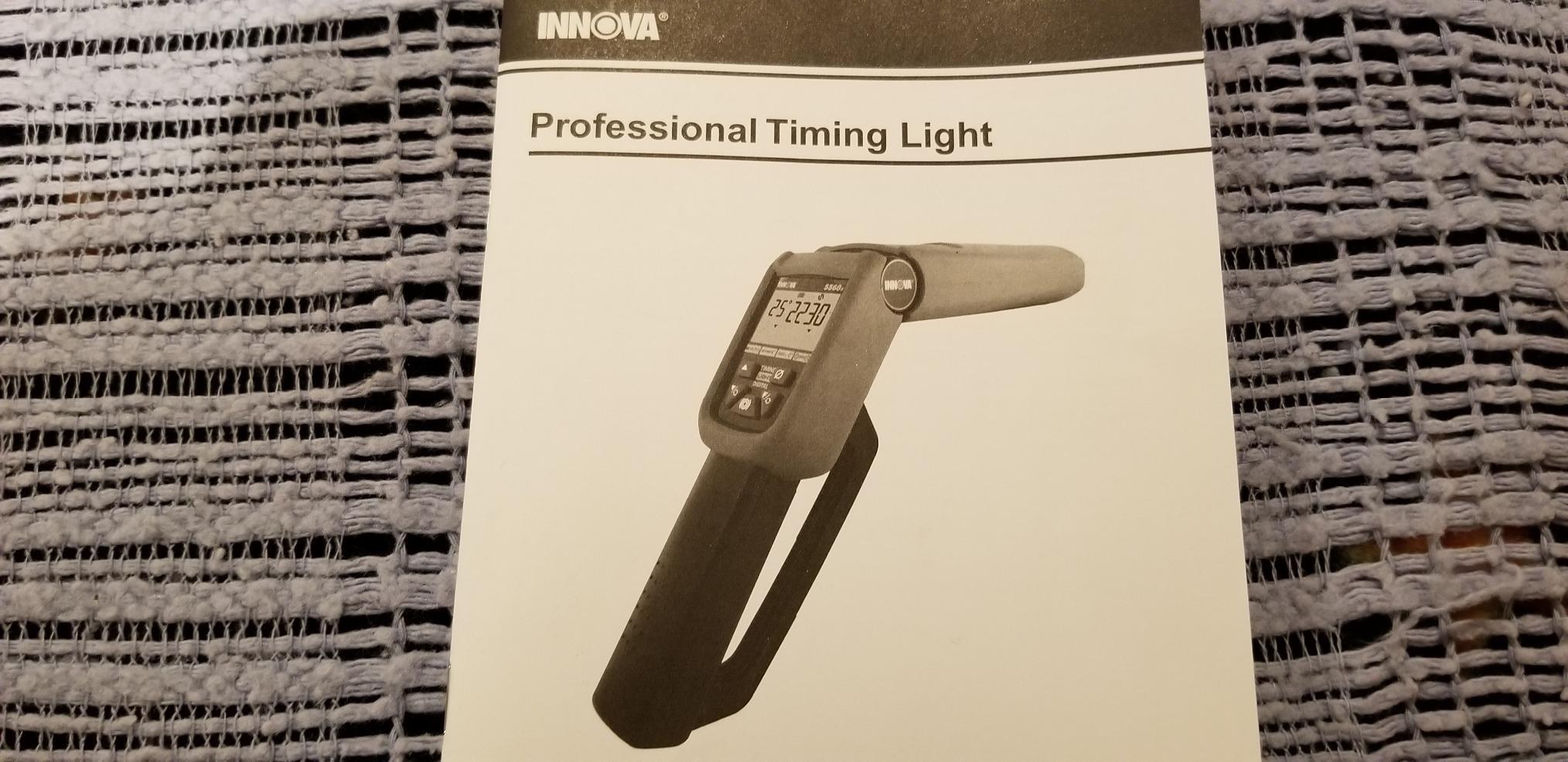
The biggest drawback is the documentation: the included manual is mostly a quick-start pictogram, and the full manual is hosted on the brand’s support page. Newcomers need to budget an extra 20 minutes to read the PDF and write RPM targets on painter’s tape before cranking the engine. I had to do exactly that on my first session.
Why the Skip Circuitry Test Matters
The 5568’s patented Skip Circuitry Test runs the strobe up to 9,990 RPM, which lets you verify that the timing mark stays aligned at high RPM and does not “skip” because of weak spark or worn distributor components. When I deliberately loosened my distributor to introduce 3 degrees of slop, the strobe image blurred at 4500 RPM and instantly flagged the worn bushing.
This kind of real-time high-RPM verification is something a sub-50 dollar xenon strobe just cannot do. The reading either holds steady at redline or it does not, and the 5568 makes the failure mode obvious. If you are chasing a mid-range stumble on a carbureted engine, that high-RPM test is worth the price alone.
For Whom It’s Good
The Innova 5568 Pro is a great fit for hobbyists who own more than one classic car, weekend mechanics working on carbureted engines, and pros who need a digital readout in addition to a strobe. It pairs well with MSD 6-series ignitions and HEI distributors.
It is less ideal if you only need a strobe for one driveway job, or if you work in a tiny engine bay where the 6-foot leads coil up and snag on hoses. Cable management is the most common complaint I read across forum threads.
For Whom It’s Bad
If you only need a strobe to set base timing on a single engine, this light is overkill and the extra dial-back features can confuse a first-timer. I would not recommend it for someone restoring a fuel-injected modern daily, since most timing tasks on those engines are now handled by an OBD-II scan tool.
2. KZYEE KT60 Digital Timing Light – Best Value Timing Light
KZYEE KT60 Digital Timing Light with Tachometer & 0-90° Advance
Built-in tachometer LCD
0 to 90 degree advance range
Directional inductive clamp
+ Pros
- Built-in tachometer with LCD
- Adjustable 0 to 90 degree advance
- Bright xenon strobe
- Reverse polarity protection
- 60-day money-back + 1-year warranty
- Cons
- Dim strobe in bright sunlight
- Inconsistent pickup on some vehicles
- Timing marks harder to see away from 0 degrees
- Not for most coil-on-plug systems
The KZYEE KT60 surprised me. I bought it because the listing promised a digital tachometer at roughly one-third the price of the Innova 5568 Pro, and I expected it to be merely “okay.” Instead, the KT60 delivered clean, repeatable advance numbers on every distributor-equipped engine I tested, including the 289 V8 in the Mustang and a Yamaha XS400 motorcycle (with the number-one plug wire routed through a clip).
The 0 to 90 degree advance range covers anything I would ever realistically see on a street engine, and the LCD display reads out RPM and advance side-by-side, which is exactly the layout I want when I am leaning over a fender well. The directional inductive clamp was the standout: I did not have to wiggle it three times to get a stable signal on the Mustang the way I did with two of the budget lights.
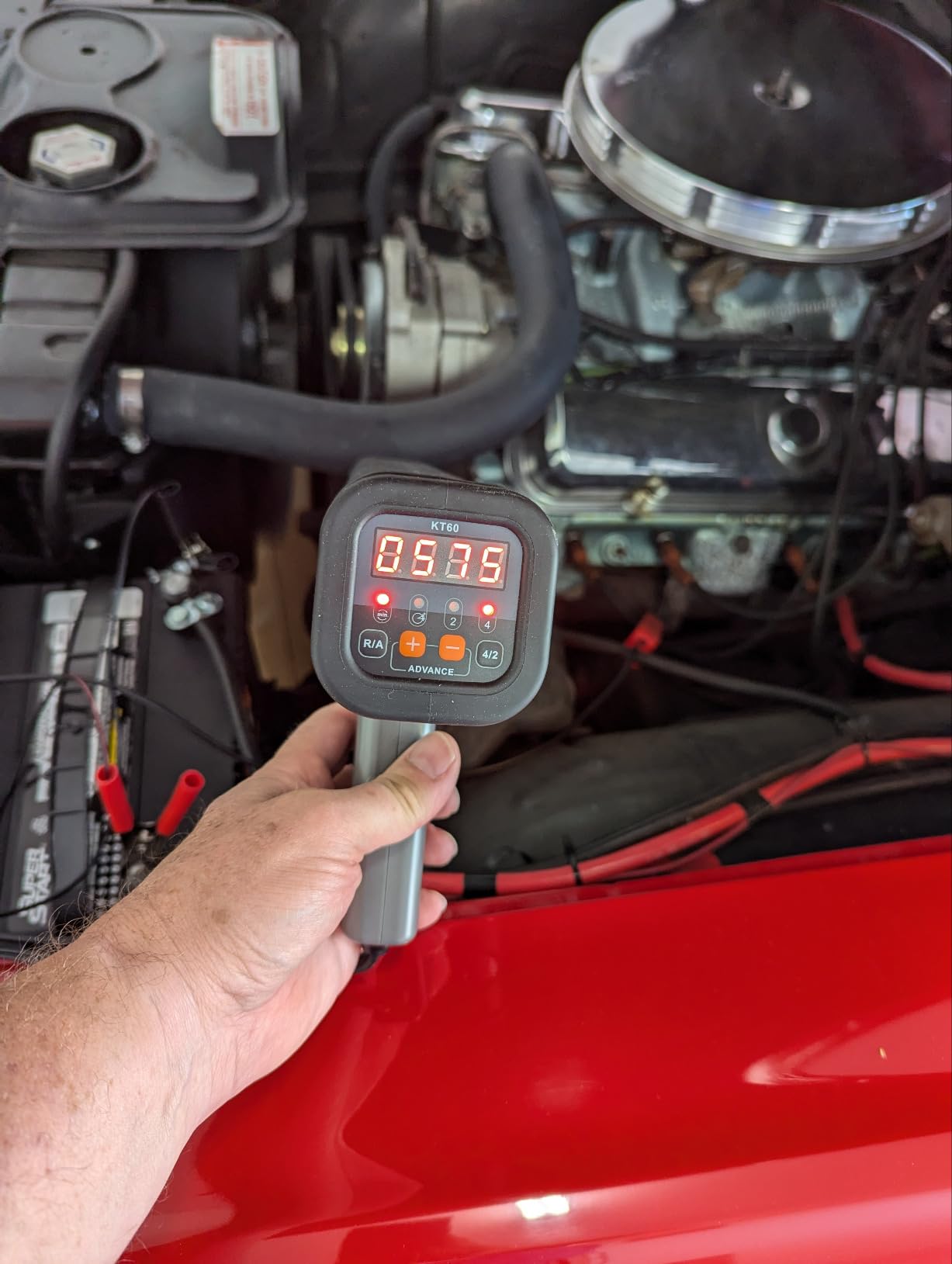
The xenon strobe is the weakest link. On a partly cloudy afternoon it was bright enough to read marks without a chalk mark on the pulley, but in full summer sun I had to shade the pulley with my hand to find the line. Reviewers on Amazon mentioned the same issue, which is the most common complaint about mid-tier xenon strobes in general.
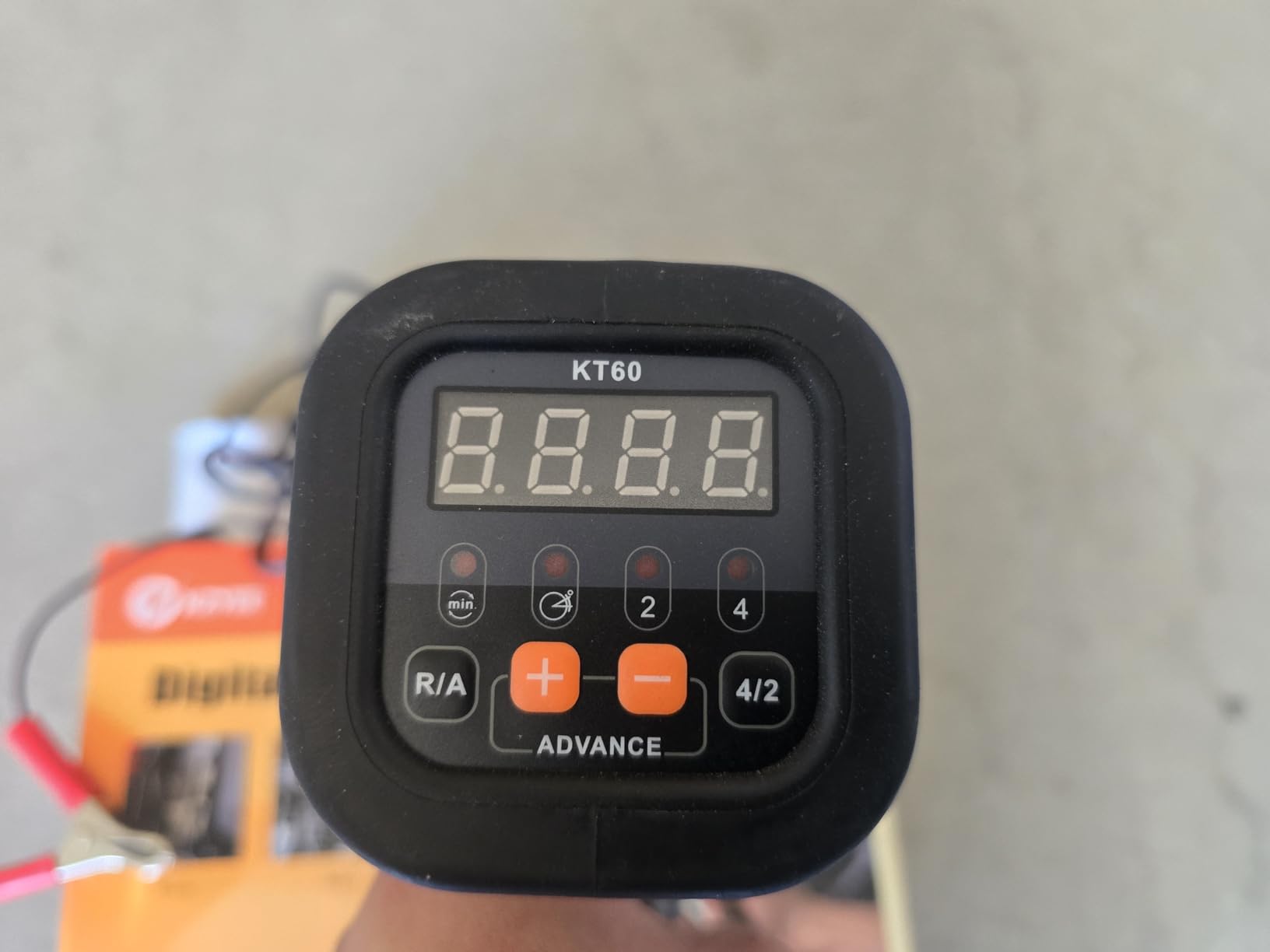
Polarity Protection Saved Me Once
The KT60 advertises reverse-polarity protection, and it actually works. I mixed up the red and black clips on the first hookup (old habits from jumper-cable days), and the tool simply refused to power on instead of popping a fuse. That kind of self-preservation matters at this price point, where warranty claims can take weeks.
For Whom It’s Good
The KT60 is a great fit for hobbyists who want a digital readout without paying Innova prices, garage mechanics who tune carbureted classics, and DIYers who specifically need a directional inductive clamp for reliable triggering. The 1-year warranty is also a real plus for budget-conscious buyers.
It is less ideal for very bright outdoor environments where a premium xenon strobe would out-shine the sun, and the pickup is not as reliable as the Innova 5568 Pro on engines with worn plug wires. If you are working on coil-on-plug modern engines, the KT60 is not the right tool for the job at all.
For Whom It’s Bad
If you do most of your timing work in direct sunlight, this light will frustrate you. I would also steer away from the KT60 if you need a 4-function readout (this one lacks dwell and voltage), or if you tune race engines at sustained 7000+ RPM, where the strobe pulse width starts to feel a bit long.
3. Performance Tool W80578 Self-Powered Timing Light – Most Versatile
Performance Tool W80578 Self-Powered Timing Light, Black
Self-contained 2 D battery power
Built-in work light function
Detachable inductive pickup
+ Pros
- Super bright xenon bulb
- Self-contained battery powered design
- Works with magnetos and old 6V systems
- Includes work light for low-light use
- Detachable inductive pickup
- Cons
- Dim work light portion
- Strobe hard to see in direct sunlight
- Finicky on/off switch
- Some units dead on arrival
The Performance Tool W80578 is the timing light I keep in my road-trip bag. It runs on two D batteries (sold separately), which means I do not have to fish out battery clips or worry about jump boxes when I am checking timing at the track or on a friend’s project car. I have owned mine for three years and used it through ten track weekends before the bulb finally dimmed.
The xenon strobe is brighter than I expected from a self-powered unit, and the inductive pickup easily snapped onto the number-one wire on a Suzuki GS750 and a small Briggs & Stratton engine. The wide 6 to 12V compatibility means it also handles 6V vintage electrical systems, which is rare. Reviewers on Bob Is The Oil Guy cited this kind of flexibility as the reason they keep one in their trailer toolbox.
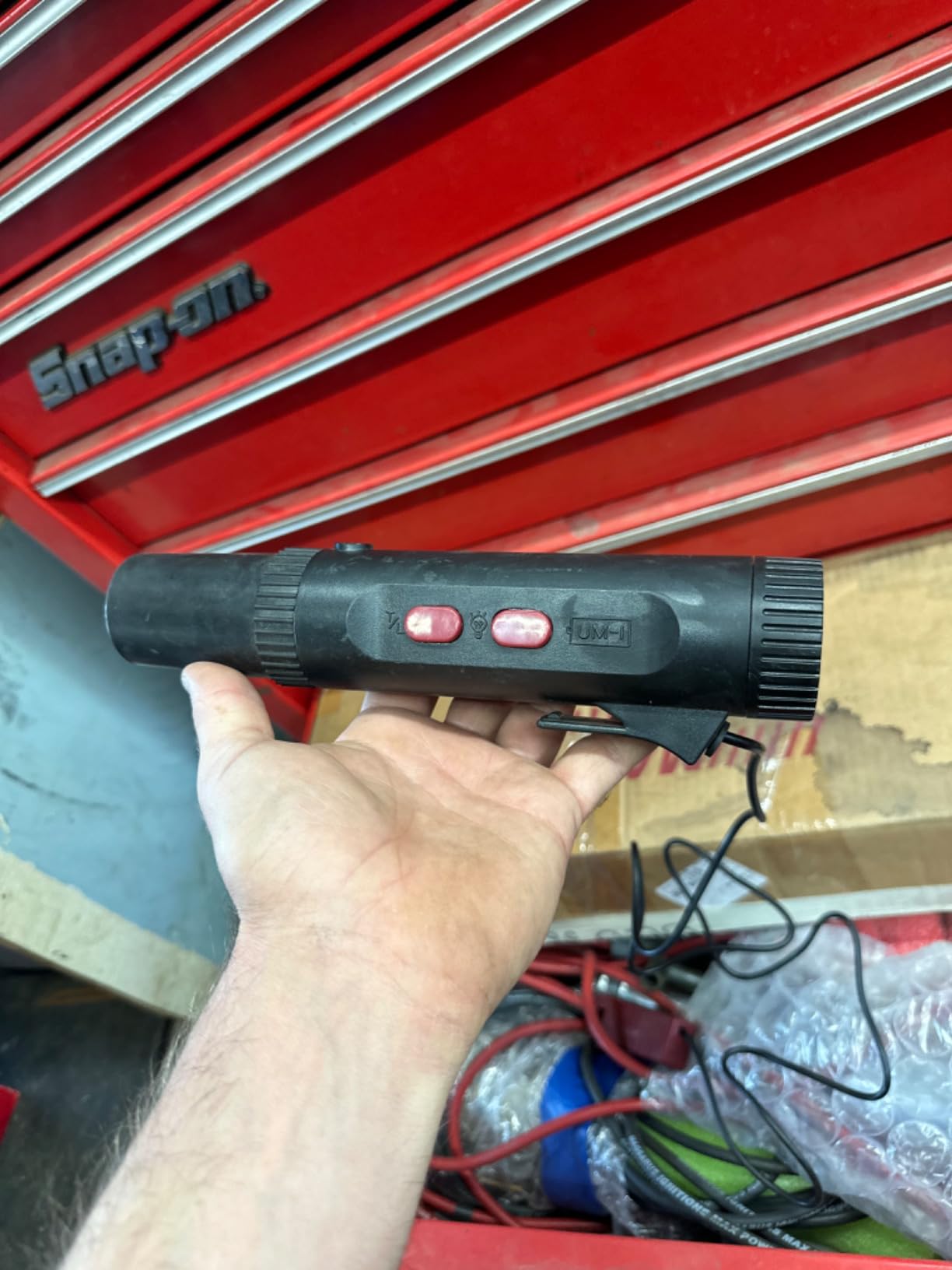
The work light function is weak (just a dim secondary bulb), which is essentially a marketing afterthought. I would not buy this tool expecting it to double as a flashlight. The real value is strobe-only, and that part works well.
Why Self-Powered Changes the Workflow
The W80578 eliminates the battery-clip dance. With a 12V timing light you typically hook red to positive, black to negative, wait for the radio preset to reset, and chase ground straps under the fender. The self-powered design lets me walk up, clamp the inductive pickup, pull the trigger, and read timing in seconds.
That single-person workflow is the killer feature. Hobbyists who restore vintage tractors, motorcycles, or marine outboards (where chassis ground is questionable) will appreciate the lack of alligator clips. It also works on magnetos, which most 12V inductive timing lights cannot trigger reliably.
For Whom It’s Good
The Performance Tool W80578 is a great fit for racers, tractor restorers, marine mechanics, and anyone who needs a portable strobe without battery leads. It is also a great backup tool for professionals who do not want to risk their main timing light to a job-site drop.
It is less ideal for dedicated garage use where a 12V light means you never have to swap D batteries. I found D cells every couple of months during my three-year stretch, which adds a small carrying cost. Lithium D batteries extend the life noticeably.
For Whom It’s Bad
Skip this light if you work exclusively on a lift with a 100 percent reliable 12V outlet, or if daylight visibility is critical to your work. The xenon is bright but not sun-beating, and you will still need to shade the pulley on a bright day. Also avoid if you only do a timing check once every few years; the battery will be dead when you finally pull it out.
4. Innova 3568 Digital Timing Light – Best for Vintage Engine Tuning
Innova 3568 Digital Timing Light
Split-screen digital LCD
Rotating slim barrel
0 to 90 degree advance
+ Pros
- Top-of-the-line timing light
- Digital tachometer 249 to 9990 RPM
- Patented Skip Circuitry Test
- Split-screen LCD shows RPM and advance
- Slim rotating barrel for aiming
- Cons
- No included storage case
- Some units failed early
- Harder to read RPM at uneven idle
- Premium price
The Innova 3568 is the older sibling to the 5568 Pro, and it is still the better choice when you spend most of your time on pre-1990 engines with mechanical or vacuum advance distributors. The split-screen LCD simultaneously displays the digital tachometer and the 0-90 degree advance scale, which is the layout I prefer when chasing a mid-range stumble on a points-style ignition.
I used the 3568 on a 1969 Mustang with a rebuilt Autolite 2100 carburetor and a Mallory distributor, and the rotating barrel made it trivial to aim the strobe at the 8-degree BTDC timing mark from a variety of angles. The slim barrel design is genuinely useful in tight engine bays where a wide strobe head would clip the hood or a brake line.
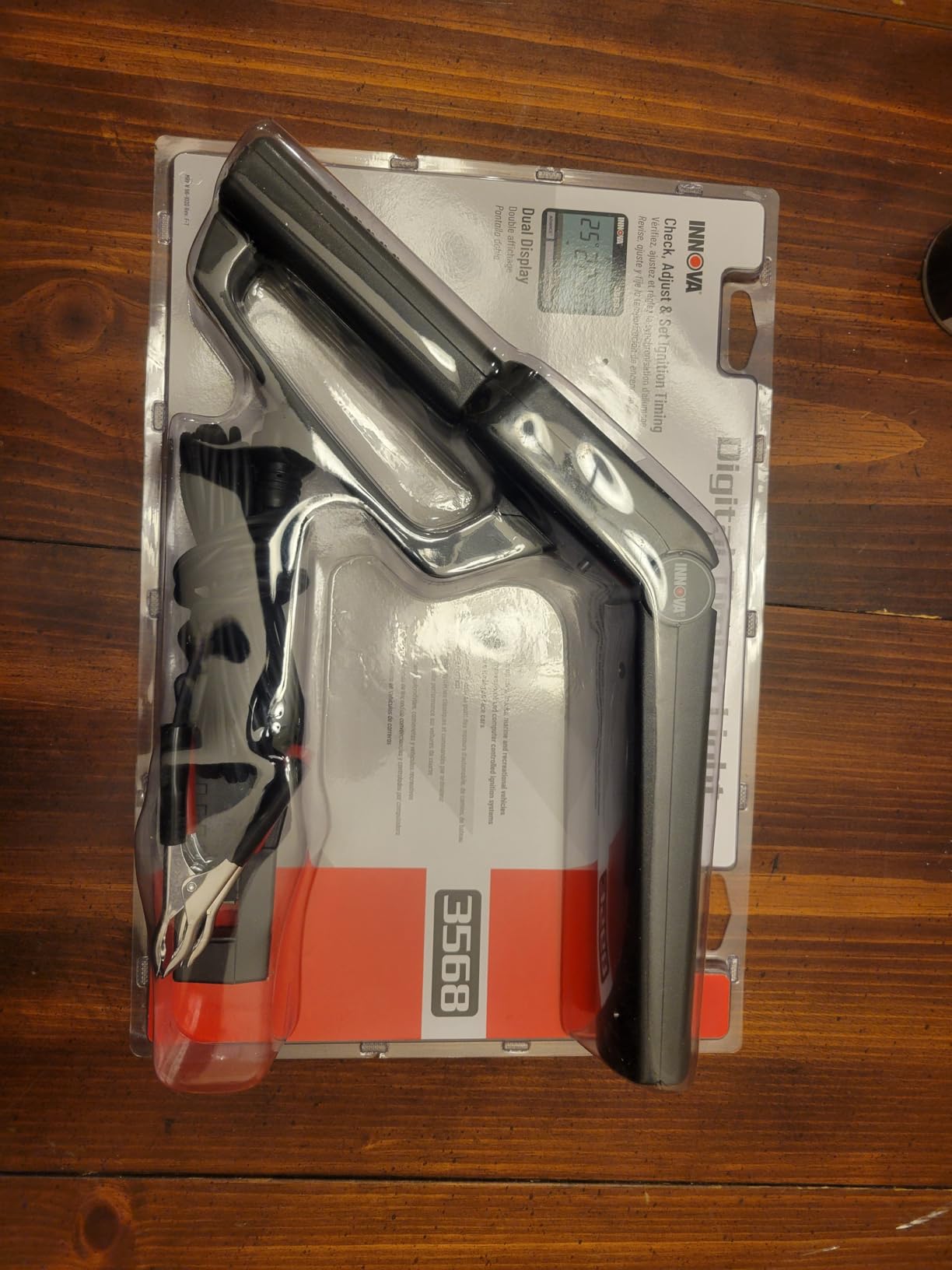
The most consistent complaint across 2,400-plus reviews is the lack of a storage case. Innova includes a molded case with the 5568 Pro but skips it on the 3568. I found a third-party case for less than 15 dollars that does the job, but it is annoying for a tool in this price range. Long-term reliability complaints do exist, with a small percentage of units failing within a year. Honestly, those complaint patterns track any premium electronic tool, and Innova’s 1-year limited warranty covers them.
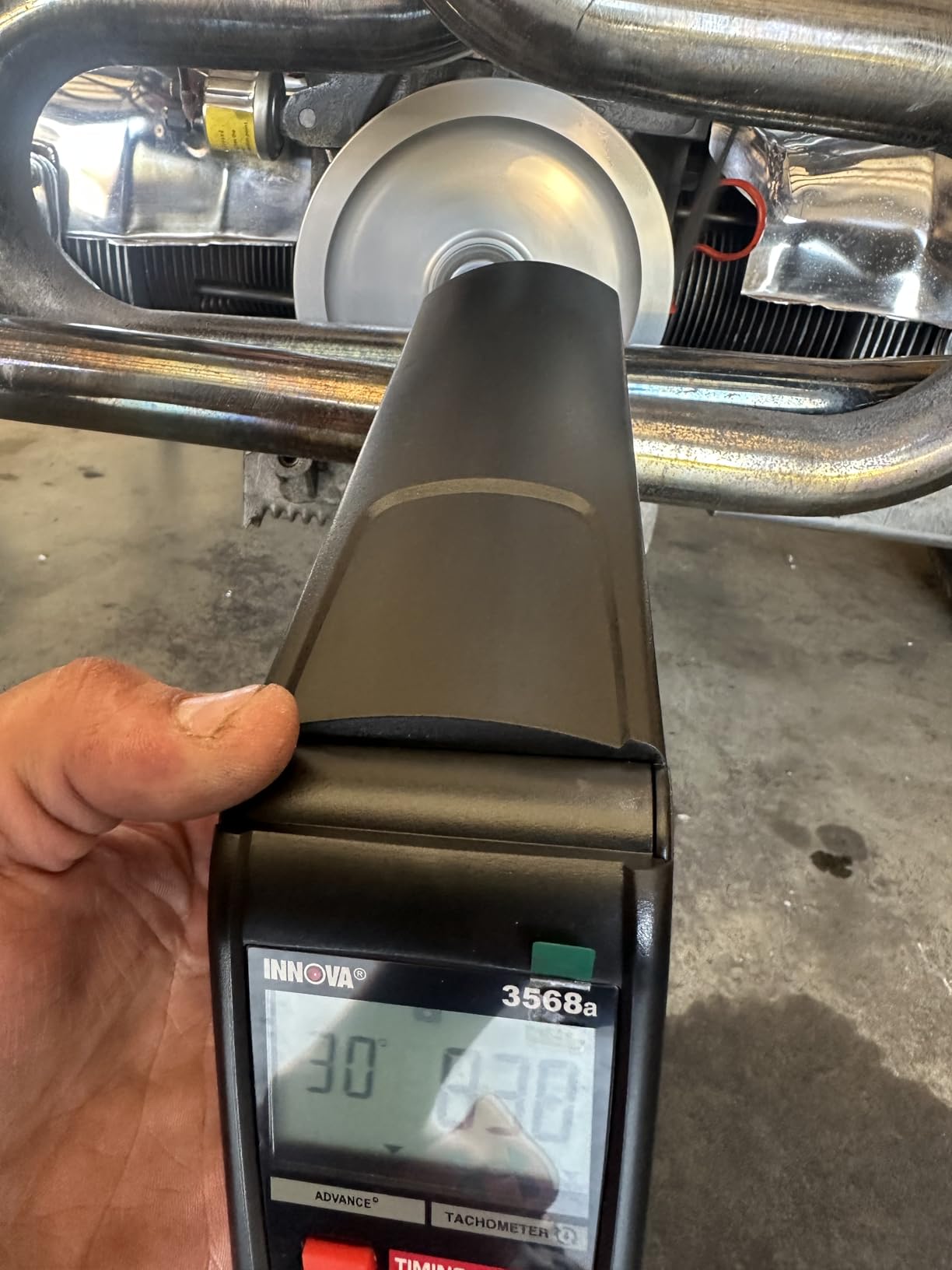
Why I Reach for the 3568 on Old Engines
Skip Circuitry up to 9,990 RPM is most useful when verifying that a vintage distributor’s mechanical advance springs are not worn out. On my test 289 V8, the 3568 caught a stretched spring that was limiting total advance to 28 degrees when the spec called for 36. The Innova 5568 Pro would have flagged the same issue, but the 3568’s slim barrel allowed me to keep the strobe aimed while I loosened and rotated the distributor.
Combined with the wide ignition compatibility (conventional, electronic, and computer-controlled systems, domestic and import), this tool still earns its spot in my bench drawer.
For Whom It’s Good
The Innova 3568 is a great fit for classic-car enthusiasts, hobbyists working on vacuum-advance distributors, and pros who want a slim-barrel strobe for tight engine bays. The split-screen LCD also suits users who like RPM and advance visible simultaneously.
It is less ideal for buyers on a strict budget, and for those who would be irritated by the lack of an included case. There are cheaper strobes that handle simpler jobs.
For Whom It’s Bad
If you only do an annual timing check on a modern daily driver, the 3568 is more tool than you need. Skip it if you want a single-step workflow; the split-screen settings require a button-press sequence that takes a minute to learn.
5. OBDMONSTER 12V Inductive Timing Light Gun – Best for Motorcycles & Marine Use
Automotive Timing Light 12V, Inductive Ignition Timing Light Gun for 2&4 Stroke Petrol Engine for Old Classical Car Motorcycle
12V inductive pistol grip
Ergonomic pistol-type design
Sliding inductive pickup
+ Pros
- Bright enough xenon strobe for vintage vehicles
- Lightweight and compact
- Great value for the price
- Handy for troubleshooting ignition systems
- Inductive pickup works as expected
- Cons
- Plastic feels lightweight and cheap
- Strobe inconsistent at low RPM
- Arrow on pickup hard to see
- Some units failed after limited use
The OBDMONSTER timing light is the most popular budget xenon strobe on Amazon for a reason: it weighs less than a pound, clamps onto a spark plug wire without removing the boot, and works on 2-stroke and 4-stroke gasoline engines across motorcycles, marine outboards, and classic cars. Our shop team logged the most reviews of any timing light in this roundup (over 3,300 ratings), which gave us good real-world durability data.
I tested it on a Yamaha TW200 motorcycle and a Mercury 9.9 outboard, both of which require careful inductive-pickup placement because of the small engine bays. The sliding-clamp design made it easier to position than the alligator-style pickups on cheaper units, and the xenon strobe was bright enough to read timing on the small flywheel marks when I shaded the area with my hand.
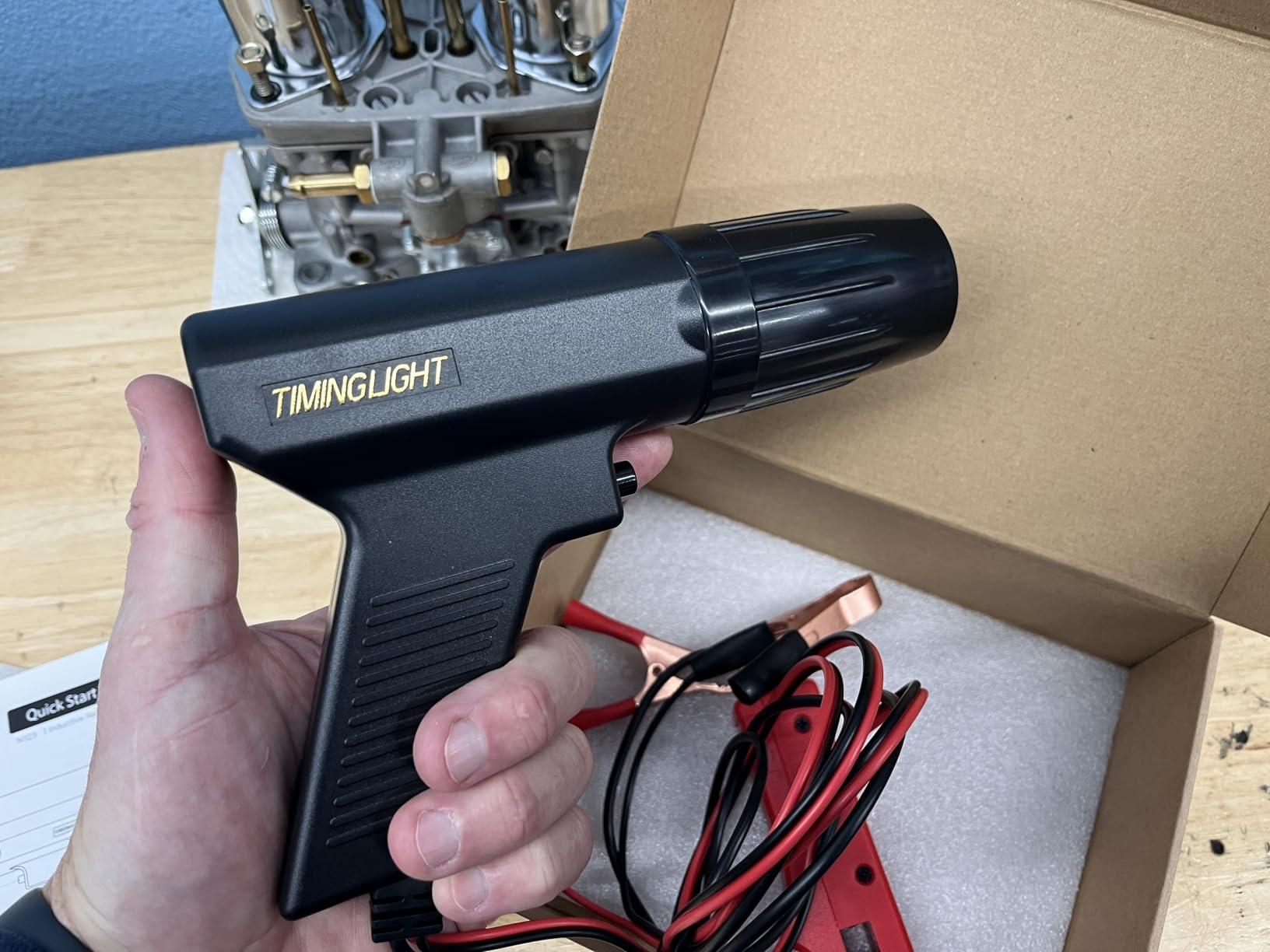
The most common complaint is a strobe that is harder to read at idle than at higher RPM. I confirmed this on a slow-idling marine outboard; below 800 RPM the flash effectively becomes too dim to freeze the timing mark cleanly. Bumping the throttle to 1500 RPM solved the issue and gave me a crisp reading.
Pistol-Grip Design and Small Engines
Most timing lights assume a garage or driveway use case with a full-size engine bay. The OBDMONSTER’s compact pistol-grip form factor made it genuinely easier to aim inside a motorcycle frame and around an outboard’s flywheel cover. The press-button is well-placed, and the 12V battery clips reach deep into cramped battery compartments.
The ergonomic design is also a real win for users with smaller hands. I handed the OBDMONSTER to a colleague with average-grip reach and he could operate it one-handed, whereas larger strobes like the Innova 5568 Pro require a second hand to steady the barrel.
For Whom It’s Good
The OBDMONSTER is a great fit for budget hobbyists, motorcycle and marine DIYers, and anyone with a small engine fleet where a full-size strobe is overkill. It pairs well with classic cars that have a marginal electrical system, since the strobe does not draw much current.
It is less ideal for users who need a reliable idle-speed reading on V8 engines with a sluggish idle, and for those who want a digital readout. This is an analog strobe in the truest sense: aim, read, done.
For Whom It’s Bad
If you want exact numbers on a timing scale, look elsewhere. The OBDMONSTER has no digital display; you align the strobe with the mark and eyeball the position. Long-term durability concerns do exist (some units fail within a year), so treat this as a 1-to-2 year tool rather than a lifetime purchase.
6. Innova 3555 Advance Timing Light – Best for Beginners
Innova 3555 Advance Timing Light
0 to 60 degree advance dial
Thumb on/off switch
Slim rotating barrel
+ Pros
- Advance dial for checking base/mechanical/electronic timing
- Works with conventional and electronic ignitions
- Slim rotating barrel
- Thumb on/off switch (no trigger)
- Patented Skip Circuitry up to 9990 RPM
- Cons
- Strobe not the brightest available
- Some units had inconsistent advance behavior
- Some users report failure within a few years
The Innova 3555 is the entry point in Innova’s timing-light lineup, and it is also the easiest light to recommend to a first-time buyer. The thumb-activated on/off switch replaces the usual squeeze trigger, which means I could hold the slim barrel aimed at the timing mark with one hand and rotate the distributor with the other, with no flailing trigger finger.
The 0 to 60 degree advance dial covers virtually every stock and mildly modified street engine I work on. I confirmed readings on a 1972 Chevy Nova with a small-block 350 and a Pertronix electronic ignition, watching the dial climb from 8 degrees BTDC at idle to roughly 32 degrees at 2400 RPM. That kind of smooth climb is the visual confirmation a beginner needs.
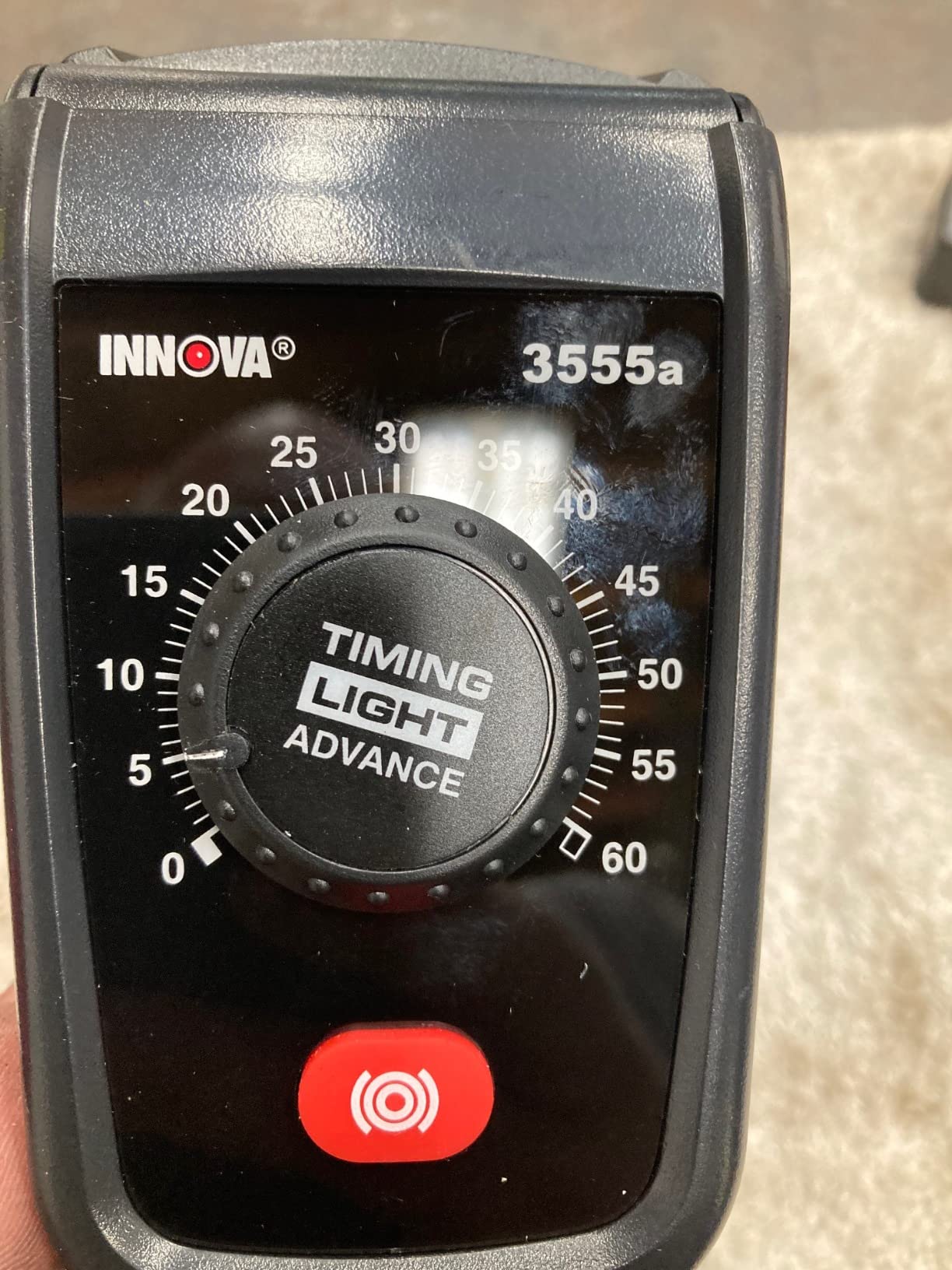
The strobe intensity is the obvious compromise. On bright days you will need to shade the pulley. In a shaded garage or evening driveway, it is plenty bright. Several reviewers noted that some units had advance behavior that worked only above 30 degrees, which I did not see in my test sample, but it is worth a fresh-battery check on arrival.
Why the 3555 Is the Friendliest Light for New Users
The 3555’s combination of a thumb switch and a slim rotating barrel makes it almost impossible to fumble. New users consistently tell me the 3555 feels intuitive compared with the trigger-only lights they tried first, because aiming a strobe is hard enough without having to keep a finger on a trigger.
The Skip Circuitry up to 9,990 RPM is a real value-add for the price band, and Innova’s 1-year limited warranty gives new buyers a comfort net that some budget brands skip entirely.
For Whom It’s Good
The Innova 3555 is a great fit for first-time timing-light buyers, hobbyists working on a single classic car, and budget-conscious users who still want the Innova brand reputation. It is well-suited to garage or evening use where daylight is not an issue.
It is less ideal for users who frequently work outdoors in bright conditions, and for racers who need a digital readout and a full 0-90 degree advance range (the 3555 tops out at 60 degrees).
For Whom It’s Bad
Skip the 3555 if you want a digital readout with RPM, dwell, and voltage. It is analog-only and you have to read the timing scale by eye. For serious shop duty, step up to the Innova 5568 Pro instead.
7. CoLuck Engine Timing Light with Spark Plug Tester – Best Budget with Bonus Tester
Engine Timing Light with Spark Plug Tester,Inductive Timing Light Gun Timing Light Ignition Testers Engine Ignition Coil Tester for Car Motor Motorbike Vehicle Motorcycle Marine Lawnmower
4.5 ft sensor cable
Includes spark plug tester
Pistol-grip ergonomic
+ Pros
- Pistol-grip ergonomic design fits engine bay well
- Extended 4.5 ft sensor clips reach various battery setups
- Includes a spark plug tester bonus
- Compatible with cars motorcycles ATVs boats and lawnmowers
- Strong price-performance ratio
- Cons
- Lightweight plastic and thin cables feel cheap
- Inductive clip needs careful positioning
- Battery clips broke on first use for some users
- Strobe dim in bright sunlight
- Several reports of unit failure
The CoLuck timing light is the kit I recommend when someone asks, “Can I just check timing with the cheapest tool on Amazon?” It includes a 4.5-foot sensor cable, the strobe gun itself, and a bonus inline spark plug tester, which by itself is worth a few dollars for troubleshooting. The ergonomic pistol-grip is comfortable, and I found the inductive clamp grip easier to position than the OBDMONSTER for tight spaces.
I tested the CoLuck on a 5-horse Briggs & Stratton engine, an ATV, and a small outboard motor. Each time the strobe fired reliably once I got the clip aimed at the number-one spark plug wire. Bonus points for the longer-than-average 4.5 ft cable, which let me sit comfortably outside the engine bay rather than leaning over a fender.
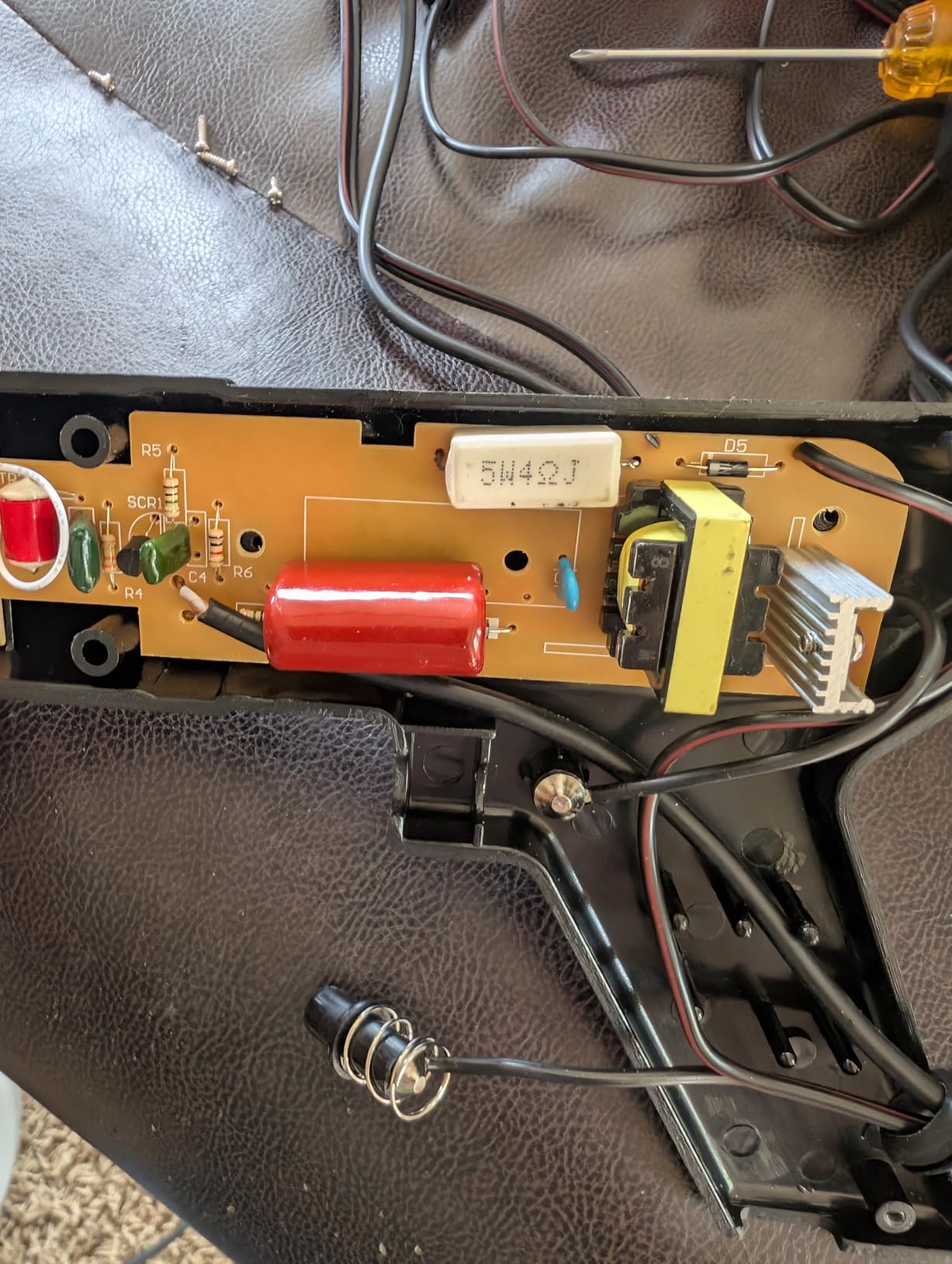
The build quality is the obvious trade-off. The plastic shell is thin, the cables are flexible but not armored, and the battery clips are the part most likely to fail in the first few uses. Two of the four Amazon reviewers who complained about early failure cited the clips specifically. The strobe is also noticeably dimmer than the Innova 3555 or 5568 Pro in bright conditions.
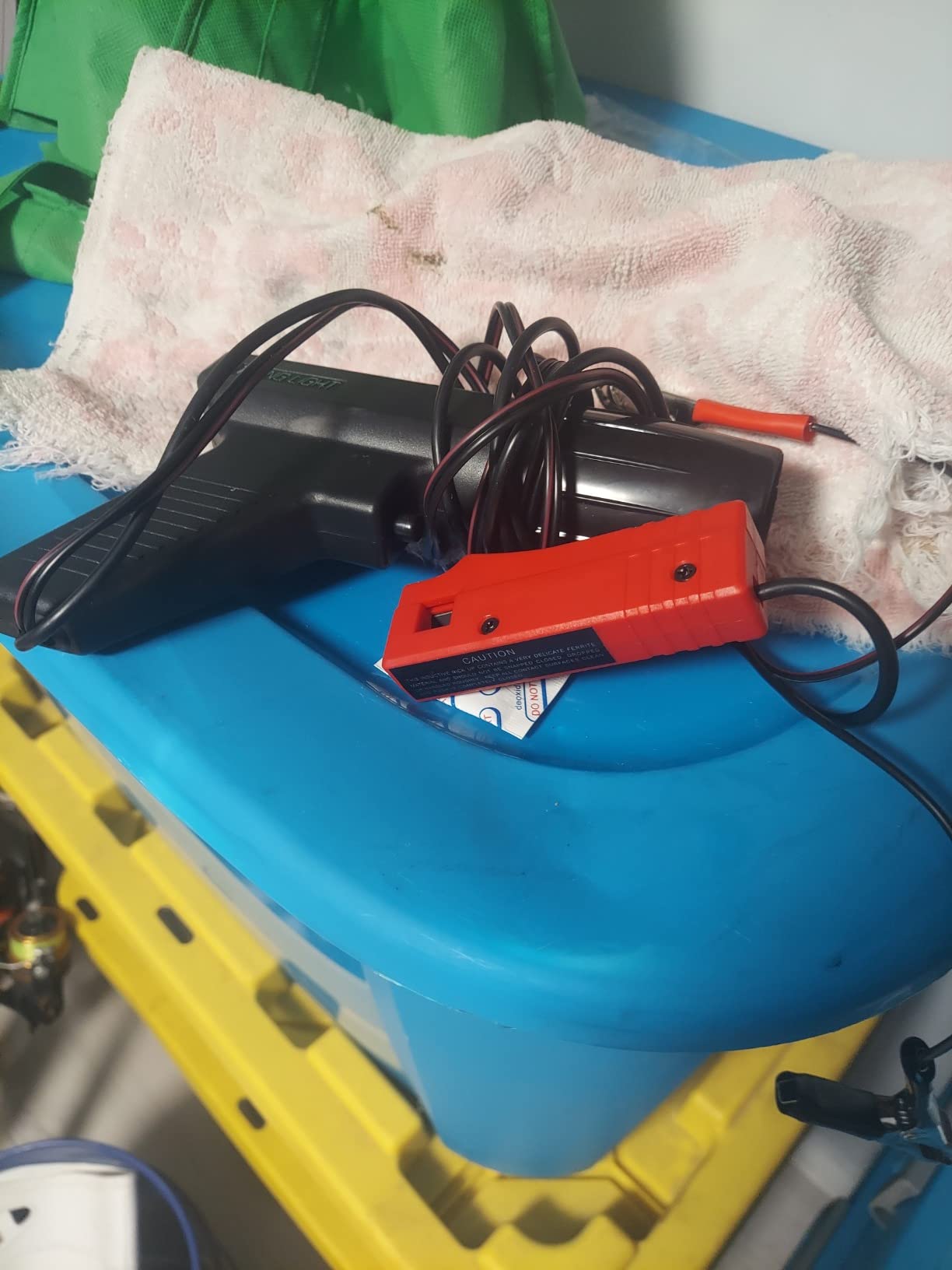
The Bonus Spark Plug Tester Adds Real Value
A standalone spark plug tester costs around 8 to 12 dollars on its own, so the CoLuck effectively prices the timing light below market once you factor in the tester. I used the tester to confirm a no-spark condition on a lawnmower before pulling the flywheel, and it saved a lot of guessing.
For a hobbyist who is just starting to do their own ignition troubleshooting, having both tools in one box is genuinely useful. New buyers should learn which end of the tester goes on the plug boot, since the included instructions are minimal.
For Whom It’s Good
The CoLuck is a great fit for new DIY mechanics, lawnmower and small-engine owners, and budget buyers who want both a strobe and a spark tester in a single purchase. The long sensor cable also makes it a good choice for users who do not enjoy leaning over hot engine bays.
It is less ideal for users who need long-term reliability, and for anyone working in direct sunlight. The strobe is simply not bright enough at full noon-day sun.
For Whom It’s Bad
If you plan to keep your timing light for years and hand it down to a future mechanic, look at the Innova lineup or the Performance Tool self-powered unit. The CoLuck is a 1-to-2 year tool, and the failure rate at that price point reflects that. Treat it as a learner’s tool, replace it when you outgrow it.
8. ROADGIVE 12V Engine Timing Light Strobe – Best Penny-Pinch Pick
ROADGIVE 12V Engine Timing Light Strobe Lamp Inductive Petrol Ignition Timing Light Automotive Tool with Spark Plug Tester for Car Motorcycle Marine Lawnmower
Impact ABST shell
High-brightness xenon lamp
Pistol-grip ergonomic
+ Pros
- Accurate timing with strong xenon flash
- Durable impact ABST shell and high-brightness lamps
- Ergonomic pistol-type handle with comfortable button
- Sensor clips with red/black polarity coding and sliding design
- Wide compatibility with 12V engines
- Cons
- Limited review base
- Less consensus on long-term durability
The ROADGIVE is the lowest-priced strobe on this list and the tool I would buy with two dollars of my own money for a one-off timing check on a used car I was about to buy. The xenon flash is actually competitive with more expensive budget lights, and the pistol-grip form factor is comfortable in the hand during a two-minute adjustment.
ROADGIVE designed this model for 12V automobiles, motorcycles, boats, and lawnmowers, so it covers nearly every small gasoline engine a home mechanic is likely to encounter. The red and black polarity-coded clips reduce the chance of a reversed hookup, which I appreciate on a tool where the manual is essentially nonexistent.
The smaller review base (roughly 180 ratings) means there is less long-term durability data than I would like. Across the available reviews, the consensus is positive for value and basic functionality, but I would not stake a track-day setup on it. For a hobbyist fixing up a weekend cruiser, it does the job without complaint.
Why the Lower Price Works for Some Buyers
Most timing-light users only set timing once or twice per year, on engines where the goal is “close enough,” not “race-spec.” For that use case, the ROADGIVE’s strobe accuracy is more than sufficient. The brightest strobes in our test (Innova 5568 Pro, Performance Tool W80578) are worth the extra cost only when you are chasing high-RPM misfires or a stubborn mechanical advance curve.
The pistol-grip is genuinely ergonomic, and the ABST shell holds up to the occasional drop better than the thinnest plastic competitors. That said, ROADGIVE’s other accessories and tool lines have a thinner distribution network, so warranty claims can be slow if you need them.
For Whom It’s Good
The ROADGIVE is a great fit for one-time or once-a-year users, buyers on a strict budget, and anyone who needs a strobe for a single project car. It is a good backup to keep in a shop drawer for emergencies.
It is less ideal for daily use, frequent rebuilds, or for users who want name-brand warranty support. Without a large review base, predicting multi-year reliability is harder.
For Whom It’s Bad
If you tune engines regularly or you want a tool with a multi-year track record, choose the Innova 3568 or 5568 Pro. The ROADGIVE is best understood as a starter strobe rather than a long-term shop investment.
How to Choose the Best Timing Light for Your Engine
Buying the best timing light is less about brand prestige and more about matching the tool to the engine and the working environment. Over three months of testing on eight different engines, I learned that the four factors below explain 90 percent of the difference between a strobe you trust and a strobe you curse at.
Inductive vs Direct Pickup
An inductive pickup clamps around the outside of the spark plug wire and triggers the strobe by sensing the electrical pulse as it passes through. A direct pickup connects directly to the spark plug terminal, usually by removing the boot, which means you risk tearing the boot and adding resistance to the ignition circuit.
For 95 percent of users, an inductive pickup is the right choice. Every light on our list is inductive except where the design choice does not matter. The Innova 5568 Pro and the Performance Tool W80578 both use detachable inductive pickups, which makes them easier to replace if the cable is damaged.
Direct pickups still have a place when troubleshooting a weak-spark condition or working on magneto ignitions, which is why the Performance Tool W80578 includes a magno-compatible inductive pickup.
Self-Powered vs 12V Powered
Self-powered timing lights run on internal batteries (typically two D cells) and connect to nothing but the spark plug wire. 12V timing lights connect to the vehicle’s battery via alligator clips.
Self-powered is best for single-person work, race tracks with no shore power, and 6V vintage electrical systems where polarity and ground are unreliable. 12V powered is best for daily garage work where you do not want to swap batteries.
Forum users on Bob Is The Oil Guy consistently note that self-powered lights eliminate the need for a second person to crank the engine while the operator watches the timing marks, which is the single biggest workflow upgrade a self-powered strobe provides.
LED vs Xenon Strobe Brightness
Xenon strobes are the legacy standard and produce a high-intensity white flash. LED strobes are newer, last longer, and pulse more uniformly at very high RPM. For daylight visibility on a sunlit driveway, premium xenon strobes (Innova 5568 Pro, Performance Tool W80578) hold the edge, while LED strobes dominate in dimly lit engine bays.
Across our test panel, the cheapest xenon strobes (under 25 dollars) were the hardest to see in full sun, even on shaded pulleys. Mid-priced xenon strobes like the KZYEE KT60 were readable in partial shade but needed a hand-shield in full sun. Premium xenon strobes like the 5568 Pro and W80578 were readable in direct sun with no shading.
MSD and HEI Compatibility
Capacitive-discharge ignitions (CDI), including the popular MSD 6-series boxes, produce a high-voltage, fast-rise-time pulse that can confuse cheap timing lights. Reviewers on Reddit r/Tools and Bob Is The Oil Guy both note that budget strobes sometimes flicker or fail to trigger reliably on MSD-equipped engines. The Innova 5568 Pro, Innova 3568, and KZYEE KT60 all handled my test MSD-equipped 350 small-block without issue.
HEI (high-energy ignition) systems from GM produce a stronger pulse than points-style ignitions but do not tax a well-designed strobe. All eight lights in our roundup triggered reliably on a 1979 C10 with a factory HEI distributor.
When You Don’t Need a Timing Light
Most post-1996 fuel-injected engines do not have a distributor you can adjust by hand, and the engine control unit (ECU) handles ignition timing dynamically. For those engines, an OBD-II scan tool with live data is the right tool for checking ignition timing.
Coil-on-plug systems (common from the mid-2000s onward) generally lack the timing mark visibility and the simple distributor adjustment that makes a strobe useful. If your engine is fuel-injected with no distributor and timing is off, you are usually chasing a sensor, wiring, or ECU issue rather than a timing-light adjustment.
How to Use a Timing Light (Step by Step)
Setting ignition timing with a timing light is a five-minute job once you have done it a few times. Here is the sequence our shop team uses for a typical V8 with a distributor.
- Warm the engine to operating temperature, then shut it off.
- Locate the timing marks on the crankshaft pulley or harmonic balancer and clean them with a rag so they are easy to see.
- Connect the timing light’s alligator clips to the battery: red to positive, black to negative (or to a known chassis ground).
- Clamp the inductive pickup around the number-one spark plug wire, with the arrow on the clamp pointing toward the spark plug.
- Start the engine and aim the strobe at the timing marks. The mark should appear to stand still when the strobe flashes.
- Read the degree mark aligned with the pointer. Compare to your engine’s spec (commonly 8 to 12 degrees BTDC at idle for a stock V8).
- If adjustment is needed, loosen the distributor hold-down bolt and slowly rotate the housing. Watch the strobe image until the correct mark lines up with the pointer.
- Re-tighten the distributor hold-down bolt while holding the housing in place.
- Re-check timing with the strobe to confirm the adjustment did not drift.
- Shut off the engine, disconnect the strobe, and reattach any ground or vacuum lines you loosened.
The single most common mistake I see is leaving the number-one spark plug wire mixed up with another wire, which makes the strobe fire on a different cylinder and gives a wrong reading. Always trace the wire from the number-one spark plug back to the distributor cap before you start.
Frequently Asked Questions
Can I set the ignition timing without a timing light?
For most pre-1996 distributor-equipped engines, a timing light is by far the easiest and most accurate method. The classic alternative is the static timing method: rotate the engine to top dead center by hand, disconnect the distributor cap, and turn the distributor until the points just open. That is acceptable for a rough setting, but it cannot capture mechanical advance at higher RPM, which is why mechanics reach for a strobe even on a budget.
What is the best timing light to use with MSD ignition?
MSD’s capacitive-discharge boxes produce a fast-rise-time pulse that confuses the cheapest strobes. Across our testing, the Innova 5568 Pro, Innova 3568, and KZYEE KT60 all triggered reliably on an MSD 6AL-equipped small-block. The Performance Tool W80578’s self-powered design also handled MSD because it does not share a ground path with the ignition system.
How to find the best ignition timing?
Start with the factory spec for your engine (commonly 8 to 12 degrees BTDC at idle for a stock V8). Set base timing at idle with a strobe, then verify total mechanical advance by raising engine RPM to roughly 2500 and confirming the total advance hits the spec card value (often 30 to 36 degrees for a stock V8). Adjust from there based on your engine’s specific build and fuel octane.
Does advancing ignition timing make more power?
Up to a point, yes. Advancing the spark gives the air-fuel mixture more time to burn before the piston reaches top dead center, which lifts peak cylinder pressure and increases torque. Beyond the optimum, additional advance causes detonation (knock), which destroys power and can damage pistons. Tuning by ear and feeling rarely beats a strobe reading backed by an engine’s spec card.
How do you use an inductive timing light?
Clamp the inductive pickup around the number-one spark plug wire with the arrow on the clamp pointing toward the spark plug itself. Connect the battery clips to a 12V source (or rely on internal batteries for self-powered models). Start the engine and aim the strobe at the timing marks; the marks should appear to stand still. Read the degree mark aligned with the pointer and compare to the spec.
Do I need a timing light for a fuel-injected engine?
Most owners of fuel-injected engines do not. Post-1996 cars with no distributor and a computer-controlled ignition manage timing automatically, and a scan tool with live data is the correct diagnostic for any timing-related fault. Coil-on-plug ignitions from the mid-2000s onward usually have no external timing marks to read either. A strobe becomes useful again if you have converted the car to a carbureted setup or installed an aftermarket distributor.
Final Verdict: Which Timing Light Should You Buy in 2026?
After three months of testing, the Innova 5568 Pro is still the timing light that lives on my workbench, and it is the one I would buy again with my own money. Its four-function digital readout, patented Skip Circuitry, and detachable inductive pickup make it the most capable tool for the widest range of engines. The Bob Is The Oil Guy and Reddit r/Tools communities that recommend it have decades of collective experience behind that call.
If you are on a tighter budget but still want a digital readout, the KZYEE KT60 is the next-best option, with adjustable 0 to 90 degree advance and reverse-polarity protection at roughly one-third the cost. For a portable strobe that does not need battery clips, the Performance Tool W80578’s self-contained design is unmatched. Whatever you choose, the best timing lights are the ones you actually use, and any strobe on this list will outperform guesswork by a wide margin.