
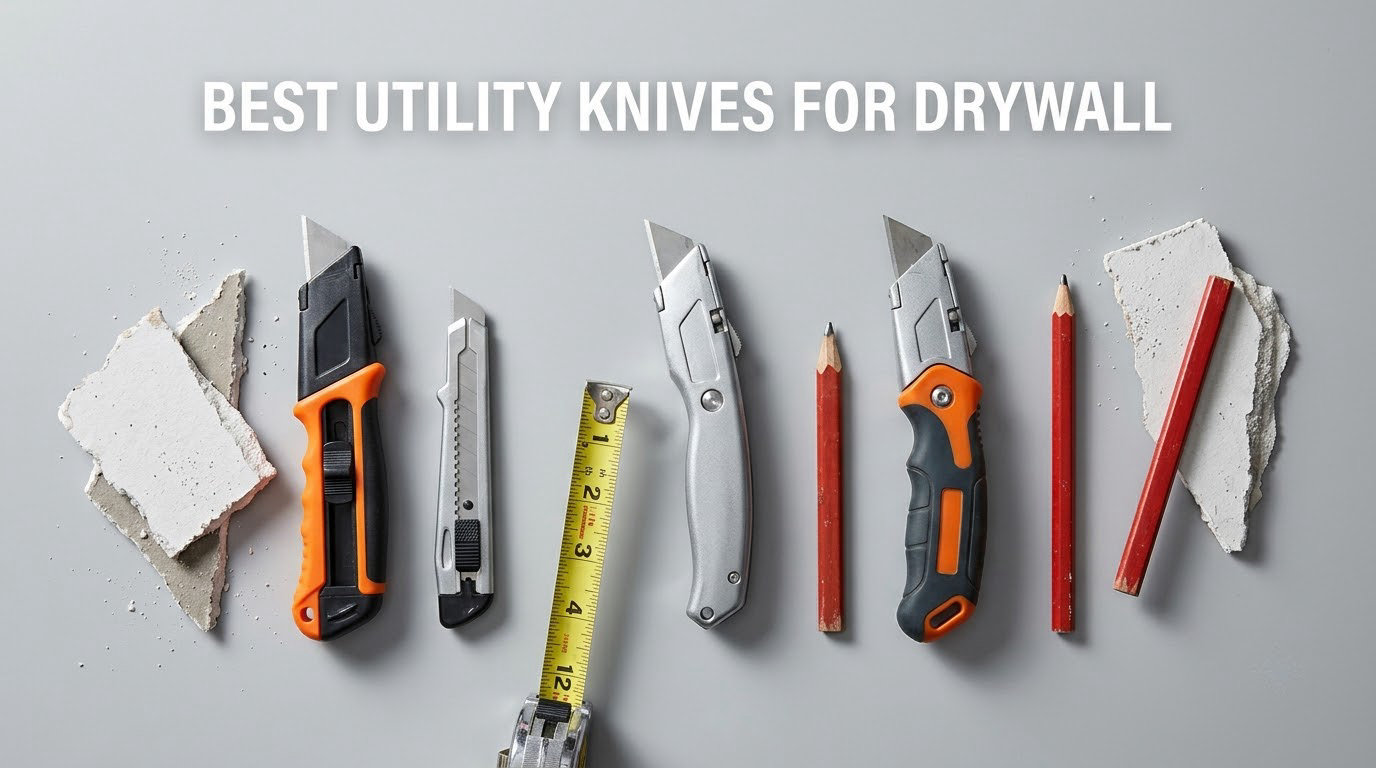
Can a utility knife cut drywall? Yes, and it is still the tool pros reach for. The right answer in 2026 comes down to three models: the WORKPRO Premium Utility Knife for proven all-metal durability, the OLFA L-1 for razor-sharp Japanese tool steel with snap-off segments, and the Stanley Classic 199 for beginners who want the benchmark fixed blade everyone in the trade recognizes.
I have cut more sheetrock than I care to admit over the years, and the failure mode is always the same. A cheap plastic-bodied knife with a loose blade channel tears the paper face instead of cutting it, and you end up with crushed edges that no amount of tape mud will hide. So I judge every utility knife for drywall on three things: how steady the blade sits under pressure, whether the blade can be changed in the middle of a job, and whether the body survives being dropped in a crawlspace.
That last point matters more than most buyers expect. Drywall dust is fine gypsum powder, and it works into every mechanism that has a moving part. Over a full install season, a knife that collects dust in a retractable track or a quick-change hinge starts to jam exactly when you need it most.
Below I break down ten utility knives that hold up on gypsum board, with the honest weakness on each one, plus the score-and-snap technique that separates a clean cut from a shredded edge.
Our Top 3 Utility Knives for Drywall Cuts Right Now

WORKPRO Premium Utility Knife
- SK5 blades at 64 HRC
- Die-cast aluminum body
- Three blade positions
- 10 spare blades

OLFA L-1 Snap-Off Knife
- 18mm blade with 8 segments
- Ratchet lock
- Japanese tool steel
- 2.5 ounces
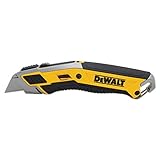
DEWALT DWHT10295
- Retractable with fixed-knife security
- Stainless steel blade
- Spare blade compartment
- Belt hook
Comparing the Best Utility Knives for Drywall in 2026
| Product | Details | |
|---|---|---|
| WORKPRO Premium Utility Knife |
|
Check Latest Price |
| OLFA L-1 18mm Snap-Off Knife |
|
Check Latest Price |
| DEWALT DWHT10295 Premium Utility Knife |
|
Check Latest Price |
 Klein Tools 44306 FLICKBLADE Klein Tools 44306 FLICKBLADE |
|
Check Latest Price |
 Stanley Classic 199 Fixed Blade Knife Stanley Classic 199 Fixed Blade Knife |
|
Check Latest Price |
 IRWIN 2081101 Fixed Blade Utility Knife IRWIN 2081101 Fixed Blade Utility Knife |
|
Check Latest Price |
 IVY Classic 11154 Hinge-Loc Fixed Knife IVY Classic 11154 Hinge-Loc Fixed Knife |
|
Check Latest Price |
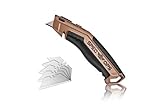 Spec Ops SPEC-K1-UR Retractable Knife Spec Ops SPEC-K1-UR Retractable Knife |
|
Check Latest Price |
 Fiskars Pro Fixed Utility Knife Fiskars Pro Fixed Utility Knife |
|
Check Latest Price |
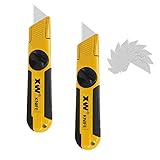 XW Fixed-Blade Utility Knife 2-Pack XW Fixed-Blade Utility Knife 2-Pack |
|
Check Latest Price |
1. WORKPRO Premium Utility Knife – The Proven All-Metal Retractable for Daily Scoring
WORKPRO Premium Utility Knife, Retractable All Metal Heavy Duty Box Cutter, Quick Change Blade Razor Knife, with 10 Extra Blades
SK5 blades at 64 HRC
Die-cast aluminum body
3.2 ounces
Ten spare blades included
+ Pros
- Blade does not flutter under heavy pressure
- Solid all-metal body at only 3.2 ounces
- Three adjustable blade positions for exact cuts
- Quick-release button makes blade changes fast
- Ten replacement blades included
- Cons
- Aluminum body will not survive being dropped off a roof
- Compact 6.3 inch length can feel short on full sheets
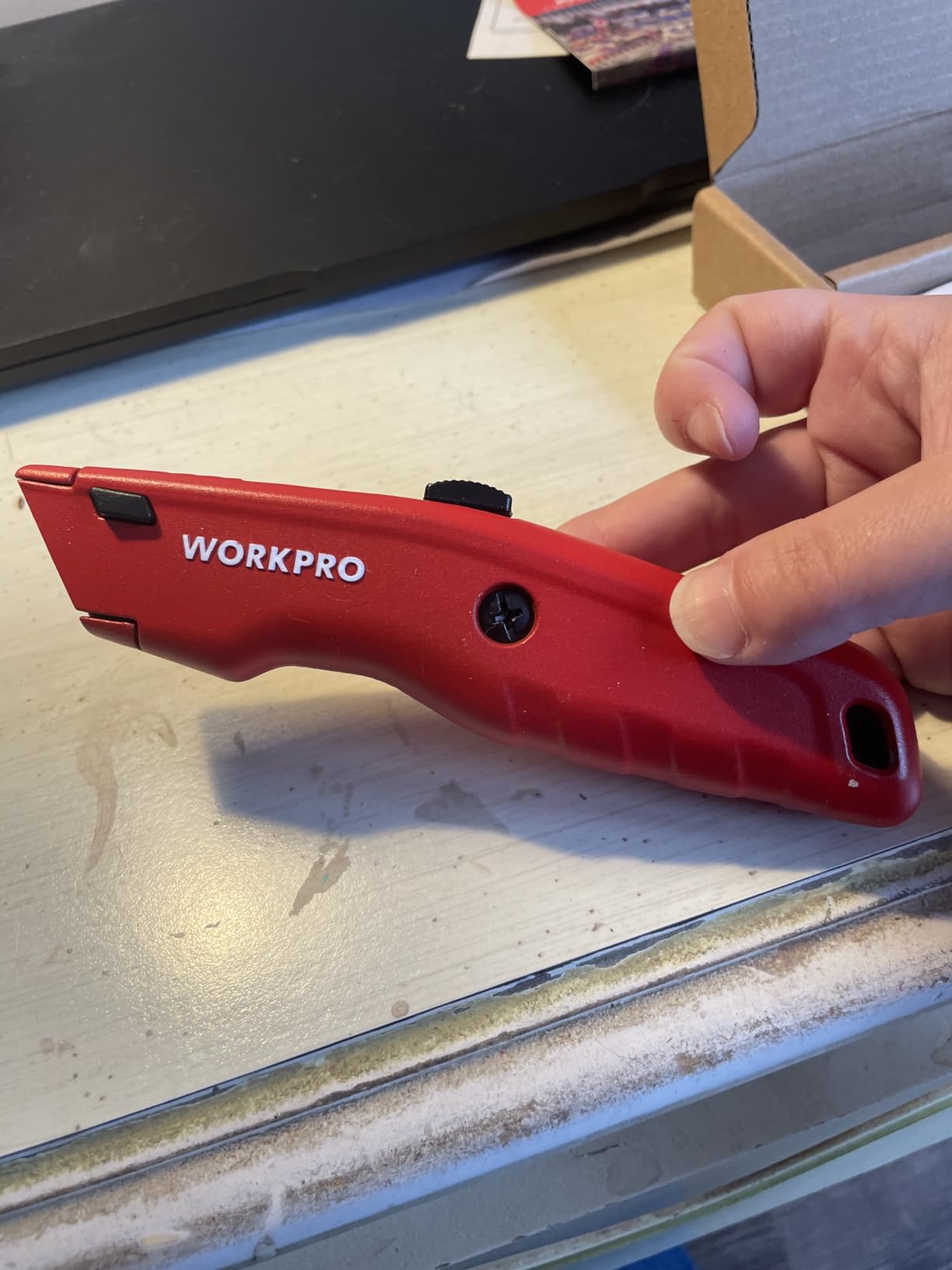
This is the knife I hand to a helper on their first week. With more than ten thousand reviews averaging 4.8 stars, it is the most proven design in this roundup, and the reason is unglamorous: nothing about it flexes. The die-cast aluminum body with a rust-free powder coat stays rigid when you lean into a hard score line, and reviewers repeatedly single out the fact that the blade does not flutter under pressure.
What sold me is the blade spec. The SK5 blades are hardened to 64 HRC through high-temperature heat treatment, which is well past what a basic carbon steel blade offers. On drywall that matters because the paper face plus embedded gypsum acts as an abrasive slurry, and a harder edge stays sharp longer between changes.
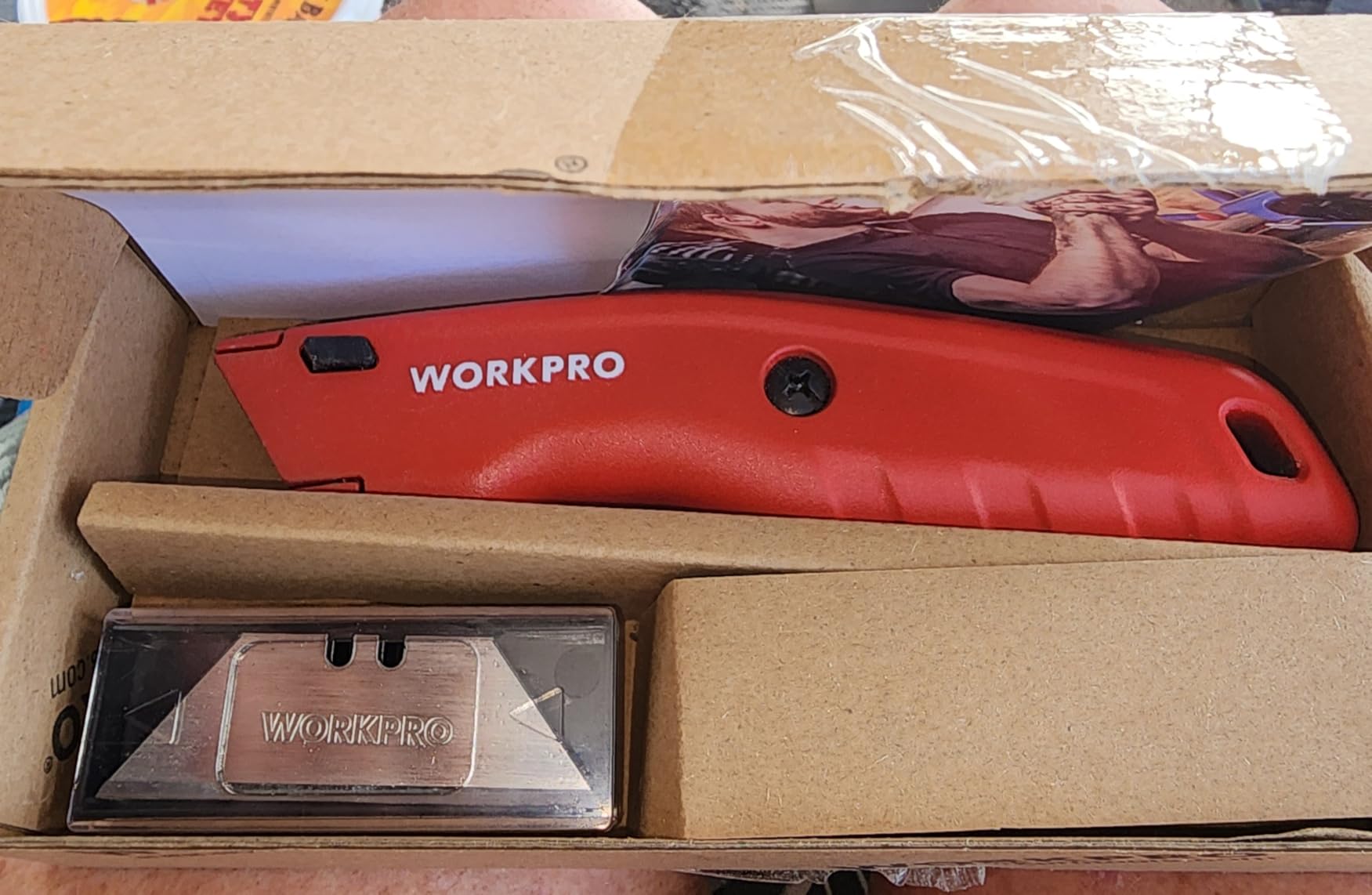
Blade Hold and Three-Stage Adjustment
The retract mechanism offers three adjustable blade positions, which lets you dial the projection to the cut rather than guessing. For scoring a full sheet you want minimal exposure, just enough to cut the paper face and not so much that the blade wanders. For trimming carpet or vinyl after the snap, you open it up one click.
Blades are double-sided, so you can flip one over for a fresh edge instead of discarding it. The quick-release button swaps a spent blade in seconds, and the box includes ten replacement blades, so a crew has a real supply on hand.
Weight, Grip and Jobsite Durability
At 3.2 ounces with a matte, hand-friendly body, this is a light knife that does not feel cheap in the hand. It is drop tested from 1.5 meters, which covers the realistic case of a blade hitting a ladder on the way down.
Be realistic about the limit, though. Aluminum is aluminum. Drop this off a roof or stand on it and it deforms, where a steel-bodied fixed knife would just ding.
Who Should Buy the WORKPRO
Anyone doing repeated scoring, rips and general cutting through a full project. New helpers, DIY renovators trimming baseboard, and crews that need a spare-blade supply built in will all be well served.
It is not the choice for someone who prefers a fixed blade for maximum rigidity, and the 6.3 inch body is compact for larger hands working across a wide sheet.
2. OLFA L-1 18mm Snap-Off Knife – Ratchet Lock and Eight Fresh Segments per Blade
OLFA 18mm Heavy-Duty Utility Knife (L-1) – Ratchet Lock, Snap-Off Blade
18mm blade with 8 segments
Ratchet lock slider
High-impact ABS handle
2.5 ounces
+ Pros
- Exceptional sharpness and edge retention from Japanese tool steel
- Snap-off segments restore a fresh tip in seconds
- Ratchet lock holds blade depth firmly
- Lightweight at 2.5 ounces
- Cuts drywall
- roofing and rubber easily
- Cons
- Lock takes longer to open than a spring-loaded cutter
- Ratchet wheel needs practice one-handed
- Segments must be broken off with cutters
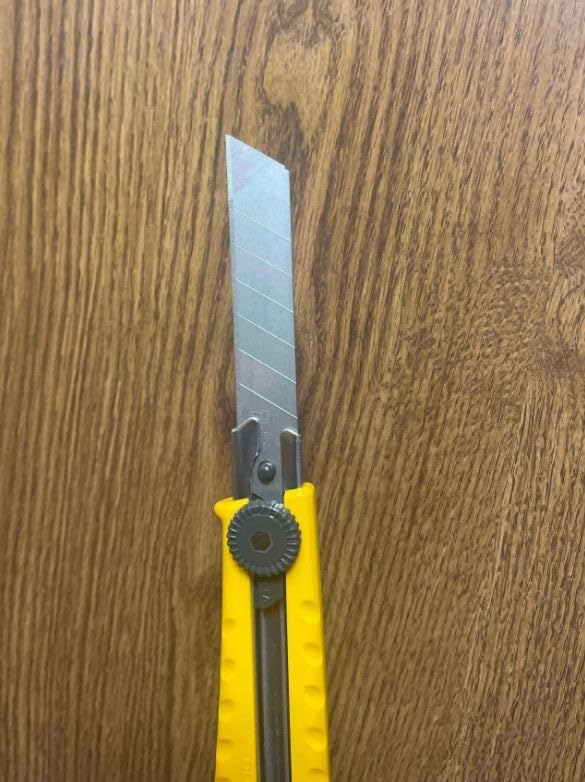
The OLFA L-1 is the one tradespeople on drywall forums repeatedly name when they talk about snap-off blades bought specifically for cutting sheetrock. It rates 4.8 stars across more than four thousand reviews, and the blade itself is the reason. It ships preloaded with an 18mm carbon tool steel blade carrying eight razor-sharp segments, made from Japanese tool steel.
Snap-off blades change how drywall work feels. Instead of hunting a spare, you twist the used segment off and expose a new one. On a job where you may score twenty sheets, that is the difference between stopping and continuing.
Ratchet Lock Depth Control
The ratchet-lock slider with a wheel locking mechanism gives you unlimited blade depth positions, and once you set a depth it will not drift mid-cut. That predictability is what a retractable cannot offer, and it matters when you are pulling a straight line against a T-square for four feet at a time.
It is also slower to operate than a spring-loaded cutter, and the wheel takes a little practice to work one-handed while the other hand is holding the board. Budget a few minutes of adjustment time if you are new to it.
Edge Retention on Gypsum Board
Owners consistently report that the edge holds through dense cardboard, drywall, roofing material and rubber. The ABS plastic handle has a stainless-steel blade channel, so even though the shell is plastic, the part that actually holds the blade is steel and the handle still gives extra leverage on tough material.
The 18mm width is narrower than a one-inch blade, and that is the point on cut-outs. A narrower blade gives you more control when you are tracing around an electrical box than a wide one ever will.
Who Should Buy the OLFA L-1
Anyone who wants maximum edge quality and instant resharpening without carrying spare blades. Installers doing tight cut-outs and helpers who constantly stop mid-task will like the segment system immediately.
Buy OLFA 18mm replacement blades to pair with it. The knife is also backed by a guarantee for life, and it is light enough at 2.5 ounces to carry all day on a belt.
3. DEWALT DWHT10295 – Metal-Forward Retractable for Weight and Security
DEWALT DWHT10295 Premium Utility Knife
Retractable with fixed-knife security
Stainless steel blade
Spare blade compartment
7.04 ounces
+ Pros
- Retractable blade gives fixed-knife security with better safety
- Weighty mostly metal build resists flex and wobble
- One-button blade change with flippable blades
- Sharp stainless steel blades
- Comfortable angled grip and belt hook
- Cons
- Highest price in this roundup
- Quick-change button is not immediately intuitive
- Some users report the retract sticking occasionally
- One reviewer felt blade play was excessive for precision work
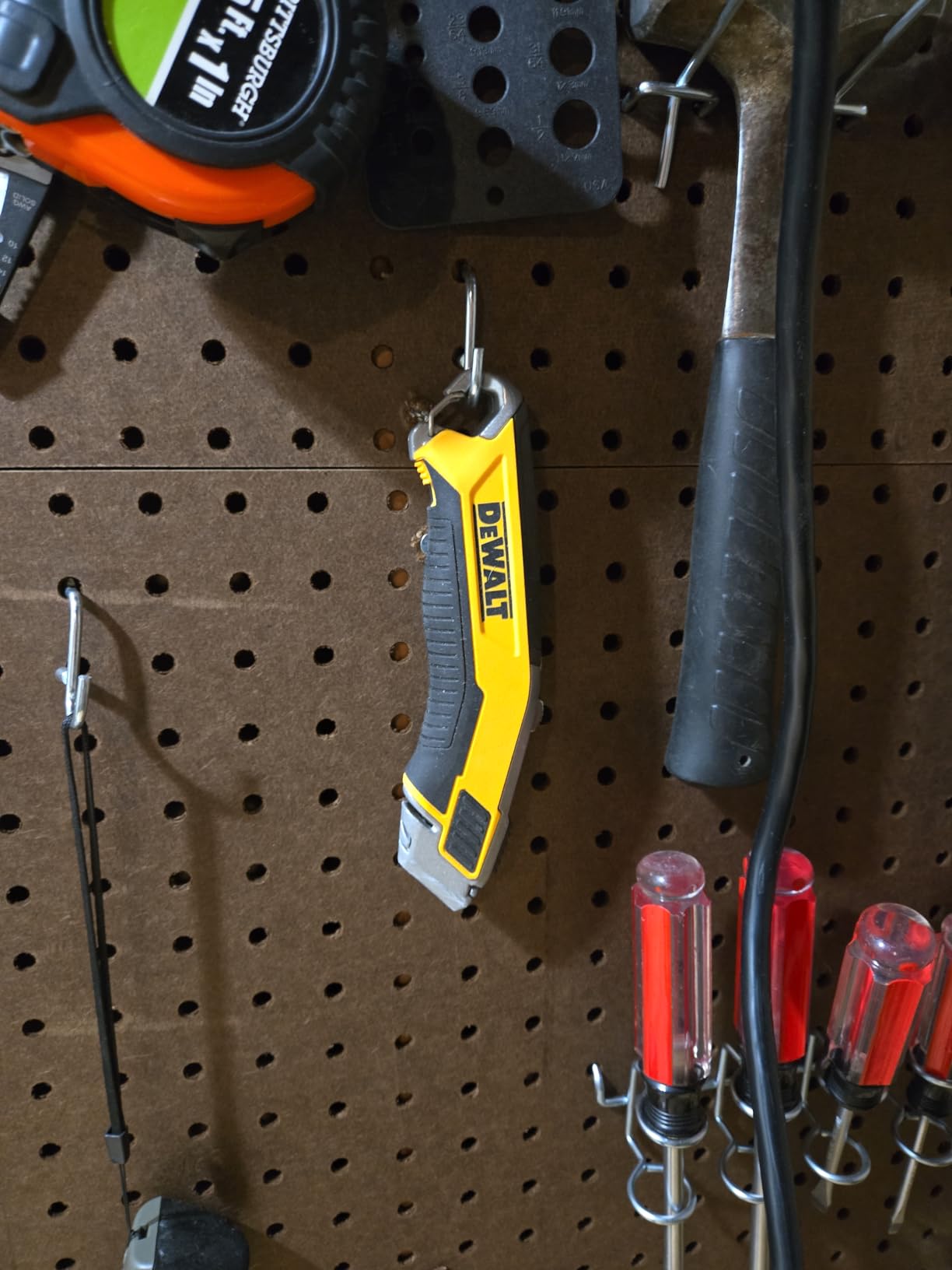
The DWHT10295 is the most expensive knife in this group, and there is a reason. It is metal-forward rather than all-plastic, and at 7.04 ounces you can feel that mass in your hand. Owners describe anchored metal construction that resists flex and blade wobble, which is exactly what you want when pressing a score line hard.
At the same time the blade retracts when you are done. That combination, which the brand describes as fixed-knife security with retractable convenience, is the compromise a lot of buyers settle on. You get a rigid cutting edge and a knife that is not a hazard sitting on a bench.
Push-Button Blade Change and Blade Flipping
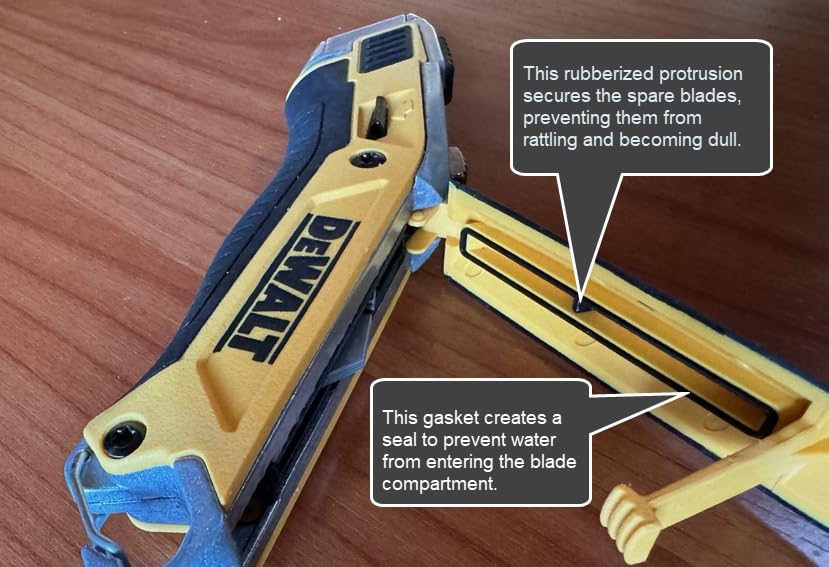
Blade changes are a single push-button action, and the blades can be flipped to use the fresh edge. Stainless steel blades that stay sharp through heavy cardboard work are the standard here, which is a step up in wear resistance from a basic carbon steel blade.
Fair warning from buyers: the button is not self-explanatory, and it takes some practice. A few reviewers also report the retract mechanism sticking occasionally, which is a fair thing to watch in drywall dust over a long season.
Ergonomics and Carry
The angled ergonomic grip sits well in the palm and the 9.2 inch length gives you a longer frame than most, which helps with longer scoring runs. There is a spare blade compartment plus a belt or tool pouch hook, so the knife stays on your hip rather than in a bucket.
One reviewer noted the blade play felt excessive for precision work, so if you are tracing tight cut-outs rather than making long rips, test it first.
Who Should Buy the DEWALT
Installers who want retractable safety without giving up rigidity, and anyone who prefers a knife with real heft in the hand. If you are new to cutting drywall and want the blade hidden when the knife is in your pocket or toolbox, this is the sensible pick.
4. Klein Tools 44306 FLICKBLADE – Folding Knife and Scraper with Dual Lock Angles
Klein Tools 44306 FLICKBLADE 2-in-1 Folding Utility Knife and Scraper with Built-In Blade Storage, Dual Locking Positions, Includes 3 Triple-Ground Carbon Steel Blades
Knife and scraper in one
Dual locking positions
Built-in blade storage
5.92 ounces
+ Pros
- Two-in-one design saves switching tools on the job
- Dual lock positions for angled or standard cuts
- Built-in storage holds spare blades
- Uses standard universal utility blades
- Aluminum body stays stable when open
- Smooth one-hand opening
- Cons
- Bulkier than a slim folding knife so it may not fit a slim pouch
- Heavier heft than minimal folders can add fatigue
- One owner reported a belt-clip screw loosening
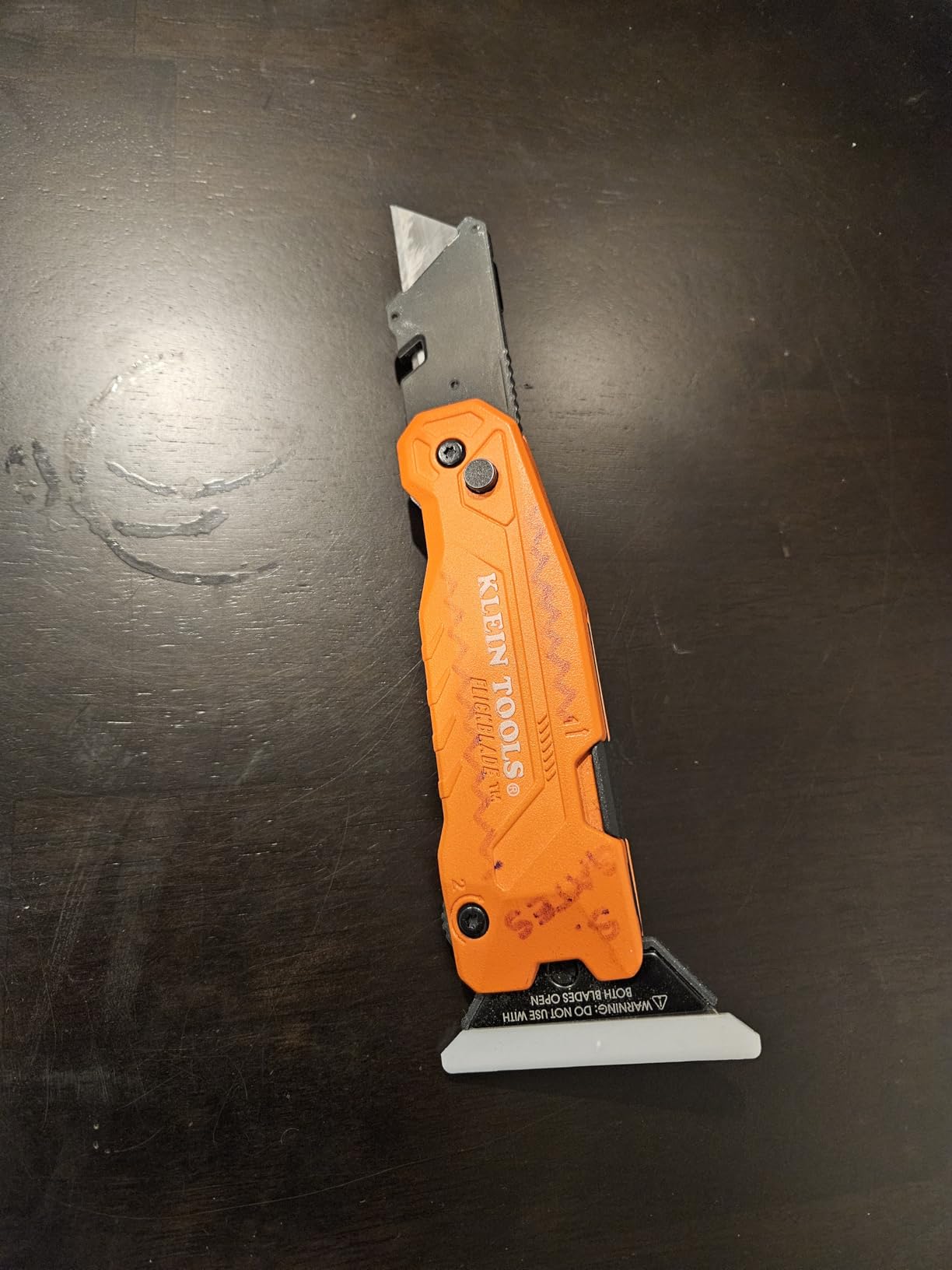
The FLICKBLADE does two jobs. One side is a utility knife, the other is a window sticker and label scraper, and drywall is full of surfaces that need scraping before tape will stick. Tradespeople like having both in one aluminum body rather than carrying two tools.
It folds, which puts it in a different class from everything else here. There are no loose parts to track, the blade tucks away when the job is done, and it is the only model in this roundup with a belt clip option for someone who does not want a knife clipped to a pocket.
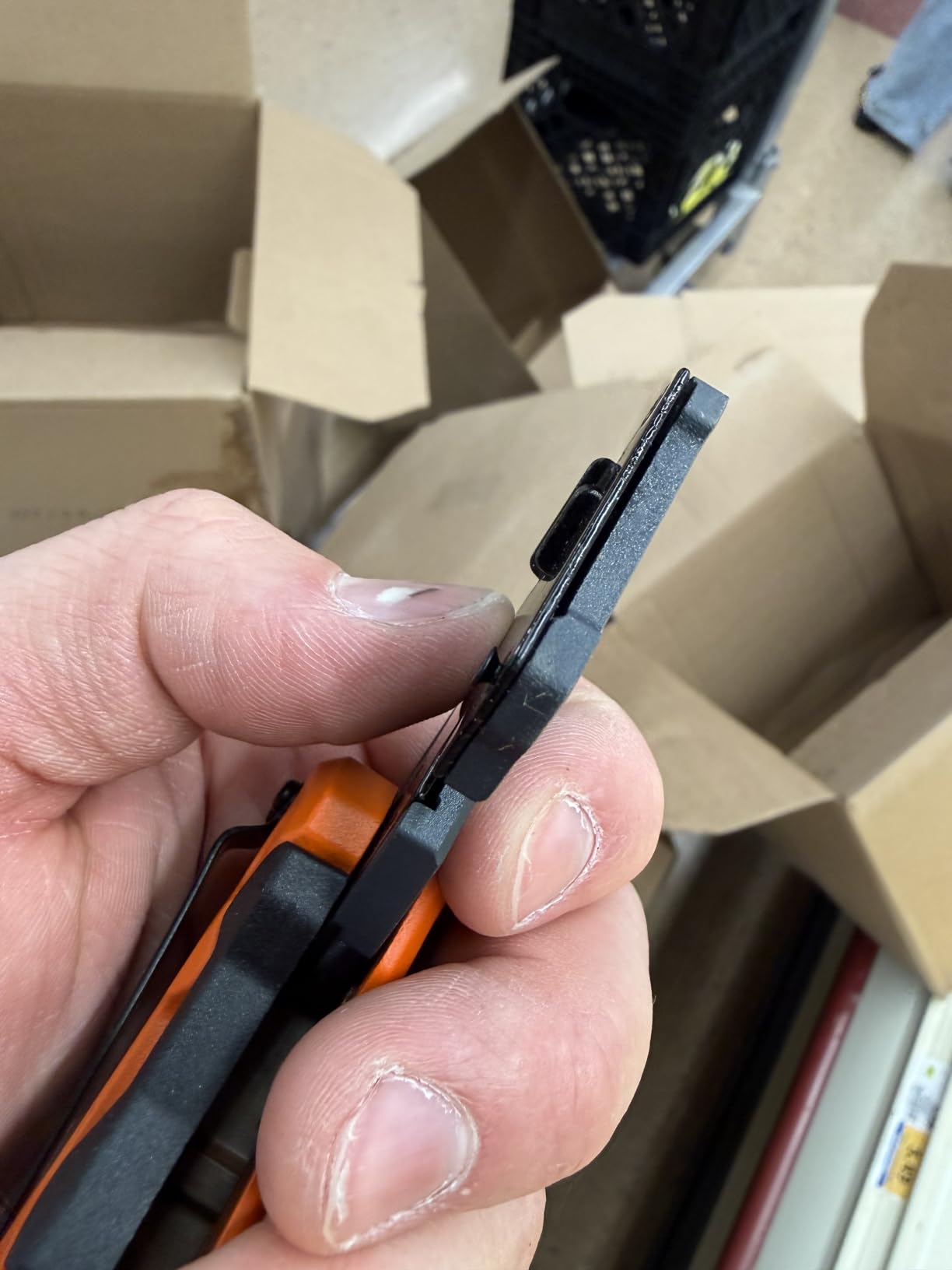
Dual Locking Positions and Wrist Angle
Two locking positions are the real feature here. The angled lock position is set for precision work and it reduces wrist strain, which owners specifically call out for long drywall days. The standard position is there for general cutting where you want a familiar blade angle.
Switching between them is a deliberate thumb action, not a spring. It takes a moment longer than a spring-loaded retract, but the trade is a blade that cannot collapse on you when you brace it against a sheet.
Standard Blades and Onboard Storage
This knife uses standard universal utility blades, not proprietary ones. That is a genuine advantage in drywall work, where blade supplies are scattered across brands, and three triple-ground carbon steel blades come in the box.
Built-in storage securely holds spares, so you are not relying on a separate pouch. At 5.92 ounces it is heavier than minimal folders, which is a fair trade for an aluminum body that stays stable when the blade is extended.
Who Should Buy the Klein FLICKBLADE
People who cut tape-adhesive materials, labels and window film alongside drywall. It is also a strong choice for anyone who wants a folding knife with a real lock rather than a lightweight slipper.
Leave it behind if you are scoring long runs on full sheets all day and want the lightest possible tool, since the bulkier profile is not ideal for that.
5. Stanley Classic 199 – The Benchmark Fixed Blade for Beginners
STANLEY CLASSIC 199 5-3/8 in. Fixed Blade Utility Knife (10-209)
Cast metal aluminum handle
Fixed blade retention
5.38 inch length
Three blades included
+ Pros
- Time-tested cast metal handle built to last decades
- Firm fixed-blade retention gives steady cuts
- Comfortable for long hours of drywall cutting
- Fits most standard replacement blades
- Sharpens easily with simple geometry
- Cons
- Blade is always exposed so handling depends on the user
- Current version drops the Made in USA stamp and uses a Phillips screw
- Some newer Stanley models have reported quality issues
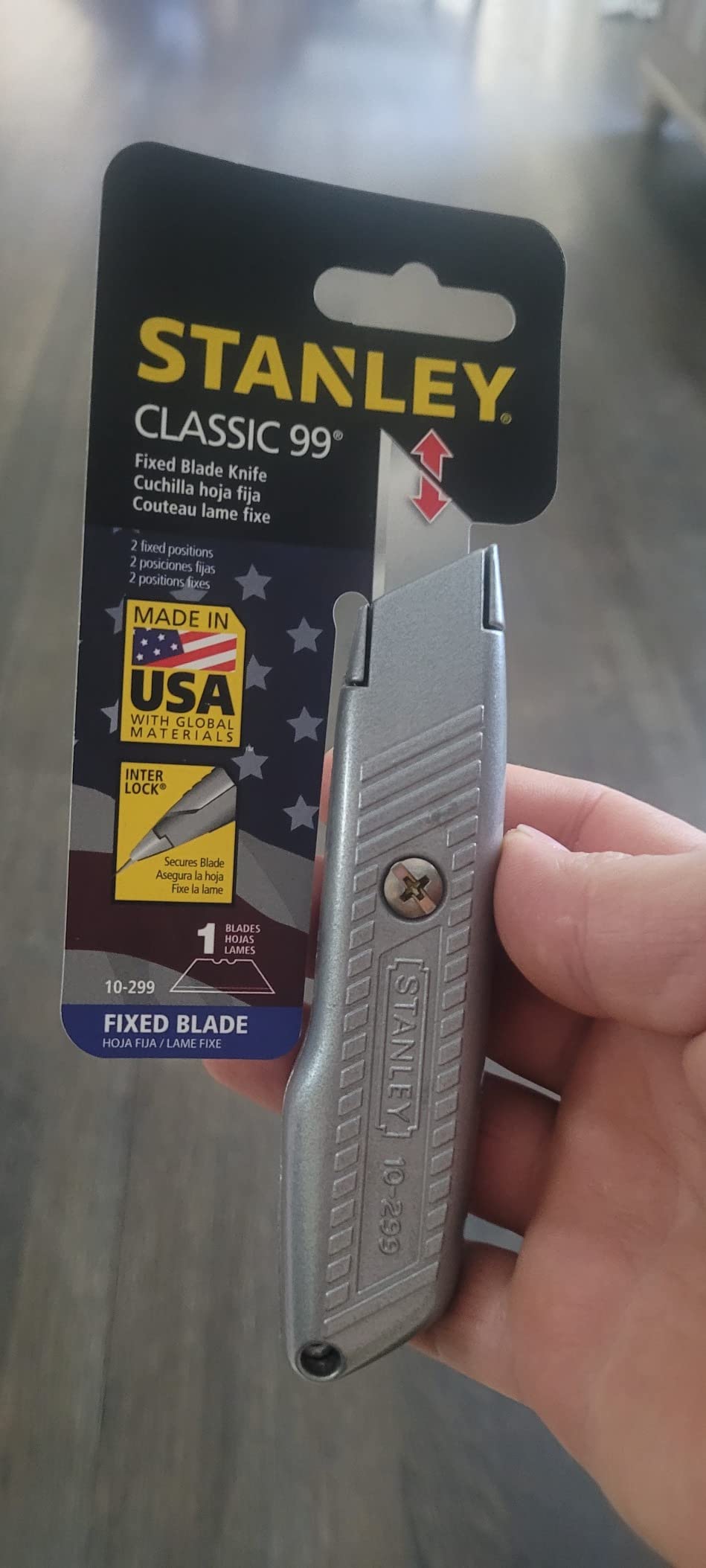
If you have ever worked around anyone in the trades, you have seen the Stanley Classic 199. With 793 reviews averaging 4.7 stars, it is treated by long-time tradespeople and DIYers as the benchmark drywall utility knife. The design is old and the reason it still sells is that nothing about it needed changing.
It is a fixed blade with firm blade retention, which means no channel to fill with dust and no lock to jam. The cast metal handle gives a solid feel that cheap all-plastic knives cannot match, and at 4.32 ounces it stays comfortable across a long scoring session.
Fixed Blade Stability for Straight Scores
A fixed blade has no projection adjustment, so the blade angle is set by the handle geometry. That means every cut is identical, which is precisely what you want when running a straight line against a T-square. There is nothing to shift under pressure and nothing to retract if you bump the board.
The 5.38 inch length is short and compact, which makes it easy to control in tight corners and around cut-outs. For ripping long edges, the tradeoff is that you cover less ground per stroke than a longer knife.
Blade Compatibility and Three Included Blades
It fits most STANLEY replacement utility blades, and the box includes three. Because the fixed-blade geometry is simple, it is also easy to sharpen the edge yourself if you run it past its useful life.
There is a front guard and a strap-cutting hole at the butt end, which is a small thing that matters when you are cutting packaging on the way to a jobsite.
Who Should Buy the Stanley 199
First-time drywall cutters, DIY renovators and anyone who wants a knife that will not need replacing. It is also the easiest fixed blade to find in any hardware store when a crew member loses theirs on a Friday afternoon.
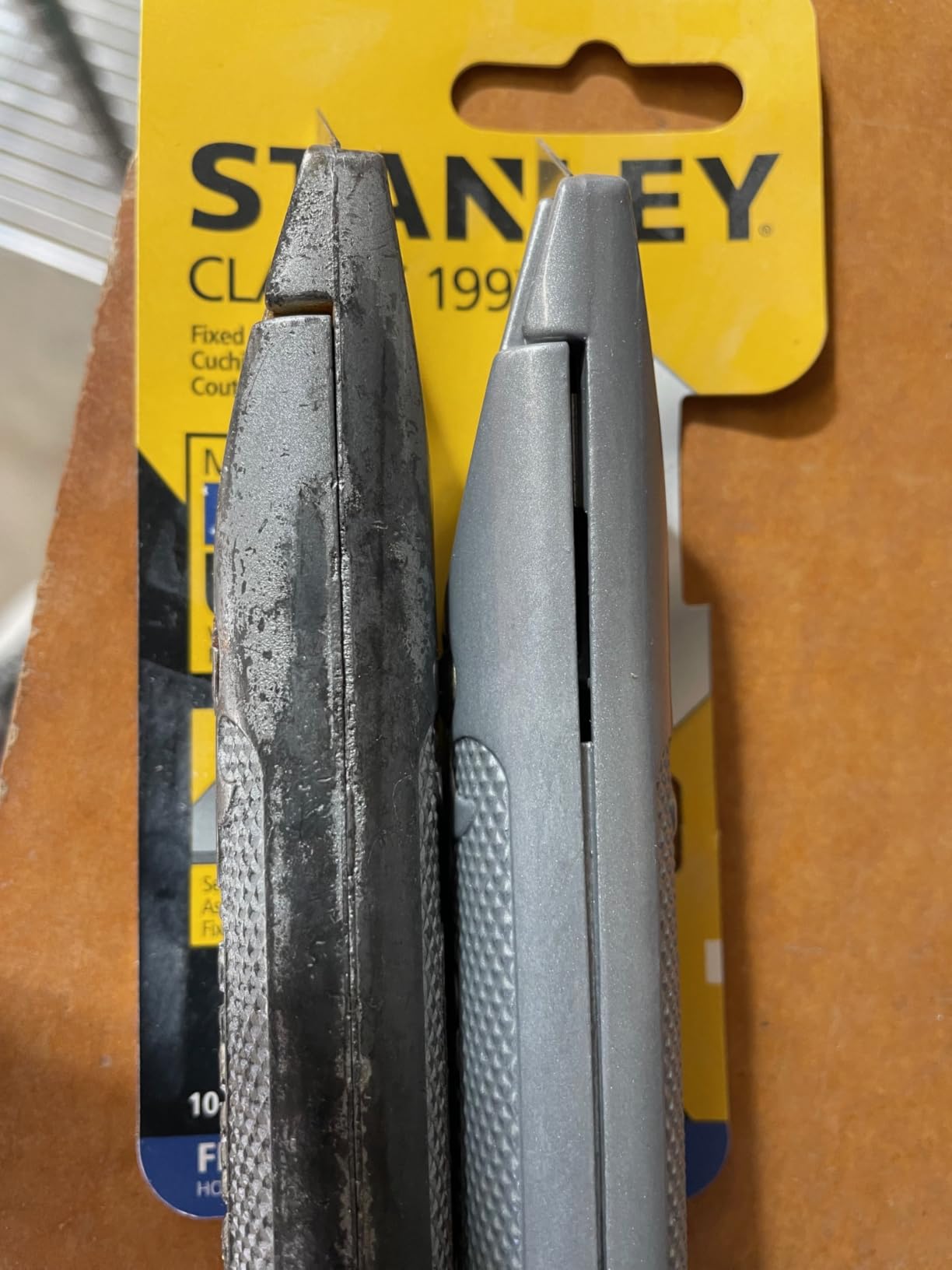
Note that the current version is no longer stamped Made in USA and the blade screw changed to a Phillips. Some buyers also caution that other newer Stanley models have quality issues, so read reviews before picking a different Stanley model.
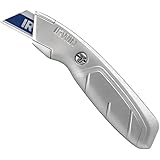
6. IRWIN 2081101 – Fixed Blade Built to Reduce Hand Fatigue
IRWIN Utility Knife, Fixed Blade (2081101), gray
Optimized cutting angle
Magnetic blade nose
Captured screw
Stores five blades
+ Pros
- Holds the blade with virtually zero wobble
- Optimized cutting angle reduces hand fatigue
- Captured screw prevents loss during changes
- Magnetic nose speeds blade changes
- Internal storage holds several spare blades
- Very light for long periods
- Cons
- Blade always exposed and very sharp
- Blade change needs a screwdriver
- Storage clip holds only about three blades comfortably
- Some users find it small for larger hands
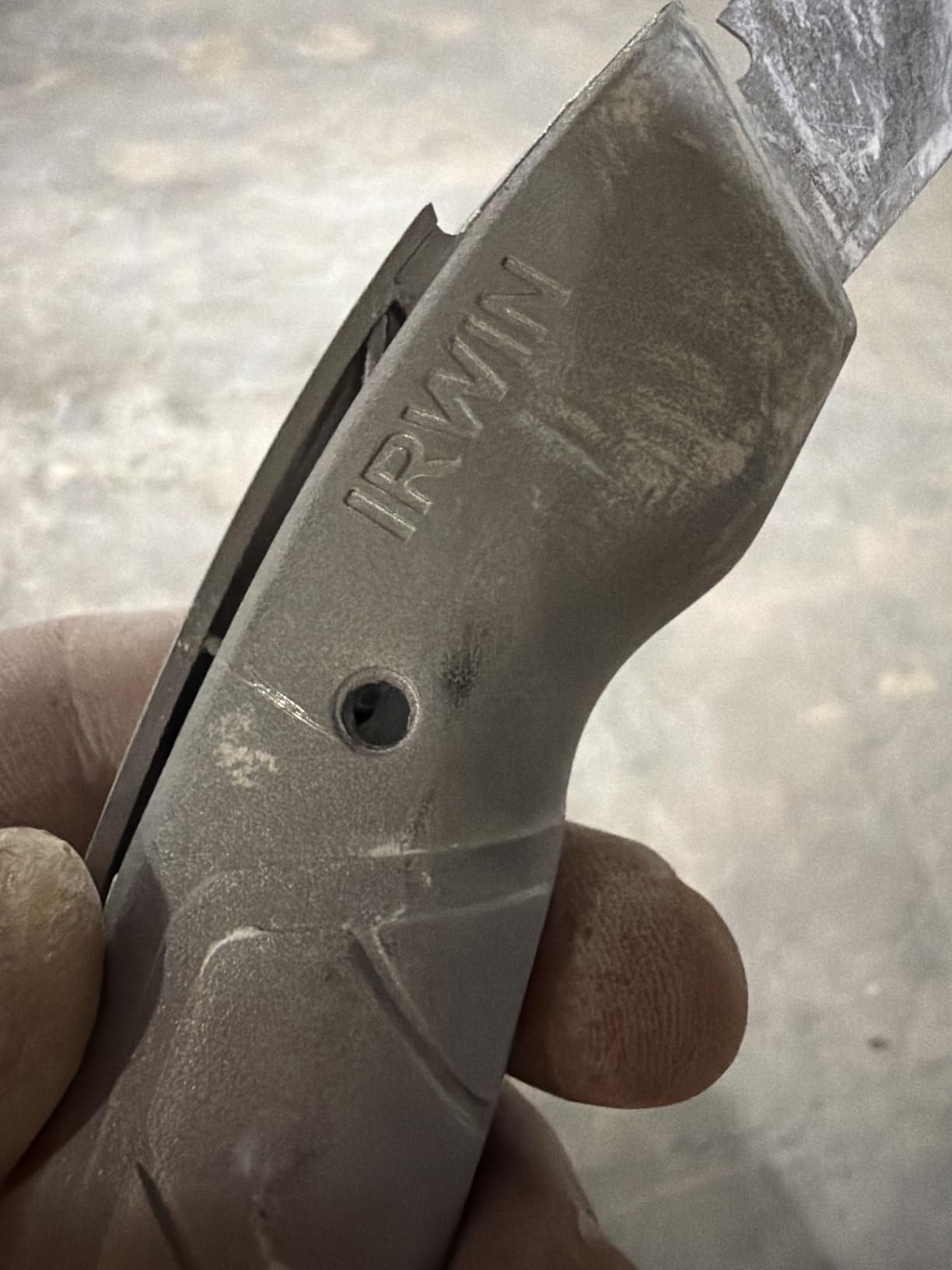
The IRWIN 2081101 is the one drywall installers in the review data call out as the best utility knife for the trade. It carries a 4.6 rating across 1010 reviews, and the reason is that it solves the fatigue problem rather than just cutting.
The optimized cutting angle reduces hand fatigue over long drywall sessions. That sounds minor until you consider that a full install can mean hundreds of score lines, and small wrist angles compound into real soreness by the end of a day.
Blade Hold and Magnetic Nose
Reviewers praise the extremely firm blade hold with virtually zero wobble, and fixed blade installation means it does not retract under force. The magnetic nose makes blade changes easy by letting the blade be drawn into position rather than aligned by hand.
The captured screw is the detail that wins over crews. Because the fastener is captured, it cannot be dropped into a cavity or a pile of drywall dust. You will still need a screwdriver for the change, which is the honest drawback.
Bi-Metal Blade and Internal Storage
It includes a shatter-proof bi-metal four-point snap-off blue blade. Bi-metal construction is widely preferred over plain steel blades for drywall because the high-speed steel edge holds a sharper point against the abrasive gypsum dust.
Internal handle storage holds up to five utility blades, though some users find the clip comfortably carries only about three. The metal handle has no tacky rubber parts to degrade over years, which is a real advantage in a trade full of plastic-bodied knives.
Who Should Buy the IRWIN
Hangers and finishers doing long scoring sessions who notice wrist fatigue early. It is also a good first fixed-blade knife for anyone who values a zero-wobble blade hold over a tool-free change.
Some users find the knife slightly small for larger hands, so try it in the aisle if hand size is a concern.
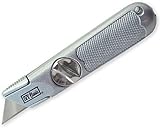
7. IVY Classic 11154 Hinge-Loc – Die-Cast Fixed Blade with Twist-Knob Changes
IVY Classic 11154 Hinge-Loc Fixed Utility Knife, 1/Card
Die-cast aluminum body
Twist-knob hinge-loc change
Internal blade magnet
5 ounces
+ Pros
- Twist-knob hinge-loc allows tool-free blade changes
- Double interlocking design prevents blade slipping
- All-metal die-cast body for heavy jobsite use
- Internal magnet positions the blade accurately
- Made specifically for drywall and roofing
- Accepts common 0.025 inch heavy-duty blades
- Cons
- Fixed-blade design leaves the blade exposed
- Blade hold can be tighter with competitor blades than branded ones
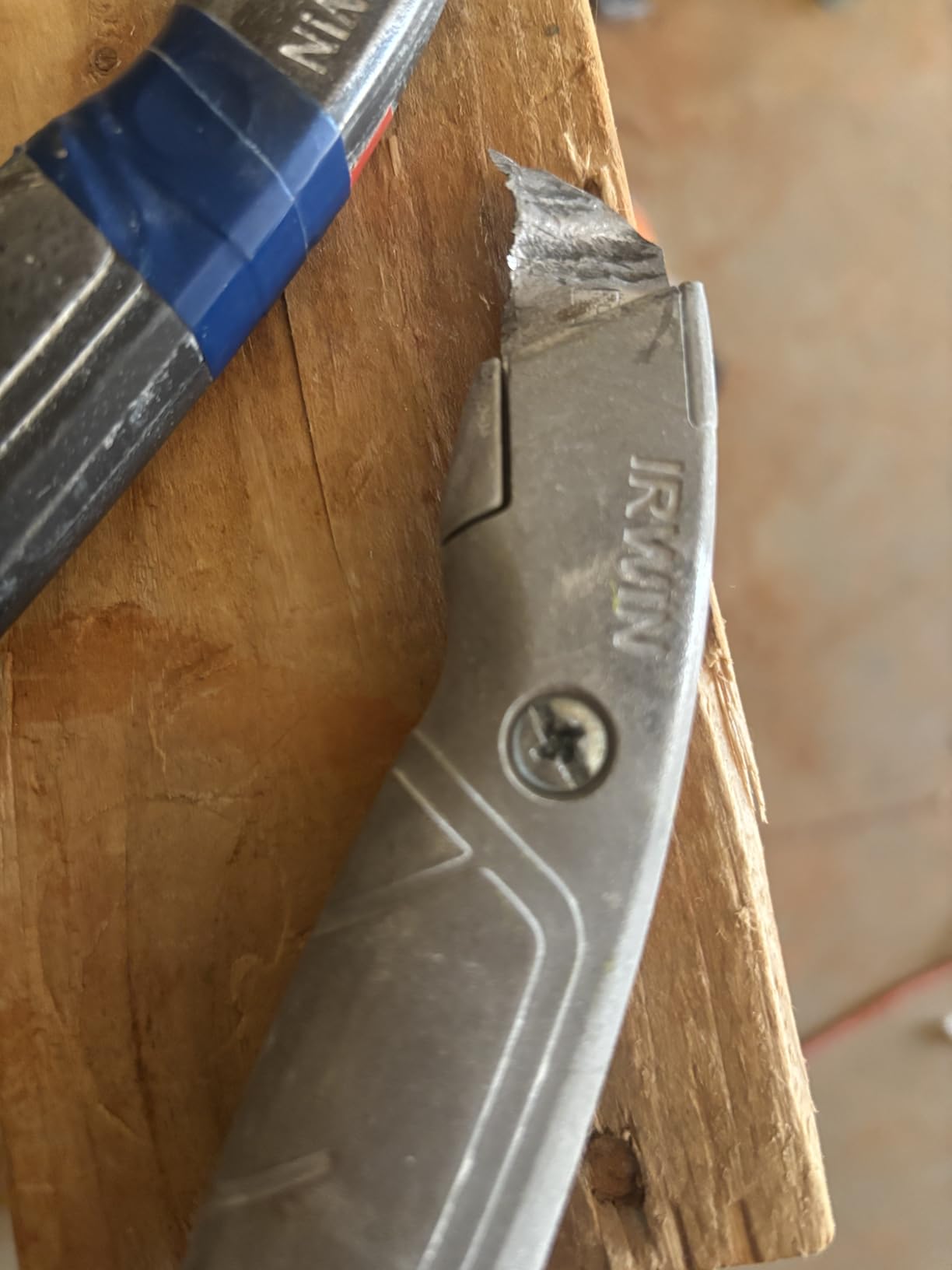
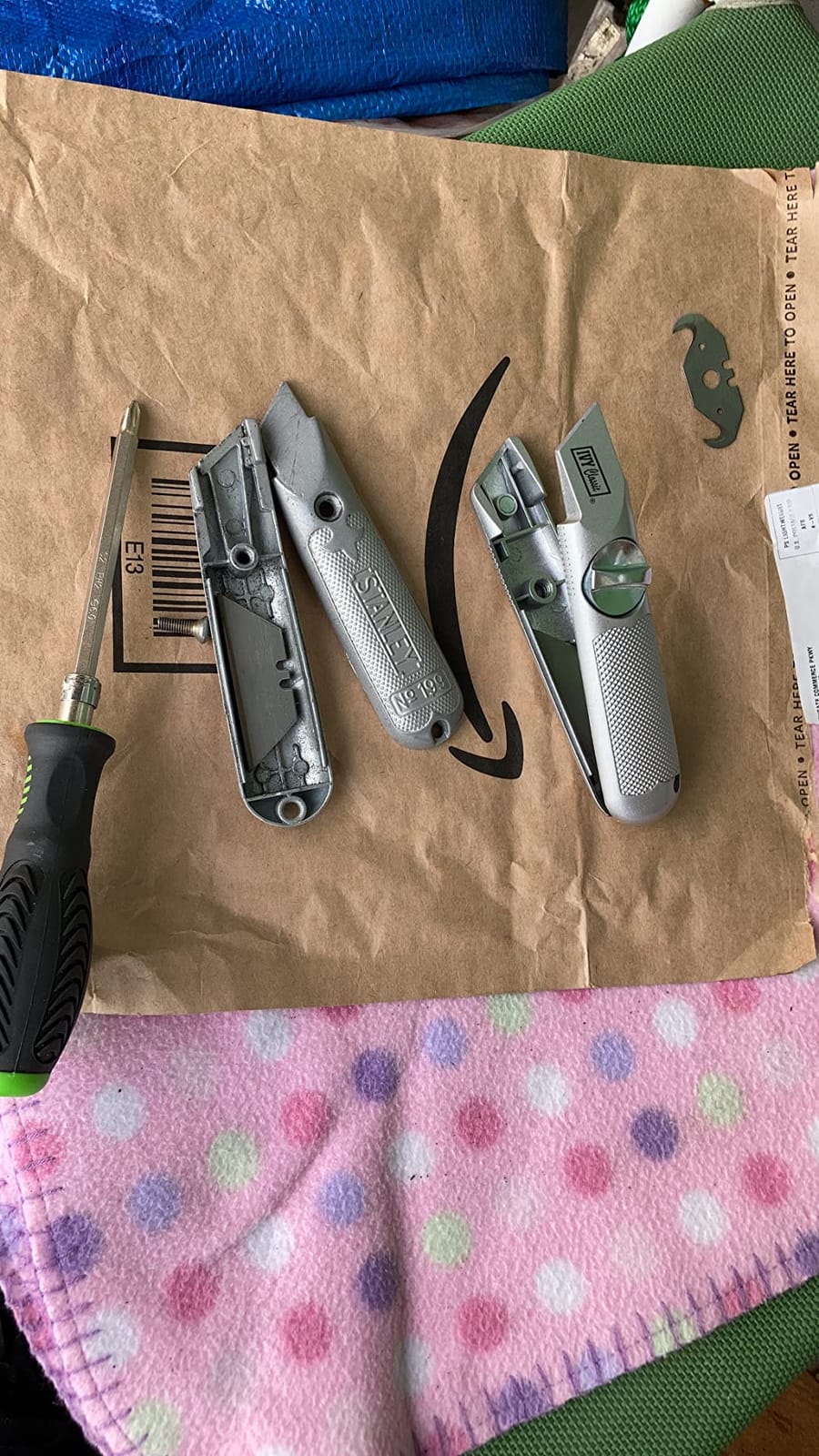
The IVY Classic 11154 is explicitly marketed for drywall, roofing, linoleum, carpet and vinyl, and that specificity shows in the design. It is a fixed knife with a twist knob that opens the body while it stays hinged at the back, so you change a blade without a screwdriver and without parts scattering.
At 4.5 stars across 410 reviews, the double interlocking fixed design is what reviewers single out. It grips the blade firmly to prevent slipping mid-cut, which is the exact complaint that ruins a long score line.
All-Metal Die-Cast Construction
The body is die-cast aluminum, all metal, at 5 ounces. There are no plastic parts to strip, crack or go sticky, which is the single most common long-term failure in utility knives and a genuine advantage on a jobsite.
An internal magnet positions the blade accurately when you load it, so the cutting edge lines up consistently instead of at whatever angle it happens to land.
Blade Compatibility and Hinge-Loc Changes
It fits 0.025 inch IVY Classic blades 11172 and 11178 as well as other heavy-duty utility blades, so you are not locked into one brand. The hinge-loc mechanism keeps the two halves of the knife connected during a change, which solves the dropped-screw problem that bothers most crews.
One thing worth knowing: some buyers note the blade hold runs tighter with competitor blades than with IVY Classic-branded blades. Buy the branded blades if you want the tightest fit.
Who Should Buy the IVY Classic
Anyone who wants a metal fixed blade with a tool-free change and does not need a retract mechanism. It suits installers cutting roofing felt and vinyl alongside drywall, and it holds up to the punishment of being dropped.
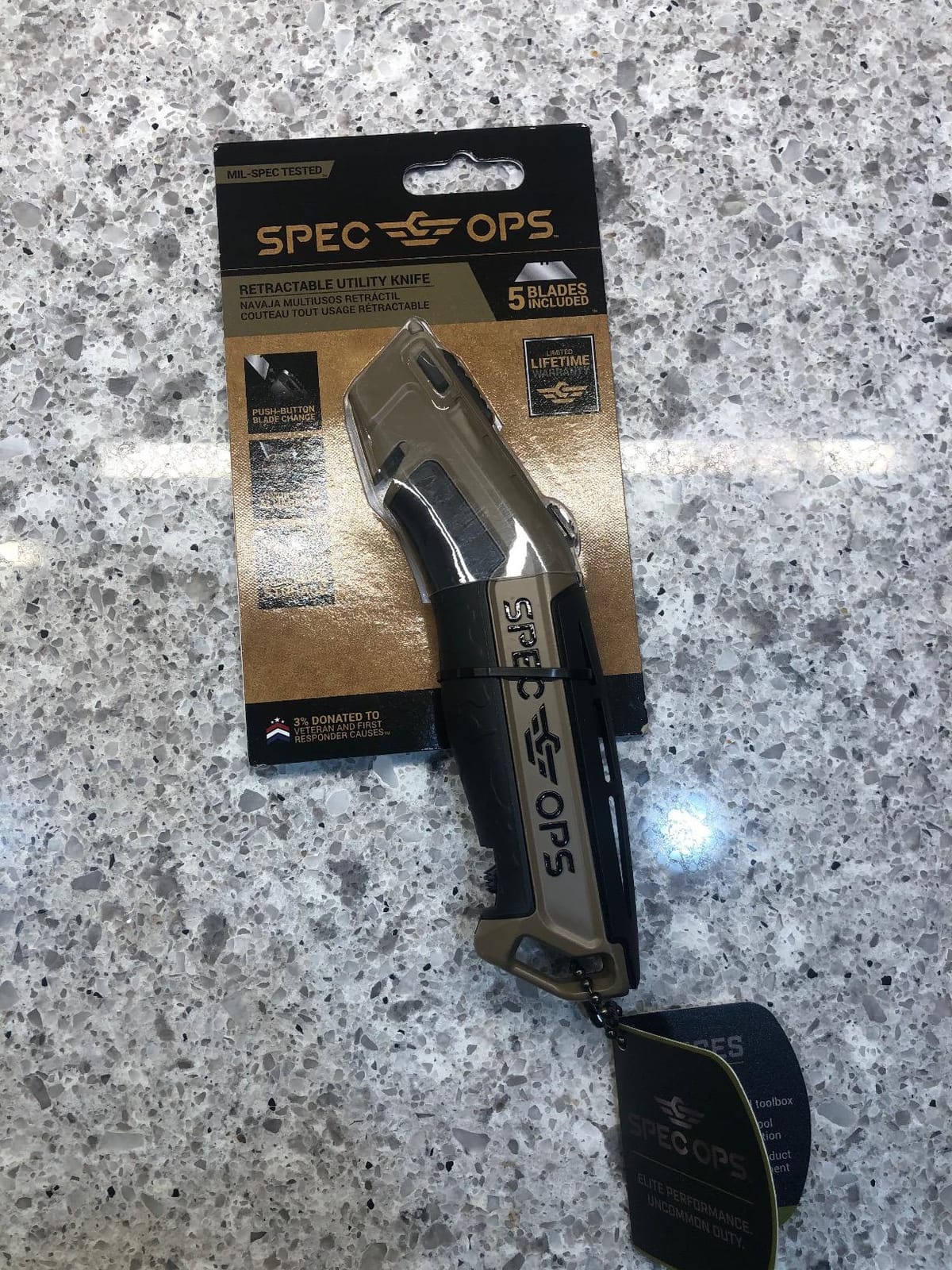
8. Spec Ops SPEC-K1-UR – Retractable with Onboard Storage for Five Blades
Spec Ops Tools Utility Knife for Cutting Drywall, Roofing & Jobsite Materials, Includes 5 Blades in Handle Storage, Retractable Blade
Vented TPR pistol grip
Push-button blade swap
Storage for five blades
6.08 ounces
+ Pros
- Comfortable well-balanced grip that suits larger hands
- Very easy one-button blade changes including spares
- Metal body holds up to heavy jobsite abuse
- Multiple retraction stages for controlled cuts
- Quick-release onboard storage holds five blades
- Cons
- Not self-retracting so the blade stays exposed during use
- Strap and string cutting slot is awkward on thick straps
- Occasional reports of blades sticking during loading
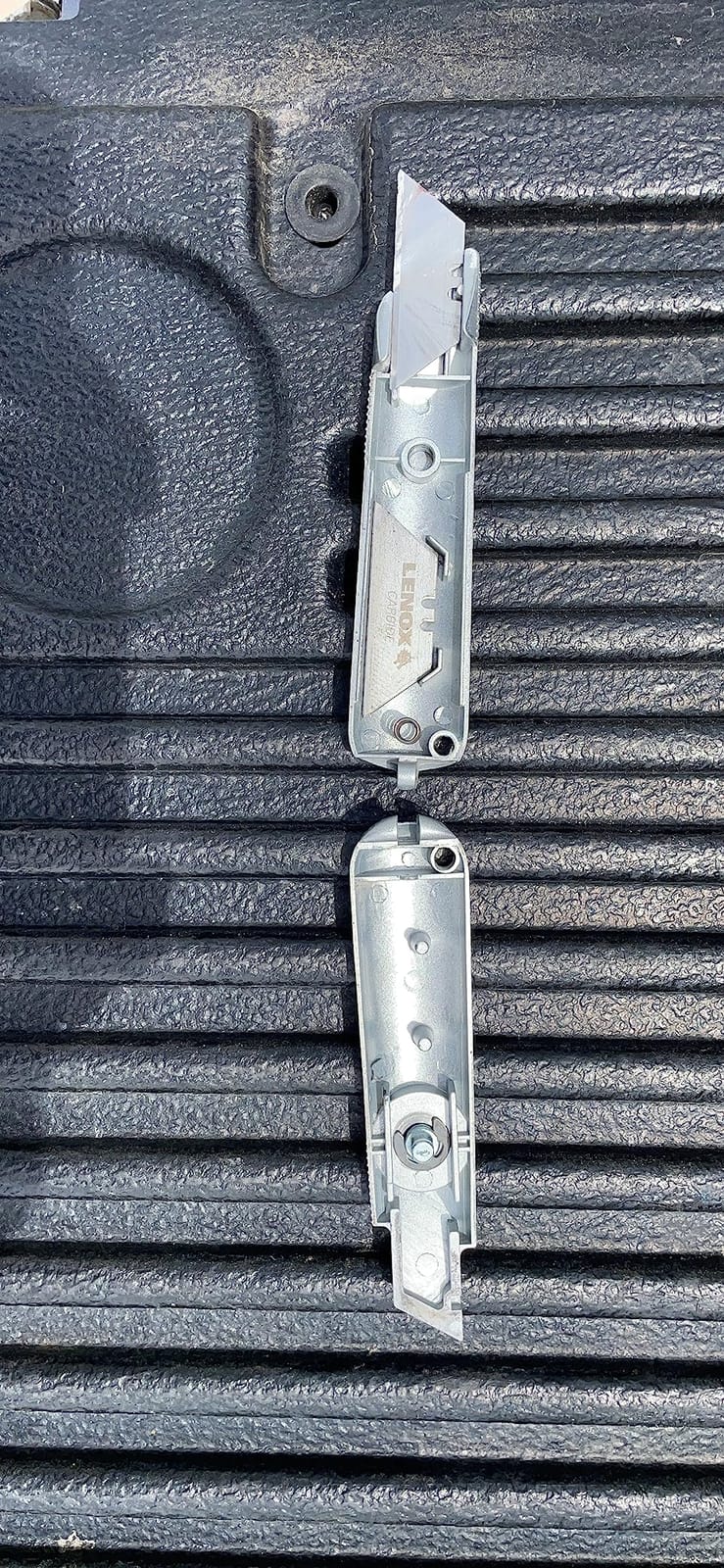
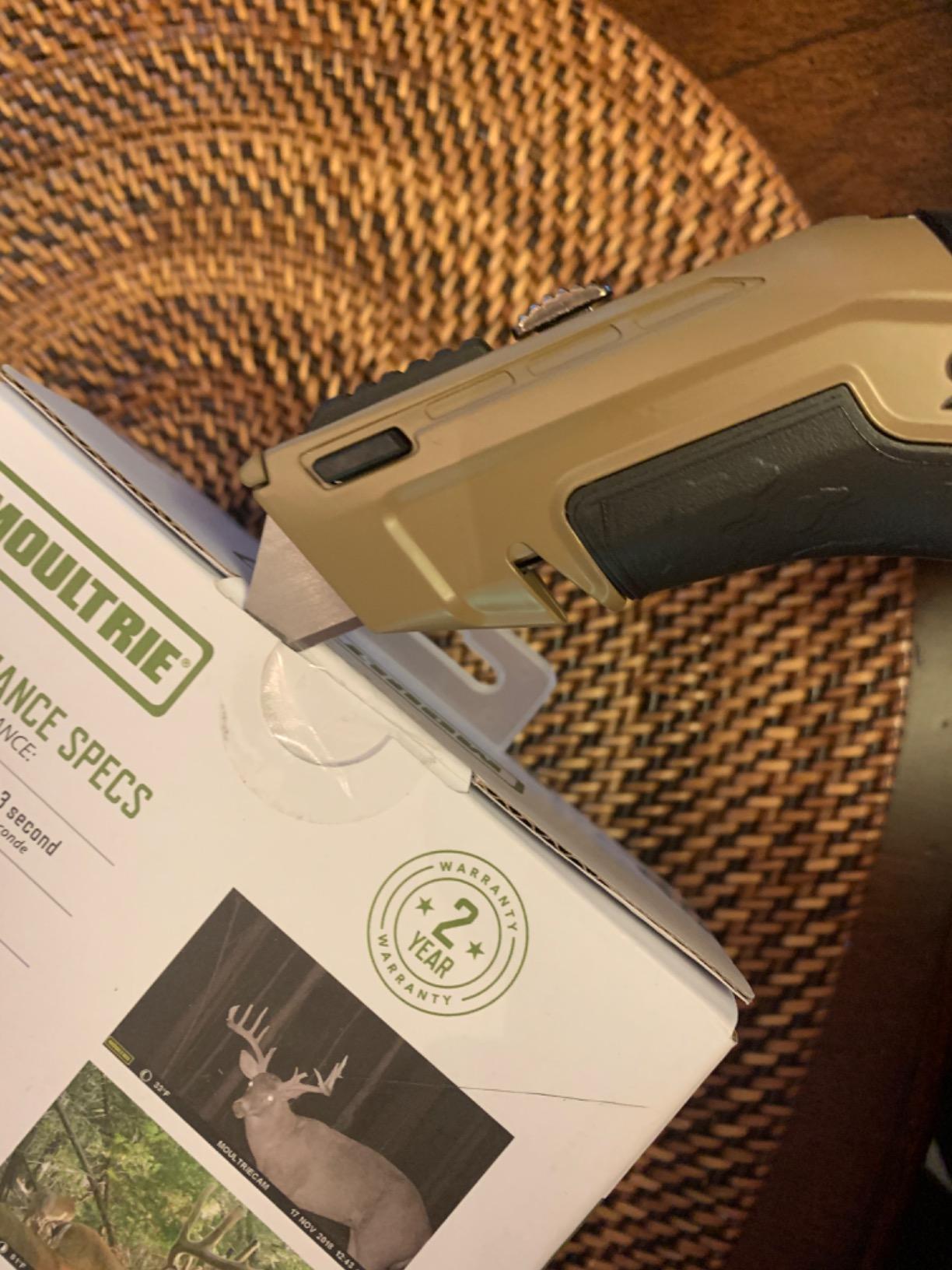
The SPEC-K1-UR was built for people who carry a lot of spare blades, and the quick-release onboard storage holds five of them. At 4.5 stars across 467 reviews, owners consistently praise the comfortable vented grip, the fast push-button blade swaps and the rugged aluminum construction for drywall, roofing and shipping work.
The shock-absorbing vented pistol grip is the distinguishing feature. It is a genuinely ergonomic hold, and reviewers note it suits larger hands better than most compact knives. At 6.08 ounces it has real balance rather than sitting heavy at the front.
Staged Retraction and Thumb Press Power
Push-button blade retraction with staged positions gives you multiple retraction stages for precise, controlled cuts. The thumb press is positioned to deliver maximum cutting power through the pressing stroke, which helps when the blade is only extended a few millimeters for scoring.
Be clear about the safety profile: it is not self-retracting, so the blade stays exposed during use. Your handling discipline is the safety feature here.
Drop-Tested Body and Extra Functions
The body is armor-grade aluminum, 100 foot drop tested, which is a meaningful claim for a tool used on ladders and in crawlspaces. It uses standard utility blades, so the blade supply is never a special order.
There is a built-in slot for strap or string cutting, though owners find it difficult to use on thick straps. It is also compatible with SRS retention lanyards, which solves the lost-knife problem crews complain about constantly on drywall jobs.
Who Should Buy the Spec Ops
Installers who carry spares on the tool and want ergonomic grip over a long day. Anyone working in a crawlspace or on a ladder also benefits from the retention lanyard compatibility and the high-visibility venting.
9. Fiskars Pro Fixed Utility Knife – Button-Deployed Guard and Reinforced Butt
Fiskars Pro Fixed Utility Knife, Orange/Black
Push-button folding blade guard
Reinforced metal butt
Hinged blade change
Five-blade storage
+ Pros
- Button-deployed guard adds protection to a fixed blade
- Hinged design means no loose hardware to lose
- Reinforced metal end survives pounding and drops
- Five-blade storage keeps spares on the tool
- Includes a long-life CarbonMax blade
- Backed by a full lifetime warranty
- Cons
- Fixed blade still relies on user discipline despite the guard
- Heavier and costlier than basic fixed-blade knives
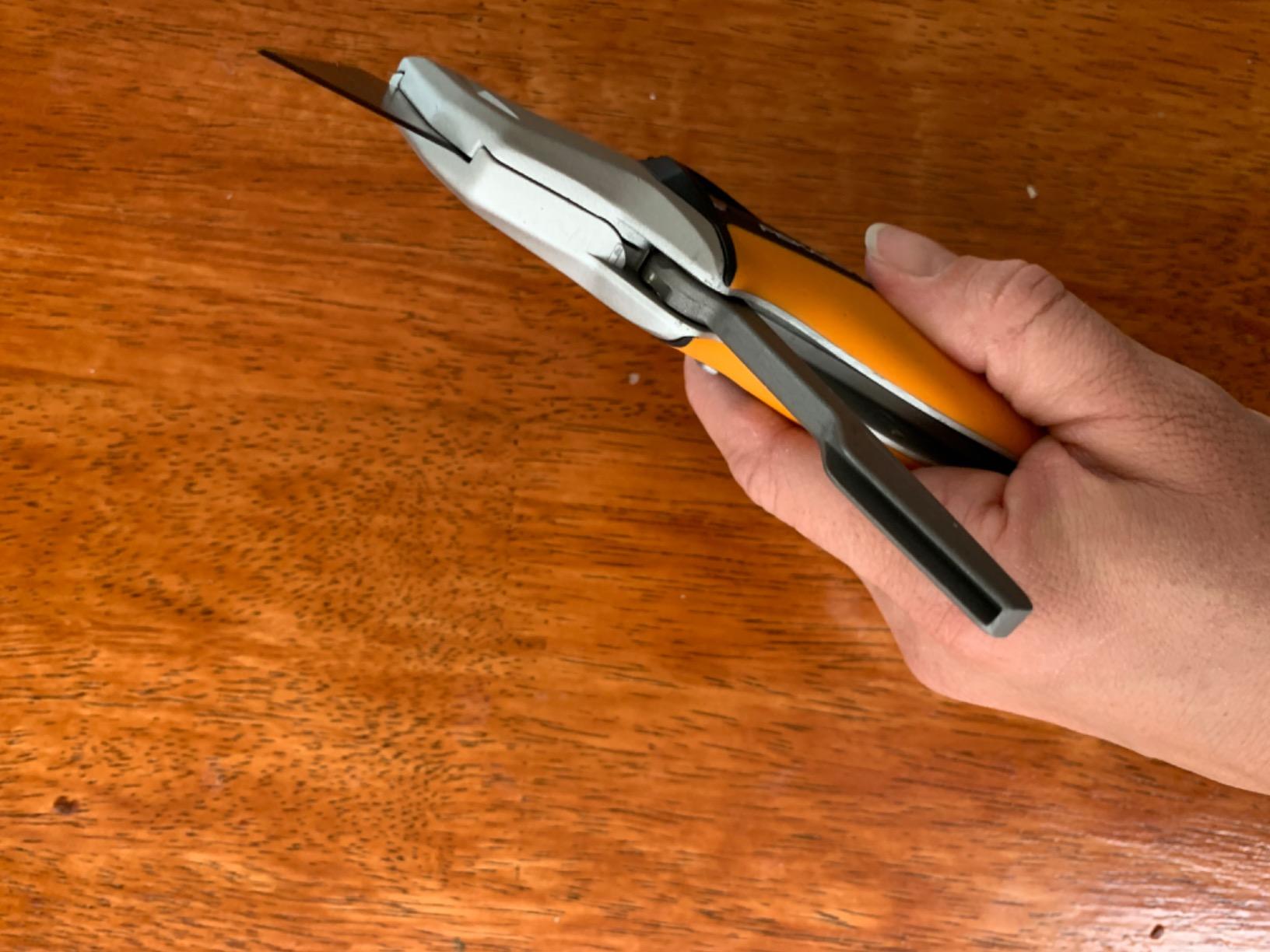
The Fiskars Pro Fixed Utility Knife solves a problem most fixed blades ignore. A folding blade guard deploys with a button for blade protection, so this is a fixed-blade cutting tool that can be made safe to carry between cuts. That is rare in the category and it is why it earns 4.7 stars across 311 reviews.
The reinforced metal butt resists pounding and drops, which is the detail that matters for anyone whose knife gets used to drive a nail, knock off a sill, or tap a shim into place while holding a cut line.
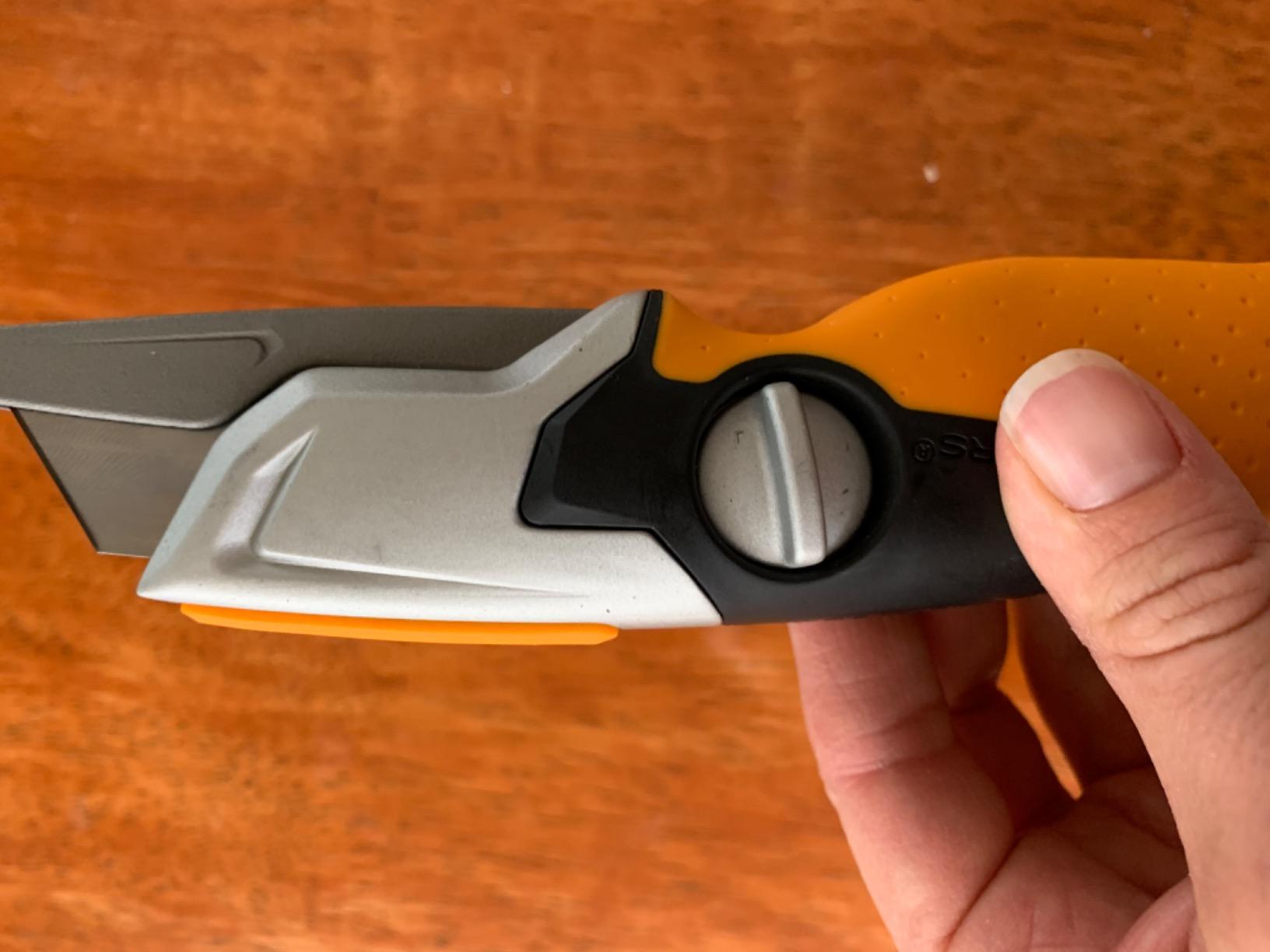
Hinged Blade Change With No Loose Parts
The knife hinges open for blade change with no loose parts to track. No screws come out, so there is nothing to drop into a wall cavity, and nothing to reassemble crooked. The whole change happens in a few seconds.
Five-blade storage capacity keeps spares on the tool itself, and it accepts standard-sized utility blades. The included CarbonMax blade is claimed by the manufacturer to last 24 times longer than the competition, and it is backed by a full lifetime warranty.
Weight and Length
At 10.25 inches this is the longest knife in the group, and that extra frame is helpful for long scoring runs because you cover more ground per stroke.
It is heavier and costlier than the basic fixed-blade knives in this roundup, and the guard does not make the exposed blade risk disappear while you are actively cutting.
Who Should Buy the Fiskars Pro
People who want a fixed blade for control but need to carry it safely between cuts. Anyone beating on their tools, working in rough conditions, or dropping knives off ladders will appreciate the reinforced metal end.
10. XW Fixed-Blade Utility Knife 2-Pack – Two Knives and Ten SK2 Blades
XW Fixed-Blade Utility Knife, Non-Retractable Heavy Duty Drywall Cutter, Extra 10 Blades Included,2-Pack
Zinc-alloy body with TPR grip
SK2 high carbon steel blades
Tool-less twist knob change
8 inch length
+ Pros
- Fixed-blade design gives a solid rigid feel
- Twist knob makes blade changes fast with no screwdriver
- Captive screw and captive cover mean nothing gets lost
- High-visibility yellow color is easy to find in a dark crawlspace
- Notch lets the blade extend farther for accurate drywall cuts
- Anti-slip TPR grip with room to store spare blades in the handle
- Cons
- Fixed blade is always exposed so the user is the only safety feature
- Slightly shorter overall than the classic fixed blade it replaces
- Ships without a blade installed in the working position
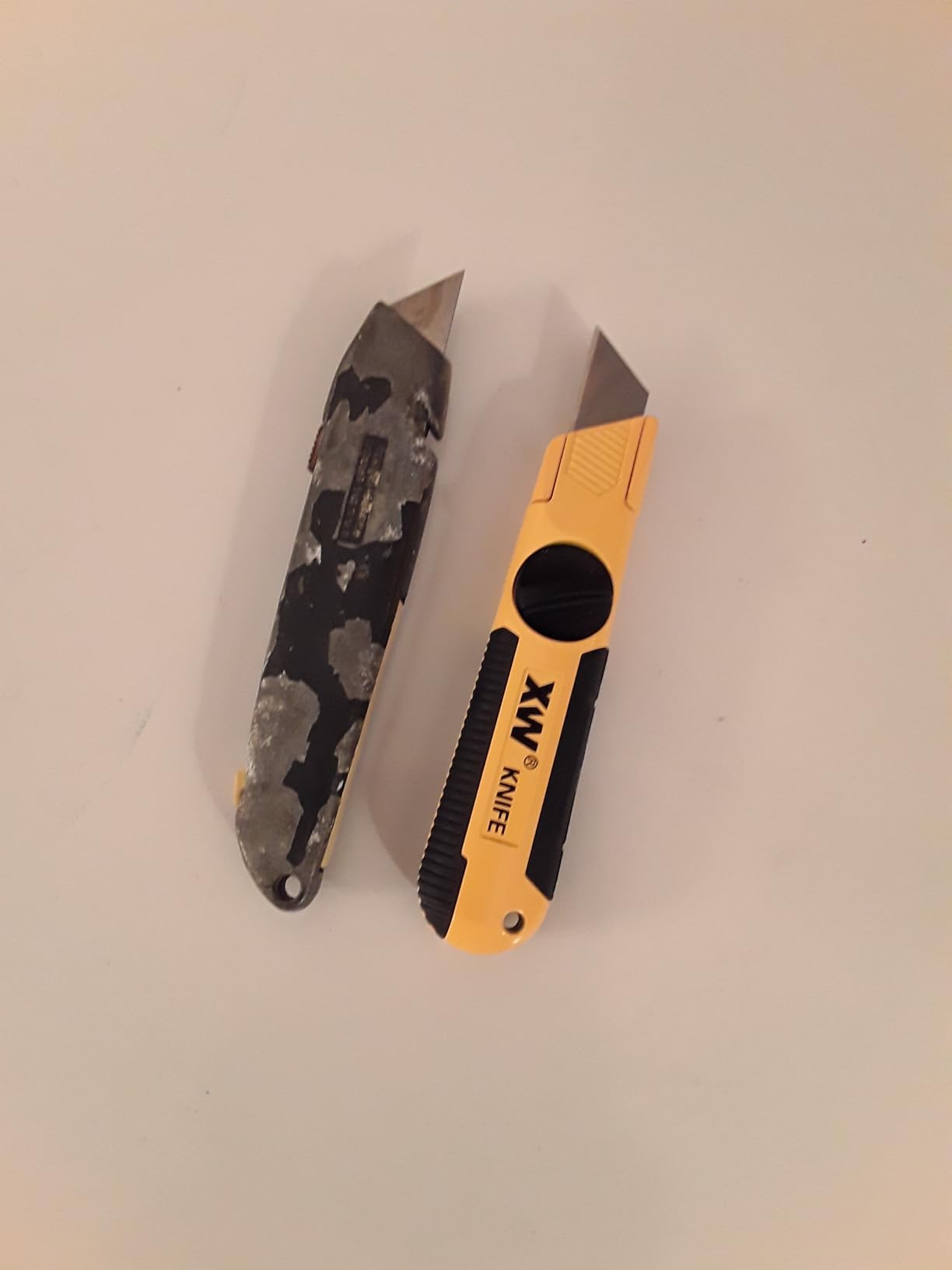
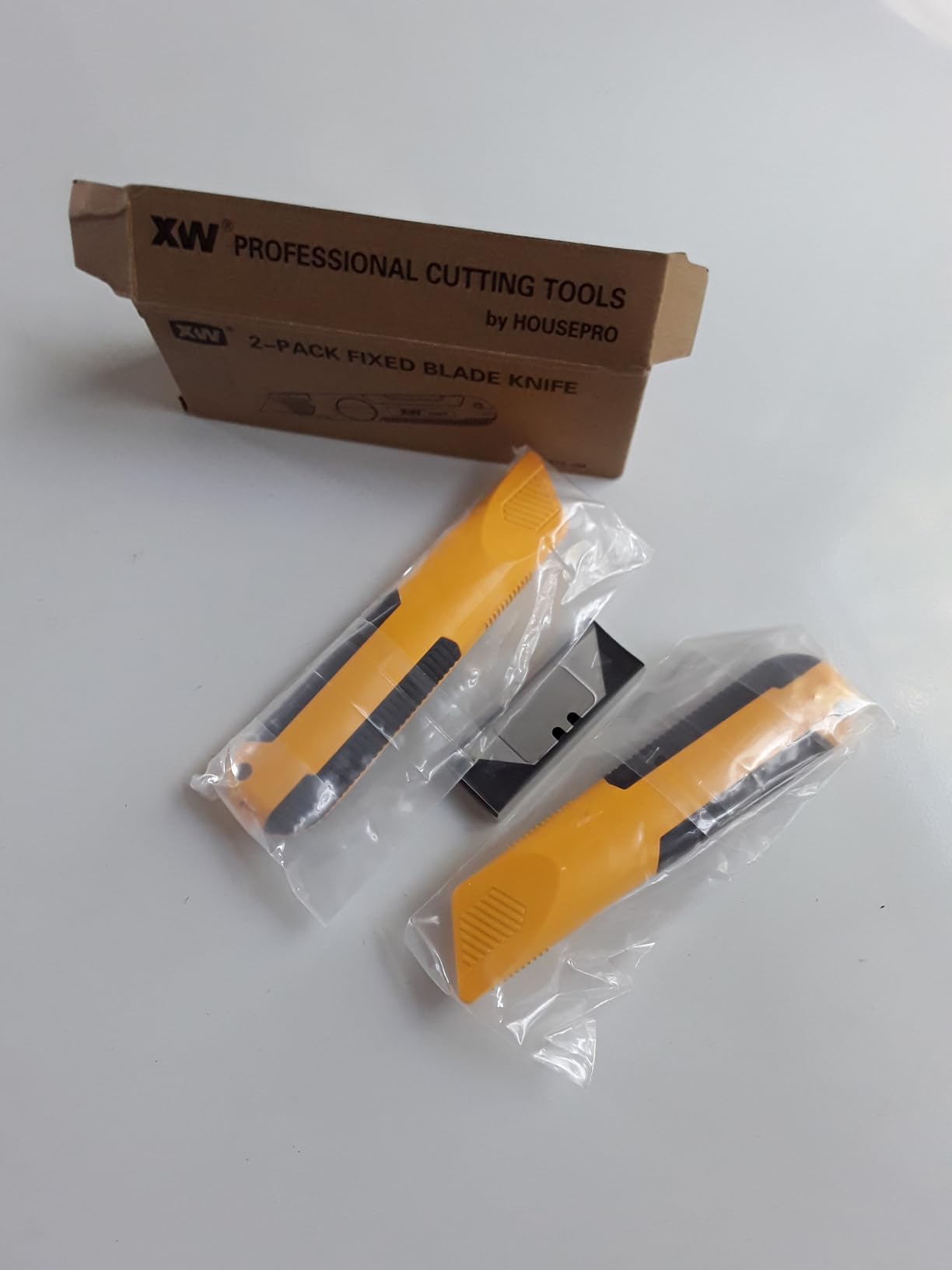
This is the two-pack answer, and it exists for a reason crews understand instantly. You get two knives plus a pouch of ten replacement blades, so a four-person crew has hardware for a full job. Professionals and serious DIYers rate it highly as a drywall cutter, calling out the fixed-blade rigidity, the no-tools blade change, the captive hardware and the bright color.
It carries a 4.5 rating across 483 reviews. The build is a heavy duty zinc-alloy body with an anti-slip TPR grip, and the blade is SK2 high carbon steel.
Tool-Less Twist-Knob Changes and Captive Hardware
The knife swivels open by twisting the knob, so the blade change needs no screwdriver. A hinged handle keeps the two halves connected throughout, and the interlocking thumb dial screw-lock holds the blade secure once it is seated.
Captive screw and captive cover mean nothing gets lost during changes. On a drywall job where a dropped screw vanishes into a cavity and you will never find it, that design detail is worth more than it sounds.
High-Visibility Color and Blade Extension Notch
The yellow and black colorway is easy to find in a dark crawlspace or toolbox, which is exactly where a drywall knife tends to end up. Losing the knife constantly is one of the most common complaints among tradespeople, and visibility solves part of it.
A notch in the handle lets the blade extend farther for accurate drywall cuts when you need more projection than the default setting. There is also a magnetic blade holder, so a loaded blade stays put in the handle instead of rattling loose.
Who Should Buy the XW 2-Pack
Crews, helpers pairing up, and anyone who wants a spare knife staged somewhere other than their tool belt. The tool-less change and captive hardware make it a good first fixed-blade purchase.
It ships without a blade installed in the working position, so plan for that before your first cut.
Fixed Blade vs Retractable vs Folding: Which One Cuts Drywall Best
Fixed blades win on control. Retractable blades win on safety. Folding blades win on convenience. That is the honest answer, and which trade matters depends entirely on what you are doing.
For long straight scores and rip cuts, a fixed blade is the tool pros reach for. There is no channel that can flex, no projection that can change mid-stroke, and the angle is identical on every cut. Contractors on drywall forums describe the preference plainly: they like fixed blades for drywall because the control through a full sheet is noticeably better than a retractable.
The counterargument comes from the DIY side, where a retractable is the safer recommendation. If you are new to cutting drywall, the exposed blade of a fixed knife is a real risk, and a retractable that disappears into the handle between cuts is a genuinely better default.
The dust issue is where retractables get their reputation damaged. Fine gypsum powder works into the track and the quick-change hinge, and reviewers report the retract mechanism sticking occasionally in exactly that scenario. Fixed blades have no moving mechanism at all, which is a quiet but real advantage over a long season.
Folding knives sit in the middle. They carry safely, and models with dual lock positions can give you a rigid blade at the angle you want. They are the best choice when you are moving between drywall and other jobs in one day.
Where the fixed blade genuinely loses is cut-outs around electrical boxes. The exposed tip is a real concern in tight spaces, which is where narrower blades and retractable bodies earn their place. A cut-resistant glove helps, but it costs you the fine dexterity that tight corners require.
How to Cut Drywall with a Utility Knife
Score, snap, trim. That is the entire method, and the quality of the result depends almost entirely on how straight and deep your score line is. Everything else is cleanup.
First, support the sheet properly. A full sheet flexes and bounces unless it is backed, so lay it flat on sawhorses or against a wall. A knife drawn across a bowed sheet wanders, and a wandering score tears.
Second, set a T-square or a straightedge firmly and hold it with your non-knife hand. Extend the blade only as far as needed. Pull the knife toward you rather than pushing it, keeping the blade at roughly 30 to 45 degrees, and make one continuous pass. Multiple light passes shred the paper face, which is the single most common cause of a failed cut.
Third, snap the board. Press from the back side of the score until the gypsum core breaks, then the sheet folds cleanly along the line. If it resists and starts to crumble, your score was too shallow or too wandering, so cut a second sheet rather than fighting this one.
Fourth, trim the back paper. Hold the knife at a shallow angle and slice the remaining paper away from the core, moving away from your body. This is the step where most hand injuries happen, so keep your off hand behind the blade line.
Fifth, for cut-outs around outlets, measure and mark the opening, then score the outline and snap inward from the edges toward the marked line. Cutting a small rectangle and enlarging it is far easier than trying to cut the full opening in one piece, and the same controlled approach works better if you break the paper from the middle outward.
Keep a pencil, a straightedge and a spare blade within arm’s reach. Most ruined cuts are not caused by a bad knife, they are caused by a knife that went dull halfway through the pass.
What to Look for in a Utility Knife for Drywall
Here is the criteria list we use, organized around the three things that actually decide how clean your cut is.
Blade Stability Under Scoring Pressure
Blade stability means the blade does not wobble, flex or change projection while you are pulling it. Look for a fixed-blade design or an anchored metal body, and check whether the handle has a steel or aluminum channel rather than an all-plastic shell.
This is the criterion that separates a clean score from a crushed edge. If the blade can move inside the handle, it will move at the exact moment you lean into a hard line.
Dust Resistance
Fine drywall dust jams retract mechanisms. The most reliable defense is simply having fewer moving parts, which is the main reason fixed blades dominate on professional jobsites.
If you prefer a retractable, look for a straightforward sliding track over a complex quick-change hinge, and expect to blow the mechanism out with a few puffs of compressed air at the end of each day.
Extra Tools and Blade Storage
Onboard blade storage is the feature that gets left out of most comparisons and it matters more than it looks. Models that store five spare blades in the handle, or use a quick-release magazine like the Spec Ops, mean nobody stops work to go find a blade.
Tool-free blade changes are the second thing to look for. A twist knob or a push button beats a screwdriver, and captured screws beat loose ones, because a dropped fastener is gone.
Blade Materials and Segment Counts
Carbon steel is the baseline and it is adequate for occasional work. Bi-metal construction, like the shatter-proof bi-metal blade on the IRWIN, holds a sharper point against abrasive gypsum dust. High carbon steel, like the SK2 and SK5 blades in this group, is hardened further for the same reason.
Snap-off segments matter in a different way. The OLFA L-1 ships with eight segments per 18mm blade, so you break off the used tip and get a fresh edge without a spare. Wide 25mm blades cover more per stroke, and narrower 18mm blades give better control on cut-outs.
Common Mistakes When Cutting Drywall
The most common mistakes are all technique rather than equipment. Pushing instead of pulling the knife, using multiple passes instead of one firm line, scoring across an unsupported or bowed sheet, and letting the blade go dull mid-cut.
Two more catch people out. Holding the sheet with your free hand on the waste side rather than behind the blade line, and cutting a full opening in one pass when breaking the paper inward from a smaller rectangle is far more controllable.
When to Use a Drywall Saw or Rotary Cutter Instead
A utility knife is the right tool for the outer edges of a sheet and for clean rips. It is the wrong tool for a tight opening in the middle of a wall, where a jab saw or keyhole saw gives you control a knife cannot.
For a full install measured in rooms rather than patches, a rotary cutter such as a RotoZip-style spiral saw cuts faster than hand scoring once you have the technique. For a single patch, the utility knife is faster to set up and cheaper to own.
Utility Knife Safety on the Jobsite
Treat every fixed-blade knife as loaded. Carry it in a sheath or a knife pouch, never loose in a bucket where a hand reaches in blind, and always cut away from your body with your off hand behind the blade line.
Pull the blade back the moment you finish a cut, snap off dull segments rather than forcing them, and dispose of used segments in a container rather than letting them land in a cavity where they puncture a foot later. Gloves help with grip in dust and with the odd slip, but they cost you the dexterity needed for tight cut-outs, so keep a pair handy for ripping work and take them off for detail cuts.
Frequently Asked Questions
What is the best utility knife for cutting drywall?
The best utility knife for cutting drywall is one with a rigid fixed blade or an anchored metal body, a blade change that needs no tools, and a hard blade material such as bi-metal or high carbon steel. In our testing the WORKPRO Premium Utility Knife stood out for its all-metal body, 3.2 ounce weight and SK5 blades hardened to 64 HRC, while the OLFA L-1 won on edge retention with eight snap-off segments per blade. Pros who cut sheet all day reach for fixed blades, and beginners do well with a retractable that hides the blade between cuts.
Can I cut drywall with a utility knife?
Yes, a utility knife is the standard tool for cutting drywall. Press the blade to the paper face, run it along a T-square to cut through the paper, snap the board along the score line, then trim the back paper with the knife held at a shallow angle. Keep the board flat and supported, make one continuous pass, and change the blade the moment it dulls.
Is a fixed blade or retractable better for drywall?
A fixed blade is better for control on long straight scores and rip cuts because the blade angle never changes and there is no track for drywall dust to jam. A retractable is better for safety, since the blade disappears into the handle between cuts, which makes it the safer choice for beginners and for anyone working in tight spaces around cut-outs.
What blade is best for cutting drywall?
A hard blade material is the most important factor because gypsum dust acts as an abrasive. Bi-metal and high carbon steel blades such as the IRWIN 4-point blue blade, the SK2 and SK5 blades hold an edge far longer on drywall than basic carbon steel. Snap-off segments are also useful, since the OLFA L-1 gives eight fresh segments per blade and no spare blade is needed.
What is the best multitool blade for cutting drywall?
For multitool use, a scraper or a wide plain blade is more useful than a fine tooth. Gypsum dust and paper fibres clog fine cutting teeth quickly, so a standard utility knife blade with a blunt scraping edge will outlast a saw-tooth multitool blade on drywall. The Klein Tools 44306 handles this by pairing a knife with a separate scraper face.
When should I use a drywall saw instead of a utility knife?
Use a drywall saw or keyhole saw for openings in the middle of a wall, such as around electrical boxes, where a knife has less room to maneuver. Use a rotary cutter for large installs measured in whole rooms. For outer edges, rips and patches, the utility knife is faster to set up and gives a cleaner straight cut.
The Bottom Line on Drywall Knives in 2026
If you want the single best utility knife for drywall, take the WORKPRO Premium Utility Knife. Its all-metal body will not flex when you lean into a score, the SK5 blades are hard enough to survive abrasive gypsum dust, and ten replacement blades are in the box.
If edge retention is your priority, the OLFA L-1 is the pick, because eight snap-off segments per blade means you never stop to find a spare. If you are new to drywall and want the blade hidden between cuts, the DEWALT DWHT10295 gives you retractable safety with a rigid, metal-forward build.
For maximum control on long straight scores, pick a fixed blade, and the Stanley Classic 199 remains the benchmark that most tradespeople started on. If you want the safety of a fold plus a scraper face, the Klein Tools FLICKBLADE covers both jobs in one body.
Whichever one you choose, keep a spare blade within reach and make the cut in a single confident pass. That habit matters more to the quality of the finished wall than any feature on the handle.