
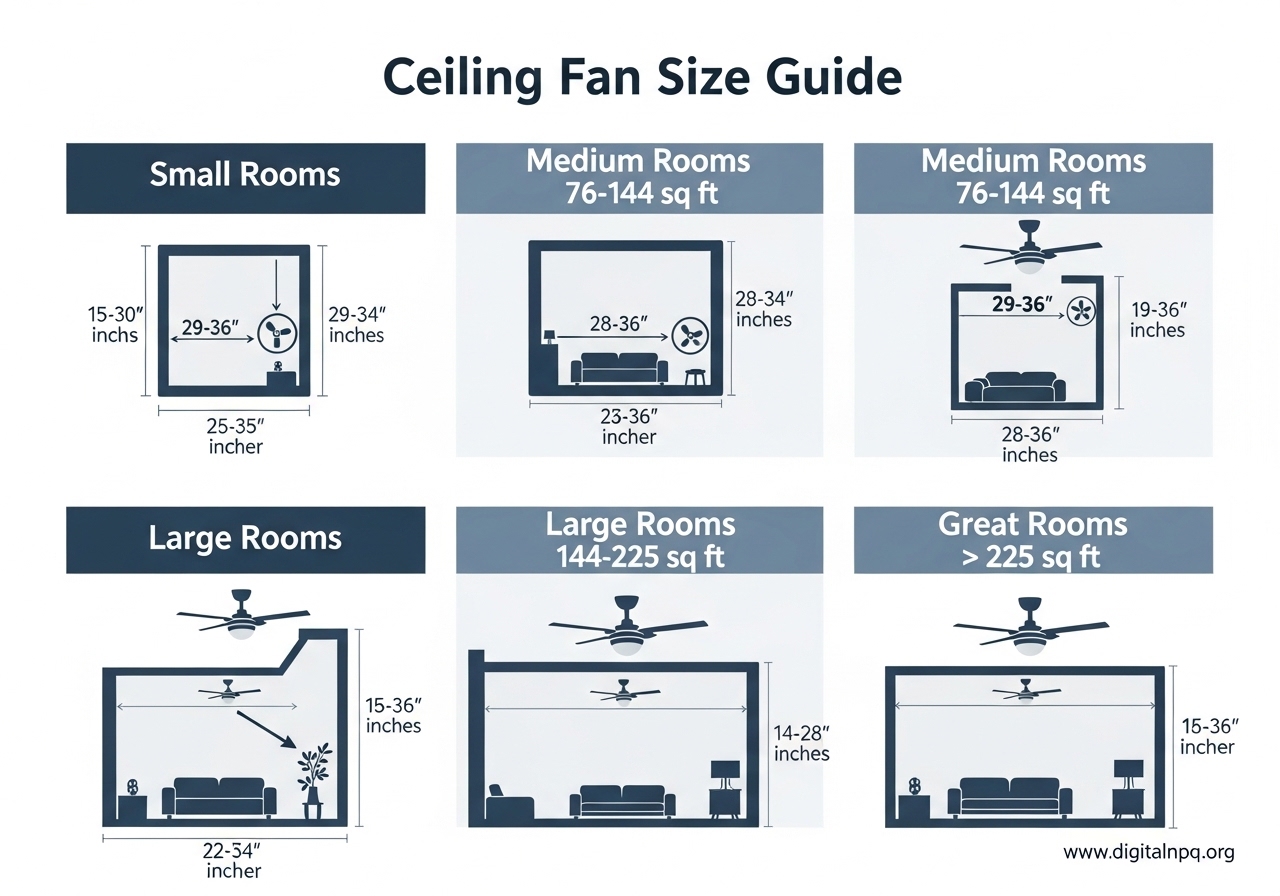
Choosing the wrong ceiling fan size is one of the most common mistakes homeowners make. A fan that is too small leaves hot spots and wastes energy. A fan that is too big can make the room feel like a wind tunnel and look visually out of place. This Ceiling Fan Size Guide will show you exactly how to measure your room, match it to the right blade span, and avoid the headaches our team has seen after helping dozens of friends and readers fix their fan choices in 2026.
We have tested sizing rules across bedrooms, living rooms, kitchens, and outdoor patios. The good news is that you only need a tape measure and about five minutes to get this right. By the end of this guide, you will know the exact fan diameter your room needs, the correct mounting style for your ceiling height, and whether you should size up or down when you land between two options.
One frustration we hear from Reddit users and forum members is that different websites give conflicting advice. One retailer says a 52-inch fan works for a 12×12 room, while another says it is too big. That confusion ends here. Getting the size right matters for comfort, energy bills, and even noise levels. A properly sized fan circulates air efficiently without overworking the motor. Let us start with the simple measurements that drive every other decision.
How to Measure Your Room for the Right Ceiling Fan Size
The first step in our Ceiling Fan Size Guide is calculating your room’s square footage. Grab a tape measure and record the length and width of the room in feet. Multiply those two numbers together. For example, a 12-foot by 12-foot bedroom has 144 square feet. That number is the foundation for choosing your fan diameter.
If your room is not a perfect rectangle, break it into smaller rectangles. Measure each section, calculate the square footage of each, then add them together. L-shaped rooms and open floor plans require this extra step, but it only takes an extra minute. Do not skip it, because the total area still dictates the airflow you need.
Next, check your ceiling height. Measure from the floor to the ceiling surface. Standard height is 8 feet, but many newer homes have 9- or 10-foot ceilings. Higher ceilings change the mount type you need, which we will cover in detail later. For now, write that number down alongside your square footage.
Wall clearance is another detail that matters. Industry standards recommend at least 18 inches of space between the fan blade tips and the nearest wall. If your room is narrow, this clearance rule can limit how large your fan can be. Measure the shortest wall distance and subtract 18 inches from each side to find your maximum allowable blade span.
Finally, consider the room’s purpose. Kitchens and home offices often need less aggressive airflow than living rooms. Bedrooms usually need quieter operation. Outdoor spaces need special weather ratings. We will address all of these room-specific factors in the sections below, but keep your room’s daily use in mind as you read the size chart.
Ceiling Fan Size Chart by Room Square Footage
The fastest way to choose a fan is to match your room’s square footage to a recommended blade span. This table gives you the exact range we recommend based on our own installs and industry consensus. Keep it bookmarked as a quick reference.
| Room Size (Square Feet) | Recommended Fan Diameter | Typical Room Type |
|---|---|---|
| Under 100 sq ft | 29 to 36 inches | Small bathroom, laundry room, walk-in closet |
| 100 to 150 sq ft | 36 to 42 inches | Small bedroom, home office, nursery |
| 150 to 250 sq ft | 44 to 50 inches | Standard bedroom, kitchen, dining room |
| 250 to 400 sq ft | 50 to 54 inches | Large bedroom, living room, family room |
| 400 to 625 sq ft | 56 to 60 inches | Great room, open-concept living area |
| Over 625 sq ft | 60 inches or larger, or multiple fans | Open floor plan, large great room, covered patio |
There is a helpful rule of thumb that designers use alongside the chart above. Your fan diameter should be roughly 20 to 25 percent of the room’s width. In a 12-foot-wide room, that means a fan between 29 and 36 inches. In a 16-foot-wide living room, you are looking at 38 to 48 inches. This proportional rule works well as a sanity check when you are between two sizes on the chart.
Let us make this even more practical with specific room dimensions. A 10×10 room is 100 square feet and needs a 36 to 42 inch fan. A 12×12 room is 144 square feet and fits best with a 44 to 50 inch fan. A 14×20 room is 280 square feet and needs a 50 to 54 inch fan. A 15×15 room is 225 square feet and pairs well with a 44 to 50 inch fan. If you have a 200 square foot room, aim for a 44 to 50 inch model for balanced coverage.
When you are right on the edge between two sizes, most homeowners in forums and our own experience recommend rounding down rather than up. A slightly smaller fan still moves enough air if the CFM is strong. A fan that is too large can feel overwhelming and may not meet the 18-inch wall clearance rule. We will cover the exact consequences of wrong sizing in a dedicated section later.
Ceiling Fan Size Guide for Every Room in Your Home
Every room has its own airflow needs. A bedroom needs quiet operation. A kitchen needs grease and moisture resistance. A living room needs wide coverage. This Ceiling Fan Size Guide breaks down the best practices for each space in your home.
Bedrooms
Small bedrooms around 10×10 feet need a 36 to 42 inch fan. Standard bedrooms around 12×12 feet work best with a 44 to 50 inch fan. Master bedrooms that are 14×16 feet or larger should have a 52 to 56 inch fan for full coverage. In our experience, bedrooms benefit from fans with 4 or 5 blades because they run quieter at low speeds. You do not want a motor hum waking you up at 2 AM.
If your bedroom has a vaulted ceiling, add a downrod to bring the blades down to the ideal 8-foot height from the floor. A fan that hangs too high in a bedroom creates weak airflow where you actually sleep. We have heard from homeowners who upgraded from a flush mount to a short downrod and immediately felt the difference in comfort.
Consider a remote control or smart fan for bedrooms. Getting out of bed to adjust the speed is inconvenient. Many modern fans now include dimmable lights, which is useful for reading before sleep. The light kit should be flush or low-profile so it does not create glare when you are lying down.
Living Rooms
Living rooms are often the largest dedicated rooms in a home. A 14×20 living room is 280 square feet and pairs perfectly with a 52 to 54 inch fan. A 16×20 living room is 320 square feet and should have a 54 to 56 inch fan. Open-concept living areas that combine the kitchen and living room can exceed 400 square feet. In those spaces, consider a 56 to 60 inch fan or two smaller fans spaced evenly.
Living rooms are also where style matters most. The fan should complement the room rather than dominate it. If you have a low ceiling, choose a low-profile mount so the fan does not hang too low. If you have 9-foot or higher ceilings, a downrod mount improves airflow circulation and keeps the room feeling balanced.
Lighting is another factor for living rooms. Many homeowners want an integrated light kit to replace a central ceiling fixture. Make sure the wattage and color temperature match the room’s ambiance. A warm 2700K light works well for relaxing, while a cooler 3000K light is better for reading or detailed tasks.
Kitchens and Dining Rooms
Kitchens and dining rooms typically range from 100 to 250 square feet. A 36 to 44 inch fan works well for most kitchens. Dining rooms between 12×12 and 14×16 feet need a 44 to 50 inch fan. Because kitchens generate grease and moisture, choose a fan with sealed motor housing and blades that are easy to wipe down. Some homeowners prefer a fan without lights in the kitchen to avoid shadows over the stove, while others want integrated lighting over the dining table.
Keep the fan at least 3 feet away from the cooking surface if possible. Heat and grease can shorten the motor life. If your kitchen is part of an open floor plan, use the total square footage of the combined space rather than just the cooking area.
For dining rooms, the fan should be centered over the table whenever possible. This creates a focused cooling zone where people actually sit. If the table is off-center, you may need to choose between centering the fan on the room or on the table. Our recommendation is to center on the table for comfort, as long as the wall clearance rule still holds.
Home Offices
Home offices are usually 100 to 200 square feet. A 36 to 44 inch fan is ideal. The key concern here is quiet operation. You are on video calls, recording audio, or concentrating on tasks. A noisy fan becomes a daily annoyance. Look for fans with DC motors or high-quality AC motors that advertise quiet operation. In our testing, 5-blade fans with 12-degree pitch angles tend to produce the least hum at medium speeds.
Install the fan directly over the desk area if the room layout allows it. This gives you the most personal cooling without needing to run the fan at high speed. Lower speed means less noise and less energy use.
If you have a ceiling light in the office, consider a fan with a low-profile light kit to avoid cluttering the ceiling with multiple fixtures. The cleaner look reduces visual distractions during long work sessions. Some smart fans also integrate with voice assistants, so you can adjust speed without leaving your chair.
Outdoor Patios and Covered Porches
Outdoor spaces have different sizing rules because they are not enclosed. A covered patio that is 12×16 feet still needs a 44 to 52 inch fan, but you must choose a damp-rated or wet-rated model. Dry-rated indoor fans will fail quickly outside. The motor can corrode, and the blades can warp in humidity.
For exposed patios with no roof coverage, only a wet-rated fan is safe. Damp-rated fans work for covered areas where rain does not reach the fan directly. Always check the UL rating on the box before installing. We will explain the rating differences in detail later in this guide.
Outdoor fans also need higher CFM ratings because the air is not contained. A 52 inch outdoor fan should move at least 4,000 CFM to create a noticeable breeze. If you live in a humid climate, look for stainless steel or ABS plastic blades that resist moisture and UV damage. Wood blades will warp and crack outdoors over time.
How Ceiling Height and Mount Type Affect Your Fan Choice
Ceiling height changes the mount type you need. The wrong mount puts the fan too close to your head or too high to move air effectively. The sweet spot is 8 feet from the floor to the bottom of the fan blades. Let us look at each ceiling height category and the correct solution.
Standard 8-Foot Ceilings
With an 8-foot ceiling, you have about 7 to 8 inches of clearance above the floor to work with. A flush mount or low-profile fan hugs the ceiling and keeps the blades at least 7 feet above the floor. That is the minimum safety standard and also the best height for airflow in a standard room. Standard downrod mounts are usually not safe here because they drop the fan below the 7-foot clearance minimum.
Low-profile fans are specifically designed for 8-foot ceilings. They have a compact motor housing that sits close to the ceiling plate. The blades are often shorter and curved to maintain airflow in a tight space. If you have a small room with an 8-foot ceiling, a low-profile 42-inch fan is usually your best option.
9 to 10 Foot Ceilings
These are common in newer homes and remodeled spaces. A 3 to 6 inch downrod brings the fan down to the ideal 8-foot height. Do not mount the fan flush to a 10-foot ceiling. The airflow will stay too high and the room will feel stagnant. We have visited homes where simply swapping a flush mount for a 6-inch downrod made the living room feel 5 degrees cooler.
If you have a 10-foot ceiling in a large room, consider a 6-inch downrod even for a 56-inch fan. The extra drop helps distribute air across the entire seating area. In dining rooms with 9-foot ceilings, a 3-inch downrod is often enough to reach the ideal height while keeping the fan visually centered over the table.
11 to 12 Foot Ceilings
Great rooms and entryways often hit this range. Use a 12 to 18 inch downrod. Some two-story spaces may even need a 24 inch downrod. The goal is always the same: get the fan blades to roughly 8 feet above the floor. If you have a ceiling that is 12 feet high and you install a flush mount fan, the effective airflow will barely reach the seating area.
Longer downrods can introduce wobble if the fan is not well balanced. Make sure the fan has a heavy-duty motor housing and reinforced mounting bracket. For ceilings over 12 feet, you may want to hire a professional installer who has the proper scaffolding and tools. The mount must be anchored to a ceiling joist or a fan-rated support box, not just drywall.
Sloped and Vaulted Ceilings
Sloped ceilings require an angled ceiling adapter. Not every fan includes this adapter in the box. Check the product description before buying. The adapter keeps the fan hanging level even when the ceiling is pitched. Without it, the fan wobbles, produces noise, and wears out the motor bearings prematurely.
Vaulted ceilings in master bedrooms and living rooms often pair well with a 12 to 24 inch downrod plus the angled adapter. Measure the slope angle with a simple angle gauge or a smartphone app. Most adapters handle slopes up to 30 degrees, but some specialty adapters go higher. If you are unsure, call the manufacturer and confirm compatibility before you drill any holes.
What Happens When Your Ceiling Fan Is Too Big or Too Small
We see this question constantly in homeowner forums and Reddit threads. Is a 52 inch fan too big for a 12×12 room? Is a 52 inch fan too big for a 10×10 room? Let us answer these directly with the numbers.
A 12×12 room is 144 square feet. The chart says 44 to 50 inches. A 52 inch fan is technically 2 to 8 inches above the recommendation. It is not a disaster, but it can feel overpowering. The blades will be only about 6 inches from the walls if centered. That is below the 18-inch clearance guideline. The room will feel drafty, papers may blow off desks, and the visual scale will look top-heavy.
A 10×10 room is 100 square feet. The chart says 36 to 42 inches. A 52 inch fan here is genuinely too big. The blade tips will be dangerously close to the walls. The motor will strain to push air in a tight space. The noise level will increase. We recommend sticking to 42 inches or smaller for any 10×10 room. If you already installed a 52 inch fan, consider returning it or moving it to a larger room.
When a fan is too small, the consequences are quieter but still frustrating. A 36 inch fan in a 20×20 living room will leave hot spots. The motor will run at high speed constantly, which shortens its lifespan and raises your energy bill. You will find yourself running the air conditioner lower to compensate. The fix is usually to replace the fan with the correct size rather than add a second fan, unless the room is over 625 square feet.
Our rule of thumb for rooms at the threshold between two sizes: size down if the room is used for sleeping or working, and size up if the room is for active gatherings like living rooms. The reason is that a slightly smaller fan is easier to tolerate at high speed than a slightly larger fan at low speed. The larger fan at low speed still moves a lot of air and can feel like a constant breeze.
Blade Count and Airflow: What Actually Matters
Fan diameter is the most important number, but blade count and motor performance matter too. A 52 inch fan with weak motor torque will underperform. A 44 inch fan with a high-torque motor and steep blade pitch can outperform it. Here is what to look for.
Blade Count
Three-blade fans spin faster and move air aggressively. They work well in large rooms and spaces where you want maximum airflow. They also tend to be louder. Four-blade and five-blade fans spin slower, create less turbulence, and run quieter. They are ideal for bedrooms and home offices. Our team prefers 5-blade fans for any room under 400 square feet where noise is a concern.
Some modern fans use 6 or even 9 blades for ultra-quiet operation. These are excellent for nurseries and recording studios. However, more blades can reduce the top-end CFM if the motor is not powerful enough. Balance blade count with the motor wattage and CFM rating before deciding.
Blade Pitch
Blade pitch is the angle of the blade relative to the motor. A steeper pitch pushes more air. The industry standard is 12 to 15 degrees. Anything below 10 degrees will move very little air, even on a large fan. Anything above 16 degrees requires a stronger motor to avoid drag and burnout. If the product listing does not mention blade pitch, it is usually a sign that the number is low. Look for 12 to 15 degrees as the sweet spot.
Our team has tested fans with 8-degree pitch and 14-degree pitch side by side in the same room. The difference is noticeable. The 14-degree fan creates a stronger breeze at medium speed than the 8-degree fan creates at high speed. Blade pitch is a hidden spec that separates budget fans from quality ones.
CFM Rating
CFM stands for cubic feet per minute. It measures the volume of air the fan moves. A good bedroom fan should deliver at least 1,500 CFM on high speed. A living room fan should deliver 3,000 to 5,000 CFM. Outdoor fans need even higher CFM because the air is not contained. When you compare two fans of the same size, the one with the higher CFM will cool the room more effectively. Do not ignore this number in the product specs.
Energy efficiency is tied to CFM per watt. Look for the EPA Energy Star label if you want the most efficient option. Energy Star fans move more air per watt of electricity, which lowers your utility bill. Over a full summer, the savings can be significant, especially if you run the fan daily.
Indoor vs Outdoor Ceiling Fans: Damp Rated and Wet Rated Explained
Not every fan can survive outdoors. The motor housing, blades, and electrical connections need different levels of protection. Using the wrong rating is a safety hazard and a waste of money. Here is the simple breakdown.
Dry Rated
Dry-rated fans are designed for indoor use only. They have standard motor housings and blades that are not sealed against moisture. If you install a dry-rated fan on a covered porch, humidity will eventually damage the motor. The blades may warp or delaminate. Stick to dry-rated fans for bedrooms, living rooms, kitchens, and offices.
Dry-rated fans are the most common and affordable type. They come in the widest range of styles, finishes, and blade materials. You can find everything from modern minimalist designs to traditional wood-finish models. Just keep them indoors.
Damp Rated
Damp-rated fans can handle humidity and indirect moisture. They have sealed motor housings and moisture-resistant blades. These are safe for covered patios, screened porches, and bathrooms with heavy steam. They cannot handle direct rain or water spray. If your porch has a solid roof and walls, a damp-rated fan is sufficient.
Many damp-rated fans look identical to indoor models. The difference is internal. The motor is sealed, the wiring is protected, and the hardware is corrosion-resistant. You can use a damp-rated fan indoors if you want, but you should never use a dry-rated fan in a damp location.
Wet Rated
Wet-rated fans are built for direct exposure to rain, snow, and water spray. They have fully sealed motors, waterproof blades, and rust-resistant hardware. Install these on exposed pergolas, open patios, and gazebos. If the fan will ever see a raindrop directly, choose wet-rated. The extra cost is worth the safety and longevity.
Always check the UL or ETL listing on the packaging. The rating should be printed clearly. If you are unsure, ask the retailer before purchasing. We have seen too many homeowners buy a beautiful indoor fan for their porch and regret it after the first humid summer.
Seasonal Ceiling Fan Direction: Summer vs Winter Settings
Most ceiling fans have a small switch on the motor housing that changes the blade direction. This is not a gimmick. It is a real comfort and energy-saving feature that too many people ignore. Here is how to use it correctly.
In the summer, set your fan to rotate counterclockwise when viewed from below. This creates a downdraft. The air blows straight down onto the room and creates a wind-chill effect on your skin. You can raise your thermostat by 2 to 4 degrees without feeling hotter. That saves real money on air conditioning over the course of a summer.
In the winter, flip the switch to clockwise rotation. This creates an updraft. The fan pulls cool air up from the floor and pushes warm air that has risen to the ceiling back down along the walls. The room feels more evenly heated. You can lower your thermostat by 2 to 3 degrees without feeling colder. The savings on heating bills add up, especially in homes with high ceilings where heat naturally pools above the living space.
Not every fan has a reversible motor. Budget models under fifty dollars sometimes skip this feature. If you want year-round savings, check the product description for “reversible motor” or “winter mode” before buying. The switch is usually located right above the light kit. Turn the fan off and wait for the blades to stop before flipping it. We recommend changing the direction at the start of each season as part of your home maintenance routine.
Some smart fans now include seasonal direction presets in their apps. You can schedule the change automatically. This is a convenient feature if you already have a smart home setup. Even without smart features, a simple manual switch takes 30 seconds and pays for itself in comfort.
Frequently Asked Questions
Is a 52 ceiling fan too big for a 12×12 room?
A 52-inch fan is slightly oversized for a 12×12 room, which is 144 square feet. The recommended range is 44 to 50 inches. A 52-inch fan can feel drafty and may not meet the 18-inch wall clearance guideline. If you already own one, try running it on low speed. For new purchases, a 48 or 50-inch model is a better fit.
How to pick the correct ceiling fan size?
Measure your room length and width in feet, then multiply them to get square footage. Match that number to a ceiling fan size chart. Under 100 sq ft needs 29-36 inches. 100-400 sq ft needs 36-50 inches. Over 400 sq ft needs 50-60 inches. Always check ceiling height and wall clearance before finalizing your choice.
Is a 52 inch fan too big for a 10×10 room?
Yes, a 52-inch fan is too big for a 10×10 room. A 10×10 room is 100 square feet, which needs a 36 to 42-inch fan. A 52-inch fan would place the blade tips too close to the walls, create excessive airflow, and likely strain the motor. Choose a 36 or 42-inch fan instead.
What size ceiling fan for 14×20 room?
A 14×20 room is 280 square feet. The best ceiling fan size is 50 to 54 inches. If the ceiling is over 9 feet, use a 3 to 6-inch downrod to bring the blades to the ideal 8-foot height. For open-concept areas attached to the 14×20 room, calculate the total square footage and consider a 56-inch fan or multiple fans.
Should I go bigger or smaller when between two ceiling fan sizes?
For bedrooms and offices, size down. For living rooms and active spaces, size up. A smaller fan is easier to tolerate at high speed and usually quieter. A larger fan in a small room can feel overwhelming and violate wall clearance guidelines. Always prioritize the 18-inch wall clearance rule over sizing up.
Conclusion
This Ceiling Fan Size Guide gave you the exact steps to measure your room, read the size chart, and pick the right mount for your ceiling height. The key is simple: calculate your square footage, match it to the blade span, and respect the 18-inch wall clearance rule. When you are between two sizes, remember that bedrooms and offices usually benefit from a slightly smaller fan, while living rooms can handle a slightly larger one.
Do not forget the secondary details that separate a good install from a great one. Check your blade pitch, look for a high CFM rating, and choose the correct indoor or outdoor rating. Use the seasonal direction switch to save energy in both summer and winter. If you follow this guide, you will end up with a fan that looks right, sounds right, and keeps your room comfortable for years.
Grab your tape measure, write down your room dimensions, and check the chart one more time. The right ceiling fan is not just about aesthetics. It is about comfort, efficiency, and getting the most value from a fixture you use every day.