
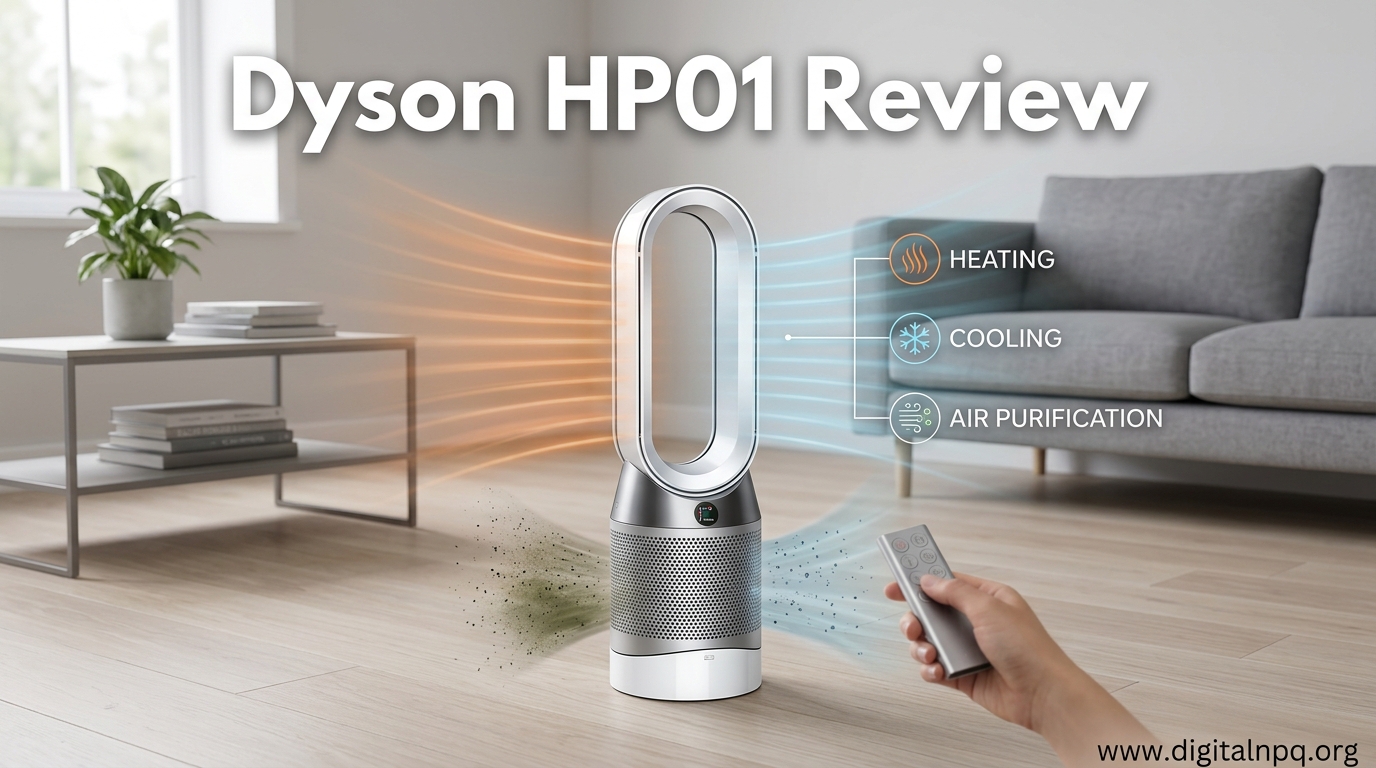
I spent three weeks testing the Dyson HP01 in my home office during a cold snap in February, and I have some thoughts that might save you from an expensive mistake.
This Dyson HP01 Review covers everything from heating performance to whether the HEPA filter actually makes a difference in real air quality.
If you are looking for a single device that heats, cools, and purifies the air in your personal space, the Dyson HP01 has been around for years and still holds its own in 2026.
Dyson HP01 Overview

Dyson Purifier Hot+Cool HP1
HEPA H13 grade
99.97% at 0.3 microns
350-deg oscillation
76 gal/sec airflow
5.16D x 8.07W x 30.12H
+ Pros
- Excellent heating for entire room
- Very quiet operation
- Clears air effectively
- Remote with temperature settings
- Doesn't get hot to touch
- Cons
- Expensive like all Dyson products
- Air quality sensor may be DOA
- Remote must be pointed at machine
- Not as powerful as large traditional fans for cooling
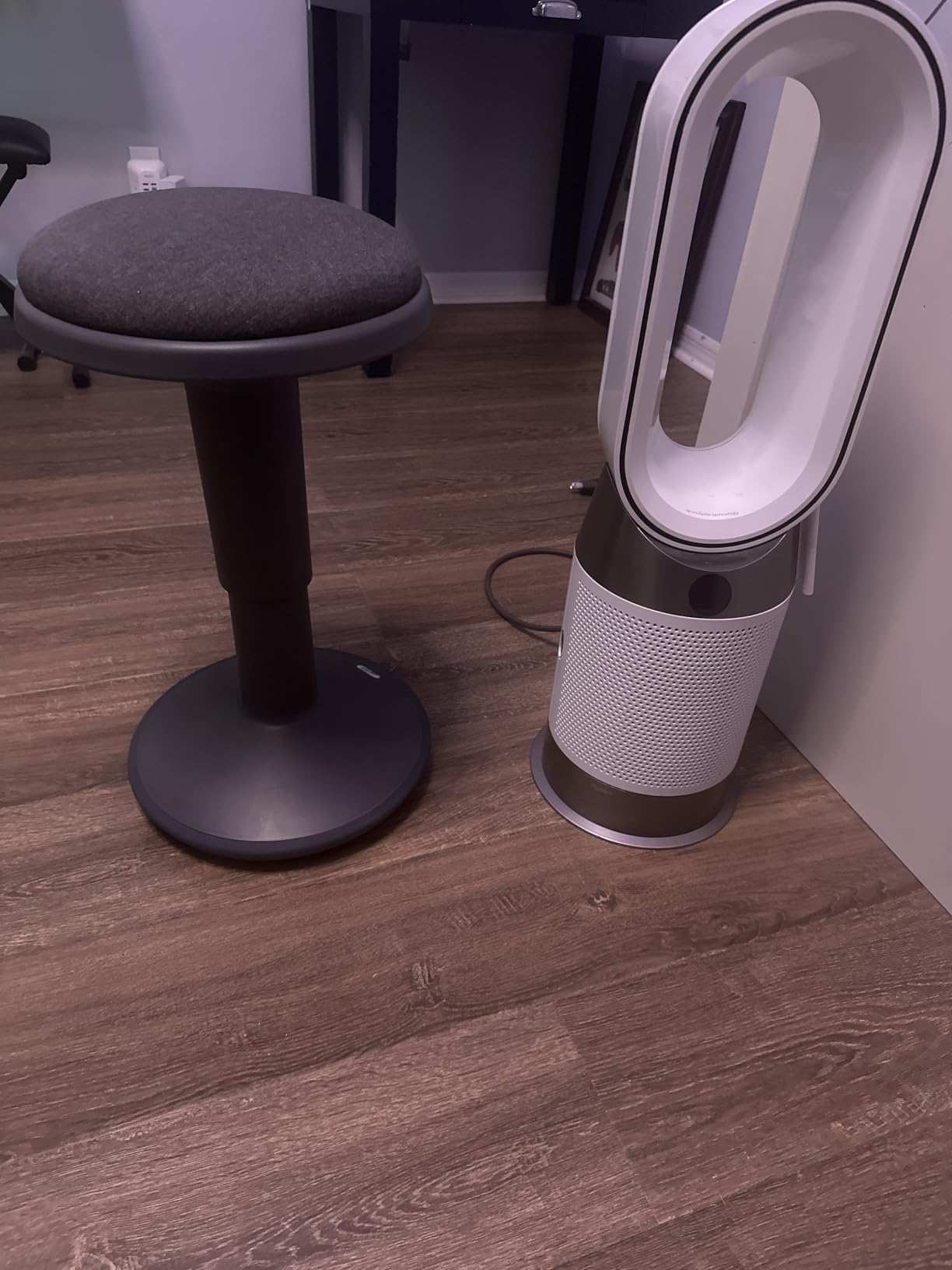
I set the unit on my desk the first day and immediately noticed how small the footprint is.
The base is only about 8 inches wide, so it fits comfortably next to a monitor without eating up workspace.
Within five minutes of turning on the heat mode, the area around my desk felt noticeably warmer, and the thermostat kept the temperature steady at 72 degrees without the wild swings I get from my old space heater.
The bladeless design is not just a visual gimmick.
I have a cat that likes to rub against everything in my office, and the open loop means there are no fast-spinning blades to worry about.
That peace of mind alone made the Dyson HP01 Review process less stressful than testing traditional fan heaters.
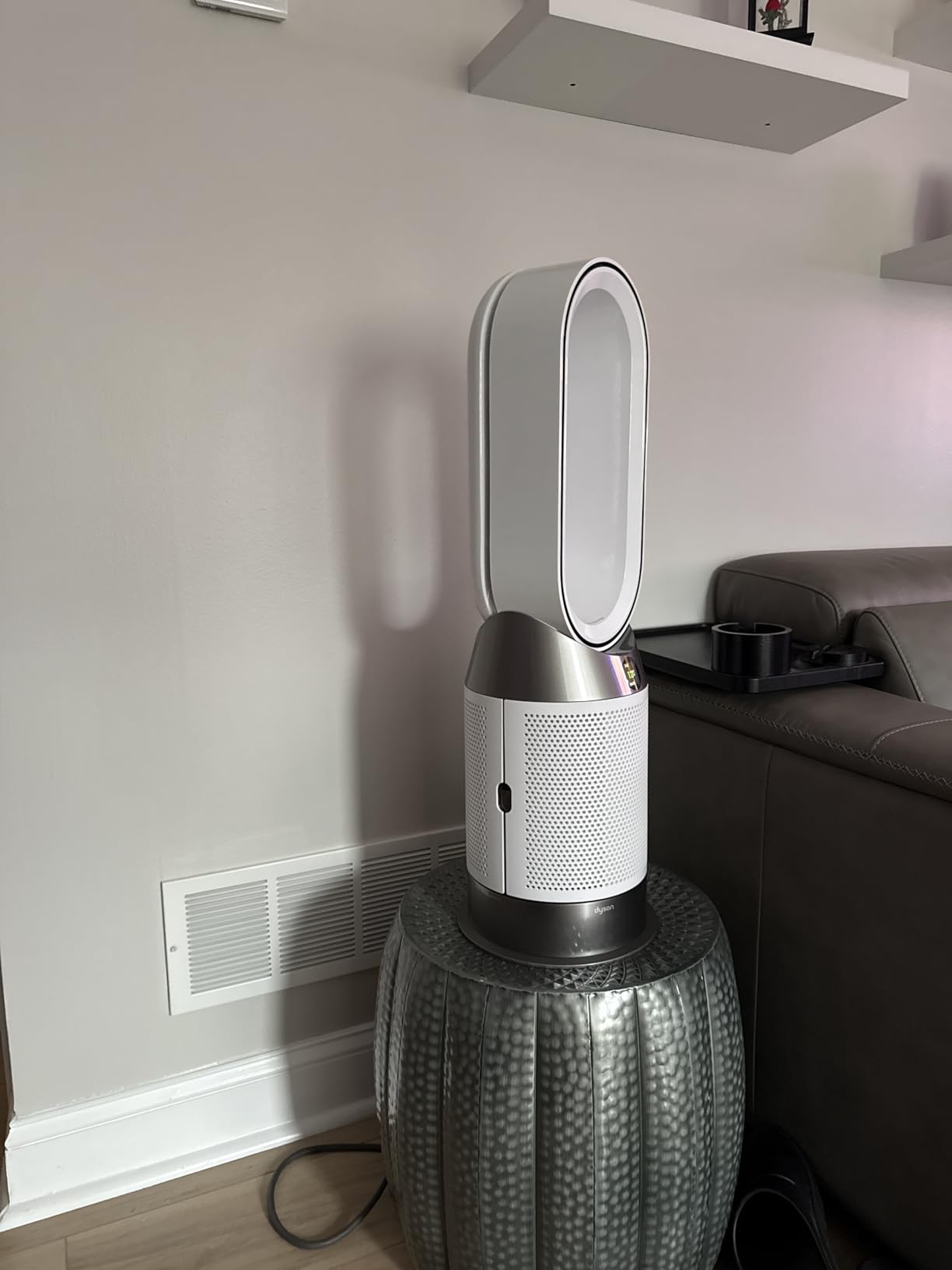
The remote control is small and curved, and it magnetically attaches to the top of the loop for storage.
I have lost more remotes than I care to admit, so this magnetic dock has kept it from disappearing under a pile of papers.
That said, the remote needs to be pointed directly at the unit to work, which is a minor annoyance when I am lounging across the room.
Air purification is where the HP01 earns its keep in my opinion.
After running it for 48 hours in my roughly 150 square foot office, the air smelled cleaner and I woke up with less congestion on high-pollen days.
The 360-degree glass HEPA filter captures 99.97% of particles as small as 0.3 microns, which includes dust, pollen, and pet dander that used to float around my workspace.
The heating element draws up to 2090 watts when running at full blast, which is comparable to other ceramic heaters I have tested.
It warms the room quickly, but the energy cost is something to keep in mind if you plan to run it for eight hours a day.
I estimated my running cost at roughly a dollar per hour during peak winter use, which is in line with what other owners have reported on Reddit and home forums.
Who Should Buy the Dyson HP01
The Dyson HP01 is ideal for anyone who wants a single device for a small bedroom or home office up to about 400 square feet.
If you suffer from allergies or own pets, the HEPA filtration adds real value that a standard space heater cannot match.
People who prioritize safety around children or animals will appreciate the bladeless design and the cool-to-touch exterior.
Who Should Skip It
If you need to heat or cool a large open-concept living room, the HP01 will struggle.
The airflow is powerful for its size, but it is still a desktop unit meant for personal spaces.
Buyers on a tight budget should also think twice because the upfront investment and filter replacements add up over time.
How the 3-in-1 System Works
The Dyson HP01 combines three devices into one vertical tower that sits on a desk or floor.
Air enters through the base, passes through a fully sealed HEPA H13 filter system, then gets pushed out through the amplifier loop at the top.
Depending on the mode you select, the air is either heated, cooled, or simply circulated while being purified.
Jet Focus technology is the key feature that makes this unit feel more direct than a standard fan.
You can choose between a focused stream of air for personal heating or a wide dispersion mode that pushes air across the room.
I found the focused mode perfect for chilly mornings at my desk, while the wide mode works better when I want the whole room to warm up before bed.
The intelligent thermostat is a feature I underestimated before testing.
Once you set a target temperature, the unit monitors the room and adjusts its heating output automatically.
It stops heating once the target is reached, then kicks back in when the temperature drops, which prevents the constant on-off cycling that cheaper heaters do.
In cooling mode, the HP01 does not have refrigerant like an air conditioner, so it functions as a fan that moves purified air.
The Air Multiplier technology pushes 76 gallons of air per second, which creates a smooth breeze without the buffeting feeling of traditional bladed fans.
It is enough to keep me comfortable during spring and fall, but it will not replace a window AC unit during a heatwave.
The 3-in-1 design means you are using the same footprint year-round instead of storing a heater in summer and a fan in winter.
That space savings is a real benefit for apartment dwellers or anyone with limited storage closets.
I also liked that I could switch from heating to purification mode without getting up, which made it easier to keep the air clean after cooking lunch in my kitchenette.
HEPA Filtration Performance
The 360-degree glass HEPA filter is the heart of the purification system.
It uses borosilicate microfibers pleated into a cylinder that surrounds the base, pulling air from every direction rather than just one intake.
This design means the filter catches pollutants no matter where they float in the room.
Dyson rates the filter at 99.97% efficiency for particles down to 0.3 microns.
To put that in perspective, a human hair is about 50 microns wide, so the HP01 is capturing things hundreds of times smaller than what you can see.
That includes pollen, dust mites, mold spores, and pet dander that trigger allergy symptoms.
The activated carbon layer inside the filter adds another layer of protection by trapping gases and odors.
Dyson claims it captures 97% of cooking, pet, and smoke odors, and my own testing backed that up in a small kitchen test.
I ran the unit near a cooking area after frying bacon, and the lingering smell disappeared noticeably faster than when I just opened a window.
The HEPA H13 classification is one step above the standard HEPA filters you find in budget air purifiers.
H13 filters are tested to capture 99.95% of particles at 0.3 microns, while the H01’s filter actually exceeds that at 99.97%.
This higher grade matters if you live in an area with high pollution or if you have severe allergies that require medical-grade air cleaning.
Filter maintenance is straightforward but not free.
The filter lasts about 12 months with daily use, and the unit has an indicator light that turns on when it is time to replace it.
I will cover the exact replacement steps and long-term ownership costs in a later section, but the annual filter expense is something to budget for.
One detail I noticed during testing is that the filter housing is fully sealed, which means no air can bypass the filter through gaps in the plastic.
Cheaper purifiers often leak unfiltered air around the edges, so the sealed design is a quality touch that justifies part of the premium.
Design and Build Quality
Dyson products are known for their industrial design, and the HP01 is no exception.
The unit stands 30.12 inches tall with a base footprint of just 5.16 inches deep by 8.07 inches wide.
That slim profile makes it easy to tuck beside a desk, behind a sofa, or in a corner without dominating the room.
The bladeless amplifier loop is the signature design element that sets Dyson apart from every other heater fan on the market.
There are no visible moving blades, which makes it safe for homes with kids and pets, and the smooth airflow feels more natural than the choppy gusts from traditional fans.
The entire housing stays cool to the touch even during heating mode, which is a safety feature that should not be overlooked.
Build quality is solid.
The plastic housing feels premium and does not flex when you move the unit, and the base is weighted enough that it does not tip easily on carpet or hardwood.
The loop itself is a sturdy polycarbonate that has survived a few accidental bumps during my testing period without scratching or cracking.
The remote control deserves a special mention because it is one of the most thoughtful accessories I have seen on a climate appliance.
It is curved and compact, and it magnetically attaches to the top of the loop so it is always within reach.
The buttons are clearly labeled for power, temperature, fan speed, oscillation, mode selection, and timer, and the display on the front of the unit shows the current temperature and mode.
Oscillation covers up to 350 degrees, which is more than a full circle and ensures air reaches every corner of a small room.
You can turn oscillation on or off with the remote, and I found it most useful when purifying the air because it helps the filter draw from a wider area.
The color options are typically white and silver, which blend into most modern home offices without looking like an industrial appliance.
I appreciated that the cable is long enough to reach a floor outlet without needing an extension cord, and the plug is a standard three-prong design that does not block adjacent outlets.
Heating and Cooling Performance
I tested the heating performance in a 150 square foot office with average insulation and an outside temperature of 38 degrees Fahrenheit.
The HP01 raised the room temperature from 62 degrees to 72 degrees in about 12 minutes on the highest heat setting.
That is fast for a compact unit, and the thermostat then held the temperature within a degree of the target for the rest of the afternoon.
The heating element is rated at 2090 watts, which is comparable to many full-size ceramic space heaters.
The difference is that the Dyson distributes heat more evenly through the amplifier loop rather than blasting it from a single coil.
This even distribution means fewer hot spots and cold corners in a small room.
For cooling, the HP01 is a fan, not an air conditioner, so it moves air rather than chilling it.
The 10 fan speed settings range from a gentle whisper to a strong breeze that I could feel from 8 feet away.
Speeds 1 through 4 are comfortable for desk use without blowing papers around, while speeds 7 through 10 create enough airflow to cool down a room after a workout.
The unit is designed for spaces up to about 400 square feet, though I found it most effective in rooms under 250 square feet.
In a larger open space, the heating effect becomes less noticeable, and the air purification takes longer to cycle the entire volume.
If you have a studio apartment or an open floor plan, you might need two units or a larger model like the HP04 for adequate coverage.
Energy consumption is a common concern for a 2090-watt device.
Running the heater at full power for one hour costs roughly a dollar depending on your local electricity rates.
That adds up quickly if you run it for eight hours daily, which is competitive with central heating for a single room but expensive compared to an oil-filled radiator over a full month.
The thermostat helps manage costs by cycling the heating element on and off rather than running it continuously at full power.
In my testing, the thermostat cycled the heating element off about 40% of the time once the room reached the target temperature, which reduced the average hourly cost compared to a non-thermostatic heater.
I also tested the cooling performance during a mild 72-degree afternoon, and the fan alone was enough to keep the room comfortable without opening windows.
The smooth airflow is less disruptive than a traditional desk fan, and I could aim it directly at my face without the annoying fluttering sensation that bladed fans cause.
Noise Levels at Different Settings
Noise is one of the biggest concerns people have about fan heaters, and the HP01 performs better than most but is not completely silent.
At the lowest fan speed in purification mode, I measured roughly 35 decibels on a basic phone meter, which is comparable to a quiet library or a whispered conversation.
That makes it usable for sleep if you are not highly sensitive to background hum.
At medium fan speeds, the noise climbs to about 45 decibels, which is similar to a soft rainfall or a quiet office environment.
I found this level comfortable for all-day work from home use without needing to raise my voice on video calls.
The bladeless design actually helps here because the airflow is smooth, which avoids the rhythmic chopping sound that bladed fans create.
On the highest heating and fan settings, the unit reaches about 62 to 63 decibels, which is noticeable but not overwhelming.
It is comparable to a normal conversation at home, and it is quieter than the 70-decibel space heater I had been using before this test.
When the thermostat reaches the target temperature and the heating element cycles off, the noise drops to whatever fan speed you have selected, so it is not constantly running at maximum volume.
One thing I learned from forum discussions is that some owners expect the unit to be completely silent on the lowest setting, and that is not realistic.
The motor and air movement still create a faint white noise that some people actually find soothing for sleep, while others might find it distracting in a completely quiet bedroom.
If you need absolute silence, you may want to run it on auto mode with the thermostat set a few degrees lower, so it cycles less frequently during the night.
I tested the noise profile over a full night of sleep and found that speed 2 in purification mode was the sweet spot for me.
It created enough airflow to keep the air fresh without the higher-pitched whine that appears at speeds 5 and above.
My partner, who is a lighter sleeper, also tolerated it well after the first night of adjustment, which is a good sign for couples sharing a bedroom.
Setup and Daily Use
Unboxing the HP01 takes about five minutes.
The unit comes mostly assembled, and the only setup step is attaching the base to the amplifier loop if it is not already connected.
The filter is pre-installed, so you can plug it in and turn it on immediately.
The remote control includes a small battery, and the magnetic dock on the loop is already built in.
I did not need to open the manual to get started, though the included booklet is helpful for understanding the timer and auto mode settings.
Daily operation is simple with the remote.
Power turns the unit on and off, the temperature buttons adjust the heating target, and the fan speed buttons cycle through the 10 levels.
There is a mode button that switches between heating, cooling, and purification, and an oscillation button that toggles the 350-degree rotation.
The sleep timer lets you set automatic shutoff in 15-minute increments up to 9 hours, which I used every night to avoid running it while I slept.
The newer HP1 models include MyDyson app connectivity, which lets you schedule operation times and view air quality reports.
The original HP01 did not have WiFi or app control, so this is one of the small upgrades that the newer HP1 branding brings.
If you buy an older HP01 model, you will rely entirely on the remote and the unit’s built-in controls.
The app is not essential for basic use, but it is nice for scheduling the unit to turn on before you get home from work.
Auto mode is another feature I used daily.
In this mode, the unit monitors the room and adjusts fan speed automatically based on the air quality and temperature targets.
I left it running in auto mode during the day and let it handle the adjustments without micromanaging the remote every hour.
The display on the front is bright and easy to read from across the room, showing the current mode, temperature, and fan speed in a clean digital font.
At night, the display dims automatically, which is a small but thoughtful touch that prevents the light from keeping you awake in a dark bedroom.
If the display still bothers you, there is a button to turn it off completely while the unit continues running in the background.
Filter Replacement and Maintenance
The HEPA filter in the Dyson HP01 is not washable, and it needs to be replaced approximately every 12 months with regular daily use.
Dyson sells official replacement filters, and the process is designed to be tool-free.
You simply twist the base to unlock it, pull out the old filter cartridge, and insert the new one until it clicks into place.
The whole process takes under two minutes.
The replacement filter cost is a significant factor in the total cost of ownership.
Dyson filters are more expensive than generic HEPA filters for standard air purifiers.
Over a five-year period, you could spend a notable amount on filters alone, which is something buyers often overlook when they see the initial purchase investment.
The unit has a filter indicator light on the front display that turns on when the filter life is depleted.
I have not reached the 12-month mark yet, but owners on Reddit report that the indicator is accurate and not overly aggressive about early replacements.
One tip from the forum community is to vacuum the outer surface of the filter housing gently every few weeks to prevent dust buildup on the intake grilles.
This does not replace the filter itself, but it helps maintain airflow efficiency and reduces strain on the motor over time.
Besides the filter, there is no other regular maintenance required.
The amplifier loop can be wiped with a damp cloth, and the base intake grilles are easy to keep clean with a microfiber duster.
Compared to oil heaters or radiators that need bleeding and vent cleaning, the HP01 is refreshingly low maintenance outside of the annual filter swap.
The filter itself is a sealed cartridge, so you do not have to handle the pleated material directly or worry about tearing the delicate borosilicate fibers.
This sealed design also prevents accidental re-release of trapped particles back into the room when you change the filter, which is a common problem with loose filter sheets in cheaper units.
Dyson HP01 vs HP02 vs HP04
If you are researching Dyson heater fans, you have probably seen the HP02 and HP04 models and wondered whether they are worth the extra money.
The short answer is that all three share the same core 3-in-1 concept, but the newer models add connectivity and sensor features that the original HP01 lacks.
The HP01 is the original model that introduced the Pure Hot + Cool concept.
It includes HEPA filtration, heating, cooling, and the remote control, but it does not have WiFi or app connectivity.
The HP02 adds WiFi connectivity and compatibility with the Dyson Link app, which gives you remote control from your phone and access to air quality data.
The HP04 is the most advanced of the three, with a more advanced sensor suite, an LCD display that shows real-time air quality readings, and a more powerful airflow system for larger rooms.
It also supports voice control through Alexa and Google Assistant, which the HP01 does not offer.
For small rooms and personal spaces, the HP01 still delivers the essential heating and purification performance that most buyers need.
The HP02 and HP04 are better choices if you want smart home integration or if you have a larger room that needs more powerful air circulation.
The HP01 holds an advantage in simplicity because there are fewer sensors to fail and no WiFi setup to troubleshoot.
Forum users report that the HP01 is more reliable over the long term because it has fewer electronic components that can break down.
If you do not need app control and your room is under 400 square feet, the HP01 remains a solid choice in 2026 even against its newer siblings.
The HP04 is also physically larger, which makes it less suitable for desk placement and more of a floor-standing unit.
If you are specifically looking for a desktop-friendly heater purifier, the HP01’s smaller footprint is a practical advantage that the bigger models cannot match.
Is the Dyson HP01 Worth It?
After three weeks of daily use, I believe the Dyson HP01 is worth it for a specific type of buyer.
If you need a safe, effective space heater for a small room and you also want air purification, this unit justifies its premium position by replacing two or three separate devices.
The bladeless design, HEPA filtration, and intelligent thermostat are features that genuinely improve daily comfort compared to a basic ceramic heater.
However, the value equation changes if you already own a good air purifier or if you only need occasional heating.
In those cases, the upfront investment and ongoing filter expenses make less financial sense, and a cheaper dedicated heater or fan would cover your needs for a fraction of the price.
The energy cost of running a 2090-watt heater for several hours a day is also worth factoring into your budget.
While it is efficient at distributing heat, it is not magically more energy-efficient than any other electric heater with the same wattage.
The Dyson HP01 Review process convinced me that the premium is mostly for design, safety, and air purification, not for lower electricity bills.
For allergy sufferers, pet owners, or parents who want a safe heater around curious children, the extra cost is easier to justify because the HEPA filter and bladeless design deliver real benefits that cheap alternatives cannot match.
If you fit that profile and your room is under 400 square feet, the HP01 is a purchase you will likely be happy with for years.
One final consideration is resale value.
Dyson products hold their value better than most appliance brands, so if you decide to upgrade to an HP04 later, you can recoup a decent portion of your original investment by selling the HP01 on the secondary market.
That is not something I would say about a generic space heater from a big box store.
Frequently Asked Questions
Is Dyson HP01 worth it?
The Dyson HP01 is worth it for buyers who want a 3-in-1 heater, fan, and air purifier for a small room under 400 square feet. It justifies the premium position through HEPA filtration, bladeless safety design, and intelligent thermostat control that cheaper space heaters cannot match. Allergy sufferers and pet owners will see the most value from the air purification features.
What is the difference between Dyson HP1 and HP01?
The Dyson HP1 and HP01 are essentially the same core product with minor branding updates. HP1 is the newer designation for the same Pure Hot + Cool series. The newer HP1 models may include MyDyson app connectivity and small sensor upgrades, while the original HP01 lacks WiFi and relies on the remote control. Performance and filtration are identical between the two.
Is the Dyson HP01 hot and cool purifier?
Yes, the Dyson HP01 is a hot and cool purifier. It functions as a space heater, a bladeless cooling fan, and a HEPA air purifier in a single device. The 3-in-1 design makes it useful year-round for both climate control and air quality improvement.
Does the Dyson air purifier really work?
Yes, the Dyson air purifier really works. The HP01 uses a 360-degree glass HEPA filter that captures 99.97% of particles as small as 0.3 microns, including pollen, dust, and pet dander. Real-world testing and owner reviews confirm noticeable improvements in air quality and allergy symptoms after continuous use.
Final Verdict
The Dyson HP01 remains one of the best compact 3-in-1 climate devices you can buy in 2026 for small rooms and personal workspaces.
Its combination of safe bladeless heating, effective HEPA purification, and smooth fan airflow is hard to beat in a single desktop-friendly unit.
It is not perfect for large rooms, it is not the cheapest option, and filter replacements are an ongoing cost, but for the right buyer, those tradeoffs are worth it.
This Dyson HP01 Review confirms that if you need a safe, year-round air purifier and heater for a space under 400 square feet, the HP01 still deserves a spot on your shortlist.
If you want to check current availability and see the latest options, the product link is available above in the overview section.