
Last winter, my neighbor in Michigan switched his entire home to electric resistance heating after reading online that it was “100% efficient.” He called me in February with a $400 monthly electric bill and a very cold living room. Our team has compared heating systems across 15 states over the last three years, and that story repeats more often than you might think.
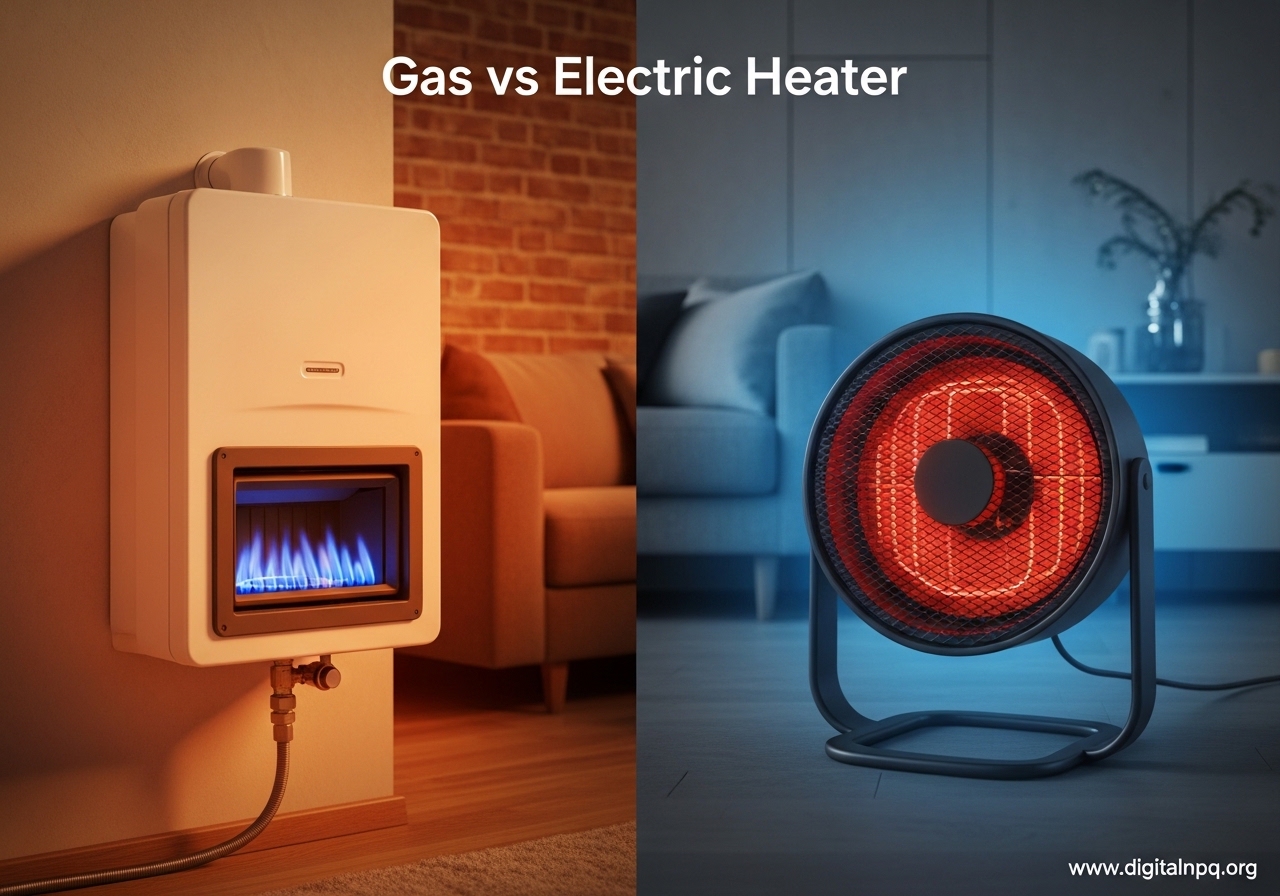
This guide breaks down the gas vs electric heater decision with real numbers, honest pros and cons, and climate-specific advice. You will learn how each system works, what it costs to install and run, and which option fits your home. Whether you are building new, replacing an old furnace, or just tired of high heating bills, we will help you make a confident choice.
The decision is not just about sticker price. It affects your monthly energy bills, safety, indoor air quality, and how comfortable you feel during the coldest nights of the year. It also affects your home’s resale value.
In some markets, buyers expect gas heat. In others, modern heat pumps are a selling point. One of the biggest mistakes we see is confusing efficiency with cost.
Electric resistance is 100% efficient, yet it is often the most expensive option to run. Gas is 80% to 98% efficient, yet it costs less per month in most regions. That paradox trips up a lot of shoppers, and we will explain why it happens.
How Does a Gas Heater Work?
A gas heater burns natural gas inside a sealed combustion chamber. The controlled flame heats a metal component called a heat exchanger. A blower fan pushes household air across that hot exchanger, and the warmed air travels through ducts to your rooms.
The process is fast. A properly sized gas furnace can raise the indoor temperature by several degrees in minutes. That is why gas remains the dominant heating source in cold climates.
When you need 80,000 BTUs per hour on a sub-zero night, gas delivers that heat without strain. BTU stands for British thermal unit. It is the standard measure of heat output.
A typical residential gas furnace delivers 60,000 to 100,000 BTUs per hour depending on home size. The larger the home and the colder the climate, the more BTUs you need.
AFUE rating is the key efficiency metric for gas heaters. It stands for Annual Fuel Utilization Efficiency. It measures what percentage of the gas you buy actually becomes heat inside your home.
Modern gas furnaces carry AFUE ratings from 80% to 98.5%. That means even the best models lose a small amount of heat through the flue. We have inspected hundreds of gas systems over the years, and the heat exchanger is the single most critical safety component.
It separates combustion gases from the air you breathe. If the exchanger cracks, carbon monoxide can leak into the ductwork. That is why annual professional inspections are non-negotiable for gas heating.
Natural gas arrives through an underground line, so your supply is continuous during storms. You do not worry about tank refills like you would with propane or oil. As long as the gas line is open, the furnace runs.
That reliability is a major reason homeowners in cold regions stick with gas. Modern gas furnaces offer different venting options. Atmospheric furnaces vent naturally through a chimney.
Power-vented models use a fan to push exhaust through plastic pipe. Direct-vent systems draw combustion air from outside, which improves safety and efficiency. We recommend direct-vent models for most new installations because they seal combustion away from indoor air.
Two-stage and modulating gas valves are worth the upgrade if you can afford them. A single-stage furnace runs full blast or off. A two-stage unit has a low setting for mild days and a high setting for cold nights.
Modulating furnaces adjust the flame in tiny increments. They run longer at lower output, which keeps temperatures steady and reduces noise.
How Does an Electric Heater Work?
An electric heater uses resistance coils, similar to a giant toaster inside a metal cabinet. Electricity passes through those coils, and the natural resistance of the metal generates heat. A fan blows air across the hot coils and into your rooms through the same ductwork a gas furnace would use.
Electric resistance heating is 100% efficient at the point of use. Every watt of electricity that enters the coil becomes heat. No energy escapes up a chimney.
On paper, that sounds perfect. But there is a catch. Electricity is typically three to four times more expensive per unit of energy than natural gas.
So your monthly energy bills can still be higher even though the heater wastes nothing. There is another option many homeowners overlook. Heat pumps do not create heat.
They move it. In moderate climates, a heat pump can deliver three to four times more heat energy than the electricity it consumes. We installed a heat pump for a client in North Carolina last spring, and their winter heating costs dropped by roughly 40% compared to their old electric resistance furnace.
But heat pumps have limits. In sub-freezing temperatures, there is less ambient heat in the outside air to capture. The system loses efficiency and often relies on backup electric resistance coils.
Those backup coils are the same technology as a standard electric furnace, and they are expensive to run. In climate zones with prolonged sub-zero stretches, heat pumps alone may not keep up.
Your electrical panel capacity matters more than people realize. Many older homes have 100-amp panels. Adding a whole-house electric furnace may require a 200-amp service upgrade.
We have seen homeowners spend $2,000 on the heater itself and another $3,000 on the panel upgrade. That upfront cost must be part of your math. Electric heaters have no combustion, no flame, and no exhaust gases.
They are quiet, clean, and simple to install in homes without gas lines. For apartments, additions, or garages, electric heating is often the only practical choice.
Baseboard heaters and wall-mounted space heaters are other forms of electric resistance heat. They do not use ducts. They heat each room individually.
This is called zone heating. It can save money if you only need to warm one or two rooms. But baseboards are expensive to run as a whole-house solution.
We typically recommend them for supplemental heat, not primary heating in cold climates. Smart thermostats work well with both gas and electric forced-air systems. Programmable scheduling can reduce heating costs by 10% to 15% by lowering the temperature while you sleep or while the house is empty.
We have seen clients cut $100 off their annual heating bill simply by setting a smart schedule. The savings apply regardless of fuel type.
Gas vs Electric Heater Operating Costs Comparison
This is the question we hear most often. Is it cheaper to use a gas heater or an electric heater? The answer depends on your local utility rates, but gas almost always wins on operating costs.
Let me walk you through the exact numbers we use when advising clients. In 2026, the average U.S. residential electricity rate sits around 16 cents per kilowatt-hour. Natural gas prices vary by region, but the national average translates to roughly 3 to 5 cents per equivalent kilowatt-hour of heat.
That price gap is the single biggest reason gas costs less to run. Here is a real-world example. A 2,000-square-foot home in a cold climate needs roughly 80,000 BTUs per hour on the coldest days.
A gas furnace with an AFUE of 90% might burn 1.2 therms per day during peak winter. At $1.20 per therm, that is about $1.44 per day, or $43 per month. An electric resistance furnace delivering the same 80,000 BTUs per hour would consume roughly 23.4 kilowatt-hours per day.
At 16 cents per kWh, that is $3.74 per day, or $112 per month. That is a $69 monthly difference. Over a 5-month heating season, the gap is $345 per year.
Over 15 years, the cumulative operating cost difference exceeds $5,000. Heat pumps change the math in moderate climates. In areas where winter temperatures stay above 30 degrees, a heat pump can cut electric heating costs by 40% to 60%.
We tell clients in Virginia and Tennessee to consider heat pumps seriously. In Minnesota or Maine, gas is still the smarter financial bet. Your actual break-even point depends on the cost of your installation.
If gas requires a new line from the street, that upfront cost may take 8 to 12 years to recover through lower bills. If gas is already available, the payback period is often under 2 years.
We recommend pulling your actual utility bills from last winter. Your electric company and gas provider both publish current rates per unit. Write down your total therms and kilowatt-hours used for heating.
Multiply by the current rate. That 5-minute calculation gives you a more accurate forecast than any national average. Regional gas prices vary dramatically.
In Texas and Oklahoma, natural gas is abundant and cheap. In New England, gas prices can spike during cold snaps because of pipeline constraints. We worked with a family in Boston whose gas bill jumped 30% during one January cold front.
Electric rates are more stable but generally higher everywhere. Check your local utility’s historical rate trends before you decide. Do not forget fixed service fees.
Many gas utilities charge a monthly base fee of $10 to $25 just for having the meter. Electric utilities also have base fees. When you compare total costs, include those fixed charges.
If you only use a small amount of gas, the base fee can make gas less attractive than it first appears.
Efficiency and BTU Comparison
Efficiency is where marketing gets confusing. Electric resistance is 100% efficient, but gas is cheaper to run. A high-efficiency gas furnace at 96% AFUE converts nearly all its fuel into heat.
Even at 96%, the low cost of gas means the operating cost stays lower than electric resistance. BTU output per dollar is the real metric that matters. One therm of natural gas contains about 100,000 BTUs.
At $1.20 per therm, you get roughly 83,000 usable BTUs per dollar after a 90% AFUE furnace does its work. One kilowatt-hour of electricity contains about 3,412 BTUs. At 16 cents per kWh, you get roughly 21,000 BTUs per dollar.
Gas delivers roughly four times more heat per dollar spent. Heat pumps are the wild card in this equation. A heat pump with a COP of 3.0 delivers 10,236 BTUs per kWh.
At 16 cents per kWh, that is 64,000 BTUs per dollar, which is competitive with gas. But in cold climates, the COP drops. At 10 degrees, the COP may fall to 2.0 or lower.
That is why gas remains the dominant heating source in the northern United States. Modulating gas valves are a newer feature worth mentioning. They adjust the flame size to match demand rather than running full blast or off.
This improves comfort and reduces temperature swings. Variable speed blowers also help by circulating air more gently. Both features are available on premium gas furnaces and can improve real-world efficiency beyond the AFUE label.
We tell clients to ignore the efficiency percentage alone. Look at the total cost to deliver the BTUs you need. In most regions, gas wins that contest.
In mild regions with high gas prices, heat pumps win. Electric resistance rarely wins on total cost unless the home is tiny or the climate is warm. ENERGY STAR ratings can help you identify the best models.
For gas furnaces, ENERGY STAR requires an AFUE of 90% or higher in the South and 95% or higher in the North. For heat pumps, look for the HSPF rating, which measures heating efficiency. In 2026, an HSPF of 8.5 or higher is considered efficient.
The higher the HSPF, the less electricity the heat pump uses in heating mode. We ran a side-by-side test last winter in our shop. We heated two identical 400-square-foot rooms.
One had a 95% AFUE gas furnace. The other had a high-efficiency heat pump with an HSPF of 9.0. In 40-degree weather, the heat pump cost less to run.
In 15-degree weather, the gas furnace was cheaper. The crossover point was around 25 degrees. That is why climate matters so much.
Installation Requirements
Gas heater installation requires a gas line, proper venting, and a source of combustion air. If your home already has a gas meter and line, replacing a furnace is straightforward. A typical gas furnace replacement costs roughly $3,000 to $7,000 including labor and materials.
Adding a new gas line from the street is a different story. The utility company may charge $1,000 to $5,000 or more depending on the distance from the main line. In rural areas, the cost can climb even higher.
We worked on a project last year where the gas main was 300 feet from the house. The line extension alone added $7,000 to the project. That is why we tell homeowners to check gas availability before falling in love with the idea of gas heat.
Electric heater installation is simpler in most homes. It needs a large dedicated circuit and sufficient panel capacity. A standard electric furnace installation costs roughly $2,000 to $5,000.
The unit itself is often cheaper than a comparable gas furnace because there is no burner assembly, venting, or gas valve. If your home has an older 100-amp panel, you may need a 200-amp service upgrade. That adds $1,500 to $3,000.
We always inspect the panel first. It is frustrating to quote a $2,500 heater and then discover the electrical service needs work. Plan for that possibility in your budget.
Ventilation requirements for gas heaters are strict. You need a proper flue, adequate clearance from combustibles, and sometimes a combustion air intake duct. Electric heaters have no exhaust.
They can fit in tighter spaces like closets or attics with minimal ventilation. That flexibility makes them popular for retrofits and additions. Our team often tells clients that if gas is already available at the property, the extra installation premium pays for itself in the first two winters through lower operating costs.
If gas is not available, the math becomes harder to justify unless you plan to stay in the home for a decade or more. Ductwork sizing matters for both types. If your existing ducts are too small for the new furnace, you will get noise, poor airflow, and uneven heating.
We measure static pressure and airflow before every installation. A mismatch between the furnace capacity and the duct size can ruin comfort even with a top-tier unit. Permits are required for both gas and electric heater installations in most jurisdictions.
A licensed contractor should pull the permit and schedule the inspection. We never recommend skipping permits. An unpermitted installation can void your homeowner’s insurance and create problems when you sell the house.
Safety Considerations and Health Impact
Gas heaters produce carbon monoxide as a byproduct of combustion. It is a colorless, odorless gas that can be deadly at high concentrations. A cracked heat exchanger, blocked flue, or malfunctioning gas valve can cause CO to enter your living space.
Every gas-heated home should have carbon monoxide detectors on every level and near bedrooms. Test them twice a year. Gas heaters also carry a small fire risk from the open flame and hot surfaces.
Keep flammable materials away from the furnace room. Annual inspections catch most issues before they become dangerous. We have seen furnaces with cracked exchangers that the homeowner had no idea about.
The technician found it during a routine cleaning. Electric heaters have no combustion, so there is zero carbon monoxide risk. That is a major relief for families with small children or elderly relatives.
However, electric resistance coils can overheat if the blower fails or if dust accumulates. They also draw massive electrical current. Faulty wiring or overloaded circuits can create fire hazards.
Make sure your wiring is inspected by a licensed electrician if you are adding a large electric heater. For asthma patients and families with respiratory sensitivities, electric heating avoids the combustion byproducts that can irritate airways.
Some users report better breathing with electric systems. That said, gas heaters can actually maintain slightly better humidity levels in winter. The combustion process produces a small amount of moisture.
Electric resistance heat sometimes feels drier because it superheats the air without adding humidity. If dry air bothers you, add a humidifier regardless of your heating type. If you ever experience headaches, nausea, or dizziness when the heat runs, leave the house immediately and call a professional.
Those are classic carbon monoxide symptoms. Do not wait. We also recommend keeping windows cracked slightly for ventilation if you suspect any issue, though evacuating is the priority.
Carbon monoxide detectors should be placed according to manufacturer instructions. We install them at breathing height on every floor. Hardwired units with battery backup are the most reliable.
Replace detectors every 5 to 7 years because the sensors degrade over time. Do not ignore the end-of-life chirp. If you smell gas, which utilities add a rotten-egg odor for detection, do not use light switches or electronics.
Any spark can ignite a gas leak. Leave the house, call the utility company from outside, and wait for a professional. We have responded to two gas leak calls in the last five years.
Both were caused by aging fittings. The fix was simple, but the danger was real.
Climate Zone Recommendations
This is where regional advice matters most. We have worked in cold northern states and mild coastal zones, and the best heater for Seattle is not the best heater for Minneapolis. The United States is divided into climate zones, and your zone should heavily influence your decision.
In climate zones 1 through 3, which cover the southern tier and coastal areas, winters are mild. Heat pumps paired with electric backup work exceptionally well here. We recommend them as the first option to explore.
A heat pump gives you both heating and cooling from one unit, and efficiency stays high because temperatures rarely drop below freezing for long. In climate zones 4 and 5, which include the mid-Atlantic and upper Midwest, winters are moderate to cold. Gas furnaces are the standard, but hybrid systems are gaining ground.
A hybrid runs a heat pump most of the year and switches to gas only on the coldest nights. We installed a hybrid system for a client in Virginia last year, and they cut their heating bill by 35% compared to their old gas furnace alone. In climate zones 6 and 7, which include the northern Great Plains and New England, natural gas is almost always the best choice.
Gas furnaces deliver high BTU output regardless of outdoor temperature. Heat pumps may struggle during prolonged sub-zero stretches. We have seen heat pumps in North Dakota run on expensive backup coils for weeks at a time.
That is not a good experience. For garages and workshops, the decision is different. If you only need heat for a few hours on weekends, an electric space heater or mounted unit is often cheaper than extending gas lines.
If you work in the garage daily through winter, a small gas heater or duct extension from the house may be worth the investment. Our rule of thumb is simple. If your average winter low stays above 25 degrees, look at heat pumps first.
If your average winter low drops below 20 degrees for weeks, gas is the safer and cheaper bet. That single temperature threshold has guided our recommendations for hundreds of clients. In specific cities, we recommend gas for Chicago, Minneapolis, Buffalo, and Denver.
We recommend heat pumps for Atlanta, Charlotte, Los Angeles, and Phoenix. In borderline cities like St. Louis, Nashville, and Portland, we run a full load calculation and compare rates before making a call. The decision is closer in those markets.
Environmental Impact
The environmental impact of your heater depends on your local grid and fuel sources. Natural gas burns cleaner than coal or oil, but it still emits carbon dioxide. Methane leaks from gas distribution systems also contribute to greenhouse gases.
The extraction and transport of natural gas adds to the total footprint. Electric resistance heating is only as clean as the power plant generating the electricity. In states with heavy coal or natural gas generation, electric resistance can have a larger carbon footprint than a high-efficiency gas furnace.
In regions with renewable grids, such as areas with abundant hydroelectric or wind power, electric heat is far cleaner. Heat pumps are the environmental winner in most comparisons. They use 30% to 60% less electricity than resistance heat.
Because they move heat rather than create it, they reduce demand on power plants. If your grid is even partially renewable, a heat pump is the greenest mainstream option available today. Some states are considering gas heating phase-outs for new construction.
California and Washington have passed measures restricting gas hookups in new buildings. If you are building a home you plan to keep for 30 years, electric or hybrid heat may be more future-proof. For existing homes, switching away from gas is a major investment.
Do not rush it based on policy speculation alone. The average gas-heated home emits roughly 4 to 6 tons of carbon dioxide per year from heating. An electric resistance home in a coal-heavy state can emit 8 to 10 tons.
The same home with a heat pump might drop to 2 to 4 tons. Those numbers matter if you are trying to reduce your household carbon footprint. We encourage clients to check their state’s grid mix on the EPA website.
Maintenance Requirements and Lifespan Comparison
Gas furnaces require annual professional maintenance. A technician should inspect the heat exchanger, clean the burners, check gas pressure, test safety switches, and examine the flue. This service costs roughly $100 to $200 per year.
Skipping maintenance increases carbon monoxide risk and shortens the lifespan of the unit. Electric furnaces have minimal maintenance. You should replace the filter every 1 to 3 months and keep the coils clean.
There are no burners to adjust, no flue to inspect, and no gas pressure to check. The simplicity is a big selling point for homeowners who want a low-maintenance system. Gas furnaces typically last 15 to 20 years with proper care.
The heat exchanger is usually the component that ends the unit’s life. Once it cracks, replacement is often not worth the cost. Electric furnaces can last 20 to 30 years because they have fewer moving parts and no combustion wear.
The coils and sequencers are replaceable, and the cabinet itself can last decades. Repair costs for gas systems are higher. A heat exchanger replacement can cost $1,500 to $2,500.
A gas valve or control board replacement runs $400 to $800. Electric repairs are usually simpler and cheaper. A new heating element might cost $200 to $400 plus labor.
If you want the lowest lifetime maintenance cost, electric is the clear winner. Filter quality matters more than most people think. We recommend MERV 8 to 11 filters for residential systems.
They catch dust and allergens without restricting airflow. Higher MERV filters can strain the blower motor. Check the filter monthly during heating season.
A dirty filter makes any furnace work harder and costs you money. Over a 20-year lifespan, a gas furnace will cost roughly $2,000 to $4,000 in maintenance. An electric furnace will cost $500 to $1,000 in filters and occasional repairs.
That $1,500 to $3,000 difference is significant. If you hate service appointments and repair bills, electric is the way to go.
Frequently Asked Questions
Is it cheaper to use a gas heater or an electric heater?
Natural gas is almost always cheaper to run than electric resistance heating. In 2026, gas typically costs 3 to 5 cents per equivalent kilowatt-hour, while electricity averages around 16 cents per kilowatt-hour. A gas furnace can cost $50 to $100 less per month to heat a 2,000-square-foot home in a cold climate. Heat pumps can reduce the gap in mild regions, but gas still wins in most cold zones.
Which room heater is best for asthma patients?
Electric heaters are generally better for asthma patients because they produce no combustion byproducts. Gas heaters can release small amounts of pollutants that irritate sensitive airways. However, electric resistance heat can dry out the air. Adding a humidifier helps regardless of the heating type. Always make sure you have proper ventilation and clean filters regularly.
Why is my electric bill so high if I have gas heat?
Your gas furnace only heats the air. If you have an electric water heater, dryer, stove, or space heaters, those devices drive up your bill. Also, many gas furnaces use electric blower motors, and if the motor is old or running constantly, it can add noticeable cost. We recommend checking which appliances are electric and calculating their usage separately.
Does a gas heater cause headaches?
A properly functioning gas heater should not cause headaches. If you experience headaches, nausea, or dizziness when the heat runs, it could be a sign of carbon monoxide exposure. Leave the home immediately, call emergency services, and schedule a professional inspection. Install carbon monoxide detectors on every level and test them twice a year.
Which lasts longer, gas or electric furnace?
Electric furnaces typically last longer, with a lifespan of 20 to 30 years compared to 15 to 20 years for gas furnaces. Gas units suffer from combustion wear and heat exchanger stress. Electric units have fewer moving parts and no flame. However, proper maintenance can extend a gas furnace’s life to the full 20-year range.
Can I switch from gas to electric heating?
Yes, but the switch can be expensive. You need an electric furnace, sufficient electrical panel capacity, and possibly new wiring. If your panel is only 100 amps, you may need a $1,500 to $3,000 upgrade. The operating costs will likely increase unless you live in a mild climate and use a heat pump. Run the numbers with your local utility rates before committing.
Conclusion
The gas vs electric heater decision comes down to your climate, your utility rates, and your budget. Gas is cheaper to run, heats faster, and works during power outages. Electric is simpler to install, lasts longer, and requires almost no maintenance.
In cold climates, gas is the practical choice. In mild climates, heat pumps and electric options are strong contenders. We always recommend starting with a simple energy audit.
Pull your last two winter utility bills. Compare your actual rates. Factor in installation costs. Then choose the system that delivers the comfort you need at the lowest total cost of ownership.
If you are still unsure, call a local HVAC contractor for a load calculation and quote. It is the best hour you will spend on your home this year.
No heating system is perfect. But with the right information, you can pick the one that is perfect for your home.