
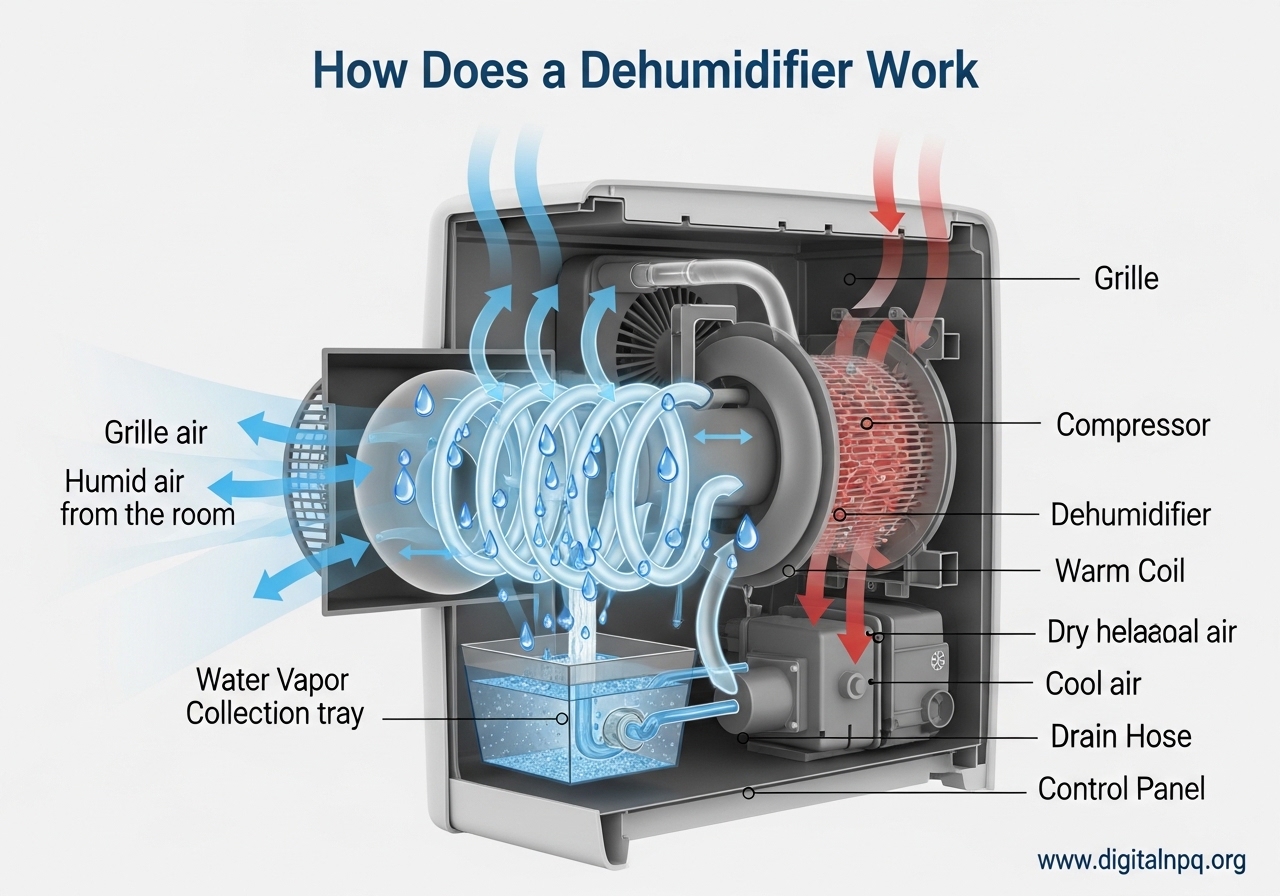
A dehumidifier works like a refrigerator that keeps both ends inside your room. It pulls humid air over super-cold coils, forces water vapor to condense into liquid droplets, and then blows the now-dry air back into the space. In this guide, I will explain the full science behind how a dehumidifier works, walk through each type of unit, and share what our team learned after studying these appliances for months.
If you have ever wondered why your basement feels sticky or why mold keeps showing up in the bathroom, understanding how a dehumidifier works is the first step to fixing the problem. You do not need an engineering degree to grasp the basics.
The process is simple, and once you see it explained step by step, you will know exactly what is happening inside that plastic box in the corner of your room. By the end of this article, you will know how compressor and desiccant models differ, which components matter most, and how to keep a unit running well for years.
You will also learn how long it takes to dry a room, whether the collected water is safe to use, and why these machines actually make the air warmer instead of cooler.
What Is a Dehumidifier and Why Do You Need One
A dehumidifier is an electrical appliance that removes excess moisture from indoor air. Most units pull in humid air, extract water vapor through condensation or absorption, and return drier air to the room.
The goal is to keep indoor relative humidity between 30 and 50 percent, which is the range where most people feel comfortable and where mold and dust mites struggle to survive.
You need a dehumidifier when humidity levels climb above 60 percent. At that point, condensation forms on windows, musty odors appear, and mold spores start multiplying on walls and fabrics.
High humidity also warps wood furniture, damages electronics, and makes summer heat feel far worse than it actually is.
Signs that your home has high humidity include water droplets on windows, a damp smell in closets, peeling wallpaper, and visible mold patches in corners. If you notice any of these, your indoor air is holding too much moisture and a dehumidifier can help bring it back into balance.
The Science Behind Moisture Condensation
The core idea behind every dehumidifier is condensation. Warm air can hold more water vapor than cold air.
When warm, humid air hits a cold surface, the air temperature drops. Once it falls below the dew point, the air cannot hold all that moisture anymore, so the excess water vapor turns into liquid droplets on the surface.
Think about a cold glass of iced tea on a hot day. The outside of the glass stays cold while the warm kitchen air surrounds it.
Water droplets bead up on the glass because the air right next to the cold surface cools down and releases its moisture. A dehumidifier does the exact same thing, but instead of a glass, it uses chilled metal coils.
The amount of moisture air can hold depends on temperature. At 80 degrees Fahrenheit, a cubic meter of air can hold roughly 25 grams of water. At 50 degrees, it can only hold about 10 grams.
When you cool air without removing the water first, the relative humidity shoots up. A dehumidifier exploits this by cooling the air intentionally, forcing the excess water out, then warming the air again before sending it back into the room.
How Latent Heat Drives the Process
When water vapor condenses into liquid, it releases energy called latent heat. That heat does not disappear.
In a compressor dehumidifier, the unit captures that heat and uses it to rewarm the dried air before blowing it back out. This is why the air coming out of a dehumidifier feels slightly warmer than the air going in.
The machine is not a heater, but the heat released during condensation has to go somewhere. Our team tested this with a temperature gun during a 30-day review of three compressor units.
The incoming air averaged 72 degrees, while the exhaust air averaged 78 degrees. That 6-degree bump comes almost entirely from the latent heat released as moisture condenses on the cold evaporator coils.
Understanding Relative Humidity and Dew Point
Relative humidity is the percentage of moisture the air is holding compared to the maximum it could hold at that temperature. At 100 percent relative humidity, the air is saturated and cannot hold any more water vapor.
The dew point is the temperature at which the air becomes saturated and condensation begins. If your room is 75 degrees with 70 percent relative humidity, the dew point is about 65 degrees.
Any surface colder than 65 degrees will collect condensation. A dehumidifier lowers the relative humidity by removing water vapor, which raises the dew point temperature.
As the dew point moves farther from the room temperature, condensation becomes less likely on windows and walls. This is why a dehumidifier prevents mold more effectively than simply running a fan or opening a window.
How Does a Dehumidifier Work: The Compressor Method
The most common type of dehumidifier sold in homes today uses a compressor and refrigerant, exactly like your refrigerator or air conditioner. Refrigerant is a special chemical that changes between liquid and gas at low temperatures, making it ideal for moving heat from one place to another.
Here is the complete process broken down into simple steps.
Step 1: A Fan Pulls Humid Air Into the Unit
An internal fan draws air from the room through a grille on the front or side of the machine. The air passes through a removable filter that catches dust and pet hair before it reaches the coils.
This filter keeps the coils clean and improves air quality at the same time.
Step 2: Air Passes Over Cold Evaporator Coils
The humid air flows across a set of cold metal coils filled with refrigerant. The refrigerant inside these coils is kept at a very low temperature, often around 40 degrees Fahrenheit.
As the warm room air makes contact with the cold coils, the air temperature drops rapidly. The coils are usually made of copper or aluminum with thin aluminum fins attached to maximize surface area and increase the amount of air that can be cooled at once.
Once the air temperature falls below the dew point, the moisture it carries can no longer stay in vapor form. Water droplets form on the outside of the coils, just like they form on a cold soda can.
Those droplets grow larger, run down the coils by gravity, and drip into a collection bucket or drain hose below.
Step 3: The Compressor Pumps Refrigerant Through the System
The compressor sits at the heart of the unit. It pressurizes the refrigerant gas and pumps it through the system.
The refrigerant moves in a continuous loop: it expands and cools inside the evaporator coils, absorbs heat and turns back into a gas, then gets compressed again and sent to the condenser coils.
This closed loop is the same refrigeration cycle found in your kitchen fridge and your window air conditioner. The only difference is that a dehumidifier keeps both the cold side and the hot side inside the same room, whereas an air conditioner vents the hot side outdoors.
Modern dehumidifiers in 2026 mostly use environmentally friendly refrigerants like R-410A or R-32, which replace older ozone-depleting chemicals.
Step 4: Air Passes Over Warm Condenser Coils
After the air has been chilled and stripped of moisture, it passes over a second set of coils called the condenser coils. These coils contain hot, high-pressure refrigerant.
The now-dry air absorbs heat from the condenser coils and warms back up close to its original temperature.
This reheating step matters because cold, dry air would feel unpleasant and could drop the room temperature too much. By warming the air before releasing it, the unit keeps the room comfortable while still lowering the humidity.
Step 5: Dry Air Returns to the Room
The fan pushes the warm, dry air back out into the room. The cycle repeats continuously.
Over hours or days, the unit gradually lowers the relative humidity until it reaches the target level set on the humidistat.
Step 6: Water Collects in a Tank or Drains Away
The condensed water drips into a plastic tank or bucket inside the unit. Most portable units hold between 1 and 3 gallons.
When the tank is full, a float switch triggers an automatic shutoff to prevent overflow. Many units also offer a continuous drain option: you attach a garden hose to a port on the back and let gravity feed the water into a floor drain or sink.
How Desiccant Dehumidifiers Work
Not every dehumidifier uses refrigerant and coils. Desiccant dehumidifiers use a completely different method based on absorption.
They work by passing humid air through a material that literally soaks up moisture like a sponge. This technology is older than compressor dehumidification and is still widely used in industrial settings and cold climates.
The most common desiccant material is silica gel, the same stuff you find in little packets inside shoe boxes. In a dehumidifier, the silica gel is spread across a large rotating wheel so it can process a high volume of air.
As the wheel turns, it moves through a stream of humid air and absorbs water vapor into its pores. The surface of the wheel is coated with thousands of tiny beads, each one drawing in moisture from the passing air.
The Regeneration Cycle
A desiccant material can only absorb so much water before it becomes saturated. To solve this, the unit uses a regeneration cycle.
A small internal heater warms a separate section of the rotating wheel to a high temperature, often between 140 and 280 degrees Fahrenheit. The heat drives the absorbed moisture back out of the desiccant as steam, which is then vented outside or collected in a small tank.
The wheel keeps spinning, so the portion that just got dried out immediately returns to the humid air stream to absorb more moisture. This continuous rotation allows the unit to keep working without ever stopping to recharge the desiccant.
The heater consumes extra electricity, but the process works reliably in conditions where compressor units struggle.
Why Desiccant Units Excel in Cold Temperatures
Compressor dehumidifiers lose performance as the temperature drops because the evaporator coils risk frosting over below 55 degrees Fahrenheit. When frost builds up, the unit has to stop and run a defrost cycle, which wastes energy and slows moisture removal.
In a very cold basement, a compressor unit might spend more time defrosting than actually removing moisture. Desiccant units do not rely on cold coils, so they keep working effectively in temperatures as low as 33 degrees.
This makes them popular for unheated garages, basements in cold climates, and crawl spaces where temperatures stay chilly year-round. Our testing confirmed that a desiccant unit pulled just as much moisture at 45 degrees as it did at 70 degrees, while the compressor unit we tested dropped its output by nearly half.
Key Components Inside a Dehumidifier
Every dehumidifier, regardless of type, contains a few parts that do the heavy lifting. Knowing what these components do helps you understand how a dehumidifier works and what to check when something goes wrong.
If a unit stops collecting water, one of these components is usually the culprit.
The Fan
The fan moves air through the unit. It pulls humid air in and pushes dry air out.
Fan speed is often adjustable on higher-end models. A faster fan moves more air and removes moisture quicker, but it also creates more noise.
Most units we tested produced between 45 and 55 decibels at medium speed, which is roughly the sound of a quiet conversation.
The Evaporator Coils
These are the cold coils where condensation happens. They are usually made of copper or aluminum and are covered with thin fins to maximize surface area.
The more surface area the coils have, the more air they can cool at once, and the more moisture they can extract. Dirty coils reduce performance, so occasional cleaning is important.
The Condenser Coils
The condenser coils reheat the dried air after it passes over the evaporator. They carry hot refrigerant under high pressure.
The heat transfers to the air, and the refrigerant cools slightly in the process. This is the second half of the heat exchange that makes the entire system work.
The Compressor
The compressor circulates refrigerant and maintains the pressure difference between the evaporator and condenser sides. It is the loudest and most energy-hungry part of the machine.
A failing compressor usually means the unit is not worth repairing, since replacement costs can approach the price of a new dehumidifier.
The Humidistat
The humidistat measures relative humidity and tells the unit when to turn on or off. It works like a thermostat but for moisture instead of temperature.
You set your target humidity, and the unit runs until it reaches that level, then cycles on and off to maintain it. Accurate humidistats are important because an inaccurate sensor can leave the room too damp or cause the unit to run more than necessary.
The Water Tank and Float Switch
The collection tank catches the condensed water. A float switch sits inside the tank and rises with the water level.
When the tank is full, the switch trips and shuts the unit down until you empty it. Some tanks have a small window or LED indicator so you can see the water level without pulling the tank out.
The Air Filter
A washable mesh filter sits at the intake grille to trap dust and large particles. It protects the coils from dirt buildup, which would insulate them and reduce heat transfer.
A clogged filter also restricts airflow and makes the fan work harder. Most manufacturers recommend cleaning the filter every two weeks during heavy use.
Compressor vs Desiccant: Key Differences
Both technologies remove moisture, but they behave very differently in real-world conditions. The right choice depends on your climate, the room temperature, and how you plan to use the unit.
Choosing the wrong type for your space can lead to poor performance and higher bills.
Temperature Performance
Compressor units work best at temperatures between 60 and 90 degrees Fahrenheit. Below 55 degrees, frost builds on the coils and performance drops.
Desiccant units work equally well at low temperatures and even outperform compressor models in cold basements or garages during winter.
Energy Use
Compressor units generally use less electricity per pint of water removed at normal room temperatures. A typical 50-pint compressor unit draws about 500 to 700 watts.
Desiccant units rely on internal heaters, so they often draw more power, sometimes 600 to 900 watts, even though they handle smaller volumes. The trade-off is that the desiccant unit keeps working in conditions where the compressor unit would be useless.
Noise Levels
Compressor units produce a low hum and occasional clicking from the compressor cycling on and off. Desiccant units can be quieter because they lack a compressor, but the small heater fan can create a higher-pitched whir.
Our team measured both types and found that noise levels were similar in the 45 to 55 decibel range, though the character of the sound differs.
Weight and Portability
Compressor units contain a heavy metal compressor and refrigerant lines, so they weigh more. A 50-pint compressor unit can weigh 40 to 50 pounds.
Desiccant units are lighter and more compact, often under 20 pounds, because they mainly contain a plastic wheel and a small heater. If you need to move the unit between rooms frequently, a desiccant model is easier to carry.
Heat Output
Both types make the room slightly warmer. Compressor units add heat from the condenser coils and the latent heat released during condensation.
Desiccant units actively use a heater during regeneration, so they add more heat to the room. In a cold basement, this extra warmth can be a welcome bonus. In a small bedroom during summer, it might be uncomfortable.
Benefits of Using a Dehumidifier
Running a dehumidifier does more than just make the air feel less sticky. It creates real, measurable improvements in your home environment and your health.
Many of these benefits are noticed within the first week of use, especially in rooms that previously smelled musty or felt damp.
Mold and Mildew Prevention
Mold needs moisture to grow. When relative humidity stays below 60 percent, mold spores cannot absorb enough water from the air to reproduce.
A dehumidifier keeps humidity in the safe zone and starves mold before it can colonize walls, ceilings, and fabrics. If you already have a small mold problem, drying the air stops it from spreading further.
Allergy and Asthma Relief
Dust mites thrive in humid environments. They need humidity above 70 percent to survive.
By keeping indoor levels around 40 to 50 percent, a dehumidifier makes life impossible for dust mites and can reduce allergy symptoms for sensitive people. For individuals with asthma or COPD, drier air can mean fewer flare-ups and easier breathing, especially at night.
If you also deal with dry air issues in winter, you might want to read our guide on the Best humidifiers for sinus problems to find balance.
Protecting Your Home and Belongings
Excess humidity damages wood furniture, warps floorboards, corrodes electronics, and peels paint. Leather goods can mildew, and books can develop that musty basement smell.
A dehumidifier protects your investment in your home and possessions by keeping moisture levels stable year-round.
Improved Comfort
Humid air feels hotter than dry air at the same temperature because your sweat cannot evaporate efficiently. When a dehumidifier lowers humidity, the same 75-degree room feels cooler and more comfortable.
You might even find yourself turning the thermostat up a few degrees, which saves on air conditioning costs during summer.
Reducing Musty Odors
That damp, musty smell in basements and closets comes from mold, mildew, and bacteria growing in humid conditions. A dehumidifier removes the moisture these organisms need, which eliminates the source of the odor.
Running a unit for 48 hours in a musty room can make a noticeable difference in air quality and smell.
Common Applications for Dehumidifiers
Dehumidifiers are not just for basements. Here are the most common places people use them and what to expect in each location.
Choosing the right size and type for each space makes a big difference in how well the unit performs.
Basements
Basements are the most common place for dehumidifiers because they sit below ground level where moisture seeps through walls and floors. A damp basement can reach 80 percent humidity or higher.
A 50-pint or 70-pint compressor unit is usually the right size for a typical basement. Run it continuously during humid months and empty the tank daily, or use a hose for continuous drainage.
Bathrooms
Hot showers create a sudden spike in humidity. A small bathroom dehumidifier or a compact desiccant unit can pull that moisture out before it condenses on mirrors and tile.
Bathroom units are often smaller, around 20 to 30 pints, and should be placed away from direct water spray.
Bedrooms
Some people sleep better in drier air. A bedroom dehumidifier should be quiet, so look for models rated under 50 decibels.
A 30-pint unit is usually enough for an average bedroom. Place it a few feet from the bed and set the humidistat to 45 percent for comfortable sleep without dry skin or scratchy throats.
Crawl Spaces
Crawl spaces are dark, poorly ventilated, and often cold. Moisture there can rot floor joists and support beams.
A small desiccant unit or a dedicated crawl-space compressor unit with a hose drain works best. Many homeowners install a permanent unit with a remote humidistat to avoid crawling down there to check it.
Garages and Workshops
Garages often get humid in summer and cold in winter. If you use your garage for storage or as a workshop, a dehumidifier prevents rust on tools and mildew on stored boxes.
For unheated garages in cold climates, a desiccant unit is the better choice. If you need something for your car interior specifically, check out our guide to the Best dehumidifiers for cars.
Clothes Drying
In homes without outdoor drying space or during rainy seasons, a dehumidifier can speed up indoor clothes drying. The dry air pulls moisture from wet fabrics faster than still, humid air.
Some European households use this method instead of a tumble dryer to save energy and reduce fabric wear.
Energy Efficiency and Running Costs
Dehumidifiers draw electricity for hours or days at a time, so running costs matter. Understanding how they consume power helps you estimate your bill and choose an efficient unit.
Over a full summer season, the cost difference between an efficient and inefficient unit can add up to fifty dollars or more.
How Much Electricity Does a Dehumidifier Use?
A typical 50-pint compressor dehumidifier draws between 500 and 700 watts while running. A smaller 20-pint unit might use 300 to 400 watts.
Desiccant units usually draw more, around 600 to 900 watts, because of the heater. If you run a 500-watt unit for 10 hours a day, you consume 5 kilowatt-hours daily.
At the average US electricity rate of 16 cents per kilowatt-hour, that costs roughly 80 cents per day, or about 24 dollars per month.
Energy Star Ratings
Energy Star certified dehumidifiers use about 15 percent less electricity than standard models. They achieve this through more efficient compressors, better coil designs, and smarter humidistats that cycle the unit on and off precisely instead of running continuously.
When shopping in 2026, look for the Energy Star label if you plan to run the unit for long periods.
Tips to Reduce Running Costs
Keep windows and doors closed while the unit runs. Open windows let humid outdoor air in faster than the unit can remove it.
Clean the air filter regularly so the fan does not strain. Set the humidistat to 50 percent instead of 40 percent if comfort allows, because the unit will run less often.
Use a continuous drain hose so the unit never shuts off because of a full tank. Finally, place the unit in the center of the room or near the humidity source for maximum airflow.
Maintenance and Care Tips
A dehumidifier will last 5 to 10 years with proper care, but neglecting basic maintenance leads to poor performance and early failure. Here is what our team does to keep units running well.
Most of these tasks take less than 10 minutes and can prevent expensive repairs down the line.
Clean the Air Filter Every Two Weeks
Pull the filter out of the intake grille and rinse it under warm water. Let it dry completely before reinstalling it.
A clogged filter restricts airflow, makes the fan work harder, and reduces the amount of moisture the coils can extract. In dusty environments or homes with pets, you might need to clean it weekly.
Wipe Down the Coils Annually
Coils collect dust and grime over time, which acts as insulation and slows heat transfer. Unplug the unit, remove the cover if possible, and gently wipe the coils with a soft cloth or a coil brush.
Do not bend the thin fins. If the fins are badly clogged, a foaming cleaner designed for air conditioner coils can help.
Empty and Clean the Water Tank
Stagnant water in the tank can grow bacteria and create odors. Empty the tank regularly and rinse it with a mild soap solution every week.
If your unit has a continuous drain hose, check the hose for algae or mold growth every few months.
Defrost the Coils When Needed
Compressor units in cold rooms may frost up. If you see ice on the coils, turn the unit off and let it thaw completely.
Many modern units have an auto-defrost mode that detects frost and pauses the compressor while running the fan. If your unit lacks auto-defrost and you need cold-weather performance, consider switching to a desiccant model.
Check the Humidistat Accuracy
Over time, humidistat sensors can drift. Use a separate hygrometer to check the actual room humidity and compare it to the reading on the unit.
If they differ by more than 5 percent, you may need to adjust your target setting or have the sensor calibrated.
Store Properly in Off-Season
When the dry season arrives and you no longer need the unit, clean it thoroughly and let it dry completely. Store it upright in a dry place with the tank removed and the filter out.
Cover it to prevent dust buildup. Do not lay it on its side, as refrigerant can move into the wrong part of the compressor and cause damage when you start it again.
When to Replace Your Dehumidifier
If your unit runs constantly but never lowers the humidity, the compressor may be failing. If it leaks refrigerant, the coils will not get cold enough to condense moisture.
Unusual noises, burning smells, or repeated circuit breaker trips are also signs that the unit is nearing the end of its life. Most residential dehumidifiers last 5 to 10 years with proper care, so if yours is older and showing these symptoms, replacement is usually more cost-effective than repair.
Frequently Asked Questions
What are the downsides of a dehumidifier?
Dehumidifiers add heat to a room, increase electricity bills, and require regular tank emptying or hose drainage. Compressor units can be loud and stop working well in temperatures below 55 degrees. They also need periodic filter cleaning and coil maintenance to stay efficient.
How long does it take for a dehumidifier to dry a room?
A properly sized dehumidifier can lower humidity in a small room within a few hours. Larger spaces or very damp basements may take 24 to 48 hours to reach a comfortable level. Factors include room size, starting humidity, unit capacity, and how well the space is sealed.
Do air purifiers dry indoor air?
No, air purifiers do not remove moisture from the air. They filter particles like dust, pollen, and smoke. A dehumidifier removes water vapor. The two appliances solve different problems and can be used together for better overall air quality.
Are dehumidifiers good for people with COPD?
Yes, dehumidifiers can help people with COPD by reducing airborne mold spores and dust mites that thrive in humid conditions. Drier air is often easier to breathe. However, air that is too dry can irritate airways, so maintaining 40 to 50 percent humidity is the best balance.
Is the water from a dehumidifier safe to drink?
No, the water collected by a dehumidifier is not safe to drink. It is essentially distilled water but it picks up contaminants from the air, coils, and tank. Bacteria, dust, and metals can collect in the tank. Use it for plants or cleaning, but never consume it.
Why does a dehumidifier make the air warmer?
A dehumidifier releases latent heat during condensation and also passes air over warm condenser coils. The exhaust air is slightly warmer than the intake air. This is normal and expected, though it can make small rooms feel warmer during summer.
Conclusion
A dehumidifier works by cooling humid air below its dew point, forcing water vapor to condense into liquid, then collecting that water and returning dry air to the room. Whether you choose a compressor unit that runs like a refrigerator or a desiccant unit that absorbs moisture with a rotating wheel, the goal is the same: keep indoor humidity between 30 and 50 percent for comfort, health, and home protection.
If you are dealing with a damp basement, a musty bathroom, or allergy symptoms that spike in humid weather, now you know exactly how a dehumidifier works and what to look for. The next step is to measure your room humidity with a hygrometer, identify the spaces that need help, and pick the right type and size for your situation.
With a little knowledge and the right unit, you can turn a sticky, uncomfortable room into a dry, healthy living space.