
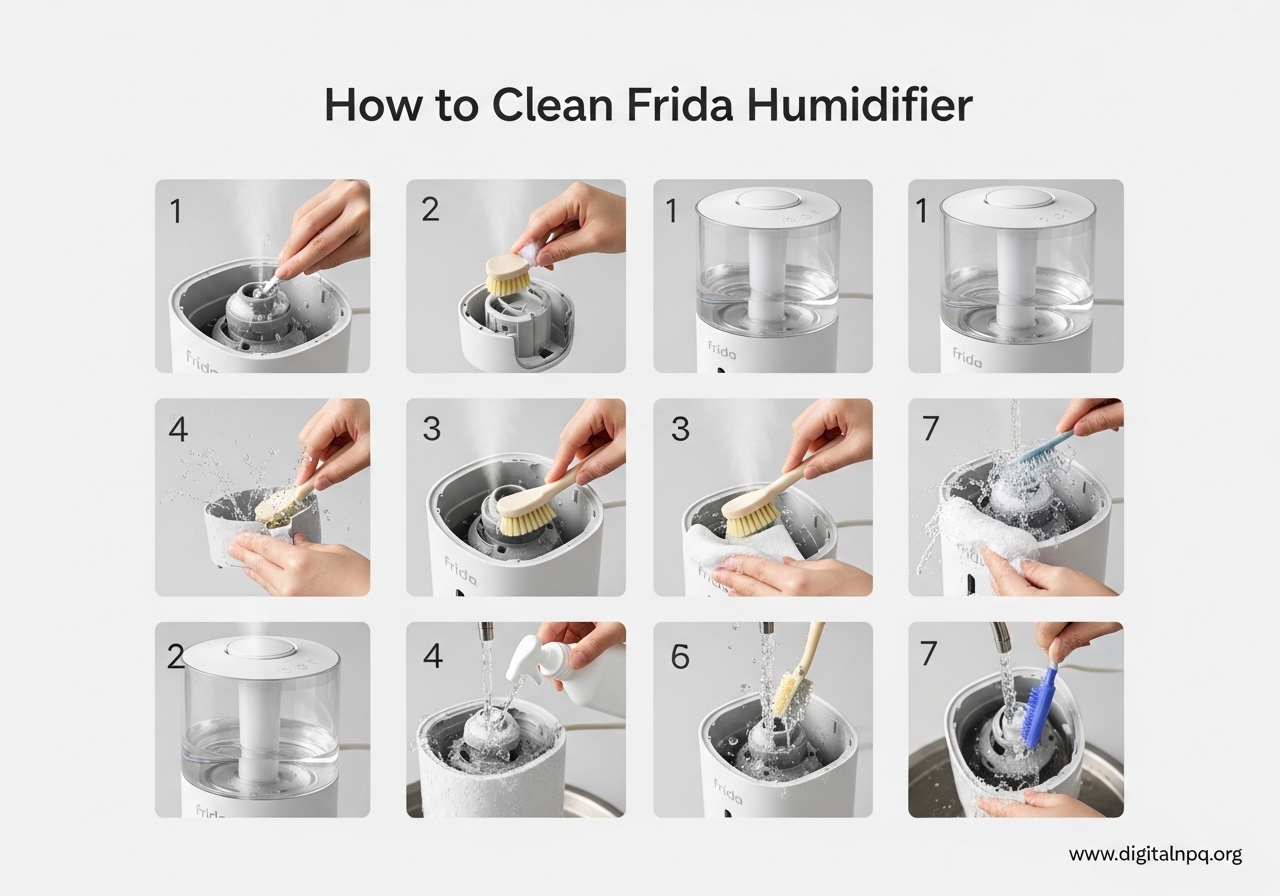
If you own a Frida Baby humidifier, keeping it clean is one of the most important things you can do for your baby’s air quality. Bacteria and mold can start growing in standing water in as little as 24 to 48 hours, and that contaminated mist goes straight into the air your little one breathes. Learning how to clean Frida humidifier parts properly takes just a few minutes, and it makes a real difference in preventing mold buildup, mineral deposits, and that pesky pink film so many parents notice.
In this guide, I will walk you through the exact cleaning steps I use on my own Frida Baby 3-in-1 Cool Mist Humidifier. I will cover weekly maintenance cleaning, deep cleaning for stubborn mold, alternative cleaning solutions if you do not have vinegar on hand, and prevention tips that will save you time and frustration down the road.
What You Need to Clean Your Frida Humidifier
Before starting the cleaning process, gather your supplies. Having everything ready makes the job faster and keeps you from running to the kitchen mid-clean with vinegar-soaked hands.
- White distilled vinegar – This is your primary cleaning solution. Do not use apple cider vinegar or balsamic vinegar. Plain white distilled vinegar is what works best for dissolving mineral deposits and killing bacteria.
- Soft bristle brush – A small bottle brush or a dedicated cleaning brush with soft bristles. You need this for scrubbing the base without scratching the plastic.
- Hydrogen peroxide (3%) – Optional, but useful for removing odors and tackling stubborn mold that vinegar alone cannot handle.
- Disposable cleaning cloth or paper towels – For wiping down the exterior and base components.
- Clean water – For rinsing all parts thoroughly after cleaning.
- A dry towel or napkin – For drying and storage prep.
Avoid using harsh chemical cleaners, abrasive sponges, or scrub pads. The Frida humidifier has delicate parts, especially the transducer inside the base, that can be damaged by rough handling or strong chemicals.
How to Clean Frida Humidifier: Step-by-Step Guide
Cleaning your Frida humidifier comes down to two main tasks: cleaning the water tank and cleaning the base unit. The entire process takes about 30 to 40 minutes, though most of that is passive soaking time where you can step away and do other things.
Before you start any cleaning, unplug the humidifier from the power source and empty any remaining water from both the tank and the base. Never attempt to clean the unit while it is plugged in.
A note on first-time use: Yes, you should clean your Frida Baby humidifier before using it for the first time. Manufacturing residue can remain inside the tank and base from the production process. Run through the full cleaning steps below before filling it with water for your baby’s room.
Step 1: Clean the Water Tank
The water tank is where most mold and mineral buildup happens since it holds standing water for hours at a time. Here is exactly how to clean it.
- Fill the tank with your cleaning solution. Pour 1 cup of water and 1 cup of white distilled vinegar into the tank. This 50/50 solution is the standard ratio recommended by Frida’s own customer support team.
- Seal and shake. Screw the tank cap back on tightly. Gently shake and swirl the solution around inside the tank, making sure the vinegar mixture reaches all interior surfaces, including the neck and bottom corners.
- Let it soak for 20 minutes. Set the tank aside and let the vinegar solution sit undisturbed. This soak time is what breaks down mineral deposits and loosens any slime buildup on the walls.
- Scrub if needed. After soaking, use your soft bristle brush to scrub the inside of the tank, paying extra attention to the bottom and around the threads where the cap screws on. These are the spots where residue likes to hide.
- Empty and inspect. Pour out the vinegar solution and check for any remaining film or spots. If you still see pink or orange residue, repeat the soak with fresh vinegar solution for another 10 minutes.
For hard-to-reach areas inside the tank, try using a clean bottle brush with a long handle. Some parents on Reddit have also had success adding a small amount of uncooked rice to the vinegar solution and shaking vigorously. The rice acts as a gentle abrasive that scrubs areas your brush cannot reach.
Step 2: Clean the Base Unit
The base unit requires more care than the tank because it houses the transducer, which is the small disc that creates the mist. Damaging the transducer means your humidifier will stop working.
- Pour undiluted white vinegar into the base. Use straight white vinegar, not the 50/50 mix. You need the full strength to dissolve mineral buildup on and around the transducer.
- Let it soak for 20 minutes. Allow the vinegar to sit in the base, covering the transducer area. The vinegar will dissolve calcium and mineral deposits that form on the disc over time.
- Gently scrub the transducer area. Using your soft bristle brush, very gently brush the surface of the transducer. Do not press hard. Light strokes are enough to remove softened deposits. Scrubbing too aggressively can permanently damage this component.
- Wipe down the rest of the base. Use a disposable cleaning cloth or paper towel dipped in vinegar to wipe the interior walls and bottom of the base. Pay attention to any crevices where slime or mold might accumulate.
- Clean the 360 degree mister. If your model has the rotating mist outlet, wipe it down with a damp cloth. Remove any visible residue from the opening.
Important warning: Never submerge the base unit in water. The base contains electrical components that will be damaged if fully immersed. Only pour liquid directly into the basin area and wipe clean.
Step 3: Rinse and Dry Everything Thoroughly
Rinsing is arguably the most important step. Any leftover vinegar or cleaning residue will get vaporized into the air the next time you run the humidifier, and nobody wants their baby breathing vinegar mist.
- Rinse the tank at least three times. Fill it with clean water, shake vigorously, and pour out. Repeat this process until you can no longer smell any vinegar. I usually rinse mine four to five times to be safe.
- Rinse the base carefully. Pour clean water into the basin and gently swish it around. Pour it out without tilting the base too far. Avoid getting water near any electrical openings or the power cord connection point.
- Air dry completely. Set all parts on a clean towel and let them air dry fully before reassembling. This usually takes 30 to 60 minutes depending on your room’s humidity. Do not reassemble while parts are still damp, as trapped moisture promotes mold growth.
Pro tip from Frida’s official support team: When you are storing the humidifier for more than a few days, place a dry napkin or paper towel inside the water tank. It absorbs residual moisture and helps prevent mold from forming during storage.
How to Deep Clean a Frida Humidifier with Mold
Sometimes a weekly cleaning is not enough. If you have noticed black spots, a thick pink or orange film, or a musty smell coming from your Frida humidifier, it is time for a deep clean. Many parents on forums like r/NewParents and r/CleaningTips report that standard vinegar cleaning does not always handle severe mold. Here is a more aggressive approach.
For Stubborn Mold and Pink Film
- Use undiluted vinegar for both tank and base. Skip the 50/50 ratio entirely. Fill both the tank and base with straight white distilled vinegar and let them soak for 30 to 45 minutes instead of the standard 20 minutes.
- Follow up with hydrogen peroxide. After emptying the vinegar, pour 3% hydrogen peroxide into the tank and base. Let it sit for 15 minutes. Hydrogen peroxide is effective at killing mold spores that survive vinegar treatment and helps remove that stubborn pink or orange slime caused by Serratia marcescens bacteria.
- Scrub all surfaces thoroughly. Use your soft bristle brush on every surface. Pay special attention to seams, crevices, and the area around the tank cap threads where mold likes to hide.
- Rinse extensively. Rinse every part five or more times with clean water. Both vinegar and hydrogen peroxide need to be fully removed before use.
When to Consider Replacing Your Humidifier
If you have deep cleaned your Frida humidifier multiple times and mold keeps returning within days, the plastic may have become too porous. Microscopic scratches in the plastic can harbor mold spores that no amount of scrubbing can reach. Some Reddit users reported having to throw away their Frida humidifiers after months of persistent mold issues. If your humidifier is more than a year old and mold keeps coming back despite regular cleaning, it may be time to replace it.
How to Clean Frida Humidifier Without Vinegar
Vinegar is the go-to cleaner for most humidifier maintenance, but some parents cannot stand the smell or simply do not have it on hand. Here are three alternatives that work.
Hydrogen Peroxide
Hydrogen peroxide at 3% concentration is an excellent substitute for vinegar. Pour it directly into the tank and base, let it sit for 20 minutes, then scrub and rinse. It kills bacteria and mold effectively and leaves no lingering odor. Some parents actually prefer peroxide over vinegar for this reason.
Mild Dish Soap and Water
For light cleaning between deep cleans, a few drops of mild dish soap in warm water works fine for the tank. Use a soft cloth or brush to wash the interior, then rinse thoroughly. This method is best for routine maintenance rather than tackling mineral deposits or mold. Never use dish soap inside the base unit near the transducer.
Bleach Solution (Use With Caution)
Frida’s official cleaning instructions mention bleach as an option. If you choose to use bleach, dilute it heavily: 1 teaspoon of bleach per gallon of water. Soak the tank for 20 minutes, then rinse at least five times. Never mix bleach with vinegar or any other cleaner. Always ensure the room is well ventilated when using bleach, and keep it far away from your baby’s nursery during the cleaning process. Personally, I only recommend bleach as a last resort for severe mold situations.
How to Prevent Mold in Your Frida Humidifier
The best way to deal with mold is to stop it before it starts. A few simple habits will dramatically reduce how often you need to deep clean your Frida humidifier.
Empty and refill daily. Do not let water sit in the tank for more than 24 hours. Even if the tank is still half full, dump it out and refill with fresh water each day. Stagnant water is the number one cause of mold and bacteria growth.
Use distilled or filtered water. Tap water contains minerals that build up on the transducer and tank walls over time. These mineral deposits create a rough surface where mold and bacteria can anchor and grow. Distilled water costs a little more but dramatically reduces mineral buildup and extends the life of your humidifier.
Keep the humidifier in a well-ventilated area. If the room is too humid, condensation forms on the unit itself, creating extra moisture where mold thrives. If you notice condensation on windows or walls near the humidifier, turn it down or run it for fewer hours.
Dry it out between uses. If you only use the humidifier at night, empty and air dry the tank during the day. Leaving water sitting in a closed tank all day is an open invitation for bacteria.
Watch for early warning signs. If you notice a slight odor, cloudy water, or any discoloration on the tank walls, clean the humidifier immediately. These are early indicators that bacteria or mold are starting to take hold. Catching it early means a simple vinegar soak instead of a full deep clean.
How Often Should You Clean a Frida Baby Humidifier
The short answer is at least once per week if you use it daily. But the real answer depends on how heavily you use it and your water quality.
- Daily use: Clean the tank and base once per week with the standard vinegar method. Empty and refill with fresh water every single day.
- Occasional use (a few times per week): Clean after every 3 to 4 uses, or at minimum once every two weeks.
- Before first use: Always clean a brand new Frida humidifier before filling it for the first time.
- Before and after storage: Clean and dry thoroughly before packing it away. Clean again before pulling it back out for the next cold season.
- Hard water areas: If your tap water is heavy in minerals, you may need to clean every 4 to 5 days instead of weekly to prevent transducer buildup.
Parents on community forums like What to Expect and Reddit consistently report that sticking to a weekly cleaning schedule is the difference between a humidifier that lasts for years and one that gets thrown away after a few months due to mold problems.
FAQ
How to clean the inside of a Frida humidifier?
Fill the water tank with a 50/50 mix of white distilled vinegar and water (1 cup each). Screw the cap on, shake to coat all surfaces, and let it sit for 20 minutes. After soaking, scrub the inside with a soft bristle brush, paying attention to the bottom and cap threads. Pour out the solution and rinse at least three times with clean water until no vinegar smell remains. For the base, pour undiluted vinegar directly in and let soak for 20 minutes before gently scrubbing and wiping clean.
How to get mold out of Frida Mom humidifier?
For mold removal, skip the diluted mix and use undiluted white vinegar in both the tank and base. Let it soak for 30 to 45 minutes instead of the standard 20. Follow up with 3% hydrogen peroxide for another 15 minutes to kill any remaining mold spores. Scrub all surfaces with a soft brush, rinse five or more times, and air dry completely. If mold returns within days despite regular cleaning, the plastic may have become too porous and replacement should be considered.
What kind of vinegar can I use to clean a Frida humidifier?
Use plain white distilled vinegar. It is the most effective type for dissolving mineral deposits and killing bacteria. Do not use apple cider vinegar, balsamic vinegar, or cleaning vinegar with additives. White distilled vinegar is inexpensive, leaves no residue, and is the type specifically recommended by Frida’s official customer support documentation.
Does Frida baby humidifier get moldy fast?
Yes, the Frida humidifier can develop mold quickly if water is left sitting for more than 24 to 48 hours. Many parents on forums report seeing mold or pink film within just a few days of stagnant water. The design has some hard-to-reach areas in the tank and base that can trap moisture. Regular weekly cleaning with vinegar, emptying the tank daily, and using distilled water instead of tap water all help slow down mold growth significantly.
Should I clean a Frida baby humidifier before first use?
Yes, you should always clean your Frida humidifier before the very first use. Manufacturing and packaging can leave behind residue inside the tank and base. Run through the standard vinegar cleaning steps: fill the tank with a 50/50 vinegar and water solution, soak for 20 minutes, scrub, rinse thoroughly, and air dry before filling with fresh water for use.
How to clean Frida baby humidifier without vinegar?
Hydrogen peroxide at 3% concentration is the best vinegar-free alternative. Pour it into the tank and base, let it soak for 20 minutes, scrub with a soft brush, and rinse thoroughly. Hydrogen peroxide kills bacteria and mold effectively without the strong smell of vinegar. For light cleaning between deep cleans, mild dish soap and warm water works for the tank. Bleach diluted at 1 teaspoon per gallon of water is another option but should only be used as a last resort for severe mold.
Can you run vinegar through a humidifier to get rid of mold?
You should not run vinegar through the humidifier while it is operating. Instead, pour the vinegar solution into the tank and base while the unit is unplugged, let it soak, then scrub and rinse before using it again. Running vinegar through an operating humidifier can damage the internal components and release vinegar vapor into your room, which is not safe for babies or young children to breathe.
Final Thoughts
Keeping your Frida Baby humidifier clean does not have to be a complicated or frustrating process. The key is consistency. A quick weekly clean with white vinegar and water, combined with daily water changes, is enough to prevent most mold and mineral buildup. When things do get bad, a deep clean with undiluted vinegar and hydrogen peroxide can bring most units back from the brink.
The biggest mistake I see parents make is letting water sit in the tank for days at a time. That is when bacteria multiply, pink film forms, and you end up spending an hour scrubbing instead of ten minutes on a routine clean. Learning how to clean Frida humidifier parts the right way, and doing it on a schedule, keeps the air in your baby’s room fresh and safe to breathe all season long.