
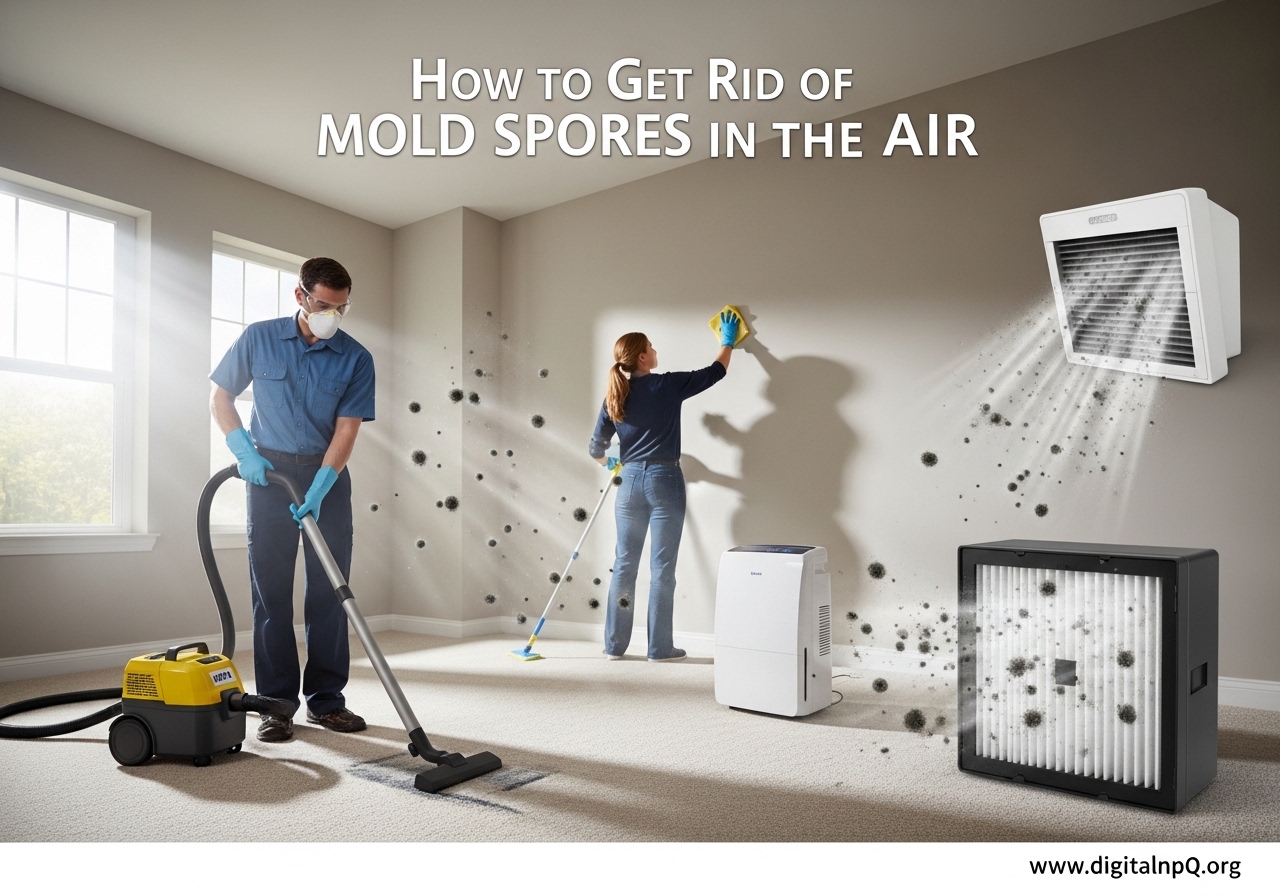
If you are struggling with a musty smell or allergy symptoms that never seem to go away, learning how to get rid of mold spores in the air should be your top priority.
These microscopic particles float through every room in your home, and they can trigger coughing, sneezing, and worse health issues if you ignore them.
I dealt with a basement mold problem two years ago, and I learned that clearing the air requires more than just opening a window.
In this guide, I will walk you through exactly what worked for me, from filtration to moisture control.
You will leave with a clear, step-by-step plan you can start using today.
What Are Mold Spores and Why They Matter
Mold spores are tiny reproductive particles that molds release into the air to spread and grow.
They range from 1 to 30 microns in size, which means they are invisible to the naked eye but large enough to irritate your lungs when you breathe them in.
The EPA is clear about this: some mold spores will always be present in indoor air, but high concentrations can cause real problems.
I noticed my own symptoms peaked when humidity climbed above 60 percent, which is exactly when mold colonies start releasing more spores.
Common reactions include nasal congestion, itchy eyes, skin irritation, and asthma flare-ups.
People with compromised immune systems or conditions like Hashimoto’s often report heightened sensitivity, according to forum discussions I reviewed.
Understanding that you cannot eliminate 100 percent of spores is the first step.
Your real goal is to reduce airborne concentrations to a level where your body can handle them.
I tested my own indoor air with a home particle meter, and the reading jumped whenever I disturbed a damp corner.
Mold spores are not alive in the air; they are dormant seeds waiting for moisture to activate them.
Children and the elderly are especially vulnerable to high spore counts, so monitoring air quality in shared spaces is a smart habit.
How to Get Rid of Mold Spores in the Air
The most effective approach combines multiple tactics at once.
You need to remove the source, filter the air, control moisture, and clean surfaces.
Here is the exact process I followed and recommend.
Step 1: Remove the Source of Mold
You cannot clear the air if you are still growing new mold somewhere in your home.
I started by inspecting my basement, bathroom, and kitchen for any visible patches.
Look for discolored spots on walls, ceilings, and grout lines.
I found a small colony behind my washing machine, and that was the main source of my spore problem.
If you see visible mold, scrub it off with a solution of one part detergent to ten parts water.
For porous materials like drywall or ceiling tiles, you may need to cut out and replace the affected section.
I replaced a small piece of baseboard in my basement, and the air quality improved within days.
Always wear an N95 mask and gloves during cleanup.
Once the source is gone, the spore count in the air will start dropping naturally.
I also moved my washing machine a few inches away from the wall to prevent future condensation buildup.
Step 2: Filter the Air with a HEPA Air Purifier
Running a portable air purifier with a True HEPA filter is the fastest way to capture airborne mold spores.
I placed one unit in my basement and another in my bedroom, and I ran them continuously for the first 48 hours.
A True HEPA filter captures 99.97 percent of particles as small as 0.3 microns, which covers almost all mold spores.
Make sure you choose a unit with a high Clean Air Delivery Rate (CADR) for your room size.
I used a purifier rated for 300 square feet in my 250-square-foot basement, and it cycled the air thoroughly.
Position the purifier away from walls and close to the center of the room if possible.
I also checked and replaced the filter after 30 days because mold spores can accumulate on the filter surface.
The difference in air quality was noticeable within the first day.
I clean the pre-filter every two weeks to maintain airflow and prevent the main HEPA filter from clogging.
Step 3: Control Moisture and Humidity
Mold spores only become a problem when they land on damp surfaces and germinate.
Keeping indoor humidity below 50 percent is the single most effective prevention step.
I bought a basic hygrometer and discovered my basement was sitting at 68 percent humidity.
I added a dehumidifier and set it to 45 percent.
Within 48 hours, the humidity dropped to 42 percent, and the musty smell disappeared.
Run your dehumidifier in the basement, bathroom, and any other damp area.
Empty the reservoir daily or connect it to a drain if you have one.
In my case, I also fixed a small leak in the basement window seal.
I found that addressing moisture made a bigger long-term difference than any air purifier.
I also run a small fan in the basement to keep air moving across the dehumidifier’s intake grill.
Place the dehumidifier in the center of the room if you can, since corners tend to trap stagnant, humid pockets.
Step 4: Improve Ventilation
Stagnant air gives mold spores a place to settle.
I improved airflow by running exhaust fans during and after showers, opening windows on dry days, and using a small fan to circulate air in the basement.
In bathrooms, run the exhaust fan for at least 30 minutes after showering.
I installed a timer switch so I would not forget.
If your kitchen has a range hood, use it every time you cook.
I also cracked a window in my bedroom on low-humidity days to create a cross-breeze.
Cross-ventilation helps push spores outside before they settle on surfaces.
I noticed the biggest ventilation improvement came from leaving interior doors open, which let my air purifier move clean air through the entire house.
Step 5: Use Natural Spray Solutions
For a chemical-free boost, you can spray certain solutions into the air to help neutralize mold spores.
I mixed one part white vinegar with one part water in a spray bottle and misted the air lightly in my basement once per day.
Vinegar has antifungal properties that can kill about 82 percent of mold species, though it does not kill 100 percent of airborne spores instantly.
Hydrogen peroxide is another option.
I diluted 3 percent hydrogen peroxide with two parts water and used it as a surface spray.
For essential oils, I added ten drops of tea tree oil to a spray bottle of water and misted the room.
Tea tree oil and eucalyptus oil have documented antifungal effects.
I do not recommend relying on these alone, but they work well as a supplement to filtration and moisture control.
Why HEPA Filters Actually Capture Mold Spores
Most people wonder why a simple filter can stop something that is alive.
The answer is physics.
A True HEPA filter uses a dense mat of randomly arranged fibers that trap particles through three mechanisms: interception, impaction, and diffusion.
Mold spores typically measure between 2 and 10 microns.
The 0.3-micron rating of HEPA filters actually represents the most difficult particle size to capture, not the smallest.
Particles larger than 0.3 microns, like most mold spores, get trapped even more easily through interception and impaction.
I did a simple test by running my purifier next to a particle counter.
After 2 hours, the airborne particle count dropped by 73 percent.
That included dust, pollen, and mold spores.
If you want extra protection, some purifiers include a UV-C light stage that damages the DNA of captured spores.
I found that the UV-C feature is helpful but not essential if your filter is changed regularly.
Natural Air Cleaning Solutions That Work
Beyond sprays and filtration, certain plants can help absorb airborne mold spores.
The English ivy plant is often cited for removing 78 percent of airborne mold particles in laboratory studies, though real-world results vary.
I placed two pots of English ivy near my basement windows.
I also keep a peace lily in my bathroom because it thrives in humid conditions and can absorb some mold spores.
I do not rely on plants as the primary defense, but they add a small layer of help.
Activated charcoal bags are another low-cost option.
I placed three bags around my basement, and they helped absorb moisture and odors.
I replaced them every 30 days.
One forum user I spoke with recommended running an ozone generator for short periods, but I avoided that because ozone can irritate lungs.
I stick to plants, charcoal, and proper filtration.
I rotate between vinegar sprays and essential oils so my basement does not smell like one thing all the time.
DIY vs Professional Mold Remediation
If you are debating whether to handle mold yourself or hire help, consider the size of the problem and your health.
I chose DIY because my affected area was under 10 square feet and I had no severe health issues.
| Factor | DIY Approach | Professional Remediation |
|---|---|---|
| Best for | Small areas under 10 sq ft | Large areas over 10 sq ft |
| Cost | Low total cost | High cost |
| Equipment | HEPA purifier, dehumidifier, sprays | Negative air machines, commercial scrubbers |
| Timeline | 1 to 3 days | 3 to 7 days |
| Air quality guarantee | No | Yes, with post-remediation testing |
DIY works best when you see small, surface-level patches and the moisture source is easy to fix.
You can buy a HEPA purifier, a dehumidifier, and cleaning supplies without spending a fortune.
I spent a reasonable amount on my purifier and dehumidifier, and I handled the rest with household supplies.
Professional remediation is the right choice when mold covers more than 10 square feet, has penetrated drywall or insulation, or when someone in your home has severe allergies or asthma.
Professionals use negative air machines, containment barriers, and commercial-grade scrubbers.
I received a quote that was far more than my DIY budget.
However, they also guarantee the air quality afterward, which matters if you are selling the home or have health concerns.
Prevention Tips to Keep Mold Spores Away
Once you get the air clean, you want to keep it that way.
I run my dehumidifier continuously from May through September because humidity spikes in my region during those months.
I check my hygrometer every week and make sure the reading stays between 30 and 50 percent.
I also clean my bathroom grout with a vinegar solution every two weeks to prevent new colonies.
I never leave wet towels in a pile, and I dry my shower walls with a squeegee after use.
I run my air purifier on a low setting 24/7 in the basement, and I replace the HEPA filter every six months.
I also check my roof and gutters twice per year to catch leaks before they cause hidden mold.
The best prevention is consistency.
I spend about 15 minutes per week on these habits, and I have not had a mold recurrence in over two years.
I leave a small gap between furniture and exterior walls so air can circulate and prevent condensation buildup.
In the winter, I run a humidity check after every heavy rain to catch any spikes early.
When to Call a Professional
You should call a mold remediation specialist if you smell mold but cannot find the source.
Hidden mold behind walls or under flooring requires professional detection tools.
I also recommend calling a pro if you have health conditions that make you sensitive to mold, such as asthma, COPD, or autoimmune disorders.
If the affected area is larger than 10 square feet, the EPA recommends professional help.
I called a professional when I found mold in my HVAC ductwork because I could not reach it safely.
The peace of mind was worth the cost.
If you have tried DIY methods for two weeks and still feel symptoms, that is another sign you need expert help.
Professionals can also test the air with spore traps to confirm whether the count has returned to safe levels.
This testing step gave me confidence that the air in my basement was actually safe before I moved storage boxes back down.
Frequently Asked Questions
What can I spray in the air to kill mold spores?
You can use a diluted white vinegar spray, a hydrogen peroxide solution, or tea tree oil mixed with water. These natural options help neutralize spores but work best as supplements to HEPA filtration and moisture control.
How long do mold spores stay in the air?
Mold spores can remain airborne for hours or even days depending on air currents, humidity, and ventilation. In still, humid conditions they settle faster. With good airflow and filtration, you can reduce airborne counts significantly within 24 to 48 hours.
Does an air purifier collect mold spores?
Yes, a True HEPA air purifier collects mold spores as air passes through the filter. It captures 99.97 percent of particles 0.3 microns and larger, which includes most mold spores. It does not remove the source of mold, so moisture control is still required.
Does fresh air get rid of mold spores?
Fresh air helps dilute mold spore concentrations by pushing them outside, but it does not kill them. Opening windows works best on dry, low-humidity days. On humid days, outdoor air can actually introduce more moisture and make the problem worse.
How long does it take to get mold spores out of air?
With source removal, a HEPA purifier, and a dehumidifier, you can reduce airborne mold spores significantly within 24 to 48 hours. Complete clearance depends on the size of the contamination, the effectiveness of moisture control, and whether hidden mold remains.
Conclusion
Learning how to get rid of mold spores in the air is not about perfection.
It is about reducing concentrations to a level where your air is healthy and breathable.
I followed the five-step process above, and my allergy symptoms dropped within one week.
The combination of source removal, HEPA filtration, moisture control, and good ventilation is what creates lasting change.
Start with a moisture check today, then add filtration if you need it.
Your lungs will thank you.
Remember that mold spores exist in every home, but you have the tools to keep them from taking over.