
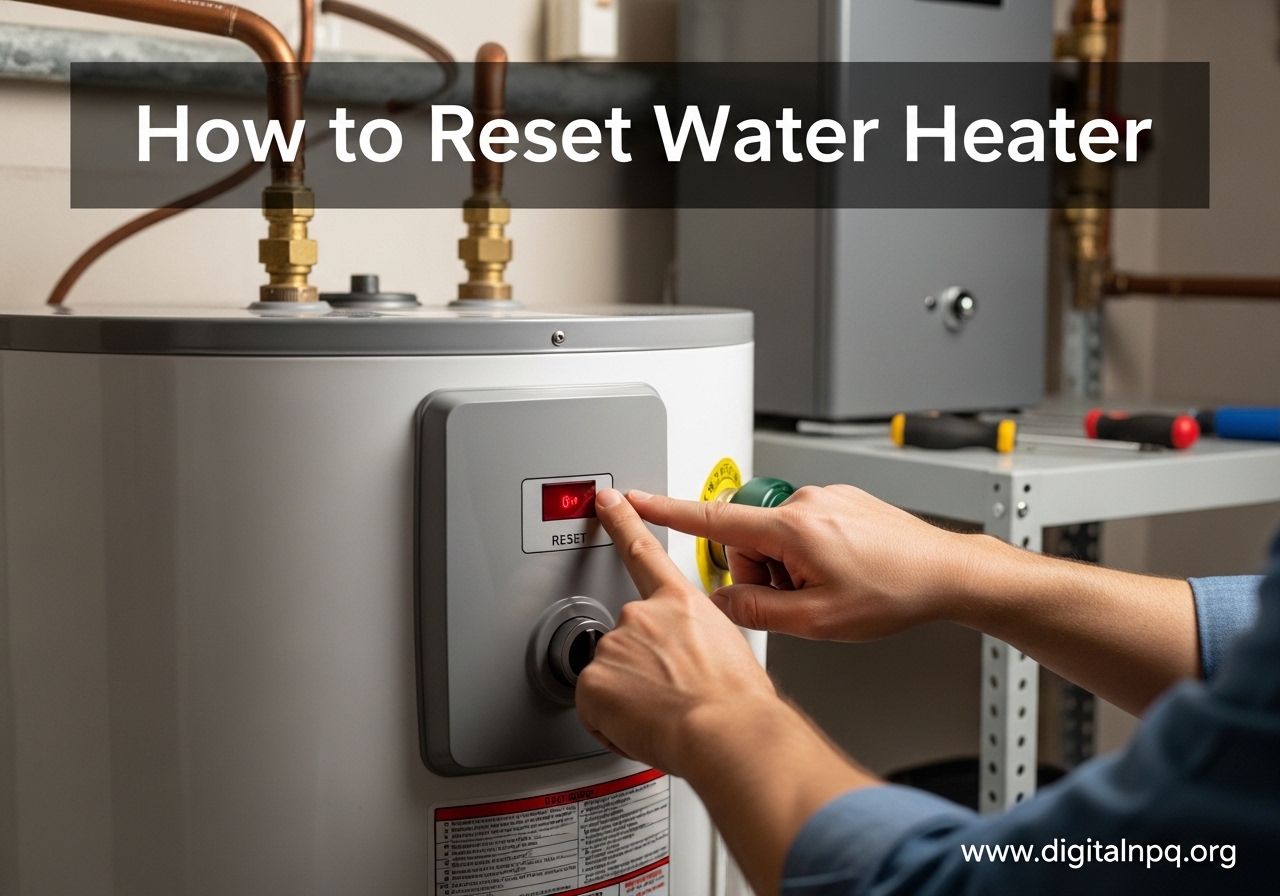
There is nothing quite like stepping into what should be a hot shower only to be hit with an icy blast of cold water. If your electric water heater has stopped producing hot water, the problem is often as simple as a tripped reset button. Learning how to reset water heater units properly can save you an unnecessary service call and get your hot water flowing again in under an hour.
In this guide, I will walk you through the complete reset process for electric, gas, and tankless water heaters. You will learn exactly where to find the reset button, how to press it safely, what to do if it keeps tripping, and when it is time to call a professional plumber. I have dealt with this exact issue in my own home more than once, so I know the frustration firsthand.
Whether your water heater stopped working after a thunderstorm, a power surge, or seemingly out of nowhere, the steps below will help you diagnose and fix the problem. Let me get your hot water back on.
What Is the Water Heater Reset Button and Why Does It Trip?
The reset button on a water heater is part of a safety device called the emergency cut-off (ECO) switch, also known as the high-limit switch. It sits behind the upper access panel on electric water heaters and is connected directly to the upper thermostat. When the water temperature inside the tank exceeds a safe limit, typically around 180 degrees Fahrenheit, the ECO switch trips and cuts power to both heating elements.
This is not a malfunction. It is a built-in safety feature designed to prevent dangerously overheated water, scalding injuries, and potential tank damage. Think of it like a circuit breaker for your water heater’s heating system.
So what causes it to trip in the first place? Here are the most common reasons:
- Power surge or electrical spike from a thunderstorm or grid fluctuation
- Faulty thermostat that fails to regulate temperature properly
- Failing heating element that causes a short circuit
- Loose or corroded wiring connections inside the access panel
- Sediment buildup at the bottom of the tank causing localized overheating
- A bad ECO switch that has become overly sensitive over time
Most electric water heaters have the reset button located on the upper thermostat behind the top access panel. Gas water heaters use a different mechanism, which I will cover separately below. If your reset button trips once after a storm, it is usually nothing to worry about. If it trips repeatedly, that is a sign of an underlying issue that needs attention.
Safety Precautions Before You Reset Your Water Heater
Before you touch anything on your water heater, safety comes first. Water heaters operate at 240 volts, and combining electricity with a water tank is a situation that demands caution. Follow these precautions every single time you work on your unit.
Turn off the power at the circuit breaker. Do not rely on just switching off the unit itself. Go to your electrical panel and flip the breaker labeled “water heater” or “hot water” to the OFF position. If your panel is not clearly labeled, look for a double-pole breaker, typically rated at 30 amps. When in doubt, use a non-contact voltage tester near the access panel to confirm power is off.
Never work on a wet floor or with wet hands. If you notice moisture around the base of the tank or near the access panel, dry the area completely before proceeding. Water and 240-volt circuits do not mix. Keep a dry towel handy.
Keep children and pets away from the area while you work. The access panel may have sharp metal edges, and you will be working near electrical components. Wear closed-toe shoes and avoid wearing jewelry that could accidentally contact live wires.
If you open the access panel and notice any signs of burning, melted plastic, charred insulation, or a burning smell, stop immediately and call a licensed electrician or plumber. These are signs of a serious electrical problem that goes beyond a simple reset.
How to Reset an Electric Water Heater (Step-by-Step)
Resetting an electric water heater is a straightforward process that takes about 10 minutes of actual work. The hardest part is usually waiting for the water to reheat afterward. Here is the complete step-by-step procedure I have used successfully on multiple occasions.
Step 1: Turn Off the Circuit Breaker
Go to your home’s electrical panel and locate the breaker for your water heater. It is usually a double-pole breaker rated at 30 amps. Flip it to the OFF position. If your panel is not labeled, look for a pair of switches connected together with a single handle. Confirm the power is off by checking if any indicator lights near your water heater have gone dark.
Step 2: Remove the Upper Access Panel
On the side of your water heater tank, locate the upper access panel. This is typically a rectangular metal cover held in place by one or two screws. Use a Phillips or flathead screwdriver to remove the screws and set the panel aside. You may need to pull gently on the panel to release it from the tank.
Step 3: Push Aside the Insulation
Behind the metal panel, you will find a layer of insulation. Carefully fold or push the insulation back to expose the thermostat underneath. Be gentle so you do not tear it. Some units have a plastic cover over the thermostat that also needs to be removed. Set all removed pieces aside in a clean, dry spot.
Step 4: Locate the Red Reset Button
Look at the face of the upper thermostat. You should see a small red button, usually located near the center or slightly off-center. This is the reset button, also called the ECO switch or high-limit switch. On some brands, it may be labeled “RESET” or have a small ring around it.
Brand-specific locations worth noting:
- Rheem: Red button is typically centered on the upper thermostat face, just above the temperature dial
- A.O. Smith: Reset button is slightly left of center on the thermostat, may have a raised ring around it
- Bradford White: Located directly in the center of the upper thermostat, slightly recessed
- GE: Usually found on the right side of the thermostat face
Step 5: Press the Reset Button Firmly
Using your thumb or index finger, press the red reset button firmly. You should feel and hear a distinct click when it engages. If the button was tripped, it will have been slightly extended outward. Pressing it resets the switch back to its normal operating position. If you do not hear a click, the button may not have been tripped, which means your no-hot-water problem has a different cause.
Step 6: Replace the Insulation and Access Panel
Carefully reposition the insulation back over the thermostat. Make sure it sits flat and does not bunch up. Then reinstall the plastic thermostat cover if your unit has one. Finally, screw the metal access panel back onto the tank. Tighten the screws snugly but do not overtighten them, as the tank metal can strip.
Step 7: Turn the Circuit Breaker Back On
Return to your electrical panel and flip the water heater breaker back to the ON position. You should hear the unit start to hum slightly as power flows to the heating elements. If you have a voltmeter, you can check that power is reaching the unit at this point.
Step 8: Wait for the Water to Reheat
This is the patience step. A standard 40-to-50-gallon electric water heater takes approximately 60 to 90 minutes to fully reheat a tank of cold water. Gas units are faster, typically 30 to 45 minutes. Tankless units provide hot water almost immediately once they are running. Check a hot water faucet after about an hour to see if the temperature is improving. If after 90 minutes you still have no hot water, the problem is likely a failed heating element or thermostat, not a simple tripped switch.
How to Reset a Gas Water Heater
Gas water heaters do not have the same ECO reset button as electric models. Instead, they use a thermal switch located near the gas control valve, and the most common reset scenario involves relighting the pilot light. Here is how to handle both situations.
Resetting the Thermal Switch on a Gas Water Heater
The thermal switch on a gas water heater is a small button or switch located near the gas control valve at the bottom of the unit. It trips when the heater overheats or when there is a vent blockage that prevents exhaust gases from escaping properly. To reset it:
- Turn the gas control valve dial to the OFF position.
- Wait 5 minutes to allow any residual gas to dissipate.
- Locate the thermal switch near the gas valve. It is usually a small red or black button.
- Press the button firmly until you hear or feel a click.
- Turn the gas control valve back to the ON position.
- Relight the pilot light if necessary.
Relighting the Pilot Light
If the pilot light has gone out, you will need to relight it. Most modern gas water heaters manufactured after 2005 use a piezo igniter, so you do not need matches. Follow these steps:
- Turn the gas control valve to OFF and wait 5 minutes.
- Turn the dial to the PILOT position.
- Press and hold down the pilot button or gas control knob.
- While holding, press the piezo igniter button repeatedly (you should hear clicks and see a spark).
- Look through the sight glass to confirm the pilot is lit.
- Continue holding the pilot button for 30 to 60 seconds to warm the thermocouple.
- Release the button slowly. If the pilot stays lit, turn the dial to ON.
- The main burner should ignite within a few seconds.
If the pilot light will not stay lit after several attempts, the thermocouple may need replacement. This is a common wear item that typically costs under $20 for the part but may require a professional to install if you are not comfortable working with gas lines.
Important safety note: If you smell gas at any point during this process, stop immediately. Leave the house and call your gas company’s emergency line. Do not operate light switches or create any sparks.
How to Reset a Tankless Water Heater
Tankless water heaters have a different reset process than traditional tank-style units. Since they do not store hot water, the reset typically involves clearing error codes and power cycling the unit. If you are considering upgrading to a tankless system, you can read more about electric tankless water heaters to see if one is right for your home.
Here is how to reset a tankless water heater:
- Turn off the unit using the power button on the control panel or remote.
- Turn off the circuit breaker dedicated to the tankless unit.
- Wait 30 seconds to 1 minute for the system to fully discharge.
- Turn the circuit breaker back on.
- Turn the unit back on using the power button.
- Check the display for any remaining error codes.
Common error codes vary by brand, but some frequently seen ones include:
- Error 11 (no ignition): Check gas supply and ignition system
- Error 12 (flame loss): Check gas pressure and venting
- Error 29 (scaling): The heat exchanger may need descaling with white vinegar
- Error 99 (vent blockage): Inspect the exhaust vent for obstructions
If an error code persists after a power cycle reset, the unit has detected a genuine problem. Check the inlet water filter for debris, verify the gas supply is adequate, and inspect the vent for blockages before calling for service.
Troubleshooting: What to Do When the Reset Button Keeps Tripping
A reset button that trips once is usually normal. A reset button that trips repeatedly is telling you something is wrong. I see this question constantly in plumbing forums, and it is one of the most frustrating problems homeowners face. Here is a systematic approach to figuring out what is going on.
Bad Thermostat (Most Common Cause)
The upper thermostat controls when the heating elements turn on and off. If it fails in the “on” position, the water will keep heating past the set temperature until the ECO switch trips as a safety measure. This is the single most common reason for repeated tripping. The thermostat cannot be repaired; it must be replaced. A replacement upper thermostat typically costs $20 to $40 and is one of the more accessible DIY water heater repairs.
Failing Heating Element (Second Most Common)
Electric water heaters have two heating elements: an upper and a lower one. When an element develops a short to ground, it can cause the ECO switch to trip. The lower element is more prone to failure because sediment accumulates at the bottom of the tank and can coat the element, causing it to overheat and eventually short out.
How to Test With a Multimeter
If you own a multimeter and are comfortable using one, you can test both the thermostat and heating elements yourself:
- Testing the thermostat: With power off, set your multimeter to the continuity setting. Touch the probes to the thermostat terminals. You should see continuity when the thermostat is calling for heat and no continuity when it is satisfied. If readings are inconsistent, replace the thermostat.
- Testing the heating element: Set the multimeter to measure resistance (ohms). A good 240-volt element should read between 10 and 30 ohms. A reading of zero means a short circuit. A reading of infinity (no continuity) means the element has burned out internally.
Always disconnect wires from the component before testing to avoid false readings through parallel circuits.
Other Causes of Repeated Tripping
Less common but still worth checking:
- Loose wiring connections under the access panel that create resistance and heat
- Corroded wire terminals that do not make clean contact
- Sediment buildup in the tank that causes localized hot spots near the lower element
- A bad ECO switch itself that has become overly sensitive with age
If you have replaced both the thermostat and heating elements and the reset button still trips, the ECO switch or the wiring may be the culprit. At this point, having a professional diagnose the issue is usually the most cost-effective path forward.
Preventive Maintenance to Avoid Frequent Resets
The best way to deal with a tripping reset button is to prevent it from happening in the first place. Regular maintenance extends the life of your water heater and reduces the likelihood of component failures. Here are the tasks I recommend.
Flush the tank once a year. Connect a garden hose to the drain valve at the bottom of the tank and run water out for 5 to 10 minutes until it runs clear. This removes sediment that causes overheating and element failure. If you have hard water, you may need to do this twice a year.
Check the anode rod every 2 to 3 years. The anode rod sacrifices itself to prevent the tank from rusting. When it is consumed, the tank begins to corrode. Pull the rod from the top of the tank and inspect it. If it is less than half its original thickness or heavily pitted, replace it.
Test the T&P valve annually. Lift the lever on the temperature and pressure relief valve briefly to confirm it opens and closes properly. If it leaks after testing or will not open, replace it immediately. This valve prevents the tank from building dangerous pressure.
Set your thermostat to 120 degrees Fahrenheit. This is the recommended setting from the Department of Energy. Higher settings waste energy, increase scalding risk, and put more stress on the thermostat and ECO switch. At 120 degrees, your water is hot enough for daily use while reducing the chance of overheating.
Frequently Asked Questions
What causes a water heater to have to be reset?
A water heater typically needs to be reset when the high-limit switch (ECO switch) trips due to overheating. Common causes include power surges from thunderstorms, a faulty thermostat that fails to regulate temperature, a failing heating element causing a short circuit, loose wiring connections, or sediment buildup in the tank. The reset button trips as a safety measure to prevent water from reaching dangerous temperatures.
Do you have to turn off the breaker to reset a water heater tank?
Yes, you should always turn off the circuit breaker before resetting your water heater. The unit operates at 240 volts, and working on it with the power on is dangerous. Turn the breaker off, reset the button behind the access panel, then turn the breaker back on. Skipping this step risks electrical shock and damage to the thermostat components.
How long does it take for a hot water heater to reset?
The actual reset process takes about 5 to 10 minutes. However, after resetting, an electric water heater needs 60 to 90 minutes to fully reheat a 40-to-50-gallon tank of cold water. Gas water heaters reheat faster, typically in 30 to 45 minutes. Tankless units provide hot water almost immediately once they are running properly again.
How do I get my hot water back running?
Start by checking your circuit breaker and make sure the water heater breaker has not tripped. If it has, flip it back on. If the breaker is fine, turn off the breaker, remove the upper access panel on the heater, locate the red reset button on the thermostat, and press it firmly until you hear a click. Replace the panel, turn the breaker back on, and wait 60 to 90 minutes for the water to reheat.
Is there a way to reset my hot water heater?
Yes. For electric water heaters, turn off the circuit breaker, remove the upper access panel, push aside the insulation, and press the red reset button on the upper thermostat until it clicks. Replace everything and turn the breaker back on. For gas water heaters, turn the gas valve to OFF, wait 5 minutes, press the thermal switch near the gas valve, then relight the pilot and turn the valve to ON.
What to push on the breaker box to reset my heater?
Find the double-pole breaker labeled for your water heater, usually rated at 30 amps. Flip the breaker handle fully to the OFF position first, then flip it back to ON. This power cycles the unit. If you are also resetting the button on the heater itself, make sure the breaker is OFF before opening the access panel for safety.
Why won’t my water heater reset button stay pushed in?
If the reset button will not stay pushed in, the underlying problem causing it to trip is still present. This usually means a bad thermostat, a shorted heating element, or a wiring issue. The ECO switch cannot be reset until the fault condition is cleared. Test the thermostat and heating elements with a multimeter, or call a plumber to diagnose the issue.
How do I know if my heating element is bad?
Signs of a bad heating element include no hot water or only lukewarm water, circuit breakers that trip when the heater runs, and a reset button that trips repeatedly. To confirm, use a multimeter set to measure resistance. A good 240-volt element should read between 10 and 30 ohms. A zero reading means a short, and an infinite reading means the element has burned out and needs replacement.
Final Thoughts
Knowing how to reset water heater units is one of those homeowner skills that pays off the very first time you use it. Most electric water heater resets follow the same eight-step process: kill the power, open the upper access panel, press the red button until it clicks, close everything back up, and restore power. Gas and tankless units have their own procedures, but the underlying principle is the same.
Safety always comes first. Turn off the breaker before opening any panels, and never ignore signs of burning, melting, or gas odors. A single trip after a storm is normal and nothing to worry about. But if that reset button keeps tripping, you are almost certainly dealing with a failed thermostat, a bad heating element, or a wiring problem that will not fix itself.
Stay on top of annual maintenance like flushing the tank and checking the anode rod. A well-maintained water heater is far less likely to develop the problems that cause repeated tripping in the first place. And if the troubleshooting steps in this guide do not resolve your issue, do not hesitate to call a licensed plumber. Some repairs are worth the service call to get right.