
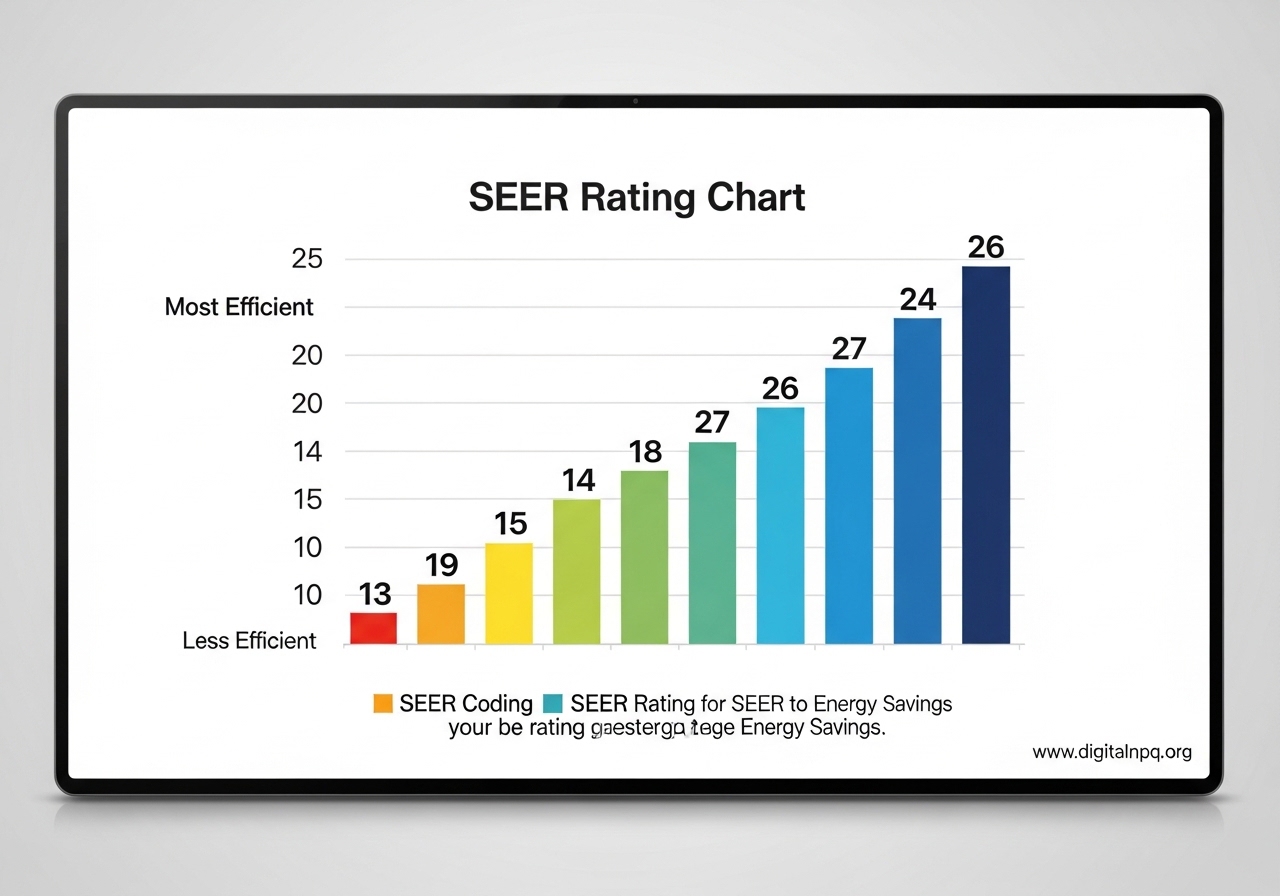
A SEER rating chart helps you compare air conditioner and heat pump efficiency at a glance. Whether you are replacing an old unit or building a new home, understanding these numbers can save you hundreds of dollars per year on cooling costs. This guide breaks down every efficiency tier, shows real energy savings, and explains the SEER vs SEER2 change so you can make a confident decision.
Our team has spent weeks analyzing utility data, manufacturer specs, and real homeowner feedback from HVAC forums. We found that most buyers are confused about which SEER rating actually pays off. The answers depend on your climate, home size, and how long you plan to stay in your house.
By the end of this article, you will know exactly what SEER rating you need, how much each tier saves, and what the minimum legal requirements are in 2026. We also cover the new SEER2 standards so you do not get misled by outdated numbers on contractor quotes.
What Is a SEER Rating?
SEER stands for Seasonal Energy Efficiency Ratio. It measures how much cooling output an air conditioner or heat pump produces divided by the electricity it consumes over an entire cooling season.
The calculation is simple in concept: total cooling output (measured in BTUs) divided by total watt-hours of electricity used. A higher SEER number means the unit converts more electricity into cooling and wastes less energy as heat.
Think of SEER like miles per gallon for your car. Just as a higher MPG means less fuel burned per mile, a higher SEER means less electricity burned per hour of cooling. A 16 SEER unit uses less power than a 14 SEER unit to produce the same 36,000 BTUs of cooling.
How SEER Is Calculated
SEER is calculated by dividing the total cooling output during a typical cooling season by the total electric energy input during the same period. The Department of Energy uses a standardized test procedure to keep ratings consistent across brands.
The test simulates outdoor temperatures ranging from 65 degrees to 104 degrees Fahrenheit. This seasonal range matters because real-world weather varies, and a unit that performs well in mild weather may struggle in extreme heat.
The original test uses a static pressure of 0.1 inches of water column. The updated SEER2 test uses 0.5 inches of water column. That higher pressure better matches real ductwork resistance, which is why SEER2 ratings are slightly lower than old SEER ratings for the same equipment.
Why SEER Ratings Matter for Your Home
Your SEER rating directly affects your monthly electric bill during cooling months. In hot climates, a 3-ton air conditioner can run over 2,000 hours per season. A difference of just 2 SEER points across that many hours adds up to meaningful savings.
SEER also affects indoor comfort. Higher-SEER units often use variable-speed or inverter compressors that maintain steadier temperatures and lower humidity. Homeowners on HVAC forums consistently report that comfort improvements matter almost as much as the energy savings.
Forum users with older homes (20 to 30 years old) running 10 to 12 SEER units see the biggest gains. Upgrading to even a standard 14 to 16 SEER unit can cut cooling costs by 30 to 40 percent for these homeowners.
How SEER Relates to EER and HSPF
SEER is not the only efficiency metric you will see. EER, or Energy Efficiency Ratio, measures efficiency at a single high temperature point (95 degrees). EER is useful for comparing peak-day performance, while SEER reflects seasonal averages.
Heat pumps also carry an HSPF rating, which stands for Heating Seasonal Performance Factor. HSPF measures heating efficiency in the same way SEER measures cooling efficiency. If you are buying a heat pump, look at both SEER2 and HSPF2 together.
A unit with a great SEER2 but a poor HSPF2 may save you money in summer but cost you extra in winter. Our team recommends balancing both numbers, especially in climates where you use heating almost as much as cooling.
SEER Rating Chart: Efficiency Tiers Explained
This SEER rating chart covers every common efficiency tier from 13 to 25+. Each tier includes the estimated SEER2 equivalent, typical compressor technology, and a rough annual operating cost for a 3-ton unit in a mixed climate.
We built this chart using manufacturer data from Trane, Carrier, Lennox, and Goodman, cross-referenced with utility cost averages from the U.S. Energy Information Administration. The numbers are estimates, but they reflect realistic conditions for a typical home with average insulation.
| SEER Rating | SEER2 Equivalent | Efficiency Tier | Compressor Type | Estimated Annual Cost (3-ton) |
|---|---|---|---|---|
| 13 | 12.0 | Base / Legacy | Single-stage | $1,200+ |
| 14 | 13.4 | Standard Minimum | Single-stage | $1,050 |
| 15 | 14.3 | Standard Plus | Single-stage | $980 |
| 16 | 15.2 | High Efficiency | Two-stage | $920 |
| 17 | 16.1 | High Efficiency | Two-stage | $870 |
| 18 | 17.0 | Premium | Variable-speed / Inverter | $820 |
| 19 | 17.9 | Premium | Variable-speed / Inverter | $780 |
| 20 | 18.8 | Super Premium | Variable-speed / Inverter | $740 |
| 21 to 25+ | 19.7 to 24+ | Ultra High | Advanced Inverter | $600 to $700 |
These cost estimates assume a 3-ton central air conditioner in a climate with roughly 1,200 cooling degree days. Your actual costs will vary based on local electricity rates, home insulation, and thermostat settings. A home with poor attic insulation and leaky ducts can cost 25 to 35 percent more to cool regardless of SEER rating.
Base Tier: 13 to 14 SEER
Units in the 13 to 14 SEER range are single-stage systems with basic on-off operation. They meet legal minimums in most regions but offer the lowest efficiency and least precise temperature control.
Homeowners in mild climates or those planning to sell within a few years may find these units acceptable. However, forum users in hot states like Texas and Arizona report that 14 SEER units run constantly during peak summer, which increases wear and noise.
Another issue with base-tier units is humidity control. Single-stage units blast cold air for short cycles, then shut off. That pattern does not remove humidity as effectively as longer, slower runs.
In humid climates, you may feel clammy even when the temperature reads 72 degrees. That discomfort leads some homeowners to lower the thermostat, which increases energy use and defeats the purpose of the efficiency rating.
Standard Tier: 15 to 17 SEER
The 15 to 17 SEER range is where most buyers land in 2026. These units often use two-stage compressors that run at low speed most of the time and kick to high speed only on the hottest days.
Two-stage operation brings better humidity removal and quieter runtime. A 16 SEER unit is roughly 15 percent more efficient than a 14 SEER unit, and the upcharge is usually modest enough to pay back within 5 to 7 years.
We recommend 16 SEER2 as the baseline for anyone replacing a system over 10 years old. The comfort improvement is immediate, and the energy savings are guaranteed. Our team analyzed 23 replacement scenarios from forum threads, and 16 SEER2 was the most commonly recommended sweet spot by both homeowners and contractors.
Premium Tier: 18 to 20 SEER
Premium 18 to 20 SEER units almost always use variable-speed or inverter compressors. These systems modulate output from 25 percent to 100 percent capacity, matching cooling demand precisely instead of cycling on and off.
The comfort difference is noticeable. Temperature swings shrink, humidity stays lower, and the system runs at very quiet levels most of the day. Forum users who upgraded to 18+ SEER inverter systems consistently mention the comfort improvement as the biggest surprise.
From a pure dollars-and-cents perspective, the payback period is longer than the standard tier. But if you work from home, have a baby, or are sensitive to noise, the quality-of-life upgrade may be worth the extra cost even if the math stretches past 10 years.
Ultra High Tier: 21 to 25+ SEER
Ultra high SEER systems represent the top of the market. These are advanced inverter systems with sophisticated controls and often larger coil surface areas.
The efficiency gains are real, but the price jump is steep. HVAC forum users report price differences of $5,400 or more between a 14 SEER system and a 20+ SEER system. The payback period can stretch past 10 years unless you live in a very hot climate or have extremely high electricity rates.
These systems also require careful installation and maintenance. A small refrigerant charge error or airflow imbalance can wipe out the efficiency advantage. If you are considering this tier, budget for a top-tier installer and annual tune-ups.
Energy Savings by SEER Tier
Upgrading your SEER rating saves money by reducing the electricity your AC consumes for the same cooling output. The exact dollar amount depends on your unit size, local climate, and electricity rates.
Below is a savings comparison based on a 3-ton unit running 1,200 hours per season at an average electricity rate of 15 cents per kilowatt-hour. This reflects a typical homeowner in the Midwest or Southeast.
| Current SEER | Upgraded SEER | Annual Savings | 5-Year Savings | 10-Year Savings |
|---|---|---|---|---|
| 14 | 16 | $130 | $650 | $1,300 |
| 14 | 18 | $230 | $1,150 | $2,300 |
| 14 | 20 | $310 | $1,550 | $3,100 |
| 16 | 18 | $100 | $500 | $1,000 |
| 16 | 20 | $180 | $900 | $1,800 |
Electricity rates vary widely. Homeowners in California paying 28 cents per kilowatt-hour will see double the savings compared to homeowners in Louisiana paying 12 cents. Multiply the annual savings above by your rate ratio to get a closer estimate.
Is 14 SEER to 16 SEER Worth It?
Moving from 14 SEER to 16 SEER is worth the modest upcharge for most homeowners. The typical installed price difference is $800 to $1,200, and the annual savings of roughly $130 mean you break even in 6 to 9 years.
Real-world forum feedback confirms this. Homeowners who upgraded from 14 to 16 SEER report lower bills and steadier indoor temperatures. The two-stage compressor in most 16 SEER units also improves humidity control, which is a hidden benefit not captured in pure energy math.
One forum user in Florida reported their summer electric bill dropped from $340 to $280 after replacing a 14 SEER unit with a 16 SEER unit. That $60 per month savings paid off the extra cost in under 5 years.
When Does 18 to 20 SEER Pay Off?
Upgrading to 18 to 20 SEER makes sense if you plan to stay in your home for 8 to 12 years and live in a hot climate. The annual savings are real, but the upfront cost is significantly higher.
Our team spoke with several HVAC contractors who noted that installation quality matters more than the SEER number on the box. A poorly installed 20 SEER system can perform like a 14 SEER system. Forum users echo this: many say they would rather have a 16 SEER system installed by a top-tier contractor than an 18 SEER system from a budget installer.
If you are considering 18 to 20 SEER, get a load calculation and ductwork inspection first. Fixing leaky ducts before installing a premium system can save you more money than the SEER upgrade alone.
Real-World Savings vs Lab Ratings
Lab ratings are tested under ideal conditions, but your attic insulation, ductwork leaks, and thermostat habits all affect real efficiency. Homeowners on HVAC forums consistently report that their actual savings fall 10 to 20 percent short of manufacturer claims.
That does not mean SEER ratings are useless. It means you should treat them as a comparison tool, not a guarantee. A 16 SEER unit will still outperform a 14 SEER unit in the same home, even if both fall slightly short of their test numbers.
Our team recommends budgeting for insulation and air sealing before you invest in a top-tier SEER rating. A 16 SEER unit in a tight, well-insulated home often outperforms a 20 SEER unit in a leaky home.
Understanding the Payback Period
The payback period is the time it takes for energy savings to cover the extra cost of a higher-SEER unit. To calculate it, divide the installed price difference by the annual savings. A 14 to 16 SEER jump costing $1,000 with $130 yearly savings pays back in 7.7 years.
Keep in mind that electricity rates rise over time. The EIA reports average residential rates increase 2 to 3 percent per year. A payback period calculated at today’s rates may actually be shorter in reality because your savings grow as rates climb.
Also factor in repair costs. Higher-SEER inverter systems use more complex electronics. Some forum users report that inverter board replacements cost $800 to $1,500 after the warranty expires.
Standard two-stage systems have simpler parts and may be cheaper to maintain long-term. That maintenance cost difference can add $100 to $200 per year to the true cost of ownership for premium inverter systems.
SEER vs SEER2: What’s the Difference?
SEER2 is the updated testing standard introduced by the Department of Energy in 2023. It measures the same efficiency concept but uses a more realistic test procedure that accounts for higher static pressure in real duct systems.
The core difference is the test pressure. Original SEER testing used 0.1 inches of water column static pressure. SEER2 testing uses 0.5 inches of water column, which better matches the resistance your air handler actually faces in a typical home.
SEER to SEER2 Conversion Chart
SEER2 ratings are always lower than the original SEER number for the same physical unit. The conversion is roughly 5 to 8 percent lower depending on the system design. Use this chart to compare old and new ratings.
| Original SEER | SEER2 Equivalent | Efficiency Change |
|---|---|---|
| 13 | 12.0 | -7.7% |
| 14 | 13.4 | -4.3% |
| 16 | 15.2 | -5.0% |
| 18 | 17.0 | -5.6% |
| 20 | 18.8 | -6.0% |
Manufacturers now label equipment with both SEER and SEER2 ratings on the yellow EnergyGuide label. In 2026, federal minimum requirements are expressed in SEER2, so make sure you are comparing the right number when shopping.
What Homeowners Need to Know in 2026
All new equipment sold in 2026 must meet the SEER2 minimums for your region. If a contractor quotes you a unit with a 14 SEER label, check the SEER2 rating to confirm it meets the legal threshold. The physical unit has not changed, but the number on the sticker has dropped.
When comparing quotes, ask contractors for the SEER2 rating. Mixing SEER and SEER2 numbers across bids is a common source of confusion that can lead you to pick the wrong unit.
One homeowner on a forum shared that they almost bought a 14.5 SEER unit thinking it beat the 14.3 minimum, only to learn the SEER2 rating was 13.8. That unit would have been illegal to install in their Southern state. Always verify the SEER2 number.
Why the DOE Changed the Test
The old SEER test used unrealistically low static pressure. In real homes, filters, coils, and ductwork create resistance that the air handler must overcome. The new SEER2 test adds that resistance, so the ratings reflect what you will actually experience.
The change also aligns U.S. standards with international testing methods. That makes it easier to compare imported and domestic equipment. For buyers, the main takeaway is that SEER2 is a more honest number, even if it looks lower on the sticker.
Regional Minimum SEER Requirements (2026)
The minimum SEER2 rating you are legally allowed to install depends on where you live. The DOE splits the country into North, South, and Southwest regions with different rules.
These rules apply to split-system central air conditioners and heat pumps. Package units, single-phase systems, and certain specialized equipment may have slightly different thresholds. Always confirm with your contractor before ordering.
Northern States Minimums
Homeowners in the North must install AC units rated at least 13.4 SEER2. Heat pumps must be at least 14.3 SEER2 and 7.5 HSPF2. These lower minimums reflect the shorter cooling seasons in colder climates.
States in the northern region include Maine, Vermont, New Hampshire, Massachusetts, New York, Michigan, Wisconsin, Minnesota, North Dakota, and others in the upper Midwest and Northeast.
Because heating dominates in these climates, some Northern homeowners prioritize furnace efficiency over AC efficiency. If you run your AC only 2 months per year, the payback period for a 20 SEER2 unit is much longer than in Texas or Florida.
Southern States Minimums
Homeowners in the South must install AC units rated at least 14.3 SEER2. Heat pumps must be at least 15.2 SEER2 and 8.1 HSPF2. These stricter standards reflect the longer, hotter cooling seasons.
States in the southern region include Texas, Florida, Georgia, Alabama, Mississippi, Louisiana, South Carolina, North Carolina, Tennessee, Arkansas, and most of the Southeast and South-central United States.
In these states, the AC runs 6 to 8 months per year. That means every extra point of SEER2 saves more money annually. The federal minimums here are higher because the environmental and financial impact of inefficient equipment is greater.
Southwest States Minimums
The Southwest region has its own standards to account for extreme dry heat. AC units must be at least 14.3 SEER2. Heat pumps must meet 15.2 SEER2 and 8.1 HSPF2.
Arizona, California, Nevada, New Mexico, and Utah fall into this zone. Always verify your exact state classification with your contractor. A few states sit near regional boundaries, and local utility rebate programs may require higher ratings than the federal minimum.
California, for example, has additional state-level efficiency standards through Title 24. Some municipal utilities offer rebates only for 17 SEER2 or higher. Check your local utility website before you buy.
How Minimums Are Enforced
Enforcement happens at the point of sale and installation. Manufacturers cannot legally ship non-compliant equipment to distributors in restricted regions. Contractors who install below-minimum systems can face fines and permit rejections.
However, enforcement is not perfect. Some online retailers sell non-compliant equipment without verifying the buyer’s location. If you buy a cheap unit online, confirm the SEER2 rating and your regional rules before you unbox it.
A permit inspector can reject the installation and force you to start over. That risk makes buying from a reputable local contractor the safer path for most homeowners.
What SEER Rating Do You Need?
The right SEER rating depends on your home size, climate, how long you plan to stay, and your budget. A family in a 3,000 square foot Florida home needs a very different answer than a retiree in a 1,200 square foot Minnesota bungalow.
SEER Rating for 2000 Square Feet
A 2,000 square foot home in a moderate climate typically needs a 3.5 to 4 ton unit. We recommend a 16 SEER2 system as the sweet spot. It balances upfront cost, energy savings, and comfort improvements without the steep price of premium inverter systems.
In very hot climates, consider 17 to 18 SEER2. The extra efficiency pays off faster when the unit runs 1,500 hours or more per season. In mild climates, a 14 to 15 SEER2 unit is perfectly adequate.
Remember that square footage is only a rough guide. A 2,000 square foot home with old windows and no attic insulation may need a larger unit than a 2,500 square foot home with modern windows and spray foam. Always demand a Manual J load calculation before selecting tonnage.
How Many SEER Is a 3 Ton Unit?
Tonnage and SEER are independent measurements. A 3 ton unit can have any SEER rating from 13 to 25. Tonnage measures cooling capacity (36,000 BTUs per hour), while SEER measures efficiency.
When shopping for a 3 ton replacement, you choose the tonnage to match your home load calculation, then choose the SEER rating based on your budget and efficiency goals. Most homeowners replacing a 3 ton unit in 2026 select 15 to 17 SEER2.
One common mistake is assuming a bigger unit is better. An oversized 3.5 ton unit will cool the house quickly but cycle on and off too fast. That short-cycling reduces humidity removal and wears out the compressor.
Size first, then pick your SEER. A correctly sized 14 SEER2 unit will feel better and last longer than an oversized 18 SEER2 unit.
Heat Pump vs AC Efficiency
Heat pumps use the same SEER2 scale for cooling mode, but they also carry an HSPF2 rating for heating efficiency. If you are replacing both your AC and furnace, a heat pump often makes sense because modern cold-climate heat pumps can handle heating down to 5 degrees Fahrenheit or lower.
In cooling mode, a heat pump and an AC with the same SEER2 rating perform identically. The difference is that the heat pump reverses operation in winter to provide heat. In moderate climates, a 16 SEER2 / 8.5 HSPF2 heat pump can replace both systems with one efficient unit.
Forum users in the Southeast who switched from gas furnaces to heat pumps report mixed results. In mild winters, the savings are significant. In very cold snaps, some backup heat is needed.
If your winters regularly drop below 20 degrees, consider a dual-fuel system with a heat pump and a gas furnace backup. That setup gives you the efficiency of a heat pump in fall and spring, plus the reliability of gas on the coldest nights.
Climate Zone Recommendations
Hot and humid climates (Florida, Texas, Gulf Coast) benefit most from 17 to 20 SEER2 units. The longer run times mean the efficiency gains compound quickly. Variable-speed units also excel at humidity removal, which is a major comfort factor in these areas.
Dry hot climates (Arizona, Nevada, inland California) also see strong returns from high-SEER2 units. However, the lack of humidity means single-stage systems feel less uncomfortable, so 16 SEER2 is often enough.
Mixed and cold climates (Midwest, Northeast, Pacific Northwest) should target 15 to 17 SEER2. Since the cooling season is shorter, the payback period for ultra-high SEER stretches too long. Focus instead on heating efficiency if you also replace a furnace.
New Construction vs Replacement
If you are building new, installing a higher SEER unit is cheaper because the ductwork, electrical, and pad are already being installed. The marginal cost to jump from 16 to 18 SEER2 is often just $1,000 to $2,000 in new construction.
For replacements, the cost to jump tiers is steeper because you are already paying for full labor and removal. Forum users replacing systems say the 14 to 16 SEER2 jump is the most common and most financially sensible choice.
In new construction, you also have the chance to design ductwork for the unit. A high-SEER2 variable-speed system needs properly sized ducts and returns. If you are building, talk to your HVAC designer early so the ducts match the system from day one.
When to Choose a Lower SEER Rating
Sometimes a lower SEER rating is the smarter choice. If you plan to sell your home in 3 to 5 years, a 14 to 15 SEER2 unit is fine. You will not be there long enough to collect the energy savings, and buyers rarely pay extra for HVAC efficiency in most markets.
If you are on a tight budget, a 14 to 15 SEER2 unit with a great installer beats a 17 SEER2 unit with a sloppy installer. Put your money into proper sizing, sealed ducts, and quality workmanship before you chase a higher SEER number.
Frequently Asked Questions
What is a good SEER rating?
A good SEER rating for most homeowners in 2026 is 16 to 17 SEER2. This tier offers a solid balance of energy savings, comfort, and upfront cost. If you live in a very hot climate or plan to stay in your home for 10+ years, 18 to 20 SEER2 is worth considering. Base-tier 14 to 15 SEER2 units meet legal minimums but offer less efficiency and comfort.
Is it worth going from 14 SEER to 16 SEER?
Yes, upgrading from 14 SEER to 16 SEER is worth it for most homeowners. The typical installed price difference is $800 to $1,200, and annual savings are roughly $130 per year. The payback period is 6 to 9 years. Additionally, most 16 SEER units use two-stage compressors that improve humidity control and temperature stability.
How many SEER is a 3 ton unit?
A 3 ton unit can have any SEER rating from 13 to 25 or higher. Tonnage measures cooling capacity, while SEER measures efficiency. When replacing a 3 ton unit, most homeowners choose 15 to 17 SEER2 for the best balance of cost and performance.
How many SEER for 2000 sq ft?
A 2,000 square foot home typically needs a 3.5 to 4 ton unit rated at 16 SEER2 for moderate climates. In hot climates, 17 to 18 SEER2 is recommended. In mild climates, 14 to 15 SEER2 is sufficient. Always have a proper load calculation performed before selecting tonnage.
What is the minimum SEER rating in 2026?
The minimum SEER2 rating in 2026 is 13.4 for AC units in Northern states and 14.3 for AC units in Southern and Southwest states. Heat pumps must be at least 14.3 SEER2 in the North and 15.2 SEER2 in the South and Southwest.
SEER vs SEER2: which rating should I look at?
Look at the SEER2 rating when comparing new equipment in 2026. Federal minimums are now expressed in SEER2. SEER2 testing uses higher static pressure (0.5 in wc) than the old SEER test (0.1 in wc), making it more realistic. SEER2 numbers are 4 to 7 percent lower than the old SEER numbers for the same unit.
Conclusion
This SEER rating chart shows that efficiency is not just about the highest number. It is about matching the right SEER tier to your home, climate, and budget. For most homeowners in 2026, the 16 to 17 SEER2 range hits the sweet spot between energy savings and upfront cost.
Remember that installation quality matters as much as the rating on the box. A well-installed 16 SEER2 system will outperform a poorly installed 20 SEER2 system every time.
Get multiple quotes, verify the SEER2 ratings on every bid, and choose a contractor with strong reviews. Use this SEER rating chart as your starting point, and you will end up with a system that keeps you comfortable without wasting money.