
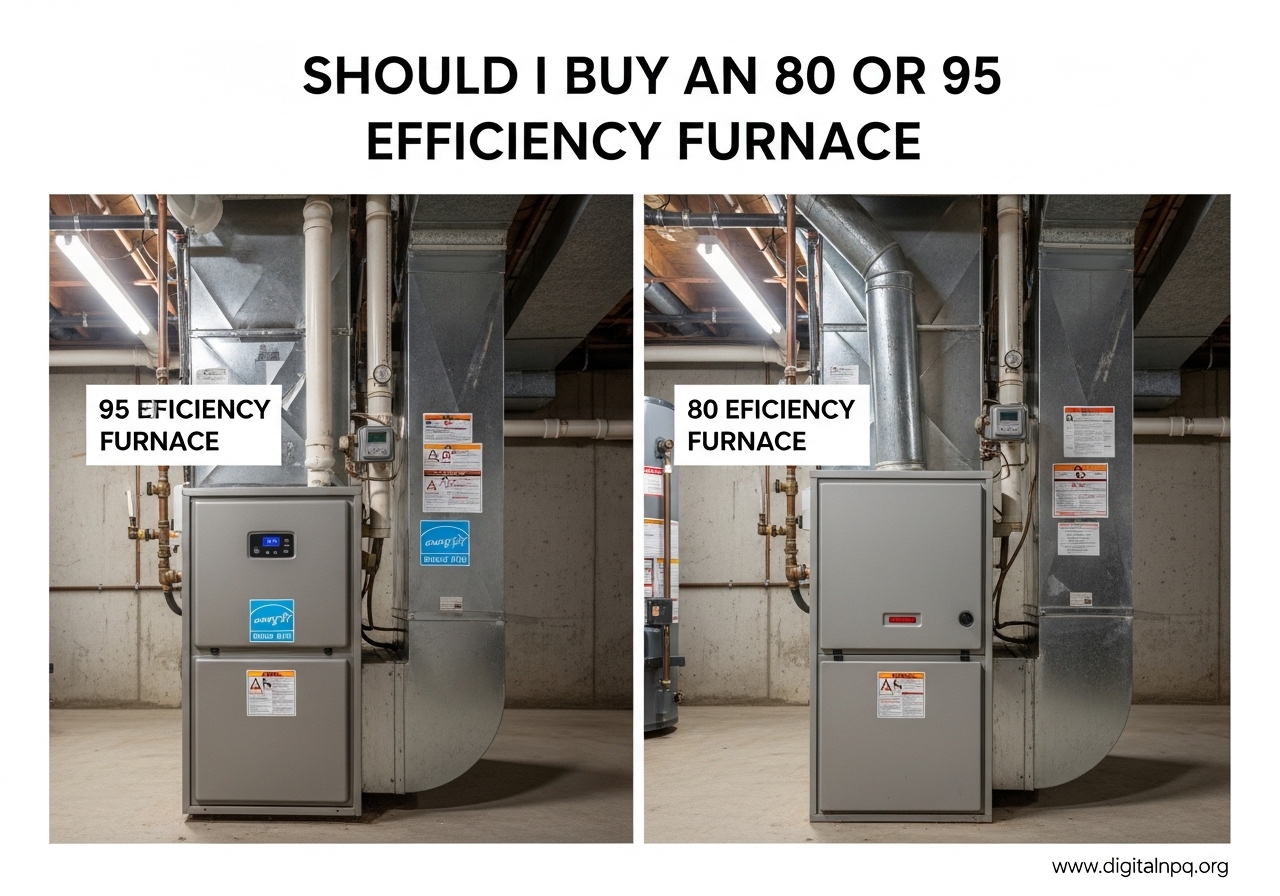
When our team talks to homeowners about replacing a furnace, the most common question we hear is whether to buy an 80 or 95 efficiency furnace. The short answer is this: an 80% AFUE furnace costs less upfront but burns more fuel, while a 95% AFUE furnace costs more to install but saves money on every gas bill. Your best choice depends on how cold your winters are, how long you plan to stay in your home, and whether you want a single-stage or two-stage heating system.
I have spent the last few months comparing real utility bills and talking with HVAC technicians to understand what the efficiency numbers actually mean in practice. The numbers on the yellow EnergyGuide sticker can be confusing, and contractors do not always explain the trade-offs clearly. Our goal in this guide is to give you the facts you need to make a confident decision without the sales pressure.
In the sections below, we will break down what AFUE really means, compare the pros and cons of each efficiency level, and show you a simple payback calculation you can use with your own gas bill.
What Is AFUE and How Does Furnace Efficiency Work?
AFUE stands for Annual Fuel Utilization Efficiency. It is the standard rating that tells you what percentage of your fuel becomes usable heat inside your home. An 80% AFUE furnace converts 80% of the natural gas it burns into heat, while the remaining 20% escapes through the exhaust flue. A 95% AFUE furnace captures 95% of that energy, leaving only 5% as waste.
The difference between those two percentages is not just a marketing number. It directly affects how much gas you buy each winter. In simple terms, a 95% furnace produces the same amount of heat as an 80% furnace while using roughly 12.5% less fuel. That is a real, measurable saving that shows up on your monthly utility bill.
The reason 95% furnaces achieve higher efficiency is a second heat exchanger. After the first heat exchanger captures the bulk of the heat, a secondary heat exchanger pulls additional heat from the exhaust gases before they leave the house. This condensing technology is what makes the unit a “high efficiency” furnace, and it is why 95% models are sometimes called condensing furnaces.
One thing we noticed while researching this topic is that homeowners often confuse efficiency with size. Efficiency is about how well the furnace uses fuel. Size is about how many BTUs the unit can produce. You can buy an 80,000 BTU furnace in either 80% or 95% efficiency, so make sure you are comparing apples to apples when you get quotes.
80% AFUE Furnace: Pros and Cons
An 80% AFUE furnace is considered the standard efficiency baseline for gas furnaces in 2026. It has been the workhorse of residential heating for decades, and it remains a popular choice for many homes. The technology is straightforward, the parts are widely available, and almost every HVAC contractor knows how to install and service one.
Pros of an 80% Furnace
The biggest advantage is the lower upfront cost. An 80% furnace typically costs $500 to $1,500 less than a comparable 95% model, depending on the brand and capacity. That lower price tag makes it an appealing option if you are on a tight budget or if you plan to sell the home within a few years and do not expect to recover the premium through energy savings.
Installation is also simpler and less invasive. An 80% furnace vents exhaust gases through a metal flue pipe, usually straight up through the roof or out a side wall. That means if you are replacing an old furnace, your existing venting may still work with a new 80% unit. No new PVC intake and exhaust pipes are required.
Another benefit is reliability. The design is simpler, with fewer components that can fail. Some HVAC technicians we spoke with said that 80% furnaces can have slightly lower long-term maintenance costs because they do not have the condensate drains and secondary heat exchangers that 95% units require.
Cons of an 80% Furnace
The main drawback is the ongoing operating cost. Because 20% of your fuel is wasted, your monthly gas bill will be higher than it would be with a 95% furnace. In a cold climate where the furnace runs four to six months per year, that difference adds up to hundreds of dollars annually.
There is also an environmental consideration. Burning more gas means more emissions, which may matter if you are trying to reduce your household carbon footprint. While 80% furnaces are not being banned nationwide, some states and municipalities have begun tightening efficiency requirements for new construction.
95% AFUE Furnace: Pros and Cons
A 95% AFUE furnace is classified as a high efficiency furnace. It captures more heat from the combustion process and turns that into warm air for your home. These units are often Energy Star certified, and they can qualify for utility rebates or tax incentives depending on where you live and the current 2026 regulations.
Pros of a 95% Furnace
The primary advantage is fuel savings. Because the unit wastes only 5% of the gas it burns, you get more heat per dollar. Homeowners in cold climates often report annual gas bill reductions of 15% to 25% after upgrading from an older 80% furnace to a new 95% model. Those savings accumulate over the 15 to 20 year lifespan of the unit.
Comfort can improve as well. Many 95% furnaces come with variable speed blowers and two-stage or modulating gas valves. That means the unit can run at a lower, quieter speed for longer periods rather than blasting hot air in short bursts. The result is more consistent temperatures and less temperature swing between heating cycles.
From a resale perspective, a high efficiency furnace can be a selling point. Buyers increasingly look at utility costs, and an efficient heating system signals that the home has been well maintained. In competitive markets, that can be a subtle advantage.
Cons of a 95% Furnace
The upfront cost is the most obvious barrier. You can expect to pay $500 to $2,000 more for the unit itself, plus additional installation costs if your home needs new venting or a condensate drain line. The total premium can reach $2,000 to $3,000 over a standard 80% installation.
Installation complexity is another factor. A 95% furnace uses PVC pipes for intake and exhaust, which must be routed through an exterior wall. If your furnace is in a basement or interior closet, the installer may need to run new piping through finished spaces. That adds labor and may require drywall repairs afterward.
Finally, the condensate drain requires attention. A 95% furnace produces acidic water as a byproduct of the condensing process. That water must drain somewhere, and in some homes, the installer may need to add a condensate pump or neutralizer. It is not a dealbreaker, but it is one more component that can require maintenance.
80% vs 95% Furnace: Side-by-Side Comparison
Sometimes the easiest way to make a decision is to see the facts lined up next to each other. Here is how the two efficiency levels compare on the factors that matter most.
| Feature | 80% AFUE Furnace | 95% AFUE Furnace |
|---|---|---|
| Efficiency Rating | 80% of fuel becomes heat | 95% of fuel becomes heat |
| Upfront Cost | Lower | Higher ($500 to $2,000+ more) |
| Monthly Gas Bill | Higher | Lower (12.5% to 15% less fuel) |
| Venting Type | Metal flue (uses existing venting) | PVC intake and exhaust pipes |
| Installation Complexity | Simpler | More complex (may need new venting) |
| Best For | Mild climates, shorter-term homes | Cold climates, long-term homes |
| Typical Lifespan | 15 to 20 years | 15 to 20 years |
| Environmental Impact | Higher emissions | Lower emissions |
As you can see, the choice is not about which furnace is objectively better. It is about which one fits your budget, your home, and your timeline. A 95% furnace is not always the right answer, and an 80% furnace is not always the budget compromise.
Cost Analysis: Upfront vs Long-Term Savings
This is where the decision gets real. Let us look at actual numbers so you can estimate the payback period for your own situation. We will use a typical 80,000 BTU furnace in a 2,000 square foot home with a winter gas bill of $120 per month.
A 95% furnace uses about 12.5% less gas than an 80% furnace for the same heat output. If you spend $120 per month on gas during the heating season, that is roughly $720 over six months. A 12.5% savings amounts to $90 per year. In a colder climate where the heating season stretches to eight months and bills are $180 per month, the annual savings would be closer to $180.
Now consider the upfront premium. If a 95% furnace costs $1,500 more installed, your payback period would be about 17 years at $90 per year in savings. At $180 per year in savings, the payback drops to about 8 years. That is why climate matters so much. The colder your winters, the faster a high efficiency furnace pays for itself.
One insight from Reddit forums we reviewed is that some contractors push 95% furnaces without explaining the payback math. We think that is a disservice. If you are in a mild climate and your heating season is only three or four months long, the savings may never justify the extra cost. You should ask your contractor to run the numbers with your actual gas usage before you decide.
There are also hidden costs to consider. If your home needs new venting for a 95% unit, add $300 to $800 to the installation. If you need a condensate pump, that is another $150 to $300. Those extras push the payback period out even further, so make sure your quote includes everything, not just the furnace itself.
Climate Considerations for Your Region
Where you live has a huge impact on whether a 95% furnace is worth the premium. In cold climates like Minnesota, Wisconsin, or upstate New York, furnaces run almost constantly for months at a time. Every percentage point of efficiency matters because the unit is working hard for so many hours each year.
In mild climates like the Pacific Northwest, coastal California, or the Southern states, the heating season is shorter. Your furnace may only run heavily for two or three months. In those cases, the fuel savings from a 95% unit may not add up to enough to cover the higher upfront cost before the furnace reaches the end of its lifespan.
Our recommendation is simple. If you live in a climate where you use the furnace more than six months per year or where winter temperatures regularly drop below 20 degrees Fahrenheit, a 95% furnace is usually the smarter long-term investment. If you live in a mild climate where freezing temperatures are rare and the furnace runs lightly, an 80% furnace is often the more practical choice.
Two-Stage vs Single-Stage: Why It Matters More Than You Think
Here is something that surprised us during our research. A two-stage 80% furnace can sometimes deliver better real-world comfort and lower bills than a single-stage 95% furnace. That is because the number of heating stages affects how the furnace runs, not just how efficiently it burns gas.
A single-stage furnace is either full blast or off. It kicks on at 100% capacity, heats the house quickly, then shuts down. That creates temperature swings and can feel drafty. A two-stage furnace can run at 60% to 70% capacity on mild days, then ramp up to 100% only when it is truly cold. That lower stage uses less gas, runs quieter, and keeps temperatures more stable.
One HVAC technician we spoke with put it this way: an 80% furnace with two stages of heat will usually run more efficiently in practice than a 95% furnace with just one stage. The reason is that the single-stage unit is constantly cycling on and off at full power, which wastes fuel during startup and creates uneven heat. The two-stage unit runs longer at lower output, which is inherently more efficient and comfortable.
Our advice is to ask your contractor about a two-stage 80% furnace before automatically upgrading to a single-stage 95%. If you want the best of both worlds, look for a two-stage 95% furnace. Those models cost the most upfront, but they deliver the highest efficiency and the best comfort.
Are 80% Furnaces Being Phased Out?
No. As of 2026, 80% furnaces are not being phased out nationwide. You can still buy them, install them, and get replacement parts in all 50 states. However, there are regional exceptions you should know about. California and some northern states have adopted stricter building codes that require higher efficiency for new construction. If you are building a new home, your builder may be required to install a 90% or higher furnace.
For existing homes, you are generally free to replace an old 80% furnace with a new 80% model. The key is to check your local building code or ask your contractor. They will know if your municipality has any restrictions. We have heard from homeowners on HVAC forums who were told 80% furnaces were “illegal” in their area, only to find out that was not true. Always verify the claim with your local building department.
Replacing an Old Furnace: What to Know
If your current furnace is 20 to 30 years old, it is probably running at 60% to 70% efficiency even if the label says 80%. Components wear out, heat exchangers get dirty, and burners lose their tuning over time. Simply replacing a 30-year-old furnace with a new 80% model will likely improve your gas bill and your comfort, even if you do not upgrade to 95%.
We looked at utility data from homeowners who replaced 25-year-old furnaces. Many reported gas bill drops of 15% to 20% just from moving to a modern 80% unit. That is because the new furnace has a better heat exchanger, a more precise gas valve, and a modern blower motor. The efficiency rating on the old label was never the real efficiency after decades of use.
If your furnace is more than 15 years old and needs a major repair, replacement is usually the smarter financial move. A $600 repair on a unit that is already at the end of its life is money you will not get back. Put that money toward a new furnace with a warranty and modern controls instead.
Frequently Asked Questions
Is a 95% furnace worth the extra money?
A 95% furnace is worth the extra money if you live in a cold climate with long heating seasons, plan to stay in your home for more than 10 years, and want lower monthly gas bills. In mild climates or short-term homes, the payback period may exceed the furnace lifespan.
Are 80% efficiency furnaces being phased out?
No, 80% efficiency furnaces are not being phased out nationwide as of 2026. They remain available for replacement installations in most areas. Some states like California require higher efficiency for new construction, but existing homes can generally still install 80% units.
Is an 80% efficient furnace good enough?
Yes, an 80% efficient furnace is good enough for many homes, especially in mild climates or for homeowners who plan to sell within a few years. A new 80% furnace is also significantly more efficient than a 20 to 30 year old unit of any rating.
What size house will an 80,000 BTU furnace heat?
An 80,000 BTU furnace will typically heat a 1,600 to 2,000 square foot home in a moderate climate. In colder climates, it may heat 1,200 to 1,600 square feet. Home size, insulation, and window quality all affect the actual heating capacity needed.
Is a new 80% furnace better than a 30 year old furnace?
Yes, a new 80% furnace is almost always better than a 30 year old furnace. Old furnaces lose efficiency over time due to wear, dirty heat exchangers, and outdated burner technology. Many homeowners see 15% to 20% fuel savings just by replacing a 30 year old unit with a modern 80% model.
Conclusion
Deciding whether to buy an 80 or 95 efficiency furnace is not about picking the highest number on the sticker. It is about matching the furnace to your home, your climate, and your budget. A 95% AFUE furnace is the better long-term investment in cold climates and for homeowners who plan to stay put for more than a decade. An 80% AFUE furnace is the practical choice for mild climates, budget-conscious buyers, or anyone who may move before the energy savings pay back the upfront premium.
Do not forget to factor in the number of heating stages. A two-stage 80% furnace can outperform a single-stage 95% in both comfort and real-world fuel usage. Ask your contractor for quotes on both single-stage and two-stage options, and run the payback numbers with your actual gas bills. The best furnace is the one that keeps you warm without emptying your wallet.
Our team is committed to publishing honest, data-driven buying guides so you can make confident decisions. If you found this article helpful, consider sharing it with anyone who is facing the same furnace replacement question this 2026.