
Picking the right type of ceiling fan is more important than most people realize. The wrong fan can leave a room feeling stuffy, waste energy, or even create a safety hazard if mounted improperly on a low ceiling. I have spent years helping homeowners and contractors sort through the dozens of ceiling fan categories, and the confusion is real. There are mounting styles, motor types, outdoor ratings, size requirements, and specialty features to consider before you buy.
This guide breaks down every type of ceiling fan you will encounter in 2026. Whether you are dealing with a low bedroom ceiling, an open patio, or a vaulted great room, I will walk you through which fan type fits your space and why it matters for comfort, safety, and energy savings.
What Are the Types of Ceiling Fans?
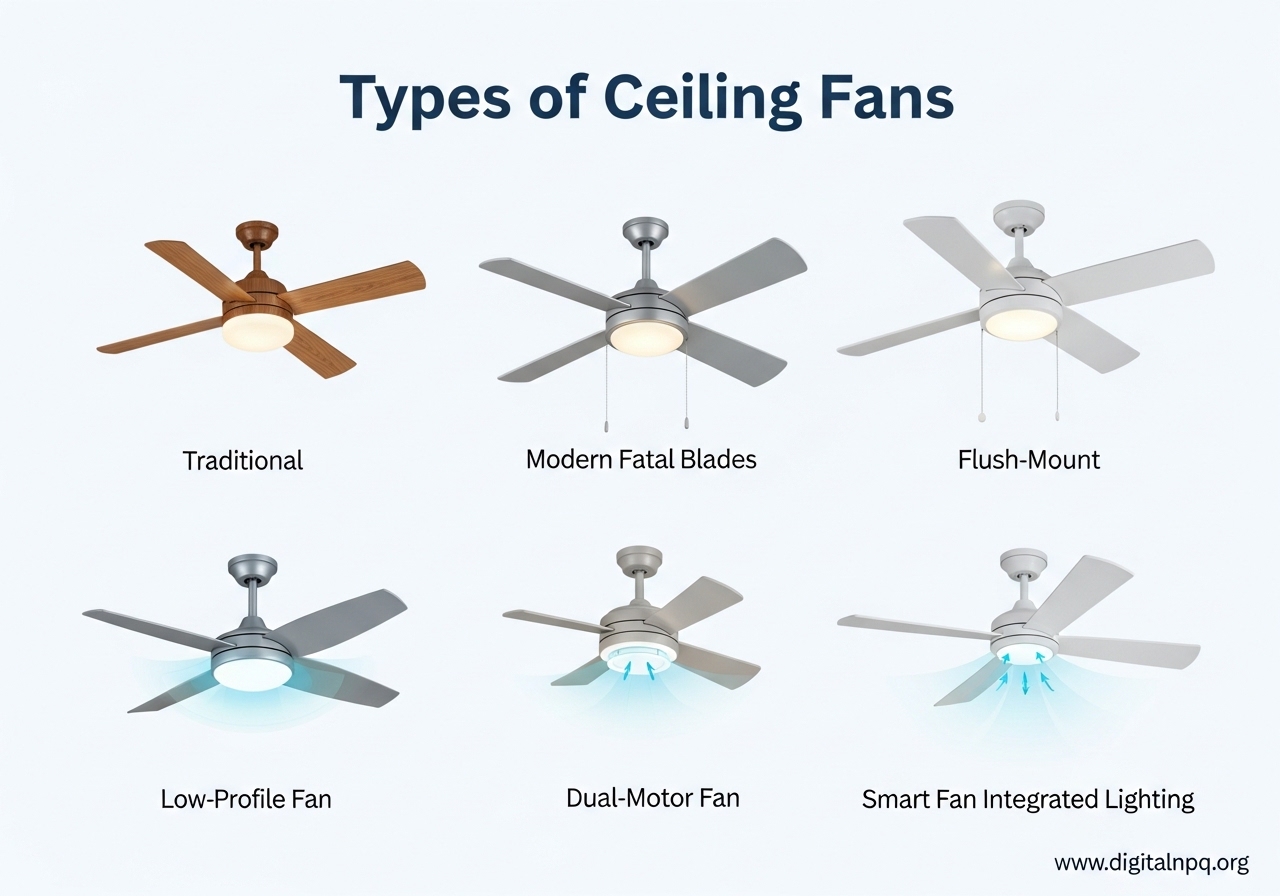
Ceiling fans fall into several main categories based on how they mount, what kind of motor they use, where they can be installed, and what special features they include. Here is the complete breakdown of every type of ceiling fan you need to know:
- Mounting Types: Standard (downrod), flush mount (hugger/low profile), and angled (sloped ceiling) fans
- Motor Types: AC motor fans and DC motor fans
- Outdoor Ratings: Dry rated, damp rated, and wet rated fans
- Size Categories: Small (under 42 inches), standard (42-52 inches), and large (over 52 inches)
- Specialty Types: Smart fans, fans with lights, retractable blade fans, dual motor fans, and commercial fans
Let me walk through each category in detail so you can understand exactly which type of ceiling fan suits your situation.
Ceiling Fan Mounting Types
The way a ceiling fan attaches to your ceiling is the first and most important classification to understand. Mounting type determines where a fan can be safely installed and how effectively it moves air. Getting this wrong can mean a fan that wobbles on a vaulted ceiling or hangs dangerously low in a room with an 8-foot ceiling.
Standard (Downrod) Ceiling Fans
Standard ceiling fans are the most common type you will see in homes. They use a metal downrod that extends from the ceiling bracket to the fan body, creating space between the ceiling and the blades. This gap is what allows air to circulate freely above and below the fan.
Downrod fans work best in rooms with ceiling heights between 8 and 9 feet. For higher ceilings, you simply use a longer downrod to bring the fan to the optimal height. Most manufacturers recommend that the bottom of the fan blades sit between 7 and 8 feet above the floor for both safety and airflow performance.
If your ceiling is 10 feet or higher, a standard mount fan with an extended downrod is usually the best option. You can find downrods in lengths from 12 inches up to 72 inches, making this the most versatile mounting type for homes with varied ceiling heights.
Flush Mount (Low Profile / Hugger) Ceiling Fans
Flush mount ceiling fans, also called low profile or hugger fans, mount directly against the ceiling without a downrod. The fan body sits tight to the ceiling surface, which keeps the entire unit higher in the room.
This type of ceiling fan is specifically designed for rooms with ceilings under 8 feet. In fact, building codes in most areas require that ceiling fan blades be at least 7 feet above the floor. If you have a standard 8-foot ceiling, a downrod fan would bring the blades too low. A flush mount fan solves this problem by hugging the ceiling.
The trade-off is airflow. Because the blades are so close to the ceiling, air cannot circulate above them as freely. This means hugger fans typically produce less CFM (cubic feet per minute of airflow) than a comparable downrod model. For small bedrooms, laundry rooms, and hallways with low ceilings, the airflow reduction is usually acceptable. For larger rooms, you may want to look at other options or accept slightly less air movement.
Angled (Sloped Ceiling) Mount Fans
If you have a vaulted, cathedral, or angled ceiling, you need a fan designed for sloped mounting. These fans use a special angled ceiling adapter, sometimes called a slope mount kit, that allows the downrod to hang perpendicular to the floor even when the ceiling is pitched.
Most standard downrod fans can handle a ceiling slope up to about 30 degrees out of the box. For steeper pitches, you will need a specific angled mount adapter. Some manufacturers offer adapters that accommodate slopes up to 45 or even 60 degrees.
One thing I always remind people about sloped ceiling installations: the fan will hang at an angle relative to the ceiling but should hang straight down relative to gravity. The downrod length matters more here because you need enough clearance for the blades to rotate without hitting the ceiling surface. Longer downrods are almost always necessary on sloped ceilings, and professional installation is strongly recommended for safety.
Ceiling Fan Motor Types: AC vs DC
The motor inside a ceiling fan determines how it performs, how much energy it uses, and how much noise it makes. There are two motor types you will see on the market: AC (alternating current) and DC (direct current). Understanding the difference between them is one of the most common questions I get asked, and it matters more than most buyers expect.
AC Motor Ceiling Fans
AC motor fans have been the standard for decades. They run on the alternating current that comes from your home’s electrical system. These motors are proven, reliable, and widely available across every brand and price range.
The main advantages of AC motors are simplicity and cost. They are less expensive to manufacture, which keeps the overall fan price lower. Replacement parts are easy to find, and most electricians are very familiar with AC motor fan installations.
The downsides are energy consumption and control options. AC motors use more electricity than DC motors, typically drawing 60 to 100 watts on high speed. They also usually offer only three or four speed settings, and reversing the fan direction requires a manual switch on the fan body itself rather than a remote or wall control.
DC Motor Ceiling Fans
DC motor ceiling fans are the newer technology and have become increasingly popular in 2026. They use a built-in inverter that converts your home’s AC power to DC, which powers a more efficient motor design.
The efficiency difference is significant. DC motors consume up to 70 percent less electricity than comparable AC motors while delivering the same or better airflow. A DC motor fan might draw only 20 to 35 watts on high speed compared to 60 to 100 watts for an AC model. Over years of daily use, that difference shows up on your electric bill.
DC motors also run noticeably quieter. In bedrooms and quiet spaces, this is a real advantage. Most DC motor fans offer six or more speed settings instead of the typical three or four, giving you finer control over airflow. The reverse function is usually controlled via remote, which is far more convenient than climbing up to flip a switch on the fan.
The trade-off is cost. DC motor fans typically cost more upfront than AC models. However, many homeowners find that the energy savings, quieter operation, and better controls justify the higher price, especially for fans that run many hours each day.
Outdoor Ceiling Fan Ratings Explained
Outdoor ceiling fan ratings are one of the most misunderstood topics I encounter. Installing the wrong fan outdoors can be a safety hazard and will dramatically shorten the fan’s lifespan. There are three ratings to know: dry, damp, and wet.
Dry Rated Ceiling Fans
Dry rated fans are designed for indoor use only. They have no protection against moisture and should never be installed in bathrooms, laundry rooms, or any space where humidity or water exposure is possible. Using a dry rated fan in a damp or wet location voids the warranty and creates an electrical hazard.
Damp Rated Ceiling Fans
Damp rated ceiling fans can handle moisture and humidity but cannot withstand direct exposure to rain or water spray. They are designed for covered outdoor spaces like screened porches, covered patios, and gazebo-style structures where the fan is protected from above.
Damp rated fans also work well in indoor spaces with high humidity, such as bathrooms and laundry rooms. The components are treated to resist corrosion from moisture in the air. Look for the UL damp location listing on the product specifications to confirm the rating.
Wet Rated Ceiling Fans
Wet rated ceiling fans are built to handle direct exposure to rain, snow, and water spray. You can install them on open patios, pergolas, and any outdoor structure without full overhead coverage. The motors are sealed, the blades are made from weather-resistant materials, and all electrical connections are protected from water intrusion.
One practical benefit of wet rated fans that many people appreciate: you can clean them by simply hosing them down. That makes maintenance much easier compared to wiping each blade by hand. If you live in an area with harsh winters, it is still a good idea to remove or cover outdoor fans during the off-season to extend their life.
A common question I see on home improvement forums is whether you can use an outdoor fan indoors. The answer is yes. Damp and wet rated fans work perfectly fine indoors and can be a smart choice for bathrooms, kitchens, and other moisture-prone areas where you want extra durability.
Ceiling Fan Size Guide by Room
Sizing a ceiling fan correctly is just as important as choosing the right type. A fan that is too small for a room will not move enough air to make a difference. A fan that is too large can overwhelm the space visually and create excessive airflow that feels uncomfortable.
The key measurement is blade span, which is the diameter of the circle the blades create when spinning. Here is a straightforward guide based on room size:
- Up to 75 square feet (small rooms, bathrooms): 29 to 36 inch blade span
- 76 to 144 square feet (small bedrooms, offices): 36 to 42 inch blade span
- 144 to 225 square feet (medium bedrooms, kitchens): 44 to 50 inch blade span
- 225 to 400 square feet (master bedrooms, living rooms): 50 to 60 inch blade span
- Over 400 square feet (great rooms, open floor plans): 60 to 72 inch blade span, or consider two fans
For a standard 12 by 12 foot bedroom (144 square feet), a 42 to 44 inch fan is ideal. For a large open-concept living area of 500 square feet, look at fans in the 65 to 72 inch range. I have seen many homeowners default to a 52 inch fan for every room, but that size is often too small for larger spaces. Forum discussions consistently show that users who upgraded from 52 inch to 60 or 65 inch fans in great rooms noticed a significant improvement in air circulation.
CFM, or cubic feet per minute, measures how much air a fan moves. Higher CFM means more airflow. When comparing fans of similar size, check the CFM rating at each speed. A quality 52 inch fan should produce at least 4,000 to 6,000 CFM on high speed. Energy Star certified fans tend to deliver better CFM per watt of electricity used.
Specialty Ceiling Fan Types
Beyond the basic mounting and motor categories, there are several specialty ceiling fan types designed for specific needs or aesthetics.
Smart Ceiling Fans
Smart ceiling fans connect to your home’s Wi-Fi network and can be controlled through a smartphone app or voice assistants like Alexa, Google Assistant, and Apple HomeKit. This type of ceiling fan lets you adjust speed, direction, and lighting from anywhere.
The real benefit of smart fans is automation. You can set schedules to turn the fan on before you get home, create routines that adjust fan speed based on room temperature, or tie the fan into a broader smart home setup. Some smart fans even include built-in temperature and humidity sensors that adjust operation automatically.
The downside is complexity. Smart fans depend on your Wi-Fi network and the manufacturer’s app. If the company stops supporting the app, you could lose smart features. Most smart fans still include a manual override, but it is worth checking before you buy. Also, smart fans are generally DC motor models, so they carry the higher upfront cost that comes with DC technology.
Ceiling Fans with Lights
Many ceiling fans come with integrated light kits or the option to add one. These serve double duty as both a fan and a room’s primary light source. In 2026, most new fans with lights feature integrated LED modules rather than standard bulb sockets.
Integrated LEDs are bright, energy efficient, and last tens of thousands of hours. However, forum users frequently point out that when the LED module eventually fails, replacing it can be more difficult than simply swapping a bulb. If you prefer the flexibility of standard bulb sockets, some models still offer that option. Look for fans with standard medium-base sockets if easy bulb replacement matters to you.
Retractable Blade Ceiling Fans
Retractable blade fans, sometimes called hidden blade fans, feature blades that extend outward when the fan is turned on and fold back into the housing when it is off. This creates a clean, minimalist look that many people prefer for dining rooms, bedrooms, or any space where a visible fan might clash with the decor.
These fans often double as a light fixture, with the central housing containing an LED light. The airflow from retractable blade fans is generally adequate for small to medium rooms but may not match the CFM output of a traditional fan with fixed blades. They are a good choice when aesthetics are the priority and moderate airflow is sufficient.
Dual Motor and Commercial Ceiling Fans
Dual motor ceiling fans feature two separate fan heads mounted on adjustable arms connected to a central motor housing. Each head can typically be positioned at different angles, making them effective for directing airflow in two directions at once.
These fans are popular in commercial settings like restaurants, retail stores, and warehouses where air needs to move across large or unusually shaped spaces. They are also used in residential settings with very large rooms or outdoor covered areas where a single fan head cannot provide adequate coverage.
Commercial ceiling fans in general are built with heavier-duty components, higher CFM ratings, and more robust mounting hardware. They are designed to run for extended periods without the wear issues that lighter residential fans might experience. If you are outfitting a gymnasium, warehouse, or large commercial space, look for commercial-rated fans specifically rather than residential models.
How to Choose the Right Type of Ceiling Fan
With so many types of ceiling fans available, narrowing down the right one comes down to answering a few key questions about your space and preferences.
Step 1: Measure your ceiling height. This determines your mounting type. Ceilings under 8 feet require a flush mount or hugger fan. Ceilings between 8 and 9 feet work with standard downrod fans using the included short downrod. Ceilings over 9 feet need an extended downrod. Vaulted or angled ceilings require an angled mount adapter.
Step 2: Measure your room size. This determines blade span. Use the sizing guide above to match your room’s square footage to the appropriate blade span. When in doubt, go slightly larger, since a bigger fan can always run on a lower speed setting.
Step 3: Determine indoor or outdoor use. Indoor rooms need only a dry rated fan. Covered outdoor spaces need a damp rated fan. Open or exposed outdoor areas require a wet rated fan. High-humidity indoor spaces like bathrooms also benefit from damp rated fans.
Step 4: Decide on motor type. If energy efficiency, quiet operation, and more speed options are priorities, a DC motor fan is the better choice despite the higher upfront cost. If budget is the main concern and you only run the fan occasionally, an AC motor fan will serve you well.
Step 5: Consider control preferences. Forum discussions consistently show that many homeowners prefer wall controls over remote controls. Remotes get lost, batteries die, and some users find them frustrating. DC motor fans almost always come with a remote, while AC motor fans typically use a wall switch. Some fans offer both options. Think about which control method fits your lifestyle.
Step 6: Factor in noise sensitivity. For bedrooms and quiet spaces, DC motor fans are noticeably quieter than AC models. Also, fans with more blades tend to operate more quietly than fans with fewer blades, though they may move slightly less air at lower speeds.
Step 7: Think about aesthetics. The fan will be a visible fixture in your room for years. Choose a style and finish that complements your decor. If you want the fan to disappear when not in use, consider a retractable blade model. If you need a light source, a fan with an integrated LED kit saves the trouble of installing a separate fixture.
FAQ
What are the types of ceiling fans?
Ceiling fans come in five main categories: mounting types (standard downrod, flush mount/hugger, and angled/sloped ceiling), motor types (AC and DC), outdoor ratings (dry, damp, and wet rated), size categories (small under 42 inches, standard 42-52 inches, and large over 52 inches), and specialty types (smart fans, fans with lights, retractable blade fans, dual motor fans, and commercial fans).
What is the best type of ceiling fan?
The best type of ceiling fan depends on your specific room. For bedrooms with standard ceilings, a DC motor fan with quiet operation is ideal. For low ceilings, a flush mount (hugger) fan is necessary. For covered patios, a damp rated fan provides the right protection. For large open rooms, a 60-inch or larger downrod fan moves the most air. There is no single best fan for every situation.
Can a ceiling fan affect your sinuses?
Yes, a ceiling fan can affect your sinuses if it blows air directly on you while you sleep. Direct airflow can dry out your nasal passages and throat, potentially causing congestion or sinus discomfort. To minimize this, set the fan to a lower speed, use the reverse (clockwise) direction on low to circulate air without creating a direct breeze, or position your bed so the fan does not blow directly on your face.
What is the difference between a damp rated and wet rated ceiling fan?
A damp rated fan can handle moisture and humidity in covered outdoor spaces but cannot be exposed to direct rain or water spray. A wet rated fan is fully sealed and can withstand direct rain, snow, and water spray, making it suitable for fully exposed outdoor locations like open patios and pergolas. You can hose down a wet rated fan for cleaning, but you should never do that with a damp rated model.
Are DC motor ceiling fans better than AC motor fans?
DC motor fans are more energy efficient (up to 70 percent less electricity use), quieter, and offer more speed settings and convenient remote reverse functions. However, they cost more upfront. AC motor fans are less expensive, widely available, and reliable for occasional use. If you run your fan many hours per day, the energy savings of a DC motor will offset the higher cost over time.
What size ceiling fan do I need for a 12×12 room?
A 12×12 foot room is 144 square feet, which calls for a ceiling fan with a 42 to 44 inch blade span. This size provides adequate airflow without overwhelming the room. Look for a fan that produces at least 3,000 to 4,000 CFM on high speed for this room size.
Conclusion
Understanding every type of ceiling fan available in 2026 helps you make a confident decision that matches your space, budget, and comfort needs. The mounting type tells you how the fan attaches to your ceiling and whether it will work safely at your ceiling height. The motor type determines energy consumption, noise levels, and control options. The outdoor rating ensures your fan can handle the environment where it is installed. And specialty features like smart connectivity, integrated lighting, and retractable blades give you options for convenience and aesthetics.
Start with your ceiling height and room size. Those two measurements narrow down your options more than anything else. From there, consider whether you need outdoor protection, prefer quiet DC motor operation, or want smart features. The right type of ceiling fan is the one that fits your specific room and how you plan to use it, not the most expensive or feature-packed model on the shelf.