
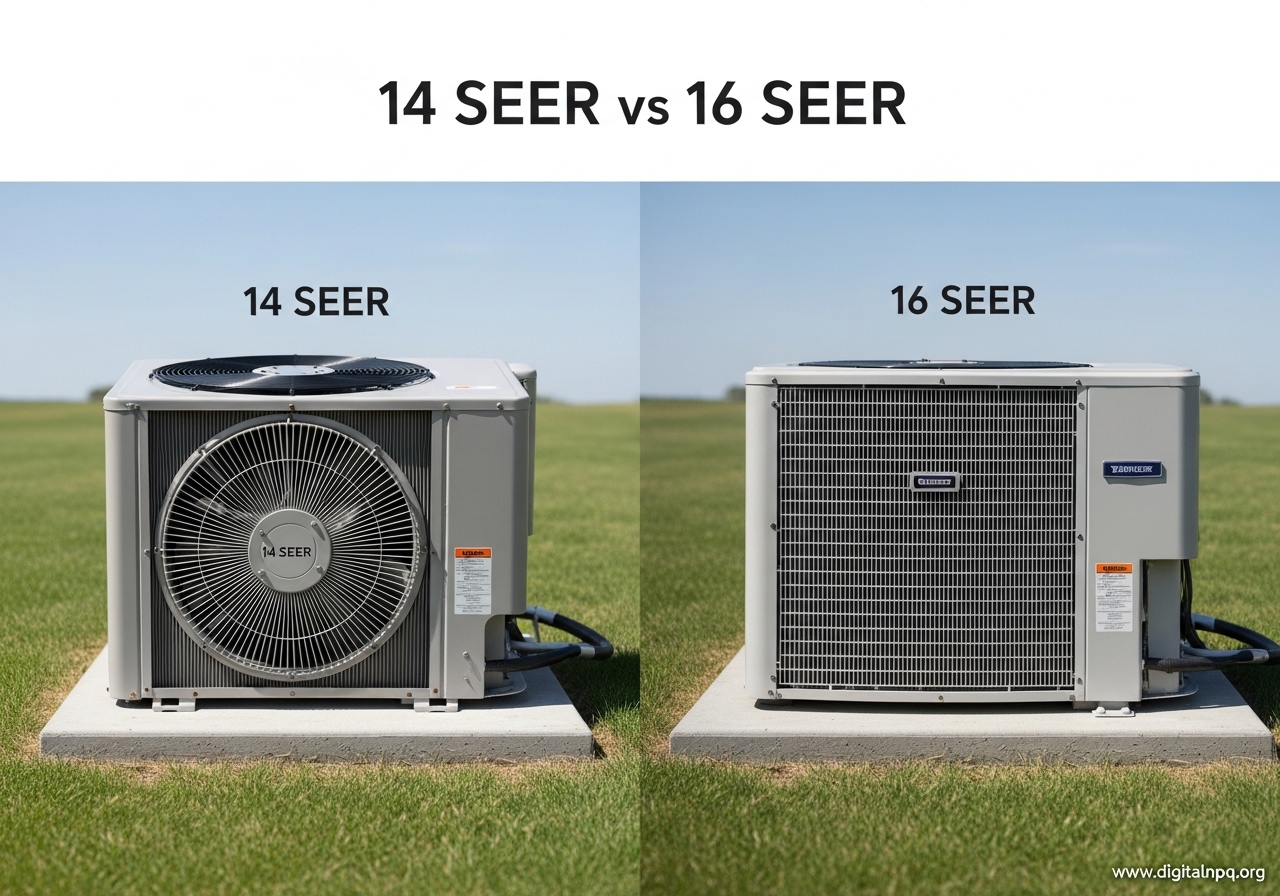
If you are shopping for a new air conditioner or heat pump, you have probably come across the 14 SEER vs 16 SEER debate. It is one of the most common decisions homeowners face when replacing an HVAC system, and the right answer depends on more factors than most people realize.
SEER stands for Seasonal Energy Efficiency Ratio, and it measures how efficiently an air conditioning unit converts electricity into cooling power. A higher SEER rating means the unit uses less energy to deliver the same amount of cooling, which translates to lower utility bills over time.
In this guide, our team breaks down everything you need to know about 14 SEER vs 16 SEER systems. We will cover what each rating actually means, how much you can expect to save on energy bills, the real cost difference, and which option makes the most sense based on your climate, budget, and how long you plan to stay in your home.
What Is SEER Rating?
SEER, or Seasonal Energy Efficiency Ratio, is the standard measurement used to rate the energy efficiency of air conditioners and heat pumps in the United States. It is calculated by dividing the total cooling output of a unit (measured in BTUs, or British Thermal Units) by the total electrical energy it consumes (measured in watt-hours) over a typical cooling season.
Think of it like miles per gallon on a car. A higher SEER rating means the system produces more cooling for every unit of electricity it uses. A 14 SEER unit delivers 14 BTUs of cooling per watt-hour of electricity consumed, while a 16 SEER unit delivers 16 BTUs per watt-hour.
The Department of Energy established SEER ratings to help consumers compare HVAC systems side by side. Since 1992, the federal government has steadily raised minimum efficiency standards, pushing manufacturers to build more efficient equipment.
SEER vs SEER2: Understanding the New Standard
In January 2023, the Department of Energy introduced a new testing procedure called SEER2. This updated standard changes how systems are tested, using more realistic external static pressure conditions that better reflect real-world installation environments.
Under SEER2, the same physical unit will have a slightly lower rated efficiency number compared to the old SEER standard. For example, a unit that was rated at 14 SEER under the old system now tests at approximately 13.4 SEER2. A 16 SEER unit tests at roughly 15.0 SEER2.
This does not mean the equipment got worse. The new testing method simply provides a more accurate picture of how the system will actually perform in your home. When you see SEER ratings advertised today, most manufacturers list both SEER and SEER2 numbers. For the purposes of this article, we use the traditional SEER ratings since that is what most homeowners are familiar with when comparing 14 SEER vs 16 SEER.
What Does 14 SEER Mean?
A 14 SEER air conditioner represents the baseline efficiency level for modern residential cooling equipment. Since January 2023, 14 SEER has been the federal minimum efficiency standard for air conditioners installed in the southern United States, which includes states from Virginia down through Florida and across to California.
Most 14 SEER systems use a single-stage compressor. This means the compressor operates at full capacity whenever it is running, then shuts off completely when the thermostat reaches the target temperature. This on-off cycling pattern is simple and reliable, but it can lead to small temperature swings and slightly higher humidity levels compared to systems with more advanced compressor technology.
For homeowners in mild climates where the air conditioner runs only a few months out of the year, a 14 SEER unit often provides the best balance of upfront affordability and adequate performance. The system does its job without the premium price tag associated with higher-efficiency models.
Installation costs for 14 SEER systems tend to be lower because the technology is straightforward and the components are widely available. Replacement parts are also easy to source, which can keep maintenance costs down over the life of the system.
What Does 16 SEER Mean?
A 16 SEER air conditioner sits in the mid-to-upper efficiency range for residential HVAC equipment. It is not the highest rating available (some systems reach 20 SEER or higher), but it represents a meaningful step up from the 14 SEER baseline.
The biggest difference between a 16 SEER and a 14 SEER system is usually the compressor. Most 16 SEER units feature a two-stage compressor that can run at a lower capacity when cooling demand is moderate. Instead of blasting at 100 percent every time it kicks on, a two-stage compressor might run at around 65 percent capacity for much of the day, only ramping to full power during the hottest afternoons.
This partial-load operation delivers several benefits. The system runs longer cycles at lower speed, which means more even temperature distribution throughout your home. It also removes significantly more humidity from the air because the indoor coil stays colder for longer periods. Many homeowners notice a tangible comfort difference when upgrading from a single-stage 14 SEER to a two-stage 16 SEER system.
Additionally, 16 SEER systems are more likely to qualify for Energy Star certification, federal tax credits, and local utility rebates. These incentives can substantially reduce the effective cost of upgrading, sometimes making the 16 SEER option nearly as affordable as the 14 SEER after accounting for credits and lower operating costs.
14 SEER vs 16 SEER: Side-by-Side Comparison
Here is a direct comparison of the key differences between 14 SEER and 16 SEER air conditioning systems across the factors that matter most to homeowners.
- Energy Efficiency: 16 SEER is approximately 14 percent more efficient than 14 SEER. For every dollar you spend cooling your home with a 14 SEER unit, the 16 SEER unit would cost roughly 86 cents to deliver the same cooling output.
- Compressor Type: 14 SEER systems typically use single-stage compressors that run at full capacity. 16 SEER systems generally use two-stage compressors that can modulate output based on cooling demand.
- Humidity Control: 16 SEER units provide better dehumidification thanks to longer low-speed compressor cycles. This is particularly noticeable in humid climates like the Southeast.
- Temperature Consistency: Two-stage compressors in 16 SEER systems maintain more even temperatures room to room, reducing hot and cold spots.
- Noise Level: 16 SEER units tend to operate more quietly because the compressor runs at lower speeds during partial-load conditions. Many homeowners report the outdoor unit is noticeably less intrusive.
- Tax Credit Eligibility: 16 SEER systems are more likely to meet the efficiency thresholds required for federal energy tax credits, which can be worth up to $600 for qualified installations.
- Upfront Cost: 14 SEER systems cost less to purchase and install. The price premium for upgrading to 16 SEER typically ranges from $800 to $2,500 depending on the brand, tonnage, and installation complexity.
- Lifespan: Both ratings can last 15 to 20 years with proper maintenance. Two-stage compressors in 16 SEER systems may experience less wear because they do not start and stop as frequently.
- Warranty: Many manufacturers offer similar warranty terms for both tiers, though some extend longer compressor warranties on their 16 SEER product lines.
Energy Savings: How Much Can You Really Save?
The efficiency difference between 14 SEER and 16 SEER is 14 percent. But what does that actually mean for your utility bills? Let us walk through a real-world example.
Say your current cooling costs run about $100 per month during the summer with a 14 SEER system. Over a typical five-month cooling season, that is $500 per year in cooling expenses. If you switched to a 16 SEER unit with the same cooling output, your annual cooling costs would drop to approximately $430 per year, saving you about $70 annually.
In hotter climates where the cooling season stretches to seven or eight months and summer bills run $200 or more per month, the savings scale up quickly. A homeowner in Texas or Florida spending $200 per month on cooling with a 14 SEER unit might save $140 to $160 per year by upgrading to 16 SEER.
Over the typical 15-year lifespan of a central air conditioning system, those annual savings add up. At $70 per year in a moderate climate, you would save roughly $1,050 over 15 years. In a hot climate saving $150 per year, the cumulative savings reach about $2,250 over the same period.
Calculating Your Payback Period
To figure out if the upgrade is worth it, you need to compare the extra upfront cost against the annual savings. Here is a straightforward way to calculate the payback period.
Step 1: Get installed quotes for both 14 SEER and 16 SEER systems. Let us say the 14 SEER installation costs $5,000 and the 16 SEER installation costs $6,200, making the upgrade premium $1,200.
Step 2: Estimate your annual cooling costs with the 14 SEER unit. Check your summer electric bills and isolate the cooling portion, or ask your HVAC contractor for an estimate based on your home size and climate zone.
Step 3: Calculate the annual savings. If your 14 SEER cooling costs are $600 per year, the 16 SEER would cost about $525 per year (600 x 14/16). That is $75 in annual savings.
Step 4: Divide the upgrade premium by the annual savings. In this example, $1,200 divided by $75 equals 16 years. If you plan to stay in the home for more than 16 years, the upgrade pays for itself. If you expect to move sooner, the 14 SEER may be the smarter financial choice.
However, this calculation changes significantly if you qualify for tax credits or rebates. A $600 federal tax credit on the 16 SEER system would reduce your effective upgrade cost to $600, cutting the payback period to just 8 years.
Cost Comparison: Upfront vs Long-Term
The installed cost of a central air conditioning system depends on several factors: the size of your home, the complexity of the installation, the brand you choose, and local labor rates. But in general terms, the price gap between 14 SEER and 16 SEER systems follows predictable patterns.
A 14 SEER system typically costs between $4,000 and $7,000 installed for a standard 2.5-ton unit serving a medium-sized home. A comparable 16 SEER system from the same manufacturer usually runs $5,000 to $9,000 installed. The upgrade premium ranges from $800 on the low end to $2,500 on the high end, with most homeowners paying somewhere around $1,000 to $1,500 more for the 16 SEER option.
Brand choice plays a role in the price difference. Budget-friendly brands like Goodman or Payne tend to have a smaller gap between their 14 and 16 SEER offerings, while premium brands like Trane or Carrier may charge a steeper premium for the efficiency upgrade.
It is worth noting that the long-term operating cost difference can narrow the gap. Over a 15-year system life, a 16 SEER unit in a hot climate can save $1,500 to $2,500 in electricity costs compared to a 14 SEER unit. When you factor in potential tax credits of $300 to $600 and any local utility rebates, the total cost of ownership between the two options can end up surprisingly close.
Our team always recommends getting quotes from at least three HVAC contractors for both SEER ratings. Pricing varies significantly by region and installer, and sometimes a contractor will offer a promotional deal on a 16 SEER system that narrows the gap even further.
Climate Considerations: Where You Live Matters
Your geographic location is arguably the single most important factor in the 14 SEER vs 16 SEER decision. The more you run your air conditioner, the more you benefit from higher efficiency.
Hot Climates (Long Cooling Season)
If you live in the southern half of the United States, including states like Texas, Florida, Georgia, Arizona, and Louisiana, your air conditioner probably runs for six to nine months out of the year. In these regions, the 14 percent efficiency advantage of a 16 SEER unit compounds across thousands of operating hours annually.
Homeowners in Phoenix, for example, may run their AC units for 2,500 to 3,000 hours per cooling season. At that usage level, the difference between 14 SEER and 16 SEER can mean $150 to $250 per year in electricity savings. Over the system lifespan, that is a substantial amount of money.
Forum discussions on Reddit consistently confirm this pattern. Users in hot climates report that upgrading from 14 SEER to 16 SEER produces meaningful, noticeable savings on their electric bills. Many say the upgrade paid for itself within 7 to 10 years.
Mild Climates (Short Cooling Season)
If you live in the Pacific Northwest, New England, or the upper Midwest, your cooling season might only last two to three months. In these areas, the annual energy savings from upgrading to 16 SEER might amount to only $30 to $50 per year.
At that savings rate, a $1,200 upgrade premium would take 24 to 40 years to pay back, which exceeds the expected lifespan of the equipment. For homeowners in mild climates, a 14 SEER system is usually the more practical choice from a pure financial perspective.
Regional Minimum Standards
Since 2023, the federal minimum SEER standard is 14 SEER in the southern region (Alabama, Arizona, Arkansas, California, Delaware, Florida, Georgia, Hawaii, Kentucky, Louisiana, Maryland, Mississippi, Nevada, New Mexico, North Carolina, Oklahoma, South Carolina, Tennessee, Texas, and Virginia) and 13 SEER in the northern region. Some states have adopted even higher minimums. Make sure you check your local requirements before shopping, because your region may not even allow 14 SEER installations.
Compressor Technology Differences
The compressor is the heart of any air conditioning system, and the type of compressor used is one of the main reasons 16 SEER systems outperform 14 SEER systems in comfort and efficiency.
Single-Stage Compressors (Typical in 14 SEER)
A single-stage compressor has one speed: full blast. When the thermostat calls for cooling, the compressor turns on at 100 percent capacity and runs until the temperature drops to the set point, then shuts off. This start-stop cycle repeats throughout the day.
The main advantage of a single-stage compressor is simplicity. Fewer moving parts mean lower manufacturing costs and straightforward repairs. These compressors have been the industry standard for decades and are proven to be reliable.
The downside is comfort. Because the system only runs at full capacity, it may overshoot the target temperature, especially during milder weather when the home only needs a small amount of cooling. The frequent cycling can also lead to uneven temperatures between rooms and less effective dehumidification.
Two-Stage Compressors (Typical in 16 SEER)
A two-stage compressor can operate at two different speeds: a low stage (typically around 65 to 70 percent capacity) and a high stage (100 percent). During most of the day when cooling demand is moderate, the system runs in low stage. It only shifts to high stage during the hottest part of the afternoon.
This staged operation makes a real difference in home comfort. Low-stage running means the system circulates air more gently and for longer periods. This allows the indoor evaporator coil to extract more moisture from the air, resulting in better humidity control. Many homeowners find that a two-stage system allows them to set the thermostat a degree or two higher while feeling just as comfortable, because the air is drier.
The longer run cycles also reduce temperature swings. Instead of the temperature bouncing between 72 and 76 degrees as the system cycles on and off, a two-stage unit might keep the home between 73 and 74 degrees consistently.
Variable-Speed Compressors
Some 16 SEER systems (and most systems rated above 16 SEER) use variable-speed compressors that can modulate their output across a wide range, often from 25 percent to 100 percent capacity. These systems offer the highest level of comfort and efficiency, adjusting their output in tiny increments to match the exact cooling load at any given moment.
Variable-speed technology is more common in systems rated 17 SEER and above, but a handful of 16 SEER models do incorporate it. If you find a 16 SEER system with a variable-speed compressor, it is worth serious consideration because you get near-premium comfort at a mid-range price point.
Tax Credits, Rebates, and Incentives
Government incentives can significantly tip the financial scales in favor of a 16 SEER system. The federal government, many states, and local utilities offer tax credits and rebates for high-efficiency HVAC installations.
Federal Energy Tax Credits
Under the Inflation Reduction Act, homeowners can claim a tax credit of up to $600 for installing a qualified high-efficiency central air conditioner. The specific efficiency requirements vary, but in general, 16 SEER systems are much more likely to qualify than 14 SEER systems.
For air conditioners, the system must meet or exceed the highest tier of efficiency set by the Consortium for Energy Efficiency (CEE) to qualify. This typically means 16 SEER or higher for split systems. Heat pumps have separate qualification criteria, but the same general rule applies: higher SEER ratings are more likely to meet the threshold.
This tax credit applies to installations in 2026 and can be claimed on your federal income tax return. It is a direct credit, not a deduction, which means it reduces your tax bill dollar for dollar.
State and Local Rebates
Many electric utilities and state energy offices offer additional rebates for high-efficiency HVAC installations. These programs vary widely by location, but rebates of $100 to $500 for installing a 16 SEER system are common. Some utilities in hot-climate states like Arizona and Texas offer even more generous incentives.
Check the DSIRE database (Database of State Incentives for Renewables and Efficiency) or contact your local electric utility to find available programs in your area. Your HVAC contractor should also be able to tell you about any rebates that apply to your installation.
Energy Star Certification
Energy Star-certified air conditioners must meet efficiency standards that exceed the federal minimum by a meaningful margin. For split-system central air conditioners, the Energy Star requirement is typically 15 SEER or higher in the southern region. This means most 14 SEER systems do not qualify for Energy Star, while most 16 SEER systems do.
Energy Star certification can unlock additional rebates and is also a good indicator of overall build quality and performance reliability.
Other Factors That Affect Real-World Efficiency
SEER ratings are measured under controlled laboratory conditions. The actual efficiency you experience in your home depends on several additional factors that can significantly influence your real-world energy costs.
Installation Quality
HVAC professionals consistently emphasize that proper installation matters as much as, if not more than, the SEER rating itself. A poorly installed 16 SEER system can actually perform worse than a properly installed 14 SEER system. Common installation issues that reduce efficiency include improper refrigerant charge, leaky ductwork, poor airflow setup, and incorrect sizing.
Reddit users in the HVAC advice community frequently share stories of high-SEER systems that underperformed because of rushed or sloppy installation. Investing in an experienced, reputable contractor is essential regardless of which SEER rating you choose.
Home Insulation and Ductwork
Your home’s insulation, air sealing, and ductwork condition have a major impact on how hard your air conditioner has to work. A well-insulated home with sealed ducts will see better returns from a higher SEER system because less cooling is wasted through the building envelope.
If your ductwork is old, leaky, or poorly designed, upgrading from 14 SEER to 16 SEER will not deliver the savings you expect. Fixing duct leaks and improving insulation before replacing your AC unit is often a better investment than chasing a higher SEER rating.
Indoor and Outdoor Unit Matching
The SEER rating of a split system is determined by the combination of the indoor evaporator coil and the outdoor condensing unit. Using a 16 SEER outdoor unit with an older indoor coil may result in actual performance closer to 14 SEER. Forum discussions frequently warn homeowners about this mismatch issue.
To achieve the rated SEER performance, both the indoor and outdoor components need to be matched and installed as a system. Most manufacturers publish AHRI (Air Conditioning, Heating, and Refrigeration Institute) ratings that specify which coil and condenser combinations achieve the rated efficiency.
Proper Sizing
An oversized air conditioner, regardless of its SEER rating, will short-cycle, running for short bursts that waste energy and fail to properly dehumidify the air. An undersized unit will run constantly, struggling to keep up on the hottest days. Both scenarios reduce the real-world efficiency you get from your system.
A quality HVAC contractor will perform a Manual J load calculation to determine the correct size for your home. This calculation accounts for square footage, insulation levels, window placement, sun exposure, and other factors specific to your house.
When to Choose 14 SEER vs 16 SEER
After reviewing all the data, here is a straightforward decision framework to help you choose between these two efficiency ratings.
Choose 14 SEER If
You live in a mild or cool climate where the air conditioner runs only a few months per year. Your cooling bills are relatively low, and the payback period for a higher SEER system would extend beyond the expected lifespan of the unit. You have a limited budget and want to keep installation costs as low as possible. You do not plan to stay in the home for more than 5 to 10 years.
A 14 SEER system is a perfectly solid choice that meets current federal minimum standards in most of the country. It will cool your home effectively and reliably for 15 to 20 years with proper maintenance.
Choose 16 SEER If
You live in a hot climate with a long cooling season of five months or more. Your summer electric bills are high, and the 14 percent efficiency improvement will generate meaningful annual savings. You qualify for federal tax credits or local rebates that reduce the effective upgrade cost. You value the improved comfort that comes with a two-stage compressor, including better humidity control and more consistent temperatures. You plan to stay in the home for 10 years or longer, giving the energy savings time to offset the higher upfront cost.
For many homeowners in the southern half of the United States, the 16 SEER system ends up being the better total-value proposition when you account for energy savings, tax incentives, and improved comfort over the life of the system.
The Bottom Line Decision
If the installed price difference between 14 SEER and 16 SEER is under $1,000 and you live in a warm climate, go with 16 SEER. The savings and comfort improvements are worth it. If the upgrade premium is closer to $2,000 and you live in a mild climate, the 14 SEER is likely the smarter financial call.
Either way, prioritize installation quality above all else. As multiple HVAC professionals have noted in forum discussions, a well-installed 14 SEER system will outperform a poorly installed 16 SEER system every time.
FAQ
Is it worth going from 14 SEER to 16 SEER?
It depends on your climate and how long you plan to stay in your home. In hot climates with long cooling seasons (Texas, Florida, Arizona), the 14 percent efficiency improvement can save $100 to $250 per year, making the upgrade worthwhile within 7 to 10 years. In mild climates with short cooling seasons, the annual savings may be too small to justify the higher upfront cost. Federal tax credits of up to $600 for 16 SEER systems can also shorten the payback period significantly.
Is 14 SEER being discontinued?
No, 14 SEER is not being discontinued as an efficiency rating. However, since January 2023, the federal minimum efficiency standard for air conditioners in the southern United States is 14 SEER, meaning manufacturers must produce units that meet or exceed this level. In the northern states, the minimum is 13 SEER. The new SEER2 testing standard has adjusted how efficiency is measured, but 14 SEER units remain widely available and legal to install in regions where they meet local minimums.
Does a 14 SEER heat pump qualify for tax credits?
Generally, a 14 SEER heat pump does not qualify for the federal energy tax credit on its own. The Inflation Reduction Act requires heat pumps to meet higher efficiency thresholds, typically equivalent to 15 SEER or higher, to be eligible for the credit. Some high-efficiency 14 SEER heat pumps may qualify if they also meet the required HSPF (Heating Seasonal Performance Factor) rating, but most standard 14 SEER models fall short. A 16 SEER heat pump is much more likely to qualify for the tax credit.
Is 14 a good SEER rating for AC?
Yes, 14 SEER is a good baseline rating for a modern air conditioner. It meets the current federal minimum standard in the southern United States and represents a meaningful improvement over older 10 or 12 SEER units that many homes still have. A 14 SEER system will provide reliable cooling and reasonable energy efficiency, particularly in mild climates. However, if you live in a hot climate and want better humidity control, lower energy bills, and more even temperatures, stepping up to 16 SEER is worth considering.
How much more does a 16 SEER unit cost than 14 SEER?
The typical installed price difference between a 14 SEER and a 16 SEER system ranges from $800 to $2,500, with most homeowners paying around $1,000 to $1,500 more for the 16 SEER upgrade. The exact premium depends on the brand, system size (tonnage), installation complexity, and local labor rates. Budget brands tend to have a smaller price gap, while premium brands may charge a steeper premium for the higher-efficiency model.
Does higher SEER mean better cooling?
Not necessarily. SEER measures energy efficiency, not cooling capacity. A 14 SEER and a 16 SEER unit of the same size (tonnage) will produce the same amount of cooling. The difference is that the 16 SEER unit uses less electricity to do it. However, 16 SEER systems typically have two-stage compressors that provide more even temperatures and better humidity control, which many homeowners perceive as better cooling comfort.
Conclusion
The 14 SEER vs 16 SEER decision comes down to three things: your climate, your budget, and how long you plan to stay in your home. A 16 SEER system is roughly 14 percent more efficient and typically comes with a two-stage compressor that delivers better humidity control and more consistent temperatures throughout your home.
For homeowners in hot climates with long cooling seasons, the energy savings, tax credits, and comfort improvements make the 16 SEER upgrade a smart investment that usually pays for itself within 7 to 12 years. For those in milder regions, a 14 SEER system provides reliable cooling at a lower upfront cost with a shorter payback period that may not justify the upgrade.
Whichever direction you choose, remember that proper installation and sizing are just as important as the SEER rating itself. Work with a licensed, experienced HVAC contractor who performs a thorough load calculation and installs the system to manufacturer specifications. That is the single best thing you can do to maximize the efficiency and lifespan of your new air conditioning system.