
If you are shopping for cleaner indoor air, you have probably come across the debate: air ionizer vs air purifier — which one actually works? It is a fair question, and the answer matters more than most people realize. These two technologies clean your air in fundamentally different ways, and choosing the wrong one could mean breathing in pollutants you thought were gone.
After researching the science behind both technologies, digging through EPA guidance, and reading hundreds of real user experiences, I can tell you that the difference is not subtle. One physically removes contaminants from your air. The other makes particles heavy enough to fall — right onto your furniture, walls, and floors. In this guide, I will break down exactly how each technology works, where each one excels, and which one makes the most sense for your home in 2026.
Here is what we will cover: how HEPA air purifiers capture pollutants, how ionizers use electrical charges to affect particles, the real health concerns around ozone, and practical recommendations based on your specific situation. Let us get into it.
What Is an Air Purifier and How Does It Work?
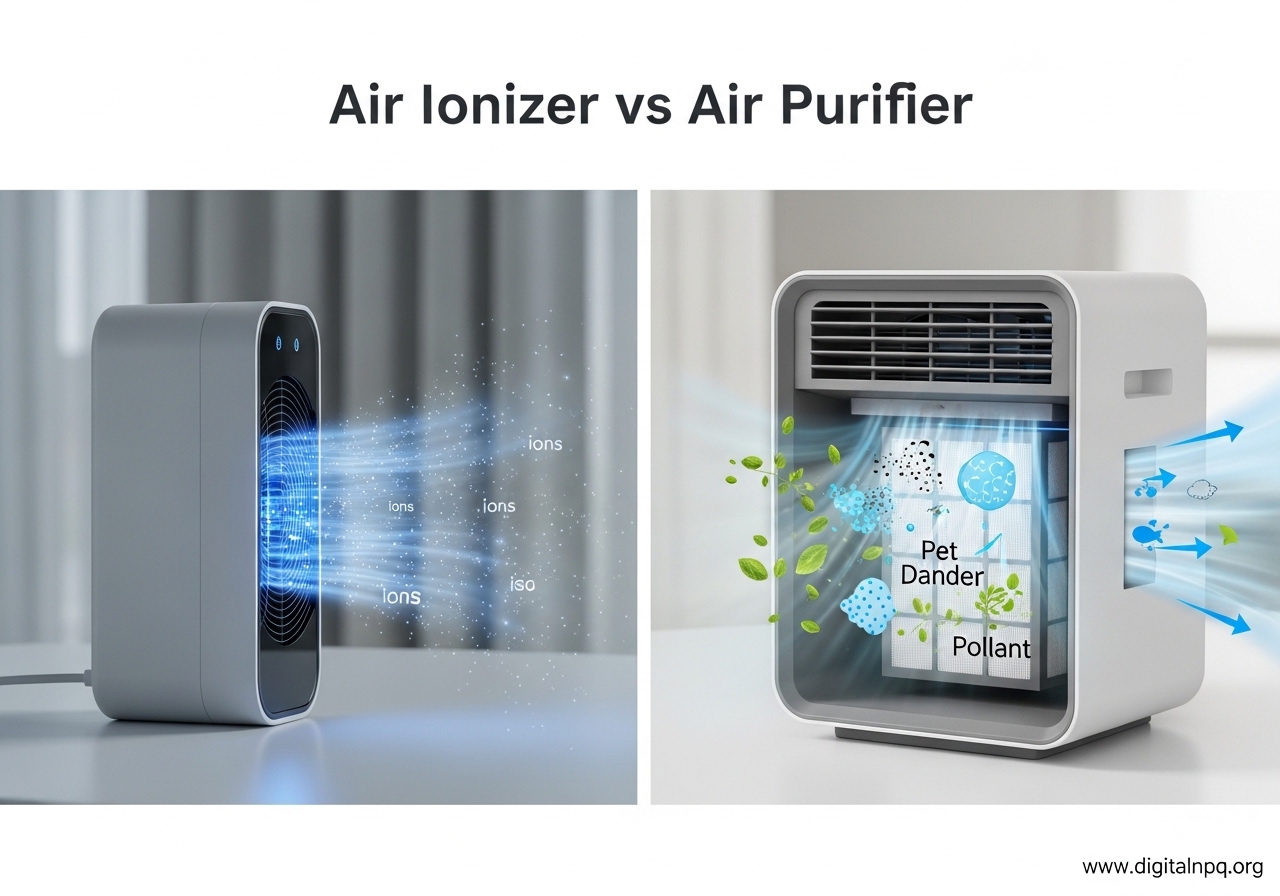
An air purifier is a device that pulls air through a series of physical filters to trap pollutants and return cleaner air to your room. Think of it like a vacuum cleaner for your air — it draws dirty air in, captures the contaminants inside, and pushes clean air back out.
The gold standard for air purification is the HEPA filter (High-Efficiency Particulate Air). A true HEPA filter captures at least 99.97% of airborne particles that are 0.3 microns in diameter. That covers dust, pollen, pet dander, mold spores, and even some bacteria. The 0.3-micron benchmark is important because particles of that size are actually the hardest to capture — both larger and smaller particles get trapped at even higher rates.
Many quality air purifiers also include an activated carbon filter layer. While HEPA handles solid particles, activated carbon absorbs gases and volatile organic compounds (VOCs) through a process called adsorption. This is what helps with cooking odors, paint fumes, cleaning chemical vapors, and smoke smell. If you have ever noticed a lingering smell after cooking fish or painting a room, that is exactly what activated carbon targets.
The process is straightforward: a fan pulls room air through the intake, the air passes through the pre-filter (catching larger debris), then through the HEPA filter (trapping fine particles), then through the carbon layer (absorbing odors and gases). The clean air exits back into your room. This cycle repeats continuously, gradually reducing the concentration of pollutants in your indoor air.
Most air purifiers also include a pre-filter that catches larger particles like hair and lint, extending the life of the HEPA filter. You will typically need to replace filters every 6 to 12 months depending on usage and air quality conditions. The Clean Air Delivery Rate (CADR) rating tells you how quickly a unit can clean a given room size — higher CADR means faster, more effective cleaning.
What Is an Air Ionizer and How Does It Work?
An air ionizer works on a completely different principle. Instead of pulling air through filters, it releases charged particles — called ions — into the air around it. These ions attach to airborne pollutants like dust, smoke, and pollen, giving those particles an electrical charge.
Once charged, the pollutants become attracted to nearby surfaces — walls, floors, furniture, curtains, and even the ionizer unit itself. The idea is simple: make particles too heavy to stay airborne, and they fall out of the breathing zone. The catch? Those particles are still in your room. They have just moved from floating in the air to sitting on your surfaces.
There are two main types of ionizers. Unipolar ionizers produce only negative ions, while bipolar ionizers produce both positive and negative ions. Both types operate on the same basic concept — charge particles so they cluster together, become heavier, and settle out of the air.
Some ionizers include collection plates that attract and hold the charged particles. These are called electrostatic precipitators, and they do remove particles from the air rather than just depositing them on surfaces. However, the collection plates need regular cleaning to remain effective, and their efficiency drops significantly as plates get dirty.
Ionizers appeal to many people because they have no filters to replace — just occasional cleaning of collection plates if present. They also tend to run quietly since they do not rely on strong fans. But this convenience comes with trade-offs that we will get into shortly, particularly around ozone production and the fact that settled particles can easily become airborne again when you walk across a carpet, open a door, or sit on a couch.
Air Ionizer vs Air Purifier: The Key Differences
The core difference comes down to this: air purifiers physically remove pollutants from your living space, while air ionizers make particles settle onto surfaces without removing them. That single distinction drives every other difference between the two technologies. Here is how they compare across the factors that matter most.
- Mechanism: Air purifiers use physical filtration (HEPA and carbon filters). Ionizers use electrical charging to make particles stick to surfaces.
- Pollutant removal: Purifiers trap and hold contaminants in filters. Ionizers deposit particles on walls, floors, and furniture — they remain in your space.
- Particle size range: HEPA filters reliably capture particles down to 0.3 microns with 99.97% efficiency. Ionizers can affect smaller particles but do not actually remove them.
- Ozone production: Quality HEPA purifiers produce zero ozone. Ionizers can produce ozone as a by-product of the ionization process, which is a health concern.
- Noise level: Purifiers produce fan noise (varies by model and speed). Ionizers are nearly silent since they lack fans.
- Maintenance: Purifiers require filter replacements every 6-12 months. Ionizers need only occasional plate cleaning — no filter purchases.
- Running cost: Purifiers have higher long-term costs due to replacement filters. Ionizers cost less to maintain but may deliver less value.
- VOC and odor removal: Purifiers with activated carbon effectively absorb odors, gases, and chemical vapors. Ionizers do not remove VOCs or gases.
- Allergy and asthma relief: Purifiers are the clear winner here — they physically remove triggers from the air. Ionizers may help reduce airborne particle counts but do not remove allergens from your environment.
- Safety certifications: HEPA purifiers are widely recommended by health agencies. Ionizers require CARB certification to ensure ozone levels stay below safe limits.
For most homes and most people, the air purifier wins across nearly every category. The main advantages of ionizers are their silent operation and low maintenance costs — but those benefits come with real trade-offs in effectiveness and safety.
Particle Size Matters: What Each Technology Actually Captures
To really understand the air ionizer vs air purifier debate, you need to think about particle sizes. Indoor air pollutants come in a wide range of sizes, and the technology you choose determines which ones get addressed.
A human hair is roughly 50 to 70 microns thick. Dust mite debris measures around 10 to 20 microns. Pollen grains are about 10 to 40 microns. Mold spores fall in the 3 to 12 micron range. Pet dander sits between 0.5 and 100 microns depending on the animal. Bacteria can be as small as 0.3 to 10 microns. Smoke particles from cigarettes or wildfires range from 0.01 to 1 micron.
True HEPA filters are tested and certified to capture 99.97% of particles at 0.3 microns — the most penetrating particle size. In practice, they capture an even higher percentage of both larger and smaller particles. This means HEPA effectively handles the full spectrum of common household pollutants, from visible dust down to microscopic smoke particles.
Ionizers can influence particles across a similar size range by charging them and causing them to cluster. The problem is not what they can affect — it is what happens after. Charged particles settle on surfaces where they can be stirred back into the air by everyday activity. Walking across a room, sitting on a couch, or opening a window can re-release those settled particles right back into your breathing zone.
Forum users on Reddit consistently report finding more dust coating their furniture when running ionizers. One user in r/AirPurifiers noted that their television screen accumulated a dark film within weeks of turning on a standalone ionizer — a visible reminder that particles had settled rather than disappeared.
The Ozone Problem: Why Ionizers Can Be Risky
Here is where the safety conversation becomes serious. When ionizers generate electrical charges to create ions, they can also produce ozone as a by-product. Ozone is a gas made of three oxygen atoms instead of the normal two, and it is a powerful lung irritant.
The EPA has issued clear warnings about ozone-generating air cleaners. According to their guidance, ozone can cause shortness of breath, chest pain, throat irritation, and worsen chronic respiratory conditions like asthma. Even at relatively low concentrations, ozone can damage lung tissue and increase the frequency of asthma attacks. Long-term exposure may permanently reduce lung function.
The California Air Resources Board (CARB) takes this so seriously that they require all air cleaning devices sold in California to meet strict ozone emission limits — no more than 0.050 parts per million. If you are shopping for an ionizer or a hybrid unit, looking for CARB certification is one of the smartest things you can do.
This is especially important for bedrooms. Many people ask whether it is safe to sleep with an ionizer running in the same room. Based on the available research and EPA guidance, I would not recommend it. Enclosed bedrooms with limited ventilation allow ozone to accumulate, and sleeping in that environment means hours of continuous exposure. If you have asthma, allergies, or any respiratory sensitivity, running an ozone-producing ionizer in your bedroom overnight is a bad idea.
Some modern ionizers are designed to minimize ozone output, and CARB-certified models are tested to stay below harmful thresholds. But even certified models may produce trace amounts, and the level can vary depending on room size, humidity, and ventilation. The safest choice for anyone with respiratory concerns remains a HEPA-based air purifier, which produces zero ozone by design.
Pros and Cons: Air Purifier vs Air Ionizer
Let me lay out the strengths and weaknesses of each technology side by side so you can see the full picture before making a decision.
Air Purifier Pros
- Physically removes pollutants from your air — they are gone, not just relocated
- HEPA filters capture 99.97% of particles at 0.3 microns, covering virtually all common household allergens
- Activated carbon filters absorb VOCs, odors, smoke, and chemical fumes
- Produces zero ozone — completely safe for continuous use around children, pets, and people with respiratory conditions
- Recommended by EPA, allergy specialists, and the asthma community
- Measurable effectiveness through CADR ratings
Air Purifier Cons
- Filter replacements cost money — typically running between 30 and 100 dollars per year depending on the model
- Fan noise can be noticeable, especially on higher settings (though many modern units are impressively quiet on low)
- Requires more energy to run than a simple ionizer due to the fan motor
- Bulkier design to accommodate filter layers and fan assembly
Air Ionizer Pros
- Nearly silent operation — no fans or moving parts in most models
- Very low maintenance — no filters to buy, just occasional plate cleaning
- Lower energy consumption since there is no powerful fan motor
- Compact design that fits easily on a shelf or nightstand
Air Ionizer Cons
- Does not remove pollutants — particles settle on surfaces and can be re-released into the air
- Can produce ozone, a known lung irritant and health risk
- Ineffective against VOCs, gases, and odors without additional carbon filtration
- Not recommended by allergy specialists or the EPA for people with respiratory conditions
- The r/AirPurifiers community buying guide explicitly lists ionizers under “things to avoid”
- Settled particles create visible dust buildup on nearby surfaces
When you weigh it all out, the air purifier delivers far more complete air cleaning with fewer health risks. The ionizer has convenience advantages, but those come at the cost of effectiveness and safety.
Which Should You Choose?
By now you probably have a good sense of where this is heading. But let me give you specific recommendations based on different situations, because the right choice depends on what you are dealing with in your home.
Choose an Air Purifier If You Have Allergies or Asthma
This is not even close. If you or anyone in your household has seasonal allergies, asthma, COPD, or any respiratory condition, a HEPA air purifier is the right choice. It physically removes allergen triggers — pollen, pet dander, dust mite debris, mold spores — from the air you breathe. An ionizer merely moves those triggers onto your furniture where they can become airborne again the next time someone sits down or walks by.
Doctors and allergists consistently recommend HEPA filtration. The EPA recommends it. Every major air quality organization recommends it. If you have respiratory concerns, do not settle for an ionizer.
Choose an Air Purifier for Smoke, Odors, and VOCs
If you are dealing with cigarette smoke, wildfire smoke, cooking odors, pet smells, or chemical fumes from household products, you need an air purifier with both a HEPA filter and activated carbon. Ionizers cannot remove gases or odors — they only affect particulate matter. Smoke particles will settle on your surfaces rather than being captured, and the smell will persist because gases pass right through ionizers unaffected.
Choose an Air Purifier for Bedrooms and Living Spaces
For rooms where you spend extended periods — bedrooms, living rooms, nurseries — a HEPA air purifier is the safer and more effective option. You get continuous, measurable air cleaning without ozone concerns. Many modern purifiers operate quietly enough on low settings that they will not disturb sleep, and the peace of mind from knowing your air is actually being cleaned is worth the small investment in replacement filters.
An Ionizer Might Make Sense In Limited Cases
I want to be fair here. There are a few situations where a basic ionizer could serve a purpose: in a rarely used guest room where supplemental air treatment is wanted, in a large open workshop where fine dust control helps, or as a secondary device alongside a primary HEPA purifier. In every case, make sure it is CARB-certified to keep ozone emissions at safe levels.
But for the vast majority of homes and use cases, a dedicated HEPA air purifier delivers better results with fewer risks. The Reddit community consensus from r/AirPurifiers echoes this — their buying guide specifically recommends against standalone ionizers and strongly favors HEPA-based filtration.
Hybrid Models: Air Purifiers With Built-In Ionizers
Many air purifiers on the market in 2026 come with an ionizer function built in. This is one of the most confusing things for buyers, so let me clear it up. These hybrid units are primarily HEPA air purifiers — they have the full filter stack (pre-filter, HEPA, activated carbon) and a fan system. The ionizer is an additional feature, usually controlled by a separate button or switch.
The benefit of a hybrid unit is flexibility. You can run the HEPA filtration on its own for standard air cleaning, and switch on the ionizer function when you want an extra boost — say, during high-pollen days or after cooking. The key advantage over standalone ionizers is that the HEPA system is still capturing particles even when the ionizer is active, so you get the charging effect plus physical filtration.
If you choose a hybrid model, here is my advice. Run it with the ionizer function off most of the time. The HEPA and carbon filters are doing the heavy lifting anyway. Turn the ionizer on only when you want supplemental particle treatment, and make sure the unit is CARB-certified. Turn it off in bedrooms overnight, in small enclosed spaces, and in any room where someone has respiratory issues.
Some popular hybrid models come with automatic ionizer controls that adjust output based on air quality sensors. These can be a good middle ground, but I still recommend being able to manually disable the ionizer function entirely. You should always have the choice to run pure HEPA filtration without any ionization.
Frequently Asked Questions
Do ionizers work better than air purifiers?
No, ionizers do not work better than air purifiers for most situations. Air purifiers with HEPA filters physically trap and remove 99.97% of particles at 0.3 microns from your air. Ionizers only charge particles so they settle on surfaces — they do not remove them from your room. For allergy relief, asthma management, smoke removal, and overall air quality, HEPA air purifiers consistently outperform ionizers based on EPA guidance and scientific research.
Is it safe to be in a room with an ionizer?
It depends on the ionizer and your health. CARB-certified ionizers are tested to produce ozone below 0.050 parts per million, which is considered a safer threshold. However, the EPA warns that any ozone exposure can irritate lungs, worsen asthma, and cause throat discomfort. If you have respiratory conditions, are elderly, or have young children, I recommend avoiding ionizers in enclosed rooms entirely. For healthy adults, short-term use of a CARB-certified model in a well-ventilated room is generally lower risk, but HEPA purifiers remain the safer choice.
Should I turn on the ionizer on my air purifier?
If your air purifier has a built-in ionizer with an on/off switch, you can safely leave it off and still get excellent air cleaning from the HEPA and carbon filters alone. Turn the ionizer on only in well-ventilated spaces when you want supplemental particle treatment, and make sure the unit is CARB-certified. Keep it off in bedrooms, nurseries, and small enclosed rooms — especially if anyone in the household has asthma or allergies.
Can an air purifier help with allergies?
Yes, a HEPA air purifier is one of the most effective tools for allergy relief. It captures pollen, dust mite debris, pet dander, mold spores, and other airborne allergens before they reach your respiratory system. For best results, place the purifier in the room where you spend the most time (typically the bedroom), run it continuously, and replace filters on schedule. Many allergy sufferers report noticeable improvement within days of adding a quality HEPA purifier to their bedroom.
Do air ionizers produce ozone?
Yes, many ionizers produce ozone as a by-product of the ionization process. When the device generates electrical charges to create negative ions, some of that electrical energy converts oxygen molecules (O2) into ozone (O3). The amount varies by model — some produce trace amounts while others generate levels that exceed health guidelines. This is why the California Air Resources Board (CARB) requires certification testing for all air cleaning devices. Always check for CARB certification before purchasing any ionizer or hybrid air purifier.
Conclusion
The air ionizer vs air purifier comparison has a clear winner for most people: the HEPA air purifier. It physically removes pollutants from your indoor air, handles the full range of particle sizes, eliminates odors and VOCs with activated carbon, and produces zero ozone. These are the reasons the EPA, allergists, and air quality communities all recommend HEPA filtration.
Ionizers have legitimate appeal in their silent operation and low maintenance costs. But the fundamental problem — they do not actually remove pollutants from your space — combined with ozone production risks makes them a weaker choice for homes where air quality truly matters.
If you are ready to invest in cleaner air, look for a HEPA air purifier with an activated carbon layer, a CADR rating appropriate for your room size, and if it includes an ionizer function, make sure it has an on/off switch and CARB certification. Your lungs will thank you.