
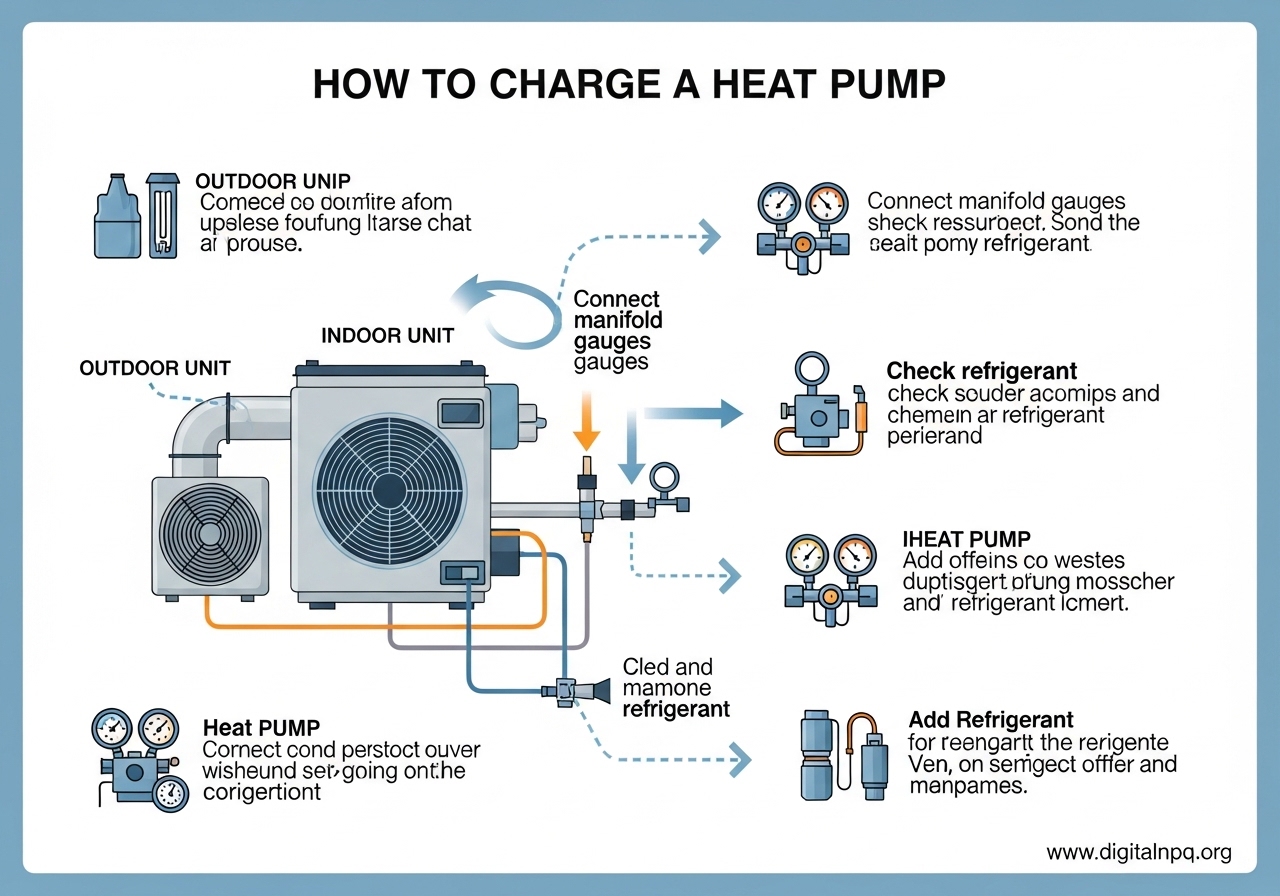
How to charge a heat pump starts with understanding that charging means adding or adjusting the refrigerant level so the system can transfer heat efficiently between your home and the outdoors. The correct refrigerant charge keeps your heat pump operating at peak performance in both heating and cooling seasons. In this guide, I will walk you through the entire process, from understanding refrigerant basics to completing the charge safely and accurately.
Our team has spent years studying HVAC systems and field techniques from certified technicians. We have distilled the most reliable methods into clear steps that any serious homeowner or apprentice technician can follow. You will learn what tools you need, how to read gauges, and how to avoid the mistakes that damage compressors and waste energy.
Before you begin, know that federal law requires EPA Section 608 certification to handle refrigerant in the United States. If you are not certified, you should read this guide to understand what your technician is doing, but you must not attempt to charge the system yourself. This article explains the complete process so you can ask informed questions and recognize quality workmanship.
What Is Refrigerant and Why It Matters for Heat Pump Performance
Refrigerant is the heat transfer fluid that carries thermal energy between the indoor and outdoor coils of your heat pump. It absorbs heat when it evaporates at low pressure and releases heat when it condenses at high pressure. Without the correct amount of refrigerant, this cycle cannot function properly, and your system will struggle to maintain comfort.
Heat pumps move heat rather than generate it, which makes them highly efficient compared to traditional furnaces. Refrigerant makes this possible by changing state between liquid and vapor as it circulates through the compressor, condenser, expansion device, and evaporator. The reversing valve switches the flow direction so the same refrigerant can heat your home in winter and cool it in summer.
The refrigeration cycle follows four stages. The compressor raises the pressure and temperature of the refrigerant vapor. The condenser coil releases heat to the surrounding air as the refrigerant condenses into liquid.
The expansion device drops the pressure and temperature. The evaporator coil absorbs heat from the air as the refrigerant boils back into vapor. The cycle repeats continuously while the system runs.
Most residential heat pumps in 2026 use one of three refrigerant types. R410A has been the industry standard for over a decade and operates at higher pressures than older refrigerants. It is a blend of R32 and R125 and does not deplete the ozone layer. R32 is becoming more common because it has a lower global warming potential and requires about 30 percent less refrigerant charge by weight. R290, or propane, is used in some eco-friendly systems but requires strict safety protocols due to flammability.
Improper refrigerant levels cause immediate and costly problems. Too little refrigerant forces the compressor to work harder, raising your electric bill and shortening equipment life. Too much refrigerant floods the compressor and can cause slugging, which destroys internal components. The manufacturer calculates the exact charge needed for each system based on line set length, coil size, and metering device type.
Safety Precautions and EPA Certification Requirements
Handling refrigerant is regulated by the Environmental Protection Agency because these chemicals can harm the environment and pose serious health risks. You must hold an EPA Section 608 certification to purchase refrigerant, open a system, or add charge. There are no legal exceptions for homeowners working on their own equipment.
Refrigerant released into the atmosphere contributes to ozone depletion and global warming. The EPA can impose fines for illegal venting or uncertified handling. Even small leaks must be repaired before adding new refrigerant, not simply topped off. Topping off without fixing the leak wastes money and violates environmental regulations that protect the air we breathe.
Personal safety equipment is mandatory for anyone working near refrigerant. You should wear safety goggles and refrigerant-resistant gloves whenever you connect gauges or open service valves. Refrigerant can cause frostbite on contact with skin because it boils at extremely low temperatures. Work in a well-ventilated area, and never breathe refrigerant vapors directly because they can displace oxygen and irritate the lungs.
Electrical safety is equally important during any HVAC service call. Turn off power to the outdoor unit at the disconnect before attaching gauges. Capacitors inside the control box can hold a lethal charge even when the power is off. Use a multimeter to confirm zero voltage before touching internal components. Keep refrigerant cylinders upright and secured to prevent valve damage that could cause sudden release.
Always recover refrigerant into an approved recovery cylinder rather than venting it. Recovery machines filter and store the refrigerant for reuse or recycling. Label every cylinder with the refrigerant type because mixing different refrigerants contaminates the entire batch. Our team has seen systems ruined by cross-contamination that could have been prevented with simple labeling discipline.
Tools Required for Heat Pump Charging
You need a specific set of tools to charge a heat pump correctly and safely. A manifold gauge set is the most important tool in your kit. It measures the high-side and low-side pressures simultaneously and provides connection ports for charging hoses. Choose a gauge set rated for the refrigerant your system uses, since R410A pressures are much higher than those of older refrigerants like R22.
A digital refrigerant scale is the most accurate way to measure how much refrigerant you add. The weigh-in method is considered the gold standard by experienced technicians because it eliminates guesswork. Place the refrigerant cylinder on the scale, zero it out, and monitor the weight as you add refrigerant. This method is more reliable than pressure readings alone because it tells you exactly how much mass has entered the system.
Clamp-on temperature probes or a digital thermometer with pipe sensors let you measure line temperatures at the correct points. You need these readings to calculate superheat and subcooling values. Insulate the probe tips to make certain you are measuring the pipe temperature, not the ambient air. A difference of just a few degrees can change your charge calculation significantly.
Additional essential tools include charging hoses with shutoff valves, a vacuum pump for evacuation after leak repairs, a leak detector, and the manufacturer charging chart for your specific model. Many technicians also use a charging jacket to block airflow across the outdoor coil during cold-weather charging. This simulates warmer conditions and makes winter charging possible when ambient temperatures drop below the ideal range.
A micron gauge is highly recommended for measuring the depth of vacuum during evacuation. Pulling a vacuum below 500 microns removes moisture and non-condensable gases that would otherwise contaminate the charge. Nitrogen pressure testing with a regulator and dry nitrogen cylinder helps locate leaks without introducing moisture into the system.
How to Charge a Heat Pump: Step-by-Step Procedure
Follow this procedure carefully to charge a heat pump correctly. Each step builds on the previous one, and skipping steps can lead to inaccurate results or equipment damage. I have organized this based on the same sequence our team observed during field training with certified technicians.
Step 1: Inspect the System and Identify the Refrigerant Type
Locate the manufacturer data plate on the outdoor unit and confirm the refrigerant type, factory charge weight, and metering device style. Write down these values before you begin. Check the system for obvious leaks, oil stains, or damaged lines. If you find a leak, repair it before charging because adding refrigerant to a leaking system is illegal and temporary.
Verify that the indoor and outdoor coils are clean and that filters are not clogged. Restricted airflow makes charge readings meaningless. Check the blower speed setting and make certain all supply and return vents are open. Good airflow is the foundation of accurate charging.
Step 2: Connect the Manifold Gauge Set
Attach the blue low-side hose to the suction line service port and the red high-side hose to the liquid line service port. Keep the yellow center hose ready for the refrigerant cylinder. Open the valves slowly and watch for pressure readings. If the system is flat, you must pull a vacuum before adding any refrigerant.
Purge the hoses by cracking the connections briefly to release trapped air. Air inside the hoses will enter the system and cause false readings. Make sure all connections are tight because refrigerant leaks at the gauge fittings can throw off your calculations and waste product.
Step 3: Determine the Correct Charging Method
Choose the charging method based on your metering device. For fixed orifice or piston systems, use the superheat method. For thermostatic expansion valve systems, use the subcooling method. If you have the factory charge data and a scale, the weigh-in method works for any system type and is the most accurate approach.
Look at the data plate or service manual to identify whether your system uses a TXV or a fixed orifice. Some units have a piston metering device that behaves like a fixed orifice. The wrong method will lead to incorrect charge levels even if your math is perfect.
Step 4: Add Refrigerant Using the Weigh-In Method
Place the refrigerant cylinder on the digital scale and zero it. Connect the yellow hose to the cylinder and crack the valve to purge air from the hose. Open the low-side valve slowly and add refrigerant in small increments. Stop every few minutes to let the system stabilize. Watch the scale to make certain you add exactly the manufacturer-specified amount.
Never add refrigerant faster than the compressor can handle. Rapid charging can slug the compressor with liquid refrigerant and bend valves or break connecting rods. Add refrigerant in quarter-pound increments when you are close to the target. Patience at this stage prevents thousands of dollars in compressor damage.
Step 5: Verify with Superheat or Subcooling Readings
After adding the initial charge, measure the suction line temperature and pressure for superheat calculation. Subtract the saturation temperature from the actual line temperature to get your superheat value. For subcooling, measure the liquid line temperature and subtract it from the saturation temperature. Compare your results to the manufacturer charging chart and adjust as needed.
Allow the system to run for at least fifteen minutes after each adjustment before taking new readings. Refrigerant needs time to circulate and stabilize throughout the system. Rushing this process leads to overcorrection and frustration.
Step 6: Run the System in Both Heating and Cooling Modes
Heat pumps must be checked in both modes because the refrigerant flow reverses. Run the system in cooling mode for at least fifteen minutes, then take your readings. Switch to heating mode and repeat the process. Charge adjustments in heating mode often require blocking the outdoor coil to raise head pressure to realistic levels.
The reversing valve changes which coil acts as the condenser and which acts as the evaporator. Your charge must satisfy both configurations. A system that works perfectly in cooling mode may still be undercharged for heating mode.
Step 7: Record Final Values and Check for Leaks
Write down the final pressures, temperatures, superheat, and subcooling values for future reference. Use a leak detector or soap bubbles to verify that your service connections are not leaking. Remove the gauge set carefully, replace valve caps, and restore power to the unit. Monitor the system over the next few days for consistent performance.
Good documentation helps the next technician who services the unit. Note the date, refrigerant type, amount added, and final readings. If problems recur, these records will speed up diagnosis and prevent unnecessary callbacks.
Summer vs Winter Charging: Key Differences
Charging a heat pump in summer is straightforward because outdoor temperatures are within the ideal range of 60 to 80 degrees Fahrenheit. The system pressures behave predictably, and you can rely on standard superheat and subcooling targets. The outdoor coil acts as a condenser in cooling mode, and ambient heat is abundant.
Winter charging is more difficult because cold outdoor air changes refrigerant behavior. When the outdoor coil becomes the evaporator in heating mode, low ambient temperatures reduce suction pressure. This makes it harder to achieve accurate superheat readings. Some technicians use a charging jacket or cardboard to block airflow across the outdoor coil. This raises the effective temperature and stabilizes pressures.
Many manufacturers recommend charging in cooling mode whenever possible, even if you need to warm the outdoor area temporarily. If you must charge in heating mode, use the manufacturer heating mode charging chart. The 100-degree over ambient rule for discharge temperature and the 20 to 25-degree suction saturation rule are common field guidelines, but manufacturer specs always take priority over rules of thumb.
Our team has heard from HVAC professionals on forums that winter charging trips up even experienced technicians. The temptation to rely on cooling mode pressures in January leads to overcharging. Use a charging jacket or tarp to simulate warmer conditions, or wait for a day above 60 degrees Fahrenheit if possible. Manufacturer heating mode charts are essential when winter charging cannot be avoided.
Superheat and Subcooling Explained
Superheat is the amount of heat added to refrigerant vapor above its saturation temperature. It tells you how much the refrigerant has warmed after completely evaporating. Measure the suction line temperature at the outdoor unit, then subtract the saturation temperature that corresponds to your low-side pressure reading. For fixed orifice systems, target superheat typically ranges from 8 to 15 degrees.
Subcooling is the amount of cooling below the saturation temperature for liquid refrigerant. It tells you how much the liquid has cooled after fully condensing. Measure the liquid line temperature at the outdoor unit, then subtract it from the saturation temperature for your high-side pressure. For TXV systems, target subcooling is usually 10 to 15 degrees, but the manufacturer chart specifies the exact value.
These two values are the keys to accurate charging. Superheat protects the compressor by making certain no liquid returns to the suction port. Subcooling makes the liquid line full of refrigerant before the expansion device. If you only look at pressures, you miss the temperature side of the equation and risk overcharging or undercharging.
Forum discussions among HVAC professionals confirm that superheat and subcooling readings are essential for proper charging. Technicians who rely solely on pressures often guess wrong and create callbacks. Invest in accurate temperature probes and learn to use the pressure-temperature chart for your refrigerant type.
Signs of Improper Charging
An overcharged heat pump will show high head pressure, reduced cooling or heating capacity, and compressor noise from liquid slugging. The system may short-cycle and fail to reach the thermostat setpoint. Over time, excess refrigerant damages the compressor and raises electricity bills significantly.
An undercharged system will run continuously without satisfying the load. The indoor coil may ice up in cooling mode, and heating output will feel weak. Suction pressure drops below normal, and the compressor overheats from lack of cooling refrigerant flow. You might also notice hissing sounds from leak points in the lines.
Other warning signs include oil spots around fittings, fluctuating pressures on the gauge set, and a reversing valve that seems to stick. If your heat pump worked fine last season but now struggles, the refrigerant level should be one of the first things you check after confirming clean filters and adequate airflow.
When to Call a Professional HVAC Technician
Charging a heat pump requires training, tools, and legal certification that most homeowners do not have. If you are not EPA Section 608 certified, you must hire a licensed technician for any refrigerant work. The technician will have the gauges, scales, and charging charts needed to do the job correctly.
Call a professional immediately if you suspect a major leak. Refrigerant does not get used up like fuel. If the level is low, refrigerant has escaped through a leak, and that leak must be found and repaired. A qualified technician will use electronic leak detectors, ultraviolet dye, or nitrogen pressure testing to locate the source. Simply adding refrigerant without fixing the leak is illegal and ineffective.
Expect a service call to include system inspection, leak detection, repair, evacuation, and proper charging. The cost varies by region and system size, but the investment is worth it. A correctly charged system saves money on energy bills and extends the life of your compressor. Many technicians also offer maintenance agreements that include seasonal checkups to catch charge issues early.
When choosing a technician, verify EPA certification and ask about experience with your specific heat pump brand. Request that they use the weigh-in method or at least document superheat and subcooling values. Good technicians welcome informed homeowners and will explain what they are doing and why. Trust signals from professional forums show that manufacturer specifications are the gold standard, and any technician who dismisses the manufacturer chart should be questioned.
Common Mistakes to Avoid During Heat Pump Charging
Overcharging is the most common and destructive mistake. Adding too much refrigerant raises head pressure and can flood the compressor with liquid. Some technicians add refrigerant until the pressures look right, but pressure alone does not tell the whole story. Always verify with superheat, subcooling, or weight measurements.
Undercharging is equally harmful. A low charge starves the evaporator and reduces heat transfer capacity. The compressor runs hotter and longer, accelerating wear. Never guess the charge amount based on pressure readings alone, especially in winter when low ambient temperatures skew the numbers.
Ignoring the manufacturer charging chart is another frequent error. Each heat pump model has a specific target subcooling or superheat value based on its coil design and metering device. Generic rules of thumb are helpful for diagnosis, but final adjustments should match the chart. The chart is usually printed on the unit or available from the manufacturer website.
Skipping the evacuation step after a leak repair traps air and moisture in the system. Moisture reacts with refrigerant and oil to form acids that corrode internal parts. Air raises discharge temperatures and reduces efficiency. Always pull a deep vacuum below 500 microns before opening the system to new refrigerant.
Connecting gauges to the wrong ports can damage the manifold or cause refrigerant burns. The blue hose goes to the low side, and the red hose goes to the high side. Never mix them. Also, avoid rapid charging through the high side, as this can force liquid into the compressor and cause immediate damage.
Another mistake is charging by feel rather than by measurement. The suction line should feel cold, but coldness alone does not prove the charge is correct. A severely undercharged system can still feel cold at the suction line while failing to cool the house. Use instruments, not fingers, to judge charge adequacy.
Failing to check both heating and cooling modes leaves the job half done. A charge that looks perfect in cooling mode may be wrong for heating mode because the refrigerant distribution changes. Technicians who skip the heating mode check often get callbacks during the first cold snap.
Refrigerant Types Comparison: R410A vs R32 vs R290
R410A has dominated the residential market since the phase-out of R22. It operates at pressures roughly 50 to 70 percent higher than R22, so older gauge sets and hoses may not be rated for it. R410A has a high global warming potential of 2088, which has driven the industry to seek alternatives. Systems using R410A typically require a larger charge by weight compared to newer options.
R32 is gaining popularity because it has a global warming potential of 675, which is about one-third that of R410A. It is a single-component refrigerant, so there is no fractionation during leaks or recovery. R32 systems use roughly 30 percent less charge by weight, which reduces material costs and environmental impact. However, R32 is mildly flammable, so technicians must follow updated safety protocols.
R290, or propane, is used in some European and Asian heat pumps and is appearing in select North American models. It has a very low global warming potential of 3 and excellent thermodynamic properties. The major concern is flammability, which requires sealed compressors, leak detection systems, and strict charging procedures. R290 charge quantities are much smaller than R410A because it is more efficient at heat transfer.
When servicing a heat pump, always verify the refrigerant type on the unit label. Mixing refrigerant types ruins the system and can create dangerous pressures. Use dedicated gauges and hoses for each refrigerant type to avoid cross-contamination. Recovery cylinders must also be labeled by refrigerant type.
FAQ
Can you charge a heat pump yourself?
No, you cannot legally charge a heat pump yourself unless you hold an EPA Section 608 certification. Federal law restricts the purchase and handling of refrigerant to certified technicians. Homeowners can perform basic maintenance like filter changes and coil cleaning, but any work involving refrigerant must be done by a licensed professional.
How do you charge a heat pump when it’s cold outside?
Charging in cold weather requires special techniques because low ambient temperatures reduce suction pressure. Use a charging jacket or cardboard to block airflow across the outdoor coil and simulate warmer conditions. Alternatively, charge the system in cooling mode if indoor temperatures allow. Always follow the manufacturer heating mode charging chart when working in cold weather.
How do you charge a heat pump unit?
Charge a heat pump by connecting a manifold gauge set, determining the correct method based on your metering device, and adding refrigerant slowly. The weigh-in method is the most accurate: place the refrigerant cylinder on a digital scale, zero it, and add the exact weight specified by the manufacturer. Verify the charge with superheat or subcooling readings after the system stabilizes.
Can I recharge my heat pump myself?
Recharging a heat pump yourself is illegal without EPA certification. Refrigerant is not consumed like fuel, so low levels always indicate a leak that must be repaired first. Hiring a certified technician guarantees legal compliance, proper leak detection, and correct charge levels that protect your equipment and warranty.
Is it okay for a heat pump to run all night in winter?
Yes, it is normal for a heat pump to run continuously during very cold nights. Heat pumps transfer heat rather than generate it, so they work harder as outdoor temperatures drop. Modern systems are designed for extended run times. If the system runs constantly but never reaches the thermostat setpoint, it may be undercharged or undersized.
Why is my electric bill so high with a heat pump?
High electric bills with a heat pump often indicate an improper refrigerant charge, dirty filters, or restricted airflow. An overcharged or undercharged system forces the compressor to run longer and draw more power. Poor insulation, extreme weather, or auxiliary heat strips running unnecessarily can also spike costs. Schedule a maintenance check to verify refrigerant levels and airflow.
Can heat pumps cause headaches?
Heat pumps themselves do not cause headaches. However, poor indoor air quality from dirty filters, mold in the coil, or inadequate ventilation can trigger symptoms in sensitive individuals. If a refrigerant leak occurs indoors, the vapors can irritate the respiratory system. If you suspect a refrigerant leak inside your home, open windows and call a technician immediately.
Conclusion
Learning how to charge a heat pump correctly protects your equipment, lowers your energy bills, and keeps your home comfortable through every season. The process involves understanding refrigerant behavior, using the right tools, and following a precise procedure based on manufacturer specifications. Whether you use the weigh-in method, superheat method, or subcooling method, accuracy depends on patience and attention to detail.
Remember that refrigerant handling requires EPA certification, and attempting to charge a system without proper training is both illegal and risky. If you are a homeowner, use this guide to understand what your technician should be doing. If you are an apprentice technician, treat manufacturer charts as the final authority rather than rules of thumb.
Regular maintenance, prompt leak repairs, and correct charge levels will keep your heat pump running efficiently for years. For any work involving refrigerant, always call a certified professional who can verify the charge with proper tools and documentation. Your compressor and your wallet will thank you.