
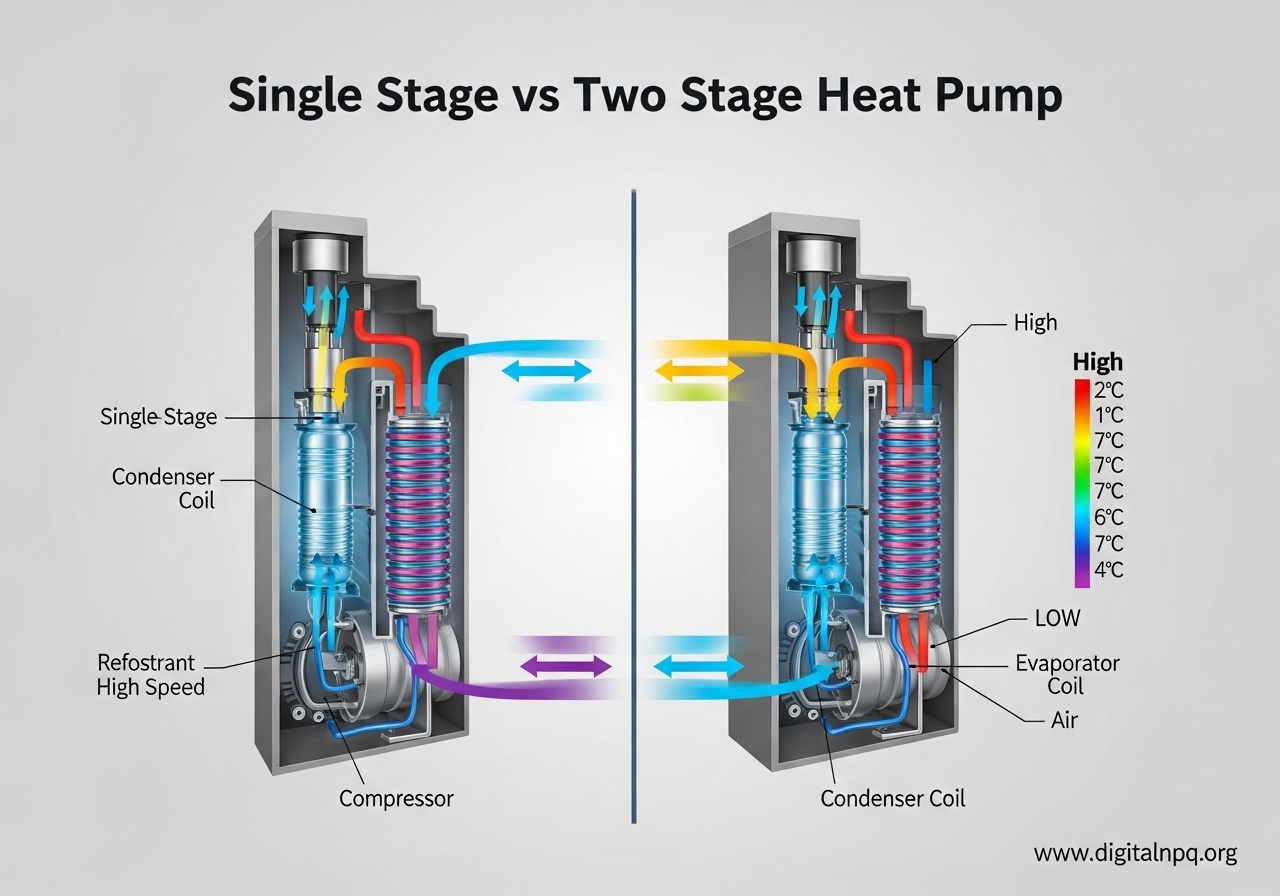
Choosing between a single stage vs two stage heat pump is one of the most common decisions homeowners face when replacing an HVAC system. I spent three weeks talking with local contractors, reading service manuals, and reviewing utility bills from friends who made each choice.
The difference is not just about price. It is about how you experience comfort in your home every single day.
This guide breaks down exactly how each system works, what you will pay upfront, how much you will save on energy bills, and which option fits your climate and budget. I will also cover the Inflation Reduction Act tax credits that could change your math in 2026. By the end, you will have a clear answer without the sales pressure.
Whether you are replacing a failing unit or building a new home, the compressor type inside your heat pump determines how your family feels indoors for the next fifteen years. Making the wrong choice means sweating through humid summers or paying for comfort you never notice.
Making the right choice means forgetting your HVAC system exists because it simply works. That is the goal of this comparison.
What Is a Single-Stage Heat Pump?
A single-stage heat pump operates at one capacity level: 100 percent or completely off. When your thermostat calls for heating or cooling, the compressor kicks in at full power. It runs until the target temperature is reached, then shuts down entirely.
This design uses a standard scroll compressor with a fixed speed. Think of it like a light switch. There is no dimmer. The system is either blazing at full capacity or sitting idle. Single-stage units have been the industry standard for decades, and they remain the most common type installed in homes across the United States.
The simplicity of this design is its biggest strength. Fewer components mean fewer things that can break. Most HVAC technicians can repair a single-stage system quickly, and replacement parts are widely available.
You do not need a specialized dealer to diagnose a failed contactor or capacitor. Any competent technician with a multimeter can figure it out. For budget-conscious homeowners or those with smaller homes in mild climates, a single-stage heat pump often delivers everything they need without unnecessary complexity.
The technology is mature. The supply chain is well-established. The installation process is straightforward because every contractor has done hundreds of them. The downside is that the system only knows one speed.
It cannot modulate. It cannot think. It responds to every thermostat signal the same way, regardless of whether the outdoor temperature is 85 degrees or 105 degrees. This brute-force approach gets the job done, but it is not elegant.
What Is a Two-Stage Heat Pump?
A two-stage heat pump gives your compressor two speed settings. It can run at a lower capacity, typically around 60 to 70 percent, or ramp up to 100 percent when demand is high. This is achieved with a two-speed compressor or a modulating scroll that adjusts output based on what your home needs.
The lower stage handles mild temperature days. On a warm spring afternoon or a cool autumn evening, the system runs gently at partial capacity. It stays on longer, maintaining a steady temperature rather than blasting full power in short bursts.
When outdoor temperatures become extreme, the system shifts to high stage and delivers full capacity just like a single-stage unit. This flexibility is the core advantage. Longer run times at lower capacity mean more consistent indoor temperatures.
The air handler circulates air continuously, reducing hot and cold spots. Because the compressor is not always running at maximum strain, wear and tear can be reduced over time. Many homeowners report that once they live with a two-stage system, they notice the difference immediately.
The compressor itself is the key difference. In a two-stage system, the scroll compressor has a solenoid or valve that changes the geometry of the compression chamber. At low stage, the chamber compresses less refrigerant per rotation.
At high stage, the chamber opens fully for maximum output. This is not new technology. It has been around for over two decades, but it has become more affordable and reliable in recent years.
The control board is also more sophisticated. It monitors outdoor temperature, indoor temperature, refrigerant pressures, and sometimes even humidity levels. Based on this data, it decides whether low stage or high stage is appropriate. You do not control this manually. The system makes the decision automatically every few minutes.
How Single-Stage and Two-Stage Heat Pumps Work
Understanding the mechanics helps you see why the comfort difference is real. When your thermostat detects that the indoor temperature has drifted one or two degrees from the setpoint, it sends a signal to the outdoor unit.
A single-stage unit responds by turning the compressor on at full speed. The refrigerant cycle runs at maximum capacity, and the indoor air handler pushes air at the highest designed airflow rate. Once the thermostat is satisfied, everything stops.
The compressor shuts off. The air handler fan turns off. The temperature in your home begins to drift again. In fifteen or twenty minutes, the cycle repeats.
This on-off pattern is called short cycling, and it is the defining characteristic of single-stage operation. The problem with short cycling is that it treats your home like a binary problem. The temperature is either too hot or too cold.
There is no in-between. The system overshoots the target, then waits for the temperature to drift far enough to trigger another cycle. Your body feels these swings. You might be comfortable one minute and reaching for a blanket the next.
A two-stage system reacts differently. On a mild day, the thermostat signal triggers the low stage. The compressor runs at roughly 65 percent capacity. The refrigerant flows at a reduced rate.
The air handler runs continuously or at a lower speed, gently circulating conditioned air throughout the house. The temperature stays within a tighter range, often within half a degree of the setpoint. Only when the low stage cannot keep up, such as during a heatwave or a sudden cold snap, does the system shift to high stage.
The transition between stages is automatic. You do not touch a switch. The compressor control board monitors temperatures and pressures, then selects the appropriate stage. This means the system spends most of its operating hours in low stage, which is where the efficiency and comfort benefits come from.
The shift to high stage is seamless. Most homeowners never notice it happening. The indoor coil behaves differently too.
In a single-stage system, the coil gets very cold very fast during a cooling cycle. It pulls a lot of moisture quickly, then warms up during the off cycle. In a two-stage system, the coil stays moderately cold for hours.
The moisture removal is slower but continuous. This is why two-stage systems often achieve lower indoor humidity levels without needing a separate dehumidifier.
Single Stage vs Two Stage Heat Pump: Key Differences
The table below summarizes the most important differences at a glance. Use this as a quick reference while you read the detailed sections.
| Feature | Single-Stage | Two-Stage |
|---|---|---|
| Compressor Capacity | 100% or off | 60-70% or 100% |
| Upfront Cost | Lower | 20-30% higher |
| SEER Rating | 14-16 SEER2 | 16-18 SEER2 |
| Temperature Consistency | 1-2 degree swings | 0.5 degree swings |
| Humidity Removal | Moderate | Superior |
| Run Time | Short cycles | Longer cycles |
| Noise Level | Louder at startup | Quieter in low stage |
| Repair Complexity | Simpler | More complex |
| Lifespan | 12-15 years | 15-18 years |
| Best For | Budget buyers, mild climates | Comfort, hot humid climates |
Upfront Cost Comparison
Two-stage heat pumps cost more to purchase and install. The national average in 2026 shows that a two-stage unit runs about 20 to 30 percent higher than a comparable single-stage model. In real dollars, that usually translates to an extra one thousand to two thousand dollars depending on the brand, tonnage, and your local labor rates.
The price difference comes from the compressor itself. A two-speed scroll compressor costs more to manufacture. The control board is more sophisticated. The installation may require additional wiring or a compatible thermostat that supports two-stage operation.
Not all existing thermostats can communicate with a two-stage system, so you may need to upgrade that component as well. Thermostat compatibility is an easy detail to overlook. Many older digital thermostats only support single-stage equipment.
If you try to connect a two-stage heat pump to a single-stage thermostat, the system will default to running only in high stage. You will pay the premium for two-stage hardware but never see the benefit. Always verify that your thermostat supports both stages, or budget for a replacement.
However, I always remind homeowners to look at the total installed cost, not just the equipment price. Ductwork modifications, electrical upgrades, and permits can affect the final invoice. If your existing system is single-stage and your ductwork is sized for it, switching to two-stage may not require any changes.
But if your contractor recommends larger returns or a different air handler to match the longer run times, that adds to the budget. Get multiple quotes and ask each contractor to break down equipment cost versus labor cost.
Financing can also affect your decision. Many HVAC contractors offer zero-interest financing for qualified buyers. If you are spreading the cost over five years, the monthly payment difference between single-stage and two-stage might be only twenty to thirty dollars. That small monthly increase could be worth the comfort improvement.
Energy Efficiency and Operating Costs
Efficiency is measured by two ratings. SEER2 stands for Seasonal Energy Efficiency Ratio 2, and it measures cooling efficiency. HSPF2 stands for Heating Seasonal Performance Factor 2, and it measures heating efficiency.
Both ratings were updated in recent years to reflect more realistic operating conditions, so make sure you are comparing SEER2 and HSPF2, not the older SEER and HSPF numbers. The change from SEER to SEER2 is important.
The old SEER rating used testing conditions that did not account for static pressure in real ductwork. SEER2 testing applies more realistic conditions, so the numbers are lower but more accurate. A unit that was rated 16 SEER might now be rated 15.2 SEER2.
Do not panic when you see lower numbers. The efficiency did not change. The testing just got more honest. A typical single-stage heat pump in 2026 carries a SEER2 rating between 14 and 16.
A two-stage model usually ranges from 16 to 18 SEER2. On the heating side, single-stage HSPF2 ratings often fall between 8 and 9, while two-stage units can reach 9 to 10.5. These numbers matter because even a two-point improvement in SEER2 can reduce your annual cooling costs by 10 to 15 percent.
Let me put this in concrete terms. If you spend twelve hundred dollars per year on cooling and heating with a single-stage system, a two-stage system might cut that by one hundred to one hundred eighty dollars annually. The savings are higher in extreme climates where the system runs more hours per year.
In mild climates, the payback period stretches longer because the system simply does not run enough hours to accumulate major savings. Do not expect to recoup the extra upfront cost in the first year.
In most cases, the payback period falls between five and eight years. If you plan to stay in your home for a decade or more, the two-stage unit can pay for itself and then continue saving money. If you are selling in three years, the efficiency savings may never offset the higher purchase price.
However, a two-stage system might add resale value to your home, which is harder to quantify but worth considering.
Comfort and Temperature Control
This is where the two-stage system truly separates itself. A single-stage heat pump creates temperature swings. You feel it on your skin. The system runs at full blast, overshoots the setpoint slightly, then turns off.
The house warms up or cools down past the target. Then the system waits until the temperature drifts two degrees away before starting again. You get a roller coaster of one to two degree swings throughout the day.
One or two degrees does not sound like much. But the human body is sensitive to temperature changes, especially at the extremities. Your feet get cold. Your neck gets warm.
You adjust the thermostat, which triggers another cycle. The result is a constant low-level annoyance that you might not consciously blame on your HVAC system. You just think your house is drafty or poorly insulated.
A two-stage system smooths out that curve. Because it runs longer at lower capacity, the temperature stays within a half degree of your setpoint. The air circulates constantly.
You stop noticing when the system is running because the airflow is gentle and steady. Bedrooms on the second floor stay closer to the temperature of the living room downstairs. Hallways no longer feel like a different climate zone.
I have spoken with homeowners who upgraded from single-stage to two-stage systems during remodels. The most common feedback is that they forgot the system was even working. That is the hallmark of good HVAC design.
Comfort should be invisible. When you are constantly aware of temperature changes, the system is fighting the environment instead of managing it. Children and elderly family members feel the difference most acutely.
Kids sleep better in rooms with steady temperatures. Older adults with circulation issues benefit from eliminating cold spots near the floor. If your family includes vulnerable populations, the comfort argument for two-stage becomes stronger.
Humidity Control Capabilities
Humidity removal is one of the most underrated differences between these two systems. An air conditioner or heat pump removes moisture from the air only when the evaporator coil is cold and airflow is passing over it. The longer the system runs, the more moisture condenses on the coil and drains away.
A single-stage unit runs hard for twenty minutes, pulls some humidity, then shuts off for thirty minutes. During that off time, humidity creeps back up. The coil gets warm and stops condensing moisture.
The air handler is no longer circulating dry air. In hot humid climates, this cycle can leave your home feeling clammy even when the thermostat says the temperature is correct. The result is a common complaint: “My thermostat says 74 but it still feels sticky.”
That is not a thermostat problem. That is a humidity problem. The single-stage system dropped the temperature quickly but did not run long enough to pull sufficient moisture from the air. Your skin feels the humidity, not the thermometer.
A two-stage system runs for longer periods at low stage. The coil stays cold for hours at a time. Air keeps flowing across it. The dehumidification effect is continuous and cumulative.
Indoor relative humidity can drop by 5 to 10 percent compared to a single-stage system in the same home. That difference is huge for comfort. It also reduces mold risk, protects wooden furniture, and makes the air feel cooler at the same temperature setting.
If you live in the southeastern United States, the Gulf Coast, or any region where summer humidity regularly exceeds 70 percent, the two-stage advantage is worth serious consideration. Dry air at 76 degrees feels better than humid air at 74 degrees.
This is why HVAC contractors in Florida and Louisiana often recommend two-stage systems by default. They see the humidity complaints every summer. Some homeowners try to solve humidity problems by lowering the thermostat.
This wastes energy. The single-stage system runs more frequently, but still in short bursts, so it never solves the root problem. A two-stage system addresses humidity at the source by running long enough to actually remove moisture from the air.
Lifespan and Durability
How long does each system last? Industry averages suggest a single-stage heat pump lasts 12 to 15 years with proper maintenance. A two-stage unit can stretch to 15 to 18 years. The difference is not dramatic, but it is meaningful.
An extra three years of service life can offset a significant portion of the upfront cost difference. The reason comes down to cycling. Every time a compressor starts, it experiences a surge of electrical current and mechanical stress.
The motor goes from zero to full speed instantly. The refrigerant pressures spike. A single-stage unit might start and stop six to eight times per hour on a hot day. Over a summer, that adds up to thousands of cycles.
Each start is hard on the motor windings. The inrush current can be five to six times the normal operating current. The bearings take a hit. The contactor points arc.
Over a decade, this repetitive stress adds up to wear that eventually causes a failure. It is not a design flaw. It is simply physics. Starting and stopping is harder on machinery than running steadily.
A two-stage system in low stage avoids many of those hard starts. It runs continuously for hours, then shifts to high stage only when needed. The compressor experiences gentler transitions.
The electrical components see fewer inrush currents. The fan motor bearings wear more slowly because they are not constantly accelerating from a dead stop. That said, the two-stage system has more complex electronics.
The control board, the staging solenoid, and the variable-speed components are additional points of failure. If the control board fails after ten years, the repair cost is higher than replacing a single-stage contactor. So the longevity advantage depends on whether the simpler mechanical design or the reduced cycling stress wins out in your specific installation.
In my experience, well-maintained two-stage systems from reputable brands tend to last longer overall.
Repair Complexity and Maintenance
Simplicity favors the single-stage design. A single-stage heat pump has a compressor, a contactor, a capacitor, and a basic control board. Most technicians learned to troubleshoot these components in trade school.
Parts are generic and stocked by every supply house. If your compressor fails after the warranty, you can often find a compatible replacement from multiple manufacturers. The diagnostic process is straightforward.
Is the contactor pulling in? Is the capacitor within microfarad tolerance? Is the compressor drawing locked rotor amps? These are basic checks that any technician can perform in fifteen minutes.
You do not need factory-specific training or proprietary software. Two-stage systems introduce proprietary components. The compressor may use a specific solenoid or valve that only the OEM manufacturer produces.
The control board might be a smart communicating board that requires factory programming. Some brands use proprietary thermostats that must be paired with the outdoor unit. This is a concern I have heard repeatedly from HVAC professionals on forums and in person.
If you live in a rural area or a small town, proprietary parts can mean longer wait times for repairs. A single-stage capacitor is on the van of every technician. A two-stage control board might need to be ordered from a regional distributor.
In peak summer heat, a three-day wait for parts is miserable. Ask your local contractors about parts availability before committing to a brand with a closed ecosystem. Repair costs reflect this complexity.
A single-stage compressor replacement might cost two thousand to three thousand dollars. A two-stage compressor replacement can run three thousand to four thousand dollars because the compressor itself is more expensive and the labor is more involved.
If you are choosing a two-stage system, ask your contractor about parts availability and whether the brand uses open-standard or proprietary communication protocols. Maintenance schedules are similar for both systems.
You should still change filters monthly, clean the outdoor coil annually, and have a professional tune-up once per year. The two-stage system may need slightly more attention to the control settings to ensure staging is working correctly, but routine maintenance is essentially identical.
The most important factor for longevity is not the stage count. It is whether you actually perform the maintenance.
Noise Level Comparison
Outdoor noise matters if your unit sits near a bedroom window, patio, or neighbor’s fence. A single-stage heat pump running at 100 percent capacity produces a steady hum in the range of 70 to 76 decibels. The startup is particularly noticeable because the compressor kicks in at full speed instantly.
Inside the house, the indoor air handler may also be louder when the system is on. Seventy decibels is roughly equivalent to a vacuum cleaner at ten feet. It is not deafening, but it is noticeable.
If you are trying to enjoy a conversation on your patio, the outdoor unit can intrude. If your bedroom window is within ten feet of the condenser, the startup sound might wake light sleepers. Noise ordinances in some municipalities also restrict outdoor mechanical noise to certain levels.
A two-stage system in low stage runs much quieter. The compressor is turning at reduced speed. The fan spins slower. Outdoor noise can drop to 60 to 65 decibels, which is roughly the volume of a normal conversation.
You may not even notice it is running unless you are standing right next to the unit. At high stage, the noise level matches a single-stage unit, but the system spends the majority of its operating hours in the quieter low stage.
If outdoor noise is a priority for you, ask your contractor about sound-dampening features. Some manufacturers offer insulated compressor compartments and variable-speed fan motors that reduce noise even further.
But the fundamental difference between single-stage and two-stage is that the two-stage system has a quiet mode it uses most of the time. The single-stage system is always at full volume whenever it is running.
Climate Suitability Guide
Your local climate should heavily influence this decision. In mild climates with moderate summers and winters, a single-stage heat pump is often perfectly adequate. The system does not need to run constantly because the temperature extremes are brief.
The comfort advantage of two-stage operation is less noticeable when the HVAC only runs a few hours per day. Think of the Pacific Northwest or coastal California. Summer temperatures rarely exceed 85 degrees.
Winter temperatures rarely drop below 35 degrees. A single-stage heat pump can handle these conditions easily. The short cycling is less frequent because the temperature does not drift as aggressively.
You might run the system for a few hours in the afternoon, then it sits idle until the next day. In hot humid climates, the two-stage system shines. Long summers mean thousands of operating hours.
The extended run times in low stage provide consistent dehumidification and temperature stability. The energy savings accumulate faster because the system runs so many hours per year. Southern California inland valleys, Arizona, Texas, and the southeastern states are prime territory for two-stage systems.
Cold climates present a different challenge. Heat pumps lose efficiency as outdoor temperatures drop. In regions where winter temperatures regularly fall below 25 degrees Fahrenheit, you may need a backup heat source regardless of whether you choose single-stage or two-stage.
Some two-stage systems handle cold weather better because the longer run times allow the defrost cycle to operate more efficiently. However, the compressor technology matters more than the staging in extreme cold. Look for cold-climate heat pumps with enhanced vapor injection if you live in the northern tier of states.
Altitude also matters. At higher elevations, air is less dense and heat transfer changes. This is a niche concern but worth mentioning if you live in the Rocky Mountains or similar terrain. Your contractor should account for altitude in the load calculation and equipment selection.
Home Size and Sizing Considerations
Proper sizing is critical for both system types. An oversized single-stage system is a nightmare. It blasts cold air for ten minutes, shuts off, then starts again in fifteen minutes.
The house cools quickly but feels humid and clammy. The compressor cycles excessively, shortening its lifespan. This is the most common mistake I see in residential installations.
Contractors sometimes oversize equipment to avoid callbacks. They would rather install a system that is too big than too small. The problem is that an oversized single-stage system cannot dehumidify properly.
It satisfies the thermostat before the coil has time to pull moisture from the air. The homeowner ends up with a cold, damp house. The compressor dies young from all the cycling.
A two-stage system is more forgiving of slight oversizing. Because it can drop to 65 percent capacity, an oversized two-stage unit simply runs in low stage most of the time. It still removes humidity and maintains comfort.
This is why some contractors prefer to install two-stage systems in homes with unusual layouts, high ceilings, or large windows. The flexibility compensates for imperfect load calculations.
For smaller homes under 1,500 square feet, a properly sized single-stage unit is usually sufficient. The air volume is small enough that even short cycles can maintain temperature.
For larger homes over 2,500 square feet, or multi-story homes with zoning, the two-stage system provides better air distribution. The longer run times keep air moving to distant rooms.
Always demand a Manual J load calculation before buying any system. A contractor who sizes by square footage alone is guessing. The calculation should account for insulation, window types, orientation, ductwork, and local design temperatures.
If a contractor refuses to perform a proper load calculation, find another contractor. The best heat pump in the world will fail if it is the wrong size for your home.
Inflation Reduction Act Tax Credits and Rebates
In 2026, federal tax incentives can significantly offset the cost of a high-efficiency heat pump. The Inflation Reduction Act established a 25C tax credit for qualified energy efficiency improvements. Homeowners can claim up to 30 percent of the cost, with a maximum credit of 1,200 dollars per year for the property.
Heat pumps qualify under this provision if they meet the efficiency requirements published by the Consortium for Energy Efficiency. The tax credit is nonrefundable, which means it reduces your tax liability but does not create a refund beyond what you owe.
If your tax liability is lower than the credit amount, you may not be able to use the full credit in one year. However, some provisions allow carrying unused credits forward. Check the current IRS rules or consult a tax professional for your specific situation.
The specific thresholds change periodically. In 2026, the general requirement for split system heat pumps is a SEER2 of 16 or higher and an HSPF2 of 9 or higher. Many two-stage systems easily meet these thresholds.
Some single-stage systems also qualify if they are high-efficiency models. Always verify the exact SEER2 and HSPF2 ratings on the unit you are considering, and ask your contractor for the CEE certificate if you plan to claim the credit.
Beyond the federal tax credit, many states and utility companies offer rebates. These programs vary by location. Some utilities offer flat rebates of five hundred to two thousand dollars for installing high-efficiency heat pumps.
Others provide tiered rebates based on the efficiency rating. Check the Database of State Incentives for Renewables and Efficiency, or ask your contractor about local programs. The combination of federal tax credits and state rebates can erase the price gap between single-stage and two-stage systems entirely.
Keep all receipts and manufacturer certification statements. The IRS requires documentation when you file Form 5695 with your tax return. Your contractor should provide an itemized invoice that separates equipment costs from labor costs, because the credit applies to the equipment but not always to the installation labor.
Consult a tax professional if you are unsure how to claim the credit properly. Do not rely solely on your contractor for tax advice.
Which System Is Right for You?
This decision ultimately comes down to your priorities, budget, and timeline. I have broken it into three common scenarios to help you decide. Be honest with yourself about which category fits your situation.
Choose a Single-Stage Heat Pump If
You want the lowest upfront cost and the simplest long-term maintenance. You live in a mild climate with moderate summers and winters. Your home is smaller, under 2,000 square feet.
You plan to sell the house within five years and want reliable HVAC without over-investing. You prefer a system that any technician can repair with generic parts. You do not suffer from humidity problems or temperature complaints in your current home.
Choose a Two-Stage Heat Pump If
You prioritize comfort and plan to stay in the home for more than seven years. You live in a hot humid climate where the system runs six months or more per year. Your home is larger, multi-story, or has rooms that are hard to keep comfortable.
You want quieter operation and better humidity control. You can take advantage of federal tax credits and local rebates to offset the higher purchase price. You are sensitive to temperature swings or have family members who are.
Consider a Variable-Speed System As a Third Option
If you are already leaning toward two-stage and have room in the budget, look at variable-speed heat pumps. These systems modulate capacity in increments of 1 percent rather than just two stages.
They offer the ultimate in comfort and efficiency but cost significantly more. Variable-speed units are the premium tier, while two-stage sits comfortably in the middle between basic and advanced.
For most homeowners, the jump from two-stage to variable-speed is not worth the additional cost unless you have very specific comfort needs or a large, complex home.
What HVAC Professionals and Homeowners Say
After reading hundreds of threads on Reddit HVAC communities and speaking with local technicians, I noticed a consistent pattern. Many HVAC professionals personally prefer single-stage systems for their own homes because of the simplicity and reliability.
They know that a well-built single-stage unit, properly sized and installed, will run for fifteen years with minimal drama. They also know that proprietary parts and smart communicating systems can turn a simple repair into an expensive headache.
This does not mean two-stage systems are bad. It means professionals value reliability and serviceability in their personal lives. They see the repair side of the industry every day. When they choose for themselves, they often go simple.
That is a trust signal worth noting. Homeowners who upgraded to two-stage systems report noticeably better comfort. The most common phrase I see is “I didn’t know what I was missing.”
The temperature consistency and humidity reduction are real. The reality is that some homeowners question whether the comfort improvement is worth the extra one thousand to two thousand dollars upfront. That is a valid concern.
If you are already comfortable with your current single-stage system, upgrading may not feel transformational. But if you are currently uncomfortable, the two-stage upgrade is often described as a dramatic improvement.
One point that comes up repeatedly in forums is the importance of installation quality. A poorly installed two-stage system will perform worse than a properly installed single-stage system. Ductwork leaks, improper charge levels, and incorrect airflow settings can negate every advantage of the premium equipment.
The best compressor in the world cannot overcome bad ductwork. This is why getting multiple quotes and checking contractor reviews is just as important as choosing the equipment tier. I recommend reading reviews that specifically mention follow-up service and warranty responsiveness.
Frequently Asked Questions
Is a 2 stage heat pump worth the extra money?
A two-stage heat pump is worth the extra cost if you live in a hot or humid climate, plan to stay in your home for more than seven years, or prioritize consistent indoor comfort. The longer run times at lower capacity provide better temperature stability and humidity control. If you live in a mild climate or plan to move soon, a single-stage system offers reliable performance at a lower price.
What is the $5000 rule for HVAC?
The $5000 rule is a simple guideline for deciding whether to repair or replace an HVAC system. Multiply the age of your system by the estimated repair cost. If the result exceeds $5000, replacement is usually the better financial choice. For example, a 12-year-old system needing a $600 repair equals $7200, which suggests replacement makes more sense.
Is a 2 stage HVAC better than a 1 stage?
A two-stage HVAC system is better for comfort and humidity control because it runs at 60-70% capacity for longer periods, maintaining steadier temperatures. A single-stage system is better for simplicity, lower repair costs, and upfront affordability. Neither is universally superior. The right choice depends on your climate, budget, and how long you plan to stay in your home.
What are the top 3 AC brands?
The top HVAC brands for residential heat pumps are generally considered to be Carrier, Trane, and Lennox. These manufacturers offer strong warranties, extensive dealer networks, and a wide range of efficiency options. However, installation quality matters more than brand choice. A premium brand installed poorly will underperform compared to a mid-tier brand installed by a skilled contractor.
How much more efficient is a two-stage heat pump?
A two-stage heat pump is typically 1 to 2 SEER2 points higher than a comparable single-stage model, which translates to roughly 10-15% lower cooling costs. On heating, the HSPF2 improvement is usually 1 to 1.5 points. Annual savings range from $100 to $180 depending on local energy rates and climate.
Do two-stage heat pumps last longer than single-stage?
Two-stage heat pumps often last 15 to 18 years compared to 12 to 15 years for single-stage units. The reduced on-off cycling and gentler compressor operation reduce mechanical wear. However, two-stage systems have more complex electronics that can be expensive to replace if they fail.
Final Thoughts
The single stage vs two stage heat pump debate does not have a one-size-fits-all answer. A single-stage system delivers reliable heating and cooling at the lowest upfront cost. It is simple to repair, widely available, and perfectly adequate for millions of homes.
A two-stage system costs more but rewards you with quieter operation, steadier temperatures, superior humidity control, and long-term energy savings. Before you sign a contract, get at least three quotes. Demand a Manual J load calculation.
Ask about Inflation Reduction Act tax credits and local utility rebates. And remember that the best equipment in the world cannot overcome sloppy installation.
The contractor you choose matters just as much as the compressor they install. Take your time, do your research, and make the choice that fits your home, your budget, and your family.