
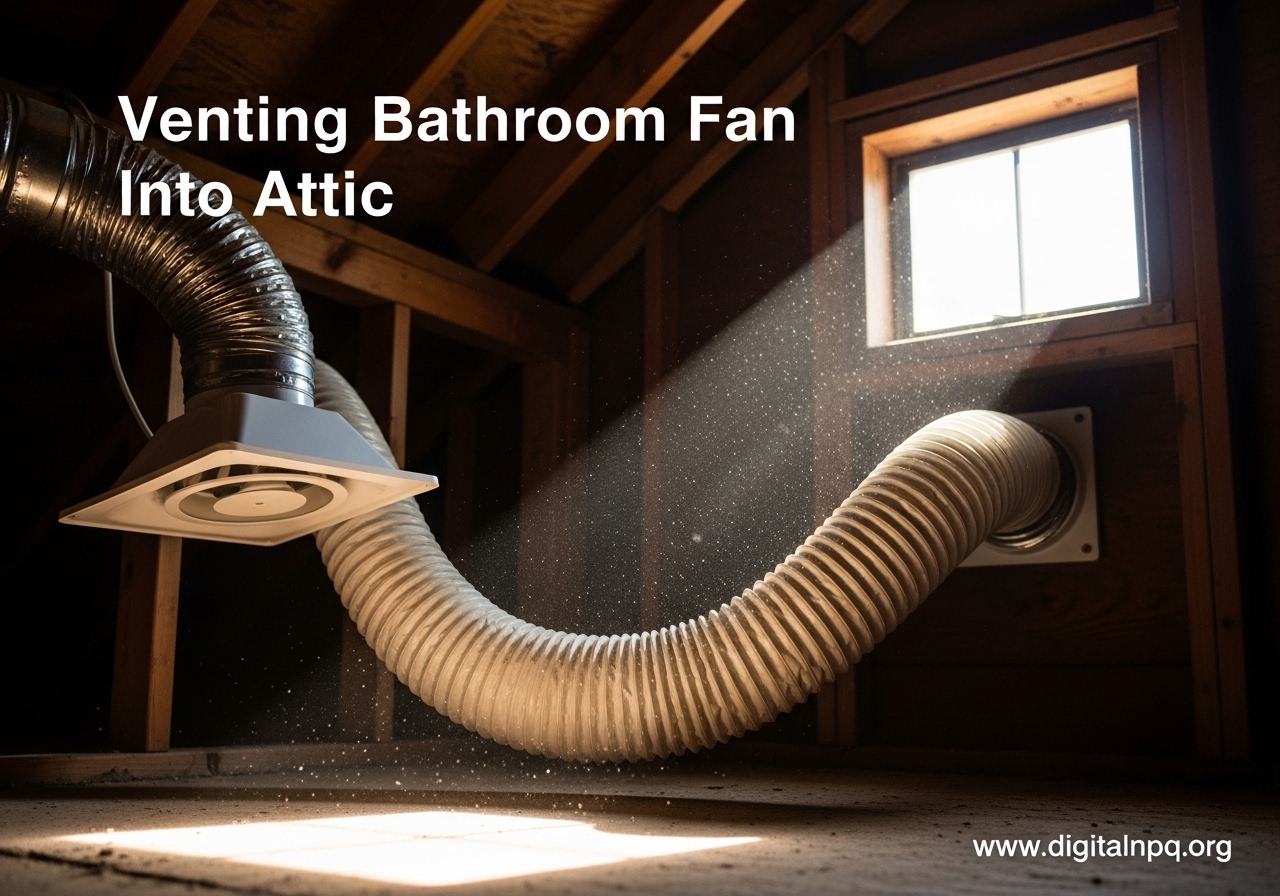
Venting a bathroom fan into the attic is one of the most common mistakes in home improvement. Many homeowners do not realize this practice violates building codes and creates serious long-term problems. If you are wondering whether it is okay to vent your bathroom exhaust fan into the attic, the answer is a firm no.
The moist air from your bathroom contains a surprising amount of water vapor. When that warm, humid air hits the cold surfaces in your attic, it condenses almost immediately. Over time, this condensation causes mold, rotting roof sheathing, and damaged insulation.
Our team has worked on dozens of homes where previous owners took this shortcut. In every case, the attic showed clear signs of moisture damage. The good news is that you can fix improper venting with the right materials and a clear plan.
This guide will explain why venting bathroom fan into attic is dangerous. You will also learn the proper alternatives, how to calculate the correct fan size, and what steps to take if you need to redirect an existing installation. We updated this guide in October 2026 to reflect the latest building code standards.
Why Venting a Bathroom Fan Into the Attic Is a Problem
Bathroom exhaust fans are designed to move humid air out of your home and terminate it in the open outdoors. When that moist air is dumped into the attic instead, it becomes trapped in a space that is not built to handle it. The consequences are predictable and costly.
Homeowners on Reddit and DIY forums frequently share stories about discovering this problem during a home inspection. One user found their bathroom fan exhausting into the attic just a foot away from an outside wall. The inspector flagged it immediately, and the seller had to cover the cost of proper roof venting before the deal could move forward.
Mold and Moisture Damage Are Nearly Guaranteed
A bathroom fan can move between 50 and 150 cubic feet of air per minute depending on its size. That air is saturated with moisture after a hot shower. When you vent that air directly into an attic instead of outside, you are essentially dumping a steady stream of humidity into an enclosed space.
Condensation forms on roof rafters, sheathing, and insulation within weeks. In cold climates, this effect is even more severe because the temperature difference between the moist exhaust air and the attic surfaces is larger. Home inspectors consistently flag this setup as a code violation because they know what comes next.
Mold spores can begin growing within 24 to 48 hours on damp surfaces. Once mold takes hold in attic insulation, removal becomes expensive. The problem does not stay in the attic either. Mold spores can travel through small gaps and affect indoor air quality.
Building Code Violations Can Affect Your Home Sale
The International Residential Code and most local building codes explicitly require bathroom exhaust fans to terminate outside the building. Venting into the attic, a garage, or any other enclosed space is not permitted under current standards.
This is not just a technicality. When you sell your home, the buyer’s inspector will almost certainly note the improper venting. That finding can delay closing, reduce your sale price, or force you to pay for repairs you could have handled earlier.
In 2026, most jurisdictions have adopted code language that makes this requirement clear. Even if your home was built decades ago, inspectors treat it as a safety issue today. Correcting the venting before listing your home is one of the smartest pre-sale investments you can make.
Structural Decay and Insulation Damage
Moisture trapped in an attic does more than grow mold. It also weakens the wooden structure that supports your roof. Roof sheathing and rafters can rot when exposed to repeated cycles of wetting and drying.
In severe cases, structural repairs costing thousands of dollars become necessary. Attic insulation loses its effectiveness when wet. Fiberglass batts compress and lose their R-value.
Cellulose insulation can clump and settle, leaving gaps where heat escapes. Replacing damaged insulation adds another layer of expense to a problem that started with a simple ductwork mistake. Our team has seen attics where years of improper venting caused the roof sheathing to turn black and soft.
How to Properly Vent a Bathroom Exhaust Fan
The right way to vent a bathroom exhaust fan is straightforward. The duct must carry moist air from the fan to an exterior termination point. There are three main methods, and the best choice depends on your bathroom location and roof structure.
Each method shares one common requirement. The duct must end outside the building envelope, not inside the attic, not inside a soffit, and not inside a wall cavity. Any termination short of the outdoors risks moisture problems.
Roof Venting Is the Preferred Method
The most reliable way to vent a bathroom exhaust fan is through the roof. A roof vent cap provides a direct path to the outdoors, and the vertical rise helps warm air escape naturally. This method is preferred by builders and contractors because it minimizes the chances of moisture re-entering the home.
You will need a roof vent cap with a built-in damper to prevent backdraft. The damper closes when the fan is off, blocking cold air, rain, and pests from entering the duct. Make sure the vent cap is rated for bathroom exhaust use, not just attic ventilation.
The duct should be rigid metal or insulated flexible duct. Uninsulated duct in a cold attic can sweat on the outside, creating a new condensation problem. Insulated ducting keeps the warm air warm until it exits the building.
Wall Venting Works for Exterior Walls
If your bathroom has an exterior wall, you can vent through the wall instead of the roof. This option eliminates the need to work on the roof and can be easier for DIYers. A wall vent cap looks similar to a dryer vent and includes a damper.
The downside is that wall venting only works when the bathroom sits on an exterior wall. Interior bathrooms still need roof venting. Wall vent caps can also be more visible from the outside, which matters for curb appeal.
Keep the duct run as straight and short as possible. Every bend adds resistance and reduces airflow. Use rigid metal duct where you can, and limit flexible duct to short transition sections.
Soffit Venting Requires Extra Care
Some homeowners consider venting through the soffit, which is the underside of the roof overhang. While this avoids roof work, it carries a significant risk. Moist air exiting the soffit can be drawn back into the attic through nearby soffit vents.
Most building codes and manufacturer guidelines now advise against soffit venting for bathroom exhaust. The warm, moist air rises naturally and can re-enter the attic space, defeating the purpose of the vent.
If you already have a soffit vent and need to redirect it, consider extending the duct to a roof vent or a gable wall vent. The small extra effort prevents the moisture recycling problem that makes soffit termination risky.
Step-by-Step Guide to Fixing Improper Attic Venting
If you discover that your bathroom fan currently vents into the attic, you should fix it as soon as possible. The process is manageable for most homeowners with basic tools and comfort working in an attic. Here is exactly how to do it.
Before you start, gather a flashlight, insulated duct, a vent cap, metal duct tape, a screwdriver, a drill, and a jigsaw or reciprocating saw. Wear a dust mask and gloves when working in the attic.
Step 1: Inspect the Current Setup
Start by finding your bathroom fan in the attic. Check where the duct ends. If it stops in open air, you have an improper vent.
Look for moisture stains, mold, or damaged insulation nearby. Take photos so you can compare the before and after condition.
Step 2: Choose the Proper Exit Point
Decide whether you will use a roof vent, wall vent, or an existing vent that can be adapted. Roof venting is best for most situations.
Measure the shortest path from the fan to the exit point. A shorter run means better airflow and less chance of condensation.
Step 3: Install the Vent Cap
For a roof vent, cut a hole in the roof sheathing that matches the vent cap size. Install the cap with proper flashing to prevent leaks.
Seal all edges with roofing cement. For wall venting, cut a hole through the exterior wall and install the wall cap with caulk around the perimeter.
Step 4: Run the Duct
Connect the bathroom fan to the new vent cap using insulated ductwork. Use metal duct tape at all joints. Avoid long runs with multiple bends.
Support the duct with straps every few feet to prevent sagging. Sagging creates low spots where condensation can pool.
Step 5: Seal and Test
Seal every joint with metal duct tape. Do not use standard cloth duct tape, as it will fail over time.
Turn on the fan and feel for airflow at the exterior vent. Check that the damper opens when the fan runs and closes when it stops.
Step 6: Address Any Damage
If you find mold or wet insulation, replace the affected materials before closing the attic. Small areas of mold can be cleaned with a fungicide.
Large areas may require professional remediation. Document the condition with photos in case you need to show a future buyer that the issue was resolved.
Step 7: Check the Fan Size
While you are in the attic, confirm that your fan has enough CFM for the bathroom size. An undersized fan will still leave moisture behind even with proper ducting.
We cover the sizing calculation in the next section.
Choosing the Right Ducting and Materials
Insulated ducting is essential for attic runs in climates with cold winters. The insulation prevents condensation on the outside of the duct. Look for duct labeled as R-6 or higher.
Flexible insulated duct is easier to install in tight attics, but rigid metal duct provides better airflow. A backdraft damper is non-negotiable. This simple flapper closes when the fan shuts off, preventing cold air from pouring back into the bathroom.
Some fans have a built-in damper, but an additional damper at the vent cap adds extra protection. In winter, a missing damper can make your bathroom freezing and waste heating energy. Use metal duct tape or mastic sealant at every connection.
Standard cloth duct tape deteriorates in heat and loses adhesion. Metal tape withstands attic temperatures and creates a lasting seal. Mastic sealant is even better for rigid metal joints, though it takes longer to apply.
If your attic is unheated, avoid uninsulated flexible duct. The thin plastic walls allow heat loss, and the ridges trap lint and dust over time. Smooth-walled rigid duct paired with an insulated sleeve is the most durable choice for a long-term installation.
Sizing Your Bathroom Fan Correctly
The Home Ventilation Institute recommends a minimum of 8 air exchanges per hour in bathrooms. To calculate the CFM you need, measure your bathroom length, width, and height. Multiply them to get cubic feet.
Then divide by 7.5 to find the required CFM. For example, a 10 foot by 8 foot bathroom with 8 foot ceilings has 640 cubic feet. Dividing by 7.5 gives you approximately 85 CFM.
Round up to the nearest standard fan size, which would be 90 or 100 CFM. Oversized is better than undersized. An undersized fan runs longer without removing enough moisture. It works harder, wears out faster, and leaves humidity behind.
If your bathroom has a separate shower enclosure, a jetted tub, or poor natural airflow, add 50 CFM to your calculation. Signs that your current fan is too small include foggy mirrors that last more than a few minutes after a shower, lingering musty odors, and visible moisture on walls.
If you notice any of these, replace the fan with a properly sized unit while you are correcting the venting.
Common Mistakes to Avoid During Installation
Even well-meaning homeowners make mistakes when rerouting a bathroom fan. One of the most common errors is using the wrong tape. Cloth duct tape will peel and lose its seal within months. Always use metal duct tape or mastic sealant designed for HVAC systems.
Another mistake is ignoring the duct slope. The duct should slope slightly toward the vent cap so any condensation drains outside. A flat or back-sloped duct can trap water and rust the metal over time.
Some people forget to install a backdraft damper entirely. Without it, cold winter air flows backward through the duct and into your bathroom. You will notice this when your bathroom feels drafty even with the door closed.
Finally, do not assume a bigger fan is always better. An oversized fan in a small bathroom can create negative pressure. This pulls conditioned air out of your home and can backdraft combustion appliances. Stick to the calculated CFM and round up by one standard size only.
Maintenance Tips for Long-Term Performance
Clean the fan grille and housing at least twice a year. Dust buildup on the blades reduces airflow and makes the motor work harder. Vacuum the grille and wipe the blades with a damp cloth.
If the fan is noisy, the motor bearings may be wearing out from overwork. Check the exterior vent cap annually. Make sure the damper opens freely and that no birds or insects have built nests.
Remove any lint or debris that collects around the opening. A blocked vent can reduce airflow by half or more. Inspect the attic-side ductwork once a year.
Look for sagging, disconnected joints, or signs of moisture. If you used flexible duct, make sure it has not kinked or collapsed. A quick test is the tissue test.
Hold a tissue near the fan grille while it is running. The fan should pull the tissue firmly against the grille. If it does not, you have an airflow problem that needs attention.
Frequently Asked Questions
Is it okay to vent a bathroom exhaust fan into the attic?
No. Venting a bathroom exhaust fan into the attic is a building code violation and creates serious moisture problems. The warm, humid air condenses on attic surfaces and leads to mold, rotting wood, and damaged insulation.
How long can I vent my bathroom fan into the attic?
You should not vent a bathroom fan into the attic at all. Even a short period can cause moisture damage. If you discover this setup, correct it immediately to prevent mold growth and structural decay.
How to vent a bathroom fan with no outside access?
If the bathroom is not on an exterior wall, run insulated duct through the attic to a roof vent cap. This is the standard solution for interior bathrooms. A licensed contractor can help if the roof work is beyond your comfort level.
Is it better to vent a bathroom fan through the roof or soffit?
Roof venting is better than soffit venting. Soffit vents can draw moist exhaust air back into the attic. A roof vent cap terminates the duct above the roof line where moisture disperses safely into the open air.
Can a bathroom fan cause mold in the attic?
Yes. A bathroom fan venting into the attic is one of the most common causes of attic mold. The constant supply of humidity creates ideal conditions for mold growth on rafters, sheathing, and insulation.
What is the 1:150 rule for attic ventilation?
The 1:150 rule means you need 1 square foot of net free ventilation area for every 150 square feet of attic floor space. This rule applies to general attic ventilation, not bathroom exhaust. Bathroom exhaust must terminate entirely outside the attic.
Can you vent a bathroom fan to a ridge vent?
No. You should not vent a bathroom fan into a ridge vent. Ridge vents are designed for passive attic ventilation, not pressurized exhaust. Moist air can backflow into the attic and cause the same moisture problems as venting into open attic space.
Can you vent a bathroom fan through an attic vent?
No. Venting through an existing attic vent such as a gable louver or turbine vent is not acceptable. Bathroom exhaust must terminate through its own dedicated vent cap that exits the roof or wall directly to the outside.
Conclusion
Venting bathroom fan into attic is a shortcut that causes mold, structural damage, and code violations. The proper solution is always to run the exhaust duct to an outdoor termination point through the roof or an exterior wall. If you currently have an attic-vented fan, correcting it should be a top priority on your home maintenance list.
By following the steps in this guide, you can protect your attic, your insulation, and your home’s value. Start with an inspection, choose the right venting method, and use insulated duct with a backdraft damper. The small investment in proper venting now will save you from expensive repairs in the future.