
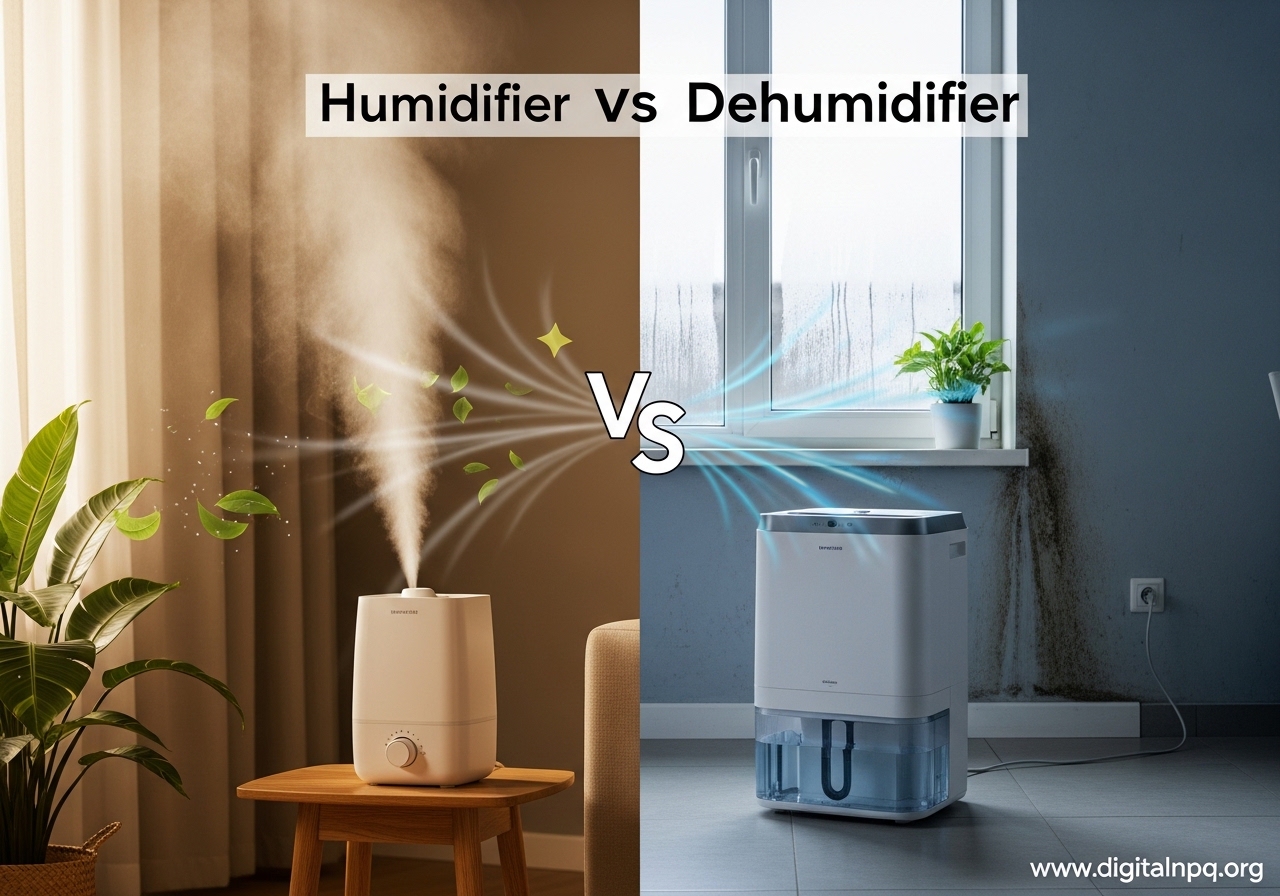
The difference between a humidifier and a dehumidifier comes down to one simple thing: what they do with moisture. A humidifier adds water vapor to dry indoor air, raising humidity levels when they drop below 30%. A dehumidifier pulls excess moisture out of the air, lowering humidity when it climbs above 50%. The EPA recommends keeping indoor relative humidity between 30% and 50% year-round for comfort, health, and home protection.
If you are trying to decide between a humidifier vs dehumidifier, the right answer depends entirely on your current indoor conditions. I have spent months researching both devices, testing them in different rooms, and talking with HVAC professionals to put together this guide. By the end, you will know exactly which device your home needs and when.
The confusion is understandable. Both devices manage indoor air quality, but they solve opposite problems. Running the wrong one can actually make things worse. Dry air causing cracked skin and static shocks calls for a humidifier. Musty smells, window condensation, and mold growth mean you need a dehumidifier. Let me break down everything you need to know.
Quick Answer: Humidifier vs Dehumidifier at a Glance
Here is the fastest way to understand the humidifier vs dehumidifier comparison. These two devices do opposite jobs with the same goal: keeping your indoor humidity in that sweet spot between 30% and 50%.
- Humidifier adds moisture to the air. Use it when indoor air feels dry, especially during winter heating months. It helps with dry skin, chapped lips, sore throat, static electricity, and sinus congestion.
- Dehumidifier removes moisture from the air. Use it when humidity runs high, especially in basements, bathrooms, or during humid summers. It helps prevent mold, mildew, musty odors, dust mites, and condensation on windows.
- Shared goal is maintaining 30-50% relative humidity indoors for comfort, health, and structural protection.
Many homeowners actually benefit from owning both devices and using them at different times of the year. Winter heating dries indoor air, calling for a humidifier. Summer humidity or year-round basement dampness calls for a dehumidifier.
What Is a Humidifier and How Does It Work?
A humidifier is a device that increases the moisture content of indoor air by releasing water vapor or fine mist into the room. It draws water from a built-in tank, converts it into a breathable mist, and disperses it throughout your space. When your indoor relative humidity drops below 30%, the air starts pulling moisture from everything around it, including your skin, nasal passages, and even wooden furniture.
Humidifiers are most commonly used during cold winter months when heating systems strip moisture from indoor air. Forced-air heating is notorious for dropping indoor humidity to uncomfortable levels, sometimes as low as 10-15%. That is when you start noticing dry, itchy skin, cracked lips, sore throats, and frequent static shocks every time you touch a doorknob.
Types of Humidifiers
Not all humidifiers work the same way. Each type has strengths and trade-offs that matter depending on your situation.
Cool-mist humidifiers are the most popular type for everyday use. They release a room-temperature mist and include ultrasonic and impeller models. Ultrasonic humidifiers use high-frequency vibrations to create a fine water mist, making them nearly silent. Impeller humidifiers use a rotating disk to fling water into a diffuser. Cool-mist units are safe around children since there is no hot water or heating element.
Warm-mist humidifiers (also called steam vaporizers) boil water to create steam, which cools before leaving the machine. The boiling process kills bacteria and minerals in the water, producing a cleaner mist. They tend to be quieter than cool-mist models but use more electricity and pose a burn risk around young children.
Evaporative humidifiers use a fan to blow air through a wet wick or filter. The air absorbs moisture naturally and carries it into the room. These are self-regulating to some degree because as humidity rises, the rate of evaporation slows down. They do not produce a visible mist.
Whole-home humidifiers connect directly to your HVAC system and humidify your entire house through existing ductwork. They draw water from your plumbing supply, so there is no tank to refill. These require professional installation but offer the most consistent humidity control.
Top Signs You Need a Humidifier
Wondering if dry air is your problem? Here are the most common warning signs.
- Static electricity keeps shocking you when you touch metal surfaces or other people.
- Dry, itchy skin and cracked lips that do not improve with lotion or lip balm alone.
- Frequent sore throats or waking up with a scratchy, dry feeling in your throat.
- Wood furniture or floors are cracking, shrinking, or showing gaps at the joints.
- Nosebleeds that happen more often than usual, especially in children.
- Peeling wallpaper or separating wallpaper seams along the walls.
- Indoor humidity reading consistently below 30% on a hygrometer.
What Is a Dehumidifier and How Does It Work?
A dehumidifier does the opposite of a humidifier. It pulls excess moisture out of the air, lowering the relative humidity in a room. When humidity climbs above 50%, problems start building quickly: mold grows on walls and ceilings, dust mites multiply, wood warps, and a musty smell settles into everything.
Most dehumidifiers work using a process similar to an air conditioner. A fan draws moist air into the unit and passes it over cold refrigerant coils. The moisture in the air condenses on those coils, drips into a collection tank, and the now-drier air is warmed slightly and released back into the room. The collected water must be emptied periodically or drained through a hose.
Dehumidifiers are especially important in basements, crawl spaces, bathrooms without exhaust fans, and any room where moisture tends to collect. If you live in a humid climate or have experienced water damage, a dehumidifier is one of the most effective tools for protecting both your health and your home. You can read more about specific best dehumidifiers for car options if you need portable moisture control for your vehicle.
Types of Dehumidifiers
There are two main types of dehumidifiers, and the difference matters depending on where and how you plan to use one.
Refrigerant (compressor) dehumidifiers are the most common type. They use a compressor, refrigerant coils, and a fan to condense moisture from the air, just like a small air conditioner. These work best at temperatures above 65 degrees Fahrenheit and in moderately to very humid conditions. They are effective, widely available, and come in capacities ranging from small room units to whole-basement models.
Desiccant dehumidifiers use a moisture-absorbing material (usually silica gel or a similar desiccant) to pull water from the air without cooling it. A rotating wheel of desiccant material absorbs moisture, then a heater dries it out so the wheel can keep absorbing. Desiccant units work well at lower temperatures, making them ideal for unheated basements, garages, and cold climates. They tend to be quieter than refrigerant models but use more energy per pint of water removed.
Top Signs You Need a Dehumidifier
These are the red flags that point to excess moisture in your home.
- Musty or damp smell that lingers in certain rooms, especially basements.
- Visible mold or mildew spots on walls, ceilings, or around windows.
- Condensation on windows that forms water droplets on the glass regularly.
- Warping wood floors or doors that suddenly stick and are hard to open.
- Water stains on walls or ceilings that indicate ongoing moisture problems.
- Allergy symptoms that worsen indoors, particularly sneezing and itchy eyes.
- Indoor humidity reading consistently above 50% on a hygrometer.
When to Use a Humidifier vs Dehumidifier: Decision Guide
This is where most people get stuck. You know the devices do different things, but how do you figure out which one your home actually needs? The answer starts with your symptoms and environment, not the device itself.
I put together this decision framework based on common household signs. It cuts through the confusion by matching what you are experiencing to the right device.
Sign-Based Decision Table
Use this table to quickly match your symptoms and home signs to the right device.
- Dry skin, chapped lips, frequent static shocks = Humidifier (humidity is too low)
- Sore throat, dry cough, nosebleeds = Humidifier (air lacks moisture)
- Musty smell, mold spots, mildew on surfaces = Dehumidifier (humidity is too high)
- Condensation on windows, water stains on walls = Dehumidifier (excess water in the air)
- Wood furniture cracking, wallpaper peeling = Humidifier (air is too dry)
- Doors sticking, wood floors warping = Dehumidifier (wood absorbing moisture)
- Dust mite allergies worse indoors = Dehumidifier (mites thrive above 50% humidity)
- Waking up congested with dry nasal passages = Humidifier (dry air irritating sinuses)
- Peeling paint or blistering walls = Dehumidifier (moisture trapped behind paint)
- Static cling on clothes and bedding = Humidifier (dry conditions cause static buildup)
If you are seeing signs from both columns, you may need to measure your humidity first. A simple hygrometer costs very little and gives you an instant reading. Below 30% means humidifier. Above 50% means dehumidifier. Between 30-50% means your levels are fine and your symptoms may have another cause.
Seasonal and Climate Guidance
Your humidity needs shift with the seasons, and your local climate plays a big role too.
Winter months: Heating systems dry out indoor air significantly. If you live in a cold climate with forced-air heat, you almost certainly need a humidifier during winter. Indoor humidity can drop to 15-20% when the heat is running constantly.
Summer months: Warm air holds more moisture, and in many regions summer brings high outdoor humidity that seeps indoors. A dehumidifier is often the right call during summer, especially in basements and ground-floor rooms.
Dry climates (Southwest US, high-altitude areas): You may need a humidifier year-round, especially in air-conditioned spaces that further dry the air.
Humid climates (Southeast US, tropical regions, coastal areas): A dehumidifier may be necessary most of the year to keep indoor humidity in check.
Seasonal transition tip: Many homeowners use a humidifier from October through March and switch to a dehumidifier from June through September. The shoulder months of April, May, and October are when a hygrometer becomes your best friend for deciding what to run.
Room-by-Room Recommendations
Different rooms have different humidity profiles. Here is what I recommend based on common room types.
Basement: Almost always needs a dehumidifier. Basements are below ground level where moisture seeps through foundation walls and floors. Even finished basements tend to run humid. A refrigerant dehumidifier with continuous drainage is your best option here.
Bedroom: Depends on the season and your symptoms. If you wake up with dry throat and congestion in winter, a quiet cool-mist humidifier on your nightstand can make a real difference. If you notice condensation on bedroom windows, a dehumidifier is the better choice.
Baby room: A cool-mist humidifier is generally recommended for nurseries. The American Academy of Pediatrics advises against warm-mist humidifiers in children’s rooms due to burn risks. Babies benefit from moisture in the air for breathing comfort, especially during cold season. Keep the humidity around 40-50% and clean the unit daily.
Bathroom: Usually needs a dehumidifier or better ventilation, not a humidifier. Showers and baths add significant moisture. An exhaust fan should be your first line of defense, but if moisture still builds up, a small dehumidifier helps prevent mold growth.
Grow room: This depends on what you are growing and at what stage. Seedlings and vegetative growth often need higher humidity (50-70%), while flowering plants prefer lower levels (40-50%). You may need both devices available and switch based on growth stage.
Health Benefits: Humidifier vs Dehumidifier for Common Conditions
Many people first start researching humidifier vs dehumidifier options because of a specific health concern. The right device can make a meaningful difference, but the wrong one can aggravate your symptoms.
For Allergies and Asthma
Both devices can help with allergies and asthma, but in completely different ways. The key is identifying what triggers your symptoms.
Choose a dehumidifier if your allergies are triggered by dust mites or mold. Both thrive in humidity above 50%. Dust mites absorb water from the air and cannot survive below 40% relative humidity. Mold spores need moisture to grow and spread. By pulling humidity down to 40-45%, a dehumidifier directly attacks the conditions these allergens need to survive.
Choose a humidifier if your asthma or allergies are aggravated by dry, irritated airways. Low humidity dries out the mucous membranes in your nose and throat, which are your body’s first line of defense against airborne irritants. When those membranes dry out, you become more sensitive to dust, pollen, and other triggers.
If you want targeted relief for sinus-related symptoms, we have a detailed guide on the best humidifier for sinus problems that covers specific models and features worth considering.
For Colds, Cough, and Congestion
This is one of the most searched comparisons: humidifier vs dehumidifier for cough and congestion. In most cases, a humidifier is the right choice when you are sick.
Cold viruses and respiratory infections cause inflammation and excess mucus in your airways. Adding moisture to the air helps thin that mucus so your body can clear it more easily. A cool-mist humidifier in your bedroom while you sleep can reduce coughing frequency, ease throat irritation, and help you breathe more comfortably through a stuffy nose.
A dehumidifier helps with congestion only when that congestion is allergy-driven. If mold spores or dust mites are causing your symptoms, reducing humidity removes the source of the problem rather than just treating the symptoms.
For Babies and Children
Infants and young children are more sensitive to air quality than adults. Their smaller airways react more dramatically to both dry and humid conditions.
A cool-mist humidifier is the standard recommendation for baby rooms, especially during cold and flu season. The added moisture helps keep their nasal passages clear and reduces the severity of coughs and congestion. The key safety point is avoiding warm-mist or steam units, which pose scalding risks if a child pulls the unit over or touches the steam output.
For conditions like RSV (respiratory syncytial virus), pediatricians typically recommend cool-mist humidifiers to help thin mucus and ease labored breathing. Always clean the humidifier daily to prevent bacteria and mineral buildup, which can actually worsen respiratory symptoms.
Humidifier vs Dehumidifier vs Air Purifier: What Is the Difference?
People often ask whether they need a humidifier, dehumidifier, or air purifier. These three devices address completely different aspects of indoor air quality.
A humidifier controls moisture by adding it. A dehumidifier controls moisture by removing it. An air purifier controls airborne particles by filtering them out. Air purifiers use HEPA filters, activated carbon, or other filtration methods to capture dust, pollen, pet dander, smoke, and other pollutants. They do not change humidity levels at all.
No, air purifiers do not dry indoor air. They simply circulate air through filters and return it to the room at the same humidity level. If you feel dry air while running an air purifier, the cause is something else in your environment, like heating or low outdoor humidity.
For the most complete indoor air quality setup, some homeowners use all three devices in combination. A humidifier or dehumidifier manages moisture, while an air purifier handles particulate matter. They serve different functions and do not conflict with each other when used properly.
Can You Use a Humidifier and Dehumidifier Together?
This question comes up constantly in forums, and the short answer is: not in the same room at the same time, but yes in the same house.
Running a humidifier and dehumidifier in the same room is counterproductive. One adds moisture while the other removes it, so they end up fighting each other. You waste energy, and the room humidity stays stuck somewhere in the middle without reaching an optimal level.
However, many homes benefit from using both devices in different rooms or at different times. Your basement might need a dehumidifier running constantly during summer, while your upstairs bedroom needs a humidifier during winter. Different rooms, different seasons, different needs.
Combination units do exist. Some manufacturers offer two-in-one humidifier-dehumidifier devices that can switch between modes. These are convenient for small apartments or dorms where you cannot fit two separate units. The trade-off is that combination units typically do not perform either function as well as a dedicated single-purpose device. They also tend to cost more and have smaller tanks.
If you have the space and budget, I recommend getting separate units. A dedicated humidifier and a dedicated dehumidifier will each outperform a combo device at their specific job.
How to Measure and Monitor Your Indoor Humidity
Before buying either device, you need to know your current humidity level. Guessing leads to buying the wrong machine.
The simplest tool is a hygrometer, a small device that measures relative humidity. Basic digital hygrometers are affordable and accurate enough for home use. Place one in the room where you are experiencing symptoms and check it at different times of day for a few days. Humidity fluctuates, so a single reading is not enough to make a decision.
Many modern thermostats and smart home devices include built-in humidity sensors. If you have a smart thermostat, check its app for humidity readings. Some models even track humidity trends over time and can alert you when levels go outside the 30-50% range.
Quick measurement tips:
- Take readings at different times of day (morning, afternoon, evening) for three to five days.
- Check multiple rooms, since humidity varies significantly between spaces.
- Measure before and after running heating or cooling systems.
- Baseline matters more than a single spike. Look at the average.
If your readings consistently fall below 30%, you need a humidifier. If they consistently sit above 50%, you need a dehumidifier. If readings bounce between the two extremes, you may need both devices for different seasons.
Maintenance Tips for Humidifiers and Dehumidifiers
Both devices require regular maintenance to work effectively and safely. Neglecting maintenance can actually make your air quality worse.
Humidifier maintenance: Clean the water tank every one to three days to prevent bacteria and mold growth. Use distilled or demineralized water to reduce mineral deposits, which can create a fine white dust in your room. Replace filters according to the manufacturer schedule, usually every one to three months. Allow the unit to dry completely when not in use. Descale the tank monthly using vinegar or a manufacturer-approved descaling solution.
Dehumidifier maintenance: Empty the water tank regularly, or set up continuous drainage with a hose if your unit supports it. Clean the air filter every two to four weeks to maintain airflow and efficiency. Check and clean the coils annually to prevent buildup that reduces performance. Inspect the drain pan and hose connections for leaks or clogs. Vacuum the exterior intake and exhaust grilles to remove dust.
Common mistake to avoid: Many people set their devices and forget them. A dirty humidifier can spray bacteria-laden mist into the air, making respiratory problems worse. A clogged dehumidifier works harder, uses more energy, and removes less moisture. Setting a monthly reminder for cleaning keeps both devices running safely and efficiently.
FAQ
Which is better for you, a humidifier or a dehumidifier?
The right choice depends on your indoor humidity levels. A humidifier adds moisture to dry air below 30% humidity and helps with dry skin, congestion, and static shocks. A dehumidifier removes excess moisture above 50% humidity and prevents mold, mildew, and musty odors. Many homeowners use both at different times of year.
Do I need a humidifier or dehumidifier for a stuffy nose?
A humidifier is usually better for a stuffy nose caused by dry air. Adding moisture helps loosen mucus and soothes irritated nasal passages. However, if your congestion is triggered by mold or dust mite allergies, a dehumidifier may help more by reducing the humidity that allows those allergens to thrive.
Do air purifiers dry indoor air?
No, air purifiers do not dry indoor air. They filter particles like dust, pollen, and pet dander from the air without changing humidity levels. Air purifiers and humidity control devices serve completely different functions and can be used together.
What kind of humidifier is best for RSV?
Cool-mist humidifiers are generally recommended for RSV and other respiratory illnesses in children. They add moisture safely without the burn risk of warm-mist units. Ultrasonic and impeller cool-mist humidifiers are both effective. Clean the unit daily to prevent bacteria growth in the water tank.
Should you use a dehumidifier if you have COPD?
A dehumidifier may help COPD sufferers in humid environments where heavy, moist air makes breathing more difficult. High humidity can worsen respiratory symptoms. However, extremely dry air can also irritate airways. The best approach is maintaining indoor humidity between 30-50% and consulting your healthcare provider for personalized advice.
Will a dehumidifier help with termites?
A dehumidifier can help discourage termites since these pests thrive in moist environments. By keeping indoor humidity below 50%, you make your home less attractive to termites and other moisture-loving insects. However, a dehumidifier will not eliminate an existing termite infestation. Professional pest control treatment is required for active infestations.
Can I use a humidifier and dehumidifier in the same house?
Yes, you can use both devices in the same house, just not in the same room at the same time. Many homes need a dehumidifier in the basement during summer and a humidifier in bedrooms during winter. Using both devices as needed in different rooms or different seasons is a common and effective approach.
How do I know if my room needs a humidifier or dehumidifier?
Use a hygrometer to measure your room’s relative humidity. If the reading is below 30%, you need a humidifier. If it is above 50%, you need a dehumidifier. You can also look for physical signs: dry skin and static mean dry air (humidifier), while musty smells and condensation mean excess moisture (dehumidifier).
Conclusion
The humidifier vs dehumidifier decision comes down to one number: your indoor relative humidity. Below 30% means dry air and a humidifier is the right tool. Above 50% means excess moisture and a dehumidifier is what you need. The goal in both cases is landing in that 30-50% sweet spot where your body, your home, and your air quality are all at their best.
Start by getting a hygrometer and checking your humidity over a few days. Match your symptoms to the signs in this guide. If you are dealing with dry winter air, static shocks, cracked skin, or sinus congestion, reach for a humidifier. If you are fighting musty smells, mold, window condensation, or allergy flare-ups indoors, a dehumidifier is your answer.
And remember, there is no rule saying you can only own one. Many homes genuinely benefit from both devices used at different times of the year. The key is knowing what your space actually needs, measuring the numbers, and choosing accordingly.