
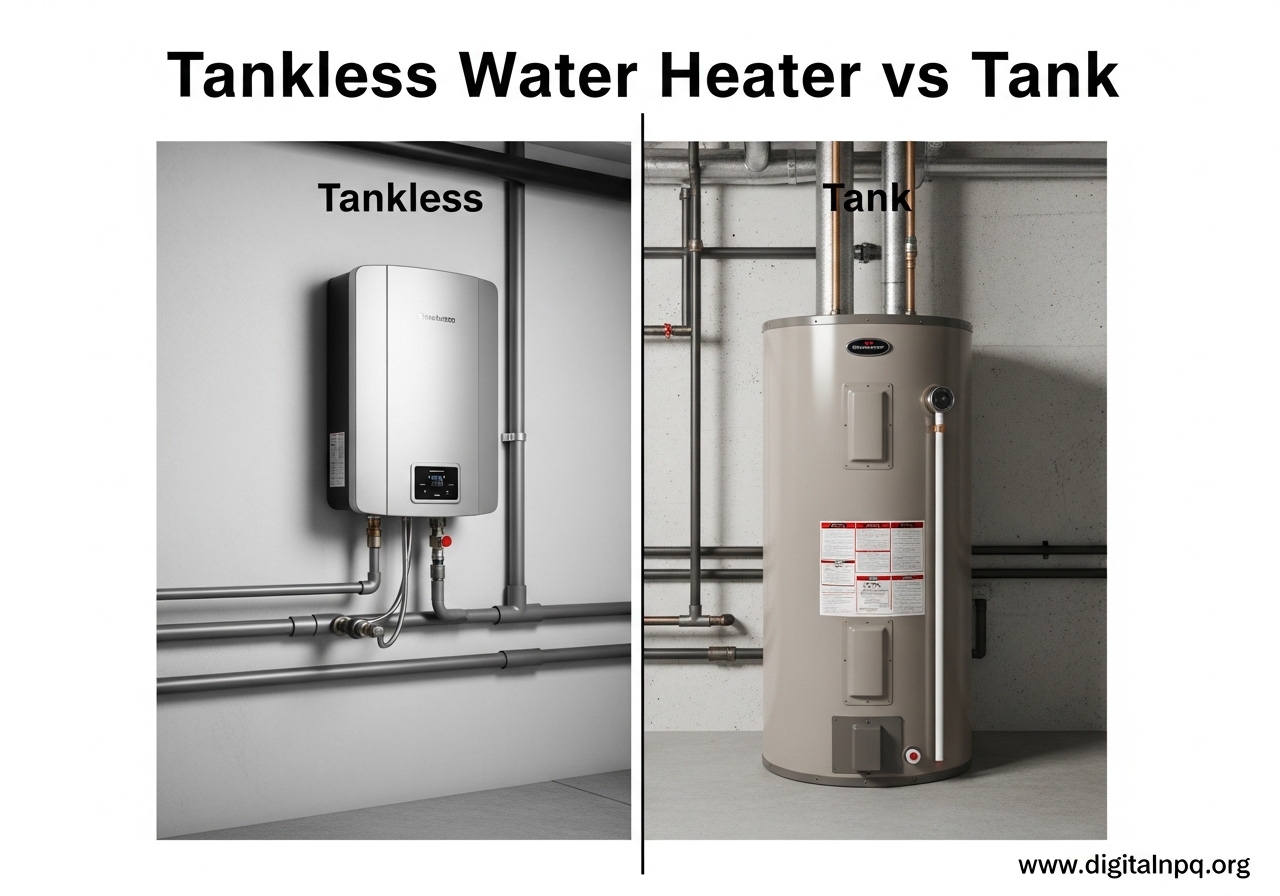
Choosing between a tankless water heater vs tank model is one of those home improvement decisions that stays with you for a decade or more. I have looked into the details so you do not have to wade through marketing fluff and conflicting advice. The right pick comes down to your household size, your budget, and how much hot water your family actually uses on a typical morning.
A traditional storage tank water heater holds 40 to 80 gallons of heated water ready to go at all times. A tankless unit, also called an on-demand or instantaneous water heater, heats water only when you turn on a faucet. Both do the same job, but they go about it in very different ways that affect your energy bills, your available space, and your daily routine.
In this guide our team breaks down every meaningful difference between these two systems. We cover upfront costs, monthly energy savings, real-world performance, lifespan, maintenance demands, and the honest pros and cons that real homeowners report on forums like Reddit and DIY StackExchange. By the end you will have a clear picture of which type fits your home best.
How Tankless and Tank Water Heaters Work
Understanding how each system operates makes the rest of the comparison much easier to follow. The core difference is simple: one stores hot water, and the other makes it on the spot.
How a Storage Tank Water Heater Works
A traditional tank water heater fills a large insulated tank with cold water, then uses either a gas burner at the bottom or electric heating elements inside the tank to bring the water up to your set temperature. A thermostat monitors the water temperature and kicks the heat source on whenever the reading drops below the target.
This means the unit is heating water around the clock, even when nobody is using hot water. That continuous cycle of heating and cooling is called standby heat loss, and it is the primary reason tank models are less energy efficient than tankless alternatives. The tank itself is insulated, but heat still escapes over time and the burner or elements must fire repeatedly to keep the water at the ready.
Most residential tanks hold between 40 and 80 gallons. When you use hot water, fresh cold water enters the tank at the bottom and the hot water flows out from the top. If you drain the tank faster than the heating element can recover, you run out of hot water and have to wait for the recovery time to pass before more is available.
How a Tankless Water Heater Works
A tankless water heater has no storage tank at all. When you turn on a hot water tap, a flow sensor detects the water movement and activates a powerful heat exchanger. In gas models, a burner fires up and heats the water as it passes through a coiled pipe. In electric models, high-wattage electric elements do the same job. The water reaches your set temperature within seconds and continues flowing hot as long as the tap stays open.
Because there is no stored water sitting around, standby heat loss is essentially zero. The unit only uses energy when hot water is actually being drawn. This on-demand heating approach is what gives tankless units their efficiency advantage, which the Department of Energy estimates at 24 to 34 percent for homes that use 41 gallons or less of hot water per day.
The trade-off is that a tankless unit can only heat so much water at one time. Its capacity is measured in gallons per minute, or GPM. If your household tries to run two showers and a dishwasher simultaneously, the unit may struggle to deliver adequate flow and temperature to all three at once. We will dig into that performance limitation later in this guide.
Upfront Cost: Tankless Water Heater vs Tank
The sticker price difference between these two systems is significant, and installation costs widen the gap even further. Here is what you can realistically expect to spend on each.
Tank Water Heater Costs
A standard gas or electric tank water heater typically runs between $500 and $1,500 for the unit itself, depending on capacity and efficiency rating. Installation for a straightforward replacement, where the new unit goes in the same spot with the same fuel type and venting, usually adds $500 to $1,200 in labor and materials.
Most homeowners end up spending between $1,000 and $2,700 total for a tank water heater replacement. If your existing setup meets current codes and nothing needs upgrading, you are looking at the lower end of that range.
Tankless Water Heater Costs
A tankless unit costs between $1,000 and $3,000 depending on whether you choose electric or gas, the GPM capacity, and the brand. But the real expense hits during installation. Retrofitting a home that previously had a tank often requires significant upgrades.
Gas tankless models usually need a larger gas line to supply the higher BTU demand, a new venting system that handles the concentrated exhaust, and possibly upgraded gas meter capacity. Electric tankless models draw a massive amount of current and frequently require a new 200-amp electrical panel or dedicated circuits. These retrofits can push total installation costs to $2,500 to $5,500 or more.
For new construction where the plumbing, gas lines, and electrical are being planned from scratch, the cost gap shrinks considerably because you are building the infrastructure to match the unit from the start.
Operating Costs and Energy Efficiency
This is where tankless water heaters make their strongest case. The efficiency gap between the two types is real, but the actual dollar savings depend heavily on how much hot water your household uses and what fuel source you have.
Energy Efficiency Ratings Explained
Water heater efficiency is measured using the Energy Factor, or EF. A higher EF means more of the energy going into the unit actually heats the water. Modern tank water heaters typically achieve an EF of 0.58 to 0.70 for gas models and 0.90 to 0.95 for electric models. Tankless gas units hit EF ratings of 0.82 to 0.98, and electric tankless models can reach 0.96 to 0.99.
The reason for the efficiency difference is straightforward. Tank units lose heat through the tank walls and the flue pipe all day and night. That standby heat loss adds up. The Department of Energy estimates that standby losses account for roughly 10 to 20 percent of a tank heater’s total energy consumption. Tankless units eliminate almost all of that waste because there is no stored water cooling down between uses.
Realistic Energy Savings
For a typical family of four using around 60 gallons of hot water per day, switching from a standard tank to a tankless unit can save roughly $100 to $200 per year on energy bills. Smaller households that use less hot water see lower absolute savings but higher percentage improvements.
Homes in warmer climates benefit slightly more from tankless efficiency because the incoming groundwater temperature is higher, meaning the unit has less work to do during each heating cycle. In cold climate regions, a gas tankless unit has to work harder to raise the water temperature, which narrows the efficiency gap.
The Payback Period
Here is the honest math that many marketing materials skip. If you spend $4,000 installing a tankless system compared to $1,800 for a tank replacement, you have a $2,200 cost difference to recoup. At $150 per year in energy savings, you are looking at a payback period of roughly 14 to 15 years. For homes with lower hot water usage, the payback stretches even longer.
Reddit users on r/HomeImprovement consistently report payback periods of 5 to 10 years for households with moderate to high hot water demand, especially when replacing an aging, inefficient tank with a high-efficiency tankless model. The savings are real, but they accumulate slowly and depend heavily on your local utility rates and usage patterns.
Performance and Hot Water Delivery
Performance is where the tankless water heater vs tank debate gets the most nuanced. Each type has a distinct advantage depending on how your household uses hot water.
Tank Water Heater Performance
A tank heater’s performance is measured by its First Hour Rating, or FHR. This number tells you how many gallons of hot water the unit can deliver in the first hour of use starting with a full tank of heated water. A 50-gallon tank with a high recovery rate might deliver 70 to 80 gallons of usable hot water in that first hour.
The limitation is obvious. Once the stored hot water is depleted, you wait for the recovery time. A gas tank heater might recover in 30 to 60 minutes, while an electric model could take 60 to 90 minutes. For a family where three people shower back to back every morning, a properly sized tank handles the demand without issue. Add a washing machine and dishwasher running at the same time, and you might run into a shortage.
Tankless Water Heater Performance
A tankless unit never runs out of hot water in the traditional sense. As long as the tap is open and the unit has fuel or power, it keeps heating. But it has a different limitation: flow rate capacity measured in gallons per minute. A typical whole-house tankless unit delivers between 4 and 8 GPM depending on the model and the temperature rise required.
The temperature rise is the key variable that many buyers overlook. If your incoming groundwater is 55 degrees and you want 120-degree shower water, the unit needs to raise the temperature by 65 degrees. In cold climate regions where groundwater might be 40 degrees, that temperature rise jumps to 80 degrees, and the same unit delivers fewer GPM because it has to heat each gallon more.
Running multiple fixtures at once is the most common complaint from tankless owners. A standard shower uses about 2 GPM, a kitchen faucet uses 1.5 GPM, and a washing machine can pull 2 to 3 GPM. If your tankless unit is rated at 5 GPM and you try to run a shower and the washing machine simultaneously during winter, you will likely notice a temperature drop at the shower head.
The Cold Water Sandwich Effect
One quirk specific to tankless units is called the cold water sandwich effect. When someone finishes using hot water and a second person turns on a hot tap shortly after, the residual hot water in the pipes flows out first, followed by a brief burst of cold water while the tankless unit fires up and begins heating again, and then sustained hot water. It is not dangerous, but it is an uncomfortable surprise if you are not expecting it. Some higher-end tankless models include a built-in recirculation pump or buffer tank to eliminate this issue.
Lifespan and Durability Comparison
Water heaters are long-term investments, and the expected lifespan differs meaningfully between the two types.
Tank Water Heater Lifespan
A standard tank water heater lasts 10 to 15 years on average. The primary enemy is corrosion. Over time, the steel tank interior degrades despite the protective glass lining and sacrificial anode rod designed to attract corrosive elements in the water. Once the tank begins to leak, the unit is done and must be replaced.
Hard water accelerates tank failure because mineral deposits build up at the bottom of the tank, creating hot spots that stress the glass lining and the steel beneath. Regular flushing to remove sediment buildup can extend the life of a tank unit by several years.
Tankless Water Heater Lifespan
Tankless units typically last 20 years or more with proper maintenance. Because there is no large volume of water sitting in a steel tank constantly, the corrosion risk profile is different. The heat exchanger is the critical component, and it is built from materials like copper or stainless steel designed to withstand repeated heating cycles.
However, hard water is a serious concern for tankless longevity. Mineral scale builds up inside the narrow passages of the heat exchanger, reducing efficiency and eventually causing blockages. In areas with hard water, annual descaling is not optional. It is essential maintenance that homeowners on forums like r/homeowners frequently mention as an unexpected ongoing cost.
Warranty Comparison
Most tank water heaters come with 6 to 12 year warranties, with longer warranties typically tied to higher-efficiency models. Tankless units usually carry 10 to 15 year warranties on the heat exchanger and 5 years on parts. The longer warranty coverage reflects the expected longer service life of tankless units.
Maintenance Requirements
Maintenance is an area where the tankless water heater vs tank comparison reveals some surprises. Many people assume tankless means maintenance-free, but the reality is more complicated.
Tank Water Heater Maintenance
Annual maintenance for a tank heater is relatively straightforward. You flush the tank to remove sediment buildup, inspect the anode rod and replace it if significantly corroded, and test the temperature and pressure relief valve to make sure it opens and closes properly. Many homeowners handle these tasks themselves with basic tools and a garden hose.
If you skip maintenance, sediment accumulates at the tank bottom and reduces the unit’s efficiency and capacity. A tank that originally held 50 gallons might effectively hold only 40 gallons of hot water after years of sediment accumulation because the mineral layer takes up space and insulates the water from the heat source below.
Tankless Water Heater Maintenance
Tankless maintenance is more involved and often requires professional service. The primary task is descaling the heat exchanger, which involves circulating a descaling solution (usually white vinegar or a dedicated flush kit) through the unit to dissolve mineral deposits. In hard water areas, this should be done every 6 to 12 months.
The unit also has inlet filters that need periodic cleaning, and the burner assembly on gas models should be inspected annually. While some handy homeowners purchase a flush kit and handle descaling themselves, the process takes 45 to 60 minutes and requires following the manufacturer’s instructions carefully to avoid damaging the heat exchanger.
Professional tankless maintenance service typically costs $150 to $300 per visit. Over a 20-year lifespan, that adds $3,000 to $6,000 in maintenance costs that tank owners generally avoid. This is one reason why some plumbers express reservations about recommending tankless units, a point we will address in the FAQ section.
Installation Complexity and Space Requirements
The physical footprint and installation demands of these two systems are dramatically different.
Space Savings
This is one of the clearest wins for tankless. A standard 50-gallon tank stands about 5 feet tall and 2 feet in diameter, requiring a dedicated closet, corner of the garage, or utility room with proper clearances. You cannot put anything too close to it, and it needs floor space plus adequate ventilation.
A tankless unit is roughly the size of a small suitcase and mounts on a wall. It frees up significant floor space, which is a major advantage in smaller homes, apartments, and condos where every square foot counts. For homeowners in space-constrained installations, this benefit alone can tip the decision toward tankless.
Installation Complexity
Replacing a tank with another tank in the same location is one of the simpler plumbing jobs. The connections are already in place, the venting matches, and the gas line or electrical circuit is sized correctly. A plumber can typically finish the swap in 2 to 4 hours.
Installing a tankless unit where a tank used to be is a different story. Gas models need a larger gas supply line because tankless burners operate at a much higher BTU output than tank burners. The existing vent pipe usually needs to be replaced with a direct-vent system rated for the concentrated exhaust. Electric tankless models draw so much power that many homes need a panel upgrade from 100 amps to 200 amps, which is a significant electrical project.
Local building codes and permit requirements vary by region, and some municipalities have specific rules about tankless installations. Reddit users frequently mention getting surprised by additional code requirements during their installation, so getting multiple quotes from licensed contractors who know your local codes is essential.
Which Type Is Best for Your Household
There is no universal winner in the tankless water heater vs tank comparison. The right choice depends entirely on your situation. Here is a straightforward guide based on common household scenarios.
Choose a Tankless Water Heater If
Your household has one to three people and moderate hot water demand. You rarely run multiple hot water fixtures at the same time. You live in a smaller home where the space savings matter. You plan to stay in the home for 10 years or more, giving the energy savings time to offset the higher upfront cost. Your home already has adequate gas supply or a 200-amp electrical panel.
Choose a Tank Water Heater If
You have a larger family of four or more people with high simultaneous hot water demand, such as back-to-back morning showers while the dishwasher runs. Your budget for the replacement is limited and you need the lowest upfront cost option. You live in an area with very cold groundwater that would reduce a tankless unit’s flow rate capacity. You prefer simpler maintenance that you can handle yourself without professional service calls.
The Middle Ground
Some homeowners install a point-of-use tankless unit at a distant bathroom to supplement their main tank heater. This hybrid approach eliminates the wait for hot water at the farthest fixture while keeping the tank’s capacity for high-demand periods. It is a practical compromise that costs less than a whole-house tankless conversion.
If you are building a new home, tankless makes more financial sense because the infrastructure costs are baked into the construction budget rather than added as a retrofit expense.
Common Myths About Tankless and Tank Water Heaters
Misinformation about both types circulates widely. Let us clear up the most common myths using real data and actual user experiences.
Myth: Tankless Means Instant Hot Water at the Tap
This is the single most common misconception. Tankless units heat water instantly, but the hot water still has to travel through your home’s plumbing from the unit to the faucet. If the tankless heater is in the garage and your bathroom is on the second floor, you still wait the same amount of time for hot water to reach the tap as you would with a tank unit. A recirculation pump or point-of-use heater solves this problem, but it is an additional cost.
Myth: Tank Heaters Waste Enormous Amounts of Energy
Modern tank heaters are much better insulated than units from 15 or 20 years ago. The actual standby heat loss on a current high-efficiency tank is lower than many people assume. While tankless units are still more efficient overall, the gap is not as dramatic as some marketing materials suggest. The real-world energy savings, as discussed earlier, typically amount to $100 to $200 per year for an average household.
Myth: Tankless Heaters Work During Power Outages
Most tankless units require electricity to operate the ignition system, flow sensors, and control board. When the power goes out, your tankless heater stops producing hot water entirely. Gas tank models with a standing pilot light may continue working during an outage, though modern tanks with electronic ignition also need power. If reliable hot water during outages matters to you, verify the specific ignition type on any unit you consider.
Myth: Tankless Is Always the Better Choice
Forum discussions on r/HomeImprovement and DIY StackExchange tell a more balanced story. Many homeowners who switched to tankless are happy with the decision, but others regret it because they underestimated the installation costs, the maintenance demands in hard water areas, or the flow rate limitations when multiple family members need hot water at the same time. The right choice is the one that matches your specific household needs, not the one with better marketing.
FAQ
Why do plumbers not recommend tankless water heaters?
Many plumbers express caution about tankless units because of the high installation costs, especially when retrofitting a home that previously had a tank. Gas line upgrades, venting changes, and electrical panel modifications can push the total cost well above what homeowners expect. Plumbers also see the maintenance side: in hard water regions, tankless heat exchangers need annual descaling, and neglected units fail prematurely. Their concerns are practical, not about the technology itself. A properly sized and maintained tankless unit in the right home performs well.
Which is better tank or tankless water heater?
Neither is universally better. Tankless units offer higher energy efficiency (24-34% savings), a longer lifespan (20+ years vs 10-15 years), and significant space savings. Tank units cost less upfront, handle simultaneous hot water demand better, require simpler maintenance, and provide consistent flow rates regardless of groundwater temperature. The better choice depends on your household size, budget, hot water usage patterns, and how long you plan to stay in your home.
What are the downsides of having a tankless water heater?
The main downsides are higher upfront and installation costs, limited flow rate capacity when multiple fixtures run simultaneously, the cold water sandwich effect between uses, annual descaling maintenance (especially in hard water areas), reliance on electricity meaning no hot water during power outages, and a long payback period that can stretch 10 to 15 years. Gas tankless units also require proper venting and adequate gas supply that many older homes lack.
Is a tankless water heater worth it?
A tankless water heater is worth it if you plan to stay in your home for at least 10 to 15 years, have moderate hot water demand that a single unit can handle, value the space savings of a wall-mounted unit, and your home already has the necessary gas or electrical infrastructure. It is less worth it if you expect to move within a few years, have a large family with heavy simultaneous hot water demand, or face expensive retrofitting costs for gas line or electrical panel upgrades.
How long do tankless water heaters last?
Tankless water heaters typically last 20 years or more with proper maintenance. The heat exchanger, which is the core component, usually carries a 10 to 15 year warranty. The key factor affecting lifespan is water quality. In hard water areas, mineral scale builds up inside the heat exchanger and can cause premature failure if the unit is not descaled regularly. Annual flushing with a descaling solution keeps the heat exchanger clean and helps the unit reach or exceed its expected lifespan.
Can a tankless water heater run a whole house?
Yes, a properly sized tankless unit can serve an entire house. Whole-house tankless models typically deliver 4 to 8 gallons per minute. The key is matching the unit’s GPM rating to your peak demand. Calculate your peak usage by adding the flow rates of fixtures you expect to run simultaneously (shower at 2 GPM, kitchen faucet at 1.5 GPM, washing machine at 2-3 GPM). Then check that the tankless unit can deliver that combined GPM at the required temperature rise for your climate. In colder regions with lower groundwater temperatures, you may need a higher-capacity unit.
Conclusion
The tankless water heater vs tank decision comes down to matching technology to your real-world needs, not chasing one-size-fits-all answers. Tankless units deliver superior energy efficiency, longer lifespan, and significant space savings, but they demand higher upfront investment and ongoing maintenance attention. Tank heaters offer lower initial costs, simpler maintenance, and reliable performance for households with heavy simultaneous demand.
Take an honest inventory of your household size, your daily hot water usage patterns, your available space, and your budget before making the call. Get at least three quotes from licensed plumbers who can assess your home’s specific infrastructure needs. The best water heater for your home is the one that fits how your family actually lives, not the one with the most impressive spec sheet.