
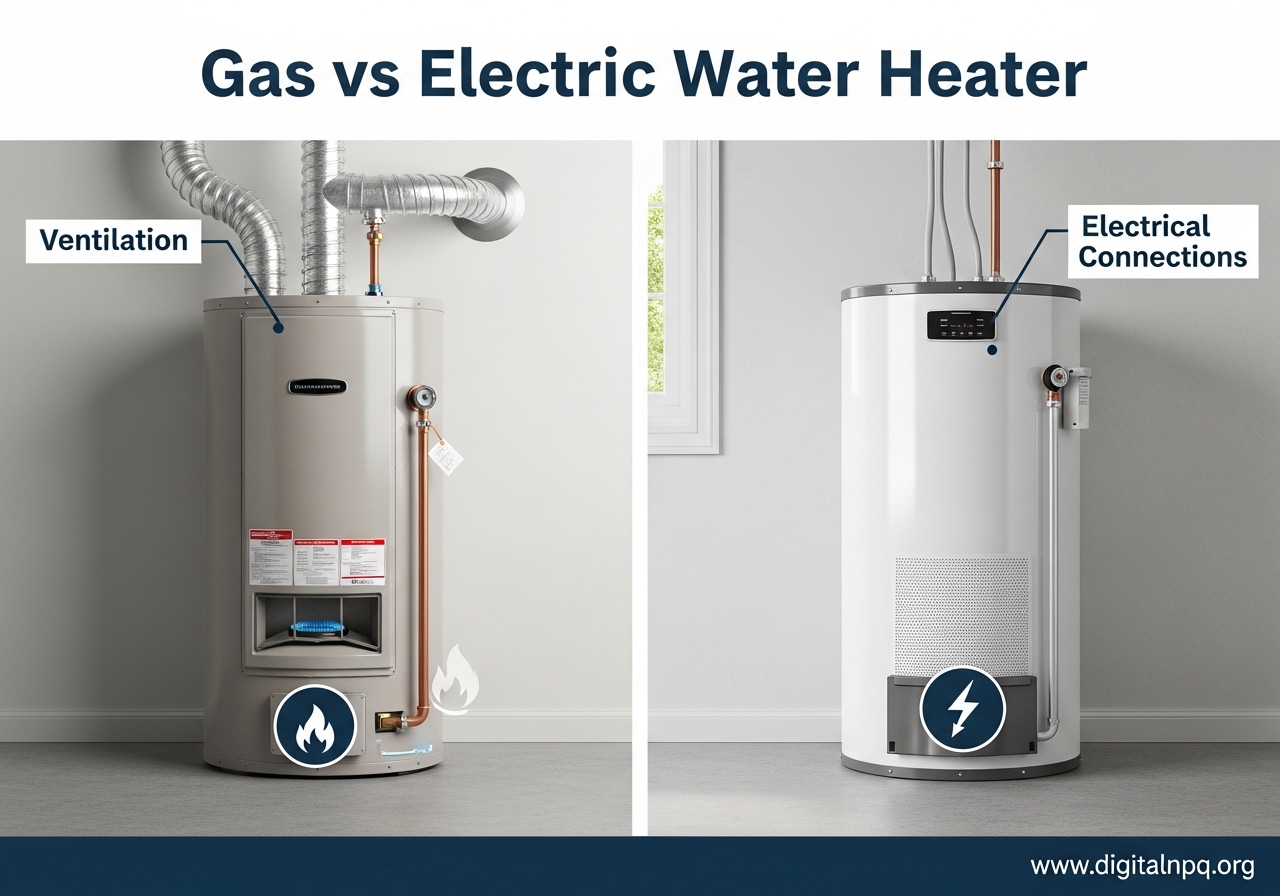
Choosing between a gas and electric water heater is one of those home decisions that quietly affects your monthly bills, your morning routine, and your household budget for the next decade. Our team has spent weeks digging through manufacturer specs, real homeowner experiences on forums, and utility rate data to put together this gas vs electric water heater comparison. Whether you are replacing a failed unit or building a new home, this guide breaks down every factor that actually matters so you can make the right call without second-guessing.
The core difference comes down to how each type generates heat. Electric tankless water heaters and standard electric tank models both use resistance heating elements, while gas models burn natural gas or propane at the base of the tank. That single mechanical difference drives everything from installation costs to monthly utility bills to how fast your water reheats after back-to-back showers.
How Gas and Electric Water Heaters Work
The heating mechanism is the fundamental distinction in any gas vs electric water heater comparison. Understanding how each type operates makes the rest of the pros, cons, and cost differences much easier to follow.
How Gas Water Heaters Work
Gas water heaters use a burner assembly located at the bottom of the tank. When the thermostat detects that water temperature has dropped below the set point, it opens a gas valve and ignites the burner, either through a standing pilot light or an electronic ignition system. The flame heats the bottom of the tank, and the heat rises through the water via convection.
Because gas combustion produces exhaust gases including carbon monoxide, every gas water heater requires a venting system, typically a flue pipe or chimney that channels those gases outside. Power vent models use a fan to push exhaust through horizontal piping, which gives more installation flexibility but adds cost.
A standard 40-gallon gas water heater with a 40,000 BTU burner can heat water at a recovery rate of roughly 30 to 45 gallons per hour. That means the tank refills and reheats quickly after heavy use, which is one reason gas models are popular with larger households.
How Electric Water Heaters Work
Electric water heaters use one or two heating elements submerged directly inside the tank. The upper element heats first, and once the top portion of the tank reaches the set temperature, the lower element takes over. This dual-element design is more efficient than it sounds because it stratifies the water and reduces standby heat loss.
These units require a dedicated 240-volt electrical circuit, usually on a 30-amp double-pole breaker. There is no combustion, no pilot light, and no venting system needed, which makes the overall installation simpler and safer from a carbon monoxide standpoint.
The tradeoff is recovery speed. A typical 40-gallon electric water heater recovers at about 14 to 20 gallons per hour, roughly half the rate of a comparable gas model. For a single person or a couple, that difference barely matters. For a family of five, it can mean the difference between everyone getting a hot shower and someone getting a cold surprise.
Gas Water Heater Pros and Cons
Gas water heaters have been the default choice in many parts of the country for decades. Here is a straightforward breakdown of where they shine and where they fall short.
Advantages of Gas Water Heaters
- Faster recovery rate: Gas models reheat 30 to 45 gallons per hour compared to 14 to 20 gallons for electric. If you have a household of four or more people who shower in the morning, gas keeps up much better.
- Lower monthly operating costs: In most regions, natural gas costs less per unit of energy than electricity. Homeowners on Reddit consistently report that their gas water heaters cost roughly half as much to operate per month as electric models in the same area.
- Works during power outages: Gas water heaters with a standing pilot light continue to operate when the power goes out. Models with electronic ignition require electricity, but many newer gas units have battery backup for the ignition.
- Better for high-demand households: The combination of fast recovery and lower per-gallon heating cost makes gas the preferred option for large families or homes with high simultaneous hot water demand.
Disadvantages of Gas Water Heaters
- Higher upfront and installation costs: The unit itself often costs more than an equivalent electric model, and installation requires a gas line, proper venting, and adequate combustion air, all of which add labor and material expenses.
- Shorter expected lifespan: Gas water heaters typically last 8 to 12 years, compared to 10 to 15 years for electric models. The combustion process creates more internal stress on the tank.
- Carbon monoxide risk: Any gas-burning appliance carries a carbon monoxide risk. Proper venting and annual inspections are non-negotiable safety requirements.
- More maintenance: Gas burners, pilot assemblies, and vent pipes need regular cleaning and inspection. Sediment buildup is also more aggressive in gas tanks due to the intense bottom heat.
- Lower Energy Factor ratings: Gas water heaters lose energy through the venting system and have EF ratings around 0.58 to 0.65, meaning roughly 35 to 42 percent of the energy purchased is wasted.
Electric Water Heater Pros and Cons
Electric water heaters are the go-to in areas without natural gas service and in homes where installation simplicity matters most. Here is how they stack up.
Advantages of Electric Water Heaters
- Lower purchase and installation cost: Electric tank water heaters generally cost less to buy and significantly less to install. No gas line, no vent pipe, no combustion air requirements. You just need a 240V circuit and a water connection.
- Longer expected lifespan: Electric models typically last 10 to 15 years because there is no burner flame causing thermal stress at the bottom of the tank and no combustion byproducts accelerating corrosion.
- Higher Energy Factor ratings: Electric water heaters convert nearly all their energy into heat, with EF ratings of 0.90 to 0.95. The energy efficiency of the unit itself is higher than gas.
- Safer operation: No combustion means zero risk of carbon monoxide poisoning or gas leaks. No venting means fewer points of failure.
- Simpler maintenance: Without a burner assembly, pilot light, or vent pipe, annual maintenance is mostly limited to flushing sediment and checking the anode rod.
Disadvantages of Electric Water Heaters
- Higher monthly operating costs: Even though electric units are more efficient at converting energy to heat, electricity rates per therm equivalent are higher in most regions. This is the biggest complaint from owners who switch from gas to electric.
- Slower recovery rate: At 14 to 20 gallons per hour, electric tanks take significantly longer to reheat after depletion. This becomes a real problem with consecutive showers or large bathtub fills.
- No hot water during power outages: Electric water heaters are completely dependent on grid power. When the electricity goes out, you have only the hot water already in the tank, and it cools steadily.
- Potential electrical panel upgrade: If your home has an older 100-amp electrical panel, adding a 240V/30A circuit for a water heater might require a panel upgrade, which can cost between $1,000 and $3,000.
Gas vs Electric Water Heater Efficiency and Costs
The efficiency comparison between gas and electric water heaters is not as straightforward as comparing Energy Factor numbers alone. You have to look at the actual energy source costs in your area to get the real picture.
Energy Efficiency Comparison
Electric water heaters have higher Energy Factor ratings, typically between 0.90 and 0.95, because nearly all the electrical energy fed into the heating elements ends up in the water. Gas water heaters, by contrast, have EF ratings of 0.58 to 0.65 because a significant portion of the heat energy escapes through the venting system as exhaust.
However, that raw efficiency number does not tell the whole story. The cost per unit of energy matters just as much. In areas where electricity rates are high and natural gas is cheap, a less-efficient gas water heater can still cost significantly less to operate each month than a highly efficient electric one.
Heat pump water heaters deserve a special mention here. They use electricity but operate at roughly 300 percent efficiency by pulling heat from surrounding air rather than generating it through resistance. These hybrid electric models can match or beat gas operating costs, but they come with higher upfront prices and have specific installation requirements around ambient air temperature and space.
Monthly Operating Costs
In most regions of the United States, gas water heaters cost less to operate per month than standard electric models. The exact difference depends heavily on your local utility rates, which can vary by a factor of two or more between states.
As a rough baseline, a household using 60 to 70 gallons of hot water per day might spend $25 to $40 per month on gas versus $40 to $70 per month on standard electric, assuming average national utility rates. But if you live in an area with cheap hydroelectric power, electric costs can drop significantly. Checking your local gas and electric rate per therm or kilowatt-hour is the most reliable way to estimate your actual monthly cost difference.
Lifespan Comparison
Electric water heaters tend to outlast gas models by two to three years on average. Electric tanks typically run 10 to 15 years, while gas tanks last 8 to 12 years. The difference comes down to the combustion environment inside a gas tank, where the flame at the base creates thermal cycling stress that accelerates tank degradation.
Regular maintenance extends the lifespan of both types. Flushing sediment annually and replacing the anode rod every three to five years can push either type to the upper end of its expected range. Neglected water heaters of either type will fail sooner, often due to internal corrosion.
Recovery Rate: Why It Matters
Recovery rate is the measure of how many gallons of water a heater can raise to the target temperature per hour. This is one of the most practical differences between gas and electric water heaters, and it directly affects daily life in multi-person households.
A standard 40-gallon gas water heater with a 40,000 BTU burner recovers at about 40 gallons per hour. A comparable electric model recovers at about 18 gallons per hour. That means a gas tank can refill and fully reheat in roughly one hour, while an electric tank might take over two hours to do the same job.
For a family of four where everyone showers between 6 and 8 AM, the gas heater will keep pace without issue. With an electric model, the third or fourth shower might run lukewarm or cold because the tank has not had time to recover. Forum users on Reddit frequently mention this as their biggest frustration with electric water heaters, especially those who switched from gas without anticipating the difference.
If you choose electric and have a large household, you can mitigate the slower recovery by sizing up to a larger tank (such as a 50- or 65-gallon model) so there is more stored hot water to draw from before recovery becomes a factor.
Installation Requirements and Switching Costs
Installation is where the financial and logistical differences between gas and electric water heaters really show up. The type you choose depends partly on what infrastructure your home already has in place.
Gas Water Heater Installation
Installing a gas water heater requires a natural gas or propane supply line, a venting system to exhaust combustion gases, and adequate combustion air in the room. If your home already has gas service and an existing gas water heater, a like-for-like replacement is relatively straightforward and might run $500 to $1,500 including labor.
If you are adding gas service where none exists, the costs climb fast. Running a new gas line from the street to the water heater location can add $1,000 to $3,000 or more, depending on distance and local permitting requirements.
Electric Water Heater Installation
Electric water heaters need a dedicated 240-volt circuit on a 30-amp breaker. If your electrical panel already has an available double-pole breaker slot and adequate amperage capacity, installation is simple and affordable, often in the $300 to $800 range.
The gotcha is the electrical panel. Older homes with 100-amp service may not have the capacity to add another 240V circuit. Upgrading to a 200-amp panel costs between $1,500 and $3,000. This is a hidden cost that catches many homeowners off guard when they try to switch from gas to electric.
Cost to Switch Between Types
Switching from gas to electric or vice versa is almost always more expensive than replacing with the same type. Going from gas to electric means capping the gas line, removing the vent, running new 240V wiring, and potentially upgrading the electrical panel. Going from electric to gas means running a new gas line, installing venting, and possibly modifying the surrounding space for proper clearances.
In either direction, expect to pay $1,500 to $4,000 in additional conversion costs on top of the water heater itself. For most homeowners, sticking with whatever type is already installed is the most cost-effective approach unless there is a compelling reason to switch.
Other Water Heater Options Worth Considering
The gas vs electric tank-style comparison covers the majority of homes, but a few alternatives deserve attention depending on your priorities.
Heat Pump Water Heaters (Hybrid Electric)
Heat pump water heaters use electricity to move heat from the surrounding air into the water tank rather than generating heat directly through resistance. This makes them roughly three times more efficient than standard electric models, with an Energy Factor of 2.0 or higher.
The catch is that heat pump models cost more upfront, need a surrounding air space of at least 1,000 cubic feet (typically a basement or garage), and can be noisy, similar to a running refrigerator. However, many utility companies and state programs offer rebates that can knock hundreds of dollars off the purchase price, making the payback period much shorter.
Tankless Water Heaters
Tankless water heaters heat water on demand rather than storing it. Electric tankless water heaters are compact and efficient for smaller households, but they can struggle with high simultaneous demand. Gas tankless models produce higher flow rates, making them better suited for homes with multiple bathrooms running at once.
Tankless units eliminate standby heat loss entirely, which saves energy. But they come with higher installation costs, especially gas models that require large gas lines and special venting. Electric tankless models may require multiple 240V circuits and an electrical panel that can handle 120 amps or more of dedicated load.
Solar Water Heaters
Solar thermal water heating systems use rooftop collectors to preheat water before it enters your tank or tankless unit. They work best in sunny climates and can reduce water heating costs by 50 to 80 percent. The main downsides are high upfront costs, climate dependency, and the need for a backup heating system for cloudy periods.
Gas vs Electric Water Heater: Which Should You Choose?
There is no universal winner in the gas vs electric water heater debate. The right choice depends on your home, your household size, your budget, and your local utility rates. Here is a practical framework to help you decide.
Choose Gas If
- You have four or more people in the household who use hot water at the same time of day
- Your home already has a gas line and venting in place
- Local natural gas rates are significantly cheaper than electricity rates
- You want the lowest monthly operating cost and faster recovery between uses
Choose Electric If
- You have a smaller household of one to three people with moderate hot water demand
- Your home does not have gas service and adding it would be expensive
- You want lower upfront purchase and installation costs
- Safety from combustion gases and gas leaks is a priority
- You want fewer maintenance requirements over the life of the unit
Four Questions to Ask Yourself
Before making your final decision, answer these four questions to clarify which type fits your situation:
- What infrastructure does my home already have? If you have a gas line, stay with gas. If you have the electrical capacity, electric is easy.
- How many people live here and what is our hot water usage pattern? High concurrent demand points toward gas. Spread-out, low demand works well with electric.
- What are my local utility rates? Pull your current electric and gas bills. Calculate the cost per therm and per kilowatt-hour. The cheaper energy source usually determines the cheaper monthly cost.
- What is my total budget including installation? Factor in not just the unit price but the full installation cost, including any infrastructure upgrades.
Frequently Asked Questions
Which water heater is better, gas or electric?
Neither is universally better. Gas water heaters are cheaper to operate monthly and reheat faster, making them ideal for large families. Electric water heaters cost less upfront, last longer, and are safer since they produce no combustion gases. The best choice depends on your household size, existing home infrastructure, and local utility rates.
Why are gas water heaters being phased out?
Some municipalities and states are moving toward electrification to reduce greenhouse gas emissions from natural gas combustion in homes. Gas water heaters produce carbon dioxide and carry carbon monoxide risks. However, gas water heaters are not being banned nationwide. Local building codes and incentive programs vary, so check your area’s regulations before making a decision.
Is it worth switching from gas to electric water heater?
Switching from gas to electric is worth it if your local electricity rates are competitive, you qualify for heat pump water heater rebates, or you want to eliminate combustion gas risks from your home. However, switching can cost $1,500 to $4,000 in additional infrastructure changes like electrical panel upgrades. If your gas unit simply needs replacing, sticking with gas is usually the more economical choice.
Why do plumbers not recommend tankless water heaters?
Some plumbers express caution about tankless units because of their higher upfront cost, complex installation requirements, and the fact that they do not solve every household’s hot water needs. Gas tankless models need large gas lines and special venting, while electric tankless models can demand significant electrical capacity. Tankless units also require more frequent descaling in hard water areas. That said, many plumbers do recommend tankless for the right application, particularly in smaller households or as supplemental point-of-use heaters.
Conclusion
The gas vs electric water heater decision comes down to three things: your existing home infrastructure, your household hot water demand, and your local energy costs. Gas wins on monthly savings and recovery speed for large families. Electric wins on upfront cost, lifespan, and installation simplicity for smaller households. Before you commit, pull your utility bills, check what your home already has in place, and use the four-question framework above to narrow it down. The right answer is the one that fits your specific situation, not a generic recommendation.