
If one room in your house feels like a sauna while the rest stays perfectly comfortable, you are not alone. I have dealt with this exact problem in my own home, and after months of research and trial and error, I figured out exactly how to increase airflow to one room without spending a fortune on HVAC upgrades.
The truth is, most homes have at least one room that gets shortchanged when it comes to air circulation. Whether it is a bedroom at the end of a long hallway, a home office above the garage, or an upstairs room far from the air handler, the underlying causes are usually the same. And the good news is that most fixes are surprisingly simple.
In this guide, I will walk you through every method I have tried, from free five-minute adjustments to more involved HVAC changes. By the end, you will have a clear plan to get that problem room breathing again.
Why One Room Gets Poor Airflow
Before jumping into solutions, it helps to understand what is actually causing the problem. HVAC systems push conditioned air through a network of ducts, and that air follows the path of least resistance. Rooms closer to the air handler get the lion’s share of airflow, while rooms at the end of long duct runs receive significantly less.
This is not a design flaw in most cases. It is simply physics. The longer the duct run, the more friction the air encounters, and the lower the pressure becomes by the time it reaches that distant room. I have seen rooms that receive barely 50% of the airflow compared to rooms right next to the unit.
Several factors can make the problem worse:
- Closed or partially blocked registers: Furniture, curtains, or rugs sitting over supply vents choke off airflow before it even enters the room.
- Dirty air filters: A clogged filter restricts airflow throughout the entire system, and the weakest rooms suffer first. Some homeowners report their furnace actually shuts down when using high-MERV filters.
- Closed doors: When a door is shut tight, air pumped into the room has nowhere to go. This creates positive pressure that actually pushes back against the supply vent, reducing incoming airflow.
- Inadequate return vents: If the room lacks a return air grille, air cannot cycle back to the system efficiently. The room becomes pressurized, and fresh air stops flowing in.
- Duct leaks or kinks: Flexible ductwork can get crushed, disconnected, or develop leaks in attics and crawlspaces, robbing air before it ever reaches the target room.
Identifying which of these is your primary culprit will point you toward the right fix. In many cases, it is a combination of two or three factors working together.
Quick Fixes to Increase Airflow to One Room
These are the solutions you can implement in under an hour with zero or minimal cost. I recommend trying these first before moving on to more advanced options.
Create a Cross-Breeze
This is the single fastest way to get air moving in a stagnant room. Open a window in the problem room and another window on the opposite side of the house, ideally one that catches a natural breeze. The pressure difference between the two openings creates a natural airflow path through your home.
If natural breezes are not reliable, place a box fan in the problem room’s window facing outward to exhaust warm air. This creates negative pressure that pulls cooler air from the rest of the house into the room. Reddit users in the HomeImprovement community swear by this technique, and I have used it myself with noticeable results in under 15 minutes.
For rooms with only one window, you can still make this work. Open the single window and use a fan to blow air out while keeping the room’s door propped open. Air from the hallway gets drawn in to replace what the fan pushes out.
Optimize Your Ceiling Fan
If the room has a ceiling fan, make sure it is spinning in the correct direction. In summer, your ceiling fan should rotate counterclockwise when viewed from below. This creates a downdraft that makes the room feel cooler by evaporating moisture from your skin.
In winter, reverse the direction to clockwise and run it on low speed. This pushes warm air down from the ceiling without creating a cold draft. It is a simple switch that many people overlook, and it costs nothing to change.
Also check the fan speed. A medium or high setting moves significantly more air than low. If the room feels stuffy, crank it up. Ceiling fans do not lower the actual temperature, but the air movement makes the room feel 4 to 8 degrees cooler, which reduces how hard your AC needs to work.
Use Doors and Hallways to Your Advantage
Closed doors are one of the most overlooked causes of poor room airflow. When a door is shut, air from the supply vent fills the room until the pressure equalizes, at which point new air essentially stops flowing in. The solution is simple: leave the door open, or at least crack it a few inches.
If privacy is a concern, consider a door with a louvered design or install a return air grille in the door itself. Some homeowners cut an inch off the bottom of the door to create a gap for air to escape. The general rule is that you need at least half a square inch of undercut for every cubic foot per minute (CFM) of air supplied to the room.
Hallways act as natural air channels in most homes. Keeping hallway doors open allows air from well-conditioned rooms to flow toward rooms that need it. Think of your home as a connected air system rather than a collection of sealed boxes.
How to Adjust HVAC Registers and Dampers
If the quick fixes above are not enough, the next step is working with your HVAC system directly. This is where you can make the biggest difference for a single room.
Balance Supply Registers Throughout the House
The idea behind register balancing is straightforward: partially close registers in rooms that get too much air, forcing more air toward the rooms that get too little. Start by identifying which rooms are the coldest or have the strongest airflow. These are usually closest to the air handler.
Close those registers about halfway. Do not close them completely, as this can create excessive static pressure in the ductwork and strain your blower motor. Then make sure the registers in your problem room are fully open and unobstructed.
Here is a step-by-step approach I have used:
- Open every register in the house fully.
- Turn on the AC or heat and let it run for 15 minutes.
- Feel the airflow at each register and rank them from strongest to weakest.
- Partially close the top 3 to 4 strongest registers by about 50%.
- Check the problem room again after 30 minutes.
- Adjust further in small increments until the airflow feels balanced.
Be patient with this process. It can take a day or two of small adjustments to find the right balance, especially if your system serves multiple floors.
Adjust Ductwork Dampers
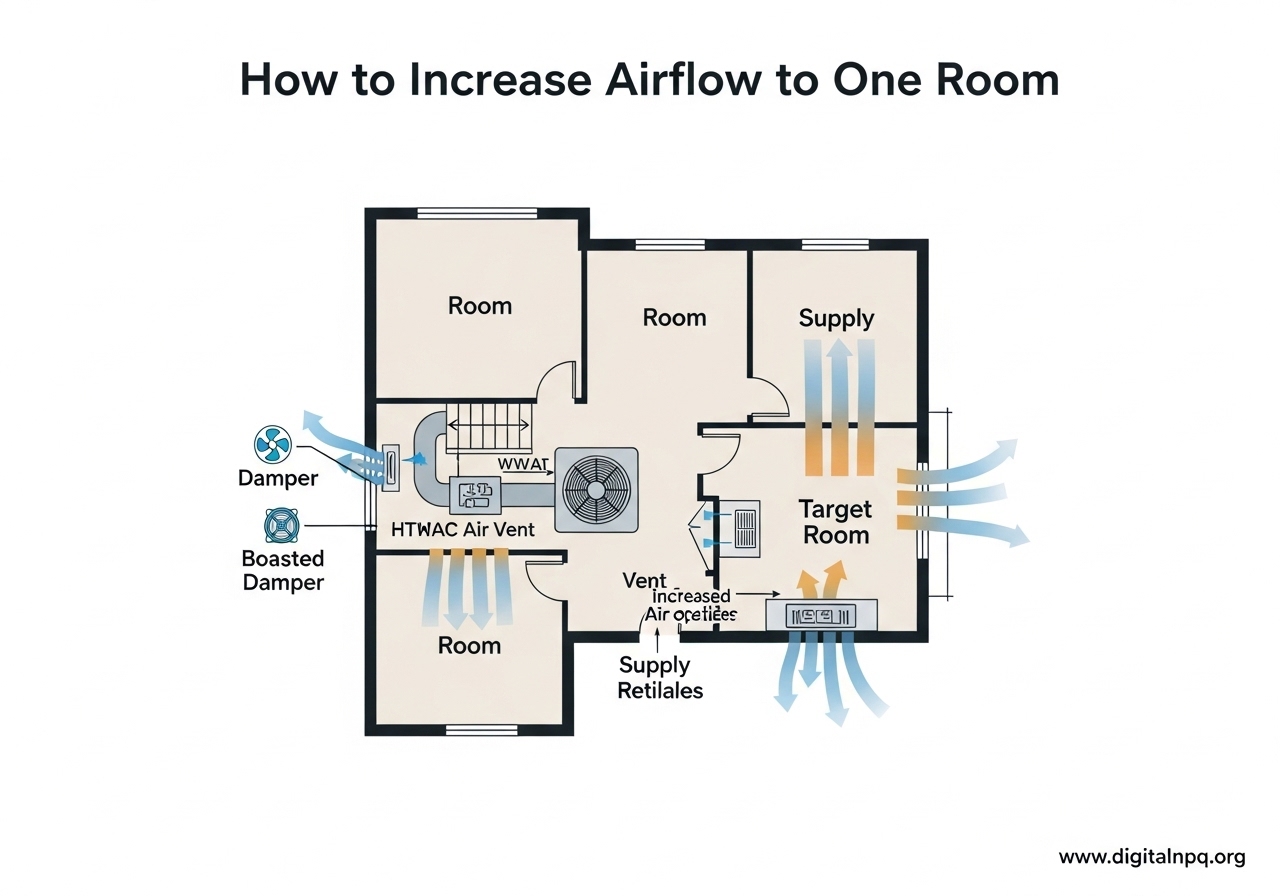
Dampers are metal plates inside your ductwork that control how much air flows through each branch. Unlike register adjustments, which happen at the room endpoint, dampers are located at the branch takeoffs near the main trunk line. They give you much finer control over airflow distribution.
Not all homes have manual dampers, but many do. Look for small handles or levers on the outside of the ductwork near where branches split off from the main trunk line. A handle parallel to the duct means the damper is fully open. A handle perpendicular means it is fully closed.
To redirect more air to one room, partially close the dampers serving other branches while keeping the damper for the problem room fully open. Make small adjustments, about a quarter turn at a time, and wait 20 to 30 minutes between changes to let the system stabilize.
If you cannot find any dampers, your ductwork may not have them. This is common in older homes. In that case, register balancing is your primary tool, or you can have dampers installed by an HVAC professional.
DIY Maintenance Tips for Better Room Airflow
Sometimes the reason for poor airflow is simply that something is dirty or blocked. Regular maintenance goes a long way toward keeping every room in your home comfortable.
Replace your air filter regularly. This is the number one maintenance task. A clogged filter chokes the entire system. Check your filter every month and replace it every 60 to 90 days, or more often if you have pets or allergies. If you have been using a high-MERV filter, try stepping down to MERV 8 or 11. High-MERV filters create more resistance, and not all systems can handle it. Some homeowners on HVAC forums report that switching from MERV 13 to MERV 11 immediately improved airflow to their distant rooms.
Clean registers and grilles. Remove the vent covers in the problem room and vacuum or wash them. Dust buildup on the louvers restricts airflow more than you might think. While the covers are off, reach into the duct opening with a vacuum hose and clean out any visible debris.
Check for duct obstructions. If you have access to your attic, crawlspace, or basement where the ductwork runs, take a look at the branch serving the problem room. Flexible ducts can get crushed under insulation, kinked around framing, or disconnected at joints. A partially collapsed flex duct can reduce airflow by 50% or more. If you find a kinked section, straighten it out and secure it with proper supports. If a joint has separated, reattach it using foil tape (not cloth duct tape) and a zip tie or clamp.
Clear the area around supply and return vents. Make sure no furniture, curtains, storage boxes, or bedding is within 12 inches of any vent in the room. Even partially blocking a vent significantly reduces its output. Rearrange the room if needed to give every vent clear breathing room.
Advanced Solutions for Stubborn Airflow Problems
If you have tried all the basic and intermediate methods and the room still feels like a different climate zone, it may be time for more involved solutions.
Install a booster fan. Also called an inline duct fan, this is a small electric fan that mounts inside the ductwork leading to the problem room. It actively pushes air down the line, overcoming the natural friction loss in long duct runs. Some models plug into a standard outlet and turn on automatically when they detect airflow from the main system. Reddit users frequently recommend this as a cost-effective fix for rooms at the end of long duct runs.
Consider smart vents. Smart register replacements have built-in sensors and motorized louvers that automatically adjust airflow based on room temperature. They connect to your home Wi-Fi and work with smart thermostats to direct conditioned air where it is needed most. While they are an investment, they solve the problem of constantly adjusting manual registers by hand.
Enlarge or add return vents. Many rooms, especially older additions and converted spaces, lack adequate return air pathways. Without a return vent, air enters the room but cannot cycle back to the HVAC unit. An HVAC contractor can add a return grille or enlarge an existing one, which can dramatically improve air circulation in that room.
Check for ductwork resizing needs. If the duct serving the problem room is undersized, no amount of register adjustment will fix the problem. A duct that is too small for the room’s square footage simply cannot deliver enough CFM. An HVAC professional can measure the duct size and calculate whether it meets the room’s requirements. Resizing a duct branch is more involved, but it provides a permanent fix.
Know when to call a professional. If you have exhausted the DIY options and the problem persists, a licensed HVAC technician can perform a static pressure test, measure CFM at each register, and identify issues that are invisible from the outside. They can also assess whether your system’s blower speed needs adjustment or whether a zoning system would help.
A good rule of thumb is to call a professional if you have tried basic fixes for two weeks without improvement, if you notice unusual noises from the ductwork, or if multiple rooms in the house have airflow problems (which suggests a system-level issue rather than a single-room problem).
Frequently Asked Questions
What is the $5000 rule for HVAC?
The $5000 rule is a guideline for deciding whether to repair or replace your HVAC system. Multiply the age of your system (in years) by the estimated repair cost. If the result exceeds $5000, replacement is generally the better investment. For example, a 12-year-old system needing a $450 repair gives you $5400, which exceeds the threshold, suggesting replacement may be wiser than repair.
How do I redirect my AC airflow to another room?
To redirect AC airflow to a specific room, start by partially closing supply registers in rooms that receive too much air. Then fully open the register in the target room. Next, locate and adjust duct dampers near the main trunk line, partially closing branches serving other areas while keeping the branch to your target room wide open. Make small adjustments and wait 20 to 30 minutes between changes to let the system stabilize.
What is the 2 foot rule in HVAC?
The 2 foot rule in HVAC states that there should be at least 2 feet of clearance between the end of a duct run and any obstacles or sharp bends. This ensures air can flow freely without excessive turbulence or resistance. Violating this rule can reduce airflow to downstream rooms and increase static pressure in the system.
Why is my AC not blowing strong in one room?
Common reasons include a closed or blocked supply register, a dirty air filter restricting system-wide airflow, a kinked or leaky duct serving that room, closed doors creating pressure imbalance, or the room being at the end of a long duct run with no damper control. Start by checking the filter, ensuring the register is fully open and unblocked, and leaving the door cracked to allow air circulation.
Conclusion
Fixing poor airflow in a single room almost always comes down to a combination of small adjustments rather than one big change. Start with the free and easy fixes: open registers, replace the filter, create a cross-breeze, and prop open the door. Then move on to register balancing and damper adjustments if needed.
For most homes, these steps solve the problem entirely. If they do not, booster fans and ductwork modifications are your next line of defense. The important thing is to work through the solutions methodically, making one change at a time so you can tell what actually helps.
Learning how to increase airflow to one room is one of those home improvement skills that pays off year after year. Once you understand how your system works and where the bottlenecks are, you can keep every room in your house comfortable through every season.