
When you turn on the hot water tap, you probably do not think about what happens inside that metal cylinder sitting in your basement or utility closet. Understanding how a water heater works can save you money on energy bills, help you troubleshoot problems, and guide you when it is time for a replacement. In this guide, our team breaks down the entire water heating process so that anyone can understand it, whether you have a traditional tank model, a tankless unit, or a hybrid heat pump system.
We have spent hours researching and comparing how different water heater types operate, consulting manufacturer documentation and real homeowner experiences from plumbing forums across the web. By the end of this article, you will know exactly how each type heats your water, which components keep it safe, and what maintenance steps keep everything running smoothly for years to come.
What Is a Water Heater?
A water heater is a household appliance designed to raise the temperature of cold water and deliver hot water throughout your home. It supplies heated water for showers, dishwashers, washing machines, and any other fixture that needs warm or hot water. Most homes in the United States use either a storage tank model that keeps a reservoir of hot water ready at all times, or a tankless model that heats water on demand as it flows through the unit.
The basic concept is straightforward: cold water enters the unit, a heat source warms it, and hot water exits when you open a tap. What changes between models is how that heat is generated and delivered. Some units burn natural gas or propane, others use electric resistance heating elements, and newer hybrid models pull ambient heat from the surrounding air using heat pump technology.
Knowing what a water heater is and how it functions at a basic level makes it easier to understand the differences between gas, electric, tankless, and hybrid systems. Each type has its own internal mechanics, efficiency profile, and maintenance requirements, which we cover in detail throughout this guide.
How Does a Water Heater Work? (Step-by-Step Process)
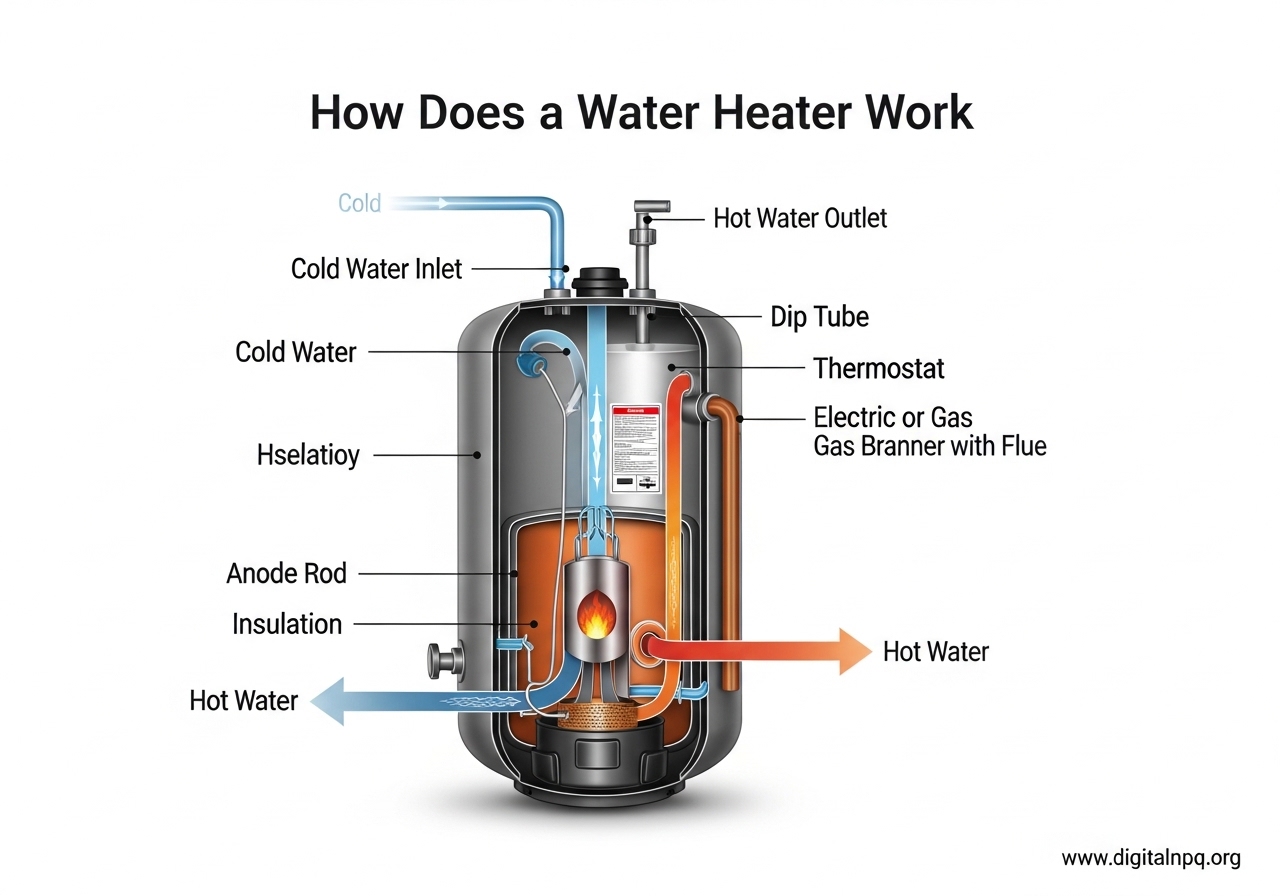
The question of how does a water heater work can be answered with a clear, numbered sequence. Here is the step-by-step process that happens inside a standard storage tank water heater every time you use hot water:
Step 1: Cold water enters through the dip tube. When you open a hot water tap somewhere in the house, cold water from your main supply line flows into the top of the tank through a pipe called the dip tube. This tube carries the cold water all the way down to the bottom of the tank, keeping it separated from the hot water that has already risen to the top.
Step 2: The heat source activates. At the bottom of the tank, the heating mechanism kicks in. In a gas water heater, a burner beneath the tank ignites and produces a flame. In an electric model, one or two heating elements immersed in the water energize and begin generating heat. A thermostat monitors the water temperature and signals the heat source to turn on or off as needed.
Step 3: Water heats and rises. As the water at the bottom of the tank absorbs heat, it becomes less dense. This heated water naturally rises to the top of the tank through a process called convection. The cold water stays at the bottom near the heat source, creating a continuous circulation pattern inside the tank.
Step 4: Hot water exits through the heat-out pipe. When you open a hot water tap, the pressurized hot water at the top of the tank flows out through a separate pipe called the heat-out pipe. This pipe is located near the top of the tank, exactly where the hottest water collects. At the same time, new cold water enters through the dip tube to replace what was used.
Step 5: The thermostat maintains set temperature. The thermostat constantly monitors the water temperature inside the tank. When the temperature drops below the set point (usually between 120 and 140 degrees Fahrenheit), it signals the heating element or burner to turn back on. Once the water reaches the target temperature, the heat source shuts off.
Step 6: Safety features keep pressure in check. The temperature and pressure relief valve, commonly called the T&P valve, sits on the side or top of the tank. If the water gets too hot or the pressure builds too high, this valve opens automatically and releases excess water to prevent the tank from rupturing. This is one of the most important safety devices on any water heater.
Step 7: The anode rod protects against corrosion. Inside the tank, a long metal rod called the sacrificial anode rod attracts corrosive elements in the water. By sacrificing itself, the anode rod prevents rust from eating through the steel tank lining. This component is the main reason water heaters can last 8 to 12 years or more.
This cycle repeats continuously, ensuring your home always has hot water available. The entire process relies on simple physics: heat rises, cold sinks, and a thermostat regulates the temperature to keep everything consistent.
How a Gas Water Heater Works
Gas water heaters use natural gas or propane as their fuel source, and they operate with a few components that electric models do not have. Understanding how a gas water heater works requires looking at the burner assembly, the gas control valve, the thermocouple, and the flue pipe.
At the bottom of a gas water heater sits a gas burner. When the thermostat detects that the water temperature has fallen below the set point, it opens the gas control valve, allowing fuel to flow to the burner. A pilot light or electronic ignition system lights the gas, creating a flame that heats the bottom of the steel tank. Some newer models use a direct spark ignition instead of a standing pilot light, which saves gas when the heater is not actively heating.
The thermocouple is a small safety sensor positioned near the pilot light. It generates a tiny electrical voltage when it senses heat from the flame. If the pilot light goes out, the thermocouple stops generating voltage, and the gas valve automatically shuts off the fuel supply. This prevents raw gas from filling your home, making the thermocouple a critical safety feature.
As the burner heats the bottom of the tank, combustion gases rise through a hollow flue pipe that runs up the center of the tank. This flue serves double duty: it vents toxic exhaust gases out through the roof or wall, and it transfers additional heat to the water surrounding it as the gases travel upward. This center-flue design makes gas water heaters efficient at transferring heat throughout the entire tank volume.
One common question homeowners have is how does a gas water heater work without electricity. The answer is that most traditional gas water heaters with a standing pilot light do not need electricity to operate. The gas valve, thermocouple, and burner all function using mechanical and thermoelectric principles. However, models with electronic ignition, power venting, or smart features do require electrical power.
Gas water heaters typically have a faster recovery rate than electric models, meaning they can heat a new batch of water more quickly after the tank is depleted. This makes them popular in larger households where multiple people shower in quick succession. However, they do lose some efficiency through the flue, which is a constant pathway for heat to escape even when the burner is off.
How an Electric Water Heater Works
Electric water heaters rely on electrical resistance heating elements instead of a gas burner to warm the water. These heating elements work on the same principle as an electric toaster or oven: when electrical current passes through a resistive metal coil, the coil generates heat. Most standard electric water heaters have two heating elements, one near the top of the tank and one near the bottom, each controlled by its own thermostat.
The upper heating element activates first when the tank is filled with cold water. It heats the top portion of the water quickly so that hot water is available at the tap sooner. Once the top thermostat is satisfied, it switches power to the lower heating element, which then heats the rest of the water in the tank. This staged heating approach prioritizes getting hot water to your fixtures fast, rather than waiting for the entire tank to heat evenly.
Each heating element is a replaceable metal rod that screws into the side of the tank. They are covered by access panels on the outside of the heater. Electric elements typically operate at 240 volts in residential settings and draw between 3,800 and 5,500 watts depending on the model and size.
Electric water heaters tend to have higher energy efficiency ratings than gas models because they do not lose heat through a flue pipe. Nearly all the electrical energy consumed goes directly into heating the water. However, electricity usually costs more per unit of energy than natural gas in most regions, so the operating cost comparison depends heavily on local utility rates.
One practical difference is that electric water heaters do not require any venting or gas line installation. They only need an electrical connection, which makes them easier and less expensive to install in homes without existing gas infrastructure. This is why many apartments and condos use electric water heaters exclusively.
Forum discussions from homeowners frequently mention that electric water heaters have safe duty cycles and cannot be used for hydronic home heating systems. They are designed specifically for domestic hot water supply, not for space heating applications. If you need both, you would need a separate boiler or a combined system designed for that purpose.
How a Tankless Water Heater Works
Tankless water heaters, also called on-demand or instantaneous water heaters, take a fundamentally different approach. Instead of storing hot water in a tank, they heat water instantly as it flows through the unit. When you turn on a hot water tap, cold water begins moving through the tankless unit, and a flow sensor detects the water movement.
Once the flow sensor registers that water is moving, it activates the heating mechanism. In a gas tankless unit, a burner ignites and heats a heat exchanger, which is a coiled set of pipes that the water flows through. In an electric tankless unit, powerful heating elements wrapped around or immersed in the water path activate. The water absorbs heat as it passes through the heat exchanger, arriving at your tap at the desired temperature within seconds.
The biggest advantage of tankless water heaters is that they provide an endless supply of hot water. As Reddit users frequently report, you can run a shower for 30 minutes or more without the water going cold, because the unit heats continuously as long as water is flowing. There is no tank to deplete. However, tankless units have a limited flow rate, typically between 3 and 7 gallons per minute depending on the model. If you try to run two showers and a dishwasher simultaneously, the flow may exceed what the unit can heat effectively, resulting in a noticeable temperature drop.
Another important consideration is that tankless units have a slightly longer delay before hot water reaches the tap. The flow sensor needs to detect water movement, activate the burner or elements, and heat the exchanger before hot water starts flowing. This delay is usually only a few seconds but can be noticeable compared to a storage tank that already has hot water ready at the top.
Tankless water heaters also eliminate standby heat loss, which is the energy wasted keeping a tank of water hot when nobody is using it. This can result in energy savings of 8 to 50 percent depending on your household’s hot water usage patterns. Households that use 41 gallons or less of hot water per day tend to see the greatest savings with a tankless unit.
How a Heat Pump (Hybrid) Water Heater Works
Heat pump water heaters, often called hybrid water heaters, use an entirely different technology from traditional gas or electric models. Instead of generating heat directly, they move heat from the surrounding air into the water, using the same refrigeration cycle found in your refrigerator or air conditioner, but in reverse.
A fan pulls warm ambient air from the room across an evaporator coil filled with refrigerant. The refrigerant absorbs heat from the air and evaporates into a gas. A compressor then squeezes this gas, raising its temperature significantly. The hot refrigerant gas circulates through a condenser coil wrapped around or inside the water tank, transferring its heat to the water. The refrigerant then cools, condenses back into a liquid, and the cycle repeats.
Because heat pump water heaters move heat rather than create it, they can be two to three times more energy efficient than conventional electric resistance models. The Uniform Energy Factor (UEF) rating on heat pump units often exceeds 3.0, compared to 0.9 to 0.95 for standard electric tanks. This means for every unit of electrical energy consumed, the heat pump delivers three or more units of heat energy into the water.
The tradeoff is that heat pump water heaters work best in warm environments. They need ambient air that is at least 40 to 50 degrees Fahrenheit to operate efficiently. In cold basements or garages, performance drops significantly. Most hybrid models include backup electric heating elements that activate automatically when the heat pump alone cannot keep up with demand or when ambient temperatures are too low.
Hybrid units also tend to be taller and require more physical space around them for proper airflow. They produce a small amount of cool, dehumidified air as a byproduct, which can actually be beneficial in hot, humid climates but may be a drawback in already-cold spaces.
Key Components of a Water Heater
Every storage tank water heater shares a core set of components, regardless of whether it runs on gas or electricity. Understanding these parts makes it easier to troubleshoot problems and communicate with a plumber when repairs are needed.
Dip tube: This is a plastic or metal pipe that extends from the cold water inlet at the top of the tank down to the bottom. It delivers incoming cold water to the base of the tank so it does not mix with the hot water at the top. If the dip tube cracks or breaks, cold water can short-circuit directly to the hot water outlet, causing lukewarm water at your taps.
Heat-out pipe: Located near the top of the tank, this pipe draws the hottest water from the tank and delivers it to your home’s hot water plumbing. Because hot water naturally rises to the top of the tank, the heat-out pipe is positioned exactly where the water is hottest.
Thermostat: The thermostat is the temperature control device that tells the heating element or burner when to turn on and off. Most residential water heaters are set to 120 degrees Fahrenheit from the factory. Gas models have an external dial on the gas control valve, while electric models have thermostats behind the access panels near each heating element.
T&P relief valve: The temperature and pressure relief valve is a spring-loaded safety device that opens automatically if water temperature exceeds 210 degrees Fahrenheit or tank pressure exceeds 150 psi. It discharges excess hot water through a discharge pipe that routes to the floor or outside. Never cap or plug this pipe, as doing so creates an explosion hazard.
Sacrificial anode rod: This long metal rod, typically made of magnesium or aluminum with a steel core, is screwed into the top of the tank. It attracts corrosive minerals and compounds in the water, sacrificing itself so the steel tank does not rust. Checking and replacing the anode rod every 3 to 5 years is one of the most effective ways to extend the life of your water heater.
Tank insulation: Most modern water heaters have a layer of foam insulation between the inner steel tank and the outer metal shell. This insulation reduces standby heat loss, which is the heat that escapes from the tank while it sits idle between uses. Higher-quality insulation means less energy wasted keeping the stored water hot.
Drain valve: Located near the bottom of the tank, this valve allows you to drain the tank for maintenance, flushing sediment, or replacement. Regular draining helps remove sediment buildup that can reduce efficiency and shorten the tank’s lifespan.
Gas vs Electric Water Heaters: How They Differ
While both gas and electric water heaters follow the same basic principle of heating stored water, their operation differs in several practical ways that affect performance, cost, and maintenance.
Heating speed and recovery rate: Gas water heaters generally have a faster recovery rate, meaning they can reheat a full tank of water more quickly after heavy use. A typical 40-gallon gas heater might recover fully in about 45 to 55 minutes, while an electric model of the same size could take 60 to 80 minutes. If your household frequently runs the tank dry during back-to-back showers, gas has a clear advantage.
Energy efficiency: Electric water heaters are more efficient at converting energy into heated water. Nearly 100 percent of the electricity consumed goes directly into the water, while gas units lose some heat through the flue and exhaust gases. However, natural gas typically costs less per unit of energy than electricity in most regions, so gas models often cost less to operate despite their lower efficiency rating.
Installation requirements: Gas water heaters require a gas line connection, adequate combustion air supply, and a venting system to exhaust combustion gases outside. Electric models only need an electrical circuit. This makes electric units simpler and cheaper to install, especially in homes without existing gas infrastructure. Many apartments and smaller homes use electric water heaters for this reason.
Operating during power outages: Traditional gas water heaters with a standing pilot light continue to work during a power outage because the gas valve, thermocouple, and burner operate without electricity. Electric water heaters stop working the moment the power goes out. However, gas models with electronic ignition, power vents, or smart features also require electricity.
Maintenance and lifespan: Both types last roughly 8 to 12 years with proper maintenance. Gas models require periodic inspection of the burner assembly, pilot light, and thermocouple. Electric models may need heating element replacements every few years, especially in areas with hard water. Both types benefit from annual flushing to remove sediment buildup.
Water Heater Maintenance Tips
Regular maintenance keeps your water heater running efficiently and extends its lifespan. Here are the most important tasks that any homeowner can handle:
1. Flush the tank annually. Sediment from minerals in your water supply settles at the bottom of the tank over time. This buildup forces the heater to work harder, reduces efficiency, and can cause rumbling or popping noises. Connect a garden hose to the drain valve at the bottom of the tank and run the water outside or into a bucket until it runs clear. Forum users on plumbing boards consistently say this is the single most impactful maintenance step.
2. Check the anode rod every 3 to 5 years. Unscrew the anode rod from the top of the tank and inspect its condition. If more than six inches of the steel core wire is exposed, or if the rod is heavily corroded and nearly gone, replace it. A fresh anode rod can add years to the life of your water heater by preventing tank corrosion.
3. Test the T&P relief valve. Place a bucket under the discharge pipe and briefly lift the lever on the T&P valve. Water should flow freely and stop when you release the lever. If the valve leaks continuously after testing or no water comes out, replace it immediately. This valve is your last line of defense against a dangerous pressure buildup.
4. Insulate exposed hot water pipes. Foam pipe insulation sleeves are inexpensive and easy to install. They reduce heat loss as hot water travels from the heater to your fixtures, meaning you get hotter water faster and waste less energy waiting for it to warm up.
5. Adjust the thermostat to 120 degrees Fahrenheit. Most manufacturers and energy experts recommend setting your water heater thermostat to 120 degrees. This temperature is hot enough for comfortable showers and effective dishwashing while reducing the risk of scalding and lowering your energy consumption. Every 10 degrees you lower the thermostat can save you 3 to 5 percent on water heating costs.
6. Inspect for leaks regularly. Check around the base of the water heater, the connections at the top, and the T&P discharge pipe for any signs of dripping or moisture. Small leaks often signal that a fitting needs tightening, a valve needs replacement, or the tank itself may be developing a failure point.
Tank water heaters tolerate hard water better than tankless models, as Reddit users frequently point out, but all types benefit from regular sediment management. If you live in an area with particularly hard water, consider a water softener to protect both your water heater and your entire plumbing system.
FAQ
How long does it take for a water heater to heat the water?
A standard 40-gallon gas water heater typically takes 30 to 40 minutes to fully reheat from cold, while an electric model of the same size takes 60 to 80 minutes. Tankless water heaters provide hot water almost instantly, with only a few seconds of delay as the flow sensor activates and the heat exchanger warms up. Recovery time depends on the tank size, fuel type, thermostat setting, and incoming water temperature.
How does a water heater work step by step?
Cold water enters through the dip tube at the top and travels to the bottom of the tank. A thermostat detects the water temperature and activates the heating element or gas burner. The heat source warms the water at the bottom, which rises to the top through convection. When you open a hot tap, hot water exits through the heat-out pipe at the top while new cold water replaces it from the bottom. The T&P relief valve monitors pressure, and the anode rod protects the tank from corrosion.
Does all water in a house go through the hot water heater?
No, only the water that goes to hot water fixtures passes through the water heater. Your home has two separate plumbing lines from the main supply: a cold water line that goes directly to toilets, outdoor spigots, and cold taps, and a hot water line that routes through the water heater before reaching hot taps, showers, dishwashers, and washing machines.
How many gallons of hot water does a 30 minute shower use?
A standard shower uses approximately 2 to 2.5 gallons per minute, so a 30-minute shower uses about 60 to 75 gallons of water total. However, not all of that is hot water. Because most people mix hot and cold water to reach a comfortable temperature, roughly 60 to 70 percent of that volume is hot water. That means a 30-minute shower uses about 36 to 53 gallons of hot water, which can deplete a standard 40-gallon tank water heater.
Conclusion
Understanding how a water heater works comes down to a few core ideas: cold water enters, a heat source warms it, hot water rises and exits through a dedicated pipe, and safety components keep the system operating within safe limits. Whether your home uses a gas model with a burner and flue, an electric model with resistance heating elements, a tankless unit that heats on demand, or a hybrid heat pump system, the fundamental goal is the same: deliver reliable hot water when you need it.
We covered the complete step-by-step water heating process, explored how each type of water heater operates differently, identified every key component inside the tank, and shared maintenance tips that can add years to the life of your unit. If you noticed warning signs like strange noises, inconsistent temperatures, or visible leaks, it may be time to inspect your water heater more closely or consult a professional plumber. A little knowledge about how your water heater works goes a long way toward preventing costly surprises and keeping your home comfortable year-round.