
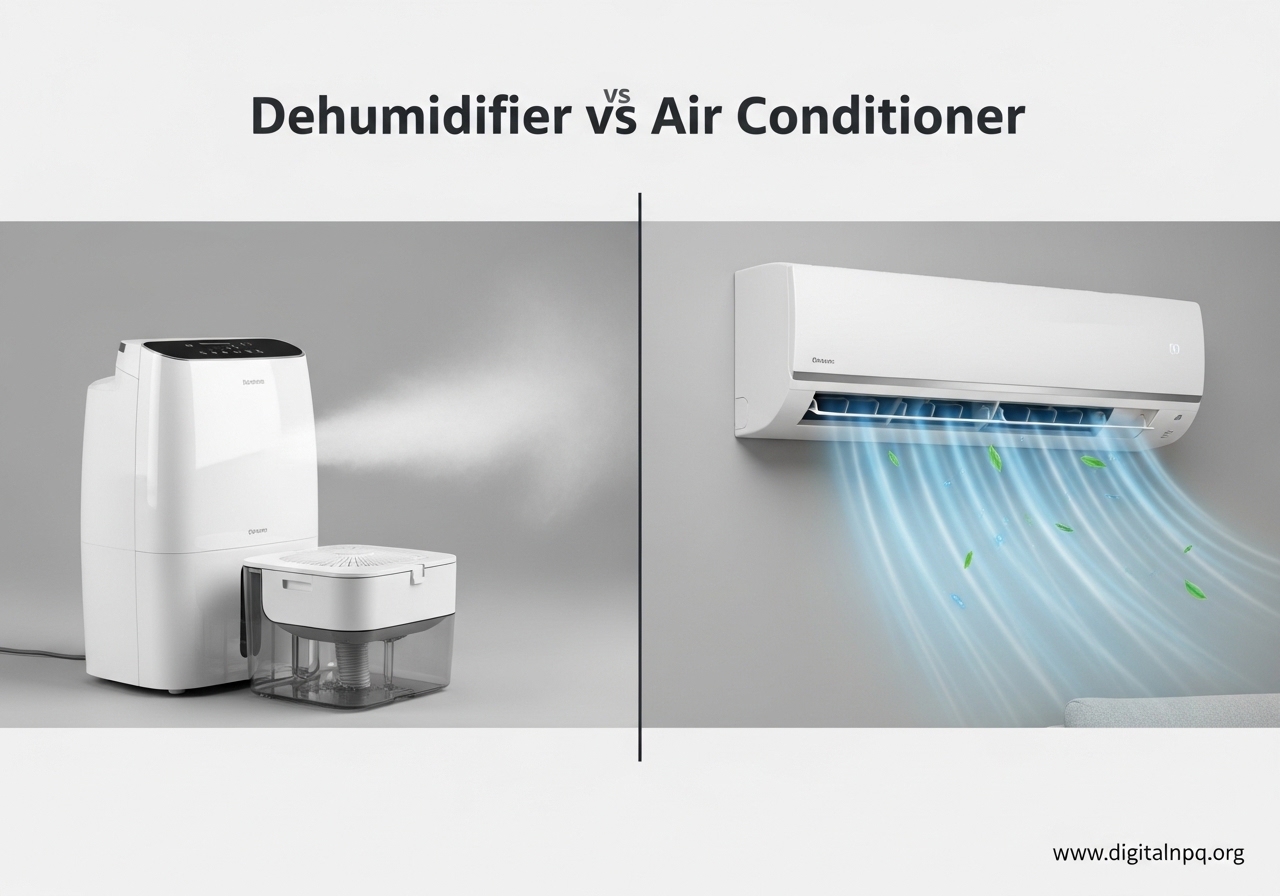
If you are trying to decide between a dehumidifier vs air conditioner for your home, you are not alone. Many homeowners struggle with this exact question, especially during humid summer months when the air feels heavy and uncomfortable. A dehumidifier is an appliance that removes excess moisture from the air by condensing water vapor into liquid. An air conditioner removes heat from indoor air and vents it outdoors while also extracting some moisture as a byproduct of cooling. The key difference is simple: both pull moisture from the air, but an AC vents the captured heat outside while a dehumidifier releases it back into your room.
Our team has spent months researching how these two appliances compare in real homes. We looked at energy consumption data, spoke with HVAC professionals, and dug through hundreds of user experiences on forums like Reddit and Stack Exchange. What we found is that the right choice depends heavily on your climate, your specific moisture problem, and whether you actually need cooling or just humidity control.
In this guide, we will break down exactly how each device works, compare their energy costs, explain when one is better than the other, and help you figure out if you might benefit from using both. By the end, you will have a clear answer for your specific situation.
How Dehumidifiers Work
A dehumidifier removes moisture from the air using a refrigeration cycle that is surprisingly similar to what happens inside an air conditioner. A fan pulls warm, humid air into the unit and passes it over cold evaporator coils. When the warm air hits those cold coils, the moisture in the air condenses into water droplets, just like dew forming on a cold glass on a summer day. That water then drips into a collection tank or flows out through a continuous drainage hose.
Here is the part that catches most people off guard: after the air loses its moisture, it passes over warm condenser coils and gets heated back up. The dehumidifier then releases that warmed air back into the room. This is why running a dehumidifier actually raises the temperature in the space slightly, usually by 1 to 3 degrees. The room feels drier and often more comfortable despite the small temperature bump, because lower humidity makes warm air feel less sticky.
Most modern dehumidifiers include a humidistat, which is a sensor that measures the relative humidity in the room. You set your target humidity level, typically between 30% and 50%, and the unit cycles on and off automatically to maintain it. Many units also feature a laundry mode that runs the fan on high to speed up indoor clothes drying, which is a feature that HVAC technicians frequently recommend for damp climates.
There are two main types you will encounter. Portable dehumidifiers are freestanding units you can move from room to room, usually rated to remove 20 to 70 pints of moisture per day. Whole-home dehumidifiers integrate directly into your existing HVAC ductwork and handle humidity control for your entire house. The whole-home option is more effective but requires professional installation.
How Air Conditioners Work
An air conditioner uses the same basic refrigeration cycle as a dehumidifier, but with one critical difference: it vents the absorbed heat outdoors instead of releasing it back into the room. A fan draws warm indoor air over cold evaporator coils inside the unit. The refrigerant inside those coils absorbs heat from the air, and that heat gets pumped outside through the condenser unit. The cooled air then circulates back into your living space.
Dehumidification happens as a side effect of this cooling process. When warm air passes over the cold evaporator coils, moisture condenses on the coils and drains away. This is why you often see water dripping from the back of a window AC unit or draining through a condensate line on a central system. An air conditioner does remove moisture, but only while it is actively cooling the air.
This is where the dew point becomes important. When your room reaches the temperature you set on the thermostat, the compressor shuts off and the AC stops removing moisture entirely. If your set temperature is reached quickly, the AC may not run long enough to make a dent in the humidity. HVAC professionals on forums consistently point out that this is the number one reason people complain their air conditioner does not remove enough humidity.
Variable-speed air conditioners handle this better than single-stage units. A variable-speed compressor can run at lower speeds for longer periods, which means more continuous dehumidification without overcooling the room. Single-stage units only have two modes: full blast or off. If you live in a humid climate and your AC seems to struggle with moisture, a variable-speed system or a dedicated dehumidifier might be the answer.
Dehumidifier vs Air Conditioner: Key Differences
Understanding the dehumidifier vs air conditioner comparison comes down to a few fundamental differences in how each device is designed and what it prioritizes. Here is a direct breakdown of how they compare across the factors that matter most.
Primary Purpose
A dehumidifier is built specifically to remove moisture from the air. That is its one job, and it does it well. An air conditioner is built primarily to cool the air. Dehumidification happens as a secondary effect, and the amount of moisture removed depends on how long the compressor runs.
Heat Management
This is the single most important mechanical difference. An air conditioner takes heat from inside your home and vents it outside, so your room gets cooler. A dehumidifier collects heat from the refrigeration cycle and releases it right back into the same room. This means a dehumidifier will not cool your space and may actually warm it slightly.
Dehumidification Capacity
A dedicated dehumidifier removes significantly more moisture per hour than an air conditioner running in standard cooling mode. Most portable dehumidifiers are rated to extract 20 to 70 pints per day, and whole-home units can handle even more. An air conditioner removes moisture only while cooling, and the rate depends heavily on runtime and the temperature differential between the room air and the evaporator coils.
Cooling Ability
An air conditioner can lower room temperature by 15 to 20 degrees or more. A dehumidifier provides zero active cooling and actually adds a small amount of heat. If you are in a hot, humid climate and need temperature relief, an AC is the only option of the two that will actually cool you down.
Installation and Portability
Portable dehumidifiers are plug-and-play. You set them on the floor, plug them in, and they start working. Portable air conditioners require window venting kits to exhaust hot air. Window units need to be mounted in a window. Central air and split systems require professional installation. Dehumidifiers win on convenience for targeted moisture control.
Noise Levels
Dehumidifiers tend to be quieter than portable air conditioners. Most dehumidifiers produce 45 to 55 decibels, comparable to a quiet conversation. Portable AC units often run at 55 to 65 decibels, and window units can be even louder. If noise matters for a bedroom or home office, the dehumidifier has a clear advantage.
Energy Efficiency and Cost Comparison
One of the most common questions people ask is whether it is cheaper to run a dehumidifier or an air conditioner. The short answer: a dehumidifier uses significantly less electricity. A typical portable dehumidifier draws between 200 and 500 watts, while a window air conditioner uses 500 to 1,500 watts, and a central AC system can draw 2,000 to 5,000 watts.
Based on the average US electricity rate, running a 300-watt dehumidifier for 24 hours costs roughly $0.87 per day. Running a 1,200-watt window AC unit for the same period costs about $3.46 per day. A central air conditioning system running at 3,500 watts would cost approximately $10.08 per day. Over the course of a humid summer, the savings from using a dehumidifier for moisture control instead of running your AC constantly can be substantial.
Many homeowners on Reddit and home improvement forums report a strategy that HVAC professionals frequently endorse: running a dehumidifier alongside your AC allows you to set the thermostat a few degrees higher while maintaining the same comfort level. Because humidity makes heat feel more oppressive, reducing indoor humidity from 65% to 45% can make 78 degrees feel just as comfortable as 72 degrees. That small thermostat adjustment can cut your AC energy consumption by 10% to 15%.
The seasonal savings are worth noting too. During spring and fall, when temperatures are mild but humidity is still high, running a dehumidifier alone costs far less than turning on the AC. This is a strategy that several HVAC technicians on forums specifically recommend for homeowners in humid but temperate climates. You get the moisture control you need without paying to cool air that is already at a comfortable temperature.
Humidity Control Effectiveness
When it comes to the core question of which device controls humidity better, the answer depends on the situation. A dedicated dehumidifier almost always wins for pure moisture removal. An air conditioner can dehumidify effectively, but only under specific conditions that many homeowners never think about.
The ideal indoor relative humidity range is between 30% and 50%. Above 50%, you start to see condensation on windows, musty odors, and an increased risk of mould growth. Below 30%, the air becomes too dry and can cause skin irritation, static electricity, and respiratory discomfort. Both devices can help you hit this target range, but they approach it differently.
An air conditioner only removes moisture while the compressor is running and actively cooling the air below the dew point. Once the room hits your thermostat set point, the compressor stops and dehumidification stops with it. In a well-insulated home where the AC reaches the target temperature quickly, the system may not run long enough to bring humidity down to a healthy level. This is a common complaint from homeowners in humid regions who notice their home feels cool but clammy.
A dehumidifier, on the other hand, runs independently of temperature. Its humidistat measures humidity directly and cycles the compressor on and off based on moisture levels, not temperature. This makes it far more reliable for maintaining consistent humidity control, especially in spaces like basements, crawl spaces, and bathrooms where moisture is a persistent problem but cooling is not needed.
For basements specifically, a dehumidifier is almost always the better choice. Basements tend to be cooler than the rest of the house, which means the AC may not run much down there. But underground walls and floors allow moisture to seep in continuously. A dehumidifier runs regardless of temperature and keeps basement humidity in check, preventing mould growth and protecting stored belongings from moisture damage.
Maintenance Requirements
Both dehumidifiers and air conditioners need regular maintenance to perform well, but the type and frequency of upkeep differs between them.
Dehumidifier Maintenance
Dehumidifiers are relatively low maintenance. The air filter should be cleaned every two to four weeks depending on usage and air quality. A clogged filter reduces airflow and makes the unit work harder. The water collection tank needs to be emptied regularly unless you have set up continuous drainage with a hose. The evaporator coils should be checked annually and cleaned gently if dust or grime builds up. Most dehumidifiers also have a defrost sensor that prevents ice buildup on the coils, so you rarely need to worry about frost in normal conditions.
Air Conditioner Maintenance
Air conditioners require more attention. Window units and portable ACs need their filters cleaned or replaced every two to four weeks during heavy use. The condensate drain line on central AC systems should be checked monthly during summer to prevent clogs that can cause water damage. Evaporator coils and condenser coils should be cleaned at least once a year, and the outdoor condenser unit needs to be kept clear of leaves, dirt, and debris. Central AC systems also need periodic refrigerant level checks, which typically require a professional HVAC technician.
The main takeaway: dehumidifiers are mostly DIY maintenance with simple cleaning tasks. Air conditioners, especially central systems, involve some tasks that are best handled by a professional. This adds to the long-term cost of ownership for AC systems.
Health and Indoor Air Quality Benefits
Controlling indoor humidity is not just about comfort. It has a direct impact on your health and the air you breathe every day. Both dehumidifiers and air conditioners contribute to better indoor air quality, but in different ways.
High humidity creates an ideal environment for mould and mildew growth. Mould spores can trigger allergic reactions, asthma attacks, and other respiratory issues. Dust mites, another common allergen, thrive in environments above 50% relative humidity. By keeping humidity between 30% and 50%, both devices help reduce these allergens. However, a dehumidifier does this more consistently because it targets humidity directly rather than as a side effect of temperature control.
Air conditioners offer an additional benefit that dehumidifiers do not: air filtration. Most AC units include built-in filters that capture dust, pollen, pet dander, and other airborne particles. Central AC systems with high-efficiency filters can significantly improve overall air quality. Some modern dehumidifiers include basic filters, but they are generally not as effective as the filtration you get from a well-maintained air conditioning system.
Proper humidity also affects sleep quality. Sleeping in a room with high humidity disrupts your body’s natural cooling process during sleep, leading to restlessness and poor sleep quality. Many people report better sleep after adding a dehumidifier to their bedroom, even in homes that already have air conditioning. The combination of lower humidity and moderate temperature tends to produce the best sleeping conditions.
For people with asthma, allergies, or other respiratory conditions, maintaining proper humidity is especially important. Too much moisture in the air can inflame airways and worsen symptoms. Too little moisture can dry out nasal passages and make you more susceptible to infections. Both devices help you maintain that balance, with dehumidifiers offering more precise control over the humidity level itself.
When to Use a Dehumidifier vs Air Conditioner
Choosing between a dehumidifier and an air conditioner comes down to your primary problem. Are you fighting moisture, heat, or both? Here is a practical guide to help you decide.
Choose a Dehumidifier When
You notice condensation on your windows, walls, or pipes during the day. You smell musty or damp odors in any room, especially basements and bathrooms. You see mould spots growing on walls, ceilings, or around window frames. Your home is in a humid climate but the temperature is already comfortable. You need moisture control in a basement, crawl space, or garage where cooling is not a priority. You want to dry laundry indoors without running the AC. You want to save money during spring and fall when humidity is high but temperatures are mild.
Choose an Air Conditioner When
Your main complaint is that rooms feel too hot and uncomfortable. You live in a hot climate where temperatures regularly exceed 80 degrees. You need both cooling and some dehumidification in one package. You want to improve air filtration alongside temperature control. You are cooling a large living space or an entire home rather than targeting a single damp room. You want a permanent, installed solution rather than a portable appliance.
Use Both Together When
Your home is hot and humid, and the AC alone does not bring humidity below 50%. You want to raise your thermostat set point by a few degrees to save on energy costs while keeping the air dry and comfortable. You have specific rooms like basements or bathrooms that stay damp even when the AC is running. You want dehumidification during shoulder seasons when running the AC would overcool your home. Running both devices together is a strategy that HVAC professionals consistently recommend for homes in humid climates.
Frequently Asked Questions
Do dehumidifiers work better than AC for removing humidity?
Yes, for pure humidity removal, a dedicated dehumidifier works better than an air conditioner. A dehumidifier is designed specifically to extract moisture and runs based on humidity levels, not temperature. An AC only removes moisture as a side effect of cooling and stops dehumidifying once the room reaches the thermostat set point.
Is it cheaper to run a dehumidifier or an air conditioner?
A dehumidifier is significantly cheaper to run. A typical portable dehumidifier uses 200 to 500 watts, costing roughly $0.87 per day for 24-hour operation. A window AC unit uses 500 to 1,500 watts and can cost $3.46 or more per day. Central AC systems cost even more. If your main goal is humidity control rather than cooling, a dehumidifier is the more cost-effective choice.
What are the downsides of using a dehumidifier?
The main downsides of a dehumidifier are: it does not cool the air and actually raises room temperature slightly by 1 to 3 degrees, it requires regular emptying of the water tank unless you set up continuous drainage, it only works in the room where it is placed unless you have a whole-home unit, and it adds to your electricity bill, though less than an AC would.
Can I run a dehumidifier and air conditioner at the same time?
Yes, running both devices together is actually recommended by HVAC professionals for humid climates. The dehumidifier handles moisture removal so the AC does not have to work as hard at dehumidification, which allows you to set the thermostat a few degrees higher and save on cooling costs. The combination provides better comfort than either device alone.
Can a dehumidifier cool a room?
No, a dehumidifier cannot cool a room. It removes moisture from the air but releases the heat from its refrigeration cycle back into the same space, which can actually raise the temperature by 1 to 3 degrees. However, lower humidity makes the air feel less sticky, so the room may feel more comfortable even though the actual temperature is slightly higher.
Does an air conditioner dehumidify as well as a dehumidifier?
Not usually. An air conditioner does remove moisture from the air, but only while it is actively cooling. Once the room reaches the thermostat set point, the compressor stops and dehumidification stops too. A dedicated dehumidifier removes moisture consistently based on humidity levels regardless of temperature, making it more effective for ongoing humidity control.
Conclusion
The dehumidifier vs air conditioner debate does not have a single winner because these devices serve different primary purposes. A dehumidifier excels at removing moisture from the air, lowering humidity to healthy levels, and doing it all at a fraction of the energy cost of an air conditioner. An air conditioner excels at cooling your home, with dehumidification as a secondary benefit that works well in most but not all situations.
If your main problem is humidity, dampness, mould risk, or musty odors, a dehumidifier is the right tool. If your main problem is heat and discomfort from high temperatures, an air conditioner is what you need. For homes in humid climates, using both devices together gives you the best results: lower energy bills, better comfort, and more consistent humidity control throughout the year.
Start by identifying your primary concern. Check your indoor humidity with a simple hygrometer, available at any hardware store. If the reading is above 50% and your home is already at a comfortable temperature, reach for a dehumidifier. If it is hot and humid, your AC should be the first line of defense, with a dehumidifier ready to fill in the gaps.