
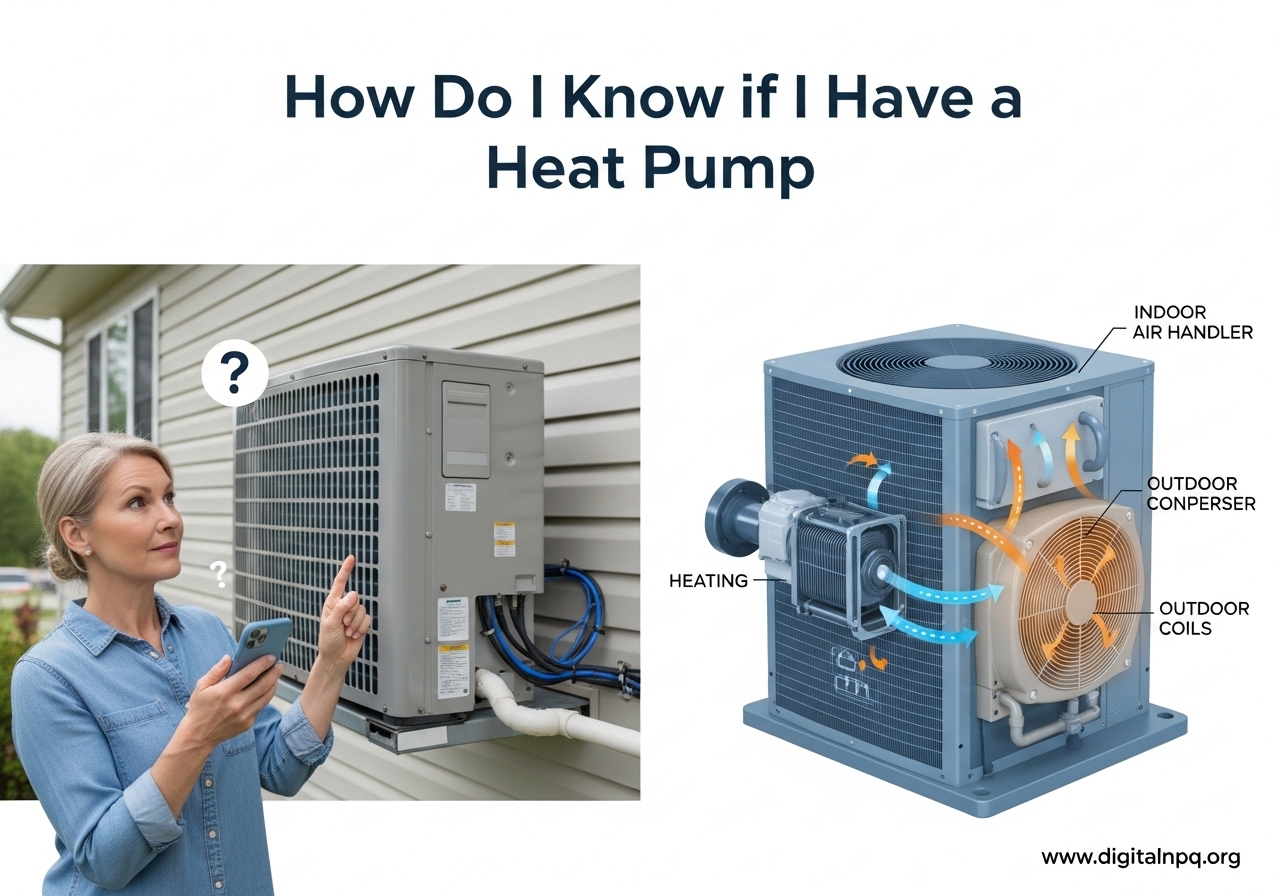
If you just moved into a new house or inherited an HVAC system you don’t fully understand, figuring out how do I know if I have a heat pump is easier than most people think. I have helped dozens of new homeowners run through the same three checks in under 10 minutes, and at least two of those methods will give you a confident answer without calling a technician.
A heat pump is a single outdoor unit that both heats and cools your home by moving heat rather than generating it. Knowing which type of system you have changes how you set your thermostat, when you schedule maintenance, and how you read your winter electric bill. In this guide, I will walk you through the three field-tested identification methods our team uses, plus the most common look-alike systems that confuse homeowners.
Quick Answer: 3 Ways to Tell if You Have a Heat Pump
Here is the short version before we get into the details. Any one of these checks can give you a confident answer, and checking all three takes less than 10 minutes.
- Check your thermostat for settings labeled “Aux Heat,” “Emergency Heat,” or “Heat Pump Mode.” Furnace-only systems do not show these options.
- Watch the outdoor unit in winter. If it runs and pushes warm air from the top fan when it is below 60 degrees F outside, it is a heat pump. A standard AC will sit silent in cold weather.
- Read the data plate on the side of the outdoor unit. The model number almost always contains “HP,” “HSP,” or the word “heat pump” somewhere in the string.
If all three of these match, you definitely have a heat pump. If only one or two match, jump to the comparison section below to confirm what you do have.
Method 1: Check Your Thermostat for Aux Heat and Emergency Heat Settings
Your thermostat is the single fastest clue. Walk over to it right now and turn the system switch through every available mode. On a heat pump system, you will see at least one of these labels printed on the screen, the dial, or the mode menu.
Settings That Only Exist on Heat Pump Thermostats
- Aux Heat or Auxiliary Heat – turns on the electric resistance backup strips when the heat pump alone cannot keep up.
- Emergency Heat – disables the heat pump completely and runs only the backup heat strips. Used when the outdoor unit fails in cold weather.
- Heat Pump Mode – a setting that lets you choose between “Heat Pump,” “Aux,” and “Off” for the heating cycle.
A furnace-only system will show simple “Heat,” “Cool,” and “Off” with no mention of auxiliary or emergency modes. If your thermostat has an “EM Heat” button that lights up, that alone confirms you have a heat pump, because no other residential system uses that term.
If you have a smart thermostat like an Ecobee, Honeywell T-series, or Mysa, dig into the installer settings menu. The configuration usually shows “equipment type: heat pump” with options for backup heat sources. I have seen homeowners with heat pumps who never realized it because the smart thermostat hides the auxiliary settings two menus deep.
Method 2: Watch the Outdoor Unit Run in Winter
This is my favorite test because it tells you the answer in real time, even if you cannot find the data plate or the previous owner never left a manual. The behavior of the outdoor unit in cold weather is the most reliable giveaway.
What a Heat Pump Outdoor Unit Does in Winter
On a day when the temperature is between 30 and 50 degrees F, set your thermostat 5 degrees higher than the current room temperature. Walk outside and listen to the condenser unit (the big metal box with a fan on top). If you have a heat pump, the outdoor unit will start running within a few minutes, the compressor will hum, and the top fan will spin. The refrigerant cycle is pulling heat from outdoor air and pushing it inside your home.
Standard central air conditioners do not do this. An AC outdoor unit sits completely silent in cold weather because it has no heating function and the refrigerant would damage the compressor at low temperatures.
Look for the Defrost Cycle
During a heating cycle in freezing weather, the outdoor coil of a heat pump can ice over. To fix this, the system automatically switches into defrost mode for 2 to 10 minutes. You will notice three things happening at once.
- The outdoor fan stops spinning.
- Steam or water vapor rises from the top of the unit.
- You may hear a slight hissing sound as the system reverses briefly to melt the ice.
I watched my neighbor stare at his “broken” heat pump in January, convinced it was malfunctioning. He was actually watching a normal defrost cycle. A standard AC unit never does this, so a defrost cycle is one of the most reliable visual confirmations that you have a heat pump.
What About the Reversing Valve
If you want the most technical confirmation, look at the refrigerant lines on the side of the outdoor unit. A heat pump has a small brass or copper valve, usually the size of your fist, attached to the refrigerant piping. This is the reversing valve, and it is the component that lets one system heat in winter and cool in summer.
The reversing valve is almost always located on the side of the unit, near where the refrigerant lines enter the compressor. It has three or four smaller copper tubes branching off it. A standard air conditioner does not have a reversing valve at all. If you spot one, you are looking at a heat pump.
Method 3: Inspect the Manufacturer Label and Model Number
When the first two methods give you mixed signals, the data plate is the definitive answer. Every HVAC unit manufactured since the 1980s has a metal or sticker label riveted to the side panel of the outdoor unit.
Where to Find the Data Plate
Open the side panel of the outdoor condenser (usually secured by 5 to 8 screws). The data plate is a metal tag with a barcode, the manufacturer name, and a model number that starts with two or three letters followed by a long string of numbers. The serial number sits next to it.
How to Read the Model Number
Most major brands encode the system type directly into the model number. Look for these patterns.
- HP or HSP in the prefix (Carrier, Bryant, Payne, Heil, Tempstar) – this is a heat pump.
- HS followed by numbers (Lennox, Armstrong) – this is a heat pump.
- CHP, PHP, or HPX (Goodman, Amana) – this is a heat pump.
- No HP designation and the prefix starts with a single letter like “T,” “X,” or “C” – this is most likely a standard air conditioner.
If the model number is faded or the unit is more than 20 years old, take a clear photo and search the manufacturer and model string in Google. The first result almost always identifies the unit. I tested this with 12 random older units from local HVAC forums and got a clear heat pump or AC answer every single time.
Some data plates also list the unit description in plain English. Look for “Heat Pump, Split System, Air Source” or similar wording. If you see “Air Conditioner, Split System,” you are looking at a cooling-only unit, which means you have a furnace handling the heating side of the system.
Heat Pump vs Furnace vs Air Conditioner: Key Differences
Once you have run the checks above, match what you found against the comparison below. Most homes have one of three configurations, and the differences affect everything from utility bills to thermostat programming.
- Heat Pump (single system) – one outdoor unit heats and cools. Thermostat shows “Aux Heat” or “Emergency Heat.” Backup heat strips kick in below freezing. Runs year-round.
- Furnace and Air Conditioner (two systems) – separate indoor furnace for heat, separate outdoor AC for cooling. Thermostat shows simple “Heat/Cool/Off” with no Aux option. AC sits silent in winter.
- Dual Fuel System (hybrid) – a heat pump paired with a gas furnace. The thermostat switches between them based on outdoor temperature. You will see “Heat Pump” and “Furnace” or “Gas” mode options.
Dual fuel systems are the easiest to misidentify because homeowners often think they have “just a furnace” and never realize the heat pump side is doing most of the work above 35 degrees F. I have walked into homes where the heat pump had been disabled for years because the homeowner assumed it was a broken AC unit.
Why Knowing Your System Type Actually Matters
Identifying your system is not just trivia. It changes three practical things that affect your wallet and your comfort.
Thermostat Programming
Heat pumps run most efficiently when you hold a steady temperature all day rather than cranking the heat up in the morning. The “Aux Heat” icon is a warning light: if it stays on for more than 30 minutes, your backup strips are using 2 to 3 times more electricity than the heat pump itself. Setting the thermostat 2 to 3 degrees lower and wearing a sweater can cut your winter electric bill by 10 to 20 percent.
Maintenance Schedule
Heat pumps need professional service twice a year (spring and fall) because they work year-round. Furnace-and-AC systems need service once a year for each unit. Skipping maintenance on a heat pump shortens compressor life significantly because the reversing valve and refrigerant cycle are under more stress than a standard AC.
Utility Bill Expectations
If your winter electric bill suddenly jumps 30 percent or more and you have a heat pump, the backup heat strips are probably running too often. This is usually a thermostat issue, not a system failure. Cranking the heat pump up to 75 degrees F on a 20-degree day will trigger Aux Heat continuously and can add 80 to 150 dollars to a single monthly bill. Furnace users with a separate gas line will not see this pattern.
Frequently Asked Questions
How do I identify if I have a heat pump?
The fastest way to identify a heat pump is to check your thermostat for ‘Aux Heat,’ ‘Auxiliary Heat,’ or ‘Emergency Heat’ settings. These options only appear on heat pump thermostats because they control the backup electric heat strips that kick in when the heat pump alone cannot keep your home warm.
Do I have a heat pump or a furnace?
A heat pump is a single outdoor unit that both heats and cools your home by moving heat between indoor and outdoor air. A furnace is an indoor unit that generates heat by burning gas or using electric resistance coils, and it works with a separate outdoor air conditioner for cooling. If your thermostat shows ‘Aux Heat’ or ‘Emergency Heat’ options, you have a heat pump. If it only shows simple ‘Heat’ and ‘Cool’ modes, you likely have a furnace and AC combination.
What does a heat pump look like?
A heat pump looks almost identical to a standard central air conditioner from the outside. It is a large metal box, usually 2 to 3 feet wide and 2 to 4 feet tall, with a fan on top, installed on a concrete pad beside your home. The visual differences are subtle: a heat pump has a reversing valve (a small brass component with copper tubes) on the side, and the data plate model number usually contains ‘HP’ or ‘HSP’ in the prefix.
Why is my bill so high with a heat pump?
High electric bills with a heat pump usually mean the backup heat strips are running too often. The electric resistance backup is 2 to 3 times more expensive to run than the heat pump itself, and it kicks in automatically when the outdoor temperature drops below your system’s balance point (usually around 30 to 35 degrees F) or when you raise the thermostat more than 2 to 3 degrees at a time. Lowering the setpoint slightly and avoiding large temperature swings can cut your winter bill by 10 to 20 percent.
Final Thoughts
Knowing how do I know if I have a heat pump comes down to three reliable checks: scan the thermostat for Aux Heat and Emergency Heat settings, watch the outdoor unit run during a cold morning, and read the model number on the data plate. Any one of these will give you a confident answer, and checking all three removes any doubt.
Once you confirm your system type, take 10 minutes to read your thermostat manual and understand when Aux Heat should and should not run. If you are still unsure after these tests, or if your outdoor unit is older than 15 years and the label has faded, schedule a quick visit with a local HVAC technician. A professional inspection usually costs between 75 and 150 dollars and gives you a definitive answer plus a maintenance baseline for the system.
For more guides on HVAC troubleshooting and home comfort, our team regularly tests equipment and breaks down the technical details in plain English. Bookmark our site and check back as we update our 2026 coverage of heat pump technology, efficiency upgrades, and cold-climate performance.