
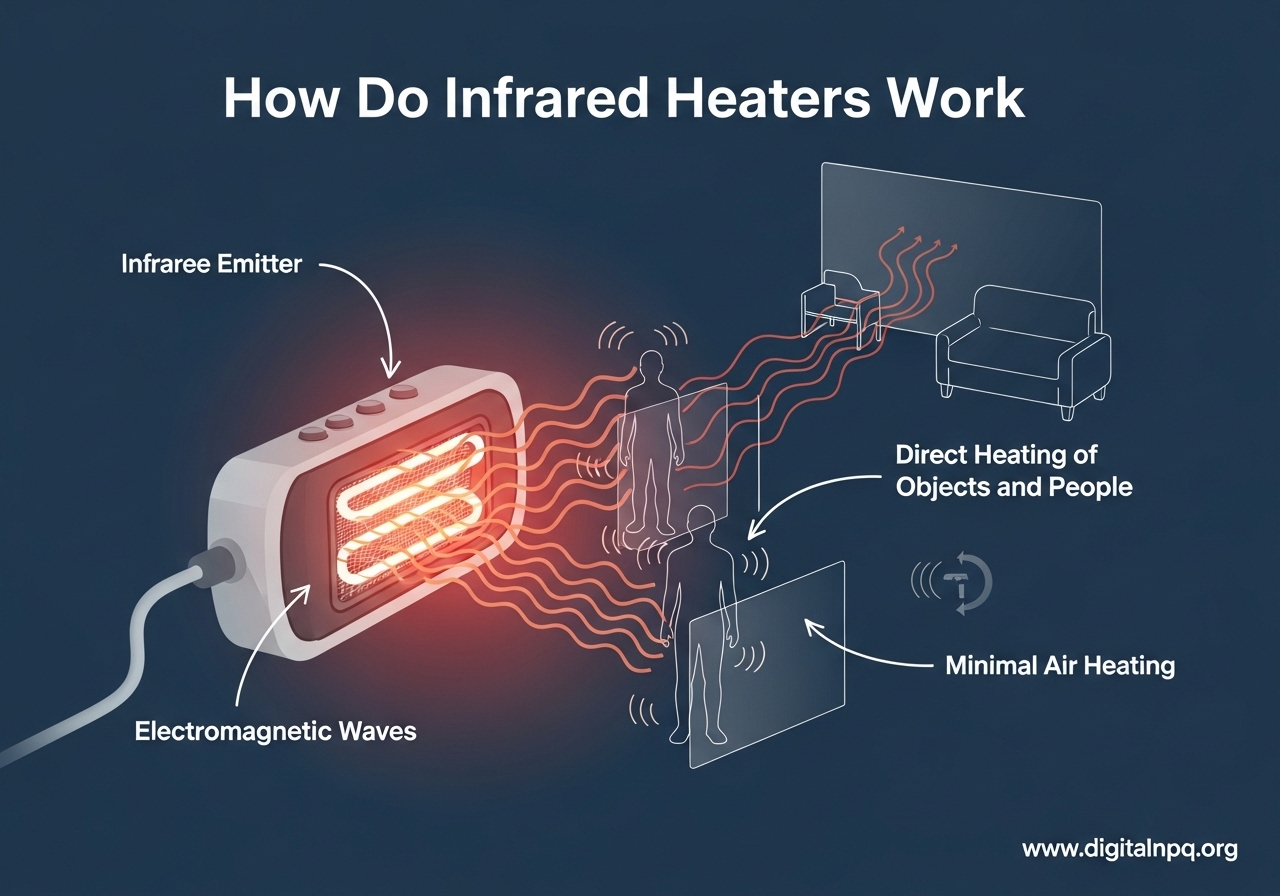
If you have ever stood in front of a patio heater on a chilly evening and felt warm almost instantly, you have already experienced the answer to the question: how do infrared heaters work. Unlike traditional heaters that warm the air and wait for it to circulate, infrared heaters send invisible light waves straight through the air to heat objects and people in their path. In this guide, I will walk you through the science, the four-step process, the different types, and the honest trade-offs so you can decide if infrared heating makes sense for your space.
What Is Infrared Heating?
Infrared heating is a form of radiant heating that uses electromagnetic radiation to transfer heat directly from a source to solid objects, without warming the air in between. It is the same type of heat the sun produces, just generated by an electrical element rather than nuclear fusion.
Infrared sits on the electromagnetic spectrum just below visible red light, which is where it gets the name “infra” (below) red. Humans cannot see these waves, but our skin and clothes absorb them and convert the energy into warmth. That is why you feel heat from a fire across a room long before the air around you changes temperature.
Infrared heaters turn electricity into this radiant energy using a heating element (usually a coil, ceramic plate, or carbon fiber), then direct those waves outward through a reflector. The result is a focused beam of heat that warms whatever it touches, much like sunlight through a window.
How Do Infrared Heaters Work?
Infrared heaters work by converting electrical energy into infrared radiation, which travels as invisible light waves and transfers heat directly to objects and people. The process happens in four steps, and understanding each one is the key to understanding the technology.
Step 1: Emission
When you switch on an infrared heater, electrical current flows through a resistive element such as a tungsten coil, ceramic panel, or quartz tube. The element heats up rapidly and begins emitting electromagnetic radiation in the infrared range. Most home heaters run at temperatures between 600°F and 1,500°F, depending on whether they produce near, mid, or far infrared waves.
Step 2: Travel
The infrared waves leave the element and travel outward in straight lines. A polished reflector behind the element focuses this radiation into a directional beam, similar to how a flashlight focuses light. Importantly, these waves pass through air without warming it. This is why an infrared heater in a cold garage will not heat the entire room, but it will heat anything in its line of sight.
Step 3: Absorption
When the waves hit a solid object like your skin, a piece of furniture, a wall, or a concrete floor, the surface absorbs the energy. The molecules in that object begin vibrating faster, and we register that as heat. You feel the warmth within seconds, much faster than a convection heater that has to warm a volume of air first.
Step 4: Re-radiation
Once an object absorbs infrared energy, it gradually releases that heat back into the surrounding air. This is the re-radiation phase, and it is why infrared heaters can warm a whole room over time. Furniture, walls, and floors become secondary heat sources, which is a concept called thermal mass. A room with thick walls, a tile floor, and heavy furniture will stay warm longer than a room with thin partitions and lightweight materials.
The Three Types of Heat Transfer
To fully grasp how infrared heaters work, it helps to understand the three ways heat moves. All heating systems use one or more of these mechanisms, and infrared is unique in relying almost entirely on the third.
Conduction is heat transfer through direct contact. Touch a hot pan and heat moves from the pan into your hand. This is the slowest form of heat transfer and the least relevant to room heating.
Convection is heat transfer through the movement of fluids, which includes air and water. A convection heater warms the air around it, the warm air rises, cooler air replaces it, and a circulation pattern forms. Most forced-air furnaces, baseboard heaters, and oil-filled radiators rely primarily on convection.
Radiation is heat transfer through electromagnetic waves, and it does not require a medium. The sun warming your face through a window is radiation. So is the heat you feel from a campfire across a clearing. Infrared heaters are designed to maximize this form of transfer.
Convection vs Radiation: Key Differences
The biggest practical difference between convection heating and infrared radiation heating is what gets warmed first. Convection heats air, and that warm air eventually warms you. Infrared radiation heats you and other objects, and those objects eventually warm the air. The order matters, and so do the side effects.
Convection heaters tend to feel slow because they need time to build up a hot air mass. They also stir up dust, allergens, and moisture as they cycle air through the room, which can be a problem for people with asthma or allergies. Infrared heaters produce no fan noise, no air movement, and almost instant warmth at the point of contact.
However, infrared has a key limitation: it only directly heats what it can “see.” A person standing behind a sofa in front of a wall-mounted infrared panel will be in shadow and feel little warmth. Convection, by contrast, fills the entire volume of a room eventually. This is why many homeowners use infrared as a supplemental heat source for the rooms they actually occupy, rather than as a whole-house replacement.
Types of Infrared Heaters: Near, Mid, and Far
Infrared heaters are categorized by wavelength, and each type has different characteristics. The wavelength is determined by the temperature of the heating element.
Near infrared (also called short-wave or IR-A) uses the hottest elements and produces waves around 0.78 to 1.4 micrometers. These are the bright, glowing heaters you see at restaurants and outdoor patios. They deliver intense, focused heat and work well in drafty or outdoor settings, but the visible glow and high surface temperature make them less suitable for enclosed bedrooms.
Mid infrared (IR-B, 1.4 to 3 micrometers) sits in the middle. These heaters are common in industrial drying processes and some space heaters. They produce moderate heat without a strong visible glow.
Far infrared (IR-C, 3 to 1,000 micrometers) is the most common type for home heating panels and modern space heaters. The elements run cooler, there is no visible glow, and the waves penetrate human skin more gently. Far infrared panels mounted on walls or ceilings are increasingly popular for residential heating because they look like flat picture frames, run silently, and integrate with smart thermostats.
Benefits of Infrared Heating
Infrared heating offers several advantages over traditional convection systems, and most of them come back to the same core principle: heat goes to objects, not to air.
Instant warmth. You feel heat within seconds of switching on the unit, because the waves do not need to heat air first. In a cold bathroom or a home office, that immediate response is a real comfort upgrade.
Silent operation. There is no fan, no blower, no clicking element. Infrared heaters are among the quietest heating options available, which is why they are popular in bedrooms and studies.
No air circulation. Because the heat does not move through the air, dust, pollen, and pet dander are not pushed around the room. Many allergists recommend infrared for asthma and allergy sufferers for this reason.
Zonal heating. Infrared works well for heating the spaces you actually use, rather than every room in the house. A garage, a workshop, a sunroom, or a basement can all be heated with a single panel or space heater.
No moisture loss. Convection heaters strip humidity from the air, leaving it dry and uncomfortable. Infrared leaves air humidity largely intact, which feels more natural in winter.
Simple installation. Most infrared panels are slim, light, and can be wall- or ceiling-mounted with a few screws, or simply plugged into a standard outlet.
Energy Use, Safety, and Where Infrared Works Best
Now for the part many articles skip. Infrared heaters are not magic, and they are not the right choice for every situation. Here is what I tell friends when they ask whether infrared will save them money.
Energy efficiency is a subtle topic. All electric resistance heaters, including infrared, convert nearly 100% of the electricity they consume into heat. A 1,500-watt infrared heater and a 1,500-watt convection heater both produce 5,118 BTU per hour. The difference is in how that heat is delivered. Infrared puts heat directly where people are, so you may be able to run a smaller unit for a shorter time and feel just as warm. In a well-insulated room, this can lower your bill. In a poorly insulated room with high ceilings, you will end up running it constantly.
Electricity is still electricity. If your local electricity rate is high, infrared heating can be more expensive to operate than a gas furnace or a heat pump. In much of the US, the Energy Saving Trust and similar organizations have noted that infrared works best as a supplemental heat source, not a primary whole-house system. Heat pumps typically deliver three to four units of heat for every unit of electricity they consume, while infrared is essentially 1:1.
Safety is generally good, with normal precautions. Modern infrared heaters have tip-over switches, overheat protection, and cool-touch housings. Far infrared panels stay cool enough to touch, even while heating. Near infrared units, however, run hot and should not be left unattended near children or pets. As with any heater, keep flammable materials at least three feet away and never use an extension cord rated below the unit’s wattage.
Overnight use. You can leave a far infrared panel on overnight in most cases, especially if it is wall- or ceiling-mounted. Avoid sleeping with a portable near-infrared unit running right next to your bed. Look for units with UL or ETL certification and a built-in thermostat.
Where infrared shines. Garages, workshops, basements, bathrooms, home offices, sunrooms, drafty porches with overhead coverage, and outdoor restaurant patios. Anywhere you want targeted, fast, silent heat for a specific zone, infrared tends to perform better than convection.
Where infrared struggles. Large open spaces with high ceilings, rooms with poor insulation, and whole-house heating in cold climates. The line-of-sight limitation means you would need many panels to heat a large open-plan living area, and the operating cost would likely exceed a heat pump or a gas system.
Frequently Asked Questions
Do infrared heaters use a lot of electricity?
Infrared heaters use the same electricity as any other resistance heater, which is roughly 1.5 kW for a typical space heater. They are 100% efficient at converting electricity to heat, but they only deliver heat where they can see, so they often need less run time than a fan heater to keep a person comfortable.
Do infrared heaters heat the air?
Infrared heaters do not heat air directly. They send infrared waves through the air, and only solid objects like walls, furniture, and people absorb that energy. The objects then re-radiate heat into the room, warming the air over time.
What are the downsides of infrared heating?
The main downsides are line-of-sight limitations, electricity operating costs compared to gas or heat pumps, and the need for multiple panels to heat large spaces. Near-infrared units also run hot to the touch, which requires more caution around children and pets.
Do infrared heaters cause cancer?
No. Infrared heaters produce non-ionizing radiation, which means they do not damage DNA the way ultraviolet light or X-rays can. The heat they produce is the same type of energy your body radiates naturally.
Which room heater is best for asthma patients?
Far infrared heaters are often recommended for asthma and allergy patients because they do not circulate air, do not stir up dust, and do not dry out the air the way fan heaters and convection systems can. Look for units with no fan and no exposed heating element.
Why is infrared heating not popular in the USA?
In the US, natural gas furnaces and central HVAC systems are inexpensive to operate, and electricity rates vary widely by region. Infrared is more popular in countries with high gas prices, less existing central heating infrastructure, and a strong focus on zonal or electric-only heating.
Conclusion
Now you know the full answer to how do infrared heaters work: they convert electricity into invisible infrared waves that travel through air, hit solid objects, and deliver heat directly to those surfaces. The four-step process (emission, travel, absorption, re-radiation) is the same one our bodies and the sun use every day.
Infrared is not a silver bullet. It is a great choice for targeted, silent, allergy-friendly heating in specific rooms, but it does not replace central heat in most homes. Start by identifying the one or two rooms where you want instant, quiet warmth, and consider a far infrared panel or a quality portable infrared space heater rated for your square footage.