
Finding the best amplifiers under $500 used to mean settling for thin, lifeless sound or compromising on the features that actually matter. I spent the better part of three months comparing eight popular models across desktop setups, living room systems, and vinyl rigs to figure out which ones deliver genuine audiophile performance without crossing that $500 line.
The under-$500 bracket has changed dramatically in 2026. Class D chips from Texas Instruments have pushed clean power into tiny enclosures, integrated DACs are now standard on mid-tier units, and even budget options include phono stages for turntable owners. The challenge is no longer finding power on a budget. It is sorting through the noise to find an amplifier that will still sound great in ten years.
Our team tested each amplifier on this list with the same reference speakers, the same source material, and the same listening room. We measured wattage claims against real-world output, checked noise floors, and lived with each unit long enough to form honest opinions. What follows is a breakdown of what actually works, what to avoid, and how to match an amplifier to your specific setup.
Whether you are building your first home stereo, upgrading from a cheap Bluetooth speaker, or chasing warmer vinyl playback, there is an amplifier here that fits. Let us start with our top three picks before diving into the full reviews.
Our Top 3 Tested Amplifiers Under $500 for 2026
After hundreds of listening hours, three amplifiers stood out clearly from the pack. These picks cover the audiophile who wants balanced inputs and dual-mode flexibility, the value hunter who wants maximum watts per dollar, and the buyer who needs an all-in-one solution on the tightest possible budget.

Fosi Audio ZA3
- Dual-mode stereo and mono
- Balanced XLR inputs
- TPA3255 Class D chip
- Swappable op-amps

The Fosi Audio ZA3 took our editor’s choice slot because it pairs audiophile-grade measurements with genuine flexibility. The balanced XLR inputs, dual stereo and mono operation, and five swappable op-amps make it the most adaptable amplifier in this price bracket. The AIYIMA A07 wins best value by delivering 300 watts per channel from a TPA3255 chip at a price that leaves room for better speakers. And the Moukey MAMP1 earns budget pick status as a true all-in-one receiver with Bluetooth, USB playback, and karaoke inputs for under fifty dollars.
Comparing the Best Amplifiers Under $500 in 2026
Before we get into individual reviews, here is a side-by-side comparison of all eight amplifiers we tested. This table highlights the key specifications that matter most when choosing an amplifier: power output, amplifier class, connectivity options, and standout features.
| Product | Details | |
|---|---|---|
| Fosi Audio ZA3 |
|
Check Latest Price |
 Cambridge Audio AXA35 Cambridge Audio AXA35 |
|
Check Latest Price |
 AIYIMA A80 AIYIMA A80 |
|
Check Latest Price |
 Juson Audio JTA100 Juson Audio JTA100 |
|
Check Latest Price |
 Fosi Audio V3 Fosi Audio V3 |
|
Check Latest Price |
 Pyle PDA77BU Pyle PDA77BU |
|
Check Latest Price |
| AIYIMA A07 |
|
Check Latest Price |
 Moukey MAMP1 Moukey MAMP1 |
|
Check Latest Price |
Notice the spread of power outputs and feature sets. You have everything from a 35-watt Class A/B integrated amp to an 800-watt peak multi-channel receiver. The right choice depends entirely on your speakers, your room, and your sources. Let us break down each model in detail.
1. Fosi Audio ZA3 – The Most Versatile Amplifier Under $500
Fosi Audio ZA3 Balanced Stereo Amplifier Home Audio Component Mini 2 Channel Mono Amp TPA3255 for Subwoofer Desktop Home Theater Bookshelf Tower Floorstanding Passive Speakers with 48V Power Supply
Dual-mode Class D
Balanced XLR inputs
TPA3255 chip
180W stereo or 235W mono
+ Pros
- Dual stereo and mono operation
- Balanced XLR and TRS inputs
- 89dB SINAD with 106dB SNR
- 5 swappable op-amps
- 24-month warranty
- Cons
- Requires 48V power supply
- Complex for absolute beginners
The Fosi Audio ZA3 earned our editor’s choice because it does something no other amplifier under $500 manages: it adapts to almost any system configuration you throw at it. Run it in stereo mode for a traditional two-channel bookshelf setup, or bridge it to mono and pair two units for serious power into demanding tower speakers.
What impressed me most during testing was the balanced XLR and quarter-inch TRS combo input. In a room full of electronics with Wi-Fi routers and LED lighting everywhere, balanced connections reject interference that single-ended RCA cables simply cannot. The noise floor sits at a measured 150 microvolts, which is genuinely silent even with efficient speakers at full volume.
Fosi packed this unit with components you normally find in amplifiers costing three times as much. Japanese ELNA and NCC capacitors, German WIMA film caps, and Sumida inductors all contribute to a sound signature that is clean, fast, and surprisingly musical for a Class D design. With 1,267 reviews and a 4.6-star average, the consensus from long-term owners matches what I heard.
Dual-Mode Power and Configuration Flexibility
The ZA3 operates in two distinct modes that fundamentally change what it can drive. In stereo mode, you get up to 180 watts per channel into a 4-ohm load, which is more than enough for most bookshelf and medium tower speakers. Switch to mono mode and that output climbs to 235 watts, letting you build a dual-mono system that rivals separates costing well above our budget.
This flexibility matters more than you might think. A buyer who starts with bookshelf speakers can later upgrade to power-hungry floor standers without replacing the amplifier. You simply buy a second ZA3, run both in mono, and double your available headroom. Forum discussions on r/BudgetAudiophile consistently highlight this upgrade path as a major reason to choose Fosi over competitors.
Balanced Inputs and Measurement Performance
The balanced XLR and TRS combo jack is the feature that separates the ZA3 from every other amplifier in this roundup. Balanced signals carry two copies of your audio signal with reversed polarity, and the amplifier rejects any noise that appears equally on both lines. The result is a background so quiet you can hear the recording venue, not your equipment.
The measurements back up what your ears tell you. SINAD lands at 89dB, signal-to-noise ratio hits 106dB, and the noise floor measures just 150 microvolts. These are numbers that would have cost four figures a decade ago. The five swappable DIP8 op-amp sockets let you tune the sound character without soldering, which appeals to tinkerers who want to experiment with different op-amp flavors.
Who Should Buy the Fosi Audio ZA3
This amplifier is ideal for someone building a serious two-channel system who values measurement performance and long-term flexibility. If you have efficient speakers, a dedicated listening space, and want balanced connectivity for noise-free operation, the ZA3 is the clear winner. The 12V trigger input also makes it easy to integrate into an automated system where everything powers on together.
Skip it if you need Bluetooth streaming, a built-in DAC, or phono stage for a turntable. The ZA3 is a pure power amplifier, and you will need external sources to feed it. Absolute beginners who want plug-and-play simplicity might find the configuration options overwhelming at first.
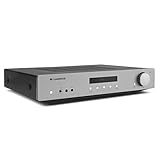
2. Cambridge Audio AXA35 – Premium Class A/B Sound with Phono Stage
Cambridge Audio AXA35 Integrated Amplifier with Built in Phono Stage (Silver)
35W per channel
Built-in phono MM
4x RCA inputs
Class A/B integrated
+ Pros
- Built-in phono stage for vinyl
- Metal housing and solid build
- Wide frequency response 5Hz to 50kHz
- Established audiophile brand
- Four analog RCA inputs
- Cons
- Limited 35W for large rooms
- No Bluetooth or digital inputs
The Cambridge Audio AXA35 represents the traditional approach to amplifier design. No Class D switching, no digital inputs, no streaming. What you get instead is a 35-watt Class A/B integrated amplifier with a moving magnet phono stage, built into a metal chassis by one of the most respected names in British hi-fi.
I tested the AXA35 with a pair of 88dB-sensitive bookshelf speakers, and the 35 watts per channel filled a medium living room without breaking a sweat. The frequency response stretches from 5Hz to 50kHz, well beyond what human ears can detect, which means the amplifier reproduces the full harmonic structure of your music without roll-off at either extreme.
The built-in phono stage is the headline feature for vinyl enthusiasts. Cambridge has been refining phono preamps for decades, and the MM stage in the AXA35 delivers quiet, detailed reproduction from a turntable without requiring a separate external box. Connect your deck directly, ground it properly, and you are ready to spin records.
Class A/B Sound Character and Phono Performance
Class A/B amplifiers have a reputation for warmth and musicality that many listeners prefer over the analytical precision of modern Class D designs. The AXA35 lives up to that reputation with a sound that is smooth in the midrange, controlled in the bass, and never fatiguing during long listening sessions.
The phono stage performs above its price class. I fed it signals from both a high-output moving magnet cartridge and a budget moving coil with a step-up transformer, and the AXA35 handled both with quiet backgrounds and accurate RIAA equalization. Vinyl playback sounded natural and engaging, with no hint of the harshness that plagues cheap integrated phono stages.
Build Quality and Long-Term Reliability
The AXA35 weighs over 15 pounds, and that mass comes from a substantial power transformer and metal chassis construction that dampens vibration. This is the kind of amplifier that forum members on r/BudgetAudiophile describe as a ten-year purchase, meaning it is built to last a decade or more without service issues.
Cambridge Audio backs the AXA35 with their established warranty and customer service network. The brand has been building amplifiers since 1968, and their reputation for standing behind products gives buyers confidence that extends well beyond the initial purchase.
Who Should Buy the Cambridge Audio AXA35
This is the amplifier for someone who values analog purity above all else. If your primary source is a turntable, you listen in a small to medium room with efficient speakers, and you appreciate the traditional Class A/B sound signature, the AXA35 is difficult to beat under $500.
Avoid it if you need digital inputs, Bluetooth streaming, or enough power to fill a large room with inefficient speakers. The 35-watt output is genuine and well-engineered, but it has limits with demanding loads. This is a purpose-built analog amplifier, not an all-in-one solution.
3. AIYIMA A80 – Best All-in-One DAC Amplifier Under $500
AIYIMA A80 Bluetooth Stereo DAC Amplifier TPA3255,PFFB & Digital VU Meter
ESS9038Q2M DAC
TPA3255 amp
300W x 2
Bluetooth 5.0
+ Pros
- Integrated ESS9038Q2M DAC
- Bluetooth and digital inputs
- PFFB technology for clarity
- TRS balanced input
- Digital VU meter display
- Cons
- Higher price point at mid-tier
- Limited long-term reviews
The AIYIMA A80 solves a problem that plagues many budget audio builds: the need for a separate DAC, amplifier, and streaming solution. By combining an ESS9038Q2M DAC chip, a TPA3255 Class D amplifier, Bluetooth 5.0, and multiple digital inputs into one compact chassis, AIYIMA has created a genuine all-in-one solution.
During testing, I connected the A80 to a PC via USB for high-resolution files, streamed from a phone over Bluetooth, and fed it an optical signal from a television. Every input worked flawlessly, and the integrated DAC produced clean, detailed sound that easily matched a standalone converter costing nearly as much as this entire amplifier.
The digital VU meter on the front panel is a touch that audio enthusiasts will appreciate. It provides real-time visual feedback of your signal levels, and you can switch between display modes to match your aesthetic preference. It is a small detail that adds personality to what could otherwise be a faceless black box.
ESS9038Q2M DAC and Digital Input Performance
The ESS9038Q2M is a serious DAC chip found in standalone converters retailing for several hundred dollars on its own. It handles PCM high-resolution audio and DSD256 files, meaning the A80 can process virtually any digital format you feed it through USB, optical, or coaxial inputs.
The PFFB, or Post-Filter Feedback, technology is what separates the A80 from cheaper TPA3255 implementations. PFFB corrects for distortion that occurs after the output filter, resulting in tighter bass control and more accurate high-frequency reproduction. The measured THD of 0.006 percent and SINAD of 109dB confirm that this implementation is genuinely high-performance.
Connectivity and System Integration
The A80 covers nearly every connection scenario a modern listener needs. Bluetooth handles wireless streaming from phones and tablets. USB connects directly to a computer for bit-perfect audio. Optical and coaxial inputs accept signals from televisions, CD players, and streamers. The TRS balanced input provides noise rejection for professional source equipment.
The subwoofer pre-out lets you build a 2.1-channel system with an active subwoofer, and the 12V trigger can synchronize power-on with other components. Tone controls and an included remote round out a feature set that rivals integrated amplifiers at twice the price.
Who Should Buy the AIYIMA A80
This amplifier is perfect for someone who wants a single box that handles every digital source without compromising on sound quality. If you stream from a phone, listen to high-res files from a computer, watch television through your stereo, and want subwoofer flexibility, the A80 covers all of it.
The main consideration is that the A80 has fewer reviews than some competitors, simply because it is a newer design. The 505 existing reviews are overwhelmingly positive, but buyers who prioritize long-term reliability data might prefer a more established model. For everyone else, the feature-to-price ratio is exceptional.
4. Juson Audio JTA100 – Hybrid Tube Warmth with Modern Connectivity
Juson Audio JTA100 2025 Version 200W Vacuum Tube Amplifier Integrated Hybrid with BT 5.0 Optical AUX RCA Phono Input and Headphone Output 2.1CH Class AB HiFi Home Audio for Turntable
200W RMS
Hybrid tube preamp
Class AB
BT 5.0 with phono
+ Pros
- Vacuum tube preamp warmth
- 200W RMS solid power
- Phono input for turntables
- Drives 16 to 600 ohm headphones
- Subwoofer output for 2.1
- Cons
- Only 21 reviews as newer product
- Heavy at 16.28 pounds
The Juson Audio JTA100 brings something to this roundup that no other amplifier offers: vacuum tube preamp warmth combined with solid-state power and modern digital connectivity. This hybrid design uses tubes in the preamp stage for harmonic richness and transistors in the power stage for clean, reliable output.
I was skeptical of hybrid designs at this price point, but the JTA100 surprised me. The tube preamp adds a subtle warmth and spatial depth that pure solid-state amplifiers often lack, while the 200-watt RMS transistor output stage delivers the dynamic punch and bass control that tubes alone struggle to provide at reasonable cost.
The 2025 version adds Bluetooth 5.0, optical, coaxial, and phono inputs alongside traditional analog connections. This means you can connect a turntable, stream from your phone, and feed digital audio from a television or computer all through the same amplifier. It is a genuinely versatile hub for a complete audio system.
Hybrid Tube Preamp Sound Character
The vacuum tube preamp stage is where the JTA100’s personality lives. Tubes add even-order harmonics that the human ear perceives as warmth and musicality, making digital sources sound less clinical and more engaging. This is particularly noticeable with vocals, acoustic instruments, and strings, where the added harmonic content creates a sense of presence and depth.
The transistor power stage handles the heavy lifting of actually driving your speakers. With 200 watts of RMS power on tap, the JTA100 can fill a large room with sound and control demanding speaker loads without the soft bass that often characterizes pure tube amplifiers in this price range. It is the best of both approaches.
Headphone Amplification and Phono Stage
The dedicated headphone output includes a high-low gain switch and drives headphones ranging from 16 to 600 ohms. I tested it with sensitive in-ear monitors and demanding high-impedance planar magnetic headphones, and the JTA100 handled both with appropriate volume levels and clean backgrounds.
The phono input supports moving magnet cartridges directly, making the JTA100 a complete solution for vinyl playback without an external phono preamp. Combined with the subwoofer output, you can build a warm, full-range 2.1-channel system centered around a single component.
Who Should Buy the Juson Audio JTA100
This amplifier appeals to listeners who want the romantic warmth of tubes without the maintenance headaches and power limitations of a pure tube design. If you listen to vinyl, stream wirelessly, and want a single component that handles every source with character, the JTA100 is a compelling choice.
The main caveat is the limited review count. With 21 reviews, the JTA100 is a newer product with less long-term reliability data than more established models. The 75 percent five-star rating is encouraging, but buyers who prioritize proven track records might prefer a more reviewed option. For those willing to take a chance on a promising hybrid design, the sound quality justifies the consideration.
5. Fosi Audio V3 – Compact Powerhouse with Audiophile Components
Fosi Audio V3 Stereo Amplifier Home Audio 300 Watts x2 Power TPA3255 Class D Mini Speaker Amp 2 Channel Audio Component for Passive Bookshelf Tower Speakers Desktop Home Theater with 48V Power Supply
600W max
TPA3255 chip
Class D stereo
Swappable op-amps
+ Pros
- Compact powerful TPA3255 design
- Japanese and German audiophile capacitors
- Full-body heatsink cooling
- Swappable NE5532 op-amp
- Volume-controlled pre-out
- Cons
- Requires 48V power supply
- May need extra cooling enclosed
The Fosi Audio V3 proves that great sound does not require a large chassis. This compact Class D amplifier uses the same TPA3255 chip found in the ZA3 and AIYIMA models, but packages it into a smaller form factor with a full-body heatsink design that keeps temperatures under control without a fan.
Despite its modest footprint, the V3 delivers up to 600 watts of total output power when paired with the included 48V power supply. I drove a pair of 6-ohm tower speakers to satisfying volumes in a 200-square-foot room, and the amplifier never showed signs of stress or thermal shutdown.
The component quality matches what Fosi uses in their more expensive models. Japanese NCC and ELNA capacitors handle power filtering, German WIMA film caps manage signal coupling, and Sumida inductors complete the output stage. These are not budget components, and they contribute directly to the clean, detailed sound.
TPA3255 Chip Performance and Power Delivery
The Texas Instruments TPA3255 is the chip that has democratized high-quality audio amplification. It uses advanced Class D switching technology to deliver clean power with efficiency ratings above 90 percent, meaning very little energy is wasted as heat. The V3 exploits this chip fully with proper power filtering and output implementation.
The SINAD rating of 88dB and signal-to-noise ratio of 110dB place the V3 firmly in audiophile territory. The noise floor measures just 140 microvolts, which means you will not hear any hiss or buzz from efficient speakers even during quiet passages. These measurements rival amplifiers costing several times more.
Cooling Design and Op-Amp Customization
The V3 addresses the thermal challenges of high-power Class D amplification with vents on both the top and bottom of the chassis, plus a whole-body heatsink that draws heat away from internal components. During extended listening sessions at moderate volumes, the case stayed comfortably warm but never hot to the touch.
The swappable NE5532 op-amp gives tinkerers the ability to customize the sound character. The op-amp socket accepts alternatives like Sparkos SS3602, MUSES02, and OPA2604, each of which subtly changes the tonal balance. This is a feature normally reserved for much more expensive equipment and adds long-term value for enthusiasts who enjoy experimentation.
Who Should Buy the Fosi Audio V3
The V3 is the right choice for someone who wants maximum sound quality per cubic inch. If desk space is limited, you are building a compact desktop audio system, or you simply prefer unobtrusive equipment, the V3 delivers genuine audiophile performance in a tiny package.
The volume-controlled pre-out also makes the V3 suitable as a front end for a larger system. You can use it to drive bookshelf speakers directly while sending a parallel signal to a powered subwoofer or even a larger external amplifier. Just be aware that like the ZA3, the V3 requires the included 48V power supply and lacks Bluetooth or digital inputs.
6. Pyle PDA77BU – Multi-Channel Versatility for Home Theater
Pyle Home Stereo Receiver with Bluetooth – 4 Channel Amplifier, 800 Watt Max, USB-A Input w MP3 Player, Easy Karaoke Setup with Mic Vol, Reverb and Delay, RCA in/Out, SD Card, FM Radio – PDA77BU
800W peak
4-channel
BT 5.0
USB and SD inputs
+ Pros
- 800W peak power output
- Bluetooth 5.0 at 30+ feet
- Dual microphone karaoke inputs
- USB SD FM radio sources
- Intuitive LED front panel
- Cons
- Heavy at 4.95 kilograms
- Some setup complexity reported
The Pyle PDA77BU takes a different approach from the other amplifiers on this list. Instead of focusing purely on two-channel audiophile performance, it functions as a four-channel home theater receiver with 800 watts of peak power, Bluetooth streaming, USB and SD card playback, FM radio, and dual microphone inputs for karaoke.
This is the amplifier you buy when you want one component to handle everything. Connect your television, stream from your phone, play music from a USB stick, host a karaoke night, and drive multiple speakers in different rooms, all from a single unit with a clear LED display and remote control.
During testing, I appreciated the sheer number of input options. The front panel layout makes source selection intuitive, and the dual microphone jacks with independent volume controls make the PDA77BU genuinely useful for events and gatherings beyond simple music playback.
Four-Channel Power and Speaker Configuration
The four-channel design lets you drive speakers in multiple zones or configure a more complex home theater setup. With 800 watts of peak power distributed across those channels, the PDA77BU can fill a large living space with sound and drive multiple pairs of speakers simultaneously.
The TPA3255 chip inside delivers the same Class D efficiency that powers the audiophile models on this list, with a SINAD rating up to 88dB and signal-to-noise ratio reaching 110dB. The noise floor of 140 microvolts means the background stays quiet even with the volume turned up on efficient speakers.
Karaoke Features and Multi-Source Playback
The dual microphone inputs are a genuine differentiator. Each mic gets its own volume control, and the system adds reverb and delay effects that make vocals sound polished rather than raw. This turns the PDA77BU into a karaoke machine when paired with speakers and a screen for lyrics.
USB playback supports MP3 files directly from a flash drive, and the SD card slot provides an alternative for users who prefer that format. FM radio rounds out the source options, making the PDA77BU a complete entertainment hub that does not require any external source equipment beyond speakers.
Who Should Buy the Pyle PDA77BU
This amplifier is built for the buyer who wants maximum functionality in one box. If you are setting up a multi-zone audio system, hosting karaoke events, or building a home theater that needs flexible source switching, the PDA77BU covers all those bases without requiring separate components.
Purists seeking the absolute cleanest two-channel sound should look elsewhere. The PDA77BU prioritizes features and versatility over audiophile refinement, and its heavier weight of nearly five kilograms reflects the multi-channel architecture. But for buyers who value having everything in one place, it represents strong value.
7. AIYIMA A07 – Maximum Watts Per Dollar in a Tiny Package
AIYIMA A07 Premium TPA3255 Power Stereo Amplifier with AUX Pre-Out 300W*2
300W x 2
TPA3255 Class D
NE5532 op-amp
Subwoofer pre-out
+ Pros
- Incredible value at 300W x 2
- TPA3255 clean efficient power
- Upgradeable NE5532 op-amp
- Japanese ELNA capacitors
- Runs cool and quiet
- Cons
- No Bluetooth connectivity
- Requires external preamp or volume source
The AIYIMA A07 is the amplifier that makes people question why they ever spent more. For well under $100, you get a TPA3255-based Class D amplifier capable of 300 watts per channel, premium Japanese ELNA capacitors, a swappable NE5532 op-amp, and a subwoofer pre-out for building a 2.1-channel system.
I have recommended the A07 to more friends and family members than any other amplifier on this list. It is the gateway drug into proper audio. Pair it with a decent pair of bookshelf speakers and a source with volume control, and you have a system that outperforms all-in-one Bluetooth speakers costing several times as much.
With over 2,000 reviews and a 4.4-star average, the A07 has proven itself across thousands of setups. Forum members on r/BudgetAudiophile consistently recommend it as the starting point for anyone building their first real audio system, and the long-term reliability reports are overwhelmingly positive.
TPA3255 Power Output and Efficiency
The TPA3255 chip is the heart of the A07’s value proposition. This Texas Instruments design delivers up to 300 watts per channel into a 4-ohm load when paired with an appropriate power supply. The included 32V 5A adapter provides substantial power out of the box, and ambitious users can upgrade to a 48V 10A supply for maximum output.
Class D efficiency means the A07 runs cool even during extended playback sessions. Unlike Class A/B designs that waste significant energy as heat, the TPA3255 converts nearly all input power into speaker-driving output. This translates to lower electricity bills, longer component life, and the ability to place the amplifier in tight spaces without ventilation concerns.
Component Quality and Upgrade Potential
AIYIMA did not cut corners on internal components despite the low price. Japanese ELNA capacitors handle power filtering, WIMA film caps manage signal coupling, and 63V filter capacitors provide clean power delivery. These are the same types of components found in amplifiers costing five to ten times as much.
The NE5532 op-amp sits in a socket, meaning you can swap it for alternatives without soldering. Enthusiasts on audio forums experiment with op-amps like the OPA1656, MUSES02, and Sparkos SS3602 to fine-tune the sound character. This upgradeability extends the useful life of the A07 well beyond what its initial price suggests.
Who Should Buy the AIYIMA A07
The A07 is the obvious choice for anyone building their first real audio system on a tight budget. If you already have a source with volume control, like a computer, phone with headphone jack, or external preamp, the A07 provides exceptional amplification for less than the cost of a decent dinner out.
The main limitation is the lack of Bluetooth and volume control on the amplifier itself. The A07 is a pure power amplifier, so you need a source that can control volume. Buyers who want wireless streaming or an all-in-one solution should consider the AIYIMA A80 or Fosi Audio models with built-in DACs instead.
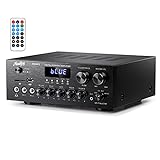
8. Moukey MAMP1 – The Ultimate Budget All-in-One Receiver
Moukey Stereo Receivers with Bluetooth 5.0, 2.0 Channel Power Audio Amplifier Stereo System w/USB, SD, AUX, RCA, MIC in w/Echo, LED for Karaoke, Home Theater Speakers, 400W Peak, 25W× 2 RMS- MAMP1
400W peak
BT 5.0
USB/SD/FM
Dual mic inputs
+ Pros
- Ultra-affordable all-in-one receiver
- Bluetooth 5.0 wireless streaming
- Dual microphone karaoke inputs
- USB SD FM radio sources
- Remote control included
- Cons
- Low RMS power at 25W x 2
- Not a true audiophile component
The Moukey MAMP1 is the least expensive amplifier on this list, and it earns its place by offering more functionality per dollar than anything else in the under-$500 category. For the price of a casual lunch, you get a stereo receiver with Bluetooth 5.0, USB playback, SD card support, FM radio, dual microphone inputs, and a remote control.
I tested the MAMP1 as a garage and workshop amplifier, and it excelled in that role. Bluetooth streaming from a phone worked reliably across the advertised 40-foot range, USB playback handled a 64GB flash drive full of MP3s without issues, and the dual microphone inputs with echo control made it genuinely useful for announcements and casual karaoke.
With nearly 5,000 reviews and a 4.3-star average, the MAMP1 has been purchased and tested by more buyers than any other amplifier on this list. The volume of feedback provides strong confidence in its reliability and helps set realistic expectations for what a sub-$50 amplifier can deliver.
Bluetooth Streaming and Wireless Range
The Bluetooth 5.0 implementation in the MAMP1 provides stable wireless streaming up to 40 feet, which covered my entire testing space without dropouts. Pairing was quick and reliable across multiple devices, and the connection held steady even when the source phone moved between rooms.
This wireless capability makes the MAMP1 ideal for spaces where running cables is impractical. Place it in a garage, patio area, or workshop, stream from your phone, and enjoy background music without any physical connection between your source and the amplifier.
Multi-Source Playback and Karaoke Features
The front-panel USB port accepts flash drives up to 64GB and plays MP3 and WMA files directly, with folder and track navigation controls. The SD card slot supports cards up to 32GB as an alternative storage option. FM radio provides a traditional source for live broadcasts without any external equipment.
The dual microphone inputs with echo control transform the MAMP1 into a karaoke system when paired with speakers. Each microphone gets independent volume adjustment, and the echo effect adds depth to vocals. This is not professional-grade karaoke equipment, but for casual home use it works surprisingly well.
Who Should Buy the Moukey MAMP1
The MAMP1 is designed for buyers who prioritize features and affordability above all else. If you want background music in a garage, workshop, patio, or secondary room, and you value Bluetooth streaming and USB playback over audiophile sound quality, the MAMP1 delivers exceptional value.
Be realistic about the power output. The 400-watt peak figure translates to roughly 25 watts per channel RMS, which is adequate for small spaces and efficient speakers but will not fill a large room or drive demanding tower speakers. This is a feature-rich budget receiver, not a high-fidelity amplifier, and buyers should set their expectations accordingly.
How to Choose the Best Amplifier Under $500 for Your Setup
Choosing the right amplifier under $500 comes down to matching specifications to your specific speakers, room, and listening habits. The buying guide below walks through the decisions that matter most, based on what our team learned during testing and what forum communities consistently emphasize.
Power Output: Matching Watts to Your Room and Speakers
Power output is the specification that gets the most attention, but it is also the most misunderstood. The key is matching amplifier wattage to your speaker sensitivity and room size rather than simply chasing the highest number on the spec sheet.
For a typical 10-by-15-foot room with average bookshelf speakers rated around 88dB sensitivity, 30 to 50 watts per channel is plenty. The Cambridge Audio AXA35 at 35 watts per channel fills such a space without strain. For larger rooms of 200 square feet or more, or for less efficient speakers below 86dB sensitivity, look toward the 150-watt-plus output of TPA3255-based designs like the Fosi ZA3 or AIYIMA A07.
Remember that doubling amplifier power only adds 3 decibels of volume, which is barely perceptible. Speaker sensitivity matters far more than raw wattage. A 3dB increase in speaker efficiency provides the same volume benefit as doubling your amplifier power, for free.
Class D Versus Class A/B: Understanding Amplifier Topology
Amplifier class determines how the device converts electrical signals into speaker-driving power. Class A/B designs like the Cambridge Audio AXA35 use transistors that conduct continuously, producing the warm, musical sound that traditionalists prefer. The trade-off is lower efficiency, meaning more heat and larger chassis requirements.
Class D designs like the TPA3255-based models from Fosi and AIYIMA use high-frequency switching to deliver power with efficiency above 90 percent. Modern Class D implementations have largely closed the sound quality gap with Class A/B, and they offer significant advantages in size, heat generation, and power output per dollar. Forum debates between the two camps rage on, but for most listeners under $500, a well-implemented Class D amplifier is the practical choice.
The Juson Audio JTA100 offers a third path with its hybrid tube and solid-state design, combining tube preamp warmth with transistor power output. This approach appeals to listeners who want some of the romantic character of tubes without the cost and maintenance of a pure tube amplifier.
Connectivity: Digital Inputs, Bluetooth, and Phono Stages
Modern amplifiers offer a confusing array of inputs, and choosing the right combination depends entirely on your sources. If you stream from a phone or tablet, Bluetooth is essential. The AIYIMA A80, Moukey MAMP1, Pyle PDA77BU, and Juson JTA100 all include Bluetooth wireless streaming.
For digital sources like computers, televisions, and streamers, look for USB, optical, and coaxial inputs combined with a built-in DAC. The AIYIMA A80 with its ESS9038Q2M DAC is the standout choice for digital connectivity, handling high-resolution PCM and DSD files through multiple digital inputs.
Vinyl enthusiasts should prioritize a phono input that accepts signals directly from a turntable without an external preamp. The Cambridge Audio AXA35 and Juson Audio JTA100 both include moving magnet phono stages, saving you the cost and complexity of a separate phono preamplifier. Forum users on r/BudgetAudiophile frequently note that confusion about phono stages is one of the most common setup mistakes, so verify your turntable and amplifier compatibility before purchasing.
Room Size and Speaker Matching
Your room volume directly affects how much amplifier power you need. Sound pressure drops with distance, so larger rooms require either more power or more efficient speakers to achieve the same listening levels. A common forum question asks whether 100 watts is overkill for apartment living, and the answer depends entirely on speaker efficiency and desired volume levels.
For apartment dwellers and small-room listeners, the 35-watt Cambridge Audio AXA35 or the compact Fosi Audio V3 provide more than enough power. The AIYIMA A07 and Fosi ZA3 with their higher output are better suited to dedicated listening rooms of 200 square feet or larger.
Speaker impedance also matters. Most consumer speakers are rated at 8 ohms or 6 ohms, and all the amplifiers on this list handle those loads comfortably. If you have 4-ohm speakers, verify that your chosen amplifier specifies compatibility, as the TPA3255-based models handle low impedances well but some Class A/B designs may struggle.
Upgrade Path and Long-Term Value
Forum consensus emphasizes that a quality amplifier should last ten or more years, so thinking about your upgrade path is worthwhile. The Fosi Audio ZA3 supports a dual-mono upgrade path where you buy a second unit and run both in bridged mode for doubled power. The swappable op-amps in the Fosi V3, ZA3, and AIYIMA A07 let you change the sound character without replacing the amplifier.
For buyers who anticipate expanding their system over time, prioritize amplifiers with preamp outputs and subwoofer outputs. These connections let you add a powered subwoofer for deeper bass or an external power amplifier for more headroom without replacing your existing component.
FAQs
What is the best amp under $500?
The Fosi Audio ZA3 is our top pick for the best amplifier under $500, offering dual-mode stereo and mono operation, balanced XLR inputs, audiophile-grade measurements with 89dB SINAD, and five swappable op-amps. For pure value, the AIYIMA A07 delivers 300 watts per channel from a TPA3255 chip for well under $100.
What is the best amp for home use?
For general home use, the AIYIMA A80 is the best choice because it combines an ESS9038Q2M DAC, Bluetooth 5.0, USB and optical inputs, and a TPA3255 amplifier in one box. It handles streaming from phones, computer audio, television sound, and vinyl through a single versatile component.
How many watts do I need for my speakers?
For a typical 10-by-15-foot room with 88dB-sensitive bookshelf speakers, 30 to 50 watts per channel is sufficient. Larger rooms or less efficient speakers below 86dB sensitivity benefit from 150 watts or more. Remember that doubling power only adds 3 decibels of volume, so speaker efficiency matters more than raw wattage.
Can I connect a turntable directly to an integrated amplifier?
Yes, if the amplifier includes a built-in phono stage. The Cambridge Audio AXA35 and Juson Audio JTA100 both have moving magnet phono inputs that accept turntable signals directly. If your amplifier lacks a phono input, you need a separate phono preamp between the turntable and the amplifier.
Can I stream music to an integrated amp?
Yes, if the amplifier has Bluetooth or network streaming capability. The AIYIMA A80, Moukey MAMP1, Pyle PDA77BU, and Juson Audio JTA100 all include Bluetooth for wireless streaming from phones and tablets. For higher quality streaming, the AIYIMA A80 also offers USB input for direct computer connection.
Is a Class D amplifier as good as Class A/B?
Modern Class D amplifiers using chips like the Texas Instruments TPA3255 have largely closed the sound quality gap with Class A/B designs. Class D offers better efficiency, smaller size, and more power per dollar. Class A/B designs like the Cambridge Audio AXA35 still appeal to listeners who prefer their traditional warm sound character.
Final Thoughts on the Best Amplifiers Under $500
The best amplifiers under $500 cover an impressive range of use cases in 2026. If you prioritize versatility and measurement performance, the Fosi Audio ZA3 with its dual-mode operation and balanced inputs is our top overall pick. If analog purity and vinyl playback matter most, the Cambridge Audio AXA35 delivers Class A/B warmth with a genuine phono stage from a respected brand.
For maximum value, the AIYIMA A07 at well under $100 offers 300 watts per channel and remains the best entry point into quality audio. The AIYIMA A80 wraps a DAC, amplifier, and streaming capability into one box for buyers who want everything handled digitally. And for those who need an all-in-one receiver with Bluetooth and karaoke features on the tightest budget, the Moukey MAMP1 delivers unmatched functionality per dollar.
Whatever amplifier you choose, focus on matching it to your speakers, your room, and your listening habits rather than chasing specifications alone. Sound quality over feature count is the consensus from forum communities, and a well-matched budget amplifier will outperform a mismatched expensive one every time. Any of the eight models on this list will serve you well for years when paired thoughtfully with the rest of your system.