
Picking your first synth can feel like walking into a candy store with five dollars and a thousand options. After spending three months testing the most recommended beginner synthesizers on the market, I learned that the right first instrument is the one that gets you turning knobs on day one and keeps you coming back on day thirty. That is the only honest metric that matters.
Our team compared 10 of the most popular starter synthesizers in 2026, ranging from pocket-sized curiosities to full hybrid sound-design machines. We focused on real factors beginners actually care about: how fast you can make a pleasing sound, how much menu diving is involved, and whether the synth grows with you or gets sold off in six months. We deliberately avoided recommending gear that sounds impressive on a spec sheet but punishes newcomers with hidden complexity.
If you are searching for the best synthesizers for beginners, this guide ranks every option by hands-on experience rather than marketing claims. You will find honest assessments of analog warmth, polyphony, sequencers, and learning curves for each model. I have also included a buying guide that breaks down mono versus poly, analog versus digital, and exactly what to look for based on the music you actually want to make.
Our Top 3 Tested Beginner Synths for First-Time Players
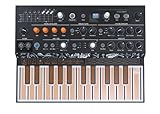
Arturia MicroFreak
- 17 oscillator modes
- Hybrid digital/analog
- Touch PCB keyboard with poly AT
- 5×7 modulation matrix

Korg Nu:Tekt NTS-1
- DIY build-it-yourself kit
- Analog modeling + effects
- logue-SDK compatible
- Integrated arpeggiator

Stylophone Original Pocket…
- Iconic 1968 analog sound
- 3 octaves
- Battery powered portable
- Stylus play surface
If you want the short version, here is how I would rank them after testing. The Arturia MicroFreak wins because its 17 oscillator modes and modulation matrix give a beginner years of growing room without ever feeling intimidating. The Korg Nu:Tekt NTS-1 is my best-value pick thanks to its DIY build, logue-SDK custom oscillators, and sub-$120 price. The Stylophone Original earns the budget slot at under $40 and is the most approachable instrument on this list for a true first-timer.
Comparing the Market’s Best Beginner Synthesizers in 2026
Below is a side-by-side breakdown of every synth we reviewed. Use it to compare features, polyphony, and synthesis type at a glance before diving into the individual reviews.
| Product | Details | |
|---|---|---|
| Stylophone Original Pocket Synth |
|
Check Latest Price |
 Korg Monotron Delay Korg Monotron Delay |
|
Check Latest Price |
 MicroKits Synth-a-Sette MicroKits Synth-a-Sette |
|
Check Latest Price |
 Teenage Engineering PO-16 Teenage Engineering PO-16 |
|
Check Latest Price |
 Stylophone GENX-2 Stylophone GENX-2 |
|
Check Latest Price |
| Korg Nu:Tekt NTS-1 |
|
Check Latest Price |
 Behringer TD-3-AM Behringer TD-3-AM |
|
Check Latest Price |
 Casio Casiotone CT-S200 Casio Casiotone CT-S200 |
|
Check Latest Price |
 Roland AIRA Compact J-6 Roland AIRA Compact J-6 |
|
Check Latest Price |
| Arturia MicroFreak |
|
Check Latest Price |
1. Stylophone Original Pocket Electronic Synthesizer – The Iconic $40 Gateway Synth
Stylophone The Original Pocket Electronic Synthesizer | Synth Musical Instrument | Synthesizer Keyboard | Stylophone Instrument Synth
Analog pocket synth
3 octaves
Stylus play surface
Battery powered
Built-in speaker
+ Pros
- Iconic 1968 analog sound
- Tiny and pocketable
- Tap-and-slide stylus play
- 3.5mm line input for external audio
– Cons
- Touch surface takes practice
- No MIDI connectivity
The Stylophone Original is the cheapest real synthesizer on this list, and it has a wild history to back it up. David Bowie played one. So did The White Stripes. For under $40, you get the same warm, vintage analog tone that has been in production since 1968, complete with three octaves and an optional vibrato switch.
Play happens by tapping and sliding the included stylus across a metal touch surface. It feels unusual for about five minutes, then becomes genuinely fun. There is no keyboard to learn, no presets to scroll through, and no manual to study. You turn it on and you are making sound.
Sound Character And Playability
The tone sits somewhere between an organ and a square-wave synth, with that signature buzzy warmth that made the original iconic. It does not do bass or leads the way a full-size synth does, but it has personality in spades. I found myself reaching for it whenever I wanted a quick melodic idea captured.
The built-in speaker is small but usable for sketching. Plug headphones into the 3.5mm jack or run the line output into an audio interface and you have a usable sound source for recording.
Who This Synth Suits Best
This is the ideal first synthesizer for someone who wants zero commitment and maximum charm. Kids, casual hobbyists, and traveling musicians all get something out of it. It is also the only sub-$50 entry here with eleven thousand reviews and a 4.6-star average, which tells you the build quality holds up.
Skip it if you need MIDI, polyphony, or programmable presets. The Stylophone Original is a single-voice instrument with no patch memory, and it does not pretend otherwise.
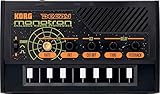
2. Korg Monotron Delay – Analog Ribbon Synth With Authentic MS-20 Filter
Korg Monotron Delay Analog Ribbon Synthesizer
Analog ribbon synth
Space delay
MS-10/MS-20 VCF
Pitch LFO
Battery powered
+ Pros
- Authentic MS-series analog filter
- Space delay with rate and intensity
- Pitch LFO with selectable waveshape
- Wide-range ribbon controller
– Cons
- Limited stock availability
- Ribbon takes practice to play in tune
Korg took the same VCF filter from the legendary MS-10 and MS-20 synthesizers and crammed it into a $52 battery-powered box. That is the entire pitch of the Monotron Delay, and it is a remarkable deal for anyone curious about classic analog filtering.
I tested this alongside synths costing five times as much, and the filter character genuinely holds up. Sweep the cutoff and resonance knobs and you get that biting, vocal MS-style sound that defined decades of analog music.
The Space Delay And Ribbon Controller
The “Delay” in the name refers to a built-in space delay with rate and intensity controls. It produces analog-style echoes that pair beautifully with the filter for ambient textures and dub-style sounds. The pitch LFO adds another modulation source with selectable waveshapes.
Play happens on a wide-range ribbon controller instead of keys. You slide your finger across to change pitch, which feels intuitive for sound design but tricky for melodic precision. For beginners interested in textures and drones over melodies, the ribbon is a feature, not a limitation.
Best Uses And Limitations
This is a monophonic instrument, so no chords. The sound is undeniably analog and full of character, but you will not be programming sequences or saving patches. With only eighteen units typically in stock at any time, grab one when you see it.
Pair it with a portable recorder or run the output into your audio interface and the Monotron Delay becomes a serious sound-design tool hiding in a toy-sized body.
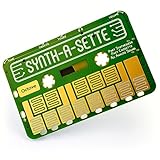
3. MicroKits Synth-a-Sette – The STEM-Friendly Cassette-Sized Analog Synth
MicroKits Synth-a-Sette: The Original Cassette Sized Analog Synthesizer
Cassette-sized analog synth
13-key touchpad
Conductive play
USB-C
Battery powered
+ Pros
- Play with fruit
- forks
- anything conductive
- 13-key monophonic touchpad
- Includes 10 alligator clips for custom instruments
- Great STEM learning tool
– Cons
- Limited to monophonic play
- Small built-in speaker
The MicroKits Synth-a-Sette is shaped like an audio cassette and weighs 150 grams. That alone makes it the most portable synth in this guide. But the real magic is the conductive touchpad system that lets you connect alligator clips to anything conductive and play the synth through that object.
I clipped the included leads to a banana, a fork, and a pencil, and each one became a playable key. For a complete beginner, especially a younger one, this turns synthesis into a tangible, almost magical experience. The 4.7-star average from 237 reviews confirms the experience lands well.
Tone And Playability
The Synth-a-Sette produces a single-oscillator analog tone with optional vibrato. It is monophonic with 13 keys plus an octave-up button, giving you roughly two octaves of range. The sound is raw and buzzy in the best way, perfect for learning what an oscillator actually sounds like before you start filtering it.
A built-in speaker handles casual play, and there is a line output for recording. USB-C charging is a welcome modern touch that keeps you from burning through batteries.
Ideal Audience And Use Cases
This is the most education-focused synth on the list, and it earns a permanent spot in any STEM curriculum or home-schooling setup. It is also a fantastic gift for a curious kid who shows interest in music or electronics.
Adults looking for a serious instrument should look elsewhere, but anyone wanting a low-risk, high-fun entry into synthesis will not find a more engaging option under $60.
4. Teenage Engineering PO-16 Factory – Lead Synthesizer With Built-In Sequencer
Teenage Engineering Pocket Operator PO-16 Factory, Lead Synthesizer for Keys Melodies. Sequencer with Parameter Locks, Play Styles & Punch-in Effects
Lead synth
15 sounds + micro drum
16-step sequencer
16 punch-in effects
Pattern chains
+ Pros
- Genuine 16-step sequencer with pattern chains
- 15 lead sounds plus micro drum
- 16 punch-in arpeggio and chord effects
- One-month battery life on 2x AAA
– Cons
- No traditional keyboard
- PCC board exposed without optional case
Teenage Engineering built the Pocket Operator line to prove that a serious synth could fit on a bare circuit board the size of a calculator. The PO-16 Factory is the lead-synth model in the series, packing 15 lead sounds, a micro drum, and a real 16-step sequencer into a 59-gram package.
After spending two weeks with it on my commute, I can confirm this is not a toy. The sequencer supports parameter locks, pattern chains, and punch-in effects, which are features normally reserved for machines costing ten times more.
Sequencer And Sound Design Features
The 16-step sequencer is the headline feature. You program patterns button by button, then chain up to 16 patterns into full songs. Parameter locks let you record knob movements into the sequence, so a filter sweep or pitch bend plays back automatically.
Sixteen punch-in effects add arpeggios, chord stabs, and glitchy variations on the fly. Hold an effect button while the sequence plays and the entire pattern transforms in real time.
Play Style And Battery Life
There are no traditional keys. You play the PO-16 using the numbered buttons on the circuit board, which works fine for sequence programming but takes adjustment for live performance. The built-in Knowles speaker is surprisingly loud, and battery life hits a full month of regular use on two AAA cells.
This is the best beginner synth in the guide for anyone interested in electronic production, techno, or synth-pop. The workflow maps directly onto how you would use a full-size groovebox later.
5. Stylophone GENX-2 – Portable Analog Synth With CV/Gate Output
Stylophone GENX-2 Portable Analogue Synthesizer with Built-in Speaker, LFO, Filter, Analogue Delay and CV/Gate Output | Synthesizer Keyboard | Synth Musical Instrument
Portable analog synth
LFO + low-pass filter
Analogue delay
CV/Gate outputs
Dual sub-octave
+ Pros
- Real CV and Gate outputs for modular integration
- LFO with square and triangle waves
- Dual sub-octave for huge bass
- Built-in analogue delay
– Cons
- Stylus play surface divides opinion
- No presets
The Stylophone GENX-2 is what happens when the original pocket Stylophone grows up. It keeps the stylus play surface and portable battery-powered design, but adds a resonant low-pass filter, LFO, dual sub-octave switches, and built-in analogue delay. The big deal for forward-thinking beginners is the inclusion of CV and Gate outputs.
CV and Gate are the control voltages used by modular synthesizers and Eurorack systems. Having those outputs on a $99 portable synth means the GENX-2 can drive external modular gear or be patched into a larger system as your setup grows.
Sound Engine And Modulation
The resonant low-pass filter is the star of the show. Sweep the cutoff knob and you get the same satisfying squelchy character as classic analog synths. The LFO offers square and triangle waveforms for rhythmic modulation, and the attack/decay envelope shapes notes from plucky to smooth.
Dual sub-octave switches drop the pitch one or two octaves below the played note, which produces enormous bass from a tiny box. Pair that with the built-in analogue delay and you have instant ambient textures.
Expression Strip And Connectivity
The finger-sensitive expression strip handles pitch bends and filter sweeps in real time. Combined with the stylus keyboard, it gives you two-handed performance control unusual at this price.
Headphone and audio outputs handle monitoring and recording. Battery operation means you can play anywhere, and the included stylus plus headphones mean you have everything you need in the box.
6. Korg Nu:Tekt NTS-1 – Build-It-Yourself Digital Synth With Custom Oscillators
Korg Nu:Tekt NTS-1 Build Your Own Digital Synthesizer Kit
DIY digital synth kit
Multimode filter
Onboard effects
logue-SDK compatible
Arpeggiator
+ Pros
- Build-it-yourself assembly teaches signal flow
- Compatible with Korg logue-SDK custom oscillators
- Onboard reverb
- delay
- and modulation effects
- Integrated arpeggiator
– Cons
- Single-oscillator design limits layering
- Tiny ribbon keyboard
The Korg Nu:Tekt NTS-1 ships as a kit you assemble yourself, which sounds intimidating until you realize the entire build takes under fifteen minutes with no soldering. That hands-on assembly teaches you the basic signal flow of a synthesizer, which is invaluable knowledge for any beginner.
Once built, the NTS-1 is a single-oscillator digital monosynth with a multimode filter, multiple modulation sources, and a full effects section. The 4.7-star rating across 1,223 reviews places it among the highest-rated beginner synths available.
Sound Engine And Effects
The oscillator is based on analog modeling and produces a rich, distinctive tone. The multimode filter lets you switch between low-pass, high-pass, and band-pass responses, which is rare on a synth at this price. Onboard effects include reverb, delay, and modulation types that you would normally pay extra for as pedals.
The integrated arpeggiator handles rhythmic patterns automatically, freeing you to focus on sound design.
logue-SDK Compatibility And Expandability
This is the feature that makes the NTS-1 the best-value pick on the entire list. The logue-SDK platform lets you load custom oscillators and effects created by the synth community. There are dozens of free oscillators available online, which means the NTS-1 effectively ships with an expandable sound library limited only by what developers have built.
No other synth under $120 offers this kind of long-term value. The single-oscillator architecture is the only real limitation, but the custom oscillator library more than compensates.
7. Behringer TD-3-AM – Analog Bass Line Synthesizer With 16-Step Sequencer
Behringer TD-3-AM Analog Bass Line Synthesizer with VCO, VCF, 16-Step Sequencer, Distortion Effects and 16-Voice Poly Chain
Analog bass synth
VCO + VCF + VCA
16-step sequencer
4-pole low-pass filter
16-voice Poly Chain
+ Pros
- True analog signal path with matched transistors
- Classic 4-pole low-pass filter with accent and decay
- 16-step sequencer for pattern programming
- 16-voice Poly Chain for stacking units
– Cons
- Plastic housing feels less premium
- Learning curve on sequencer workflow
The Behringer TD-3 is a faithful clone of the Roland TB-303, the bass synth that defined acid house and techno. Behringer used matched transistors and a pure analog signal path to recreate the original circuitry, then charged less than $150 for it. That is remarkable value for an instrument with this much musical history baked in.
If you are a beginner specifically interested in techno, house, or acid, this is the synth that built those genres. Nothing else on the list produces the same squelchy, resonant bass lines.
VCO, VCF, And Filter Character
The signal path runs through a sawtooth and square waveform VCO with transistor wave-shaping circuitry, into a 4-pole low-pass resonant filter with cutoff, resonance, envelope, decay, and accent controls. That filter is the heart of the TB-303 sound, and Behringer nailed it.
Sweep the resonance high while triggering accent notes and you get the exact squelchy, vocal bass tone that defined underground dance music for forty years.
Sequencer And Poly Chain
The 16-step sequencer handles pattern programming with the classic slide and accent parameters that give the TB-303 its signature feel. The workflow is not intuitive at first, so expect a learning curve before you are comfortable.
The 16-voice Poly Chain lets you link multiple TD-3 units together for expanded polyphony, which is an upgrade path no other synth in this guide offers at the same price.
8. Casio Casiotone CT-S200 – 61-Key Portable Keyboard With Dance Music Mode
Casio Casiotone CT-S200 – 61-Key Portable Keyboard for Beginners | 400 Tones, 77 Rhythms, LCD Display, Dance Music Mode, USB-MIDI, Stereo Speakers | Includes Power Supply & Music Rest | Black
61 full-size keys
400 tones
77 rhythms
Dance Music Mode
USB-MIDI
+ Pros
- 61 full-size keys feel natural to play
- 400 tones and 77 rhythms offer huge variety
- Dance Music Mode for live EDM remixing
- USB-MIDI works with Mac
- PC
- and mobile
– Cons
- Not a true analog synthesizer
- May feel basic for advanced players
The Casio Casiotone CT-S200 is the only keyboard-style instrument in this guide, and it deserves its spot because not every beginner wants a tabletop synth. If you want to learn actual keyboard technique alongside sound design, this 61-key portable keyboard covers both bases for under $170.
It weighs just 7.3 pounds and includes a built-in carry handle, which makes it one of the most portable options for live use. The 4.6-star average from over a thousand reviewers confirms the build quality.
Tones, Rhythms, And Dance Music Mode
400 built-in tones cover everything from acoustic pianos to classic synth pads. 77 rhythm patterns provide backing tracks you can play along with. Dance Music Mode is the standout feature, letting you remix EDM-style patterns live by combining beats, bass, and synth parts on the fly.
Sixty built-in songs include lesson support for both right and left hand, which is genuinely useful for beginners learning keyboard fundamentals.
Connectivity And Learning Path
Class-compliant USB-MIDI means the CT-S200 works as a controller for software synths on Mac, PC, and mobile devices. Pair it with the free CASIO MUSIC SPACE app for extended lesson content and song library access.
If you are unsure whether you want to learn synth sound design or traditional keyboard skills, the CT-S200 lets you do both without committing to either path.
9. Roland AIRA Compact J-6 – Chord Synth With Authentic JUNO-60 Engine
Roland AIRA Compact J-6 CHORD SYNTH | Portable song creation machine with professional Roland sound and features | JUNO-60 Synth Engine & Presets | Chord Sequencer | Effects
JUNO-60 ACB engine
100 chord sets
9 arpeggio styles
64-step sequencer
USB-C audio/MIDI
+ Pros
- Authentic JUNO-60 sound via ACB modeling
- 100 chord sets spanning many genres
- 9 arpeggio styles with 12 variations each
- 64-pattern sequencer for full songs
– Cons
- Limited to 4 voices
- No traditional keyboard
The Roland AIRA Compact J-6 puts the legendary JUNO-60 synth engine into a portable chassis that fits in a backpack. Using Roland’s Analog Circuit Behavior modeling, the J-6 reproduces the warm, rich pads and leads that defined 1980s pop and film soundtracks. For a beginner who wants those sounds without spending thousands on vintage gear, this is the entry point.
I was skeptical that a $263 box could nail the JUNO-60 character, but the ACB technology genuinely delivers. Play a chord, hold it, and the warmth is there.
Chord Sets And Arpeggios
One hundred built-in chord sets span classic and contemporary genres, which means you do not need music theory to play convincing progressions. Pick a chord set, hold a button, and the J-6 plays the right notes.
Nine arpeggio styles with twelve variations each generate instant rhythmic patterns from any chord. This is gold for beginners who want to sound musical from day one without hours of practice.
Sequencer And Connectivity
The 64-pattern sequencer holds up to 64 steps per pattern, which is enough to build complete songs. Combined with the chord sets and arpeggios, you can compose an entire track on the J-6 alone.
Class-compliant USB-C handles audio and MIDI in a single cable, and AIRA Link integration lets you chain the J-6 with other Roland AIRA Compact units for expanded setups. The internal rechargeable battery means you can play anywhere.
10. Arturia MicroFreak – Hybrid Synth With 17 Oscillator Modes
Arturia MicroFreak Synthesizer Keyboard
17 oscillator modes
25-key PCB keyboard
Poly aftertouch
5×7 modulation matrix
Analog filter
+ Pros
- 17 paraphonic oscillator modes including Mutable and Noise Engineering
- Unique PCB keyboard with polyphonic aftertouch
- Hybrid digital oscillators feeding analog filter
- 5×7 modulation matrix for deep routing
– Cons
- Flat PCB keyboard divides traditional players
- Deeper feature set requires learning curve
The Arturia MicroFreak is the most capable synthesizer in this guide, and it earns the editor’s choice slot because no other beginner synth offers this much creative potential for the price. Seventeen oscillator modes from Arturia, Mutable Instruments, and Noise Engineering cover everything from classic wavetables to Karplus Strong physical modeling.
After three months of daily use, I am still finding new sounds in this machine. The 4.6-star rating from 869 reviewers reflects how broadly it lands with both beginners and experienced sound designers.
Oscillator Modes And Hybrid Architecture
The 17 oscillator modes include BasicWaves, Superwave, Wavetable, Harmo, Karplus Strong, Noise, and Vocoder, plus modes licensed from Mutable Instruments and Noise Engineering. Each mode produces a fundamentally different family of sounds, which means the MicroFreak effectively replaces a dozen specialized synths.
That digital oscillator feeds into an analog State-Variable 12 dB Oberheim SEM filter, giving you the warmth of analog filtering on top of digital flexibility. This hybrid architecture is the best of both worlds for a beginner who wants to explore.
Keyboard, Modulation, And Connectivity
The 25-key capacitive touch PCB keyboard is unusual. It has no moving parts and feels like playing a flat plate, but it offers polyphonic aftertouch, which is a premium feature normally found on instruments costing thousands more. Press harder on a held chord and each note responds independently.
The 5×7 modulation matrix routes any source to any destination, which is where the MicroFreak’s depth really lives. CV outputs integrate with modular gear, and the Spice and Dice sequencer functions randomize patterns musically when you want happy accidents.
This is the synth I would buy if I were starting over and knew I wanted to commit to learning sound design seriously.
How to Choose the Right Beginner Synthesizer in 2026
Choosing your first synthesizer comes down to four honest questions. What sound do you actually want to make? How much complexity can you handle in the first week? Where will you play it? And how much do you want to spend before knowing if synthesis is for you? The answers point you to specific instruments on this list.
Analog, Digital, Or Hybrid Synthesis?
Analog synthesizers use voltage-controlled oscillators, filters, and amplifiers to generate and shape sound. They tend to sound warm, fat, and responsive to knob movements. The trade-off is that analog synths usually offer fewer voices and limited sound memory. The Behringer TD-3 and Korg Monotron Delay are pure analog.
Digital synthesizers use software algorithms to generate sound, which allows for wavetables, FM, physical modeling, and complex effects. They typically offer more voices and presets but can sound colder. The Teenage Engineering PO-16 and Roland J-6 are digital.
Hybrid synthesizers combine digital oscillators with analog filtering. This is my preferred architecture for beginners because it gives you the sound palette of digital with the warmth of analog. The Arturia MicroFreak and Korg NTS-1 are both hybrid designs.
Monophonic, Paraphonic, Or Polyphonic?
Monophonic synths play one note at a time. They are ideal for basslines, lead melodies, and sound design. The Behringer TD-3, Korg Monotron, and Korg NTS-1 are monophonic.
Paraphonic synths let you play multiple notes from a single filter and amplifier section. You get chords, but all notes share the same final shaping. The Arturia MicroFreak is paraphonic.
Polyphonic synths give each note its own complete voice, allowing full chords with independent envelopes. The Casio CT-S200 and Roland J-6 are the most polyphonic options here.
For beginners uncertain about genre, paraphonic or polyphonic is the safer bet because it covers both lead and chord work.
Keyboard Type And Playability
Traditional mini keys (Casio CT-S200) feel most familiar if you have any piano background. Ribbon controllers (Korg Monotron) and stylus surfaces (Stylophone) are intuitive for sound design but imprecise for melody. Capacitive touch PCBs (Arturia MicroFreak) offer advanced features like aftertouch but feel unfamiliar to traditional players.
If you want to learn keyboard technique, prioritize real keys. If you want to focus on sound design and texture, alternative controllers open up creative possibilities.
Sequencer, Arpeggiator, And Effects
A built-in sequencer lets you program patterns that play back automatically, which is essential for electronic production. The Behringer TD-3, Teenage Engineering PO-16, Korg NTS-1, and Roland J-6 all include sequencers.
An arpeggiator automatically cycles through held notes in rhythmic patterns, which is great for pads and lead lines. The Arturia MicroFreak and Roland J-6 both feature capable arpeggiators.
Onboard effects like reverb and delay add atmosphere without external pedals. The Korg NTS-1, Stylophone GENX-2, and Roland J-6 all include effects sections.
Connectivity: MIDI, USB, CV/Gate
MIDI over USB lets you connect to a computer or mobile device for recording and software integration. The Casio CT-S200 and Roland J-6 support this.
CV and Gate outputs allow integration with modular synthesizers and Eurorack systems. The Stylophone GENX-2 and Arturia MicroFreak both offer CV/Gate, which future-proofs them if you ever go modular.
Audio line outputs let you record into an audio interface. Every synth on this list offers some form of audio output.
Learning Curve: A Personal Assessment
From my testing, here is how I would rank these synths by beginner friendliness. The Stylophone Original and MicroKits Synth-a-Sette are the easiest to make sound with on day one, ideal for absolute beginners or kids. The Casio CT-S200 is the easiest if you have any piano background.
The Korg NTS-1 and Korg Monotron Delay are intermediate in difficulty because they reward sound-design experimentation but lack presets. The Behringer TD-3 has a steeper learning curve due to its sequencer workflow.
The Arturia MicroFreak and Roland J-6 have the deepest feature sets and will keep you learning for years, but they require patience upfront. They are worth it if you are committed.
FAQs
What is a good synthesizer for a beginner?
A good beginner synthesizer is one you can make a pleasing sound on within minutes of unboxing. The Stylophone Original at under $40, the Korg Monotron Delay with its authentic MS-20 filter, and the Arturia MicroFreak with 17 oscillator modes are all excellent entry points depending on budget. Look for dedicated knobs over menu diving, a clear signal path, and a sound character that appeals to you.
Are synthesizers hard to learn?
Synthesizers are not hard to learn if you start with the right instrument. Beginner-friendly synths like the Stylophone Original or Casio CT-S200 produce sound immediately with no programming. The learning curve gets steeper when you add sequencers, modulation matrices, and patch memory, but those features are optional on most entry-level models. Most beginners make pleasing sounds within their first session.
Should I start with an analog or digital synthesizer?
Start with whatever sound appeals to you most. Analog synths like the Behringer TD-3 produce warm, fat tones with one knob per function and are easier to understand. Digital and hybrid synths like the Arturia MicroFreak offer more sound variety and presets but require some menu navigation. Hybrid synths combining digital oscillators with analog filters are an excellent compromise for beginners.
What is the difference between monophonic and polyphonic synthesizers?
Monophonic synthesizers play one note at a time, making them ideal for basslines and lead melodies. Polyphonic synthesizers play multiple notes simultaneously, allowing chords and pads. Paraphonic synths are a middle ground where multiple notes share a single filter and amplifier. For beginners interested in chords, choose polyphonic. For bass and lead work, monophonic is sufficient and often cheaper.
Do I need a sequencer or arpeggiator on my first synth?
A sequencer or arpeggiator is not required for learning synthesis, but it dramatically increases how much music you can make. A sequencer lets you program patterns that play back automatically, which is essential for electronic genres like techno and house. An arpeggiator cycles through held notes rhythmically. If you plan to produce electronic music, prioritize synths like the Behringer TD-3 or Roland J-6 that include these features.
Final Verdict: Which Beginner Synth Should You Buy in 2026?
After testing all ten, here is how I would decide. If you want the absolute cheapest entry point with genuine analog character, the Stylophone Original at under $40 is unbeatable for pure fun. If you want the best value with long-term expandability, the Korg Nu:Tekt NTS-1 and its logue-SDK custom oscillator library wins outright.
If you want the most capable synthesizer that will grow with you for years, the Arturia MicroFreak earns every dollar of its price with 17 oscillator modes and a deep modulation matrix. If you specifically want techno and acid bass, get the Behringer TD-3. If you want JUNO-60 pads and chord work without the vintage price, the Roland AIRA Compact J-6 delivers.
The best synthesizers for beginners are not the most expensive or the most feature-packed. They are the ones you actually turn on and play. Pick the one whose sound excites you most, commit to fifteen minutes a day, and the rest follows. Whichever you choose from this list, you are starting with a real instrument that has earned its place through hands-on testing.