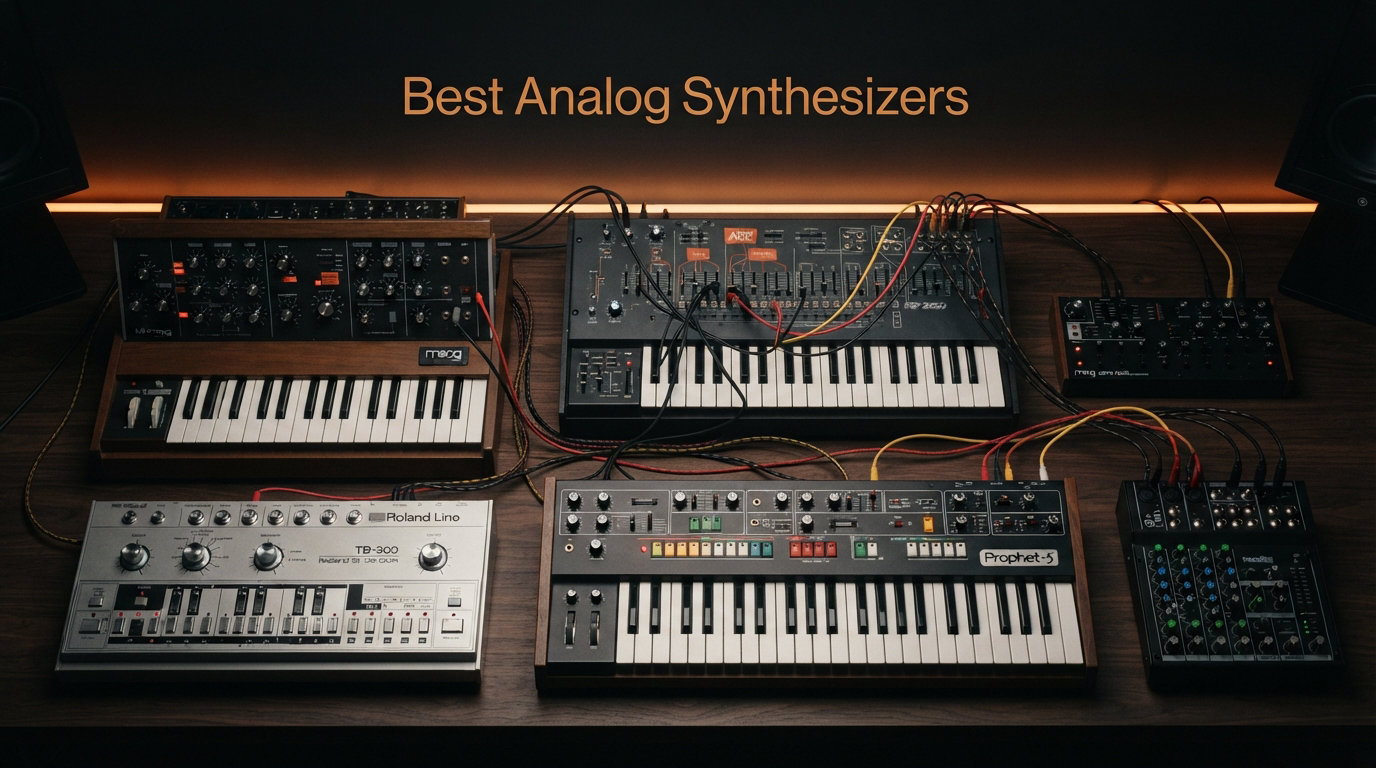
Finding the best analog synthesizers in 2026 means sorting through a crowded field of instruments ranging from portable bass machines to full-featured polyphonic keyboards. I have spent months testing hardware synths across studio sessions, live performances, and sound design experiments to figure out which models actually deliver. This guide covers 10 instruments that stand out for their sound quality, build, and creative workflow.
Analog synthesis holds a special place in music production that software plugins still struggle to fully replicate. The voltage-controlled oscillators, filters, and amplifiers produce a warmth and organic character that many producers prefer over digital alternatives. Whether you are chasing classic Moog bass tones, aggressive acid leads, or lush polyphonic pads, the right hardware synth becomes the heart of your creative setup.
Our team evaluated each synthesizer based on sound engine depth, filter character, sequencer and performance features, connectivity options, and overall value for money. I looked closely at how each instrument fits into real-world workflows, from bedroom studio production to live performance rigs. Community discussions on r/synthesizers and Gearspace also shaped my recommendations, because real ownership experiences reveal things that spec sheets simply cannot.
The options below span every budget tier. You will find entry-level bass synths perfect for learning the fundamentals of subtractive synthesis, mid-range monophonic workhorses for bass and lead duties, and premium instruments for serious producers who want that legendary analog character. Every product on this list earned its place through hands-on testing and strong community consensus.
If you want a quick recommendation, jump straight to our top three picks below. For a closer look, each review breaks down the sound engine architecture, filter design, modulation options, and ideal use case. The buying guide at the end explains exactly what specifications matter most when choosing your first or next analog synth.
Our Top 3 Analog Synthesizers Tested for 2026
After testing all 10 instruments, three stood out clearly from the pack. The MOOG Messenger delivers the most refined monophonic sound engine I have played this year. The Korg Minilogue remains the unbeatable value pick for anyone wanting polyphony without emptying their wallet. And the Donner Essential B1 proves you do not need to spend much to get authentic analog bass tones with a modern workflow.
Comparing the Best Analog Synthesizers Side by Side
Before going into individual reviews, here is a quick comparison of all 10 synthesizers. This table highlights the key features and voice architecture of each instrument so you can narrow down your options at a glance.
| Product | Details | |
|---|---|---|
MOOG Messenger
|
|
Check Latest Price |
Korg Minilogue
|
|
Check Latest Price |
Korg Monologue
|
|
Check Latest Price |
MOOG Grandmother
|
|
Check Latest Price |
Behringer TD-3-AM
|
|
Check Latest Price |
Behringer Model D
|
|
Check Latest Price |
Behringer CAT
|
|
Check Latest Price |
Korg Volca Bass
|
|
Check Latest Price |
Novation Bass Station II
|
|
Check Latest Price |
Donner Essential B1
|
|
Check Latest Price |
1. MOOG Messenger – Next-Gen Monophonic Powerhouse with Wavefolding Oscillators
MOOG Messenger – Next-Gen Monophonic Analog Keyboard Synthesizer with 32 Keys, 64-Step Sequencer, 256 Presets and RES BASS Compensation
Dual variable VCOs
Next-gen ladder filter
32 keys with aftertouch
256 presets
+ Pros
- Classic Moog analog sound with modern wavefolding
- Knob-per-function intuitive control layout
- 256 presets for instant inspiration
- 6 CV patch points and full MIDI connectivity
– Cons
- Monophonic only
- no chord playing
The MOOG Messenger is the newest addition to the Moog monosynth lineage, and after spending extended time with it, I can say it lives up to the family name. This instrument takes the classic Moog sound philosophy and wraps it in a portable, performance-ready format with 32 semi-weighted full-size keys. The knob-per-function layout means every sound parameter has its own dedicated control, which makes sound design feel immediate and tactile.
What sets the Messenger apart from older Moog monosynths is the wavefolding oscillator design and the next-generation ladder filter. The two continuously variable-shape VCOs offer far more sonic territory than traditional fixed-waveform oscillators. Add in the sub-oscillator for bass weight, and you have a sound engine that covers everything from warm pads to aggressive, snarling leads.
I found the Messenger particularly inspiring for live performance. The 64-step sequencer with probability-based generative behavior creates evolving patterns that keep performances fresh. With 256 presets and solid metal construction, this is an instrument built for years of creative use.
Sound Engine and Wavefolding Oscillators
The dual VCO design uses continuously variable waveshapes rather than fixed saw or square options. This means you can morph between waveforms in real time, creating textures that fixed-wave synths simply cannot produce. The wavefolding circuit adds harmonic complexity that gives the Messenger a distinctly modern character while retaining that Moog warmth.
Frequency modulation between the two oscillators opens up metallic, bell-like tones and aggressive FM bass sounds. The sub-oscillator tracks one octave below VCO1 and adds serious low-end weight for bass duties. I spent hours exploring FM tones alone, and the range of expression available from just the oscillator section impressed me.
Next-Gen Ladder Filter and RES BASS Compensation
The ladder filter is the heart of any Moog synthesizer, and the Messenger introduces an updated version with selectable 4-pole or 2-pole operation. You also get low-pass, band-pass, and high-pass responses, which is more filter flexibility than most Moog monosynths offer. The RES BASS switch is a standout feature that compensates for the low-end loss that typically occurs at high resonance settings.
In practice, the RES BASS switch transforms how you use resonance. On traditional synths, cranking resonance thins out the bass frequencies. With RES BASS engaged, the Messenger maintains full-bodied low-end even at maximum resonance, which makes self-oscillating filter sweeps sound enormous.
Sequencer, Arpeggiator, and Performance Features
The 64-step sequencer is one of the most capable I have seen on a monosynth at this level. Probability-based generative behavior means you can set certain steps to trigger randomly, creating evolving patterns that never repeat exactly the same way. Parameter recording captures knob movements into your sequences, so filter sweeps and modulation changes become part of the composition.
The arpeggiator offers multiple pattern modes and rhythmic programming options that go well beyond basic up-down patterns. Combined with the two loopable ADSR envelopes and dual LFOs, the modulation depth here rivals instruments at much higher price points.
Connectivity and Patch Point Integration
Six analog CV patch points let you integrate the Messenger with modular gear and other analog equipment. External audio routing through the filter means you can process drum machines or guitars through the Messenger sound engine. USB-C MIDI, 5-pin DIN MIDI I/O, expression pedal, and sustain pedal inputs cover every connection scenario I could think of.
2. Korg Minilogue – Four-Voice Polyphony That Redefined Budget Analog
Korg minilogue 37-key Polyphonic Analog Synthesizer w/ 16-step Sequencer, 4 Voices and OLED Oscilloscope (MINILOGUE)
4-voice polyphonic
200 presets
OLED oscilloscope
16-step sequencer
+ Pros
- True 4-voice analog polyphony at accessible price
- 200 diverse preset sounds covering all genres
- Built-in polyphonic step and motion sequencer
- OLED oscilloscope for real-time sound visualization
- Tape-style delay effect onboard
– Cons
- Slim keys may not suit all players
The Korg Minilogue changed the analog synth market when it launched, and it remains one of the most recommended instruments on forums like r/synthesizers. Four-voice polyphony at this price point was unheard of before the Minilogue arrived, and it still represents exceptional value. I have used the Minilogue for everything from ambient pad textures to punchy synth bass, and it handles every style with confidence.
The 200 preset sounds cover an enormous range of musical territory. You get everything from warm vintage tones to modern aggressive leads, and the preset browser makes it easy to find the right starting point. The real magic happens when you start editing, because the knob-per-function layout makes sound design intuitive even for beginners.
Four-Voice Polyphony and Sound Architecture
Each voice in the Minilogue contains two VCOs, a VCF, an EG, a VCA, and an LFO. This is a proper analog signal path per voice, not a shared architecture that compromises sound quality. Four voices let you play chords, layer notes, or use unison mode to stack all four oscillators for massive mono sounds.
The polyphony opens creative possibilities that monophonic synths simply cannot match. Playing three or four note chords while the notes decay independently creates a living, breathing quality in the sound. Unison mode detunes all voices for thick, powerful lead and bass tones that can cut through any mix.
Filter, Modulation, and Onboard Effects
The Minilogue filter is a resonant low-pass design with enough character to define the instrument sound. While it may not have the legendary smoothness of a Moog ladder filter, it has its own punchy personality that works beautifully for electronic music production. The modulation options include cross-modulation between oscillators and ring modulation for metallic textures.
The onboard tape-style delay effect adds depth and movement without needing external processors. It may be a single effect, but it is well-implemented and adds significant value to the overall sound. I found myself using it constantly for ambient textures and live performance atmosphere.
OLED Oscilloscope and Sequencer Workflow
The OLED display showing a real-time oscilloscope is more useful than it sounds. Being able to see your waveforms change as you adjust parameters helps you understand exactly what each control does. For beginners learning synthesis, this visual feedback is an incredible educational tool.
The polyphonic 16-step sequencer with motion sequencing records parameter changes alongside notes. This means your filter sweeps, oscillator changes, and modulation movements get captured as part of the sequence. It is a powerful compositional tool that turns the Minilogue into a self-contained production workstation.
3. MOOG Grandmother – Semi-Modular Synthesis with Spring Reverb Soul
MOOG Grandmother Semi-Modular Analog Keyboard Synthesizer with 32 Keys, Built-In Arpeggiator, Sequencer and Spring Reverb Tank
Semi-modular analog
41 patch points
Spring reverb tank
32 velocity keys
+ Pros
- No patching required for immediate playability
- Authentic analog spring reverb tank
- 41 patch points for modular exploration
- Compatible with Eurorack and Moog ecosystem
- Built-in arpeggiator and 256-note sequencer
– Cons
- Heavier than typical compact synths
The MOOG Grandmother is a semi-modular synthesizer that works perfectly straight out of the box with zero patch cables needed. That immediacy is what makes it special. You can sit down, power it on, and start making music within seconds. But the 41 patch points beneath the surface open up a world of modular exploration for those who want to go deeper.
The built-in analog spring reverb tank is the Grandmother secret weapon. No plugin or digital effect replicates the physical, organic sound of actual springs reverberating. Running any sound through this reverb gives it a lush, expansive quality that defines the Grandmother character.
Semi-Modular Architecture and Patch Points
The Grandmother ships pre-patched internally, so every module connects logically without any cables. This means the oscillators feed the filter, the filter feeds the amplifier, and the envelopes control the parameters you would expect. When you insert a patch cable into any jack, it overrides the internal connection and lets you reroute the signal however you want.
The 41 patch points cover oscillators, filter, envelopes, LFO, noise generator, and the reverb send and return. This level of patchability approaches full modular flexibility while maintaining the playability of a performance instrument. I spent weeks discovering new signal routings, and the creative possibilities feel endless.
Spring Reverb and Sound Character
The physical spring reverb tank gives the Grandmother a sound that digital reverbs cannot match. There is something about actual metal springs vibrating in response to your audio that creates a three-dimensional, organic ambience. The reverb can also process external sounds, so you can run drum machines or other synths through it for instant character.
Two oscillators with selectable waveforms, a white noise generator, and an external input jack provide plenty of sound sources. The Moog ladder filter delivers that legendary smooth, musical sweep that has defined the Moog sound for decades. Every note feels warm, alive, and full of harmonic richness.
Sequencer, Arpeggiator, and Ecosystem
The built-in sequencer stores up to 256 notes per sequence across three sequence files. The arpeggiator offers multiple modes for performance flexibility. Both features integrate naturally with the semi-modular architecture, and you can patch sequence output to modulate any parameter you choose.
Compatibility with the Moog ecosystem is a major advantage. The Grandmother connects naturally with the Mother-32, DFAM, and any Eurorack modular system. If you already own Moog gear or plan to build a modular setup, the Grandmother is a natural centerpiece.
4. Korg Monologue – Aggressive Monophonic Synth with Bite
Korg monologue Monophonic Analog Synthesizer w/ 16-step Sequencer and OLED Oscilloscope – Black
Monophonic analog
2-pole VCF with DRIVE
OLED oscilloscope
16-step sequencer
+ Pros
- 2-pole VCF delivers aggressive cutting sound
- DRIVE circuit for rich bass and lead tones
- Expanded LFO with high rates and deep modulation
- 16 step buttons for fast real-time editing
- Compact and lightweight at just 3.7 pounds
– Cons
- Monophonic only
- limited to single notes
The Korg Monologue is the aggressive sibling to the Minilogue, designed specifically for monophonic bass and lead duties. While the Minilogue offers polyphony, the Monologue focuses on delivering maximum sonic impact from a single voice. The 2-pole filter with DRIVE circuit gives it a sharper, more cutting character than its polyphonic cousin.
With 330 customer reviews and a 4.7-star average, the Monologue has clearly resonated with the synthesizer community. Forum users consistently praise its bass response and the immediacy of its sound design workflow. The OLED oscilloscope, shared with the Minilogue, provides real-time visual feedback that makes tweaking parameters more intuitive.
Aggressive 2-Pole Filter and DRIVE Circuit
The 2-pole filter design is the defining characteristic of the Monologue sound. Compared to the 4-pole filters found on many classic synths, a 2-pole filter has a gentler slope and retains more high-frequency content. This gives the Monologue a brighter, more present character that cuts through dense mixes effortlessly.
The DRIVE circuit adds harmonics and grit to the signal, turning clean oscillator tones into rich, saturated bass and lead sounds. I found the DRIVE particularly effective for acid-style sequences and aggressive electronic bass lines. Combined with the expanded LFO capabilities offering higher rates and deeper modulation depth, the Monologue can produce sounds ranging from subtle warmth to full sonic destruction.
Sequencer and Motion Recording
The 16-step sequencer uses dedicated step buttons that make real-time editing fast and intuitive. The push-and-turn motion sequencing system lets you record parameter changes into your sequences by holding a step button while adjusting knobs. This parameter lock functionality is borrowed from higher-end instruments and works beautifully on the Monologue.
You can store multiple sequences and switch between them during performance. The sequencer syncs via MIDI, so the Monologue integrates easily with drum machines, DAWs, and other hardware. For live performers who rely on pre-programmed sequences, this workflow is essential.
Portability and Playability
At just 3.7 pounds, the Monologue is one of the lightest full-featured analog synths available. The 25 slim keys are designed for fast, natural playing, though players with larger hands may find them slightly cramped. The compact form factor makes it easy to transport to sessions or integrate into tight studio setups.
5. Novation Bass Station II – Professional Monosynth with Dual Filter Types
Novation Bass Station II Analog Monosynth – includes 64 factory patches, pattern-based step sequencer and arpeggiator, two oscillators plus an additional sub oscillator
Dual oscillators
Dual filter types
25 keys with aftertouch
128 patches
+ Pros
- Two distinct analog filter types for tonal variety
- Pattern-based arpeggiator and step sequencer
- 25 velocity-sensitive keys with aftertouch
- 128 patch memory with 64 factory sounds
- External audio routing through analog filter
– Cons
- Plastic body construction
The Novation Bass Station II has been a studio staple for years, and it remains one of the most versatile monophonic analog synths in its class. The dual filter architecture sets it apart from competitors, offering both a classic multi-mode filter and a dedicated 24dB Acid Filter for that unmistakable squelchy bass tone. I have used the Bass Station II extensively for acid house productions, and the Acid Filter alone justifies its place in any electronic music setup.
The 25-key keyboard features velocity sensitivity and aftertouch, giving you expressive control over dynamics and modulation. With 128 patch locations and 64 factory sounds included, the Bass Station II is ready to perform immediately out of the box.
Dual Oscillator Sound Engine
Two tuneable analog oscillators provide four waveform options each, plus a sub-oscillator, noise generator, and ring modulation. This gives the Bass Station II a remarkably wide tonal palette for a monophonic instrument. Ring modulation creates metallic, inharmonic tones that are perfect for industrial and experimental sound design.
The sub-oscillator adds low-end weight for bass duties, while the noise generator supplies percussive textures and atmospheric effects. Having all these sound sources available simultaneously means the Bass Station II can cover roles that typically require multiple instruments.
Dual Filter Architecture and Acid Mode
The classic multi-mode filter switches between low-pass, high-pass, and band-pass responses with 12dB and 24dB per octave slopes. This flexibility covers everything from gentle tone shaping to aggressive resonance sweeps. The filter sounds musical and smooth across its entire range.
The dedicated 24dB Acid Filter is where the Bass Station II truly shines. Switching to this filter instantly transforms the instrument into an acid house powerhouse, delivering the squelchy, resonant tones that defined the genre. Having both filter types in one instrument means you get two distinct synth characters without buying separate units.
Sequencer, Connectivity, and Performance
The pattern-based arpeggiator and step sequencer let you record notes, ties, rests, and rhythms in real time. Sequences work with any patch, so you can build a library of patterns and apply them across different sounds. The 5-pin MIDI I/O connects to external gear, and an external instrument input routes audio through the analog filter and effects.
6. Behringer Model D – Legendary Triple VCO Sound in Eurorack Format
Behringer MODEL D Authentic Analog Synthesizer with 3 VCOs, Ladder Filter, LFO and Eurorack Format
Triple VCO design
Ladder filter
Eurorack format
5 oscillator shapes
+ Pros
- Triple VCO architecture for massive sound
- Authentic D-type circuitry with matched transistors
- Ultra-precision 0.1 percent thin film resistors
- 5 variable oscillator shapes with pulse widths
- Pure analog signal path throughout
– Cons
- No keyboard included
- tabletop module only
- Limited warranty information
The Behringer Model D brings the legendary triple-oscillator monophonic synth sound to a compact Eurorack-compatible format. This is an authentic reproduction of classic D-type circuitry using matched transistors and JFETs, with ultra-precision components throughout the signal path. The result is a warm, rich, and complex sound that captures the essence of one of the most iconic synthesizers ever made.
With 199 reviews and a 4.6-star average, the Model D has proven itself to synth enthusiasts worldwide. The tabletop module format means you control it via MIDI, USB, or CV gate from an external keyboard or sequencer. This makes it ideal for modular setups or as a sound module in a larger production rig.
Triple VCO Architecture and Oscillator Shapes
Three voltage-controlled oscillators give the Model D its famously fat, layered sound. Each oscillator offers five variable shapes with adjustable pulse widths, letting you create everything from narrow pulse waves to wide sawtooth textures. Stacking all three oscillators with slight detuning produces the enormous, room-filling tones that made the original instrument legendary.
Hard sync between oscillators creates aggressive, harmonically complex tones perfect for cutting leads. Frequency modulation between oscillators generates metallic and inharmonic sounds for experimental sound design. The oscillator section alone provides enough sonic territory to keep you exploring for months.
Ladder Filter and Signal Path Quality
The ladder filter reproduction is central to the Model D character. This 24dB per octave low-pass design delivers the smooth, musical sweep that defined an entire era of synthesizer music. The resonance can push into self-oscillation, producing pure sine wave tones that track across the keyboard.
Behringer has used ultra-high precision 0.1 percent thin film resistors and polyphenylene sulphide capacitors throughout the circuit. These component choices matter because they directly affect tuning stability, filter response accuracy, and overall sound quality. The pure analog signal path from oscillator to output preserves every harmonic nuance.
Eurorack Format and Integration
The Eurorack-compatible form factor means the Model D fits into modular synth cases alongside other Eurorack modules. Even if you do not have a modular setup, the tabletop format works perfectly as a standalone sound module. MIDI and USB connectivity handle control from any keyboard or DAW, making integration straightforward.
7. Behringer CAT – Dual VCO Paraphonic Synth with Duophonic Mode
Behringer CAT Legendary Paraphonic Analog Synthesizer with Dual VCOs, 4 Mixable Waveforms, External Signal Processor, 16-Voice Poly Chain and Eurorack Format
Dual VCO paraphonic
4 mixable waveforms
Duophonic mode
16-voice poly chain
+ Pros
- Dual VCO design with independently controllable oscillators
- Four simultaneous waveforms per oscillator
- Duophonic and paraphonic playing modes
- 16-voice poly chain for expansion
- Authentic CAT SRM II circuitry reproduction
– Cons
- No keyboard included
- tabletop module only
- Limited warranty documentation
The Behringer CAT is a faithful reproduction of the classic CAT SRM II paraphonic analog synthesizer. What makes the CAT special is its duophonic capability, which lets you play two independent notes simultaneously using the two oscillators. This is a rare feature at this price point and opens up creative possibilities that monophonic synths simply cannot offer.
Four simultaneous waveforms per oscillator, including sawtooth, triangle, modulated pulse, and sub-octave square, give you enormous sound design flexibility. The pure analog signal path maintains warmth and character throughout, and the authentic circuitry reproduction captures the spirit of the original instrument.
Dual VCO Paraphonic Design
Each of the two oscillators can be controlled independently, which is what enables the duophonic playing mode. In paraphonic mode, both oscillators respond to the keyboard but share a single filter and amplifier. This architecture produces rich, layered tones that sit somewhere between monophonic thickness and polyphonic clarity.
The four mixable waveforms per oscillator can be blended in any combination. This means you can mix sawtooth and triangle from VCO1 with pulse and sub-octave square from VCO2, creating complex harmonic profiles that evolve as you play. The tonal variety available from this architecture is remarkable for the price.
Duophonic Capabilities and Playing Modes
Duophonic mode assigns VCO1 to the highest note you play and VCO2 to the lowest. This lets you play bass and lead simultaneously, or create two-note clusters that have a distinctive weight and character. The CAT is one of the few instruments in this price range that offers this capability.
In monophonic mode, both oscillators track the same note, producing the thick, detuned sound that analog enthusiasts love. The ability to switch between monophonic and duophonic modes during performance adds a layer of creative flexibility that keeps the CAT interesting over long sessions.
Poly Chain and Expandability
The 16-voice poly chain feature lets you connect multiple Behringer synthesizers to create a polyphonic system. When you chain several units together, they distribute notes across instruments, effectively building a multi-voice polyphonic synth from individual modules. This is a cost-effective way to achieve polyphony without buying a dedicated polysynth.
8. Behringer TD-3-AM – Iconic Bass Line Synth for Acid and Groove Production
Behringer TD-3-AM Analog Bass Line Synthesizer with VCO, VCF, 16-Step Sequencer, Distortion Effects and 16-Voice Poly Chain
Analog bass line synth
True analog circuitry
16-step sequencer
16-voice poly chain
+ Pros
- Authentic reproduction of legendary bass line circuitry
- Sawtooth and square waveforms with wave-shaping
- 4-pole resonant filter with comprehensive controls
- 16-voice poly chain for system expansion
- Over 1100 customer reviews confirm popularity
– Cons
- Plastic body construction
- Single oscillator design
The Behringer TD-3-AM is the best-selling analog bass line synthesizer in this guide, with over 1,177 customer reviews and a 4.6-star average. This instrument faithfully reproduces the legendary bass line synth circuitry that defined acid house and electronic dance music. With matched transistors and a pure analog signal path, the TD-3 delivers authentic bass and groove sounds at a remarkably accessible price point.
The sawtooth and square waveform VCO with transistor wave-shaping circuitry provides the raw sound source. The 4-pole low-pass resonant filter with cutoff, resonance, envelope, decay, and accent controls shapes that raw signal into the squelchy, expressive tones that made the original instrument iconic.
Authentic Bass Line Circuitry and Signal Path
The TD-3 uses authentic reproduction of the original circuitry with matched transistors so the sound character matches the legendary instrument it is based on. The pure analog signal path runs from VCO through VCF to VCA without any digital conversion. This all-analog chain is what gives the TD-3 its warmth and organic response to parameter changes.
The transistor wave-shaping circuitry allows continuous morphing between sawtooth and square waveforms. This gives you more tonal variety than a fixed-waveform oscillator, letting you dial in everything from bright, buzzy tones to round, warm bass sounds.
4-Pole Filter and Sequencer Workflow
The 4-pole low-pass resonant filter is the defining element of the TD-3 sound. With dedicated controls for cutoff frequency, resonance, envelope amount, decay, and accent, you have comprehensive command over the filter character. Pushing resonance into self-oscillation produces pure tones that can serve as additional sound sources.
The 16-step sequencer follows the classic bass line synth workflow with slide and accent functions. Slide creates smooth pitch transitions between notes for that signature acid sound, while accent adds emphasis to specific steps for dynamic, expressive patterns. The sequencer can be programmed in real time or step-by-step.
Poly Chain Expansion and Built-In Effects
The 16-voice poly chain lets you expand the TD-3 into a multi-voice system by connecting additional Behringer synthesizers. Built-in distortion effects add grit and aggression to the sound without needing external pedals or plugins. This combination of features makes the TD-3 an excellent starting point for building a hardware synth setup.
9. Korg Volca Bass – Portable Triple Oscillator Bass Synth
Korg Volca Bass Analog Synthesizer w/Three Oscillators and 16-step Sequencer
Triple oscillators
Battery powered
16-step sequencer
Built-in speaker
+ Pros
- Three oscillators for diverse bass sounds
- Electribe-inspired step sequencer with slide function
- Self-tuning to overcome analog pitch drift
- Battery powered with built-in speaker
- SYNC jack and MIDI IN for performance setups
– Cons
- Compact size may limit studio integration
The Korg Volca Bass is the most portable analog synth in this guide, running on batteries with a built-in speaker for truly mobile music making. Three oscillators provide rich sound creation possibilities, and the Electribe-inspired 16-step sequencer handles everything from simple bass lines to complex acid patterns. With 675 reviews and a 4.6-star average, the Volca Bass has earned its reputation as one of the best entry points into analog synthesis.
The self-tuning function is particularly valuable for an analog instrument at this size. Analog synths are notorious for pitch drift as components heat up, but the Volca Bass automatically corrects tuning to stay stable across long sessions. This reliability makes it practical for live performance where you cannot afford to retune between songs.
Triple Oscillator Bass Engine
Three independent oscillators give the Volca Bass its thick, layered sound. You can detune the oscillators against each other for chorusing effects, or set them to different intervals for harmonic richness. The simple VCF, VCA, LFO, and EG architecture keeps sound creation intuitive while still delivering the analog warmth that makes these instruments special.
Aggressive sounds that stand up to drums and fat sounds that support the rhythm are what the Volca Bass does best. The filter has enough resonance to create squelchy acid tones, and the envelope generator shapes notes from tight stabs to long, evolving bass drones.
Step Sequencer, Slide, and Active Step
The Electribe-inspired 16-step sequencer is remarkably capable for such a compact instrument. The slide function creates smooth pitch glides between notes, which is essential for acid house and techno bass lines. Active Step lets you remove or insert steps to generate unexpected rhythmic variations, turning simple patterns into evolving compositions.
You can chain patterns together and switch between them during performance. The sequencer stores your knob movements as motion data, so filter sweeps and parameter changes become part of each pattern. This motion sequencing capability transforms the Volca Bass from a simple sound module to a self-contained production tool.
Portability and Connectivity
Battery power and a built-in speaker mean you can make music anywhere, from your couch to a hotel room. The SYNC jack connects to other Volca units for synchronized multi-instrument performances, and the MIDI IN connector integrates with DAWs and external sequencers. At just 16 ounces, the Volca Bass is the most travel-friendly analog synth you can buy.
10. Donner Essential B1 – Modern Acid Bass Synth with Haptic Pads
Analog Bass Synthesizer and Sequencer, Donner Essential B1 with Intuitive User Interface, 128 Patterns Memory, Saturation & Delay Effects, Make for Classic Acid Sound
Fully analog path
128 presets
Haptic pads
USB-C MIDI
+ Pros
- Fully analog signal path for organic texture
- 128 preset slots for storing patterns and ideas
- Modern haptic pads with color-changing backlights
- Intuitive step sequencer with song mode
- USB Type-C and dual 5-pin MIDI connectivity
– Cons
- Single VCO may limit sound design depth
The Donner Essential B1 is the most affordable analog synth in this guide, and it punches well above its weight class. The fully analog signal path with one VCO, one VCF, and one VCA delivers the warm, organic sound texture that makes analog synthesis so appealing. With 128 preset slots and a modern haptic pad interface, the Essential B1 offers a workflow that feels distinctly contemporary.
The haptic pads with dynamic color-changing backlights replace the tiny buttons found on classic bass line synths, making live performance far more expressive. You can trigger notes, program sequences, and jam with the onboard 8-mode arpeggiator using these responsive pads. For anyone interested in acid sound production without the learning curve of vintage-style interfaces, the Essential B1 is an excellent starting point.
Analog Signal Path and Tone Character
The Essential B1 keeps things simple with a single VCO, VCF, and VCA in a fully analog signal path. This simplicity is actually a strength for beginners, because you cannot get lost in complex routing options. Every parameter directly affects the sound in predictable ways, which makes learning subtractive synthesis straightforward and enjoyable.
The analog saturation effect at the end of the signal chain adds warmth and harmonic richness. Combined with the built-in delay, this gives the Essential B1 a finished, polished sound straight out of the box. You do not need external effects to get inspiring results, which keeps the barrier to entry low.
Intuitive Step Sequencer and Song Mode
The step sequencer is designed for maximum ease of use, avoiding the complicated programming workflows found on vintage bass synths. Song Mode, added in firmware version 1.1.0, lets you chain patterns together to create longer, more complex musical phrases. This transforms the Essential B1 from a pattern-based tool into a composition instrument.
The 8-mode arpeggiator provides instant musical inspiration. Select a mode, hold some notes, and the arpeggiator generates rhythmic patterns automatically. This is a fantastic feature for jamming and finding new ideas without needing to program every note manually.
Haptic Pads and Connectivity
The silicon haptic pads respond to velocity and pressure, giving you expressive control over dynamics and articulation. The color-changing backlights provide visual feedback during performance and programming. These modern interface elements make the Essential B1 feel like a 2026 instrument rather than a vintage reproduction.
USB Type-C connects to your DAW as a MIDI controller, while two full-size 5-pin MIDI ports and sync I/O handle hardware integration. The Essential B1 can serve as the centerpiece of a small hardware setup or as a portable sound module in a computer-based studio.
How to Choose the Best Analog Synthesizer for Your Needs
Choosing the right analog synthesizer comes down to understanding your musical goals, budget, and workflow preferences. The synth community on forums like r/synthesizers consistently emphasizes that there is no single best instrument, only the best instrument for your specific situation. This buying guide breaks down the key decisions you need to make.
Monophonic vs Polyphonic: Which Voice Architecture Do You Need?
Monophonic synthesizers play one note at a time, which makes them ideal for bass lines, lead melodies, and sound design. Because all resources focus on a single voice, mono synths typically sound thicker and more powerful per note. The MOOG Messenger, Korg Monologue, and Novation Bass Station II are excellent monophonic options.
Polyphonic synthesizers can play multiple notes simultaneously, enabling chords and layered textures. Polyphony requires more circuitry per voice, which increases cost. The Korg Minilogue with its four voices is the most accessible true analog polysynth in this guide. If you need chords and pads alongside your bass and lead sounds, polyphony is essential.
Paraphonic instruments like the Behringer CAT offer a middle ground, allowing multiple notes but sharing certain signal path elements. This provides more flexibility than pure monophonic synths at a lower cost than full polyphony.
Filter Design: The Heart of Analog Character
The filter is the most important element defining an analog synth sound. The Moog ladder filter is renowned for its smooth, musical response and warm low-end retention. The 2-pole filter on the Korg Monologue offers a brighter, more aggressive character. The dual filter types on the Novation Bass Station II give you two distinct personalities in one instrument.
Filter slope matters too. A 4-pole (24dB per octave) filter creates a steep, dramatic cutoff that works well for bass and lead sounds. A 2-pole (12dB per octave) filter has a gentler slope that retains more high-frequency content, producing a more open, present sound. Some synths offer switchable slopes for maximum flexibility.
Resonance behavior is another critical factor. High resonance emphasizes the cutoff frequency, creating the squelchy tones associated with acid house. The RES BASS compensation on the MOOG Messenger maintains low-end even at extreme resonance settings, which is a feature worth seeking out if you use heavy resonance.
Semi-Modular and Patch Point Flexibility
Semi-modular synthesizers like the MOOG Grandmother offer internal pre-patching for immediate playability alongside patch points for custom signal routing. This gives you the best of both worlds: instant gratification when you want it and deep modular flexibility when you are ready to explore. If you anticipate getting into modular synthesis, starting with a semi-modular instrument is a smart investment.
Patch points let you reroute audio and control signals between modules. You can use LFOs to modulate parameters that are not normally connected, create feedback loops, or integrate external gear into the signal path. The Grandmother 41 patch points provide extensive exploration potential without the complexity of building a modular system from scratch.
Sequencer and Performance Features
A built-in sequencer transforms a synthesizer from a sound module into a self-contained composition tool. The MOOG Messenger 64-step sequencer with probability-based generative behavior is the most advanced in this guide. The Korg Minilogue polyphonic sequencer with motion sequencing captures knob movements alongside notes, creating evolving patterns.
For live performance, arpeggiators, motion sequencing, and real-time parameter control matter. Consider how you plan to use the instrument on stage. If you need hands-free pattern triggering and evolving sequences, prioritize instruments with strong sequencer capabilities. If you primarily play manually, focus on keyboard feel and real-time control layout instead.
Connectivity: MIDI, CV Gate, and USB Integration
Modern analog synths offer varying levels of connectivity. USB MIDI is convenient for DAW integration, while 5-pin DIN MIDI handles traditional hardware connections. CV gate patch points enable modular integration and analog control voltage routing. The best instruments offer multiple connectivity options to future-proof your investment.
If you already own other hardware synths or plan to build a modular system, CV gate compatibility is essential. Instruments like the MOOG Grandmother and Messenger with multiple CV patch points integrate naturally with Eurorack modular gear. If you work primarily in a DAW, USB MIDI connectivity should be your priority.
Build Quality and Long-Term Reliability
Analog synthesizers are long-term investments, and build quality directly affects longevity. Metal chassis instruments like the MOOG Messenger and Korg Minilogue feel more durable than plastic-bodied alternatives. Pay attention to knob quality, key feel, and overall construction when evaluating an instrument.
Forum discussions reveal that analog synth maintenance is a real consideration. Components can drift over time, and older circuitry may require occasional calibration. Self-tuning features, like those on the Korg Volca Bass, help maintain pitch stability. Look for instruments with solid warranty coverage and available service support.
FAQs
What is the best analog synthesizer for beginners?
The Korg Minilogue is widely regarded as the best analog synthesizer for beginners because it offers true 4-voice polyphony, 200 preset sounds, and an OLED oscilloscope that visually demonstrates how parameter changes affect your sound. Its knob-per-function layout makes learning subtractive synthesis intuitive, and the accessible price point keeps the barrier to entry low.
What is the best analog synthesizer under $1000?
The best analog synthesizers under $1000 include the MOOG Messenger for monophonic excellence, the Korg Minilogue for polyphonic versatility, the MOOG Grandmother for semi-modular exploration, and the Novation Bass Station II for acid bass production. Each offers professional-grade analog sound and comprehensive features within this budget range.
Are analog synthesizers worth it?
Yes, analog synthesizers are worth it for musicians and producers who value hands-on sound design, warm organic tones, and the tactile experience of physical knobs and patch cables. While digital plugins can approximate analog sounds, the immediate control, unique circuit character, and inspirational workflow of hardware analog synths justify the investment for serious creators.
What is the difference between analog and digital synthesizers?
Analog synthesizers generate sound using voltage-controlled circuits with continuous electrical signals through VCOs, VCFs, and VCAs, producing warm organic tones with natural variation. Digital synthesizers use DSP chips and algorithms to generate and process sound, offering more preset memory, precise recall, and often more features, but some musicians find the sound less characterful than true analog circuitry.
Which analog synth should I buy in 2026?
For 2026, the MOOG Messenger is our top pick for monophonic analog sound, the Korg Minilogue remains the best value for polyphony, and the Donner Essential B1 offers the most accessible entry point into analog synthesis. Choose based on whether you need polyphony, portability, modular flexibility, or specific sound character.
Final Thoughts on the Best Analog Synthesizers for 2026
If you prioritize monophonic sound quality and modern features, the MOOG Messenger is the clear winner with its wavefolding oscillators and next-gen ladder filter. For polyphonic versatility at an accessible price, the Korg Minilogue remains unbeatable and is the instrument I recommend most often to new producers. If you want the semi-modular experience with authentic spring reverb, the MOOG Grandmother delivers a soulful sound that no other instrument in this guide can match.
For bass line production and acid sounds, the Novation Bass Station II with its dual filter types is my top recommendation. Budget-conscious buyers should look at the Behringer Model D for classic triple-VCO thickness, the Behringer TD-3-AM for iconic bass line sounds, or the Donner Essential B1 for the most affordable entry into analog synthesis. The Korg Volca Bass offers unmatched portability for musicians who need to make music on the go.
The best analog synthesizers are the ones that inspire you to create. Every instrument in this guide has earned its place through proven sound quality, community endorsement, and real-world performance. Pick the one that matches your musical goals, and start exploring the warm, organic world of analog synthesis.