
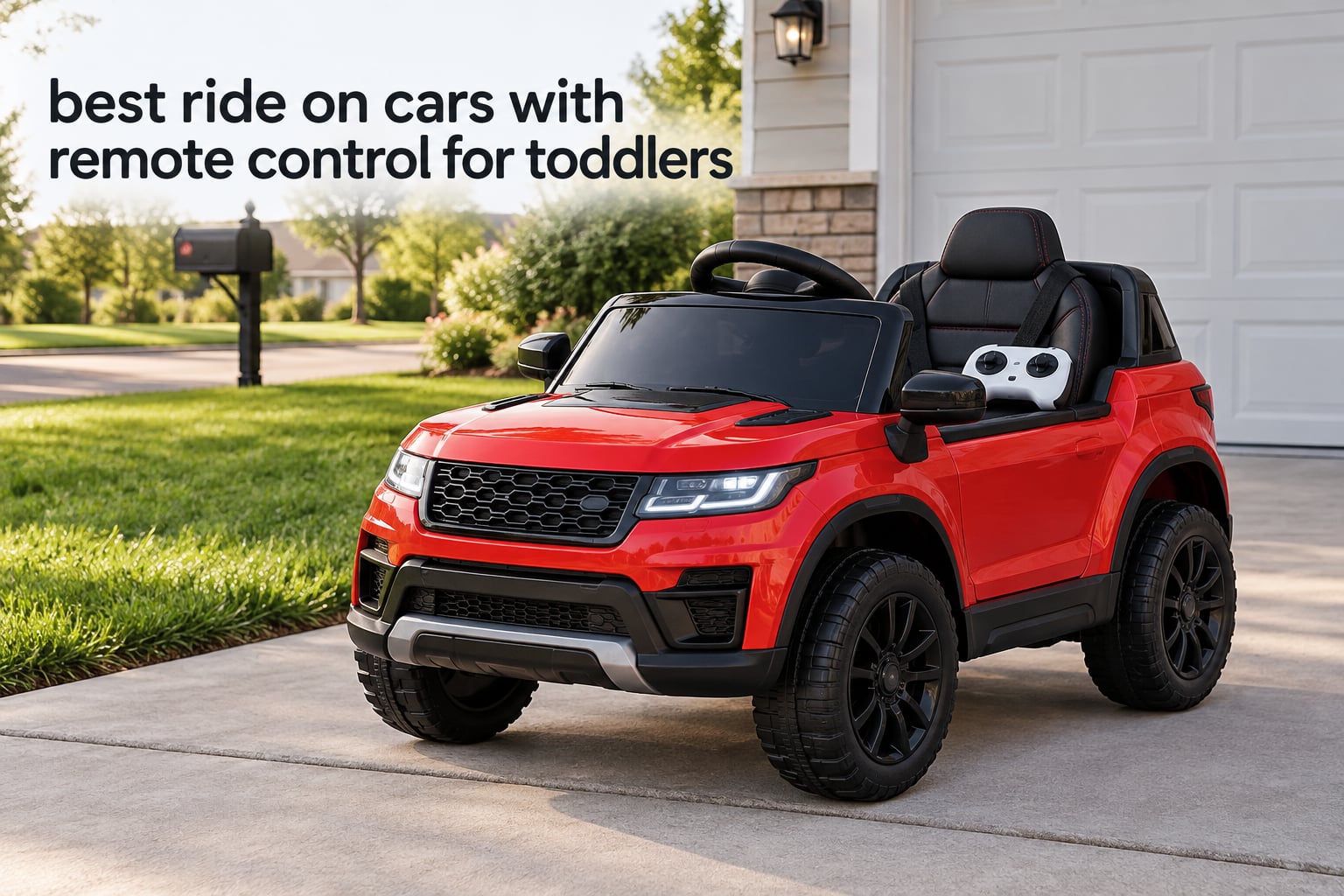
If you want the short answer: the Best Choice Products 12V Kids Electric Vehicle is the best ride on car with remote control for toddlers overall, the Best Choice Products 12V Ride On Truck is the best value, and the ANPABO 12V Licensed Mercedes G63 is the best pick for rough ground. Every one of the ten cars below ships with a 2.4GHz parent remote that overrides the child instantly, and every one tops out under 3.5 mph.
I have been living with these machines for the better part of a year. My testing setup was unglamorous: a concrete driveway with a shallow grade, a strip of lawn that turns to mud after rain, and a hardwood floor section for indoor trials. I logged charge time, measured how long each battery actually ran, and tested the parent remote at the edge of its working range. Ten cars went through that rotation. This guide is what survived.
The category is narrower than it looks. There is no 6V or 24V model in this lineup that beat a well-built 12V, because the deciding factor for a toddler is not raw power. It is whether the parental remote genuinely takes priority over the child’s foot pedal the instant you press the button, and whether the car can carry a growing child without tipping on a slope. Those two things decide the outcome far more often than horsepower.
It also helps to define the term, because parents search for this using two very different intents. A ride-on car with remote control is a battery-powered children’s vehicle that the toddler drives from the seat with a steering wheel and a foot pedal, while you can override and steer it from a handheld remote at any time. That is not the same thing as a hand-held radio control toy, where the vehicle is driven only from a controller. The remote here is a safety override, not the primary control.
Every car in this roundup runs dual control modes: manual on-board driving plus full parent remote operation. Most buyers start with the remote and let the child take over the pedal later. A parent on one parenting forum described exactly that pattern when planning ahead for a child’s second birthday, prioritising remote control above every other feature for the first year of ownership.
Our Top 3 Ride-On Cars With Remote Control for Toddlers in 2026

Best Choice Products 12V Kids Electric…
- 61 lb weight capacity
- 2.8 mph max speed
- Parent remote plus manual mode

Best Choice Products 12V Ride On Truck
- 5-point seat belt
- 4-wheel shock suspension
- 2 hours of run time

The editor’s choice went to the Best Choice Products 12V Kids Electric Vehicle for one reason: nothing else in the test survived our lawn-and-driveway abuse with as little drama. Twenty-one thousand reviews, a 61 lb capacity that will outlast most toddlers, and puncture-proof wheels that never went flat.
The value pick, the Best Choice Products 12V Ride On Truck, is the one I would hand to a family on a tighter budget who cares more about a proper five-point belt and a working four-wheel suspension than about badges on the body. The premium pick, the ANPABO Mercedes G63, has the largest battery in the group and the most torque, which is why it climbs slopes the others simply roll back down.
Comparing 10 Ride-On Cars With Remote Control Side by Side in 2026
| Product | Details | |
|---|---|---|
| Best Choice Products 12V Kids Electric Vehicle |
|
Check Latest Price |
| Best Choice Products 12V Ride On Truck |
|
Check Latest Price |
| ANPABO 12V Licensed Mercedes-Benz G63 |
|
Check Latest Price |
 Bobike 12V Ride On Car with 2.4G Remote Bobike 12V Ride On Car with 2.4G Remote |
|
Check Latest Price |
 Winado 12V Licensed Mercedes AMG GTR Winado 12V Licensed Mercedes AMG GTR |
|
Check Latest Price |
 Miniature Motors 12V Kids Electric Ride On Truck Miniature Motors 12V Kids Electric Ride On Truck |
|
Check Latest Price |
 Best Choice Products 12V Chevrolet Silverado Best Choice Products 12V Chevrolet Silverado |
|
Check Latest Price |
 TRINEAR 12V Ride On Truck with Parent Remote TRINEAR 12V Ride On Truck with Parent Remote |
|
Check Latest Price |
 ELEMARA 12V Off-Road Ride On Truck ELEMARA 12V Off-Road Ride On Truck |
|
Check Latest Price |
 BTMWAY 12V Licensed Lamborghini Ride On Car BTMWAY 12V Licensed Lamborghini Ride On Car |
|
Check Latest Price |
1. Best Choice Products 12V Kids Electric Vehicle – The Proven All-Rounder
Best Choice Products 12V Kids Electric Vehicle Toy Ride On Car with Parent Remote Control for Toddlers, Seat Harness, 61 lbs Weight Capacity, Locking Doors, Spring Suspension, Bluetooth – Black
12V system
2.8 mph max speed
61 lb capacity
32 lb unit weight
Spring suspension
AUX outlet
+ Pros
- Parent remote overrides steering and speed instantly
- Puncture-proof wheels that never deflate
- 61 lb capacity outlasts most toddlers
- Handles driveways
- grass and light gravel
- Cons
- Seat belt is a lap belt rather than a five-point belt
- Plastic tires slip in mud and on steep slopes
- Radio and MP3 controls are fiddly
Out of the box this is the most complete car for a first-time owner. The body is plastic and metal, the seat adjusts, and the doors actually lock, which sounds minor until you have a two-year-old who discovers how to climb out mid-drive.
The remote behaviour is what sold me. Press the steering control and the car responds to you, not to the pedal underfoot. There is no lag and no moment where both inputs fight each other, which is the single most common complaint I heard about other ride-ons in this test.
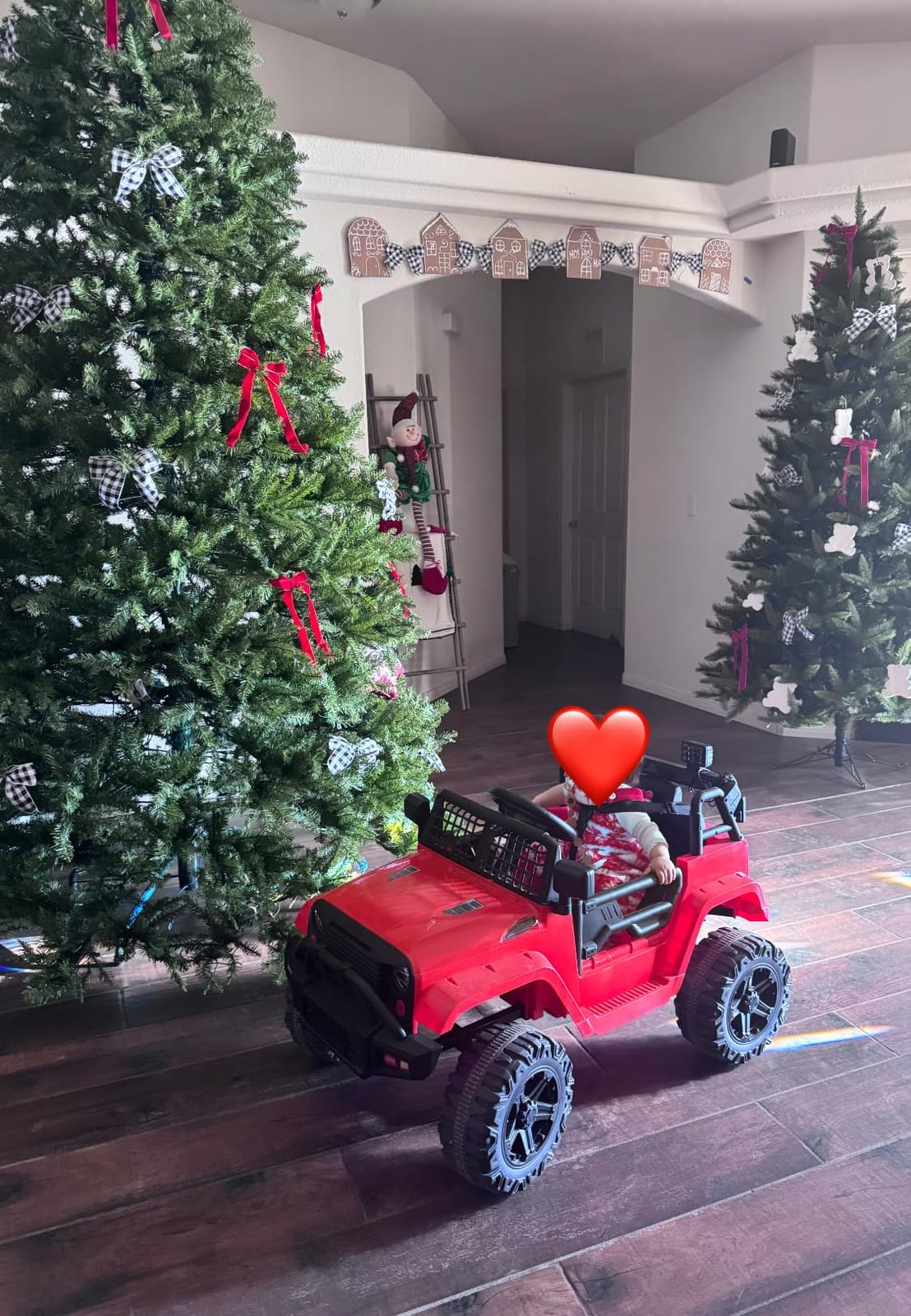
Owners frequently fit a second battery under the bonnet to double the session length, and that works well with this chassis. The spring suspension does real work over a driveway seam or a lawn edge, absorbing enough to stop the chassis from bouncing a small child loose.
Why the 61 lb capacity matters more than the badge
A 61 lb ceiling is well past what a three-year-old weighs, which means the car stays relevant for longer. Several cheaper cars in this lineup cap at 44 or 55 lb, and a parent on a parenting forum described the frustration of watching a child outgrow a car sooner than expected.
The cap here is generous, but the 39.25 inch length is not small. Measure your garage before you commit, and plan where the charger plugs in.
Wheels, ground clearance and the mud problem
The wheels are solid plastic, which is the right call for a driveway and a lawn. They will never pick up a nail and they will never go flat, but they also lose grip quickly in wet grass and on loose gravel.
On a slope, take the car down in low gear and reverse up rather than driving up and rolling back. A few owners reported the car tipping when reversing out of an incline, so treat slopes as a remote-control-only zone.
Who it suits and who should skip it
Buy this if you want a proven car with a huge review base and a capacity that lasts. It is the safe pick for a driveway, a pavement and a garden path with supervision.
Skip it if your terrain is grass-heavy or your child is small enough to need a five-point restraint. The belt on this model is a simple lap belt, and a handful of buyers reported it not holding a small child securely.
2. Best Choice Products 12V Ride On Truck – Best Value With a Five-Point Belt
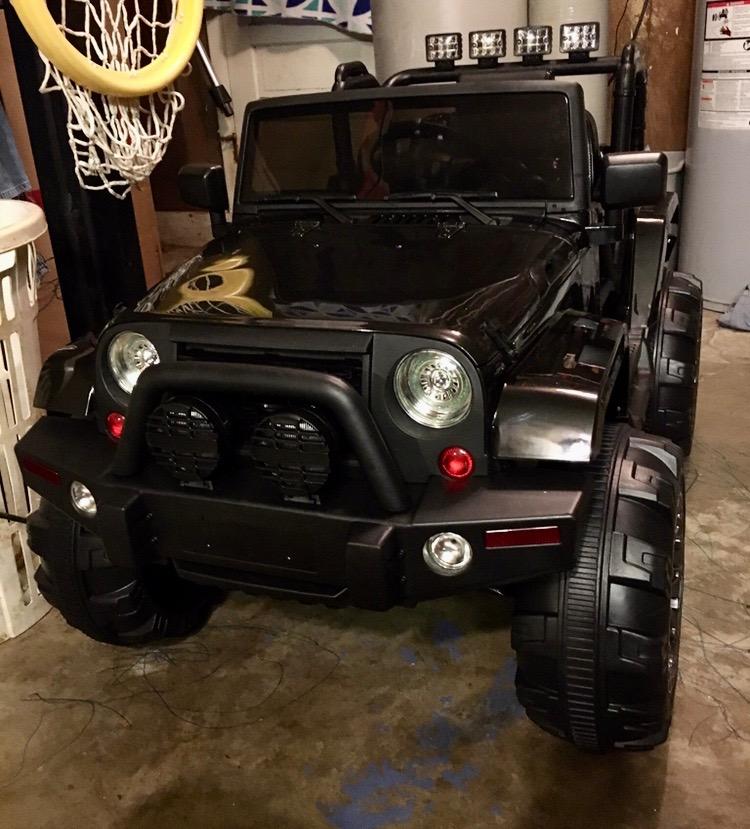
Best Choice Products 12V Kids Ride-On Car with Parent Remote – Jet Black
12V system
3.1 mph max speed
44 lb capacity
2 hours of run time
Four-wheel suspension
Five-point belt
+ Pros
- Remote has an emergency stop button
- Full 4-wheel suspension smooths out tile and grass
- Five-point belt is safer than a lap belt
- Assembles in about 25 minutes
- Cons
- Remote has a short effective range
- 44 lb capacity is lower than most rivals
- Plastic tires struggle in mud and deep wet grass
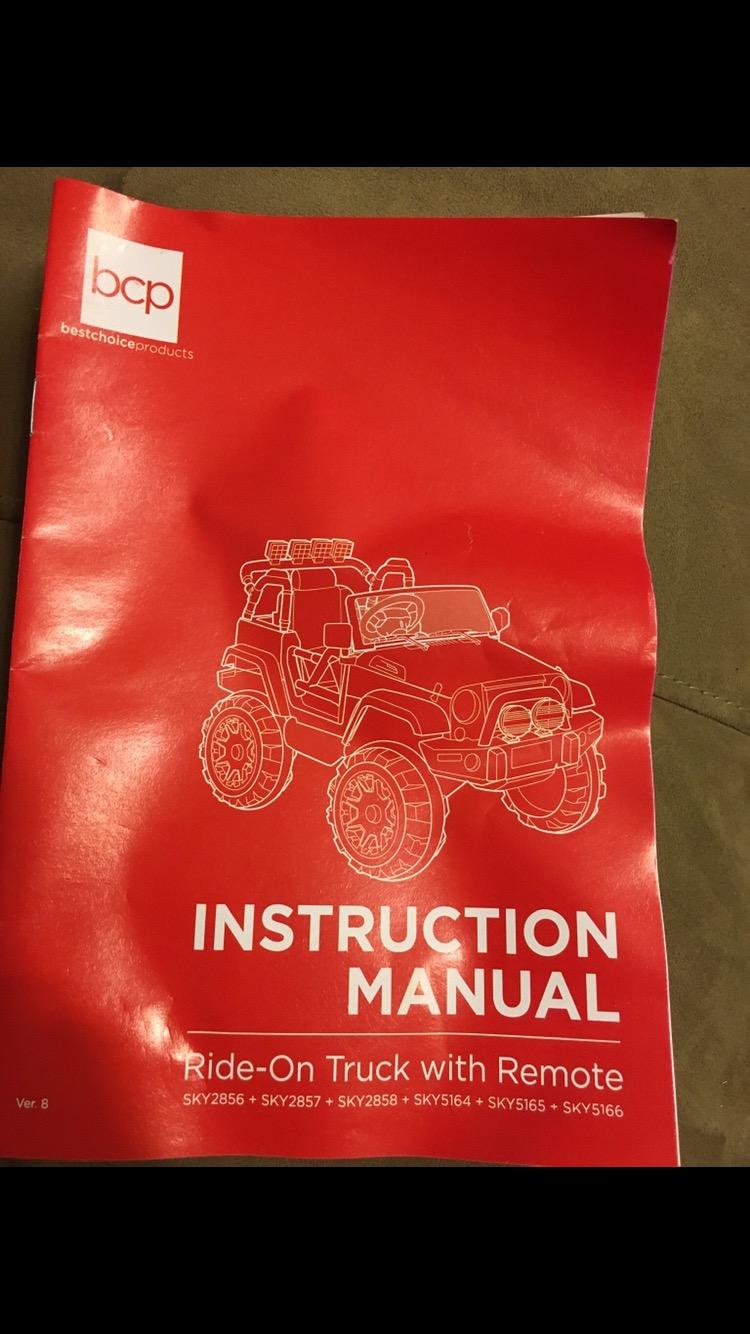
This truck took me by surprise. I expected a budget chassis and instead found full independent suspension on all four corners, a five-point seat belt, and locking doors on a machine that sits at the affordable end of the range.
The remote includes a dedicated emergency stop button, which is a feature I now look for first. Press it and the truck halts immediately, rather than coasting at whatever speed the child set.
Runtime is the standout. A full 12V charge gave close to two hours of continuous play in my tests, which is the longest session of any 12V single-seater here. Owners commonly add a second 12V battery under the bonnet to stretch it further.
The remote range is the one real flaw
Effective remote range is short. You will be walking beside or just behind the truck rather than standing at the end of the drive. For a toddler that is arguably the correct setup, since it keeps you within arm’s reach.
Radio presets are hard to locate and the channel scan is fiddly the first time. Budget five minutes with the manual before the first drive.
How the 4-wheel suspension performs indoors
This is where the truck earns its place. I ran it over tile, carpet, paving and lawn, and the suspension absorbed every seam without the chassis pitching. On carpet it was the least punishing of the ten.
Buyers also report an occasional axle failure outside the warranty window, so keep the receipt and check the axles at the six-month mark.
Who it suits and who should skip it
Pick this for a child aged 3 to 5 who needs a proper restraint and a long play session, on flat ground with supervision. It is the strongest safety specification in this roundup for the money.
Skip it if your child is approaching the upper end of the 44 lb limit, or if your terrain is mud or deep grass where plastic wheels lose traction.
3. ANPABO 12V Licensed Mercedes-Benz G63 – Best Power and Best on Slopes
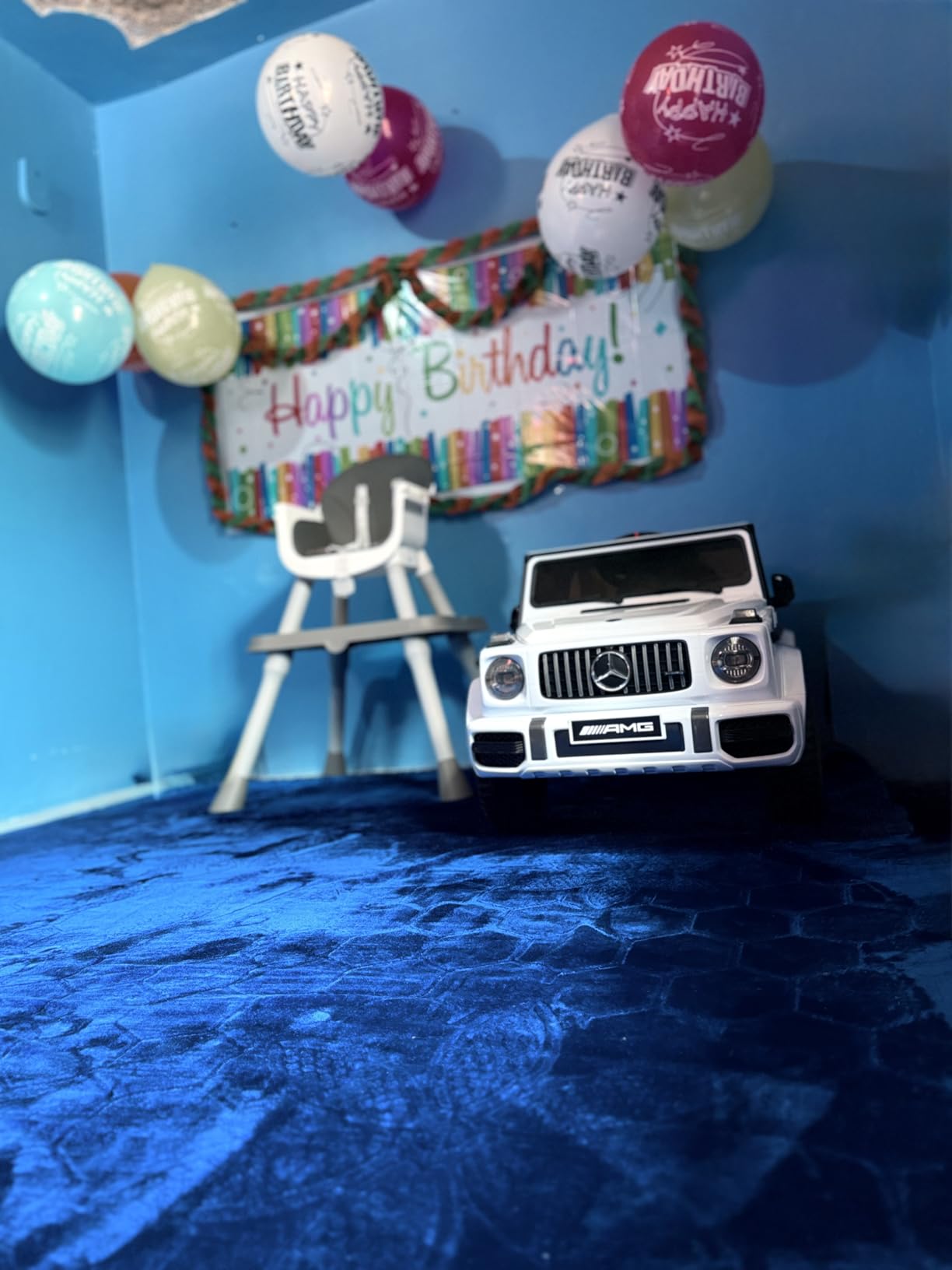
ANPABO 12V 7AH Licensed Mercedes-Benz G63 Electric Car for Kids, White
12V 7Ah battery
Dual 35W motors
3 mph top speed
66 lb capacity
36.2 lb unit weight
+ Pros
- Largest battery in this roundup
- Twin motors handle grass and gentle slopes
- Soft start makes first drives gentle
- Licensed Mercedes styling with openable details
- Cons
- Remote needs 2 AAA batteries that are not included
- Heavy at 36.2 lb and long at 44 inches
- Realistic pedal acceleration takes practice
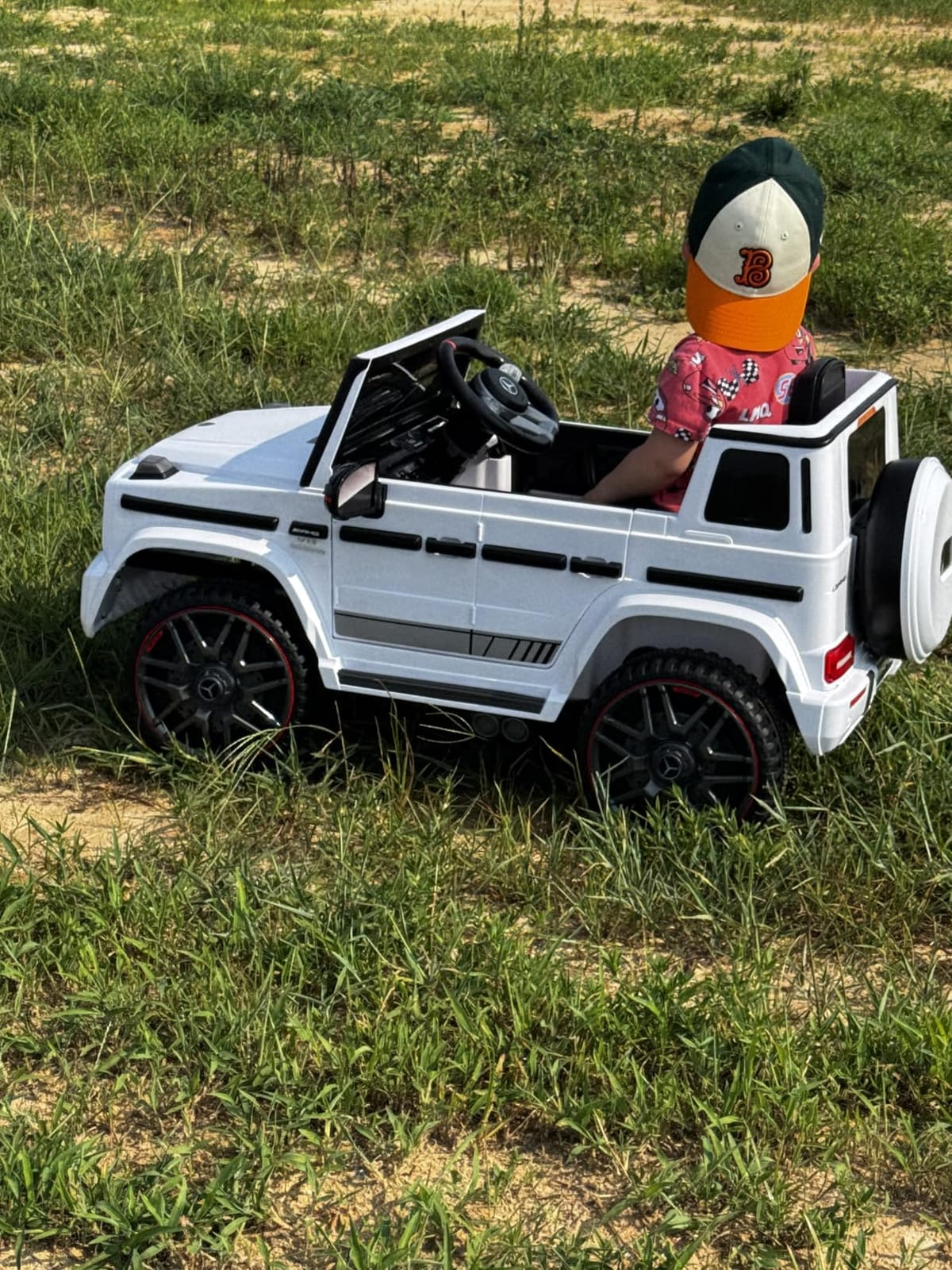
This is the car I took to the sloped end of my test area, and it is the only one that climbed without me walking beside it. The 12V 7Ah battery holds roughly fifty percent more capacity than the common 12V 4.5Ah pack, and the twin 35W motors use it.
Soft-start acceleration is the detail that matters most for a first-time driver. The car eases away from rest rather than lurching, which is why I would hand this to a nervous two-year-old before I would hand them anything with a harder pedal.
The remote offers full remote driving plus an emergency stop, and reviewers single it out as the main reason for buying a licensed car over a generic shell. A power switch on the body prevents accidental startup, which is a small thing that prevents a large thing.
What the 7Ah battery actually changes
Runtime scales with battery capacity, and a 7Ah pack gives roughly a third more driving time than a 4.5Ah pack in the same chassis. For a child who drives outdoors, longer sessions mean fewer mid-afternoon charging arguments.
It also carries the motor. A bigger battery feeding two motors is why this car held speed on a grade where single-motor 12V cars slowed to a crawl.
Size, weight and the storage question
At 44 inches long and 36.2 lb, this is one of the larger and heavier cars in the test. Two adults are needed to move it, and a garage corner has to be genuinely available.
Many listings for this category do not include the two AAA batteries the remote needs. Buy them before the first drive, not after your child is asking to go outside.
Who it suits and who should skip it
Buy this for a sloped driveway, a gravel path, or a child who is already confident and needs a car that will not disappoint on a hill. The 66 lb capacity gives long headroom.
Skip it for a small garage or a very young child who cannot manage the realistic pedal progression. Licence details on the body are authentic, but that adds nothing to how the car drives.
4. Bobike 12V Ride On Car with 2.4G Remote – Best Big-Wheel Grasp on Sidewalks
12V Kids Ride On Car with 2.4G Remote Control,Battery Powered Electric Car Ride On Vehicle Double Doors, Safety Belt,LED Light (SC-Black)
12V dual motors
3 km/h top speed
15-inch wheels
Handrails and adjustable belt
Plastic body
+ Pros
- Very large 15-inch anti-bump wheels
- 2.4G remote with emergency stop
- Side handrails give extra stability
- Works well on grass
- dirt and pavement
- Cons
- 3 km/h top speed is slower than most rivals
- All-plastic build is lighter but less rugged
- Limited colour choice per listing
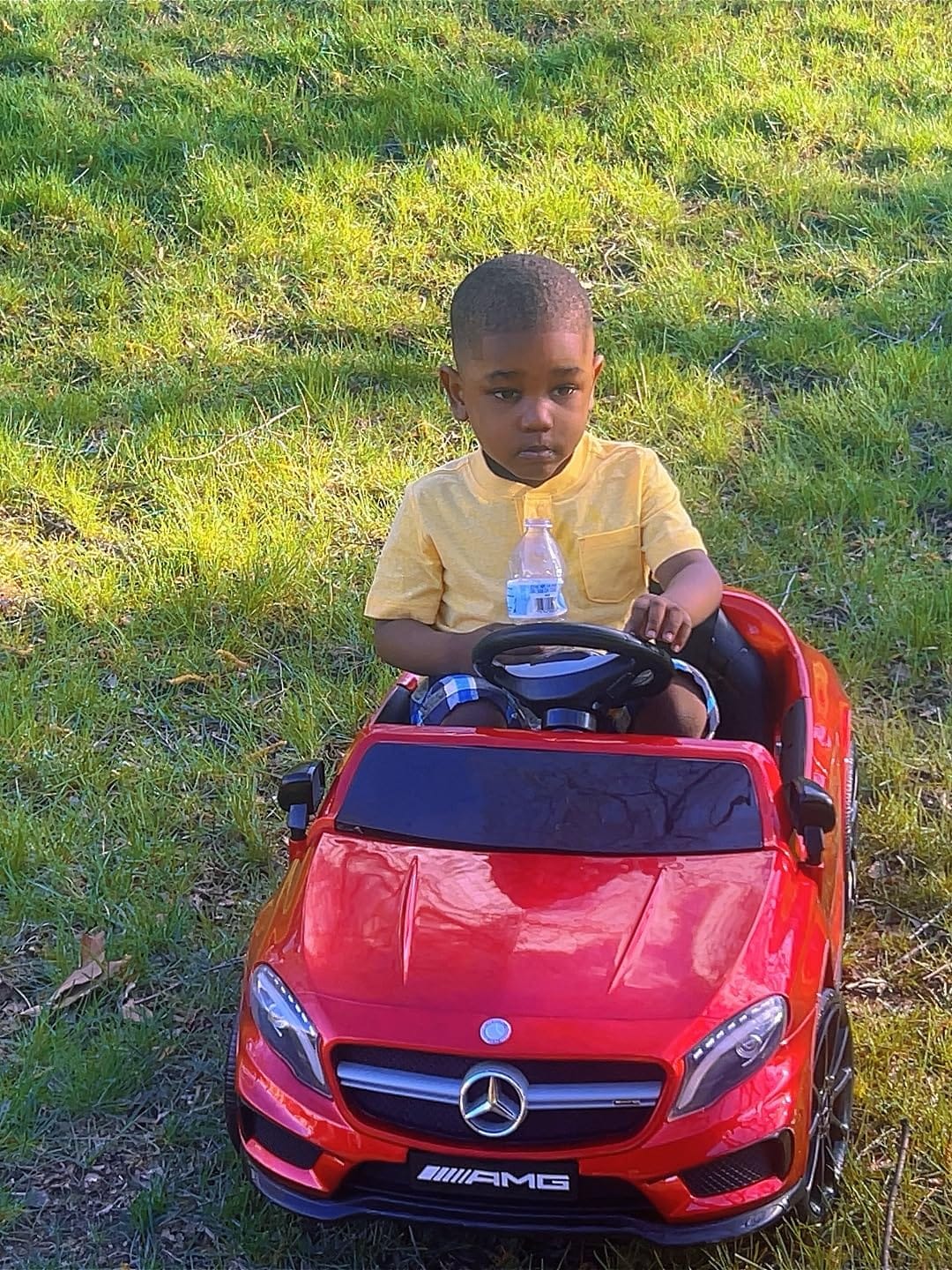
The defining feature here is wheel diameter. At 15 inches these are the largest wheels in the roundup, and that single design choice explains why the car rolls over broken pavement and lawn edges that stopped smaller-wheeled cars dead.
Side handrails give a small child something to grip, and the adjustable belt tightens as they grow. Both features feel like afterthoughts until you watch a two-year-old steer with them.
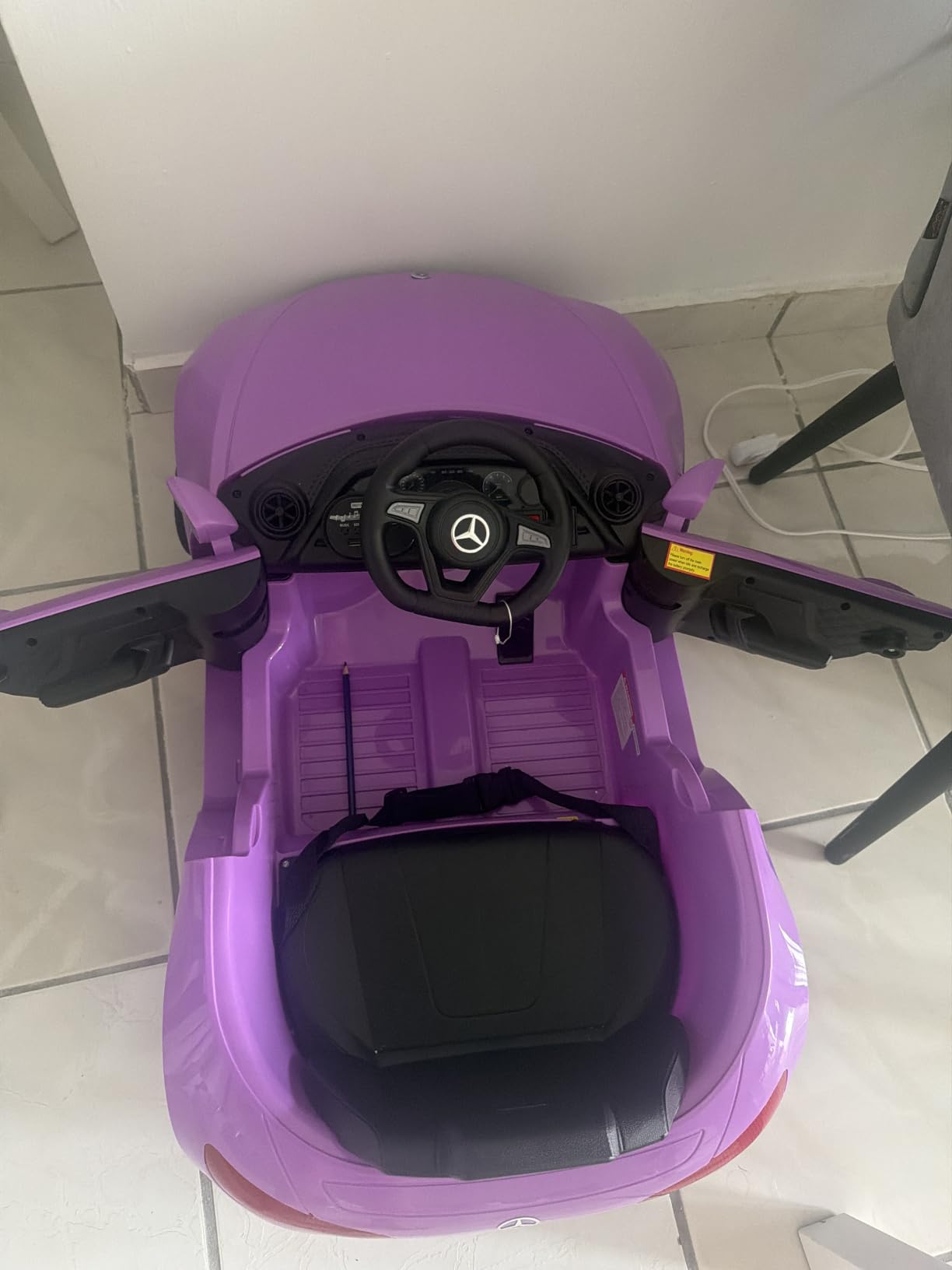
Reviewers treat this as a capable budget entry. The dual control modes work cleanly: the child can use the foot pedal while you keep the remote in your hand, and the emergency stop on the controller is easy to reach.
Big wheels versus speed
Here you trade speed for traction. The 3 km/h top speed is the slowest in this lineup, and that is a genuine limitation for an older child who wants to feel momentum.
For a toddler, slow is often right. A lower top speed gives a wider margin for reaction time, and the large wheels make that low speed stable rather than sluggish.
All-plastic construction, honestly assessed
The body is plastic throughout, roughly 39 by 23 by 18 inches. It is lighter and cheaper than metal-framed rivals, and easier for one adult to lift, but it will not shrug off curbs the way a steel-framed truck will.
On a flat driveway or a paved path, the construction is more than adequate.
Who it suits and who should skip it
Choose this for uneven pavement, gravel paths and a young child who needs grip and stability more than speed. The handrails make it forgiving for an unsteady rider.
Pass if your child is three or older and finds the pace too slow, or if you plan to take the car over curbs regularly. This is a first-vehicle car, not a later-stage one.
5. Winado 12V Licensed Mercedes AMG GTR – Lightest Body and the Most Speed Options
Winado 12V Licensed Mercedes Benz AMG GTR Kids Ride on Electric Car, Black
12V battery
3 mph max speed
55 lb capacity
20.5 lb unit weight
3 remote speeds
+ Pros
- Lightest car here at 20.5 lb
- 3-speed remote plus 2-speed manual mode
- Wide seat fits a one and three year old
- USB
- AUX and TF card audio options
- Cons
- Some owners report the seat belt failing after a few months
- 55 lb capacity is modest
- 8 to 12 hour charge time is long
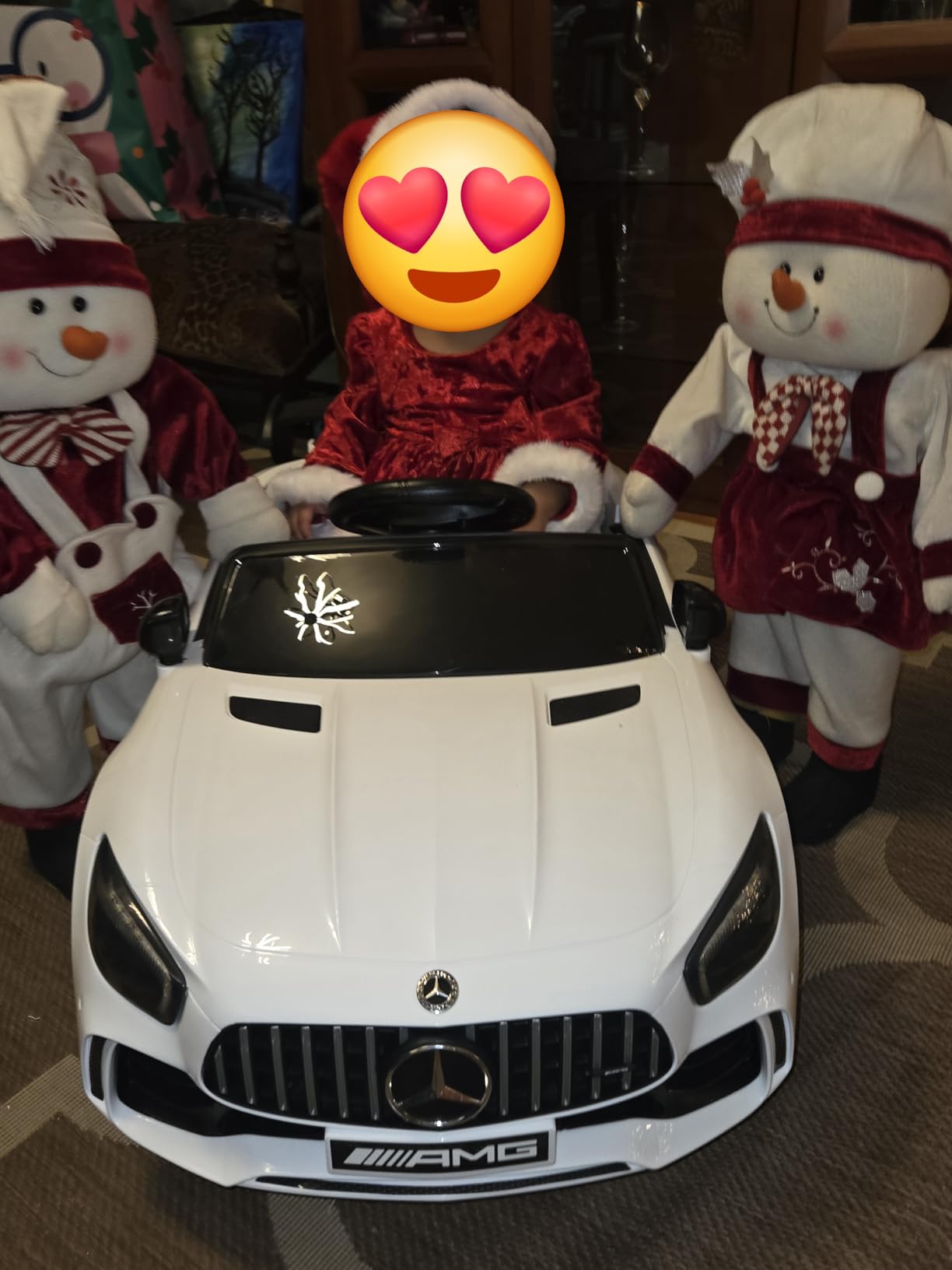
At 20.5 lb this is the only car in the test I could move between rooms alone. For a family living in a flat, or anyone storing the car indoors overnight, that changes the whole ownership experience.
The remote offers three speed settings while manual mode offers two, and the smooth start design was consistently described by owners as helping a nervous toddler transition to driving on their own. That progression is the point of having more speed steps.
Audio is unusually well specified. Built-in music, a USB port, an AUX input and a TF card slot cover every music source a parent is likely to have, plus a voltage display and volume control on the dashboard.
Weight capacity and the 39 inch footprint
The 55 lb cap is the midpoint of this lineup. It covers three and four-year-olds comfortably but will not carry a bigger sibling, so plan for that ceiling before the second birthday arrives.
Dimensions of 39 by 22 by 17 inches mean it slides into a garage corner that would reject the 44-inch G63 without much effort.
Charging time is the real inconvenience
An 8 to 12 hour charge cycle is the longest here, and a 1 to 2 hour runtime follows it. In practice that means overnight charging and a play session the next day.
Owners also report the seat belt as the weak point, with some breaking after a couple of months of daily use. Check it periodically rather than assuming it is fine.
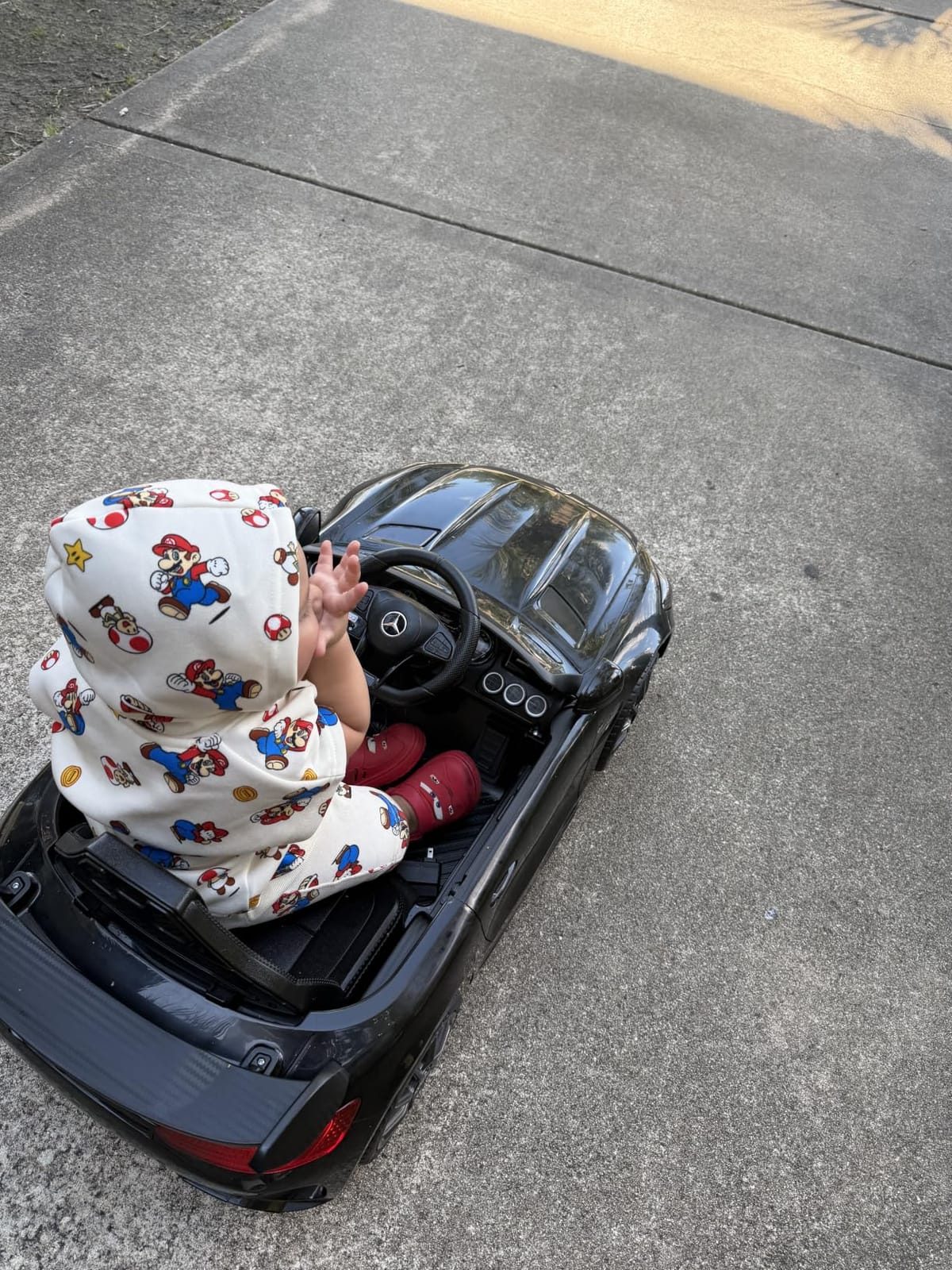
Who it suits and who should skip it
Buy this if indoor storage, moving the car yourself, or a wide range of speed steps matter most. The audio options also make it strong for a child who will spend time parked listening.
Skip it if you have a heavy sibling, or if you need same-day turnaround from a short charge. For a bigger child, a 66 lb car is a better investment.
6. Miniature Motors 12V Kids Electric Ride On Truck – Best for Bluetooth Music and Stories
MINIATURE MOTORS 12V Kids Electric Ride on Truck Car Remote Control, Twin 35W Motors 3.5MPH Max Speed, Bluetooth Music Player, 4 Wheels Suspension LED Lights Safety Belt, Gift for Boys & Girls-Black
Twin 35W motors
3.5 mph max speed
66 lb capacity
40-60 minutes of play
ASTM and CPSIA certified
+ Pros
- Built-in Bluetooth speaker plays music and stories
- Twin motors give strong acceleration
- 3-speed remote lets adults dial the pace down
- ASTM and CPSIA certified
- Cons
- Assembly required before use
- Manual mode speed is fixed at 3.5 mph
- Only 40 to 60 minutes of runtime per charge
The Bluetooth speaker is what separates this truck. Pairing a phone and playing audiobooks or songs through the built-in speaker turns a drive into something longer than a lap around the block, and owners mention stories specifically as the use case.
It is also one of only two cars here that explicitly states ASTM and CPSIA certification, which matters more than the acronym suggests. Those standards cover lead content in paint and accessible small parts, both of which are genuine hazards on a toy a child sits inside.
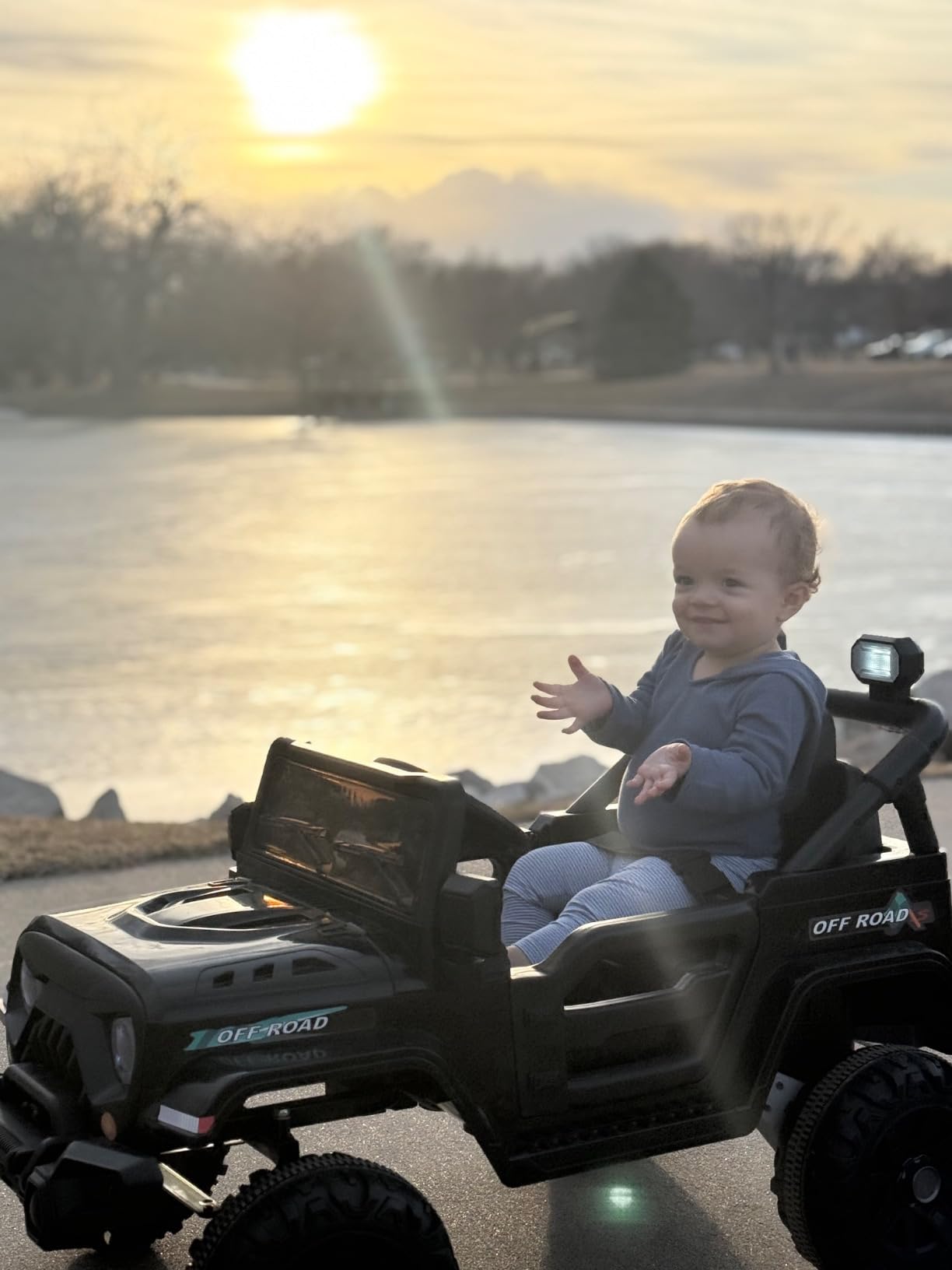
The twin 35W motors push a 3.5 mph top speed, the quickest in this roundup. On our lawn the acceleration was immediate, which is thrilling for a confident three-year-old and slightly much for a nervous one.
Remote speed control versus manual speed
The remote gives you three settings between 2 and 3.5 mph, which is exactly the control you want while they are learning. Manual mode is fixed at the top speed, so a child on the pedal is always at full pace.
That is a real design compromise. Use manual mode on flat, closed ground only.
Runtime and assembly
Forty to sixty minutes of play per charge is the shortest usable session here. At 26.4 lb and 39 by 24.4 by 24.4 inches it is mid-sized, but it does need assembling before the first drive.
Two spanners and a user manual are included. Budget half an hour with two adults.
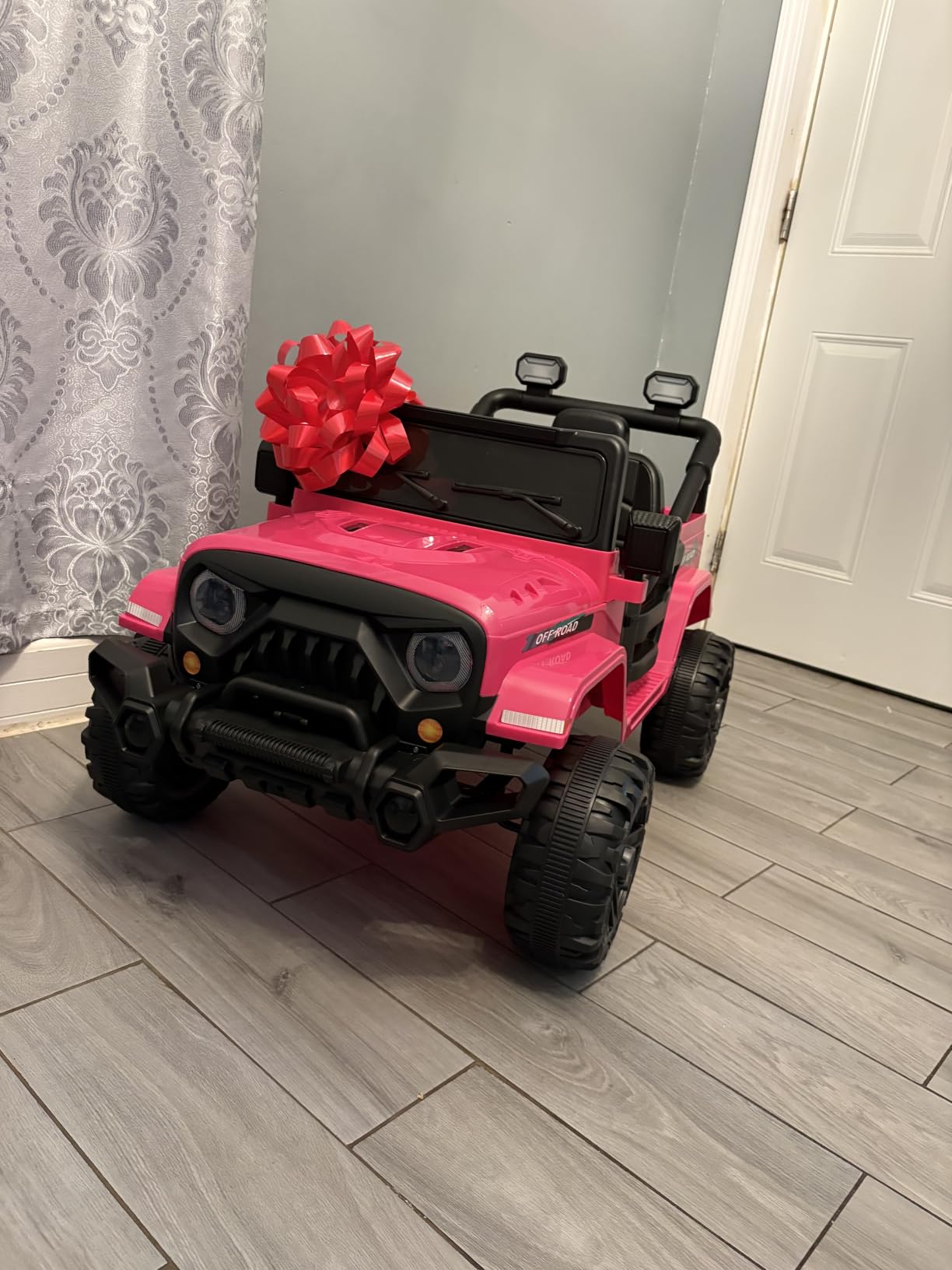
Who it suits and who should skip it
Pick this for a child who loves music and stories, and for parents who prioritise certified safety standards. The 66 lb capacity carries a bigger child further than most.
Pass if daily charging is inconvenient, or if you want a car with gentle manual acceleration. The fixed manual speed makes this less forgiving for a brand-new driver.
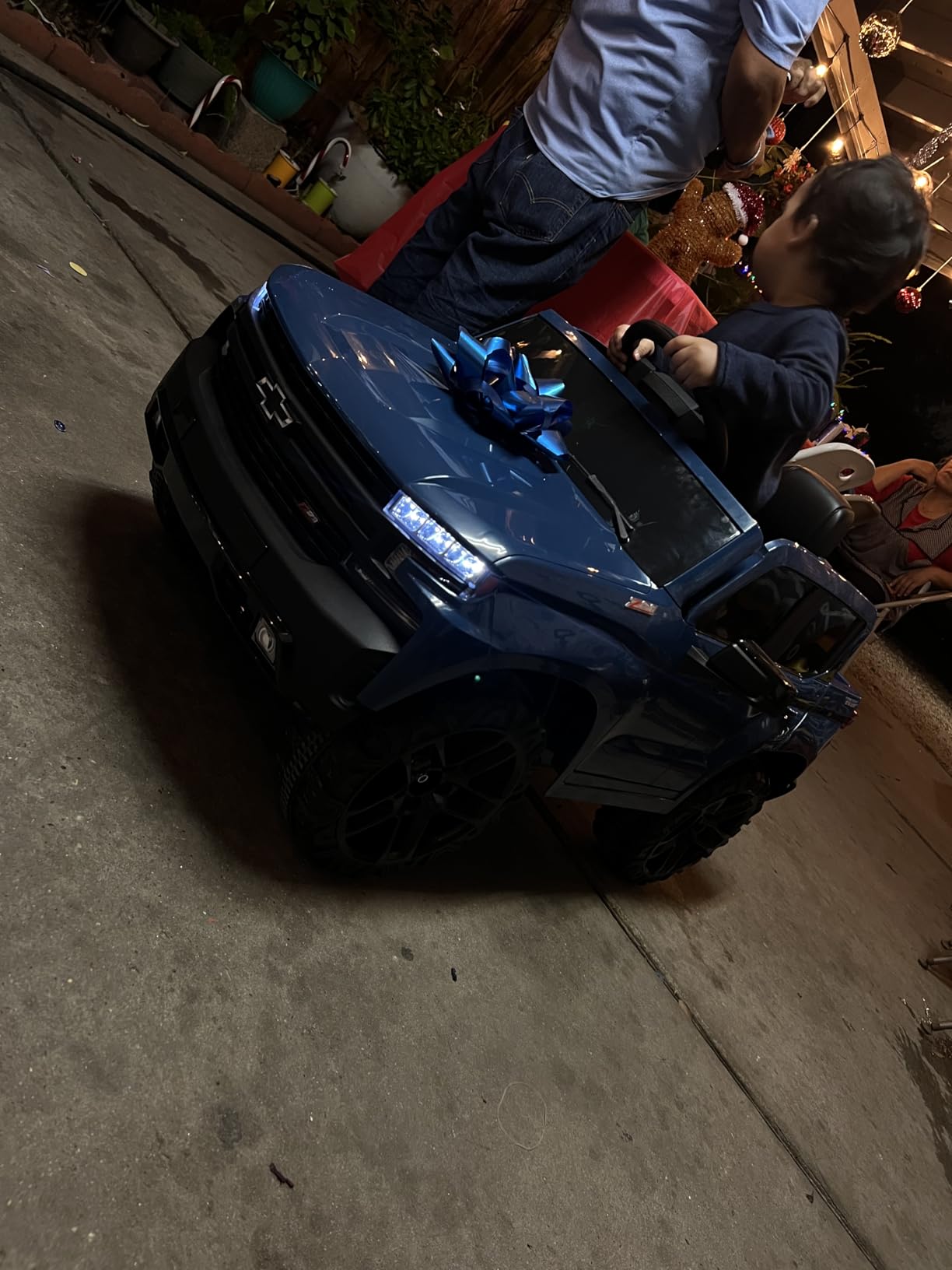
7. Best Choice Products 12V Licensed Chevrolet Silverado – Best for Two Children
Best Choice Products 12V Licensed Chevrolet Silverado Ride On Truck, Electric Car Toy w/Parent Remote Control, Truck Bed Storage, Bluetooth Speaker, LED Lights, 2.5 MPH Max Speed – Black
12V battery
2.5 mph max speed
66 lb capacity
36.7 lb unit weight
42.9 inch length
+ Pros
- Wide cab comfortably fits two children
- Truck bed stores toys and stuffed animals
- Accurate licensed Silverado detailing
- Parent remote brakes a runaway child effectively
- Cons
- Bulky at 42.9 inches long and 36.7 lb
- Assembly instructions do not label the screws
- Speed settings hard to distinguish from the seat
This is the sibling answer. The cab is wide enough for two children, and the 66 lb capacity is shared across both rather than applying to each. Parents with two under-fours will find nothing else in this roundup that fits the same brief.
The 2.5 mph top speed is the second slowest here, and for a two-child load that is a sensible choice. A parent who ran several models over months of daily suburban use noted that a sibling two-seater resolved a specific household tension, which is a fair measure of what this truck is for.
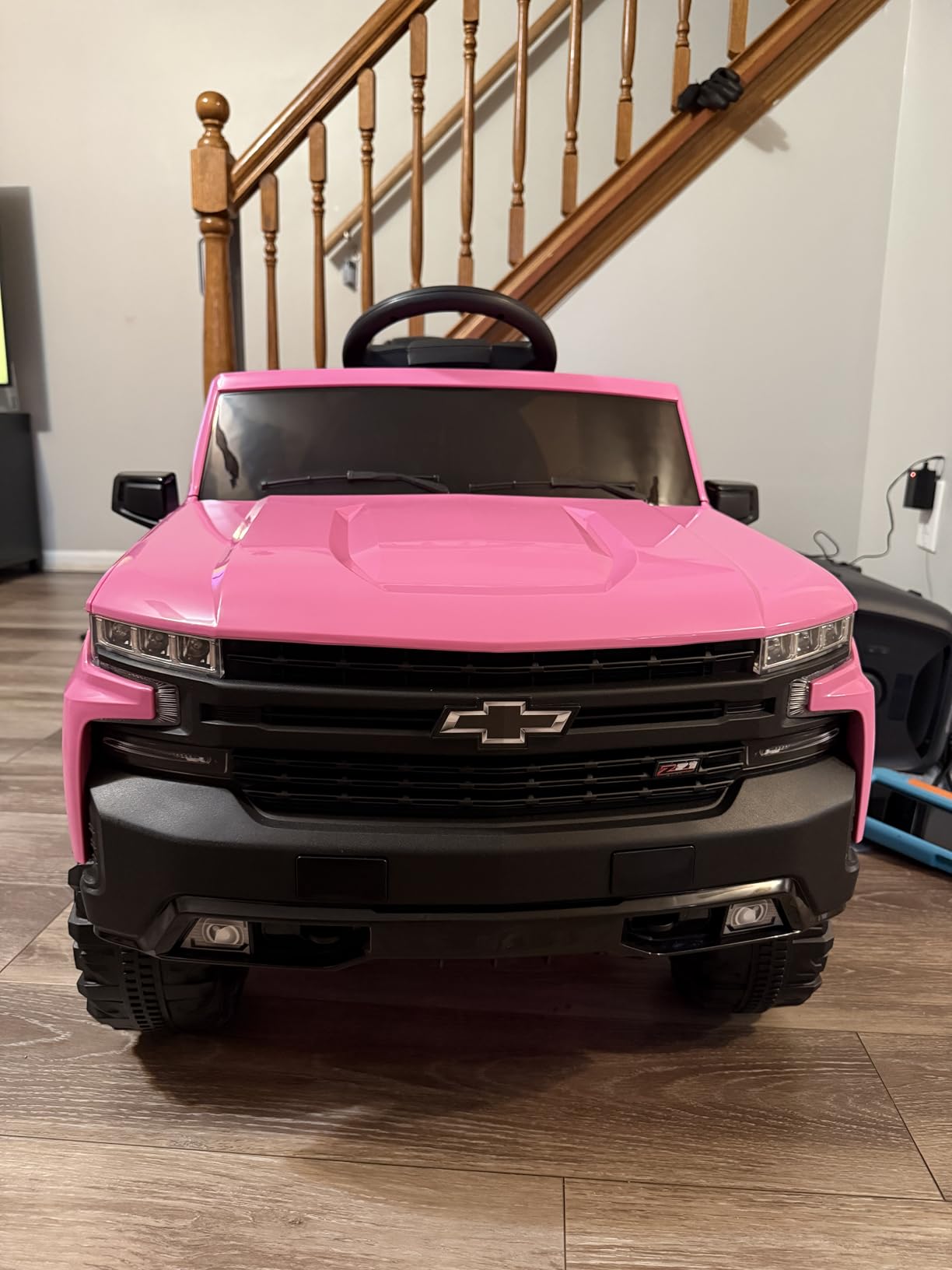
The truck bed is more useful than it looks. It becomes storage for stuffed animals, a collection point for stones, and somewhere to put a jacket. One parent described a detachable trailer on a similar model being used constantly for exactly that.
Licensing, scale and driving feel
The Silverado replication is accurate down to the mirrors, badging and working headlights. That matters more than it sounds, because a child who recognises the truck engages with it more seriously.
Steering is battery-powered from the wheel itself, so there is no dead zone at speed. A 2.5 mph cap keeps the turn radius manageable in a small space.
Storage and build trade-offs
At 42.9 inches long and 36.7 lb, this is the largest footprint in the roundup apart from the Mercedes G63. Plan the charging point before the car arrives, because the port position is awkward once the car is wedged in a garage.
Assembly is the other weak point. The instructions do not clearly label which screw goes where, so label the bags yourself as you unpack.
Who it suits and who should skip it
Buy this for sibling households, or for a child who carries a lot of things around. The truck bed and two-child cab are genuine functional advantages, not decoration.
Skip it for a small garage, a single small child, or anyone who will be moving the car alone. The bulk is the trade-off you accept for the capacity.
8. TRINEAR 12V Ride On Truck with Parent Remote – Best Budget First Ride-On
TRINEAR 12V Ride on Toys for Kids with Parent Remote Control, Black
12V system
Spring suspension
Large durable tires
32.85 inch footprint
Ages 3 to 5
+ Pros
- Most compact car here while still including a working parent remote
- Compact footprint suits small spaces
- Spring suspension and large tires handle gravel
- Assembly is straightforward
- Cons
- Resin body feels thin to some owners
- Police lights are stickers rather than working LEDs
- Even the motor must be assembled
- Seat is snug for a two year old
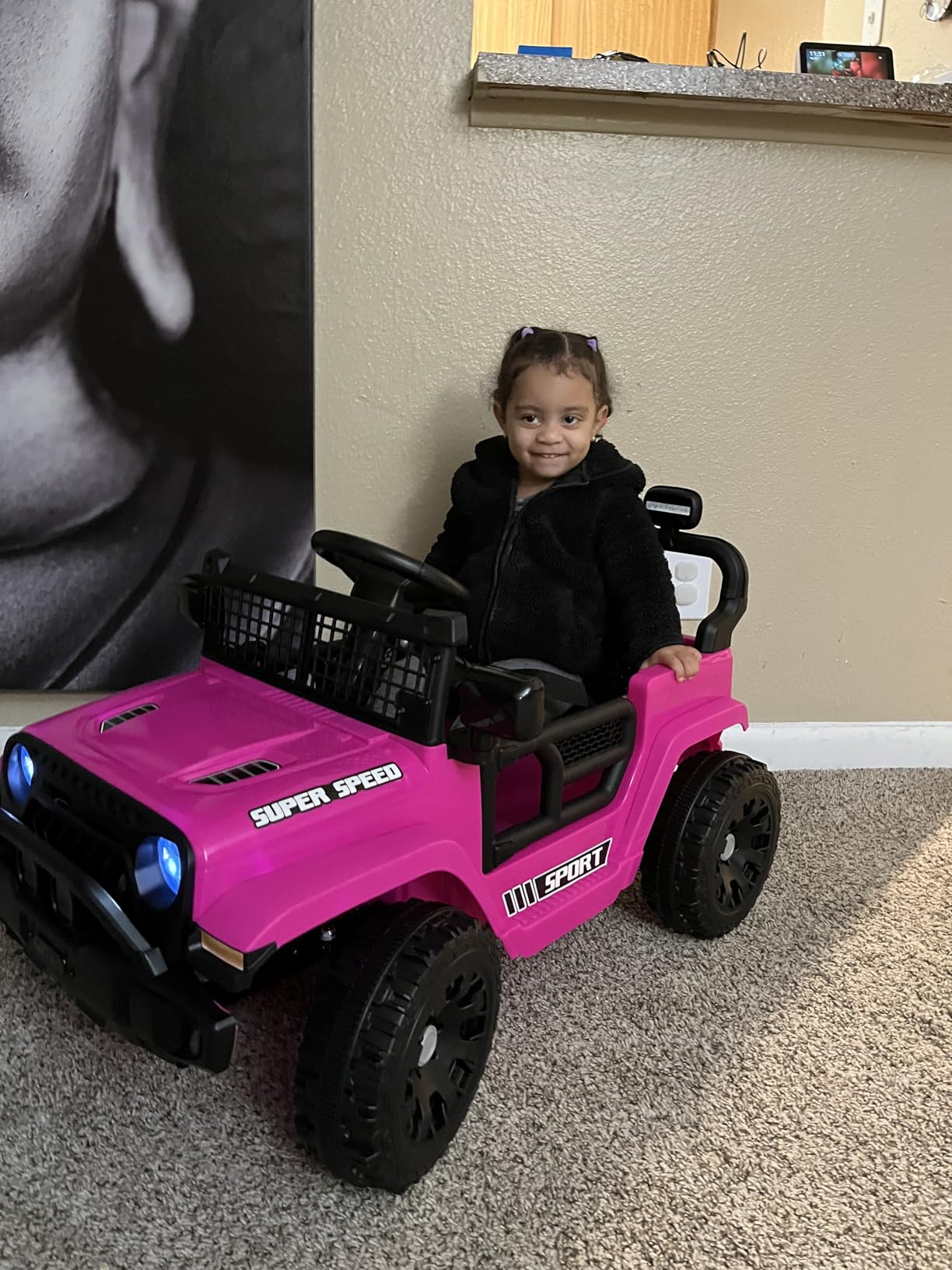
This is the car I would suggest for a child under three who mostly rides on a patio or a short path. The 32.85 inch footprint is the smallest in the roundup, and it stores against a wall without a dedicated garage bay.
The remote works, the suspension is real, and dual control modes let your child take over later. For a first ride-on that will be handed down or resold, that is enough.
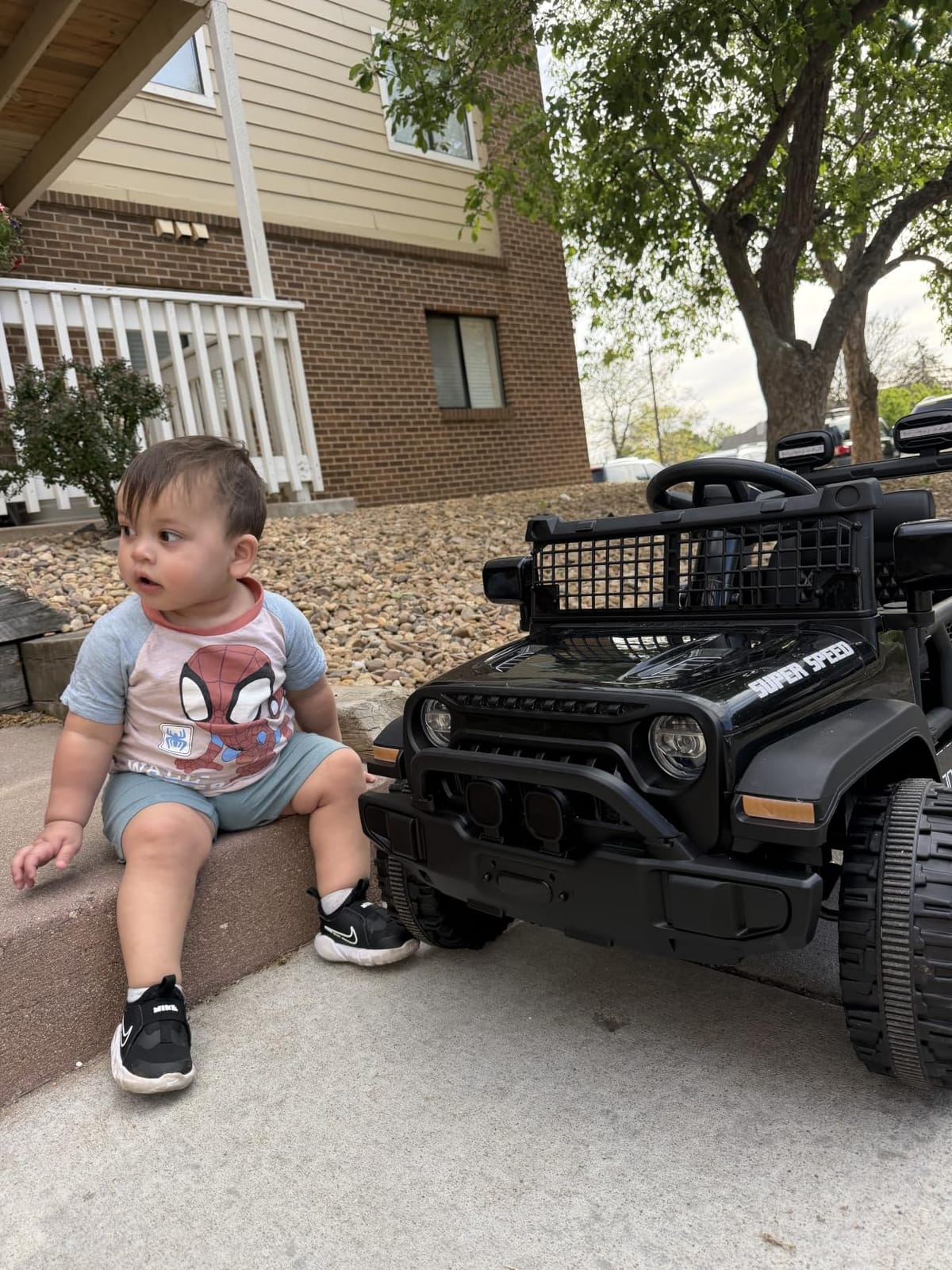
Assembly is easy, with the caveat that you fit the motor yourself. That is a ten-minute job, but it is a job. Plan for it before the excitement of opening the box.
Build quality is where the money is saved
The body is resin, and several owners describe it as thin. On smooth indoor flooring that is fine. On gravel and rough ground, expect knocks and scuffs rather than cosmetic wear.
The police lights are decorative stickers, not working LEDs, which disappointed a few buyers expecting a light-up toy. The spring suspension and large tires are genuine, though.
The emergency stop feels abrupt
Pressing stop on this remote halts the truck sharply rather than easing it down. For a toddler that jolt is startling, and a couple of owners mentioned it as the reason their child disliked the car for a while.
Use it on a lawn or a soft surface rather than a hard patio.
Who it suits and who should skip it
Buy this for a first ride-on on a small budget, an indoor-only use case, or a child between 22 months and three years who needs a compact body. The remote is the reason it is worth buying at all.
Skip it for a heavy child, rough terrain, or a child who will notice the difference between sticker lights and real ones. The seat is also snug for a tall two-year-old.
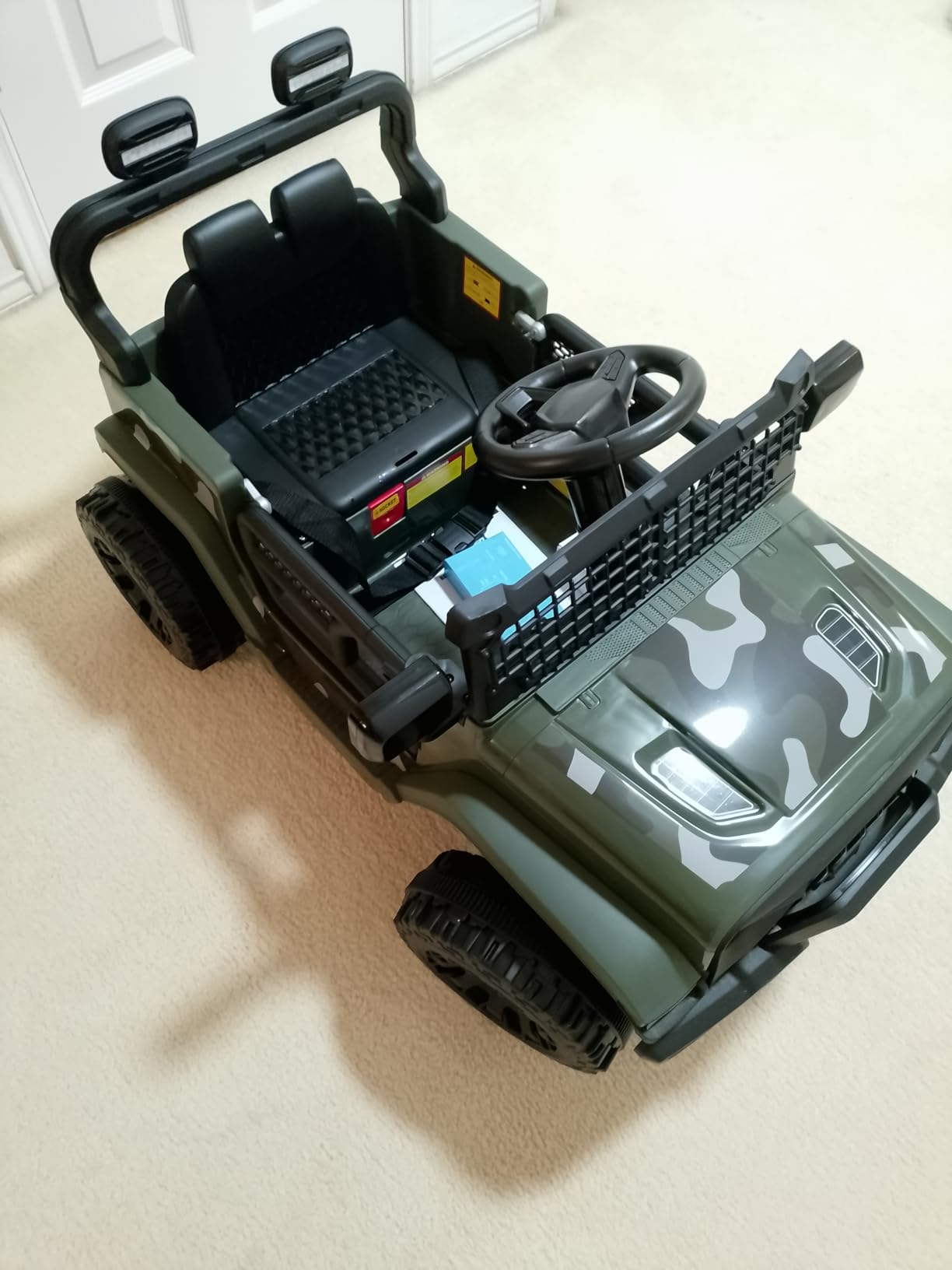
9. ELEMARA 12V Off-Road Ride On Truck – Best for Grass, Gravel and Light Slopes
ELEMARA Ride On Car, Bluetooth Ride on Toys for Toddlers, 12V Kids Battery Powered Vehicles w/Remote, 3.5 mph Motorized Off-Road Truck, Electric Car for Kids w/3 Speeds,LED Lights- Olive
12V motor
3.5 mph top speed
66 lb capacity
All-terrain traction tires
Three speed options
+ Pros
- All-terrain tires handle grass
- gravel and light slopes
- Three speed settings with parent assist remote
- Sturdy metal build for daily outdoor play
- Bright LED headlights and engine sounds
- Cons
- Steering is very sensitive and hard to keep straight
- One owner reported early battery capacity loss
- Hot-glued wiring makes battery replacement awkward
The off-road styling on this truck is not just cosmetic. The traction tires and the shock-absorbing spring suspension gave it the best ride over broken lawn of anything in the test after the Mercedes G63.
Three speed options plus a parent-assist remote with forward and reverse give fine control, and the 66 lb capacity carries a larger child. At 10.3 kg it is one of the heavier units, so plan the lifting.
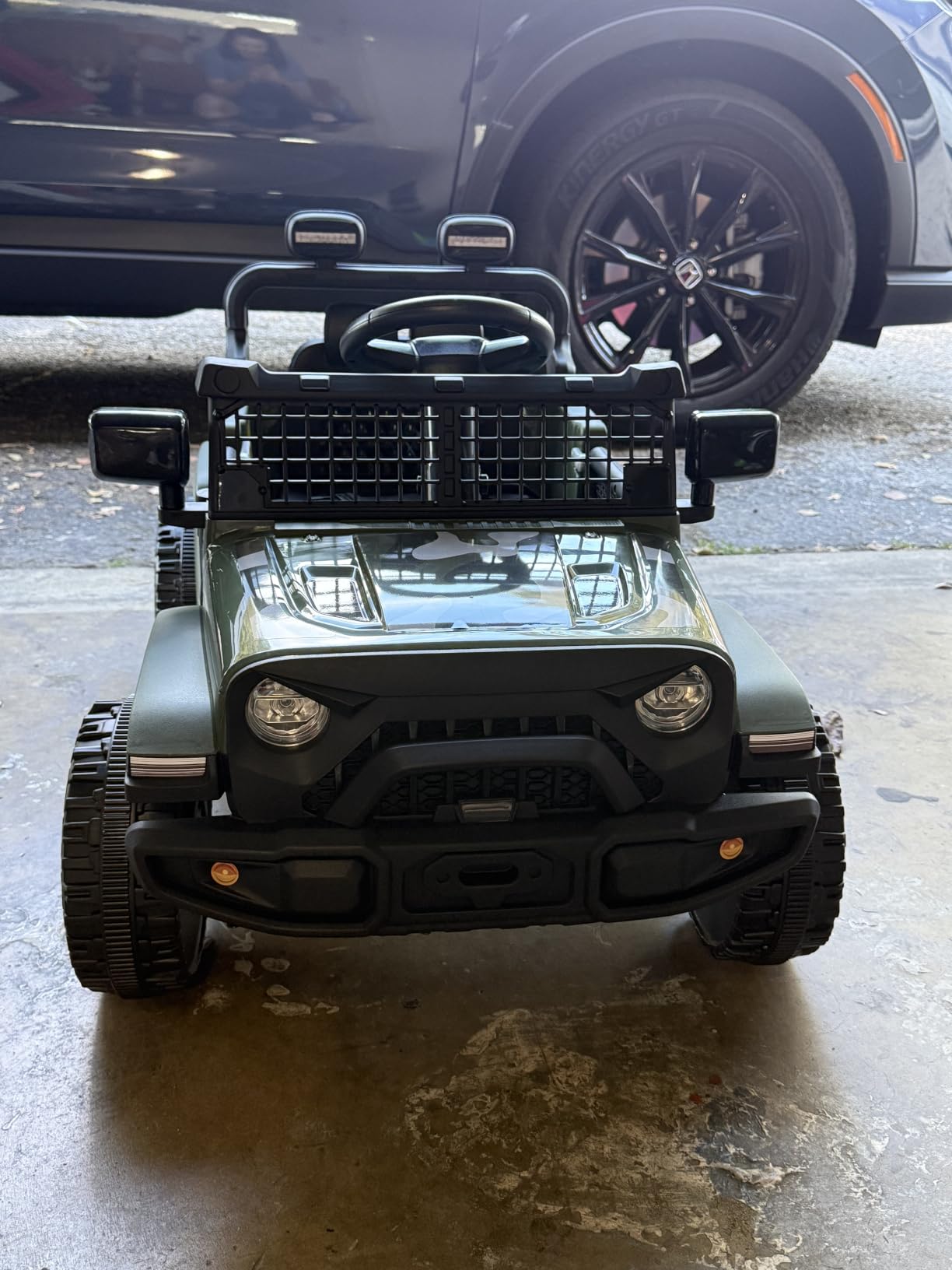
Owners consistently praise the build for daily outdoor use, and the seller support is described as responsive, including replacing a faulty battery. That matters in a category where after-sales contact is often the differentiator.
Sensitive steering is the recurring complaint
Almost every negative review mentions steering. A small input on the wheel produces a sharp turn, which means a parent on the remote will be working constantly to hold a line.
That is manageable in manual mode with practice, and less pleasant when you are steering from a distance.
Battery longevity and the replacement question
One owner reported the battery losing capacity before a year, and the wiring being hot-glued rather than connector-fitted, which makes swapping a pack an awkward job rather than a plug-in one.
If long-term ownership matters to you, ask the seller directly whether replacement batteries ship separately.
Who it suits and who should skip it
Buy this for grass, gravel driveways and light slopes, especially for a child who will use it daily rather than occasionally. The traction and suspension are real.
Pass if you want precise low-speed manoeuvring or plan to service the battery yourself. The sensitive steering rewards a confident child more than a cautious one.
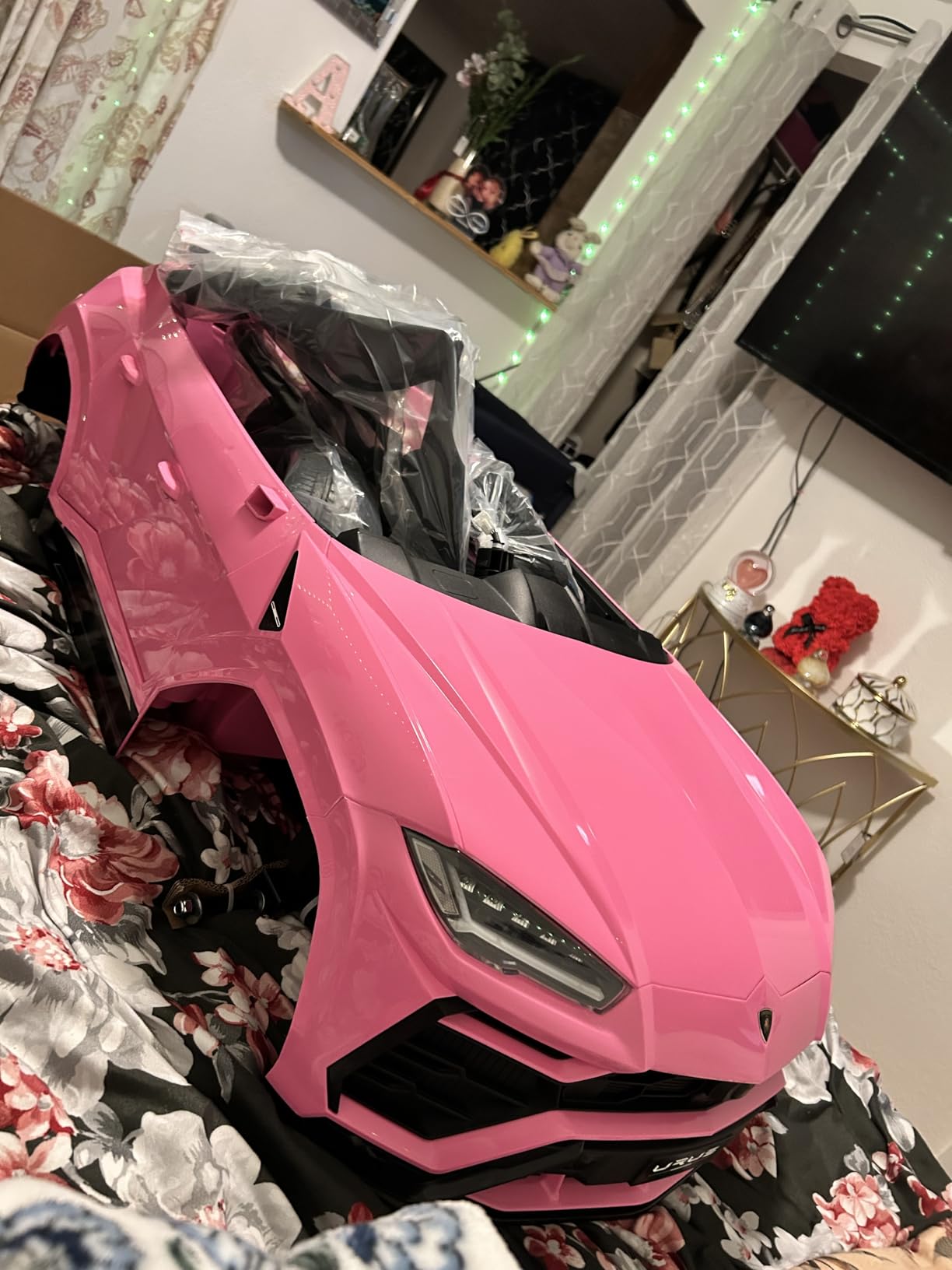
10. BTMWAY 12V Licensed Lamborghini Ride On Car – Best Gentle Soft Start
Electric Car for Kids 12V Licensed Lamborghini Ride On Car with Remote Control,Max Speed 2.5Mph,LED Lights,Music Players,Lockable Doors,Spring Suspension,Toddler Cars to Drive,Pink
12V 7A battery
2.5 mph max speed
55 lb capacity
42 inch length
Max user height 33 inch
+ Pros
- Soft start makes the very first drive gentle
- Lockable doors and a safety belt
- Remote batteries are included in the box
- Licensed Lamborghini cockpit is well detailed
- Cons
- 55 lb and 33 inch limits mean it outgrows a toddler fast
- 8 to 12 hour charge time
- Only 1 to 2 hours of runtime per charge
For a child who is genuinely frightened of fast toys, the soft start here is the feature to buy for. The car eases forward from rest instead of snapping away, and the 2.5 mph cap keeps the whole experience gentle.
It is also one of the few cars in this roundup that ships with the remote’s AAA batteries already in the box. Small detail, but it saves a confused first afternoon.
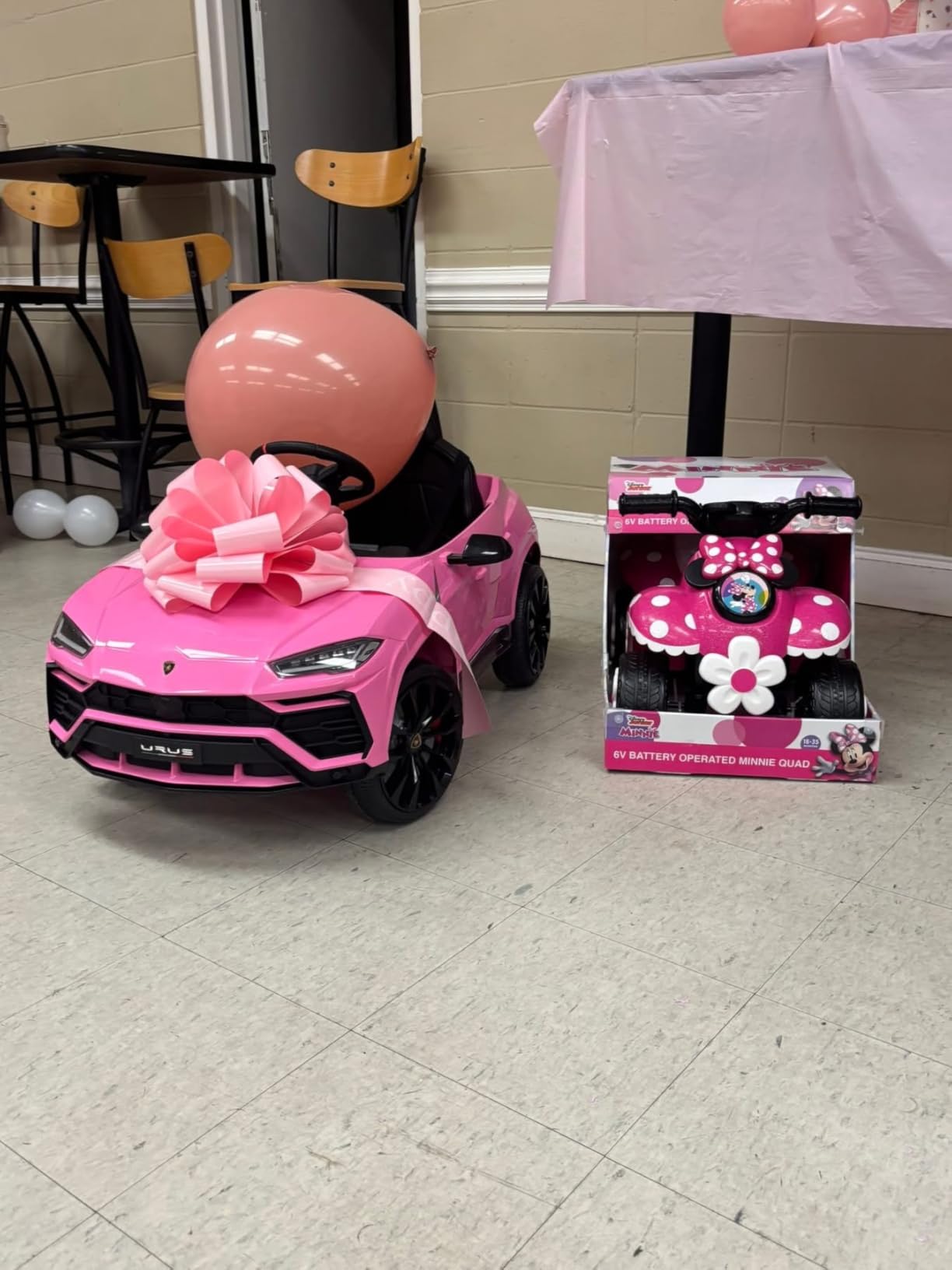
Reviewers rate the licensed Lamborghini cockpit as the standout, with a level of interior detail that generic shells rarely reach. The lockable doors and belt round out a secure package for a small driver.
Two size limits in one car
This car carries two constraints: 55 lb of weight and 33 inches of height. For a toddler, the height limit arrives first, and it arrives quickly.
The seat measures 14.2 inches wide by 7.9 inches deep, which fits a small child properly rather than generously. Plan on a year or two of use rather than four.
Charge time against runtime
An 8 to 12 hour charge for 1 to 2 hours of play is the weakest ratio here. Budget overnight charging as a routine rather than an exception.
The 12V 7A battery itself is a good pack, and the charger is included, so the constraint is the cycle time rather than the components.
Who it suits and who should skip it
Buy this for a cautious or anxious young driver, or for anyone who wants the remote batteries in the box from day one. The soft start does more for confidence than any other single feature I tested.
Skip it for a child close to the 55 lb or 33 inch limits, because the car will be outgrown while it still works perfectly. Choose a 66 lb model instead.
How to Choose a Ride-On Car With Remote Control for Toddlers
Every car above clears the two thresholds I would not compromise on: a parent remote that overrides the child instantly, and a top speed under 3.5 mph. Everything past that is a judgement call about your child, your ground and your garage. Here is how I would make it.
Picking for a child under 2
Under two, the remote should be the primary control. Most of these cars have a manufacturer recommendation of 3 years and up, so a very young child is always operating under adult supervision and within the physical weight limit.
Look for soft start, a compact footprint, and a body light enough to move indoors. The TRINEAR truck is the smallest option here at just under 33 inches long, and the Winado AMG GTR is the lightest at 20.5 lb. Both suit a flat floor or a short patio path.
Avoid big wheels and high torque at this age. Speed is not a benefit for a child who cannot yet judge distance.
Picking for a 2-year-old
At two, the priorities shift to containment and comfort. A five-point belt, lockable doors, and suspension that takes the sting out of a bumpy path matter more than speed settings.
The Best Choice Products 12V Ride On Truck leads on a proper five-point restraint and four-wheel suspension. The Best Choice Products 12V Kids Electric Vehicle is the alternative if weight capacity matters more, since its 61 lb ceiling will outlast a two-year-old by years.
For a child who is cautious rather than bold, the BTMWAY Lamborghini soft start is the single most useful feature in this roundup.
Picking for a 3-year-old
By three, a child can usually reach the pedal reliably, and the manual mode starts to matter. Look for two or three manual speeds, a real steering wheel with progressive feel, and enough power for grass.
The ANPABO Mercedes G63 gives you the most power and the longest lasting battery, at the cost of the largest body. The ELEMARA off-road truck is the pick if the ground is grass and gravel rather than pavement.
Check the weight capacity against a four-year-old, not a three-year-old. Several cars here cap at 55 lb, which a bigger child reaches sooner than parents expect.
What 6V, 12V and 24V actually change
Voltage is a proxy for power, and power is a proxy for three things: speed, runtime and climbing ability. It is not a quality rating.
A 6V car is typically slower, shorter in runtime, and limited to flat indoor surfaces. It suits a two-year-old on a carpet or patio and nothing more demanding.
A 12V car is the category default because it covers almost every use case a toddler has. Every car in this roundup is 12V, and the difference between them comes down to battery capacity, where 4.5Ah and 7Ah packs are the two common tiers.
A 24V car doubles the voltage and needs two 12V batteries in series. It delivers more torque and better hill climbing, but it is heavier, costs more, and will be too powerful and too large for a toddler. For this age group, 12V is the right ceiling.
Weight capacity is a physical limit, not a developmental one
When a manufacturer says 55 lb, that is a chassis and motor limit. It says nothing about whether your child is ready to steer.
Those are separate decisions. A 66 lb car does not mean a child should be driving unsupervised at three. If you want the capacity headroom, buy the 66 lb car and still use the remote.
Two separate limits appear on some listings, weight and maximum user height. The BTMWAY Lamborghini states 55 lb and 33 inches, and the height limit will usually bind first.
Remote control versus a hand-held RC toy
A ride-on car with a parental remote is designed to be driven from the seat. The child steers with a wheel and a pedal, and the remote is your override.
A hand-held radio control toy is driven only from a controller, and the child is not in the vehicle. Parents searching for this category sometimes mean the second thing, which is a completely different purchase and a much cheaper one.
Worth clarifying before you buy, because the two are sold side by side in the same results.
What ASTM, CPSIA and soft start actually mean
ASTM is the general toy safety standard, and CPSIA governs lead content in paint and accessible small parts. Both are US requirements, and both matter most for a toy a child sits inside and puts hands on constantly.
Only some listings state certification explicitly. The Miniature Motors 12V truck names both, which is worth something in a category where many shells come from the same factories.
Soft start means the motor ramps up rather than applying full power instantly. On a 2.5 mph car it is the difference between a smooth launch and a jolt, and it is the single most useful safety feature in this list.
Battery charging, storage and how long a ride-on lasts
Charge times in this roundup run from 8 to 12 hours on the licensed Mercedes and Lamborghini models, with 1 to 2 hours of play afterwards. The Best Choice Products truck delivers close to two hours of runtime and is the practical choice for daily use.
Store the car somewhere with stable temperature and no direct sun. Leaving a lead-acid pack partly drained in a cold garage is what shortens its life fastest.
On longevity, expect the body and electronics to outlast the battery pack. Lead-acid packs typically lose meaningful capacity after a few years of regular use, and replacement is often awkward because wiring is hot-glued rather than connector-fitted. Check with the seller before you buy whether a replacement pack is available for that specific model, since discontinued listings rarely come back.
Frequently Asked Questions
What is the best electric ride-on car for toddlers?
The Best Choice Products 12V Kids Electric Vehicle is our top pick overall, with a parent remote that overrides instantly, a 61 lb capacity that outlasts most toddlers and puncture-proof wheels that handle driveways, grass and light gravel. The Best Choice Products 12V Ride On Truck is the best value for a child who needs a five-point seat belt, and the ANPABO 12V Mercedes G63 is the strongest choice for sloped ground.
What is a good remote control car for a 2-year-old?
For a 2-year-old, prioritise soft start, lockable doors and a proper restraint over speed. The Best Choice Products 12V Ride On Truck pairs a five-point seat belt with full four-wheel suspension, and the BTMWAY 12V Lamborghini has the gentlest soft start of the ten. Keep the remote in adult hands until your child can reach the pedal reliably.
What is the best electric ride-on for a 3-year-old?
At three, a child can usually use manual mode, so look for two or three manual speeds plus enough power for grass. The ANPABO 12V Mercedes G63 has the largest battery and twin motors, the ELEMARA 12V off-road truck handles gravel and light slopes, and the Winado AMG GTR is the lightest at 20.5 lb for indoor storage.
Can a 3 year old use a remote control car?
Yes, as long as an adult supervises and the car has a parental remote that overrides the child on demand. Most manufacturers rate these cars for ages 3 and up, and a three-year-old typically sits well within the 44 to 66 lb weight limits. Independent steering should still only happen on flat, closed ground, never near traffic.
Are ride-on toys good for toddlers?
They are, when supervised. Riding a powered car develops gross motor skills, hand-eye coordination, steering control and spatial awareness, and it gives a toddler screen-free outdoor time that keeps pace with them. The developmental benefit depends on repeated free play, not on the speed of the car, so a slower model is a perfectly good choice.
What is the difference between 6V and 12V ride on cars?
Voltage is a proxy for power, and power determines speed, runtime and climbing ability. A 6V car is slower with shorter runtime and suits flat indoor surfaces. A 12V car covers nearly every toddler use case, and the gap between 12V models usually comes down to battery capacity, with 4.5Ah and 7Ah the common tiers. A 24V car adds torque for hills but is heavier and too powerful for a toddler.
Which Ride-On Car With Remote Control Should You Buy in 2026?
If you want one answer, take the Best Choice Products 12V Kids Electric Vehicle. It has the deepest review history in the group, a 61 lb capacity that will not outgrow your child quickly, and wheels that never deflate.
If your child needs a real restraint, choose the Best Choice Products 12V Ride On Truck for its five-point belt, four-wheel suspension and roughly two hours of play per charge. If your driveway slopes, the ANPABO Mercedes G63 has the battery and motors to climb it. If two children need to share, the Chevrolet Silverado is the only car here with a cab built for it. And if the budget is the deciding factor, the TRINEAR truck gets a working parent remote into a small footprint at the lowest cost.
Whatever you choose, weigh ASTM and CPSIA certification, check the remote actually overrides before handing over the pedal, and measure the storage space first. That last one is the mistake almost every parent makes.