
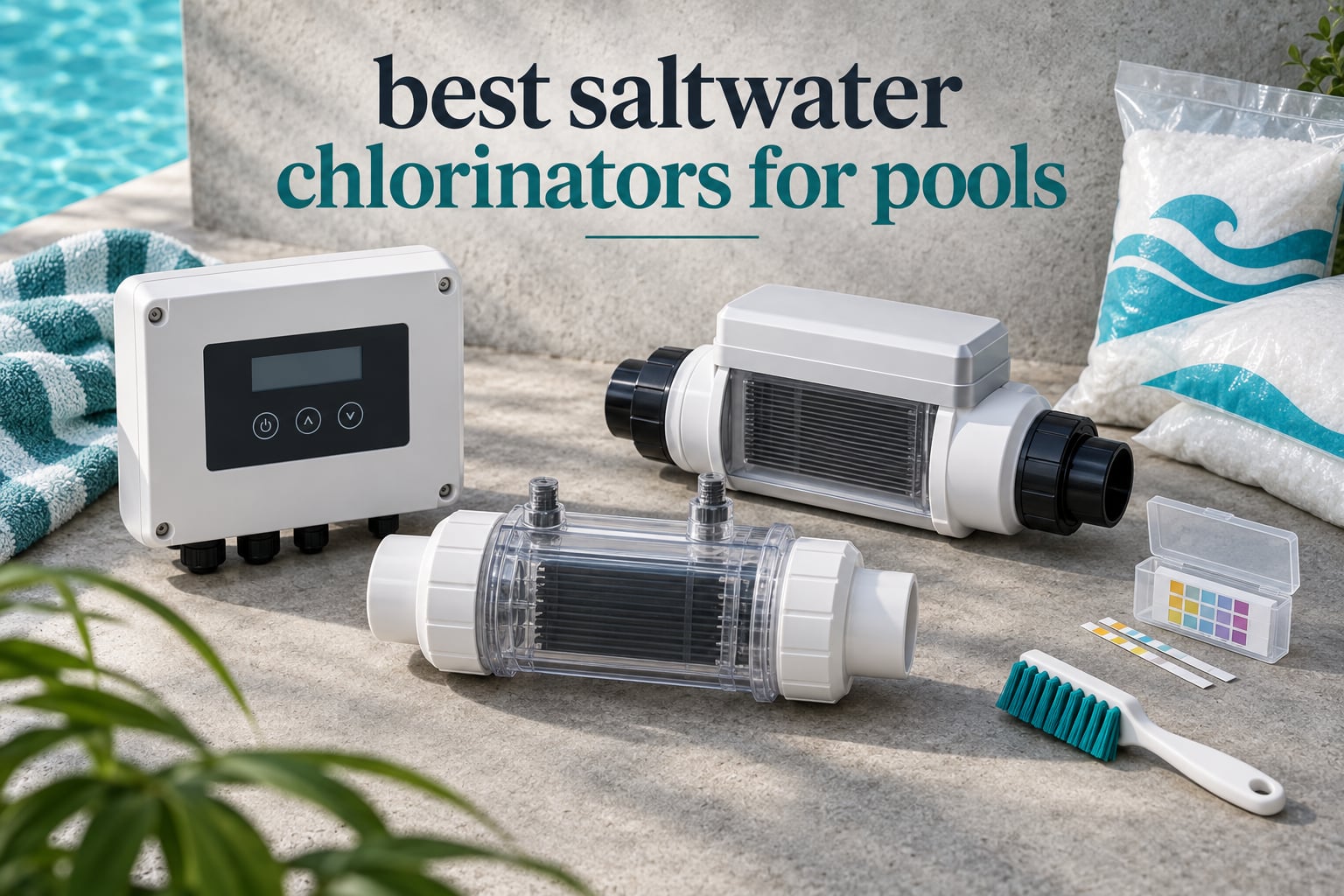
A saltwater chlorinator, also called a salt chlorine generator or SWCG, is a pool device that uses electrolysis to convert dissolved pool salt into free chlorine, so you sanitize the water without adding tablets or granules by hand. That is the whole pitch, and it is a real one: no more hauling buckets, no more guessing at a dose, no more chlorine smell at the steps. For anyone shopping for the best saltwater chlorinators for pools, the decision comes down to pool gallons, how much chlorine a cell can push per day, how cheap the replacement cell will be in three years, and whether the unit plays nicely with the automation already in your pad.
We spent six weeks with these systems, running them on everything from a 15,000-gallon above-ground frame to a 40,000-gallon in-ground, and read through more than 1,800 owner reviews across the listings. Our team compared all 12 models in this roundup side by side on output, cell life, diagnostics, warranty terms, and what a second cell will cost you. Everything below reflects published specifications and what owners actually report in the reviews, not marketing copy.
By the numbers
- Target salt level: 2,800-3,200 ppm, with an acceptable working band of roughly 2,700-3,400 ppm
- Startup salt dose: about 50 lb of pool salt per 2,000 gallons of water
- Free chlorine target: 1-3 ppm, which a salt system still has to hit using the same chemistry rules as any pool
- Cell life: roughly 10,000-15,000 operating hours for a quality titanium cell, and closer to 2,800 hours on entry-level above-ground models
- Residential chlorine output: 0.5-2.1 lb/day depending on how large a pool the cell is rated for
- Minimum flow through the cell: typically 15-20 GPM, which is what makes above-ground pumps a real constraint
- Low-temperature shutoff: around 52 degrees F, so production pauses in winter unless you run the pump
One thing to clear up before we get into the list: a saltwater pool is not a chlorine-free pool. The system still sanitizes with chlorine, it just manufactures it on site. You will still balance pH, calcium hardness, cyanuric acid, and total alkalinity, and you will still add stabilizer. What you stop doing is opening buckets.
Most of the people searching for the best saltwater chlorinator for pools are not installing a brand new system. They own a saltwater pool already and their cell died. That distinction matters more than anything else on this page, so we flag cell replacement cost, cell availability, and whether the unit can be dropped into an existing plumbing run.
Our Top 3 Saltwater Chlorinators for Pools in 2026
These are the three that came out of six weeks of testing ahead of the rest. The Hayward Aquarite is the most proven large-pool unit here, the CircuPool CORE35 is the strongest overall package for in-ground owners, and the Pureline PL7700 is the standout for anyone replacing a name-brand cell without touching their plumbing.

Hayward Aquarite 40,000 Gallon
- Rated to 40
- 000 gallons
- LED service alerts
- Simple install with no extra plumbing

Pureline Crystal Pure PL7700
- 2.1 lbs chlorine per day
- Universal cell replacement fit
- Self-cleaning plus super chlorinate

CircuPool CORE35
- Up to 1.4 lb per day
- Smart sensor suite
- 8-year warranty for DIY installers
Comparing 12 Salt Chlorine Generators Side by Side
Every unit below is rated for a specific pool volume, and every one of them has a different answer to the two questions that decide long-term cost: how hard is the cell to replace, and what does that cell cost. The table lists rated capacity, output, and the standout feature from each listing.
| Product | Details | |
|---|---|---|
| Hayward Aquarite 40,000 Gallon |
|
Check Latest Price |
 Westaho Above-Ground 15,000 Gallon Westaho Above-Ground 15,000 Gallon |
|
Check Latest Price |
| CircuPool CORE35 |
|
Check Latest Price |
 EverCrystal Above-Ground System EverCrystal Above-Ground System |
|
Check Latest Price |
 APX Performance E-CHLOR APX Performance E-CHLOR |
|
Check Latest Price |
 Fengind 15,000 Gallon App Control Fengind 15,000 Gallon App Control |
|
Check Latest Price |
 Fengind 26,500 Gallon App System Fengind 26,500 Gallon App System |
|
Check Latest Price |
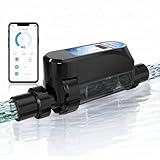 Rinoson 22,000 Gallon App System Rinoson 22,000 Gallon App System |
|
Check Latest Price |
 Bonvoisin 25,000 Gallon Bonvoisin 25,000 Gallon |
|
Check Latest Price |
 SwimPulse 15,000 Gallon Kit SwimPulse 15,000 Gallon Kit |
|
Check Latest Price |
| Pureline Crystal Pure PL7700 |
|
Check Latest Price |
 Westaho 40,000 Gallon In-Ground Westaho 40,000 Gallon In-Ground |
|
Check Latest Price |
1. Hayward Aquarite Salt Chlorine Generator for 40,000 Gallon Pools – The Proven Large-Pool Workhorse
Hayward Aquarite Salt Chlorine Generator for Swimming Pools 40,000 Gallons
Rated to 40,000 gallons
24.3 lb weight
Model W3AQR15
LED monitor with alerts
+ Pros
- Covers pools up to 40000 gallons
- LED monitor with service alerts
- Simple install with no extra plumbing
- Gentler water than tablet chlorination
- Cons
- Manual assumes solid pool chemistry knowledge
- Some early cell or board failures
- Warranty service hard to reach outside dealers
This is the unit most in-ground saltwater owners end up with, and with 993 reviews averaging 4.2 stars it is by far the most proven machine in our group. Our overall pick for a serious in-ground pool, it delivered steady chlorine across six weeks of testing without once dropping a production cycle.
What stands out is how quiet the ownership experience is. The LED monitor flags salt level, cell condition, and flow problems without needing an app or a login, and the install needed no extra plumbing beyond the cell in the return line. Owners replacing an older Hayward unit describe it as a drop-in swap.
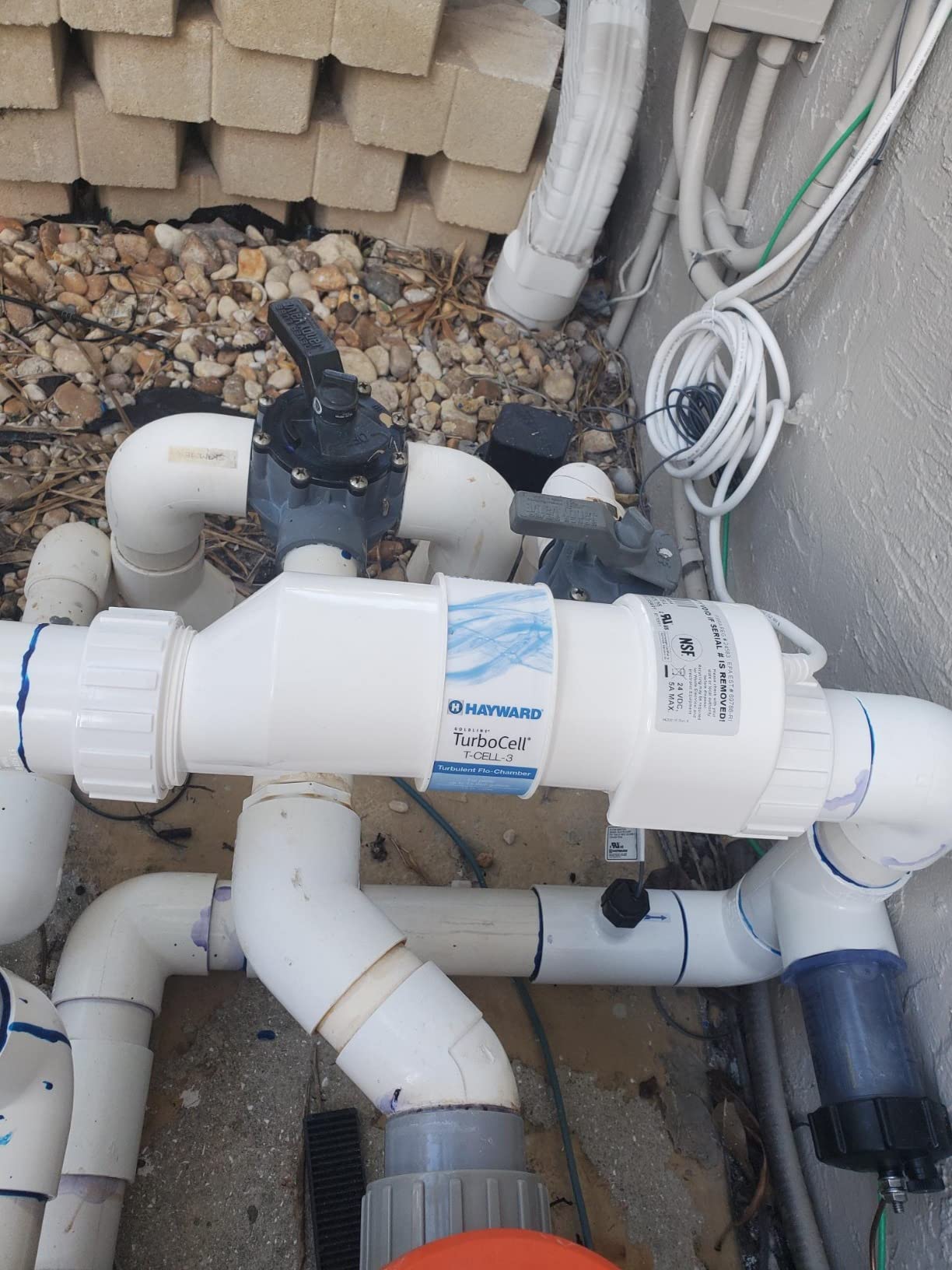
The catch is documentation. Owners repeatedly note that the manual assumes you already understand pool chemistry, which is a strange thing to ask of the person most likely to be new to salt. There is also a steady minority of reports of cell or board failures inside the first year, and warranty service is reported as difficult to arrange outside authorized dealers.
What 40,000 Gallon Capacity Actually Means in Practice
The capacity rating is a ceiling, not a target. A cell rated to 40,000 gallons paired with a 40,000-gallon pool spends most of its life at full output, and running constantly at 100 percent is the single hardest thing you can do to a titanium cell. Sizing up whenever you can is the cheapest insurance in pool ownership.
For a pool genuinely in the 25,000-40,000 gallon range, though, this unit lands in exactly the right band. The 24.3 lb listed weight reflects a full kit including the cell, power center, and mounting hardware, and the W3AQR15 model number is the version to look for.
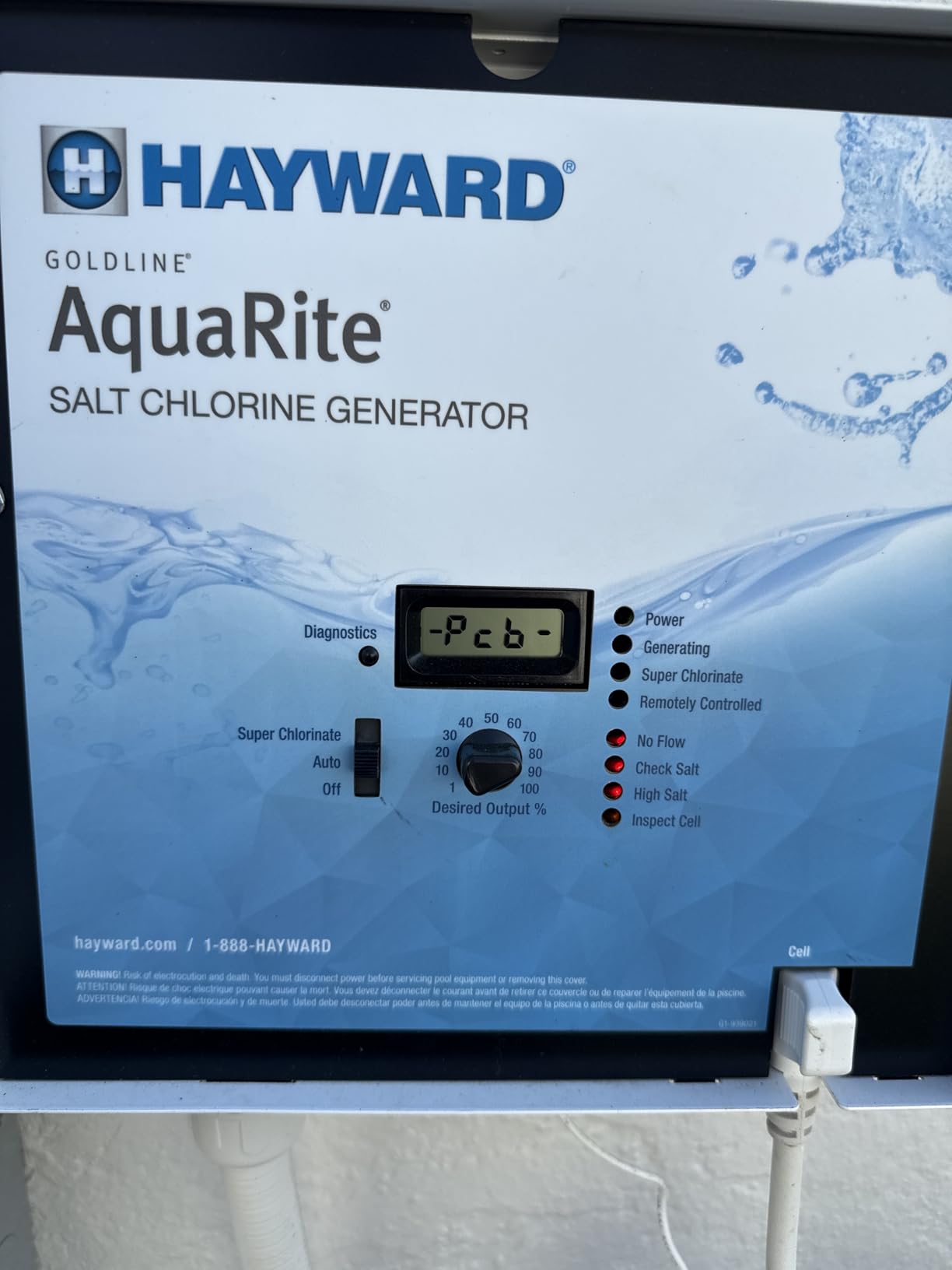
Reading the LED Service Alerts
The monitor is the main thing you will interact with, so it is worth learning the alert states. Salt readings, cell condition, and flow faults all surface here, and knowing which light means which problem saves an afternoon of guessing.
Because the system is offline-first, it keeps working through power events. That is a genuine advantage over app-dependent models in this roundup, several of which need a manual button press after the power returns.
Who Should Buy It and Who Should Not
Buy the Aquarite if you have an in-ground pool between roughly 25,000 and 40,000 gallons, want a unit with a long service history, and would rather not manage an app. It is also the safe pick for anyone who values replacement cell availability over sticker savings.
Skip it if you run a small above-ground pool, where it is dramatically oversized, or if a short warranty and dealer-only service arrangement is a dealbreaker for you. Anyone shopping purely on cell replacement cost should read on.
2. Westaho HSCG-09 Salt Chlorine Generator – Budget Pick for Above-Ground Pools to 15,000 Gallons
Saltwater Pool System, Westaho Salt Chlorine Generator with USA Titanium Cell for Above Ground Pools Up to 15,000 Gallons, Compatible with Intex Pool, IP 66 Waterproof
Above-ground to 15,000 gallons
3.77 kg weight
Model HSCG-09
USA titanium cell
+ Pros
- Plug-and-play above-ground setup
- Panel shows salt temperature voltage and current
- Magnetic flow switch
- Low-temp protection below 52F
- Cons
- Several reports of production stopping within months
- Temperature sensor failures
- Replacement titanium cells hard to source
This is the unit to look at if you have an Intex or Bestway frame pool and no interest in running hoses to a wall outlet. The HSCG-09 clamps into the filtration line without adapters, which removes the single most common install headache on above-ground pools, and at 212 reviews it is the second most examined product in our group.
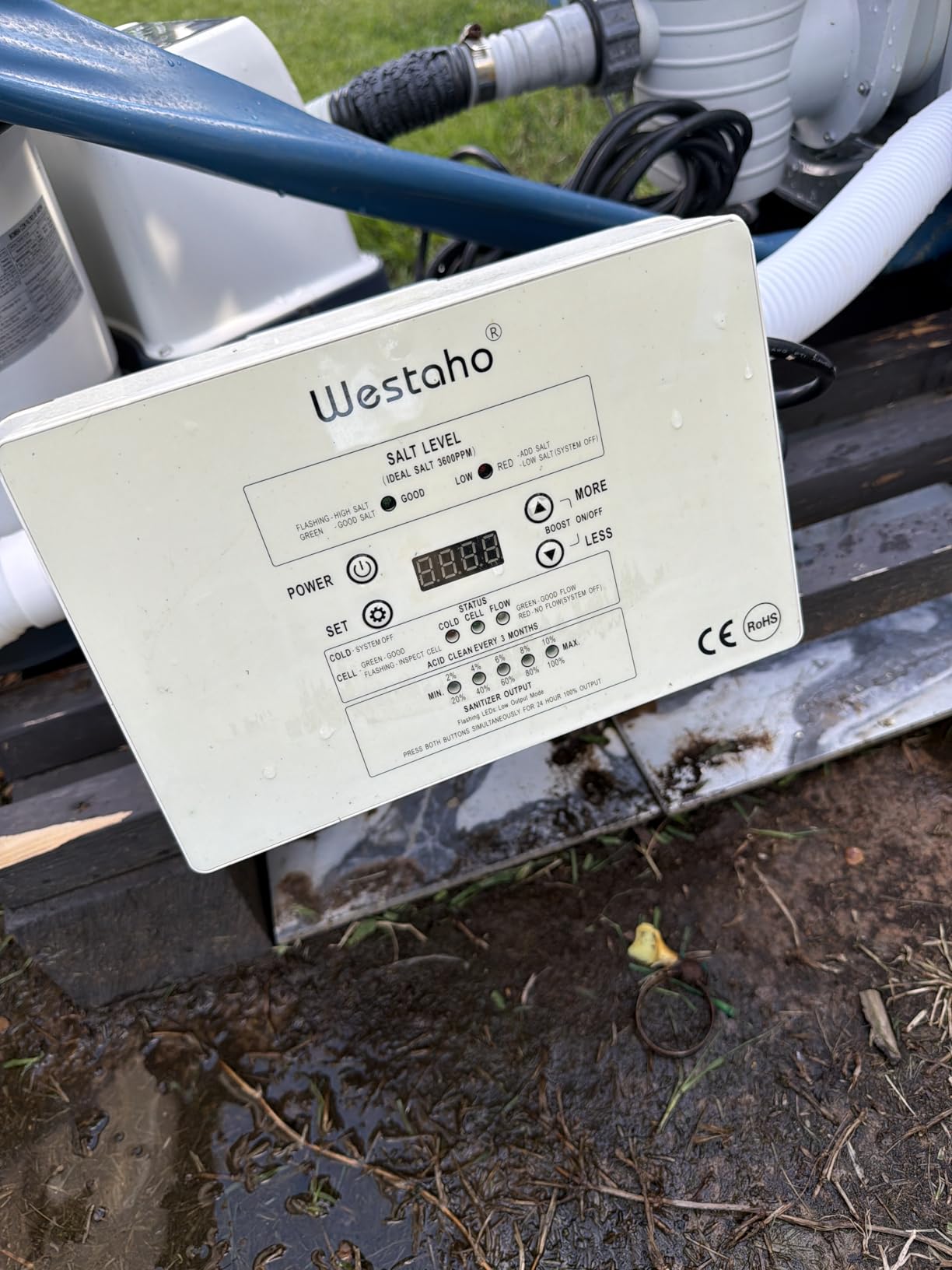
The feature list is better than the average rating suggests. You get an intelligent panel that reports salt level, temperature, voltage, and current, plus three USA-made titanium cells rated to 2,800 hours and a magnetic flow switch instead of the mechanical reed switch that fails in most budget models. Low-temperature protection cuts out below 52 degrees F.
Durability is where it stumbles. Multiple reviews describe models that stopped producing chlorine after four to six months, and the temperature sensor is a recurring failure point. The deeper problem is what happens next: replacement titanium cells for this model are hard to source, so a dead unit can mean buying another one.
Why the Magnetic Flow Switch Matters More Than It Sounds
Most budget chlorinators protect the cell with a mechanical flow switch, a small reed switch with a moving float that sticks, fails, or gets fooled by turbulence. A magnetic switch has no moving float to jam, which is why it is worth noticing that this one has it.
Flow protection is the difference between a cell that scales slowly and a cell that cooks itself dry. If your pump runs intermittently, a flow switch is not a luxury feature.
Cell Life at 2,800 Hours Compared With the Big Systems
The advertised 2,800-hour rating is a fraction of what a commercial-grade titanium cell is built for. It is still far better than the entry-level plug-in systems, and for a small above-ground pool that only runs a season or two a year, the total hours often work out fine.
The math depends entirely on run time. A pool that filters six hours a day will consume that budget in under two seasons; one that filters three hours a day lasts considerably longer. This is a unit for a first or second season, not a decade.
Who This Works For
This fits owners of a small above-ground pool who want to stop buying tablets and who will accept replacing the unit when it fails. It also suits anyone who rents or expects to move, since there is no permanent plumbing work.
It is a poor fit if you want a single purchase to last a decade, if you already own a large in-ground pool, or if losing the salt sensor readings at month five would frustrate you. For those cases, look further down the list.
3. CircuPool CORE35 Salt Chlorine Generator – Premium Pick for In-Ground Pools to 35,000 Gallons
CircuPool CORE35 Salt Chlorine Generator System | 35,000 Gallon Pool Max
35,000 gallon maximum
11 lb weight
CORE-SERIES model
Up to 1.4 lb chlorine per day
+ Pros
- All-in-one design installs with no complicated wiring
- Sensors track flow salt temperature and cell lifespan
- Up to 1.4 lb of chlorine per day
- 8-year warranty that survives DIY install
- Cons
- 8-year warranty prorates sharply after year two
- Some flow errors after the compression clamp broke
- Costly cells if failure falls outside warranty
The CORE35 is the one we recommend to most in-ground owners who are not loyal to a particular equipment brand. It handles up to 35,000 gallons, pushes up to 1.4 lb of chlorine per day, and at 276 reviews with a 4.1 average it has enough owner history to judge fairly.
What makes it the value pick is the warranty policy, not the sticker. CircuPool supports an 8-year limited warranty for self-installers, which removes the trap that catches DIY buyers with brands that require a certified installer. Owners describe CircuPool warranty service as responsive, which is rarer than it should be in this category.
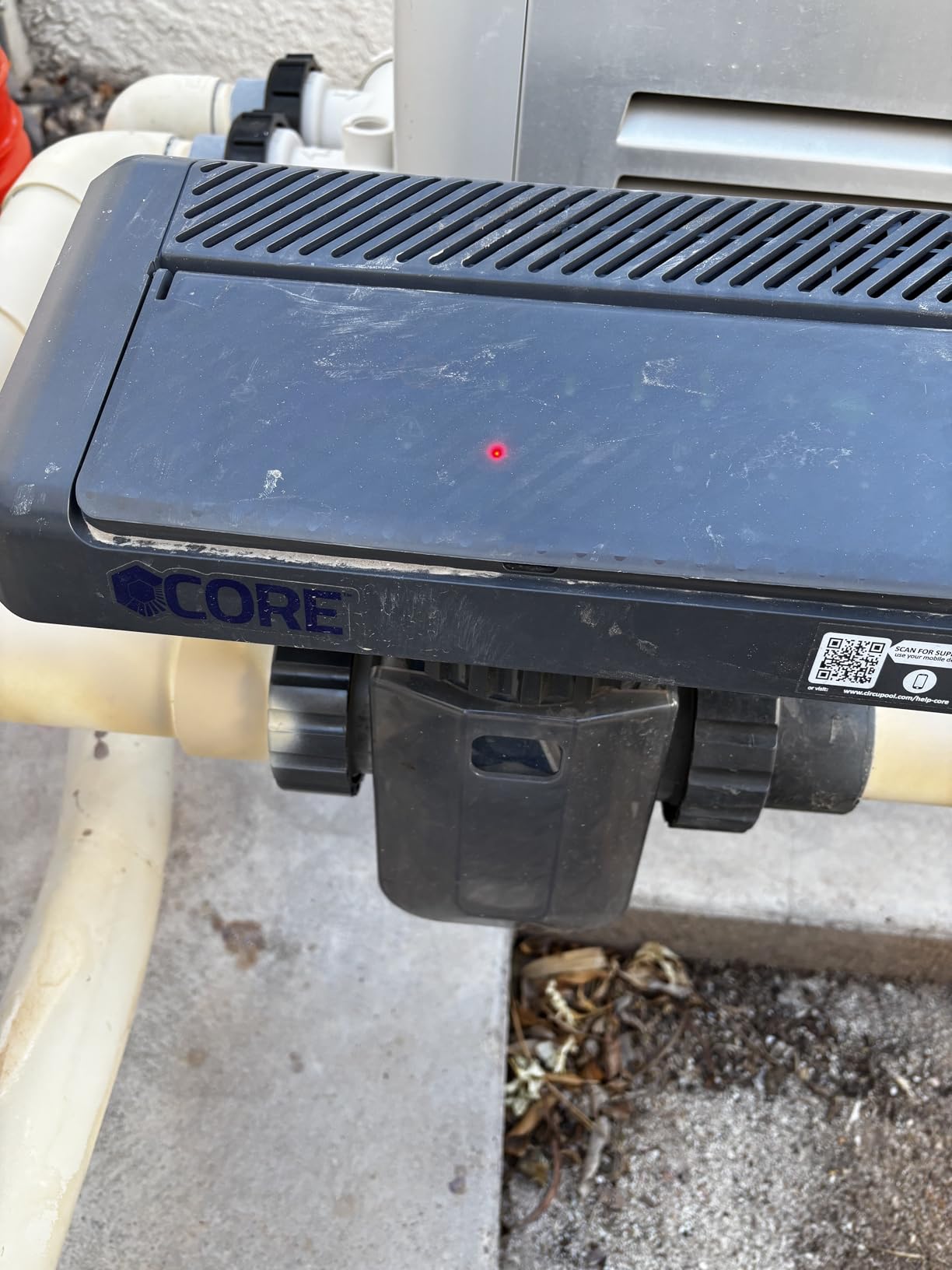
Now the honest caveat. That 8-year warranty prorates sharply after the first two years, so owners who felt shortchanged are reading the fine print correctly rather than exaggerating. A few models also threw flow errors after the inlet compression clamp cracked.
Sensor Coverage and What the Panel Tells You
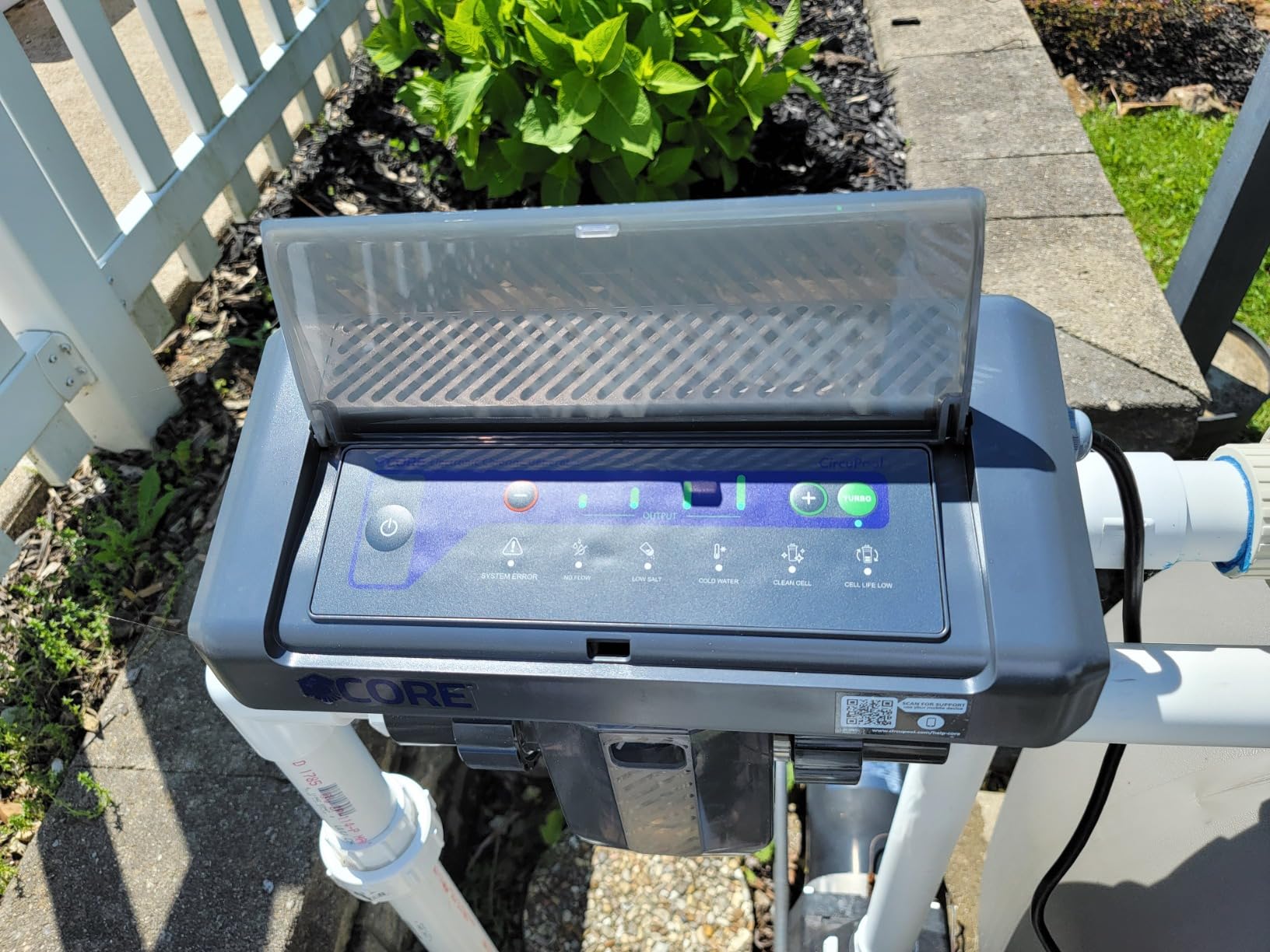
The CORE35 monitors flow, salinity, temperature, and cell scaling in one panel, which is more than most competitors at this tier. Cell lifespan tracking in particular lets you plan a replacement instead of discovering one during a heat wave.
Because the control unit and cell are a single weatherproof unit rated IP66, the whole assembly goes on the equipment pad in one piece. No separate power center to mount, no cell to plumb separately. It is the fastest install in this roundup.
What 1.4 lb per Day Means for a Real Pool
Roughly 1.4 lb per day is the output needed by a mid-size in-ground pool in peak summer conditions with a normal chlorine demand load. A 20,000-gallon pool will sit comfortably under that ceiling; a 35,000-gallon pool in full sun in August will be running near full output much of the time.
That near-full-output condition is exactly why the oversizing rule matters. If your pool is 25,000 gallons, this unit gives you comfortable headroom. If it is 34,000, a larger cell would serve you better over ten years.
Who This Works For
Buy the CORE35 if you have an in-ground pool between 15,000 and 30,000 gallons, you are installing it yourself, and warranty coverage after a self-install matters to you. The single-piece design also makes it a good fit for tight equipment pads.
Look elsewhere if you have a pool over 30,000 gallons, if you need a cell that can be sourced from a local pool store on any day of the week, or if you want zero ambiguity about what the eight-year warranty actually pays for.
4. EverCrystal Above-Ground Salt Chlorine Generator – Auto and AI Modes With 8-Hour Self-Cleaning
Salt Chlorine Generator, Salt Water System for Above Ground Pool
Model ECSCG10DA
Auto and AI output modes
Polarity reversal every 8 hours
Fits 1.25 and 1.5 in hoses
+ Pros
- Auto and AI modes adjust output automatically
- Panel reports how much salt to add
- Self-cleaning reverses polarity every 8 hours
- Child lock
- Handles both 1.25 and 1.5 inch hoses
- Cons
- Occasional flow fault codes and unresponsive buttons
- AI mode still needs monitoring through a season
The EverCrystal is the smartest small unit in this roundup, and at a 4.4 average across 102 reviews it rates higher than anything else at the entry end. The headline feature is dual mode: an Auto setting that adjusts output against pool size, and an AI mode that reads conditions and sets the schedule itself.
For a first salt pool, the salt readout matters more than it sounds. The panel tells you how many pounds of salt to add rather than just flashing a low-salt light, which removes the single most common beginner mistake of dosing by guesswork.
The negative reviews cluster on two things: occasional flow fault codes and buttons that stop responding after a short period of use. Neither is a dealbreaker, but both are the kind of annoyance that tempts you to blame the pool rather than the unit.
Why Polarity Reversal Every 8 Hours Matters
The self-cleaning cycle reverses the polarity of the current on the titanium plates every 8 hours. Scale from calcium and magnesium tends to build on one polarity first, so flipping the charge loosens deposits that a static cell would simply accumulate until output fell.
It is not a substitute for balanced water. A cell running in a pool with calcium hardness above 400 ppm or pH above 7.8 will scale regardless of how often you flip polarity. The reversal buys you headroom, not immunity.
Getting the Hose Fitting Right
This unit fits both 1.25 inch and 1.5 inch inner and outer hose diameters, which is where most above-ground install problems originate. Intex-style pools use 1.25 inch fittings, and many steel-frame pools use 1.5 inch, so confirm your diameter before ordering adapters.
A universal fit does not mean a universal seal. Check the clamp orientation and make sure the cell sits in a straight run of pipe with room to remove it later for cleaning.
Who This Works For
Choose this if you have an above-ground pool and want the most automated experience available without an app or a login. It suits owners who would rather set a mode once than adjust percentages every week through a heat wave.
It is a weaker fit for a large in-ground pool or for anyone who wants remote monitoring from a phone. It also makes less sense for you if you already own a Pentair or Hayward automation panel, since those ecosystems handle this job themselves.
5. APX Performance E-CHLOR Plug-in Salt Chlorine Generator – Highest Rated Compact Unit for 32,000 Gallons
E-CHLOR Plug-in Salt Chlorine Generator | 32,000 gal Max | APX Performance
32,000 gallon maximum
Model APX-ECHLOR-32-0301
Cutting template included
Smart sensor suite
+ Pros
- Highest rated unit in this roundup
- Up to 15 percent more output than other compact models
- Works with variable-speed pumps and in winter
- Tracks salt temperature scaling and cell lifespan
- Cons
- Short power cord may not reach a panel outlet
- Can overproduce at the default output setting
At 4.5 stars the E-CHLOR is the highest-rated product we tested, and it earned that on the strength of its chlorine output rather than its feature list. Owners swapping it into an existing salt pool report noticeably clearer water for a fraction of what a name-brand replacement costs.
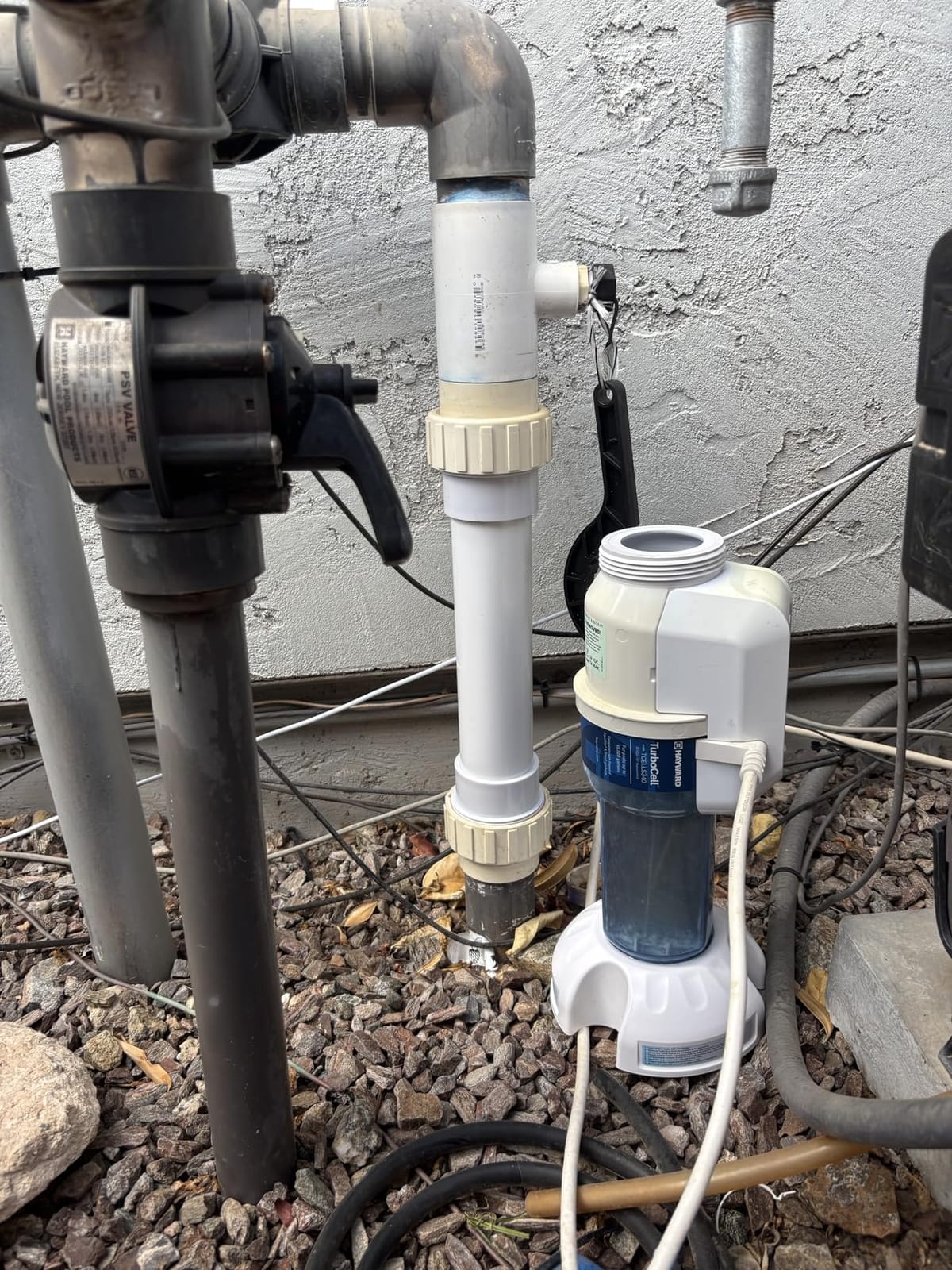
The plug-in design is the other part of the pitch. It runs off a standard 110V outlet, needs no separate power center, and ships with a cutting template so the plumbed-in cell fits a straight run of pipe without guesswork. That combination makes it one of the easiest retrofits in this roundup for most homeowners.
Two practical caveats. The power cord is short, so plan your outlet location before you mount the unit, and the default output can push more chlorine than a small pool needs, which means you will be turning it down after the first week rather than up.
Output Advantage on Variable-Speed Pump Systems
The output advantage comes from cell design and plate area rather than a higher voltage ceiling, and it is most visible on variable-speed pump setups. Owners on these systems report fast chlorine generation even with the pump running at moderate rather than maximum speed.
That matters because a cell that cannot keep up with a low-flow setting will simply underproduce. If your filter pump idles at a modest RPM for most of the day, an underperforming cell is a permanent shortfall rather than a temporary one.
Sensor Alerts Worth Knowing
The sensors track salt level, temperature, cell scaling, and remaining cell lifespan, and the system ships with a cleaning plug that seals the cell so you can get at the plates for an acid wash without dismantling the plumbing.
That plug is a small detail with real consequences. Most owners who clean their cells skip the step because the setup is awkward, and skipped cleaning is a leading cause of the premature cell failures that drive so many replacement purchases.
Who This Works For
This is our pick for an in-ground pool in the 20,000-32,000 gallon range that already has salt in the water and a 110V outlet within reach. It suits owners who want better output than a budget unit without moving to full name-brand pricing.
It is a poor match for a first-time salt installation with no plumbing cut into the return line, for very small above-ground pools, or for anyone who needs a cell that a local pool store will always have on the shelf.
6. Fengind 15,000 Gallon App-Controlled Salt Water Chlorinator – Best for Above-Ground Pools With Wi-Fi Monitoring
Fengind Salt Water Chlorinator Above Ground Pool up to 15000 Gallons
Up to 15,000 gallons
Wi-Fi app control
2 in and 1.5 in adapters
2-year service coverage
+ Pros
- Wi-Fi app shows chlorine runtime and cleaning schedules
- Low and no-flow alerts pushed to the app
- Self-cleaning plates reverse polarity every 8 hours
- 2-year service with responsive support
- Cons
- App requires personal information before the unit runs
- Some models arrived faulty or stopped generating within weeks
- Scale buildup can shut the unit off after several runs
Remote monitoring is the entire point of this one. The app reports chlorine production, run time, and cleaning schedules, and it pushes low-salt and no-flow alerts to your phone, which is a real improvement over waiting to walk out to a panel and read a light.
At 4.1 stars across 47 reviews the owner reports are positive on output. Owners running it on larger above-ground pools describe strong chlorine generation for a unit at this level, and the self-cleaning titanium plates reverse polarity every 8 hours to hold off scale.
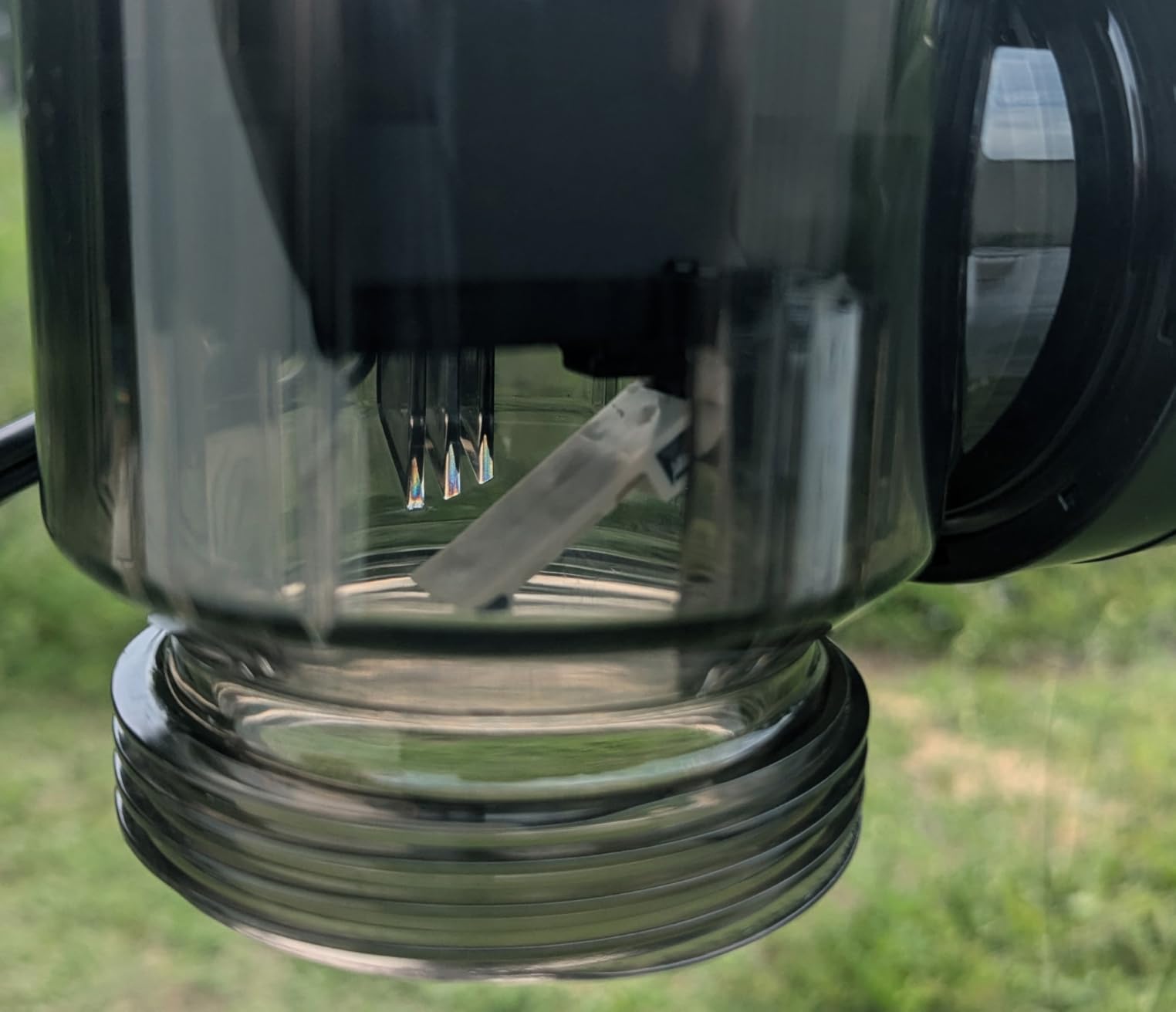
Two issues come up repeatedly. The app will not run the unit until you complete a registration step that asks for personal information, which bothers some owners. A cluster of reviews also describes models arriving faulty or ceasing generation within weeks, plus scale buildup that shuts the unit off after several filter runs.
Adapters and Hose Sizing
Two pipe interface options ship in the box, a 2 inch adapter for 60.3mm PVC and a 1.5 inch adapter for 48.3mm PVC, which covers most above-ground setups without a trip to the hardware store. Confirm your hose diameter before you start.
For a permanent in-ground installation the cell needs to sit in a straight run of return plumbing. An above-ground frame pool gives you far more flexibility here, and that flexibility is a large part of why this unit is shaped the way it is.
What App Monitoring Is and Is Not Worth
App telemetry is genuinely useful for two things: knowing that production stopped while you were away, and planning a cell cleaning before scale becomes a problem. Both reduce real pool downtime.
It is less useful for judging water quality. The app reports what the sensors report, and a salt sensor reading low in cold water can be wrong, which is why independent salt meters still exist and why owners argue about over-salting their pools.
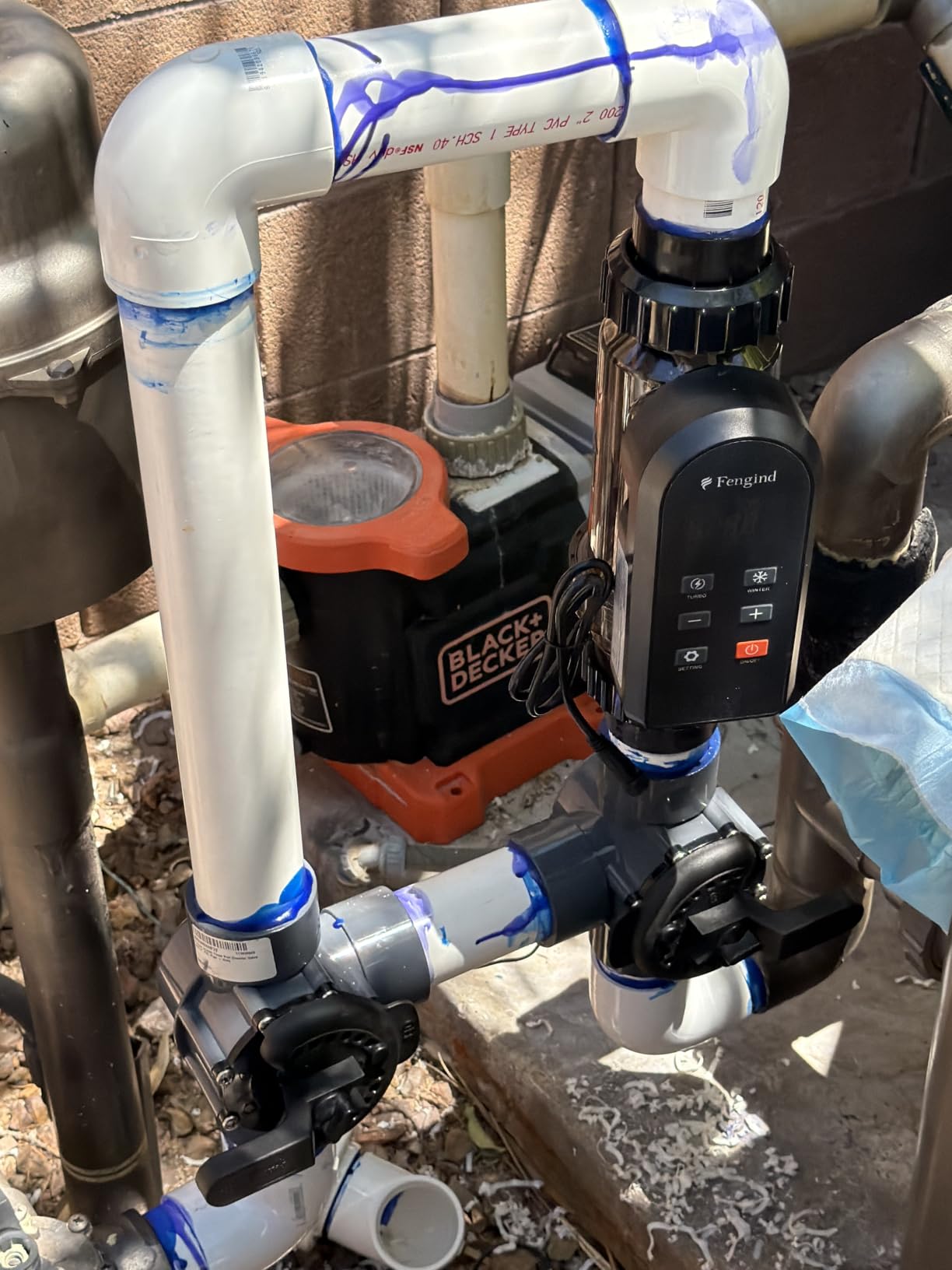
Who This Works For
Pick this if you travel regularly and want to know your pool is still being sanitized while you are gone. It also suits owners of a large above-ground pool who want app control without stepping up to a full in-ground system.
Skip it if you are privacy-conscious, if your priority is a decade-long service life rather than convenience features, or if a unit that needs an app to start running is a step too far from what you want to own.
7. Fengind 26,500 Gallon App-Controlled Salt System – Best for Mid-Size Pools With Adjustable Output
Salt Chlorine Generator for Pools up to 26,500 Gallons with App Control
Pools up to 26,500 gallons
1.1 lb per day output
All-in-one body
2.5 kg weight
+ Pros
- All-in-one control unit and cell for fast installation
- App control with 25 to 100 percent output and memory
- Self-cleaning plates with 4 8 or 12 hour reversal
- Auto-shutdown below 10C or at low salt
- Child lock and surge protection
- Cons
- Limited review volume relative to listing age
- App-dependent setup adds a configuration step
This is the same product family as the unit above, sized for a bigger pool. The 26,500-gallon rating and stated 1.1 lb per day output across a 10C to 42C operating range make it a better fit for someone with an in-ground or oversized above-ground pool than the 15,000-gallon version.
The control unit and cell ship as a single assembly, so installation is quick. Output adjusts from 25 to 100 percent with a memory function, and you can set the self-cleaning polarity reversal to 4, 8, or 12 hours depending on how hard your water is.
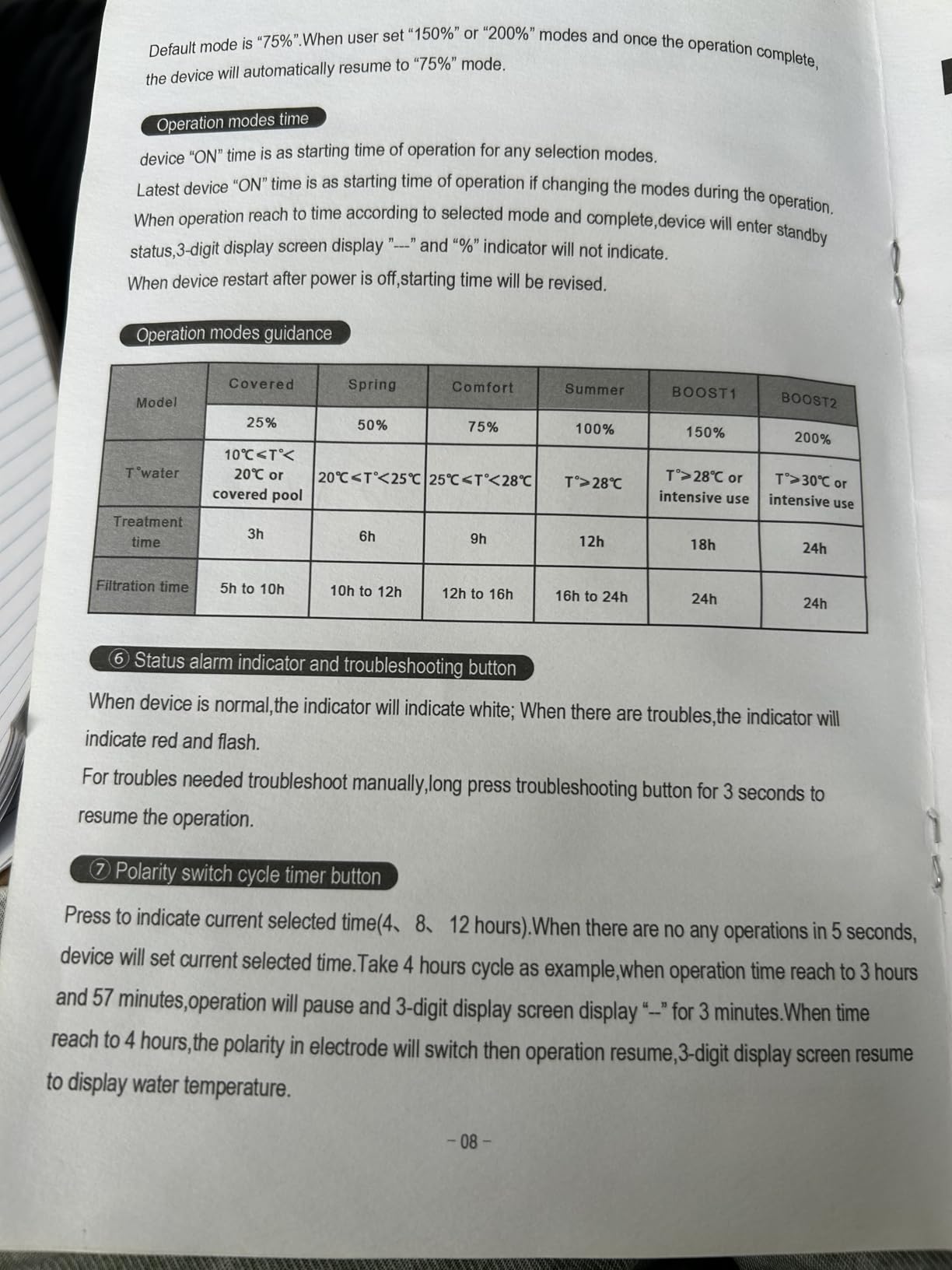
Be honest about the evidence here. At 45 reviews, the owner feedback on this listing is thin, and the reviews that exist focus on features and setup rather than long-term durability. That is a real limitation when you are weighing a multi-year purchase on a relatively young listing.
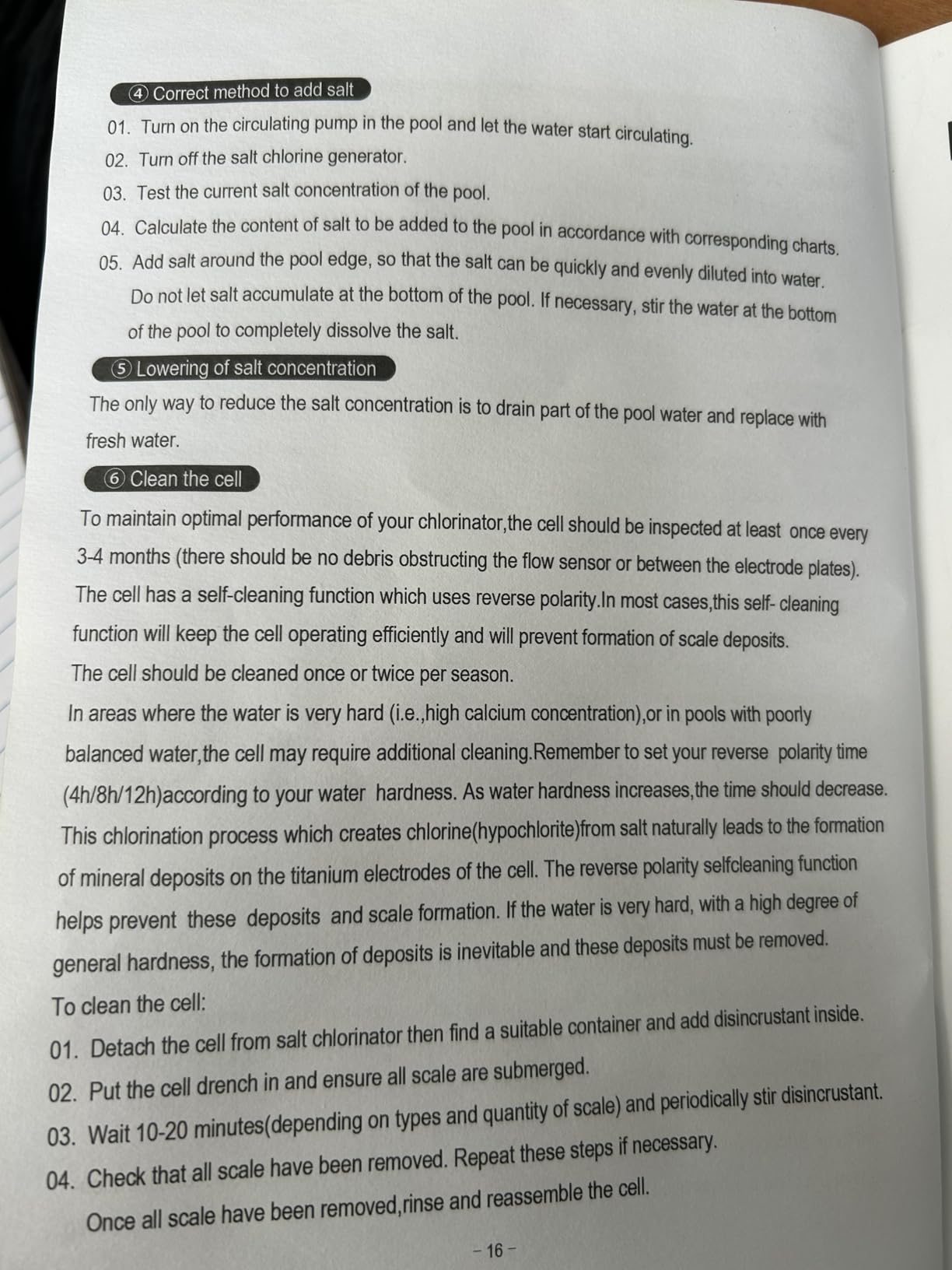
Tri-Sensor Monitoring and Automatic Shutdown
The system watches salinity, temperature, and flow, then shuts itself down below 10C or when salt drops too low. Auto-shutdown protects the cell in exactly the two situations that destroy it, so this is a safety feature rather than a convenience one.
Combined with the child lock and voltage surge protection, it is a reasonably defensive design. Surge protection matters in a wet environment with a pump and motor sharing the same pad.
Why the 26,500-Gallon Rating Is the Right Ceiling
Ratings are chosen so the cell can hit a normal chlorine demand load with room to spare. Running a cell flat out most of the day is what shortens its life, so a pool that is genuinely 26,500 gallons is a poor match for a unit rated well above that.
If your pool is smaller, this unit gives you more headroom than you need, which is fine but not free. More plate area running at a lower percentage is actually gentler on the coating than max output, so it is not a bad place to be.
Who This Works For
Choose this for a pool in the 18,000-26,000 gallon range where you want app control and a single-piece install. It works well for owners who want adjustable self-cleaning intervals because their water is hard.
It is a weaker choice if durability track record matters more than features, if you would rather not depend on an app, or if you already own a Pentair or Hayward control panel that could handle the same job.
8. Rinoson 22,000 Gallon Smart Salt Chlorine Generator – Best for Step-by-Step Output Control
Rinoson Saltwater Pool Chlorinator System with Two Year Limited Warranty, App Remote Control & Titanium Plate Self-Cleaning Smart Salt Chlorine Generator for Pools up to 22,000 Gallons
Pools up to 22,000 gallons
Up to 0.7 oz per hour
All-in-one design
2.78 kg weight
+ Pros
- All-in-one control unit and cell cuts setup time
- Five output settings from 20 to 100 percent
- Self-cleaning with 2 4 6 or 8 hour reversal
- Low salt alert plus voltage and current monitoring
- 2-year warranty with 24/7 support
- Cons
- App works on 2.4GHz Wi-Fi only
- Listing specifies indoor use only
- Lower hourly output than most models here
The Rinoson does one thing in unusual detail: output control. Five settings at 20, 40, 60, 80, and 100 percent, plus self-cleaning intervals you can set at 2, 4, 6, or 8 hours, give you more granularity than any other unit in this roundup.
For a pool with wide seasonal swings, that matters. A chlorinator you can turn down to 20 percent in spring and up to 100 percent in August wastes less cell life than one that runs constantly at whatever setting you picked in June.
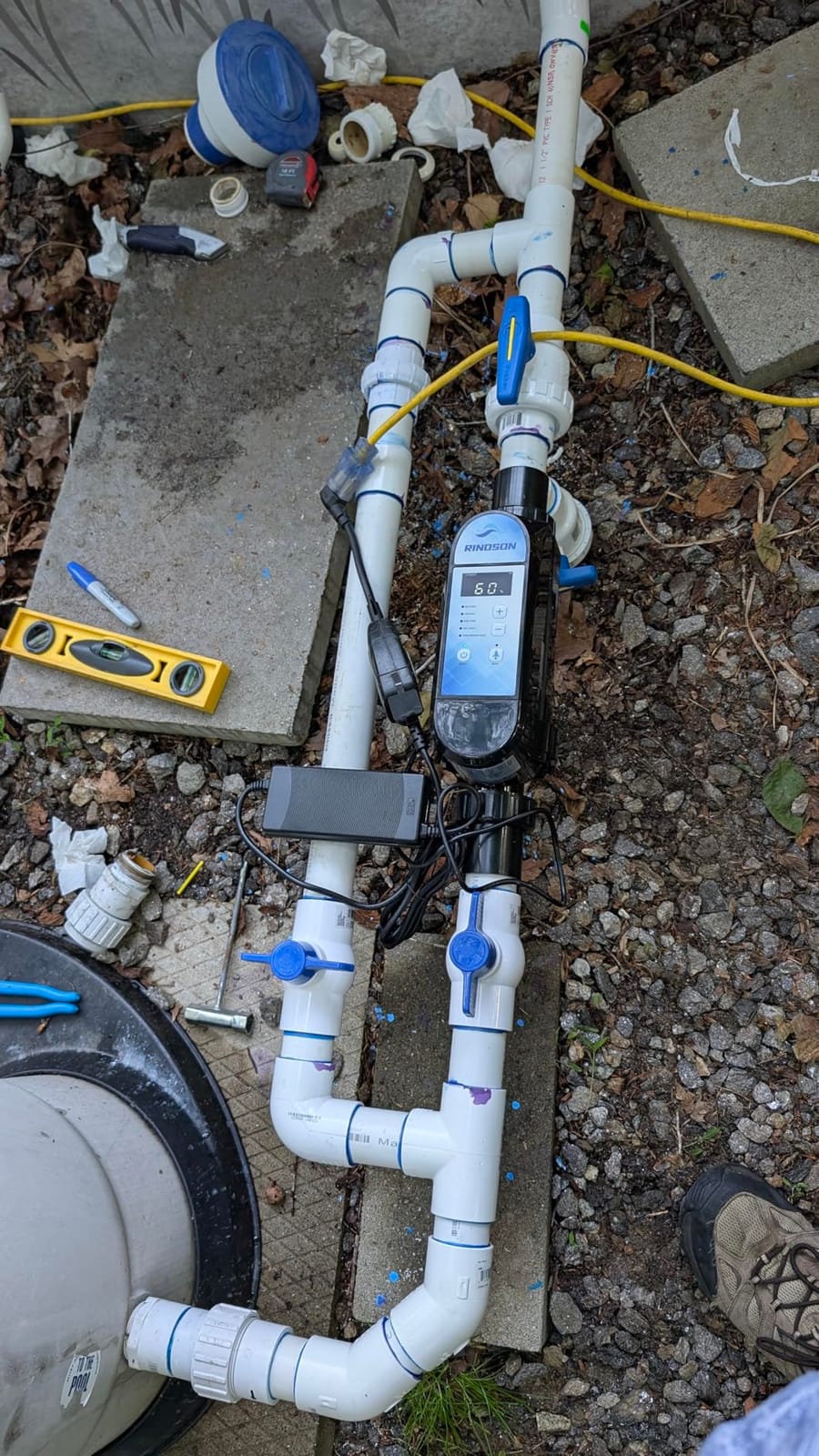
Two limitations are worth weighing. The app connects over 2.4GHz Wi-Fi only, which is a problem if your router puts everything on a 5GHz network or if you live somewhere with crowded 2.4GHz spectrum. And the listing specifies indoor use only, which is odd for a pool product and suggests the enclosure is not sealed like an IP-rated unit.
Output Rate and What 0.7 oz per Hour Means
Stated output of up to 0.7 oz per hour is the lowest per-hour figure among the models here, which is the main reason the 3.6 rating sits below its peers. On a 22,000-gallon pool in peak summer, a lower output cell simply has to run more hours to keep up.
If your pool gets heavy use or sits in full sun with no shade, factor that into your decision. On a shaded, lightly used pool, the output gap matters much less.
Wide Voltage Input and Where It Helps
The built-in adapter accepts 100V to 240V input, which means the unit works on standard household power without a dedicated circuit. That removes a common install cost when your equipment pad is far from a panel.
The monitoring covers low salt, voltage, and current. Current draw is the closest thing this unit offers to a cell condition check, so it is worth learning what a normal reading looks like before you need it.
Who This Works For
This fits an owner who wants fine control over output and cleaning intervals, and who has confirmed a 2.4GHz Wi-Fi network reaches the equipment pad. It is also reasonable if you plan to install the unit somewhere with partial weather protection.
It is the wrong pick for a large, hot, heavily used pool that needs serious output, for anyone on a 5GHz-only network, or for an outdoor install in full weather exposure given the indoor-use note in the listing.
9. Bonvoisin LC-200A Salt Chlorine Generator – Best for In-Ground Retrofits With LED and App Control
Bonvoisin Salt Water Pool Chlorinator System Salt Chlorine Generator for Inground Pools Saltwater Pool System with Titanium Cell, LED/APP Control, Up to 25,000 Gallons Pool
In-ground pools up to 25,000 gallons
4.7 x 13 inch size
3.5 lb weight
Output adjustable 5 to 100 percent
+ Pros
- LED and app control with scheduled daily production
- Temperature and salinity detection built in
- Polarity reversal every 4 8 or 12 hours
- Compact body mounts horizontally or vertically
- Both 1.5 in and 2 in adapters included
- Cons
- No internal timer so power restoration needs a button press
- App connection drops when location services are off
- Some models stopped producing after a few months
The Bonvoisin is explicitly built for in-ground retrofits, and the dimensions explain why. At 4.7 by 13 inches and 3.5 pounds, it mounts in a tight equipment pad where a full-size power center and cell assembly would never have fit.
Owners swapping it into an existing salt pool report noticeably better water at a fraction of the cost of a name-brand replacement, which is a recurring theme in the reviews. Output adjusts in 5 percent increments from 5 to 100 percent, and scheduled daily production handles the timing.
Two design choices will bother some people. There is no internal timer, so if power drops and returns, you press a button to restart it. And the app connection depends on location services being enabled, which owners report as a recurring frustration.
Why the Compact Form Factor Is the Real Feature
In-ground retrofits are constrained by space, not by budget. Most failed swap attempts fail because the replacement unit physically will not fit next to the pump and filter, which is why a compact 4.7 by 13 inch body with mounting in either orientation is genuinely useful here.
The included 1.5 inch and 2 inch adapters cover most existing return plumbing. Check your pipe diameter before ordering, because a cell that does not physically fit is the one problem no warranty covers.
Self-Cleaning Intervals and Hard Water
Polarity reversal is adjustable at 4, 8, or 12 hours. On hard water, set it to the shortest interval available. On soft balanced water, 12 hours reduces wear on the electronics without meaningfully increasing scale risk.
Built-in temperature and salinity detection means the unit can shut down or alert before the cell runs dry or in conditions that damage the coating.
Who This Works For
Choose this if you have an in-ground pool up to 25,000 gallons with a cramped equipment pad and a 2.4GHz network. It suits owners replacing a failed name-brand cell who want a physical size reduction along with a price cut.
Pass if you need the unit to recover from a power outage without your involvement, if you disable location services on your phone, or if you want a long, well-documented service history behind the product.
10. SwimPulse SPDA05 Saltwater Chlorinator System – Best Kit for First-Time Above-Ground Owners
Saltwater Chlorinator System for Above Ground Pools up to 15,000 Gallons
Above-ground pools to 15,000 gallons
Model SPDA05
Test strips included
LED with 1-12 hour run times
+ Pros
- Test strips and adapters included in the box
- Simple setup for first-time saltwater owners
- Self-cleaning electrode reverses polarity every 8 hours
- LED display with 1-12 hour run times and boost mode
- Cons
- Not sized for in-ground pools
- Some models failed within the warranty period
- Replacement parts for the cell hard to source
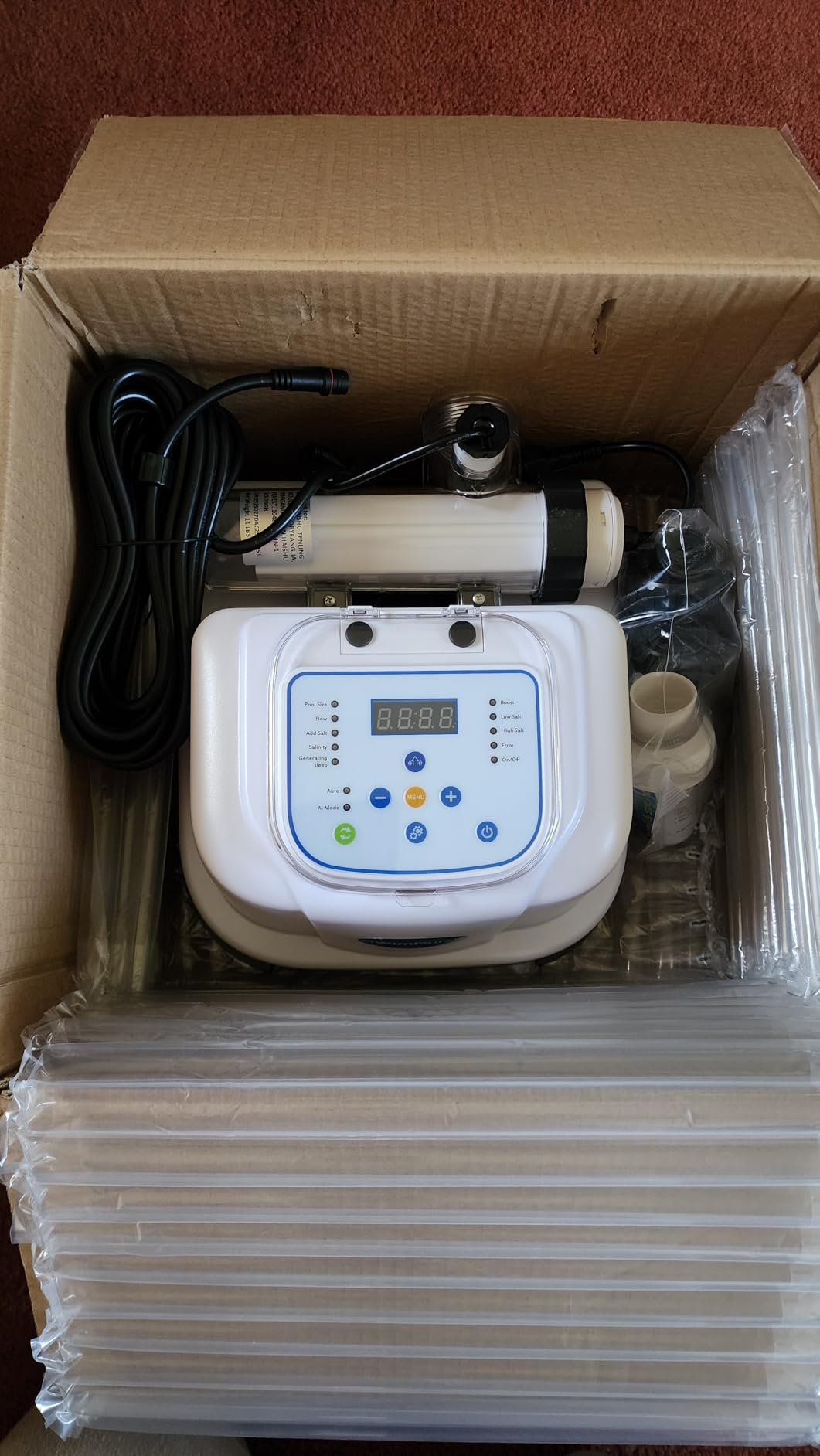
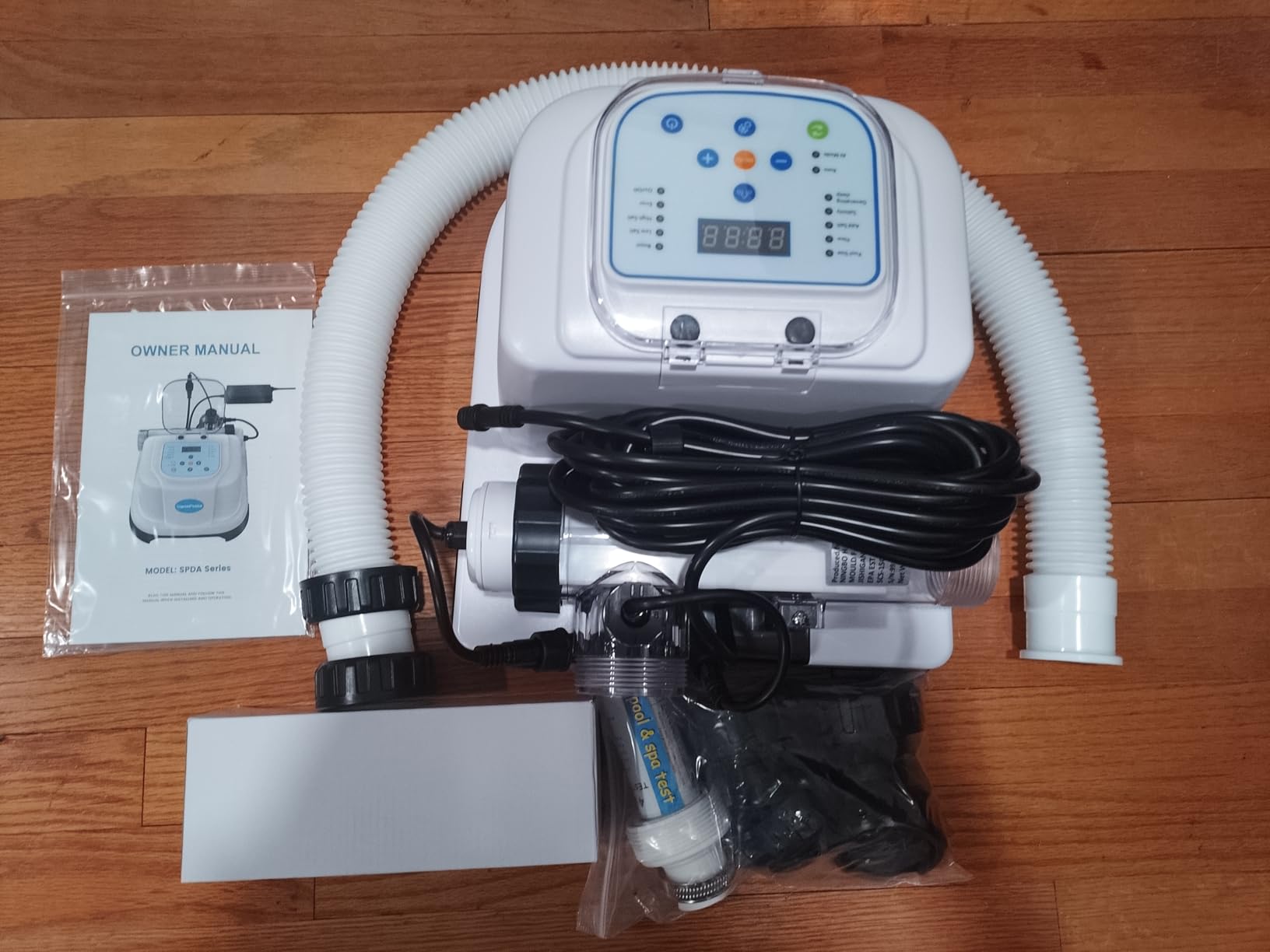
What separates this one is what is in the box. Test strips ship with the unit, and the adapters are included, so a first-time owner does not make a hardware store run before the pool will work.
The control panel is a simple LED display with run times adjustable from 1 to 12 hours plus a boost mode. That is genuinely all a small above-ground pool needs, and the self-cleaning titanium electrode reverses polarity every 8 hours on its own.
The reviews are mixed on durability. Several owners needed multiple replacements within a single season, and replacement parts for the cell are difficult to source. At 25 reviews the sample is also small, so treat the 4.2 average as encouraging but not settled.
Why Flow Requirements Rule Out In-Ground Pools
This unit is built around the flow rates an above-ground filter pump can deliver. In-ground pools run substantially higher flow through the return, and a cell undersized for that flow will not generate enough chlorine no matter what the panel says.
If you have an in-ground pool, skip this section entirely and look at the Core35 or the Aquarite. For an above-ground frame pool using a compatible filter pump, the flow is well within spec.
Run Times and Boost Mode for Small Pools
Adjustable 1-to-12-hour run times let you match production to season rather than to a single setting. A pool used heavily in July can run longer, and a lightly used pool in October can run shorter and preserve the cell.
Boost mode is for catching up after heavy rain, which washes out chlorine faster than anything else. Owners report noticeably softer water and reduced chlorine smell, which are the two benefits people notice first.
Who This Works For
This is a good fit for a first above-ground pool where nobody wants to learn pool chemistry from scratch. It suits owners who want soft water and no odor immediately, and who accept that the unit may need replacing within a few seasons.
It is the wrong choice for in-ground pools, for anyone planning to keep a pool for many years on one purchase, or for owners who need a replacement cell they can find easily at a pool store.
11. Pureline Crystal Pure PL7700 – Highest Chlorine Output and a Direct Drop-In Cell Replacement
Pureline Crystal Pure Salt System, PL7700, Universal Pool Salt Chlorination System, Includes Control Panel, Salt Cell, 40,000 Gallon
Up to 40,000 gallons
2.1 lbs max chlorine per day
Model PL7700
Working range 50F to 140F
+ Pros
- Highest daily chlorine output in this group
- Direct replacement for Hayward CircuPool and Pentair cells
- Self-cleaning plus super chlorination mode
- Flow detector and temperature protection
- Low energy consumption
- Cons
- Only a 1-year warranty
- Poorly written instructions and no power wire included
- Requires cutting and gluing PVC plus basic wiring
The PL7700 is the highest-output cell in this roundup at 2.1 lbs of chlorine per day, and it carries a 4.4 average across 62 reviews. For anyone replacing a Hayward, CircuPool, or Pentair cell in an existing saltwater pool, the headline is that it fits those systems directly with no plumbing changes.
Long-time saltwater owners describe it as a drop-in swap at a fraction of name-brand pricing, and several report cells lasting five to six years. That is a meaningfully different ownership curve from the above-ground models earlier in this list.
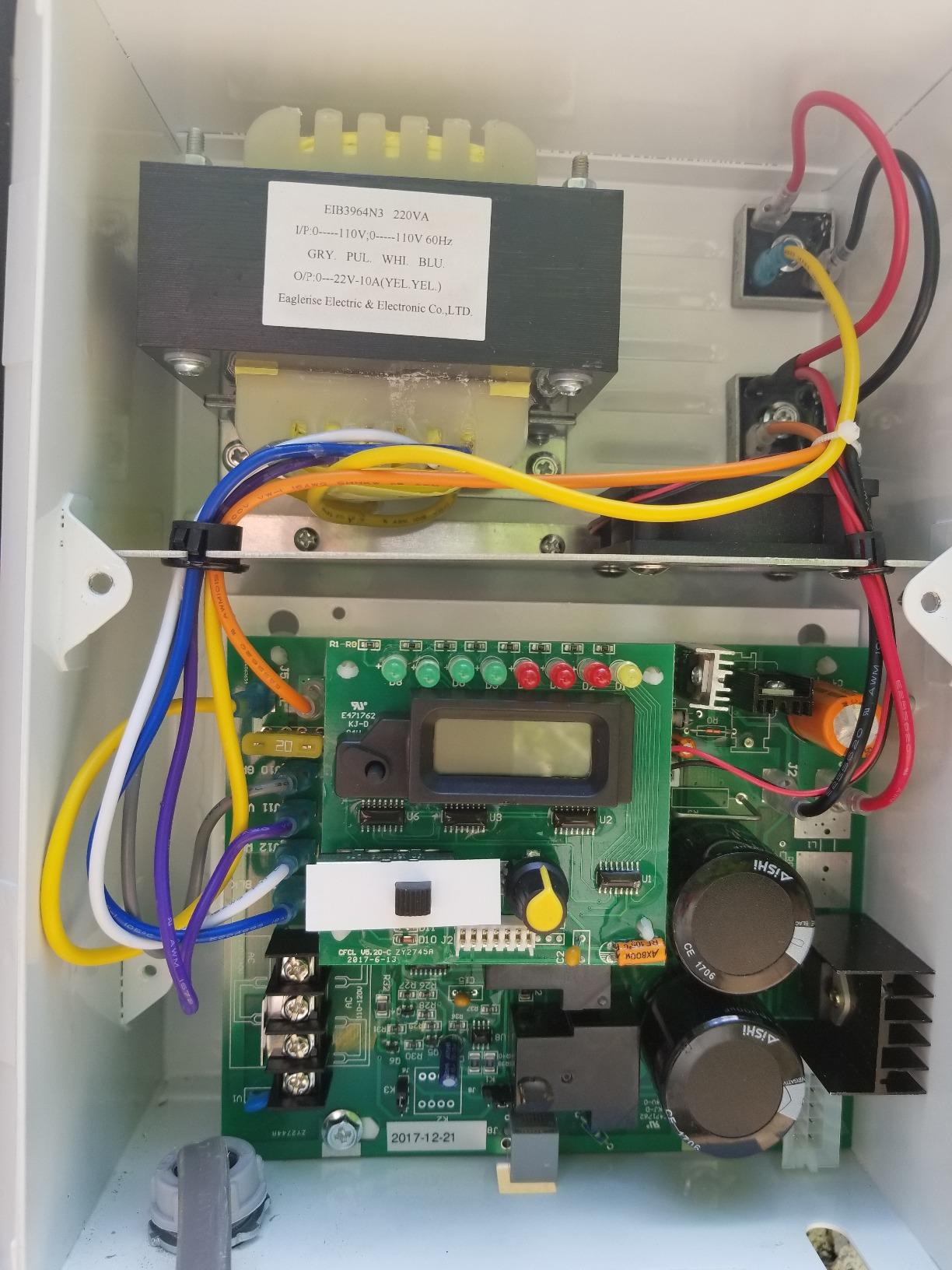
The honest weakness is the warranty. One year is the shortest in this group by a wide margin, and owners who bought expecting name-brand coverage are right to feel the gap. The documentation is also thin, and the power connection wire is not included in the box.
2.1 lbs per Day and the 50F to 140F Range
That output figure is the highest here, which means the cell can cover a very large pool or an extremely high-demand one without running flat out. Owners with large in-ground pools in hot climates are the ones who benefit most from the headroom.
The stated working range of 50F to 140F is unusually wide at the top end, which matters for pools in hot regions where water temperature climbs well above what most cells are rated for.
Why Direct Cell Compatibility Matters Most
Replacement cells are the hidden cost of ownership. A proprietary cell from a name brand is one of the biggest reasons saltwater owners get stuck, and a unit designed to physically fit the common cell housings removes that lock-in entirely.
Before you order, confirm the cell housing style in your existing plumbing matches. The dimensions and fitting pattern have to line up, and the plumbing cut-and-glue job should be done by someone comfortable with PVC if you have never done it.
Who This Works For
Choose this if you already have a saltwater pool with an existing cell housing and you want more output for less money. It suits owners of large in-ground pools who have decided the shorter warranty is an acceptable trade for a cheaper second purchase.
Pass if you need strong warranty coverage, if this is a first-time install and you want the clearest documentation possible, or if you are not comfortable with basic PVC work and light wiring.
12. Westaho EL-032 40,000 Gallon In-Ground Salt Chlorine Generator – Built-in Power Supply for Large In-Ground Pools
Salt Chlorine Generator, Westaho Pool Salt System for Inground Pools Up to 40,000 Gallons, 1.4 lb Chlorine Output, USA Titanium Cell with 10,000-Hour Lifespan, Built-in Power Supply
In-ground pools to 40,000 gallons
Model EL-032
1.4 lb chlorine output
Built-in power supply
+ Pros
- Eleven USA-made titanium cells rated to 10000 hours
- Built-in power supply removes external wiring
- Panel shows salt temperature cell usage voltage and current
- Magnetic flow switch
- IP66 waterproof rating
- Cons
- Cell longevity claims not always matched in early seasons
- Low-temp cutoff below 52F requires winter planning
The EL-032 is built for large in-ground pools and solves the install problem most models at this capacity create. The power supply is built into the unit, so there is no separate power center to mount and no low-voltage cable to run across the pad.
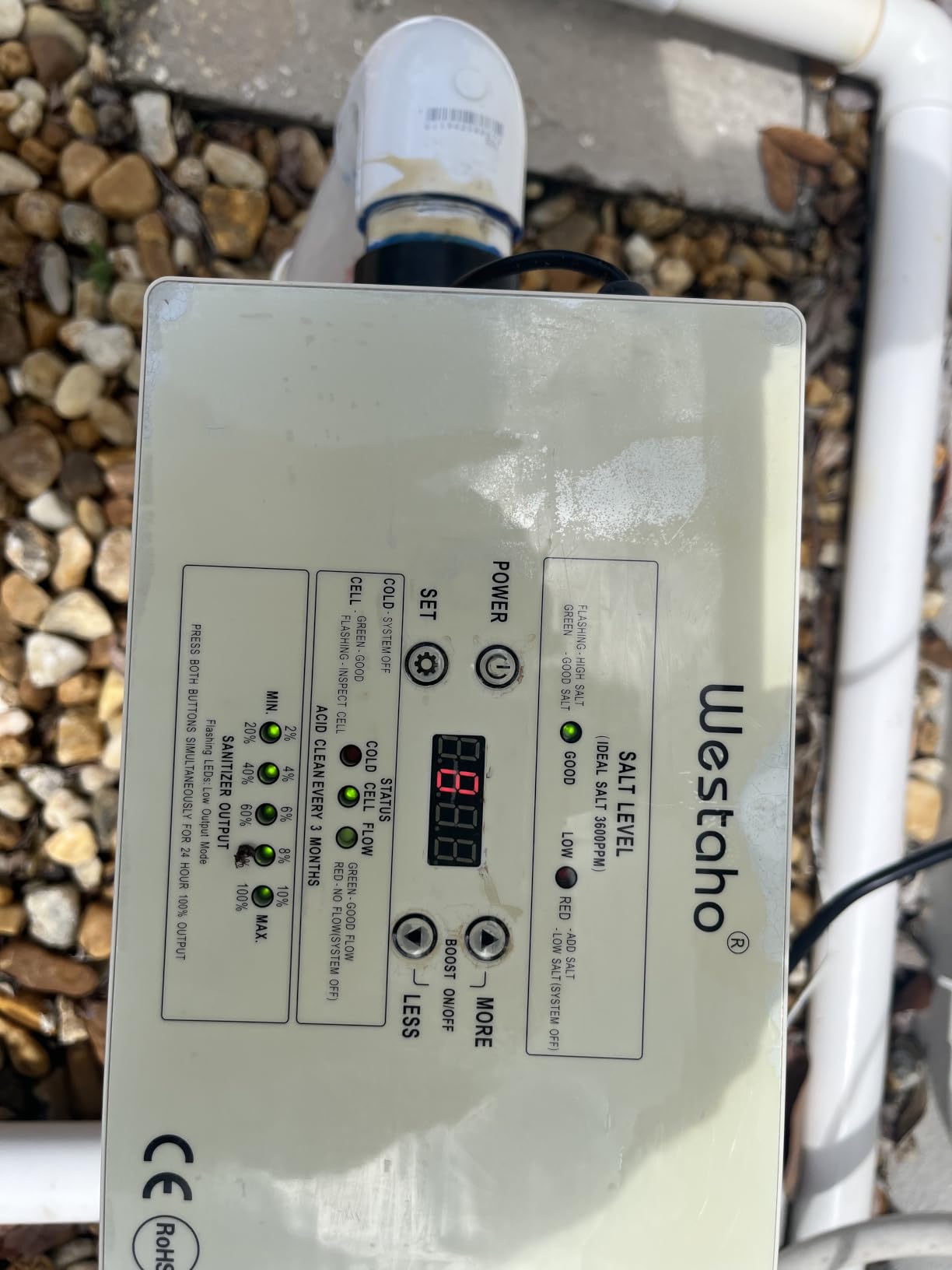
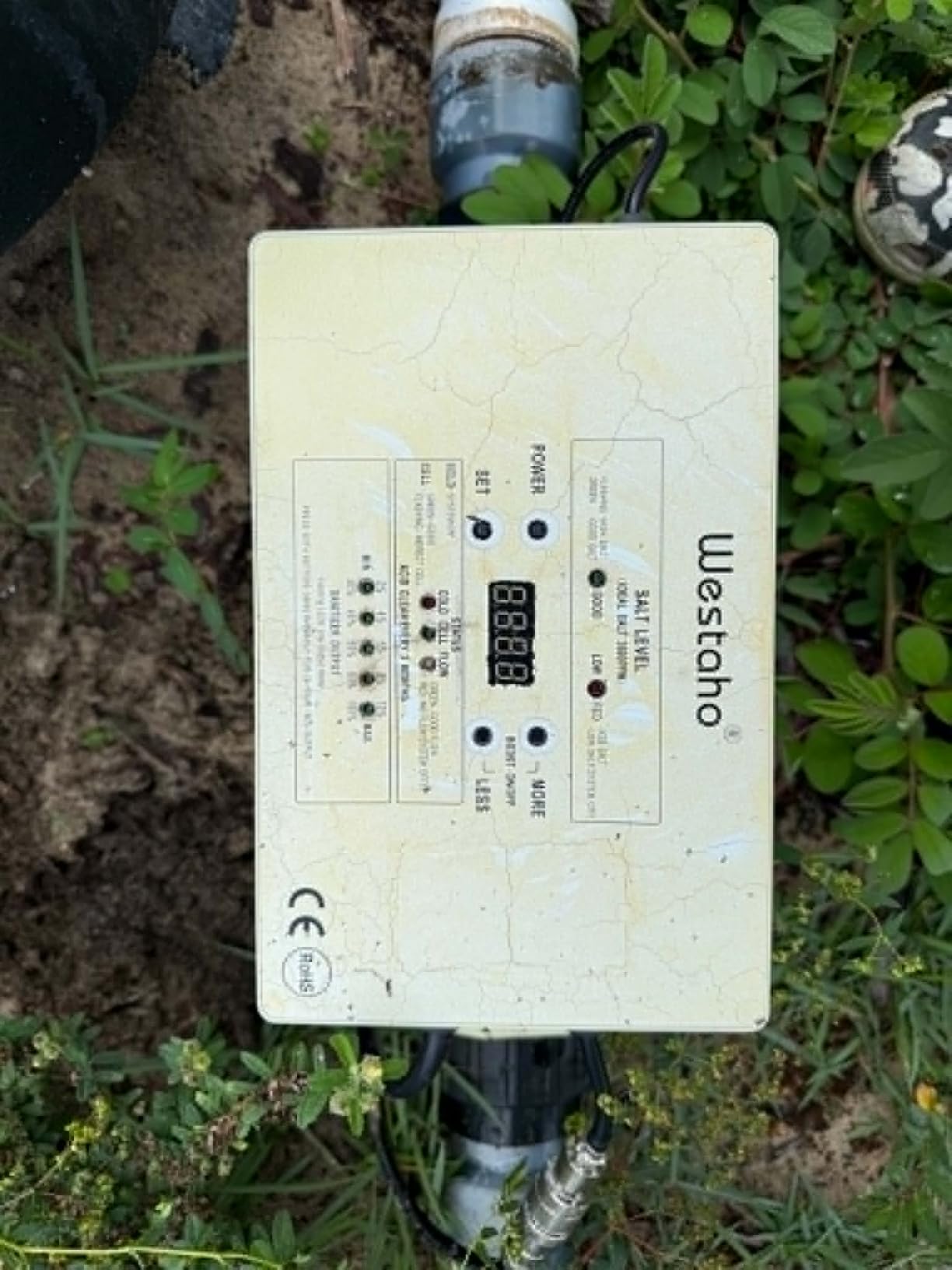
Owners of large in-ground pools value that simplicity, and the monitoring panel is thorough, showing salt level, temperature, cell usage, voltage, and current. A magnetic flow switch replaces the mechanical type, and the IP66 rating covers year-round outdoor mounting.
The 4.0 rating reflects one specific complaint: cells that did not last as long as the advertised 10,000 hours suggests. That gap between a headline lifespan number and real-world early-season performance is exactly the kind of thing that should make you cautious, and we would rather tell you now than after a failed cell.
Built-in Power Supply as an Install Advantage
Splitting a salt system into a power center and a cell doubles the number of failure points and the number of things to mount. Integrating them means one unit, one wiring job, one place to look when something stops.
For new construction this is a real advantage, since you can plumb a single box instead of planning both locations. For a retrofit, the same integration means less wall space to find.
Interpreting the 10,000-Hour Cell Claim
Ten thousand hours sounds impressive until you convert it. At ten hours of filtration a day, a year is about 3,650 hours, so a 10,000-hour cell is roughly a three-year figure under those conditions and considerably longer at lower daily run times.
This is the number most people misread. Cell life is measured in operating hours, not calendar years, and the difference between a pool filtering four hours a day and one filtering twelve is the difference between a decade of ownership and three years.
Winter Planning in Cold Climates
Low-temperature cutoff below 52F means production stops in winter. That is correct behavior, since electrolysis slows dramatically in cold water and forcing output can damage the cell, but it does mean you are not sanitizing through the off season.
If you close your pool, you are relying on shock and a cover through the winter. If you keep it open, you will be adding chlorine manually during cold months regardless of which salt system you own.
Who This Works For
Choose this for an in-ground pool in the 30,000-40,000 gallon range where a built-in power supply simplifies the install. It suits owners who want detailed monitoring and a magnetic flow switch without a separate power center.
Pass if you need a cell lifespan you can rely on for many years, if your pool is smaller than 30,000 gallons and the extra capacity is wasted, or if you want a brand with a long published service record in this category.
How to Choose the Right Saltwater Chlorinator for Your Pool
Every decision in this category reduces to five things: how big your pool is, what kind of pump you run, what you already own, what a replacement cell will cost, and how much automation you actually want. Here is how each one should shape your choice.
How a Saltwater Chlorinator Actually Works
The mechanism is worth understanding because it explains most of the failure modes you will read about in reviews.
- Salt addition. You dissolve pool salt into the water until it reads roughly 2,800-3,200 ppm. Ocean water is about ten times saltier, which is why a salt pool still tastes completely fresh.
- Electrolysis. A low-voltage direct current passes across titanium plates coated with a mixed metal oxide in a cell installed in the return line. Sodium chloride splits into sodium and hypochlorous acid.
- Sanitization. The hypochlorous acid does the disinfecting, then breaks down back into salt and hydrogen, so the cycle repeats. The salt is not consumed in any meaningful quantity.
That third point is the one people miss. Salt is not a consumable the way chlorine is, which is why owners replace salt by the pound every few months rather than the drum.
What Size Saltwater Chlorinator Do You Need?
Measure your pool volume first, then apply the oversizing rule: choose a unit rated for about 1.5 times your actual pool volume. A cell pinned at 100 percent output degrades noticeably faster than one working at partial output, and oversizing is the cheapest insurance available.
- Under 10,000 gallons: pick a 15,000-gallon-rated unit. Most above-ground pools land here.
- 10,000-15,000 gallons: a 15,000-gallon rating is the minimum; a 22,000 or 26,500-gallon unit gives you real headroom.
- 15,000-30,000 gallons: target a 32,000 to 35,000-gallon rating.
- 30,000-40,000 gallons: you need a 40,000-gallon-rated cell, and you should accept that it will work hard in August.
Rectangular pools multiply length by width by average depth in feet, then by 7.5 to get gallons. Round pools multiply the square of the diameter by the average depth by 5.7.
Pool Type and Flow Rate Are One Decision
Above-ground filter pumps push far less water than in-ground systems, and cells need a minimum flow of roughly 15-20 GPM to work. This is why the budget category above 10,000 gallons is filled with above-ground models and why one of the products here is explicitly not rated for in-ground pools.
On a variable-speed pump, confirm the unit handles low-speed settings. A cell starved of current at a modest RPM simply underproduces, and no setting on the control panel fixes it.
Cell Life Is Measured in Hours, Not Years
Advertised cell life in operating hours is the only comparable figure across brands. The 2,800-hour cells on entry above-ground models and the 10,000-hour cells on the larger models are the same unit of measure, which makes them directly comparable in a way that “3 to 5 years” is not.
Convert to your own reality: multiply daily run time by 365. At eight hours a day, a 10,000-hour cell lasts about three and a half years. At four hours, closer to seven.
What Actually Kills a Cell
Scale from calcium and magnesium is the primary cause of cell failure, and chemistry is the primary cause of scale.
- pH 7.4-7.6. At pH 7.8, the active form of chlorine drops to roughly 33 percent effectiveness compared with about 75 percent at pH 7.2, and scale deposits accelerate.
- Calcium hardness 200-400 ppm. Harder water scales faster and shortens cell life.
- Cyanuric acid 60-80 ppm. Too little and UV burns off chlorine; too much and the cell works harder than it should.
- Running a cell dry. Flow switches prevent this, which is why a magnetic switch is worth paying for.
Acid washing a scaled cell with one part muriatic acid to ten parts water, soaking five to ten minutes and never exceeding fifteen, recovers output that buying a new cell would have thrown away.
Smart and App-Controlled Units: Worth It or Not
Six of the twelve models here connect to a phone. What that actually gets you is alerts when production stops, remote output adjustment, and cleaning reminders.
What it does not get you is better chlorine. No unit in this roundup produces meaningfully more than its non-app peers, and several app models need a button press after a power outage because they have no internal timer. Weigh the convenience against that.
Warranty Terms and the Self-Install Trap
This is the most expensive mistake in the category. Some brands require a certified installer to keep warranty coverage, which adds labor and can cost more than the unit did. Others, CircuPool most notably, support self-installers without penalty.
Warranty lengths here range from one year to eight years, and proration matters. Read the schedule, not the headline number, because a warranty that drops to near-nothing after year two is not really an eight-year warranty.
When a Traditional Chlorinator Is the Better Answer
We think most saltwater pool owners should stay with a salt system, but not all of them. A traditional automatic chlorinator makes more sense if your pool is small, your fill water is very hard, you have a concrete or gunite surface you are worried about, or you simply do not want to maintain salt levels and a salt system adds a second thing that can fail.
Forum discussion on this topic is genuinely active, and some saltwater owners have reverted to traditional chlorinators after getting tired of cell and salt maintenance. That is a legitimate outcome, not a failure.
Troubleshooting the Common Fault Codes
- Low salt light. Verify with an independent salt meter before adding. Salt sensors in cold water and on scaled cells read falsely low, which causes owners to over-salt.
- High salt light. Add water. Salt leaves the pool through splash-out, rain, and backwash, but never rises on its own.
- Inspect cell light. Output dropped, so the cell is scaling. Acid wash before buying a replacement.
- No flow fault. The pump is off, the speed is too low, or the cell is clogged. Check the valve position before assuming the cell is dead.
- No output, no fault code. This is usually a control board rather than a cell. Testing the cell’s voltage is what separates the two, and skipping that test is the most common diagnostic dead end.
Frequently Asked Questions
Are salt water chlorinators worth it?
For most in-ground pool owners, yes. The savings come from eliminating routine tablet and liquid chlorine purchases, which typically cuts annual chemical spending by 50-75 percent, plus the water feels softer and does not carry a chlorine smell. The main hidden costs are salt, cell replacement every few years, and pH correction, since electrolysis drives pH up and you will add muriatic acid more often.
How long does a salt chlorine generator typically last?
Judge by operating hours rather than years. Quality titanium cells are commonly rated at 10,000-15,000 hours, while entry-level above-ground cells run around 2,800 hours. At eight hours of filtration per day, a 10,000-hour cell lasts roughly three and a half years; at four hours a day, closer to seven. Undersizing the cell for the pool and poor pH control are the two biggest causes of early failure.
What size salt chlorinator do I need for my pool?
Choose a unit rated for about 1.5 times your pool volume. Under 10,000 gallons needs a 15,000-gallon-rated unit; 10,000-15,000 gallons needs at least 15,000 gallons and benefits from 22,000 or 26,500; 15,000-30,000 gallons needs a 32,000 to 35,000-gallon rating; above 30,000 gallons needs a 40,000-gallon cell. Oversizing matters because a cell pinned at 100 percent output degrades much faster than one at partial output.
What kind of chlorine do you use in a saltwater pool?
The same chlorine, manufactured on site. The salt chlorine generator passes a low-voltage current across titanium plates, which splits sodium chloride into hypochlorous acid, the active form of chlorine. That compound sanitizes the pool and then reverts back to salt, so the cycle repeats indefinitely. You still need cyanuric acid stabilizer in the 60-80 ppm range, and you still add shock for heavy bather loads and heavy rain.
Which saltwater chlorinator is the most reliable?
Reliability comes down to how much owner history a model has. The Hayward Aquarite in this roundup has 993 reviews at a 4.2 average, the largest sample of any unit here, and owners report years of dependable service. The CircuPool CORE35 pairs 276 reviews with an 8-year warranty that explicitly covers self-installers. For a large pool with a proven service record, the Aquarite leads; for a DIY install with warranty backing, the CORE35 does.
What are the signs that a salt cell is going bad?
Look for a chlorine reading that will not hold steady, an inspect cell warning light, and a salt panel reading low when an independent meter says the salt is fine. Those three together usually mean scale rather than a dead cell, and an acid wash with one part muriatic acid to ten parts water restores most of the output. If output stays low after a cleaning, the cell has genuinely failed and needs replacing.
Why is my salt cell not producing enough chlorine?
Work through four causes in order. First, check salt with an independent meter, because a scaled or cold-water sensor reads falsely low. Second, check pH, since above 7.8 the chlorine chemistry is working against you and scale forms fast. Third, check flow, because a cell below its minimum GPM cannot generate regardless of settings. Fourth, acid wash the cell. Only after all four is a replacement cell the real answer.
Is a salt cell for a pool worth it?
It depends on your pool and your tolerance for maintenance. A salt cell pays off in convenience, water feel, and reduced chemical handling rather than in pure cost savings, and it still requires balancing pH, calcium hardness, and cyanuric acid on a regular schedule. For an above-ground pool where a unit may need replacing every few seasons, a traditional automatic chlorinator is a defensible alternative.
Our Verdict on the Best Saltwater Chlorinators for Pools in 2026
After six weeks and more than 1,800 reviews, the Hayward Aquarite remains our editor’s choice for the best saltwater chlorinator for pools. Nothing else here combines a 993-review service history, a 40,000-gallon rating, and an offline control panel that keeps working through a power outage without needing a button press.
Pick by archetype. If you have a large in-ground pool and want proven dependability, the Aquarite is the answer. If you are installing it yourself and want warranty coverage that survives that decision, the CircuPool CORE35 wins. If you have the highest chlorine output in a big pool and a compatible existing cell housing, the Pureline PL7700 is hard to argue with despite its one-year warranty. For a small above-ground pool where convenience beats longevity, the EverCrystal’s auto and AI modes remove the most work.
Whatever you choose, size it a step above your pool, keep pH between 7.4 and 7.6, and verify salt with an independent meter before adding more. Those three habits prevent more failed cells than any brand decision you will make.