
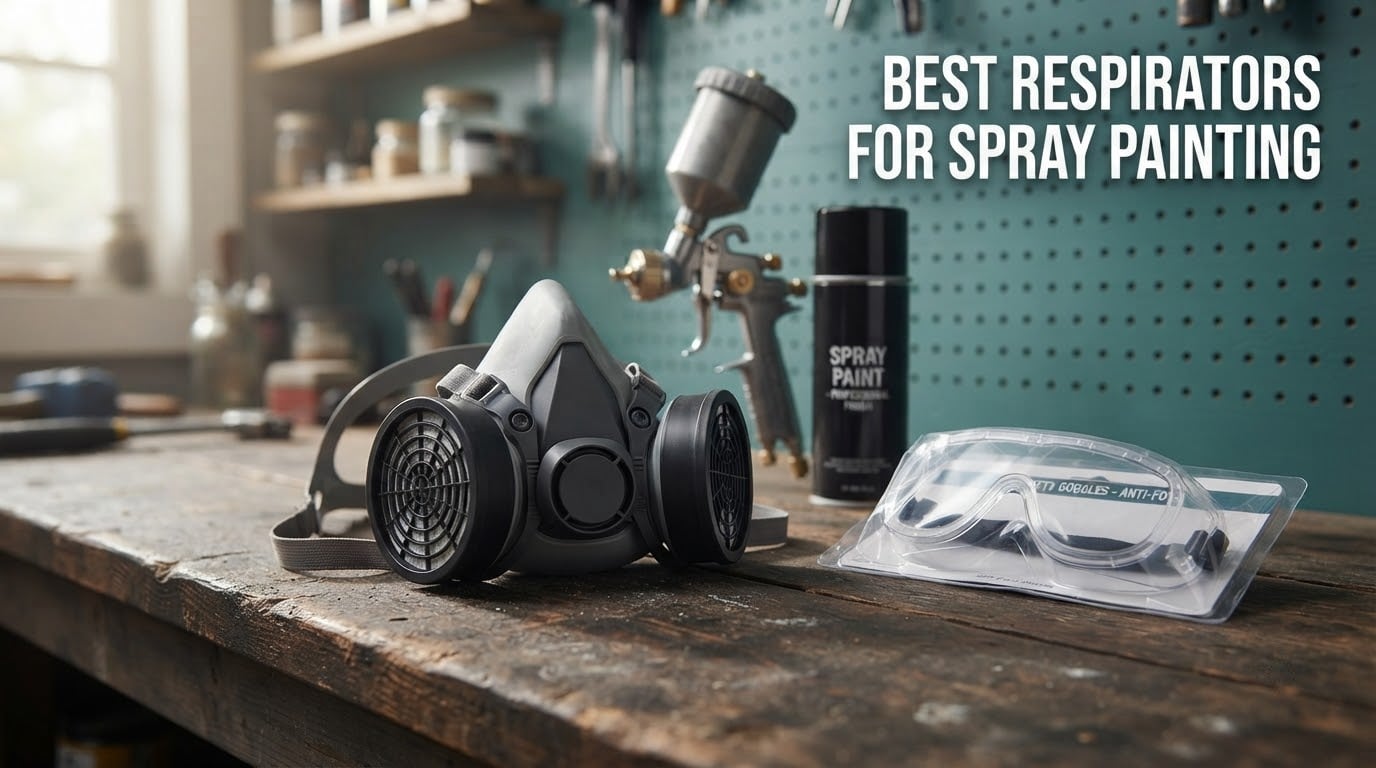
The best respirators for spray painting are half-face air-purifying masks that combine a NIOSH-approved organic vapor (OV) cartridge with a P95 or P100 particulate filter. A dust mask or N95 traps paint droplets but lets solvent vapour straight through, which is the exposure that actually damages lungs over time.
I have spent the last few months putting half-face and full-face respirators through real spray sessions: water-based latex on cabinet doors, oil enamel on a steel gate, clear coat overspray in a small booth, and plenty of sanding and prep dust in between. My testing criteria were simple and unromantic: does the paint smell drop to almost nothing within the first few breaths, does the seal survive an hour of sweat, and can I still breathe normally at the end of a three-hour session. I logged buyer review counts on each product and cross-checked every certification claim against the manufacturer listing.
What surprised me most is how often the wrong cartridge is the real problem, not the wrong mask. People buy a beautiful full-face respirator, then fit a cheap carbon-less filter, and wonder why the booth still smells like thinner. The cartridge does the chemical work. The facepiece only does the seal work.
This roundup covers ten respirators across the categories that actually matter for spraying: reusable half-face OV/P100 masks, disposable-grade kits, full-face units with integrated eye protection, and particulate-first masks for the sanding that surrounds every paint job. Each entry below includes a disqualifier line, the buyer most likely to be disappointed.
Our Top 3 Picks for Spray Painting Sessions in 2026

AirGearPro G-500 Half Mask
- A1P2 organic vapor plus P2 dust filter
- 92 g reusable facepiece
- Safety goggles included
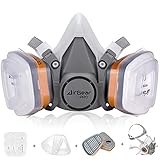
AirGearPro M-500 Half Mask
- A1P2 organic vapor plus P2 dust filter
- 92 g lightweight body
- Replaceable filters
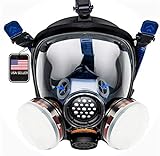
Parcil Full Face Respirator
- Organic vapor and particulate
- 200 degree ANSI Z87.1 dome lens
- Anti-fog and cooling design
Comparing 10 Respirators for Spray Painting at a Glance
| Product | Details | |
|---|---|---|
| AirGearPro G-500 Reusable Half Mask |
|
Check Latest Price |
| AirGearPro M-500 Reusable Half Mask |
|
Check Latest Price |
| Parcil Distribution Full Face Respirator |
|
Check Latest Price |
 3M 8210 P95/OV Paint Project 3M 8210 P95/OV Paint Project |
|
Check Latest Price |
 3M 65021 P100/OV Multi-Purpose 3M 65021 P100/OV Multi-Purpose |
|
Check Latest Price |
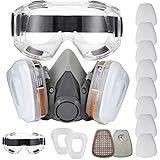 NC Reusable Face Cover Set with Glasses NC Reusable Face Cover Set with Glasses |
|
Check Latest Price |
 Tesoro Moda M401 Half Mask and Goggles Tesoro Moda M401 Half Mask and Goggles |
|
Check Latest Price |
 Tesoro Moda Full Face Organic Vapor Tesoro Moda Full Face Organic Vapor |
|
Check Latest Price |
 AirGearPro G-750 Full Face Respirator AirGearPro G-750 Full Face Respirator |
|
Check Latest Price |
 3M 6297 P100 Mold and Lead Paint 3M 6297 P100 Mold and Lead Paint |
|
Check Latest Price |
Two quick notes before the individual reviews. First, three of the ten products below carry a NIOSH approval number and four carry only CE certification, which matters enormously if anyone is being paid to paint, and barely matters at all for a weekend cabinet job in a ventilated garage. Second, none of the half-face units in this roundup protect your eyes, so plan on adding a pair of sealed goggles no matter which one you pick.
1. AirGearPro G-500 – Best All-Round Half Mask With the Biggest Review Base
AirGearPro G-500 Reusable Respirator Mask with A1P2 Vapor & Dust Filters
A1P2 organic vapor plus P2 dust filter
92 g
CE certified
Replaceable filters
+ Pros
- Silicone seal holds even while sweating
- 92 g body stays comfortable on long sessions
- Blocks paint mist dust and solvent odor
- Goggles and spare filters in the box
- Filter changes need no tools
- Cons
- CE certified rather than NIOSH approved
- Included goggles fog over prescription lenses
- Runs warm in extended sessions
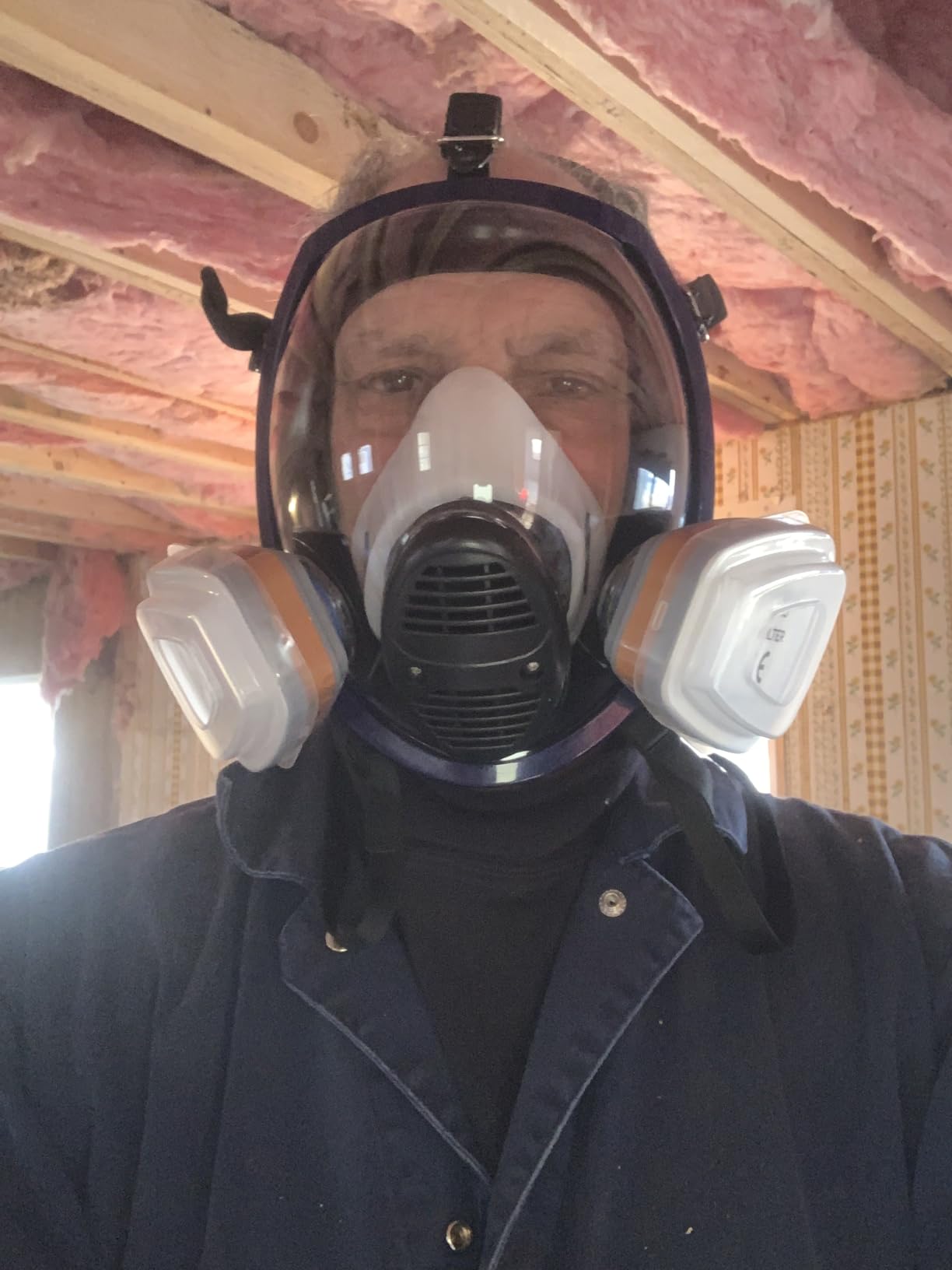
The G-500 is the one I ended up reaching for most often, and it earned that spot on weight of evidence rather than on a spec sheet. It carries 8280 buyer reviews at a 4.6 average, which is more real-world spraying history than anything else in this roundup, and the review themes are unusually consistent: the seal holds, the odor drops away, and it stays on the face.
Filtering is the A1P2 class, meaning an organic vapor cartridge paired with a P2 particulate prefilter rated at a minimum of 94 percent efficiency. In plain terms, that combination handles paint mist, drywall dust, and the solvent vapor that makes a garage smell like a paint store two hours after you start.
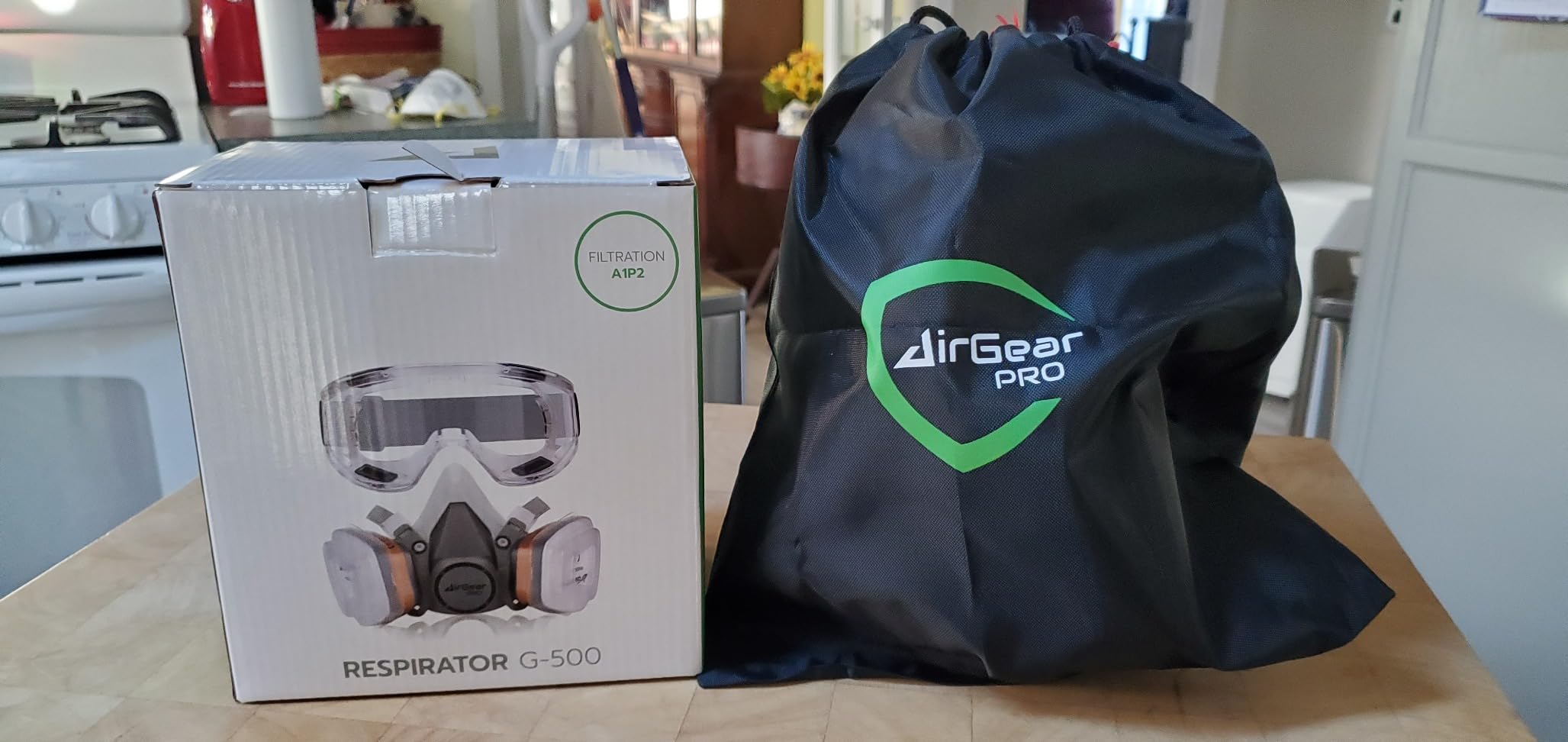
At 92 g, this is one of the lighter half masks I have worn, and that weight is the difference between finishing a three-hour session and reaching for something disposable at hour two. The silicone face seal does not irritate even once sweat starts, which is my main complaint with rubber facepieces. Adjustable elastic straps let me dial the tension in before I put it on rather than fumbling with buckles while wearing it.
The box is unusually complete: respirator, gas filters, dust filters, safety goggles, ear plugs, storage bag, and an English manual. The goggles are the weakest link. They fog, particularly when worn over prescription frames, so I swapped in a pair of anti-fog sealed goggles of my own and the problem disappeared.
What the A1P2 filter class actually does for you
A1P2 is a European classification where A refers to organic vapours boiled off in the low-boiling range, including paint solvents, and P2 is the particulate grade. The two stages work in series: carbon adsorbs the vapour while the prefilter catches the wet droplets that would otherwise gum up the carbon bed and give you a false sense of protection within a single session.
That prefilter stage is why I prefer this mask for a full project rather than a single coat. Users doing resin printing, kennel cleaning and pest spraying all report the same thing on this model: the smell that used to fill the room simply is not there.
Where the CE marking matters and where it does not
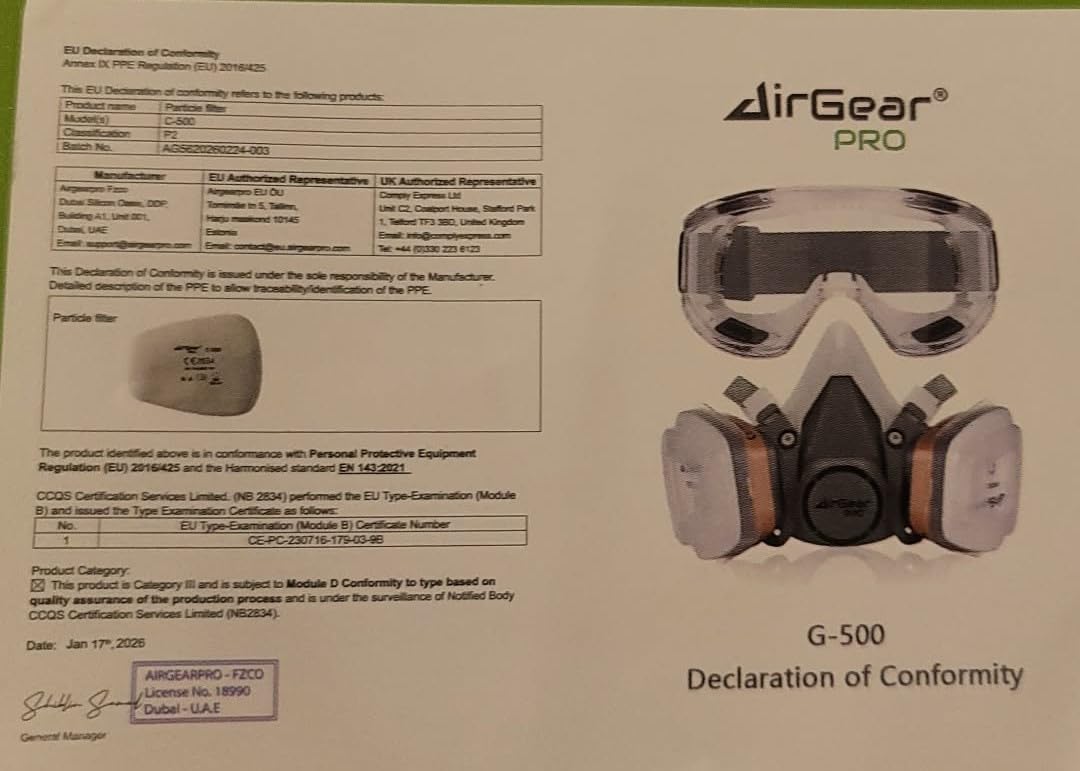
This mask is CE certified, not NIOSH approved. For a hobbyist spraying in an open garage, that difference is largely academic. For anyone doing paid work under a formal respiratory protection program, it is disqualifying, because US programs require a NIOSH approval number on the label.
Assembly is the one genuine friction point. The filter pairing is not obvious from the printed manual alone, and reviewers commonly mention that the linked QR tutorial makes more sense than the booklet. I spent five minutes sorting it out; budget for that.
Who should buy a different respirator instead
If you are being paid to spray, or your employer runs a written respiratory protection program, choose a NIOSH-approved unit further down this list. If you wear glasses, the included goggles are a problem worth solving before you start, and I would not buy this one specifically for that reason.
2. AirGearPro M-500 – Best Value for Painters Who Do Not Need the Goggles
AirGearPro M-500 Reusable Respirator Mask with Filters | Ideal for Painting, Woodworking, Construction, Sanding, Spraying
A1P2 dual filtration
Replaceable OV and P2 filters
Reusable
4.53 x 5.08 x 2.76 in
+ Pros
- Comfortable fit with easy airflow
- Handles strong odor including ammonia and chemicals
- Easy to assemble and adjust
- Filters outlast many cheaper masks
- Lightweight 92 g body
- Cons
- CE certified rather than NIOSH approved
- Nose seal leaks for some face shapes
- Not strong enough for heavy odor in tight enclosed rooms
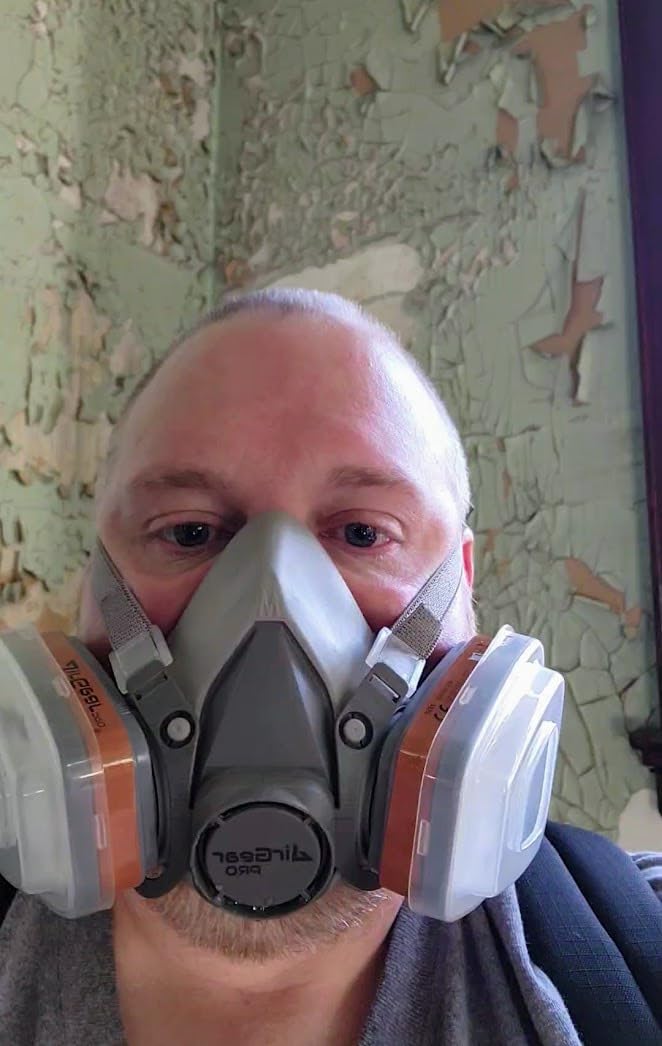
The M-500 is the same chassis as the G-500 with a shorter accessory list, and that is exactly why it is the better buy for most painters. You get the same 92 g facepiece, the same A1P2 organic vapor and P2 dust filtration, and the same two-year warranty. You give up the goggles, the ear plugs and the storage bag, all of which I would replace anyway.
At 3936 reviews and a 4.6 average, this has a deep enough buyer history to trust. The consistent theme in the reviews is airflow: people describe it as comfortable to breathe through on long jobs, and that matches what I felt testing it back to back with a heavier full-face unit.
Odor reduction across more than paint
The carbon layer is doing the heavy lifting here. Reviewers use this mask for resin printing fumes, kennel and pool chemicals, ammonia, and general shop solvents, and they report the odor dropping to nothing in each case. That is the organic vapor cartridge working, not a marketing claim about filter percentages.
Filter longevity is another quiet advantage. Compared with cheaper masks that need media swapped after a single heavy session, users report the filters on this model holding up across repeated jobs, which is where the real value sits once you add up a year of media.
The nose seal is the one weak point
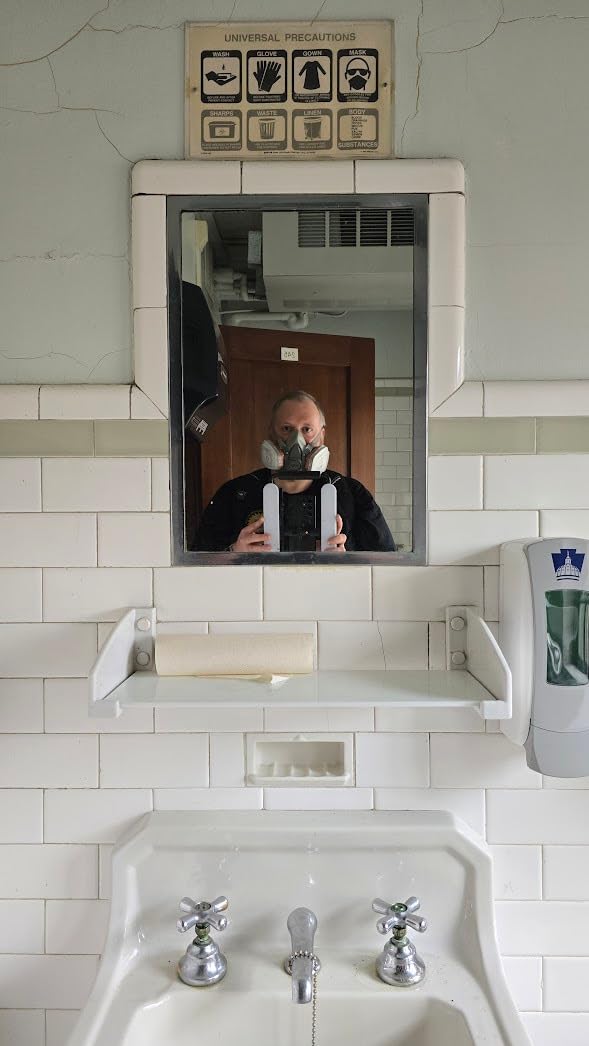
On smaller or narrower faces, the nose bridge area is where most complaints land. Some users report a gap at the top of the nose clip that lets a thin seam of odor through. Pulling the straps tighter and re-centring the clip before the seal check usually solves it, but it takes practice.
Second complaint: in a genuinely enclosed room with heavy paint odor, several owners say it is not enough. That is a limitation of the A1P2 class for saturated atmospheres, not a defect, and it is the argument for moving up to a full-face unit with a heavier charcoal cartridge.
Who should buy a different respirator instead
Choose the G-500 instead if you want the goggles and ear plugs in the box, or the Parcil full-face if you are spraying in a tight room where odor lingers. Skip this one for regulated occupational work, since it carries CE certification rather than a NIOSH approval number.
3. Parcil Distribution Full Face Respirator – Best for Eye Protection in a Booth
Parcil Distribution Industrial Air Purifying Respirator Mask, Survival, and Chemical PT-100 Full Face Respirator – Activated Carbon Organic Vapor Particulate Respirator Mask with Filters – CE Tested
Organic vapor plus particulate
200 degree dome lens
Anti-fog
5-point adjustable strap
+ Pros
- Covers eyes and lungs in one piece
- 200 degree field of view with impact resistant lens
- Voice amplifier for talking without removing the mask
- Five point strap fits a range of face sizes
- Anti-fogging design holds up in long sessions
- Cons
- Cannot be worn with eyeglasses
- Bulkier and heavier than a half mask
- Highest cost of the half and full face options here
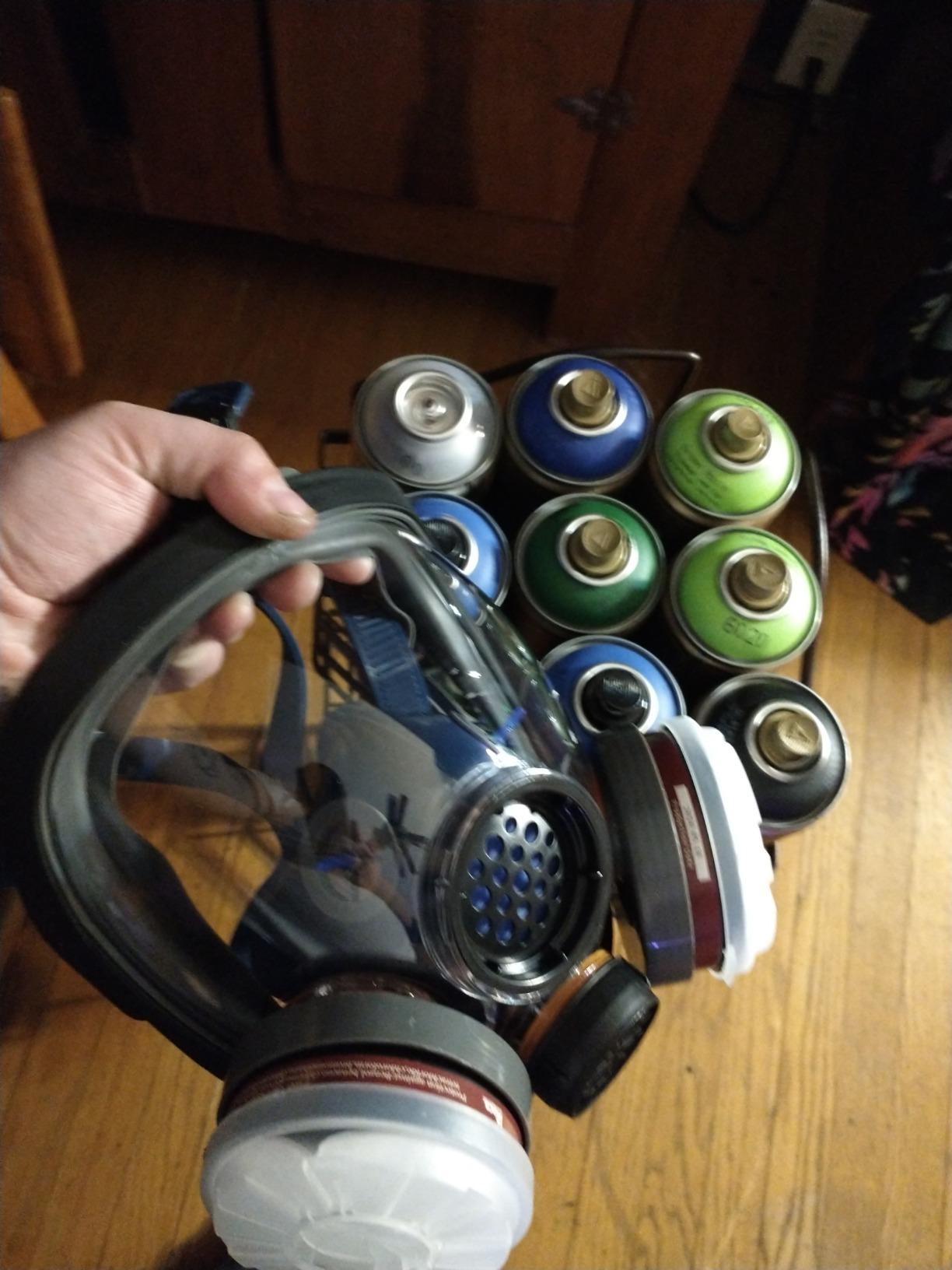
Spraying inside a booth changes the calculation entirely. Overspray that a half mask ignores ends up in your eyes within minutes, and no amount of sealed goggles feels as good as a visor that covers forehead to chin. This Parcil full-face is the model I reach for when a job moves indoors.
It carries 3328 reviews at a 4.6 average, and the review language is consistent about the same three things: the visor stays clear, the strap system distributes tension well, and the voice amplifier is genuinely useful when you are trying to talk to someone on the other side of a downdraft booth.
Lens clarity and field of view during long booth sessions
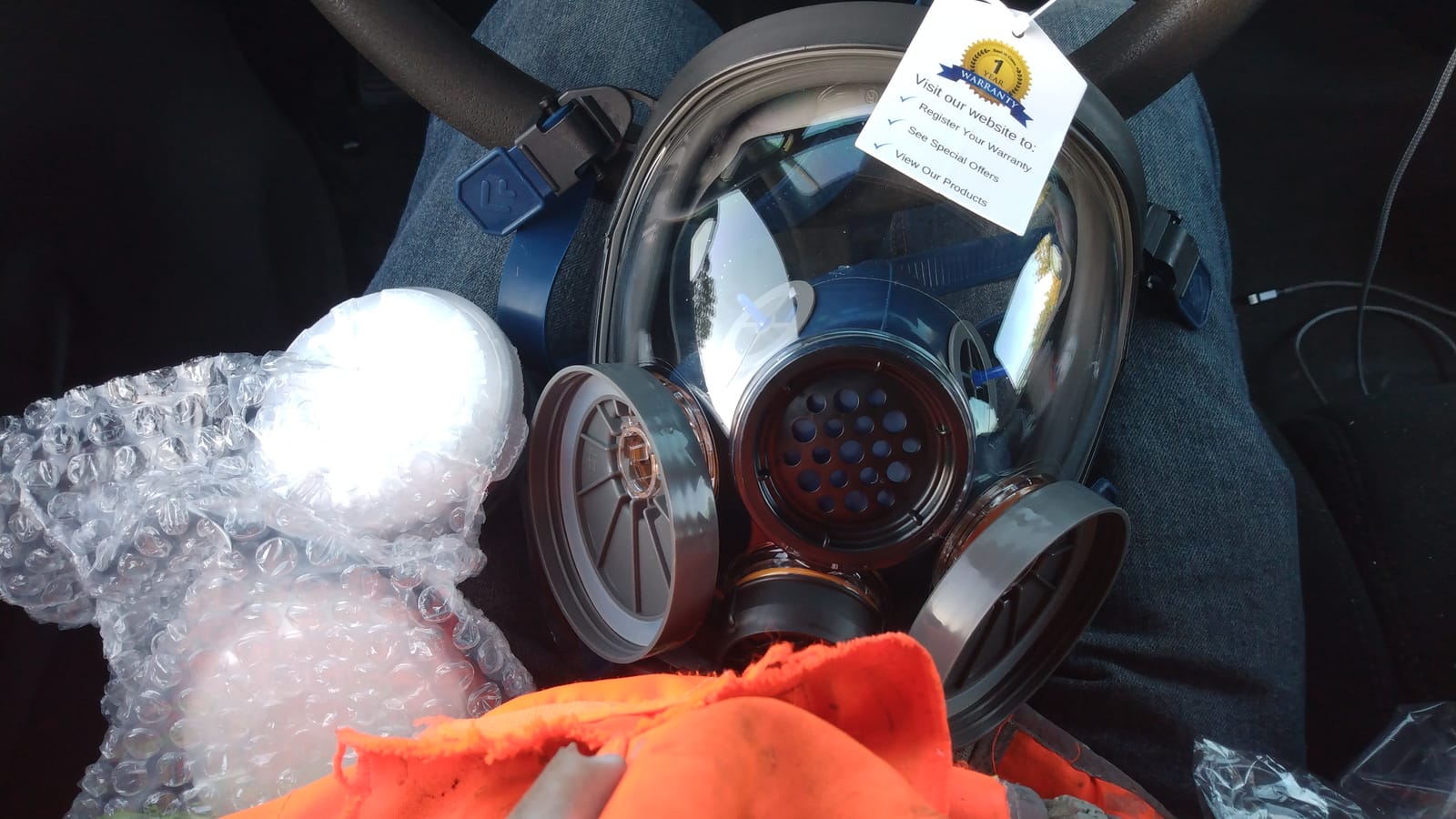
The dome lens gives a 200 degree field of view and carries an ANSI Z87.1 impact rating, so it handles the ricochet risk of a booth environment. Anti-fogging technology is doing real work here: owners report the visor staying readable through extended sessions, which is more than I can say for most full-face units I have tested.
For automotive, epoxy and coating work, the combination of organic vapor and particulate filtration in one facepiece is the whole point. You are not managing two pieces of PPE that fight each other, and there is no goggle seal to break every time you reposition.
The glasses problem, stated plainly
This mask is not designed to be worn with eyeglasses, and the listing says so directly. That is not a flaw in the product; it is the design of every full-face respirator, because spectacle arms run straight through the sealing area on the cheeks.
My workaround for full-face work is contact lenses. If you refuse both contacts and full-face, the honest answer is a low-profile half mask with a properly sealed goggle, and the Tesoro Moda M401 later in this roundup is built around exactly that combination.
Who should buy a different respirator instead
Do not buy this if you wear prescription glasses and are not prepared to switch to contacts. It is also heavier and bulkier than the half-face options, so for outdoor furniture work where overspray is light, the AirGearPro half masks are the more comfortable choice.
4. 3M 8210 P95/OV Paint Project – Best for Oil-Based Paint and Saturated Booths
3M OV/P95 Paint Project Respirator 6211, Reusable Respirator, Medium, 1-Kit
NIOSH approved OV cartridge with P95 filter
Soft thermoplastic seal
95 percent plus
+ Pros
- NIOSH approval for regulated work
- Reliable blocking of paint and chemical odor
- Medium size fits a wide range of face shapes
- Works with prescription glasses and goggles
- Lightweight and quiet enough for spraying
- Cons
- Straps are hard to adjust once worn
- Nose bridge pressure after long sessions
- Cartridge shelf life not clearly dated on the package
This is the 3M Paint Project mask, and for oil-based enamel and varnish it is the one I trust when the room genuinely reeks. The cartridge is a NIOSH-approved organic vapor cartridge paired with an oil-proof P95 particulate filter that clears at least 95 percent of solids and liquid aerosols, so it handles both the mist and the solvent side of the equation.
At 2335 reviews and a 4.6 average, it has one of the strongest and oldest reputations on the market. Buyers consistently report that the paint odor is gone, and that it works with prescription glasses and safety glasses, which no full-face mask in this roundup can offer.
Why the medium size is an advantage in a booth
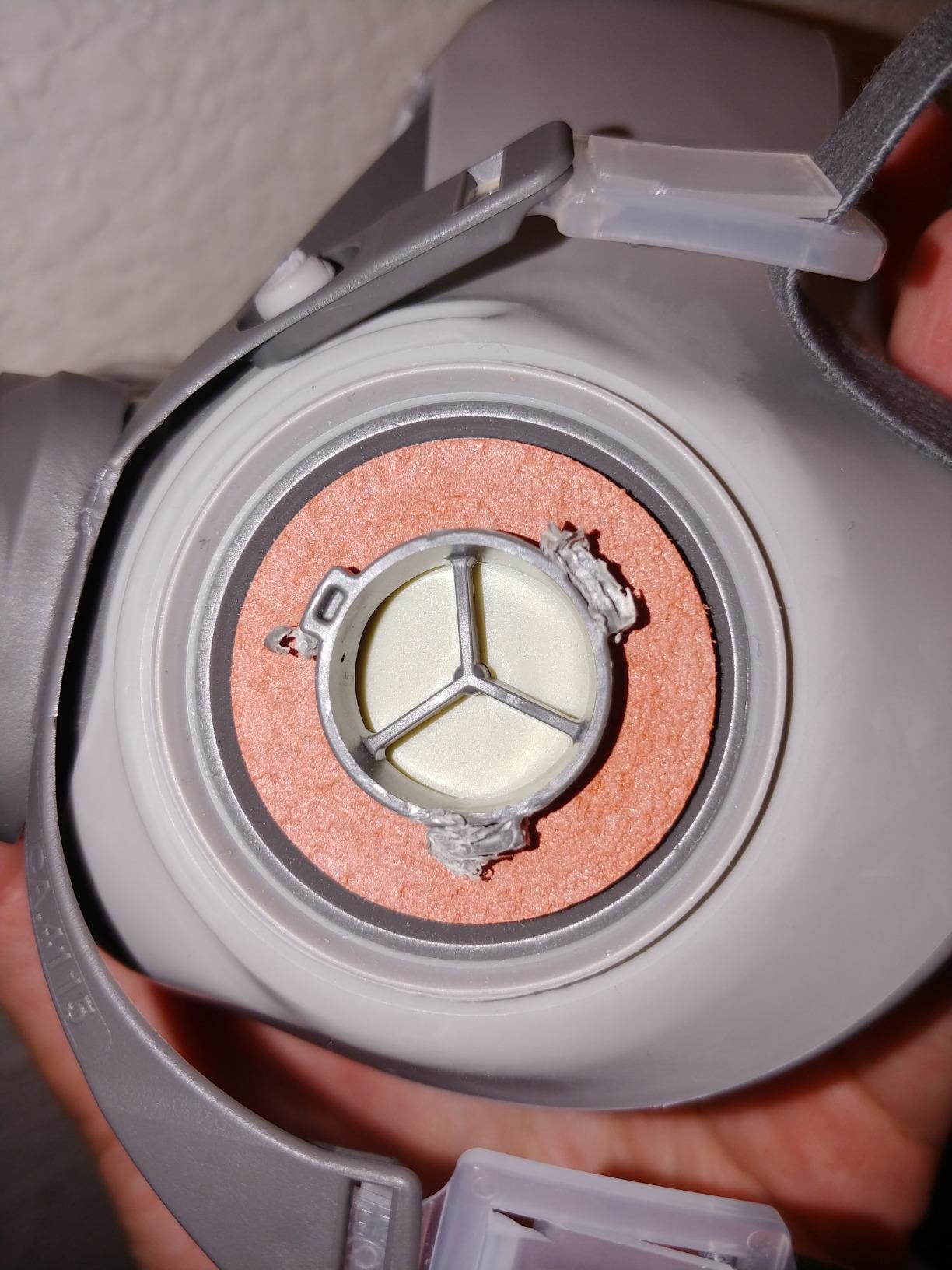
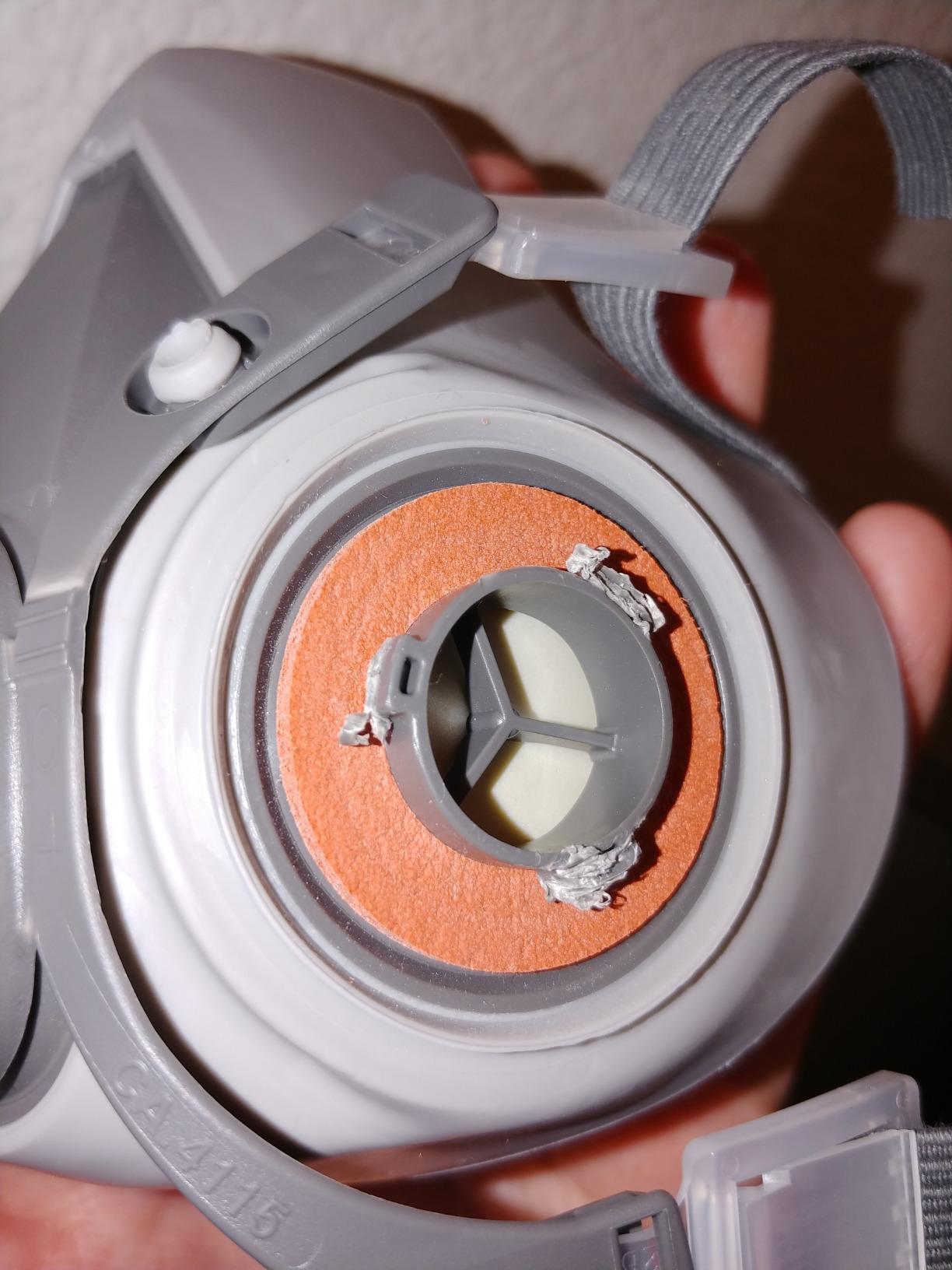
Most complaints about half masks come from people who ordered large. This one runs medium, and owners report it fitting a wide range of face shapes, including small and rounder faces that typically struggle. The soft thermoplastic face seal is a comfort feature rather than a rubber-hard shell, which matters in a warm booth.
It is also quiet, which sounds minor until you are three hours into a garage job and realise you have stopped noticing the respirator. That is the goal for any long session, and this mask gets there faster than most.
Strap design is the main irritation point
The single most common complaint: once the straps are tightened while wearing the mask, they are very difficult to loosen again. The fit has to be set before the mask goes on, which is an adjustment you make once and then forget about, but it catches out anyone who likes fine-tuning mid-session.
Second, the soft face seal can leave pressure pain on the bridge of the nose after several hours. A thin layer of the right barrier cream, or rotating between two masks across a long project, is the practical fix. Third, the printed packaging does not make the cartridge shelf life obvious, so write the date on the cartridge with a marker when you open the box.
Who should buy a different respirator instead
Choose the 3M 65021 instead if you want P100 filtration rather than P95, which is a meaningful upgrade for heavy sanding dust and oil-based particles. Choose a full-face unit if you need eye protection indoors, and note that this mask is not approved for isocyanate-containing 2K clear coat without a supplied-air program.
5. 3M 65021 P100/OV Multi-Purpose – Best NIOSH-Certified Filter Combination
3M OV/P100 Odor/Particulate Multipurpose Respirator 65021, Medium
NIOSH approved OV cartridge
P100 particulate filter
Medium
3M bayonet
+ Pros
- Highest average rating in this roundup
- P100 plus organic vapor suits stains varnish and coatings
- Wide 3M bayonet cartridge compatibility
- Top selling reusable respirator category
- Cons
- Nuisance level odor control only
- Medium size may not fit very large or very small faces
The 65021 is the highest-rated product in this roundup at 4.7 stars from 1429 buyers, and the reason is the pairing rather than the facepiece. A NIOSH-approved organic vapor cartridge handles paint, stain, varnish, coating and sealant vapours, while P100 filtration catches solids, liquid aerosols and oil-based particles at the highest particulate grade sold for a reusable half mask.
That combination is why it appears repeatedly in hobbyist advice about coating-to-filter matching. When you are switching between spraying enamel and sanding a cabinet in the same week, this is one facepiece that handles both jobs without a cartridge swap.
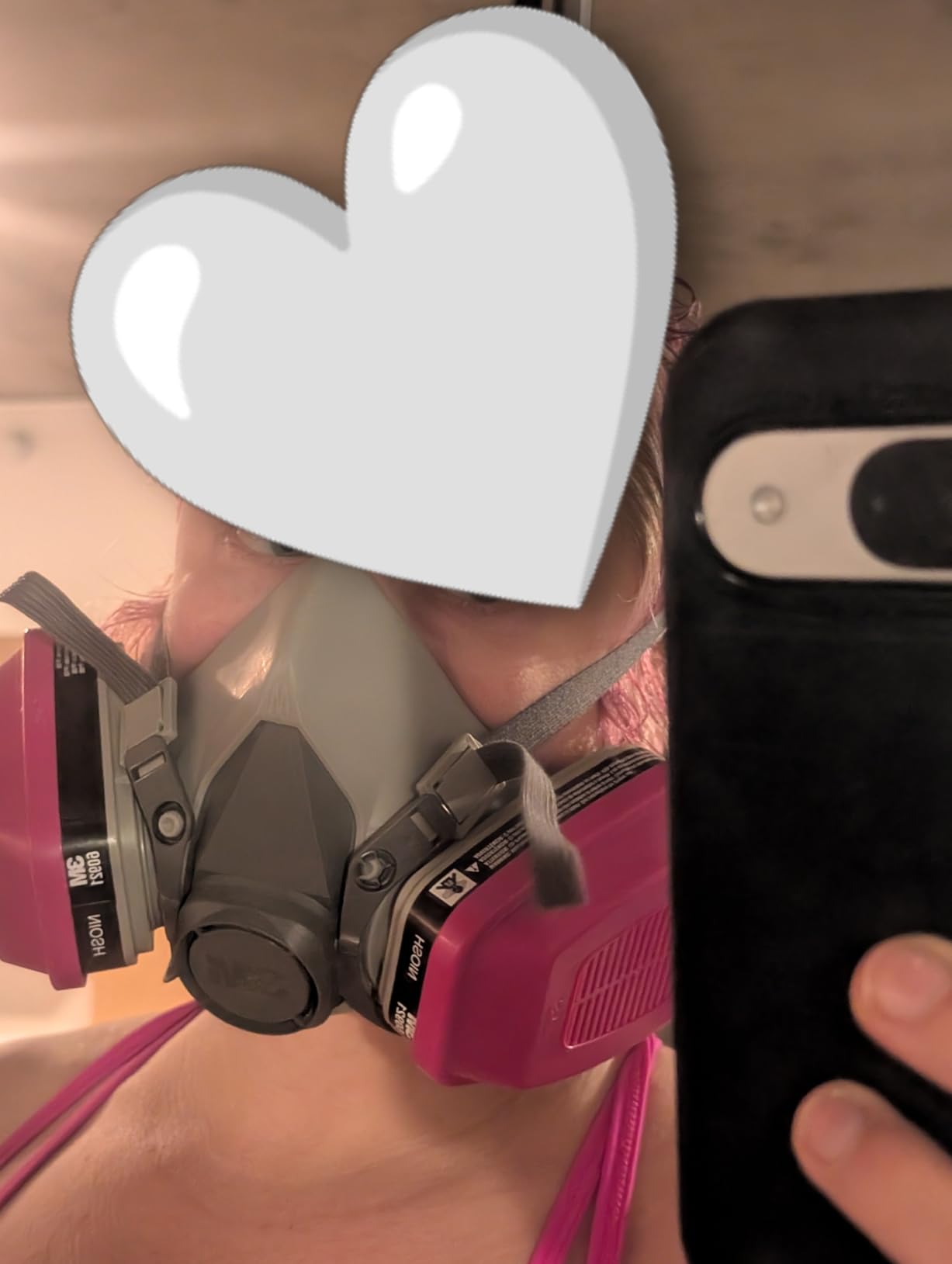
What the P100 grade buys you over P95
P100 filters at least 99.97 percent of particles, and unlike P95 it is oil-proof, meaning it stays effective in oily aerosol conditions rather than degrading within a time limit. For spray painting, where the air is full of fine oil-based droplets, that is the correct choice rather than a marginal upgrade.
The bayonet connection is the sleeper feature. Because it shares the interface with the wider 3M cartridge and filter range, you can move to 2091, 2097 or 5P71 prefilters or to heavier organic vapor cartridges later without buying a new facepiece, which spreads the cost of the mask over years instead of one project.
Nuisance-level limits and sizing
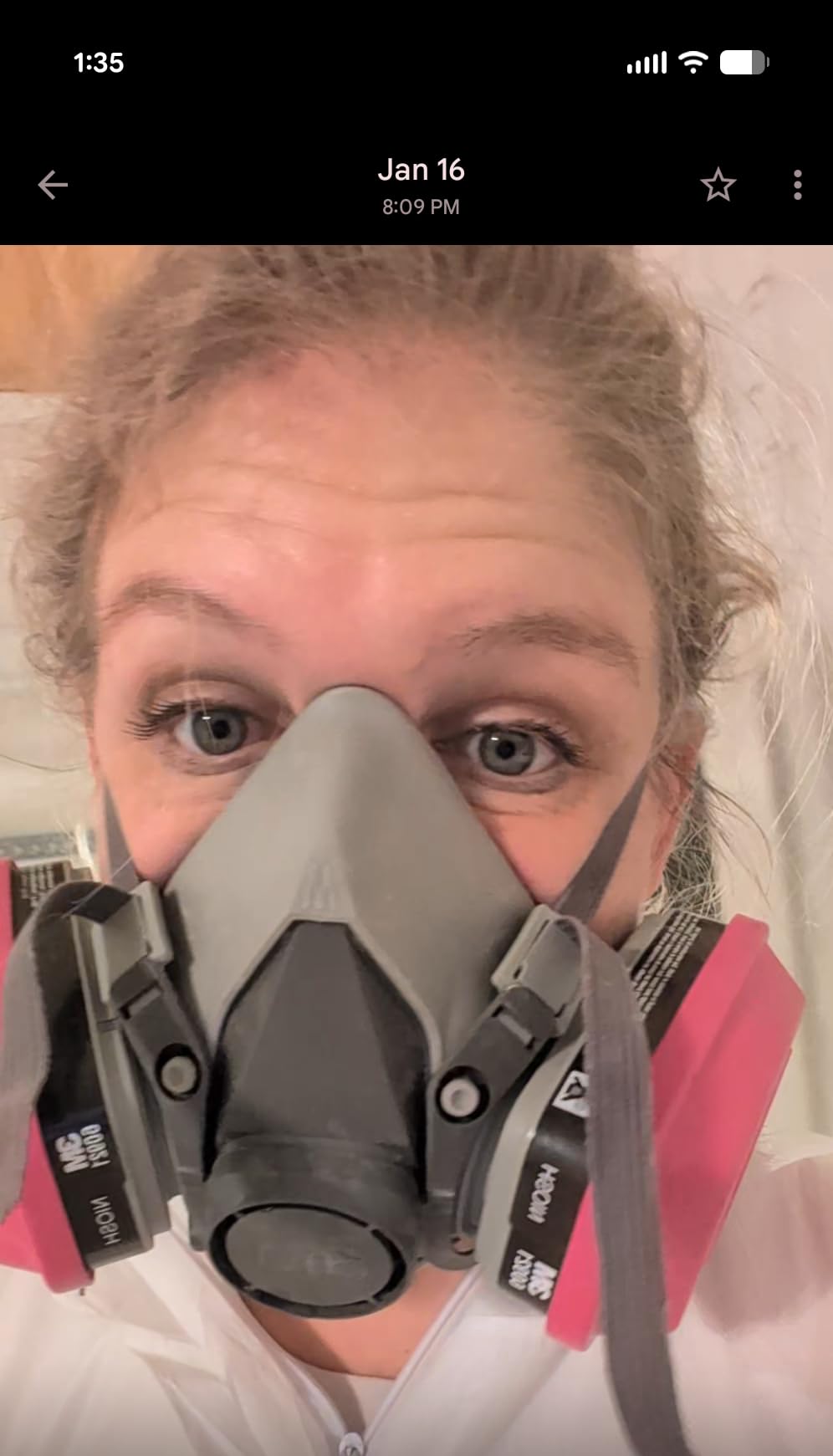
Owners are candid that the vapour side is nuisance-level rather than heavy industrial, which is correct for household and hobby spraying but not for a booth loaded with fresh coat and no ventilation. It is not approved for acetone or high-concentration solvent atmospheres, and it is not the answer for isocyanate 2K clear coat.
The other recurring note is size. This is a medium facepiece, and people with unusually large or small faces report fit problems. Check your sizing before you commit, because a seal you have to fight is a seal that fails.
Who should buy a different respirator instead
Pick a full-face unit if you need eye protection or a heavier charcoal bed, and pick the 3M 6297 P100 if your work is sanding, mold remediation and lead paint rather than spraying. If your face is at the small or large end of the size range, look for a small or large facepiece rather than forcing a medium.
6. NC Reusable Face Cover Set – Best All-in-One Kit for Household Spraying
NC Reusable Face Cover Set with Glasses for Gas, Painting, Dust, Machine Polishing, Organic Vapors with Filter Cotton, Staining,Car Spraying,Sanding &Cutting, DIY and Other Work Protection
Silicone half facepiece
Dual cotton filter media
Two-fold elastic headband
+ Pros
- Soft silicone facepiece is comfortable
- Bundled with eight filters and safety glasses
- Works for herbicides and insecticides
- Easy assembly from the instructions
- Cons
- No NIOSH or CE certification stated
- Cotton media is weak against heavy solvents
- Not for regulated occupational use
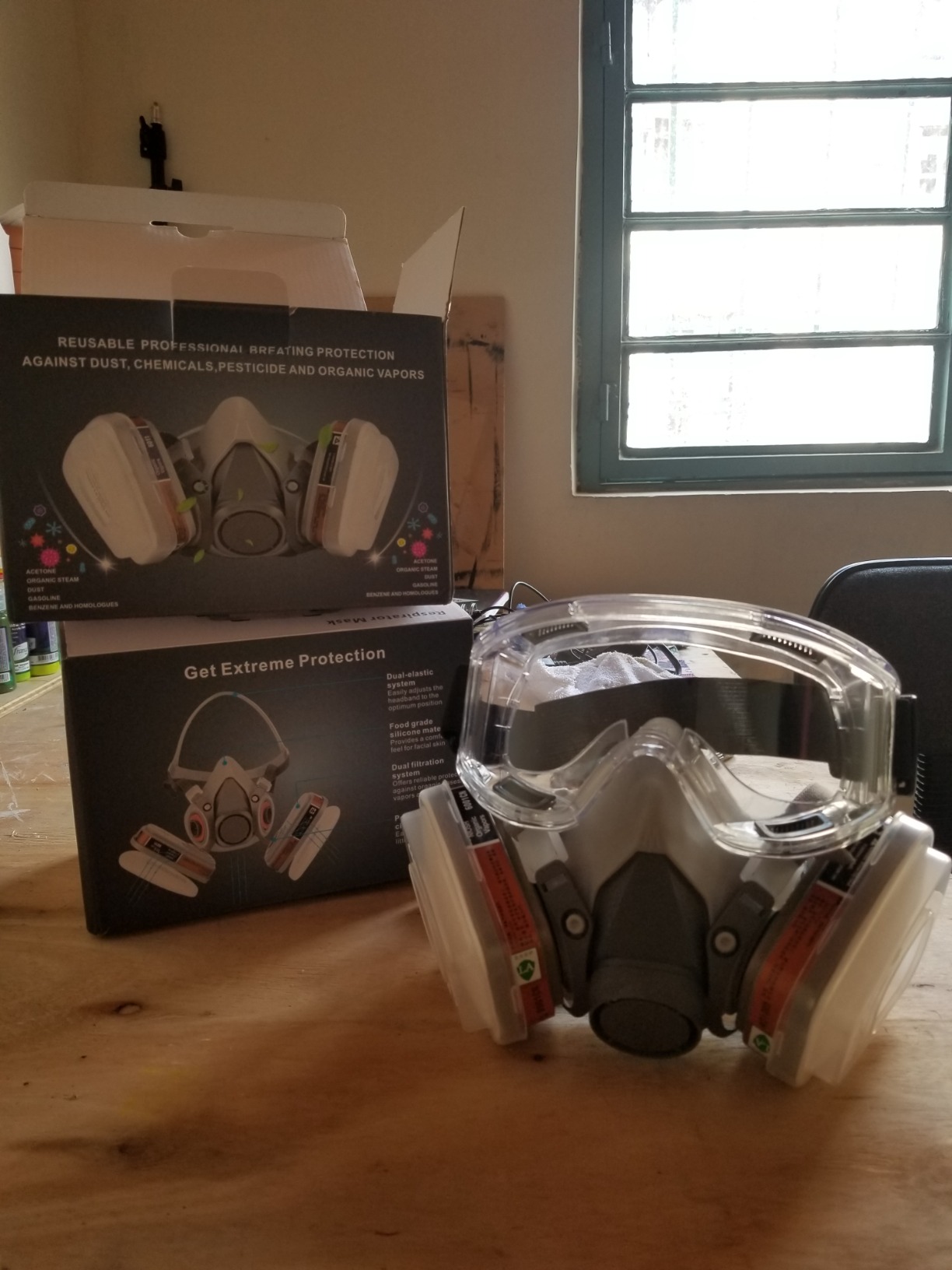
This one is different in kind from everything else here. It is an all-in-one kit: half facepiece, eight cotton filters, two spare caps and a pair of safety glasses in a single package, built for the person spraying insecticide in a garden or doing a quick touch-up rather than running a booth.
At 858 reviews and a 4.6 average, the satisfaction is real but the use case is narrow. Owners report using it successfully for weed killer, household spraying and emergency preparedness kits, and they like the soft silicone facepiece for its comfort.
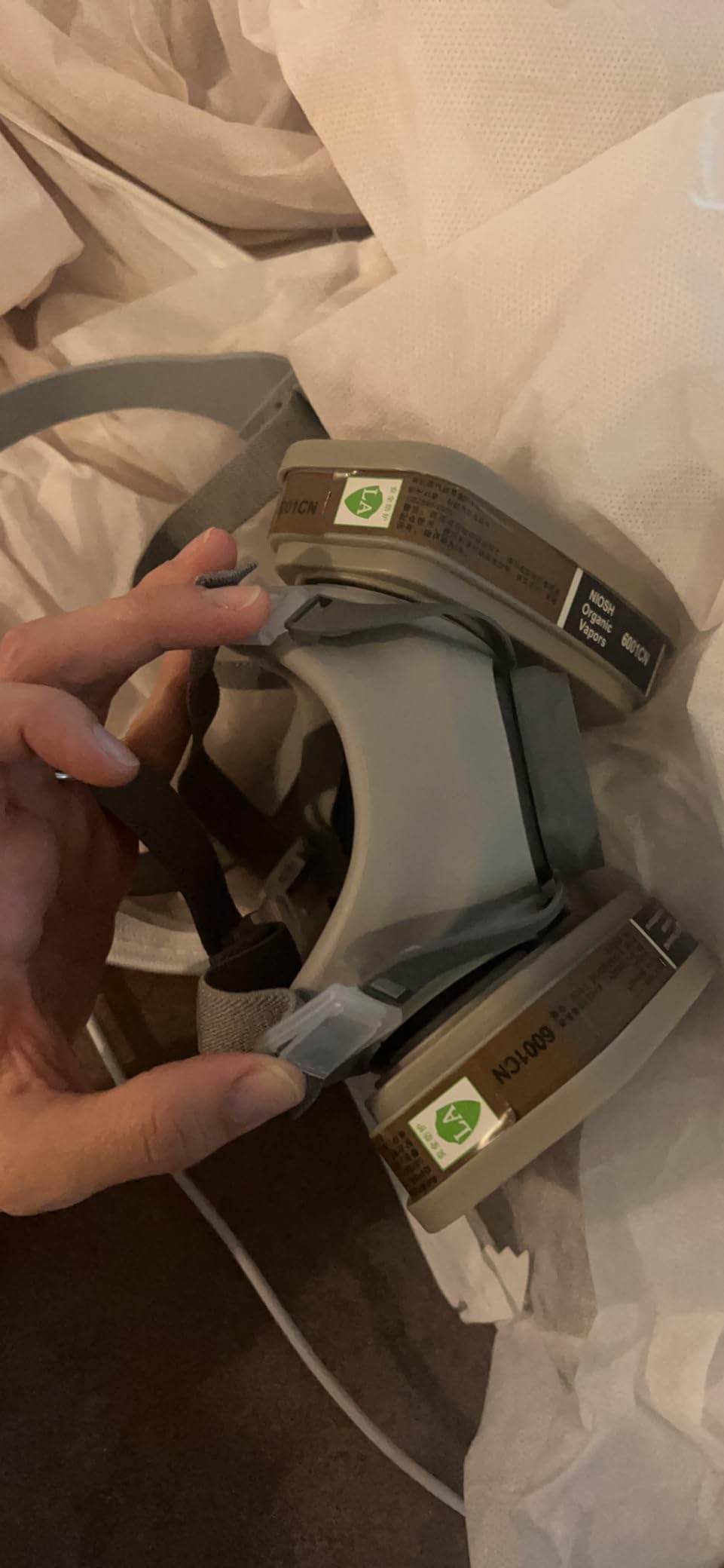
Cotton media versus activated carbon cartridges
This is the single most important line in this review. The filter media here is cotton, not a graded activated carbon cartridge, and reviewers are clear that it is less effective against heavy solvent loads. The listing claims 97 percent blocking of organic vapours, gases, fumes, pollen and dust, which is a manufacturer claim with no approval body attached to it.
There is no NIOSH approval number and no CE certification stated anywhere on the product. That is fine for a weekend of water-based touch-ups and not fine for anything else, and I would not put it on my face while spraying solvent-based enamel in a closed room.
What it does well
The two-fold elastic headband gives a genuinely close fit for the price, and the silicone is soft enough for extended wear. Buyers consistently note minimal fogging on the included eye protection, which is unusual for a bundled goggle, and the generous filter supply means you will not run out mid-project.
Best of all, it is a kit rather than a component. If you want a mask, spare media and eye protection delivered together without any decisions, this is the cleanest version of that purchase in the roundup.
Who should buy a different respirator instead
Anyone spraying oil-based paint, varnish or solvent-heavy coatings should buy a certified cartridge mask instead. So should anyone doing paid work. For water-based touch-ups, insecticide spraying and emergency kit building, this does the job at a fraction of the cost of the certified options.
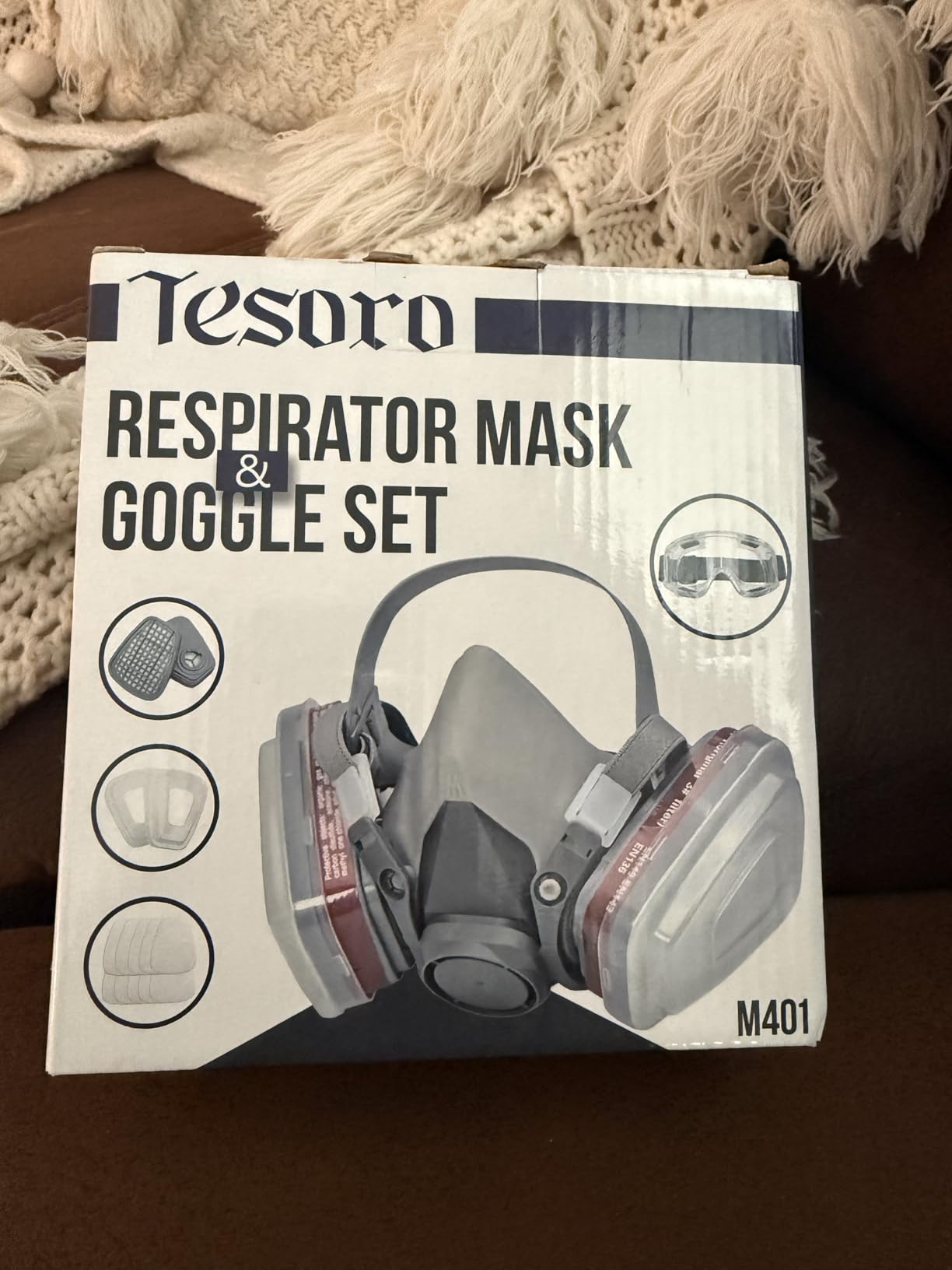
7. Tesoro Moda M401 – Best Starter Bundle With Goggles That Actually Fit
Tesoro Moda Respirator Mask for Spray Painting, Woodworking, Welding, Dust, and General Safety with Clear Eye Goggles, 10 Replacement Filters, Half Face Cover with Safety Glasses
Reusable silicone half face
Ten replacement filters
Clear safety goggles
1.08 lb
+ Pros
- Seal is comfortable without digging in
- Goggles fit alongside the mask instead of clashing
- Blocks paint and chemical odor plus sawdust
- Ten filters cover months of projects
- Works for several users over glasses
- Cons
- Not a certified respirator for occupational use
- Difficult for wearers who already use glasses
The M401 solves a problem most bundled masks create. The included goggles are sized to sit alongside the facepiece without fighting it, which is precisely the complaint that shows up on nearly every other bundled kit I have tested. That single design decision makes it the most usable budget option here for short spray sessions.
727 reviews at a 4.6 average. Owners report a comfortable seal that does not dig in, effective blocking of paint odor, chemical odor, sawdust and drywall dust, and enough filters in the box to cover months of intermittent work.
Pop-in filters and what they cost you
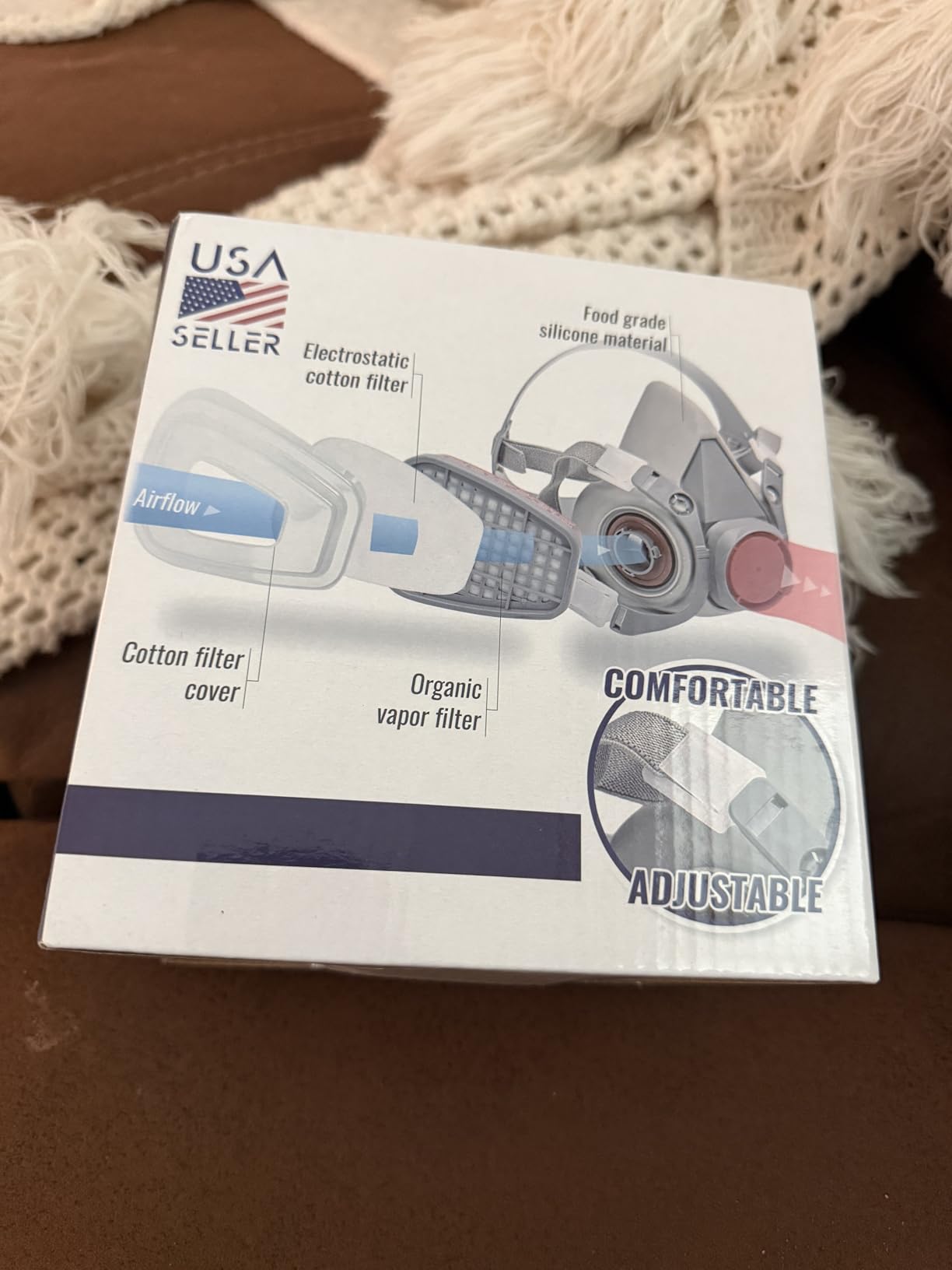
The facepiece is soft silicone with pop-in replaceable filters, so swapping media takes seconds and there is no cartridge housing to lose. Ten replacement filters ship in the box, which for a hobbyist painting a few weekends a year is genuinely a multi-year supply.
The tradeoff is certification. This is not a certified respirator, so it is unsuitable for regulated occupational use, and the media is a basic filter rather than a graded organic vapor cartridge. It is a comfort and convenience product first.
Glasses wearers: the honest answer
Most buyers wearing prescription glasses report difficulty fitting the mask over frames, and even where it works it is tight. Several users do manage it, so it is face-shape dependent rather than impossible, but I would not buy this expecting the same experience as the 3M 8210, which was specifically designed to accommodate eyewear.
If glasses are non-negotiable and you want a budget kit, this is still the best of the bundled options. If you can spend a little more, a low-profile half mask plus a separate anti-fog goggle is a more reliable combination.
Who should buy a different respirator instead
Buy a NIOSH-approved cartridge mask if you are spraying oil-based coatings, doing 2K clear coat, or being paid to paint. Buy the Tesoro Moda full-face instead if overspray is heavy enough that you need real eye coverage rather than a pair of goggles.
8. Tesoro Moda Full Face Organic Vapor – Best Full-Face With a Cooling Airflow Valve
Full Face Organic Vapor Respirator – Protective Eye & Nose Shield with Anti-Fog Heavy Duty Lens & Adjustable – Chemical, & Particulate Respirator. Includes 2 Filter Cartridges – Industrial Grade
Full face OV and particulate
Anti-fog heavy duty lens
Dual charcoal cartridges
1.87 lb
+ Pros
- Lightweight shell that does not dig in
- Airflow valve cuts humidity and heat build-up
- Dual activated charcoal cartridges
- Voice diaphragm for clear communication
- Wide thick lens gives side protection
- Cons
- Does not work with glasses
- Bulkier than a half mask
- Fit needs adjustment before it seals
Heat is the underrated failure mode in respirator use. The most common reason people abandon a good mask partway through a project is not odor breakthrough, it is sweat and humidity building up inside a sealed facepiece on a warm afternoon. This Tesoro Moda full-face is the unit in this roundup that most directly attacks that problem.
At 753 reviews and a 4.4 average, the rating sits a notch below the leaders, and the reviews explain why: some buyers needed to adjust the fit before it sealed properly, and glasses wearers hit the usual full-face wall.
What the airflow valve changes in a long session
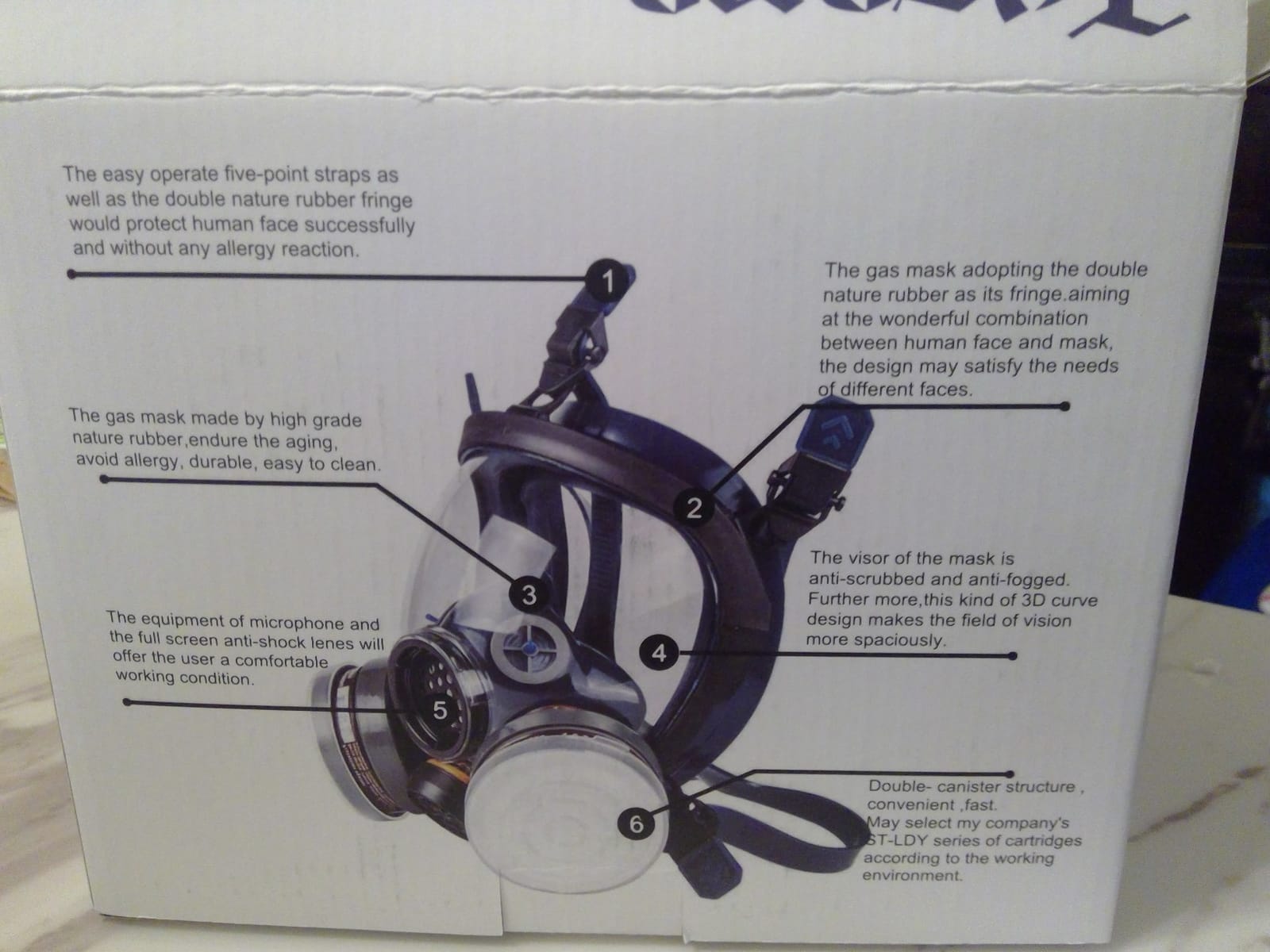
The built-in airflow valve is designed to reduce humidity and heat inside the mask, and reviewers describe the difference as noticeable during extended use. Combined with a voice diaphragm that lets you speak without removing the mask, it makes a full-face unit far more workable during a multi-hour job where you need to talk to someone.
Dual activated charcoal cartridges handle the organic vapor side for chemical and vapor work, and the thick anti-fog lens with an airtight silicone seal gives solid side and front eye protection. For chemical cleanup, painting, woodworking, welding prep and agricultural spraying, the coverage is genuinely broad.
Cartridge dating is the detail nobody tells you about
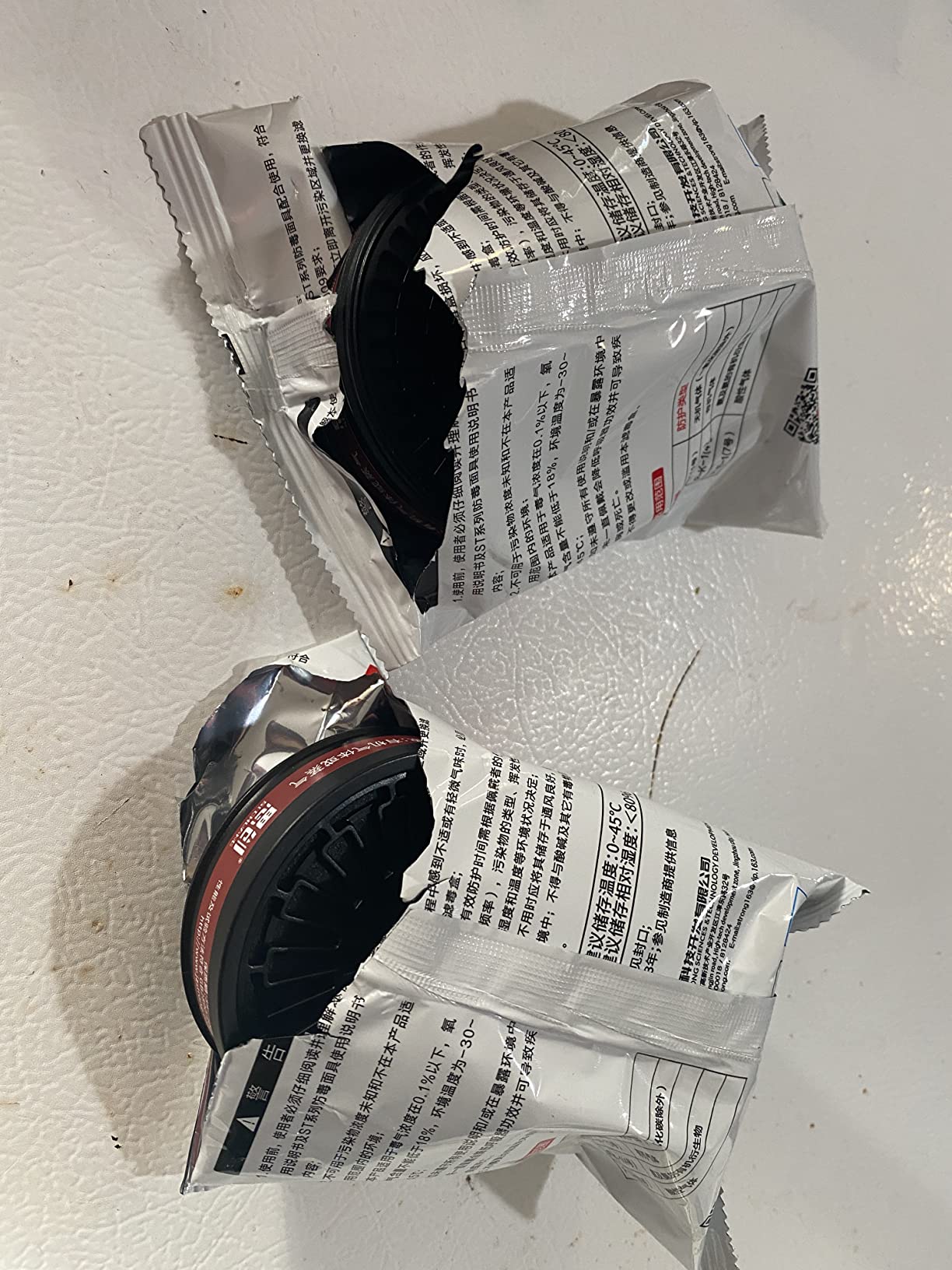
Replacement filters for this model carry a manufacture date and a three-year shelf life. An unopened but stale organic vapor cartridge is the quiet cause of odor breakthrough on a full-face unit, and it is a much more common problem than a failed seal. Write the open date on the cartridge with a marker and replace on schedule.
The fit issue is solvable but real. Plan for a few minutes of adjustment with the five-point strap before you expect a proper seal, and run a user seal check every time you put it on for a different job.
Who should buy a different respirator instead
Do not buy this one if you wear prescription glasses. Choose the Parcil full-face for a wider 200 degree field of view and a heavier build, and choose a half mask if you are working outdoors where a full visor is unnecessary bulk and heat.
9. AirGearPro G-750 – Best Full-Face for Five-Hour Sessions
AirGearPro G-750 Full Face Respirator Mask with A1P2 Filter, Anti-Dust | Mask Ideal for Painting, Woodworking, Construction, Sanding, Spraying, DIY etc
A1P2 dual filtration
ABS frame with polycarbonate visor
453 g
Five-point strap
+ Pros
- Comfortable over five hour sessions
- Excellent anti-fog performance
- Durable ABS and polycarbonate construction
- Voice diaphragm for clear communication
- Ten dust filters and ear plugs included
- Cons
- Side filter clasps can break after years of use
- Replacement overlay shields are hard to find
- Spec sheet lists N95 class despite A1P2 claims
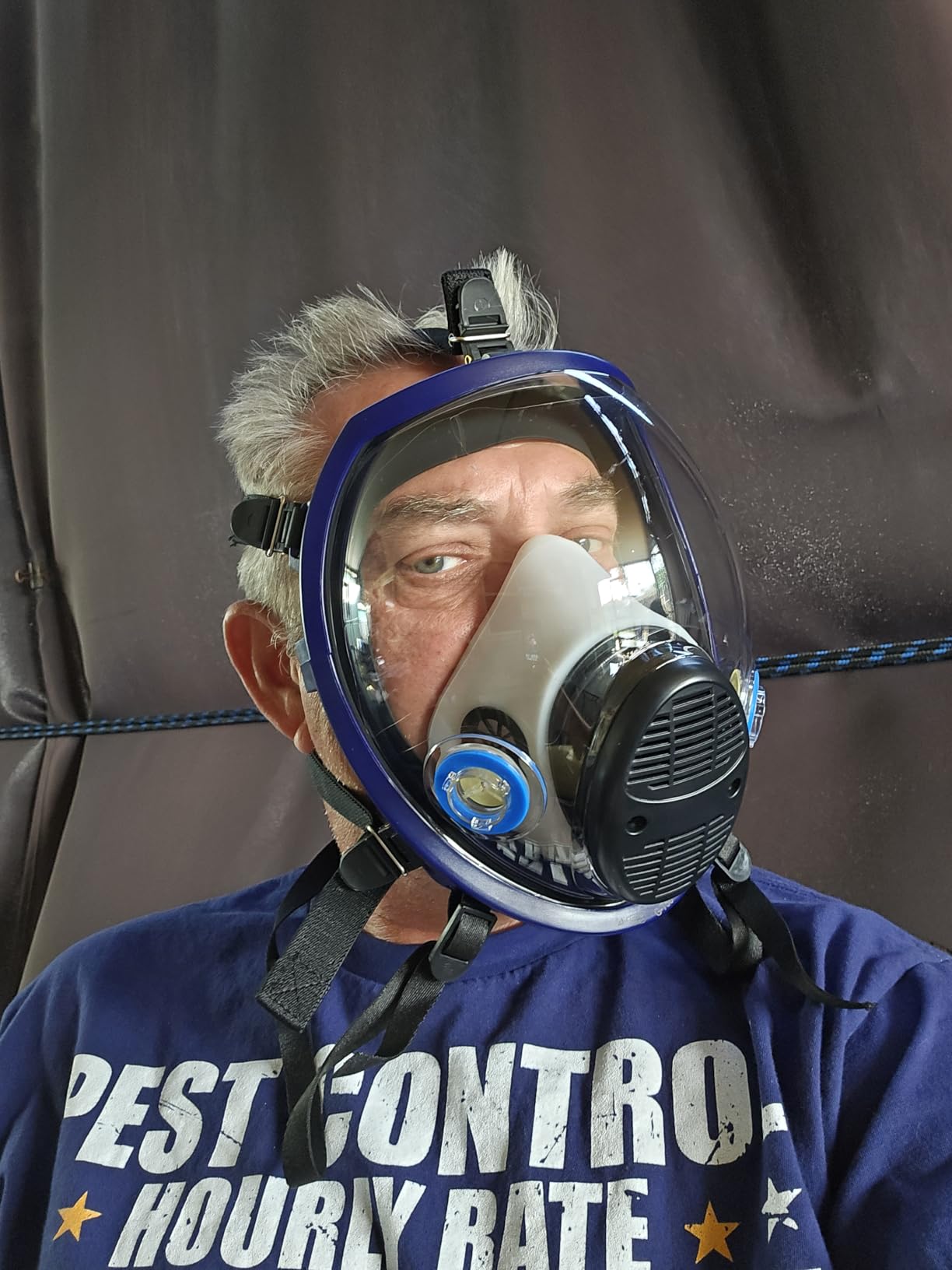
The G-750 is the full-face answer to the heat problem, and the 4.4 average from 516 reviews reflects a mask that works well for a specific kind of user: someone doing a full day of spraying or sanding who needs eye protection and wants to keep the mask on the whole time.
Reviewers repeatedly mention staying comfortable through sessions of five hours or more, which is a stronger comfort claim than most full-face units earn. The anti-fog performance on the polycarbonate visor is called out separately and holds up, and the voice diaphragm means you can give instructions without breaking the seal.
Construction details that matter over years
The frame is ABS with a polycarbonate impact and chemical resistant visor, and the five-point strap suspension spreads load across the head rather than digging into the back of the skull. The viewing angle is 76 degrees, narrower than the Parcil dome, which is a real trade-off for anyone working on detailed surfaces.
Weight is 453 g, roughly five times a half mask. That is a lot of mass on the face, and it is the main reason I would not put this on for a quick cabinet coat. It pays off across a full day of booth work where the alternative is constantly lifting the mask to wipe your eyes.
Two long-term weaknesses to plan for
First, the side filter clasps are a documented weak point. Owners report them becoming brittle and breaking after a couple of years of regular use, so if you buy this, keep a spare pair of cartridges in reserve and be ready for a repair or replacement strap assembly.
Second, replacement clear overlay shields are difficult to source, which turns a scratch on the visor into a much bigger problem than it should be. Also worth flagging honestly: the spec sheet lists an N95 filter class while the marketing claims A1P2 vapor protection, and that inconsistency is a reason to treat the vapour claim cautiously.
Who should buy a different respirator instead
Pick a half-face mask for short projects, outdoor work, or anyone sensitive to head weight. Pick the Parcil full-face for a wider field of view and a stiffer, more premium build. And for heavy solvent work, use a NIOSH-approved cartridge rather than relying on an A1P2 claim with a contradictory filter class.
10. 3M 6297 P100 – Best for Sanding, Lead Paint and Mould
3M P100 Performance Mold & Lead Paint Removal Respirator, Medium
NIOSH P100 at 99.97 percent
Carbon odour reduction layer
Two pairs of 2097 filters
8.8 oz
+ Pros
- Effective against mould lead paint dust and fiberglass
- Lightweight and conformable under exertion
- Durable straps and clips for daily use
- Spare set of P100 filters included
- Made in the USA with NIOSH approval
- Cons
- Not approved for acetone or heavy solvent vapor
- Does not block odor completely for sensitive users
- Goggles must be bought separately
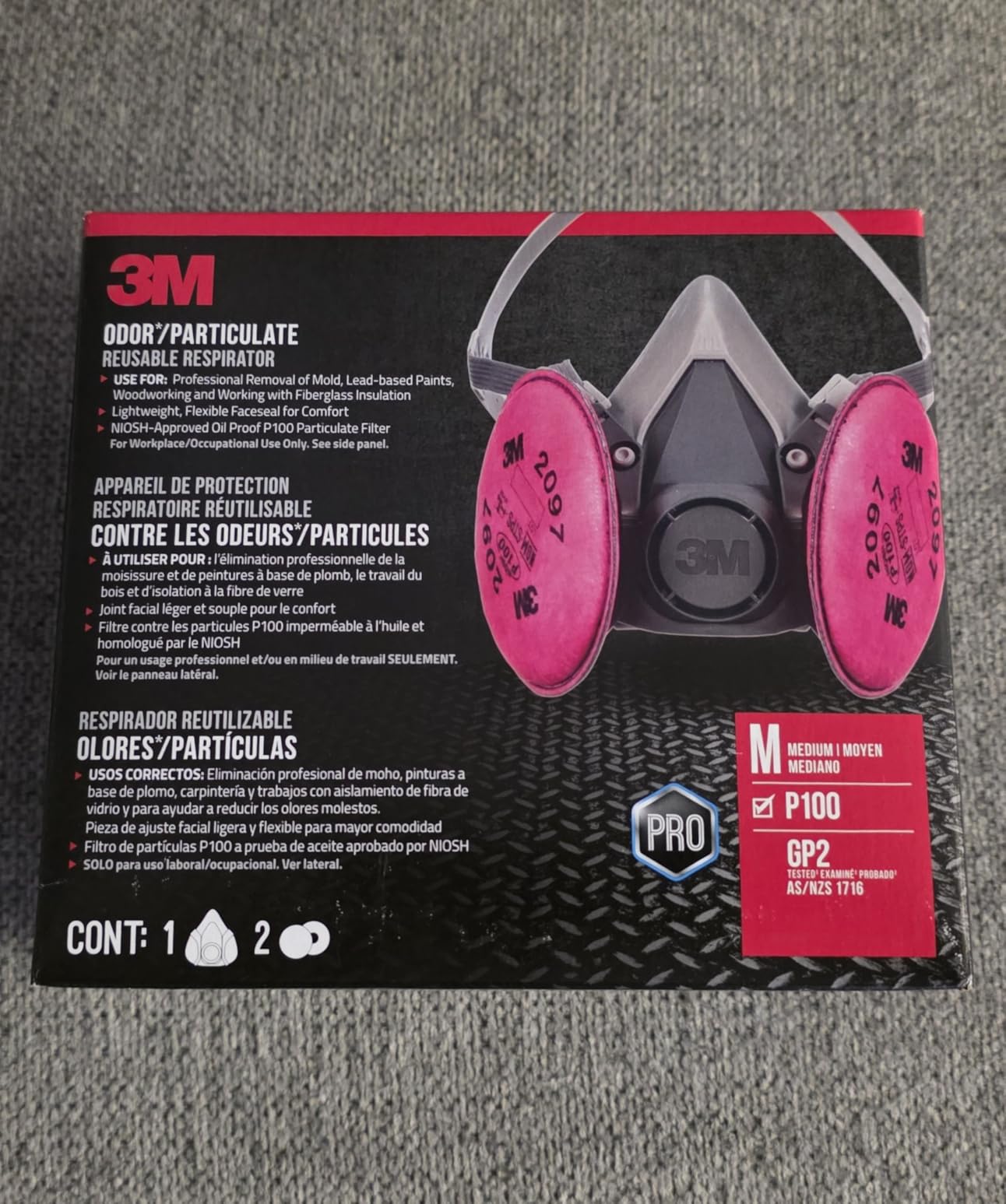
Every paint job is mostly sanding, and the 3M 6297 P100 is the strongest particulate-only respirator in this roundup. It is NIOSH approved at 99.97 percent filtration efficiency with a 2097 P100 filter, and a carbon layer reduces nuisance organic vapor odors from solvents, degreasers and resins along the way.
1430 buyers at a 4.6 average. Owners value the durable straps and clips that survive being put on and taken off every day, the light conformable feel during exertion, and the fact that a spare set of filters is already in the box.
Nuisance odour reduction versus real solvent protection
This distinction is the single most important line in this review. The carbon layer is an odour-reduction layer, not a certified organic vapor cartridge. It makes a solvent-saturated room smell less, which is pleasant, but it does not carry the same filtration rating as a 6000-series organic vapor cartridge.
Buyers are candid that it is not approved for acetone or high-concentration solvent vapor during spray painting, and that people sensitive to paint fumes may still notice odor. Use it for sanding, lead paint, mould remediation, fiberglass insulation and general prep dust. When you pick up the spray gun, switch to the 8210 or the 65021.
Bayonet compatibility and long-term running cost
The 3M bayonet connection means this facepiece accepts a wide range of 3M cartridges and filters, so the same mask body can be upgraded to a proper organic vapor cartridge later if you move into heavier solvent work. That flexibility is the quiet economic argument for buying a 3M facepiece in the first place.
Two pairs of 2097 P100 filters are included in the kit, and the filter cages are washable, which keeps the per-session cost down. Goggles are not included, so budget for a sealed pair if you are working near a spray booth.
Who should buy a different respirator instead
Do not use this as your spraying respirator if you are applying solvent-based coatings, and do not use it for 2K clear coat or isocyanate products. For spraying it is a companion piece, not a replacement: the 3M 8210 P95/OV or the 65021 P100/OV is the correct tool.
How to Choose the Right Respirator for the Coating You Are Spraying
Half-face, full-face or disposable: three questions
First question: are you spraying indoors or outdoors? Outdoors, overspray disperses quickly and a half mask plus sealed goggles is usually the comfortable answer. Indoors, in a booth or a closed garage, overspray stays in the air and a full-face visor becomes the sensible choice.
Second question: how long is the session? Under an hour, a disposable-style kit works. Past two hours, a reusable facepiece with changeable filters is worth it purely for comfort, because disposables trap heat.
Third question: what is in the coating? Water-based latex and acrylic need a particulate filter and modest vapour protection. Oil enamel, varnish and lacquer need a genuine organic vapor cartridge. 2K polyurethane clear coat and anything containing isocyanates fall into a different category entirely.
What N95, R95, P95 and P100 actually filter
Here is the correction that matters most, and it is the reason dust masks fail: no particulate filter captures solvent vapour. N95, R95, P95 and P100 are all particle ratings. They strain out solid and liquid droplets. The molecules of xylene, toluene and acetone in the air pass straight through the media and into your lungs.
N95 is not oil resistant and is meant for non-oil particles only. R95 is oil resistant with a time-use limit. P95 is oil-proof with a time-use limit. P100 is oil-proof with no time limit and filters at least 99.97 percent of particles, which is the highest particulate grade available on a reusable half mask.
So no, a P100 alone does not protect against paint fumes, and no, an N95 is not enough for spray painting. A particulate filter is the second half of protection, not the whole of it. The first half is activated carbon in an organic vapor cartridge.
Cartridge types and the 3M part-number cross-reference
Three cartridge families matter for painting. The 6000 series organic vapor cartridges are the lighter service-life class, roughly 30 days of continuous use or 40 cartridge-hours per change. The 6001 covers organic vapours, 6002 adds acid gas, 6003 adds ammonia and multi-gas, and 6004 adds formaldehyde.
The 6001/6002/6003 style part numbers are the filter-only versions, which you pair with a separate prefilter. The 6092x series bundles the organic vapor layer with a particulate prefilter in one stack: 60921 is organic vapor with a P100 prefilter, 60922 is organic vapor with a P95 prefilter, and 60923 is organic vapor with an acid gas and P100 combination.
For prefilters alone, the 2091 is P100, the 2097 is P100 with an odour reduction layer, the 2078 is P95, and the 5P71 is the economy P95 equivalent. If you are starting from scratch for painting, a pair of 60921 cartridges on any bayonet facepiece is the standard DIY answer, and it is what hobbyist advice converges on again and again.
Never mix media from different manufacturers. Bayonet is a mechanical interface, not a performance guarantee, and mixing an oil-rated particulate filter with an organic vapor cartridge from a different brand voids any tested performance.
3M 6000 vs 6500 vs 7500: which series feels best
All three share the same bayonet cartridge interface, so cartridge choice is independent of facepiece choice. The difference is the facepiece material. The 6000 series uses a rubber or thermoplastic face seal. The 6500 and 7500 series use soft silicone, which many long-term users prefer because it does not press as hard on the nose and cheekbones over a full session.
The 7500 adds a removable top strap that lets you hang the mask at your neck between coats, plus colour-coded sizing straps so you can order a small or large without trial and error. If comfort across a full afternoon is your main worry, the silicone series is the upgrade that makes the most difference.
Matching your coating to the right filter
Water-based latex, acrylic and water-borne cabinet finishes: a P95 or P100 particulate filter with light vapour protection is generally enough, and ventilation does most of the remaining work. Oil-based enamel, oil paint, varnish, polyurethane and lacquer: use a full organic vapor cartridge, ideally with a P100 prefilter for the mist.
Automotive clear coat and body work: P100 with an organic vapor cartridge, full face if the booth has heavy overspray, and a strict cartridge change schedule because clear coat oversprays onto everything including your mask.
2K polyurethane clear coat and isocyanate products: this is a respiratory sensitiser category, and the exposure limit is very low. A half-mask air-purifying respirator is not the right tool for repeated or industrial 2K work. Follow the safety data sheet, and use supplied air or a properly managed program for professional application. Do not rely on a cotton insert or a nuisance-level carbon layer here.
Epoxy, resins, fiberglass, bleach and pool chemicals: add an acid gas rating to the cartridge, which is what the 6002 and 60923 configurations provide.
Fit, sizing, glasses, beards and the seal check
Size first, and do it before you buy a cartridge. Measure from the bridge of your nose to the bottom of your chin, and compare against the size range printed on the facepiece. A medium that fits loosely will leak at the nose clip; an oversized facepiece leaks along the cheeks.
Then perform a user seal check every single time you put the mask on, not just the first time. Cover the cartridge inlet with your hand, inhale gently and hold for a few seconds, and watch for the mask to collapse slightly. Any air escaping around the rim means the fit is wrong, and no cartridge rating compensates for a leak.
Glasses: half masks can be worn over spectacle frames, with the strap tightened after the frames are in place. Full-face masks cannot, because the arms pass through the sealing area. If you wear glasses and need eye protection, use a low-profile half mask with a goggle that fits around it, or wear contacts under a full-face.
Facial hair: a beard, moustache or stubble under the sealing area breaks the face seal, and no strap adjustment fixes that. Shaving is the only reliable half-mask answer. If you will not shave, a hooded powered air-purifying respirator is the alternative, because the hood seals around the head rather than the face.
Cartridge life, storage and the real running cost
Rule of thumb: change 6000-series organic vapor cartridges after about 30 days of use, or after 40 cartridge-hours, whichever comes first, and immediately if you notice odor at all. P100 particulate filters last far longer in practice, typically months, but replacing them on a schedule is cheap insurance.
On cost, do the division. A pair of 60921 cartridges represents the cost of roughly 80 cartridge-hours of actual spray time, so a moderate hobbyist working a few hours a month will use one or two pairs a year. That is the number that makes a reusable mask look cheap and a disposable-per-session habit look expensive, and it is why a mask that is more expensive up front is usually the cheaper one over a year.
Storage matters more than people expect. Keep partly used cartridges in a sealed plastic bag between sessions, out of direct light and heat, because open cartridges pre-saturate from the surrounding air. Always check the manufacture date printed on the cartridge, and never rely on smell alone to judge whether a cartridge is still good.
Protective gear beyond the respirator
A respirator handles your lungs. It does not handle the rest of you, and a complete setup for spray painting includes the following.
1. Eye protection. Sealed anti-fog goggles for half-mask work, or a full-face visor indoors. The goggles must sit outside the mask seal and not push it out of position.
2. Coveralls. Disposable coveralls for booth work, because overspray settles on everything and the removal of contaminated clothing at the end of a shift is a real exposure event.
3. Gloves. Nitrile or butyl chemical-resistant gloves. Solvents eat through bare skin and through thin cotton liners quickly.
4. Respiratory protection program. For paid work, a written program with medical clearance, fit testing and cartridge change procedures. This is a legal requirement, not optional.
5. Ventilation. A spray booth with downdraft, or a garage setup that pulls air out through a filtered opening. A box fan alone does not filter, but combined with an activated carbon or HEPA filter and a sealed make-up air path it transforms an enclosed garage into a workable space.
Common mistakes we see every time
1. Spraying in a dust mask. This is the most common and the most dangerous. An N95 or cloth dust mask filters mist and passes solvent vapour, which is the more damaging exposure.
2. Running on saturated cartridges. Once a carbon bed is loaded, odor returns and many people assume the mask has failed. It has not; the cartridge needs replacing, and the schedule should have caught it earlier.
3. Skipping the seal check. A mask that has been adjusted by habit rather than by checking is a mask that leaks. Thirty seconds before you start is enough.
4. Buying uncertified marketplace masks. If there is no NIOSH approval number and no CE marking on the label, you are buying an unverified claim, and a cotton insert is not a substitute for activated carbon.
5. Fogged eyewear driving people back to disposables. The answer is a low-profile half mask with a compatible goggle, or a full-face with a good anti-fog lens, not abandoning protection.
Frequently Asked Questions
Does a P100 protect against paint fumes?
No. A P100 is a particulate rating, meaning it filters solid and liquid droplets at 99.97 percent efficiency. Solvent vapours from paint are individual molecules and pass straight through particulate media. To stop paint fumes you need an organic vapor cartridge with activated carbon, and the P100 should be used as the prefilter in front of it, not as a replacement for it.
Is N95 enough for spray painting?
No. An N95 filters particles only and is not oil resistant, so it is the wrong class entirely for spray work. Paint spraying needs an organic vapor cartridge to capture solvent vapours, combined with a P95 or P100 particulate filter to catch the mist. A dust mask or N95 will stop overspray droplets and do nothing about the fumes.
Which respirator mask is rated for organic vapors?
Any half-face or full-face mask fitted with an organic vapor cartridge. In 3M terms that means the 6000 series cartridges for filter-only use with a separate prefilter, or the 6092x series where the organic vapor layer is stacked with a P100 or P95 prefilter in one cartridge. European-rated equivalents use the A class, such as A1P2 on the AirGearPro masks in this roundup.
Is there a better filter than P100?
No, P100 is the highest particulate grade available on a reusable half mask or full face respirator, at 99.97 percent filtration. No upgrade gets you better particle capture, because particles are not the limiting factor. For solvent exposure the improvement comes from a heavier organic vapor cartridge, not from a finer particulate filter.
What PPE is required for spray painters?
1. A respirator with an organic vapor cartridge plus P95 or P100 prefilter. 2. Eye protection, either sealed anti-fog goggles or a full-face visor. 3. Chemical-resistant gloves such as nitrile or butyl. 4. Disposable coveralls for booth work. 5. Ventilation, ideally a downdraft booth or a filtered exhaust in an enclosed garage.
Can I wear a respirator with a beard?
Not with a half mask, because facial hair under the sealing area breaks the face seal and no strap adjustment will fix it. Shaving is the only reliable solution for half-mask use. If you will not shave, a hooded powered air-purifying respirator seals around the head instead of the face and is the standard alternative for bearded users.
How long do respirator cartridges last?
For 3M 6000-series organic vapor cartridges, the guidance is roughly 30 days of use or 40 cartridge-hours, whichever comes first, and immediate replacement if you smell solvent breakthrough. P100 particulate prefilters last far longer, typically several months of intermittent work. Always check the manufacture date, because even unopened organic vapor cartridges have a finite shelf life.
Which 3M respirator is the most comfortable?
The silicone 6500 and 7500 series are generally reported as the most comfortable 3M facepieces, because the soft silicone seal presses less hard on the nose and cheekbones than the 6000 series rubber or thermoplastic. The 7500 adds a removable top strap you can hang at your neck between coats. All three share the same bayonet cartridge interface, so cartridge choice is independent of the facepiece you pick.
Which Respirator Should You Buy in 2026?
If you want one mask that handles most spraying jobs, take the AirGearPro G-500. It carries the deepest buyer history in this roundup, an A1P2 organic vapor and particulate combination that genuinely clears paint odor, and a 92 g body you can wear for a full session. Add your own anti-fog goggles, because the bundled pair fogs.
If budget matters more than accessories, the AirGearPro M-500 gives you the same facepiece and filtration without them, and it is the value pick of the set. If you are spraying indoors and need eye protection, the Parcil full-face is the one I use, with the caveat that contacts replace glasses.
For oil-based paint and solvent-heavy work, choose the 3M 8210 P95/OV for its forgiving medium fit and NIOSH approval, or the 3M 65021 P100/OV if you want the highest particulate grade and bayonet flexibility. For sanding, lead paint and mould, the 3M 6297 P100 handles the dust half of every project. The Tesoro Moda M401 suits anyone who wants a mask, spare filters and goggles in one box, and the AirGearPro G-750 is built for all-day full-face work.
Whatever you choose, buy the cartridge for the coating rather than the facepiece for the face. Match the OV cartridge to the solvent, size the facepiece to your jaw, seal check before every session, and replace cartridges on a schedule rather than on smell. That last habit is the difference between a respirator that protects you and one that only feels like it does.