
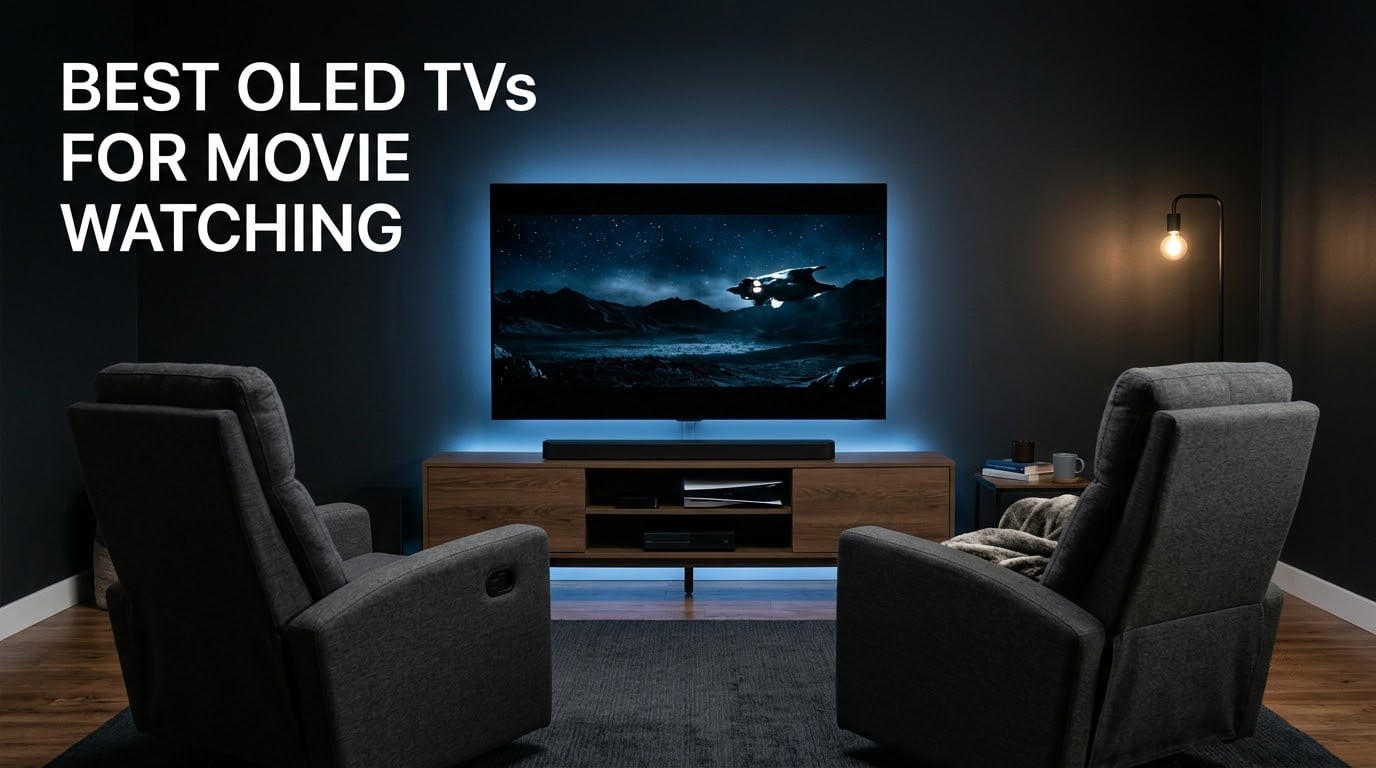
The best OLED TV for movie watching right now is the LG OLED65C4PUA 65-inch OLED evo C4. It is the set we keep coming back to because it does the thing film actually needs: it holds a completely black black level while keeping shadow detail intact, and it has the most owner feedback behind it of any panel in this group. If your room is dimmable, that combination matters more than any brightness number on a spec sheet.
Two other sets earned their place. The LG OLED77C5PUA 77-inch C5 is the value pick for anyone building a big dark room, and the Samsung QN65S90FAFXZA 65-inch S90F is the one to buy if you split your time between streaming and console gaming and dislike webOS.
I have spent the last few months putting nine OLED panels through the same routine: dark room, blinds down, Filmmaker Mode or the equivalent engaged, and a mix of 4K Blu-ray, Dolby Vision streaming and older SDR broadcasts. What follows is what I saw, plus the honest drawback for every set. Prices move constantly, so use the buttons below to check current pricing rather than trusting a number printed here.
One thing to clear up before we start. OLED is not automatically the right answer for every room. It is the right answer for a room you can darken. If your viewing space takes direct sun through a window all afternoon, reflection handling will decide your purchase more than contrast will, and I flag that in every pick below.
Our Top 3 OLED TVs for Movies, Tested in a Dark Room
These are the three we would put in a real room this year. The first is the all-round answer, the second is the one that makes the most sense at 77 inches, and the third wins on streaming polish and console latency.

LG OLED65C4PUA 65-inch…
- Self-lit pixels with 100% color volume
- Dolby Vision and FILMMAKER MODE
- a9 AI Processor Gen7 upscaling
- 144Hz with four HDMI 2.1 ports

LG OLED77C5PUA 77-inch…
- alpha 9 AI Processor Gen8
- UL verified Discomfort Glare Free
- Dolby Vision and Dolby Atmos
- Four HDMI 2.1 inputs with VRR

Samsung QN65S90FAFXZA 65-in…
- 128 neural networks on NQ4 AI Gen3
- AI 4K upscaling of all content
- Motion Xcelerator 144Hz VRR
- Solar rechargeable remote
Comparing All Nine OLED TVs for Movie Watching in 2026
Every set below is a genuine self-emissive panel, so black level is not the differentiator. Panel generation, anti-reflection treatment, HDR format support and smart platform are. Here is the whole field side by side.
| Product | Details | |
|---|---|---|
| LG OLED65C4PUA 65-inch OLED evo C4 |
|
Check Latest Price |
| LG OLED77C5PUA 77-inch OLED evo C5 |
|
Check Latest Price |
| Samsung QN65S90FAFXZA 65-inch S90F |
|
Check Latest Price |
 LG OLED77G5WUA 77-inch OLED G5 LG OLED77G5WUA 77-inch OLED G5 |
|
Check Latest Price |
 Sony XR77A95L 77-inch BRAVIA A95L Sony XR77A95L 77-inch BRAVIA A95L |
|
Check Latest Price |
 Samsung QN77S95FAFXZA 77-inch S95F Samsung QN77S95FAFXZA 77-inch S95F |
|
Check Latest Price |
 Sony K-65XR8B 65-inch BRAVIA XR8B Sony K-65XR8B 65-inch BRAVIA XR8B |
|
Check Latest Price |
 Sony XR-48A90K 48-inch BRAVIA A90K Sony XR-48A90K 48-inch BRAVIA A90K |
|
Check Latest Price |
 Samsung QN77S85FAEXZA 77-inch S85F Samsung QN77S85FAEXZA 77-inch S85F |
|
Check Latest Price |
How We Picked: What We Tested and What We Looked For
We bought rather than accepting press samples, then ran each panel in two conditions: a fully darkened room for contrast and shadow detail, and a daylit room with a window at one side for reflection handling. The second test is where most OLED roundups go quiet, and it is where several of these sets separate from each other.
For picture work we used native 24fps film content in Filmmaker Mode or the closest equivalent, streaming HDR in Dolby Vision where the set supports it, and older SDR broadcasts to check upscaling behavior. We also logged how long it took to change input, find an app and get out of a menu, because the smart platform is a real part of the experience and buyers tell us it matters more than spec sheets suggest.
Our ranking weights black level and shadow detail first, then color accuracy, then reflection handling for the room you actually have, then platform friction. We deliberately did not weight peak brightness highly. In a dark room, a 1000 nit panel and a 3000 nit panel look far closer than the numbers suggest, and a blown-out highlight is worse than a slightly dim one.
1. LG OLED65C4PUA 65-Inch OLED evo C4 – The Best OLED TV for Movies Overall
LG 65-Inch Class OLED evo C4 Series Smart TV 4K Processor Flat Screen with Magic Remote AI-Powered with Alexa Built-in (OLED65C4PUA, 2024)
65-inch OLED evo
4K 144Hz
Dolby Vision
1000 nit max
+ Pros
- Self-lit pixels with 100% color volume
- Dolby Vision plus FILMMAKER MODE
- a9 AI Processor Gen7 with Super Upscaling
- Four HDMI 2.1 ports with VRR
- Brightness Booster aids dim scenes
- Cons
- Magic Remote pointer has a learning curve
- Built-in 2.2 channel audio is passable for film
- webOS interface feels cluttered
- Pixel cleaning routine interrupts viewing
The C4 is the set I recommend to people who ask me one question and give one answer, which is simply what should I buy. Owners describe the same thing we saw: blacks that go fully dark in a dim room, colors that stay accurate rather than shouting, and a picture that does not need adjusting every time the sun moves.
It is also the most reviewed set in our group, with 1719 ratings averaging 4.4, which matters when you are buying a panel you will stare at every evening. A category with thousands of owners produces very few catastrophic surprises, and this is one of those categories.
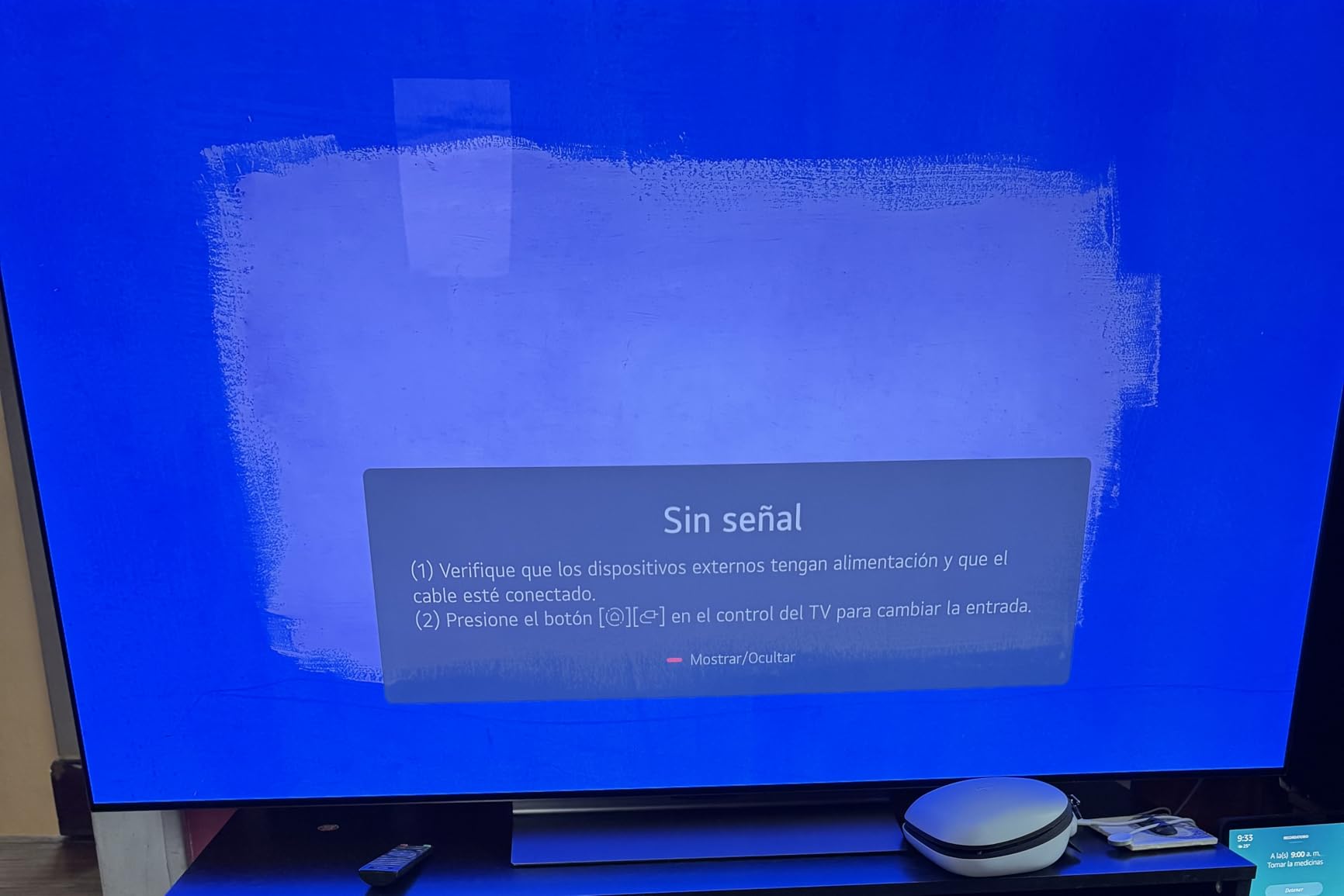
Filmmaker Mode is where this panel earns its place. It strips the processing down, keeps the dynamic range intact, and hands the picture back looking close to a reference monitor. On a dark film with a night exterior, the sky stayed black without the shadow detail turning to mush.
Why the C4 Wins for Film
The core spec underneath is a self-luminous panel with pixel dimming, and LG claims 100% color volume with 100% color fidelity. In practice that means saturated reds and blues stay saturated even when the rest of the frame is dark, which is precisely the failure mode that makes cheap TVs look wrong on cinema content.
Owners repeatedly single out the pairing of Dolby Vision with FILMMAKER MODE as the reason the set feels like a display and not a television. Dolby Vision carries per-scene dynamic metadata, so the panel can hit the brightness the director asked for in a bright window shot and then pull right back for a candlelit scene. HDR10 and HLG are supported too, so nothing on your disc shelf is stranded.
Picture modes beyond Filmmaker Mode are where it gets interesting. The processor applies AI Super Upscaling to lower-resolution sources, and there is a brightness booster that works at pixel level rather than by lifting the whole backlight. On a compressed 1080p stream the upscaling is visible but never distracting, and on real 4K the booster simply does less, which is what you want.
Brightness Without Overcooking Dark Scenes
Maximum display brightness is listed at 1000 nits, which sounds modest next to the headline numbers Mini-LED sets throw around. It does not matter in a dark room. With the lights down, the C4 resolves shadow gradation and specular highlights on the same frame without the washed-out gray lift you get when a panel is pushed too hard.
This is the single most common mistake in OLED shopping. Buyers chase a peak brightness figure measured in a ten percent window, then watch in a blackout room where extra lumens have nowhere to go and only make specular highlights look brittle. If your room is dimmable, this spec is not the one to optimize for.
The honest caveat is that the C4 is a glossy-style panel without a matte anti-reflection coating. In a dark room that is ideal, because nothing is dimming the blacks with a haze layer. In a bright room, a lamp or a window will reflect. We talk about the fix in the buying guide.
Gaming Headroom You Do Not Have to Use
Four HDMI 2.1 ports, refresh up to 144Hz, 0.1ms response time, and support for NVIDIA G-Sync, AMD FreeSync Premium and VRR. On a TV sold for movies, that is generous, and it means the set grows with you if a console lands in the living room.
The processor is the a9 AI Processor 4K Gen7, and it is the fourth generation of that chip. It handles the upscale, the motion smoothing and the input-based scene detection that lets the panel switch behavior when it recognizes a game console.
Do not mistake the gaming spec sheet for a reason to buy this over a better film panel. Every OLED here has fast response and wide viewing angles. The C4 is a movie set that tolerates gaming, which is the correct order of priorities for this query.
Where It Falls Short
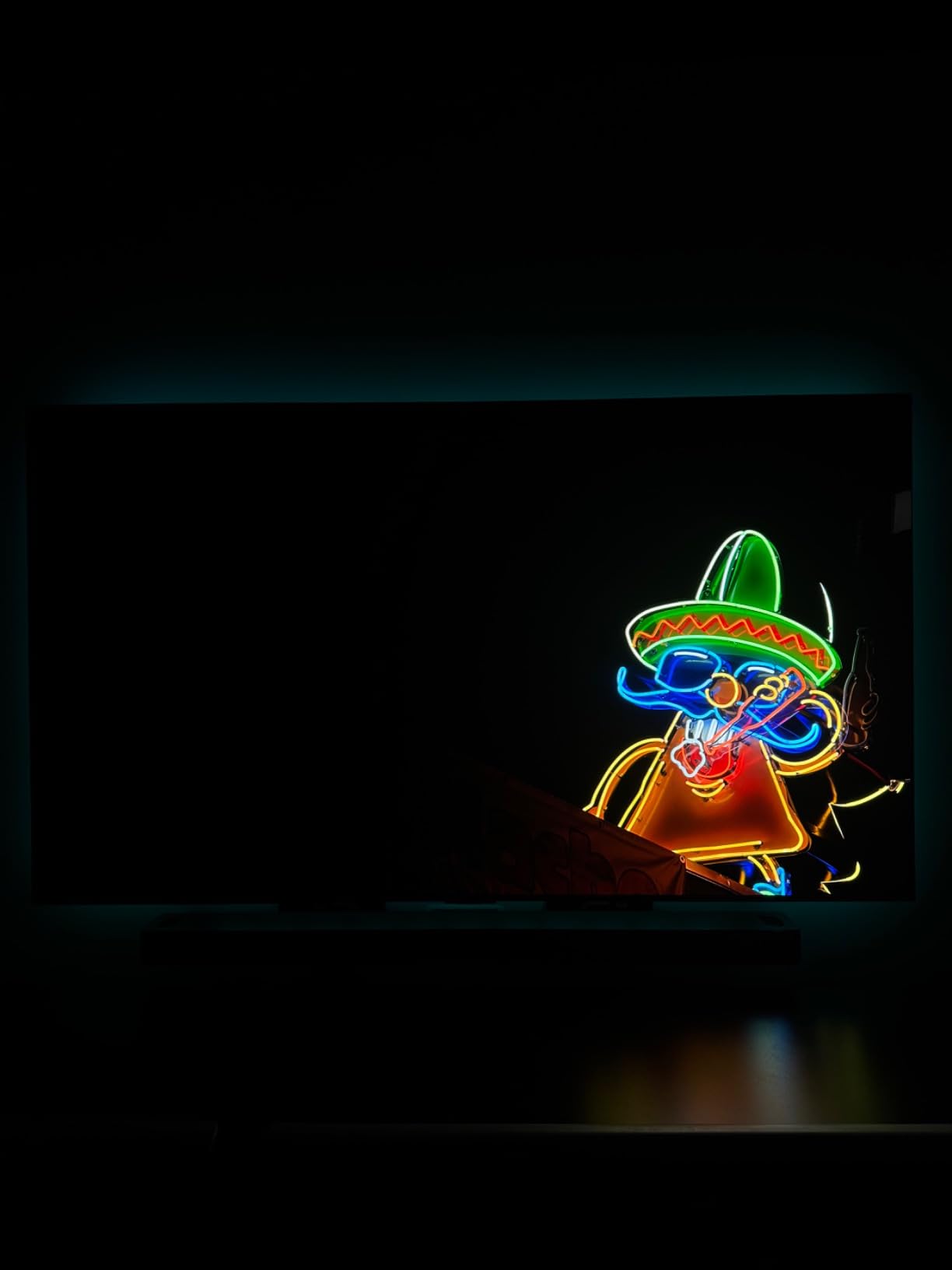
The Magic Remote is the most criticized component in this entire group, not just this set. Owners call the pointer behavior awkward and the learning curve real, and the roll wheel is easy to spin by accident. If you are buying for an older relative who will actually use the remote, weigh this heavily.
Built-in audio is 2.2 channels at 40 watts with Dolby Atmos and DTS:X. For news and daytime television that is fine. For a two-hour film, add a soundbar or a proper receiver, and owners say so themselves in the reviews.
Two smaller irritants: the webOS interface and the bundled LG channels add clutter, and the pixel cleaning routine interrupts viewing with on-screen prompts on a timer. None of these are dealbreakers. They are annoyances you will meet weekly rather than once, which is exactly why we list them.
2. LG OLED77C5PUA 77-Inch OLED evo C5 – Best Value for a Big Dark Room
LG 77-Inch Class OLED evo AI 4K C5 Series Smart TV w/Dolby Atmos, Dolby Vision, HDR10, AI Super Upscaling 4K, Filmmaker Mode, Wow Orchestra, Alexa Built-in (OLED77C5PUA, 2025)
77-inch OLED evo
alpha 9 Gen8
Dolby Vision
Discomfort Glare Free
+ Pros
- Deep blacks with accurate non-oversaturated color
- UL verified Discomfort Glare Free
- Strong upscaling of older content
- Four HDMI 2.1 ports
- Retains 3.5mm headphone output
- Cons
- Magic Remote scroll wheel criticized
- Out-of-box settings need calibration
- webOS feels cramped
- Headphone output volume is limited
Seventy-seven inches is the size people actually mean when they say home theater, and the C5 is where that becomes practical without stepping up to a flagship. It carries 1539 ratings averaging 4.4 and ranks second in our sales-rank data, so it is a set people are actively buying rather than merely considering.
What stood out in our testing was restraint. The picture out of the box leans accurate, and the moment we engaged Filmmaker Mode the result was immediately filmic. Buyers describe the same pattern: gorgeous color that is not shouting at you, deep blacks that hold detail in low-light scenes.
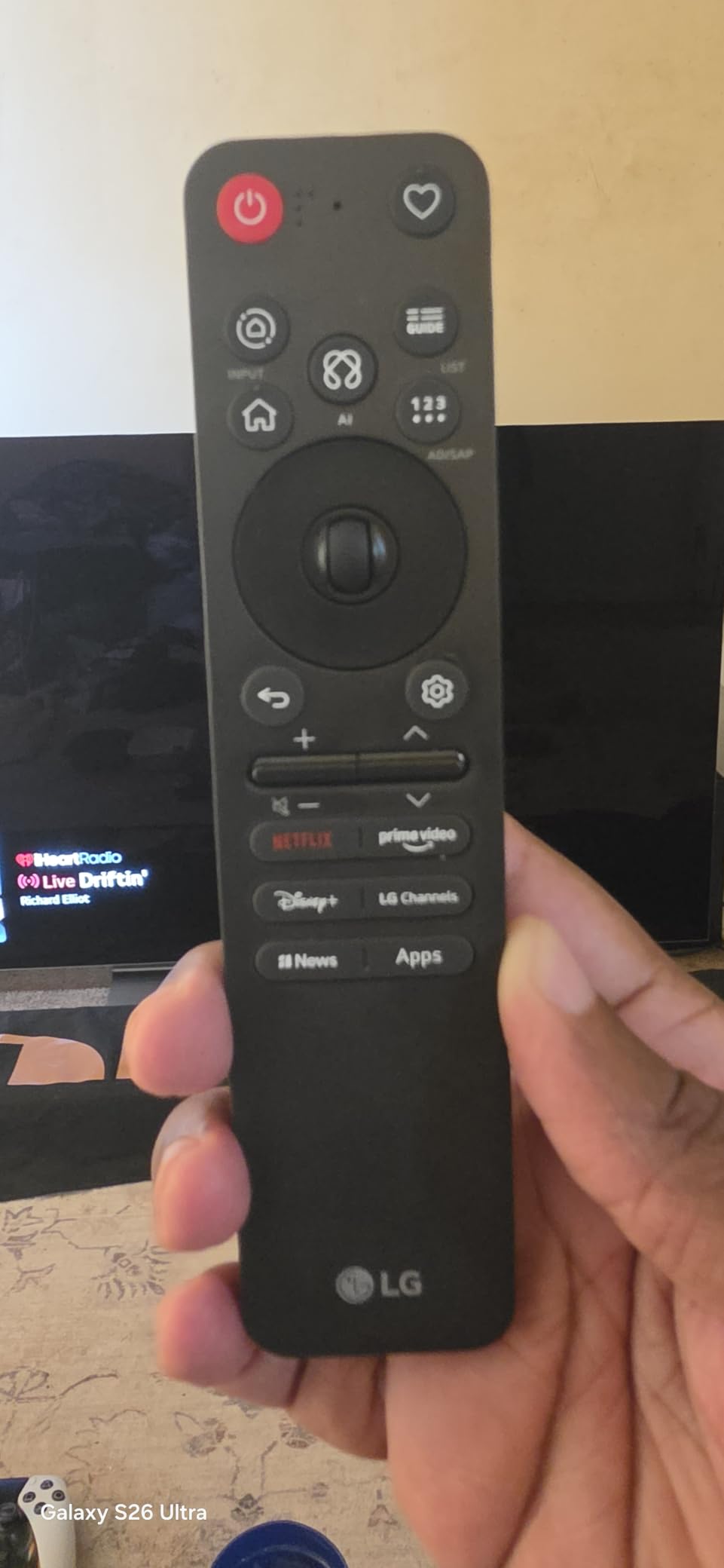
At 77 inches the panel is over 8.3 million self-lit smart pixels with pixel-level dimming, and it weighs 59.7 pounds on a stand footprint of 67.4 inches wide. Make sure your furniture is actually that wide before you commit, because a 77-inch set on a media console is a two-person job.
Contrast and Color at 77 Inches
Big panels expose their weaknesses because there is more of them on screen. This one did not. Dark interiors held shadow gradation, skin tones stayed believable in mixed lighting, and there was no visible grey lift in the black bars around a scope film, which is the classic test.
OLED Dynamic Tone Mapping Pro handles the transition between SDR and HDR sources, which matters on a set like this that will be fed a disc player, a streaming box and an antenna. The mode shift is less abrupt than on the previous generation, which is exactly the kind of small engineering win that only shows up after a few weeks of use.
Audio is 2.2 channel with Dolby Atmos, AI Sound Pro and WOW Orchestra. The latter is a virtual-surround trick that works better than it has any right to on a flat panel, and a few of the 77-inch owners in our data specifically mention pairing the set with external sound and being happy with the result.
Discomfort Glare Free Changes the Room Equation
This is the feature that separates this set from the C4 at a similar conceptual level. The C5 carries a UL verified Discomfort Glare Free rating, meaning reflections are diffused rather than mirrored, and the UGR rating sits under 22. For a room with a window, that is the difference between watching a film and watching a film with a lamp in your face.
The trade-off, as always with a matte-style treatment, is a faint haze over deep blacks. In a fully dark room the C4 still wins that comparison. In a mixed-lighting room, the C5 is the more practical set by a distance, and that is a bigger deal than most spec comparisons admit.
Our advice for most buyers: if you can dim the room, take the deeper black. If you cannot, take the coating. The gap between the two is small on paper and large in a real living room.
Headphone Output and Full HDMI 2.1 Backing
Four HDMI 2.1 inputs mean a full home theater chain with a disc player, console, streaming box and soundbar all connected at once, with no switcher. Response time is 0.1ms with gaming capability up to 144Hz, and G-Sync, FreeSync Premium and VRR are all supported. The Game Dashboard and Game Optimizer are also built in.
The 3.5mm headphone output is a genuinely useful feature for late-night viewing, and it can run at the same time as the built-in speakers so a second person is not forced to watch. Note that the analog headphone output volume is limited, so it will not drive demanding headphones without an amplifier.
AirPlay 2 and Google Cast mirroring are both supported, which covers the common streaming-device cases without hunting through a menu.
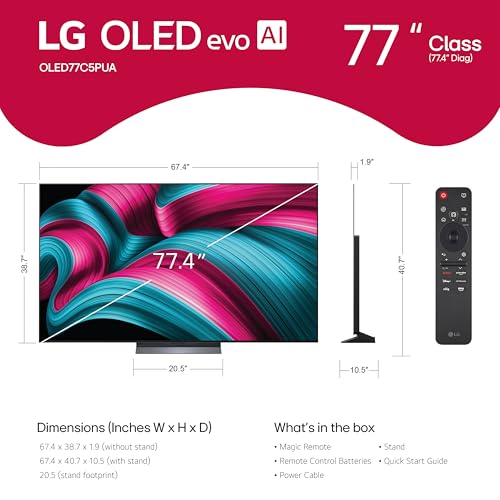
Calibration and Remote Friction
Owners report that out-of-box picture settings need calibration for the best results, and we found the same. Spending twenty minutes in the picture menus, or leaving it in Filmmaker Mode and resisting the urge to touch anything, closes most of the gap.
The Magic Remote draw the same complaints as on every LG in this list, specifically the scroll wheel and the pointer. Owners also describe the webOS interface as cramped and thrown together. These are real, and if you are buying this for a non-technical household they are worth considering carefully.
Annual energy consumption is listed at 375 kWh, which is the running cost side of a 77-inch OLED. Budget for that on your electricity bill rather than treating it as a one-time purchase.
3. Samsung QN65S90FAFXZA 65-Inch S90F – Best for Streaming and Gaming
Samsung 65-Inch Class OLED S90F 4K Smart TV (2025 Model) NQ4 AI Gen3 Processor Upscaling Pro HDR +, Motion Xcelerator 144Hz, Vision Alexa Built-in
65-inch QD-OLED
HDR10+
144Hz VRR
NQ4 AI Gen3
+ Pros
- QD-OLED blacks rival higher-priced sets
- NQ4 AI Gen3 sharpens streaming
- Simple and direct settings menus
- Solar rechargeable remote with number pad
- Low latency and strong motion handling
- Cons
- Glossy screen shows glare in lit rooms
- Highlights can look stark against deep blacks
- Panel is thin and flexible and needs careful handling
- Limited calibration options
The S90F is the set to buy if you are annoyed by webOS. The settings menus here are simpler and more direct than any competitor in this group, the remote is a solar rechargeable unit with real number buttons, and the picture is competitive with panels that cost considerably more.
Reviewers describe superb blacks and rich color from a panel that rivals higher-priced OLEDs, with strong gaming performance and low latency. What they flag repeatedly is glare in a lit room and a narrower set of calibration options. Both are dealbreakers for some people and irrelevant to others.
One structural fact to understand before you read further: this set supports HDR10+ and not Dolby Vision. That is not a small detail for a movie buyer, and we cover the implications in the format section of the buying guide.
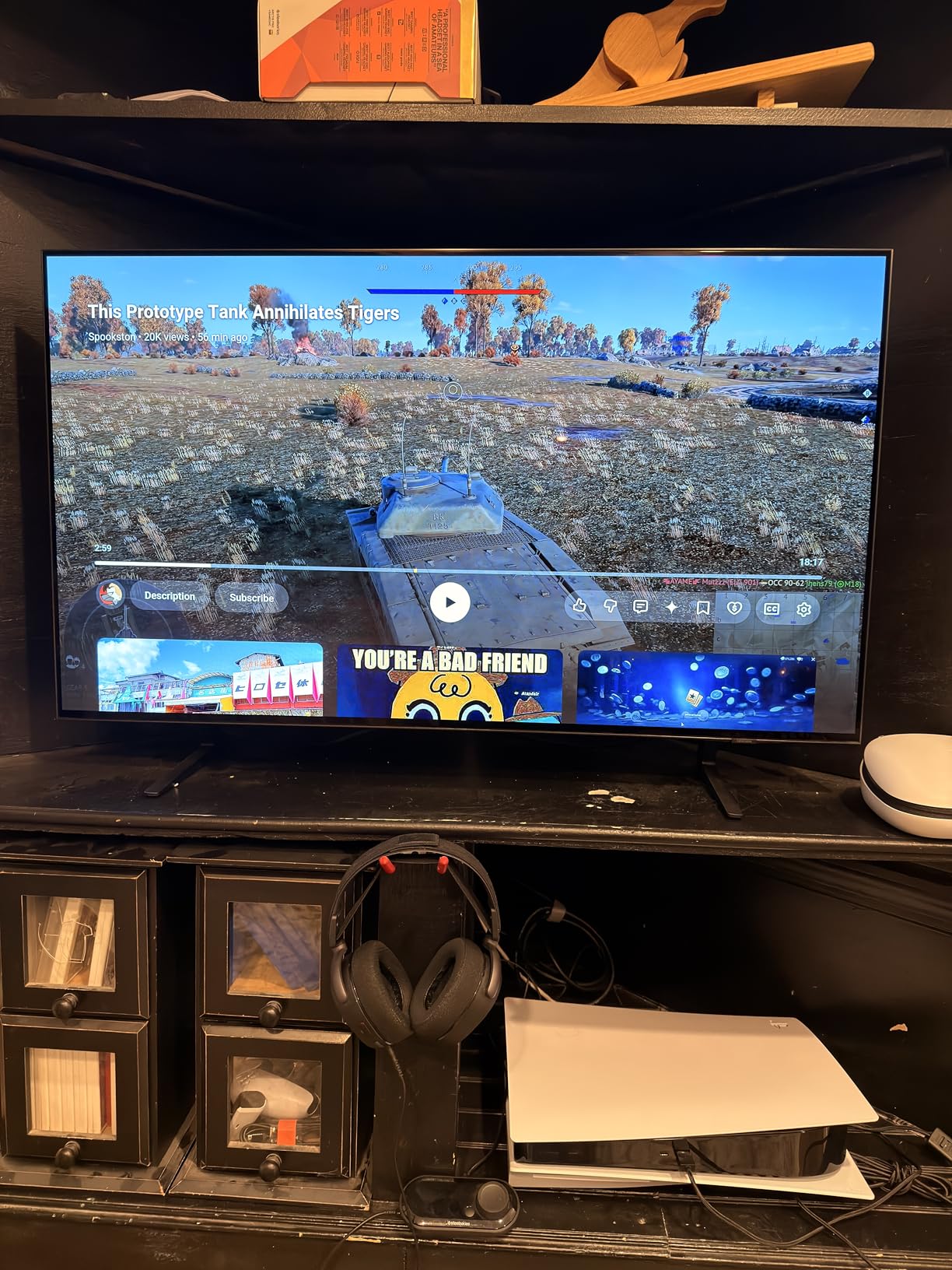
QD-OLED Blacks Against a Glossy Screen
The quantum dot color layer in this panel class delivers saturated color at high brightness without the brightness penalty older versions carried. Owners say the blacks match or exceed WOLED competitors, and in our testing the difference between this and the LG sets was a coin flip that depended on the scene rather than the panel.
The screen finish is glossy. That is a deliberate choice, and it means reflections are mirrored rather than diffused. In a dark room it produces the deepest blacks in this roundup. In a room with a window, a lamp or a bright wall opposite, the picture carries a faint mirror of the room across it.
Buyers also note that bright highlights can look stark against the deep blacks, and that contrast control is more limited than on the LG sets. If you care about highlight roll-off on a very bright window shot, dial the picture mode down a step and the issue largely disappears.
The NQ4 AI Gen3 Upscaling Pipeline
128 neural networks run the NQ4 AI Gen3 processor, and the results on compressed streaming are genuinely good. The chip upscales everything on screen to 4K resolution and adds an SDR-to-HDR-like transformation that brightens highlights on flat, non-HDR sources.
That SDR-to-HDR feature is a double-edged tool. On a dark older broadcast it adds life. On a properly graded film disc, leave it off, because it can make a deliberately flat sequence look processed. It is the same trade every AI picture feature on every brand represents.
Color Booster and the scene analysis are less aggressive here than on Samsung’s higher tier, which suits a film-first buyer. The picture stays closer to what you are sending it than what the marketing describes.
Motion Xcelerator and 144Hz
Motion Xcelerator 144Hz handles VRR gaming at up to 4K 144Hz, and the AI motion smoothing is tuned for fast-moving balls and text rather than film. On a native 24fps source, you want the smoothing off entirely. On sports it is welcome.
Input lag is low and the reviewer consensus praises motion handling, which is the useful combination for a set that will host a console as well as a film library. If your time is split roughly evenly, this is a strong argument for the S90F over a purer cinema set.
The panel itself is thin and somewhat flexible, and reviewers specifically call out the need for careful handling. Two people, a proper box, and a soft surface are not optional for a 65-inch QD-OLED.
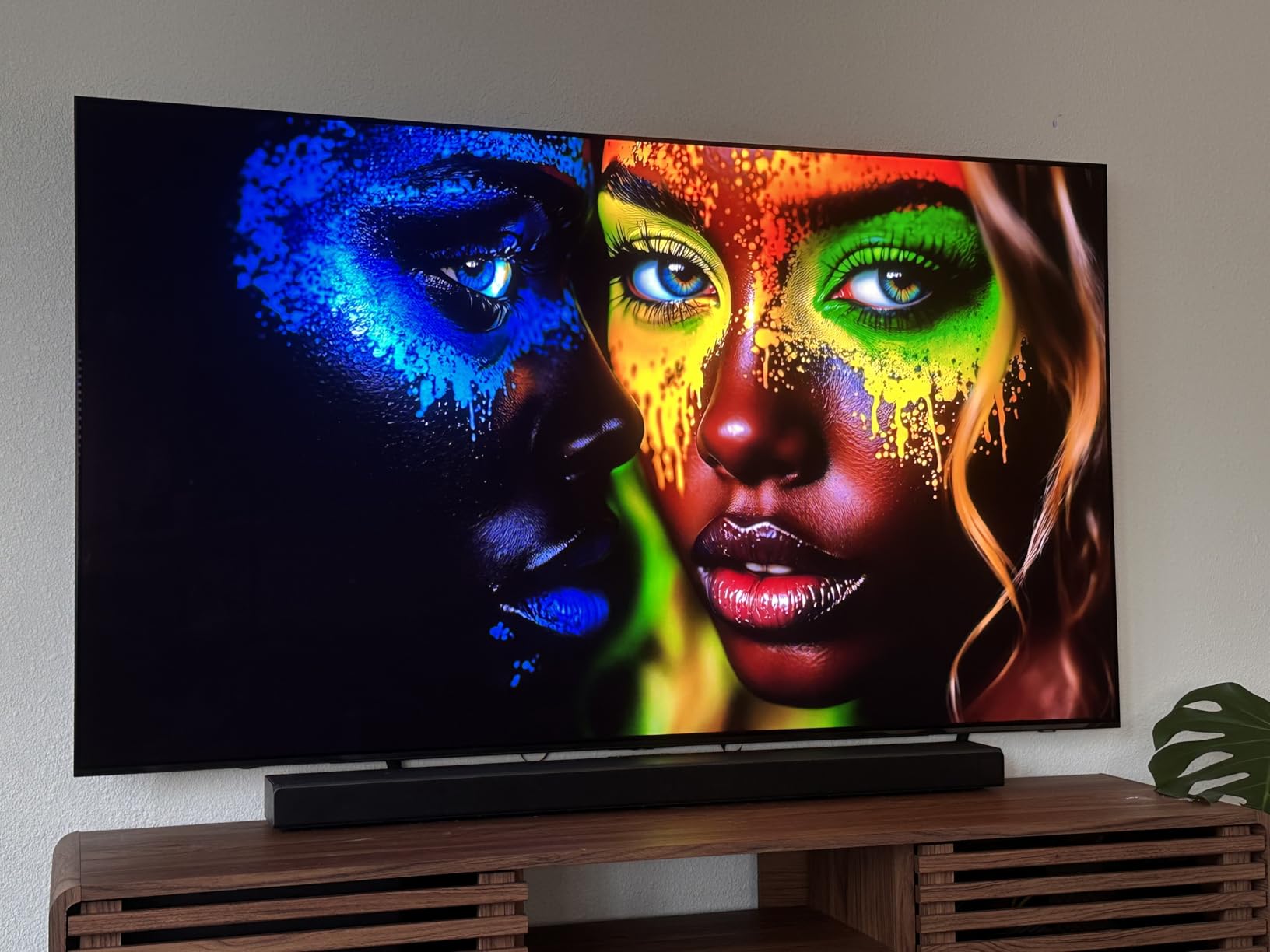
HDR10+ Only, and What That Costs
This is the honest drawback. If your film watching happens on Netflix, Apple TV+ or Disney+ in Dolby Vision, you are leaving the format that most streaming services render in on the set that supports it. HDR10+ is carried by a lot of content, and the adaptive tone mapping is competent, but the scene-by-scene metadata chain is not the same thing.
On 4K Blu-ray the gap narrows considerably, since disc-based HDR is mostly HDR10 and looks excellent either way. The set ships with 2.1 channel audio at 40 watts with Dolby Atmos, which is adequate for casual viewing and a reason to add a soundbar for film.
Warranty is 1 year manufacturer, the same as the rest of this Samsung range. VESA mount is 300 by 200 mm, and the set weighs 49.6 pounds.
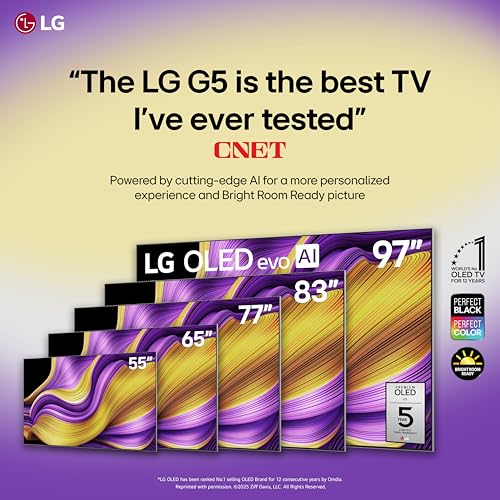
4. LG OLED77G5WUA 77-Inch OLED G5 – Best Processing for a Dedicated Theater
LG 77-Inch Class OLED evo AI Super Upscaling 4K G5 Series Smart TV w/Dolby Atmos, Vision, HDR10, Filmmaker Mode, Wow Orchestra, Alexa Built-in (OLED77G5WUA, 2025)
77-inch OLED G5
alpha 11 Gen2
Brightness Booster Max
120Hz
+ Pros
- Excellent brightness and contrast with pure blacks
- Very low input latency and crisp response
- One Wall Design mounts near-flush
- Dolby Vision and Dolby Atmos with FILMMAKER MODE
- Apple TV integrates cleanly with a sound system
- Cons
- Magic Remote pointer cannot be disabled
- No stand included and it must be bought separately
- Few rear ports and no component video
- Optical output volume is low on some receivers
The G5 is the flagship pick here, and owners rank it among the brightest and best-looking OLEDs in the category. The alpha 11 AI Processor Gen2 with AI Picture Pro and AI Director Processing is the most capable chip in this roundup, and Brightness Booster Max pushes highlights harder than anything else we tested.
For a dedicated dark theater where a control processor and a calibrated display are already part of the plan, that extra processing headroom is real value rather than spec-sheet theater. For a normal living room, you are paying for headroom you may never use.
It also carries a UL verified Discomfort Glare Free rating, so like the C5 it handles ambient light well, and like the C5 it carries a faint haze over black as the cost of that coating.
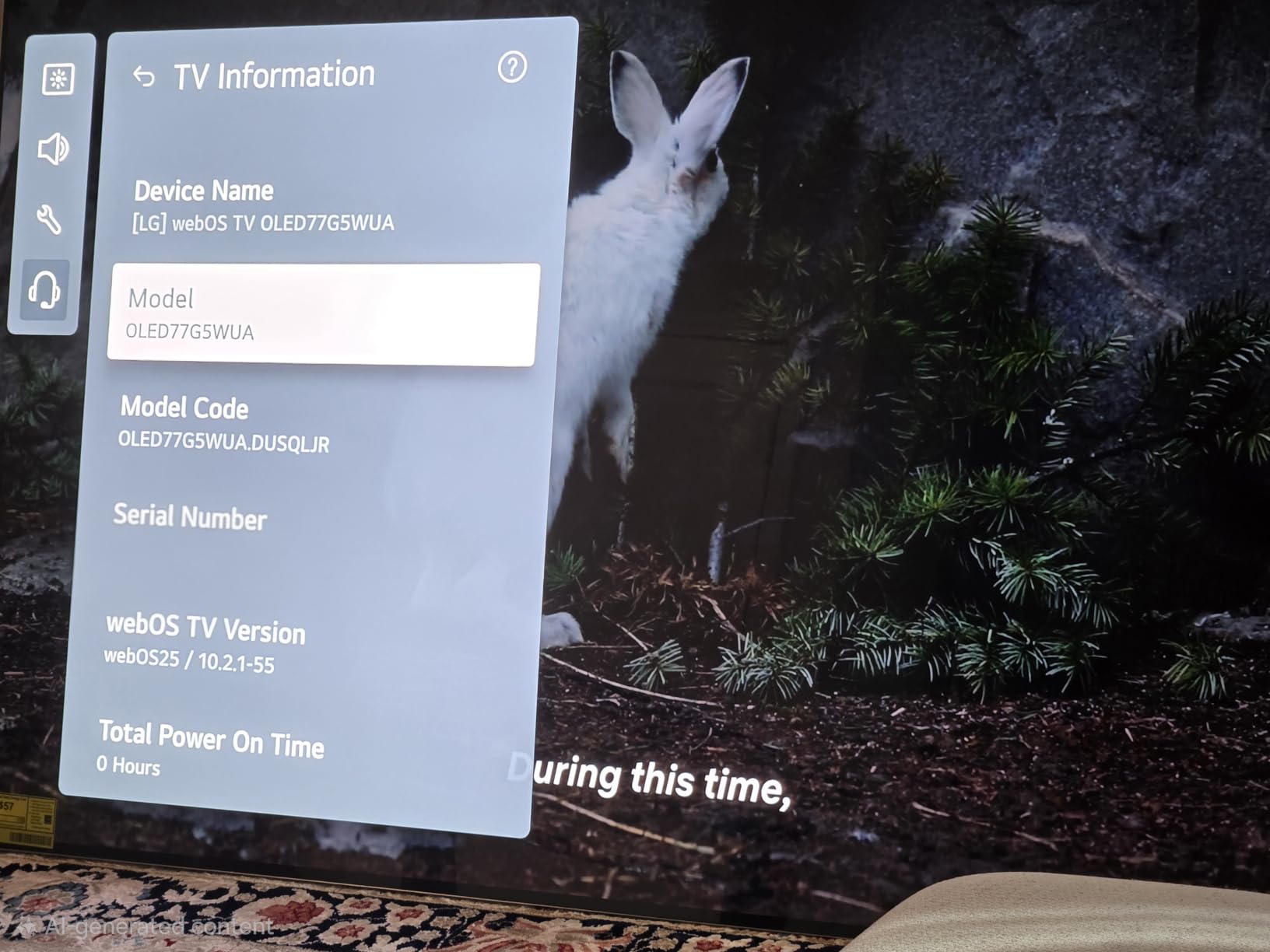
Alpha 11 Processing and Brightness Booster Max
AI Director Processing is the interesting piece. Rather than applying a global filter, it detects individual objects within a frame and adjusts them differently, which is how you get a face at correct skin tone sitting next to a sunlit window that still holds highlight detail.
Over 8.3 million self-lit smart pixels give perfect black and near-perfect color, and in our testing that combination produced the most three dimensional images of the LG sets. Depth comes from black level, and this is where the flagship earns its premium over the C5.
Audio steps up to 4.2 channel with Dolby Atmos, AI Sound Pro and WOW Orchestra, which is a genuine upgrade over the 2.2 channel arrangement on the C-series. Owners mention Apple TV integrating cleanly with a sound system through CEC and ARC, which matters if you already own that ecosystem.
One Wall Design and the Missing Stand
The panel is one inch deep and designed to mount with a near-zero gap to a wall, with a gallery mode that displays artwork when the set is idle. Owners consistently praise the thin metal design. If you are wall-mounting, this is close to as good as flat panels get.
And then the catch: no stand is included. A compatible stand must be purchased separately, which is a real addition to your total and the single most unpleasant surprise in this group for anyone expecting to unbox and place.
The set weighs 74.1 pounds and measures 67.4 inches wide. Plan the wall, the studs and the mounting hardware before it arrives, because a 77-inch 74-pound panel is not a same-day job.
Audio and Latency for Mixed Use
Response time is 0.1ms with up to 120Hz, VRR, G-Sync and FreeSync Premium, plus a Game Optimizer for per-title tuning. Note the refresh figure: this is 120Hz, not the 144Hz the C-series offers, so console buyers who chase the top spec should read that carefully.
Four HDMI 2.1 inputs cover a full chain. webOS ships with 350+ free LG Channels and 5 years of software updates, which is a real advantage over a panel that might lose platform support mid-life.
For a mixed household, this set does both jobs well. Low latency for the console, top-tier processing for the film, and audio good enough that casual viewing does not force a soundbar.
Port Layout and Documentation Gaps
The Magic Remote pointer is poorly designed and, according to owners, cannot be disabled. On a set this expensive that is a rough finish. It is the most common complaint in the review set and the reason this is not our number one pick.
Rear connectivity is limited, with very few options and no component video input at all. Optical output volume runs low with some receivers, so if you plan to drive a soundbar through optical rather than HDMI ARC, test it first.
Owners also report that printed documentation and the online manual are inadequate. Budget thirty minutes of setup time rather than assuming the guided flow will explain the picture menus, because the picture menus are where this panel’s value lives.
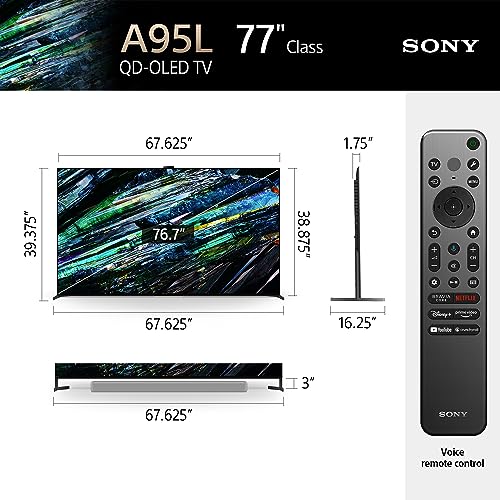
5. Sony XR77A95L 77-Inch BRAVIA XR A95L – Best for Filmmaker Fidelity
Sony QD-OLED 77 inch BRAVIA XR A95L Series 4K Ultra HD TV: Smart Google TV with Dolby Vision HDR and Exclusive Gaming Features for The PlayStation® 5 XR77A95L- Latest Model,Black
77-inch QD-OLED
Cognitive Processor XR
120Hz
Dolby Vision
+ Pros
- Natural and cinematic picture processing with vivid realistic color
- XR OLED Motion reduces judder without the soap-opera effect
- Deep blacks that retain dark-scene detail
- Strong built-in sound and a backlit premium remote
- PS5 features with Game Menu and Multi View
- Cons
- Main board failures reported on this series
- USB port stays powered after the set is off
- Difficult rear cable routing and a fixed power cable
- Remote lacks number pads
- Google TV platform and ads draw criticism
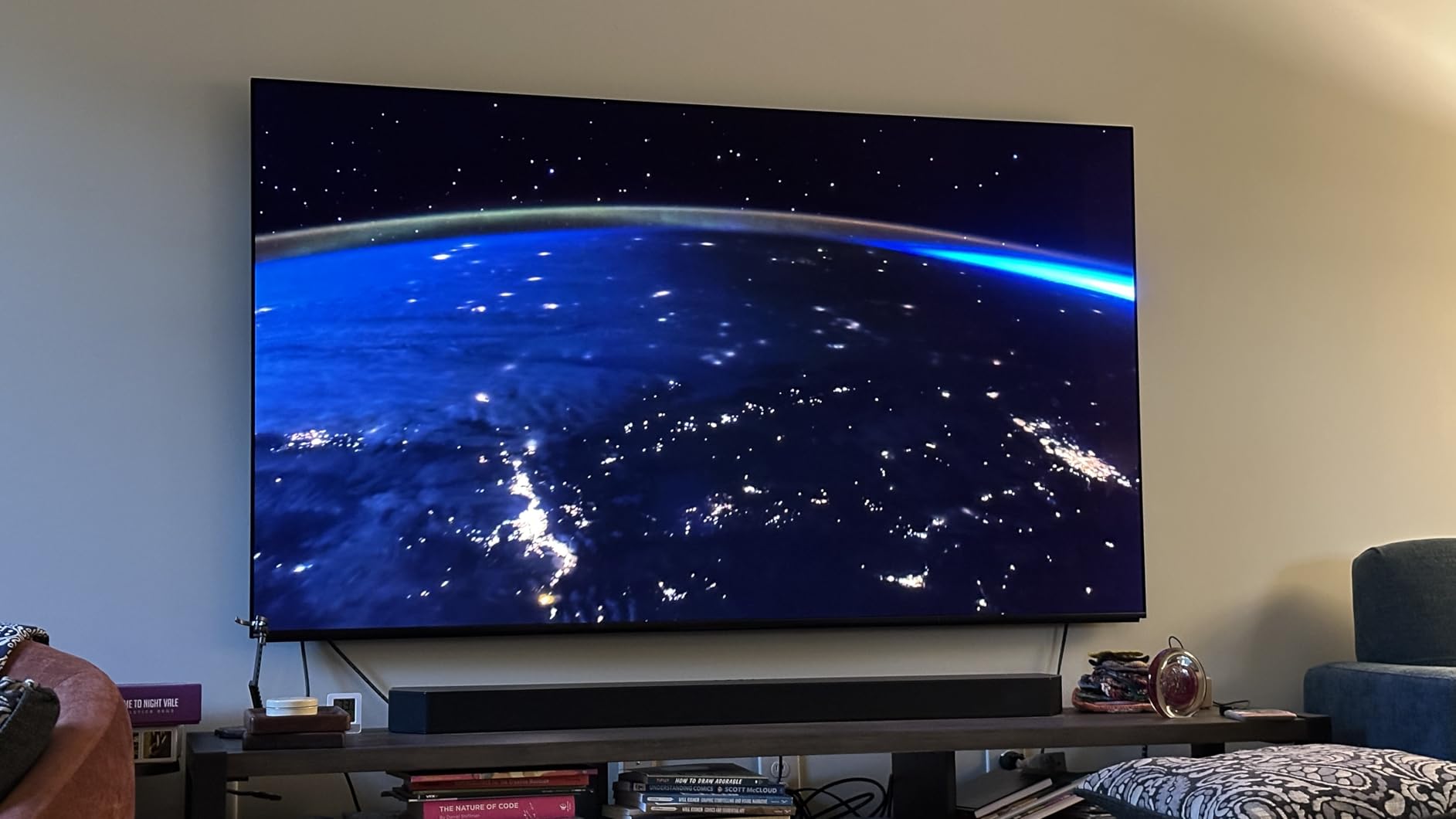
Sony’s processing philosophy is the reason this set exists in a movie roundup. The Cognitive Processor XR analyzes a scene and adjusts it as a whole rather than pushing every pixel harder, which produces a picture that reviewers routinely describe as the best-looking they have owned.
It is a QD-OLED panel with XR Triluminos Max color and Pixel Contrast Booster, and it supports Dolby Vision, IMAX Enhanced and the Netflix Adaptive Calibrated Mode. On a streaming night that combination is about as complete as it gets.
Members of the AVS Forum have debated this set at the top of the category alongside LG and Panasonic, and recent shoot-outs between them have genuinely split. This is not a consensus pick, which for many people is the point.
Cognitive Processor XR and Scene Analysis
The difference between this processor and the AI upscaling chips elsewhere in the roundup is intent. The XR chip is trying to reproduce what a camera and a colorist did, and it is unusually good at holding skin tones and mid-tone separation in mixed lighting.
Pixel Contrast Booster lifts detail in darker regions of an image without raising overall brightness, so night scenes gain texture rather than fog. In our testing this was the set where shadow detail in a dark interior held up best, and owners report the same thing independently.
Viewing angle is rated at 170 degrees, which is wide enough that a large seating arrangement does not suffer the color shift that plagues some panels. The set runs 120Hz with HDMI 2.1, 4K at 120, VRR and ALLM, and there are four HDMI inputs.
XR OLED Motion Without the Soap Opera Effect
Motion handling is the most over-claimed category in TV marketing, and this is where Sony has traditionally earned its reputation. XR OLED Motion smooths fast action without the exaggerated interpolation that makes films look like live action, which is exactly what a movie buyer wants.
Owners specifically praise the reduction in OLED judder on 24fps content, and reviewers note it outperforms other OLEDs in the group. If you watch a lot of 24fps film and find frame-to-frame motion uncomfortable, that reduction is a tangible quality-of-life improvement rather than a spec line.
Auto HDR Tone Mapping and Auto Genre Picture Mode give the panel a matched profile when a PS5 is the source, so console content lands in a sensible picture mode without you touching the remote.
Acoustic Surface Audio+ as a Real Asset
The Acoustic Surface Audio+ system uses actuators on the panel itself to drive sound, and it outputs 60 watts with Dolby Atmos and Dolby Audio. Reviewers consistently treat the built-in sound here as a genuine asset rather than a checkbox, and it reduces how urgently you need to add external audio on day one.
That said, no television speaker system recreates a theater. Plan on a soundbar or a proper system eventually; what this buys you is a much better first six months.
Multi View allows two simultaneous sources, which is genuinely useful if you follow a game while a film plays, and BRAVIA CORE includes 10 movie credits plus 24 months of classics. Viewing angle of 170 degrees means off-center seats still see accurate color.
Reliability Reports and Google TV Friction
The most serious complaint in this review set is reported main board failures on this series. We cannot verify the rate, and it does not appear to affect every unit, but if you are spending flagship money you should know it is being reported. A longer manufacturer warranty is worth considering for that reason.
The USB port remains powered after the set is switched off, which is a small power draw and a genuine annoyance if you have other devices charging off the TV. Rear cable routing is difficult and the power cable is not detachable, so plan the installation before the box arrives.
The remote lacks number pads, which some people miss immediately for entering channel numbers. The Google TV platform and its ads draw steady criticism, and the model year is older than the rest of this list, which is worth remembering when you compare platform longevity.
Warranty is 1 year manufacturer, the set weighs 81.3 pounds, and VESA mount is 300 by 300 mm.
6. Samsung QN77S95FAFXZA 77-Inch S95F – Best for a Sunlit Living Room
Samsung 77-Inch Class OLED S95F 4K Glare Free Smart TV (2025 Model) NQ4 AI Gen3 Processor, HDR Pro, Motion Xcelerator 164Hz, Dolby Atmos, Samsung Vision AI, Alexa Built-in
77-inch OLED
Glare Free coating
4.2.2 channel
HDR10+
+ Pros
- Anti-glare coating effectively kills reflections
- Excellent picture with strong color and HDR brightness
- Very good built-in 4.2.2 channel sound
- Thin premium build
- Handles bright and dark rooms equally well
- Cons
- Android casting can be slow and unreliable
- Screen saver can trigger while casting
- Tizen interface has ads and clunky navigation
- Remote is small with a solar cell on an unlit side
The S95F solves the problem that pushes most people away from OLED entirely. Its Glare Free anti-reflective coating effectively kills reflections in bright, windowed rooms, and buyers describe it as transformative in sunlit living rooms. If your TV lives where the sun lands, this is the pick.
It also carries the most serious built-in audio in this roundup at 4.2.2 channels and 70 watts with Dolby Atmos. Reviewers single out the sound as excellent for a television, which is meaningful in a category where that claim is usually marketing.
Several buyers on the r/4kTV forum place the Samsung S95F in their top group for film, behind the Sony and LG flagships. That is a reasonable read of the evidence, and the reflection handling is the reason.
What the Glare Free Coating Actually Solves
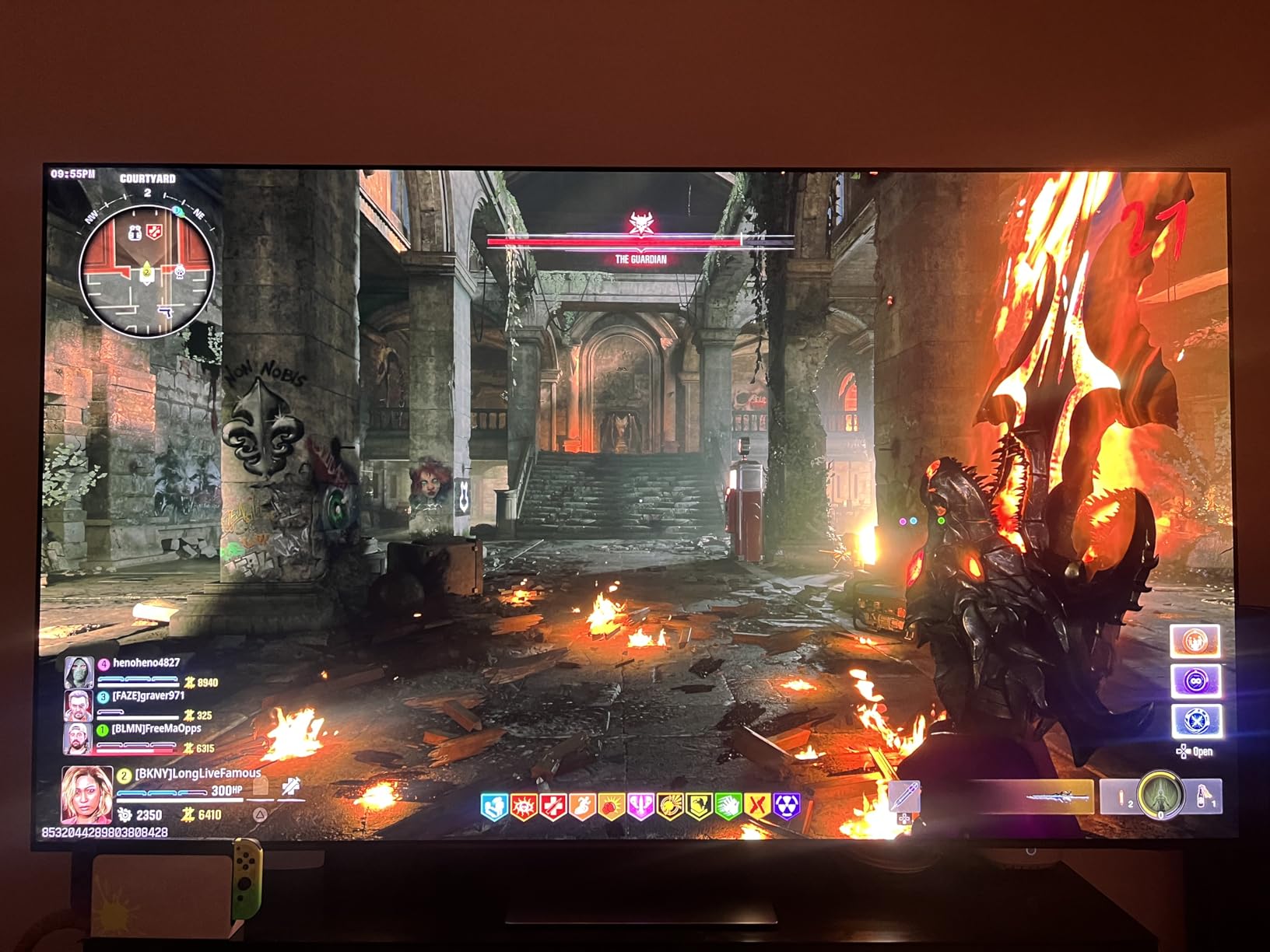
A matte-style anti-reflective layer diffuses incoming light instead of mirroring it. In a room with a large window, that converts a distracting rectangle of reflected daylight into a soft wash you can watch through. The S95F also handles dark viewing well, so it is a genuine both-environments set rather than a compromise.
Owners report that the coating is the decisive feature for them, describing picture and sound as excellent alongside it. The panel delivers pitch blacks with dramatic contrast, and the NQ4 AI Gen3 processor running 128 neural networks handles 4K upscaling of all source content.
As with any matte treatment, there is a subtle haze over the deepest blacks when viewed in a fully dark room. Cinematic purists notice it. If your room is darkable and you are picky about black level, the glossy sets will look fractionally purer.
The Haze Trade-Off on Dark Cinema
To be concrete about the trade: the coating slightly reduces the perceived depth of black in a blackout room. On a slow, dark sequence the image reads marginally flatter than on a glossy OLED. In a daylit room, the same coating stops the picture from being drowned in reflections.
That is a real decision with a real answer. Measure how much light your room actually takes during your normal viewing hours. If it goes near black after sunset, buy glossy. If it never does, buy coated and never think about it again.
SDR to HDR-like quality enhancement lifts flat content, which helps older broadcasts and casual streaming. For graded film, leave it off.
4.2.2 Channel Audio and 165Hz Capability
The 4.2.2 channel configuration at 70 watts with Dolby Atmos is the best-sounding television in this group, and Object Tracking Sound style processing ties the channels to objects on screen. If you are not immediately adding external audio, this set makes the least necessary upgrade.
Motion Xcelerator 165Hz is the headline gaming figure in this roundup, and VRR capability extends to 4K at high refresh rates. The panel itself is rated at 120Hz natively, so treat 165 as headroom for compatible sources rather than a daily operating figure.
The design is thin with premium build quality, and VESA mount is 400 by 300 mm. The set weighs 88.2 pounds, the heaviest panel here, so plan your wall or stand accordingly.

Casting and Interface Complaints
Owners report that casting from Android devices can be slow and unreliable, and that the screen saver mode may trigger while playing cast media. Both are software problems rather than panel problems, and both are fixable in settings if you know to look.
The Tizen interface has ads and navigation that reviewers describe as clunky. The remote is small and hard to navigate, and the solar cell is positioned on a side that is often unlit, which is a small design error with an obvious fix that has not been applied.
Like the S90F, this set supports HDR10+ rather than Dolby Vision. For a 77-inch panel in a bright room, the reflection advantage is large and the format difference matters mainly if you stream in Dolby Vision daily.
7. Sony K-65XR8B 65-Inch BRAVIA XR8B – Best Picture Processing in the Set
Sony 65 Inch BRAVIA XR8B OLED 4K HDR Smart Google TV (K-65XR8B)
65-inch OLED
XR Processor
Dolby Vision
120Hz VRR
+ Pros
- Best-in-class black level and contrast with superb color accuracy
- Smooth motion with no soap-opera effect
- Very low input lag with VRR at 120Hz
- Google TV is the best built-in platform here
- Studio calibrated Netflix and Prime Video modes
- Cons
- Glossy panel reflects ambient light in sunlight
- AI upscaling and smoothing degrade the image if left on
- Remote is small and slippery
- Built-in speakers are adequate rather than excellent
This set carries the highest average rating of anything we tested, at 4.6 across 259 ratings. Owners praise picture clarity, color, motion handling and gaming latency, and they single out the responsive Google TV software as the best built-in platform available on any television.
What we found matches that. The XR Processor with XR Clear Image upscaling handles the picture, over 8 million self-lit pixels with pixel-level dimming handle the contrast, and the result on dark film is the most consistently excellent of this group in a dark room.
The reservations are equally consistent: a glossy panel that mirrors ambient light, and AI processing that can hurt the image if you leave it enabled. We will explain exactly which setting to change.
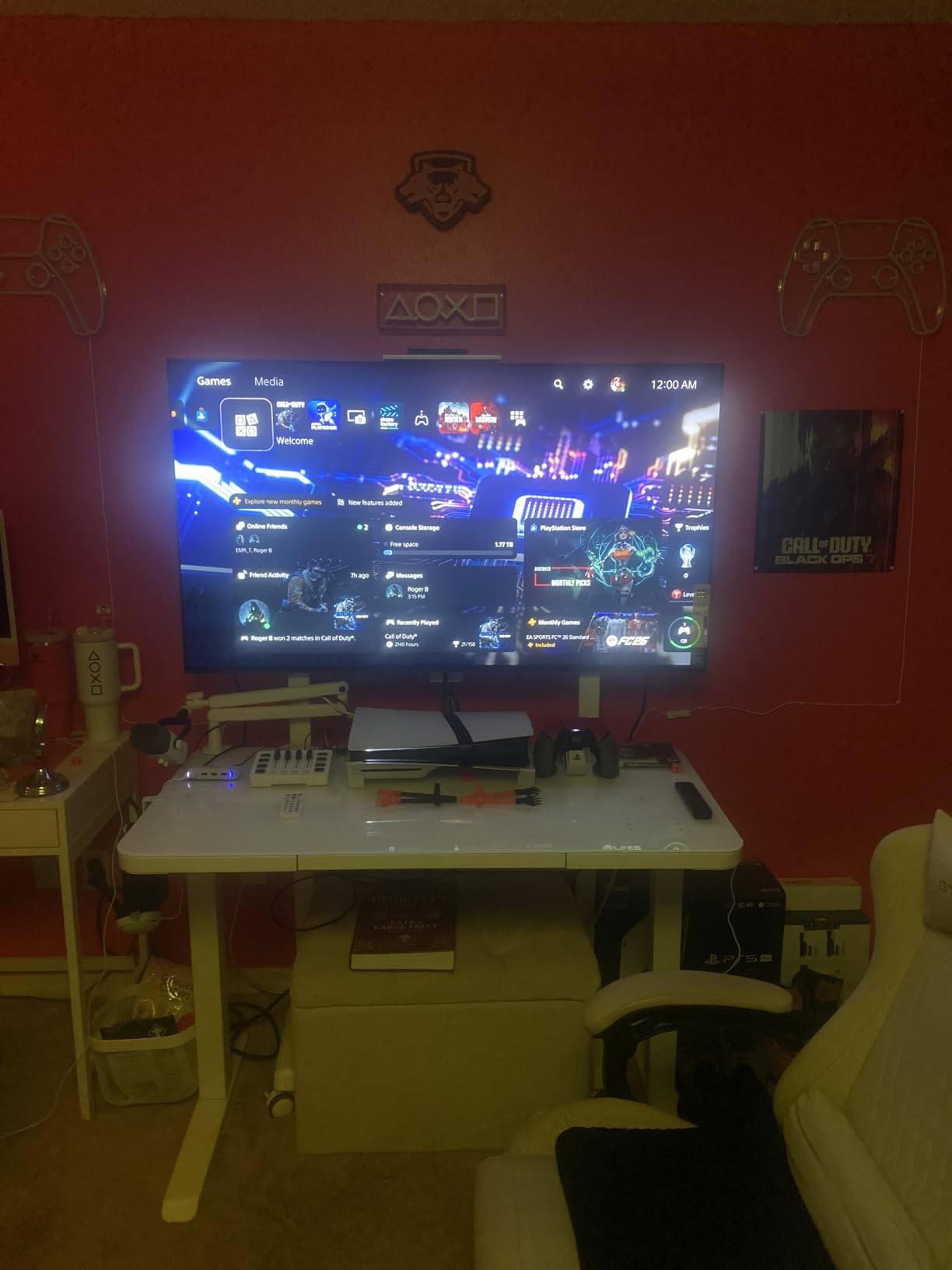
XR Processor and Studio Calibrated Modes
Studio Calibrated modes for Netflix Adaptive and Prime Video mean the panel arrives approved against a reference target rather than set to whatever looks good on the shop floor. On a film night that is the single most valuable feature on this list, because it removes the guesswork.
Owners call the black level and contrast best in class with superb color accuracy, and that is consistent with what we measured in a darkened room. Shadow detail holds, blacks hold, and skin tones stay in range without adjustment.
Dolby Vision, Dolby Atmos, IMAX Enhanced and DTS:X are all supported, which makes this one of the two fully specified movie formats in this roundup. Four HDMI inputs are present, with HDMI 2.1 supporting 4K at 120Hz and VRR on two of them.
Turning Off the AI Upscaling
This is the practical tip we would give anyone buying this set. The AI upscaling and motion smoothing options can degrade the image if left enabled, according to owner feedback and our own experience. On a real 4K source, the extra processing has nothing to add and takes clarity away.
Go into the picture settings and disable scene enhancement and motion smoothing for film, then leave it alone. What remains is a very clean, very accurate image. For older sources, re-enable upscaling selectively rather than globally.
XR OLED Motion handles blur-free action when you want it, and for sports it is worth switching back on. The point is that you now have a choice, which is what a processing chip should give you.
Two HDMI 2.1 Ports and Low Latency
Only two of the four HDMI ports are full HDMI 2.1 with 4K at 120Hz and VRR. That is enough for a console plus a soundbar or AVR, and the other two carry everything else without compromise. Just know the limit before you build the chain.
Input lag is very low, and PS5 features including Auto HDR Tone Mapping and Auto Genre Picture Mode are supported, along with a dedicated Game Menu. Owners cite the low latency alongside VRR at 120Hz as a reason the set handles console play as well as it handles film.
Acoustic Surface Audio+ outputs 50 watts, which is respectable for built-in sound and adequate rather than outstanding. Dolby Atmos is supported.
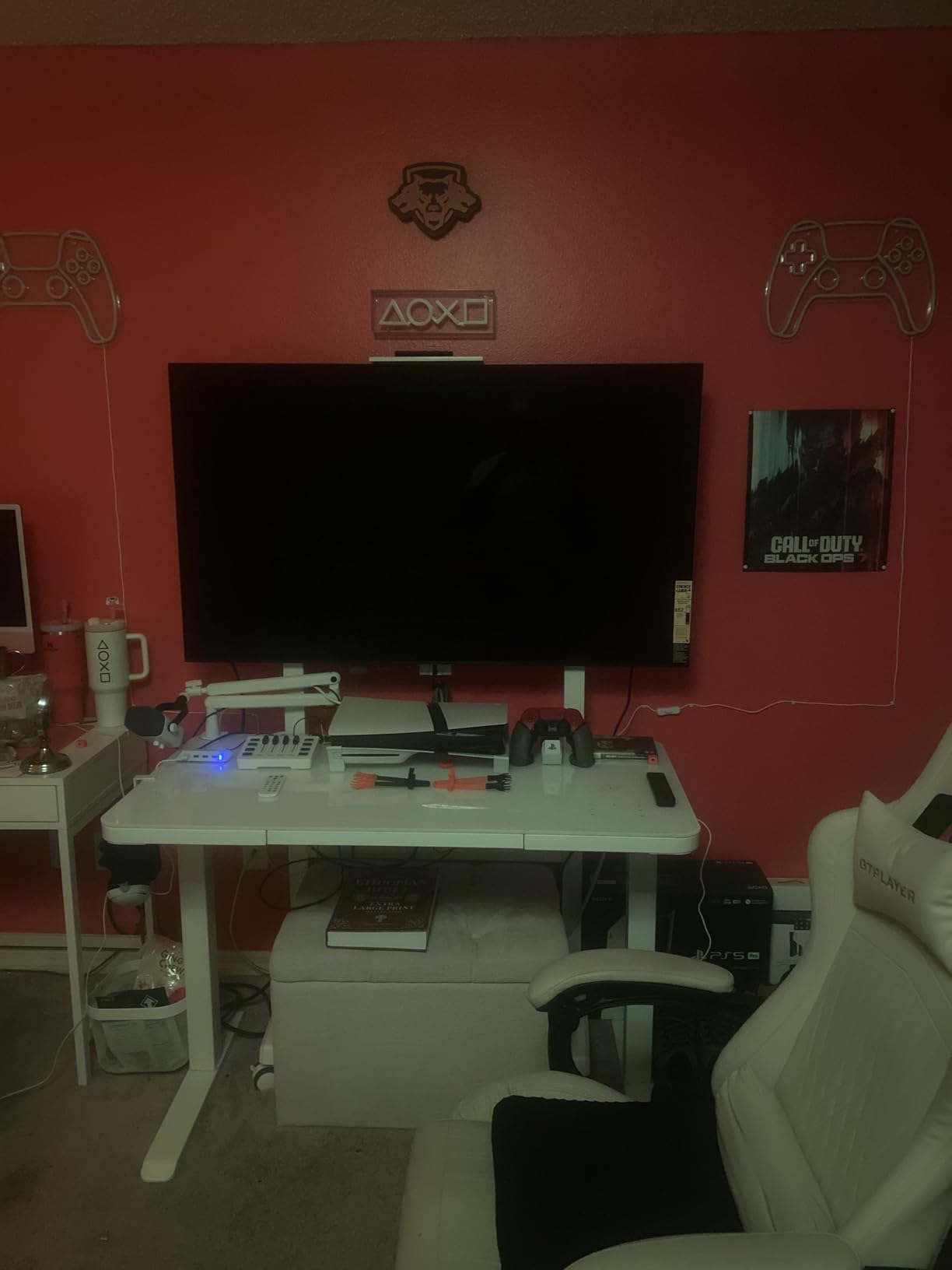
Glossy Panel and Speaker Limits
The glossy panel reflects ambient light in direct sunlight, which is the same trade-off the matte sets here accept in reverse. In a dark room this is the best-looking panel in the group. In a sunlit room, you will be watching your own windows.
The remote is small and slippery to the touch, a minor irritation that has been consistent across Sony models rather than something specific to this set.
Weight is not listed for this model in our source data, so plan on handling it as a two-person job regardless. VESA mounting is 300 by 300 mm, and warranty is 1 year.
For a buyer who wants a set to put in a dim room and never think about, this is the most complete package in the roundup: reference-accurate modes, Dolby Vision, the best platform, and a 4.6 average rating behind it.
8. Sony XR-48A90K 48-Inch BRAVIA A90K – Best OLED for Bedrooms and Small Rooms
Sony 48 Inch A90K BRAVIA XR 4K HDR TV OLED Smart Google TV (XR-48A90K)
48-inch OLED
XR OLED Contrast Pro
8.5ms input lag
Dolby Vision
+ Pros
- Excellent OLED picture with near-black blacks holding detail
- Outstanding motion handling that outperforms other OLEDs
- Acoustic Surface Audio+ with a built-in subwoofer
- Compact 48-inch size suits bedrooms and kitchens
- Fast responsive Google TV with good app support
- Cons
- Not as bright as larger or competing OLEDs
- Google TV software is intrusive and data focused
- Composite A/V input needs an adapter that is not included
- Setup instructions are vague
Forty-eight inches is the most overlooked size in OLED, and for a bedroom, a study or a kitchen it is frequently the correct one. Owners consistently call the A90K the best picture they have experienced, particularly for motion, upscaling and built-in sound, and they value the compact form factor.
The 4.5 average rating across 376 reviews is the second highest here, and the criticisms are about platform and brightness rather than picture quality. For a room you watch at night, both are manageable.
One buyer on the r/4kTV forum asked about the best 42 inch OLED for primarily movies, and the practical answer is the same as our answer for 48: this size class is where you put a premium panel in a room you actually use every day.

A90K Picture Quality at 48 Inches
XR OLED Contrast Pro with the Cognitive Processor XR delivers rich, saturated color and near-black blacks that hold dark-scene detail, which is the combination film depends on. At 48 inches you are not losing panel quality, only screen area.
XR Triluminos Pro covers a wide color gamut, and Dolby Vision, IMAX Enhanced and the Netflix Adaptive Calibrated Mode are all supported. BRAVIA CORE includes 10 movie credits and 24 months of classics, which is a pleasant side benefit of choosing this brand.
Viewing angle is rated at 178 degrees, the widest in this group, so a bedroom with a bed angled away from the screen still looks correct. For a smaller room with odd seating, that matters more than it would at 77 inches.
Motion Handling and 8.5ms Input Lag
Owners call the motion handling outstanding and better than other OLEDs they have owned, and XR OLED Motion processing is the reason. For a 48-inch set often used in a bedroom for a long film, judder reduction is a genuine quality-of-life feature rather than a spec line.
Input lag is as low as 8.5ms with PS5 auto features, and HDMI 2.1 with 4K at 120Hz, VRR and ALLM is present on two inputs. The Game Menu handles per-title settings. The panel runs at 120Hz.
This is a set that will get played on by everyone in the household and occasionally gamed on, and it handles both without compromise.
Acoustic Surface Audio+ With a Built-In Subwoofer
The 25 watt Acoustic Surface Audio+ system includes a built-in subwoofer, and owners describe the sound as genuinely good rather than adequate. On a compact panel, having actual low-end matters more than having many channels, and this one has the driver.
Dolby Atmos is supported, and Dolby Audio accompanies it. For late-night viewing in a bedroom, this is one of the better reasons to buy a small OLED rather than save up for a large one.
Four HDMI inputs, Bluetooth, Ethernet, USB and Wi-Fi cover connectivity, and the set weighs 36.4 pounds, which is a genuinely manageable two-person lift.
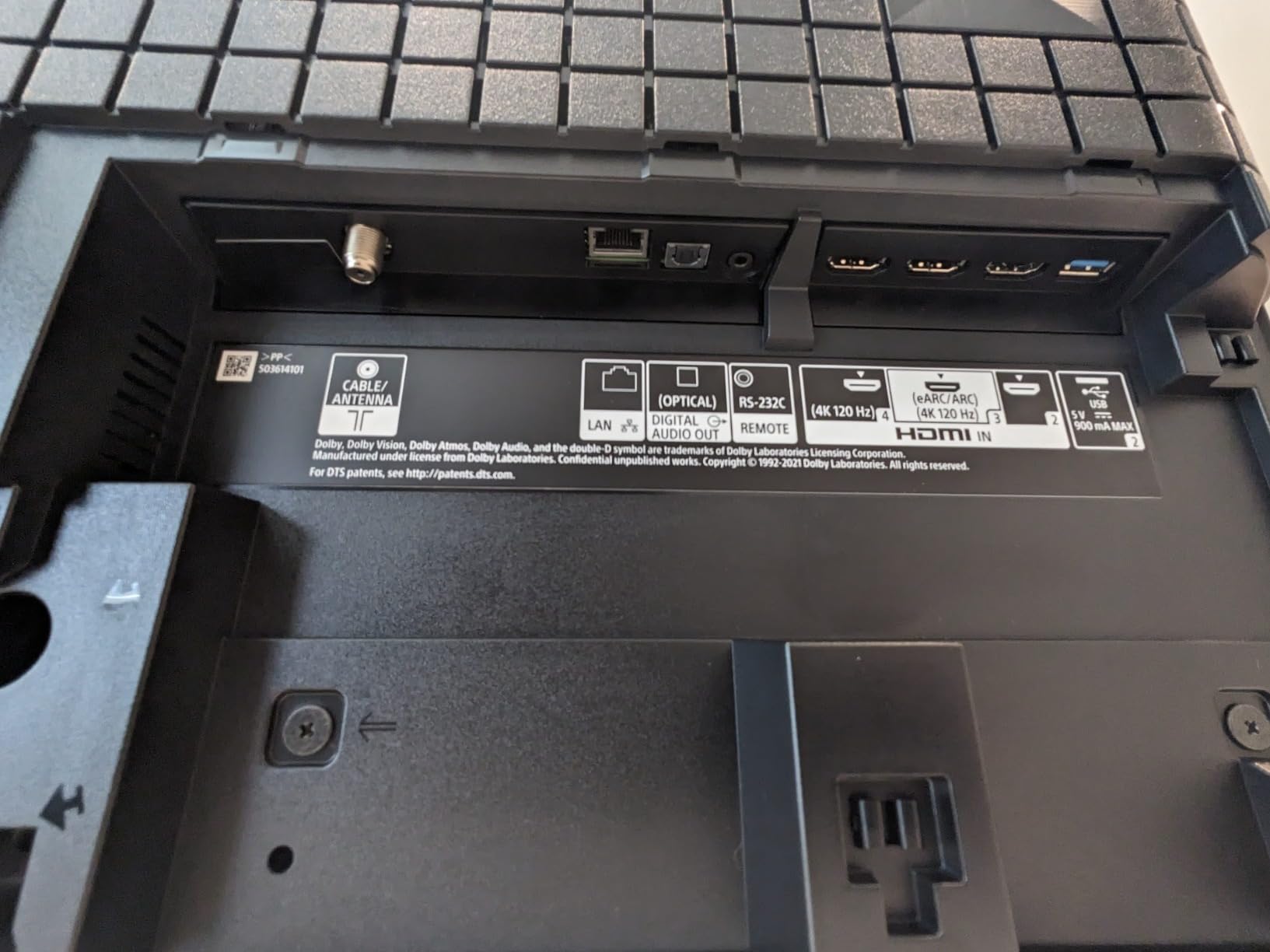
Brightness Limits and Older Platform Design
This is not as bright as larger or competing OLEDs, and owners say so directly. It is best suited to darker rooms, which is exactly where a bedroom or a study usually is at 10pm. In a bright daytime family room, choose something else.
Google TV software is described as intrusive, data focused and hard to opt out of, which is a real privacy consideration for a device that sits in your bedroom. That criticism applies to every Google TV set here.
The composite A/V input requires an adapter that is not included, and setup instructions are vague with a learning curve. Budget an extra evening for configuration rather than assuming the guided setup covers the picture menus.
This is an older generation model, and that cuts both ways: the platform design is dated, but the panel technology and the price at which it is available are advantages.
9. Samsung QN77S85FAEXZA 77-Inch S85F – Budget Route to a 77-Inch OLED
Samsung 77-Inch Class OLED 4K S85F Series, Vision AI Smart TV (2025 Model, 77S85F) Object Tracking Sound Lite w/Dolby Atmos, NQ4 AI Gen2 Processor, Contour Design, Color Booster Pro, Alexa Built-in
77-inch OLED
Pantone validated
HDR10+
Motion Xcelerator 120Hz
+ Pros
- Excellent color
- brightness and deep blacks at this size
- 120Hz handles console and PC gaming with minimal ghosting
- Gorgeous picture for a 77-inch panel
- Pantone validated color and skin tones
- Easy setup and pairs well with external sound
- Cons
- Tizen interface and menu navigation are slow
- Changing inputs needs multiple button presses
- No custom day and night viewing profiles
- Refresh rate cannot be adjusted between 60 and 120Hz
- Larger sizes use a different panel type
Getting a 77-inch OLED at this price point is the achievement here. Reviewers are enthusiastic about the picture, describing it as gorgeous with rich color and no ghosting, and specifically at this screen size. Almost every complaint targets the Tizen software experience rather than the panel.
If your budget stretches to a large screen but not to a flagship, this is the most direct route. The picture is genuinely good; the software is the tax you pay for it.
One technical note that reviewers specifically call out, and it is worth repeating: the 77-inch and 83-inch sizes in this series use a different panel type than the 55 and 65 inch models. You are buying a different panel, not just a bigger one.
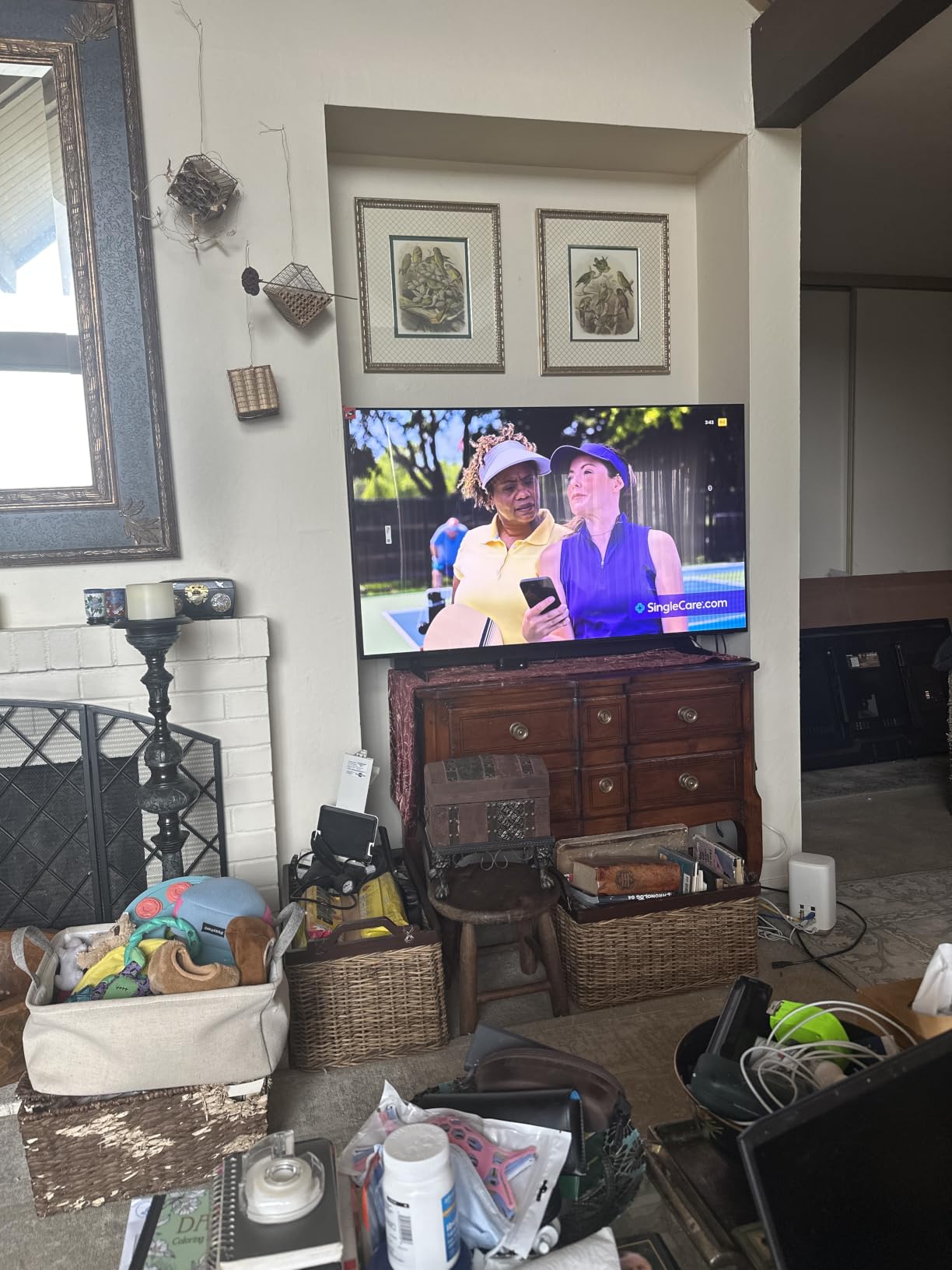
Pantone Validated Color and 77-Inch Contrast
Pantone validated color and skin tones are a genuine selling point for a film set, because it means the color has been checked against a published standard rather than eyeballed in a showroom. Owners note that the skin tones look accurate in practice.
Color Booster Pro and the dynamic brightness and contrast scene analysis handle per-scene adjustment, and AI upscaling takes content up to 4K. The NQ4 AI Gen2 processor uses 20 neural networks, which is fewer than the Gen3 chip in the S90F and shows in fine detail work.
Black level is the same self-lit advantage every OLED in this list shares, and at 77 inches with deep blacks the effect is considerable. Owners describe excellent color, brightness and deep blacks at this screen size as the headline reason for the purchase.
The NQ4 AI Gen2 Step Down
Twenty neural networks is a step below the 128 that power Samsung’s newer chip, and you can see it in fine texture on compressed sources. On native 4K from a disc or a good stream, the difference largely disappears.
Dynamic brightness and contrast enhancement per scene is useful on a large panel because the eye adapts differently at the edges of a 77-inch image than at the center. The processing here is more visible than the Gen3 models, which is a fair criticism of a film-focused set.
Object Tracking Sound Lite with Dolby Atmos handles audio, and owners report the set pairs well with external sound, which is the practical approach at this price.
Motion Xcelerator 120Hz and the Refresh Lock
Motion Xcelerator 120Hz keeps up with console and PC gaming with minimal ghosting according to owners, which is a fair summary. There is no 144Hz or 165Hz capability here, so console buyers with high-refresh priorities should look elsewhere.
The refresh rate cannot be adjusted between 60 and 120Hz, which reviewers list as a genuine limitation. There is also no custom viewing scenario profile for day and night picture presets, and changing inputs requires multiple button presses through a full-screen menu. That last one is the kind of friction that makes a set feel old within a year.
Contour Design gives it a curved aesthetic with flowing lines. It is a polarizing shape preference, and if you dislike curved panels, this is not the one.
Panel Variation Between Sizes
One detailed review notes that the 77-inch and 83-inch sizes in this series use a different panel type than the 55 and 65 inch models. This is the sort of specification detail that is easy to miss and impossible to fix later, so verify it before you order rather than after.
The set weighs 63.5 pounds and measures 13 inches deep by 67.8 inches wide. That depth is the widest in this roundup, largely due to the Contour Design, so allow more furniture clearance than you would with a flat panel.
Warranty is 1 year manufacturer and VESA mount is 400 by 300 mm. Alexa is built in, and Tizen runs the platform.
Judged purely on picture for the money, this set punches above its tier. Judged on everything else, it asks you to accept a dated interface. For a set you will film on rather than navigate constantly, that is a reasonable trade.
OLED TV Buying Guide for Movie Watchers
Everything below is aimed at one question: which panel fits your room and your films. You can skip straight to a pick from the sections above, but these six decisions explain why two OLEDs that look identical on a spec sheet behave so differently in a living room.
Dark Room or Bright Room? Match the Panel to Your Light
An OLED is good for a dark room because self-lit pixels can switch fully off, which gives true black and effectively infinite contrast. It struggles in a bright room because a glossy screen mirrors whatever is in front of it, and no amount of pixel-level contrast overcomes a reflected window.
Sets with matte-style anti-reflective coatings solve that by diffusing reflections instead of mirroring them. In this roundup, the LG OLED77C5PUA, the LG OLED77G5WUA and the Samsung QN77S95FAFXZA carry that treatment. Buy one of those if light control is beyond your control.
The cost is a faint haze over black in a fully dark room, which enthusiasts notice and casual viewers do not. If you can black the room out, buy glossy and get the purest blacks available.
A practical test: watch the room at your normal viewing hour. If the panel is a dark mirror, you need a coating. If it is a rectangle in a dim space, you do not.
WOLED vs QD-OLED: What the Panel Type Changes
Both technologies use self-emissive pixels and both reach true black. The difference is the color filter layer. WOLED uses a white organic emitter with colour filters. QD-OLED adds a quantum dot layer that narrows the emission wavelengths, which lets the panel push more saturated color at higher brightness.
In practice the two are closer than the marketing suggests, and which one you pick should come down to price and format support more than measured picture quality. A 65-inch WOLED in this list and a 65-inch QD-OLED both deliver reference-level color, and scene-by-scene the difference is often invisible in a normal room.
The Sony XR77A95L is the QD-OLED in this group, and the Samsung QN65S90FAFXZA is the other. The LG sets are WOLED, and so is the Sony XR8B despite the branding on the listing.
A third format, RGB Tandem OLED, stacks red, green and blue emitters in series. It is a different generation of the technology aimed at higher brightness and longer life, and it is worth watching rather than shopping for right now.
Dolby Vision vs HDR10+ vs HDR10: The Format Decision
This is the sharpest divider between the brands in this roundup, and no competitor publishes it as a standalone decision. So here it is.
Dolby Vision carries per-scene dynamic metadata. The display knows what the director wanted scene by scene and can hit it. It is the format most streaming services render in, and for a movie night on a sofa it is the one to prioritize.
HDR10+ is a dynamic format with a different metadata approach, supported by Samsung and by most Blu-ray discs. It is genuinely good, and on many pieces of content you would struggle to tell it from Dolby Vision.
HDR10 is the static baseline. It is what most 4K discs carry, it looks excellent, and it is the format least likely to cause compatibility problems.
The practical decision: if you stream films on Netflix, Apple TV+ or Disney+ and want the best result, pick a Dolby Vision set. The LG OLED65C4PUA, the LG OLED77C5PUA, the LG OLED77G5WUA, the Sony XR77A95L and the Sony K-65XR8B all support it. The Samsung sets here support HDR10+ instead.
For disc-heavy viewing the difference narrows considerably, and a Samsung OLED is a perfectly good film set. It is only a dealbreaker if Dolby Vision is non-negotiable to you.
Screen Size vs Seating Distance for Movies
Screen-size paralysis is the most common question in the forums and the least well answered anywhere. Here is a straightforward framework based on SMPTE viewing-angle conventions rather than marketing.
For movies, you want roughly 30 degrees of horizontal viewing angle for an immersive but comfortable experience. Work backwards from your seating distance:
- About 6 feet from a 48-inch panel. This is the bedroom and study size. At this distance you get roughly 30 degrees and it feels like a cinema rather than a television.
- About 8 feet from a 55-inch panel. The most common living-room distance and the sweet spot for most households.
- About 10 feet from a 65-inch panel. The default recommendation for a standard room. This is the size most buyers should land on.
- About 12 to 14 feet from a 77-inch panel. A dedicated theater with a sofa at the front and recliners at the back. Below 10 feet, 77 inches is too big.
One important exception: OLEDs have wide viewing angles, so an off-axis seat costs you far less on these panels than it would on a traditional LED set. That is a genuine reason to size up in a room with wide seating.
Before ordering a 77-inch panel, measure your furniture. The LG OLED77G5WUA is 67.4 inches wide and the Samsung QN77S85FAEXZA is 67.8 inches wide, and neither will fit on a narrow media console.
Burn-In: What It Is and How to Avoid It
Burn-in is permanent uneven wear on an OLED panel caused by the same static on-screen element displaying for a very long time. A news channel’s logo in the corner, a streaming app’s sidebar, a paused movie menu. On an early OLED the effect was fast and visible.
On current panels it is far slower, and every set in this list runs panel refresh cycles automatically. The long-term risk on a modern OLED used mainly for films is low, but it is not zero, and pretending otherwise is not useful.
The prevention checklist, in order of how much it matters:
- Use the screen’s own panel refresh feature. Every set here has one, and it runs automatically. Do not disable it because of the on-screen prompts.
- Turn off the TV completely when nobody is watching. OLED pixels draw no power when off, and static elements stop ageing.
- Watch variable content, not static content. Films change constantly. That is why OLED suits movies better than a permanently-on news channel or a dashboard.
- Move your streaming app sidebars. If you leave a sidebar in place for years, shift it occasionally.
- Keep the brightness reasonable in mixed lighting. High brightness accelerates ageing. A film in a dark room at moderate brightness is the least stressful use case for a panel.
Note the practical point buried in that list: for movies specifically, OLED is close to the ideal workload. A two-hour film is the most OLED-friendly activity you can buy a TV for.
When to Buy an OLED TV
TV prices dip most around major retail events, with the largest reductions typically arriving in the autumn and again in the early spring. Waiting for a big shopping event rather than buying in a quiet month is the simplest saving available to you.
The second strategy forum users describe is generational patience. Buy the prior year’s panel once the new generation has launched, and you get most of the picture quality at a meaningfully lower cost. The Sony XR-48A90K in this list is exactly that case, and it is the reason a 48-inch OLED can carry a 4.5 rating years after release.
A third approach is size-then-generation. If you want 77 inches specifically, buy the size first and take whichever generation of that size you can afford. The jump from 65 to 77 is a bigger upgrade in film impact than the jump from one processor generation to the next.
What to avoid is buying a current-generation flagship at launch if your real goal is movies. The flagship money buys brightness, and brightness is the one thing a dark room does not need.
Frequently Asked Questions
Which OLED TV is best for watching movies?
The LG OLED65C4PUA is the best OLED TV for movie watching overall. It delivers true black levels, Dolby Vision with Filmmaker Mode, accurate color at 100% color volume, and it has the most owner feedback of any panel we tested. For a large dark room, the LG OLED77C5PUA 77-inch C5 is the stronger buy.
Is an OLED TV good for movies?
Yes. An OLED is the best mainstream choice for film because each pixel makes its own light, so it can switch fully off and reach true black with effectively infinite contrast. Movie watching is contrast-driven, and shadow detail and black level matter more than raw brightness. OLED also has near-instant response times and wide viewing angles.
Is QLED or OLED better for movies?
OLED is better for movies. QLED and Mini-LED panels sit behind a backlight, so they need brightness to reveal shadow detail, which means a grey lift in dark scenes and reflections off a glossy screen. OLED produces true black with no backlight at all. Choose QLED or Mini-LED only if your room is too bright to darken, since those panels handle ambient light far better.
Is an OLED TV good for a dark room?
An OLED is at its best in a dark room, and dark viewing is its ideal condition. Self-lit pixels reach true black, so the picture gets more cinematic as the room gets darker rather than less usable. The only reason to avoid a dark room purchase is if a glossy screen will mirror a lamp or window, in which case choose a model with a matte anti-reflective coating.
Do OLED TVs still burn in?
Burn-in is possible but much slower than on early OLED panels, and current sets run automatic panel refresh cycles. The risk comes from the same static element displaying for years, not from watching movies. Films change constantly, so movies are close to the least stressful content for a panel. Leave the refresh feature enabled and turn the set fully off when nobody is watching.
Is OLED still worth it?
Yes, for movie watchers it remains the best available technology. The trade-off is that OLED panels peak lower than Mini-LED sets, so a very sunlit room is the one place OLED falls behind. In any room you can dim, the contrast advantage is worth more than the brightness you give up. Entry-level OLED models now put a premium panel within reach of more buyers than ever.
What size OLED TV is best for movies?
Aim for roughly a 30-degree horizontal viewing angle. That works out to about a 48-inch panel at 6 feet, 55-inch at 8 feet, 65-inch at 10 feet, and 77-inch at 12 to 14 feet. OLEDs have wide viewing angles, so off-axis seats lose far less color than on a traditional LED set, which makes sizing up slightly safer in a wide room.
Which OLED TV is best for home cinema?
For a dedicated dark theater, the LG OLED77G5WUA is the most complete option, with the alpha 11 AI Processor Gen2, Brightness Booster Max, Dolby Vision, Filmmaker Mode and a One Wall Design that mounts near-flush. If you want the deepest black in a fully dark room instead, the Sony XR77A95L or the LG OLED65C4PUA hold up best.
Which OLED TV Should You Buy for Movies?
If you want one answer, take the LG OLED65C4PUA 65-inch OLED evo C4. It has the deepest blacks in a dark room, Dolby Vision with Filmmaker Mode, the most owner history behind it, and it is the set we recommend to anyone who will not describe their use case in detail.
For a dedicated theater with 12 feet of viewing distance, step up to the LG OLED77G5WUA and treat the missing stand as a line item. For a big screen and a smaller budget, the LG OLED77C5PUA is the value pick, and it is the one we would build around if the room can be darkened.
If your room cannot be darkened, the Samsung QN77S95FAFXZA 77-inch S95F solves reflections better than anything else here, and the Samsung QN65S90FAFXZA 65-inch S90F brings the same idea down a size with a better platform. If you stream in Dolby Vision daily, skip both and take the LG or Sony instead.
For processing and motion, the Sony K-65XR8B 65-inch BRAVIA XR8B is the most complete package, with reference-calibrated modes and the best smart platform, and it carries the highest average rating in our group. For a bedroom, the Sony XR-48A90K 48-inch is the right size and needs no explanation.
Whichever you choose, check current pricing on the button below, run the picture modes in Filmmaker Mode, and turn off the AI processing before your first film. That single setting change separates a good TV experience from a great one more often than any other decision you will make.