
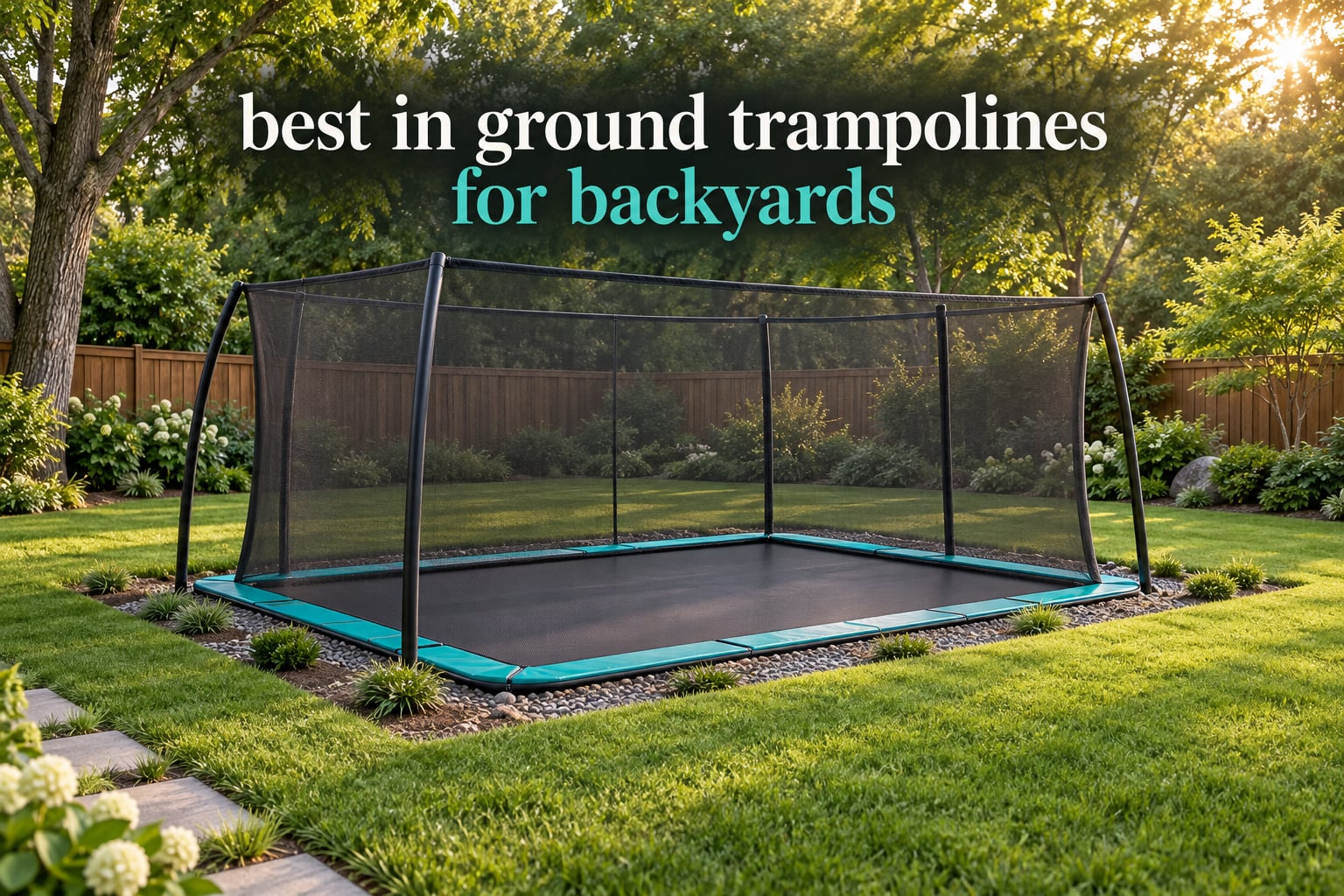
Most people picture a trampoline as a tall steel ring standing three feet above the lawn, taking up sightlines and swallowing a pile of soil every time it rains. An in-ground trampoline removes that object entirely. I have spent the last few months going through every in-ground kit I could get my hands on, reading owner build logs, and comparing frame gauge, mat weave, wall construction and airflow design side by side. This is the result: the best in ground trampolines for backyards in 2026, ranked on the things that actually decide whether you are happy with the pit five years from now.
Short answer: yes, in-ground trampolines are a good idea for most suburban backyards with a flat patch of ground, a working irrigation plan and a willingness to deal with excavation. They cut fall height to zero, keep your lawn open and continuous, and get a shrug from neighbors who object to above-ground structures. They also cost more, take far longer to install, and bounce badly when the pit is built wrong.
That last point is where most disappointed owners end up. A trampoline mat needs air to move beneath it, and a pit with no drainage, no retaining wall and no ventilation under the frame turns a great jumping surface into a stiff, flat, unpleasant pad. The installation section below explains how to build the pit so that does not happen to you.
I ranked these six kits on mat area, frame material, spring system, whether the retaining wall is included, ventilation design and warranty length rather than on the weight limit printed on the box. The listed capacity number is close to meaningless on its own, which I explain in the buying guide.
Our Top 3 In-Ground Trampolines for Backyards in 2026
Three kits stood out once the specs were laid next to each other. The Avyna leads on frame gauge, mat ventilation and warranty length. The BERG Champion comes with a safety enclosure already attached. The ANYTHING SPORTS rectangle gives you a rectangular jumping area at an entry-level outlay.
Avyna Premium In-Ground…
- 11-gauge hot-dip galvanized steel
- 70% more airflow vented mat
- 1750 lb frame rating
- Lifetime frame coverage
BERG Champion InGround 14ft
- Safety enclosure included
- TwinSpring gold springs
- Air flow mat
- Low 20cm step-on threshold

ANYTHING SPORTS Rectangular…
- Rectangular even spring tension
- Frame springs pads and anchors included
- Flush ladder-free access
- 1 year no-questions warranty
Comparing the Six Best In-Ground Trampolines for Backyards
Six distinct kits survived my screening. Everything below is a genuine in-ground unit designed to sit flush in an excavated pit, not an above-ground frame with ground anchors or a mini rebounder. Use the buttons to check current listings and confirm the details before you commit.
| Product | Details | |
|---|---|---|
| Avyna Premium In-Ground Trampoline |
|
Check Latest Price |
 Capital Play Inground Rectangle Kit Capital Play Inground Rectangle Kit |
|
Check Latest Price |
| BERG Champion InGround 14ft |
|
Check Latest Price |
| ANYTHING SPORTS Rectangular In-Ground Kit |
|
Check Latest Price |
 ANYTHING SPORTS Round In-Ground Trampoline ANYTHING SPORTS Round In-Ground Trampoline |
|
Check Latest Price |
 ExacMe No-Gap In-Ground Trampoline ExacMe No-Gap In-Ground Trampoline |
|
Check Latest Price |
1. Avyna Premium In-Ground Trampoline – Best Overall Fit for Family Backyards
Avyna Premium Round In-Ground Trampoline, 15, 14, 12 FT
11-gauge galvanized steel
96 springs
Rated to 1750 lb
Air X-TREAM vented mat
+ Pros
- Highest airflow mat in this lineup with up to 70% more ventilation
- 11-gauge hot-dip galvanized frame built for ground contact
- Lifetime frame coverage plus 10 year spring coverage
- Enclosure with lockable entrance and fully covered springs
- Cons
- Weighs 235 lb so placement needs two people
- Excavation and pit construction are on the buyer
Everything about this kit says it was engineered by people who thought about the actual failure modes of an in-ground unit. The frame is 11-gauge hot-dip galvanized steel rather than the lighter 12- or 14-gauge tubing you see on entry-level kits, and the manufacturer rates the assembled frame to 1,750 pounds. That is a structural number, not a user limit, and it is the one worth caring about.
It is one of only two products here with a vented mat that states its airflow gain numerically. Owners in the r/ingroundtrampoline community post finished Avyna installations and ask each other for brand validation, and the recurring answer is that the mat response is the reason people stay with them. I agree with that read after looking at the weave and the pad venting.
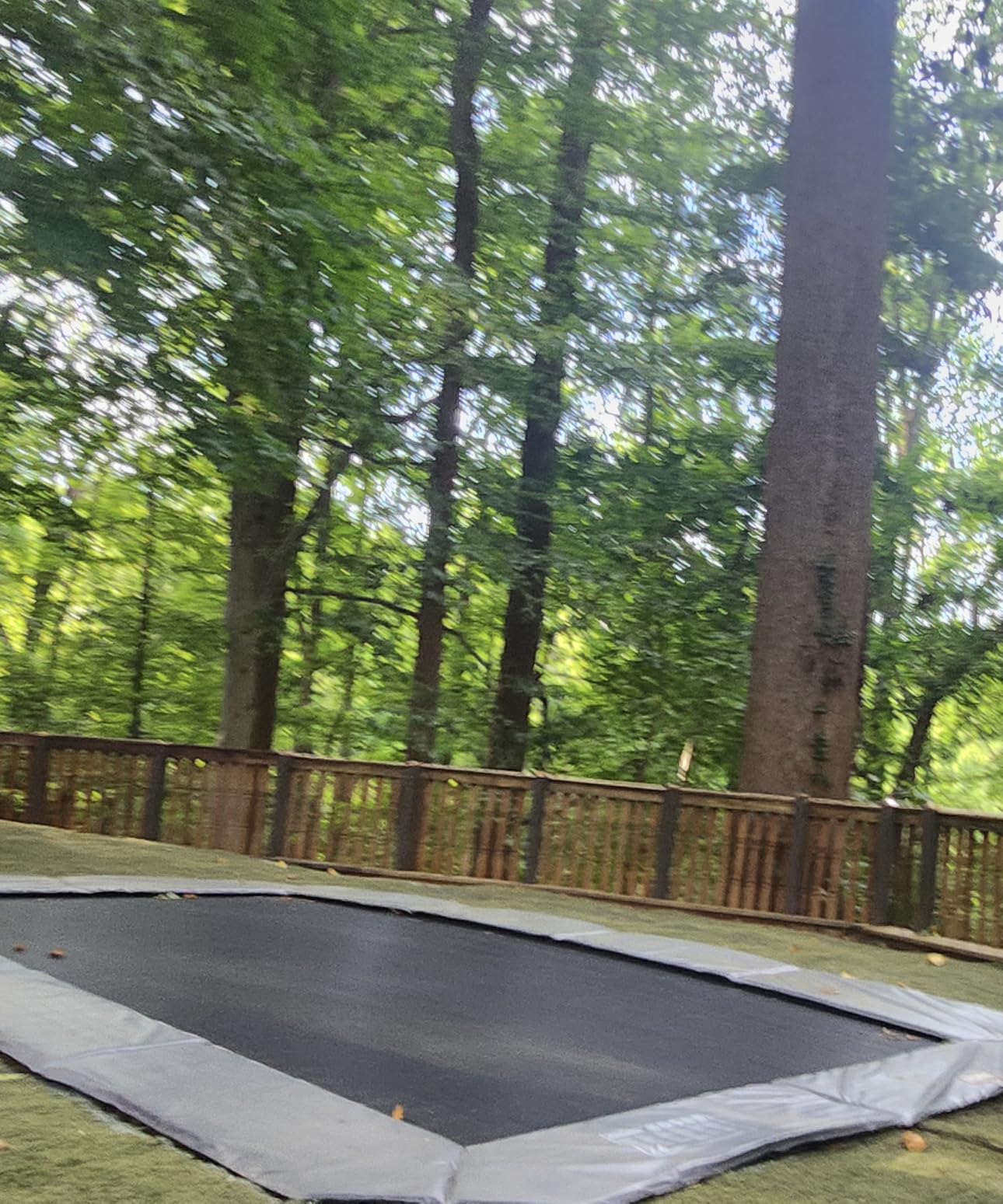
The Air X-TREAM Vented Mat and the Air Displacement Problem
A trampoline mat works by pushing air downward, and that air has to go somewhere. In an above-ground frame, it escapes sideways under the mat. In a pit, it hits the retaining wall, the gravel and the underside of the pad, and a poorly built pit develops a partial vacuum that makes the surface feel dead and stiff.
This is the single most repeated technical complaint in owner threads about in-ground trampolines, and it is the reason the Avyna mat matters more than its rivals’. The manufacturer claims up to 70% more airflow than a standard mat, and the vented pad channels that air out along the whole perimeter rather than trapping it in the corners.
The practical rule that follows: if you buy any kit without a vented mat, plan to spend on vented pads and a perimeter air channel, because that does the hard work for you. It changes bounce quality more than a heavier frame ever will.
11-Gauge Galvanized Steel and a 1750 Pound Frame Rating
Because the frame sits at or below grade, it lives in a wet environment that an above-ground frame mostly avoids. Hot-dip galvanizing is the coating that stands up to that. The 11-gauge wall thickness on this frame is meaningfully heavier than what most competing kits use, and the spec sheet lists 96 springs, which is a healthy count for the mat area.
The 1,750 pound figure is worth reading carefully. It is the load the frame structure is engineered to carry, not a permission to put 1,750 pounds of children on the mat. Treat it as a durability signal, and treat the actual safe jumping rule as one person at a time.
At 235 pounds the assembled unit is heavy, and reviewers consistently flag handling as the main friction point during install. My advice is to assemble nothing until the frame is already sitting in the pit. There is no way to lift this into place after the fact.
Layered Safety: Enclosure, UV Pad and Covered Springs
Safety is handled in three layers here. A weather-treated enclosure with a lockable entrance surrounds the jumping area. A thick UV-protected foam pad covers the frame edge. And the springs are fully covered so nothing metal is reachable from the mat.
The lockable entrance is a detail I did not expect to see and one that matters in a shared yard. It means a trampoline that sits in view of a street or a neighbor’s deck can be closed off when it is not in use, rather than sitting permanently open.
On a jump mat this size, a child who lands short has nowhere to fall except grass, which is the core safety argument for in-ground units. The enclosure adds a second barrier for the smaller children who bounce off the edge anyway.
Who It Suits and Where Owners Snag
This is the kit I would put in a family yard with multiple jumpers of mixed ages, on a flat area, with a build budget that covers a proper pit. The airflow design handles the stiff-bounce problem better than anything else on this list, and the frame specification is the strongest of the six.
Two things work against it. The mat is round, and round shapes use their area less efficiently than rectangles, so you get less usable jumping surface per square foot of pit. And the whole 235-pound assembly has to be positioned during install, which decides your excavation timeline more than any other single factor.
2. Capital Play Inground Rectangle Kit – Double-Frame Rigidity in a Compact Pit
Capital Play Inground Trampoline 11ft x 8ft Rectangle | High Jump Trampoline Unique Airflow Vented Pads | Heavy Duty Commercial Grade | Long Warranty | Enclosure Available. (Green Pads)
11ft x 8ft rectangle
2mm double-dip galvanized frame
Retaining wall included
80 springs
+ Pros
- Retaining wall comes in the box
- removing the hardest part of the build
- Double-frame construction resists movement in the ground
- Minimal soil disposal cuts excavation volume
- Vented TDU pads and a commercial grade mat
- Cons
- Listed user weight of 220 lb is the lowest here
- Enclosure not included and must be added separately
- One detailed review questions the materials-to-price ratio
This is the kit that treats a trampoline as a piece of civil engineering rather than a toy, and the two decisions that define it are the double frame and the included retaining wall. At 11 by 8 feet it is a compact rectangular mat, which is exactly why it fits the small suburban yards most people actually have.
Owners in the r/ingroundtrampoline community ask directly whether a simpler kit is worth it before committing, and Capital Play comes up in those discussions as a middle answer: more structure than the entry kits, less of a step up than the premium brands.
Double-Frame Steel and Minimal Soil Disposal
The frame is 2mm-thick, double-dip galvanized steel tubing measuring 42mm in diameter, built on a twin-frame system where the perimeter is doubled up. In the ground, that extra structure resists the lateral movement that comes from wet soil pushing against the wall through freeze and thaw cycles.
The design brief also calls for minimal soil disposal, and that has real consequences for the install. A pit that needs a skip or two hauled away costs more and takes longer than one where the spoil can go onto the lawn beside it. Owners who have done this build call that out as a genuine time saver.
80 springs across the perimeter on a rectangular layout give even tension across the whole jumping surface, which matters more for anyone attempting flips, twists or repeated landings in the same spot.
The Retaining Wall Comes in the Box
This is the feature that sets the Capital Play kit apart from the rest of this list. The included components list names the trampoline, jump mat, springs, retaining wall and safety pads. You are not sourcing wall material separately and hoping it lines up with the frame’s bolt pattern.
For a first-time in-ground buyer, that removes a leading reason builds stall. Nearly every owner thread about installation mistakes centers on wall height, wall collapse or soil not being packed properly behind the wall. A supplied wall matched to the frame removes that whole category of failure.
It does not remove drainage. You still need a gravel base and a way for water to leave the pit, and the wall only works if the soil behind it is compacted in lifts as you backfill.
The 220 Pound Limit Needs Real Context
The 220 pound limit sits far below the Avyna figure, and that gap will make buyers nervous. It is also the least meaningful spec on the page, and treating it as a disqualifier is a mistake.
What a weight rating tells you is that the manufacturer built the mat, springs and frame for a use pattern. What actually determines whether a trampoline is safe is how many people are on it at once, and how the mat behaves at the edges. A 220 pound rating is not a claim that a 300 pound adult will be injured. It is a sizing decision about springs and mat weave.
Judge the frame on steel gauge, the wall on whether it is included, and the mat on airflow. Ignore the headline number until you have the other three.
The Enclosure Is an Add-On Here
The kit includes vented TDU safety pads but no net. The manufacturer sells an enclosure separately, which is a real cost and a real decision point. If the trampoline will sit in view of a neighbor’s deck or a play structure, budget for the enclosure at the time of purchase rather than assuming one is included.
For a family with a child under five, I would not skip it. Zero fall height protects a jumper who lands short, but the half-on, half-off landing onto the mat edge is a different hazard.
3. BERG Champion InGround 14ft – The Pick When the Enclosure Comes Standard
BERG Champion InGround 14ft Trampoline with Safety Net, Trampoline for Kids, High Performance & Safety Features, Jump Higher with Airflow
14ft round
96 TwinSpring gold springs
Safety net included
20cm step-on threshold
+ Pros
- Full safety enclosure included in the box
- Air flow mat claims 50% more breathability than standard mats
- Low 20cm threshold makes stepping on safe for kids
- 10 year warranty extends to 13 years on registration
- Cons
- Heaviest listed weight at 394.4 lb
- Installation requires drilling a hole underneath before placement
- 330 lb user limit is lower than the Avyna rating
- Arrives by freight so placement must be planned around it
The BERG Champion pairs a 14 foot round pit with a complete safety net enclosure, a low step-on threshold and a 10 year warranty. For a household with young children, the included enclosure is worth more to you than every other spec on this page. The cost of that convenience is a 3.9-star average, the lowest of the six, and the reason is handling rather than the product itself.
At 394.4 pounds, the heaviest listed weight in this group by a wide margin, this kit also arrives by freight carrier. Plan the manpower before the pit is finished.
A 14 Foot Round Pit With the Net Already Included
Round, 14 feet, alloy steel frame, 96 springs. The enclosure wraps the full perimeter and has its own entry point, so a family with a five-year-old does not have to solve that problem separately. That is the case for this kit in one sentence.
For adults using it for fitness, the enclosure is less relevant and the handling is more relevant. Four hundred pounds of trampoline means the pit has to be finished before the unit arrives, and you need equipment or several people to place it.
The low 20cm step-on threshold is a quiet but real design win. Flush trampolines often sit slightly below grade, and a taller lip is exactly what causes a child to catch a foot and fall awkwardly. A shallow threshold means stepping on and off is close to a normal step.
TwinSpring Gold Springs and the Air Flow Mat
BERG uses TwinSpring gold springs, 96 of them on this 14-foot round. Twin-spring systems use two shorter springs per anchor point rather than one long spring, which spreads the load and reduces the harsh initial tension you feel in the first half of the bounce.
The air flow jumping mat is claimed to offer 50% more breathability than a standard mat, which puts it behind the Avyna’s 70% figure but comfortably ahead of a conventional solid-weave mat. Given that stiffness is the top complaint about in-ground units, the mat is doing real work here.
Spring choice also affects maintenance. A sprung design needs periodic spring tension checks as the mat stretches, and the springs are a consumable part of the system no matter how good they are at the start.
394 Pounds of Handling and a Drilling Step
The installation notes say the trampoline requires drilling a hole underneath before placement. That step exists so the drainage path under the frame is created rather than sealed, and it is a good sign that the manufacturer expects the pit to be built properly.
Getting 394.4 pounds into a pit at grade level is the harder problem. This is not a job for one person with a wheelbarrow, and it is not a job to attempt on a day when the soil is wet. Plan the excavation so the frame goes in on the day it arrives, with the pit finished and shored.
Owners also report the freight handling as a friction point. You will need people available when the unit is delivered, and the driver needs to be able to reach the yard with the equipment.
Why the 3.9 Star Average Splits Owners
The reviews praise the enclosure, the threshold and the mat while complaining about weight, installation demands and delivery. That is a consistent pattern, and it tells you the product itself is doing what it claims. The rating reflects the purchase experience, not a failure of the trampoline.
The 330 pound user limit is the other divider. It sits well below the 1,750 pound figure on the Avyna, and the gap between the two numbers is a good illustration of how inconsistent this spec is across brands. As I noted earlier, it says far less about real-world safety than the frame and mat do.
My verdict: if the enclosure is what you need most and you have the manpower to place the unit, this is the sensible choice. If the install logistics are already your weak point, pick something lighter.
4. ANYTHING SPORTS Rectangular In-Ground Kit – A Rectangular Mat at an Entry-Level Outlay
Rectangular In-Ground Trampoline – Heavy-Duty Flush-to-Ground Outdoor Jumping Mat, Safety Padding & Easy Install Kit | Ideal for Kids, Families & Athletes | 7×10 Without Enclosure
10ft rectangular
Galvanized steel frame
Frame springs pads and anchors
50 kg shipping weight
+ Pros
- Rectangular layout delivers even tension and more usable mat than a round
- Kit includes frame springs padding and ground anchors
- Flush access means no ladder for children
- Owners report quieter bouncing than spring-heavy models
- Cons
- 1 year no-questions-asked warranty is the shortest here
- Pit excavation and soil preparation are entirely on the buyer
- Mat picks up dirt quickly after mowing
This is the shape argument in one product. A rectangle gives you more usable jumping area than a round of comparable footprint, and it distributes spring tension evenly instead of pulling harder at the perimeter where the geometry concentrates load.
Owners consistently describe it as heavier and more stable than the above-ground unit it replaced, and quieter in operation thanks to the spring cover. Those two attributes, stability and noise, are what people notice most in the first weeks of ownership.
Why a Rectangle Wins on Mat Area and Spring Tension
Round trampolines waste usable area. A jumper near the edge of a round mat travels a longer path back to the center and can slide off the usable zone, so part of the surface is decorative. A rectangle has a consistent usable width across its whole length, and near-constant tension from the springs.
For cardio, flips and repeated footwork, that consistency is the difference between a mat that trains you and a mat you work around. For a family where several people take turns, the larger effective area reduces collisions and off-the-edge landings.
The listing describes the rectangular shape as delivering controlled bounce and even spring tension, and that is exactly the property that separates a well-built rectangle from a weak one. Poorly built rectangular units have weak corner springs and a mat that dips diagonally.
What the Kit Includes and What You Still Have to Dig
The included components are the support frame, springs, jumping mat, safety padding and ground anchors. That is a complete jump surface. What is not included is the entire surrounding structure: the excavation, the retaining wall, the gravel base, the drainage and the backfill.
That distinction matters more than any spec. The least expensive in-ground kit on this list is only a sensible buy if you already have a pit. If you need wall material and a gravel delivery, the total job is what you are actually budgeting for.
Soil preparation is explicitly called out as required, which is a good sign. Soil that is loose around a frame will let the frame settle out of level within a season, and a frame out of level means a mat that pulls to one side.
The One-Year Warranty Is the Weak Spot
Every other kit here carries a frame warranty of at least five years, and two carry ten years or lifetime frame coverage. A one-year no-questions-asked parts warranty on a product that goes into the ground, where corrosion and mat wear are near-certain over a decade, is the single biggest gap between this kit and the premium options.
That is not a reason to skip it. It is a reason to photograph and record every part at install, keep the original packaging, and expect to replace the springs and possibly the mat once over its life rather than twice.
Support is based in Charlotte, NC, which matters mainly for replacement parts. Know that going in.
Quiet Bouncing and the Mat Dirt Cycle
The spring cover is the reason owners call this unit quiet compared with louder spring-fed models. On an in-ground trampoline, a mat plus a pad is a wide flat surface sitting near grade, so sound carries into the house. Anything that dampens the springs pays off.
The recurring maintenance complaint is dirt. Reviewers report the mat picks up debris quickly after mowing and needs a leaf blower to clean. This is normal for a flush unit with no enclosure, and it is a five-minute job, but it is a weekly-ish task during season.
Children can step on and off without a ladder, which is the single biggest usability gain over an above-ground frame. Flush access removes the climb, and the climb is where most small-child falls on above-ground trampolines actually happen.
5. ANYTHING SPORTS Round In-Ground Trampoline – A Clean Flush Look for Small Yards
ANYTHING SPORTS Premium Round In-Ground Trampoline, 12FT and 14FT Diameters (14 FT Without Enclosure)
Round flush mount
Galvanized steel frame
UV resistant mat
Frame springs pads anchors
+ Pros
- Round geometry funnels jumpers back toward the center
- Rust resistant galvanized frame and reinforced springs
- UV resistant mat with thick edge padding
- No ladder needed and no sightline impact
- Cons
- Less usable jumping area than the rectangular version
- 1 year parts warranty only
- Excavation and soil preparation are on the buyer
This is the same kit as the previous pick with the geometry swapped, and that is not a criticism. In a compact yard, a round pit fits a walkway around it far more easily than a rectangle of the same width, and the way a circle reads in a lawn is calmer than a rectangle cut into the same space.
Owners highlight the clean flush appearance and the way the design keeps a beginner’s landings near the center. For a household where most jumpers are not yet doing flips, that is a genuine safety and confidence benefit rather than a compromise.
Round Geometry Keeps Jumpers Centered
A circular mat creates a natural inward pull. Combined with the fact that a child bouncing off-center on a round mat will land back toward the middle rather than continuing outward, it reduces the off-the-edge scenario that rectangular units produce at the corners.
The trade is that this inward pull is only a benefit for jumpers who are not trying to do directional work. Athletes and adults doing cardio want a rectangle, where they can use the full width and the corners without fighting the shape.
Available in multiple diameters, so the same platform can be sized to whatever the pit will allow. That flexibility is more useful than it sounds, because available ground area is usually the constraint that decides the whole project.
The Same Kit With a Different Shape
Frame material is galvanized steel with reinforced springs, the mat is UV resistant, and the edge padding is thick. The install kit again includes the frame, springs, safety padding and ground anchors. Warranty is the same one-year no-questions-asked coverage.
Sharing the platform means sharing its strengths and its weak points. The good news is the build is straightforward and the parts list is complete for a jump surface. The bad news is the same short warranty, and the same requirement to build the surrounding pit structure yourself.
At 50 kg listed shipping weight, this is a lighter unit to place than the two kits above it, and that matters if the frame has to go into a pit on the day it arrives.
Where a Round Pit Costs You Jumping Area
Compare a round and a rectangle of similar footprint and the rectangle gives you more usable jumping surface, because the circle’s corners are not usable and the circle’s perimeter overshoots. That difference grows with size, and it is the argument for choosing rectangular.
The correct way to think about it is jumps per square foot. If your household will do directional movement, flips, or a jump workout, you want area. If your household is small children bouncing recreationally, a round pit at a smaller footprint is the better use of the yard you have.
A round pit also has one practical advantage: it is harder to walk into accidentally. Straight edges invite a trip; a flush circle reads as an object, not a route.
The Budget Reality Check
This and the rectangular version sit at the entry end of the kits that come with a complete jump surface, and they are the reason this roundup includes two kits from the same brand.
What you give up at that end of the range is warranty length, retaining wall inclusion and any included enclosure. What you get is a complete jump surface, flush access and a shape that fits a modest yard.
Owners who install these report that the recurring work is mat cleaning and keeping grass off the frame edge, not repairs. At an entry-level outlay that is a tradeoff most yards can absorb.
6. ExacMe No-Gap In-Ground Trampoline – The Safety-First Enclosure Design
ExacMe No-Gap In-Ground Trampoline for Kids, 14 12 10 8FT with Safety Enclosure Net, Round Outdoor Heavy-Duty Round Backyard Trampoline for Family Fun (14FT)
Round in-ground kit
No-gap spring perimeter
Zipperless overlap entry
5 year frame warranty
+ Pros
- No-gap design removes the gap where feet get pinched between mat and frame
- Zipperless self-closing entry cannot be propped open
- Fiberglass net resists sagging and rust
- ASTM and CPC certified with a 5 year frame warranty
- Cons
- No customer reviews yet so durability is unverified
- 300 lb user limit
- Large 192 inch footprint means a bigger excavation
Most trampoline enclosures are nets hung from poles, and nets are only as good as the gap between the mat edge and the net. This kit is built around closing that gap. The no-gap design eliminates the space between the mat and the frame where small feet get caught, which is one of the more common mechanisms behind spring-related injuries on any trampoline.
It is also the only kit here with no owner history at all, so read this section as an assessment of the design and the certification rather than of long-term experience. That is an honest limitation, not a disqualification.
The No-Gap Perimeter and Why It Matters
A common way a child injures a foot on a trampoline is landing with toes pointing down near the perimeter, where a spring or the gap beside a spring is reachable. Enclosures reduce the chance of falling out; no-gap frames reduce the chance of a toe reaching anything.
That is why this design is worth considering even for buyers who do not have small children. A perimeter with no exposed gap is a permanent structural mitigation, not a supervision rule you have to remember.
Support structure is 360-degree multi-point with reinforced vertical struts, which is what keeps the perimeter geometry square and true over time in a pit where soil pressure changes seasonally.
Zipperless Entry and a Fiberglass Net
The entry is a zipperless, self-closing overlap. That solves a specific failure: an enclosure flap propped open. Every owner eventually forgets to secure an enclosure with a zipper, and the overlap design closes itself.
The net itself is high-strength fiberglass, which resists the sagging and shape loss that causes many nets to lose enclosure coverage after a couple of seasons. Steel net poles in a below-grade frame also corrode, and fiberglass does not.
Everything in the enclosure is rust-proof, which matters in a pit. The listing also notes a shifting teal finish, a cosmetic detail that will fade over a few seasons in full sun.
Certifications and a 5 Year Frame Warranty
The kit is listed as ASTM and U.S. CPC certified, with a five year manufacturer warranty on the frame. That warranty length puts it ahead of the one-year entry kits and behind the ten-year and lifetime frame coverage on the premium options.
The included components list a ladder, the trampoline, spring tools and anchors. So enclosure hardware comes with the kit, and you get the tools needed to stretch the springs.
Available in 14, 12 and 10 foot sizes, with a 192 inch listed dimension on this frame size. The user weight recommendation is 300 pounds, which is mid-range in this group.
No Owner History Yet
This listing has no customer reviews posted, so there is no owner evidence on how the frame holds up over a few winters. Everything I have said about it comes from the listed specifications.
That absence is not unusual for a newer in-ground design, and certifications plus a five year frame warranty are meaningful substitutes. But if you are risk-averse, the honest comparison is that four of the other five kits here have real owner reports, and one of those is rated well above this one.
Given the safety-focused perimeter and the included enclosure, this is a reasonable pick for a family that puts a hard boundary on net coverage. Everything else about it, I would want a season of data on first.
Are In-Ground Trampolines a Good Idea? In-Ground vs Above-Ground
The honest answer is that an in-ground trampoline trades money and installation effort for aesthetics, fall height and yard space. Whether that trade is worth it depends almost entirely on how much flat ground you have and how willing you are to have a pit dug.
Where In-Ground Wins
Fall height is the big one. An above-ground trampoline puts the mat roughly three feet off the ground, so a missed bounce means landing on grass from that height. In a flush unit, that same missed bounce lands at ground level, and the surrounding lawn is the landing surface.
Beyond safety, an in-ground unit gives the visual space back. No ring blocks a view, no ladder sticks up, and the lawn reads as continuous lawn. For a yard that is also used for entertaining, that is a real quality-of-life difference that no amount of planting around an above-ground frame fully recovers.
It also removes the objections that neighborhood associations usually raise. Height and sightline complaints are the standard complaints about above-ground units, and a flush mat removes both.
Where Above-Ground Wins
Installation. An above-ground frame is a two-hour job on a Saturday. A proper in-ground pit is excavation, wall construction, drainage, gravel, backfill in lifts and then assembly, and a beginner can get it wrong in ways that only show up a year later.
Cost is the second above-ground win. Even a well-built above-ground unit costs far less than a mid-tier in-ground kit once labor and wall material are counted.
That is worth understanding before you spend. An in-ground pit is a permanent alteration to your yard. If you rent, or you may move within five years, it does not make sense to dig one.
The Bounce Physics Almost Nobody Explains
Owners say in-ground trampolines bounce better than above-ground ones, and that is correct in one specific sense. The mat is at grade, so the jumper’s body is at grade, and the air column beneath the mat has the full frame depth plus the pit volume to move into. Above-ground, the underside of the mat has a much smaller space, so the mat works against a firmer barrier and loses energy.
The failure mode is the opposite case. In a pit with a sealed floor, poor drainage and non-vented pads, that same trapped air has nowhere to go. It builds pressure under the mat, the mat stops responding, and the surface feels like it is pulling against you. Every owner thread about a disappointing in-ground bounce is describing this.
Three fixes, in order of impact: a vented jump mat, vented perimeter pads, and an open gravel base under the frame that lets air move across the whole pit floor. Get all three and the pit will bounce like the owners describe.
In-Ground Trampoline Installation: Pit Depth, Retaining Wall and Drainage
Installation is where in-ground projects succeed or fail, and it is the section most roundups skip. A badly built pit does not fail loudly. It just feels wrong for years, and the fix means tearing the whole thing out.
Step 1: Excavate to the Right Pit Depth and Shape
Dig the pit slightly larger than the frame footprint. The frame itself needs clearance, and the mat edge plus padding needs a landing zone. The common mistake is excavating to the exact frame size, which leaves no room to set the frame level and no room to work around it.
Depth should place the frame top roughly flush with finished grade, with the mat sitting at or just above lawn level. If you set the mat too low, jumpers land in a tray. Too high, and you have rebuilt an above-ground frame.
Rectangular pits are less forgiving here than round ones, because a rectangle has four corners that must all line up or the mat pulls diagonally. Owners who build say the most useful trick is digging in stages and checking the frame footprint at each stage, so you catch a misaligned corner before the wall goes up.
Step 2: Build the Retaining Wall
The wall holds the surrounding soil back. Without it, soil pressure pushes inward and the frame distorts, and the mat develops a diagonal tension that feels wrong underfoot and eventually damages the springs and mat stitching.
The Capital Play kit here includes a wall matched to the frame. For everything else, you are supplying your own: treated timber, stacked masonry block or a poured concrete ring, depending on how permanent you want the structure to be.
Wall height equals the depth of soil you are holding back, plus enough to sit at finished grade with a lip. That lip is what protects jumpers who land just off the mat, so do not bury the wall flush and leave nothing.
Step 3: Add a Gravel Base and a French Drain
Two components solve it. A compacted gravel base under the frame gives water somewhere to go and gives the pit a stable floor. A French drain running to daylight, or to a dry well, gives it an exit.
Water under the mat is its own problem too. A pit that holds water adds load to the springs and the frame, and the mat behaves differently cold and wet. A gravel floor that drains solves both.
This is a step owners frequently skip, and it is also the step that determines whether your mat and frame last a decade or a few seasons. Check your local water table before you start, because a high water table changes the design.
Step 4: Leave Airflow and Assemble the Kit
Whatever kit you buy, budget for a vented mat or vented pads. That decision shapes the bounce, and it costs far less than replacing a frame.
Assemble the unit in the pit, not beside it. Every product reviewed here is heavy, and the heaviest listed weight is close to 400 pounds. There is no second chance to slide a frame into a finished hole.
Backfill in compacted lifts. Soil dropped loose around a frame settles unevenly over a season, and the frame tips, and the mat pulls.
DIY or Contractor
DIY is entirely reasonable on a flat yard with easy soil. Rectangular pits in rocky or sloped ground are the case where people hire a contractor, and that is not a failure, it is the point where the labor cost stops being less than the materials cost.
The crossover is straightforward: the moment excavation, hauling spoil or wall construction looks like more than a weekend, get quotes. The regret reported in owner threads is not usually about the trampoline. It is about the pit.
How to Choose an In-Ground Trampoline for Your Backyard
Shape First: Round vs Rectangle
Buy a rectangle for jumping area, cardio, flips and anything directional. Buy a round for small yards, small children and a cleaner lawn. This single decision usually matters more to satisfaction than any brand name.
Rectangles use their footprint more efficiently and hold spring tension even. Rounds are easier to fit, harder to fall off the side of, and read better in a lawn.
Mat Area Beats the Listed Weight Limit
The printed maximum user weight tells you almost nothing useful. The ratings in this roundup run from 220 to 1,750 pounds, and the 1,750 figure is a frame structure rating while the 220 figure is a user guidance number. They are not comparable numbers.
Judge a kit on frame steel gauge, mat weave, spring count and warranty. If you want a real safety signal, count jumpers and keep it to one at a time.
Does the Kit Include a Retaining Wall?
This is the clearest differentiator on the whole list. A kit with a matched wall included removes the hardest part of the build and one of the most common reasons a pit ends up wrong.
Everything else in the kit is a jump surface. The wall, the gravel and the drain are the surrounding structure, and they are the real cost of the project.
Vented Pads and Airflow Under the Mat
Ask one question of any in-ground kit: where does the air under the mat go? A vented mat plus a vented perimeter pad plus a gravel floor answers it. A solid mat on a sealed floor does not, and that is the stiff-bounce complaint in its purest form.
This is also a worthwhile addition to a simpler kit. It changes the feel more than a heavier frame ever will.
Warranty Length as a Durability Proxy
Warranty length in this lineup runs from one year to lifetime frame coverage. Manufacturers price risk, so a long frame warranty is a quiet vote for how long the steel expects to sit in wet soil.
Pay attention to whether springs, mat and pad are covered separately and for how long. A lifetime frame with a three year mat is a common and reasonable structure, and it tells you the mat is the consumable.
Yard Fit: Slopes, Utilities, Irrigation and Wildlife
Check four things before you order. Is the ground flat enough that a level frame is achievable, or will you be fighting a slope. Are there utility lines or irrigation runs that excavation will cross. Does your irrigation system spray into the pit, and if so, can that zone be changed. And how will you handle what falls in.
Wildlife intrusion is the detail nobody plans for. An open pit is a shelter for frogs, mice and anything else looking for cover, and a fitted ground cover over the unused ground area solves it. Owners in in-ground communities post about this constantly, usually after the fact rather than before.
Grass recovery is the other one. The ring of soil around the frame where nothing grows can be filled in and seeded, and doing it in the first season gives you a lawn that looks planted rather than excavated.
Why Are In-Ground Trampolines So Expensive?
Because you are not only buying a trampoline. You are buying a galvanized steel structure, a woven mat, a spring or suspension system, a safety enclosure and, in many cases, a supplied retaining wall engineered to hold back several tons of soil. The hardware is a small part of the invoice.
You Are Buying a Ground-Level Structure
The comparison that matters is not trampoline against trampoline. It is in-ground job against in-ground job, which includes excavation, wall material, gravel, a drain, backfill labor and disposal. Labor is usually the largest line and the one most often forgotten.
Two kits on this list sit at the entry end and two sit well above them. The gap is frame gauge, mat ventilation, wall inclusion and warranty length.
The Three Cost Tiers
Entry tier covers the kits that come with a complete jump surface and leave the pit to you. You get a galvanized frame, mat, springs, padding and anchors, and you supply excavation, wall, gravel and drainage. The trade is a one-year warranty and no enclosure.
Mid tier is where a matched retaining wall usually appears, along with double-frame construction, vented pads and a real frame warranty. The wall inclusion is the meaningful upgrade because it removes the hardest part of the build.
Premium tier buys frame gauge, state-of-the-art mat ventilation, a multi-year or lifetime frame warranty and enclosures in the box. It is the only tier where a heavy unit still arrives with a safety net already attached.
What the Premium Tier Actually Buys You
Not a better-looking yard. Anyone who installs any of these flush gets the same lawn.
You are buying airflow. The premium mats here claim 50 to 70 percent more ventilation than a standard weave, and that directly prevents the stiff-bounce problem that is the most common in-ground complaint.
Grounding the frame also reduces corrosion. Steel that touches soil directly corrodes far faster than steel that sits on a gravel bed with air around it, which matters over a ten-year life.
In-Ground Trampoline Safety: Fall Height, Nets and Pediatric Guidance
An in-ground trampoline is meaningfully safer than an above-ground unit because the mat sits at ground level. It is not safe, and the two biggest remaining hazards are the same as they have always been: multiple jumpers and unsupervised jumping.
Fall Height Drops to Ground Level
This is the core argument for digging one. A missed bounce on an above-ground trampoline means landing from roughly three feet up. The same miss on a flush unit means landing on the grass at ground level, which is where a child would naturally roll.
The fall height reduction is the single largest safety improvement available to a residential household, and it is a structural one rather than a behavioral one.
The Half-On, Half-Off Problem
The distinctive in-ground hazard is landing half on the mat edge and half off, with a foot or shin ending up in the frame channel. This is where ankle and lower-leg injuries come from on flush units, and it is the reason the no-gap perimeter design is worth something.
Three mitigations, in order: buy a no-gap or well-padded frame, add vented pads over the frame channel, and keep the lawn around the mat short and clear so a leg that slides off has somewhere soft to land.
When a Net Is Not Optional
A net is optional when the jumpers are all tall enough to clear the perimeter and the mat is large enough that landing off it is unlikely. That describes few family yards with children under about eight.
If children under five will use the unit, treat the enclosure as required. Three kits on this list include one, and the rest need a separate purchase. An enclosure that can be propped open is not doing its job, so look for a self-closing entry.
Supervision Still Decides the Outcome
Pediatric guidance on home trampolines has long favored one jumper at a time, no flips, and direct adult supervision for young children. In-ground installation addresses the fall-height component of injury, and it does not address collisions.
Collisions are the mechanism families most often worry about, and the fix is behavioral. Enforce one jumper, keep the mat clear of clutter, and do not use the trampoline as a childcare substitute, however convenient the flush access makes it look.
One final note on annual death rates, since it comes up in searches. The figures cited for trampoline injuries are dominated by accidental, largely preventable events involving multiple jumpers and lack of supervision. That is worth knowing not as a deterrent but as a description of which rules actually matter.
Frequently Asked Questions
Which brand of inground trampoline is considered the best?
Avyna is the most frequently recommended brand in owner communities for frame quality and mat ventilation, with its 11-gauge hot-dip galvanized frame and vented mat leading this roundup. BERG is the pick when you want a safety enclosure included in the box, and the ANYTHING SPORTS kits are the simplest complete jump surfaces. Brand matters less than matching shape and mat area to your yard.
Are in-ground trampolines a good idea?
Yes, for most suburban backyards with flat ground and a willingness to pay for proper excavation. An in-ground unit removes the frame from the lawn, cuts fall height to ground level, and usually satisfies neighborhood sightline rules. The trade-offs are higher total cost, a much longer installation, and a bounce that suffers badly if the pit lacks drainage and vented pads.
What is the best quality trampoline for a backyard?
Quality comes down to four things: frame steel gauge and galvanizing, mat weave and ventilation, spring system quality, and frame warranty length. On this list, the Avyna leads on gauge, ventilation and lifetime frame coverage, while the BERG Champion pairs a 10 year warranty with an included enclosure. The entry-level kits share the same fundamentals in lighter materials.
What is the average cost of an inground trampoline?
It depends almost entirely on whether the wall and the labor are included in the number. Entry-level kits include the jump surface only and leave excavation, retaining wall, gravel and drainage to the buyer. Mid-tier kits add a matched wall and a real frame warranty. Premium kits add frame gauge, mat ventilation and enclosures. Always price the installed job, not the kit.
Why are in-ground trampolines so expensive?
Because you are buying a ground-level structure as much as a piece of sporting equipment. The invoice covers a galvanized steel frame, a woven mat, springs, often a supplied retaining wall, and the labor for excavation, wall construction, a gravel base, drainage and backfill in compacted lifts. Labor is usually the largest line item.
Which In-Ground Trampoline Should You Buy?
If you want the best overall build quality and the bounce to hold up over a decade, the Avyna Premium In-Ground Trampoline is the one to buy. It has the heaviest frame steel in this roundup, the strongest airflow claim, and lifetime frame coverage, and those three things decide how an in-ground pit ages.
If your yard is small and you want the most jumping area you can get, take the ANYTHING SPORTS rectangular kit and accept the one-year warranty as the trade-off. If your household has children under five and you do not want to source an enclosure separately, the BERG Champion comes with one, and you should plan the install around its 394 pounds.
If you want a rectangular pit with the retaining wall already in the box, the Capital Play kit saves you the hardest weekend of the project.
If you want a round footprint that fits a modest yard or you want the strongest spring-injury mitigation available, the ExacMe no-gap design is worth a look, with the honest caveat that it has no owner history yet.
Whichever you choose, the pit matters more than the kit. Get the depth right, build a real wall, drain it properly, and leave air moving under the mat, and any of these six will feel like a very different trampoline than the same kit dropped into a shallow, wet, sealed hole. Check the current listing for whichever one fits your yard, and get the excavation quotes before you commit to a build window.