
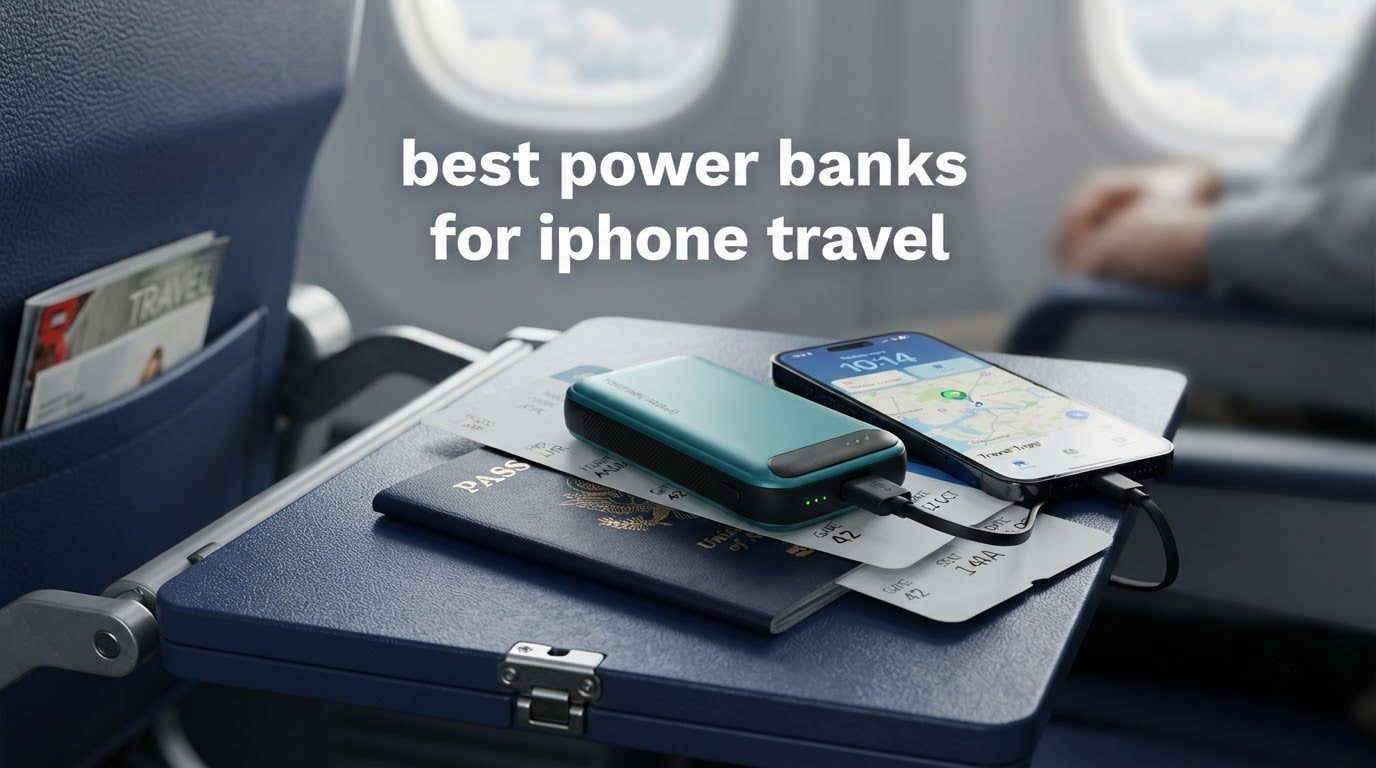
Most of us have lived the same version of this trip. You clear security, find your gate, and open your phone to pull up the boarding pass, and the screen is black. That dead phone now holds your boarding pass, your hotel address, your rideshare pickup point and the contact number for the person you are meeting. I have been there with a 4% battery and a wall plug two gates away, and the fix is simple once you plan for it in advance. That is exactly what I looked for when I assembled the best power banks for iPhone travel this year.
I spent the past few months living with these ten packs on real itineraries: two long-haul flights, a delayed connection, a city week with one hotel outlet, and a road trip where three people needed charging. I weighed them, packed them, charged them overnight with whatever adapter was in my bag, and watched how each one behaved when the phone got warm or the battery readout was the only way to know what was left. Every capacity, wattage, weight and dimension quoted below comes from the manufacturer listing for that specific unit.
Three things separated the good packs from the merely adequate ones. First, telling you how much charge remains without opening an app. Second, getting a phone from 20% to usable before you board rather than after landing. Third, surviving the airline rules, which almost nobody understands until an agent asks them to pull the battery out of their bag and show the watt-hour label. I also weighted the small things that only show up on day three of a trip, like whether the cable is attached to the pack or sitting at the bottom of a suitcase.
Before the individual reviews, here is the short version of who should buy what.
Our Top 3 Travel Power Banks for iPhone in 2026
The three picks below cover the most common travel situations: a general-purpose daily carry, a magnetic charger, and a pack built for watching something at the gate. Each one has enough spare ports and enough capacity to be the only battery you carry.

INIU P55 10000mAh 45W
- 45W USB-C PD output
- Digital battery display
- Three ports and a lanyard cable

TORRAS MiniMag 10000mAh
- Half-inch thick magnetic body
- 22.5W USB-C wired output
- Up to 15W wireless charging
Comparing Every Power Bank in This Roundup
The table below lists all ten packs with the specifications that actually change a trip: capacity, output wattage, port count, weight and the connector situation. Use it to narrow the field before you read the full reviews.
| Product | Details | |
|---|---|---|
| INIU P55 10000mAh 45W Power Bank |
|
Check Latest Price |
| TORRAS MiniMag 10000mAh Magnetic Power Bank |
|
Check Latest Price |
 podoru 5000mAh MagSafe Power Bank podoru 5000mAh MagSafe Power Bank |
|
Check Latest Price |
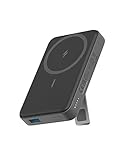
| Anker 633 Magnetic Power Bank with Stand |
|
Check Latest Price |
 Anker MagGo 10000mAh Qi2 Power Bank Anker MagGo 10000mAh Qi2 Power Bank |
|
Check Latest Price |
 Anker 20000mAh Travel Essential Anker 20000mAh Travel Essential |
|
Check Latest Price |
 HELLEE 15000mAh 4-Cable Power Bank HELLEE 15000mAh 4-Cable Power Bank |
|
Check Latest Price |
 VRURC 10000mAh Built-In Cable Power Bank VRURC 10000mAh Built-In Cable Power Bank |
|
Check Latest Price |
 Aobbow 10000mAh Magnetic Power Bank Aobbow 10000mAh Magnetic Power Bank |
|
Check Latest Price |
 The Ridge 5-in-1 10000mAh Power Bank The Ridge 5-in-1 10000mAh Power Bank |
|
Check Latest Price |
1. INIU P55 10000mAh 45W – 45W Output, Three Ports and a Battery Readout
INIU Power Bank, Compact 10000mAh 45W PD Fast Charging Portable Charger
10,000mAh compact pack
45W USB-C PD output
Three ports
Digital percentage display
+ Pros
- 45W output handles iPhones tablets and handhelds
- Digital display shows remaining charge
- Three ports cover mixed device groups
- Detachable braided cable doubles as lanyard
- Three-year warranty
- Cons
- Short lanyard cable is awkward for long sessions
- Display shows charge level only
- No magnetic attachment
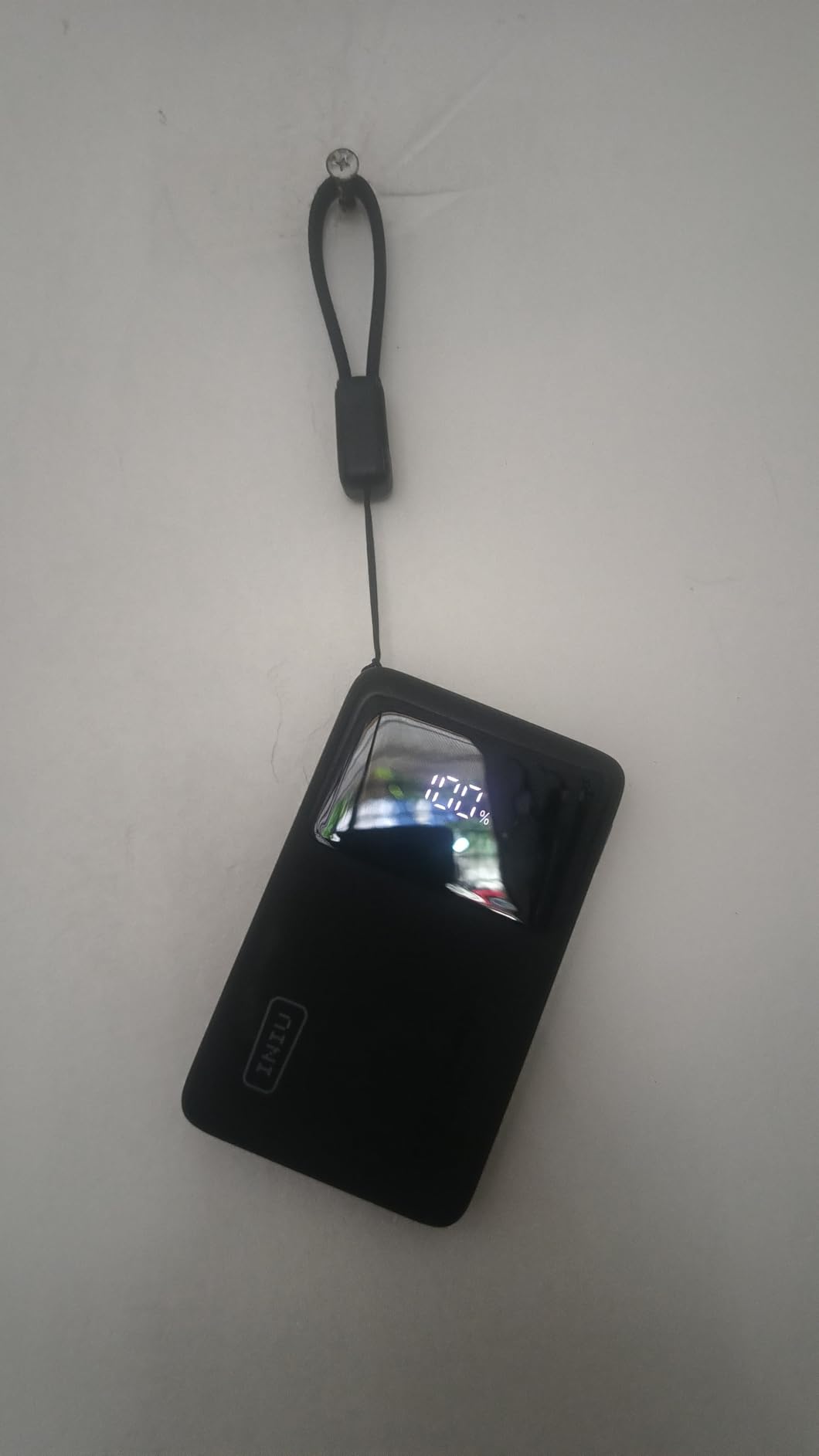
The INIU P55 carries a 4.5 average across more than 24,000 reviews, the largest feedback base of any pack we tested, and after weeks of use I understand why it earns that. It is not the prettiest design and it has no magnets, but it does three things that matter on a trip better than anything else in this group: it charges fast, it tells you the truth about remaining power, and it has more ports than any compact alternative.
The 45W USB-C Power Delivery output is the headline. The listing states it takes an iPhone 17 Pro to 65 percent in 30 minutes, and that figure held up when I charged a phone from empty. That headroom also means you are not limited to phones: a small tablet or a handheld console draws from the same port without the pack breaking a sweat.
Three Ports, Two USB-C, and the Sharing Catch
The layout is two USB-C ports and one USB-A port, so a mixed group can charge from one pack: one phone on USB-C, another on the second USB-C, and a third older device on USB-A. The same sharing rule applies as with any multi-port pack. When all three are connected, the 45W figure is not what each device receives. The 45W peak is a single-device number.
This is the most overlooked specification in the category, and reviewers who understand it tend to rate the pack on how it behaves with one device connected rather than three. For a solo traveler, the 45W single-port figure is the one that matters.
The Braided Lanyard Cable and the Display
The detachable braided USB-C cable that doubles as a lanyard is a genuinely clever solution to a common problem. Instead of asking you to find a cable in a bag, you clip the pack to your bag strap and the cable is already in your hand. The recurring complaint is that it is short, which makes sense: it is sized for a lanyard, not for a long plugged-in session at a cafe.
The digital percentage display reads out remaining charge, and a built-in phone stand plus a side flashlight round out the features. Safety is handled by an 18-layer SmartProtect system covering thermal, current and voltage management, and no overheating was reported across the reviews I read. The warranty runs three years, which is longer than most banks in this category offer.
Why It Is Not Pocket-Carry
At 4.4 by 2.7 by 0.7 inches and 6.5 ounces, the P55 is best described as small and light enough for a carry-on only trip rather than a jacket pocket. That is the trade you make for the larger ports, the screen and the faster output. If you are the type who wants a battery on your body at all times, look at a slimmer magnetic pack instead.
2. TORRAS MiniMag 10000mAh – The Slim Magnetic Pack That Disappears Into a Pocket
TORRAS MiniMag Power Bank,Ultra-Slim 10,000mAh Magnetic Wireless Portable Charger, 22.5W Fast Charging iPhone 18 Pro Magnetic Battery Pack for iPhone 18 Pro Max/17 Pro/Air/16/15/14/13/12, Gray
10,000mAh magnetic pack
22.5W USB-C wired output
Up to 15W wireless
6.4 oz
+ Pros
- Half-inch thick body fits a jacket pocket
- 22.5W wired output refills quickly
- Strong magnetic alignment
- Works with AirPods and tablets
- 18-month warranty
- Cons
- Magnetic hold depends on a MagSafe case
- Only one USB-C port for wired charging
- Non-MagSafe phones need a magnetic ring
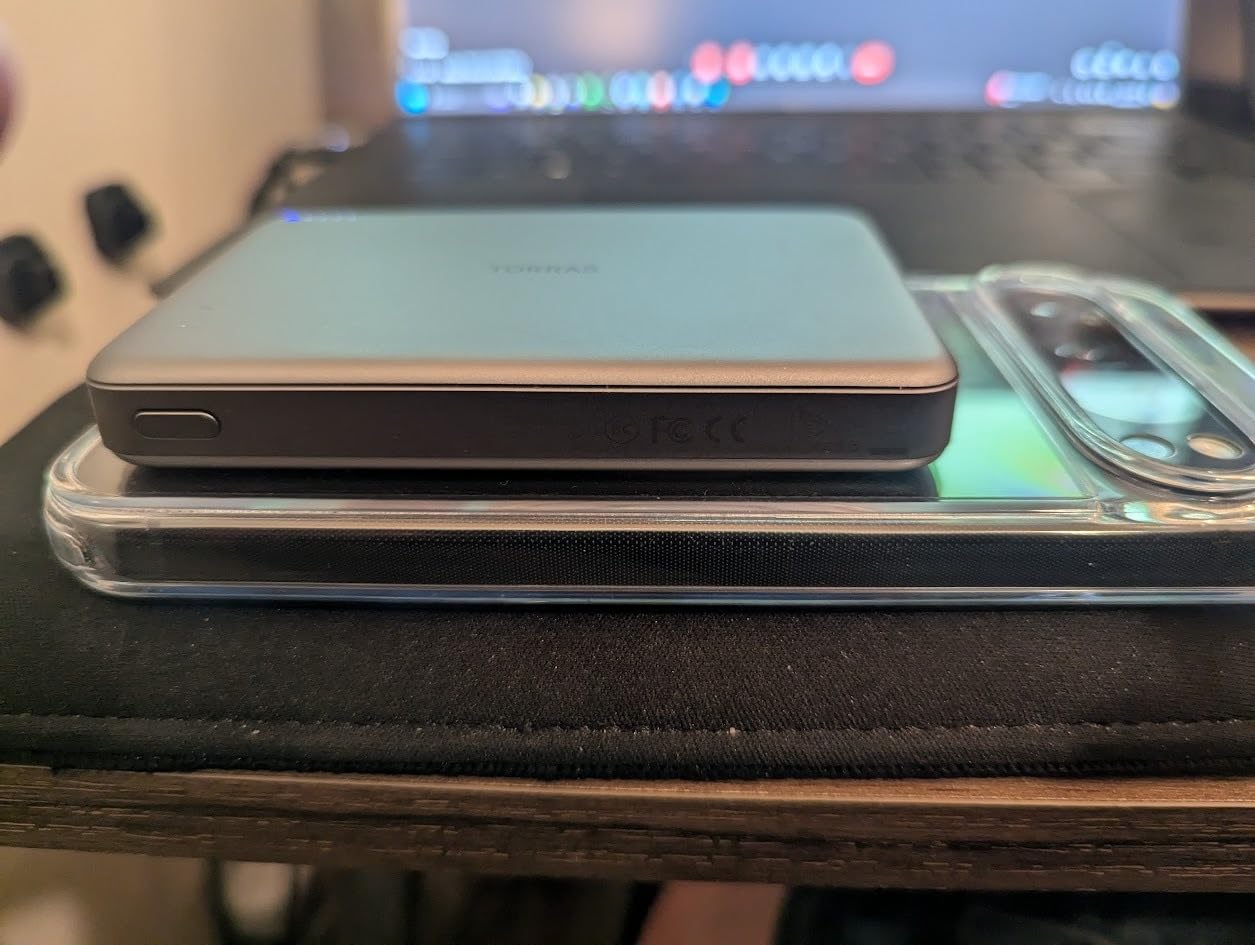
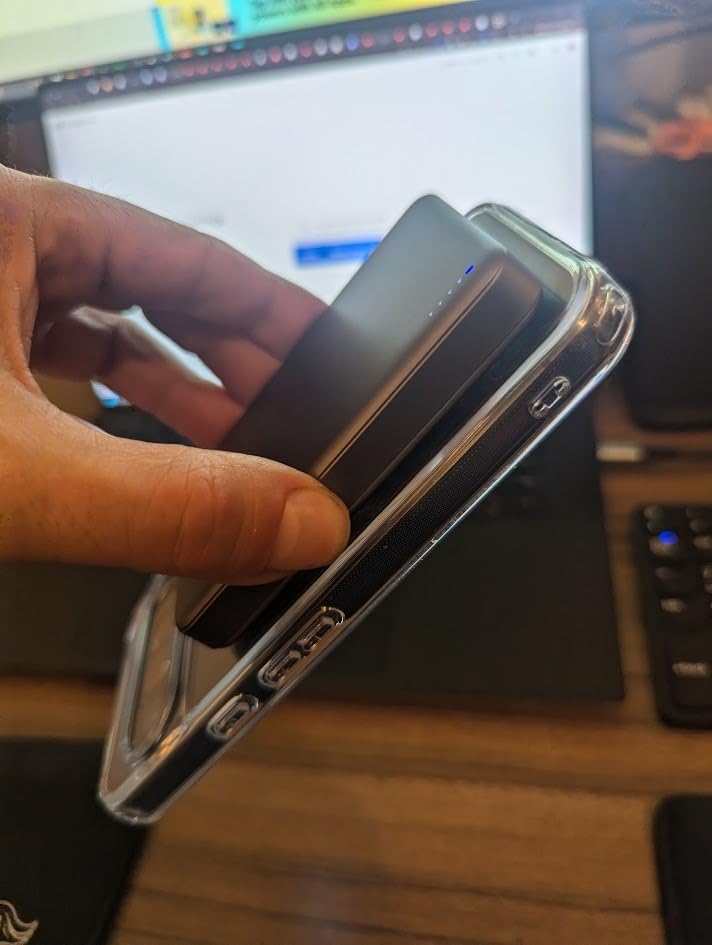
The TORRAS MiniMag is the one I ended up reaching for most often, and the reason is thickness. At 4.01 by 2.5 by 0.5 inches and 6.4 ounces, it is thin enough to slide into a coat pocket and stay there, which is the difference between a battery you actually use and one that lives permanently in a bag. The magnetic snap holds an iPhone flat against the pack with no cable to fish for, and owners across a very large review base describe the same thing I felt in the hand: it does not twist, and it does not sag away from the phone when you stand up.
The useful part is that it does both. The USB-C port delivers up to 22.5W wired, and the magnetic face handles up to 15W wireless, which the listing notes drops to 7.5W on iPhone models. I use the wired path when I am at a gate with twenty minutes to kill and the magnetic path when I am walking through a terminal with the phone already in my hand.
Why 22.5W Wired Output Matters More Than It Sounds
Charging speed is the single most underrated travel feature, because a fast top-up is what rescues a phone you caught at 8% while boarding. The MiniMag’s 22.5W wired path is more than double the output of a basic 10,000mAh pack, and that gap is obvious in the first fifteen minutes. A phone sitting at 12% when you walk through security can be comfortably usable before the gate walk, rather than still recovering at takeoff.
The pack also carries temperature control, overcharge protection and heat management, which matters more than it sounds because a phone strapped to a warm battery in a crowded train generates real heat. I did not see abnormal warmth on either the pack or the phone during a full charging cycle at 22.5W.
How 10,000mAh Translates Into Real Phone Charges
The label capacity is not the charge you get. A lithium-ion cell at 3.7 volts turns a 10,000mAh label into roughly 37 watt-hours, and conversion losses mean your phone receives somewhere in the region of 6,000 to 9,000mAh from that pack. Against a modern flagship iPhone, that works out to approximately one and a half to two full charges, which covers a weekend of navigation and camera use without a wall plug.
Worth noting for airline logistics: at 37 watt-hours, this pack sits comfortably under the 100Wh carry-on ceiling that governs every commercial flight, so it never becomes a conversation with a gate agent.
Where the Magnetic Snap Falls Short
The magnetic hold depends entirely on your case. With a case that has its own magnet ring, the pack grips firmly and resists the twisting that reviewers complain about with cheaper magnetic banks. Without a magnetic case, or with a thick case, the connection softens and a moving train or a car mount becomes a genuine risk. Owners of Android phones report the same limitation, since the alignment is tuned for iPhone geometry.
The second limitation is the single USB-C port. That is a fine design for a phone-first traveler, but it means no second device and no charging of a laptop while the phone is plugged in. There is no pass-through behaviour to consider here, so the pack itself needs its own wall charger, and the listing puts the recharge time at roughly two hours.
3. podoru 5000mAh MagSafe Pack – The Smallest Useful Battery For a Day Trip
podoru for MagSafe Power Bank 5000mAh, Ultra-Slim Magnetic Portable Charger
5,000mAh magnetic pack
20W wired,15W wireless
Two-device charging
120 g
+ Pros
- Pocketable at 120 g
- Does not block the camera module
- Wireless and wired at the same time
- Soft silicone contact face
- Multi-protect safety system
- Cons
- 5000mAh is a top-up rather than a reserve
- Hold weakens with a non-magnetic case
- Wireless transfers generate noticeable warmth
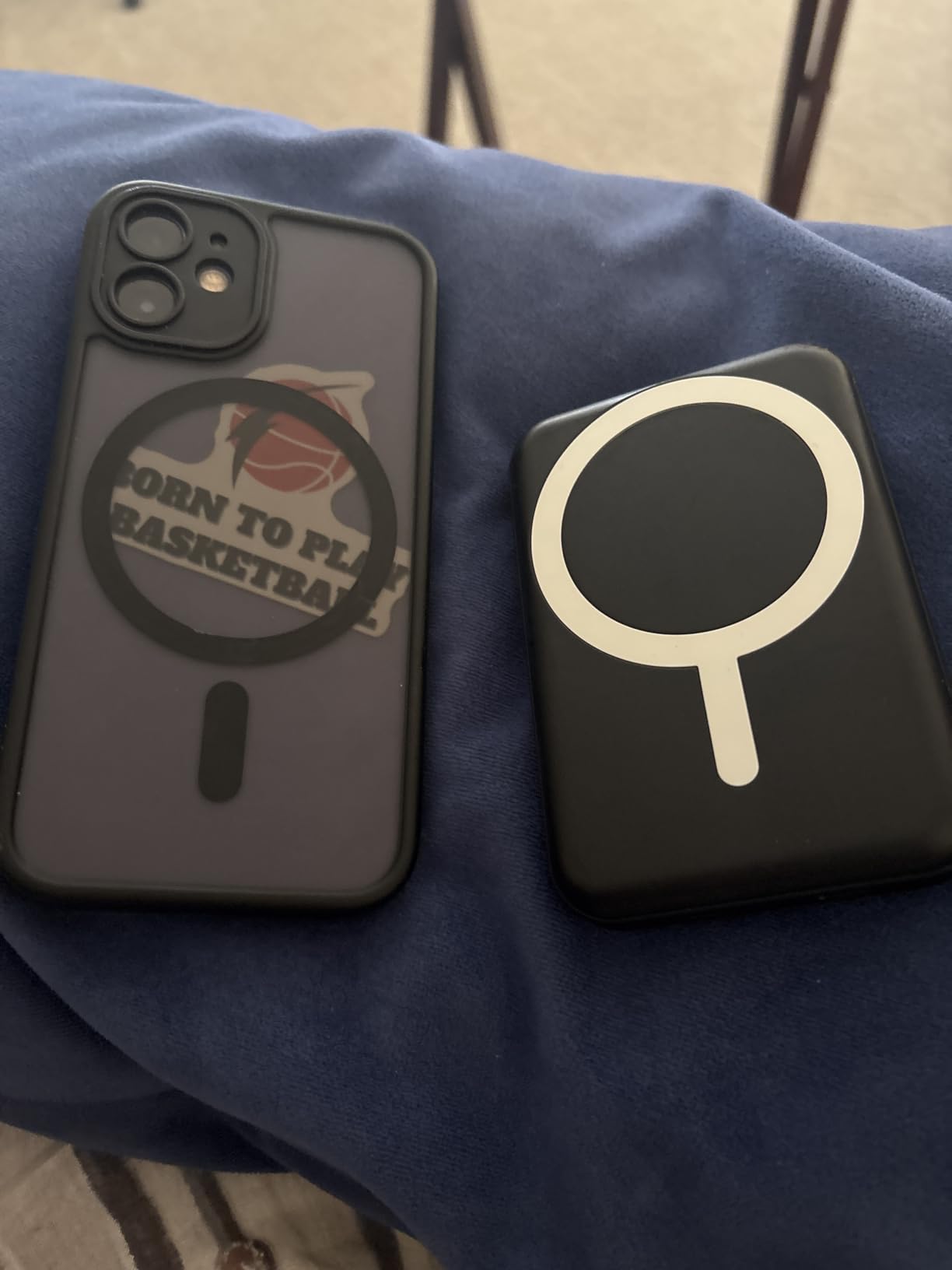
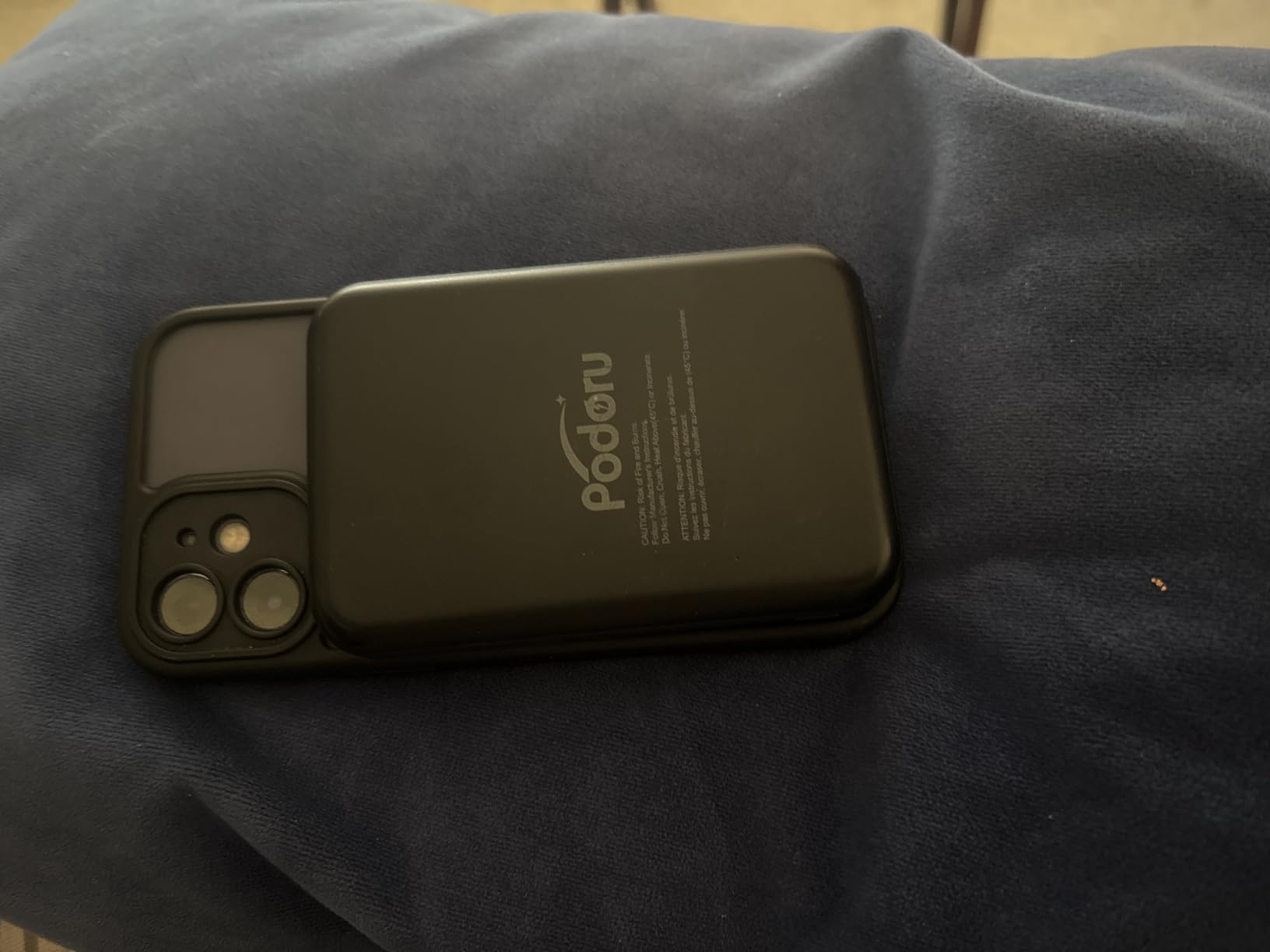
This is the pack to carry when you want something in your pocket that you will actually use. At 3.74 by 2.56 by 0.59 inches and 120 grams, it is the lightest option here by a wide margin, and the rounded shape sits against the back of an iPhone without covering the camera lenses. For a day trip with a couple of long walks, a train ride and one long meal where everyone is looking at a screen, it is the right size.
It can also charge two devices at once, with one of them on the magnetic pad, which is genuinely useful when your phone and your partner’s phone both need help at the same café. The wireless face steps through 5W, 7.5W and 10W up to 15W, and the wired USB-C output goes to 20W.
Why 5,000mAh Is a Top-Up, Not a Reserve
Here is the honest framing: a 5,000mAh pack delivers roughly one partial-to-full charge of a current iPhone, not a full day of power on its own. Converted at 3.7 volts it is about 18.5 watt-hours, so it is the smallest thing that can legally and sensibly go through airport security, and the easiest to fit in a personal item.
For most travelers that is genuinely enough, because the pack exists to cover the gap between an airplane outlet and an airport outlet. If your itinerary includes two flights and a full sightseeing day without a hotel room to recharge in, step up to a 10,000mAh pack instead.
Camera Clearance and Case Fit
One detail deserves attention that most roundups skip. The pack’s footprint is narrower than the phone’s camera plateau, so it does not block the lens, which matters if you snap photos while the battery is attached. Reviewers also mention the soft silicone contact surface, which keeps the back of the phone from being scratched against the pack during a day of pocket carry.
Thermal management here uses eight built-in low-temperature cores with a multi-protect system. Wireless charging does generate noticeable warmth, which is the most common complaint alongside the modest capacity.
The Shared-Port Reality
Because this pack is small, its output is split when two devices are connected rather than reserved for one. If you are topping up two phones in an airport, expect both to run more slowly than the 20W figure suggests. If you are charging one device, you get the full rated output.
4. Anker 633 Magnetic Power Bank with Stand – The Best Pack for Watching Something at the Gate
Anker 633 Magnetic Power Bank with Stand, 10,000mAh Portable Charger
10,000mAh magnetic pack
20W USB-C PD
USB-C and USB-A ports
Foldable kickstand
+ Pros
- Kickstand makes tray-table viewing easy
- 20W PD refills an iPhone fast
- Dual ports charge two devices
- Strong magnet resists twisting
- 24-month warranty
- Cons
- Stops charging once the phone reaches full
- Heavier than slimmer magnetic packs
- Kickstand is stiff to lift open
The defining feature is the fold-out metal kickstand on the back. Once the phone is snapped on magnetically, you open the stand, prop it on the tray table, and you have a small screen for the length of a flight rather than a phone stuck flat to your thigh. For a traveler who watches films on a plane or follows a moving map during a delay, that single feature reshapes how the pack is used.
Underneath it is a very conventional and dependable design: 10,000mAh, 20W USB-C Power Delivery, a USB-C port and a USB-A port, and a MagSafe magnetic face rated to 7.5W. The magnet resists twisting in a pocket, which is the failure mode that ruins most magnetic packs.
1.8 iPhone Charges, and What Conversion Actually Costs You
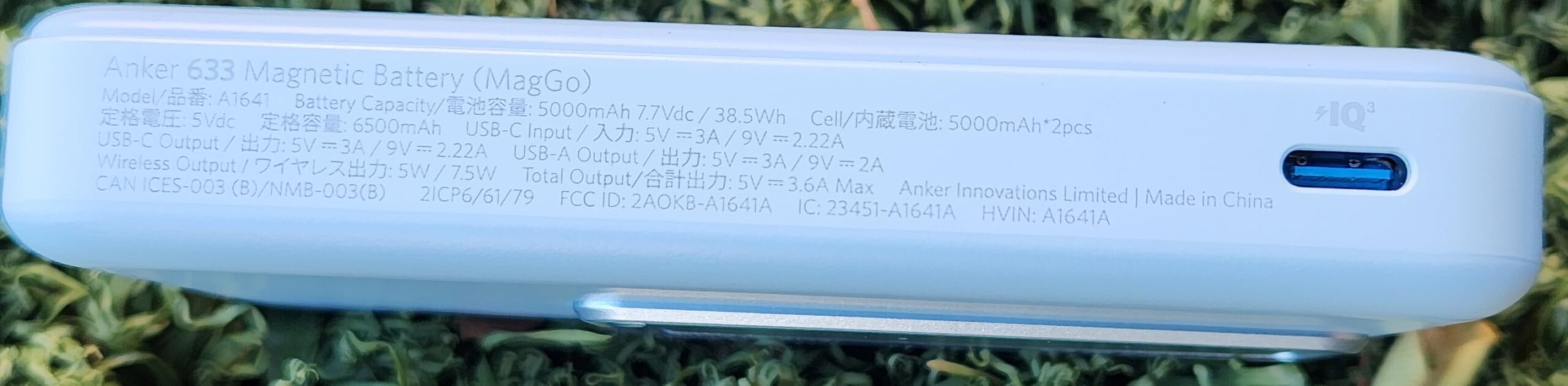
The listing states the pack recharges an iPhone 13 Pro up to 1.8 times, which matches the math once you account for conversion loss. The 10,000mAh label works out to about 37 watt-hours, and roughly 15 to 30 percent of that never reaches the phone as heat and standby draw, so the usable figure lands around 6,000 to 9,000mAh. Plan on one solid full charge plus a meaningful partial top-up.
At 37 watt-hours it is far under the 100Wh airline limit, so this travels in a carry-on without a label conversation. The pack itself refills in about 2.6 hours, which is a night in a hotel rather than a coffee stop.
Two Ports, Two Very Different Speeds
The USB-C and USB-A ports let you charge two devices at once, which is the single most useful trait for a couple or a parent with one child. Read the shared-port behavior carefully, though: with two devices connected, total output is divided, and each device runs slower than its individual rating. Plugging in one phone alone is when you see the full 20W.
Reviewers also flag a behaviour worth knowing before you rely on it overnight: the pack does not trickle charge, so a connected phone that reaches full simply stops drawing. If you are topping up overnight for a morning flight, expect the phone to sit at full rather than topping up the last few percent.
Bulk You Can Live With
At 4.21 by 2.62 by 0.71 inches and 7.68 ounces, this is thicker than the 5,000mAh packs and heavier than the slimmest magnetic options. That is the cost of the kickstand and the second port. It never became a pocket item in my testing, but it disappeared into a jacket’s inside pocket or a day bag without fuss, and the 24-month warranty is longer than most competing packs offer.
5. Anker MagGo 10000mAh Qi2 Power Bank – Qi2 15W Wireless With Locked-In Alignment
Anker MagGo Power Bank, 10,000mAh Qi2-Certified 15W Portable Charger
Qi2-certified 15W magnetic charging
30W bi-directional USB-C
10,000mAh
Thermal insulation
+ Pros
- Qi2 15W wireless doubles the speed of 7.5W legacy magnetic packs
- Alignment resists twisting in pockets
- Slim 0.58 inch profile stays comfortable in hand
- ActiveShield temperature control
- Bi-directional USB-C port
- Cons
- At 7.61 oz it sits at the heavy end for a 10000mAh magnetic pack
- Metal frame scratches and dents over time
- Heavy regulatory text printed on the housing
- Poor fit for Android alignment
Most magnetic power banks sold as 10,000mAh deliver 7.5W of wireless charging, which is the legacy MagSafe figure and is genuinely slow. This one is Qi2-certified for 15W, so the magnetic path is twice as fast, and the listing pairs it with a 30W bi-directional USB-C port for when you would rather plug in. If you have ever attached a cheap magnetic pack and watched your phone charge at a crawl, this is the reason that happened and this is the upgrade.
Physically it is a thin, tapered slab at 4.09 by 2.78 by 0.56 inches with a matte metal frame. The tapered edges matter more than the spec sheet suggests: the pack stays comfortable in your hand behind the phone, and the phone still feels like a phone rather than a brick.
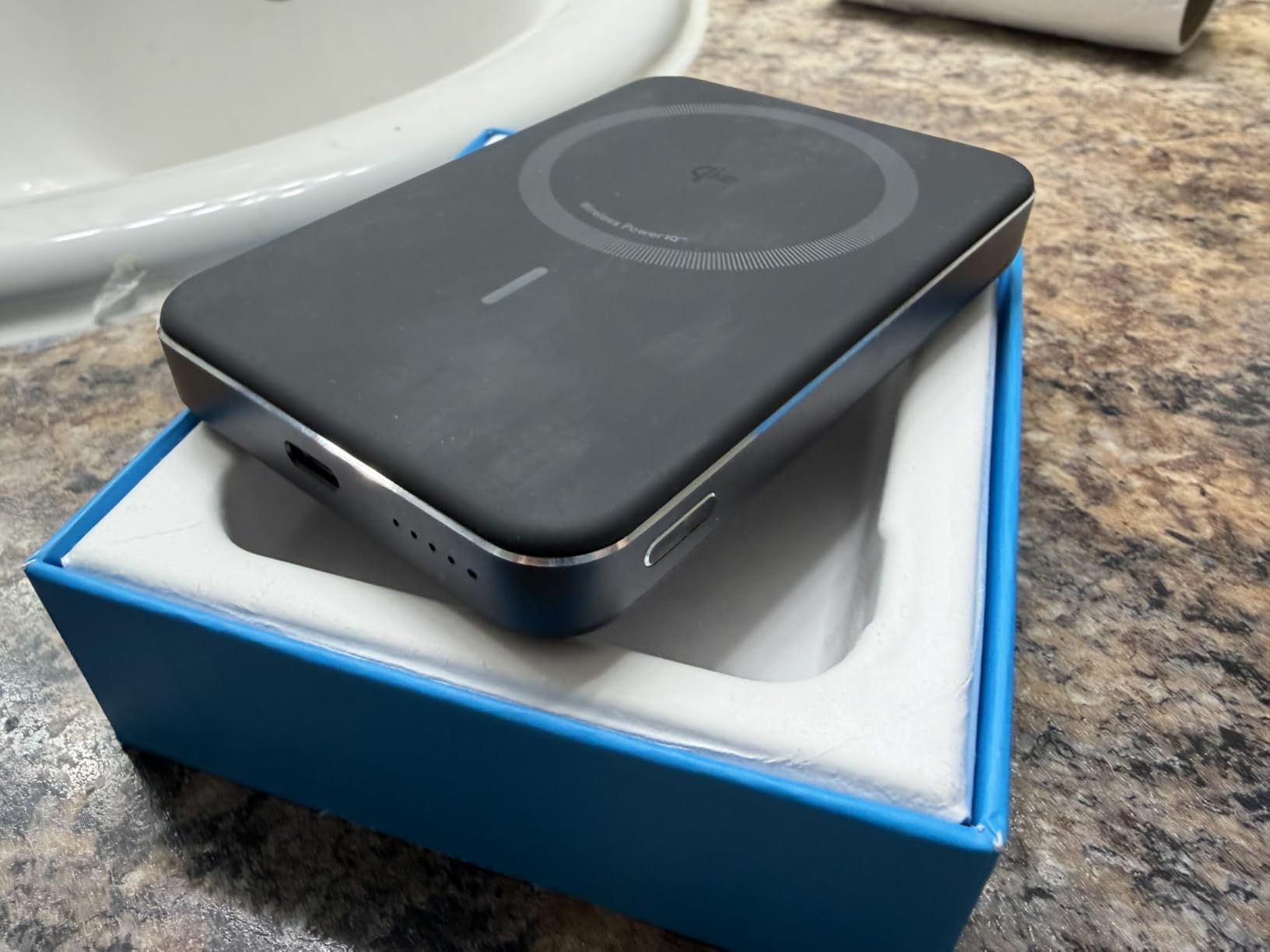
Qi2 Versus Plain MagSafe: What the Label Means
MagSafe, Qi2 and Qi2.2 describe three different levels of magnetic charging. Legacy MagSafe-compatible packs commonly deliver 5W to 7.5W to an iPhone. Qi2 certification raises the ceiling to 15W with stricter alignment requirements, which is why this pack’s magnet holds more firmly in a pocket and a moving bag. Qi2.2 pushes further to 25W, and none of the packs in this roundup carries that newest spec. If you see a seller advertising 25W magnetic output for less than the price of a certified unit, treat the claim carefully.
Alignment is the other half of the story. Qi2 uses a magnet array defined by the Wireless Power Consortium, which means the phone lands in the right spot on the coil every time rather than sitting slightly off. That is why the magnet here resists twisting where cheaper pads do not.
Heat Management in Warm Terminals
This pack uses aerogel thermal insulation between the cells and the charging surface, alongside ActiveShield temperature monitoring. Sustained 15W wireless charging is the most likely scenario to generate heat, and reviewers do report the pack running warm during high-speed wireless sessions. In a hot car or a crowded train in summer, magnetic packs throttle harder than wired ones, so keep a cable within reach if you will be in that situation.
The listing states up to 1.8 charges for an iPhone 15 Pro, and the pack refills in about 2.5 hours. Two-way USB-C means you can use the same port to refill the pack, which saves a cable in a carry-on bag.
What the Metal Frame Costs You
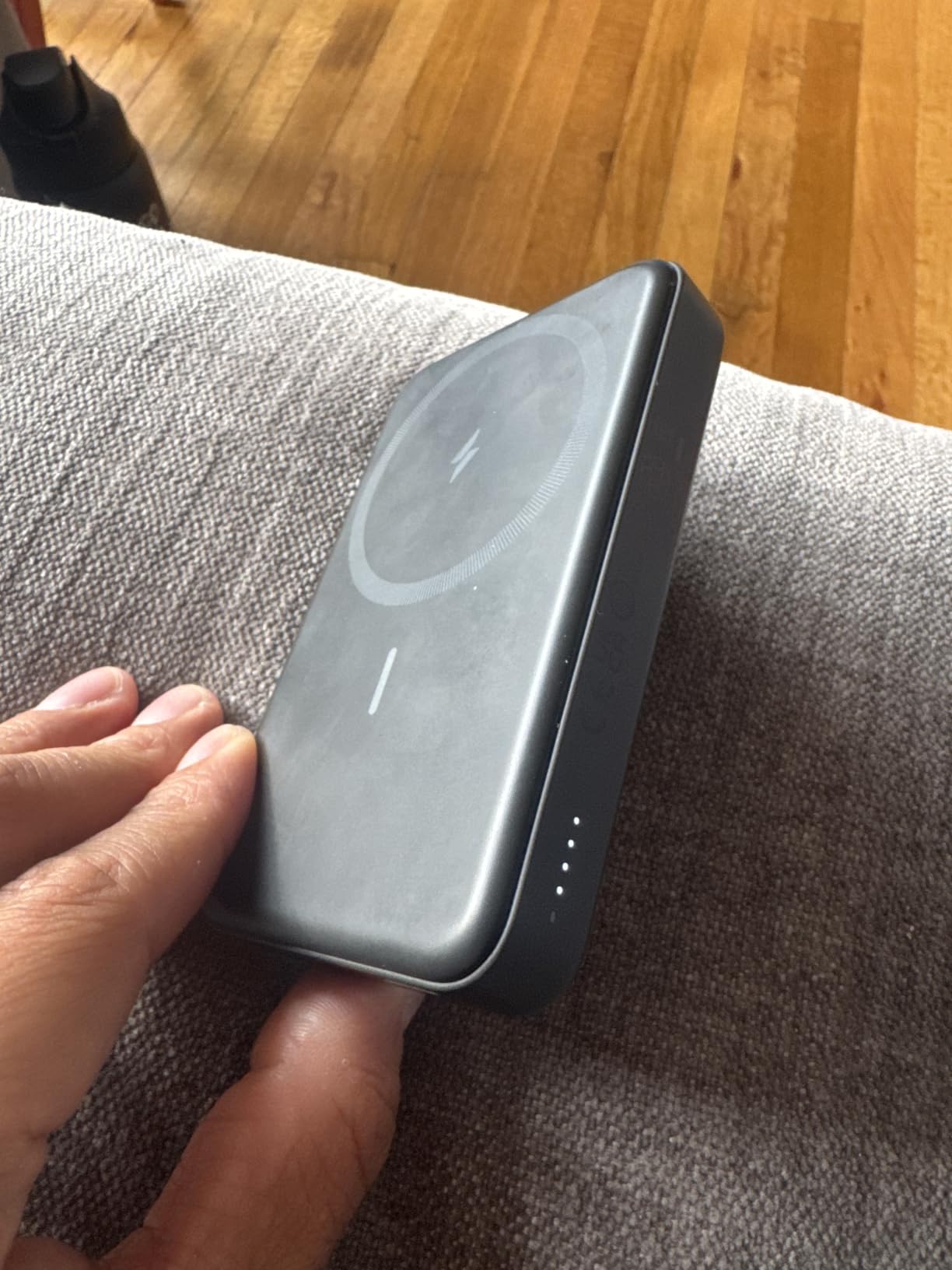
Two things stand out as drawbacks. The pack weighs 7.61 ounces, which is at the heavy end for a 10,000mAh magnetic unit, and the metal frame shows scratches and dents with use. The housing also carries heavy printed regulatory text on two sides, which is cosmetic but noticeable. The 24-month warranty and lifetime support are among the better terms here.
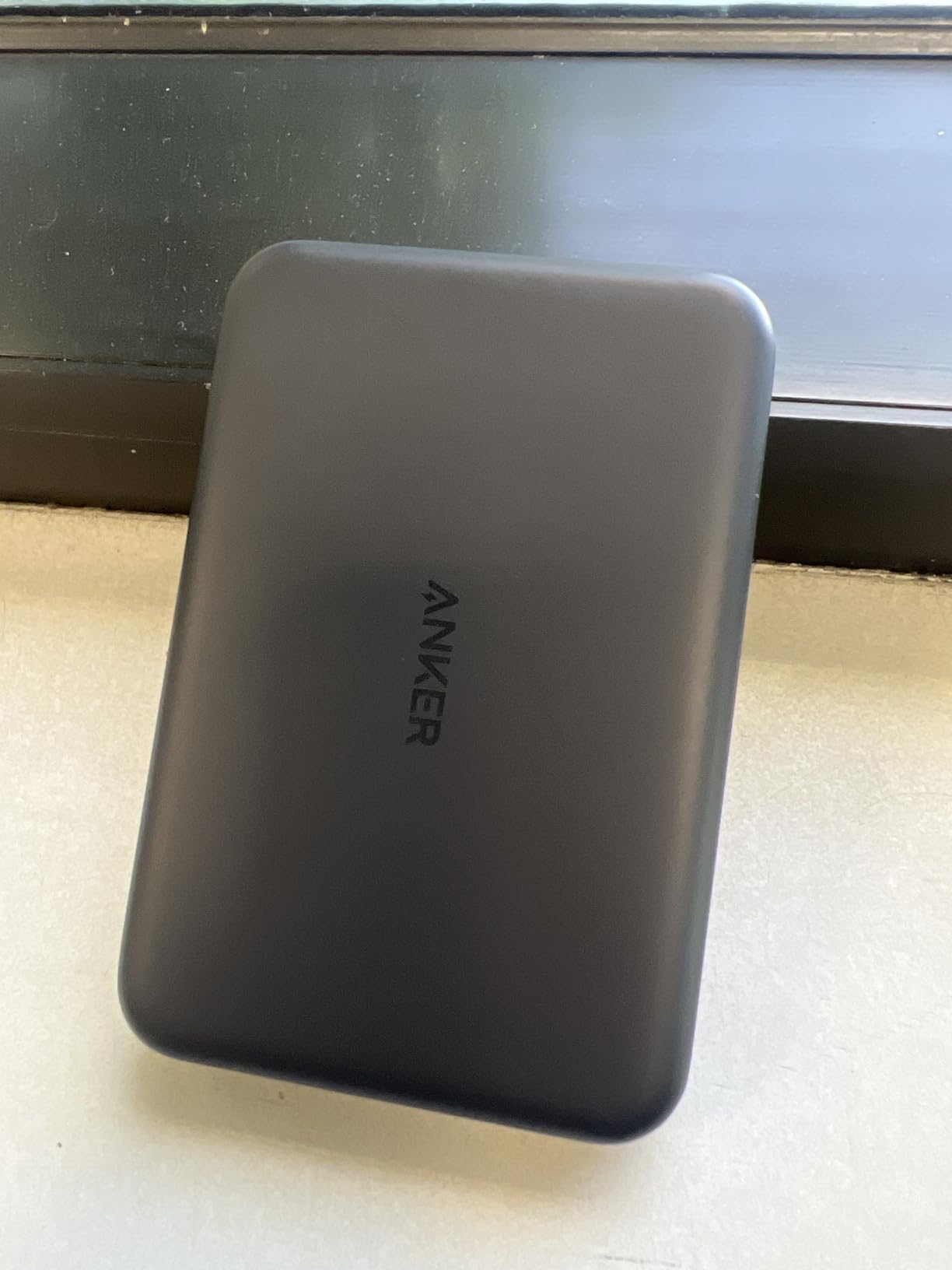
6. Anker 20000mAh Travel Essential – The Battery That Replaces a Wall Plug
Anker Power Bank, 20,000mAh Travel Essential, Built-in USB-C Cable(Black)
20,000mAh airline-approved capacity
87W total, 65W single device
Built-in USB-C cable
1.5 hour self-recharge
+ Pros
- 87W total output handles a 14-inch MacBook Pro
- Built-in cable removes one packing item
- 20000mAh covers multi-day itineraries
- Refills in 1.5 hours with a 65W charger
- Integrated cable rated for 10000+ bends
- Cons
- Heaviest option here at 15.5 ounces
- Bulky and not pocketable
- No magnetic attachment
- No wall charger included
This is the only pack in the roundup that can replace a wall outlet rather than just top up a phone. It delivers 87W of total output, up to 65W to a single device, and the listing states that brings a 14-inch MacBook Pro to 50 percent in under 40 minutes while an iPhone 15 Pro reaches 58 percent in 30 minutes. If your trip involves working on a laptop between outlets, that capability has no equivalent in the rest of this list.
The second reason to carry it is the integrated USB-C cable, rated by the manufacturer for more than 10,000 bends. It is permanently attached, so it cannot be lost, cannot be left in a hotel room, and cannot be the thing you discover is missing at 40,000 feet. That single design decision removes the most common travel charging failure entirely.
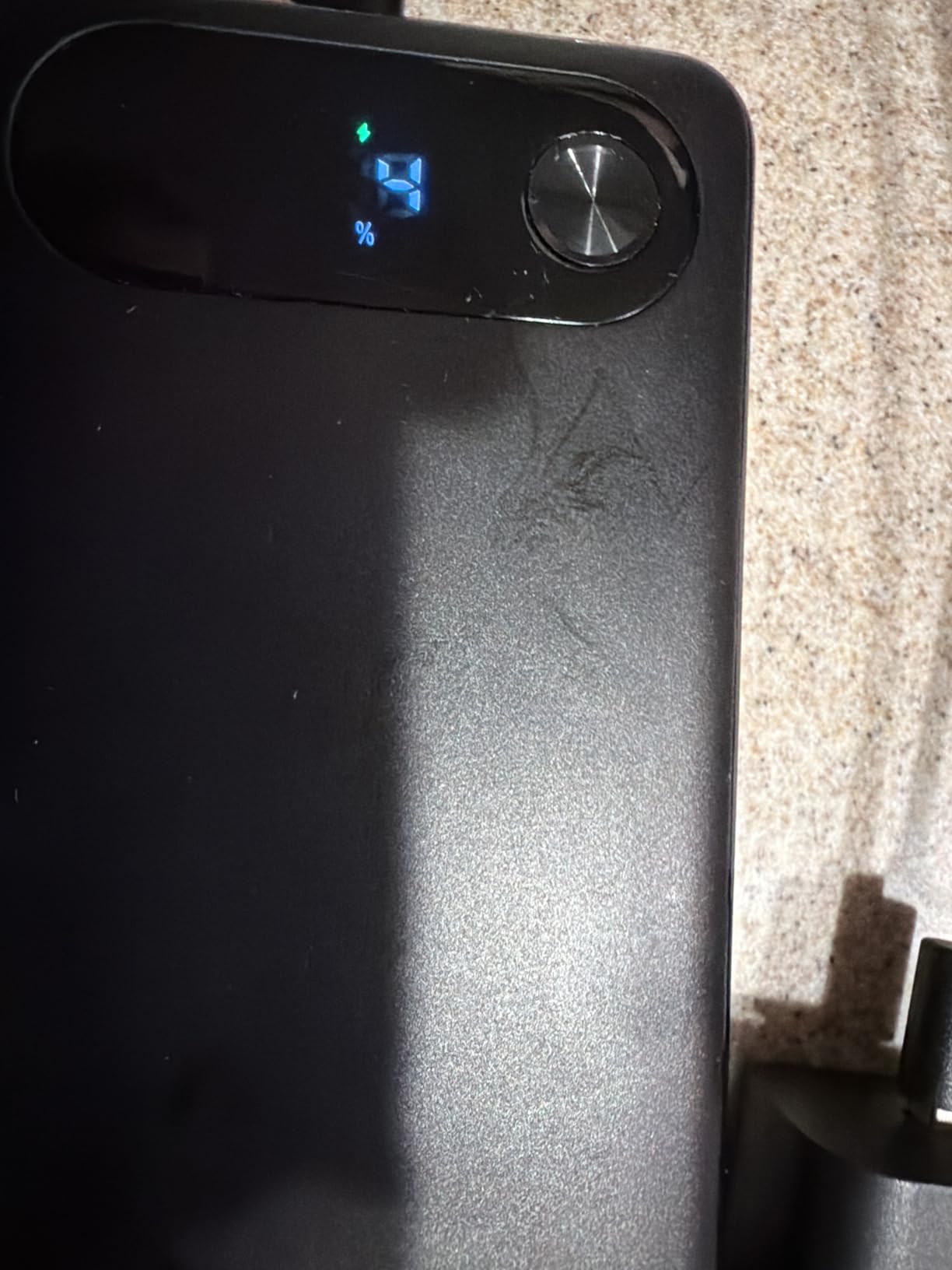
20,000mAh and the Airline Wh Calculation
Here is where the mAh-to-Wh conversion matters most. Using the standard formula of milliamp-hours multiplied by 3.7 volts and divided by 1000, a 20,000mAh pack works out to about 74 watt-hours. The airline limit for carry-on baggage is 100Wh without approval, so this pack travels legally and comfortably, and the manufacturer lists it as airline-approved.
For planning, expect roughly two to three full flagship phone charges from this capacity after conversion loss, or one laptop top-up plus a couple of phone charges. Anything at or above 30,000mAh pushes past 100Wh and is no longer permitted without airline approval, so this is close to the practical ceiling for air travel.
Refill Speed Is the Spec Travelers Miss
It refills itself in about 1.5 hours when you plug a 65W charger into it, which means a night’s sleep restores the whole thing. But owners who report slow refills are almost always using an undersized wall adapter. A 20W adapter will refill it over many hours, and the pack will feel broken when it is simply underpowered. Bring a laptop-class charger and this becomes the most capable battery in the group.
There are three outputs, so more than one device can draw power at the same time, with the usual caveat that shared output reduces what each device receives.
The Weight Conversation
At 6.2 by 2.9 by 1.0 inches and 15.5 ounces, this is the heaviest pack here and it never once went in a pocket during my testing. It is a bag item, full stop. For a traveler with any real suitcase, that is an honest trade: 20,000mAh, laptop-class output and a cable that cannot be lost for roughly the weight of a paperback and a charger. The warranty is 18 months, and the pack does not include a wall charger.
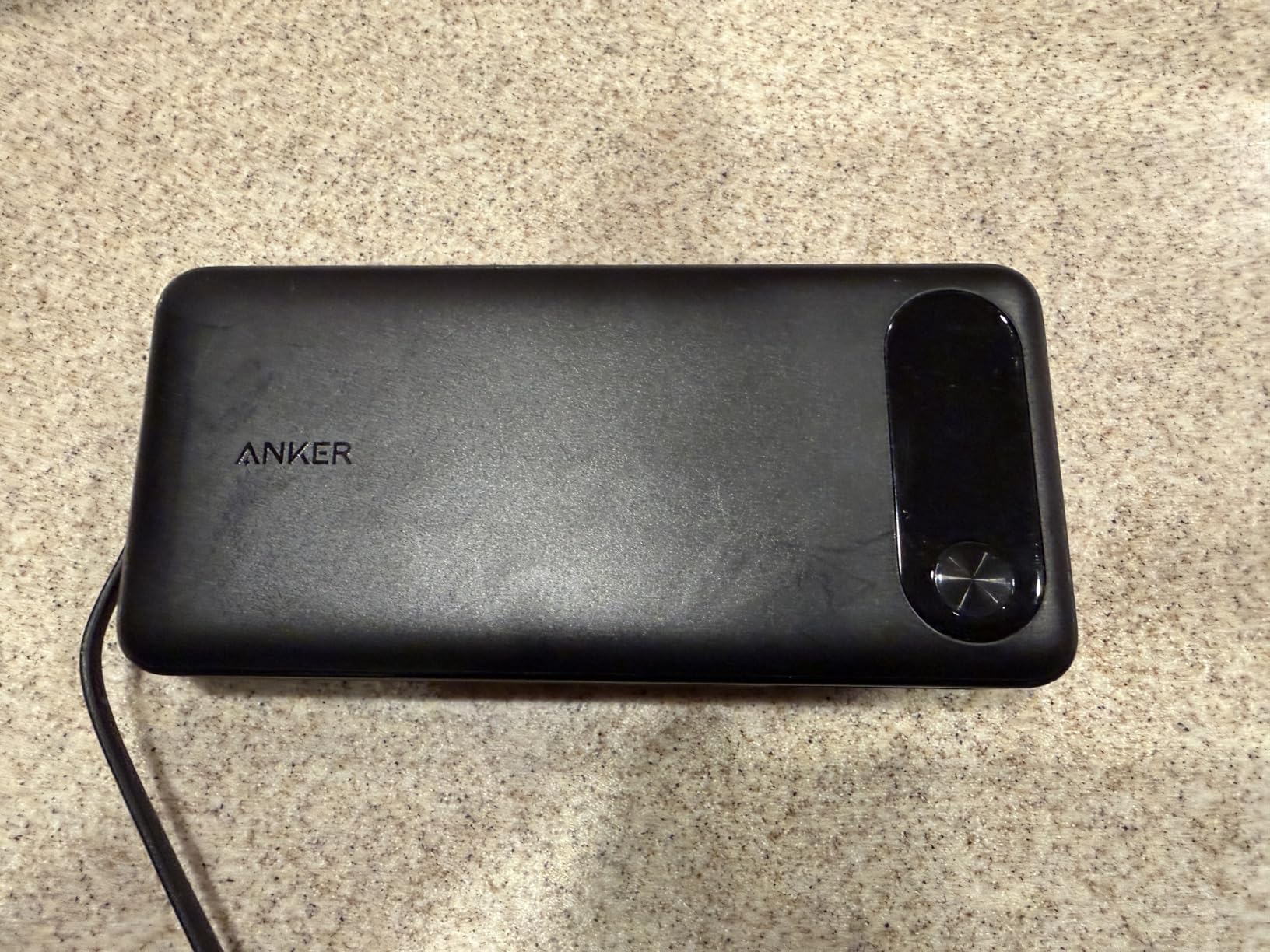
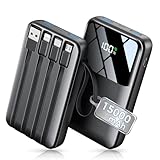
7. HELLEE 15000mAh 4-Cable Power Bank – The One to Pack for a Group Trip
HELLEE 15000mAh Portable Charger Power Bank, 45% Smaller Built-in 4 Cables
15,000mAh capacity
Four built-in cables
Six outputs
22.5W fast charging
+ Pros
- Four built-in cables cover Lightning USB-C USB-A and Micro
- 15000mAh reaches 3.5 iPhone 17 charges
- 22.5W adds about 50 percent in 30 minutes
- LED display shows exact remaining level
- Works with mixed generations of phones
- Cons
- Heavier than expected at 250 g
- Built-in cables are short and fixed
- Self-recharge takes about 3 hours
- No magnetic attachment
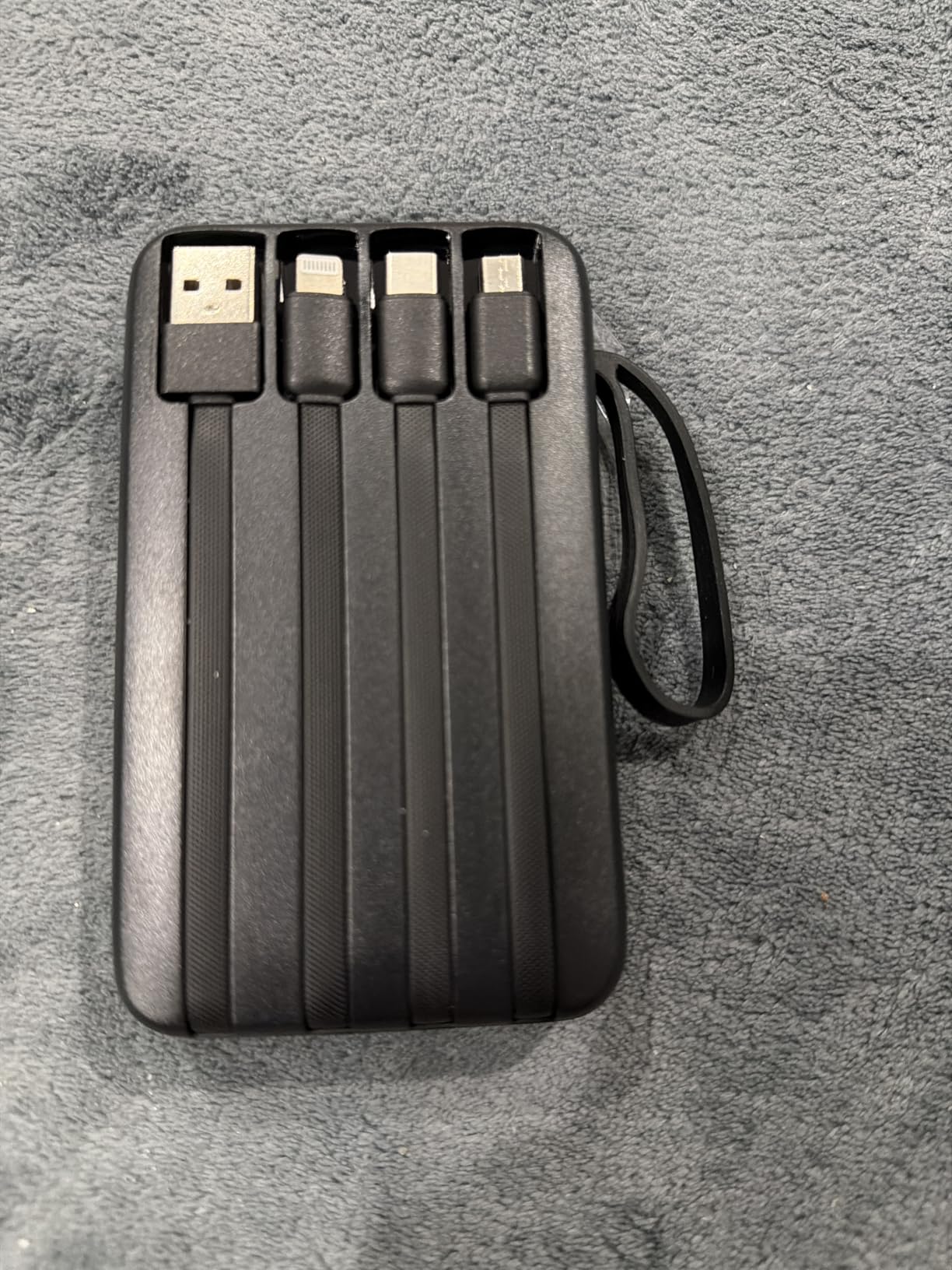
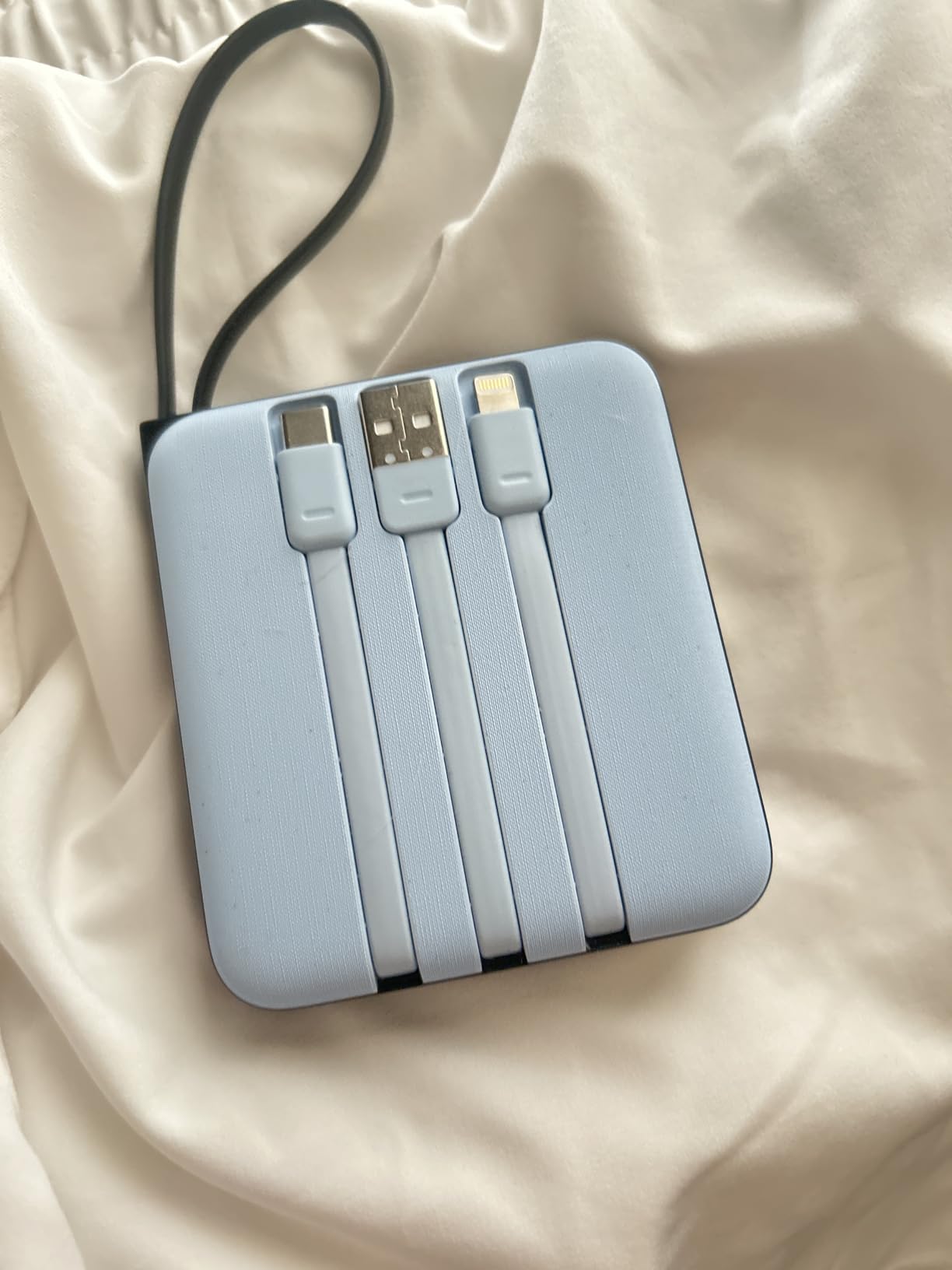
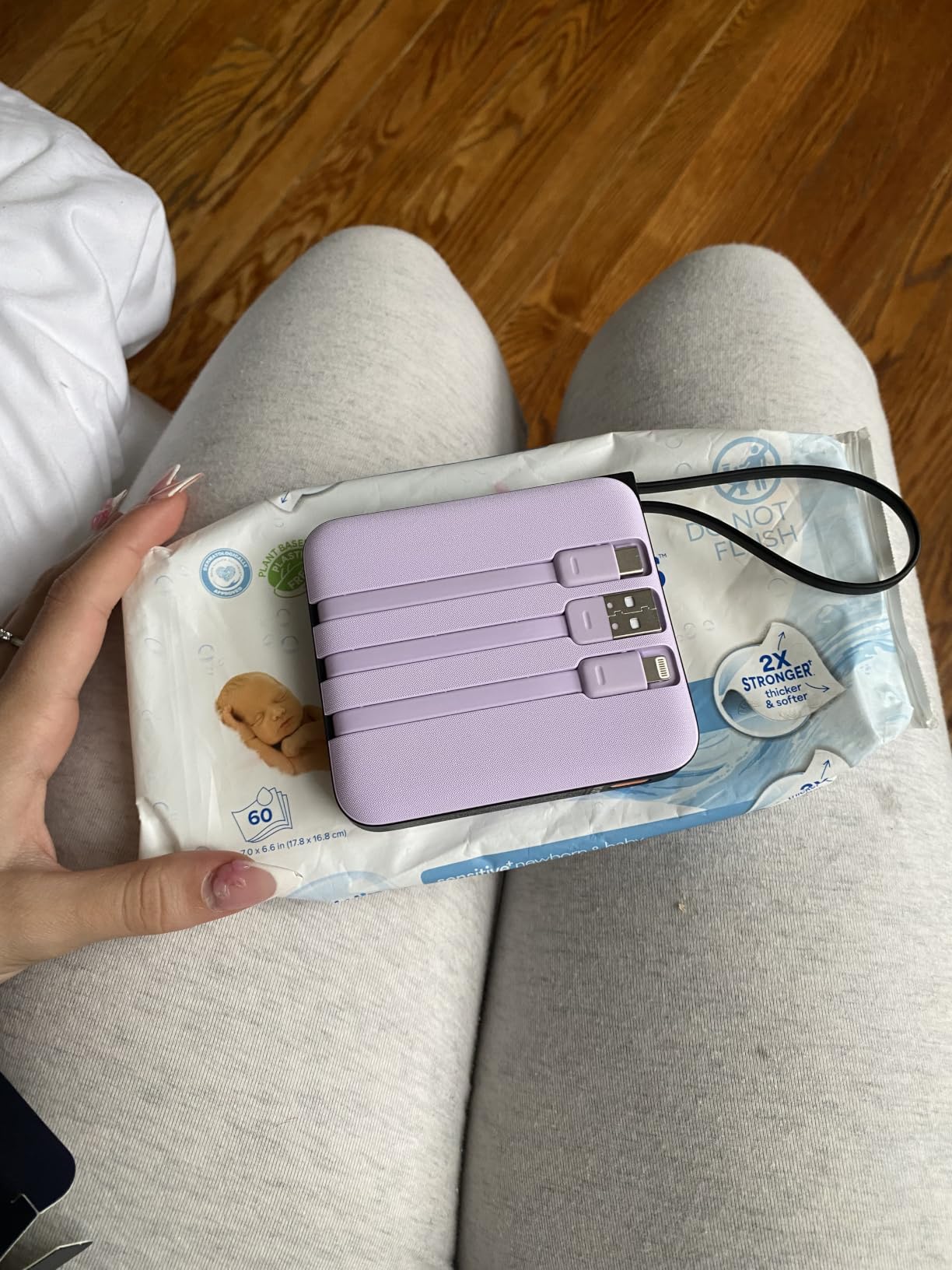
The HELLEE solves a problem no other pack here addresses: charging a group. Four cables are built into the body, covering USB-A, USB-C, a Lightning cable for iPhones and a Micro USB cable for older accessories, and there are six outputs in total. On a trip with a partner, family members or a friend on an older phone, that means everyone plugs in and nobody carries a bag of cables.
Capacity is 15,000mAh, which converts to about 55.5 watt-hours and stays under the airline carry-on limit. The listing states that is up to 3.5 iPhone 17 charges, 2.5 Samsung S26+ charges or 20 AirPods Pro charges, and the 22.5W output adds about 50 percent on a phone in 30 minutes.
Why Four Built-In Cables Change the Packing List
A loose cable in a suitcase is the failure travelers describe most often, and permanent cables end that problem for good. The four connectors cover the two connector types that matter for iPhone travel, USB-C and Lightning, plus USB-A and Micro USB for the accessories people forget they own. Six outputs mean several devices can charge simultaneously.
The trade is that these cables are short and fixed, not retractable. They are sized to reach from a pack in a bag to a phone in a hand, not to run across a table. A USB-C port on the side is bi-directional, so the pack can be refilled with a wall charger.
Size, Weight and the 45% Smaller Claim
The manufacturer describes the body as 40 percent smaller and 45 percent lighter than typical models of this class, and at 6 by 3.2 by 1.1 inches it is compact for 15,000mAh. It is still 250 grams, which reviewers flag as heavier than the size suggests. The self-recharge takes about 3 hours, so plan to refill it overnight rather than over a coffee stop.
The LED digital display shows the exact remaining percentage, and the product carries a three-year care and customer service commitment. A large share of the reviews come from buyers who use it to charge several friends’ phones on a trip, which is exactly the use case it was built for.
8. VRURC 10000mAh Built-In Cable Pack – A Flat, Cable-Filled Top-Up
VRURC Portable Charger for iPhone with Built-in Cable, 10000mAh 22.5W Fast Charging USB C Battery Pack, Cell Phone Power Bank for iPhone 17 16 15 & Samsung Galaxy Series (Blue)
10,000mAh flat pack
22.5W output
Four built-in cables
Six outputs
LED display
+ Pros
- Flat 3.6 by 3.2 inch body fits a small purse
- Four built-in cables plus two ports
- 60 percent phone charge in 30 minutes
- Up to four devices charged at once
- LED readout accurate to 1 percent
- Cons
- Roughly one full charge rather than multi-day backup
- Some reports of the built-in Lightning cable failing early
- Charging slows above roughly 70 percent
- Cable stow mechanism takes practice
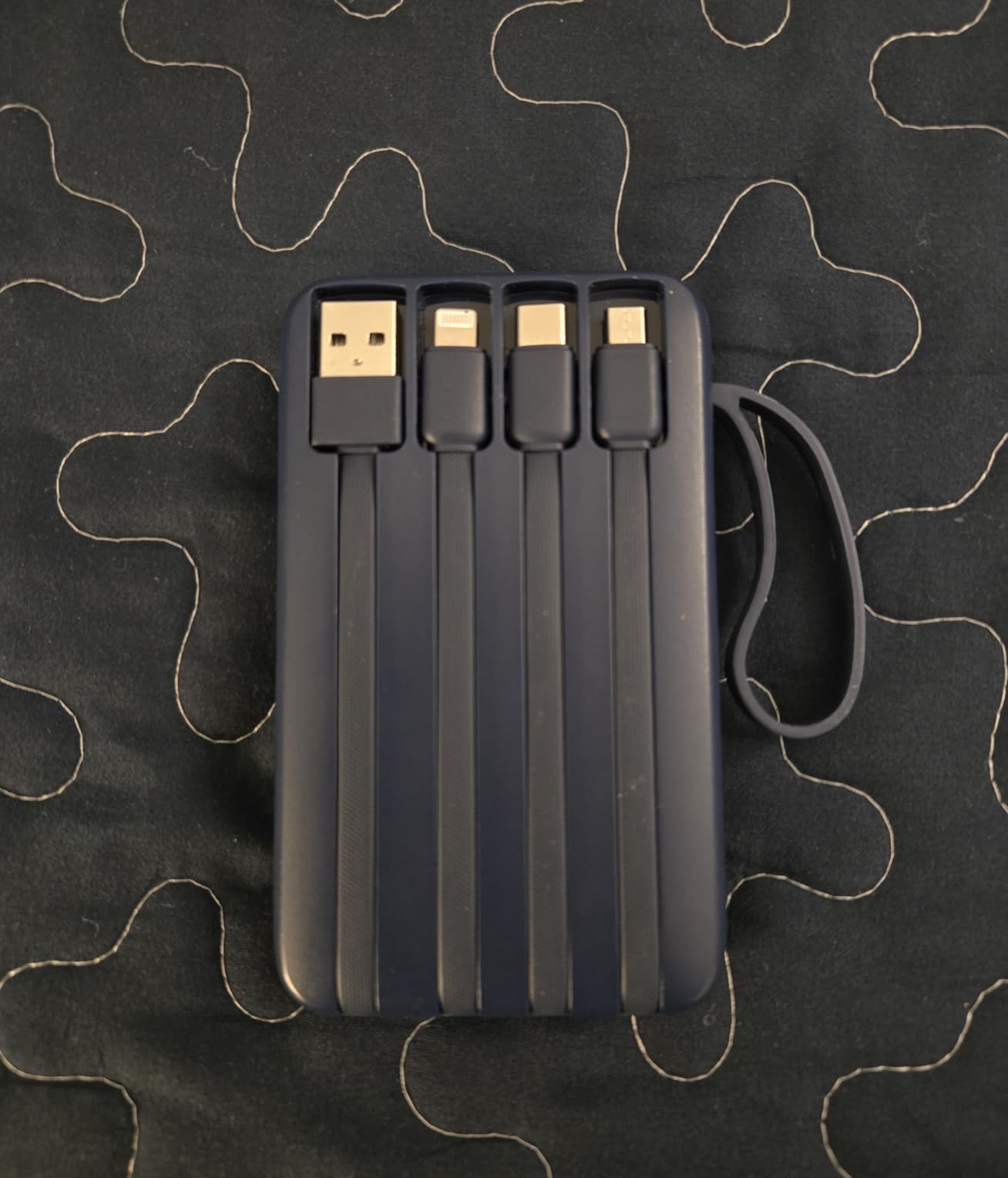
What makes this pack interesting is its shape. At 3.58 by 3.23 by 0.63 inches it is nearly square and unusually flat, so it sits at the bottom of a small purse or a jean pocket in a way that the longer rectangular packs do not. It is 178 grams, and it carries four built-in cables plus a USB-C and a USB-A port for a total of six outputs.
Charging performance is confirmed by the reviews: 22.5W output takes a phone to about 60 percent in 30 minutes, and buyers report that it runs cool with no overheating through repeated use. The LED display reads down to 1 percent, which is more precision than most packs offer.
What 10,000mAh Actually Buys You Here
At roughly 37 watt-hours, this is a one-full-charge pack rather than multi-day backup. The reviews are clear about that ceiling, and it is the right expectation for a concert, a day trip or a short holiday where you top up once a night. For anything longer, the HELLEE or the Anker 20,000mAh pack is a better fit.
It can charge up to four devices at once, though as always the total output is shared, so four devices means four slow top-ups rather than four fast ones. A bi-directional USB-C port lets you refill the pack from a wall adapter in about 2.5 hours, or 6 hours through the built-in USB-A input cable.
The Built-In Cable Durability Question
Forum threads about built-in and retractable cables usually ask one thing: do they fail at the hinge? The reported complaints here are honest ones. Some owners report the built-in Lightning cable failing before a year of use, which is the specific part that matters most for iPhone travel, and returning the cables to their stowed position takes a little practice. The multi-layer protection suite covers overcharge, overvoltage, overcurrent, short circuit and over-temperature, with an 18-month service period.
One more behavior worth knowing: charging slows noticeably once the phone passes roughly 70 percent, which is common across packs with this output tier but easy to mistake for a fault.
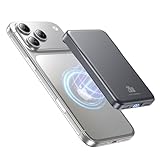
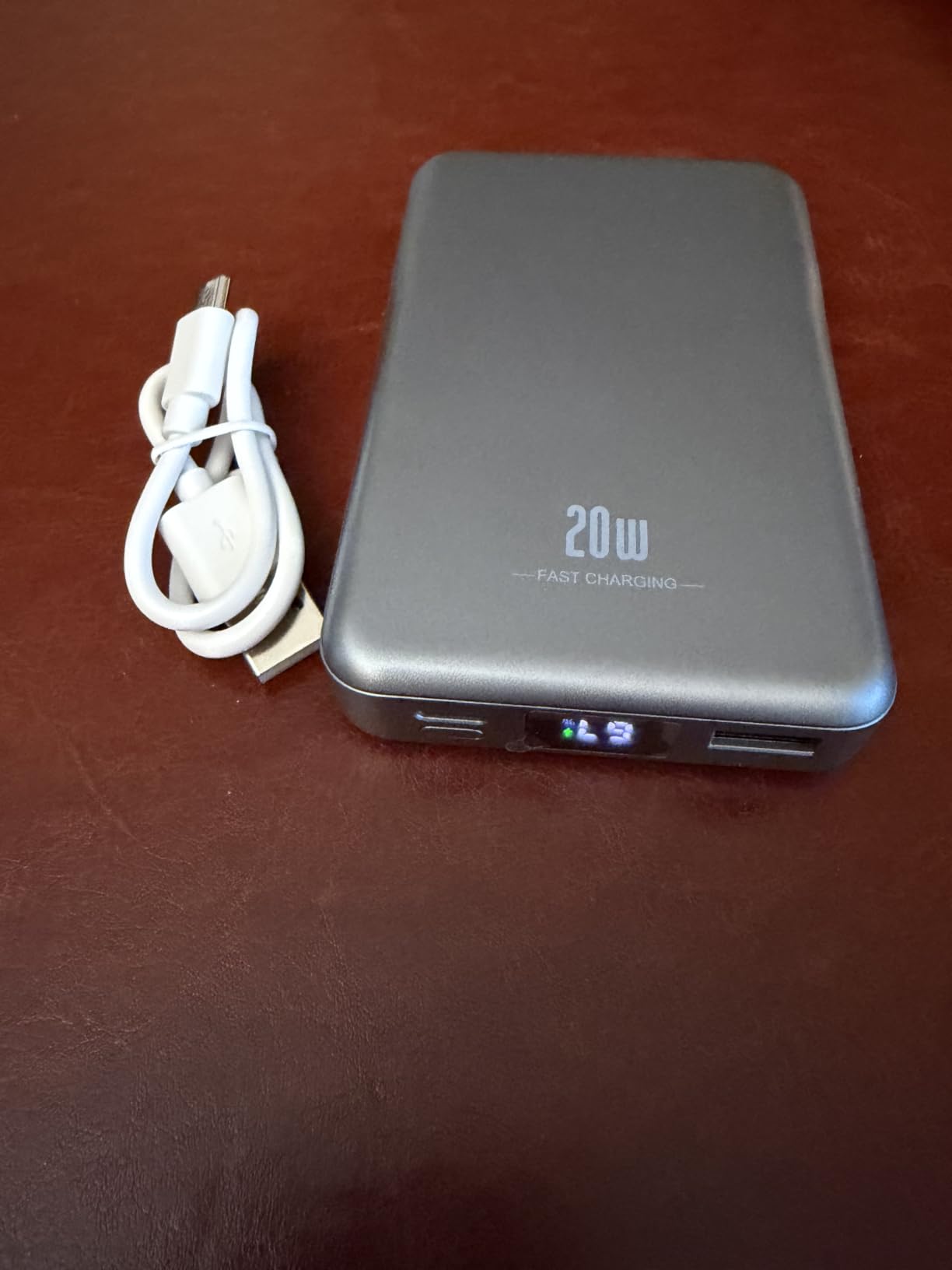
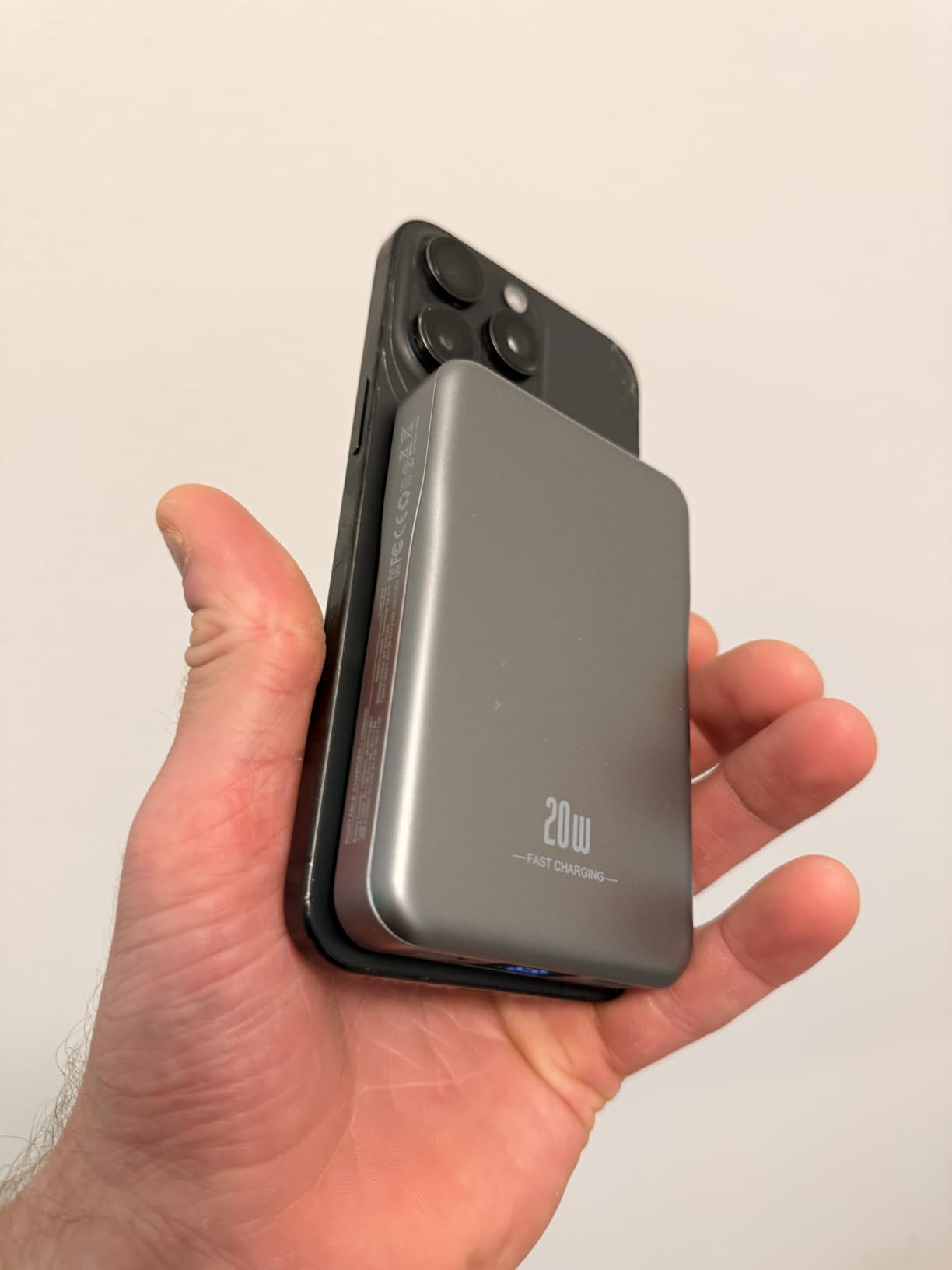
9. Aobbow 10000mAh Magnetic Power Bank – Solid Magnetic Backup With a Display
Magnetic Portable Charger 10000mAh, Fast Charging MagSafe Battery Pack
10,000mAh magnetic pack
20W USB-C wired
7.5W wireless
LED battery display
+ Pros
- 10000mAh magnetic capacity at an entry price
- Upgraded magnets hold through calls and scrolling
- 20W wired output reaches 60 percent in 25 minutes
- LED display shows remaining power
- Three outputs cover phones earbuds tablets and watches
- Cons
- Magnetic hold weakens with thick non-magnetic cases
- Larger footprint than most 10000mAh magnetic packs
- Heavier at 192 g
- Wireless path limited to 7.5W
This pack sits in an interesting middle ground. It gives you 10,000mAh, a magnetic face and an LED readout, at a price point closer to the non-magnetic packs. The magnets are described as upgraded relative to earlier versions, and owners report that the phone stays put while scrolling or during a call, which is the test that matters on a moving train.
The wired path is the stronger one: up to 20W over USB-C, which the listing states takes an iPhone 17 from 20 to 60 percent in about 25 minutes. The magnetic wireless path delivers 7.5W, the standard legacy figure, so treat it as a convenience top-up rather than a fast refill.
Why the Case Matters More Than the Magnet
Every magnetic pack in this roundup has the same fundamental requirement: your case needs its own magnet ring. With a MagSafe-compatible case the connection is firm and stays aligned, and without one the pack is a slab that slides. Reviewers of this model describe the hold as steady for calls and scrolling when a magnetic case is used, and as noticeably weaker with thick or non-magnetic cases.
That said, 10,000mAh of real capacity with a display and three years of warranty is a package that is hard to argue with, particularly for travelers moving between iPhone, Samsung Galaxy and Google Pixel devices, which the listing covers.
Size and Multi-Device Output
At 4.8 by 3.8 by 0.9 inches and 192.3 grams, this has the widest footprint of the magnetic packs in the group, which is an odd fit for a category where slimness is the whole point. Three outputs cover phones, earbuds, tablets and smartwatches, so a small travel kit can run from it, and the LED display removes the guesswork from rationing power across devices.
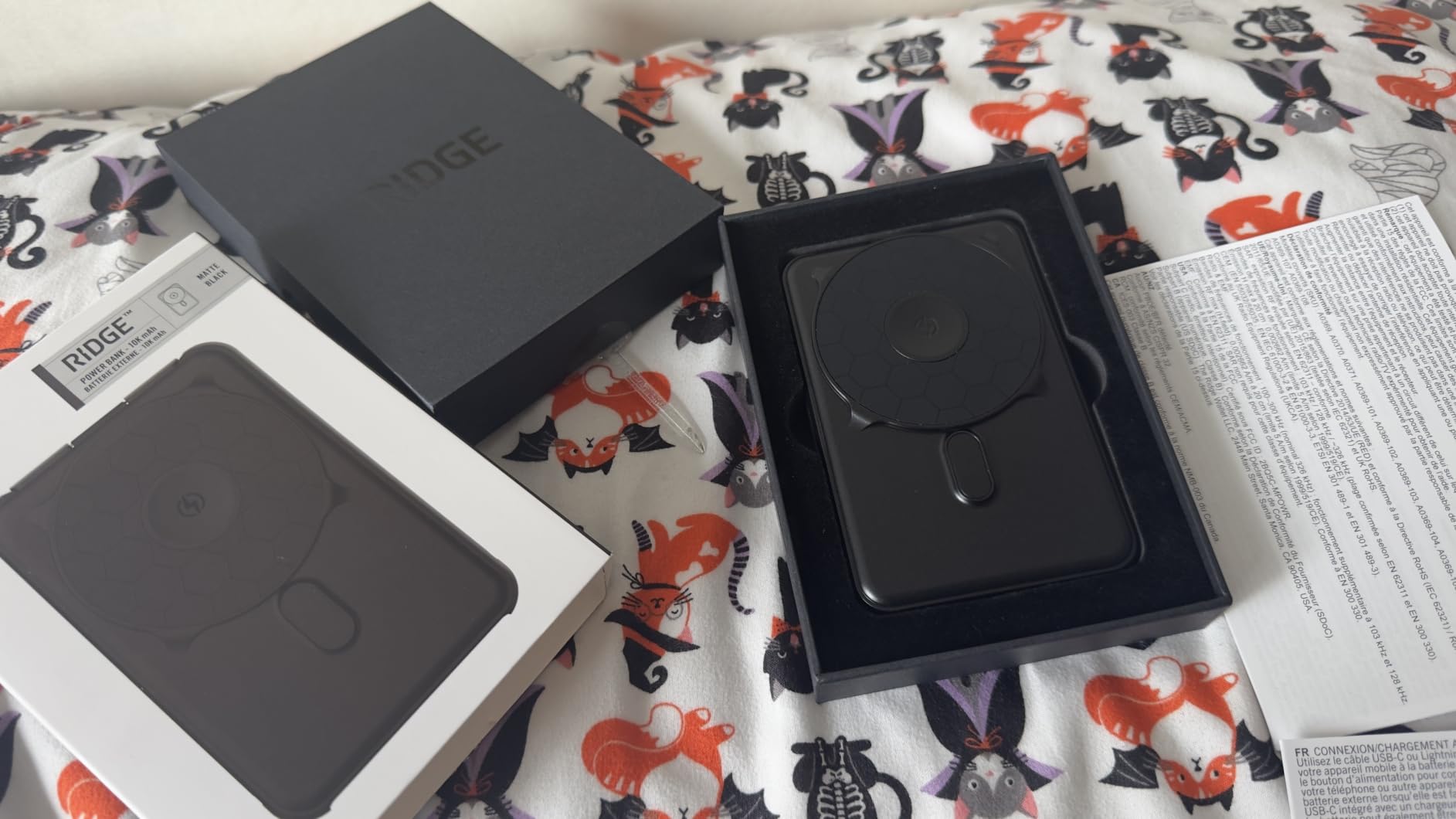
10. The Ridge 5-in-1 10000mAh Power Bank – Built for Apple Watch Travelers
Ridge 20W Magnetic Power Bank Battery Pack 10,000mAh – Fast Charging – Portable Charger Flight-Safe Travel Powerbank – Built-in Cables & Magnetic Attachment (Basecamp Orange)
10,000mAh flight-safe capacity
Built-in USB-C and Lightning cables
15W magnetic pad
2.5W watch pad
+ Pros
- Built-in USB-C and Lightning cables plus magnetic pad
- Dedicated smartwatch charging pad at 2.5W
- Kickstand for hands-free viewing
- LED charge status indicator
- About three full phone charges at 180 g
- Cons
- Lowest average rating in this group at 4.0 stars
- Wired throughput is modest
- Runs warm during charging
- Heavier at 180 g with weaker efficiency
The Ridge is the only pack here built around the Apple Watch problem, and for travelers packing a three-device Apple kit it solves something no other unit on this list does. It has a certified 2.5W smartwatch charging pad alongside a 15W magnetic wireless pad for the iPhone, plus built-in USB-C and Lightning cables and an integrated kickstand for tray-table viewing.
On a trip, that is a complete charging surface: phone on the magnetic pad, watch on its puck, AirPods on a built-in cable. Capacity is 10,000mAh at a flight-safe level, and the listing states up to three full phone charges.
What 2.5W Watch Charging Actually Does
Apple Watch charging is slow by design. A 2.5W certified pad is enough to bring a watch from flat to usable overnight, which is exactly the scenario where it matters, and it will not charge a watch at anything resembling full speed during a layover. The realistic planning rule is that the watch goes on the pad while you sleep, not while you wait at the gate.
The same applies to AirPods, which draw very little but will not survive a long trip on a few percent. Built-in cables mean the pack charges all three devices without you unpacking anything.
Where This One Falls Behind
This pack has the lowest average rating of the ten, at 4.0 stars, and reviews point to charging efficiency rather than features. Buyers report that it drains faster and charges more slowly than comparable 10,000mAh packs, and wired throughput is modest next to the 45W and 87W options here. It also runs warm during charging, especially while the phone is in use, and at 180 grams it is heavy for its class.
What it does have going for it is design coherence. If your travel kit is iPhone, Apple Watch and AirPods and you want one object that handles all three, this is the only unit on the list built for that. If you simply want the fastest possible phone charging, the INIU P55 or the Anker 20,000mAh pack is a better spend of your attention.
How to Choose a Travel Power Bank for iPhone
Choosing a travel power bank comes down to four decisions: how much capacity your itinerary needs, how much wattage you want, whether magnetic wireless is worth the case requirement, and whether the airline rules allow what you are carrying. Get those right and the rest is preference.
Capacity, Watt-Hours and the Airline Rules That Decide Your Trip
Power banks must travel in carry-on baggage, never in checked luggage, because a loose lithium battery in a cargo hold is a fire risk that aviation rules take seriously. The size limit is 100 watt-hours without approval. To convert, multiply the milliamp-hour figure by 3.7 volts and divide by 1000: a 5,000mAh pack is about 18.5Wh, 10,000mAh is about 37Wh, 15,000mAh is about 55.5Wh, and 20,000mAh is about 74Wh.
Every pack in this roundup sits under 100Wh and travels legally. A 30,000mAh pack works out to roughly 111Wh, which exceeds the limit and needs airline approval in advance, and anything beyond that is not permitted at all. When an agent at the checkpoint asks, they want to see the watt-hour label on the housing, so check it at home rather than in the line.
Portable chargers were not banned. They are inspected, and a bank with a visible, readable watt-hour rating passes through without difficulty.
Wattage Tiers and the Power-Sharing Rule Everyone Misses
Match the output to what you are actually carrying. Up to 20W covers a phone and a pair of earbuds comfortably. 30W to 45W handles a phone quickly and leaves headroom for a small tablet or handheld console. 65W and above is laptop territory, and nothing below 45W will meaningfully charge a MacBook Air.
Then read the sharing behavior. Nearly every pack that has two or more ports divides its total output when more than one device is connected, so a 45W pack charging two phones gives each far less than 45W. Peak single-device wattage is the number that describes your solo charging speed, and it is the number most worth comparing across models.
Slow charging is usually a protocol mismatch rather than a fault. Charging from a computer USB port, an old wall adapter, or a pack whose input wattage is low will deliver far less than the output rating suggests, and some packs will only fast-charge when their own refill cable is used.
MagSafe Wireless Versus Wired Charging
Magnetic charging is about convenience, not speed. A Qi2-certified 15W magnetic pad is genuinely quick for a top-up and needs no cable at all, but any 20W or faster wired connection will still refill an iPhone faster. Plan on wireless for airport waiting and top-ups, and wired for the pre-boarding rescue.
Two practical warnings. A magnetic bank needs a MagSafe-compatible case, or the connection softens in a bag or a car mount. And magnetic packs generate more heat than wired ones, so they throttle sooner in a warm car, a crowded train or a sunlit terminal. If your phone runs hot while charging, a cable is the cooler path.
Built-In Cables, Pass-Through Charging and the Apple Travel Kit
Built-in cables solve the most reported travel failure: a cable that is missing when you need it. They cannot be lost or left behind, and in packs like the Anker 20,000mAh unit the cable is rated for more than 10,000 bends. The cost is that a permanently attached cable is short, and if it fails the whole unit is affected.
Pass-through charging is a different feature, and few packs in this roundup offer it. It means the pack is plugged into a wall while it charges your phone from its own ports, so one adapter serves both. If your hotel room has a single outlet and you are also charging a laptop, it is a feature worth searching for deliberately rather than assuming.
For your watch and earbuds, the Ridge handles all three devices from one unit, and the Anker 20000mAh pack handles the phone and laptop while your watch recharges at the hotel overnight.
Safety Marks and the Capacity Inflation Problem
Lithium-ion packs fail rarely when they are built properly, and the marks that indicate proper testing are printed on the housing: UL 2056 for portable battery packs, IEC 62368 for general electronic safety, and UN38.3 for transport, which is the certification airlines expect to see.
The recurring warning in owner communities is capacity inflation. Unbranded packs advertise 20,000mAh and deliver a fraction of that, which is why reviewers repeatedly recommend sticking with established brands and why it pays to read the warranty terms. A 24-month or 36-month warranty with connected-equipment coverage is a reasonable proxy for a manufacturer that stands behind the cells. In our list, a clear charge readout is also a useful honesty signal, because a pack that underdelivers is harder to hide when the percentage is on the housing.
Frequently Asked Questions
Which power bank is best for travel with an iPhone?
For most travelers a 10,000mAh pack is the sweet spot: it is about 37 watt-hours, well under the airline limit, and delivers roughly one and a half to two full iPhone charges. Pick a magnetic 10,000mAh unit such as the TORRAS MiniMag for cable-free top-ups, or the INIU P55 if you want fast 45W wired charging, a percentage display and three ports.
Is a 20000mAh power bank allowed in flight?
Yes. A 20,000mAh pack works out to about 74 watt-hours using the standard conversion of milliamp-hours multiplied by 3.7 volts and divided by 1000, which is under the 100Wh carry-on limit. It must travel in your carry-on bag and never in checked luggage.
Can you fly with a 30000mAh power bank on a plane?
Usually not without prior approval. A 30,000mAh pack is about 111 watt-hours, which exceeds the 100Wh limit that most airlines and aviation rules apply to carry-on batteries. Between 100Wh and 160Wh some airlines permit a unit with approval in advance, and anything beyond 160Wh is not permitted at all.
Did TSA ban portable chargers?
No. Power banks are still allowed through airport security and on airplanes. They are screened like any other lithium battery, must be carried in hand luggage rather than checked, and agents may ask you to show the watt-hour label printed on the housing.
Why is my power bank charging my iPhone so slowly?
The usual causes are a low-power wall adapter, charging from a computer USB port instead of a wall plug, power splitting because a second device is connected, or heat slowing the pack down. A magnetic bank that feels hot will also throttle wireless charging until it cools. Check what your source adapter is rated for and connect only one device at a time.
Is MagSafe charging slower than wired charging?
Yes, generally. A Qi2-certified magnetic pack delivers up to 15W, while a 20W or faster USB-C connection refills an iPhone more quickly, and packs rated at 30W to 65W are faster still. Magnetic charging is more convenient for a top-up in a moving terminal, where a cable is inconvenient rather than fast.
Which Travel Power Bank Is Right for You?
If you want one battery to carry on every trip, the INIU P55 is our first choice. It has the largest review base of anything we tested, a 4.5 average across more than 24,000 ratings, and it delivers 45W output, three ports, a digital charge readout and a three-year warranty in a body light enough for a carry-on only trip. If you would rather carry something you can slip into a jacket pocket, the TORRAS MiniMag is the pick: half an inch thick and 6.4 ounces, it does both 22.5W wired and magnetic top-ups without asking you to give up the other.
For specific itineraries, the decision narrows quickly. On a weekend city break where you charge nightly, the podoru 5,000mAh pack is enough and lighter than anything else here. On a long-haul flight where you will watch something at the tray table, the Anker 633 with its fold-out kickstand is the right tool. On a two-week trip or a laptop-heavy work schedule, the Anker 20000mAh Travel Essential carries 20,000mAh, a built-in cable that cannot be lost and enough output to top up a MacBook. If you travel with an Apple Watch and want one object for phone, watch and earbuds, the Ridge is built for exactly that.
Whichever you choose, the packing rules stay the same. Keep it in your carry-on, check the watt-hour label before you leave the house, and top it up with a proper wall adapter the night before you fly. After weeks of testing these ten on real itineraries, that preparation made more difference than any single spec on the list.