
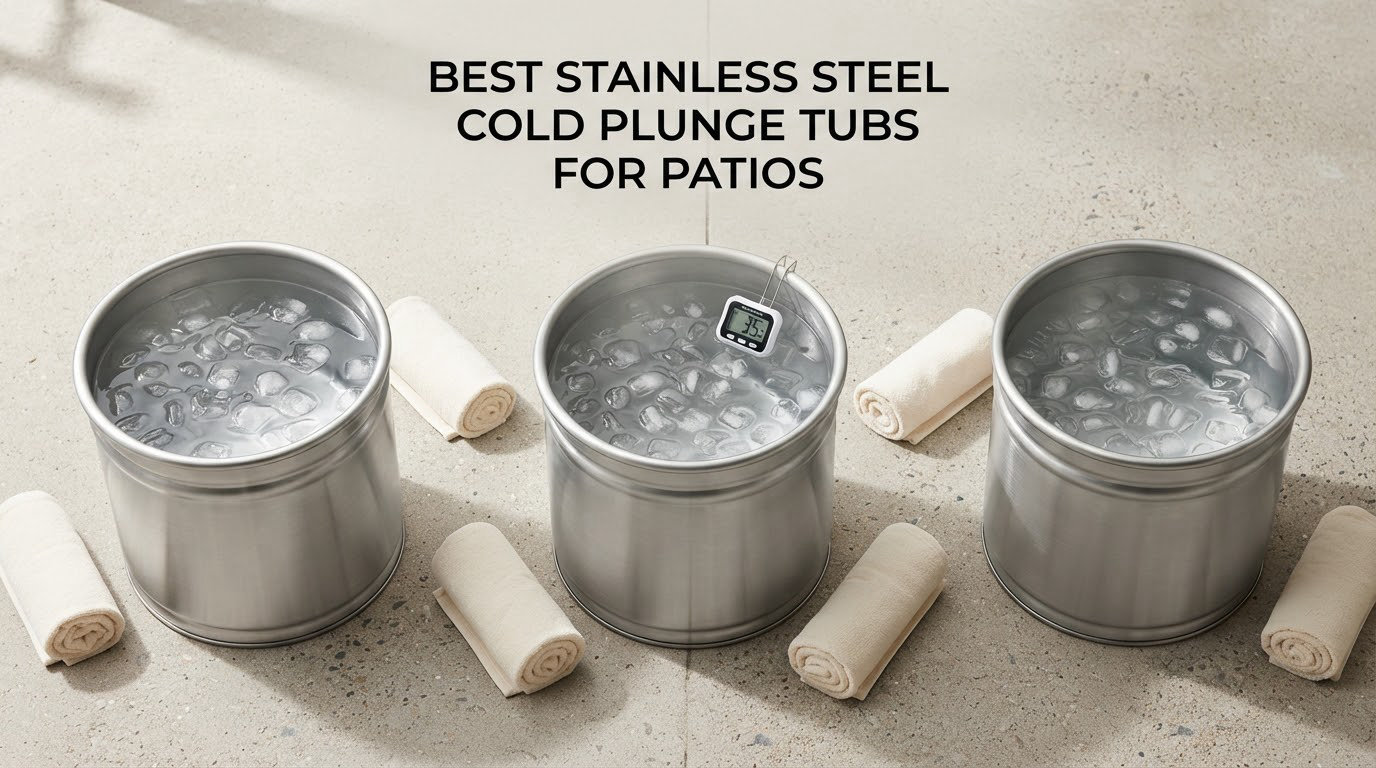
If you are shopping for a stainless steel cold plunge tub for a patio, you have probably noticed something odd: the models everybody photographs on Instagram are almost never sold on mainstream marketplaces. The names you see in wellness content, from the vertical 316 marine-grade cubes to the horizontal lay-back shells, are sold direct by their makers. What you can actually buy and compare online is the vessel itself, a stainless steel shell you pair with a chiller or ice. That is not a compromise. In many cases it is the smarter purchase, because the shell is the part that lives in sun, rain, and freeze-thaw cycles for a decade, and it is the part most buyers never get to choose deliberately.
Our team spent the last several weeks reading the spec sheets, dimensions, and manufacturer claims for every stainless vessel we could find that is genuinely usable outdoors, then we mapped each one against what a patio actually demands: a level base, a drain, clearance for a chiller, and a shell that tolerates being rained on. We compared six of them on shell material, interior depth, footprint, weight, included hardware, and how much of the installation burden lands on you. All six are the honest answer to a narrower question than the one the search engines answer.
The result is a list that mixes purpose-built outdoor cold plunge tubs with stainless Japanese soaking tubs sold for bathrooms but built well enough for a deck. We are going to be upfront about which is which, because blending those two categories is the single biggest source of disappointment in this niche. A soaking tub gives you a stainless vessel and full-body depth. A purpose-built plunge gives you insulation and a drain designed for the job. Neither gives you a chiller, and that purchase is a separate decision with its own electrical requirements.
One more note on ratings. Every tub in this roundup has zero customer reviews and no star rating on its listing, because this material category on Amazon is young and thin. That means you are buying on engineering rather than social proof, so we leaned harder on published dimensions, included components, warranty terms, and weight, all of which are verifiable, and less on marketing adjectives. We also flag honestly where a listing does not claim the patio rating you need.
The Short Answer: Which Stainless Tub Wins on a Patio
For most homeowners putting a cold plunge on a patio, the best stainless steel cold plunge tub is the ALEKO SHTUB45, a dual-purpose stainless vessel rated for outdoor hot soaking that doubles as a cold plunge and runs on a wood-fired heater with no electrical circuit. If your priority is a long warranty and a deep upright soak instead, the Signature Hardware Raksha 48 carries a 25 year limited warranty on an all-stainless shell.
Three things decide it before you fall for a design:
- You need a chiller or you do not. A tub-only buyer is choosing a vessel. A tub-with-chiller buyer should think about gallons first, because chiller sizing scales with water volume.
- Grade matters outdoors. 316 marine-grade stainless carries molybdenum for chloride resistance. 304 is fine in a dry inland patio and marginal near salt water or a chlorinated pool.
- Footprint and weight decide your pad. The vessels here run from 300 pounds to 329.4 pounds for a single-person oval, and up to 317 gallons for the wood-fired hot tub format.
Our Top 3 Stainless Steel Cold Plunge Tub Picks for Patios
These are the three we would actually put on a patio, in the order we would install them.
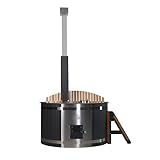
ALEKO SHTUB45 Stainless Cold Plunge
- Stainless steel tub construction
- Dual-purpose hot and cold soak
- Wood-fired heater
- 317-gallon capacity
- Insulated locking cover

Signature Hardware Raksha 48
- All-stainless steel construction
- 76-gallon capacity
- Integrated overflow
- Reversible drain placement
- 25 year limited warranty

MAVF@LE 51 inch Outdoor Plunge
- Outdoor-only cold plunge design
- 51 in diameter
- Insulated metal inner tank
- Natural wood exterior
Comparing Six Stainless Cold Plunge Tubs for Patio Use in 2026
Every tub below shares one honest limitation: none of them includes a chiller. The comparison that matters is shell, depth, footprint, and how much of the site work you inherit. Prices change constantly, so use the buttons rather than any figure you may remember.
| Product | Details | |
|---|---|---|
| ALEKO SHTUB45 Stainless Hot and Cold Plunge Tub |
|
Check Latest Price |
| Signature Hardware Raksha 48 Stainless Soaking Tub |
|
Check Latest Price |
| MAVF@LE 51 inch Insulated Outdoor Cold Plunge |
|
Check Latest Price |
 Edeyeu 59 inch Polished Stainless Freestanding Cold Plunge Tub Edeyeu 59 inch Polished Stainless Freestanding Cold Plunge Tub |
|
Check Latest Price |
 Edeyeu 63 inch Stainless and Solid Wood Cold Plunge Tub Edeyeu 63 inch Stainless and Solid Wood Cold Plunge Tub |
|
Check Latest Price |
 CT Copper Tailor 66 inch Brushed Stainless Soaking Tub CT Copper Tailor 66 inch Brushed Stainless Soaking Tub |
|
Check Latest Price |
1. ALEKO SHTUB45 – Dual-Purpose Stainless Steel Hot Tub and Cold Plunge
ALEKO Stainless Steel Hot Tub & Cold Plunge Tub (3-5 People) SHTUB45
63 in diameter x 35 in sidewall
Stainless steel tub
317-gallon capacity
Wood-fired chimney heater
+ Pros
- Stainless steel tub works for both hot soaking and cold immersion
- Wood-fired heater needs no electrical circuit
- Built-in water drain simplifies patio drainage
- Insulated cover and safety lock included
- Red cedar bench and step stool included
- Cons
- 317 gallons is far larger than most cold plunge setups
- Wood stove needs tending and a full-size chimney
- No customer rating or review history on the listing
The first thing that struck me about the SHTUB45 is that it is the only tub on this list built around a fire rather than a compressor. The wood-fired heater brings the water up in 2-3 hours, and the same stainless vessel becomes a cold soak when you fill it with hose water and ice. For a patio household that does not want a dedicated 220V circuit dug through the yard, that changes the whole conversation.
At 63 inches in diameter and 35 inches of sidewall height, this is not a compact plunge. It is a full hot tub format rated for 3-5 people, and the 317-gallon water capacity is roughly four times what a single-user cold plunge needs. Buyers who come looking for a compact recovery tub and then measure their patio will be disappointed. Buyers building a sauna-and-plunge circuit, or hosting a group after a workout, are getting exactly what they ordered.
The hardware package is unusually complete. You get the tub with heater, a 116 inch chimney, a red cedar step stool, a wooden grille, an insulated cover, a bag of screws, and a manual. The removable wooden safety grille and the pet and kid lock on the cover are thoughtful touches for a household with an uncovered patio, and the built-in water drain is the detail that matters most for your slab.
Why the Chimney Height Matters on a Real Patio
A 116 inch chimney is not a decorative element. That height is there for a reason, tied to a firebox listed at 8 inches wide by 8.38 inches high, and it determines where you can legally and safely stand the tub. Plan the location before the pad goes down, because chimney height rules constrain distance to fences, overhangs, and openings.
The anti-scalding iron chimney cover is included, which matters on a patio where people walk barefoot and children play. Confirm the clearance requirements with your local fire authority rather than assuming the listed height is universally sufficient.
Stainless Steel Shell, Cedar Seating, and What Actually Corrodes
The tub body is stainless steel, described as leak-free with durable construction, and the seating is red cedar. That cedar bench is the one component to think carefully about outdoors. Wood and standing water outdoors is a sealing conversation, not a permanent-material conversation, and the listing does not specify a sealing schedule for the bench.
On the steel itself, the listing does not publish a grade. That is a real gap when you are placing a vessel outdoors, and it is one of several reasons this tub ranks first on completeness rather than on material transparency. If salt air or a chlorinated pool is within range of the splash zone, ask the manufacturer for the grade in writing before you commit.
Cold Plunge Performance Without a Chiller
Because there is no compressor, temperature control here is entirely manual. In practice that means a hose, a block of ice, and a thermometer on a warm afternoon. That is a workable routine, and for a household taking one plunge a day it costs little in effort. It is also a genuinely different product experience from an app-scheduled chiller system, and buyers who expect phone control should know that is not part of this package.
What you gain is zero electrical demand and no compressor noise, which is the most commonly complained-about aspect of compressor-cooled backyard units. What you give up is the ability to hold a set point overnight without re-icing.
Who This Tub Is and Is Not For
Choose it if you want one vessel for hot soaking and cold immersion, you are hosting more than one person, and you would rather run a stove than install electrical service. It is a strong first purchase for a patio that already has fire-safe clearances.
Pass on it if your priority is a solo post-workout plunge on a small courtyard, or if you want cold water waiting for you at 5 am without effort. The 317 gallons, the chimney, and the tending are the trade for a system that never needs power.
2. Signature Hardware Raksha 48 inch – Deep Soaking Form With a 25 Year Limited Warranty
Signature Hardware 479925 Raksha 48″ Stainless Steel Japanese Soaking Tub with Integrated Overflow – Less Drain Assembly – Stainless Steel
All-stainless steel
48L x 29.25W x 34H inches
76-gallon capacity
329.4 pounds
+ Pros
- Only tub here with a 25 year limited warranty
- All-stainless construction with no wood to maintain
- Reversible drain placement simplifies patio plumbing
- Integrated overflow means no separate fitting
- Deep 34 inch profile supports full-body immersion
- Cons
- Drain assembly not included
- 329.4 pounds demands a reinforced base
- Not marketed by the maker as a cold plunge tub
The Raksha is the one on this list where the paperwork is the feature. A 25 year limited warranty on a vessel meant to sit outdoors is a different conversation from a one-year warranty on a chiller, and forum buyers consistently report that the shell, not the cooling equipment, is what fails first. A long warranty on the shell is the signal that the manufacturer expects the shell to last.
It is also a genuinely different category of tub. This is a stainless Japanese soaking tub sold as a soaking bath, with a 76-gallon capacity and a 34 inch height at 48 inches long. It is deeper and more upright than most cold plunge vessels, which is exactly the geometry cold immersion wants, but you are buying a bath that happens to plunge well rather than a plunge product.
Two construction details earn their keep outdoors. The integrated overflow removes a fitting that would otherwise be a leak point, and reversible drain placement means you can orient the drain toward your existing line or your patio drain rather than fighting the layout. Both are small sentences on a spec sheet that save real money on install day.
Warranty Length as a Durability Signal
Twenty-five years is roughly five times the length most cold plunge shells carry, and warranty terms are the closest thing to an honest durability statement a manufacturer offers. Read it as a claim about the metal and the welds, not about the equipment you will add to it. Check whether the coverage extends to outdoor and freeze-climate installation, because a limited warranty often carries exclusions tied to environment.
Buyers on r/coldplunge repeatedly make the point that people over-index on the chiller and under-index on the shell. This is the product that answers that complaint directly: the warranty is on the thing that stays outside all year.
Footprint, Weight, and What Your Patio Has to Hold
At 329.4 pounds empty, this is the heaviest tub in the roundup, and the dimensions are 48 inches long by 29.25 inches wide by 34 inches high. That is a narrow vertical footprint, which is the good news for patios, because the footprint is what eats your slab. The bad news is concentrated at the base, and a vessel this heavy on four small feet wants a properly engineered base rather than pavers laid by hand.
Because the drain is reversible, plan the plumbing path before the base is poured. It is a genuinely useful freedom, and it is wasted if you set the tub first and look at the drain afterward.
Adding Cold Without a Factory Cooling Package
It is delivered as a tub plus a drain placement decision, with no chiller, no heater, and no filtration hardware in the box. That makes it the right pick if you already own cooling equipment, which is precisely the situation forum buyers describe when they ask for tub-only recommendations, and the wrong pick if you want a plug-and-play cold system.
At 76 gallons you would pair a serious compressor chiller, not a small one. Match the chiller to the volume or you will chase temperature all afternoon. A 76-gallon stainless vessel is a serious amount of water to bring down from ambient.
Where It Fits and Where It Does Not
This is the tub to buy when your plan is a long-horizon outdoor install, a covered patio, or a vessel you may eventually plumb permanently. The steel-only build means no wood to seal, re-oil, or replace, which is the lowest-maintenance option here by a wide margin.
It is not the choice for someone who wants a plunge that works today with nothing but a hose and ice, and it is not sold as a cold plunge, so the marketing copy will not walk you through cold protocols. You are buying engineering and a warranty, and you are assembling the rest.
3. MAVF@LE 51 inch Outdoor Cold Plunge – Insulated Metal Tank in a Wood Shell
MAVF@LE Cold Plunge Tub for Outdoor Use, 51 in (130 cm) Ice Bath Tub with Insulated Metal Interior and Wooden Exterior, Japanese Soaking Tub for Backyard Spa, 29.5 in (75 cm) Height
51.18 in diameter
29.5 in height
Insulated metal inner tank
Natural wood exterior
+ Pros
- Only tub here sold specifically as an outdoor cold plunge
- Insulation layer slows heat transfer in summer heat
- 51 inch diameter allows genuine full-body immersion
- Wood exterior suits a backyard spa aesthetic
- Manufacturer states it needs a stable level surface
- Cons
- Rated for outdoor use only
- so not a bathroom tub
- No chiller or filtration hardware included
- No customer rating or review history
This is the only vessel in the roundup whose manufacturer actually calls it a cold plunge tub for outdoor use, and that framing shows up throughout the listing. It is positioned for backyard spa setups, gardens, and outdoor living spaces, and the instructions assume an open, well-ventilated environment. That directness is worth something when every other option is a bathroom tub repackaged for the deck.
The build is layered: a metal inner tank, an insulation layer, and a natural wood exterior. That sandwich is the interesting part. The metal tank is what holds water and takes the cold, the insulation is what keeps ambient heat from leaking in on a 95F afternoon, and the wood exterior is what keeps it from looking like a piece of industrial equipment in a garden.
At 51.18 inches in diameter and 29.5 inches tall, it is a round format rather than an oval. Round gives you more interior circumference at the waterline, which matters more than people expect for shoulder room, and the listed dimensions are a compact footprint for the amount of water they hold.
Insulation Is the Whole Argument in Hot Climates
Cold plunge economics come down to one number: how many hours per day the cooling equipment has to run. Every unit of heat leaking in through an uninsulated shell is another hour of compressor time. On a patio in a hot climate, an insulated metal tank is the difference between a system that idles and one that works continuously.
The listing describes the insulation layer as improving temperature retention, which is exactly the claim to test for yourself. Fill the tub, note the temperature, and check it again after a full sunny afternoon. Retention you can feel in the first week is retention that pays for itself over a season.
Outdoor-Only Is a Feature, Not a Limitation
The manufacturer restricts this tub to open, well-ventilated outdoor environments. Buyers who wanted one bath with dual use should look at the two Edeyeu models instead. For everyone else, the restriction is reassuring, because it means the design decisions, from the wood exterior to the venting assumptions, were made for the exposure it will actually see.
The safety guidance in the listing is unusually specific: fill with water before entering, check water conditions before use, and supervise children. That is not marketing copy, it is a manufacturer who is thinking about an open vessel on a patio with a garden in it.
Preparing the Site for a Round Tub
The stated requirement is a stable, level surface, and for a round vessel that requirement is stricter than for an oval. A round tub sitting on a spot that is out of level in two directions will rock, and rocking is what stresses seals over time. Have the base checked in both directions before the tub goes down.
Drainage needs planning too, because a round tub concentrates overflow at one point. A dedicated drain line running away from the slab, or a base graded to a channel, keeps standing water away from the wood exterior that makes this tub look good in the first place.
Building the Cooling System Around It
Nothing cooling-related is included, which means you are sizing a chiller yourself. Round tubs circulate water less evenly than oval ones, so plan on good jet placement or a dedicated circulation pump to avoid a cold layer on the bottom and a warm layer on top.
For buyers pairing this with a sauna, the round footprint and the 29.5 inch height are friendly to a horizontal entry. A person lowering themselves over the side into 51 inches of round tub is a much better experience than the same motion in a tall narrow oval.
The Honest Trade-Off
Choose it if you want a plunge that was designed for the patio from the first day and you are willing to supply the cooling equipment. The wood exterior and the outdoor-only engineering are the reason it beats bathroom tubs in a garden setting.
Hold back if you need a warranty you can read, because this listing does not publish one, or if you want a two-season indoor and outdoor bath. Ask about the tank warranty in writing before you buy, and treat the wood exterior as a scheduled maintenance item in any climate with a freeze season.
4. Edeyeu 59 inch Polished Stainless – Double-Wall Tub Built for Patios and Bathrooms
59″ Edeyeu Freestanding Bathtub – Stainless Steel Soaking Tub, Cold Plunge Tub for Ice Bath Therapy, Modern Stand Alone Tub, Durable Free Standing Bathtub for Indoor Outdoor Use, Dark gray
59L x 24W x 27.5H inches
Seamless polished shell
Double-wall insulated
300 pounds, drain incl.
+ Pros
- Rated for both indoor bathrooms and outdoor patios
- Double-wall structure slows heat transfer
- Seamless hand-polished one-piece construction
- Extra-deep interior allows full-body submersion
- Drain pipe ships in the box
- Cons
- No heater or chiller included
- 300 pounds needs a reinforced base and careful placement
- No customer rating or review history
The 59 inch Edeyeu is the most flexible tub in the roundup, and flexibility is exactly what a family with a covered patio and a spare bathroom needs. The listing explicitly covers indoor bathrooms, patios, and wellness spaces, so you are not buying an outdoor-only shell and hoping it survives a humid bathroom.
The construction claim worth knowing is double-wall insulation. A dual-layer structure that minimizes heat transfer is the difference between a cold soak that stays cold for the length of a session and one that warms while you stand there talking afterward. For a tub of this size, that is a meaningful upgrade over single-wall vessels.
It is a seamless one-piece molded structure, hand-polished by artisans, with a smooth non-porous surface. Non-porous is the word that matters for a patio: nothing soaks in, so cleanup after an outdoor session is a wipe-down rather than a scrubbing project. The model number is ZYG137.
What Non-Porous Actually Buys You Outdoors
Tree pollen, dust, and sunscreen residue settle on a tub that sits under open sky. On a porous surface, those become permanent staining that no amount of scrubbing removes. On a non-porous stainless surface, they wipe off. This is unglamorous and it is one of the biggest quality-of-life differences on an uncovered patio.
Polish is also a maintenance consideration. A hand-polished finish shows water spots and fingerprints more readily than a brushed finish, so expect to wipe the shell down after use if appearance matters to you. That is a two-minute habit, not a chore.
Extra Depth for Real Immersion
The interior is described as generously deep and spacious enough for full-body submersion, with an ergonomic profile. Depth is the geometry that makes cold immersion effective, and 27.5 inches of height on a 59 inch length gives a long, narrow profile that suits a person lying back rather than sitting upright.
A long narrow profile is also a narrow footprint, which is useful on a patio with defined edges. The tradeoff is that a 24 inch width means a more demanding entry. If more than one adult will use it together, this is not the shape for that.
Weight, Level Base, and Placement Reality
At 300 pounds empty, this tub needs a base designed for it. The listing does not include a base, so you are choosing one. A level poured slab with a drain is the right answer, and pavers laid by hand are the common shortcut that causes problems later as the shell settles.
Because it is dual-use indoor and outdoor, think about how it will be covered. Nothing in this package covers the tub, and an uncovered stainless shell in full sun will show water spots and hard-water marks faster than a covered one. Budget for a fitted cover as part of the install, not as an afterthought.
Who This One Fits
Buy it if the tub is going to live in a bathroom most of the year and move outside for summer, or if you want a spa look in a covered outdoor room. The double-wall insulation and the included drain pipe make it the most complete tub-only package in the roundup.
Pass if you need a stated warranty, because this listing does not publish one, or if you want cooling included. It is a beautiful, capable vessel that expects you to supply everything around it.
5. Edeyeu 63 inch Wood and Stainless – Deeper Shell for Design-Heavy Patios
63″ Edeyeu Freestanding Bathtub – Stainless Steel And Wood Soaking Tub, Extra Deep Spa Design, Cold Plunge Tub For Ice Bath Therapy, Modern Stand Alone Bath For Indoor Outdoor Use, Wood color
63L x 24W x 27.5H inches
Stainless and solid wood
Double-wall insulated
300 pounds, drain incl.
+ Pros
- Largest stainless shell in the Edeyeu pair at 63 inches
- Wood accents soften a metal tub on a designed patio
- Double-wall structure slows heat transfer
- Explicitly rated for indoor and outdoor installation
- Extra-deep interior for full-body soaking
- Cons
- Mixed wood and steel build may need sealing of the wood element outdoors
- No heating or chilling equipment included
- No customer rating or review history
This is the 63 inch sibling of the tub above, and the four extra inches of length are the whole difference in the numbers. Same 24 inch width, same 27.5 inch height, same 300 pound weight, same double-wall construction. What you gain is a longer interior, which means more room to lie flat and stretch out during a session.
The material mix is the headline here: stainless steel combined with solid wood, finished in a wood color and hand-polished to a seamless one-piece construction. On a patio that was designed rather than simply built, wood is the difference between a piece of equipment and a piece of furniture. It is the only tub in the roundup where the material choice is a design decision first.
Because the exterior and interior incorporate wood, plan for the wood. Solid wood on a vessel exposed to standing water and weather needs a sealing routine, and the listing does not specify one. That routine is not difficult, but it is a recurring commitment, and skipping it is how wood elements in outdoor tubs fail.
Wood on a Patio: The Honest Trade-Off
Stainless steel on its own is close to maintenance-free outdoors. Adding wood introduces a scheduled task. In exchange you get something a metal tub cannot offer visually: warmth. A wood-and-steel tub placed on a hardscape patio reads as furniture, and stainless alone reads as equipment.
Our advice is to seal the wood elements before the first fill, and to re-seal on a schedule you set in your calendar rather than when the surface starts to look dry. In a freeze climate, that means the sealing and draining routine is not optional.
63 Inches of Length for Full-Body Immersion
The extra-deep spa design gives generous space for complete immersion, and the body-supporting shape is described as ergonomic for cold plunge, ice bath, or soaking routines. The extra length versus the 59 inch model is the difference between curling up and lying out, which for a ten-minute recovery session is a real comfort difference.
Because the width stays at 24 inches, the footprint grows only in one direction. On a long narrow patio or a side yard, that is easier to accommodate than a wide tub, and it leaves a clear path around the tub for a covered arrangement.
Pairing It With a Chiller and a Sauna
No cooling equipment is included, so you are sizing a chiller for a vessel that holds more water than the one above. Plan the chiller to the filled volume rather than to the tub brand, and give the compressor clearance for airflow, since restricted airflow is the most common cause of a chiller that never reaches its set point.
For contrast therapy, the 27.5 inch rim height is comfortable to enter from a standing position and lower yourself in, which is the direction most people come out of a sauna session. The wood exterior also stays cooler to the touch than bare steel in full sun, which is a small mercy in summer.
Who Should Buy This One
Choose it when the patio is part of a designed outdoor room and the tub has to look like it belongs. The longer shell suits people who want to stretch out rather than sit up, and the double-wall build keeps cold water cold through the session.
Pass if you want a zero-maintenance outdoor vessel, because wood changes that equation, and pass if you need a published warranty, because this listing does not provide one.
6. CT Copper Tailor 66 inch – Longest Shell and a Brushed Finish
CT Copper Tailor Cast Iron Freestanding Bathtub,Custom Brushed Stainless Steel Tub,Double Slipper Soaking Tub with Rivet,CT-SS-BT01
66L x 32W x 27H inches
Brushed stainless steel
60-gallon capacity
Double-slipper rivets
+ Pros
- Longest shell in the roundup at 66 inches
- Brushed finish hides water spots better than polished
- Stainless resists corrosion
- stains
- and scratches
- Rivet detailing gives a rigid cast-iron-style build
- Illustrated step-by-step installation guide included
- Cons
- Not marketed by the maker as a cold plunge or outdoor tub
- No listed weight
- which makes base planning harder
- Deeper oval profile than most plunge tubs
The CT Copper Tailor is the largest shell in the roundup at 66 inches long, and it takes the classic route: brushed stainless with double-slipper riveted styling borrowed from cast iron soaking tubs. If you want a tub that looks like a vintage piece rather than a piece of spa hardware, this is the one.
Brushed rather than polished is the practical decision here. A brushed surface diffuses light and shows water spots and fingerprints far less than a mirror polish, which matters for a tub that lives outdoors and gets used wet. The listing also states the surface is resistant to stain and scratch, and stainless is inherently strong against both.
Capacity is listed at 60 gallons with dimensions of 66 by 32 by 27 inches. That is a long, relatively tall oval, and the taller profile means more water per fill and more water to bring down in temperature. Plan the chiller for the actual volume rather than for the length.
Rivets, Rigidity, and Why the Build Feels Solid
The double-slipper riveted design is not only decorative. Riveted construction on a soaking tub shell adds structural stiffness at the points where a long oval wants to flex, and a long 66 inch shell is exactly the geometry that flexes. The listing describes the build as giving a rigid, cast-iron-style feel.
That rigidity matters outdoors because a flexing shell works its seals. On a patio with daily temperature swings, a shell that holds its shape keeps the drain and overflow fittings sealed season after season.
The Missing Weight Figure Is a Real Problem
Every other tub in this roundup publishes an item weight, ranging from 300 pounds to 329.4 pounds. This one does not. For a 66 inch stainless tub that is obviously not light, the missing number is a genuine planning gap: you cannot engineer a base for a vessel whose weight nobody has published.
Ask for the shipping weight before you order. Stainless at this length is heavy, and base design depends on knowing the load. Our guidance is to treat any base you build as if it needs to handle several times the published figure of comparable tubs until the manufacturer confirms otherwise.
Not Sold as a Cold Plunge: What That Means for You
The manufacturer does not market this as a cold plunge or outdoor tub, which is a real limitation on the listing’s claims. You are buying a soaking bath with excellent corrosion resistance and a finish suited to weather, then deciding yourself that it will hold ice water.
Structurally that works. A stainless soaking tub holds temperature, handles a cold fill, and the surface resists the staining that red-tinted water leaves behind. What you do not get is cold-plunge-specific engineering: no insulation claim, no filtration provision, and no guidance on the cold protocols this shape suits.
Where It Wins and Where It Does Not
Choose it if the riveted classic look is what you want on the patio, you want the longest shell here for full-length lying immersion, and you would rather not polish a tub after every session. The illustrated installation guide is a small help for a freestanding install.
Pass if you need a published outdoor rating, a warranty figure, or a weight you can plan a slab around. This is the most design-forward and the least specified tub in the group, and for a permanent outdoor install those gaps are worth asking about before the pad is poured.
How to Choose a Stainless Steel Cold Plunge Tub for a Patio
Every tub in this roundup is a vessel. The decisions that determine whether your patio ends up with a working cold plunge happen around the vessel: the steel grade, the cooling method, the chiller size, the electrical service, the water treatment, and the base. Here is how we would work through them in order.
316 vs 304 Stainless Steel: What Actually Matters Outdoors
The difference between 304 and 316 stainless is molybdenum. 316 contains roughly 2 to 3 percent molybdenum, and that addition is what gives it resistance to chloride pitting that 304 lacks. Everything else about these two grades, their appearance, their strength, their weldability, is very similar. This is the single most useful material fact in this category, and almost no roundup covers it.
Where 304 is fine: an inland patio in a dry climate, kept covered when not in use, with no pool nearby and no salt in the air. Where 316 earns its cost: within a mile of salt water, anywhere a chlorinated pool can splash or where a pool chemicals get carried on a breeze, and any freeze-thaw climate where road salt reaches the tub. For coastal properties, 316 is the safe default.
One caution specific to this roundup: none of the six listings publishes a steel grade. Ask each manufacturer in writing, and treat the answer as part of your purchase decision rather than a detail to confirm later. It is a cheap question with an expensive wrong answer.
Do You Need a Chiller, or Will Ice Do?
Ice-only cooling is a manual routine: add water, add ice, check the temperature, repeat. It costs very little in equipment and it costs ongoing effort and a recurring ice habit. Chiller cooling is an upfront equipment and electrical cost with near-zero daily effort after that. The trade is manual labor against capital and power.
Forum buyers on r/coldplunge describe this as the decision they most regret getting wrong, and the pattern is consistent: people who plunge daily regret ice, and people who plunge three times a month are delighted by it. Decide by frequency before you decide by feature list.
The tub you choose should follow the cooling decision, not lead it. A 76-gallon or 317-gallon vessel needs a serious compressor to reach a set point in reasonable time. A smaller tub on a chiller pulls down fast and runs cheaper. Match chiller horsepower to filled gallons and to your hottest expected afternoon, not to the tub’s marketing.
Chiller Size, Pull-Down Time, and Temperature Stability
Three numbers tell you more than any marketing adjective. Pull-down time is how long the filled tub takes to reach temperature from ambient. Temperature stability is how many degrees it drifts per hour once it is there, and honest manufacturers quote it as a plus or minus figure. Chiller horsepower is the raw capacity, and it is the number people shop on, when it is the least useful of the three.
Ask all three in writing before you buy. A compressor that reaches 34F but drifts five degrees an hour in direct sun is a different product from one that holds a set point, and only the stability figure tells you which you are getting.
Electrical, Pad, and Drainage Are Part of the Tub Decision
Compressor chillers need a dedicated circuit with GFCI protection, and a 220V line often means an electrician, a trench, and sometimes a panel upgrade. That cost belongs in your install budget on day one, not in a surprise later. The ALEKO in this roundup is the one model that needs none of it, which is its real advantage.
The base matters as much as the electrical. Weight in this roundup starts at 300 pounds for a 59 inch tub and goes to 329.4 pounds for the 48 inch oval, with no figure published for the 66 inch model. A poured slab with a positive slope to a drain is the answer. Drainage is the item most often deferred and the one most likely to cause standing water against the shell, which is exactly the condition stainless is supposed to outlast.
Filtration, Sanitation, and Water Chemistry Outdoors
Outdoor water is not indoor water. Pollen, dust, leaves, and sunscreen arrive whether you filter them or not, and a tub that only ever sees ice and a hose will still need a sanitation routine. A mechanical cartridge filter handles solids. Ozone handles organic load. UV handles microbes without chemicals. The practical combination is mechanical plus one of the other two.
Decide the water chemistry before you finalize the tub, because some shells and liners interact poorly with heavy sanitizer dosing. A pure stainless vessel tolerates aggressive treatment better than a shell with wood or a rubber liner, which is another argument for an all-steel build in an outdoor install.
Size, Footprint, and Entry Style
Two geometry questions decide comfort. How much of the body is underwater, and how do you get in and out. Deeper tubs support full-body immersion; shallower ones suit casual cold soaks. Entry style follows from rim height: a 27.5 inch rim is comfortable to lower yourself over, a 34 inch rim on an upright oval is a step-in.
Footprint is the patio constraint. Round tubs like the 51 inch model have a compact circle and generous waterline circumference. Long ovals like the 66 inch and 63 inch models need length but keep width narrow at 32 and 24 inches. Measure your patio, then measure the tub including the space you need around it for entry and for chiller access.
A Climate Matrix for Your Patio
Hot and dry: prioritize insulation and a cover, and accept that a chiller will run hard in July. Humid subtropical: prioritize sanitation, because warm standing water and humidity breed biofilm faster than cold water alone will control. Coastal or salt air: 316 stainless, rinse with fresh water after use, and expect fittings to need attention sooner. Cold and freeze: confirm freeze-thaw coverage in the warranty, plan a winterization routine, and treat the drain line as the weak point you protect first.
Pick your climate row before you pick your tub. It narrows the shortlist faster than any feature comparison, and it is the framing that no roundup in this niche currently provides.
Patio Siting, Drainage, and Winterizing a Stainless Cold Plunge
Location first. Choose a spot with level support, access to your electrical panel, a drain path, and enough clearance for the chiller to pull air and exhaust it. Chiller and pump hum is the most cited annoyance in backyard placement debates, and distance plus a directional placement solves most of it. Do not put the compressor where neighbors sit in the evening.
Sun exposure is the second decision. Full sun is the hardest case for temperature retention and the worst case for appearance, since polished stainless shows water spots immediately. Partial shade or a covered outdoor room is the sweet spot for both comfort and finish longevity.
For freeze climates, winterization is a four-step routine. Drain the tub and the lines completely. Disconnect or shut off the chiller at the breaker and bring any exposed component out of the weather. Leave the tub drained and covered, and keep the cover on so debris does not collect in the shell. Confirm that the warranty does not exclude freeze damage before you rely on the tub through a winter.
Finally, plan the cover before the tub arrives. Every stainless vessel in this roundup benefits from being covered when not in use, and a fitted cover costs far less than the water spots, staining, and debris it prevents.
Frequently Asked Questions
What is the difference between 304 and 316 stainless steel?
The difference is molybdenum. 316 stainless contains roughly 2 to 3 percent molybdenum, which gives it much better resistance to chloride pitting and corrosion than 304. Appearance, strength, and weldability are similar. For an outdoor cold plunge, 304 suits a dry inland patio, while 316 is the better choice near salt water, pools, and road salt in cold climates.
Is 304 or 316 stainless better for salt water?
316 stainless is better for salt water. The molybdenum in 316 slows the chloride-driven pitting that eats into 304 in salty, humid air, which is why 316 is called marine grade. In coastal locations, choose 316, rinse the tub with fresh water after use, and expect fittings and fasteners to need inspection more often.
Is 304 or 316 stainless better for heat?
Neither grade is meaningfully better for heat. Both 304 and 316 handle high temperature well, and the limiting factor in a hot climate is not the steel but the shell design: insulation thickness, whether the tub has a lid or cover, and how much direct sun it takes. Choose the grade for corrosion exposure and choose the tub for insulation.
How cold should a cold plunge tub be?
Most cold plunge protocols use water between about 34F and 50F. The bottom of that range, close to 34F, is the standard target for full-body immersion, while slightly warmer water around 45F to 50F is more comfortable for beginners. The number matters less than holding it steady, because temperature stability is what makes repeated sessions consistent.
How long should you stay in a cold plunge?
Begin with 30 to 60 seconds and build from there. A common progression is one to two minutes once you are comfortable, with most sessions landing in the three to ten minute range. Never plunge alone, avoid holding your breath, and stop immediately if you feel lightheaded or lose control of your breathing.
Do I need a chiller or can I use ice?
You need one or the other, and the choice is about frequency. Ice-only cooling is nearly free in equipment and costs ongoing manual effort plus a recurring ice habit. A chiller is an upfront equipment and electrical cost with almost no daily effort. Daily users tend to regret ice; occasional users are usually delighted by it.
What electrical requirements does a cold plunge chiller need?
Most compressor chillers need a dedicated 220V circuit with GFCI protection, and the run to the tub often needs a trench and an electrician. A smaller chiller may run on standard service, so check the nameplate before you plan the install. Budget for the circuit, the pad, and the drain line in your install budget on day one.
How much does it cost to run a cold plunge?
Running cost depends almost entirely on chiller size, how often you plunge, and your local electricity rate. A larger chiller holding a bigger volume of water draws more power, especially during pull-down. Ice-only systems trade money for effort, since you pay for ice and your time every session. Ask for the chiller wattage and estimate annual sessions before you commit.
Which Stainless Steel Cold Plunge Tub Should You Buy in 2026?
Pick the ALEKO SHTUB45 if you want one stainless vessel for hot soaking and cold immersion and you would rather run a stove than trench a 220V line. It ships with the heater, chimney, cover, and bench, so the install is the least technical of the group.
Pick the Signature Hardware Raksha 48 if warranty length and an all-steel, no-wood build matter most to you. The 25 year limited warranty is the strongest durability signal in this roundup, and the reversible drain placement makes patio plumbing easier.
Pick the MAVF@LE 51 inch if you want a tub actually designed for open-air use, with an insulated metal tank inside a wood shell and a round footprint that suits a garden. Pick the 59 inch Edeyeu for a double-wall tub that works indoors and out, the 63 inch Edeyeu for a longer, design-led shell with wood warmth, and the CT Copper Tailor 66 inch for the longest, most classic riveted profile with a brushed finish that hides water spots.
Whatever you choose, settle the grade question, the cooling method, and the electrical service before the pad is poured. Those three decisions cost far more to change later than the tub itself ever did. Start by measuring the space you actually have, then pick the shell that fits it.