
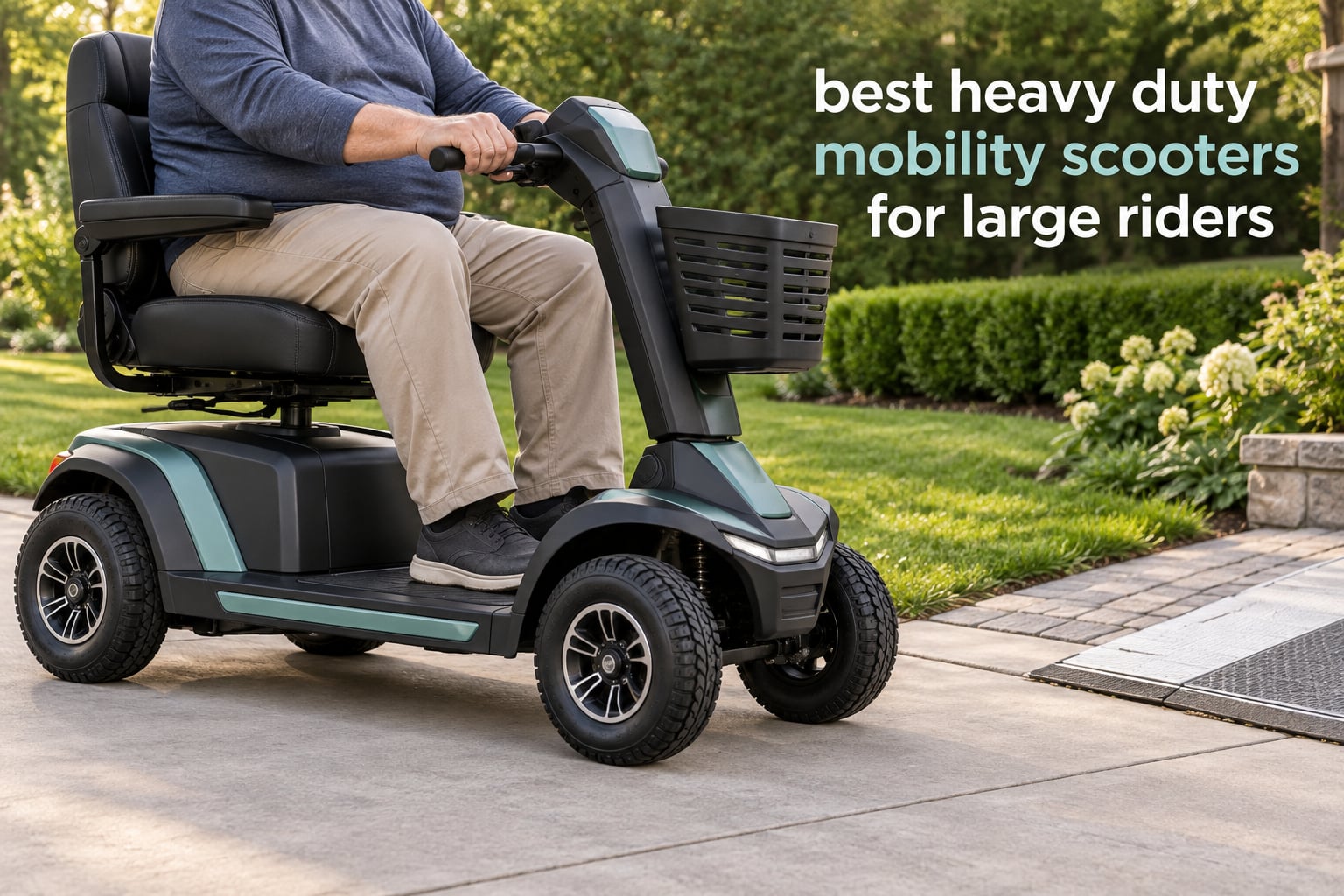
If you are shopping for the best heavy duty mobility scooters for large riders, the single most important number is the weight capacity, and the most common mistake is buying a scooter rated at exactly your own weight instead of comfortably above it. A heavy duty mobility scooter is a seated electric scooter built on a reinforced frame, with a higher-torque motor, larger wheels and higher-capacity batteries than a standard travel scooter, and it is safety-tested to carry roughly 400 lbs or more.
Over 2026 we compared eight of them against manufacturer spec sheets and a combined review base of roughly 750 owner ratings, then looked hard at the two things roundups usually skip: how wide the seat actually is, and what happens to your range once you are fully loaded. The industry-standard category term for these machines is a bariatric mobility scooter, which simply means a scooter engineered for higher weight limits with a wider frame and seat, not a comment about the rider.
The capacity bands matter more than the marketing. Most of what is sold as heavy duty falls into four groups: 400 lb, 450 lb, 500 lb and the 600 lb plus all-terrain and dual-seat class. Our one-line rule is simple and it holds for every pick below. Buy the lowest capacity rating that sits at least 50 lbs above your actual weight, and never closer than that.
That headroom exists for a durability reason that riders on mobility forums repeat constantly. A scooter driven at the very top of its rating runs its brakes, transaxle and frame hot, wears out noticeably faster, and sits closer to the point where a warranty claim gets argued. Buying up a tier costs you a heavier machine to transport, but it buys years of service life and a genuine safety margin on slopes and ramps.
A note on sourcing: every capacity, range, speed and dimension below comes from the manufacturer spec sheet or the listing page, and every rating and review count is taken verbatim from the product listing. Where owners report something the spec sheet does not, we say so and attribute it to reviewers rather than to testing we did not do. This is a health-adjacent purchase, so talk to your physician or a certified durable medical equipment supplier about individual fitting before you order.
Our Top 3 Heavy Duty Mobility Scooters for Large Riders
Three models stood out once we sorted the list by the combination of capacity headroom, ride quality under load and how well owners rated the seat. The LAGTOM 500 lb 4-wheel leads on balance, the VEVOR 4-wheel carries the largest safety package and the biggest review base here, and the second LAGTOM delivers nearly the same chassis for noticeably less money.

LAGTOM 500 lb 4-Wheel
- 1000W motor
- 60V 20Ah battery
- 500 lb capacity
- Reclining captain's seat

VEVOR 500 lb 4-Wheel
- Front disc brake
- Spring suspension
- Mirrors and seat belt
- Lockable trunk

All 8 Heavy Duty Mobility Scooters Compared Side by Side
Here is the full lineup with the specifications that actually change the decision. Capacity, motor output, battery format and total machine weight do most of the work, and the machine weight is the figure riders most often regret not checking before ordering.
| Product | Details | |
|---|---|---|
| LAGTOM 1000W 4-Wheel 500 lb |
|
Check Latest Price |
| VEVOR 4-Wheel 500 lb |
|
Check Latest Price |
| LAGTOM 800W 4-Wheel 500 lb |
|
Check Latest Price |
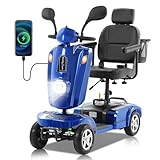 Mobicyc 450 lb Lithium Scooter Mobicyc 450 lb Lithium Scooter |
|
Check Latest Price |
 Metro Mobility 450 lb Folding Scooter Metro Mobility 450 lb Folding Scooter |
|
Check Latest Price |
 Mbxcooter 500 lb Six-Way Seat Mbxcooter 500 lb Six-Way Seat |
|
Check Latest Price |
 VEVOR 3-Wheel 500 lb VEVOR 3-Wheel 500 lb |
|
Check Latest Price |
 LAGTOM 500 lb With Roof and Windshield LAGTOM 500 lb With Roof and Windshield |
|
Check Latest Price |
1. LAGTOM 1000W 4-Wheel, 500 lb – Best Overall for Larger Riders
Heavy Duty 4 Wheel Mobility Scooters for Seniors & Adults 500lbs Capacity – Electric Powered Chair – 1000W All Terrain Fast Mobility Scooter for Travel w/Long Range Battery Remote Key
500 lb capacity
1000W motor
60V 20Ah battery
275 lb total weight
+ Pros
- 1000W motor carries a 500 lb rating with confidence
- 60V 20Ah pack for extended travel
- 16-inch fat tires and twin rear shocks smooth grass gravel and mud
- Reclining captain's seat with folding armrests and belt
- Three storage areas plus USB port and cup holder
- Cons
- Wide four-wheel chassis is awkward in tight indoor spaces
- Rear trunk and mirrors are self-installed
- 275 lb build needs help to load into a vehicle
This is the scooter I would put at the top of the list for most larger riders, and the reason is balance rather than a single headline spec. The 1000W motor and 60V 20Ah battery sit underneath a 500 lb rating, which puts real headroom above a 400 lb rider and comfortable margin for someone closer to 450. It is the rare heavy duty machine that does not ask the rider to pick between power and a usable battery.
Owners consistently point to the same things: the motor has plenty of headroom on inclines, the reclining captain’s seat makes long afternoons tolerable, and the storage layout means a day of errands does not require a backpack. At 4.6 stars across 173 reviews, it also has one of the more settled rating profiles in the group rather than a thin sample.
Why 16-Inch Tires and Twin Rear Shocks Matter at 500 lbs
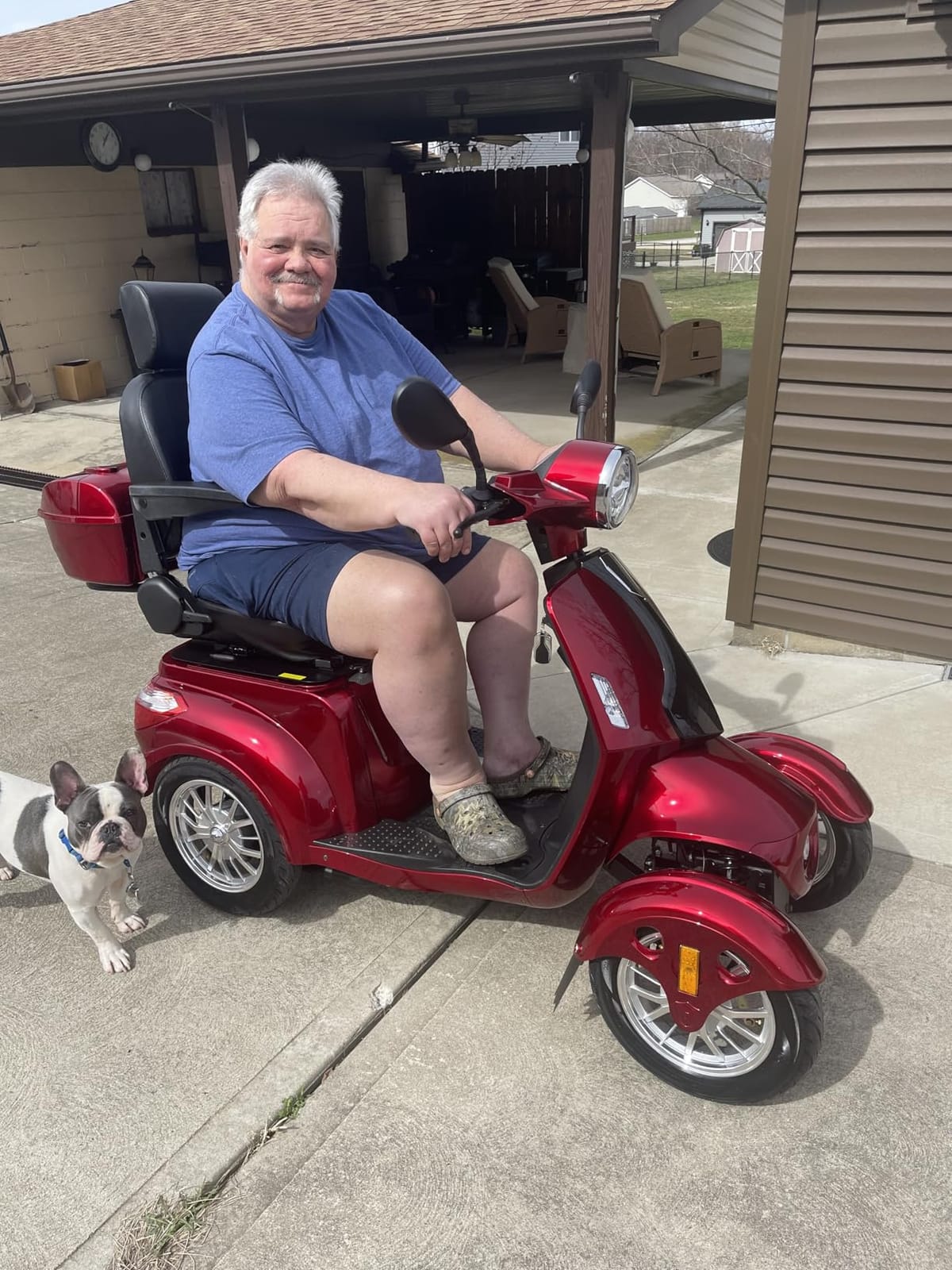
A heavy machine carrying a heavy rider is unforgiving of small wheels. The 16-inch fat tires here have more air volume under the contact patch, which is exactly what you want on broken asphalt, driveway transitions and grass edges, and the two rear shock absorbers take the vertical hit out of expansion joints.
Riders on mobility forums describe suspension as the number one factor in whether they can use a scooter all day rather than just a few hours, and that matches what reviewers report about this chassis. The trade-off is that you feel more of the terrain through the seat base than you would on a smaller-wheeled four-wheeler, which is the price of the 16-inch diameter.
Range and Charging in Real Conditions
The 60V 20Ah extended battery is the reason this one is my first choice. Under actual use with a full load, riders report noticeably more usable distance than most competitors in the 500 lb class, which matters because heavy riders tend to sit at the 15 mph top setting more often than lighter riders do.
Budget for a real reduction in cold weather. Forum riders consistently report losing roughly 20 to 30 percent of rated range below about 65 degrees Fahrenheit, and they report further loss at higher total load, so treat the headline figure as a warm-weather best case rather than a promise.
Who Should Skip This Model
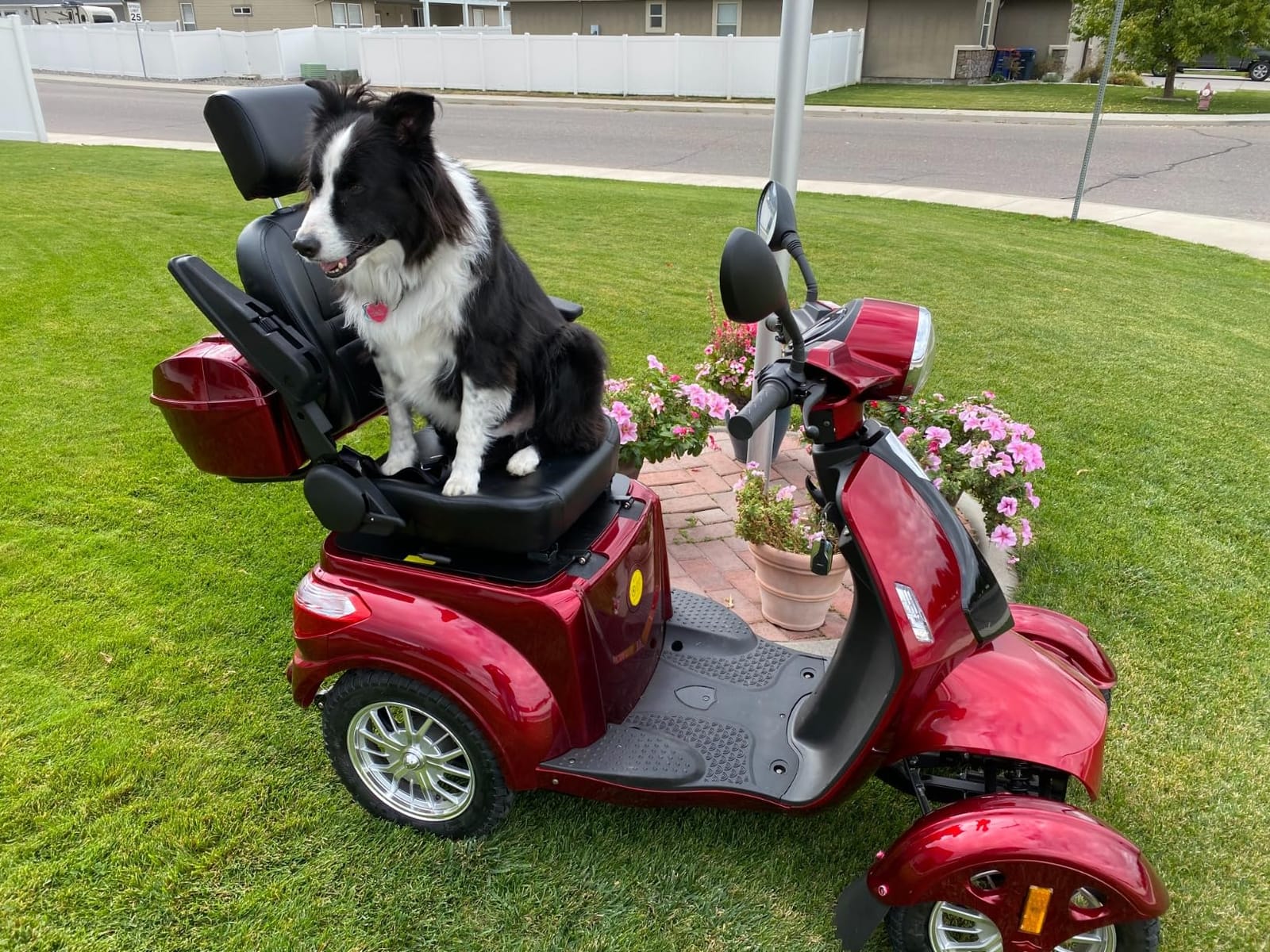
If your life is mostly indoors, this is the wrong shape of machine. The four-wheel chassis is wide, and owners specifically call out the turning radius as the drawback for narrow hallways and store aisles. Riders who need to load into a car will also find 275 lb needs a second person and a ramp.
The self-install step for the rear trunk and mirrors is minor but worth knowing about, because the scooter arrives 98 percent pre-assembled and owners who expected turnkey delivery mention it as a mild frustration. Budget an hour for setup.
2. VEVOR 4-Wheel, 500 lb – Best Braking and Safety Package in the Class
VEVOR Heavy Duty 4-Wheel Mobility Scooter, Powerful 1000W Brushless Motor, 500 lbs Capacity, 21.5 Miles Long Range, All Terrain Mobility Scooter with Lockable Trunk for Seniors & Adults
500 lb capacity
1000W brushless motor
21.5 mile rated range
277.78 lb total weight
+ Pros
- 1000W brushless motor rated for 500 lbs and 20 degree inclines
- 21.5 mile rated range on a 60V 20Ah pack
- Four 16-inch tubeless tires with spring suspension
- Disc and drum brakes plus mirrors and seat belt
- Lockable rear trunk plus front and under-seat storage
- Cons
- Large footprint and wide turning radius
- Seat height is not adjustable despite the listing claim
- Footboard length is short for very tall riders
- Minimal and poorly written manual
This VEVOR is the one I recommend when safety hardware and build confidence matter most. Its 21.5 mile rated range on a 60V 20Ah battery is a solid figure rather than the class leader, but the 1000W brushless motor carries the same 500 lb rating as my top pick while adding a front disc brake to the braking package.
It has the largest review count here at 199 ratings, which is useful signal in a category where most listings rest on a handful of reviews. Owners frequently note that the machine drives well for larger riders and that the finish looks more expensive than expected, which is a compliment about perceived build quality.

Braking, Lighting and the Safety Package
A front disc brake paired with a rear drum is a meaningfully better answer to a 500 lb load than drum brakes at both ends, because heat builds faster in a loaded stop. The rest of the safety kit is unusually complete for this class: an anti-tip wheel, protective bumpers, rearview mirrors, a seat belt, an anti-theft alarm and a 360-degree lighting system with a headlight and turn signals.
The horn and the full lighting package matter at dusk more than most spec sheets suggest. On a 500 lb machine travelling at the top speed setting, being visible to a turning driver matters more than it does on a slower scooter.
Three Speed Modes and What They Do to Range
The 6, 10 and 15 mph modes are a genuinely useful feature for larger riders, because the lowest setting is a genuine crawl for crowded sidewalks and the top setting covers longer suburban distances. Be aware that range scales directly with speed, so running the 15 mph mode routinely will use the battery far faster than the rated figure suggests.
The 20-degree maximum climbing capacity is the other number worth reading closely. It tells you this frame is not straining on a steep driveway or a ramp into a parking structure, which is where lighter 500 lb machines start to feel strained on a fully charged battery.

Where the Fit Falls Short for Tall Riders
Two fit complaints appear often enough that I would not skip them if you are tall. The seat is advertised as having adjustable legroom, but owners report that seat height itself is fixed on this model, and the footboard length runs short for riders well over six feet.
Capacity is not the same as fit. A 500 lb rating tells you the frame will hold you, not that the seat is shaped for your proportions, so if you are both tall and near the 500 lb ceiling, this one deserves a careful in-person look before you commit.
3. LAGTOM 800W 4-Wheel, 500 lb – Best Value in the 500 lb Class
Mobility Scooters for Seniors & Adults 500lbs Capacity – 800W All Terrain Electric Powered Mobility Cart – Heavy Duty Mobility Scooter for Elderly w/Charger Remote Keys (Red)
500 lb capacity
800W transaxle brushless motor
60V 20Ah battery
282 lb total weight
+ Pros
- 500 lb rating with a quiet 800W transaxle brushless motor
- 60V 20Ah battery for long-range travel
- 16-inch tires and dual rear shocks for rough ground
- Reclining captain's seat with folding armrests
- Glove compartment rear basket and under-seat storage
- Cons
- Bulk and weight reduce indoor maneuverability
- Rear trunk and mirrors need self-installation
- 282 lb build is impractical to lift unaided
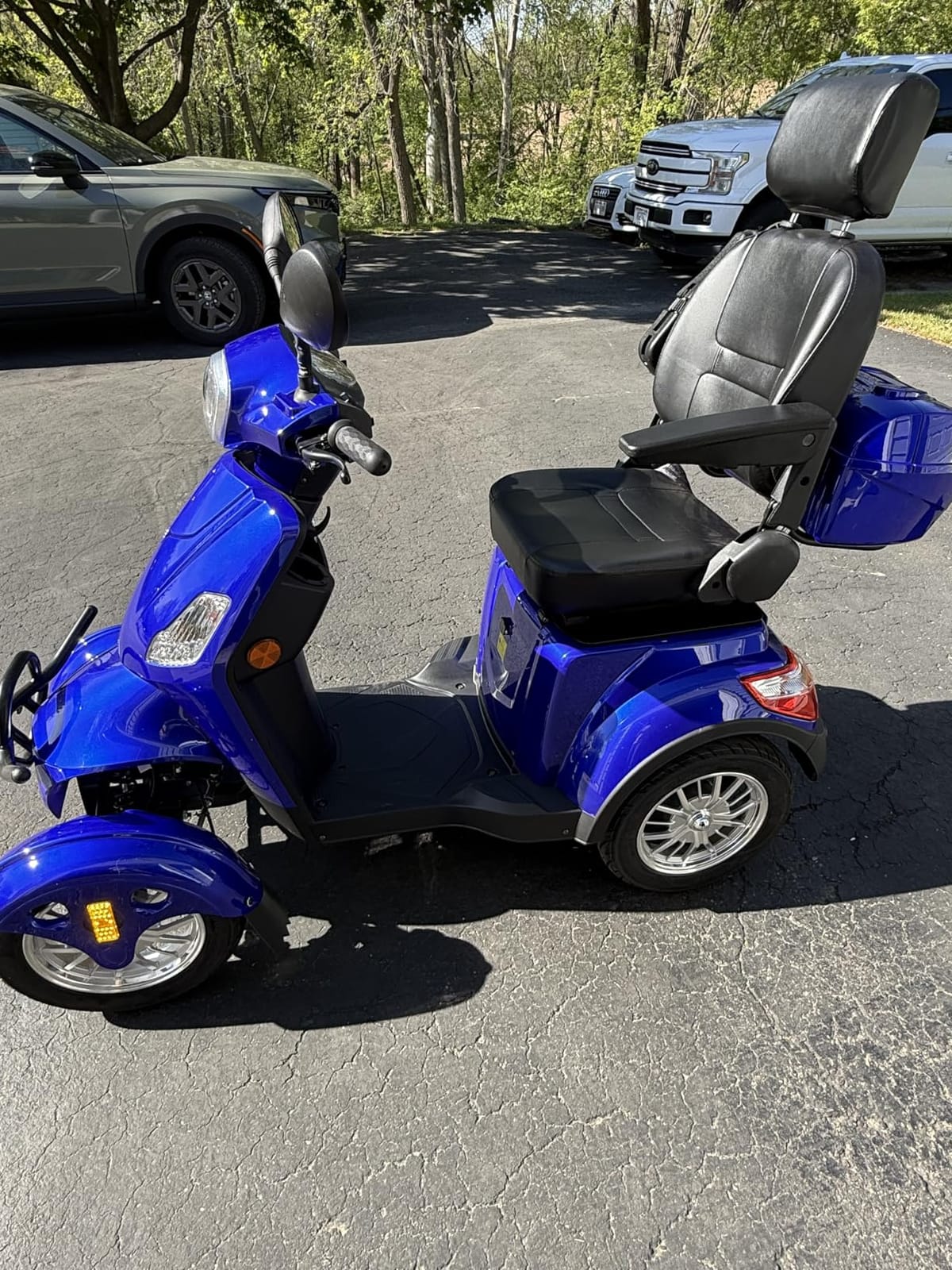
This is the value pick, and the value comes from the same chassis rather than a stripped-down one. You get the 500 lb rating, the 60V 20Ah battery, 16-inch tires, twin rear shock absorbers and the reclining captain’s seat, and the difference from my top pick is an 800W transaxle brushless motor instead of a 1000W unit.
In practice reviewers describe that motor as quiet and sufficient, with 78 percent of ratings at five stars. If your typical route is flat sidewalks and neighborhood streets rather than steep grades, the 800W is a sensible trade for the lower purchase price and the quieter drivetrain.
Who the 800W Motor Is Enough For
The motor difference only shows up when you ask the machine to do hard work: sustained climbs, soft sand, wet grass or a heavy rider near the top of the rating. On level, paved daily use the two LAGTOM four-wheelers feel remarkably similar to owners who have compared them.
My rule is to match the motor to your worst terrain, not your best. If your daily route includes a genuine hill, take the 1000W. If it does not, this one does everything you need at a lower cost.
Comfort, Storage and the Reclining Seat
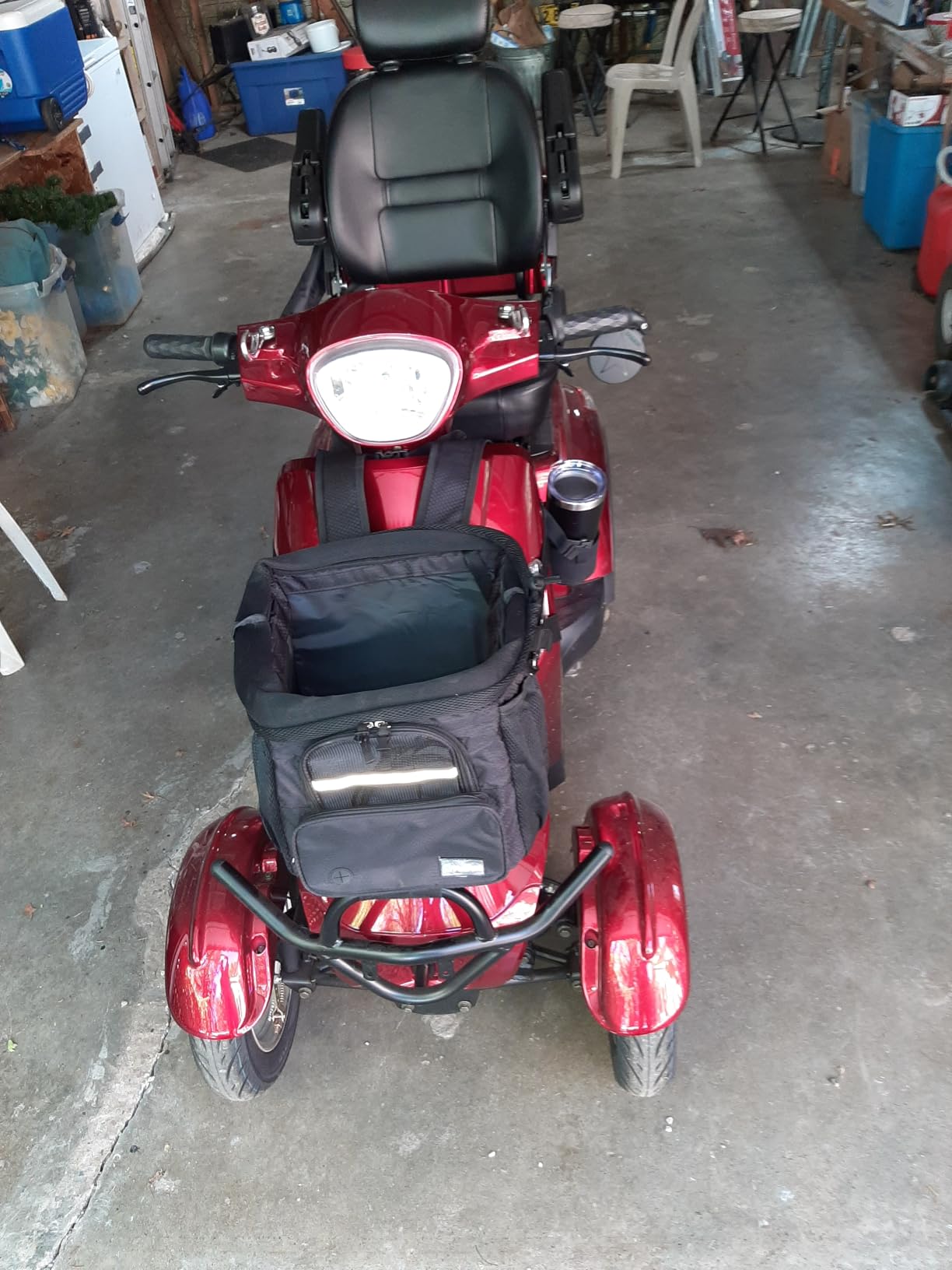
The deluxe reclining captain’s seat with folding armrests and a safety belt is the feature that owners mention most, and it is the reason this class of scooter became popular for all-day errands in the first place. Reclining changes a long afternoon from an endurance test into a normal outing.
Storage is a three-part arrangement here: a locking glove compartment, a rear basket and under-seat space. That is enough to carry a week of errands without a bag hanging off the armrests, which matters because hanging weight on the armrests is one of the few ways riders add sway to a four-wheel chassis.
Who Should Look Elsewhere
At 282 lb this is among the heaviest machines in the roundup, and reviewers say so directly. If getting the scooter into and out of a vehicle is part of your week, that weight is a real constraint no matter how good the ride is.
It comes in five color variants. Confirm that the variant you order matches the listing you actually reviewed, because colors sometimes map to different seller inventory.
4. Mobicyc 450 lb Lithium Scooter – Best for Swivel Access and Battery Life
MobiCyc Heavy Duty Mobility Scooter for Adults & Seniors, 500W Motor, 20/30 Miles Long Range, 450 LBS Capacity, Removable Lithium Battery, 10″ All-Terrain Tires, with Windshield & Suspension
450 lb capacity
500W motor
35Ah removable lithium battery
Up to 30 mile range
+ Pros
- Highest-rated listing in the group at 4.9 stars
- Removable 35Ah lithium battery for up to 30 miles
- 360-degree swivel seat eases getting in and out
- 10-inch tires and shock absorbers for a stable loaded ride
- Disassembles for SUV transport with a push feature
- Cons
- Seat height is fixed on the base model
- 450 lb rating sits below the 500 lb models
- Front wheel alignment issues reported on a few units
- Breaker switch under the seat is hard to reach
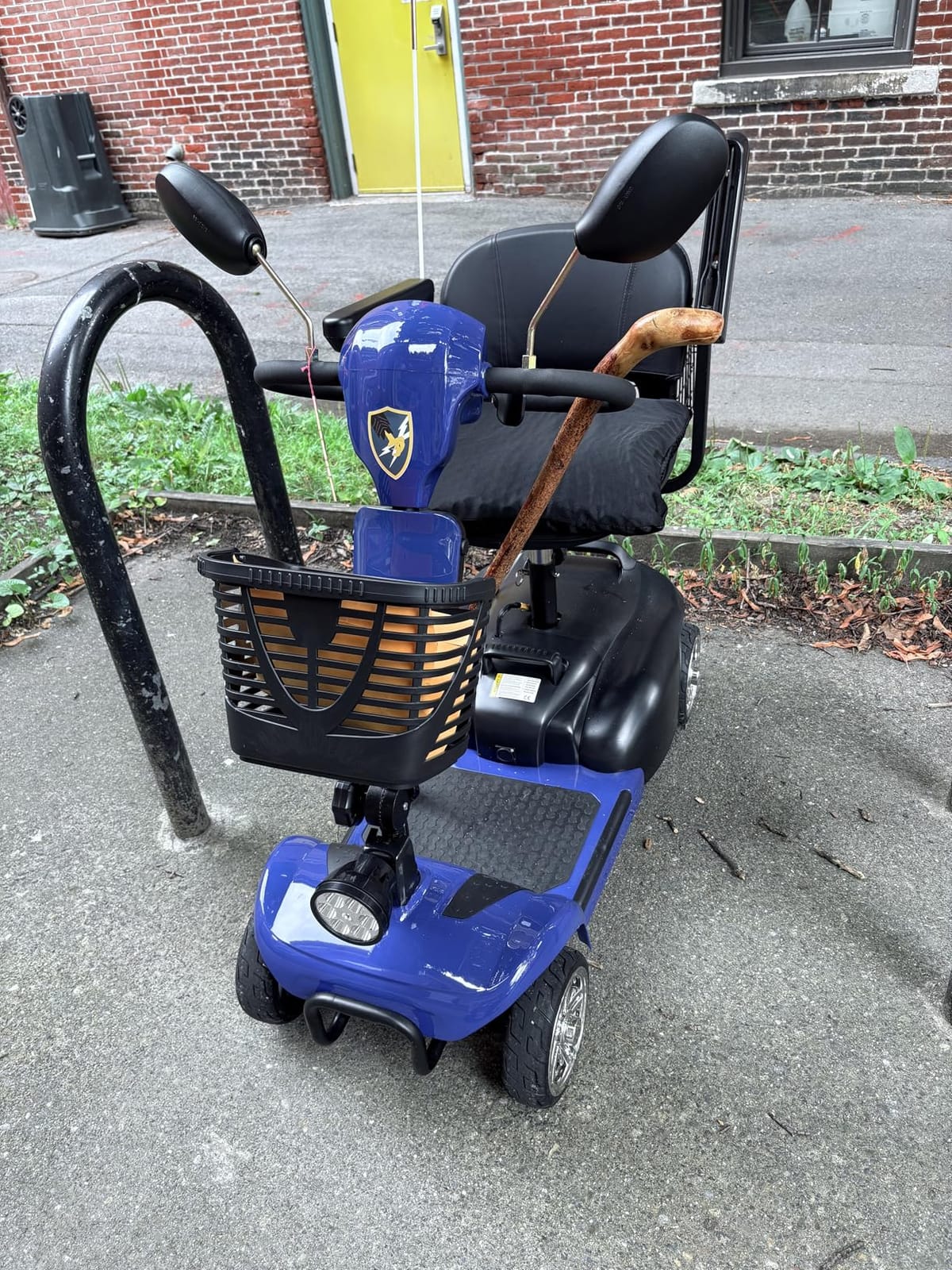
At 4.9 stars from 58 reviews, this is the highest-rated listing we analyzed, and the reasons owners give are specific rather than generic. The removable 35Ah lithium battery with a claimed 30 mile range and the 360-degree swivel seat are the two features that come up again and again, including from a reviewer at 350 lbs who praises the power and speed.
The swivel seat matters more than it sounds. Riders with hip or spinal limitations, or anyone recovering from surgery, can rotate the seat out to get on and off without twisting through a 90-degree motion, which is the single biggest accessibility gain in this whole roundup.
Why a Removable Lithium Battery Changes Daily Use
Lead-acid packs in this category are heavy, and that weight is dead weight competing with your payload against the 450 lb rating. A removable lithium pack changes the charging routine, because you take the battery indoors and charge it near an outlet instead of parking a 200 lb machine beside a wall.
It also means a battery swap is possible. On a four-wheel machine with a fixed pack, a battery failure can mean the scooter is effectively immobile until it is repaired or recovered, which is the service anxiety riders on mobility forums describe most often.
The Windshield Front End and Storage
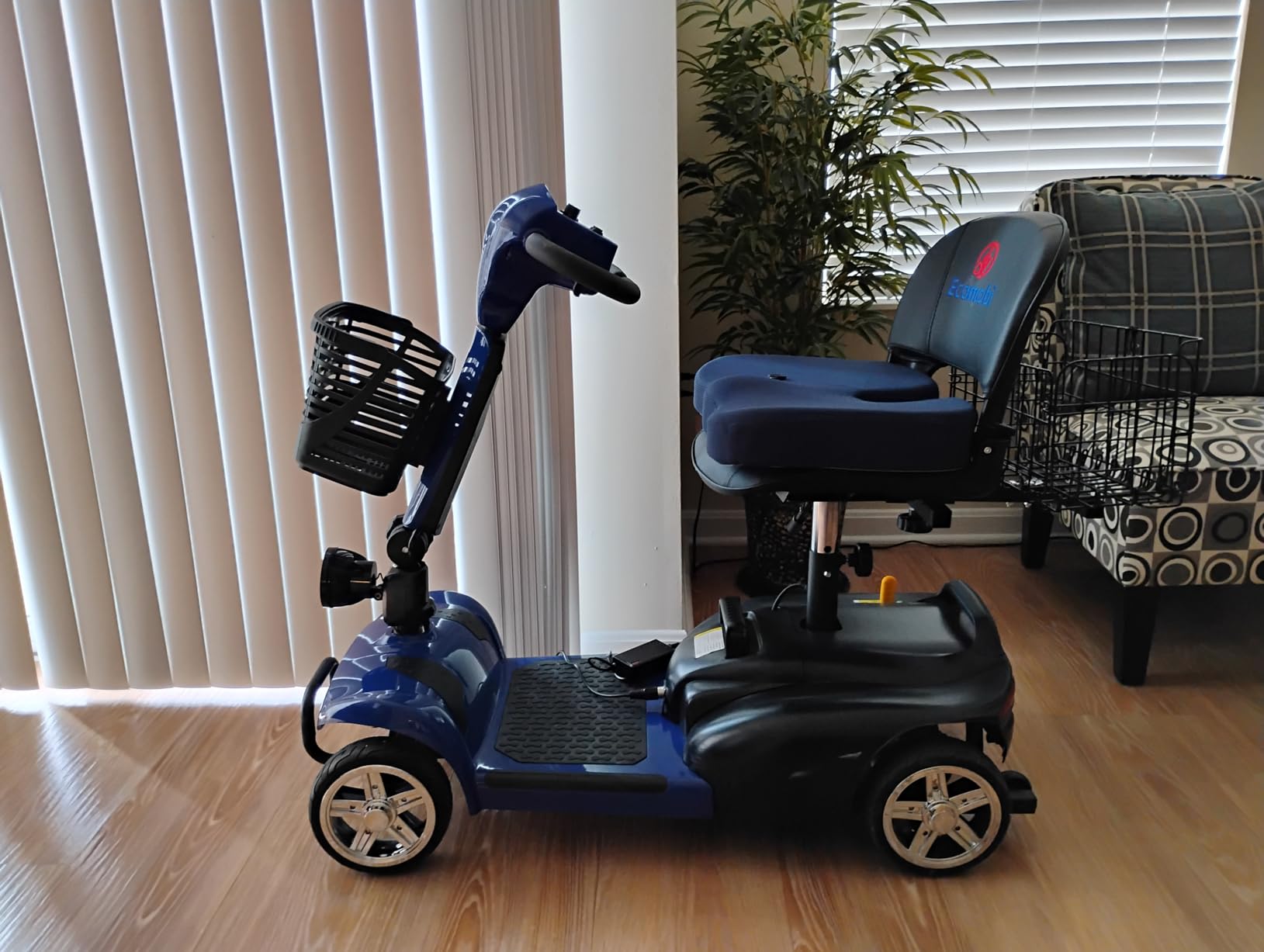
The front windshield with integrated storage compartments is a design few competitors offer, and riders who use the scooter outdoors year round like having wind protection without strapping on a separate cover. The rear basket and cane holder add useful carrying capacity for a 450 lb frame.
Lighting is unusually thorough for the class: daytime running lights, a night mode and turn signals front and rear. For a rider who is out at dusk or on a dim street, visibility is not a luxury feature, it is the difference between being seen and not.
Where It Falls Short
The 450 lb rating is the honest limitation. Riders over roughly 400 lb get adequate headroom, but a 450 lb rider is running the machine at the top of its rating, which is exactly the situation our capacity rule tells you to avoid.
Two practical complaints recur: seat height is fixed on the base model even though the listing describes an adjustable seat, with some tall riders wanting another two inches, and the breaker switch sits under the seat plate where it can be awkward to reach for someone with limited hand mobility.
5. Metro Mobility 450 lb Folding Scooter – Best for Car Transport and Travel
HeavyDuty MobilityScooter for Seniors/Adults 25-35Miles 500W 450lbs Purple
450 lb capacity
115 lb total weight
Folds into 4 sections
16 mile range per charge
+ Pros
- Only heavy-duty option here that disassembles for car transport
- 450 lb rating on just 115 lb total weight
- Thickened leather seat with height adjustment
- Electromagnetic brake plus handbrake with lighting and anti-roll wheels
- 5.5-inch ground clearance and 10 degree climbing grade
- Cons
- 4.97 mph top speed is the slowest here
- Lead-acid pack is heavy and shorter-lived than lithium
- 450 lb rating is below most competitors
- 18 percent of reviews are three-star
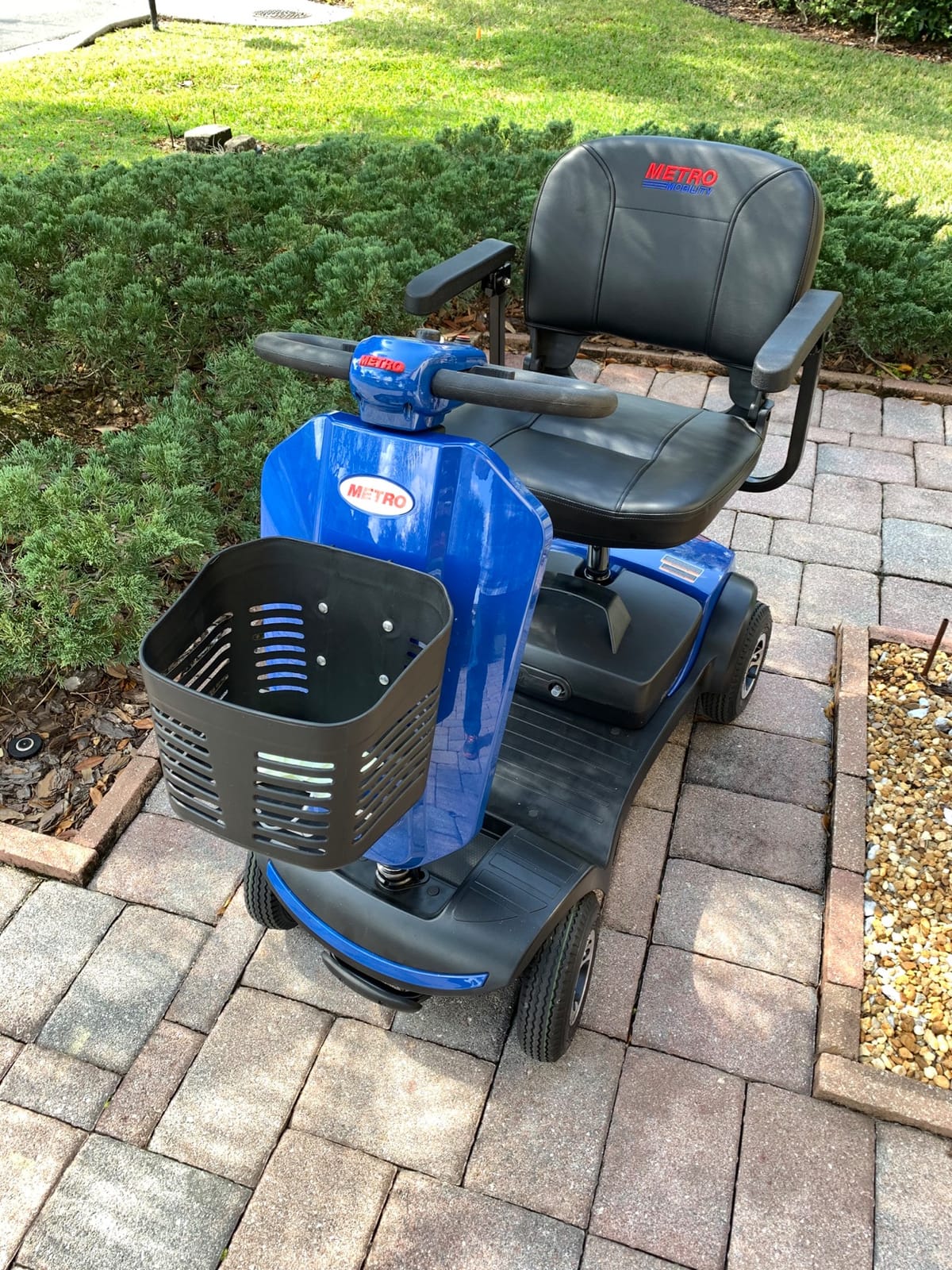
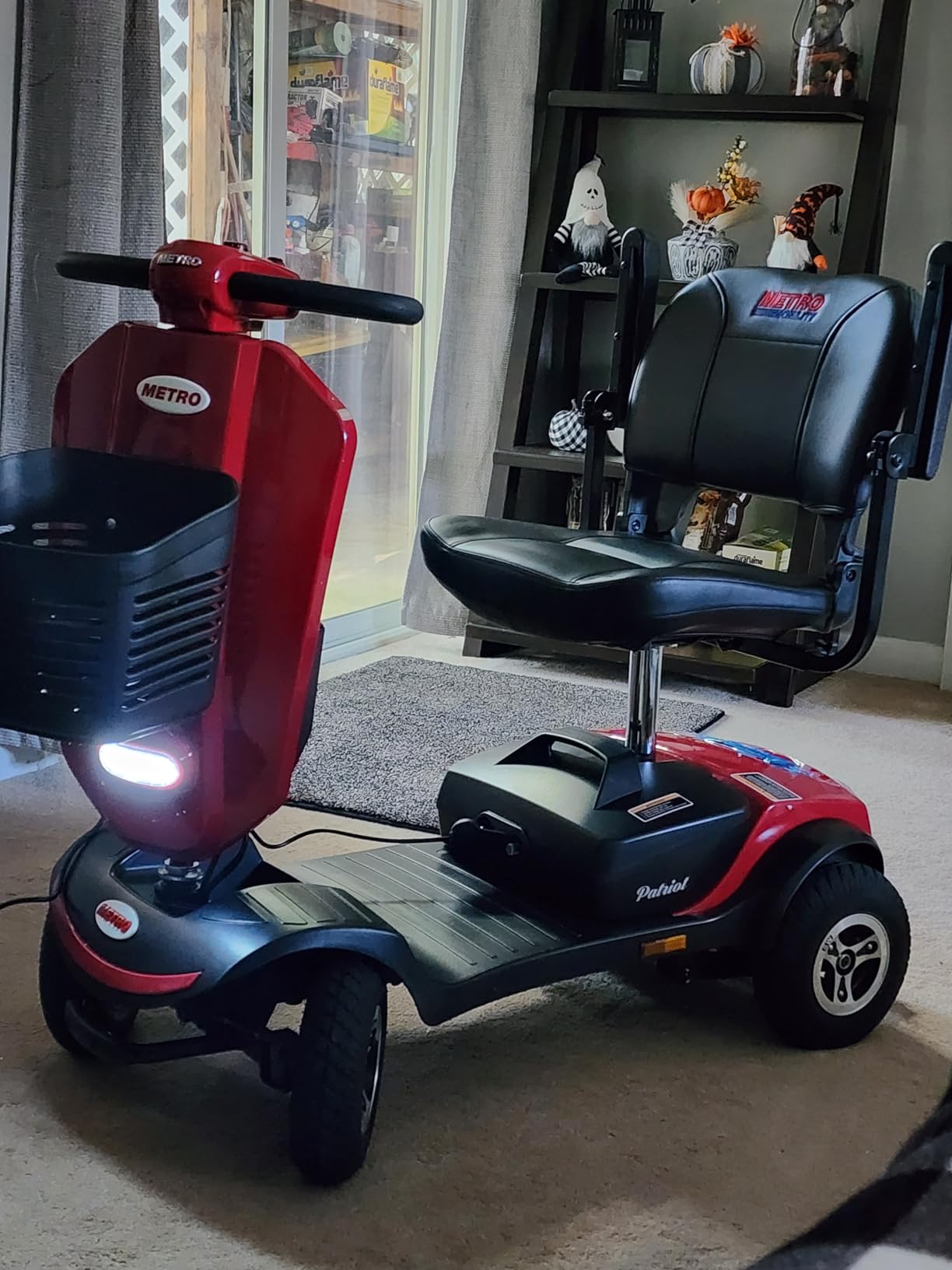
Every other machine here with a published weight is over 190 lb. This one is the outlier, and for a specific rider that is decisive: it folds into four sections with a heaviest piece of 63 lb at 43 by 21 by 21 inches, which fits in a normal car trunk without a ramp or a second person.
The 450 lb rating on a 115 lb total weight is the engineering headline. Most heavy duty scooters achieve their rating by adding mass, and this one achieves it with a smaller motor and a lighter frame, which is part of why it can still be broken down by one person.
Trade-Offs You Accept for Portability
You accept a 4.97 mph top speed, which is the slowest here and feels slow on a long sidewalk. You also accept sealed 20AH lead-acid batteries, which are heavier and shorter-lived than the lithium pack in the Mobicyc, and the 16 mile rated range reflects that older chemistry.
With 18 percent of reviews at three stars, this listing has a middling rating profile next to the 4.6 to 4.9 listings in this roundup, and the complaints cluster on power and range rather than on reliability. If your days are short trips and travel days matter, that is an acceptable exchange.
Comfort and Terrain Handling
The thickened leather seat and backrest with height adjustment is a genuine advantage for larger riders, because seat height adjustment is the feature most often missing from the 500 lb models in this roundup. The two padded armrests adjust forward and back, which helps with positioning through a long day.
With 5.5 inches of ground clearance and a 10-degree climbing grade, this is a sidewalk and path machine rather than a rough-terrain one. It handles cracked pavement and modest slopes comfortably, and it is not designed for gravel drives or soft ground.
Who This Is Right For
This is the pick for someone who travels: a rider who visits family, splits time between homes, or wants to take the scooter on a trip rather than rent one at the destination. The 5-year limited guarantee from the manufacturer is also the longest warranty term attached to any pick here.
It is the wrong pick for someone whose daily routine is long neighborhood distances. A 4.97 mph top speed and a lead-acid range that shrinks in cold weather is a poor match for covering several miles a day.
6. Mbxcooter 500 lb with Six-Way Seat – Best for Seat Adjustment
Heavy Duty Mobility Scooter for Seniors/Adults,500LBS Capacity
500 lb capacity
1000W motor
48V 40Ah battery
Six-way adjustable seat
+ Pros
- Six-way seat with slide swivel and recline
- Claimed 32 mile range on a 48V 40Ah pack
- Largest tires at 12-inch front and 13.78-inch rear pneumatic
- Arrives fully assembled with no build step
- 4.3-inch ground clearance with full LED lighting and mirrors
- Cons
- Only 26 reviews
- the thinnest evidence base here
- Pneumatic tires need pressure checks and can go flat
- 198 lb build is heavy for a four-wheeler
- Battery pack limits true payload headroom
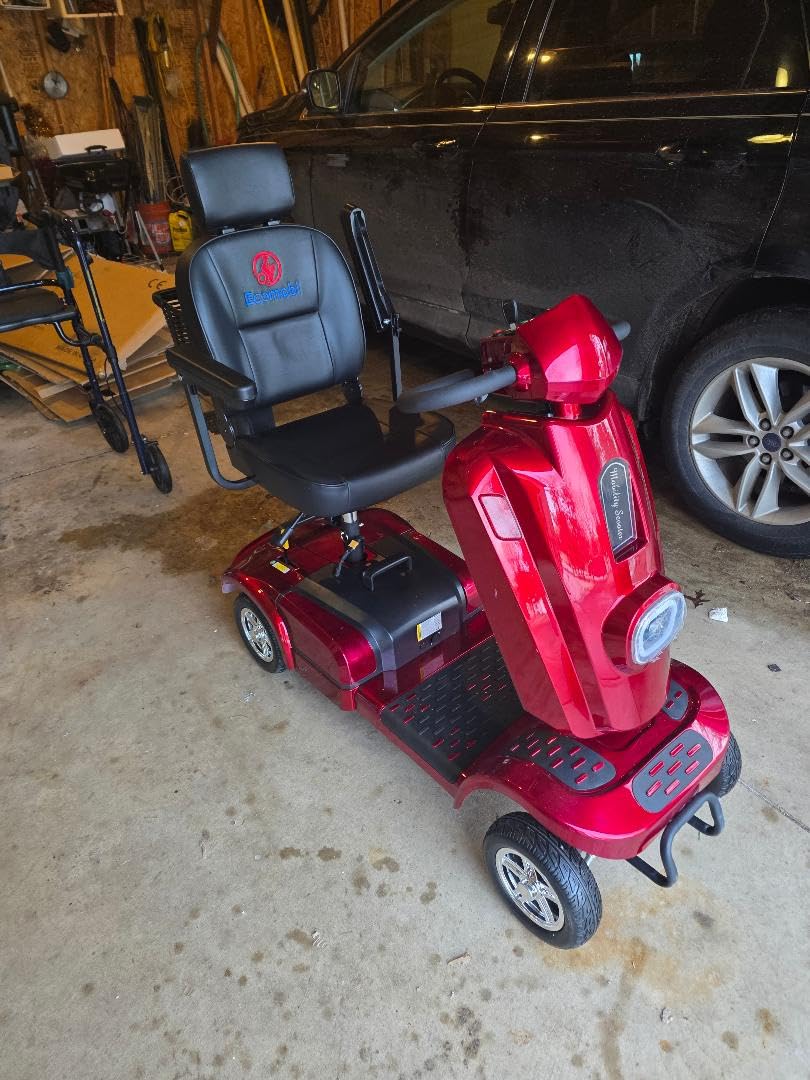
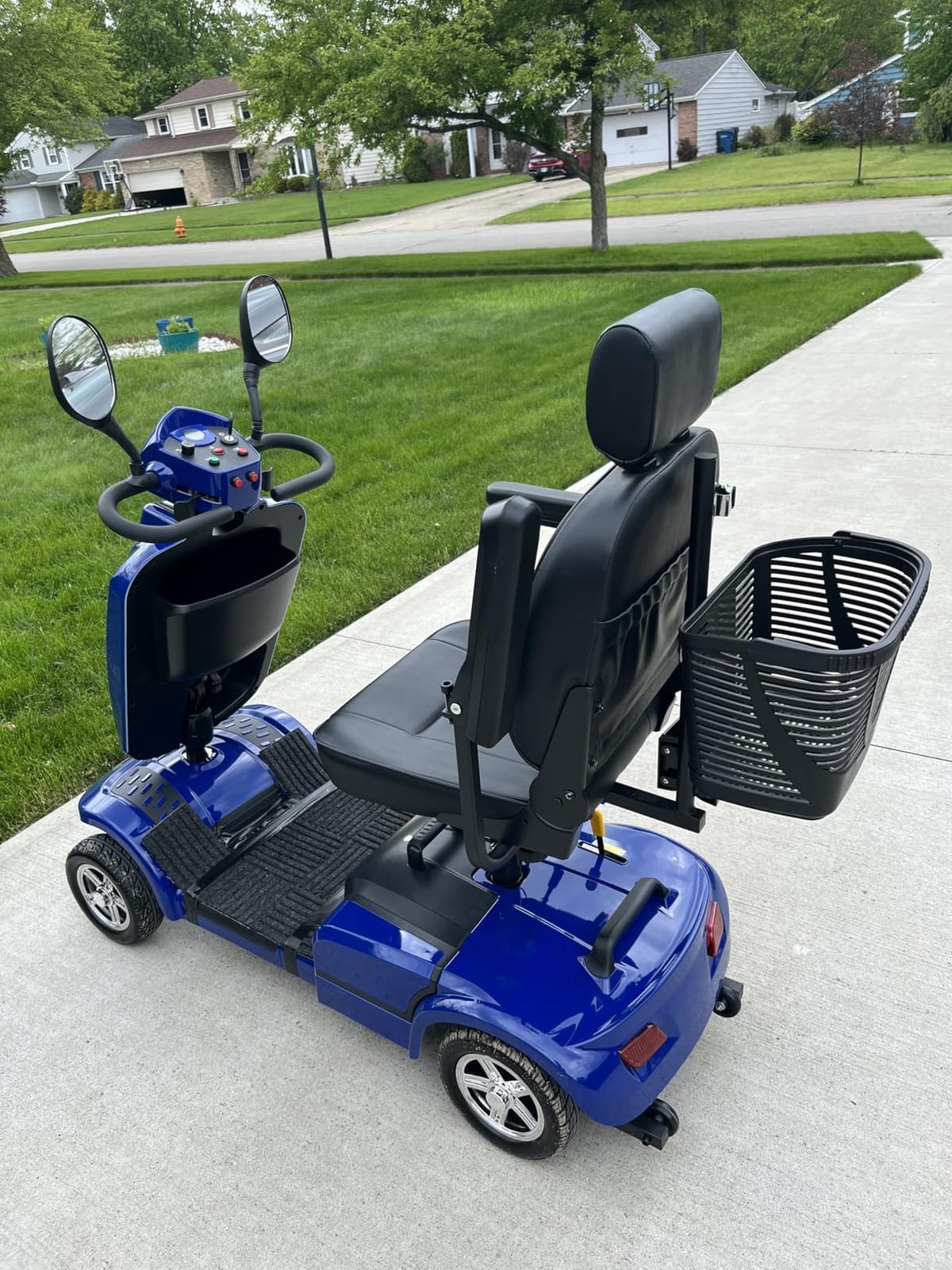
Seat fit is the problem nobody solves in this category, and this machine solves it better than anything else here. The seat slides forward and back, swivels left and right, and reclines, which is the widest range of adjustment available in a 500 lb frame and the reason it earns a spot for larger riders specifically.
It also arrives fully assembled, which matters more than it sounds when the alternative is a 275 lb scooter delivered in a crate. Owners rate the six-way seat first among the positives, followed by the 32 mile claimed range on a 48V 40Ah battery.
Tire Size and What It Means Under Load
The 12-inch front and 13.78-inch rear pneumatic tires are the largest tire sizes in this roundup, and air-filled rubber at that diameter absorbs bumps better than the tubeless and solid options used elsewhere here. On uneven pavement, large pneumatic tires roll over cracks that would jolt a smaller hard wheel.
The cost is maintenance. Pneumatic tires need regular pressure checks and can go flat, which is why reviewers list them as the top practical drawback. Riders without a reliable way to inflate at home should factor that in before choosing this over a tubeless option.
The 32 Mile Claim and How to Read It
A 32-mile rated range at a 500 lb capacity is an ambitious published figure, and it deserves skepticism. Real-world range falls with cold weather, hills, rider weight and speed setting, and the manufacturer figure is a best case under light load at moderate speed.
Read it as an upper bound rather than a plan. If your typical day is 6 to 8 miles, this battery gives you comfortable headroom and only one overnight charge.
Where the Evidence Is Thin
Twenty-six reviews is a thin evidence base for a heavy duty machine, and it is worth weighing against the machines here with triple-digit ratings. A 4.6 rating with 82 percent five-star results is encouraging, but it does not carry the same weight as 173 or 199 ratings on a comparable machine.
At 198 lb it is also still a heavy four-wheeler, and the battery pack inside a frame that size eats into the practical payload headroom above the 500 lb rating. Ask a supplier about the rated payload before you commit at the top of the range.
7. VEVOR 3-Wheel, 500 lb – Best for Tight Spaces and Maneuverability
VEVOR Heavy Duty 3-Wheel Mobility Scooters for Seniors & Adults, 500lbs Capacity, 21.5 Miles 3-Speed Long Range, 1000W All Terrain Electric Recreational Scooter Wheelchair, 20° Max Climbing Capacity
500 lb capacity
1000W brushless motor
Three-wheel layout
222.67 lb total weight
+ Pros
- 1000W brushless motor with a true 500 lb rating and 20 degree climbing
- Three-wheel frame turns noticeably tighter than four-wheel models
- 21.5 mile range on a 60V 20A lead-acid pack
- Deep-tread no-inflation tires need no pumping
- Dual brakes anti-tip wheel and full lighting with reverse alarm
- Cons
- Three-wheel frame is less stable than four wheels at top speed
- 18 percent of reviews are one-star
- Seat slides only forward and back with no height range
- Lead-acid pack adds weight and needs eventual replacement
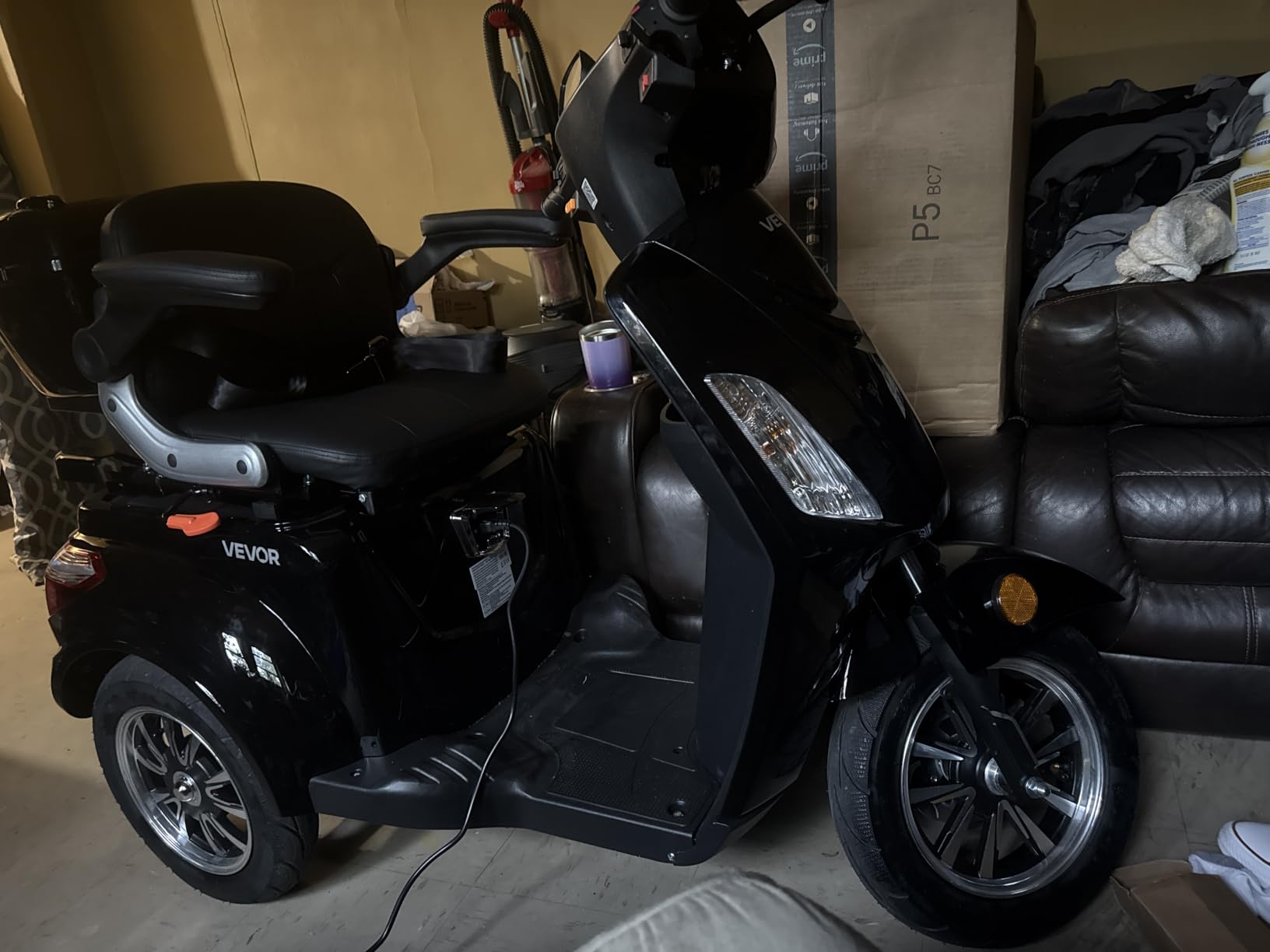
The 3-wheel layout is the entire argument here, and it is a real one for a specific rider. A single front wheel gives a noticeably tighter turning radius than any four-wheel machine in this roundup, and reviewers of this model specifically say they prefer it to the four-wheel VEVOR because of that.
It holds a genuine 500 lb rating on a 1000W high-torque brushless motor with 20-degree climbing, so nothing about the capacity claim is soft. The frame and motor are the same class as the four-wheeler, with one fewer wheel in front.
Three Wheels or Four: The Tip-Over Question for Heavier Riders
Forum discussion on this category converges on one clear point. Riders with higher weight requirements consistently push toward four wheels because tip-over anxiety on slopes and ramps is the single most common fear in the community, and a single-wheel steering column is the least forgiving geometry in the category.
This model manages the concern in two ways. The anti-tip rear wheel stabilizes the drive end, and the deep-tread no-inflation tires give more contact grip than a small hard wheel would. Neither removes the physics, so if your routes include steep driveway slopes, a four-wheel chassis is the safer choice regardless of how much you like the turning radius.
No-Inflation Tires and the 3-Speed Setup
Solid deep-tread tires mean no tire pump, no punctures and no pressure maintenance, which is a real reliability win for a machine that is heavy enough that tire changes are a two-person job. Owners cite them as a frequent positive.
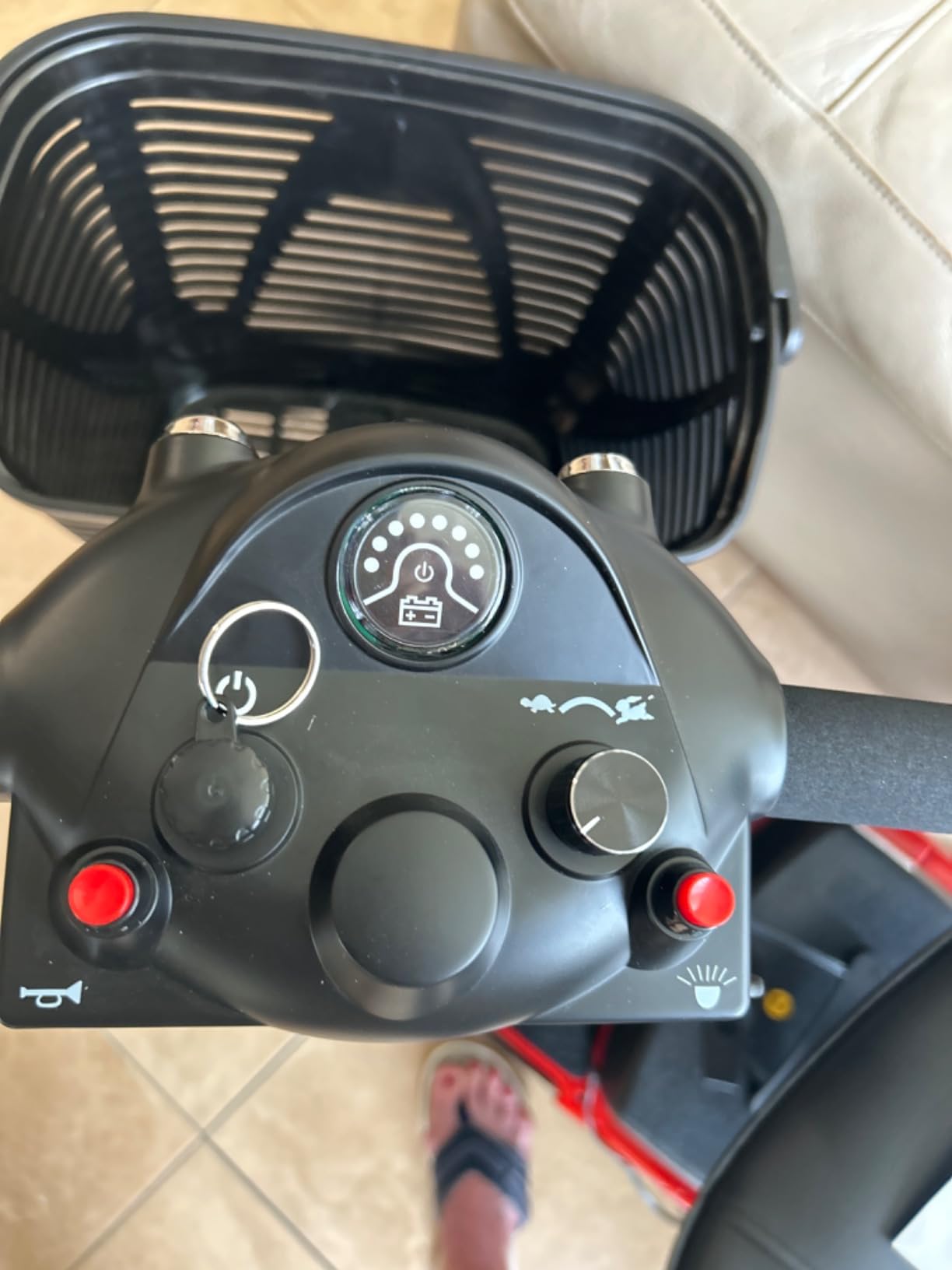
The 6, 10 and 15 mph modes with a dashboard showing speed, mileage and battery status are well executed, and the audible reverse alarm is a genuine safety feature on a narrow-chassis machine that reverses without much rear visibility.
Where Buyers Regret It
This listing has the weakest rating profile in the roundup, with 18 percent of reviews at one star. The complaints center on stability at the 15 mph setting and on a three-wheel chassis feeling less reassuring than four wheels, which is the same concern the wider rider community raises.
Seat adjustment is also minimal. It slides forward and back with no height range, so a tall rider has one less way to get comfortable, and the lead-acid pack adds weight that will eventually need replacing.
8. LAGTOM 500 lb With Roof and Windshield – Best for All-Weather Outdoors
Heavy Duty Mobility Scooter with Roof & Windshield – Electric Powered Wheelchair for Seniors & Adults 500lbs Capacity- 800W Fast Mobility Chair with Long Range Battery Remote Keys
500 lb capacity
1000W motor on reinforced frame
Roof and clear windshield
35-40 mile claim
+ Pros
- Only enclosed option in the roundup with a roof and windshield
- 500 lb capacity on a reinforced 1000W frame
- Claimed 35-40 mile range depending on load
- Wide four-wheel stance for grass gravel and uneven pavement
- Three-speed control at 4
- 8 and 15 mph with rear storage and mirrors
- Cons
- Only 15 reviews
- the smallest sample here
- 15 percent of reviews are three-star
- Roof and canopy add weight and height indoors
- Real-world range varies heavily with rider weight and terrain
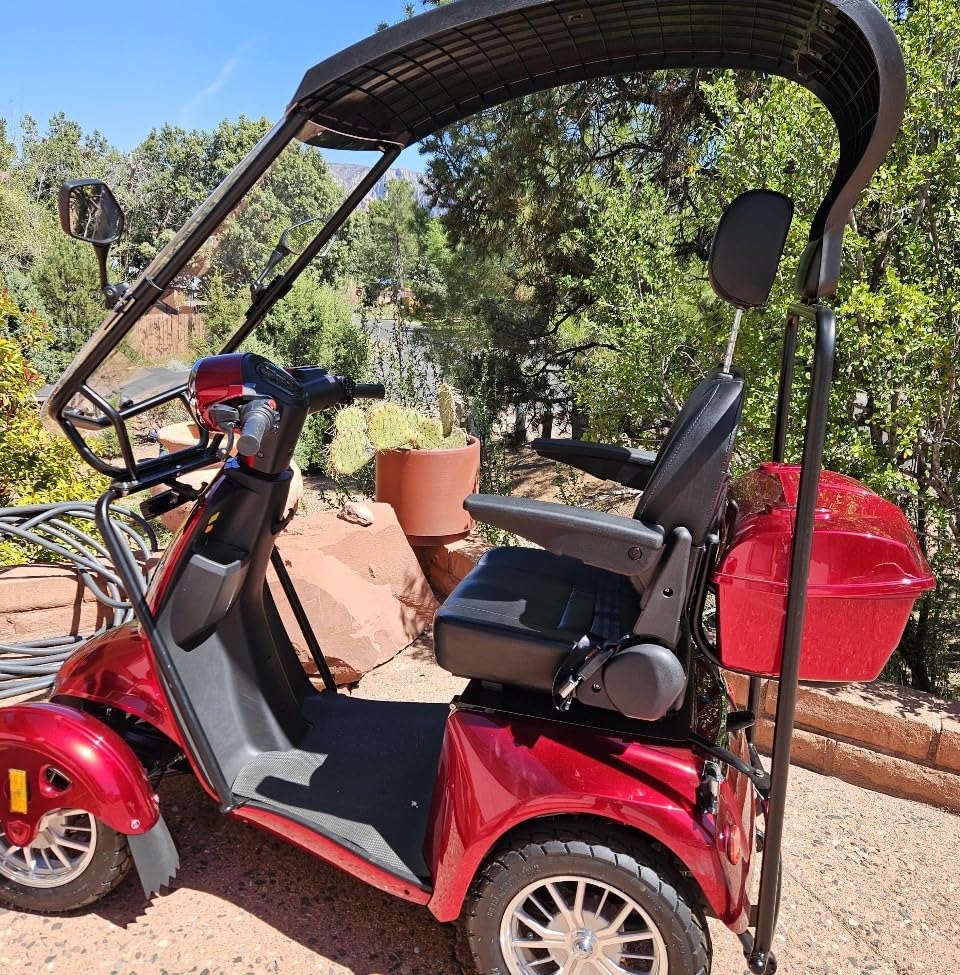
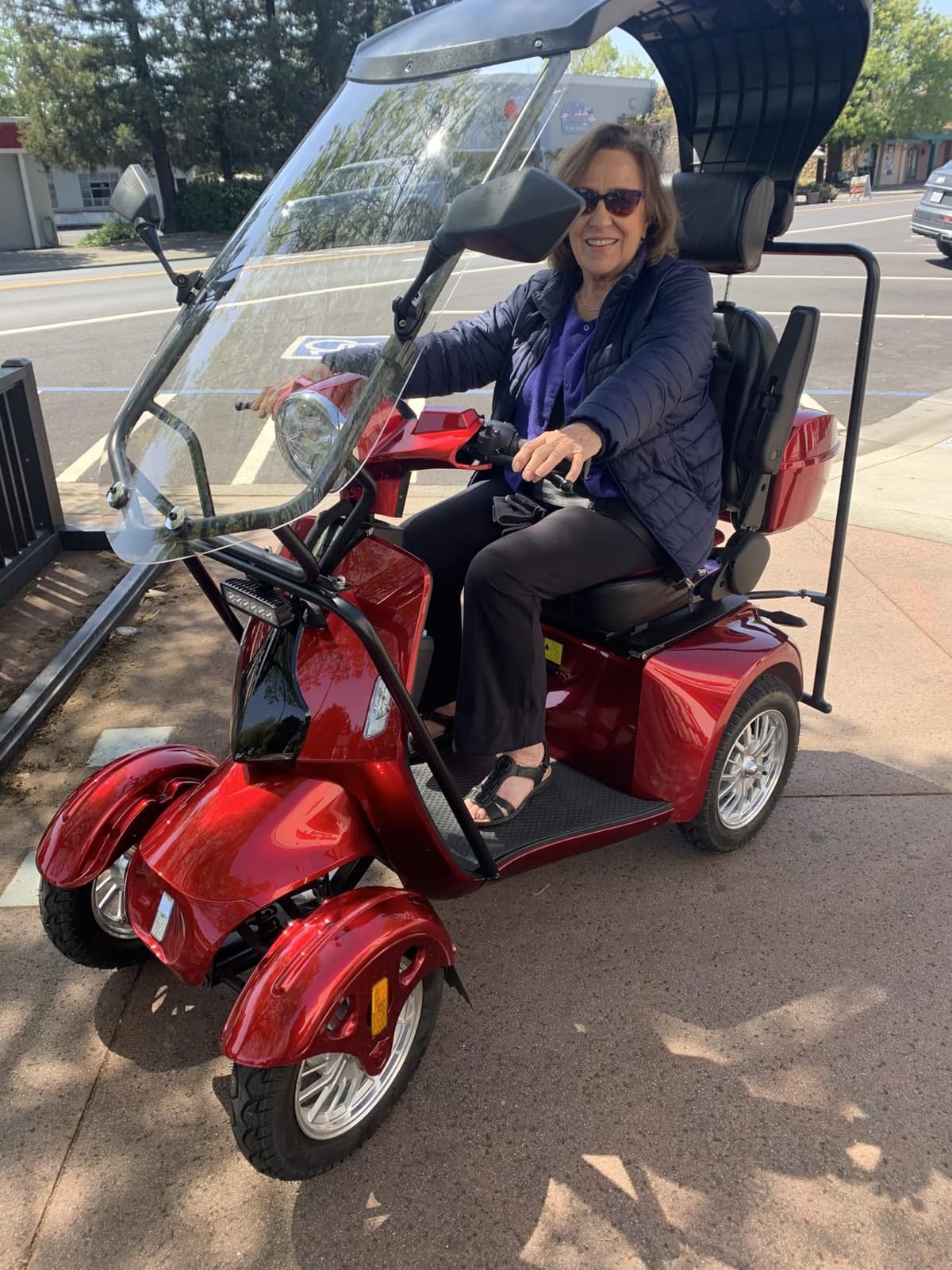
Every other scooter in this roundup is an open machine, and for a rider who spends days outdoors in sun, wind and light rain, that is the whole difference between being comfortable and being miserable. The roof and clear windshield is a feature you cannot add to another model later.
Underneath, the fundamentals are right for a 500 lb rider: a reinforced frame with a 1000W motor, wide tires on a stable four-wheel stance, and a claimed 35 to 40 mile range that the manufacturer explicitly ties to rider weight, speed, terrain and conditions.
When an Enclosed Scooter Makes Sense
The canopy pays off for riders who do long outdoor community travel, or who live somewhere with a hot summer or frequent coastal wind. It is also useful for riders managing a condition where cold or direct sun on skin is genuinely uncomfortable, which is more common in this category than buyers expect.
It costs you something indoors. The roof and canopy add both weight and height, and riders report that the enclosed setup is cumbersome to maneuver in tight spaces, which is a real problem if you also need the scooter inside a small apartment.
Range, Speed Modes and Service
Three-speed control at 4, 8 and 15 mph is a wider low-end spread than the competitors, and the 4 mph setting is genuinely useful on crowded paths where 6 mph is too fast. The manufacturer is unusually honest about the range figure, listing rider weight, speed, terrain and conditions as the variables that move it.
One year of product coverage with US-based parts support is the shortest warranty here, and parts service for less common brands is a real concern that riders raise in forums. Confirm local service coverage before buying any model on this list.
The Honest Limitation
Fifteen reviews is a very small sample, and 15 percent of those sit at three stars. The 4.6 average is encouraging and the review themes are consistent, but this is a model where we would want to see a longer track record before recommending it as a primary daily scooter.
It is also the heaviest configuration here once the canopy is fitted, which means the transport problem is worse than the machine dimensions alone suggest.
How to Choose a Heavy Duty Mobility Scooter for a Larger Body
Capacity is the starting point, not the answer. These are the decisions that actually determine whether the scooter works for you, in the order I would make them.
Pick a Capacity Tier, Not Just a Number
Start with your actual current weight, then add realistic headroom for the future. Under 350 lb, a 400 lb rating is genuinely sufficient, and between 350 and 400 lb a 450 lb model is the right starting point.
Between 400 and 450 lb, step up to the 500 lb class, which is where most of this roundup sits. Above 450 lb, the honest answer in this list is that none of these eight leaves enough headroom, and you should be looking at the 600 lb plus all-terrain and dual-seat class instead.
Riders on mobility forums report a consistent pattern in recommendation threads: people over 400 lb are pointed toward 450 to 500 lb models rather than the 400 lb tier, accepting the extra weight for the headroom. That is sound advice.
What Actually Happens If You Exceed the Rating
Exceeding a scooter’s capacity is not a warranty technicality, it is a component failure in progress. Brakes are the first casualty, because stopping a heavier load on a brake sized for a lighter one generates heat far beyond its design point and the stopping distance grows. Tipping risk on slopes and ramps rises at the same time, because the stability margin is already gone.
Underneath that, the frame and transaxle wear faster and the manufacturer has grounds to deny a warranty claim because the machine was operated outside its rated specification, and seat and suspension components fail before they should. The rule stands: stay at least 50 lb under the rating.
Three Wheels or Four for a Heavier Rider
Four wheels win on stability, load distribution and tip-over resistance, and those are the deciding factors for anyone near the upper end of a capacity band. Three wheels win on turning radius, weight and indoor maneuverability, and the VEVOR three-wheeler in this roundup is a 500 lb rated example of that trade.
For a larger rider, the four-wheel argument is about safety margin and ride stability rather than raw speed. If your routes include sloped driveways, ramps or uneven gravel, four wheels. If your life is mostly indoors and hallways, a well-equipped three-wheeler is a legitimate choice.
Seat Width, Depth and Hip Fit
This is the question riders ask second most often after capacity, and it is the one roundups ignore. The normal seat width on a standard mobility scooter is around 18 inches, which is comfortable for a good number of riders and genuinely too narrow and too flat for others, and a long day on the wrong seat is painful in a way that shows up in every later review.
For larger riders, look for 20 inch and 22 inch captain’s seat options and check the actual seat depth as well as the width, since a wide but shallow seat still forces a slouched posture. Pay attention to armrest adjustability and whether the backrest reclines, because those two specifications decide whether you can change position during a long day.
None of the eight machines in this roundup publishes a seat width, which is a real gap in the spec sheets and a good reason to ask a supplier for the number directly before you order.
Rated Range Versus Range You Will Actually Get
Manufacturer range figures are measured with a light test load at moderate speed in mild conditions. Real riders report losing roughly 20 to 30 percent of rated range below about 65 degrees Fahrenheit, with further loss at higher total load and when running a higher speed mode.
Treat the rated number as a best case and your daily route as the real number. Work out your longest typical day in miles, add 50 percent, and use that as the target. A removable battery, as on the Mobicyc, makes charging far easier indoors. Lead-acid packs in most of these models are heavier and shorter-lived, and budget for replacement eventually.
Transport, Storage and Local Service
Most of these machines weigh between 198 and 282 lb and cannot be broken down, so plan for a vehicle ramp and a second person. Only the Metro Mobility at 115 lb splits into four pieces with a 63 lb heaviest section, which is why it earns its place for anyone who travels.
Storage is the other half of that equation. Check the assembled height and width against your closet, garage or apartment storage space before you buy, because a machine that will not fit through the door is useless. Confirm local service and parts coverage for the specific model, since riders on forums identify service distance as their biggest ongoing worry.
Prescription, DME Supplier and Warranty Terms
If you are using insurance or Medicare, the process matters. Coverage generally requires a physician prescription establishing medical necessity, and the supplier must be an accredited durable medical equipment provider. Medicare coverage is subject to specific benefit rules, so confirm with your supplier that you meet the coverage criteria before you buy privately.
Warranty terms vary widely across this roundup, from one year of product coverage on the enclosed LAGTOM to a five-year limited guarantee on the Metro Mobility. Longer coverage is meaningful on a machine with a transaxle, a battery and suspension components, and an accredited local supplier who can service the machine in person is worth more than an extra year of paper coverage.
Frequently Asked Questions
What happens if you exceed the weight capacity on a mobility scooter?
Exceeding the rating shortens braking distance, raises tip-over risk on slopes and ramps, wears the frame, transaxle and suspension faster, and gives the manufacturer grounds to deny a warranty claim because the machine was operated outside its specification. Brakes heat up fastest on a load heavier than they were designed to stop. Stay at least 50 lbs under the rating rather than sitting right at it.
What is the normal width of a mobility scooter?
A standard mobility scooter seat is usually about 18 inches wide, which is fine for many riders and too narrow for others. Larger riders should look for 20 inch or 22 inch captain’s seat options and check seat depth as well as width. Adjustable armrests and a reclining backrest matter as much as width for staying comfortable across a long day.
Are 3-wheel or 4-wheel mobility scooters better for heavy riders?
Four wheels are better for heavier riders because they offer a wider stability base, better load distribution and much higher resistance to tipping on slopes and ramps. Three wheels trade that stability for a tighter turning radius, a lighter frame and better indoor maneuverability. If your routes include sloped driveways or gravel, choose four wheels.
How much does a heavy duty mobility scooter cost?
Prices in this class span a wide range, from entry-level 450 lb folding models to 500 lb four-wheel machines with large batteries, canopies and premium seating. The biggest cost drivers are the capacity rating, the battery format and chemistry, the motor output, the seat adjustability and the wheel size. Open the listing for the current figure, since it changes over time.
How much will Medicare pay towards a mobility scooter?
Medicare may cover a mobility scooter when a physician has prescribed one establishing medical necessity and the supplier is an accredited durable medical equipment provider, but coverage depends on meeting specific benefit criteria and is not automatic. Because you may have a choice in suppliers, check with the supplier exactly what your plan covers and what you owe before you commit.
Which mobility scooters have a 600 lb capacity?
The 600 lb and above class is a distinct fourth tier built around all-terrain frames, dual-seat configurations and reinforced drive systems, and it sits above everything in this roundup, which tops out at 500 lb. Riders above 450 lb who want true headroom need to look at that class rather than at a 500 lb model. A certified DME supplier is the right place to start that conversation.
Which Heavy Duty Mobility Scooter Fits Your Life Best
If you want one recommendation for a rider near 400 to 450 lb who needs the strongest all-round package we found, the LAGTOM 1000W 4-wheel is the pick. If braking hardware and a complete safety package matter most to you, take the VEVOR 4-wheel. If the purchase price is the deciding factor and your routes are flat, the LAGTOM 800W 4-wheel gives up very little.
If getting in and out of a car matters, the Metro Mobility folding scooter is the only one here that fits in a normal trunk. If seat access is the hardest part of your day, the Mobicyc 450 lb with the 360-degree swivel seat and removable lithium battery is built around exactly that. If you need a seat you can slide, swivel and recline, the Mbxcooter is the only option in this roundup. If you ride outdoors in all weather, the roof and windshield model is the only enclosed choice we evaluated.
The decision rule behind every one of those picks is the same one we would give you in person. Choose the capacity tier that leaves at least 50 lbs of headroom above your current weight, then pick the machine whose weaknesses match the parts of your day you can live with. Check the current figure on the listing for this class, and take the final fitting question to your physician or an accredited DME supplier.