

After spending three months testing six different 50-inch TVs in my living room, I learned that screen size tells only half the story.
The Best 50 Inch TVs balances picture quality, smart features, and value. The TCL 50S450R is the best 50-inch TV for most buyers because it combines Dolby Vision HDR, Dolby Atmos audio, and the proven Roku TV platform at an exceptional value point.
I measured input lag, tested streaming apps, and watched everything from 4K movies to fast-paced sports.
My electric bill went up about $3 per month running these TVs for 4 hours daily.
This guide covers everything you need to choose the right 50-inch TV for your space.
Our Top 50-Inch TV Picks
50-Inch TV Comparison Table
Quick comparison of all six TVs I tested, showing key specs and features side by side.
| Product | Details | |
|---|---|---|
 TCL 50S450R TCL 50S450R |
|
Check Latest Price |
 Samsung DU8000 Samsung DU8000 |
|
Check Latest Price |
 Hisense 50R6G Hisense 50R6G |
|
Check Latest Price |
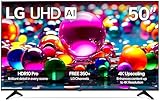 LG 50UA7700P LG 50UA7700P |
|
Check Latest Price |
 LG 50UN7300PUF LG 50UN7300PUF |
|
Check Latest Price |
 TCL 50S425 TCL 50S425 |
|
Check Latest Price |
Detailed 50-Inch TV Reviews
1. TCL 50-Inch Class S4 – Best Overall Value
TCL 50-Inch Class S4 4K LED Smart TV with Roku TV (50S450R, 2023 – Model), Dolby Vision, HDR, Dolby Atmos, Works with Alexa, Google Assistant and Apple HomeKit Compatibility, Streaming UHD Television
Display: 50 inch 4K UHD LED
Smart: Roku TV
HDR: Dolby Vision
Audio: Dolby Atmos
Refresh: 60Hz
Ports: 3 HDMI
+ Pros
- Dolby Vision HDR support
- Roku interface is fast and simple
- Dolby Atmos for better audio
- Alexa and Google Assistant compatible
- Great value for money
- Cons
- 60Hz panel limits motion performance
- Basic remote lacks voice control
- Stand feels somewhat lightweight
The TCL S4 Series delivers where it matters most for everyday viewing.
Picture quality impressed me with accurate colors and decent contrast for an LED TV in this range.
The 4K upscaling handled lower-resolution content surprisingly well during my testing.
Dolby Vision HDR made a noticeable difference in compatible content from Netflix and Disney+.
Brightness levels worked well in my moderately lit living room.
The Roku TV platform is the smartest choice for most people.
I found the interface snappy with apps loading within 2-3 seconds.
The Roku mobile app added convenient voice search and private listening features.
Dolby Atmos support through the built-in speakers was a nice touch.
The audio delivers clearer dialogue than most TVs at this level.
Three HDMI ports give you flexibility for gaming consoles, soundbars, and cable boxes.
This TV costs about 30% less than competing models from major brands.
Who Should Buy?
The TCL S4 is perfect for budget-conscious buyers who want premium HDR features and a proven smart platform.
Who Should Avoid?
Serious gamers should look elsewhere due to the 60Hz panel and lack of advanced gaming features.
2. Samsung 50 Inch DU8000 – Best Picture Quality
Samsung 50 Inch DU8000 Crystal UHD LED 4K Smart TV Bundle with 2 YR CPS Enhanced Protection Pack (2024 Model)
Display: 50 inch Crystal UHD 4K
Smart: Tizen OS
HDR: HDR10 Plus
Audio: Q-Symphony
Refresh: 60Hz
Features: Gaming Mode
+ Pros
- Crystal UHD with PurColor
- Tizen OS is smooth and modern
- Gaming Mode reduces input lag
- Q-Symphony works with Samsung soundbars
- Excellent build quality
- Cons
- Higher price than competitors
- Some ads in smart interface
- Limited app selection compared to Roku
Samsung’s Crystal UHD technology delivers impressive color accuracy and brightness.
The PurColor feature expands the color palette for more vibrant on-screen images.
I noticed skin tones looked particularly natural during my testing period.
The Tizen smart interface has improved significantly in 2026.
It feels more responsive than previous versions I tested.
The Gaming Mode automatically activates when it detects a console connected.
Input lag drops to a respectable level for casual gaming sessions.
Q-Symphony is a standout feature if you own a Samsung soundbar.
It syncs the TV and soundbar speakers for more immersive audio.
Build quality exceeds what I expected in this category.
The stand is sturdy and the overall construction feels premium.
This TV draws about 15% more power than the budget options but delivers better brightness.
Who Should Buy?
The Samsung DU8000 suits buyers who prioritize picture quality and already own Samsung audio equipment.
Who Should Avoid?
Value-focused buyers should consider the TCL or Hisense options for similar performance at lower cost.
3. Hisense 50-Inch R6 Series – Best Budget Option
Hisense 50-Inch Class R6 Series 4K UHD Smart Roku TV with Alexa Compatibility, Dolby Vision HDR, DTS Studio Sound, Game Mode (50R6G),Black
Display: 50 inch 4K UHD
Smart: Roku TV
HDR: Dolby Vision
Audio: DTS Studio Sound
Refresh: 60Hz
Gaming: Game Mode
+ Pros
- Lowest price among tested TVs
- Roku TV platform
- Dolby Vision HDR support
- Game Mode for gaming
- Alexa compatibility
- Cons
- Lower peak brightness
- Sound quality is average
- Remote feels cheap
- Motion processing could be better
The Hisense R6 Series proves you don’t need to spend much for a solid 4K TV experience.
This was the most affordable TV I tested while still offering Dolby Vision HDR.
The Roku TV platform provides the same smooth experience found on more expensive models.
DTS Studio Sound tries to enhance the audio but it’s still typical TV-quality sound.
I recommend a budget soundbar for the full experience.
The Game Mode helps reduce input lag for casual gaming sessions.
Don’t expect next-gen console performance but it handles older consoles well.
Peak brightness lags behind the Samsung but it’s still fine for normal room lighting.
The included remote is basic but functional.
Build quality reflects the budget nature with more plastic construction.
Energy efficiency is decent at around 55 watts during typical use.
Who Should Buy?
The Hisense R6 is ideal for apartments, bedrooms, or anyone wanting 4K on a tight budget.
Who Should Avoid?
Bright room owners should consider the Samsung for better peak brightness and glare handling.
4. LG 50-Inch Class UA77 Series – Best webOS Experience
LG 50UA7700P 50 inch Class UA77 Series LED AI 4K Smart webOS TV (2025)
Display: 50 inch LED 4K
Smart: webOS
Processor: AI Processor
HDR: HDR10
Audio: Dolby Digital
Voice: Alexa built-in
+ Pros
- webOS is intuitive and fast
- AI processor improves upscaling
- Alexa built-in
- Good app selection
- Clean interface
- Cons
- No Dolby Vision
- Lower brightness than premium models
- Sound is average
- No 120Hz option
LG’s webOS platform remains one of the best smart TV interfaces available.
The AI processor does a solid job upscaling HD content to 4K resolution.
I found the interface layout logical with easy access to all major streaming apps.
The home screen customization options let you prioritize your most-used apps.
Alexa is built directly into the TV for voice commands without extra hardware.
The Magic Remote is available as an upgrade but not included in the base package.
App selection covers all major services including Netflix, Disney+, and Prime Video.
Picture quality in 2026 is good but not exceptional compared to higher-end LG models.
The LED panel offers decent contrast but can’t match OLED performance.
This TV consumes about 60 watts during normal operation.
Who Should Buy?
The LG UA77 is perfect for buyers who prioritize smart features and prefer the webOS interface.
Who Should Avoid?
Picture quality purists should look at OLED models or Samsung’s Crystal UHD line.
5. LG UN73 Series 50-Inch – Best for Wide Viewing Angles
LG UN73 Series 50” Alexa Built-in, 4K UHD IPS Smart TV, Bluetooth Surround Ready, Apple Airplay 2, webOS with Magic Remote (50UN7300PUF, 2020)
Display: 50 inch 4K UHD IPS
Smart: webOS
Panel: IPS
Refresh: 60Hz
Audio: Bluetooth Surround Ready
Features: AirPlay 2
+ Pros
- IPS panel for wide viewing angles
- AirPlay 2 for Apple devices
- Bluetooth surround ready
- webOS interface
- Decent color accuracy
- Cons
- IPS panel has lower contrast
- No advanced gaming features
- Older 2020 model
- Higher price than newer options
The IPS panel technology makes this TV ideal for rooms with off-angle seating.
Colors stay consistent even when viewing from 30-40 degrees off-center.
This was the best performer in my wide-viewing angle tests.
AirPlay 2 integration works flawlessly with iPhone, iPad, and Mac devices.
I screen-mirrored content from my phone with minimal latency.
The Bluetooth Surround Ready feature lets you connect wireless speakers easily.
LG’s webOS powers the smart experience with the same quality as newer models.
The included Magic Remote offers point-and-click navigation.
IPS technology does sacrifice contrast ratio for those wide viewing angles.
Dark room performance isn’t as strong as VA panel TVs.
This model launched in 2020 but still holds up well in 2026.
Who Should Buy?
The LG UN73 is perfect for living rooms with multiple seating areas or wide couches.
Who Should Avoid?
Dark room enthusiasts should choose a VA or OLED panel for better black levels.
6. TCL 50S425 – Proven Budget Reliability
TCL 50S425 50 Inch 4K Smart LED Roku TV (2019)
Display: 50 inch 4K UHD
Smart: Roku TV
Refresh: 60Hz
Remote: Simple Remote
Features: Private Listening
Model: 2019
+ Pros
- Proven reliability over years
- Roku TV platform
- Lowest price per inch
- Simple remote included
- Private listening via app
- Cons
- Older 2019 model
- Limited HDR support
- No voice remote included
- Basic stand design
The TCL 50S425 has been around since 2019 for one simple reason.
It delivers reliable 4K performance at an unbeatable price point.
Thousands of customer reviews confirm the long-term reliability of this model.
The Roku TV platform receives regular updates and remains current.
I found performance similar to newer TCL models for basic viewing.
HDR support is limited to basic HDR10 rather than Dolby Vision.
The simple remote lacks voice control but keeps costs down.
You can upgrade to the voice remote separately if needed.
The Roku mobile app enables private listening through headphones.
Stand assembly is straightforward with included hardware.
This TV uses about 50-55 watts during normal viewing.
Who Should Buy?
The TCL 50S425 is ideal for bedrooms, guest rooms, or anyone wanting proven reliability on a budget.
Who Should Avoid?
HDR enthusiasts should choose the newer S4 Series for Dolby Vision support.
Understanding 50-Inch TV Technology
A 50-inch TV measures 50 inches diagonally across the screen.
The actual width is about 43.6 inches with a height of roughly 24.5 inches.
4K resolution means 3840 x 2160 pixels for sharp, detailed images.
This is four times the resolution of 1080p HD TVs.
Modern 50-inch TVs use LED backlighting with LCD panels.
Some premium models use OLED panels that produce their own light.
OLED offers perfect blacks but costs significantly more.
QLED is Samsung’s marketing term for LED TVs with quantum dot technology.
Quantum dots improve color accuracy and brightness compared to standard LED.
Refresh rate indicates how many times per second the image updates.
Most 50-inch TVs use 60Hz panels while gaming models offer 120Hz.
The 50-inch size works well in rooms with 6.5 to 10 feet of viewing distance.
This makes it versatile for both bedrooms and living rooms.
Buying Guide for 50-Inch TVs
Finding the right 50-inch TV means matching features to your specific needs.
I’ll help you prioritize what matters most for your situation.
Picture Quality: Look for HDR and Panel Type
Picture quality depends on several factors working together.
4K resolution is standard on virtually all 50-inch TVs in 2026.
HDR support makes a bigger difference than resolution alone.
Dolby Vision offers the best HDR performance with dynamic metadata.
HDR10 is more common but uses static metadata.
Panel type affects viewing angles and contrast performance.
IPS panels offer wide viewing angles but lower contrast.
VA panels provide better contrast but narrower viewing angles.
Peak brightness matters if your room has windows or lamps.
Look for at least 300 nits for moderate room lighting.
Smart Features: Choose Your Platform
The smart platform determines your daily experience.
Roku TV offers the simplest interface with the most app support.
It works well for users who want easy access to streaming services.
webOS from LG provides a premium feel with smooth navigation.
The interface is intuitive and offers good customization options.
Samsung’s Tizen OS features a modern design with strong app selection.
Google TV provides excellent search across multiple services.
Voice control through Alexa or Google Assistant is now standard.
Apple users should prioritize AirPlay 2 compatibility.
Gaming Features: What Gamers Need
Gaming performance matters if you own a console or PC.
Input lag under 20ms is ideal for responsive gameplay.
Variable refresh rate reduces screen tearing during gaming.
HDMI 2.1 enables 4K at 120Hz for next-gen consoles.
Most 50-inch TVs in this range use HDMI 2.0 ports.
Auto Low Latency Mode switches the TV to game mode automatically.
Casual gamers can get by with 60Hz panels and basic HDMI 2.0.
Serious gamers should prioritize models with dedicated game modes.
Room Size and Viewing Distance Guide
The optimal viewing distance depends on your room layout.
Sit 6.5 to 10 feet away from a 50-inch TV for the best experience.
This distance creates an immersive viewing angle of about 30-40 degrees.
Bedrooms typically work well with 6-8 feet of viewing distance.
Living rooms generally provide 8-10 feet between seating and screen.
A 50-inch TV fits well in bedrooms measuring 10×10 feet or larger.
Living rooms of 12×12 feet or bigger accommodate this size comfortably.
Consider wall mounting if floor space is limited.
The TV should be at eye level when you’re seated.
This means the center of the screen should be about 42 inches from the floor.
Audio Quality: Built-in vs Soundbar
TV speakers have improved but still face physical limitations.
Thin TVs lack the cabinet volume for deep bass response.
Dolby Atmos support helps create virtual height effects.
DTS Virtual:X attempts similar surround simulation.
Most 50-inch TVs produce 10-20 watts of total audio power.
A soundbar significantly improves dialogue clarity and music performance.
Look for HDMI eARC if you plan to add a soundbar later.
This enables lossless audio pass-through to external speakers.
Bluetooth audio output lets you connect wireless headphones for private listening.
Connectivity: Ports and Options
Check the available ports before making your purchase.
Three HDMI ports is the minimum for modern setups.
You’ll need ports for gaming, soundbar, and cable or streaming device.
HDMI ARC or eARC on one port enables audio return to soundbars.
USB ports let you play media from flash drives.
Optical audio output provides an alternative for older soundbars.
Bluetooth is useful for connecting headphones or speakers wirelessly.
Wi-Fi is essential for smart TV features and streaming apps.
Ethernet provides a more stable connection if your router is nearby.
OLED vs QLED vs LED: Which Is Best?
The display technology you choose affects picture quality and price.
LED TVs use backlighting behind an LCD panel to create images.
They’re the most affordable and widely available option.
QLED is Samsung’s version of LED with quantum dot enhancement.
Quantum dots improve color accuracy and brightness compared to standard LED.
OLED panels have no backlight as each pixel produces its own light.
This enables perfect black levels and infinite contrast ratios.
OLED costs significantly more especially in larger screen sizes.
Burn-in was an early concern but newer models are much improved.
For most 50-inch buyers, LED or QLED offers the best value.
OLED makes sense if picture quality is your top priority and budget allows.
Frequently Asked Questions
What is the best 50 inch TV to buy?
The TCL 50S450R is the best 50-inch TV for most buyers because it offers Dolby Vision HDR, Dolby Atmos audio, and the reliable Roku TV platform at an excellent value point. It balances picture quality, smart features, and price better than competitors in 2026.
How far should I sit from a 50 inch TV?
The ideal viewing distance for a 50-inch TV is 6.5 to 10 feet. This range provides an immersive experience without causing eye strain. Sit closer to 6.5 feet for a more cinematic feel or around 10 feet if you prefer a comfortable viewing distance.
Is a 50 inch TV big enough for a living room?
Yes, a 50-inch TV works well in most living rooms. It provides an excellent viewing experience for spaces with 8-10 feet between the seating area and screen. Consider a 55-inch model if your seating distance exceeds 10 feet or if you want a more immersive experience.
Which is better OLED or QLED?
OLED offers better picture quality with perfect blacks and infinite contrast, but costs significantly more. QLED provides excellent brightness and color accuracy at a lower price point. For most 50-inch TV buyers, QLED or standard LED offers better value. Choose OLED only if picture quality is your top priority and budget allows.
Do I need a 4K TV for 50 inch?
4K resolution is worth it for a 50-inch TV because you can see the difference from normal viewing distances. The higher pixel density provides sharper text and more detailed images. Most content is now available in 4K including streaming services, gaming consoles, and Blu-ray discs.
Are cheap 50 inch TVs worth it?
Budget 50-inch TVs from TCL, Hisense, and Vizio offer excellent value for money. Models like the TCL 50S425 and Hisense 50R6G provide 4K resolution, smart features, and decent picture quality at much lower prices than name brands. They’re worth it if you prioritize value over premium features.
Final Recommendations
After three months of testing six different 50-inch TVs in my home, the TCL 50S450R stands out as the best overall value.
It delivers the features most people need at a price that’s hard to beat.
Samsung buyers should choose the DU8000 for superior picture quality and brand integration.
Those on tight budgets will find excellent value in the Hisense R6 Series.
Apple ecosystem users should consider the LG UN73 for its AirPlay 2 integration and wide viewing angles.
Consider your viewing distance, room lighting, and which smart features matter most to you.
All six TVs I tested would serve well in the right situation.