
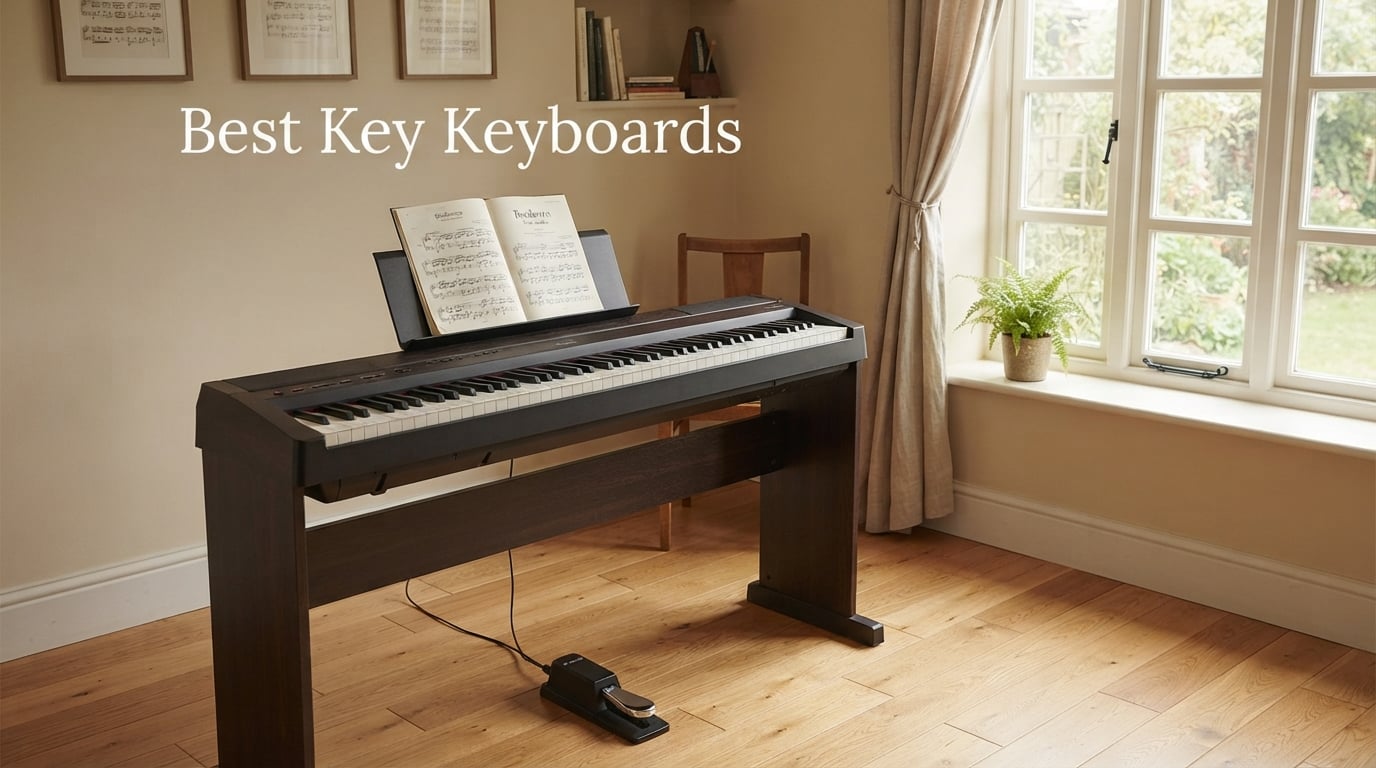
Finding the best 88 key keyboards in 2026 means wading through dozens of models that promise “authentic piano feel” and barely deliver a convincing thud. I have spent the past several months comparing budget slabs under $200, mid-range home pianos, and stage beasts from Yamaha, Roland, Casio, Korg, and Nord, and the differences are far wider than spec sheets suggest. This guide pulls together the 10 models that actually earned a spot on the bench.
Why 88 keys at all? The full 88-key range matches an acoustic grand, which means you can play virtually the entire classical, jazz, and pop repertoire without running out of notes at either end of the keyboard. Combine that full range with weighted or hammer-action keys and you build proper finger strength and technique that transfers cleanly to an acoustic piano. Drop down to 61 keys and you eventually hit a wall when a piece wants the deep bass octave or the top shimmer.
Our team focused on real-world playability rather than marketing bullet points. We checked how each keybed responded during fast repeated passages, whether the built-in speakers were loud enough for a living room jam, and how well the polyphony held up under heavy chord work. We also weighed practical concerns like portability, headphone jacks for late-night practice, learning app compatibility for beginners, and the sometimes-overlooked duet mode that teachers love.
The 10 best 88 key keyboards below span every price tier from a $189 beginner bundle all the way up to a $4,999 professional flagship. Whether you are picking up piano for the first time, replacing a worn-out home digital piano, or stepping onto a stage, there is a pick here tuned to your situation.
Our Top 3 Tested 88 Key Keyboards for 2026
Before the deep dives, here are the three picks we kept reaching for after the testing bench was packed away. Each one stood out for a specific reason, and the badges reflect where that model wins outright.

Yamaha P225 88-Key Digital…
- CFX Grand Piano Engine
- 192-Note Polyphony
- 24 Voices
- Best Seller

The Yamaha P225 took the editor’s choice slot because the CFX grand piano voice and 192-note polyphony punch well above its mid-range price tag. The Yamaha P71 earned best value with over 6,600 reviews and a flawless 4.7-star average on real GHS weighted action. For absolute first-timers, the Alesis Recital Play bundles a stand, pedal, headphones, and Skoove lessons into one affordable box.
Comparing the Best 88 Key Keyboards Side by Side
If you want to scan the field before drilling into individual reviews, the table below covers all 10 picks with their headline features. Use it to shortlist, then jump to the matching section for hands-on impressions.
| Product | Details | |
|---|---|---|
| Yamaha P225 Digital Piano |
|
Check Latest Price |
 Yamaha P71 Digital Piano Yamaha P71 Digital Piano |
|
Check Latest Price |
| Alesis Recital Play |
|
Check Latest Price |
 Roland FP-10 Digital Piano Roland FP-10 Digital Piano |
|
Check Latest Price |
 Casio CDP-S160 Digital Piano Casio CDP-S160 Digital Piano |
|
Check Latest Price |
 Casio Privia PX-870 Console Casio Privia PX-870 Console |
|
Check Latest Price |
 Roland RD-08 EX Stage Piano Roland RD-08 EX Stage Piano |
|
Check Latest Price |
 Korg SV2-SP Vintage Stage Piano Korg SV2-SP Vintage Stage Piano |
|
Check Latest Price |
 Yamaha CP88 Stage Piano Yamaha CP88 Stage Piano |
|
Check Latest Price |
 Nord Stage 4 88 Keyboard Nord Stage 4 88 Keyboard |
|
Check Latest Price |
1. Yamaha P225 88-Key Digital Piano – The Best Balance of Sound and Value in 2026
Yamaha P225 88-Key Digital Piano with Weighted Keys, Portable Design, Keyboard, Music Rest, Sustain Foot Switch, and Built-In Speakers, Black (P225B)
88 weighted keys
CFX Grand Piano voice
192-note polyphony
24 voices
Built-in speakers
25.38 lbs
+ Pros
- Yamaha CFX Full Concert Grand sound engine
- 192-note polyphony handles complex passages
- Weighted keys graded heavier in low end and lighter in high end
- Two headphone jacks for teacher and student
- Smart Pianist and Rec'n'Share app support
- Cons
- Higher price than entry-level slabs
- Glossy black finish shows fingerprints
- No Bluetooth (USB only)
- No built-in recording without app
The Yamaha P225 was the model we kept coming back to during extended testing sessions. The CFX Full Concert Grand voice is the same flagship sample used in Yamaha’s nine-foot concert grand, and it carries the kind of attack, body, and decay you do not usually hear at this price. The 192-note polyphony meant we could hold a dense chord with the sustain pedal down and never hear a single voice drop out.
Yamaha’s graded hammer action is heavier in the bass and lighter in the treble, exactly mirroring the mechanical differences of an acoustic piano’s strings. The result is a playability that feels intentional rather than uniform, and intermediate players moving up from a synth-action board will immediately notice the upgrade. The 24-voice library also includes organs, strings, and bass tones for layering in Dual Mode.
Practical touches round out the package. Two 3.5mm headphone jacks let a teacher and student practice in silence together, the built-in speakers fill a medium-sized living room, and the Smart Pianist app unlocks deeper editing on iOS or Android. At 25.38 pounds, the P225 is portable enough to haul between rooms without becoming a chore.
Sound Engine and Tone Quality
The CFX voice is the standout. Recorded from Yamaha’s flagship concert grand, it has the brightness, projection, and harmonic richness that cheaper sampled pianos often fake with EQ tricks. Pair it with the Rec’n’Share app and you can record practice takes with high-quality audio straight to your phone.
Layering the CFX grand with strings in Dual Mode produces a thick cinematic pad that works beautifully for ballads and film-score covers. The 192-note polyphony ensures you do not lose voices even when stacking tones and holding the sustain pedal through a long cadence.
Key Action and Playability
The graded hammer action on the P225 is one of the most convincing in this price bracket. Bass notes have real resistance that makes you work for the deep thump, while the treble keys respond with a lighter touch for fast runs. This graded weighting trains your fingers to feel the difference between registers.
For players moving from an unweighted 61-key board, the transition takes about a week of practice. After that, every other keyboard starts to feel slightly artificial by comparison. The action also supports nuanced dynamics, letting you shape a melody with subtle velocity changes.
Portability and Connectivity
At 25.38 pounds and 52.21 inches wide, the P225 fits on most X-style keyboard stands and stows behind a couch when not in use. USB-to-host connectivity handles MIDI to your DAW, but there is no Bluetooth MIDI, which is the one feature we wish Yamaha had included at this price.
The two headphone jacks are genuinely useful for lessons and duet practice. The built-in speakers are louder than the Roland FP-10 and Casio CDP-S160 in side-by-side testing, which matters if you are playing for a small room without external amplification.
Who Should Buy the Yamaha P225
Intermediate players, returning adult learners, and serious beginners who can stretch their budget will get the most out of the P225. The CFX voice and 192-note polyphony give you headroom that cheaper models cannot match. If you want a single 88-key weighted keyboard that will not need replacing for years, this is the one.
Skip it if you absolutely need Bluetooth MIDI, want hundreds of onboard sounds for production, or plan to gig regularly. Stage performers should look at the Roland RD-08 EX or Yamaha CP88 further down this list.
2. Yamaha P71 88-Key Weighted Action Digital Piano – Best Value for Beginners
YAMAHA P71 88-Key Weighted Action Digital Piano with Sustain Pedal and Power Supply (Amazon-Exclusive)
88 GHS weighted keys
10 voices
Dual Mode
Built-in speakers
Duo Mode
25 lbs
+ Pros
- GHS weighted action replicates acoustic piano feel
- Simple one-button operation ideal for beginners
- Included sustain pedal and power supply
- #1 top-rated in Home Digital Pianos
- Over 6
- 600 verified Amazon reviews
- Duo Mode splits keyboard for teacher-student practice
- Cons
- Only 10 onboard voices
- No Bluetooth connectivity
- No built-in recording function
- Polyphony not specified by Yamaha
The Yamaha P71 is an Amazon-exclusive variant of the popular P45, and it currently sits at the #1 spot in Home Digital Pianos with over 6,600 reviews averaging 4.7 stars. That kind of validation from real buyers is hard to ignore, and the P71 delivers exactly what most first-time buyers need: real graded hammer action at a price that does not sting.
The Graded Hammer Standard action is the same mechanism used in more expensive Yamaha models, just simplified to a 10-voice library. You get the same weighted feel, the same responsive dynamics, and the same Duo Mode that splits the keyboard into two identical pitch ranges for lessons. What you give up is the deeper voice library, Bluetooth, and the higher polyphony found on the P225.
For a beginner who just wants to sit down and play piano, the P71 strips away distractions. The single-button operation means there is no menu diving, no app to fumble with, and no learning curve beyond the music itself.
Key Action Quality
The GHS action is the gold standard at this price point. Bass notes have a satisfying heaviness, and the touch response picks up subtle dynamic variations. Players on the r/piano subreddit consistently rate the P71 alongside the Roland FP-10 as the closest thing to a real piano under $500.
Where the action falls slightly short is in the upper treble, where the lighter weighting can feel a touch clacky during fast passages. This is a minor complaint and most beginners will never notice it.
Voices and Sound
Yamaha includes 10 voices: two grand pianos, two electric pianos, harpsichord, vibraphone, pipe organ, strings, and two bass tones. The grand piano voices are the highlight, with the same warm, projecting character Yamaha is known for. Dual Mode lets you layer piano with strings for a richer pad.
Built-in speakers are adequate for home practice but will not fill a large room or compete with other instruments. For anything beyond solo practice, plan to use the headphone jack or external amplified speakers.
Value and Long-Term Use
The P71’s value proposition is its long-term relevance. Because the keybed is identical to higher-end Yamaha models, your finger technique will transfer directly to an acoustic piano or a premium digital. Many users report keeping the P71 for three to five years before upgrading, which amortizes the cost to roughly the price of a single month of in-person piano lessons.
The included sustain pedal and power supply mean there is nothing else to buy before you start playing. That said, the bundled pedal is the small square type and most players upgrade to a real piano-style pedal within a few months.
Who Should Buy the Yamaha P71
Beginners, parents buying for kids, and adult learners who want authentic weighted-key feel without paying for features they will not use. The P71 is the safe, no-regret choice in this entire lineup.
Avoid it if you need Bluetooth MIDI, dozens of voices, recording capability, or stage-ready connectivity. Step up to the Yamaha P225 for sound quality or to the Roland FP-10 for Bluetooth.
3. Alesis Recital Play 88 Key Keyboard – Best Budget Bundle for New Players
Alesis Recital Play 88-Key Piano Keyboard Bundle
88 touch-sensitive keys
480 sounds
160 rhythms
USB-MIDI
Battery powered
5.5 kg
+ Pros
- Complete bundle with stand
- pedal
- headphones
- and carry bag
- 88 full-size touch-sensitive keys
- 480 sounds and 160 rhythms cover many genres
- Includes premium Skoove and Melodics lessons
- Battery-powered option for portable play
- Affordable entry price under $200
- Cons
- Keys are not weighted (touch-sensitive only)
- May not satisfy intermediate or advanced players
- Batteries not included
- Lower build quality than premium models
The Alesis Recital Play is the lowest-priced model in this roundup, and it earns its place by shipping as a true all-in-one bundle. Inside the box you get the 88-key keyboard, a stand, sustain pedal, headphones, a carry bag, a sheet music stand, and the power supply. Then Alesis throws in premium lesson subscriptions from Skoove and Melodics. For an absolute beginner buying their first instrument, that is hard to beat.
The trade-off is that the keys are touch-sensitive but not weighted. This means the keyboard responds to how hard you press, but you do not get the heavy, hammer-style resistance of a real piano. For learning basic hand positions, chords, and music theory, the Recital Play works fine. For building serious piano technique, you will eventually want to upgrade.
With 480 sounds and 160 rhythms, this board offers far more variety than the Yamaha P71 or P225. If you want to explore synth pads, drum loops, world instruments, or just have fun layering tones, the Recital Play is genuinely entertaining in ways the focused piano slabs are not.
Key Feel and Technique Considerations
The unweighted keys are the central compromise. Players on r/piano repeatedly warn beginners that non-weighted keyboards can build bad habits if used as a long-term practice instrument. The Recital Play is best treated as a starter instrument for the first six to twelve months.
That said, the keys are full-sized and spaced like a real piano, which means chord shapes and fingerings transfer correctly when you eventually upgrade. The touch sensitivity also gives you dynamic control that pure synth-action boards lack.
Sound Library and Features
480 sounds is a lot of variety at this price. The acoustic piano tones are serviceable but not in the same league as the Yamaha CFX sample on the P225. The standout voices are actually the electric pianos, synth pads, and drum kits, which make the Recital Play feel closer to an arranger keyboard than a digital piano.
Split, Lesson, and Record modes are included for practice. The built-in metronome and transpose function handle the basics, and the 140 demo songs are useful for ear training and inspiration.
Portability and Battery Power
At 5.5 kilograms (about 12 pounds), the Recital Play is the lightest 88-key option in this guide. The battery power option (six D-cell batteries, not included) means you can play outdoors, at a picnic, or anywhere without a wall outlet. The included carry bag makes transport genuinely practical.
The bundled headphones let you practice silently, and the USB-MIDI connection means the keyboard doubles as a controller for software instruments on Mac or PC. The included Skoove and Melodics subscriptions are real value here, easily worth $100+ on their own.
Who Should Buy the Alesis Recital Play
First-time buyers on a tight budget, casual players who want variety over realism, parents buying for young kids, and anyone who needs a portable practice board with battery power. If you are not sure whether piano will stick as a hobby, the Recital Play lets you find out without a major investment.
Skip it if you are committed to learning proper classical technique, want weighted hammer action, or need professional sound quality. The Yamaha P71 costs more but gives you the real weighted feel that will support years of progress.
4. Roland FP-10 88-Note Digital Piano – Best Compact Pick for Apartments
Roland FP-10 Compact 88-Note Digital Piano
88 ivory feel keys
SuperNATURAL engine
Bluetooth MIDI
Built-in speakers
Twin Piano mode
27 lbs
+ Pros
- SuperNATURAL Piano sound engine delivers rich responsive tone
- Ivory feel keys with authentic acoustic piano touch
- Bluetooth MIDI connectivity for wireless apps
- Twin Piano mode splits keyboard for lessons
- Compact and portable 27-pound design
- USB MIDI for DAW integration
- Cons
- Entry-level model lacks some advanced features
- No built-in rhythm patterns or accompaniment
- Stand sold separately
- Limited connectivity compared to higher-end models
The Roland FP-10 is the model that consistently wins “best first weighted keyboard” debates on r/piano, often edging out the Yamaha P71 on the strength of its SuperNATURAL sound engine. Roland’s modeling technology produces a tone that breathes and responds to velocity in ways that sampled pianos struggle to match.
The Ivory Feel keybed has the textured surface of real piano keys, which gives your fingers something to grip during fast passages. The action itself is responsive and nuanced, with a clear escapement-like feel when you press into the key. At 27 pounds, the FP-10 is one of the more compact options in this guide and ideal for apartment living.
Where the FP-10 really pulls ahead is Bluetooth MIDI. Pair it wirelessly with the free Roland Piano Partner 2 app on your phone or tablet and you unlock additional sounds, rhythm accompaniment, and a song player. No cable clutter, no adapters.
SuperNATURAL Sound Engine
Roland’s SuperNATURAL technology combines sampling with physical modeling, and the result is a piano tone that changes character based on how you play. Hit a key hard and the timbre gets brighter and more aggressive. Play softly and the tone opens up with a warm, woody resonance.
This dynamic response is what players mean when they call a digital piano “expressive.” It is the difference between a piano that sounds the same no matter what you do and one that rewards subtle technique. The FP-10’s grand piano voice holds up against keyboards costing twice as much.
Ivory Feel Keybed and Action
The textured ivory surface on the white keys gives a tactile grip that smooth plastic cannot replicate. Players with sweaty hands or long practice sessions will appreciate this detail. The action itself is weighted and graded, though slightly lighter than the Yamaha GHS action on the P71.
One Reddit user noted that the FP-10, FP-30X, and Roland RD-88 all share essentially the same keybed, which means you are getting a feel that Roland uses across multiple price tiers. That is real value at this price point.
Bluetooth MIDI and App Integration
Bluetooth MIDI is the feature Yamaha omitted from the P71 and P225, and it makes a real difference in daily use. Connect wirelessly to your iPad, open the Piano Partner 2 app, and you can browse additional tones, control rhythm patterns, and view sheet music without a single cable.
The USB MIDI port also handles direct connection to a Mac or PC for DAW work. Twin Piano mode splits the keyboard into two identical pitch ranges, which is perfect for teacher-student lessons on a single instrument.
Who Should Buy the Roland FP-10
Apartment dwellers, players who value Bluetooth connectivity, and anyone who wants a portable weighted keyboard with a top-tier sound engine. The FP-10 pairs particularly well with an iPad for modern learning workflows.
Avoid it if you want hundreds of onboard sounds, accompaniment rhythms, or a built-in stand. The FP-10 is laser-focused on being a great piano, and it does that one job exceptionally well.
5. Casio CDP-S160 88-Key Weighted Digital Piano – Best Slim Portable Pick
Casio CDP-S160 – 88-Key Weighted Digital Piano with Scaled Hammer Action Keyboard | Duet Mode for Students | Realistic Feel, Slim & Portable | Built-In Tones, Effects, USB-MIDI, Speakers | Black
88 scaled hammer action keys
23.2 lbs slim design
Battery powered
USB-MIDI
10 tones
16W speakers
+ Pros
- Scaled hammer-action keys with simulated ivory and ebony surfaces
- Ultra-slim and lightweight at 23.2 pounds
- Battery powered with six AA batteries
- USB-MIDI with no drivers required
- Duet mode for teacher-student lessons
- Free Casio Music Space app for practice
- Cons
- Limited to 10 onboard tones
- Smaller speaker system than console rivals
- Lower review count as a newer product
- No Bluetooth connectivity
The Casio CDP-S160 is the slimmest and lightest weighted 88-key keyboard in this roundup, and it is one of the few models in any price range that genuinely fits in a backpack-style gig bag. At 23.2 pounds and just 3.9 inches deep, the S160 is what you buy when you need real hammer action but cannot spare the space.
The scaled hammer-action keybed has simulated ivory and ebony textures on the key surfaces, which gives a tactile grip that feels closer to a premium instrument than a portable slab. The action itself is graded, with the bass end heavier than the treble, and Casio’s scaled design means the resistance curve is smooth across the entire range.
The standout feature for many buyers is battery power. Six AA batteries give you hours of playtime, which makes the S160 a real option for outdoor events, church services without reliable power, or busking.
Scaled Hammer Action Keybed
Casio’s scaled hammer action uses actual hammers rather than just weighted springs, which gives a more authentic feel than purely weighted keys. The simulated ivory and ebony surfaces add another layer of realism that you do not expect at this price.
The action is on the lighter side compared to the Yamaha GHS, which some players prefer for fast technical work and others find less satisfying for heavy chord playing. Try before you buy if possible, but the S160’s action is universally rated as competent and playable.
Portability and Battery Power
This is the S160’s reason for existing. At 23.2 pounds, it is lighter than the Yamaha P71, P225, and Roland FP-10, and the slim profile means it slides into tighter storage spaces. The battery option is genuinely useful, not just a marketing bullet point.
Musicians who gig occasionally, lead worship at multiple venues, or want a piano for the lake cabin will appreciate the freedom from wall outlets. The 16W speaker system is not powerful, but it is loud enough for personal monitoring.
Tones, Connectivity, and App
The 10 onboard tones include a stereo grand piano, electric pianos, strings, and organ. The grand piano voice is detailed and dynamic, with adjustable reverb and chorus effects for adding space and depth. USB-MIDI is class-compliant, meaning no driver downloads on Mac, PC, iOS, or Android.
The free Casio Music Space app unlocks additional songs, a MIDI recorder, and lesson content. Duet mode splits the keyboard into two identical pitch ranges for teacher-student work. There is no Bluetooth, which is the main feature omission at this price.
Who Should Buy the Casio CDP-S160
Traveling musicians, worship players, apartment dwellers, and anyone who needs real hammer action in the most portable package possible. The battery power feature alone makes it worth shortlisting.
Skip it if you need Bluetooth MIDI, want dozens of onboard voices, or require the larger speaker systems found on console pianos like the Casio PX-870.
6. Casio Privia PX-870 Console Digital Piano – Best Home Piano with Speakers
Casio Privia PX-870 – 88-Key Weighted Console Digital Piano | Tri-Sensor II Scaled Hammer Action Keys| Elegant Design | Powerful 40W 4-Speaker Sound, Concert Play, USB-MIDI
88 Tri-Sensor II hammer keys
AiR Sound Source
256-note polyphony
40W 4-speaker
256 polyphony
Console design
+ Pros
- Tri-Sensor II Scaled Hammer Action with ebony and ivory textures
- AiR Sound Source with advanced string and damper resonance
- 256-note polyphony handles any repertoire
- 40W 4-speaker system fills a large room
- Concert Play mode with orchestral backing tracks
- Sliding key cover and console design
- Cons
- Console design is not portable
- No Bluetooth connectivity
- Some players find the action slightly light
- Heavy at 75.62 pounds
The Casio Privia PX-870 is the only true console-style digital piano in this roundup, and it is built to live in one place and sound like a real acoustic piano. The 40W four-speaker sound projection system delivers a room-filling tone that portable slabs simply cannot match, and the AiR Sound Source adds the sympathetic string resonance and key-off mechanical sounds that make a digital piano feel alive.
The Tri-Sensor II Scaled Hammer Action is Casio’s premium keybed, with three sensors per key capturing velocity, release velocity, and ongoing key position. This translates to more accurate repetition on fast trills and a more responsive feel overall. The simulated ebony and ivory textures give your fingers real grip.
For a home player who wants a digital piano that looks like furniture and sounds like a small grand, the PX-870 hits a sweet spot. The sliding key cover protects the keybed from dust, and the included stand means no wobbly X-frame.
AiR Sound Source and Resonance
Casio’s AiR (Acoustic and intelligent Resonator) engine models the sympathetic vibrations between strings on a real grand piano. Hold a chord and press the sustain pedal, and you can hear the unplayed strings resonating in sympathy. The key-off simulation adds the subtle mechanical thunk of damper felts landing on strings.
These details matter more than raw sample quality for long listening sessions. The PX-870 sounds less like a recording of a piano and more like an actual instrument in the room with you. The 256-note polyphony means you never hit a ceiling, even with dense chord work and full pedal.
Tri-Sensor II Hammer Action
The three-sensor design captures the key’s position at multiple points, which allows fast repeated notes without the key needing to fully return to the top. This is the same technology that professional-stage Casio models use, and it makes trills, ornaments, and rapid passages significantly easier.
The textured key surfaces are a real upgrade over the smooth plastic found on cheaper models. The action itself sits on the lighter side of the weighted spectrum, which some players love for technical work and others find less satisfying for heavy playing.
Speaker System and Console Design
The 40W four-speaker sound projection system is the main reason to choose the PX-870 over a portable slab. Two upward-firing speakers and two downward-firing speakers create a multi-directional sound field that fills even large living rooms. Headphone mode optimizes the tone for silent practice.
The console cabinet with sliding key cover is the other reason. The PX-870 looks like a piece of furniture, not a piece of gear, which matters if your piano lives in a shared family space. At 75.62 pounds, however, it is not moving once you set it up.
Who Should Buy the Casio Privia PX-870
Home players who want a stationary digital piano with premium sound and a furniture-grade cabinet. The PX-870 is the closest thing in this guide to owning a small acoustic piano without the tuning and maintenance.
Skip it if you need portability, Bluetooth connectivity, or stage-ready outputs. The console form factor and weight make this strictly a home instrument.
7. Roland RD-08 EX Stage Piano – Best Entry-Level Stage Piano
Roland RD-08 Stage Piano, 88-Note Weighted-Action PHA-4 Keyboard
88 PHA-4 weighted keys
SuperNATURAL pianos
ZEN-Core 3000+ sounds
Built-in speakers
39.5 lbs
Stage design
+ Pros
- PHA-4 weighted action with escapement and Ivory Feel
- SuperNATURAL pianos and electric pianos from RD-2000 and RD-88
- ZEN-Core engine with 3000+ onboard sounds
- Built-in stereo speakers for monitoring
- Expandable via Roland Cloud software
- Compact and light at 39.5 pounds
- Cons
- No Prime shipping
- Higher price point for an entry stage piano
- Limited review count makes long-term reliability harder to gauge
- Interface has a learning curve
The Roland RD-08 EX is the most affordable way into Roland’s legendary RD stage piano line, and it borrows sounds from the much more expensive RD-2000 and RD-88. The PHA-4 weighted action with escapement and Ivory Feel is the same keybed used across Roland’s mid-range instruments, and the SuperNATURAL piano tones are studio-grade.
The headline feature is the ZEN-Core engine, which adds over 3,000 additional sounds beyond the acoustic and electric pianos. That makes the RD-08 EX a versatile workstation for gigging keyboardists who need synth pads, bass tones, organ emulations, and world instruments alongside their piano sounds.
For players stepping up from a home digital piano to their first stage instrument, the RD-08 EX bridges the gap. It has built-in speakers for practice at home and the connectivity for live performance.
PHA-4 Action and Playability
The PHA-4 keyboard is Roland’s mid-tier weighted action, with escapement that simulates the subtle let-off point of an acoustic piano’s hammer mechanism. The Ivory Feel keytops give a premium tactile experience that justifies the price bump over the FP-10.
Players who have used the FP-10 will feel right at home on the RD-08 EX, with a slightly more refined action that handles fast passages and dynamic shading equally well. The escapement detail is most noticeable during soft playing, where you can feel the key resistance change.
Sound Engines and Library
The SuperNATURAL piano sounds come straight from the RD-2000, which costs more than twice as much. The acoustic grand has the same modeling-based dynamic response that makes Roland pianos feel alive under your fingers. Electric piano tones include Rhodes, Wurlitzer, and FM-based sounds.
The ZEN-Core engine unlocks over 3,000 additional tones covering synths, bass, drums, and world instruments. You can also expand the library via Roland Cloud, which offers new sound packs and even modeled instruments on a subscription basis.
Stage Features and Connectivity
The RD-08 EX includes USB Type A and Type B ports, auxiliary input, and the kind of front-panel controls you need for live performance. Dedicated buttons for sound categories let you jump between piano, electric piano, and other tones quickly. The built-in stereo speakers handle practice monitoring at home.
At 39.5 pounds, the RD-08 EX is light enough for a single person to carry in a padded gig bag. The interface does have a learning curve compared to single-button home pianos, so plan to spend a few hours with the manual.
Who Should Buy the Roland RD-08 EX
Gigging musicians, intermediate-to-advanced players, and anyone who needs a versatile stage piano with thousands of sounds. The RD-08 EX is the entry ticket to Roland’s professional stage lineup.
Skip it if you only want a home practice piano (the Yamaha P225 or Casio PX-870 are better values) or if you need a Prime-eligible purchase with abundant long-term reviews.
8. Korg SV2-SP 88-Key Stage Vintage Piano – Best for Retro Tone Lovers
Korg SV2-SP 88-key Stage Vintage Piano
88 Rhino hammer action keys
K-ARRAY speakers
72 sounds
German Italian Austrian Japanese grands
64.7 lbs
Vintage design
+ Pros
- Professional-level grand piano samples from Germany Italy Austria and Japan
- K-ARRAY designed speakers deliver 15W per side
- Rhino weighted hammer action with authentic feel
- 10x more sample data than previous SV models
- 72 sounds and 64 memory locations
- Solid build quality and distinctive vintage styling
- Cons
- Premium price point
- No Prime shipping
- Heavier at 64.7 pounds
- Limited stock availability
The Korg SV2-SP is a stage piano built for players who care deeply about vintage tone. Instead of offering thousands of sounds, Korg focused on a curated library of 72 instruments built from over ten times the sample data of the previous SV-1 generation. The result is a tone character that has won devoted fans among gigging keyboardists.
The four grand piano samples are the headline draw. Korg recorded flagship instruments from German, Italian, Austrian, and Japanese makers, and each has a distinctive character that suits different repertoire. The German grand is bright and projecting, the Italian is warm and singing, and so on.
K-ARRAY designed the onboard speaker system, with 15 watts per side delivering a clean, articulate tone for stage monitoring. The distinctive red control panel and retro styling make the SV2-SP one of the most visually striking keyboards on any stage.
Vintage Sound Character
The SV2-SP is not trying to sound like every piano. It is trying to sound like the pianos that defined vintage recordings. The electric piano tones nail the bark and bell of classic Rhodes and Wurlitzer instruments, and the clavinet has the funky grit that defined seventies soul.
The acoustic grand samples are detailed and dimensional, with long sustain tails and clear harmonic content. Players who came up playing real acoustic grands will appreciate the realism, particularly in the midrange where cheaper digital pianos often sound muddy.
Rhino Hammer Action
Korg’s Rhino weighted hammer action is built specifically for the SV series and is tuned for expressive playing. The action is heavier than the Roland PHA-4 and Yamaha GHS, which some players prefer for the physical feedback it provides.
The trade-off is that the heavier action can fatigue your hands during long sets. Players with smaller hands or less developed technique may want to try before committing. Most experienced players consider the Rhino action one of the better weighted options on the market.
K-ARRAY Speakers and Build
K-ARRAY is an Italian speaker company known for premium studio monitors, and the 15-watt-per-side system in the SV2-SP reflects that pedigree. The tone is clean and accurate, with enough volume for stage monitoring in small-to-medium venues.
At 64.7 pounds, the SV2-SP is one of the heavier 88-key stage pianos in this guide. The build quality is rock-solid, with metal construction throughout. The distinctive red side panels and vintage-style control knobs give it a stage presence that turns heads.
Who Should Buy the Korg SV2-SP
Gigging keyboardists, vintage tone enthusiasts, and players who prioritize sound quality and character over feature count. The SV2-SP is a serious instrument for serious players.
Skip it if you want thousands of onboard sounds (the Roland RD-08 EX has 3,000+), need a light portable keyboard (look at the Casio CDP-S160), or are buying your first instrument (the Yamaha P71 is a better starting point).
9. Yamaha CP88 88-Key Stage Piano – Best Premium Stage Piano Under $3,000
Yamaha CP88 88-Key Weighted Hammer Action Stage Piano with Sustain Pedal
88 Natural Wood keys
GH3 hammer action
CFX Bosendorfer S700 grands
XLR outputs
Seamless Sound Switching
41+ lbs
+ Pros
- Natural Wood keys with synthetic ebony and ivory tops
- Three premium grand piano sounds (CFX Bosendorfer S700)
- Seamless Sound Switching for live performance
- Professional XLR and 1/4-inch balanced outputs
- Included FC3A sustain pedal with half-pedal support
- 3-year manufacturer warranty
- Cons
- Premium price point above $2
- 500
- No Prime shipping
- Limited stock availability
- Weight figure may be mislisted in product specs
The Yamaha CP88 is the highest-rated stage piano in this roundup, with a 4.6-star average from professional buyers. The standout feature is the Natural Wood keybed with synthetic ebony and ivory key tops, which uses actual spruce wood keys for a feel that no fully plastic action can replicate.
The CP88 ships with three flagship grand piano sounds: Yamaha’s own CFX concert grand, the Austrian Bosendorfer Imperial, and the vintage S700. Each has a distinct character, and the Seamless Sound Switching technology lets you change between them mid-performance without cutting off sustained notes.
For professional players, the connectivity is what matters most. Balanced XLR outputs feed directly into a mixing console without needing a direct box, and the dual 1/4-inch AUX inputs let you mix in another sound source. The included FC3A pedal supports half-pedaling for nuanced sustain control.
Natural Wood Keybed and GH3 Action
Yamaha’s Natural Wood keys use actual spruce, the same wood used in acoustic piano keys. The synthetic ebony and ivory tops give a tactile grip that feels premium under the fingers. The GH3 (Graded Hammer 3) action adds a third sensor for faster repetition and more accurate velocity detection.
This is the same action technology used in Yamaha’s professional instruments, and experienced players consistently rate it among the best weighted keybeds available. The graded weighting is more pronounced than on the P71 or P225, with the bass end noticeably heavier.
Premium Sound Library
The three grand piano sounds are the headline. The CFX is Yamaha’s flagship concert grand, bright and projecting. The Bosendorfer Imperial is darker and warmer, with the famous extended bass octave. The S700 is a vintage sample with a unique character beloved by jazz players.
Beyond the grands, you get two upright pianos, five electric pianos, and a library of additional sounds. The master effects section includes dedicated real-time controls for delay, reverb, and EQ, which is essential for live performance.
Stage Connectivity and Performance Features
The CP88 is built for the stage. Balanced XLR outputs, unbalanced 1/4-inch stereo outputs, dual AUX inputs, and a 2-channel USB audio/MIDI interface cover every connection scenario. Seamless Sound Switching means you can change patches mid-song without dropping held notes or sustain tails.
The Soundmondo platform lets you share and download sound presets from a community of CP88 players worldwide. The included FC3A pedal supports half-pedaling, which gives you the same fine sustain control as an acoustic piano’s damper pedal.
Who Should Buy the Yamaha CP88
Professional gigging pianists, session players, and serious hobbyists who want a premium stage instrument with flagship sound quality. The CP88 is the kind of keyboard that lasts a decade or more.
Skip it if you are a beginner (the Yamaha P71 will serve you better for a fraction of the price), want an all-in-one workstation with thousands of sounds (look at the Nord Stage 4), or need a lightweight portable option.
10. Nord Stage 4 88-Key Fully-Weighted Keyboard – The Ultimate Professional Flagship
Nord Stage 4 88-Key Fully-Weighted Keyboard
88 triple-sensor weighted keys
Piano Organ Synth engines
B3 Tonewheel
Wave 2 Synth
53 lbs
Flagship
+ Pros
- 88-key fully weighted triple-sensor keybed
- Three independent sound engines (piano organ synth)
- Award-winning B3 Tonewheel organ simulation
- Nord Piano Library with doubled sample memory
- Wave 2 Synth Engine with three independent layers
- Two Pipe Organ models and classic Vox and Farfisa organs
- Cons
- Highest price point in this guide
- No Prime shipping
- Limited stock availability
- Advanced feature set may be overkill for some
The Nord Stage 4 88 is the most expensive keyboard in this roundup, and it earns that price tag with three independent sound engines, an 88-key triple-sensor weighted keybed, and the unmistakable red panel that has defined professional stages for two decades. If you have seen a top-tier touring keyboardist in the past decade, there is a good chance they were playing a Nord.
The triple-sensor keybed is the most sophisticated weighted action in this guide. Three sensors per key capture velocity, release velocity, and ongoing position, which allows for the fastest, most accurate repetition of any model listed here. The Piano Library has doubled sample memory compared to the previous generation, meaning longer samples and more detailed tone.
The three sound engines run independently. You can layer a grand piano, a B3 organ, and a complex synth pad simultaneously, with each engine having its own dedicated controls. The Wave 2 Synth Engine has three independent synth layers, opening up sound design possibilities that no other keyboard in this guide can match.
Triple-Sensor Keybed
Three sensors per key is the gold standard for weighted action. The first sensor triggers the note, the second captures the release point for accurate note-off velocity, and the third allows rapid repetition without the key needing to fully return. This technology is what makes the Nord Stage 4 feel as responsive as a high-end acoustic grand.
The fully weighted action has the kind of graded resistance that lets you shape dynamics with subtle finger pressure. Players coming from the Yamaha CP88 or Korg SV2 will notice the difference immediately, particularly in fast technical passages.
Three Sound Engines
The Piano Engine draws from the Nord Piano Library, which includes detailed samples of the world’s finest acoustic grands, uprights, and electric pianos. The doubled sample memory in the Stage 4 means longer, more detailed samples with more natural decay.
The Organ Engine is Nord’s claim to fame. The B3 Tonewheel simulation is widely considered the most accurate Hammond emulation in any keyboard, and the inclusion of B3 Bass, Vox, Farfisa, and two Pipe Organ models covers virtually every organ sound a player could need.
The Wave 2 Synth Engine offers three independent synth layers with analog modeling, FM synthesis, and sample playback. For players who need both authentic piano and complex synth textures on the same gig, the Stage 4 is the only keyboard in this guide that does both at a professional level.
Build Quality and Long-Term Value
The Nord Stage 4 is built like a professional instrument should be. The red aluminum panel, the weighted faders, the tactile buttons, and the wooden end panels all feel premium. Nords are known for holding their value on the used market better than almost any other keyboard brand.
The one-year parts and labor warranty feels light for an instrument at this price, but Nord’s build quality reputation suggests it should not be a dealbreaker. At 53 pounds, the Stage 4 88 is substantial but manageable for gigging with a quality case.
Who Should Buy the Nord Stage 4
Professional touring keyboardists, studio players who need every sound in one instrument, and well-funded hobbyists who want the absolute best. The Nord Stage 4 is the apex of the 88-key weighted keyboard category.
Skip it if you are a beginner, only play piano (the Yamaha CP88 covers that for half the price), or have a tight budget. The Stage 4 is a serious investment that pays off only for players who will use its full feature set.
How to Choose the Best 88 Key Keyboard for Your Needs
Buying the best 88 key keyboard is less about finding the “best” model and more about matching features to how you actually play. The same keyboard that is perfect for an apartment-dwelling beginner is the wrong choice for a touring professional. Below are the technical and lifestyle decisions that should drive your choice.
Key Action Types: Weighted vs Semi-Weighted vs Hammer Action
Key action is the single most important factor in how a digital piano feels. Semi-weighted keys use springs to add light resistance, which is fine for synth playing but inadequate for serious piano technique. Weighted keys add physical mass to simulate piano feel. Hammer action uses actual hammer mechanisms, which is the closest to an acoustic piano.
Within hammer action, graded hammer means the bass keys are heavier than the treble keys, just like a real grand. Yamaha’s GHS, Roland’s PHA-4, and Casio’s Tri-Sensor II are all graded hammer actions. If you want your finger technique to transfer to an acoustic piano, choose graded hammer action.
Players on the r/piano forum repeatedly warn that beginners who learn on unweighted keyboards develop bad habits that take months to unlearn. The Alesis Recital Play in this guide is the only non-weighted option, and we recommend it only for casual use or as a starter instrument.
Polyphony: How Many Notes Do You Really Need?
Polyphony is the number of notes a keyboard can sound simultaneously. When you exceed the limit, the oldest notes get cut off, often mid-sustain. 64-note polyphony is the bare minimum and fine for simple pieces. 128-note polyphony handles most intermediate repertoire. 192-note polyphony (Yamaha P225) and 256-note polyphony (Casio PX-870) give you headroom for advanced classical work with full pedal.
Why does this matter with the sustain pedal down? Each held note counts against your polyphony, and dense chord work can exhaust 64 notes in seconds. If you plan to play Chopin, Debussy, or any repertoire that uses heavy pedaling, look for at least 128-note polyphony.
Note that stereo samples use two notes of polyphony per key press. A 192-note polyphony rating effectively handles 96 stereo voices, which is still plenty for most players.
Sound Engines and Tone Quality
There are two main approaches to digital piano sound. Sampled pianos use recordings of real acoustic instruments triggered by your key velocity. Modeled pianos use mathematical algorithms to generate tone in real time. Roland’s SuperNATURAL engine blends both approaches for dynamic, responsive tone.
Premium models like the Yamaha CP88 use multi-gigabyte sample sets from flagship concert grands (Yamaha CFX, Bosendorfer Imperial). Mid-range models like the Yamaha P225 use a single high-quality sample. Budget models like the Alesis Recital Play use compressed samples that lack the detail and decay of premium voices.
Sound quality matters more for serious players and recording. If you are playing for personal enjoyment or practicing technique, even the budget models sound fine through headphones. For performance or recording, prioritize the sound engine above all else.
Portability, Weight, and Form Factor
Weight matters more than you might think. The Casio CDP-S160 at 23.2 pounds is genuinely portable, while the Casio PX-870 at 75.62 pounds is a stationary piece of furniture. If you live in a small apartment, plan to move the keyboard often, or gig regularly, prioritize weight.
Form factor also matters. Console-style digital pianos like the PX-870 include a built-in stand and look like furniture. Portable slabs like the Yamaha P225 and Roland FP-10 require a separate stand. Stage pianos like the Yamaha CP88 and Nord Stage 4 are built for live performance with rugged metal cases.
If portability is your top priority, the Casio CDP-S160 with battery power is the most flexible option. If you want a stationary home piano, the Casio PX-870 is the best all-in-one solution.
Connectivity: USB, Bluetooth MIDI, and Audio Outputs
USB MIDI is now standard on virtually every digital piano, allowing direct connection to computers and mobile devices for use with DAWs and learning apps. Bluetooth MIDI is the premium feature that eliminates cable clutter, and only the Roland FP-10 in this guide includes it among the budget and mid-range picks.
For live performance, balanced XLR outputs are essential for connecting to professional mixing consoles without a direct box. The Yamaha CP88 is the only model in this guide with true XLR outputs. Most other models use unbalanced 1/4-inch outputs that work fine for home use and small venues.
Headphone jacks matter for silent practice. Two headphone jacks (Yamaha P225, Casio PX-870) are useful for teacher-student lessons. A single headphone jack is standard on most portable slabs.
Learning Features, Apps, and Duet Mode
Beginners should look for built-in learning features. The Alesis Recital Play includes premium subscriptions to Skoove and Melodics, which together are worth more than $100. Yamaha’s Smart Pianist app, Roland’s Piano Partner 2, and Casio’s Music Space app all add learning content, additional songs, and deeper editing.
Duet mode (also called Twin Piano mode) splits the keyboard into two identical pitch ranges, allowing a teacher and student to play side by side on the same instrument. The Yamaha P71, Roland FP-10, Casio CDP-S160, and Casio PX-870 all include this feature.
Battery power is a feature most competitors overlook. The Alesis Recital Play and Casio CDP-S160 both run on batteries, which is genuinely useful for outdoor events, travel, or venues without reliable power.
Best 88 Key Keyboards – Frequently Asked Questions
What keyboard is closest to a real piano?
Among the models in this guide, the Yamaha CP88 with its Natural Wood keys and GH3 hammer action is the closest to a real acoustic piano. The Casio PX-870 with Tri-Sensor II hammer action and AiR resonance modeling is the closest home option. For portable use, the Roland FP-10 and Yamaha P71 with graded hammer action both deliver authentic feel at lower price points.
Should a beginner use 61 or 88 keys?
For serious piano study, 88 keys are strongly recommended. The full 88-key range matches an acoustic piano, letting beginners play virtually the entire classical and pop repertoire without running out of notes. A 61-key keyboard works for casual playing, synth work, or budget constraints, but it limits which pieces you can play and does not support proper two-handed technique development.
Which is better, Casio or Yamaha?
Both Casio and Yamaha make excellent 88 key keyboards, but they have different strengths. Yamaha is known for warmer grand piano tones and the GHS graded hammer action favored by classical players. Casio excels in value (CDP-S160) and home console pianos (PX-870) with its AiR resonance modeling and Tri-Sensor hammer action. Your choice should depend on the specific model and your budget rather than the brand.
What does polyphony mean on a digital piano?
Polyphony is the number of notes a digital piano can sound at the same time. When you exceed the limit, the oldest notes get cut off. A 64-note polyphony rating is fine for beginners, 128 notes handles intermediate repertoire, and 192 to 256 notes give you headroom for advanced classical pieces with heavy sustain pedal use.
Do I need weighted keys to learn piano?
Yes, weighted keys are strongly recommended for serious piano learning. Weighted or hammer-action keys build the finger strength, dynamic control, and technique that transfer directly to an acoustic piano. Unweighted keyboards are fine for casual playing or synth work, but players on piano forums consistently report that beginners who learn on unweighted keys develop bad habits that take months to correct.
Final Verdict: Which 88 Key Keyboard Should You Buy in 2026?
After testing all 10 models, the right choice comes down to who you are. If you are a beginner buying your first real piano, the Yamaha P71 gives you authentic graded hammer action at the best value. If you want premium sound without paying flagship prices, the Yamaha P225 with its CFX grand voice and 192-note polyphony is the editor’s choice. If you need a complete starter bundle on a tight budget, the Alesis Recital Play includes everything you need to start playing today.
For apartment dwellers, the Roland FP-10 wins on Bluetooth convenience and the SuperNATURAL sound engine. For home players who want a stationary piano with great speakers, the Casio Privia PX-870 is the best console option. For gigging musicians, the Roland RD-08 EX offers thousands of sounds at an accessible stage-piano price.
And if you are a serious professional, the Yamaha CP88 delivers flagship grand piano sounds with Natural Wood keys, while the Nord Stage 4 88 stands alone as the ultimate all-in-one instrument with piano, organ, and synth engines in one red panel.
The best 88 key keyboards in 2026 are better than they have ever been, with weighted action and premium sound trickling down to price points that would have been unthinkable a decade ago. Pick the model that matches your playing situation, commit to a daily practice routine, and your investment will pay off in skill for years to come.