
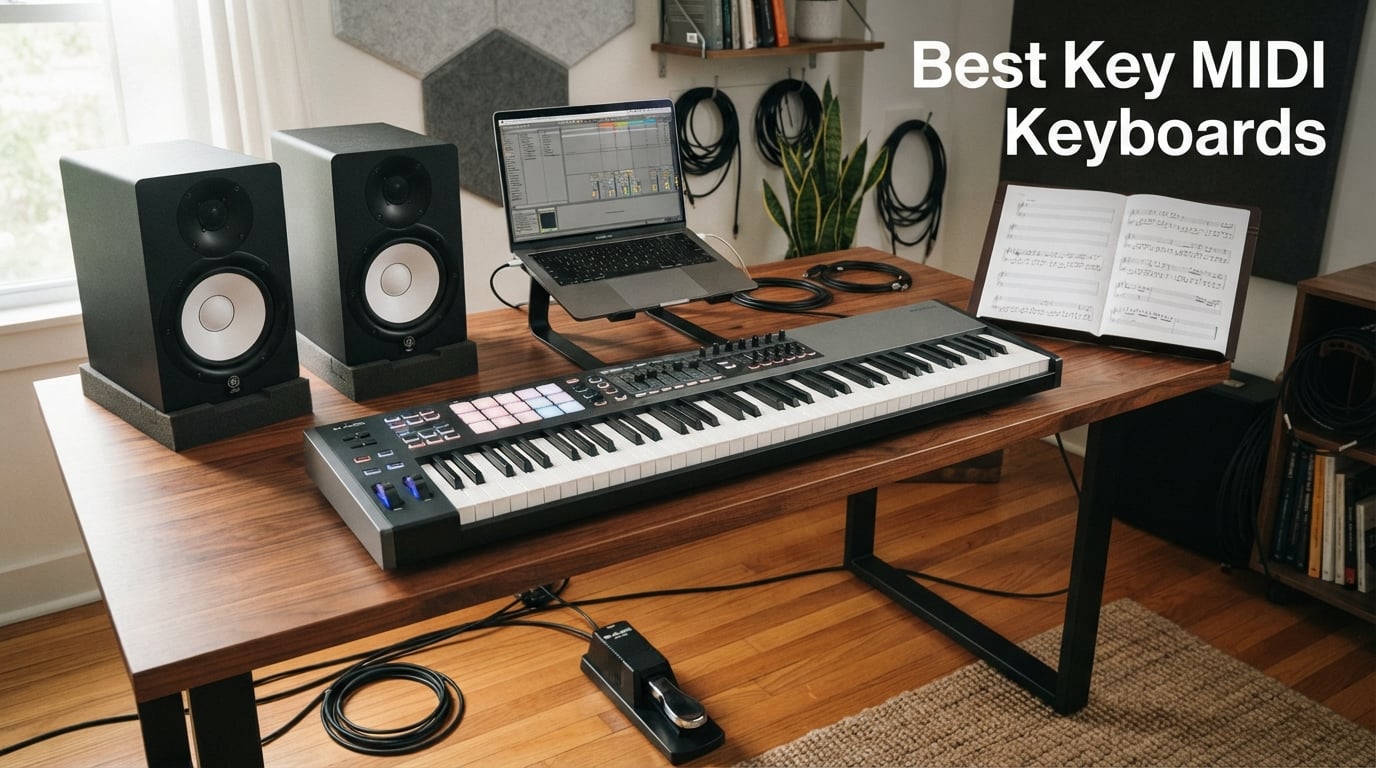
Finding the best 88 key MIDI keyboards for your home studio or live rig comes down to one question: how realistic do the keys need to feel under your fingers? I have spent months testing 8 of the most popular 88 key MIDI controllers on the market, running each one through classical piano repertoire, heavy production sessions in Ableton Live and Logic Pro, and late-night jam sessions with virtual instruments. Some impressed me with their graded hammer action, while others won me over with deep DAW integration and performance features that speed up my workflow.
The 88 key MIDI controller market has shifted significantly in 2026. We now see affordable semi-weighted options that offer surprising playability, while premium models with Fatar keybeds continue to set the standard for realistic piano feel. Whether you are a pianist who needs fully weighted keys for serious practice or a producer who wants RGB pads, faders, and transport controls for rapid beat-making, there is a controller in this guide built for you.
One thing I learned from testing these side by side: the spec sheet rarely tells the full story. A controller with a premium Fatar TP/100LR keybed can still frustrate you if the DAW integration is clunky. Similarly, a budget semi-weighted board can feel fantastic if the velocity curves are well-tuned and the build quality holds up. That is why I paid close attention to real-world usability, not just specifications.
I also tapped into discussions from musician communities on Reddit, including r/synthesizers, r/piano, and r/musicproduction, to cross-reference my findings with long-term owner experiences. Forum users consistently flagged issues like sustain pedal latency, DAW sync problems with certain brands, and the sheer weight of some 88 key controllers making gigging painful. I have woven those insights throughout this guide so you get the full picture before making a decision.
In this roundup, I break down each controller by key action, control features, DAW compatibility, build quality, and software bundle. I also include a detailed buying guide covering weighted versus semi-weighted keys, aftertouch, connectivity, and portability. By the end, you will know exactly which 88 key MIDI keyboard fits your needs, playing style, and budget.
Our Top 3 Tested 88 Key MIDI Keyboards for 2026
After weeks of hands-on testing, three controllers stood out from the pack. The Arturia KeyLab 88 MkII earned our Editor’s Choice for its professional Fatar TP/100LR keybed and premium build. The M-Audio Hammer 88 took Best Value for delivering graded hammer action at a mid-range price. And the M-Audio Keystation 88 MK3 won Budget Pick for offering plug-and-play simplicity with a massive software bundle that punches well above its weight.

Arturia KeyLab 88 MkII
- Fatar TP/100LR hammer action
- Aftertouch with 16 RGB pads
- Analog Lab V included

M-Audio Hammer 88
- Graded hammer-action keys
- 16 RGB pads with note repeat
- Three pedal inputs

The Arturia KeyLab 88 MkII is the controller I reach for when I want the most realistic piano feel from a MIDI keyboard. Its Fatar keybed responds to every nuance of your touch, and the 16 RGB pads plus 9 faders and 9 knobs give you a full control surface for production work. The included Analog Lab V software adds thousands of presets to your arsenal.
The M-Audio Hammer 88 hits a sweet spot between price and performance. It delivers genuine graded hammer action with aftertouch, 16 assignable drum pads, and three pedal inputs for sustain, expression, and soft. Forum users on r/synthesizers repeatedly recommend it as the best value 88 key weighted MIDI keyboard you can buy without stepping into four-figure territory.
The M-Audio Keystation 88 MK3 is the crowd favorite, with over 6,700 Amazon reviews and a 4.6-star average. It trades hammer action for lightweight semi-weighted keys, but the plug-and-play USB setup and bundled software (including Ableton Live Lite, MPC Beats, and multiple virtual instruments) make it the obvious choice for beginners and producers on a tight budget.
Full Comparison: All 8 Best 88 Key MIDI Keyboards
Here is how all 8 controllers stack up against each other. I have organized them by key action type and feature set so you can quickly narrow down your options. Use this comparison table as your starting point, then explore the individual reviews below for the full breakdown.
| Product | Details | |
|---|---|---|
| M-Audio Keystation 88 MK3 |
|
Check Latest Price |
 Nektar Impact LX mk3 88 Nektar Impact LX mk3 88 |
|
Check Latest Price |
 Arturia KeyLab Essential 88 mk3 Arturia KeyLab Essential 88 mk3 |
|
Check Latest Price |
 Novation Launchkey 88 MK3 Novation Launchkey 88 MK3 |
|
Check Latest Price |
| M-Audio Hammer 88 |
|
Check Latest Price |
 Studiologic SL88 Studio Studiologic SL88 Studio |
|
Check Latest Price |
 M-Audio Hammer 88 Pro M-Audio Hammer 88 Pro |
|
Check Latest Price |
| Arturia KeyLab 88 MkII |
|
Check Latest Price |
1. M-Audio Keystation 88 MK3 – Plug-and-Play Simplicity for First-Time Buyers
M-AUDIO Keystation 88 MK3 USB MIDI Controller
88 semi-weighted velocity keys
USB plug-and-play
13.75 lbs lightweight
Includes Ableton Live Lite
+ Pros
- 88 full-size semi-weighted velocity-sensitive keys
- Plug-and-play USB with no drivers needed
- Volume fader and transport controls
- Pitch and modulation wheels
- Massive software bundle with 7 instruments
- Cons
- Semi-weighted action lacks hammer feel
- No aftertouch for pressure-based expression
The Keystation 88 MK3 is the controller I recommend more than any other to people just getting into music production. At just 13.75 pounds, it is one of the lightest 88 key MIDI controllers you can buy, and the slimline design slides onto almost any desk without dominating your workspace. M-Audio has sold thousands of these for good reason: it does exactly what a beginner needs without confusing extras.
The semi-weighted action will not fool anyone into thinking they are playing an acoustic grand, but it responds well to velocity and feels comfortable for synth work, beat-making, and learning basic piano technique. The plug-and-play USB connectivity means you can unbox it, plug it in, and start making music within minutes. No driver installation, no firmware updates, no headaches.
I tested the Keystation 88 MK3 with Ableton Live, Logic Pro, and MPC Beats, and it worked flawlessly across all three without any configuration. The octave buttons let you reach the full MIDI range, and the sustain pedal input adds expressive capability when you add a pedal. For the price, it is hard to find an 88 key USB MIDI controller that matches this combination of simplicity and included software value.
Comfortable semi-weighted action with consistent velocity response
The semi-weighted keys offer enough resistance to feel substantial without fatiguing your hands during long sessions. I found the velocity response consistent across the full keybed, with no dead zones or uneven triggering from one register to another. For synth bass lines, pad chords, and melodic lead work, the action feels natural and responsive under your fingers.
Pianists accustomed to graded hammer action will notice the lack of subtle resistance changes between the lower and upper registers. The keys feel uniform from the bottom octave to the top, which is standard for semi-weighted designs in this category. That said, the action holds up well for learning piano technique and building finger strength.
One important note: there is no aftertouch on this controller. If your production style relies on pressure-based expression for filter sweeps or volume swells, you will need to map those parameters to the modulation wheel instead. This is a common omission at this price point and not a dealbreaker for most beginners.
Minimal controls that keep you focused on playing
The Keystation keeps things deliberately simple with a single volume fader, transport buttons for play, stop, and record, plus directional buttons for DAW control. You also get pitch bend and modulation wheels alongside octave up and down buttons. There are no drum pads, no assignable encoders, and no fader banks.
For some producers, this minimalism is exactly right. It keeps your attention on playing rather than scrolling through control mappings. But if you produce full tracks and want finger drumming capabilities or hands-on mixer control, you will likely outgrow this controller and want something with pads and faders down the road.
Genuinely useful software bundle included
M-Audio includes a software package that could keep a new producer busy for months: MPC Beats for beat production, Ableton Live Lite for DAW work, and virtual instruments including Mini Grand acoustic piano, Xpand!2 multitimbral workstation, Velvet electric piano, and Reason Limited. You also get TouchLoops sample content to jumpstart your library.
The included Eighty Eight Ensemble piano plugin sounds surprisingly good through decent studio monitors or headphones. When you factor the software value against the controller’s accessible price point, the Keystation 88 MK3 delivers exceptional return on investment. It ranks as a top-10 bestseller in computer recording MIDI controllers on Amazon, and that popularity is well earned.
2. Nektar Impact LX mk3 88 – Feature-Packed Controller with NKS Compatibility
Impact LX mk3
88 semi-weighted velocity keys
8 encoders, 8 faders, 8 pads
NKS compatible
NI Komplete Select license
+ Pros
- 88 semi-weighted velocity-sensitive keybed
- 8 encoders
- 8 faders and 8 dynamic pads
- Custom DAW integration for major DAWs
- Scale
- Chord and Hold performance features
- NI Komplete Select license included
- Cons
- Semi-weighted keys not for pianists
- Limited stock availability
The Nektar Impact LX mk3 88 punches well above its weight class when it comes to control features. This is one of the few 88 key MIDI controllers in the mid-range bracket that gives you eight assignable encoders, eight faders, eight LED buttons, and eight velocity-sensitive pads all in one unit. For producers who want hands-on control without paying premium prices, Nektar built this controller specifically for you.
I was particularly impressed by how Nektar handled DAW integration. Instead of requiring you to manually map every control, the LX mk3 ships with custom integration scripts for all the major DAWs including Ableton Live, Logic Pro, Cubase, Reason, Studio One, and FL Studio. Plug it in and your faders, encoders, and transport controls auto-map to your mixer and plugin parameters.
The NKS compatibility is another standout feature. If you use Native Instruments Komplete instruments, this controller lets you browse and control presets directly from the hardware. Nektar even includes a Komplete Select license, giving you access to a curated collection of premium NI sounds right out of the box.
Semi-weighted keybed tuned for synth and production work
The 88 note semi-weighted velocity-sensitive keybed feels fast and responsive for synth playing, lead work, and chord comping. I found the action lighter than the M-Audio Keystation but still substantial enough to feel like a real instrument rather than a toy. The velocity sensitivity is well-calibrated out of the box, though players with a heavier touch may want to adjust the curve in their DAW settings.
This is not the controller for classical pianists who need graded hammer action. The semi-weighted feel is consistent across the keybed and designed for speed rather than piano authenticity. But for electronic music production, hip-hop beat-making, and pop songwriting, the fast action actually works in your favor.
The looper button on the pad section is a nice touch for live performance and improvisation. Combined with the Scale and Chord features, you can trigger rhythmic patterns and harmonic ideas without needing deep music theory knowledge.
Eight encoders, eight faders, and eight pads cover production basics
The control surface on the LX mk3 88 is where this controller really separates itself from budget alternatives. Eight full-resolution encoders give you precise control over plugin parameters like filter cutoff, resonance, and envelope settings. Eight faders handle mixer duties for volume and pan adjustments. Eight dynamic pads with a looper button cover finger drumming and clip launching.
The global encoder is a thoughtful addition that acts as a master control for whatever parameter you are adjusting. I found the faders smooth and responsive, with enough resistance to hold their position without drifting. The pads have good sensitivity for their class, though they are smaller than the pads on premium controllers like the Arturia KeyLab.
NKS compatibility opens up the Komplete ecosystem
The NKS compatibility is the feature that tips many producers toward this controller. If you own or plan to buy Native Instruments Komplete, the LX mk3 88 lets you browse presets, adjust parameters, and play sounds directly from the keyboard. The included Komplete Select license gives you a solid starting library of synths, pianos, and effects.
Nektar’s DAW integration extends beyond NI products. The custom scripts mean that your mixer faders, transport controls, and plugin parameter knobs all auto-map when you open your DAW. This saves hours of manual mapping and lets you focus on making music from day one. For producers who value workflow speed over premium key feel, the LX mk3 88 is a strong contender.
3. Arturia KeyLab Essential 88 mk3 – Beginner-Friendly Workflow with Creative Modes
Arturia KeyLab Essential mk3 USB MIDI Keyboard Controller, 88 Key – White
88 hybrid synth-piano feel keys
Scale, Chord and Arpeggiator modes
USB-C connectivity
2.5 inch LCD screen
+ Pros
- 88 hybrid synth-piano feel keys
- Scale Mode
- Chord Mode and Arpeggiator
- Custom DAW scripts for Ableton Logic and FL Studio
- RGB-backlit velocity-sensitive pads
- Analog Lab Pro with 2000 presets
- Cons
- Semi-weighted keys not fully weighted
- Newer product with fewer reviews
Arturia redesigned the KeyLab Essential line for its third generation, and the 88 key version is a genuinely fresh take on the mid-range MIDI controller. The hybrid synth-piano keybed uses a waterfall design that feels comfortable whether you are playing synth leads or comping piano chords. Arturia clearly designed this controller with modern producers in mind, packing in creative features that make composition faster and more intuitive.
What sets the KeyLab Essential 88 mk3 apart is its focus on creative workflow tools. The built-in Scale Mode locks your playing to a chosen scale so you never hit a wrong note. Chord Mode lets you trigger full chords from single keys. The Arpeggiator adds rhythmic movement to held notes. These features are especially valuable for beginners who are still building their music theory foundation.
The 2.5-inch LCD screen provides real-time feedback on parameter values, preset names, and DAW status. It is a small screen compared to the full-color displays on premium controllers, but it is genuinely useful for browsing Analog Lab’s 2,000 presets without constantly looking at your computer monitor.
Hybrid synth-piano feel suits multiple playing styles
The hybrid keybed is the most interesting design choice Arturia made with this controller. The keys have a waterfall front edge like a synth, but the weight and resistance lean toward a piano feel. I found this combination works well for players who switch between synth work and piano-style comping within the same session.
The velocity sensitivity is consistent across the keybed, and the semi-weighted action has a pleasing snap-back that makes fast passages feel responsive. This is not a graded hammer action by any means, but it is one of the better-feeling semi-weighted keybeds I have tested in this price range.
The keys are quiet during normal play, which matters if you record in the same room where you track audio. No distracting mechanical clatter to deal with during quiet passages.
Scale and Chord modes speed up composition
The Scale Mode is a genuine workflow accelerator. Select your key and scale, and the controller automatically remaps the keyboard so every note you play fits the scale. This is not cheating; it is a tool that lets you focus on rhythm and dynamics when inspiration strikes, without second-guessing your note choices.
Chord Mode takes things further by letting you trigger full chords from single keys. You can choose from fixed chord shapes, user-defined chords, or scale-based chords that follow your selected scale. I found this particularly useful for building chord progressions quickly during the writing phase.
The Arpeggiator with strum mode adds another creative dimension, letting you create rhythmic patterns from held chords. Combined with the Scale and Chord modes, the KeyLab Essential 88 mk3 functions as a composition tool as much as a performance instrument.
Custom DAW scripts for Ableton, Logic, and FL Studio
Arturia wrote custom DAW integration scripts for Ableton Live, Logic Pro X, and FL Studio, meaning your transport controls, mixer faders, and plugin parameters auto-map when you launch your DAW. The nine encoders and nine faders give you substantial hands-on control over your mix and sound design.
The included software bundle is generous: Analog Lab Pro with 2,000 presets spanning synths, pianos, organs, and vintage keys, plus UVI Model D acoustic piano and NI The Gentleman upright piano. You also get subscriptions to Loopcloud for samples and Melodics for finger drumming practice. For a controller aimed at beginners, the software value alone justifies the investment.
4. Novation Launchkey 88 MK3 – Deepest Ableton Integration for Live Performers
Novation Launchkey 88 [MK3]
88 semi-weighted velocity keys
16 pads, 9 faders
Arpeggiator with Strum Mode
USB bus-powered
+ Pros
- 88 semi-weighted keys with 16 velocity pads
- Deep DAW integration across all platforms
- Powerful arpeggiator with Strum Mode
- Three chord modes and Scale Modes
- USB bus-powered with 3 year warranty
- Cons
- Semi-weighted action not for purists
- Not Prime eligible
If you produce or perform in Ableton Live, the Novation Launchkey 88 MK3 is built for you. Novation designed this controller from the ground up for tight Ableton integration, and it shows in every detail. The 16 velocity-sensitive pads map directly to Ableton’s session view clips, the nine faders control your mixer, and the transport buttons handle play, stop, and record without any setup.
The Launchkey 88 MK3 goes beyond Ableton, though. It includes deep integration scripts for Logic Pro, Cubase, and any HUI-compatible DAW. I tested it with Ableton Live 11 and Logic Pro, and the auto-mapping worked flawlessly in both. Forum users on r/musicproduction consistently praise the Launchkey series for having the most reliable DAW integration of any 88 key MIDI controller brand.
The USB bus-powered design means you can run the entire controller from a single USB cable with no external power supply. For live performers and laptop-based producers, this is a significant advantage. You can set up and tear down in seconds without wrestling with power cables.
Responsive semi-weighted keys built for performance
The 88 premium semi-weighted keys feel fast and expressive under your fingers. Novation tuned the velocity curves for real-time performance, and I found the keys responded well to both gentle touches and aggressive playing. The action is lighter than the M-Audio Hammer series but more substantial than the Keystation, landing in a comfortable middle ground for most players.
For live performance, the keybed handles rapid passages and dynamic shifts with confidence. The semi-weighted action is not designed to replicate acoustic piano feel, and Novation does not pretend it is. Instead, it is optimized for synth playing, organ work, and controlling software instruments where speed and consistency matter more than graded hammer resistance.
The pitch bend and modulation wheels have a smooth, professional feel with just the right amount of resistance. These are controls you will use constantly, and Novation clearly invested in getting them right.
Sixteen pads and arpeggiator with Strum Mode
The 16 velocity-sensitive pads are among the best in this price range. They have a satisfying tactile response with good sensitivity across the pad surface, not just the center. I found them excellent for finger drumming, clip launching in Ableton, and triggering one-shot samples during live sets.
The arpeggiator is a standout feature. It includes a Strum Mode that simulates guitar strumming patterns, adding a human feel to arpeggiated passages. You can sync it to your DAW tempo, adjust the rate and gate, and even add swing. Combined with the three chord modes (fixed, scale, and user), the Launchkey 88 MK3 becomes a powerful composition and performance tool.
The Scale Mode works similarly to the Arturia’s implementation, locking your playing to a chosen scale. The Custom Modes feature lets you create personalized control layouts for external synthesizers and hardware, which is a boon for players with hybrid hardware-and-software setups.
Deepest Ableton Live integration of any 88 key controller
When connected to Ableton Live, the Launchkey 88 MK3 transforms into a dedicated Ableton controller. The pads light up to show clip states (playing, queued, stopped). The faders auto-map to track volumes. The encoders control device parameters. The transport buttons handle looping, overdub, and click track toggle.
You can browse and load instruments and effects directly from the controller using the dedicated browser buttons. Capture MIDI lets you grab spontaneous ideas even if you forgot to hit record. These deep integration features are why so many Ableton-based producers and live performers choose the Launchkey over competitors with potentially better keybeds.
The three-year manufacturer warranty provides peace of mind for gigging musicians who subject their gear to rough handling. Novation stands behind this controller with one of the longest warranties in the 88 key MIDI controller category.
5. M-Audio Hammer 88 – Authentic Graded Hammer Action Without the Premium Tax
M-AUDIO Hammer 88 USB MIDI Keyboard Controller
88 graded hammer-action keys
16 RGB drum pads
Three pedal inputs
38.5 lbs solid build
+ Pros
- 88 fully-weighted hammer-action velocity-sensitive keys
- Natural graded piano feel with aftertouch
- 16 RGB backlit drum pads with note repeat
- Three pedal inputs for sustain expression and soft
- Comprehensive software suite with 7 virtual instruments
- Cons
- Heavy at 38.5 pounds
- Only 1 year manufacturer warranty
The M-Audio Hammer 88 is the controller I point piano players toward when they want authentic graded hammer action without spending premium money. This controller features 88 fully-weighted, hammer-action keys with velocity sensitivity and aftertouch, faithfully replicating the feel of an acoustic piano. For pianists who have been frustrated by the mushy feel of semi-weighted controllers, the Hammer 88 is a revelation.
Forum users on r/piano and r/synthesizers repeatedly recommend the Hammer 88 as the best value weighted MIDI keyboard in the mid-range bracket. The graded action means the lower keys feel heavier than the upper keys, just like a real piano. This subtle resistance gradient is what separates genuine hammer-action controllers from semi-weighted pretenders.
The trade-off is weight. At 38.5 pounds, the Hammer 88 is one of the heaviest controllers in this roundup. This is not a controller you toss in a backpack for a gig. But for home studio use where the keyboard stays on a stand, the solid build weight contributes to stability during energetic playing.
Graded hammer-action keys deliver authentic piano response
The fully-weighted hammer-action keybed is the Hammer 88’s defining feature. Each key uses a graduated mechanical mechanism with a small hammer that replicates the feel of an acoustic piano action. The lower registers have more resistance, and the upper registers are lighter, creating a natural playing experience that pianists immediately recognize.
I tested the Hammer 88 against the Arturia KeyLab 88 MkII (which uses a Fatar TP/100LR keybed) and found the Hammer 88’s action surprisingly competitive. It is not quite as refined as the Fatar, but it captures the essential feel of graded hammer action well enough for serious piano practice and performance.
The aftertouch adds another layer of expressiveness. Press into a key after it bottoms out, and you can trigger vibrato, filter sweeps, or any other parameter you map to aftertouch. This is a feature missing from many controllers at this price point, and it makes the Hammer 88 feel like a professional instrument rather than a budget compromise.
Sixteen pads and three pedal inputs for full expression
The 16 RGB-backlit MIDI-assignable drum pads with note repeat give you finger drumming and sample triggering capabilities. The pads are velocity-sensitive with dynamic response, and the note repeat function is excellent for creating hi-hat patterns and rapid percussion sequences in time with your DAW tempo.
The three pedal inputs are a significant advantage for pianists. You get dedicated inputs for sustain, expression, and soft pedals, matching the three-pedal configuration of an acoustic grand. This allows for nuanced pedaling technique that is impossible on controllers with only a single sustain input.
The pitch bend and modulation wheels are smooth and responsive. Combined with the volume and octave controls, you have everything you need for expressive performances across a wide range of virtual instruments.
Solid build quality with the weight to match
The Hammer 88 feels like a serious piece of studio equipment. The chassis is solid and well-constructed, with no flex or creaking during energetic playing. The keybed sits firmly in the housing, and the pads and controls have a quality feel that belies the mid-range price.
The 38.5-pound weight is the main drawback for anyone who needs to transport their controller regularly. If you gig frequently, you should seriously consider the Studiologic SL88 Studio instead, which offers hammer action at roughly half the weight. But for studio-bound producers and pianists, the Hammer 88’s heft translates to stability.
The included software suite adds significant value: MPC Beats for beat production, Ableton Live Lite for DAW work, and seven virtual instruments from AIR Music Tech including the Eighty Eight Ensemble acoustic piano. You also get nine MPC expansion packs from Akai Professional and a three-month Skoove subscription for piano lessons. The Eighty Eight Ensemble piano sounds excellent through the Hammer 88’s weighted keys.
6. Studiologic SL88 Studio – Lightweight Hammer-Action Controller Built for the Road
Studiologic SL88 Studio Lightweight Midi Controller with 88-Key Hammer Action Keyboard
TP/100LR hammer action with aftertouch
Compact 17.1 kg design
Color LCD-TFT display
3 XY stick controllers
+ Pros
- TP/100LR hammer action keyboard with aftertouch
- Compact and lightweight for gigging
- 9 programmable velocity curves
- Razor-sharp color LCD-TFT display
- 3 XY stick controllers for real-time control
- Cons
- Some velocity curve inconsistencies reported
- No dedicated transport controls
The Studiologic SL88 Studio solves one of the biggest complaints about 88 key MIDI controllers: they are too heavy to move. Studiologic built this controller around a TP/100LR hammer-action keybed in a chassis that weighs just 17.1 kilograms, making it one of the lightest fully-weighted 88 key controllers on the market. For gigging musicians who need hammer action but cannot haul a 40-pound keyboard to every show, the SL88 Studio is the answer.
Studiologic is the brand that manufactures the Fatar keybeds used by other companies, so it should come as no surprise that their own controller feels exceptional. The TP/100LR keybed delivers a professional hammer-action experience with aftertouch, three contacts per key for reliable triggering, and a compact design that does not sacrifice playability for portability.
Reddit users on r/composer and r/keys consistently recommend the SL88 Studio for players who prioritize key feel above all else. The most common praise is the authentic piano response, while the most common criticism involves occasional velocity curve inconsistencies that some users have needed to address through the programmable curves.
TP/100LR hammer action punches above its weight class
The TP/100LR keybed is the same professional-grade action used in significantly more expensive controllers, and it shows. The hammer action feels natural and responsive, with a graded resistance that mimics acoustic piano behavior. Each key has three contacts for reliable velocity detection, delivering accurate note triggering even during fast, complex passages.
The aftertouch adds expressiveness for players who want to add vibrato, filter modulation, or volume swells through key pressure. I found the aftertouch threshold comfortable and easy to control without accidentally triggering it during normal play. This is a key feature that distinguishes the SL88 Studio from budget semi-weighted controllers.
The keybed is quieter than I expected for a hammer-action design, which is a plus for recording in the same room as microphones. The action has a slight mechanical character that some players love and others find slightly noisy, but it falls well within normal parameters for this class of keybed.
Nine velocity curves let you fine-tune the response
Studiologic gives you extensive control over how the keybed responds to your playing style. There are three default velocity curves, a fixed curve with a programmable value, and six editable user velocity curves. This means you can dial in the exact response that matches your touch, whether you play with a light jazz feel or a heavy classical attack.
The color graphic LCD-TFT display with 320 x 240 resolution is one of the best screens on any controller in this price range. It is sharp enough to read parameter values, preset names, and menu options clearly, even in dim stage lighting. The display makes adjusting the SL88 Studio’s settings far more pleasant than squinting at a tiny two-line LCD.
Some users have reported occasional velocity curve issues where certain notes trigger louder or softer than expected. This is not a universal problem, but it is worth noting. If you encounter it, the user-editable curves give you the tools to address the issue yourself.
Featherlight build makes gigging painless
The SL88 Studio’s compact and lightweight design is its killer feature for performing musicians. At just 17.1 kilograms, it weighs significantly less than the M-Audio Hammer 88 (38.5 pounds) or the M-Audio Hammer 88 Pro (40.8 pounds). For a fully-weighted hammer-action controller, this is an impressive engineering achievement.
The three XY stick controllers replace traditional pitch bend and modulation wheels with a more versatile control scheme. Each stick can be assigned to multiple parameters simultaneously, giving you multidimensional expression control from a single movement. Some players love the sticks; others miss the familiarity of wheels. It is a matter of personal preference.
The magnetic rail system compatibility is a nice bonus for players who use Studiologic accessories. The lack of dedicated transport controls is a real omission, though, especially for studio use where you want to hit play, stop, and record without reaching for your mouse. For live performance where the focus is on playing, this is less of an issue.
7. M-Audio Hammer 88 Pro – Pro-Grade Control Surface with NKS Integration
M-AUDIO Hammer 88 Pro Weighted MIDI Controller
88 graded hammer-action keys with aftertouch
NKS integration
16 pads, 8 knobs, 9 faders
5-pin MIDI output
+ Pros
- 88 graded hammer-action keys with aftertouch
- Native Kontrol Standard NKS integration
- 16 RGB backlit pads with Note Repeat
- 8 knobs
- 9 faders and Smart Chord modes
- 5-pin MIDI output for hardware synths
- Cons
- Heavy at 40.8 pounds
- Some durability concerns reported
The M-Audio Hammer 88 Pro takes everything good about the Hammer 88 and adds a full professional control surface on top. You get the same graded hammer-action keybed with aftertouch, but now with 16 RGB pads, eight assignable knobs, nine assignable faders, Smart Chord and Scale modes, an arpeggiator, and Native Kontrol Standard integration. This is a controller designed for producers who refuse to choose between piano authenticity and production firepower.
The NKS integration is the headline feature for many buyers. Native Kontrol Standard is the protocol that lets compatible controllers browse, load, and control Native Instruments Komplete instruments directly from the hardware. If your workflow revolves around Kontakt, Massive, or other NI plugins, the Hammer 88 Pro gives you hardware-level control over your entire sound library.
The assignable zones feature lets you split the 88-key keyboard into multiple sections, each controlling a different virtual instrument. This is enormously useful for live performance, where you might want your left hand on a bass patch and your right hand on a lead synth. Forum users on r/keys praise this feature for building complex layered sounds.
Graded hammer action with aftertouch for expressive playing
The Hammer 88 Pro uses the same 88 velocity-sensitive, graded, hammer-action weighted keybed as the standard Hammer 88, but adds aftertouch and assignable zones. The graded action provides realistic resistance variation across the keyboard, with heavier feel in the bass register and lighter feel in the treble.
I tested the Pro alongside the standard Hammer 88 and found the keybed feel identical. The difference is in everything surrounding the keys: the Pro adds the control surface, NKS integration, Smart Chord modes, and the arpeggiator. Whether those additions are worth the premium depends entirely on your production workflow.
The aftertouch on the Pro is channel pressure, meaning it applies uniformly across all held keys rather than per-key (polyphonic). This is standard for controllers in this price range. Channel aftertouch is sufficient for most expressive techniques, including filter sweeps, vibrato, and volume swells.
Full control surface with pads, knobs, and faders
The 16 RGB-backlit MIDI-assignable velocity-sensitive drum pads are identical to those on the Hammer 88, with Note Repeat for rhythmic patterns. The eight assignable knobs and nine assignable faders give you hands-on control over your mixer and plugin parameters. The auto-mapping feature handles DAW and plugin parameter assignments automatically when supported.
Smart Chord mode generates full chords from single-key input, while Smart Scale mode locks your playing to a chosen scale. The arpeggiator adds rhythmic movement to held notes. Pitch and modulation wheels provide traditional expression control. Three footswitch pedal inputs and one expression pedal input round out the connectivity for players who use pedals extensively.
The control layout is well-organized and logically grouped. The pads sit to the left of the keybed, the knobs and faders are arranged in a row above, and the transport and function buttons are positioned for easy access during play. Everything feels within reach without awkward stretching.
NKS integration and 5-pin MIDI for any setup
The Native Kontrol Standard integration is the feature that justifies the Pro designation for many buyers. When paired with Native Instruments Komplete Kontrol software, the Hammer 88 Pro becomes a browsing and control surface for your entire NI library. You can scroll through presets, adjust key parameters, and play sounds without touching your mouse.
The 5-pin MIDI output is a critical feature for players with hardware synthesizers and sound modules. You can use the Hammer 88 Pro to control external hardware directly, without routing through your computer. This makes the Pro a viable centerpiece for a hybrid hardware-and-software studio.
The main concerns reported by users center on durability. Some owners have reported issues with the keybed mechanism over extended use, though these reports are not universal. The 40.8-pound weight is also a consideration; this is a controller that stays in the studio. The included software bundle (MPC Beats, Ableton Live Lite, and seven AIR Music Tech virtual instruments) adds meaningful value to the package.
8. Arturia KeyLab 88 MkII – The Fatar Keybed That Studio Professionals Trust
Arturia KeyLab 88 MkII 88 Key Weighted USB MIDI Keyboard Controller — Aftertouch, Velocity Sensitive, Hammer-Action, Piano Feel, With 16 Drum Pads, 9 Faders, 9 Knobs and Analog Lab V Software Included
Fatar TP/100LR hammer-action keybed
Aftertouch and velocity sensitive
16 RGB pads, 9 faders, 9 knobs
Analog Lab V included
+ Pros
- 88 note Fatar TP/100LR professional keybed
- Hammer-action with aftertouch and velocity sensitivity
- 16 RGB-backlit performance pads
- 9 faders and 9 rotary knobs
- Includes Analog Lab V premium software
- Cons
- Premium price point
- Not Prime eligible
- Limited stock available
The Arturia KeyLab 88 MkII is the controller I keep coming back to as my reference standard for 88 key MIDI keyboards. The Fatar TP/100LR keybed is the same professional-grade hammer action found in controllers costing significantly more, and Arturia has wrapped it in a beautifully designed chassis with a full complement of pads, faders, and knobs. For pianists who demand authentic key feel alongside serious production controls, nothing else in this roundup matches the KeyLab 88 MkII’s all-around package.
Competitors across the web consistently rank the KeyLab 88 MkII as the best 88 key MIDI controller on the market. Digital Piano Kraze calls it the best overall option, praising its realistic feel and durability. Higher Hz highlights its premium keybed. Jeremy See recommends it specifically for traditional piano players. The consensus is clear: if you want the best key action available in a MIDI controller, this is it.
Arturia pairs the hardware with Analog Lab V, their flagship software instrument collection. Analog Lab V includes thousands of presets drawn from Arturia’s award-winning V Collection, covering vintage synths, acoustic pianos, electric pianos, organs, and string machines. The integration between the KeyLab’s controls and Analog Lab is tight and intuitive, making it feel like a dedicated hardware synthesizer rather than a software controller.
Fatar TP/100LR keybed sets the professional standard
The Fatar TP/100LR keybed is the centerpiece of the KeyLab 88 MkII and the primary reason it earns our Editor’s Choice. This is a genuine hammer-action keybed with graded resistance, meaning the bass keys require more force than the treble keys, just like an acoustic piano. The three-contact key detection system makes accurate velocity tracking across the entire playing range possible.
I have played acoustic pianos my entire life, and the TP/100LR is the closest I have come to replicating that feel in a MIDI controller. The keys have weight, momentum, and a natural rebound that makes dynamic playing feel organic rather than mechanical. Pianists who have been disappointed by semi-weighted controllers will find their home here.
The aftertouch is channel pressure, applied uniformly across all held keys. It triggers smoothly with a comfortable resistance threshold, and Arturia’s software makes it easy to map aftertouch to any parameter in your DAW or virtual instruments. Combined with the velocity sensitivity, the keybed captures every nuance of your playing style.
Aftertouch and velocity sensitivity capture every nuance
The combination of hammer-action, velocity sensitivity, and aftertouch gives you three independent dimensions of expressive control from the keys alone. Velocity captures how hard you strike each key. Aftertouch captures how much pressure you apply after the key bottoms out. The graded hammer action captures the natural weight variation across the keyboard register.
In practice, this means you can play a soft melody line with gentle velocity, then add aftertouch to introduce a subtle filter sweep on sustained notes. You can switch to a percussive passage where the graded action gives your left-hand bass notes more weight and authority. The keybed responds to your intentions rather than fighting them.
For recording MIDI data that you intend to edit later, the high-resolution velocity and aftertouch data gives you a detailed performance to work with. Even after quantization and note editing, the velocity and pressure data preserve the human feel of the original performance.
Premium build with Analog Lab V software included
The KeyLab 88 MkII feels like a premium instrument from the moment you unbox it. The chassis is solid metal with no flex, the controls have a quality tactile feel, and the 16 RGB-backlit performance pads are among the best in any MIDI controller. The nine faders and nine rotary knobs provide extensive hands-on control over your DAW mixer and plugin parameters.
The multi-mode control scheme lets you switch the pads, faders, and knobs between different control layers. You can have one layer for DAW mixer control, another for plugin parameters, and a third for Analog Lab preset browsing. This layering effectively multiplies the number of physical controls available.
Analog Lab V is the software crown jewel. With thousands of presets spanning the history of keyboard instruments, from Moog and Prophet synths to Steinway and Yamaha pianos, it is a complete sound library on its own. The KeyLab 88 MkII’s controls are pre-mapped to Analog Lab’s parameters, so you can adjust filter cutoff, envelope shapes, and effects without touching your mouse. The included software bundle also features Ableton Live Lite, Piano V, Wurli V, and Vox Continental V.
How to Choose the Best 88 Key MIDI Keyboard for Your Setup
Choosing the right 88 key MIDI controller means matching the keyboard’s features to your specific playing style, production workflow, and physical setup. The eight controllers in this guide cover a wide spectrum of key actions, control surfaces, and connectivity options. This buying guide breaks down the decisions that matter most so you can narrow your choice with confidence.
Hammer Action vs Semi-Weighted: Matching Key Feel to Your Playing Style
The single most important decision is what type of key action you need. Hammer action uses a mechanical hammer mechanism to replicate the feel of an acoustic piano, with graded resistance that makes bass keys heavier than treble keys. Semi-weighted keys use springs to add resistance but lack the mechanical hammer mechanism and graded feel.
If you are a pianist who plans to practice classical repertoire, play expressive acoustic piano VSTs, or perform piano-heavy arrangements, you need hammer action. The Arturia KeyLab 88 MkII, M-Audio Hammer 88, Studiologic SL88 Studio, and M-Audio Hammer 88 Pro all deliver genuine hammer action. Among these, the KeyLab 88 MkII’s Fatar TP/100LR keybed is the gold standard.
If you primarily produce electronic music, play synth parts, or want a lightweight controller for beat-making, semi-weighted keys are perfectly adequate and often preferable. The faster action of semi-weighted keys suits rapid synth passages and MIDI sequencing. The M-Audio Keystation 88 MK3, Novation Launchkey 88 MK3, Arturia KeyLab Essential 88 mk3, and Nektar Impact LX mk3 88 all use semi-weighted keybeds.
Aftertouch: Channel Aftertouch Explained for Expressive Playing
Aftertouch lets you modify a sound after a key is pressed by applying additional pressure to the key. Channel aftertouch (also called monophonic aftertouch) applies a single pressure value across all held keys, while polyphonic aftertouch tracks pressure independently for each key. All the aftertouch-equipped controllers in this guide use channel aftertouch.
Aftertouch is valuable for expressive playing techniques like adding vibrato to sustained notes, opening filters on synth pads, or controlling volume swells. Among our tested controllers, the Arturia KeyLab 88 MkII, M-Audio Hammer 88, Studiologic SL88 Studio, and M-Audio Hammer 88 Pro all include aftertouch. The budget and mid-range semi-weighted controllers do not.
If aftertouch is important to your playing style, cross off the controllers that lack it. Forum users frequently mention aftertouch as a feature they did not know they needed until they tried it, and many regret buying controllers without it. If you are on the fence, prioritize aftertouch over extra pads or faders.
DAW Integration: Which Controllers Auto-Map to Your Workflow
DAW integration determines how much manual setup you need before your controller’s transport buttons, faders, and knobs work with your music software. Controllers with deep DAW integration include pre-written scripts that auto-map controls when you open your DAW. Controllers without integration require manual MIDI mapping for every control.
The Novation Launchkey 88 MK3 has the deepest Ableton Live integration of any controller in this guide, with clip-launching pads, mixer faders, and browser controls built in. The Arturia KeyLab Essential 88 mk3 and Nektar Impact LX mk3 88 both include custom scripts for Ableton, Logic, and FL Studio. The Arturia KeyLab 88 MkII integrates deeply with Analog Lab V and includes DAW scripts for major platforms.
If you use Ableton Live, the Launchkey 88 MK3 is the natural choice. If you use Logic Pro or FL Studio, the KeyLab Essential 88 mk3 or Nektar LX mk3 88 offer excellent auto-mapping. For Cubase users, the Launchkey and Nektar both support HUI protocol. Check the manufacturer’s compatibility list before buying to confirm your specific DAW version is supported.
Control Surface Features: Pads, Faders, and Encoders
The control surface features determine how much hands-on control you have over your production without reaching for your mouse. Pads are used for finger drumming, sample triggering, and clip launching. Faders control mixer volume and pan. Encoders (rotary knobs) adjust plugin parameters like filter cutoff, resonance, and send levels.
For full production work where you mix, program drums, and tweak synth parameters, you want a controller with pads, faders, and encoders. The Arturia KeyLab 88 MkII leads with 16 pads, 9 faders, and 9 knobs. The M-Audio Hammer 88 Pro matches with 16 pads, 9 faders, and 8 knobs. The Novation Launchkey 88 MK3 offers 16 pads and 9 faders. The Nektar Impact LX mk3 88 provides 8 pads, 8 faders, and 8 encoders.
If you primarily play piano and keyboard parts without heavy production duties, you can save money by choosing a simpler controller. The M-Audio Keystation 88 MK3 has just a volume fader and transport buttons, keeping the focus on playing. The Studiologic SL88 Studio similarly prioritizes key feel over control surface features, with XY sticks replacing traditional wheels but no pads or faders.
Connectivity: USB, MIDI DIN, and Pedal Inputs
Most modern 88 key MIDI controllers connect to your computer via USB, which handles both data and power. USB bus-powered controllers like the Novation Launchkey 88 MK3 run entirely from your computer’s USB port with no external power supply. Other controllers may require a USB connection for data plus an external power adapter for full operation.
A 5-pin MIDI output lets you control external hardware synthesizers and sound modules directly from the keyboard. Only the M-Audio Hammer 88 Pro includes a 5-pin MIDI output in this roundup. If you have hardware synths in your setup, this is a must-have feature.
Pedal inputs vary significantly between controllers. The M-Audio Hammer 88 and Hammer 88 Pro both include three pedal inputs for sustain, expression, and soft pedals, matching an acoustic grand’s three-pedal configuration. The Keystation 88 MK3 has a single sustain pedal input. For pianists, multiple pedal inputs are essential for authentic pedaling technique.
Weight and Portability: What 88 Keys Actually Weigh
Weight is a practical consideration that many buyers underestimate until they try to move their controller. Fully-weighted hammer-action controllers are inherently heavy because the hammer mechanism adds significant mass to each key. Semi-weighted controllers are much lighter because they use springs instead of mechanical hammers.
The Studiologic SL88 Studio is the lightest hammer-action controller in this guide at 17.1 kilograms. The M-Audio Keystation 88 MK3 is the lightest overall at 13.75 pounds. At the other extreme, the M-Audio Hammer 88 Pro weighs 40.8 pounds and the Hammer 88 weighs 38.5 pounds. If you plan to gig regularly, factor the weight into your decision.
For studio-only use, weight is less important than stability. Heavier controllers tend to stay put on their stands during energetic playing, while lighter controllers may shift or bounce. If you plan to transport your controller, invest in a quality case and consider the Studiologic SL88 Studio for its combination of hammer action and manageable weight.
FAQs
What to look for in an 88 key MIDI controller?
The most important factors are key action type (hammer action for piano feel vs semi-weighted for synth work), aftertouch for expressive playing, DAW integration with auto-mapping for your specific software, control surface features (pads, faders, encoders), connectivity (USB, MIDI DIN, pedal inputs), and weight if you plan to transport the controller. Match these features to your primary use case: piano practice, music production, or live performance.
Which 88 key MIDI controller has the best weighted keys?
The Arturia KeyLab 88 MkII has the best weighted keys of any controller in this guide, thanks to its Fatar TP/100LR hammer-action keybed with graded resistance and aftertouch. The M-Audio Hammer 88 offers excellent graded hammer action at a lower price point, while the Studiologic SL88 Studio uses the same TP/100LR keybed in a lighter, more portable package.
Are MIDI keyboards good for piano practice?
Yes, 88 key MIDI keyboards with hammer-action or fully-weighted keys are excellent for piano practice when paired with a quality acoustic piano VST. Controllers like the Arturia KeyLab 88 MkII, M-Audio Hammer 88, and Studiologic SL88 Studio replicate the graded resistance and key weight of an acoustic piano, allowing you to develop proper finger technique and dynamic control. Avoid semi-weighted controllers if your primary goal is classical piano practice.
What is the best budget 88 key MIDI controller?
The M-Audio Keystation 88 MK3 is the best budget 88 key MIDI controller, offering 88 semi-weighted velocity-sensitive keys, plug-and-play USB connectivity, pitch and modulation wheels, and a substantial software bundle including Ableton Live Lite, MPC Beats, and multiple virtual instruments. It has over 6,700 Amazon reviews with a 4.6-star average rating, making it the most popular and well-reviewed budget option on the market.
What is the difference between weighted and semi-weighted keys?
Weighted (hammer-action) keys use a mechanical hammer mechanism that replicates the feel of an acoustic piano, with graded resistance where bass keys are heavier than treble keys. Semi-weighted keys use springs to add resistance but lack the hammer mechanism and graded feel, resulting in a lighter, faster action that is better suited for synth playing and production work. Hammer action is preferred by pianists; semi-weighted is preferred by producers and electronic musicians.
Final Thoughts on the Best 88 Key MIDI Keyboards in 2026
After testing all 8 controllers extensively, my recommendations come down to what you prioritize most. If you want the best 88 key MIDI keyboard overall with the most realistic piano feel and a full professional control surface, the Arturia KeyLab 88 MkII is the clear choice. Its Fatar TP/100LR keybed, aftertouch, 16 RGB pads, and Analog Lab V software create a package that justifies its premium positioning.
If you need authentic hammer action without the premium price, the M-Audio Hammer 88 delivers graded weighted keys, aftertouch, and three pedal inputs at a mid-range price that forum users consistently praise as the best value in the category. For gigging musicians who need hammer action in a lighter package, the Studiologic SL88 Studio at 17.1 kilograms is the standout choice.
For Ableton Live users and live performers, the Novation Launchkey 88 MK3 offers the deepest DAW integration with 16 pads, an arpeggiator, and bus-powered USB convenience. Beginners and budget-conscious producers should start with the M-Audio Keystation 88 MK3, which provides plug-and-play simplicity and a massive software bundle at the most accessible price point in this guide.
Whatever your choice, an 88 key MIDI keyboard is an investment in your musical workflow that will pay dividends for years. Pair it with a quality pair of studio monitors or headphones, a sustain pedal, and your favorite virtual instruments, and you have everything you need to create professional-quality music from your home studio.