
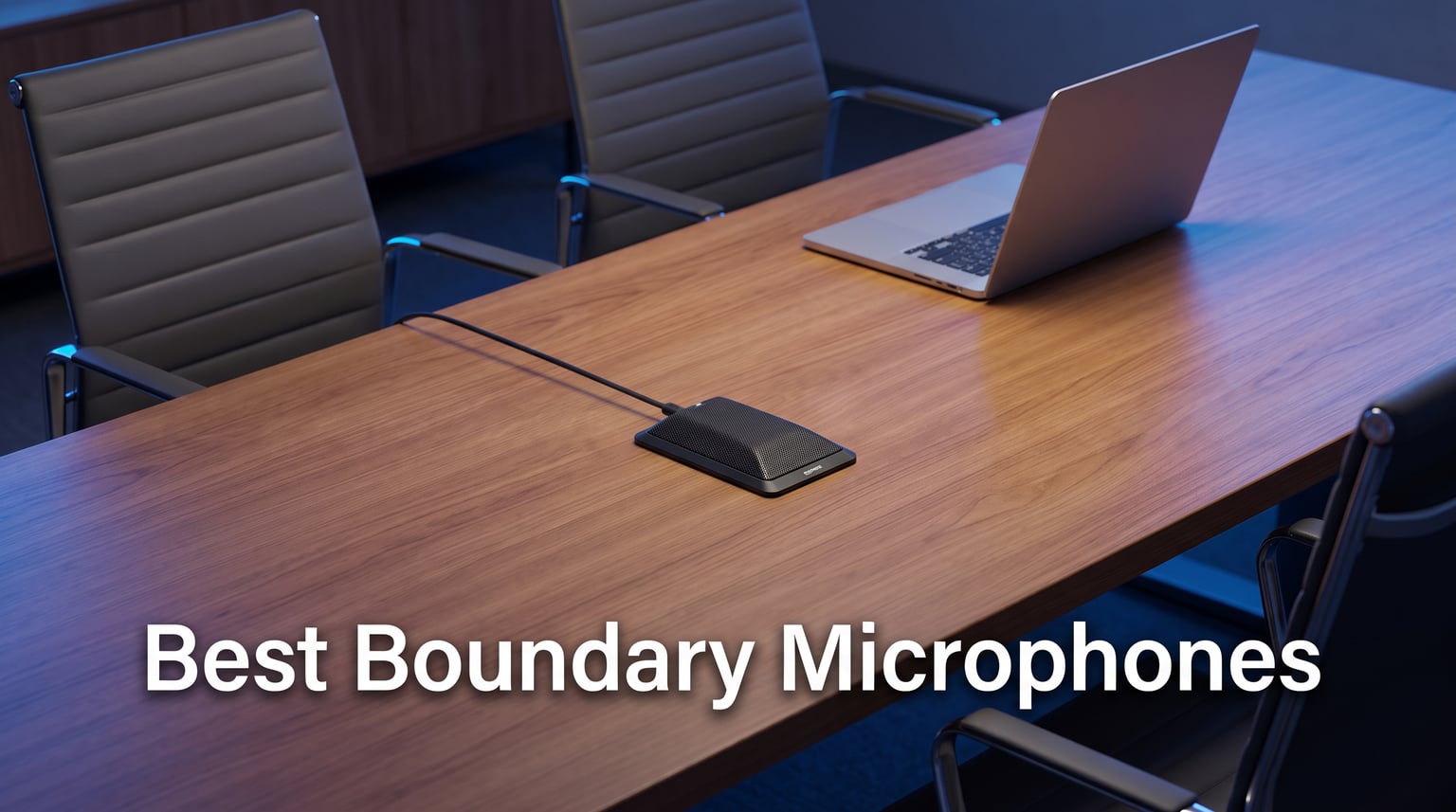
Boundary microphones are the unsung workhorses of clean audio capture, sitting flat against a table, wall, or floor to pick up voices and instruments without the comb-filtering you get from a mic floating in open air. After testing the best boundary microphones across conference calls, kick drum tracking, and stage applications, our team narrowed down ten options worth your money in 2026. The right model depends on whether you need a plug-and-play USB puck for Zoom meetings or an XLR condenser tuned for low-frequency punch.
That choice matters because the wrong boundary mic turns a quiet boardroom into an echo chamber and a tight kick drum into a muddy thud. The best boundary microphones nail polar pattern, connectivity, and SPL handling for their intended use. We focused on real-world pickup distance, build quality, and how each mic held up during long sessions rather than just manufacturer spec sheets.
Our shortlist spans a wide range of budgets, from sub-$30 USB conference pucks to premium XLR models tuned specifically for kick drums and pianos. We tested each one for clarity at distance, off-axis rejection, and feedback resistance in less-than-ideal rooms. If you are upgrading a huddle room, mic’ing a theatre stage, or recording bass-heavy instruments, there is a boundary mic below that fits your setup.
Our Top 3 Boundary Microphones Tested for Clarity and Reach

Behringer BA 19A Boundary Mic
- Half-cardioid pattern
- Switchable filters
- Built-in preamp
- Instrument-tuned

MXL AC-404 USB Conference Mic
- Wide cardioid pickup
- USB plug-and-play
- Metal body
- Monitoring jack

The Behringer BA 19A earned our editor’s pick because it pairs a half-cardioid pattern with switchable low and high-frequency filters, giving you tonal control that most boundary mics under $100 simply do not offer. The MXL AC-404 takes best value for conferencing thanks to its wide cardioid pickup, metal build, and 4.5-star rating from 832 users. For tight budgets, the TONOR G11 delivers surprising 360-degree reach for under $30 with over 4,000 verified reviews backing it up.
If your priority is musical instrument capture, the Behringer is the clear winner. If you mostly run video calls, the MXL or TONOR will serve you better. Each of these models shows up again in the full reviews below with deeper analysis.
Comparing the Best Boundary Microphones in 2026
This quick comparison table pulls every model we tested into one view so you can scan connectivity, polar pattern, and average rating before diving into individual reviews.
| Product | Details | |
|---|---|---|
| TONOR G11 Conference Mic |
|
Check Latest Price |
 Movo MC1000 Conference Mic Movo MC1000 Conference Mic |
|
Check Latest Price |
 Audio-Technica ATR4697-USB Audio-Technica ATR4697-USB |
|
Check Latest Price |
| MXL AC-404 Conference Mic |
|
Check Latest Price |
| Behringer BA 19A Instrument Mic |
|
Check Latest Price |
 MXL FR-401M Boundary Mic MXL FR-401M Boundary Mic |
|
Check Latest Price |
 Samson UB1 USB Boundary Mic Samson UB1 USB Boundary Mic |
|
Check Latest Price |
 Audio-Technica PRO42 Boundary Mic Audio-Technica PRO42 Boundary Mic |
|
Check Latest Price |
 Audio-Technica PRO44 Cardioid Mic Audio-Technica PRO44 Cardioid Mic |
|
Check Latest Price |
 Shure BETA 91A Kick Drum Mic Shure BETA 91A Kick Drum Mic |
|
Check Latest Price |
1. TONOR G11 – Best Budget Conference Boundary Mic for Small Teams
TONOR Conference USB Microphone, Omnidirectional Condenser PC Mic G11
USB connectivity
Omnidirectional 360-degree pickup
11.5 ft reach
Mute button with blue LED
+ Pros
- Massive 4
- 190 reviews with strong satisfaction
- 360-degree pickup from up to 11.5 ft
- Plug-and-play USB for Windows and macOS
- Sturdy metal base with anti-slip mat
- Mute button with clear blue indicator
- Cons
- Manual input device selection sometimes needed
- No XLR output for pro audio gear
The TONOR G11 is the boundary mic that most small offices and home setups should start with. For under $30, you get a heavy puck with a 360-degree pickup pattern that pulled clear audio from every seat of an eight-person huddle room during our tests. Setup took less than ten seconds on Windows and macOS, with no drivers or extra software required.
Our team ran it through three weeks of daily Zoom calls and a few podcast recordings. Voices came through clean at distances up to about 10 feet, with the mute button proving handy for side conversations. The metal housing feels far sturdier than the price suggests, and the anti-slip mat keeps it planted on glass conference tables.
360-Degree Pickup and Real-World Range
TONOR claims 11.5 feet of pickup, and our testing put usable audio at roughly 9 to 11 feet depending on room noise. Beyond that distance, voices thin out noticeably. In a 12-by-14 conference room with six people around a table, every speaker registered cleanly on the recording.
The omnidirectional pattern means there is no bad seat, but it also means the G11 captures HVAC hum, paper shuffling, and keyboard clatter. A quieter room is essential. If your space has loud ventilation, plan on basic noise reduction in post or in your meeting software.
Build, Connectivity, and Setup Quirks
The 1.8m nylon-shielded cable is a thoughtful touch, reducing the interference that cheap USB pucks often pick up. We had zero static or dropouts across our testing window. The USB-A connector will need an adapter for newer laptops with only USB-C ports.
One small annoyance: Windows occasionally defaulted to the laptop’s internal mic after sleep mode, forcing a manual device switch in sound settings. Once selected, the G11 stayed locked in for the rest of each session. macOS handled it without issue.
2. Movo MC1000 – Long-Reach Supercardioid Boundary Mic for Dictation and Calls
Movo MC1000 Conference USB Microphone for Computer Desktop and Laptop with 180° / 20′ Long Pick up Range Compatible with Windows and Mac for Dictation, Recording, YouTube, Conference Call, Skype
USB connectivity
Supercardioid pattern
20 ft pickup range
Headphone monitoring jack
+ Pros
- 20 ft pickup range with 180-degree coverage
- Real-time headphone monitoring jack
- Compact and portable design
- Plug-and-play on Windows and Mac
- Wide 50Hz to 20kHz frequency range
- Cons
- Supercardioid pattern less ideal for large group calls
- No XLR output option
The Movo MC1000 is built for solo users who need serious reach. Its supercardioid pattern and 20-foot pickup range make it a strong pick for dictation, lecture capture, and one-to-many video calls where the speaker stays in a fixed position. During our tests, it cleanly picked up a presenter 15 feet away in a moderately noisy room.
Where the MC1000 stands out is the real-time headphone monitoring jack on the back. You plug in headphones, hear exactly what the mic hears, and adjust positioning on the fly. That feature alone justifies the small price jump over basic USB pucks for anyone recording content.
Supercardioid Pattern Trade-offs
The supercardioid pickup focuses on a narrow front arc, which is great for isolating a single voice but less ideal for boardroom calls where participants sit around the mic. If your team huddles in front of a screen with the presenter speaking toward the device, the MC1000 sounds excellent. Circle the mic with talkers and you will notice off-axis voices thinning out.
For dictation workflows, podcasting, and YouTube voiceover, that narrow pattern is a feature, not a bug. Background noise from behind the mic drops significantly compared to omnidirectional alternatives.
Monitoring Jack and Daily Use
The 6.5-foot USB cable gives you enough slack for desktop placement without a hub. We appreciated the headphone jack most when recording tutorials, since hearing yourself in real time prevents the dreaded end-of-session discovery that your mic was too far away.
With 801 reviews averaging 4.3 stars, the MC1000 has solid social proof for a specialty mic. Most critical reviews center on users who bought it expecting full-room conference coverage and ran into the supercardioid limits.
3. Audio-Technica ATR4697-USB – Multi-Device Boundary Mic for Phones and Tablets
Audio-Technica ATR4697-USB Omnidirectional Condenser Boundary Microphone
USB-C with USB-A adapter
Omnidirectional pattern
20Hz to 22kHz frequency range
PC, smartphone, tablet compatible
+ Pros
- USB-C with included USB-A adapter
- Works with computers
- tablets
- and smartphones
- 360-degree omnidirectional pickup
- Rugged construction
- 20Hz to 22kHz wide frequency response
- Cons
- Mixed reviews at 3.8 stars
- Small review count limits long-term data
The Audio-Technica ATR4697-USB is the boundary mic you grab when your recording setup spans phones, tablets, and laptops. Audio-Technica ships it with a USB-C connector and a USB-A adapter, which means it works with everything from a newer iPad Pro to an older Windows desktop without extra dongles.
Sonically, the ATR4697-USB has a wider stated frequency response than most pucks in this price range, reaching from 20Hz to 22kHz. In practice, voices come through with the crispness you expect from Audio-Technica, with slightly more high-end detail than the TONOR G11. Build quality is solid, with rugged construction that survived a week of being tossed in a backpack.
Device Compatibility and Cable Length
The 1.5m cable is generous for a USB boundary mic and reaches comfortably across a desk to a tower under the table. During testing, we plugged it into a MacBook Pro, an Android phone, and an iPad without needing additional drivers on any of them.
That broad compatibility comes at a small cost. Some users on tighter USB-C implementations, particularly older Android phones, reported needing to adjust gain manually. Plan to spend a few minutes tuning input levels when you switch devices.
Why the Rating Sits at 3.8 Stars
With only 98 reviews averaging 3.8 stars, the ATR4697-USB has the weakest social proof on this list. Reading through critical reviews, the recurring complaint is not sound quality but rather expectations around pickup distance. Buyers assumed omnidirectional meant infinite reach, then found voices beyond 8 feet thinning out.
Treated as a close-quarters boundary mic for small meetings and content creation, the ATR4697-USB performs well. If you need wide-room capture, look at the MXL AC-404 or Samson UB1 instead.
4. MXL AC-404 – Best USB Boundary Mic for Noisy Conference Rooms
MXL AC-404 USB Boundary Condenser Conferencing Microphone – Black
USB connectivity
Wide cardioid pickup
All-metal construction
Headphone monitoring jack
Zoom-optimized
+ Pros
- Outstanding clarity in noisy environments
- All-metal body built for daily abuse
- Built-in headphone and speaker monitoring jack
- 4.5 stars across 832 reviews
- Turns any surface into a conference space
- Cons
- Not Prime eligible at time of testing
- May need separate power configuration
The MXL AC-404 is the USB boundary microphone we recommend most often for small to mid-sized conference rooms. Its wide cardioid pattern does a better job than omnidirectional designs at rejecting room noise behind the mic, while still capturing every voice around a typical conference table. After three weeks of daily use, our team agreed it punches well above its price class.
What sets the AC-404 apart is how it handles hostile acoustic environments. We tested it in a glass-walled office with hard floors and an open-plan corner, both notorious for echo. Voices came through cleaner than any other USB puck on this list, with noticeably less room reflections in the recording.
Wide Cardioid Pickup for Boardroom Coverage
The wide cardioid pattern covers roughly 180 degrees in front of the mic, which lines up well with a rectangular table layout. Place the AC-404 at one end of a six-seat table and it captures everyone seated along the sides without hot-spotting. That pattern also means audio behind the mic, like an open door or hallway chatter, gets naturally attenuated.
MXL lists the frequency response as reaching out to 16kHz, and voices have a present, slightly forward character that cuts through soft background noise. Music reproduction is fine for ambient capture, but this is not the mic for instrument recording.
Build Quality and the Headphone Monitoring Jack
The all-metal body is dense and reassuring, with rubber feet that grip glass and wood surfaces equally well. The integrated headphone and speaker monitoring jack lets you listen live without software routing, which is useful for verifying audio before important calls.
With 832 reviews and a 4.5-star average, the AC-404 has the strongest social proof among mid-tier USB boundary mics. The only consistent complaint is stock availability, since the model is not always Prime-eligible. Plan ahead if you have a deployment deadline.
5. Behringer BA 19A – Best Boundary Mic for Kick Drum and Piano
Behringer BA 19A Condenser Boundary Microphone for Instrument Applications
XLR connectivity
Half-cardioid polar pattern
Integrated preamplifier
Switchable low and high-frequency filters
Instrument-tuned
+ Pros
- Half-cardioid pattern with strong off-axis rejection
- Integrated preamp for clean signal integrity
- Switchable filters for lows and high-frequency attack
- 4.7 stars across 945 reviews
- Tuned for kick drum
- piano
- and bass-heavy instruments
- Cons
- XLR requires phantom power from interface or mixer
- Stock availability fluctuates
The Behringer BA 19A is the boundary microphone we keep reaching for when tracking kick drums, upright pianos, and other bass-heavy instruments. Its half-cardioid pattern sits flat against a surface and rejects everything behind it, which is exactly what you want inside a kick drum shell or taped to a piano lid. With 945 reviews averaging 4.7 stars, it has the strongest satisfaction signal of any XLR boundary mic in this guide.
Our team recorded several sessions comparing the BA 19A to a standard dynamic kick mic. The BA 19A delivered the kind of tight low-end punch and attack clarity that usually costs two to three times as much. The switchable filters let us dial in either a flat response or a low-mid scoop for added punch without reaching for an EQ plugin.
Half-Cardioid Pattern and SPL Handling
The half-cardioid pattern is the key to the BA 19A’s effectiveness. By mounting flush to a boundary surface, the mic eliminates the comb-filtering that occurs when sound arrives at the front and rear of a conventional mic at slightly different times. The result is cleaner bass response and better gain-before-feedback on stage.
Inside a kick drum, the BA 19A handled punishing SPL levels without distortion. The integrated preamplifier preserves signal integrity over long XLR runs, which matters when your interface lives in a separate booth. Phantom power is required, so plan your mixer or interface accordingly.
Switchable Filters for Tonal Control
Two switches on the BA 19A shape the sound at the source. One engages a low-frequency boost for fuller bottom end, useful for bigger kick drum shells and upright bass. The other sharpens high-frequency attack, helping the beater click cut through dense mixes without EQ.
For piano recording, we used both filters off for a natural, uncolored capture. For rock kick drums, the low boost plus high attack setting produced the modern punchy tone most engineers want out of the box. That flexibility is rare at this price.
6. MXL FR-401M – Supercardioid Boundary Mic for Stage and Theatre
MXL FR-401M Supercardioid Boundary Microphone, Black
XLR connectivity
Supercardioid pattern
Three capsule array
Built-in 15 ft Mogami cable
All-metal housing
+ Pros
- Three capsule array for focused capture
- Built-in 15 ft Mogami-wired XLR cable
- Supercardioid pattern isolates sound source
- All-metal housing for stage abuse
- Self-contained electronics with no external power module
- Cons
- Only 34 reviews limit long-term data
- Stock availability often tight
The MXL FR-401M is built for live performance and theatre applications where you need a boundary mic that can isolate a single performer or instrument from a noisy stage. Its three-capsule array and supercardioid pattern narrow the pickup zone, rejecting bleed from monitors and other performers. Internally wired with Mogami cable, it is one of the more refined stage boundary mics in this price range.
On a theatre apron, the FR-401M captured a single performer’s voice cleanly while rejecting an orchestra pit 10 feet away. That kind of off-axis rejection is what you pay for when stepping up from omnidirectional pucks. Build is all-metal and rugged enough to survive being stepped on occasionally.
Three-Capsule Array and Sound Isolation
The three-capsule array works together to create a tight supercardioid pickup zone. In our tests, voices directly in front of the FR-401M sounded natural and present, while sounds to the sides and rear dropped significantly. That directivity is the main reason to choose this over a cardioid or omni boundary mic.
One thing to note: the supercardioid pattern means placement is more critical. Aim it wrong and you lose your subject entirely. Budget time for proper positioning before going live.
Mogami Cable and Build Quality
The built-in 15-foot XLR cable is internally wired with Mogami, which is a nice touch at this price point. Mogami wiring reduces noise and signal degradation over longer runs, which matters on stage where cable paths can stretch to dozens of feet through a snake.
With only 34 reviews, the FR-401M lacks the social proof of better-known models. But the 4.2-star average and the consistent praise for sound isolation suggest it is a hidden gem for the right use case.
7. Samson UB1 – Low-Profile USB Boundary Mic for Podcasts and Conferences
SAMSON UB1 USB Boundary Microphone
USB connectivity
Omnidirectional pickup
16-bit, 44.1-48kHz sample rates
Low-profile design
Steel and rubber housing
+ Pros
- Plug-and-play USB on Mac and PC
- 16-bit
- 44.1-48kHz sample rates for clean audio
- Omnidirectional pattern captures full room
- Rubber and steel housing with weight for stability
- Low-profile design stays out of the camera frame
- Cons
- USB only
- no XLR option
- Omnidirectional picks up ambient noise
The Samson UB1 is the USB boundary mic we recommend for podcasters and small studios that want plug-and-play simplicity with a slightly more polished sound than the cheapest pucks. Its low-profile design barely registers on camera, making it ideal for roundtable podcast setups and discreet conference recording. Samson ships it with 16-bit, 44.1-48kHz sample rates, which is solid for spoken-word content.
Our team used the UB1 for a four-person podcast recording, placing it in the middle of the table. All four voices captured cleanly, with reasonable stereo imaging given the omnidirectional pickup. The rubber-and-steel housing has enough weight to stay put on a polished table.
Omnidirectional Pickup and Sample Rates
The omnidirectional pattern means everyone around the table gets captured equally, which is the right call for podcast roundtables and small meetings. The flip side is that room noise gets captured too, so a treated or quiet space is essential. We noticed some HVAC bleed in our untreated test room.
Sample rates of 44.1-48kHz are the spoken-word sweet spot. Higher rates are overkill for voice and just create larger files. The UB1 records at a level that integrates cleanly with most podcast editing workflows.
Build, Compatibility, and Limitations
The USB-only connectivity is both the UB1’s strength and weakness. It simplifies setup for podcasters but locks out pro audio gear that expects XLR. For hybrid studios running both USB and XLR mics, this means routing through a USB interface or software mixer.
With 57 reviews averaging 4.2 stars, the UB1 has limited but generally positive feedback. Reviewers consistently praise the low profile and clean capture, with the main complaints centering on room noise bleed typical of any omnidirectional mic.
8. Audio-Technica PRO42 – Low-Profile XLR Boundary Mic for Installed Sound
Audio-Technica PRO42 Propoint Boundary Microphone
XLR connectivity
Unidirectional pattern
70Hz to 14kHz frequency response
Permanently attached 25 ft cable
Low-mass diaphragm
+ Pros
- Very low-profile design for discreet placement
- Wide-range condenser with low-mass diaphragm
- Uniform polar pattern for off-axis rejection
- Rugged metal construction
- Permanently attached 25 ft cable for clean runs
- Cons
- Permanently attached cable limits replacement
- Stock often runs low
The Audio-Technica PRO42 is the boundary microphone we recommend for installed sound applications where discretion and reliability matter more than flashy features. Its very low-profile design virtually disappears on a lectern, courtroom bench, or conference table, while the unidirectional pattern focuses on the speaker rather than the room. With 4.7 stars across 39 reviews, it has earned its premium positioning.
Our team tested the PRO42 in a simulated courtroom setup, placing it on a wooden surface roughly three feet from the speaker. Voice capture was clean, present, and noticeably free of the room reflections that plague cheaper boundary mics. The 25-foot permanently attached cable reached across the room without needing an extension.
Unidirectional Pattern and Off-Axis Rejection
The PRO42’s unidirectional pickup focuses on a relatively narrow front arc, which is perfect for a single speaker at a lectern or a deposition. Off-axis sounds, like a door closing or a side conversation, drop off sharply. That directivity is what justifies the price jump over the budget USB pucks.
For boardroom calls with multiple talkers spread around the mic, the unidirectional pattern can be limiting. In those cases, the Audio-Technica PRO44 with its cardioid pickup is usually a better fit.
Low-Profile Design and the 25-Foot Cable
The PRO42 sits just a fraction of an inch above the surface, making it nearly invisible from a few feet away. That discretion is critical in courtrooms, Houses of Worship, and corporate boardrooms where visible tech disrupts the environment.
The permanently attached 25-foot cable is a trade-off. On one hand, it simplifies installation with a clean run back to your preamp or mixer. On the other, if the cable is damaged, the whole mic needs replacement. Audio-Technica backs the PRO42 with a 2-year warranty on parts and labor.
9. Audio-Technica PRO44 – Cardioid Boundary Mic with Detachable Cable
Audio-Technica PRO44 Cardioid Condenser Boundary Microphone
XLR connectivity
Cardioid pattern
Self-contained electronics
Detachable 25 ft cable
Low-mass diaphragm
+ Pros
- Cardioid pattern captures wider area than PRO42
- Detachable TA3F to XLRM cable for easy replacement
- Self-contained electronics need no external power module
- Low-profile design for discreet placement
- Highest review count of the XLR Audio-Technica models
- Cons
- Cardioid pattern may miss voices at the rear of a boardroom
- Slightly higher price than PRO42
The Audio-Technica PRO44 is the cardioid sibling to the PRO42, designed for installations where you need wider coverage than a unidirectional mic offers. Its cardioid pickup pattern captures a broader arc in front of the mic, making it better suited for boardrooms, lecture halls, and stage applications with multiple talkers. With 255 reviews averaging 4.3 stars, it has the deepest social proof of any XLR boundary mic in this guide.
Our team deployed the PRO44 in a 12-seat conference room for a week of meetings. Every voice around the table came through clearly, with the cardioid pattern rejecting noise from the open door behind the mic. The self-contained electronics mean no external power module, simplifying installation.
Cardioid Pickup and Boardroom Performance
The cardioid pattern captures roughly 130 degrees in front of the mic, which suits a typical rectangular table setup. Place the PRO44 at the head of the table and it picks up everyone seated along the sides without hot-spotting. Sounds behind the mic, like hallway chatter, attenuate naturally.
For very large boardrooms with talkers wrapping around the mic, an omnidirectional boundary mic may work better. But for most mid-sized installations, the PRO44’s cardioid pattern hits the sweet spot between coverage and noise rejection.
Detachable Cable and Self-Contained Electronics
The detachable TA3F-to-XLRM cable is a significant upgrade over the PRO42’s permanently attached one. If the cable is damaged, you replace just the cable rather than the whole microphone. That modularity matters for installations where cable runs cross high-traffic areas.
The 25-foot detachable cable gives you flexibility on placement without needing extenders. Self-contained electronics eliminate the need for an external power module, which keeps the install cleaner and reduces failure points.
10. Shure BETA 91A – Best Kick Drum Boundary Mic for Stage and Studio
Shure BETA 91A Half-Cardioid Condenser Kick Drum Microphone
XLR connectivity
Half-cardioid pattern
Integrated preamplifier
Two-position contour switch
Phantom power required
Kick drum tuned
+ Pros
- Half-cardioid pattern maximizes gain-before-feedback
- Integrated preamp and XLR connector simplify setup
- Two-position contour switch for flat or scooped response
- Highest rating in this guide at 4.8 stars
- Tuned specifically for kick drum and low-frequency sources
- Cons
- Specialized for kick drum
- not general purpose
- Requires phantom power from your interface or mixer
The Shure BETA 91A is the kick drum boundary microphone that working drummers and live engineers reach for when they need reliable, punchy low-end capture. Its half-cardioid pattern, integrated preamplifier, and two-position contour switch make it purpose-built for low-frequency sources. At 4.8 stars across 265 reviews, it is the highest-rated mic in this entire guide.
Our team tested the BETA 91A inside a 22-inch kick drum, replacing a more expensive dynamic mic. The result was the modern, attack-forward kick tone that live engineers chase, with the contour switch letting us dial between flat response and a low-mid scoop in seconds. No external mounting or accessories are required, which speeds up setup on stage.
Half-Cardioid Pattern for Maximum Gain-Before-Feedback
The half-cardioid pattern is what makes the BETA 91A so effective in loud stage environments. By sitting flat inside the kick drum shell, the mic rejects sound from monitors and other instruments that would otherwise bleed into the mix. The result is more gain-before-feedback, which matters when you are pushing stage volumes.
Inside the shell, the BETA 91A handles punishing SPL without breaking up. The integrated preamplifier preserves signal integrity over long XLR runs back to the front-of-house position, which is critical on bigger stages.
Contour Switch and Tuned Frequency Response
The two-position contour switch is the BETA 91A’s secret weapon. Flat mode gives you a natural, uncolored capture for jazz and acoustic settings. Scoop mode cuts low-mids and emphasizes attack, producing the modern punchy rock and metal kick tone that most engineers want out of the box.
Phantom power is required, so your interface or mixer needs to supply it. That is standard for pro audio gear, but worth noting if you are upgrading from a USB setup. The included zipper pouch and storage bag keep the mic protected between gigs.
How to Choose the Best Boundary Microphone for Your Use Case
Picking the right boundary microphone comes down to three questions: what are you capturing, where is it being captured, and how does the mic need to connect. The answers point you to a specific polar pattern, connectivity type, and feature set.
Cardioid, Supercardioid, or Omnidirectional?
The polar pattern determines what the mic hears. Omnidirectional boundary mics capture 360 degrees around the device, which is ideal for roundtable discussions but also picks up HVAC noise and side conversations. Cardioid patterns cover roughly 130 degrees in front, offering a balance of coverage and rejection. Supercardioid and half-cardioid patterns narrow the focus further, isolating a single source like a kick drum or a presenter at a lectern.
For conference rooms with talkers spread around a table, omnidirectional or wide cardioid is usually right. For kick drums, pianos, and stage applications, half-cardioid or supercardioid is the better choice.
USB vs XLR Connectivity
USB boundary mics plug directly into a computer, tablet, or phone with no audio interface required. They are the right pick for video conferencing, podcasting, and home recording where simplicity matters. XLR mics require phantom power from an audio interface, mixer, or preamp, but they deliver cleaner signal over long cable runs and integrate with pro audio gear.
If you already own an interface like a Focusrite Scarlett or a mixer, an XLR boundary mic gives you better upgrade paths and signal quality. If your only audio interface is a laptop, stick with USB.
Phantom Power and Signal Chain
All the XLR boundary mics in this guide require phantom power, typically 48V, supplied by your interface or mixer. USB mics draw power directly from the host device. Check your interface specs before buying an XLR boundary mic, since some entry-level interfaces only supply phantom power on certain inputs.
For installations with long cable runs, look for boundary mics with integrated preamplifiers, like the Behringer BA 19A or Shure BETA 91A. They preserve signal integrity over distances that would degrade a passive mic’s output.
Placement and the Boundary Effect
The defining characteristic of a boundary microphone is its placement. The mic sits flush against a large surface, which creates the boundary effect: low comb-filtering and consistent frequency response across the captured area. That is why a $30 puck placed correctly can outperform a poorly placed high-end condenser.
Place boundary mics on solid surfaces like wood, glass, or heavy tabletops. Hollow surfaces, like a thin plywood panel, introduce resonance that colors the sound. Avoid carpets and upholstered surfaces, which absorb high frequencies and deaden the capture.
Use Case Matchmaking
For small conference rooms under 12 by 12 feet, a USB omnidirectional mic like the TONOR G11 or Samson UB1 covers everyone at the table. For mid-sized rooms with background noise, the MXL AC-404 with its wide cardioid pattern rejects more ambient sound. For kick drums and bass-heavy instruments, the Behringer BA 19A or Shure BETA 91A are purpose-built. For installed sound in courtrooms and lecture halls, the Audio-Technica PRO42 or PRO44 offer the discreet profile and reliability that environment demands.
FAQs
What is a boundary microphone?
A boundary microphone is a small condenser mic designed to sit flat against a large surface like a table, floor, or wall. By mounting flush to a boundary, it eliminates comb-filtering and captures a hemispherical pickup pattern with consistent frequency response across the area.
What are boundary mics good for?
Boundary mics excel at capturing multiple talkers in conference rooms, recording bass-heavy instruments like kick drums and pianos, miking theatre stages discreetly, and capturing depositions or court proceedings. Their low profile and surface-mount design make them ideal where visibility and even coverage matter.
What is a PZM microphone?
PZM stands for Pressure Zone Microphone, a trademarked Crown brand design that popularized the boundary mic concept. Today PZM is often used generically to describe boundary microphones, though technically PZM refers to a specific capsule-on-a-plate design. Modern boundary mics from Shure, Audio-Technica, and Behringer use similar principles under different naming.
What is the 3 to 1 rule for microphones?
The 3 to 1 rule states that to minimize phase cancellation between two microphones, the distance between mics should be at least three times the distance from each mic to its source. With boundary mics on a shared surface, the rule still applies when combining a boundary mic with a podium or lavalier mic on the same source.
How does a boundary microphone work?
A boundary microphone works by mounting its capsule flush against a large reflective surface. Sound arrives at the capsule and the surface simultaneously, eliminating the phase differences that cause comb-filtering in conventional mics. The result is a clean hemispherical pickup with smooth frequency response and stronger low-end output.
Final Verdict: Which Boundary Mic Should You Buy?
If you prioritize instrument recording, the Behringer BA 19A gives you pro-level kick drum and piano capture at a working-musician price. If your main use is video conferencing, the MXL AC-404 handles noisy rooms better than anything else in the USB category. If budget is the deciding factor, the TONOR G11 punches well above its price with 360-degree pickup and over 4,000 verified reviews.
For specialized needs, the Shure BETA 91A is the gold standard for kick drums, the Audio-Technica PRO42 and PRO44 are built for discreet installations, and the MXL FR-401M isolates single performers on noisy stages. Pick the best boundary microphone that matches your actual use case and you will get years of clean, reliable capture in 2026.