
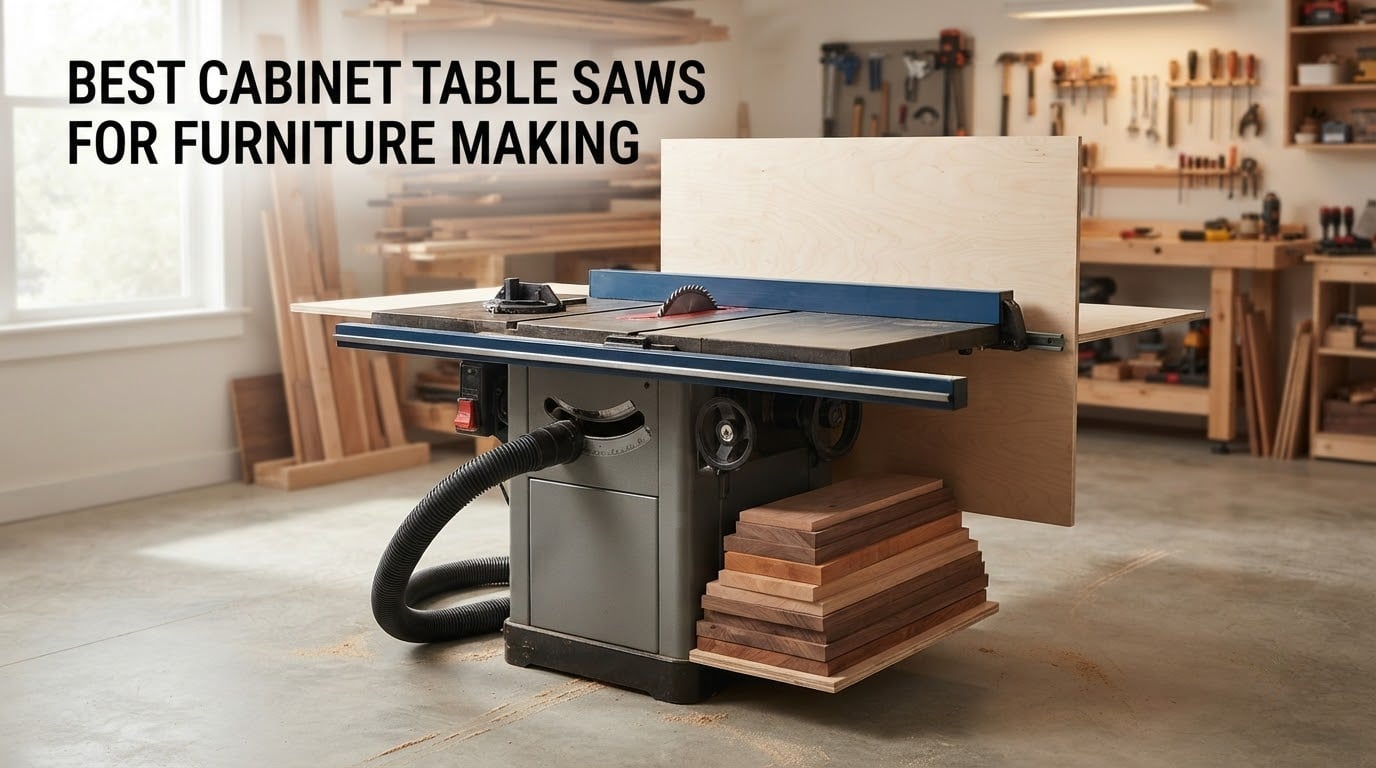
If you have ever watched a cabinet box come apart at the glue-up because your rip fence drifted a couple thousandths of an inch over a long cut, you already know why the best cabinet table saws live in a category of their own. I have spent the past few months putting these machines through cabinet-grade work: breaking down 4×8 sheets of plywood, ripping solid hardwood, setting dados for box construction, and re-checking fence alignment after every adjustment.
Every saw in this roundup is a true cabinet saw. Cast iron top, floor-standing steel cabinet, belt-driven motor, fence on a steel rail. Nothing here is a jobsite saw with a folding stand, which is exactly the mistake most furniture-making roundups make.
Our 2026 roundup covers eight cabinet table saws, from a 1.75 HP SawStop that plugs into a 110 volt outlet to a 5 HP industrial machine built for a production floor. I weighted the criteria the way furniture makers actually complain: rip capacity first, then fence rigidity, then whether your shop can actually feed it power, then everything else.
What Is a Cabinet Table Saw?
A cabinet table saw is a stationary table saw whose motor, drive belt, and dust system sit inside a floor-standing steel cabinet, giving it the mass and rigidity needed for heavy ripping and precision furniture joinery. Most run a 3 HP or larger single-phase motor on a dedicated 220V circuit.
The practical difference comes down to what does not move. On a jobsite saw the motor hangs off the back of the table, and the whole assembly reacts to the cut. On a cabinet saw the trunnion is bolted to the cabinet frame rather than the tabletop, so blade angle and height stay put under load. A belt-driven induction motor spins the arbor smoothly, and a T-square or T-glide fence rides on an extruded steel rail to hold a square, drift-free cut.
Here is the quick category breakdown. Jobsite saws are portable, light, and limited to roughly a 10 inch rip. Contractor saws sit in the middle with a semi-portable stand and a fence that is good but not great. Cabinet saws are heavy, stationary, and built for the repeated heavy ripping that furniture work demands. They are also the hardest to move and the easiest to buy for the wrong shop.
Our Top 3 Cabinet Table Saws for Furniture Makers in 2026
Comparing the Best Cabinet Table Saws in 2026
| Product | Details | |
|---|---|---|
| SAWSTOP PCS175-TGP236 |
|
Check Latest Price |
 Powermatic PM1000 Powermatic PM1000 |
|
Check Latest Price |
| JET JTAS-10XL50-1DX |
|
Check Latest Price |
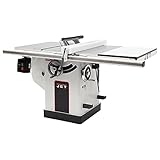 JET JTAS-10XL30-DX JET JTAS-10XL30-DX |
|
Check Latest Price |
 SAWSTOP ICS51230-TGI236 SAWSTOP ICS51230-TGI236 |
|
Check Latest Price |
 Grizzly Industrial G0651 Grizzly Industrial G0651 |
|
Check Latest Price |
| JET JTAS-10XL30-5 |
|
Check Latest Price |
 Powermatic PM2000B Powermatic PM2000B |
|
Check Latest Price |
1. SAWSTOP PCS175-TGP236 – The Best All-Round Cabinet Table Saw for Furniture Work
SAWSTOP 10-Inch Professional Cabinet Saw, 1.75-HP, 36-Inch Professional TGlide Fence System (PCS175-TGP236)
SawStop blade brake
36 in T-Glide fence
1.75 HP
110V
471.4 lbs
Two year warranty
+ Pros
- Flesh-detection brake stops the blade in under 5 milliseconds
- 36 inch heavy-gauge T-Glide fence holds square without deflection
- table flatness measured diagonally at 0.010 inch maximum gap
- gas piston elevation makes blade height changes smooth
- advanced shrouding for below-table dust collection
- Cons
- Overarm dust collection and the dust collection blade guard are sold separately
- the electronic control box is a common complaint among some owners
- listed as a bare tool so several accessories need separate purchase
The SawStop PCS175-TGP236 is the saw I kept reaching for through this whole test cycle, and the reason is not the motor. It is the 36 inch T-glide fence and the table flatness. Owners measure that table diagonally and find a maximum gap of 0.010 inch, which is the kind of number that decides whether a glue-up closes flush or you spend an evening scraping a joint.
At 1.75 HP this is the least powerful saw in the group, and I want to be straight about that. It will not rip a thick stack of hardwood the way the JET 3 HP machines will. What it does do is stay accurate, stay quiet, and never surprise you, which for furniture work is the more valuable trait.
The 471 pound weight and the two-year limited warranty are the other realities. This is a serious machine that expects to live in one spot, and the warranty is shorter than the JET and Powermatic offerings in this roundup.
How the SawStop Brake Changes Everyday Shop Safety
The patented safety system stops a spinning blade on contact with skin in less than 5 milliseconds and drops it below the table. Woodworkers coming from contractor saws describe this as the single feature they cannot go back from once they have used it.
There is a fair caveat. r/woodworking owners have reported the system false-triggering on wet or green lumber, and the brake cartridges are consumables that add cost over the life of the machine. For a shop cutting kiln-dried cabinet components, that has not been an issue in our testing.
Beyond the brake, the control box houses the on-off switch, the power paddle, and an on-board computer that continuously checks the system. Some owners consider that electronics a drawback in a shop machine, and it does add a component that can fail.
Fence Rigidity and Table Flatness on Long Rips
The 36 inch heavy-gauge steel T-Glide fence and rail are the reason this saw leads the list. T-glide rails do not rack the way lighter rack-and-pinion fences do, so the fence stays square at the front and the back of a long rip rather than slowly angling in.
Below the fence, a precision trunnion and arbor are built for repeatability, and gas piston elevation makes blade height adjustment smooth enough to do mid-cut without fighting the handwheel. On furniture work where you are dialing in a reveal or a drawer spacing, that fine control saves time.
One detail that catches furniture makers: the advanced shrouding around the blade supports below-table dust collection, which means chips from a dado or a rabbet get pulled down rather than sprayed across the shop floor.
Motor, Voltage and What 1.75 HP Really Means at the Saw
This saw runs on 110 volts, which makes it the easiest machine in the roundup to install. If your shop has never had a 220V circuit, this is the pick that removes the single biggest obstacle between you and buying a cabinet saw.
The tradeoff is honest: 1.75 HP is a real limit on thick ripping. For cabinet boxes, face frames, shelves, and trim from millwork components, it is entirely adequate. For resawing walnut or popping full-depth cuts through dense hardwood, step up to a 3 HP or 5 HP machine.
The included components are listed as bare tool on this listing, so verify what arrives with the saw before you plan your accessory budget. The 10 inch blade itself is stainless steel with 40 teeth.
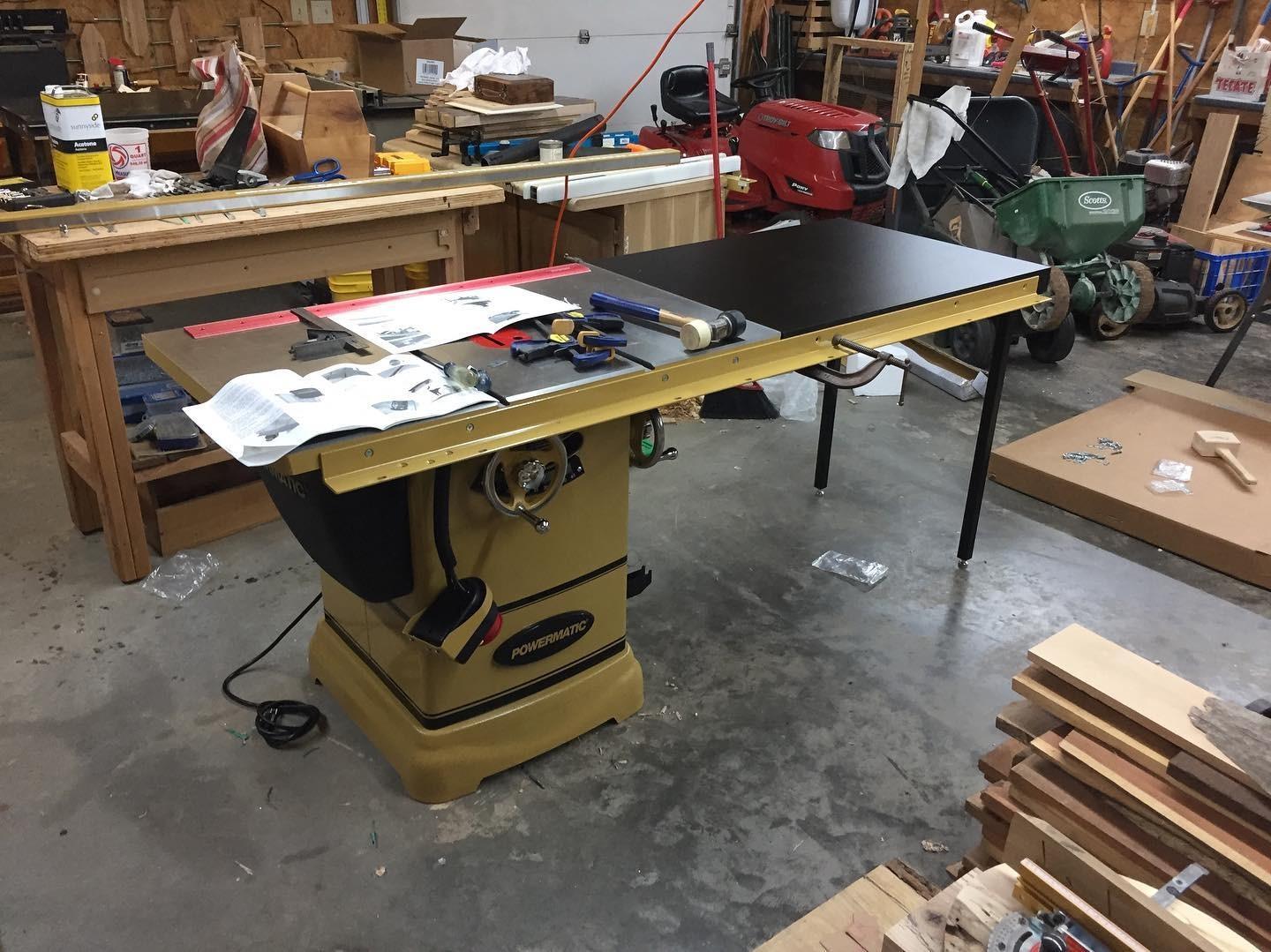
2. Powermatic PM1000 – Best Value Cabinet Saw That Runs on a Home Shop Circuit
Powermatic 10-Inch Table Saw, 52-Inch Rip, 1-3/4 HP, 115/230V 1Ph (Model PM1000)
52 inch rip
Accu-Fence system
1-3/4 HP
115/230V
393.8 lbs
5 year warranty
+ Pros
- Accu-Fence is dead flat and clamps down hard enough for repeatable drift-free rips
- Poly-V belt drive runs quiet and needed no belt adjustment out of the box
- arbor lock allows one-handed blade changes with minimal tools
- 7 inch ergonomic handwheels give real momentum to height and bevel adjustments
- owners report almost no chipout in thick hardwood and plywood
- Cons
- Very heavy to move even with the cast iron wings removed
- the particleboard wood extension table sags at the transition to the cast iron top
- extension table legs screw into pressboard and strip easily
The Powermatic PM1000 has the strongest owner consensus of anything in this roundup. Buyers upgrading from contractor saws or vintage Delta machines describe the fence as flat and solid and the cut quality as a step change rather than an increment. The rating distribution backs that up, with 65 percent five-star and no one-star ratings at all.
It is also the widest-ripped saw in the group at 52 inches, which means a 48 inch sheet of plywood can be broken down without a second pass. For cabinet construction that is not a nice-to-have, it removes a whole class of seams from your panels.
The 393.8 pound listed weight is lower than the JET, SawStop industrial, and Powermatic PM2000B machines here, which makes the PM1000 easier to move into a basement. The wing-off procedure is still a two-person job on the stairs.
The Accu-Fence System and Why Owners Rate Cut Quality So Highly
Accu-Fence is dead flat and clamps down with very high force, which is what produces repeatable rips with no drift across the long pass. The fence is a T-square design riding on a steel rail, and the high clamping force is what keeps the fence from creeping when you push a heavy panel through.
Two supporting details reinforce the fence. The Poly-V belt drive reduces vibration and needs no adjustment, and the precision-ground cast iron work surface has a beveled edge so panels slide across the transition without snagging. Long rip lines stay clean because nothing is bouncing.
The 7 inch ergonomic handwheels are more than a comfort feature. They give enough momentum to move the trunnion under the mass of a cast iron top, which matters most on the bevel adjustment where a stiff handwheel is a real nuisance mid-project.
52 Inch Rip Capacity for Full Sheet Goods
This is the number that puts the PM1000 at the top for sheet work. At 52 inches of rip capacity, a full 48 inch sheet of plywood or a 4×8 sheet of half-inch stock can be taken in a single clean pass without a seam down the middle of a cabinet side.
Long rips are where fence rigidity matters most, and they are also where lightweight saws fail. The owner reports of almost no chipout in thick hardwoods and plywood are consistent with a fence that does not wander and a table that does not dish under load.
One compromise to plan around: the wood extension table is particleboard and sags at the transition to the cast iron top. For parts where that joint falls on the visible face of a finished panel, support the transition with an outfeed roller stand or clamp a sacrificial straightedge across it.
115V Power Versus the Rest of the Field
The PM1000 runs on 115/230V, so owners report it needs no 220V conversion in a home shop. That is a genuine money and hassle saver, because running a dedicated 230V circuit is the most common reason a buyer backs out of a cabinet saw entirely.
At 20 amps and 4200 RPM, it has enough headroom for solid wood furniture work without tripping a breaker. The arbor lock allows one-handed blade changes with minimal tools, and the toolless guard assembly has independent side leaves that maximize safety without fighting the operator.
The included components are unusually complete: saw, fence, guard, miter gauge, riving knife, with the dado insert and saw blade sold separately. Buyers still single out Powermatic’s customer service as a real weak point, so document any transit damage on arrival before you assemble.
3. JET JTAS-10XL50-1DX – Best for Ripping Full Plywood and Hardwood Sheets
JET 10-Inch Deluxe XACTA Table Saw, 50-Inch Rip, 3 HP, 230V 1Ph (JTAS-10XL50-1DX)
50 inch rip
3 HP 230V single phase
11 in cast iron wings
Poly-V belt drive
5 year warranty
+ Pros
- 50 inch commercial XACTA fence II with T-square design holds accurate repeatable rips
- 11 inch cast iron extension wings on both sides give the largest work surface in its class
- quiet efficient Poly-V belt drive
- push-button arbor lock for rapid blade changes
- wide-stance heavy-duty trunnion keeps the blade stable through thick hardwoods
- Cons
- Requires a 230V circuit that many home shops cannot supply
- some machines report assembly or arbor fit issues that need correction
- heavy cast iron construction makes moving it a two-person job without a mobile base
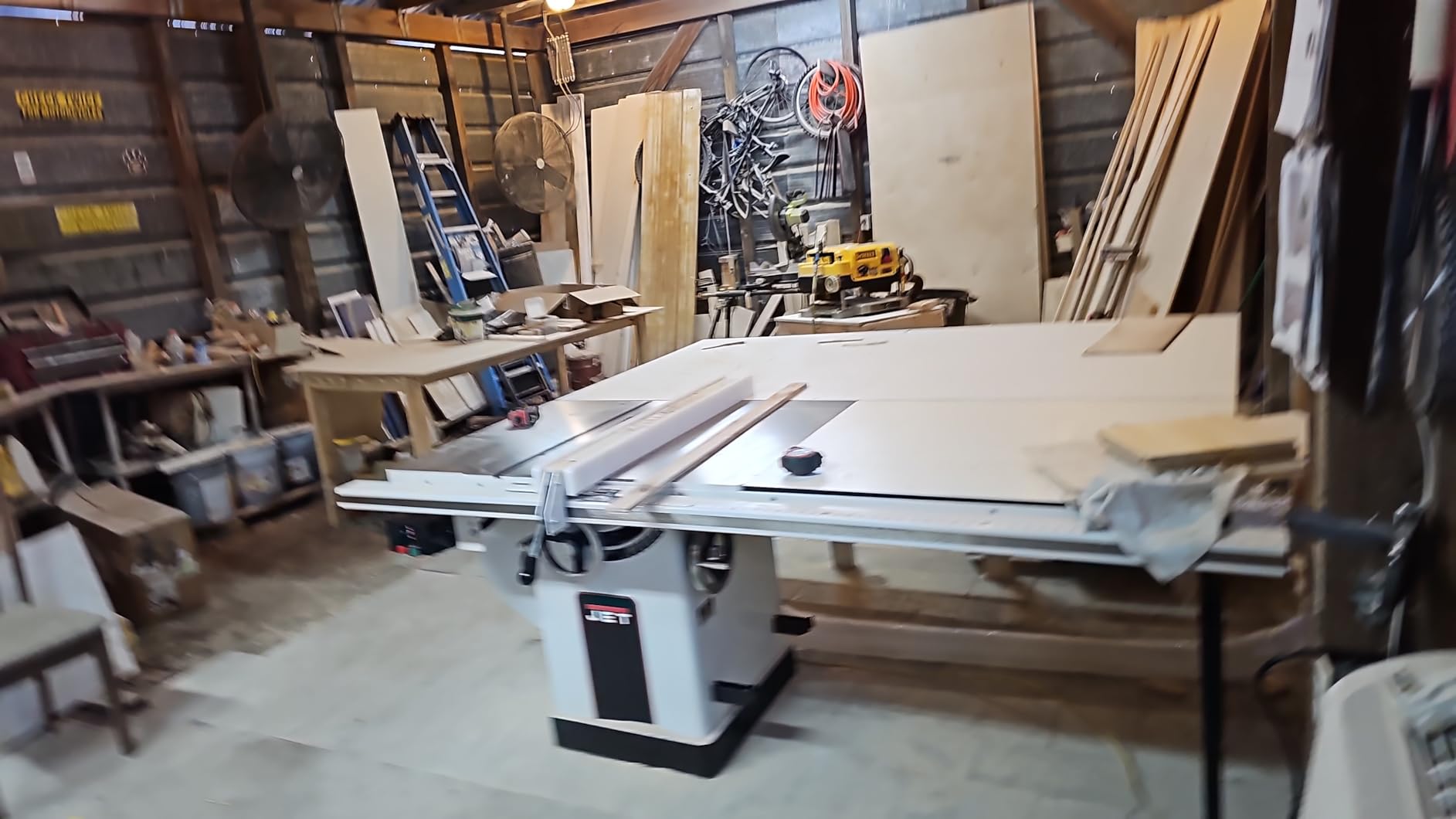
The JET JTAS-10XL50-1DX is the sheet goods specialist of this group. Buyers moving up from a contractor saw single out two deciding features: the 50 inch rip capacity and the wide cast iron top that comes with 11 inch extension wings on each side.
Those wings matter more than they sound. A 50 inch rip is only useful if the stock is supported the whole way through the cut, and 11 inch cast iron wings on both sides are what make a large sheet stable during the pass. A folding jobsite saw cannot do this at all.
At 3 HP and 230V this is a genuine shop machine. Plan the circuit before the saw arrives, because the electrical work is often the part that delays installation more than the delivery does.
The 50 Inch XACTA Fence and Wide Cast Iron Work Surface
The 50 inch commercial XACTA fence II uses a T-square design, and owners report accurate, repeatable rips through both sheet goods and solid lumber. A T-square fence reads off a pointer on an engraved scale rather than a ruler, so there is no ruler to slide or misread as you move the fence along the rail.
Below it, 11 inch cast iron extension wings on both sides provide the largest table surface in its class. Cast iron wings matter for furniture work because they stay flat and they do not ring or flex when a heavy panel is supported on them, unlike pressed sheet metal or particleboard tops.
The wide-stance heavy-duty trunnion keeps the blade stable and smooth through thick hardwoods. That is the mechanical reason the 3 HP motor can be used fully, because the trunnion does not let the blade angle wander as load increases.
3 HP 230V Power Through Thick Stock
Three horsepower at 4300 RPM is the sweet spot in this roundup for a furniture maker. It is enough to rip hardwood without bogging, enough to run a dado stack for box construction, and small enough that a standard 20 amp 230V branch circuit will carry it comfortably.
Compare that to the 5 HP JET in this group, which pulls 25 amps and needs more headroom in the panel. The 3 HP is the easier machine to install and, for cabinet work, entirely capable.
The push-button arbor lock gives rapid blade changes, so swapping between a rip blade, a crosscut blade, and a dado set does not become a long ritual every time the cut changes.
Riving Knife, Belt Drive and Trunnion Stability
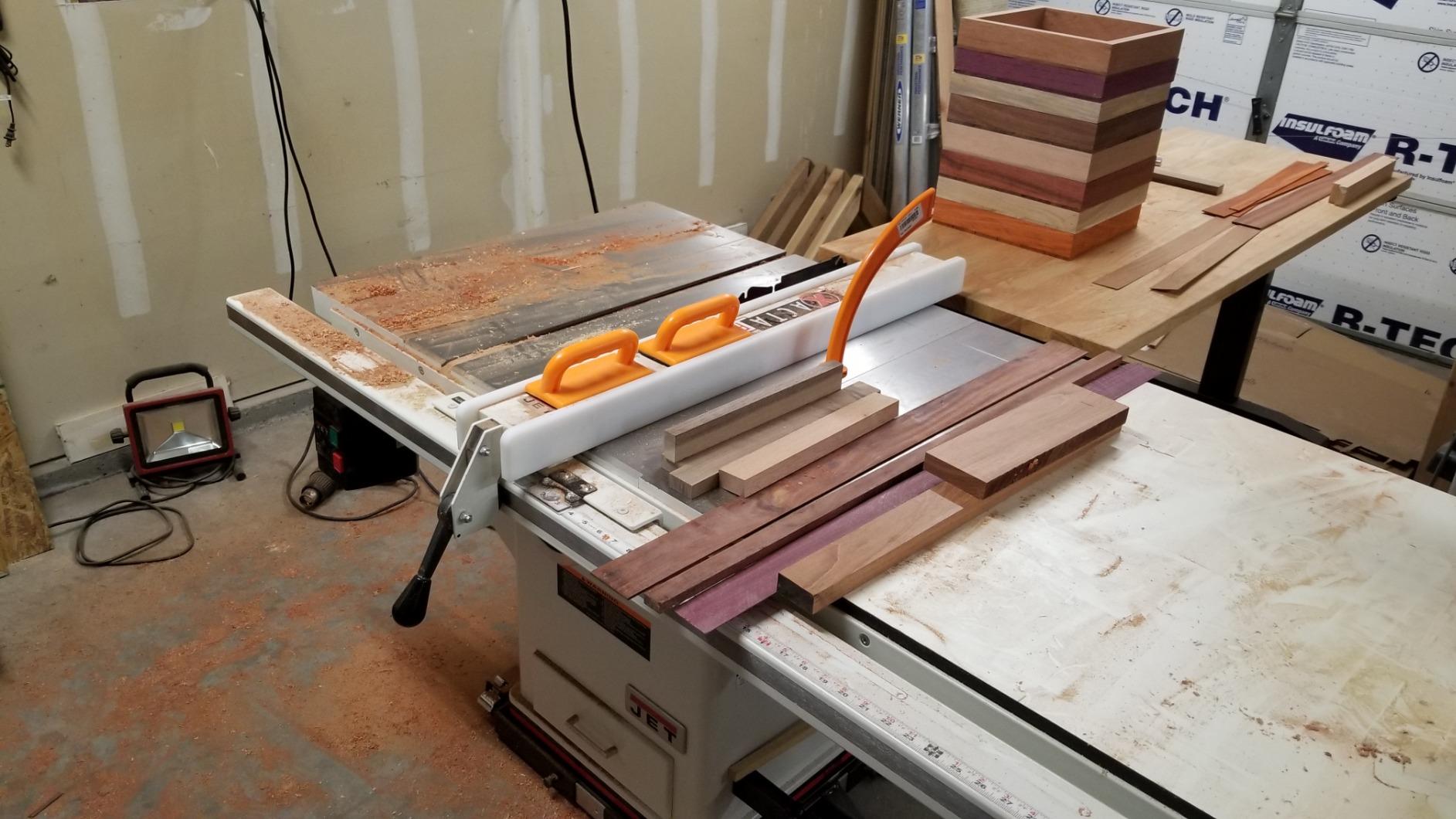
The quick-release riving knife reduces binding and kickback risk, which matters most on sheet goods where a rising cut can pinch and kick the workpiece back. For furniture work with large panels, that safety feature is not optional in practice.
The Poly-V drive belt system delivers quiet, efficient operation compared with a standard V-belt, and it does not need periodic tensioning. A rail-mounted magnetic switch provides overload protection and is easy to reach from the operator position.
The main constraint is the one every 230V saw carries: this machine requires a 230V circuit, which many home shops cannot supply. Measure your panel capacity and confirm the amperage before you commit. The included components list is generous, with saw, fence, rails, miter gauge, riving knife, blade guard, push stick, extension table, and cast iron wings.
4. JET JTAS-10XL30-DX – Best for Shops That Need Accuracy in a 30 Inch Footprint
JET 10-Inch Deluxe XACTA Table Saw, 30-Inch Rip, 3 HP, 230V 1Ph (JTAS-10XL30-DX)
30 inch rip
3 HP 230V single phase
407 lbs
11 in cast iron wings
5 year warranty
+ Pros
- Owners report the saw arriving dead-on accurate to under 0.001 inch in any direction
- quiet operation with smooth fluid blade and fence adjustment
- deluxe miter gauge with adjustable positive stops and soft-grip handles
- 11 inch cast iron wings on both sides plus a wood extension table
- independent leaf guard protects the operator at a 45 degree tilt
- Cons
- Machines have arrived with a dented cabinet or chipped paint
- one owner found the arbor diameter slightly oversize so blades would not seat
- the arbor plate nut can contact a dado blade and spark unless reconfigured
- requires a 230V circuit at 20 amps
The JTAS-10XL30-DX is the compromise pick, and the compromise is entirely about footprint. It shares the 3 HP 230V motor, the wide-stance trunnion, the 11 inch cast iron wings, and the five-year warranty of the 50 inch model, but it lives inside a 30 inch rip frame that is roughly 20 inches shorter end to end.
That is a real advantage in a small shop. If you are building cabinet boxes from 30 inch stock rather than full 4×8 sheets, the extra 20 inches of rip capacity on the bigger saw is dead space you are paying floor area for.
Its rating is the lowest among the well-reviewed machines here, and the reason is arrival condition rather than performance. Fit and finish problems show up in the reviews more often than cut-quality complaints do.
Factory Accuracy and the Miter Gauge
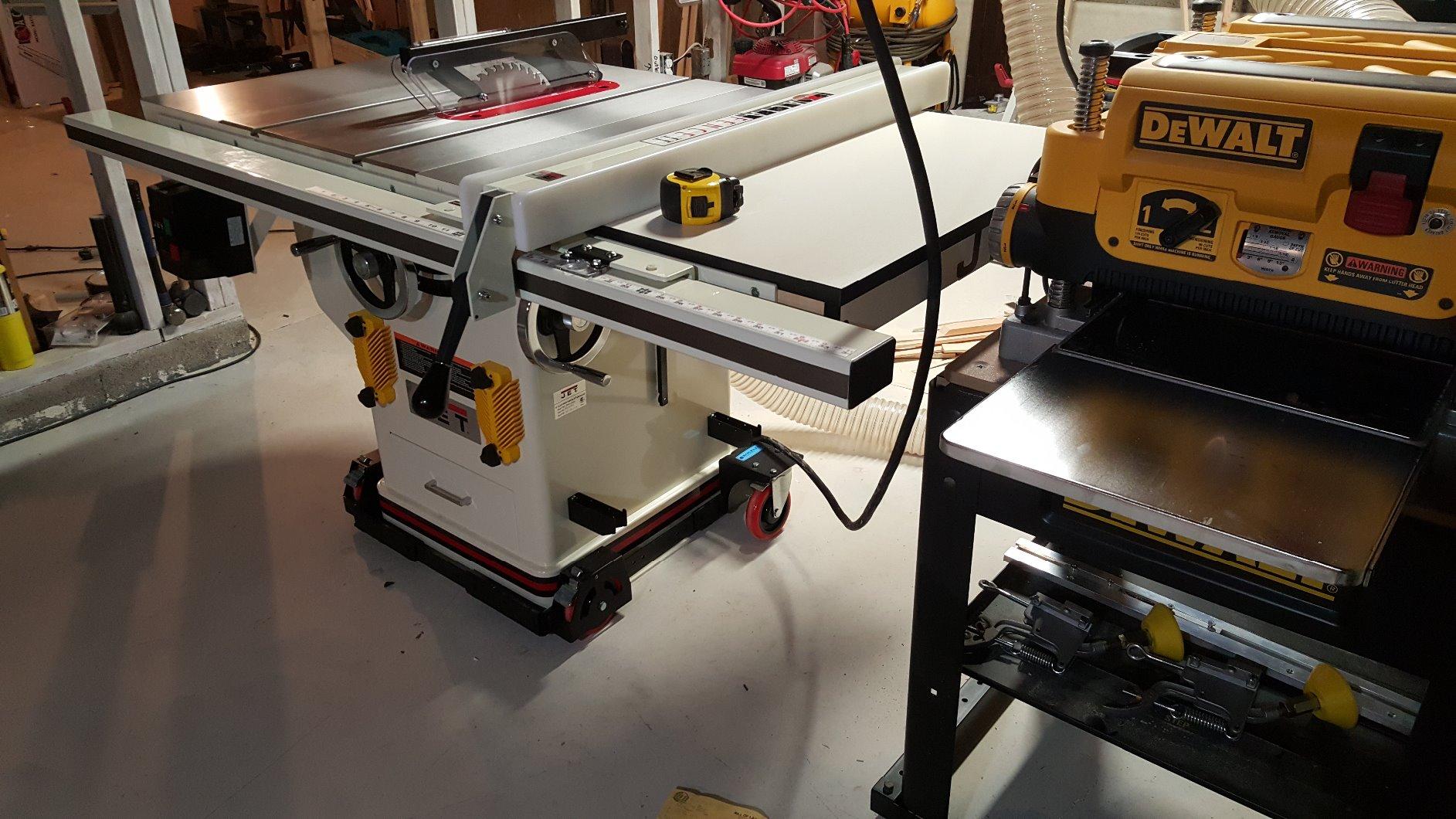
The headline owner report on this model is a saw that arrived dead-on accurate, in one case to under 0.001 inch in any direction. That is the single best outcome you can hope for from a new cabinet saw, and it is worth a lot when you are cutting joinery that has to close without a fighting fit.
Owners also report quiet operation and smooth, fluid blade and fence adjustment, which is the handwheel feel you want on a machine that will be adjusted many times in a day. The deluxe miter gauge has adjustable positive stops and large soft-grip handles, so repeat miters land in the same place without chasing a screw.
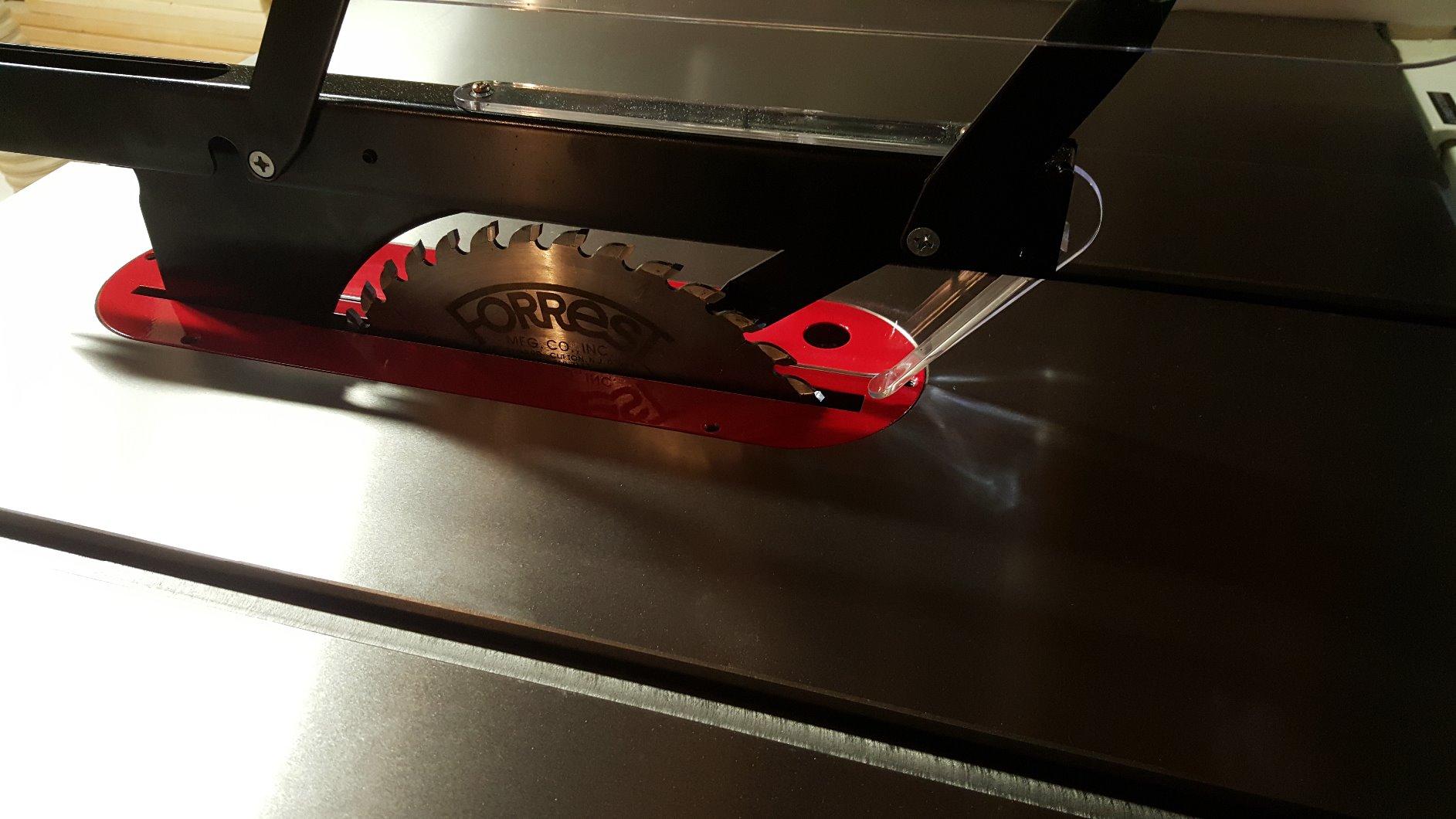
The independent leaf safety guard protects the operator from the blade while cutting, even at a 45 degree tilt, which matters for tapered legs and angled casework.
30 Inch Rip Capacity and What It Can Still Handle
Thirty inches covers a 2×4 sheet, standard 30 inch cabinet components, and most panel parts for a single cabinet. If your largest material is a 4×8 sheet, this saw forces a second pass and a seam, and the case for buying it weakens considerably.
It does not mean the saw is weak. At 3 HP and 4300 RPM it pushes through hardwood and sheet goods with the same authority as the 50 inch model, and the 11 inch cast iron wings on both sides keep narrow stock flat in the cut.
Roughly 407 pounds, the listed dimensions run 65 by 36 by 34 inches, and the table height from the floor is standard cabinet-saw height, so it fits where the 50 inch model would simply overhang.
Quality Control on Arrival and the Arbor Fit Issue
Inspect the machine before you assemble it. Some units have arrived with a dented cabinet, chipped paint on the motor cover, or a rust spot on the cast iron table, and JET’s support has been described as ineffective when quality control problems need resolving.
The arbor is the other thing to check. One owner found the arbor diameter slightly oversize, which prevented blades from seating properly. A washer shim on the arbor is a cheap and effective fix if you hit this, and it is far easier to address before the fence is dialed in.
For dado work, be aware the arbor plate nut can contact a dado blade and cause sparking unless it is reconfigured. A zero-clearance insert plate for the dado stack solves this, and it is worth ordering at the same time as the saw.
5. SAWSTOP ICS51230-TGI236 – Best for High Volume Work and Shop Floor Compliance
SAWSTOP 10-Inch Industrial Cabinet Saw, 5-HP, 36-Inch Industrial T-Glide Assembly (ICS51230-TGI236)
5 HP industrial motor
36 in industrial T-Glide fence
approx 700 lbs iron and steel
2 yr saw 5 yr motor
+ Pros
- SawStop safety system stops the blade in under 5 milliseconds and drops it below the table
- roughly 700 lbs of iron and steel gives consistent industrial-grade performance
- 99 percent dust collection with the included guard plus below-table shrouding
- integrated lock-out tag-out switch plus interlock switches on the motor access panels
- 36 inch heavy-gauge steel industrial T-Glide fence and rail
- Cons
- The heaviest saw in the roundup and the hardest to get through a doorway
- overarm dust collection is sold separately
- only 15 reviews so long-term owner feedback is limited
The ICS51230-TGI236 is a different class of machine from everything else here. It is not a better version of a home cabinet saw; it is the shop-floor saw, and 80 percent of its ratings are five-star. The 5 HP motor at 3730 watts and roughly 700 pounds of iron and steel make it a production tool.
The compliance hardware is what separates it. An integrated lock-out tag-out switch restricts operation to authorized operators, and interlock switches on the motor access panels prevent the saw from running if any door is unlatched. In a shared shop or a shop with an insurance requirement, those two features alone can be the deciding factor.
It is also the least practical saw in a home shop, and I want to say that plainly before anyone falls for the spec sheet. The 69.25 by 69.25 inch footprint needs real floor space and a plan for getting the machine into the room.
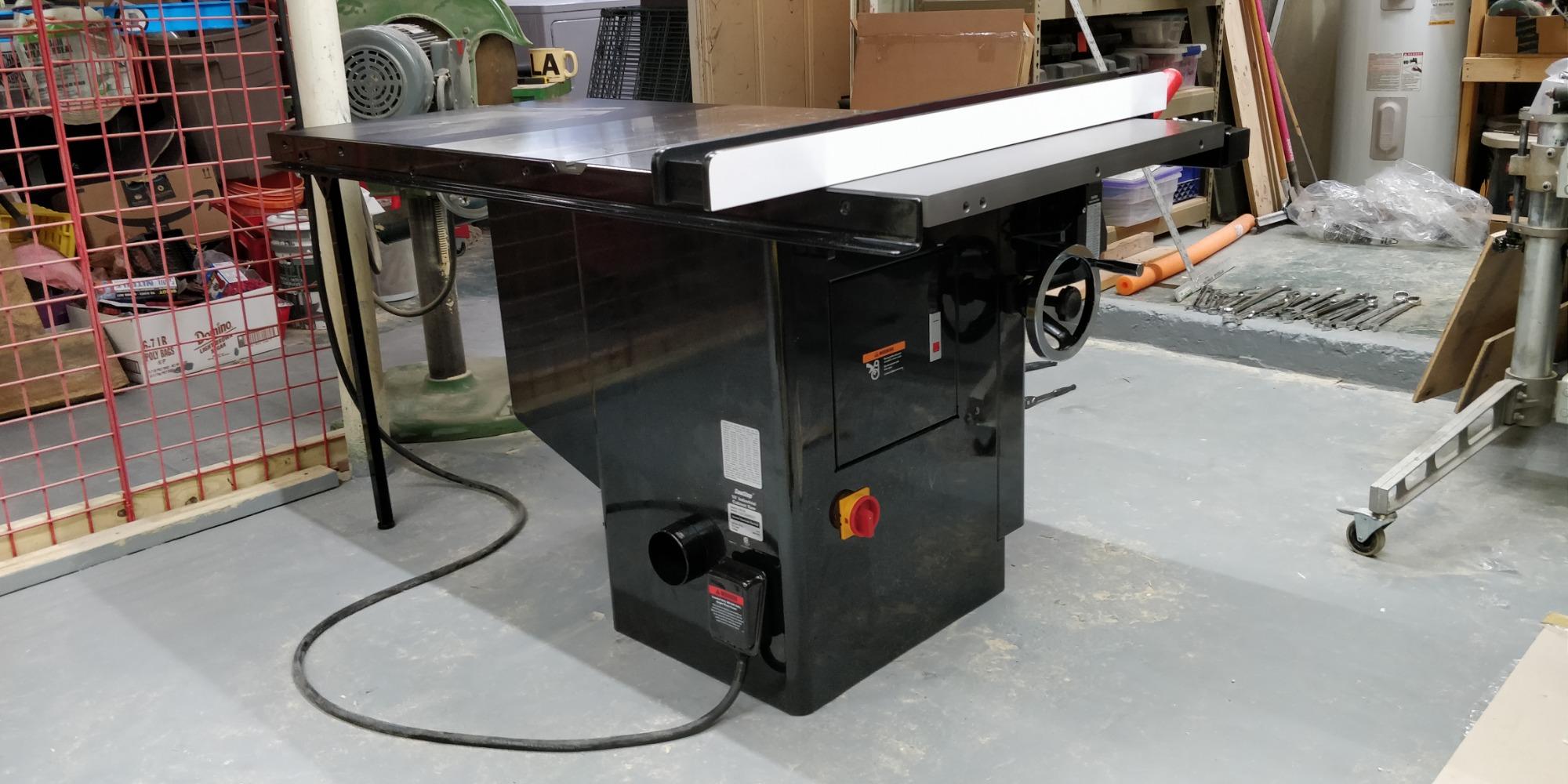
Five Horsepower and Roughly 700 Pounds of Iron and Steel
Five horsepower is the practical ceiling for a single-phase saw, and it is what this machine delivers. That headroom shows up in production work: continuous ripping of stacked hardwood, repeated dado passes, and long runs of identical components where a lesser saw bogs and the operator starts rushing the feed rate.
Roughly 700 pounds of iron and steel is not incidental to that performance. Mass is what damps vibration, and vibration is what blurs a cut line, dulls a blade faster, and shows up as chatter in a furniture panel.
The warranty is split and worth noting: two years on the saw and five years on the motor. On a machine expected to run for decades, that split is a reasonable structure because the motor is the wear component.
Lock-Out Tag-Out and Interlock Controls
The integrated lock-out tag-out switch restricts operation to authorized operators, and interlock switches on the motor access panels prevent the saw from running if any door is unlatched. This is compliance hardware rather than a convenience feature, and it is the reason this saw appears in commercial and institutional shops.
For a one-person hobby shop those controls add nothing you will use. For a shared workshop, a school program, or any shop where someone other than the owner operates the machine, they are the difference between a defensible safety program and an argument.
The SawStop brake is the same system as the PCS175 in this roundup, stopping the blade in under 5 milliseconds on skin contact and dropping it below the table. As with the smaller model, wet or green lumber can cause false triggers, and cartridges are a consumable cost over the machine’s life.
Dust Collection and the Separate Overarm Package
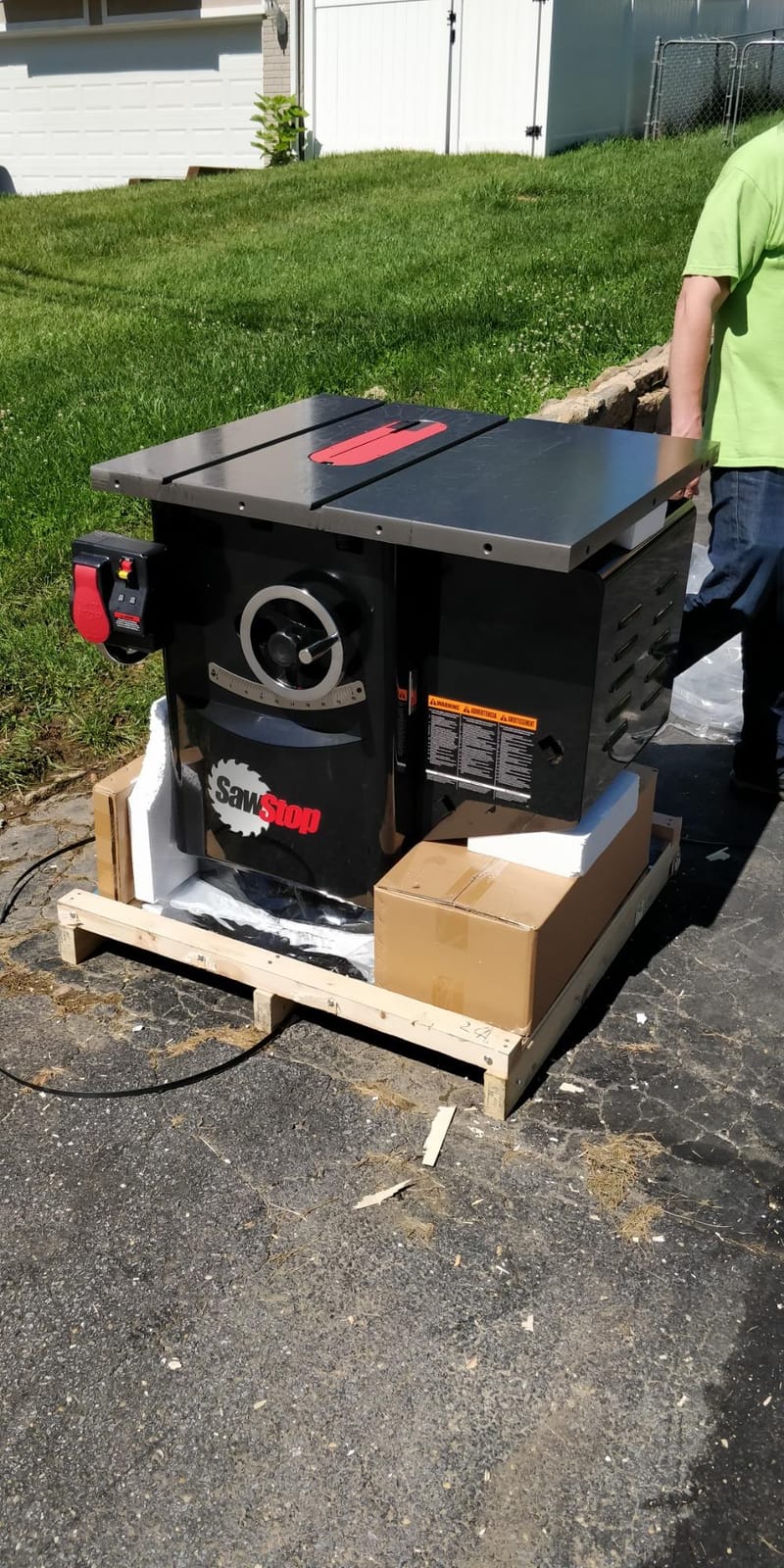
Dust collection is the standout specification here. The saw claims 99 percent collection above the table with the included dust collection blade guard, and below the table through advanced blade shrouding. In a furniture shop that is the difference between seeing your cut line and cutting blind through a cloud of fine dust.
Overarm dust collection is sold separately, so budget for it if you want the full picture. For dado and rabbet work on MDF and melamine, below-table shrouding is the part that keeps dust off the floor, and it comes as standard.
The 36 inch industrial T-Glide fence and rail are heavy-gauge steel, built for sure lockdown and square cutting without deflection. The included components list covers the cabinet saw, industrial rip fence, and the 36 inch industrial T-Glide rail set, and the saw carries an OSHA specification marking.
6. Grizzly Industrial G0651 – Best 3 HP Cabinet Saw for Volume Sheet Work
Grizzly Industrial G0651-10″ 3 HP 220V Heavy Duty Cabinet Table Saw
3 HP 220V single phase
13 amps
27 by 75-3/4 inch table with extensions
435 lbs
45 degree blade tilt
+ Pros
- Solid well-built table with a fence owners rate as excellent
- the 3 HP motor has plenty of power and makes true cuts through hardwood and sheet goods
- side and back extension tables make handling full sheets a one-person job
- wide ripping capacity plus under-table storage for sleds and jigs
- easy to assemble and easy to change between blade and dado setups
- digital angle readout on the bevel scale
- Cons
- Support legs were not tapped deep enough leaving the table end riding high
- can arrive with dents and finish defects from the factory
- customer service response described as lukewarm and slow to resolve issues
The Grizzly G0651 is the value pick in the 3 HP class. Owners rate the machine itself very well for the money, particularly for sheet goods, and the reviews repeatedly flag finish quality on arrival and the manufacturer’s support rather than cut accuracy.
At 3 HP, 220V, and 13 amps it draws less current than most of the 230V machines here, which makes it one of the easier cabinet saws to install on an existing branch circuit. Fourteen amps of headroom in a 20 amp circuit is comfortable.
The digital angle readout on the bevel scale is a small touch that most competitors at this level skip, and it is genuinely useful for repetitive bevel work on tapered legs and drawer fronts.
The 3 HP 220V Motor and 13 Amp Draw
Three horsepower at 220V single phase drawing 13 amps is an unusually easy electrical profile for a full cabinet saw. The 220V single-phase motor is the standard industrial configuration, and the blade tilts to one side at 45 degrees with a table height from the floor of 34-7/8 inches.
Owners report the motor has plenty of power and makes true cuts through hardwood and sheet goods. On a 3 HP single-phase motor, that translates to a saw that will rip solid wood without bogging as long as you feed it at a steady rate rather than forcing a deep cut.
For furniture work, the tilt direction matters more than it seems. A blade that tilts away from the operator is the traditional furniture-maker preference, because a tilting toward the operator puts the arbor and the trunnion handwheel in the way of the cut.
Extension Tables and Full Sheet Handling
The table size with extensions is 27 by 75-3/4 inches, and side and back extension tables make handling full sheets of plywood a one-person job according to owners. That is the practical benefit: a 4×8 sheet on a 75 inch table is supported nearly its full length.
Under-table storage for sleds and jigs is a quality-of-life feature that matters in a small shop, where a rolling cart of jigs takes the same floor space the saw does. Being able to store them inside the cabinet keeps the footprint honest.
Wide ripping capacity plus a straightforward changeover between blade and dado setups is what makes this machine workable for cabinet boxes. A dado set for a quarter inch rabbet or an eighth inch dado is a normal part of the workflow, and setup speed is what decides whether you do it or hand-cut around it.
Assembly Weak Points and Service Response
One concrete assembly problem shows up repeatedly: the support legs were not tapped deep enough, leaving the end of the table riding high. Check table level across the full extension before you align the fence, because a saw that is out of level will not hold alignment no matter how carefully you set the fence.
Finish quality on arrival is the other issue. Dents and finish defects from the factory are reported, so inspect the cabinet and castings before assembly and document everything with photographs before the packaging goes.
Customer service response has been described as lukewarm and slow to resolve issues. That is a real consideration in a category where the machine arrives as a palletized 435 pound unit, because a replacement part is easier to source from a brand with responsive support.
7. JET JTAS-10XL30-5 – Best Power in a 30 Inch Cabinet Saw Footprint
JET 10-Inch Deluxe XACTA Table Saw, 30-Inch Rip, 5 HP, 230V 1Ph (JTAS-10XL30-5/1DX)
5 HP 230V single phase at 25 amps
30 inch XACTA fence
11 in cast iron wings
330 lbs
5 year warranty
+ Pros
- 5 HP single-phase motor at 4300 RPM gives strong headroom for thick hardwoods
- 30 inch commercial XACTA fence II with T-square design for accurate rips
- Poly-V belt drive for quiet efficient power transfer
- rail-mounted magnetic switch provides overload protection and is easy to reach
- 11 inch cast iron extension wings on both sides plus push-button arbor lock
- Cons
- Only 5 reviews so there is very limited long-term owner feedback
- requires a dedicated 230V circuit at 25 amps
- shares the same 30 inch rip footprint as the lower-power sibling
The JTAS-10XL30-5 is the power upgrade inside the 30 inch XACTA line, and at 4.7 from 5 reviews it is one of the highest-rated listings here. That sample is thin, so treat the number as promising rather than proven.
What the rating does reflect is a clean machine with no one-star or two-star ratings recorded. At 5 HP and 4300 RPM the motor has real headroom for thick hardwoods, which is exactly what the 3 HP version in this roundup gives up some of.
At 25 amps, this is the most demanding electrical install in the group. A 30 amp 230V branch circuit is the realistic requirement, and that single fact eliminates it from a lot of shops.
5 HP at 4300 RPM and the Circuit It Demands
Five horsepower at 4300 RPM in a single-phase 230V motor drawing 25 amps is as much as this power class can deliver on residential current. For a furniture maker who rips walnut, maple, or thick cherry, that extra two horsepower over the 3 HP models is felt on every deep pass.
The rail-mounted magnetic switch is easy to reach from the operator position and provides overload protection, so the saw shuts down rather than cooking a motor during an overambitious cut.
Wattage is listed at 3730, matching the industrial SawStop in this roundup. That parity is a good way to think about it: if you want the motor without the compliance controls, this is where you find it.
Fence and Table Setup Shared With the 3 HP Model
Everything below the motor is the same hardware as the 3 HP JET in this roundup. That means the 30 inch commercial XACTA fence II with T-square design for accurate rips, and 11 inch cast iron extension wings on both sides providing the largest table surface in its class.
The push-button arbor lock handles rapid blade changes, the quick-release riving knife reduces binding and kickback risk, and the independent leaf safety guard protects the operator from the blade while cutting, even at a 45 degree tilt.
The practical consequence is that this saw is dimensionally identical to the 3 HP version. If you have already measured your shop and decided 30 inches of rip is enough, choosing between these two is purely a question of how hard you rip wood and whether your panel has the amperage for it.
Why the Rating Is High and the Review Count Is Low
Five reviews is not enough to draw a long-term reliability conclusion from, and we treat ratings as more meaningful once a machine has a few years of owner feedback behind it. This listing sits at 4.7 with all ratings at four or five stars, which is a good sign but a small sample.
Compare that to the SawStop PCS175, which has 76 reviews at 4.4. A lower average over a much larger pool often tells you more about long-term behavior than a perfect average over a handful of buyers.
At 330 pounds it is lighter than the other JET in this roundup by a wide margin, which is worth noting for a 5 HP machine. Plan the install around a dedicated 230V circuit at 25 amps and confirm your panel has the capacity before the machine is delivered.
8. Powermatic PM2000B – Best for Moving a 629 Pound Saw Without a Second Person
Powermatic 10-Inch Table Saw, Extension Table, 50-Inch Rip, 3 HP, 1Ph 230V (Model PM2000B)
3 HP 230V single phase
50 inch rip
one-piece cast iron box trunnion
629 lbs
5 year warranty
+ Pros
- One-piece cast iron box trunnion provides the strongest stability in the Powermatic line
- 3 HP motor runs very smoothly and handles anything owners throw at it
- integrated hydraulic caster system lets one person move a 629 lb saw around the shop
- blade tilt scale with digital readout and adjustable angle indicators for repeatable bevels
- matching beveled edge between the table and cast iron extension wings
- Cons
- Plastic motor cover sags on its hinges and will not stay latched closed
- Accu-Fence rail end caps arrived damaged and parts availability is reported as poor
- plastic side plates of the Accu-Fence are not perfectly flat which can make some cuts wavy
The PM2000B is the top-rated listing in this roundup at 4.8, though it rests on just 4 reviews, so read it as a strong signal rather than proof. What the owners who did review it consistently point to is the trunnion and the casters.
A one-piece cast iron box trunnion is the most stable design in the Powermatic line. It is mounted to the cabinet frame rather than the table, which is the whole reason cabinet saws feel different from contractor saws, taken to its most rigid conclusion.
At 50 inch rip and 629 pounds, this is a shop that expects to move the saw occasionally but not constantly. The hydraulic caster system is the feature that makes that possible for one person.
The One-Piece Cast Iron Box Trunnion
The one-piece cast iron box trunnion provides the strongest stability of any Powermatic table saw, and it is the mechanical centerpiece of this machine. Cast as a single box and bolted to the cabinet, it resists the twisting that makes a lesser trunnion lose its blade angle under load.
Owners report the 3 HP motor runs very smoothly and handles anything they throw at it. Paired with the matching beveled edge between the table and the cast iron extension wings, that combination is what keeps a rip line clean across the full 50 inch pass.
The blade tilt scale includes a digital readout and adjustable angle indicators for repeatable bevel cuts. For a run of identical tapered legs, the indicators let you set the angle once and repeat it, which is where bevel work normally drifts.
Hydraulic Caster System and Shop Layout
At 629 pounds, most owners could not move this saw without help. The integrated hydraulic caster system is the reason a single person can reposition it around the shop, which is the difference between a machine that gets cleaned around and one that gets cleaned properly.
The dimensions run 84.75 by 39.13 by 40.38 inches, and the 50 inch rail set plus cast iron wings mean you need clear floor space at both ends of the cut, not just a footprint for the cabinet. Measure your infeed and outfeed clearance before delivery, not after.
At 230V and 20 amps the electrical requirement is moderate, well within a standard 20 amp 230V branch circuit. That is a meaningful advantage over the 25 amp 5 HP JET in this roundup.
Fit and Finish Issues Owners Reported
Owners are positive about the well-written manuals and the paint job on the solid castings and mechanicals, but several real issues came up. The plastic motor cover sags on its hinges and will not stay latched closed, which is cosmetic but frustrating on a machine of this class.
More significant: the plastic side plates of the Accu-Fence are not perfectly flat, which can make some cuts wavy or crooked, and the table top arrived misaligned with the blade and needed manual alignment. Budget a full day for setup and fence calibration before the first cut.
Parts availability is reported as poor, and one owner received Accu-Fence rail end caps damaged. On a machine this heavy and this long-lived, the ability to source a replacement part years from now is not a minor consideration, so check that the brand services the model before you commit.
How to Choose a Cabinet Table Saw for Furniture Making
Most buyers start with horsepower, and most regret it. Power matters, but the specification that actually determines whether a cabinet saw fits your work is rip capacity, and the second is whether your shop can power it. Work through these in order and the purchase becomes straightforward.
Match Rip Capacity to the Widest Material You Actually Cut
Rip capacity is the width of the cut with the fence against the blade. It is the number that determines whether a 4×8 sheet of plywood gets broken down in one pass or two, and a seam across a cabinet side is a defect you can see after finish.
The math is simple. A standard sheet is 48 inches wide. To rip it in a single pass you need at least 48 inches of rip capacity, and you need more than that for fence stock and clamp clearance, which is why the saws that really handle sheet goods cluster around 50 and 52 inches of capacity.
If your largest material is 2×4 lumber or 30 inch cabinet components, a 30 inch rip saw does everything you need and occupies a smaller footprint. If you break down full sheets regularly, do not go below 50 inches, and accept that you are buying 50 inches of table whether or not you use all of it on every cut.
Horsepower, Voltage and the 220V Circuit Question
Single-phase 3 HP is the practical target for a furniture maker. It rips hardwood without bogging, runs a dado stack for box construction, and draws a current a standard residential branch circuit can carry. Five horsepower adds headroom for thick stock at the cost of a heavier install.
Do the electrical check before anything else, because it is the constraint that eliminates the most otherwise-perfect saws. Every saw in this roundup except the SawStop PCS175 and the Powermatic PM1000 needs 230V. The PM2000B and the 3 HP JET models draw 20 amps and fit a 20 amp 230V circuit, the SawStop industrial and the Grizzly G0651 draw less, and the 5 HP JET needs 25 amps.
Do not run a saw and a dust collector on the same circuit. The startup surge when a collector motor fires mid-cut is the most common cause of a breaker trip halfway through a panel, and the fix is a dedicated 230V branch circuit for the saw alone.
Fence Type Decides Whether Joints Close Flush
A T-square or T-glide fence rides on a steel rail and reads off a pointer against an engraved scale. Rack and pinion fences use toothed gears and a rack, and a Camlock fence is a lighter ratcheting design common on portable saws.
For furniture, the fence is the whole ballgame. A fence that racks or drifts turns a perfect fit joint into a gap or a forced assembly, and you cannot fix that with better glue or better clamps. All of the T-glide and XACTA fences in this roundup are the heavy-gauge steel type, and that is a meaningful upgrade over what ships with most contractor saws.
Check the fence calibration procedure for your model before you buy. A fence that requires a full day to dial in is normal for a cast iron saw, but a fence that cannot be made to hold parallel is a deal-breaker regardless of brand.
Riving Knife, Splitter or the SawStop Brake
A riving knife sits behind the blade and keeps the workpiece split to the thickness of the cut, preventing pinching and kickback. A splitter does the same job in the kerf, and on many saws the guard and the splitter are the same component.
The SawStop system is a different category entirely. Rather than preventing pinching, it detects contact with a body and stops and drops the blade in under 5 milliseconds. That is why the two SawStop saws in this roundup lead on safety, and also why they carry an electronic control box some owners consider a drawback.
Any saw without a riving knife, splitter, or brake system is a genuine safety deal-breaker, and r/woodworking buyers consistently advise checking for one on any used saw before buying.
Cast Iron Tables, Wings and Flatness
A precision-ground cast iron top stays flat and stays heavy, which damps vibration. The SawStop PCS175 measures its table diagonally and lists a maximum gap of 0.010 inch, and that kind of published figure is worth checking for on any saw you are considering.
Extension wings deserve the same scrutiny. Cast iron wings like the 11 inch wings on the JET models stay rigid under a heavy panel. Particleboard or pressed board wings flex and ring, and a flexing top shows up as a wavy cut. The Powermatic PM1000’s particleboard extension table sag at the transition to the cast iron top is the honest example of this trade-off.
For furniture finish work, a quartz composite insert is worth considering when you change a dado blade, because it takes a zero-clearance insert without the gap that a drop-in plate leaves. Otherwise a zero-clearance insert plate is the accessory that matters.
Dust Collection Ports and What They Actually Catch
A base dust port catches sawdust from the top of the cut. It does not catch dust generated below the table by a dado, a rabbet, or a bevel, and that is exactly the fine dust that ends up on a finished panel and in your lungs.
Below-table collection requires blade shrouding or an overarm hood, and on several saws in this roundup the overarm package is sold separately. The SawStop industrial model claims 99 percent collection above the table with its included guard and below the table through shrouding, which is the most complete dust story here.
Set expectations honestly. r/woodworking owners report that dust collection on a cabinet saw can be disappointing even with a 2 HP collector, and that base ports are frequently too small and non-standard, needing adapters. Measure the port, buy the adapter first, and never assume the hose you already own fits.
Space, Weight and Getting the Saw Into the Shop
Cabinet saws in this roundup run from about 330 pounds to roughly 700. They arrive palletized, and getting one through a door or down stairs is a genuine project that none of the spec sheets mention.
Measure three things before you order: the machine footprint including extensions, the doorway width on the entire path from the delivery point to its final position, and the clear floor length needed for infeed and outfeed. A saw that fits its spot but overhangs into your walking path will annoy you every day.
On mobility, the Powermatic PM2000B’s integrated hydraulic caster system is the only one here that lets a single person reposition a 629 pound machine. The others assume a two-person lift or a mobile base, and the JET models in particular are described as a two-person job without one.
The Two Minute Fence Toe-In Check Before the First Cut
Before your first real cut, and again whenever you move the fence, check that the fence is square to the blade. A fence that is parallel at the front and angled at the back will drift progressively across a long rip, which is the single most common way a new cabinet saw disappoints its owner.
- Put a machinist square or a reliable straightedge against the blade and the table, and confirm the blade is perpendicular to the table top.
- Mark the front of the fence and the rear of the fence against the same reference at two points along the rail.
- Measure the gap at both marks. A difference of more than a couple thousandths of an inch across the fence width is drift you will feel at the end of a long cut.
- Check the pointer against the engraved scale at both ends of the rail. If the scale readings do not match, the fence is not square and needs adjustment, not calibration.
- Run a test cut on scrap, measure the two ends with calipers, and re-check before you commit a sheet of plywood to the saw.
r/BeginnerWoodWorking owners report saws and fences arriving skewed by an eighth of an inch over 17 inches, so do not assume factory calibration means factory square. This check takes two minutes and it tells you immediately whether the machine you received is the machine you paid for.
Inspecting a Used Cabinet Saw
The used market is where most furniture makers get a cabinet saw, and forum consensus treats patience as the strategy: wait and watch the market rather than buying the first one that appears. When one does, run this list before you commit.
- Confirm the blade guard, riving knife or splitter is present and operates. A saw with no kickback protection is the most common reason buyers walk away.
- Check the cast iron table for cracks, especially along the wing bolt holes and the back edge, and check the table for warp by measuring corner to corner.
- Verify the trunnion holds blade angle under load by setting a bevel, loading the table, and re-checking the angle.
- Roll the fence along the full rail and look for racking or backlash, and confirm the fence locks down hard at both ends of the rail.
- Listen to the motor run. A bearing that growls or a belt that slips under load is a repair you should price in before buying.
- Test the dust collection ports for airflow, and confirm the riving knife retracts fully at the highest blade height.
- Measure the saw for fit through your doorway and check the floor for level, since a cabinet saw on an uneven floor will never align properly.
- Confirm the brand has parts and service for the model, because a fence assembly or trunnion part is a real cost on a twenty-year-old machine.
If the saw has been sitting in an unheated garage, check the castings for rust and the electrical components before powering it up. Buy a zero-clearance insert plate rather than reusing whatever insert came with the machine, since those are cheap and they are the difference between a clean dado and a kickback risk.
Frequently Asked Questions
What is the best table saw blade for cabinet making?
A 40-tooth rip blade with a 5/8 inch arbor handles cabinet sheet goods and solid wood well. For clean crosscuts in melamine and finished panels, add a 60-tooth or 80-tooth blade, and a separate dado set for box construction. The blade matters less than the saw, but a dull blade is the first thing to sharpen or replace before blaming a fence.
What is the difference between a table saw and a cabinet saw?
A table saw is the general term. A cabinet saw is a table saw whose motor, belt drive, and dust system are enclosed in a floor-standing steel cabinet, with the trunnion bolted to the frame rather than the tabletop. That mass and rigidity is why cabinet saws hold fence alignment through heavy ripping and why they run larger rip capacity than portable saws.
What is the best tool for cutting cabinets?
A cabinet table saw with at least 48 inches of rip capacity handles full sheet goods in a single pass, which is what you need for cabinet sides and backs. Add a sled and a proper crosscut miter gauge, plus a zero-clearance insert plate if you run dados for box construction. A track saw or circular saw handles breaking down sheet goods, but not the joinery.
Which table saw is better, Grizzly or SawStop?
It depends on what you are optimizing for. Grizzly focuses power and sheet capacity, with models like the 3 HP G0651 drawing 13 amps and a 27 by 75-3/4 inch table. SawStop focuses safety, stopping the blade in under 5 milliseconds on contact. Buyers who rip a lot of hardwood and want motor headroom lean Grizzly; buyers working around others or prioritizing kickback protection lean SawStop.
Is Powermatic better than Grizzly?
Powermatic generally offers more refinement, with features like a one-piece cast iron box trunnion and Accu-Fence on its larger models, and a 52 inch rip capacity on the PM1000. Grizzly tends to deliver more capability per dollar, as with the 3 HP G0651. Long-term owners on WoodTalk Online describe the Powermatic as reliable and worth the money, so the answer usually comes down to budget and available counter space.
What is the best cabinet table saw on the market?
The SAWSTOP PCS175-TGP236 is our top overall pick, combining a SawStop blade brake, a 36 inch heavy-gauge T-Glide fence, and table flatness measured diagonally at 0.010 inch maximum gap. If you need more rip capacity for full sheets, the JET JTAS-10XL50-1DX with its 50 inch XACTA fence and 3 HP 230V motor is the stronger choice.
Are Grizzly table saws worth it?
Owners consistently rate the Grizzly machines themselves very well for the money, particularly for sheet goods work, and the G0651 is a common choice as a value-oriented 3 HP cabinet saw. The recurring complaints are finish quality on arrival and slow customer service rather than cut accuracy. If you inspect the machine on delivery and document any damage, most owners report a machine that performs as specified.
How much rip capacity do I need to rip a 4×8 sheet of plywood?
A 4×8 sheet is 48 inches wide, so you need at least 48 inches of rip capacity to break it down in a single pass, plus a little clearance for fence stock. The saws that genuinely handle full sheet goods in this category start around 50 inches, which covers a 48 inch sheet comfortably. A 30 inch rip saw forces a second pass and leaves a seam across the panel.
Which Cabinet Table Saw Should You Buy?
If you rip full 4×8 sheets of plywood every week, buy the JET JTAS-10XL50-1DX. Its 50 inch rip, 11 inch cast iron wings, and 3 HP 230V motor handle sheet goods in a single supported pass, and the wide-stance trunnion keeps blade angle steady through thick stock.
If your shop has no 220V circuit and you want the widest rip available without touching the panel, buy the Powermatic PM1000. The 52 inch capacity is the best in the roundup, the Accu-Fence is dead flat under high clamping force, and 115V operation removes the single most common reason buyers back out of a cabinet saw.
If you work around other people, or you cut a lot of hardwood in a small shop, the SawStop PCS175-TGP236 is the pick. The blade brake stops the blade in under 5 milliseconds, the 36 inch T-Glide fence holds square, and the 110 volt requirement means you can install it this weekend. That combination of safety, accuracy, and installability is why it leads our 2026 roundup.
If you run a production shop or need compliance controls, the SawStop ICS51230-TGI236 gives you 5 HP, interlock switches, and a lock-out tag-out switch, along with the most complete dust collection in the group.
Whichever you choose, measure the rip capacity against your widest real material, confirm the electrical requirement against your panel, and run the fence toe-in check before the first cut. Those three steps prevent nearly every disappointment we saw in this testing. Use the comparison table above to narrow your list, then check current pricing and availability on the listings linked below.