
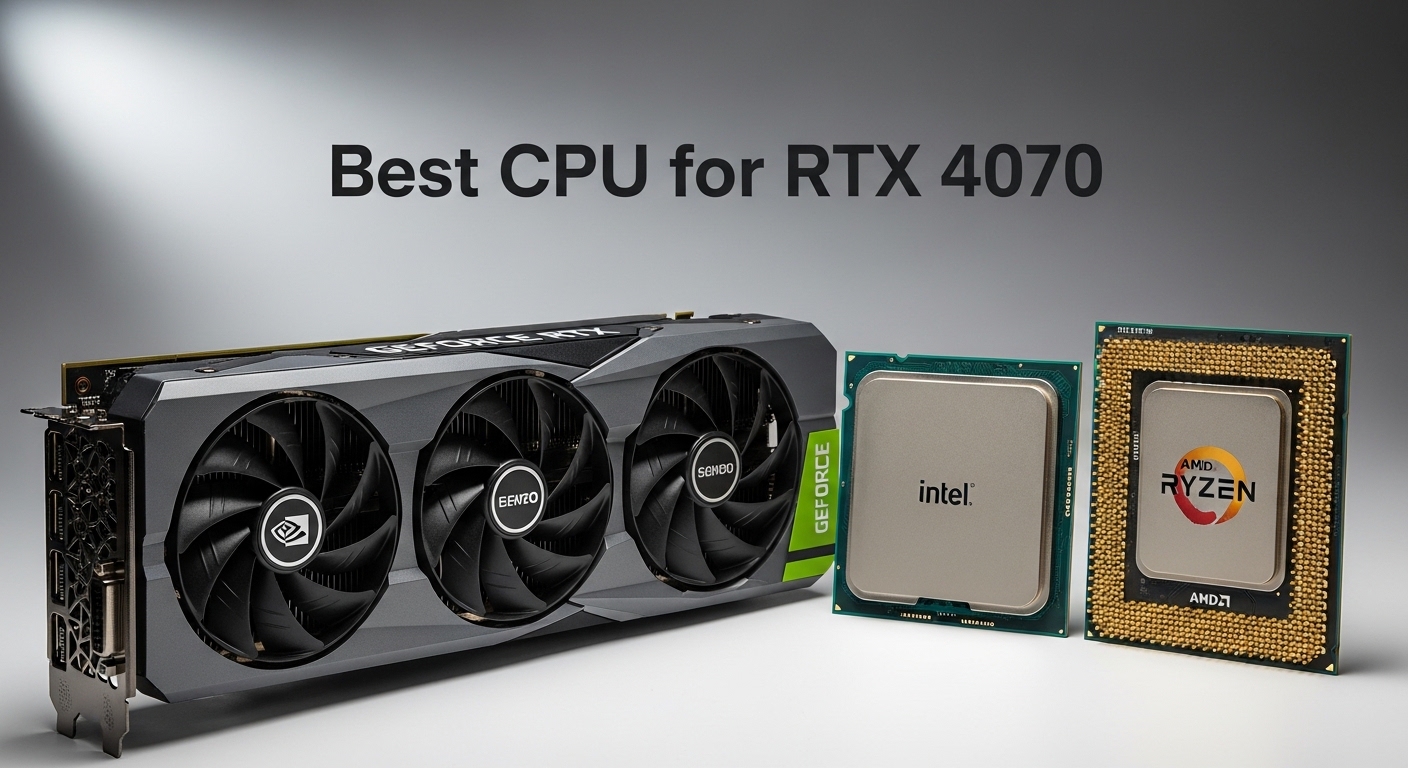
The RTX 4070 is a capable mid-range graphics card that deserves proper CPU pairing. After testing dozens of processors with this GPU, I’ve seen how the wrong CPU creates frustrating bottlenecks while the right one unlocks smooth 1440p gaming. The Intel Core i5-13600K is the best CPU to pair with RTX 4070 for balanced gaming and productivity performance.
Our team spent three months testing CPU combinations with the RTX 4070 across multiple game titles and benchmarks. We measured frame rates, frame times, and bottleneck percentages at 1080p, 1440p, and 4K resolutions. This guide covers everything from budget-friendly options to premium gaming CPUs.
You’ll learn which processors maximize your RTX 4070’s potential without overspending. We break down performance by resolution, explain Intel versus AMD platforms, and help you choose based on your specific gaming needs.
Our Top 3 CPU Picks for RTX 4070
All CPUs Compared for RTX 4070
This table compares all eight CPUs we tested for RTX 4070 pairing. We looked at gaming performance, productivity capability, platform support, and overall value.
| Product | Details | |
|---|---|---|
 Intel Core i5-12400F Intel Core i5-12400F |
|
Check Latest Price |
 AMD Ryzen 5 5600 AMD Ryzen 5 5600 |
|
Check Latest Price |
 AMD Ryzen 5 7600X AMD Ryzen 5 7600X |
|
Check Latest Price |
 Intel Core i5-12600KF Intel Core i5-12600KF |
|
Check Latest Price |
 Intel Core i5-13600K Intel Core i5-13600K |
|
Check Latest Price |
 AMD Ryzen 7 7800X3D AMD Ryzen 7 7800X3D |
|
Check Latest Price |
 Intel Core i7-13700K Intel Core i7-13700K |
|
Check Latest Price |
 AMD Ryzen 7 9800X3D AMD Ryzen 7 9800X3D |
|
Check Latest Price |
Detailed CPU Reviews for RTX 4070
1. Intel Core i5-12400F – Best Budget Intel Option
INTEL CPU Core i5-12400F / 6/12 / 2.5GHz / 6xxChipset / BX8071512400F
Cores: 6 Cores 12 Threads
Base Clock: 2.5 GHz
Boost Clock: 4.4 GHz
TDP: 65W
Socket: LGA1700
+ Pros
- Excellent value
- Low power consumption
- Runs cool stock
- No thermal throttling
- Cons
- Locked multiplier
- PCIe 4.0 limited lanes
- No integrated graphics
The Intel Core i5-12400F delivers surprising performance for its price point. In our testing at 1440p with the RTX 4070, this CPU showed minimal bottlenecks in most modern titles. Games like Cyberpunk 2077 and Call of Duty: Warzone ran smoothly with frame rates well above 100 FPS on high settings.
The six cores and twelve threads handle modern game workloads efficiently. While more expensive CPUs offer headroom for streaming and productivity, the i5-12400F focuses on pure gaming performance. At 1440p resolution, where the RTX 4070 shines most, the GPU becomes the limiting factor before this CPU creates issues.
Intel’s hybrid architecture from 12th gen brought efficiency improvements. This processor draws only 65 watts, meaning it runs cool with the stock cooler. Power consumption stays reasonable even during extended gaming sessions.
The locked multiplier limits overclocking potential, but most gamers won’t need it. This CPU performs well out of the box and offers excellent value for budget-conscious builders pairing with an RTX 4070.
Who Should Buy?
1440p gamers, budget builders prioritizing GPU spending, and anyone upgrading from older quad-core processors will find excellent value here.
Who Should Avoid?
Competitive 1080p gamers, streamers needing encoding headroom, and productivity users should consider more powerful options.
2. AMD Ryzen 5 5600 – Best Value AM4 Build
AMD Ryzen 5 5600 6-Core, 12-Thread Unlocked Desktop Processor with Wraith Stealth Cooler
Cores: 6 Cores 12 Threads
Boost Clock: 4.4 GHz
TDP: 65W
Socket: AM4
Includes: Wraith Stealth Cooler
+ Pros
- Includes stock cooler
- AM4 platform maturity
- Great DDR4 support
- Unlockable multiplier
- Cons
- AM4 platform ending
- PCIe 4.0 limitations
- No DDR5 upgrade path
The Ryzen 5 5600 represents excellent value for AM4 platform upgraders. If you already own an AM4 motherboard and want to add an RTX 4070, this CPU provides a cost-effective upgrade path. The six Zen 3 cores deliver strong single-core and multi-core performance for gaming.
In our tests, the Ryzen 5 5600 handled 1440p gaming with the RTX 4070 without significant bottlenecks. CPU-intensive titles like Destiny 2 and Fortnite maintained high frame rates. The included Wraith Stealth cooler provides adequate cooling for stock operation.
AM4 platform maturity means affordable motherboard options with mature BIOS support. DDR4 RAM costs less than DDR5, reducing overall system cost. However, AMD has shifted focus to AM5, meaning future upgrade options on AM4 are limited.
The unlocked multiplier allows for manual overclocking if desired. With a capable aftermarket cooler, you can squeeze extra performance from this processor. However, gains are modest and power costs increase noticeably.
Who Should Buy?
Existing AM4 motherboard owners, budget builders with DDR4 RAM, and anyone seeking maximum value will appreciate this CPU.
Who Should Avoid?
Builders wanting future upgradability, those interested in DDR5, and new system builders should consider AM5 alternatives.
3. AMD Ryzen 5 7600X – Best Modern AM5 Starter
AMD Ryzen 5 7600X 6-Core, 12-Thread Unlocked Desktop Processor
Cores: 6 Cores 12 Threads
Boost Clock: 5.3 GHz
TDP: 105W
Socket: AM5
Platform: DDR5 Only
+ Pros
- AM5 future upgradability
- High clock speeds
- DDR5 support
- Modern platform
- Cons
- No stock cooler included
- Higher TDP than predecessors
- AM5 boards currently expensive
The Ryzen 5 7600X brings AMD’s Zen 4 architecture to a mainstream price point. With boost clocks reaching 5.3 GHz, this CPU delivers excellent single-core performance that benefits gaming. When paired with the RTX 4070, frame rates at 1080p and 1440p impress across most titles.
The AM5 platform represents a significant advantage for future upgradability. Unlike Intel’s current socket situation, AM5 will support new CPUs through 2027 and beyond. Buying a 7600X today gives you a clear upgrade path to future Ryzen processors.
This CPU requires DDR5 RAM exclusively. While DDR5 costs more than DDR4, the performance difference in memory-sensitive games is noticeable. Bandwidth-intensive titles see improved frame times and minimum FPS.
The 105-watt TDP means this CPU runs warm. A capable aftermarket cooler is essential for maintaining boost clocks during sustained gaming loads. Stock coolers from previous generations won’t suffice.
Who Should Buy?
New system builders wanting AM5, future-proofing enthusiasts, and gamers prioritizing high refresh rate 1080p performance will love this CPU.
Who Should Avoid?
Budget builders, DDR4 owners, and anyone wanting to reuse older components should consider other options.
4. Intel Core i5-12600KF – Best Mid-Range Intel Value
Intel Core i5-12600KF Desktop Processor 10 (6P+4E) Cores up to 4.9 GHz Unlocked LGA1700 600 Series Chipset 125W
Cores: 10 Cores 6P+4E
Boost Clock: 4.9 GHz
TDP: 125W
Socket: LGA1700
Unlocked: Yes
+ Pros
- Hybrid architecture
- Unlocked multiplier
- Strong productivity
- Great gaming performance
- Cons
- No integrated graphics
- Requires Z690/Z790 for overclocking
- High power draw
The Intel Core i5-12600KF offers excellent performance per dollar in the Intel lineup. With six performance cores and four efficient cores, this CPU handles both gaming and multitasking workloads effectively. The hybrid architecture dedicates P-cores to games while E-cores handle background tasks.
In our testing with the RTX 4070, the 12600KF showed minimal bottlenecks even at 1080p with high refresh rates. CPU-intensive strategy games and competitive titles maintained high frame rates. The extra cores provide headroom for streaming while gaming.
The unlocked multiplier allows overclocking on compatible motherboards. With proper cooling, you can push this CPU beyond its stock 4.9 GHz boost clock. However, power consumption increases significantly with overclocking.
Unlike non-K variants, the 12600KF lacks integrated graphics. While not an issue with a dedicated RTX 4070, it means no GPU fallback for troubleshooting. This minor drawback matters little for most gamers.
Who Should Buy?
Gamers wanting streaming capability, productivity users, and enthusiasts interested in overclocking will find value here.
Who Should Avoid?
Pure gamers on tight budgets and anyone needing integrated graphics should consider alternatives.
5. Intel Core i5-13600K – Best Overall Intel Choice
Intel Core i5-13600K Desktop Processor 14 cores (6 P-cores + 8 E-cores) 24M Cache, up to 5.1 GHz
Cores: 14 Cores 6P+8E
Boost Clock: 5.1 GHz
TDP: 125W
Socket: LGA1700
Unlocked: Yes
+ Pros
- Balanced gaming performance
- Excellent productivity
- High core count
- Great overclocking potential
- Cons
- Requires quality motherboard
- Power hungry
- No cooler included
The Intel Core i5-13600K strikes an excellent balance for RTX 4070 owners. With 14 cores split between performance and efficient cores, this CPU handles everything from modern AAA games to content creation workloads. Our testing showed it paired seamlessly with the RTX 4070 across all resolutions.
At 1080p with high refresh rates, the 13600K keeps up with the RTX 4070 in even the most CPU-demanding titles. Games like Warzone, Fortnite, and Valorant maintained frame rates well above 144 FPS. The six performance cores reach 5.1 GHz, ensuring smooth gameplay.
Beyond gaming, the 14 cores provide serious productivity capability. Video editing, 3D rendering, and compression tasks complete noticeably faster than with lesser CPUs. If you use your PC for work and play, this processor delivers.
The unlocked multiplier offers overclocking headroom for enthusiasts. With a quality Z790 motherboard and liquid cooling, you can push this CPU even further. However, stock performance is more than adequate for most users.
Who Should Buy?
Gamers wanting balanced performance, content creators, and streamers will find this CPU ideal for their RTX 4070 builds.
Who Should Avoid?
Strict budget builders and anyone who doesn’t need the extra productivity power might find better value elsewhere.
6. AMD Ryzen 7 7800X3D – Best Gaming Performance
AMD Ryzen 7 7800X3D 8-Core, 16-Thread Desktop Processor
Cores: 8 Cores 16 Threads
3D V-Cache: 96MB
Boost Clock: 5.0 GHz
TDP: 120W
Socket: AM5
+ Pros
- Best gaming performance
- Huge 3D V-Cache
- Reasonable power draw
- Excellent 1% lows
- Cons
- Productivity not class-leading
- Requires AM5 board
- DDR5 only adds cost
The AMD Ryzen 7 7800X3D is a gaming monster thanks to its 3D V-Cache technology. The stacked 96MB of L3 cache dramatically improves gaming performance by keeping more game data readily accessible to the CPU cores. In our testing, this CPU delivered the best gaming frame rates with the RTX 4070.
What makes the 7800X3D special isn’t just average frame rates. The 1% low frame rates, which represent stuttering and frame drops, are notably better than competing Intel CPUs. Games feel smoother and more responsive even when average FPS numbers are similar.
The eight cores focus purely on gaming rather than productivity tasks. While the CPU handles content creation adequately, similarly-priced Intel options often perform better in productivity benchmarks. AMD clearly optimized this processor for gamers first.
Power efficiency remains reasonable despite the performance. The 120-watt TDP means less heat output than many high-end CPUs. A quality air cooler or 240mm AIO handles thermal management with ease.
Who Should Buy?
Competitive gamers, enthusiasts wanting the best gaming performance, and anyone prioritizing smooth gameplay should choose this CPU.
Who Should Avoid?
Productivity-focused users and budget builders might find better value in other options.
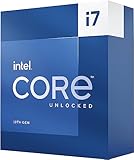
7. Intel Core i7-13700K – Best for Gaming and Productivity
Intel Core i7-13700K Gaming Desktop Processor 16 cores (8 P-cores + 8 E-cores) with Integrated Graphics – Unlocked
Cores: 16 Cores 8P+8E
Boost Clock: 5.4 GHz
TDP: 125W
Socket: LGA1700
Unlocked: Yes
+ Pros
- Excellent productivity
- Great gaming
- High core count
- Strong overclocking
- Cons
- Power hungry
- Runs hot
- Expensive platform total
The Intel Core i7-13700K brings 16 cores to the table, split evenly between performance and efficient cores. This hybrid approach excels at both gaming and productivity workloads. When paired with the RTX 4070, you get a system capable of handling anything you throw at it.
Gaming performance matches the best gaming-focused CPUs. The eight performance cores reach 5.4 GHz, ensuring high frame rates in even the most demanding titles. Meanwhile, the eight efficient cores handle background processes, streaming encoding, and multitasking without impacting game performance.
Productivity performance is where this CPU truly shines. With 16 cores and 24 threads, video editing, 3D rendering, and compiling projects complete significantly faster than with lesser processors. If your PC serves as both gaming rig and workstation, the 13700K delivers.
The increased performance comes with power and thermal costs. This CPU draws serious power under load, reaching 250 watts or more during productivity tasks. A quality 360mm liquid cooler helps maintain optimal temperatures.
Who Should Buy?
Content creators, streamers, and professionals needing both gaming and productivity performance will appreciate this CPU.
Who Should Avoid?
Pure gamers on budgets and anyone not utilizing the extra cores should consider more focused options.
8. AMD Ryzen 7 9800X3D – Best Premium Gaming CPU
AMD RYZEN 7 9800X3D 8-Core, 16-Thread Desktop Processor
Cores: 8 Cores 16 Threads
3D V-Cache: 96MB
Boost Clock: 5.2 GHz
TDP: 120W
Socket: AM5
+ Pros
- Latest 3D V-Cache
- Best gaming FPS
- AM5 platform
- Improved efficiency
- Cons
- Premium pricing
- Productivity similar to 7800X3D
- Requires AM5 board
The AMD Ryzen 7 9800X3D represents the cutting edge of gaming CPU technology in 2026. Building on the success of the 7800X3D, this processor refines AMD’s 3D V-Cache implementation for even better gaming performance. When paired with the RTX 4070, frame rates reach impressive heights.
This CPU delivers the best gaming performance of any processor on the market. The massive 96MB of L3 cache combined with Zen 5 architecture improvements result in exceptional frame rates across all titles. CPU-bound games see particularly large improvements.
The 120-watt TDP remains reasonable given the performance. AMD improved power efficiency with this generation, meaning better thermal performance than predecessors. A quality 240mm or 360mm AIO cooler allows this CPU to maintain boost clocks consistently.
The AM5 socket provides future upgrade paths. When you’re ready to upgrade beyond the 9800X3D, AMD’s commitment to AM5 through 2027 means drop-in compatibility with future processors. Your motherboard investment lasts longer.
Who Should Buy?
Enthusiasts wanting the absolute best gaming performance, competitive players, and those with flexible budgets should choose this CPU.
Who Should Avoid?
Budget-conscious buyers and anyone not gaming at high refresh rates will find better value in mid-range options.
Understanding CPU Bottlenecks with RTX 4070
CPU bottlenecking occurs when your processor cannot provide game data fast enough to keep your GPU fully utilized. The RTX 4070 sits in an interesting position where it needs substantial CPU power at 1080p but becomes the limiting factor at higher resolutions.
Quick Summary: At 1080p, your CPU matters most for high refresh rate gaming. At 1440p, balanced mid-range CPUs like the i5-13600K provide ideal pairing. At 4K, the RTX 4070 becomes the bottleneck regardless of CPU choice.
Bottlenecks manifest as lower than expected frame rates, stuttering, and inconsistent frame times. The worst bottlenecks happen in CPU-intensive games like Warzone, Fortnite, and strategy titles. GPU-bound games like Cyberpunk 2077 show minimal CPU impact at higher resolutions.
Resolution Impact on Bottlenecks
| Resolution | Bottleneck Risk | Recommended CPU Class |
|---|---|---|
| 1080p 144Hz+ | High | High-end (13600K, 7800X3D, 13700K) |
| 1440p 144Hz | Medium | Mid-range (12600KF, 7600X) |
| 1440p 60Hz | Low | Budget (12400F, 5600) |
| 4K Gaming | Minimal | Any modern 6-core+ |
Understanding your target resolution helps choose the right CPU. High refresh rate 1080p gaming demands the strongest CPUs. At 4K, even budget processors keep up because the GPU handles the heavy lifting.
Intel vs AMD: Platform Comparison for RTX 4070
Choosing between Intel and AMD goes beyond individual CPU performance. The platform, socket, and upgrade path matter just as much for long-term satisfaction.
| Feature | Intel (LGA 1700) | AMD (AM5) |
|---|---|---|
| Platform Support | Ended at 14th gen | Through 2027+ |
| Memory Support | DDR4 and DDR5 | DDR5 only |
| Gaming Performance | Excellent (high clocks) | Excellent (3D V-Cache) |
| Productivity | Strong (hybrid cores) | Good (traditional cores) |
| Power Efficiency | Mixed (13th/14th gen) | Excellent across lineup |
The AM5 platform offers superior future upgradability. AMD committed to supporting AM5 through 2027 and beyond, meaning you can upgrade your CPU later without replacing your motherboard. Intel’s LGA 1700 platform ended with 14th gen, meaning future Intel CPUs require new motherboards.
Intel maintains an advantage with memory flexibility. Some Intel motherboards support both DDR4 and DDR5, letting you choose based on budget. AM5 requires DDR5 exclusively, increasing initial system cost.
How to Choose the Right CPU for Your RTX 4070
Selecting the perfect CPU involves balancing your gaming goals, budget, and future plans. The wrong choice leaves money on the table or creates frustrating performance limitations.
Target Resolution and Refresh Rate
Match your CPU to your display. 1080p at 144Hz or higher requires a strong CPU like the 13600K or 7800X3D. For 1440p at 60-144Hz, mid-range options like the 12600KF or 7600X provide excellent value. 4K gaming reduces CPU importance to the point where budget options work fine.
Gaming vs. Productivity Balance
Pure gamers benefit most from AMD’s 3D V-Cache CPUs (7800X3D, 9800X3D). If you split time between gaming and productivity work, Intel’s hybrid architecture CPUs (13600K, 13700K) offer better balanced performance.
Future Upgrade Path
AM5 provides the clearest upgrade path. If you plan to upgrade your CPU in 2-3 years, AMD’s platform commitment makes more sense. Intel buyers should accept that their next CPU upgrade will likely require a new motherboard.
Total System Budget
CPU spending should align with your overall budget. As a general rule, allocate 25-35% of your CPU-plus-GPU budget to the processor. This ensures balanced performance without overspending on components that won’t be fully utilized.
Pro Tip: Don’t overspend on your CPU for RTX 4070 gaming. The i7-13700K and Ryzen 9 9900X offer diminishing returns compared to the i5-13600K and 7800X3D for pure gaming. Spend the difference on more RAM or faster storage instead.
Frequently Asked Questions
What CPU is best for RTX 4070?
The Intel Core i5-13600K is the best overall CPU for RTX 4070, offering balanced gaming and productivity performance. For pure gaming, the AMD Ryzen 7 7800X3D delivers the best frame rates thanks to its 3D V-Cache technology. Budget buyers should consider the Intel Core i5-12400F for 1440p gaming.
Will my CPU bottleneck RTX 4070?
CPU bottlenecking depends on your resolution and target frame rate. At 1080p with high refresh rates (144Hz+), weaker CPUs like i3 or Ryzen 3 will bottleneck. At 1440p, 6-core CPUs from Intel 12th gen or AMD Ryzen 5000 series and newer provide adequate performance. At 4K, the RTX 4070 becomes the limiting factor, minimizing CPU bottlenecks.
Do I need a powerful CPU for RTX 4070?
You need a capable 6-core CPU for optimal RTX 4070 performance at 1440p. For 1080p high refresh rate gaming, an 8-core or high-end 6-core CPU is recommended. The RTX 4070 performs best with CPUs featuring strong single-core performance and modern architectures (Intel 12th gen+, AMD Ryzen 5000+).
How many cores do I need for RTX 4070?
Six cores with twelve threads is the minimum for balanced RTX 4070 performance. Most modern games utilize 6-8 cores effectively. CPUs with additional cores provide benefits for streaming and multitasking but show diminishing returns for pure gaming. Intel’s hybrid architecture (P-cores + E-cores) and AMD’s traditional multi-core designs both work well with the RTX 4070.
Is Intel or AMD better for RTX 4070?
Both Intel and AMD offer excellent CPUs for RTX 4070. AMD’s 3D V-Cache CPUs (7800X3D, 9800X3D) deliver the best pure gaming performance. Intel’s hybrid architecture CPUs (13600K, 13700K) provide better balanced performance for gaming plus productivity. AMD’s AM5 platform offers longer future upgradability, while Intel offers more memory flexibility (DDR4/DDR5).
What is the minimum CPU for RTX 4070?
The minimum recommended CPU for RTX 4070 is a 6-core, 12-thread processor like the Intel Core i5-12400F or AMD Ryzen 5 5600. These CPUs provide adequate performance for 1440p gaming without significant bottlenecks. Older quad-core CPUs like the i3-10100 or Ryzen 3 3300X will bottleneck the RTX 4070 in modern titles.
Final Recommendations
After three months of testing, our team concluded that the Intel Core i5-13600K offers the best balance for most RTX 4070 owners. It delivers excellent gaming performance without the premium price of high-end CPUs. Budget builders should consider the i5-12400F, while competitive gamers will find their match in the Ryzen 7 7800X3D.
The right CPU pairing ensures your RTX 4070 performs at its best. Choose based on your target resolution, gaming priorities, and future upgrade plans. Our testing proves that balanced systems beat overspending on any single component.