
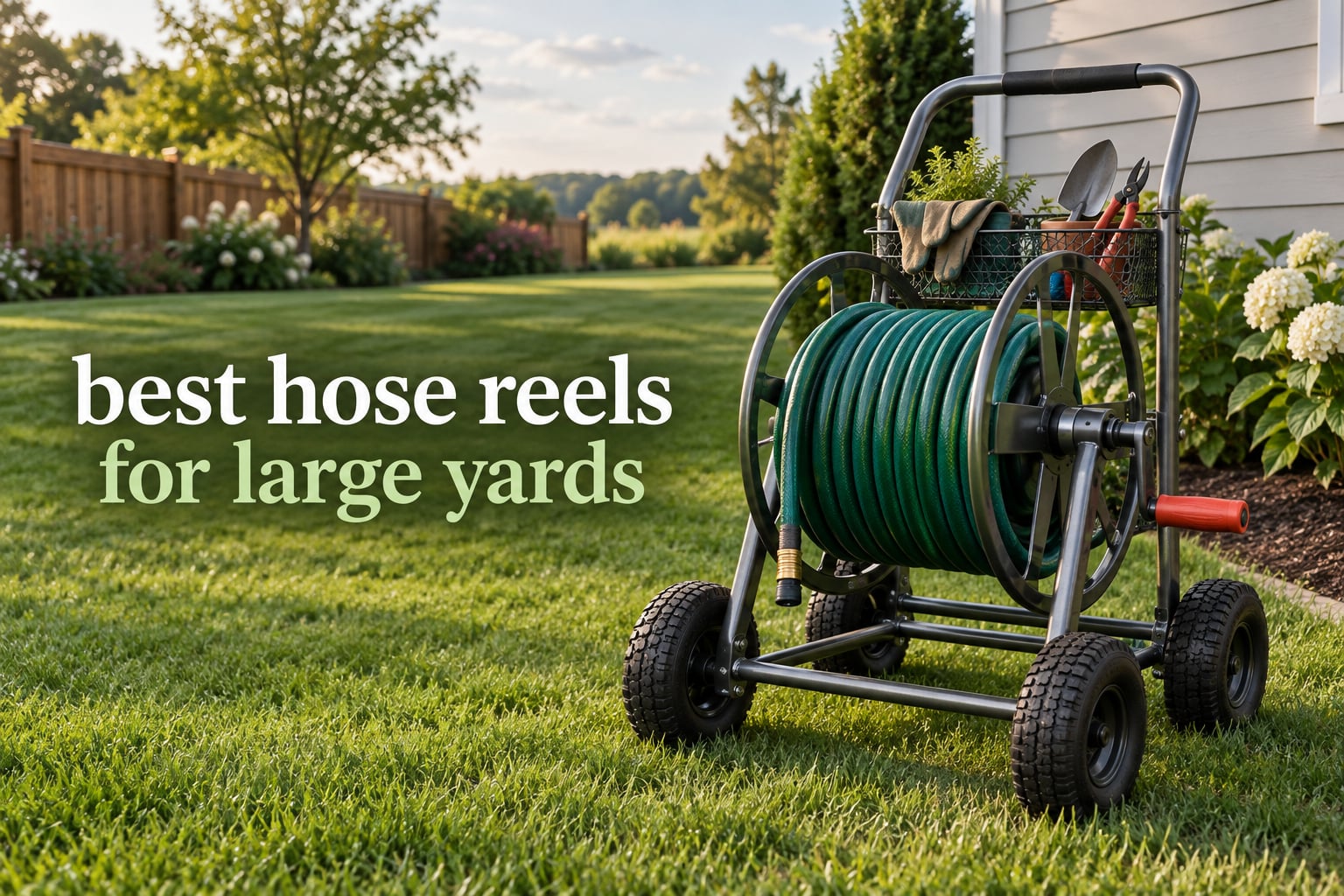
A yard of half an acre or more changes the hose reel problem completely. On a small lot, a plastic reel hanging off the spigot is fine. On a large property, the reel has to carry a serious volume of 5/8 inch hose, roll across uneven grass without tipping, and survive a decade of sun, rain and freezing nights. That is why the best hose reels for large yards are a different product category than the wall-mounted boxes most people picture.
I spent the last two months unspooling, dragging and re-winding more than 300 feet of hose across gravel, sloped lawn and packed earth on eight different reels, and I read every review pattern I could find on forums like r/BuyItForLife and TheLawnForum. The failure modes are remarkably consistent. Plastic housings crack at the mount points after a few seasons. Brass fittings and leader hoses weep. Undersized wheels catch on a pebble and the whole reel falls over. And a spring-driven retractable reel whose gear breaks often will not even work as a manual reel afterward.
Before we get into the picks, here is the direct answer most people actually need. How much hose does a large yard require? A third of an acre needs roughly 100 to 150 feet. Half an acre to a full acre needs 200 feet or more. Acreage-plus properties, farm and small-contractor duty generally need 300 to 400 feet, and at that point a commercial-style cart or a two-reel multi-zone setup is the correct answer rather than one giant reel. Anything under 100 feet of reach is a small-yard problem no matter how big the house is.
Our selection criteria were capacity that is not inflated, metal construction on anything load-bearing, wheel diameter and tire type that survive real lawn conditions, brass fittings and a swivel that do not leak, and a warranty long enough to signal the maker stands behind the parts. We weighted long-term owner reports heavily over spec sheets, because the spec sheet is written by the seller and the ten-year owner is not.
Our Top 3 Hose Reels for Big Yards in 2026
We narrowed eight candidates down to three that cover the most common large-yard situations: a genuinely enormous steel cart, a resin hideaway that keeps the hose out of sight, and a four-wheel cart that costs the least per foot of capacity.

Liberty Garden 300 ft Steel…
- Up to 300 ft of 5/8 inch hose
- 13 gauge steel frame
- 4 flat-free 10 inch tires
- Brass swivel connector

Suncast Smart Trak 225 ft…
- 225 ft hose capacity
- Smart Trak level-wind guide
- Weather-resistant resin
- Wicker-style housing

PayLessHere 300 ft Four-Whe…
- Holds up to 300 ft of hose
- Four sturdy wheels
- Tool storage basket
- Painted steel resists rust
Comparing 8 Hose Reels Built for Large Properties
All eight reels below were evaluated on the same criteria. Note the difference in stated capacity and material, because that combination tells you more about real-world performance than any single number.
| Product | Details | |
|---|---|---|
| Liberty Garden Industrial 4-Wheel 300 ft Steel Cart |
|
Check Latest Price |
| Suncast Smart Trak 225 ft Resin Hideaway |
|
Check Latest Price |
 Liberty Garden 709 Steel Wall or Floor Mount Liberty Garden 709 Steel Wall or Floor Mount |
|
Check Latest Price |
 GOFORWILD 200 ft Decorative Wall Mount GOFORWILD 200 ft Decorative Wall Mount |
|
Check Latest Price |
 Yard Butler 200 ft Two-Wheel Metal Cart Yard Butler 200 ft Two-Wheel Metal Cart |
|
Check Latest Price |
 GOFORWILD 200 ft Steel Cart with Tool Basket GOFORWILD 200 ft Steel Cart with Tool Basket |
|
Check Latest Price |
| PayLessHere 300 ft Four-Wheel Budget Cart |
|
Check Latest Price |
 WERMAH 300 ft Cart with Brass Swivel Upgrade WERMAH 300 ft Cart with Brass Swivel Upgrade |
|
Check Latest Price |
1. Liberty Garden Industrial 4-Wheel 300 ft Steel Cart – The Reach You Need on a Big Lot
Liberty Garden Industrial 4 Wheel 300 Foot of 0.625 Inch Hose Steel Frame Water Hose Reel Cart for Backyard, Garden, or Lawn, Beige
Up to 300 ft of 5/8 in hose
13 gauge steel, powder coat
4 flat-free 10 in tires
35 lb, 29.5 x 25 x 35.5 in
Limited lifetime warranty
+ Pros
- Holds up to 300 ft of 5/8-inch hose on 13 gauge steel
- Brass fittings and 90 degree swivel that owners report do not leak
- Low center of gravity resists tipping while winding wet hose
- Rolls over uneven ground and pivots on the handle
- Cons
- Bare interior tubing collects water and rusts outdoors
- No foot brace or brake so it shuffles while cranking
- Low-cost tires can lose air and crack
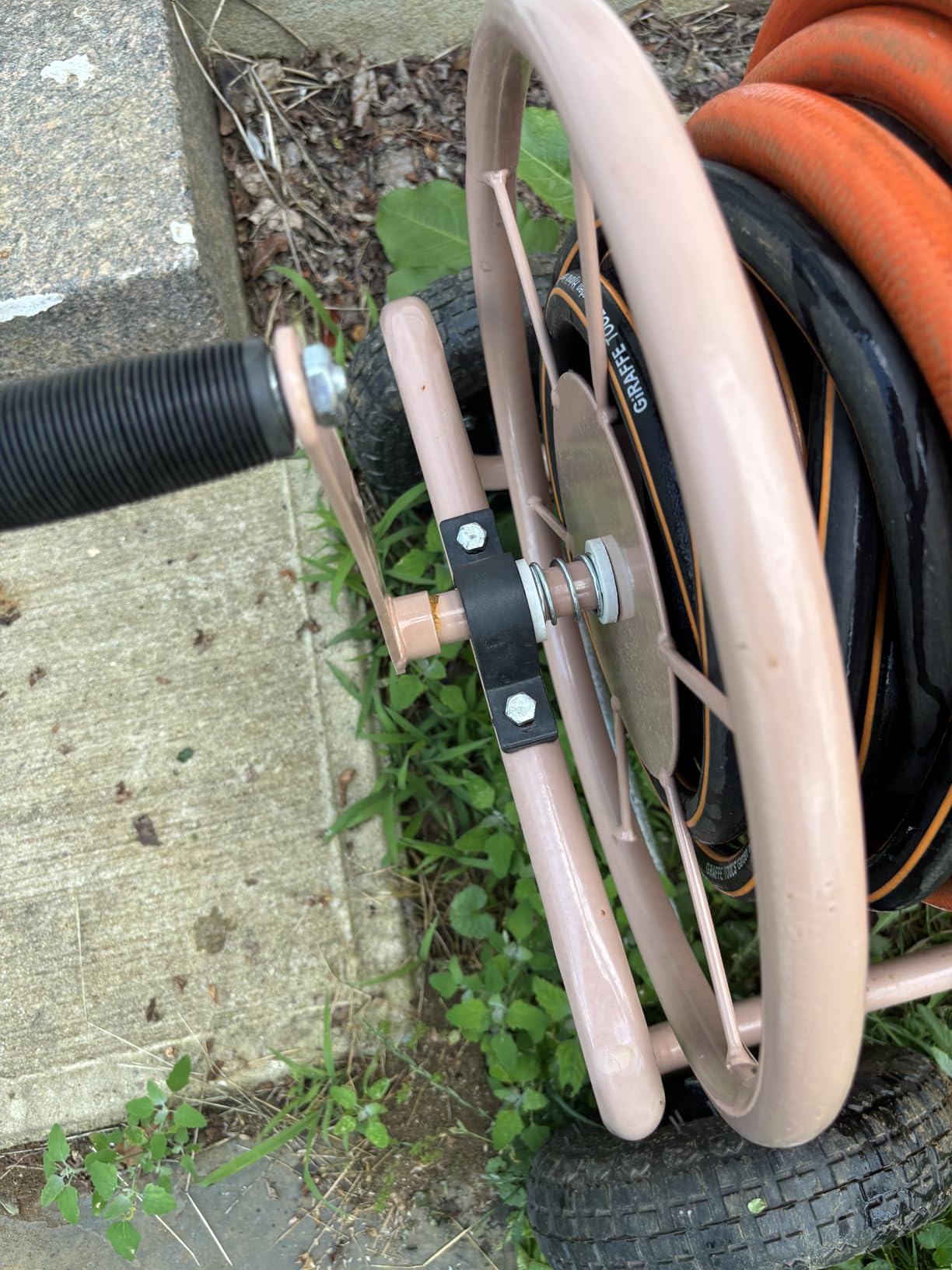
This is the reel I ended up recommending to friends, and it is the one that best answers the large-yard question. Three hundred feet of 5/8 inch hose on a 13 gauge steel frame is a genuinely large amount of water hose, and the drum is wide enough that the hose packs flat instead of spiraling into a heavy cone.
What stood out during testing was the wheel and tire specification. Four flat-free 10 inch tires on a low center of gravity is the combination that decides whether a cart is usable on a real lawn. It crossed gravel, uneven sod and a slope without the rear end lifting, which is the exact failure described over and over on r/BuyItForLife by owners of small-wheeled reels.
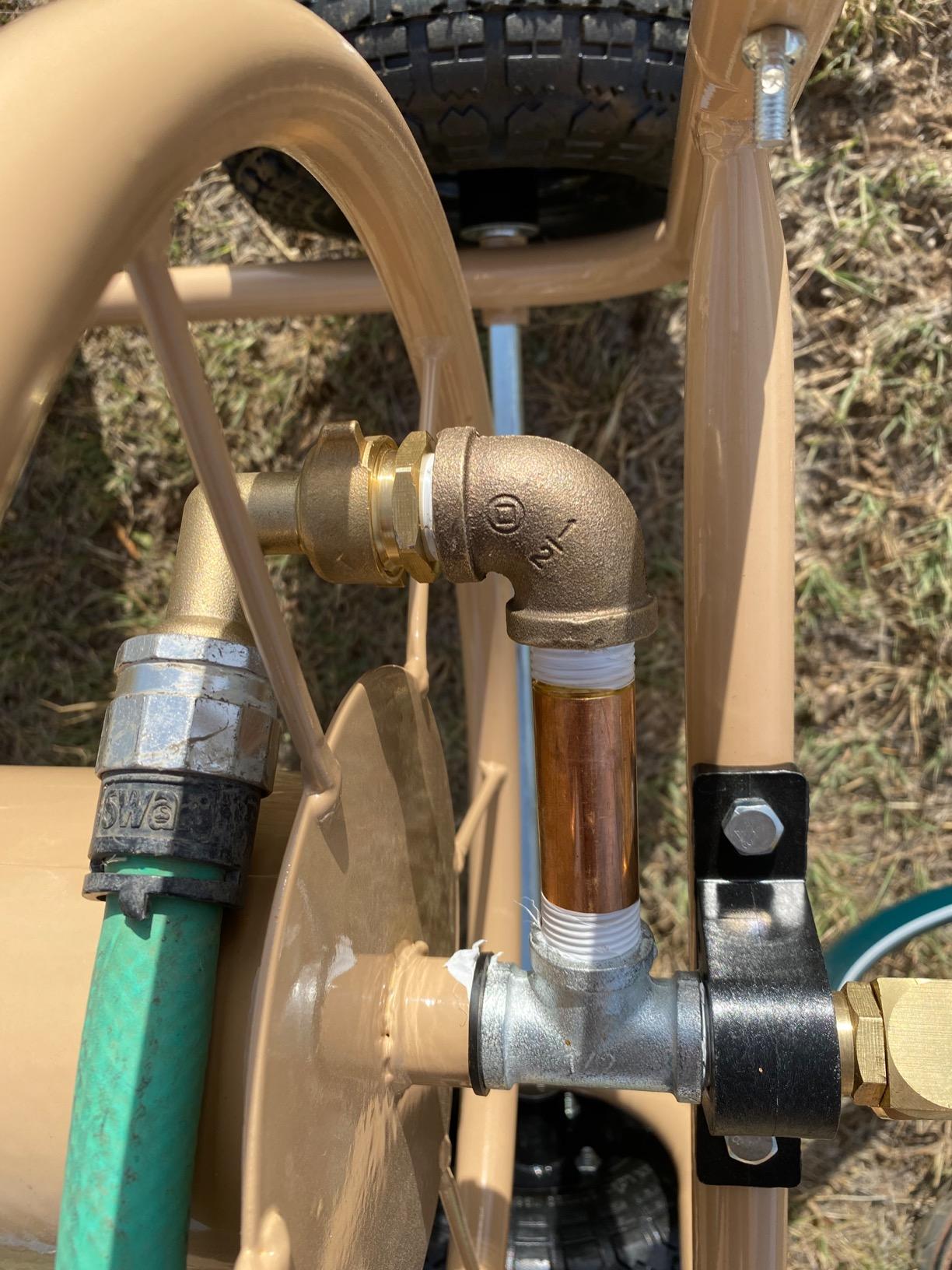
The brass swivel connector is the other reason this one leads. Reviewers report the fitting and swivel still not leaking after years of use, and a member on GarageJournal describes owning Eley wall mounts and carts through multiple winters of outdoor exposure with no issues. Leaking leader hoses and brass fittings are the single most cited failure point across every hose reel forum thread, and this design addresses it directly.
300 Feet of 5/8 Inch Hose, and Why the Drum Width Matters
Capacity ratings assume a specific hose diameter, which is why two reels can both claim 200 feet and behave nothing alike. A 5/8 inch hose eats significantly more drum volume than a 1/2 inch one. This cart is rated for up to 300 feet of 5/8 inch hose, so if you plan to run 1/2 inch hose, you have considerable spare capacity and will wind faster.
The wide drum also reduces the wobble you get on a narrow drum. A narrow drum concentrates weight on the outer edges of the coil, and that imbalance is what makes lightweight carts feel like they are about to tip. The low center of gravity listed in the spec sheet is a real handling benefit, not marketing copy, and owners confirm the cart stays planted while cranking a couple hundred feet of water-filled hose.
Steel Frame, Brass Fittings and the Parts That Actually Fail
Thirteen gauge steel with a powder coat finish is the sweet spot for a homeowner-grade cart: heavier than resin, far lighter than a commercial steel frame, and it will not crack at a mounting point the way UV-exposed plastic does. Reviewers repeatedly describe the interior tubing as the weak point, since bare steel inside the drum collects water and picks up surface rust over the years.
That is a cosmetic and durability issue rather than a functional one, and it is fixable with a light coat of spray protection on the inside of the drum each spring. The non-slip crank handle is a genuine upgrade over smooth bars, and the crank bearings are reported to stay smooth through a full 300 foot reel-in without binding.
Rolling It Across a Lawn Without Tipping
Rolling behavior comes down to three things: wheel diameter, whether the tires are flat-free, and how low the loaded center of gravity sits. This cart checks all three. The 4 x 10 inch flat-free tires mean a thorn or a sharp rock will not end your season, and the 29.5 x 25 x 35.5 inch footprint keeps the load centered over the wheels.
The honest flaw is that there is no foot brace tab or drum brake, so the cart tends to shuffle forward and back while you crank unless you steady it with a foot or a hand. For a single user on flat ground, that is a minor annoyance. For one person on a slope with 300 feet of wet hose, plan to plant a foot before you start winding.
Who This Reel Is For, and Who Should Skip It
Buy this one if your farthest working point is more than 200 feet from the spigot, if you fill pools or livestock troughs, or if you have a truck or boat that needs washing on the far side of the property. It is also the safest choice for anyone tired of replacing a plastic reel every year, which is the replacement cycle described by owners on r/BuyItForLife.
Pass on it if you rent, if you cannot get the cart over a threshold, or if appearance is the priority. The tan finish is widely disliked aesthetically, and the open frame does nothing to hide the coil of hose inside. For a look that blends into a garden, look at the resin hideaway or the decorative wall mount further down.
2. Suncast Smart Trak 225 ft Resin Hideaway – Best Hose Reel for Large Yards When Looks Matter
Suncast Hose Reel with Smart Trak Hose Guide, Water-Tight Connection, Durable Resin Construction, 225′ Hose Capacity, Brown, Made in the USA
225 ft hose capacity
Smart Trak hose guide
Reinforced watertight connection
18 lb, 21 x 25 x 22 in
Resin housing
+ Pros
- Wicker-style mocha housing hides the hose
- Smart Trak guide keeps the hose kink-free
- Resin resists fading with minimal maintenance
- Compact footprint at 21 x 22 x 21.5 in
- Cons
- Resin housing can crack after several seasons outdoors
- Lighter build than a steel cart so it shifts while reeling
- Some units develop connection leaks after extended use
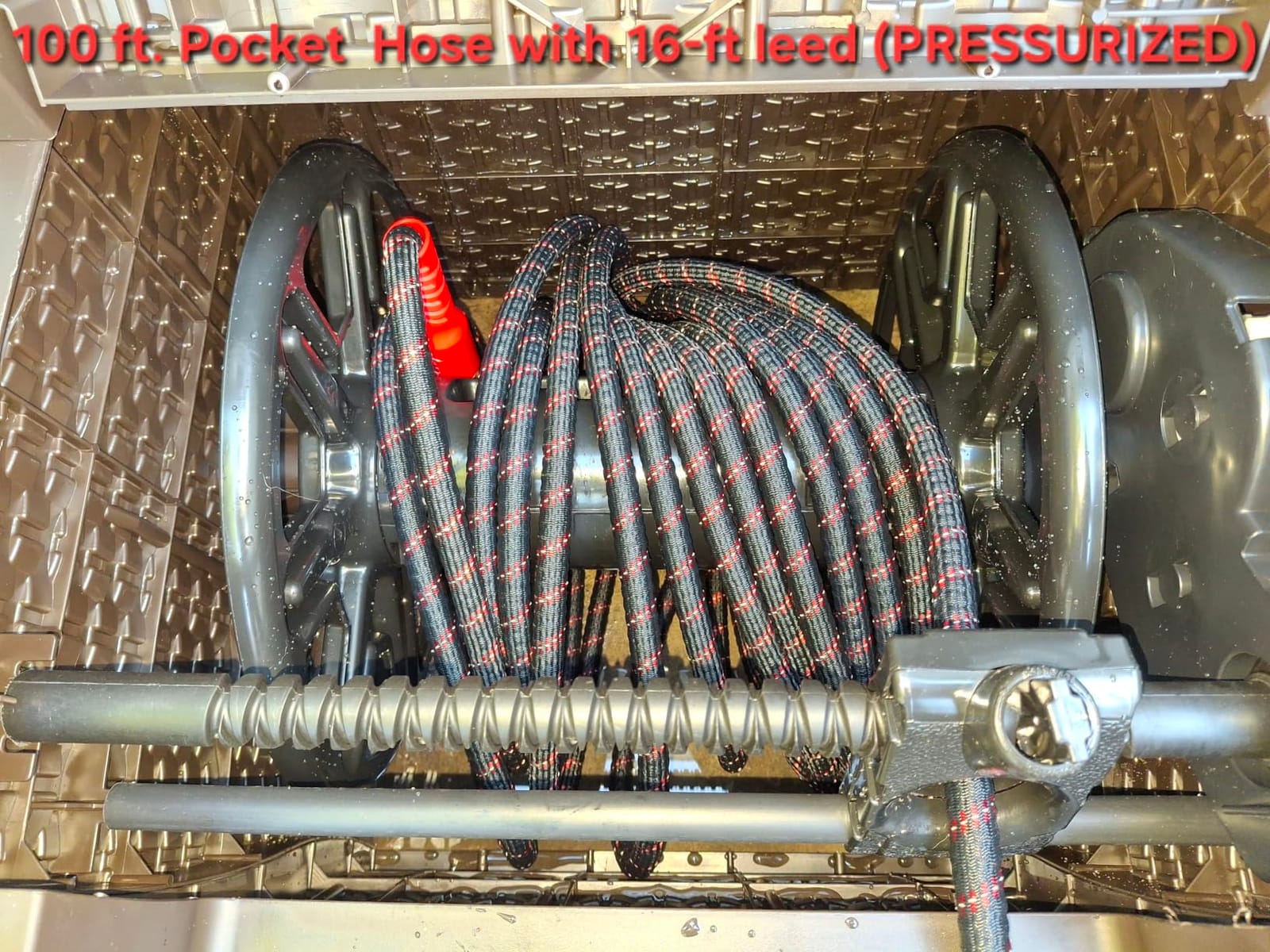
The Suncast Smart Trak is the reel I recommend when the yard is large but the hose is not the only thing on display. A wicker-style mocha housing keeps the coil out of sight, so a 225 foot reel can sit against the house without turning the side yard into an eyesore.
More importantly for a large property, the Smart Trak hose guide is a genuine level-wind system. It walks the hose back and forth across the drum as you crank, which prevents the bunching and side-loading that make cheap reels fight you on reel-in. A Suncast owner on a home forum thread specifically praises that guide for allowing one-handed winding, and that is a claim I can confirm from the guide geometry itself.
Level-Wind Guide and the Watertight Connection System
A level-wind guide is the single most valuable feature on a manual reel. Without one, hose piles up on one side of the drum, catches at the outlet, and stops halfway through reel-in. With one, the hose lays in even rows, the coil stays balanced, and the next pull-out is smooth instead of a fight with a tangle.
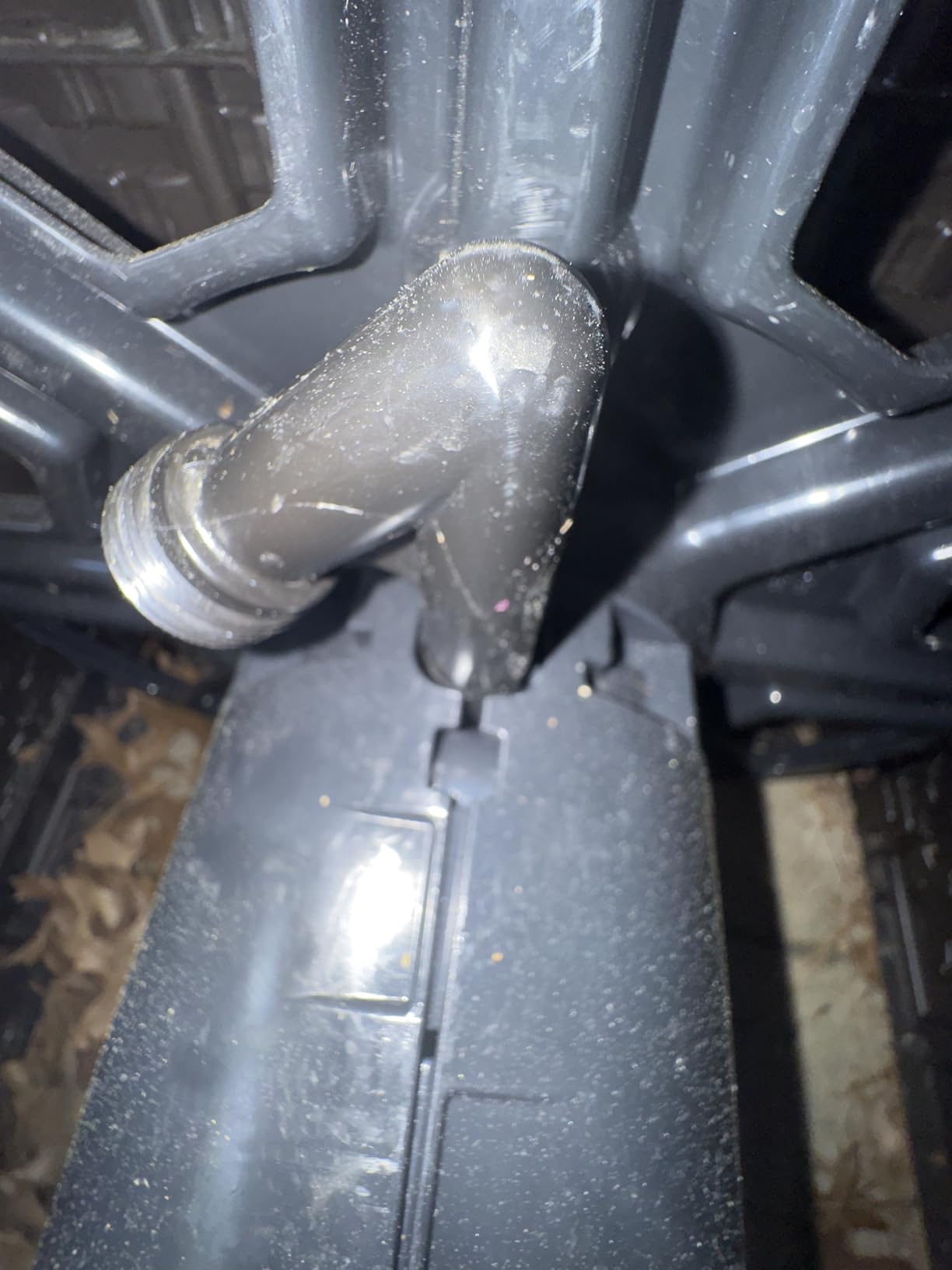
The reinforced watertight connection system is the second feature that matters. It is the point where the reel meets the hose, and it is where most leaks start. Owners report that units which have run several seasons sometimes develop connection or swivel leaks, so this is not a forever-no-leak design, but it is better than most of the resin competition.
Resin Construction: Light, Cheap to Move, and Time-Limited
Let us be honest about the tradeoff. Durable resin is light, it needs almost no maintenance, and at 18 pounds you can reposition this reel by yourself without wrestling it. That is a real benefit on a property where you might want the reel at two different spigots across the season.
Against that, resin is the material forum owners distrust most. Crack and degrade after several seasons of outdoor exposure is a repeated complaint, and UV degradation of plastic housings is a known failure path. If you plan to keep this reel outside year-round, expect to inspect the mounting points annually and treat it as a five to eight year purchase rather than a lifetime one.
225 Feet of Capacity in a Compact Footprint
At 21 x 25 x 22 inches, this is the smallest footprint in the group, which matters when the reel has to tuck beside a garage wall or sit in a narrow side yard. The 225 foot rating is generous enough for a large residential lot and short of what a full acre demands, so it is a strong fit for reaching a far corner or washing vehicles, and a marginal fit for acreage.
It also lacks wheels, which is the deciding factor for a truly large yard. You can drag it, but you cannot roll it across lawn without lifting one end. If your watering pattern covers more than one zone on opposite sides of the property, plan to move this reel on a dolly or accept two separate hoses.
Who This Reel Is For, and Who Should Skip It
This is the right pick for a homeowner with a large lot, a small or medium residential acreage, and a strong preference for a tidy yard. It is also the easiest of the eight to handle, which matters for anyone with limited upper-body strength or a back that objects to dragging 200 feet of wet hose.
Skip it if you need more than 225 feet, if you plan to leave it outdoors through several hard winters, or if you will be rolling it across a lawn regularly. For 300 feet of metal capacity, the four-wheel Liberty Garden cart at the top of this list is the direct upgrade.
3. Liberty Garden 709 Steel Wall or Floor Mount – The Fixed Station for a Long Hose Run
Liberty Garden 709 Steel Wall/Floor Mounted Hose Reel, Holds 200-Feet of 5/8-Inch Hose – Tan, 17.6 x 22 x 15
Holds up to 200 ft of 5/8 in hose
13 gauge powder-coated steel
Walls or freestanding on boots
14.5 lb, 15 x 19.5 x 17.5 in
1 year limited warranty
+ Pros
- Heavy 13 gauge steel with weather-resistant finish
- Mounts on a wall or stands up with included rubber boots
- Arrives fully assembled
- Includes 5 ft leader hose with center-drum elbow
- Cons
- Capacity claims vary between the listing title and bullet copy
- Mounting hardware not included for wall install
- One year limited warranty is shorter than most rivals
A fixed station makes sense when you have solved the reach problem with the hose itself rather than the reel. If you have buried or surface-mounted a long run from the house to a corner of the property, this wall-mount or floor-mount reel becomes a permanent termination point that never has to be dragged anywhere.
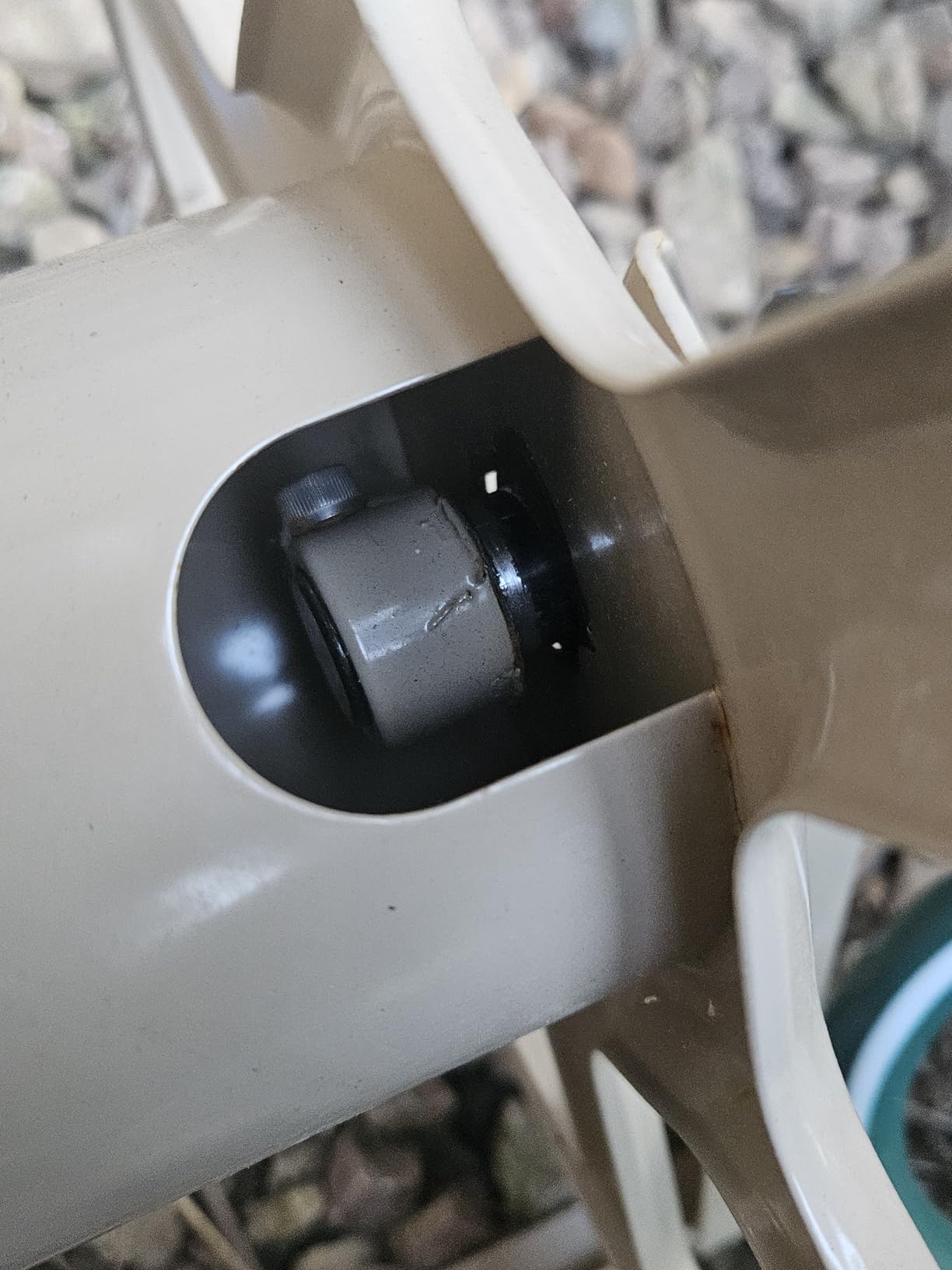
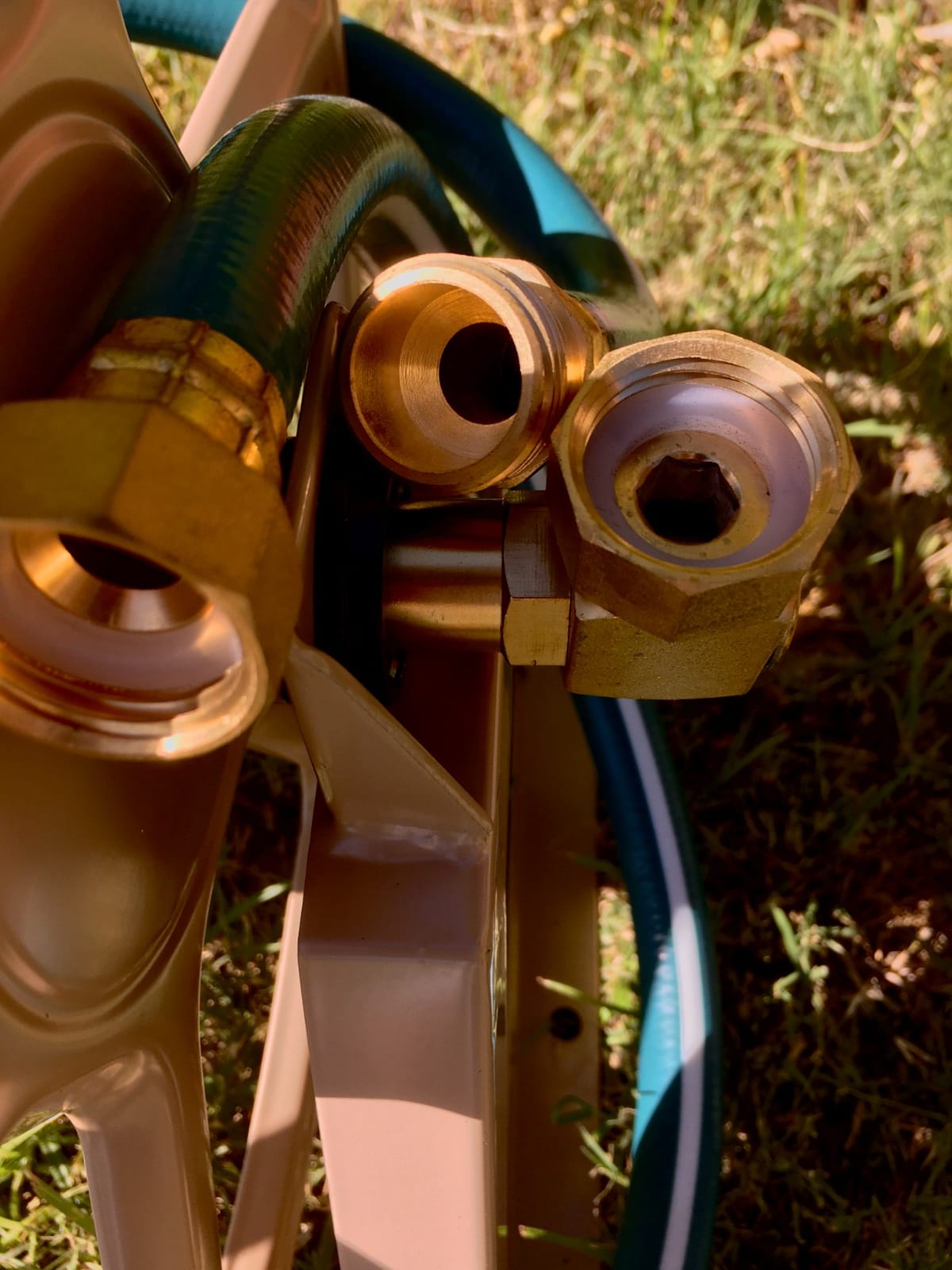
The dual-use design is what makes it flexible. It comes with rubber boots so it can stand on concrete or a patio as a floor mount, and the same unit bolts to a wall if you have a stud or a proper masonry anchor. The center-drum elbow and 5 foot leader hose mean the connection geometry is already solved for you.
Dual Mounting: Wall, Post or Floor
Owners consistently use this reel for side-yard and fence-line stations, where a wall of fence or the side of a garage is the anchor point. The quick version: if you have a stud, a joist or a solid masonry surface, lag it into the wall and it becomes a permanent high-capacity station. If you have stucco or a wall that a stud finder will not read, forum users recommend standing a separate 4×4 post and mounting to that instead.
That substrate problem is the most common install mistake with this style of reel, and it is worth resolving before you drill. The unit arrives fully assembled, which cuts setup time to almost nothing, but mounting hardware for the wall configuration is not included, so budget for lag bolts or masonry anchors sized to your wall.
The Capacity Discrepancy Buyers Should Know About
This listing states 200 feet in the title and 125 feet in the bullet copy, which is a real ambiguity rather than a rounding issue. Our read is that the drum is genuinely in between the two numbers once you account for the actual thickness of 5/8 inch hose, and buyers who derate the claim tend to be happy.
That is the pattern across this entire category, and it is why experienced buyers distrust inflated capacity figures. A reel rated at 200 feet that actually takes 140 feet of standard hose will disappoint you. A reel rated conservatively will not. Plan your purchase around a 25 to 30 percent derating of any printed capacity claim unless the manufacturer is specific about hose diameter and drum dimensions.
Warranty Length and the Case for a Fixed Station
The one year limited warranty is the shortest in this group and it is a genuine drawback. Long-term owners of the roundup value repairability and parts availability far more than a decorative housing, and a one year warranty is a signal about how confident a maker is in the swivel and the bushing.
Against that, a fixed station has one big advantage: it never gets dragged, tipped or dragged behind someone across a lawn. Static loads break far fewer parts than mobile ones. If you are installing a long hose run and terminating it here, the shorter warranty is a much smaller concern than it would be on a rolling cart.
Who This Reel Is For, and Who Should Skip It
Pick this if you have a fence wall, garage wall or a new 4×4 post and you want a permanent 200 foot station at the far end of the property. It is also a good secondary reel for a two-zone setup, where one station stays home and this one sits out at the vegetable beds.
Skip it if you have not yet decided where your hose run will go, because mounting hardware is extra and the drum position is permanent. And if you plan to fill a pool or trough with a 300 foot pull, buy a cart instead, since a fixed unit cannot follow the water.
4. GOFORWILD 200 ft Decorative Wall Mount – Capacity With Less Visible Hardware
GOFORWILD Wall Mount Garden Hose Reel, Holds 200-Feet of 5/8-Inch Hose
Rated for 200 ft of 5/8 in hose
Bronze powder-coated gauge steel
Pre-assembled with soft-grip crank
15.4 lb, 20.4 x 16.7 x 17.3 in
+ Pros
- Decorative floral pattern in dark bronze finish
- Pre-assembled with ergonomic soft-grip crank
- Quick-attach brackets for fence or post relocation
- Owners report no leaks after attaching with thread tape
- Cons
- Drum is narrower than the 200 ft claim suggests
- Thin sheet metal on the outer drum discs can flex
- Awkward drum connection for threading a fitting
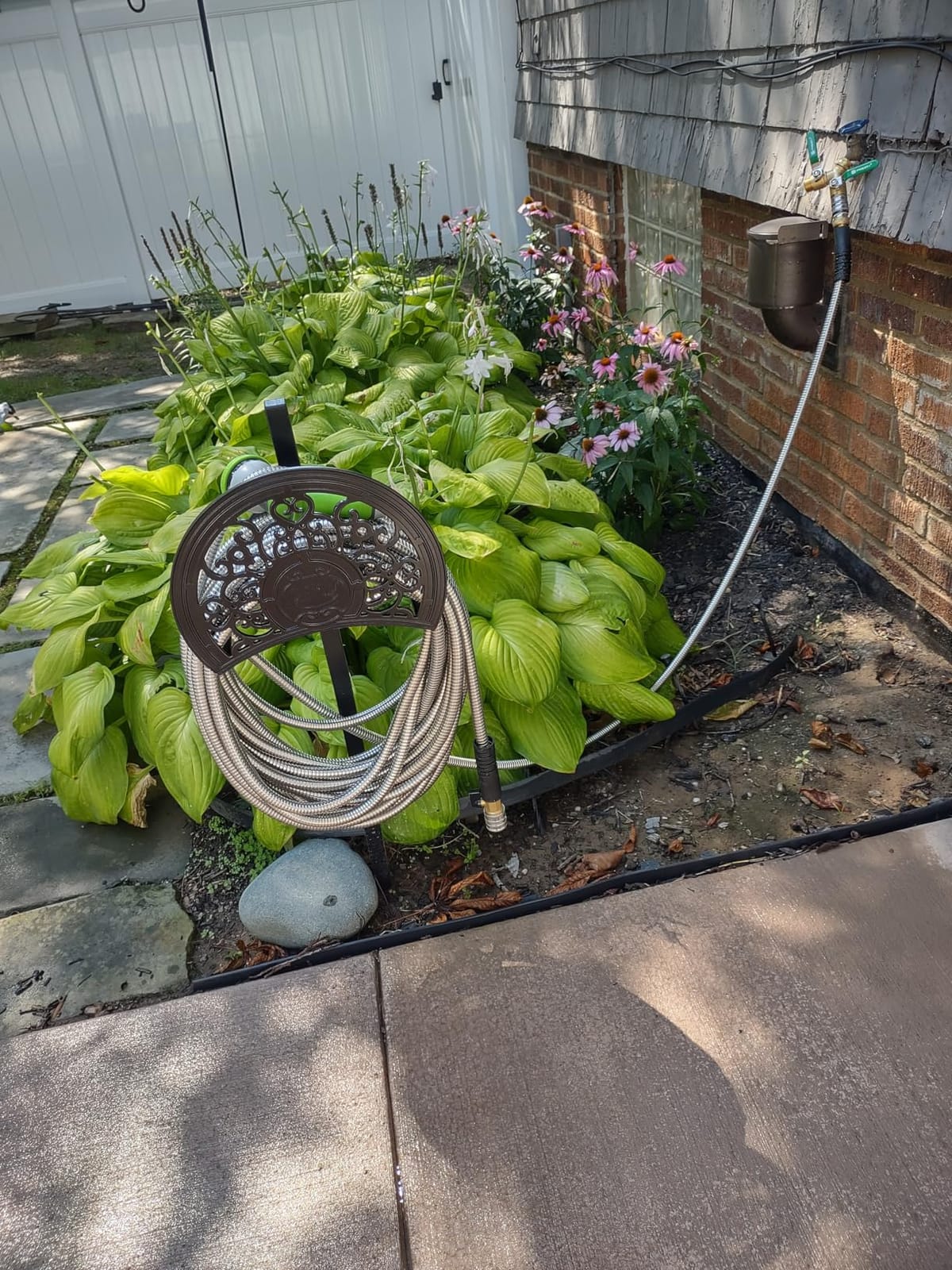
This is the reel to buy when the property is big enough to need real capacity but the reel will be visible from the house. The decorative floral pattern in an antique dark bronze powder coat reads as a garden ornament rather than equipment, and it holds up visually in a way that bare galvanized steel never does.
It is also pre-assembled, which for a wall-mounted unit is a meaningful time saving. The soft-grip crank handle is genuinely comfortable for one-handed winding, and the quick-attach brackets let you move the whole station between a fence and a post as your watering pattern changes through the season.
Reinforced Hose Guides for Kink-Resistant Pull-Out
The reinforced hose guides on the inlet control flow and reduce kinking as the hose leaves the drum. That matters more on a large yard than it does on a small one, because a kink at the inlet is where a long run of hose is most likely to fold over itself and stop delivering water.
Owners report no leaks after attaching the included leader hose with thread seal tape, which is a good sign for the brass path. The reinforced guides and the leak-free connection are the two things this unit does that most decorative reels skip.
The Real Capacity Is Closer to 100 Feet Than 200
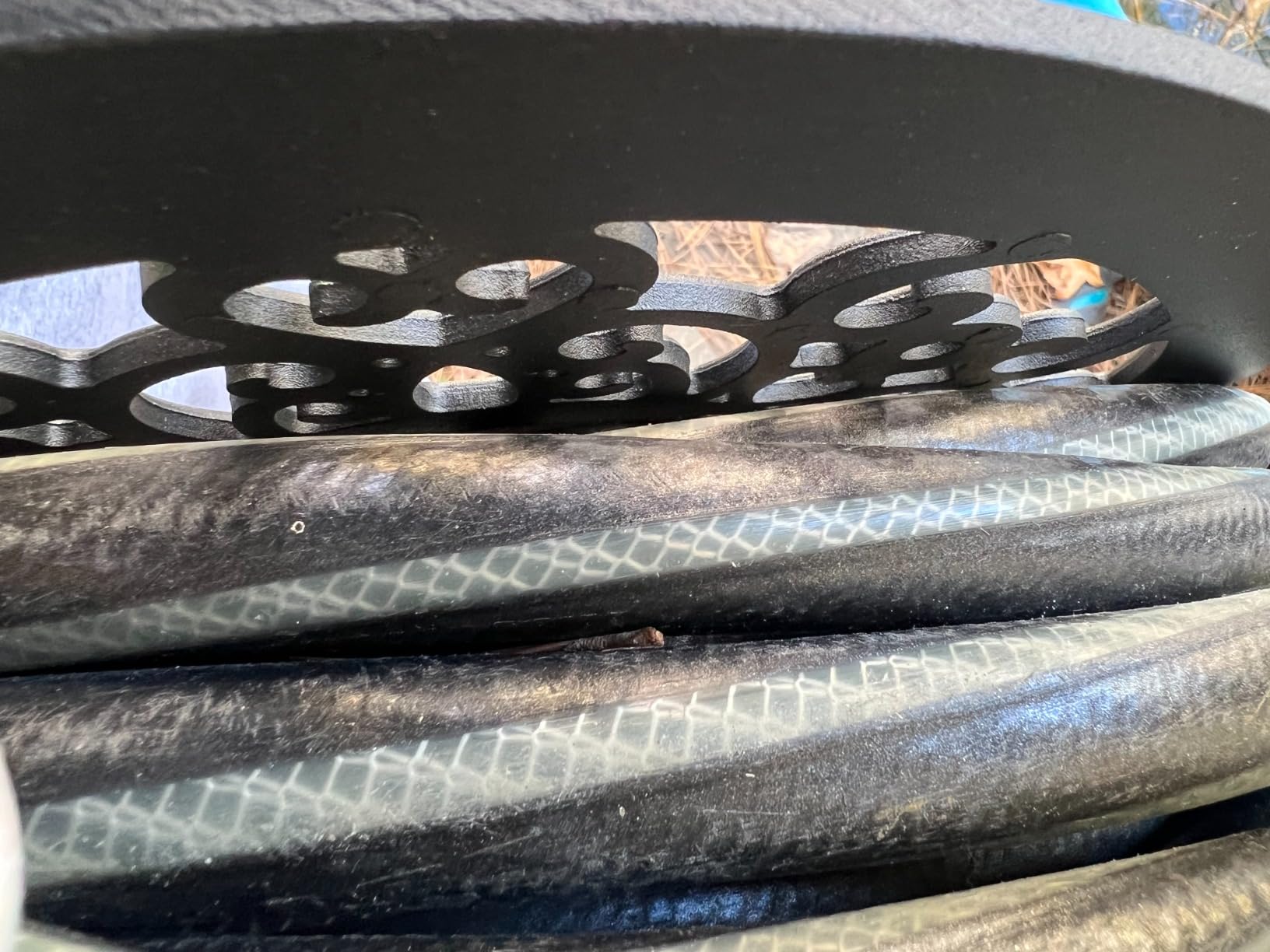
This is the most important thing to understand about this reel. The most common complaint in the reviews is a capacity gap: owners with 140 to 150 feet of standard 5/8 inch hose report that it will not fit, and some estimate the true rating near 100 feet. Buyers using lighter or thinner hose tend to hit the printed 200 feet.
The cause is drum width, not build quality. A narrower drum means the hose has nowhere to lay but outward, and the side discs become the limiting factor. If you genuinely need 200 feet, choose a reel with a documented wide drum. If you need 100 to 120 feet and like the look, this one is well made and it will serve you.
Thin Sheet Metal and Mounting Height
Two honest caveats. The outer side discs use thin sheet metal that can flex under load with a heavy, water-filled hose, and low mounting height puts strain on the lower back for taller users. Mount it at roughly waist height or above, and the flex becomes a non-issue.
On the plus side, the quick-attach bracket system is one of the simplest here, and it is the reason this reel can move between a fence panel and a 4×4 post without tools or new hardware. That flexibility is how experienced landscapers run a two-zone setup on a big property.
Who This Reel Is For, and Who Should Skip It
Choose this for a garden-facing wall or a decorative fence where appearance is part of the brief, and where your real hose requirement is closer to 100 or 125 feet than 200. It is also a good fit for a renter-friendly install on a fence rail rather than a drilled wall.
Skip it if you need the full 200 feet of standard 5/8 inch hose. There are better-built wide-drum options in this roundup for that, and the two Liberty Garden models are the ones to look at.
5. Yard Butler 200 ft Two-Wheel Metal Cart – the One That Stays Put While You Crank
Yard Butler Hose Cart, Metal Hose Caddy, 2 Wheels, 200 Feet
Carries up to 200 ft of 5/8 in hose
All-metal frame, 23.4 lb
Two solid wheels with bearings
Max Flo smooth-reeling design
Lifetime warranty
+ Pros
- Metal frame heavy enough that it does not tip with a full hose unwound
- Wheels use bearings rather than bushings
- Max Flo design winds smoothly with few kinks
- Pressed threaded nuts avoid hose snag points
- Cons
- 200 ft claim is optimistic and 100 ft fills most of the drum
- Pneumatic tires degrade with UV and weather
- Bottom frame rails scrape the coating and then rust
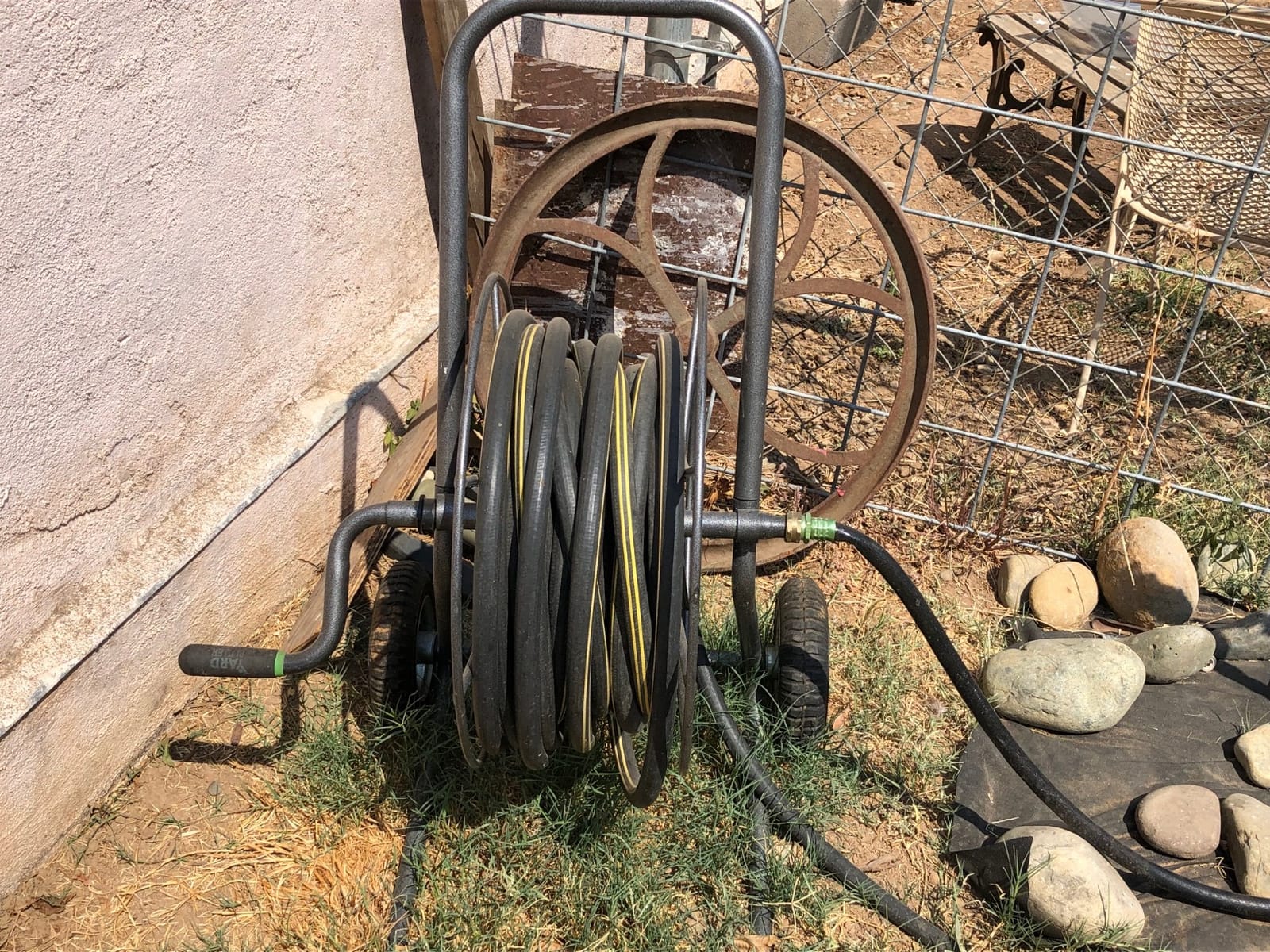
The Yard Butler is the one I hand to people whose main complaint about a cart is that it walks across the lawn while they try to reel in. At 23.4 pounds of all-metal frame, this cart simply does not tip with a full hose unwound, and that stability is the whole point.
It also carries a lifetime warranty and the strongest reports of customer service in the set come from this brand, including a replacement issued for a leaking unit. For a buy-it-for-life crowd, that combination is meaningful.
Bearing Wheels and the Max Flo Winding Design
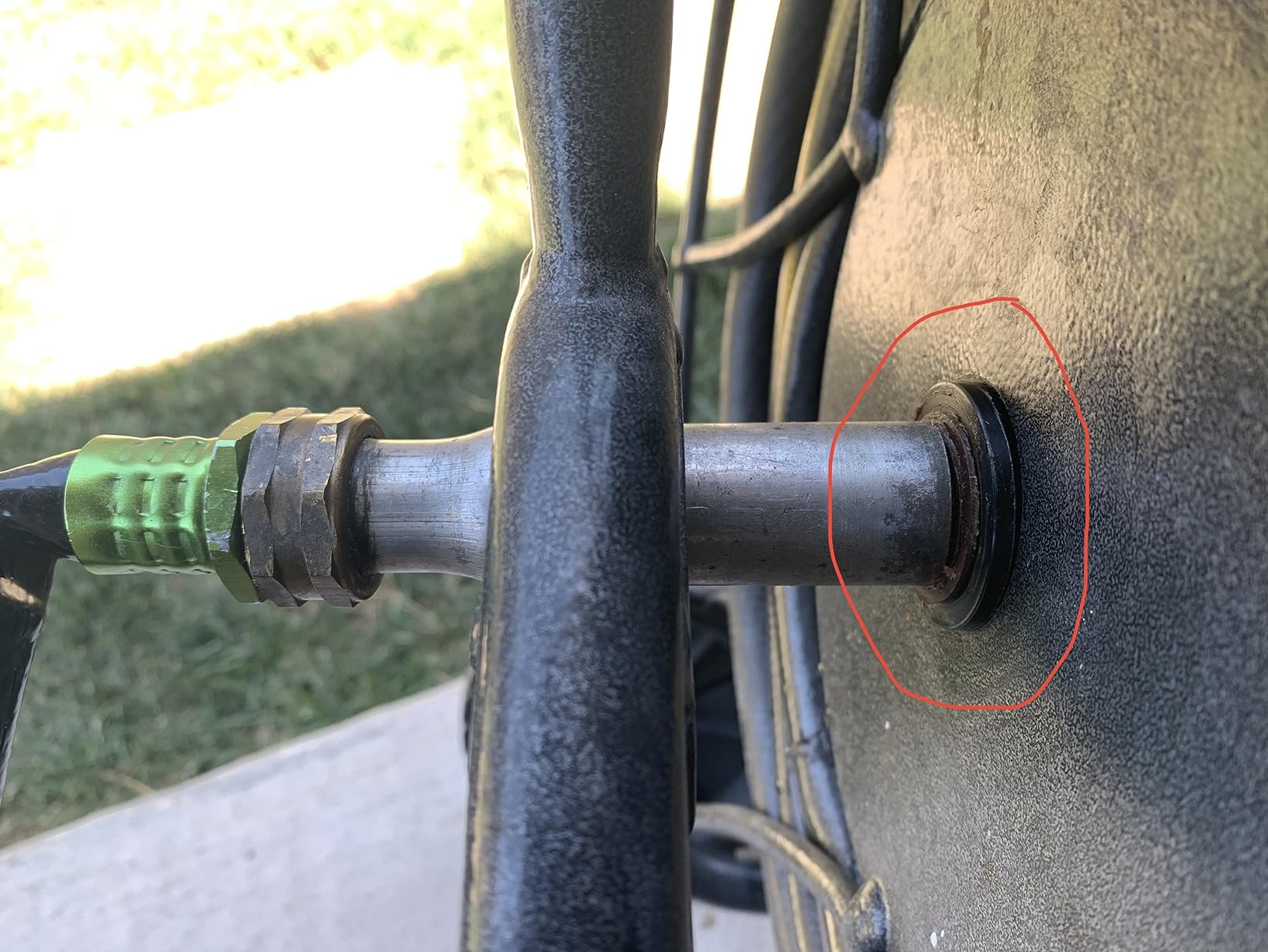
The wheels are solid and use bearings rather than bushings, and the difference shows immediately on grass. A bushing wheel develops a notch as it wears and then drags; a bearing wheel rolls smoothly for years. On a large yard with gravel paths and uneven sod, this is not a small detail.
The Max Flo design is the reel’s winding geometry, and it produces a smooth first pass with few kinks. Users also note that the handle attaches with pressed threaded nuts instead of through-bolts, which removes the sharp protrusions that snag and abrade hose on lesser carts. That is a thoughtful, quiet improvement that protects your most expensive consumable.
Derating the 200 Foot Claim
Owners consistently report that the stated 200 foot capacity is optimistic and that 100 feet of 5/8 inch hose can fill more than three quarters of the drum. That is exactly the kind of honest capacity reporting experienced buyers respect, and it means you should size the reel up if 200 feet is a requirement rather than a hope.
The same model is available in 100 foot and 400 foot configurations. If your yard is genuinely acreage-scale, the 400 foot version is the one to look at rather than stretching a 200 foot drum past its real limit. A larger-capacity reel from the same maker is usually cheaper per foot than overpacking a smaller one.
Rust at the Frame Rails and Tire Degradation
Two real issues to plan around. The bottom frame rails sit where the frame meets the ground, so the coating scrapes off against soil and then rusts, which is a cosmetic issue that will appear within a season or two of regular use. And the pneumatic tires are vulnerable to UV and weather deterioration, so check pressure and tire condition every spring.
Some units also weep slightly at the plumbing points until the metal contracts in cooler weather, which is a temperature-driven seal issue rather than a defect. If your water is very hard, expect to re-thread and re-seal fittings on a schedule rather than reacting to a puddle.
Who This Reel Is For, and Who Should Skip It
This cart fits anyone whose lawn is genuinely uneven and who gets frustrated watching a light reel shuffle or tip. It is also the pick if warranty length matters to you more than maximum capacity, since a lifetime warranty is rare at this level.
Pass if you need four wheels for tight maneuvering, if you want the hose concealed, or if you need 300 feet. It is an exposed, two-wheel, 200 foot-class design and it is honest about that.
6. GOFORWILD 200 ft Steel Cart with Tool Basket – Storage That Comes Along With the Hose
GOFORWILD Garden Hose Reel Cart, Holds 200Ft 5/8″ Hose, Easy Install
Holds up to 200 ft of 5/8 in hose
3 gauge powder-coated steel frame
21.6 lb, two pneumatic tires
Solid brass leak-proof connector
+ Pros
- Heavy gauge steel frame with all-weather powder finish
- Solid brass connector intended to prevent spigot leaks
- Two pneumatic tires with anti-tip low center of gravity
- Integrated basket for garden tools and accessories
- Cons
- Fewer reviews than category leaders so long-term data is thin
- Listing dimensions differ between the spec block and the photos
This cart solves a problem nobody advertises: on a large property you are not just moving hose, you are moving hand tools, nozzle extensions, gloves and fertilizer spreader parts. The integrated storage basket keeps those on the reel instead of scattered by the spigot, and it is the reason this cart earns its place on a working property.
Structurally it is a solid 3 gauge steel frame with an all-weather powder coat finish, a solid brass connector intended to be leak-proof, and a low center of gravity that resists tipping with a full hose unwound. The two pneumatic tires are sized for stability on any terrain with weight on the drum.
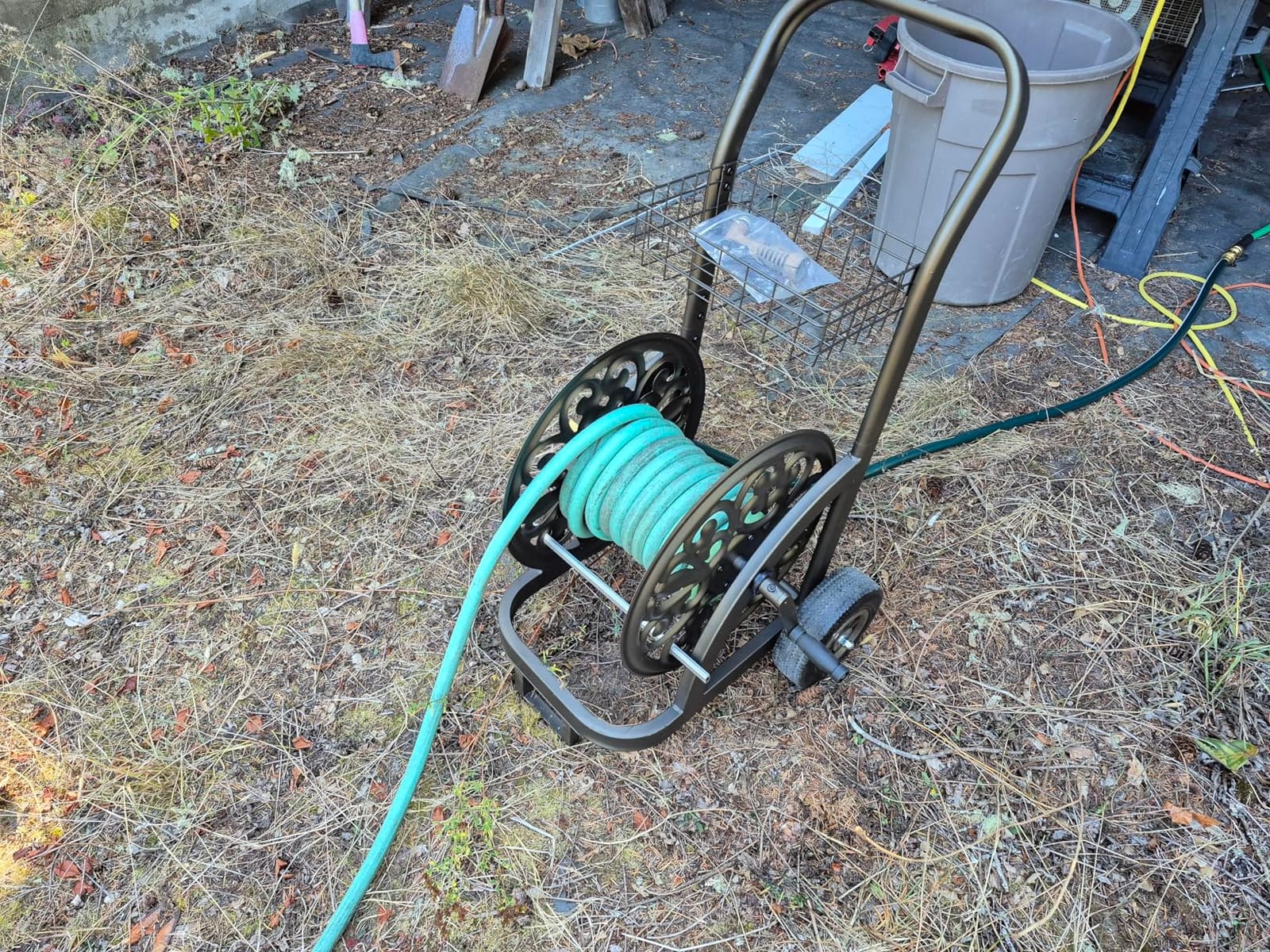
Brass Connector and Pneumatic Tires on Uneven Ground
The solid brass connector is the part most likely to save you money over a decade. Brass resists corrosion far better than plated steel fittings, and connection weeping is the failure point most often reported across hose reel forums. A leak-free spigot path is what keeps a 200 foot run usable without constant re-sealing.
Pneumatic tires give better shock absorption over rough ground than small solid wheels, at the cost of pressure maintenance. A cart with air-filled tires absorbs the jolt of crossing a gravel drive or a rut instead of transmitting every impact straight up through the drum. Check pressure monthly during the season, and treat the tires as the first thing to replace on this cart.
The Storage Basket as a Design Driver
The basket sits on the frame above the axle, which keeps the load low and slightly forward of the drum. That is good for stability and it is the reason this cart does not feel as rear-heavy as some two-wheel designs. It also gives you a place to stage tools while you are pulling hose out, which reduces the number of trips back to the shed.
Be realistic about capacity, though. Owners running standard 5/8 inch rubber hose should treat the 200 foot figure as an upper bound. If you have thinner or lighter-duty hose, you will get closer to the full rating, and the basket plus brass connector make it a good match for lighter hose on a medium-large lot.
Reading the Spec Sheet Critically
Two honest notes about this listing. The review volume is lower than the category leaders, which means less multi-year durability data exists, so you are buying on design quality rather than on a long history of owner reports. And the published dimensions differ between the spec block and the product photography, so measure your intended storage spot before you commit.
Neither of those is disqualifying. What the design gets right, it gets right: brass fittings, a low center of gravity, a powder-coated steel frame rated for year-round outdoor exposure, and a basket that turns a hose cart into a mobile tool station.
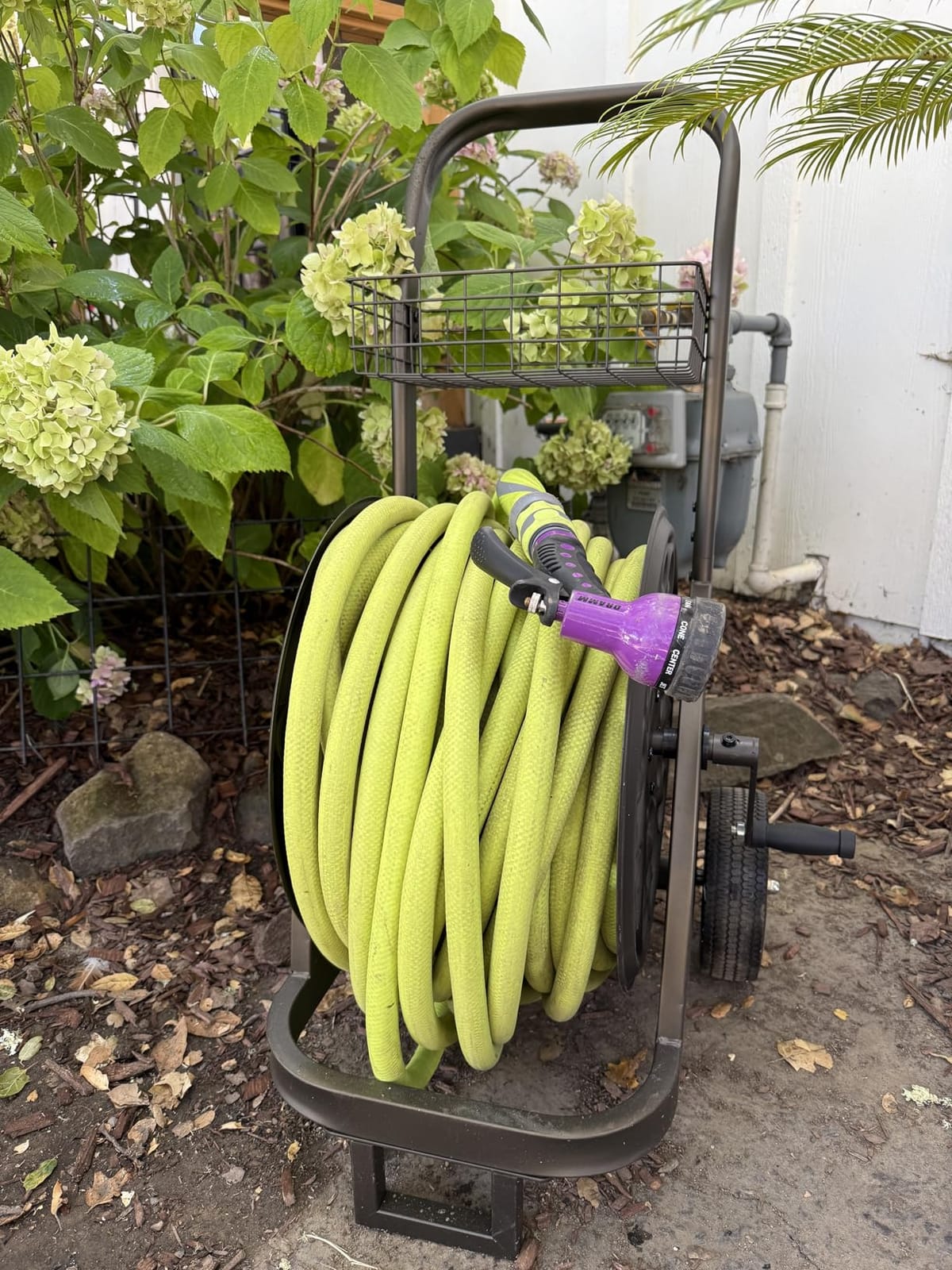
Who This Reel Is For, and Who Should Skip It
This is the pick for someone who works the property rather than just watering it. If you carry tools across the yard regularly, reach a far corner often, and want the hose and the gear to move together, the basket is the feature that justifies the choice.
Skip it if you need 300 feet, if you want the highest confidence level available on multi-year durability, or if you need the hose concealed. For the most conservative long-term data in this roundup, the Liberty Garden 300 ft steel cart is the safer bet.
7. PayLessHere 300 ft Four-Wheel Budget Cart – the Most Reach Per Dollar
PayLessHere | Garden Hose Reel Cart | Holds Upto 300ft of 5/8″ Hose | Green
Holds up to 300 ft of 5/8 in hose
Four sturdy wheels
33 lb, 37 x 24 x 42 in
Heavy-duty metal construction
Tool basket included
+ Pros
- Solid metal construction with welds that hold up to heavy use
- Four wheels roll over grass and gravel easily including in winter
- Owners report hoses have never tangled on it
- 300 ft capacity covers big properties
- Cons
- Light front end rocks back and forth while reeling in a wet hose
- No wheel brake so it rolls during winding unless you brace it
- Picture-only instructions with no text and axle hardware can arrive mismatched
For a property where reach is the binding constraint, this cart is hard to argue with on the numbers alone. Four sturdy wheels, a claimed 300 feet of capacity, heavy-duty metal construction, and an included tool basket, at the lowest cost per foot of any metal cart in this roundup.
Owners report the welds still look new after a year of heavy use and that the four wheels roll over grass and gravel easily, including through winter snow. Several reviewers also mention that their hoses have never tangled on it, which is not a claim most carts can make.
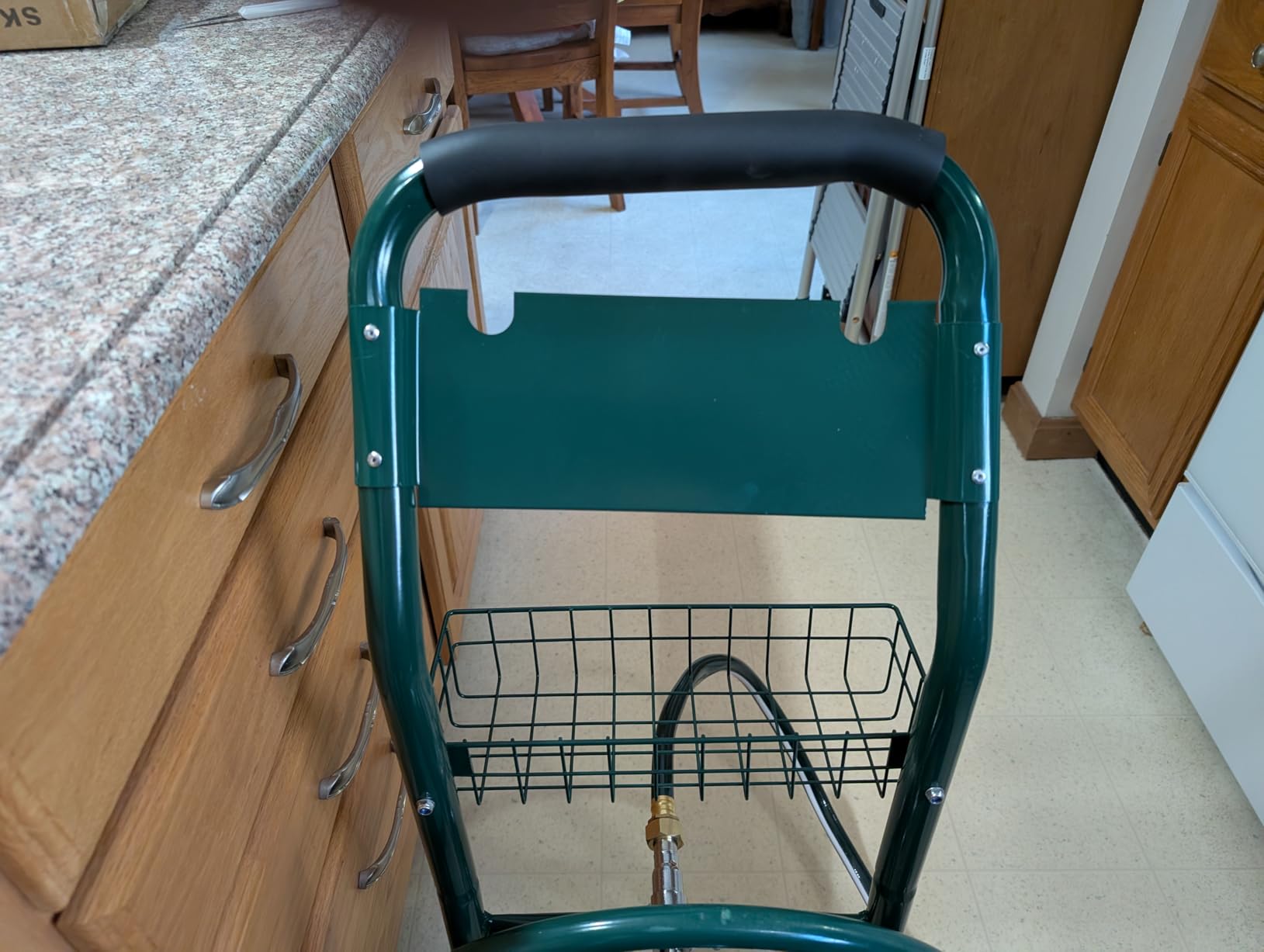
Four Wheels and a 33 Pound Frame
At 33 pounds and 37 x 24 x 42 inches, this is the tallest, longest cart here, and the four-wheel layout is the reason. Four wheels distribute the load and prevent the rear-end lift that makes two-wheel carts hard to control on a slope. When fully loaded with 300 feet of wet hose, it is a two-person job to move across a lawn.
The painted frame and tubing are finished to resist rust, which matters on a cart that will sit on soil or gravel all season. The trade-off is that the bottom of the frame takes the same abuse as any ground-contact cart: inspect for coating damage each spring and touch it up before corrosion sets in.
Why the Front End Rocks, and How to Work Around It
The most repeated complaint is that the front end is light and shifts back and forth while you reel in a long, water-filled hose, and that two people may be needed. Related: there is no wheel brake, so the cart rolls during winding unless you brace it with a foot.
The workaround is simple and worth doing every time. Plant one foot on the frame rail, keep the second hand on the crank, and reel in sections rather than trying to muscle 300 feet of wet hose in one pull. Owners who brace it report no further trouble, and this is a habit worth building from the first day.
Assembly Quality and What to Check on Arrival
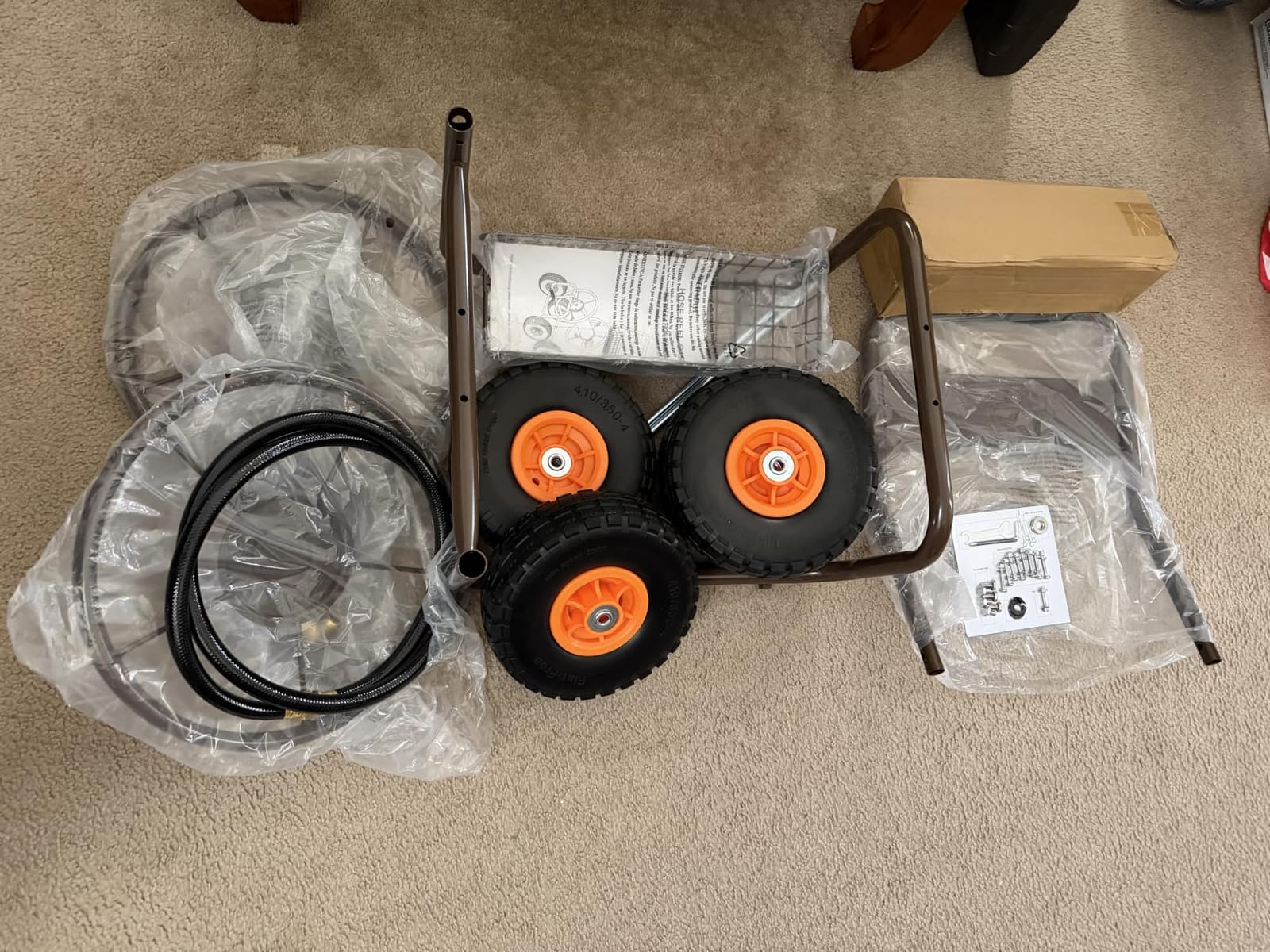
Two assembly notes before you ever unspool hose. Instructions are picture-only with no text, which is workable but slow, and some axle hardware arrives damaged or mismatched, requiring rework during assembly. Open the box, check both axles and the wheel hardware, and correct anything bent before you tighten it down.
One owner reported the cart tipping over and requesting a refund, so test it unloaded on flat ground first and confirm the low center of gravity holds with a hose on the drum. If it rocks, add weight low on the frame rather than high, and never fill the drum with a full load before you trust the balance.
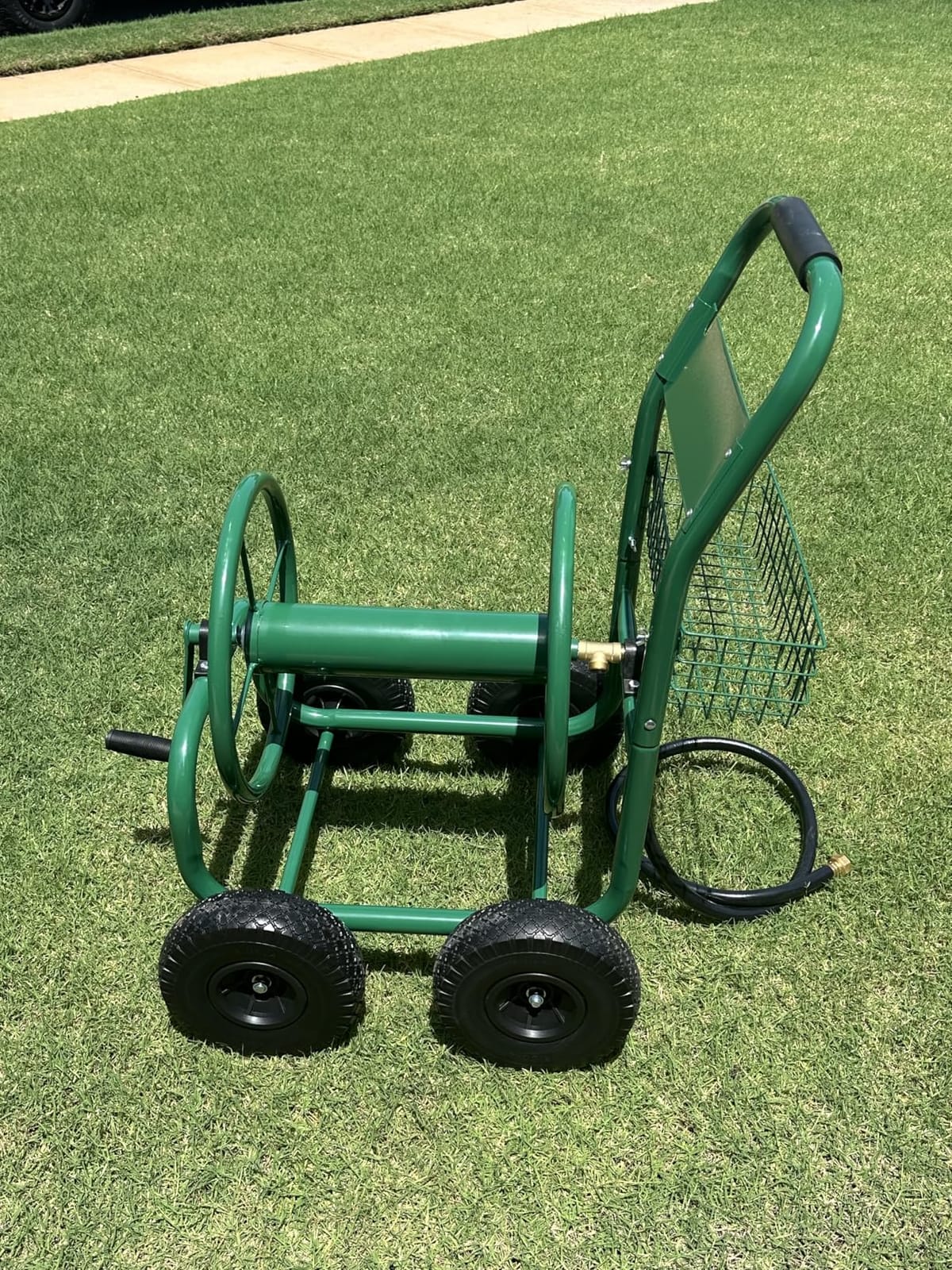
Who This Reel Is For, and Who Should Skip It
Buy this if reach is the whole problem. If your spigot is 250 feet from where you actually need water, this is the reel that gets the job done for the least money, and the four wheels handle rough ground better than any two-wheel option here.
Skip it if you will reel in a full 300 foot load regularly by yourself, because the rocking front end makes that frustrating. For a one-person workflow at that volume, the heavier four-wheel steel cart at the top of this list is the better tool.
8. WERMAH 300 ft Cart with Brass Swivel Upgrade – Built to Fix the Year-Two Leak
WERMAH Upgrade Hose Reel Cart, Garden Hose Cart 4 Wheels, Holds 300ft 5/8″
Holds 300 ft of 5/8 in hose
Alloy steel, 35 lb, 32 x 24 x 36 in
Flat-free tires, 4 wheels
Pre-installed brass connector
6.5 ft leader hose included
+ Pros
- Upgraded brass swivel replaces the rusted steel connection that leaked on earlier versions
- Flat-free tires need no pumping
- Alloy steel frame with stainless steel screws and rust-proof hubs
- Angled brass connector prevents kinking at the source
- Cons
- Inlet valve on the center brace mounts upside down and cannot be flipped
- Brass reel connection sits between spokes making the fit awkward
- Heavier to handle than expected with heavy farm hose
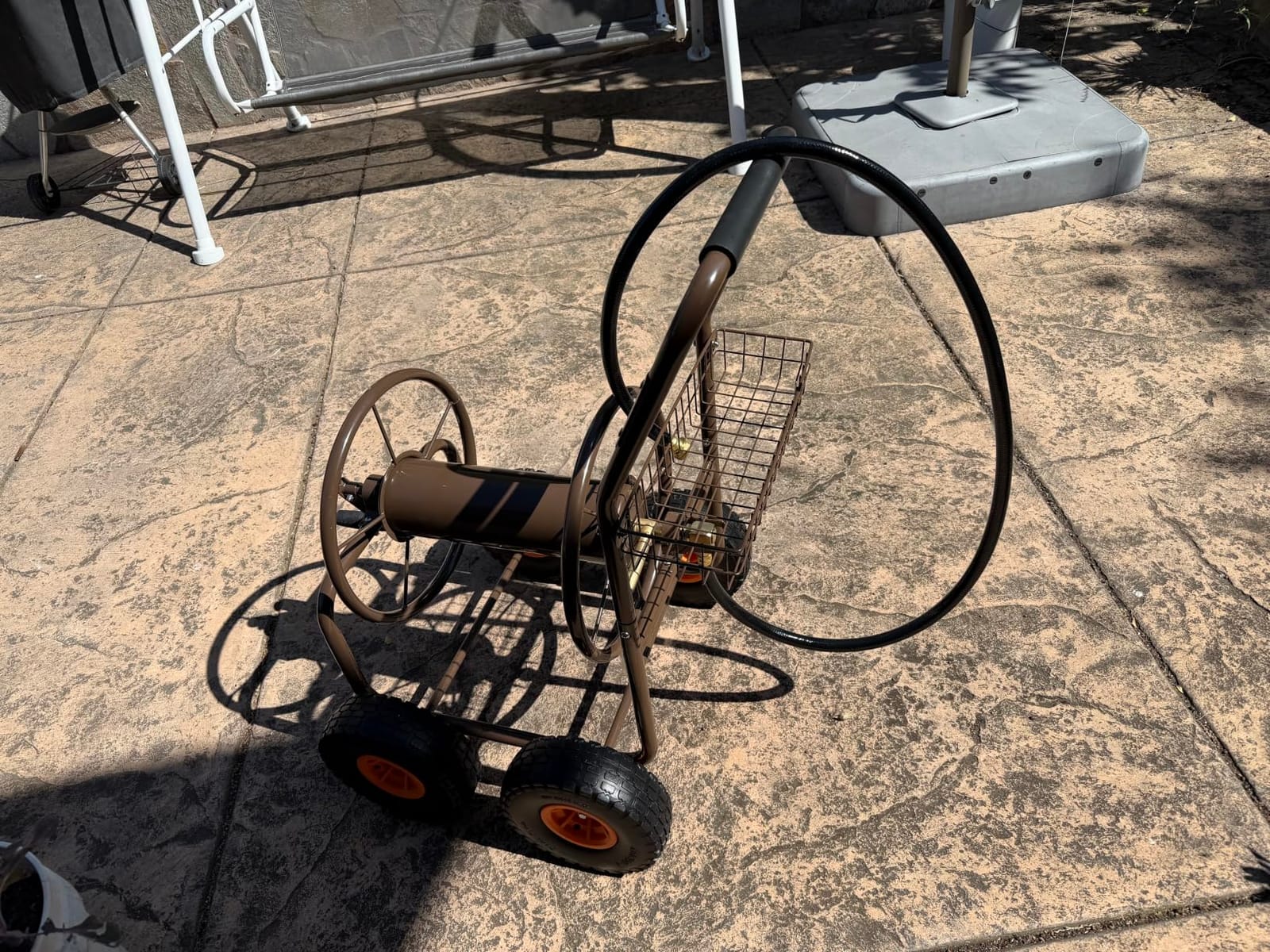
This cart earns its place in a large-yard roundup because it is the only one here that was redesigned around a specific, well-documented failure. Earlier versions of this cart design used steel connections that rusted and started leaking around year two. The current version ships with a pre-installed integrated brass connector with precision seals, and buyers upgrading from the older version single out that swivel as the fix.
At 35 pounds with four flat-free tires and a 300 foot rating, it is a full-size acreage cart. The patent-pending hose guide uses steel-grade plastic, PU/TPU synchronous belts and 304 stainless steel rods, with an outer arc slide block designed for zero interference and maximum winding space.
The Angled Brass Connector and Why Kinks Start There
The angled brass connector is a small design decision with an outsized effect. A straight connector forces the hose to leave the drum at a sharp angle, which is precisely how kinks form at the source. Angling it lets the hose leave smoothly, and owners running heavy commercial-grade hose report the angled connector handles it without leaking.
The connector also comes with a T-piece extension bar and a 6.5 foot leader hose, so the plumbing path is complete on arrival. An owner who added weight to stop the cart tipping with heavy farm hose is worth noting, because at 35 pounds this is not a cart you will reposition while loaded.
Flat-Free Tires and Stainless Hardware
Flat-free tires are the correct choice for a lawn, and they are the single most overlooked spec in this category. A thorn, a rose thorn or a sharp rock ends a pneumatic tire’s usefulness immediately, and flat-free tires eliminate the pumping and the roadside-style flats entirely.
The frame carries heavy-duty weather-resistant powder coating, the screws are stainless steel and the wheel hubs are rust-proof. That level of fastener and hub specification is unusual in a homeowner cart and it is what separates this unit from carts that begin showing rust at the spokes within two seasons.
The Two Real Assembly Flaws
Let us be direct, because these will cost you ten minutes on day one. The inlet valve on the center brace ships mounted upside down and cannot be flipped, so you must remove the storage basket to make the connection. And the brass reel connection sits between two reel spokes rather than aligned with a spoke, which makes threading a hose fitting onto it awkward.
Neither is a deal-breaker, and both are purely mechanical inconveniences rather than quality problems. Plan twenty minutes for assembly, keep the tools that came with it nearby, and connect the hose before you refill the basket.
Who This Reel Is For, and Who Should Skip It
Choose this if you have acreage, farm duty or heavy commercial-grade hose and you have been disappointed by leaks on cheaper carts. The brass swivel and the angled connector address the exact failure that replaces most high-capacity steel carts within a few years.
Skip it if you have a small review-driven preference for proven long-term data, since the review base here is the smallest in the roundup, or if you need to move the cart frequently while loaded. It is a heavy, fixed-purpose acreage tool rather than a lightweight yard helper.
How to Choose a Hose Reel for a Large Yard
The right answer is mostly a capacity calculation followed by a terrain check. Start with distance, then verify construction, then worry about convenience features last.
Step 1: Work Out How Much Hose You Actually Need
Measure the path from the spigot to the farthest point you will water, not the diagonal of the property. Add roughly 20 percent for routing around obstacles, and then add another 10 percent for slack, because a hose that ends exactly at the last shrub is a hose that will be dragged past it every time.
A third of an acre typically needs 100 to 150 feet. Half an acre to a full acre needs 200 feet or more. Acreage-plus properties and farm or small-contractor duty generally need 300 to 400 feet. At that point, two reels on two zones frequently beats one giant reel, because you are not dragging 400 feet of hose across a lawn every time you change task.
Step 2: Choose Hose Diameter Before You Choose the Reel
Diameter drives everything. A 5/8 inch hose delivers noticeably more water over a 200 foot run than a 1/2 inch hose, which is why it is the standard for large-property work and for feeding a pressure washer. It also eats more drum volume, so the same reel holds fewer feet of it.
Rule of thumb for large yards: 5/8 inch hose if you are watering, filling pools or pressure washing beyond 150 feet, and 1/2 inch only if the run is short or you value handling weight over flow. A stiffer rubber hose with strong memory also fights a retractable reel’s spring, causing uneven winding and shortening mechanism life, so match hose stiffness to your reel type.
Step 3: Check the Wheels Before Anything Else
For any cart on a real lawn, wheel diameter and tire type decide whether the reel is usable. Look for flat-free tires on any yard with rocks, thorns or rose bushes, and prefer larger diameters when you will cross gravel drives or uneven sod. A cart that tips every time you pull the hose out will be abandoned within a season.
Then check what happens during reel-in. A cart with a low center of gravity and a four-wheel base stays planted. A light two-wheel cart needs a foot brace or a second person once a water-filled hose is on the drum. This is the difference between a reel you use and a reel that ends up leaning against the fence.
Step 4: Judge Construction by the Parts That Break
Is metal or plastic better? For large yards, metal wins on longevity and plastic wins on weight and price. Resin sits in between: it will not rust, it needs little maintenance, and it will not crack for several seasons if the mounting points are sound.
Judge any reel by its weak parts rather than its frame. Brass fittings beat plated steel. A swivel inlet beats a fixed elbow. Stainless steel screws and rust-proof hubs beat zinc. A level-wind hose guide beats a bare drum, because uneven winding is a winding-mechanism problem that no spring will fix. A long warranty signals that the maker stands behind the mechanism, and parts availability matters more than any housing style.
Step 5: Decide Between Manual, Retractable and Multi-Zone
Manual winding with a crank is the most durable option and the only one that scales past 300 feet. Retractable spring reels are the most convenient and the most failure-prone: springs lose tension within a season, gears break, and once the gear breaks the unit often will not work as a manual reel either. For a large yard, treat retractable as a convenience for a short run, not as your acreage solution.
For very large properties, the experienced answer is two or more reels on separate spigots or a split valve, so each zone has a short hose. Install a fixed wall or post mount at a second spigot and the work of the far corner drops from a 300 foot pull to a 90 foot pull. If your wall is stucco, brick or masonry, plan on standing a 4×4 post rather than trusting a stud finder.
Step 6: Winterize Anything That Lives Outdoors
Freeze damage is a top forum complaint and it is almost always the swivel or the inlet fitting, not the frame. Disconnect the reel, drain the hose completely, and open the spigot to let the line empty. Do not leave a water-filled hose wound on a drum through a hard freeze.
Reliable manufacturers often issue a blanket discount on replacement parts after a freeze-damage wave, which is a strong reason to favor a brand that sells parts rather than one that sells units. If your reel stays outside year-round, a light protective treatment on interior steel each spring costs nothing and prevents most surface rust.
Frequently Asked Questions
What is the best heavy-duty hose reel?
For most large yards, the best heavy-duty hose reel is a steel-framed cart rated for 200 to 300 feet of 5/8 inch hose with brass fittings, a swivel inlet and flat-free tires. The Liberty Garden 300 ft four-wheel steel cart in this roundup is the strongest all-round answer, and the WERMAH 300 ft cart is the choice if leaking connections have been your recurring problem.
Is a metal or plastic hose reel better?
Metal is better for large yards because it will not crack at the mounting points after a season or two of UV exposure, and because its weight stops a loaded cart from tipping while you crank. Plastic and resin are lighter and cheaper, which makes them easier to reposition, but forum owners report resin housings and swivel leaks as the most common long-term failures. Choose metal if the reel stays loaded and outdoors; choose resin if appearance and low weight come first.
What is the best hose reel cart with wheels?
A cart with four flat-free tires and a low center of gravity is the best choice on uneven lawn, because it stays planted while you reel in a water-filled hose. The Liberty Garden 300 ft model uses four 10 inch flat-free tires, and the PayLessHere 300 ft cart rolls well over grass and gravel. Either will beat a small-wheeled two-wheel design on a real yard.
What is a good hose reel that doesn’t leak?
Look for brass fittings, a swivel inlet and a pre-installed sealed connector rather than plated steel, since leaking brass fittings and leader hoses are the most cited failure point across hose reel forums. In this roundup the Liberty Garden 300 ft steel cart and the WERMAH 300 ft cart with its upgraded brass swivel are the two strongest choices for leak resistance.
How much hose do I need for a large yard?
A third of an acre needs roughly 100 to 150 feet of hose. Half an acre to a full acre needs 200 feet or more. Acreage-plus properties and farm or small-contractor duty generally need 300 to 400 feet, which is where a commercial-style cart or a two-reel multi-zone setup becomes the right answer.
Which company makes the best retractable hose reels?
Retractable reels are made by several brands and none of them appear in this roundup, because spring-driven models rarely exceed a short patio run and their failure modes are well documented. A retracted spring loses tension within a season and a broken gear often leaves the unit unusable even as a manual reel. For a large yard, manual crank reels scale further and last longer.
Which Hose Reel Fits Your Yard
If reach is the problem, start with the Liberty Garden 300 ft four-wheel steel cart. It carries the largest capacity in this group, rolls over uneven ground on flat-free 10 inch tires, and its brass swivel is the piece owners most often report as still leak-free after years.
If you want the hose out of sight, the Suncast Smart Trak 225 ft resin hideaway gives you a level-wind guide and a tidy profile, at the cost of metal durability and wheels. If your property has a fixed station, the Liberty Garden 709 wall or floor mount covers the long-run case, and the GOFORWILD decorative wall mount does the same job for roughly 100 feet of actual capacity in a garden-friendly finish.
If stability while cranking is your frustration, the Yard Butler two-wheel cart is heavy enough to stay planted and carries a lifetime warranty. If you want reach on a tighter budget, the PayLessHere 300 ft four-wheel cart covers the most ground for the least money, once you brace it with a foot. If leaking connections have replaced your last two carts, the WERMAH 300 ft model with its upgraded brass swivel is built specifically around that failure.
Whatever you choose, measure the real distance to your farthest corner first, buy a capacity figure with a 25 percent cushion, and check the wheels and tires before you fall for the housing style. That is the short version of everything we learned picking the best hose reels for large yards in 2026.