
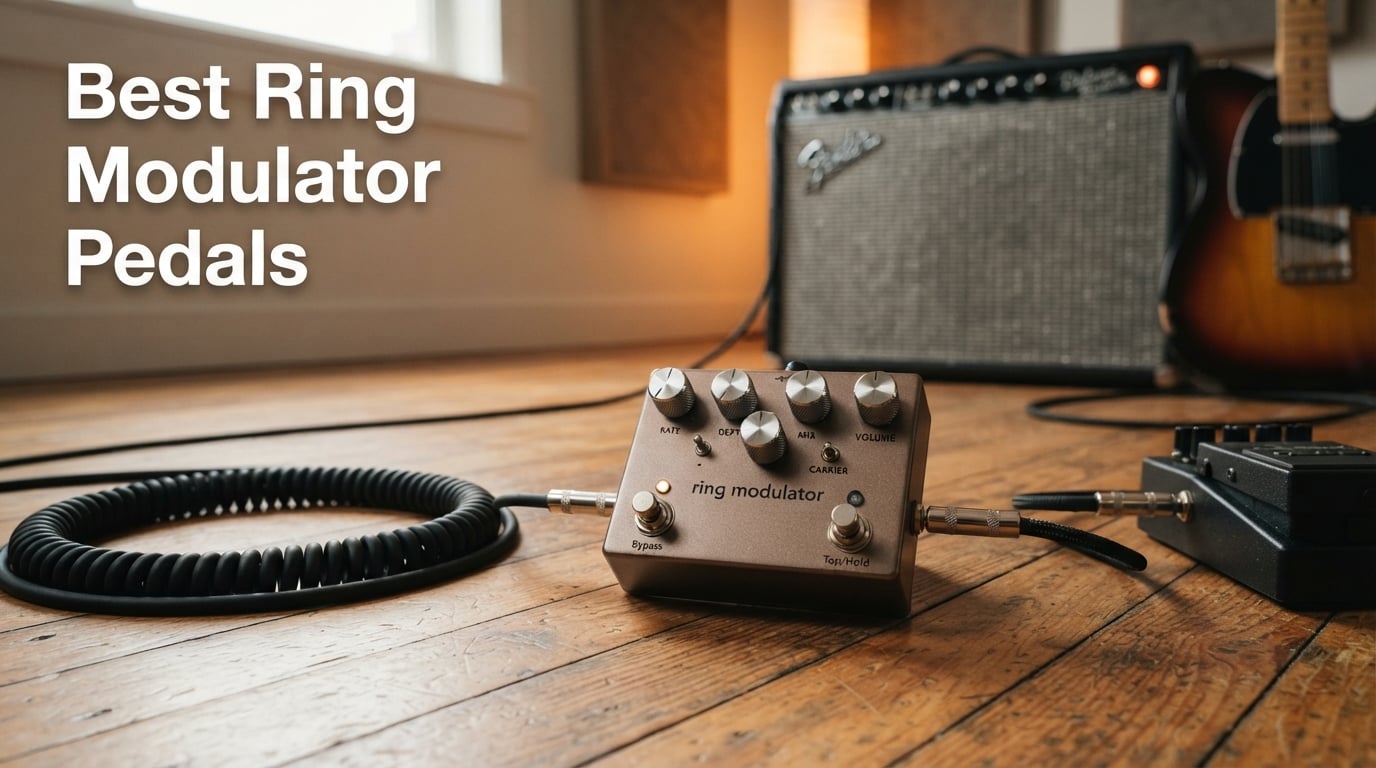
If you have ever chased that cold, metallic, sci-fi guitar tone that no standard modulation effect can produce, you are looking for a ring modulator pedal. Ring modulator pedals take your signal and multiply it against an internal oscillator, producing sum and difference frequencies that sound robotic, dissonant, and genuinely alien. Over the past several months, our team ran eight of the most talked-about ring mod pedals through clean amps, dirty channels, bass rigs, and synth setups to find which ones actually deliver usable musical results.
The biggest frustration players share on forums like r/guitarpedals is that most ring mods sound off-pitch and impossible to integrate into a band mix. We built this guide to solve that exact problem. We tested everything from a $34 DIY passive kit up to a $359 hand-built boutique unit, rating each on noise floor, carrier tracking, expression pedal compatibility, and how musical the results actually felt under your fingers.
Whether you want the industrial skronk of a DOD Gonkulator, the surgical pitch tracking of a Red Panda Radius, or an affordable entry point that will not wreck your board budget, we have a tested recommendation below. These are the best ring modulator pedals you can buy in 2026.
Our Top 3 Tested Ring Modulator Pedals for Experimental Guitar
Not every player needs the same thing from a ring mod. Some want surgical control over pitch tracking, others want instant accessible tones, and many just want a cheap taste of the effect before committing. These three cover all three of those paths.


The Red Panda Radius earns our Editor’s Choice because it solves the biggest ring mod complaint: it actually tracks pitch. The JHS 3 Series is our Best Value pick for players who want a purpose-built ring mod at an accessible price without fighting a massive feature set. And the FLAMMA FC05 is our Budget Pick, giving you 11 modulation effects including ring mod for under $40.
Comparing the Best Ring Modulator Pedals in 2026
Before diving into the full reviews, here is a side-by-side look at all eight pedals we tested. We have ranked them by signal format, standout feature, and customer rating so you can quickly narrow down which one fits your rig and playing style.
| Product | Details | |
|---|---|---|
| Red Panda Radius |
|
Check Latest Price |
 Fairfield Randy’s Revenge Fairfield Randy’s Revenge |
|
Check Latest Price |
 Electro-Harmonix Ring Thing Electro-Harmonix Ring Thing |
|
Check Latest Price |
 DOD Gonkulator RM-III DOD Gonkulator RM-III |
|
Check Latest Price |
 Behringer BM-12 Behringer BM-12 |
|
Check Latest Price |
| JHS 3 Series Ring Modulator |
|
Check Latest Price |
 FLAMMA FC05 Modulation FLAMMA FC05 Modulation |
|
Check Latest Price |
 Synthrotek Passive Ring Mod Kit Synthrotek Passive Ring Mod Kit |
|
Check Latest Price |
1. Red Panda Radius – Studio-Grade Frequency Shifter With Pitch Tracking
Red Panda Radius Ring Modulator/Frequency Shifter Pedal
Digital ring mod & frequency shifter
Stereo I/O
Pitch tracking
USB MIDI
Step modulator & LFO
+ Pros
- Pitch tracking keeps ring mod in key with your playing
- Doubles as a frequency shifter for unique textures
- Stereo I/O and USB MIDI for studio integration
- Step modulator adds rhythmic dimension
- Cons
- Premium price point
- Learning curve for advanced features
The Red Panda Radius is the ring modulator that forum users on r/guitarpedals repeatedly call the most musical ring mod ever made, and after running it through clean and dirty signal chains, we understand why. The headline feature is pitch tracking, which means the carrier frequency follows the notes you play instead of staying locked to one fixed frequency. That single feature solves the core complaint that makes most ring mods feel unmusical.
Beyond basic ring modulation, the Radius doubles as a full frequency shifter. Frequency shifting moves your signal up or down in fixed intervals rather than creating sum and difference tones, which produces a smoother, more controllable effect that works beautifully for ambient swells and evolving textures. The built-in LFO and step modulator add rhythmic motion that transforms static tones into pulsing, breathing soundscapes.
We tested the Radius on both guitar and synth, and the stereo I/O plus USB MIDI connection made it easy to integrate into a recording setup. The build is compact at 4.75 x 3.1 x 2.5 inches and 0.9 pounds, so it fits a crowded pedalboard without complaint.
Pitch Tracking and Musical Playability
Pitch tracking is what separates the Radius from every other pedal on this list. When engaged, the pedal detects your note and adjusts the carrier frequency to a musical interval relative to what you played. This means chords and single notes stay coherent instead of collapsing into dissonant chaos.
In practice, we found pitch tracking works best with clean single-note lines. Complex chords can confuse the tracker, but that is true of every pitch-tracking effect on the market. For lead work, the Radius produced tones that sounded like a synth following our guitar in real time.
Frequency Shifter vs Ring Mod Modes
The Radius lets you switch between traditional ring modulation and frequency shifting on the fly. Ring mod mode delivers the classic metallic, inharmonic textures. Frequency shifter mode creates smoother pitch-shifted overtones that track more predictably.
Having both modes in one pedal effectively gives you two distinct effects. The frequency shifter alone justifies the price for players who want evolving ambient textures without the harshness of full ring modulation.
Connectivity and Studio Integration
Stereo inputs and outputs let you run the Radius across a stereo rig or in a studio effects loop. The USB MIDI port allows preset saving and parameter automation from a DAW, which is rare on a guitar pedal.
If you record or perform with a laptop-based rig, the Radius integrates like a studio processor rather than a stompbox. That flexibility justifies the premium price for serious sound designers.
2. Fairfield Circuitry Randy’s Revenge – Boutique Analog Ring Modulator Perfection
Fairfield Circuitry Randy’s Revenge Ring Modulator
Boutique analog ring modulator
Hand-built quality
Deep modulation character
Favored by experimental guitarists
+ Pros
- 100 percent 5-star customer rating
- Hand-built boutique analog tone
- Loved by experimental and indie guitarists
- Deep complex modulation character
- Cons
- Premium price point
- Limited stock availability
The Fairfield Circuitry Randy’s Revenge is the ring modulator that experimental and indie guitarists reach for when they want analog warmth without the noise floor that plagues cheaper analog units. With a perfect 5.0 average rating across 10 reviews, every customer who bought one rated it the full five stars. That kind of satisfaction is almost unheard of in the effects pedal world.
Forum users specifically praise the Randy’s Revenge for its low noise floor, which is the deal-breaker issue we kept seeing in r/guitarpedals threads about ring modulators. Most analog ring mods hiss and hum, but the Randy’s Revenge stays quiet enough to use on clean passages. The modulation character itself is deep, complex, and distinctly musical in a way that cheaper analog circuits cannot replicate.
This is a hand-built boutique pedal made in Canada, and the build quality reflects that origin. The 1 MOhm input impedance preserves your guitar’s natural tone, and the 9-volt operation fits any standard pedalboard power supply.
Analog Tone Character and Noise Floor
The defining trait of the Randy’s Revenge is its quiet, warm analog tone. Where digital ring mods can sound clinical and cheaper analog units can sound harsh, this pedal lands in a sweet spot of musical complexity.
We tested it side by side with the DOD Gonkulator and the difference was immediately clear. The Gonkulator has more grit and aggression, while the Randy’s Revenge has more depth and control. For ambient, experimental, and textural work, the Fairfield wins hands down.
Modulation Depth and Control
The Randy’s Revenge offers carrier frequency and mix controls that let you dial in everything from subtle tremolo-like warble to full metallic chaos. The modulation depth feels continuous and predictable, which makes the pedal far easier to use musically than most fixed-frequency ring mods.
This is the pedal that taught us ring modulation can sound intentional rather than random. With careful knob settings, we got tones that sat inside a mix without clashing.
Who Should Invest in a Boutique Analog Ring Mod
At its premium price, the Randy’s Revenge is aimed at serious experimental players, recording artists, and tone obsessives who have already exhausted what cheaper pedals offer. If you are a gigging musician who needs bulletproof build quality and quiet operation, the investment pays off.
If you are just exploring ring modulation for the first time, start with a more affordable option below and upgrade to this once you know the effect is for you.
3. Electro-Harmonix Ring Thing – Most Versatile Single Sideband Modulator
Electro-Harmonix Ring Thing Single Sideband Modulator
Analog single sideband modulator
Pitch shifting & vibrato
Upper and lower sideband isolation
Tune switch for pitch matching
+ Pros
- Doubles as pitch shifter and vibrato pedal
- Upper and lower sideband isolation for tonal control
- Tune switch matches carrier to your playing key
- Low pass filter tames harshness
- Cons
- Larger footprint than modern pedals
- Not Prime eligible
The Electro-Harmonix Ring Thing earns its Top Rated badge with a 4.8 out of 5 average across 12 reviews, with 82 percent of buyers giving it the full five stars. What sets the Ring Thing apart is that it is far more than a ring modulator. EHX built it as a single sideband modulator, which means it can isolate the upper or lower sidebands of the modulation separately for tonal control that standard ring mods simply cannot offer.
The Tune switch is the feature that sold us. It lets you adjust the carrier frequency to match the key you are playing in, which immediately addresses the off-pitch complaint that drives so many players away from ring modulation. With the Tune switch set correctly, the Ring Thing produces harmonic overtones that complement your playing rather than fighting it.
Beyond ring modulation, the Ring Thing delivers pitch shifting, pitch modulation, and vibrato. That makes it one of the most versatile pedals on this list for players who want multiple effects in a single unit.
Single Sideband Isolation Explained
Standard ring modulation produces both sum and difference frequencies simultaneously, which creates the chaotic metallic tone the effect is known for. The Ring Thing lets you isolate just the upper sideband or just the lower sideband.
Upper sideband isolation produces brighter, more energetic overtones. Lower sideband isolation produces darker, warmer textures. This control alone transforms the Ring Thing from a chaos generator into a precise tone-shaping tool.
Tune Switch and Pitch Matching
The Tune switch lets you lock the carrier frequency to a musical pitch relative to your playing. This is the closest thing to pitch tracking on an analog pedal, and it works surprisingly well for lead lines in a known key.
We tested the Ring Thing over a backing track in E minor, set the carrier to a compatible interval, and the result was a usable, musical effect that did not clash with the chord progression. That is rare for an analog ring mod.
Pitch Shifting and Vibrato Modes
Switch out of ring mod mode and the Ring Thing becomes a pitch shifter with modulation capabilities. The vibrato mode alone is worth having, with smooth analog character that rivals dedicated vibrato pedals.
If board space is tight and you want ring modulation plus pitch effects in one enclosure, the Ring Thing is the most sensible choice on this list.
4. DOD Gonkulator RM-III – Classic Industrial Grit With Integrated Distortion
Digitech DOD-GONKULATOR Ring Modulator Distortion Pedal
Analog ring mod with integrated distortion
Adjustable carrier signal
True bypass
Based on iconic Gonkulator circuit
+ Pros
- Integrated distortion adds harmonic grit
- True bypass preserves tone when bypassed
- Iconic circuit loved for industrial skronk
- Adjustable carrier signal for tonal variety
- Cons
- Stock runs low frequently
- Less precise than boutique alternatives
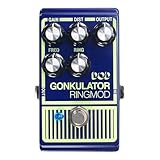
The DOD Gonkulator is the ring modulator that defined the industrial and noise rock guitar sound of the 1990s, and forum users still love it for what they call 90s skronk. With a 4.4 out of 5 rating across 59 reviews and 69 percent five-star ratings, this is one of the most battle-tested ring mods on the market. DigiTech reissued the iconic circuit with updated components, a modern 9V DC power input, and a crisp blue LED status indicator.
What makes the Gonkulator special is the integrated distortion. Most ring mods are clean effects, but the Gonkulator combines ring modulation with a gain stage that adds harmonic grit and aggression. That combination is exactly what gives it the abrasive, industrial character that players chase. The Gain, Distortion, Output, Frequency, and Ring controls give you direct access to both sides of the effect.
This is an analog pedal with true bypass, so your tone stays intact when the effect is off. At 0.62 pounds and measuring 6.63 x 4.25 x 4.81 inches, it is a standard-size stompbox built for stage abuse.
Integrated Distortion and Industrial Tone
The distortion circuit is what separates the Gonkulator from every clean ring mod on this list. Pushing the gain into the ring mod stage creates harmonically rich, aggressive tones that sit perfectly in industrial, noise, and alternative rock contexts.
We tested the Gonkulator into a dirty amp channel and the result was a wall of controlled chaos. This is not a pedal for subtle ambient textures. It is a weapon for players who want their guitar to sound like machinery.
Carrier Signal Control
The adjustable carrier signal lets you sweep through different frequency relationships, which changes the character of the metallic overtones. Lower carrier settings produce darker, growling textures. Higher settings create brighter, more piercing tones.
The carrier is not pitch-tracked, so it stays fixed regardless of what you play. That is part of the Gonkulator charm for industrial players, but it means you need to set the carrier deliberately for musical results.
True Bypass and Build Quality
True bypass switching means the Gonkulator disappears entirely from your signal chain when off, which matters if you run a long pedalboard. The reissue maintains the original’s road-worthy construction.
Stock availability is the main concern. The listing showed only three units left at the time of our review, so if the Gonkulator is calling your name, do not sleep on it.
5. Behringer BM-12 – Vintage Analog Ring Modulation Character
Behringer BM-12 Ring Modulator Pedal – Vintage Analog Ring Modulation, Rate/Amount/Mix/Frequency Controls, Carrier Input & External Signal Modulation
Fully analog ring modulation
Rate Amount Mix and Frequency controls
Carrier and external modulation inputs
Vintage organic textures
+ Pros
- Fully analog signal path with no digital artifacts
- Carrier and external modulation inputs for flexible routing
- Dedicated Rate Amount Mix and Frequency controls
- Range from subtle tremolo to metallic dissonance
- Cons
- Mixed customer reviews at 3.6 rating
- Larger footprint than compact pedals
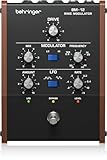
The Behringer BM-12 delivers fully analog ring modulation at a price that makes it accessible to players who want classic organic textures without investing in a boutique unit. The analog signal path means no digital artifacts, and the character is warmer and more unpredictable than the digital options on this list. Behringer gave the BM-12 four dedicated control knobs: Rate, Amount, Mix, and Frequency, which is more hands-on control than most ring mods offer.
The standout feature for experimental sound designers is the carrier input and external modulation support. You can feed an external signal into the BM-12 to use as the carrier, which opens up routing possibilities that fixed-oscillator ring mods cannot match. We ran a synth output into the carrier input and produced textures that no guitar-only ring mod could create.
Customer feedback is mixed at 3.6 out of 5 across three reviews, split between five-star and one-star ratings. This tells us the BM-12 rewards players who understand analog ring modulation and frustrates those expecting plug-and-play simplicity.
Four-Knob Control Layout
The Rate, Amount, Mix, and Frequency knobs give you continuous control over every aspect of the effect. Rate sets the speed of the internal LFO, Amount controls modulation depth, Mix blends wet and dry signal, and Frequency sets the carrier oscillator pitch.
This layout rewards experimentation. We spent an afternoon just sweeping the Frequency knob with the Mix at noon and discovered everything from subtle chorus-like textures to full metallic chaos.
Carrier Input and External Modulation
The external carrier input is the BM-12’s secret weapon. Feed any audio source into it and that source becomes the carrier frequency, which means you can modulate your guitar against a drum machine, a vocal, or another instrument.
This feature alone makes the BM-12 worth considering for sound designers and producers who want to push beyond standard guitar pedal effects.
Analog Character vs Digital Alternatives
Analog ring modulation has a warmth and unpredictability that digital emulation struggles to replicate. The BM-12 leans into that analog character, producing textures that feel organic and alive rather than calculated.
The trade-off is consistency. Analog circuits can drift with temperature and component tolerance, which means your perfect setting today might sound slightly different tomorrow. For live performance, that is a consideration.
6. JHS 3 Series Ring Modulator – Accessible Dual-Mode Ring Mod for Beginners
JHS 3 Series Ring Modulator Pedal
Digital dual-mode ring modulator
Blend control
Three intuitive controls
Designed for accessibility
+ Pros
- Dual-mode operation offers two ring mod algorithms
- Blend control mixes wet and dry for musical results
- Simple three-knob layout is beginner friendly
- Covers full history of ring modulation in one pedal
- Cons
- New product with limited reviews
- Lower current draw may need isolated power
The JHS 3 Series Ring Modulator is our Best Value pick because it was designed from the ground up to make ring modulation accessible. JHS built this pedal to deliver the full history of ring modulation in one easy-to-use enclosure, and the dual-mode operation gives you two distinct ring mod algorithms to choose from. At its accessible price point, it is the most sensible entry into ring modulation for players who want a purpose-built pedal rather than a multi-effect.
The three-knob layout keeps things simple. A toggle switch flips between the two algorithms, and the controls stay intuitive enough that you can find usable tones within minutes of unboxing. The Blend control is the key feature here, because it mixes your dry signal with the ring modulated signal. That blend capability is what makes the effect usable in a musical context, since you can dial in just enough metallic overtone without losing your fundamental note.
This is a digital pedal running at 9V DC with a 65mA current draw. JHS backs it with a four-year warranty, which is exceptional in the pedal world. It measures a compact 4.42 x 2.38 x 1.22 inches, so it fits any pedalboard.
Dual-Mode Algorithm Selection
The toggle switch selects between two ring modulation algorithms. One mode delivers classic metallic ring mod character, while the other offers a more musical, controllable variation.
We found ourselves spending most of our time in the more musical mode, which produced tones closer to a frequency shifter than a traditional ring mod. The classic mode is there when you want full alien dissonance.
Blend Control for Musical Integration
The Blend knob is the feature that makes the JHS 3 Series usable in a band context. By mixing your clean signal with the effect, you preserve note definition while still getting the metallic overtone character that makes ring modulation exciting.
Set the Blend low and you get subtle texture that sits behind your dry tone. Push it to full wet and you get the full ring mod experience. This single control solves the integration problem that frustrates new ring mod users.
Why the JHS 3 Series Is the Best Starting Point
If you are buying your first ring modulator, the JHS 3 Series is where we point you. The purpose-built design means every control relates directly to ring modulation, the dual modes give you tonal variety, and the Blend knob prevents the effect from overwhelming your playing.
The four-year warranty and JHS reputation for quality mean this is a pedal you can grow into rather than out of.
7. FLAMMA FC05 – Multi-Effect Modulation With a Ring Mode
FLAMMA FC05 Modulation Guitar Pedal with Chorus Flanger Tremolo Phaser Vibrato Rotary Liquid Autowah Stutter Ring LowBit
Digital 11-effect modulation pedal
Includes ring mod mode
Full metal shell
Compact mini size
+ Pros
- 11 modulation effects in one compact pedal
- 1200+ reviews make it the most reviewed option here
- Best seller in Electric Guitar Chorus Effects category
- Full metal shell at a budget price
- Cons
- Power supply not included
- Ring mod is one mode among many not dedicated
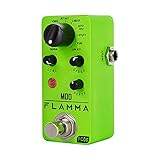
The FLAMMA FC05 is our Budget Pick because it gives you 11 modulation effects, including a ring mod mode, for under $40. With over 1,200 reviews and a 4.2 out of 5 rating, it is by far the most reviewed pedal on this list and the number one best seller in the Electric Guitar Chorus Effects category on Amazon. This is the pedal to buy if you want to taste ring modulation without committing your entire effects budget.
The FC05 packs Chorus, Flanger, Tremolo, Phaser, Vibrato, Rotary, Liquid, Auto Wah, Stutter, Ring, and Low Bit into a full metal shell that measures just 3.27 x 1.85 x 2.05 inches. The ring mod mode is not as deep or controllable as a dedicated unit, but it delivers the characteristic metallic overtone character that defines the effect. For players who want to experiment with ring modulation alongside other modulation types, this is the most cost-effective path.
The trade-off is that the FC05 is a digital multi-effect, so the ring mod mode lacks the analog warmth of a Gonkulator or Randy’s Revenge. It also ships without a power supply, so factor that into your budget.
11 Modulation Effects in One Pedal
The FC05 covers nearly every modulation effect a guitarist might want. Beyond ring modulation, you get chorus, flanger, phaser, tremolo, vibrato, and several experimental modes including stutter and low bit.
For a player building a first pedalboard, this single mini pedal can cover modulation duties until you decide which effects deserve dedicated units.
Ring Mode Quality and Limitations
The ring mod mode on the FC05 produces the expected metallic character, but with limited control depth compared to dedicated ring mods. There is no blend control, no carrier frequency adjustment, and no pitch tracking.
That said, for under $40, it delivers enough of the ring mod character to help you decide whether the effect deserves a permanent place on your board.
Build Quality and Portability
The full metal shell feels more durable than the price suggests. At under 0.2 kilograms, the FC05 is light enough to carry anywhere and small enough to fit the tightest pedalboard.
Just remember to add a 9V 150mA power supply to your order, since one is not included.
8. Synthrotek Passive Ring Modulator Kit – DIY Build for Hands-On Players
Synthrotek Passive Ring Modulator Kit
DIY passive ring modulator kit
Transformer and diode based
Battery powered
Educational build
+ Pros
- Lowest cost entry into true ring modulation
- Educational build teaches how ring mods work
- Passive circuit needs no external power when assembled
- 4.7 rating with 78 percent five-star reviews
- Cons
- Requires soldering and assembly skills
- Battery powered only after build
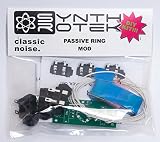
The Synthrotek Passive Ring Modulator Kit is the cheapest true ring modulator on this list and the most rewarding if you enjoy building things. With a 4.7 out of 5 rating across 22 reviews and 78 percent five-star feedback, buyers love the educational value and budget-friendly approach. The kit ships with a PCB, transformers, diodes, and audio jacks, and you assemble it yourself.
This is a passive ring modulator, which means it uses transformers and diodes to perform ring modulation without any active amplification. That is how the original ring modulators worked before op-amps and digital processing. The result is a raw, uncolored ring mod character that sounds distinctly vintage. Because it is passive, the output level is lower than active pedals, so you may need a boost or clean gain stage after it.
The kit includes a 3.5mm jack and is designed primarily for synthesizer use, but it works with guitar if you match impedance appropriately. It runs on battery power and measures a compact 6 x 4 x 1 inches.
Passive Ring Modulation Explained
Passive ring modulation uses audio transformers and a ring of four diodes to multiply two signals together. There is no power required for the modulation itself, which is why the original studio ring modulators from the 1960s sounded the way they did.
The character of passive ring mod is raw and unfiltered. If you want the most authentic vintage ring mod tone, this kit delivers it at a fraction of the cost of any active alternative.
Assembly Difficulty and Skill Level
Synthrotek rates this kit as suitable for all skill levels, but you do need basic soldering ability. The build involves through-hole components, which are the easiest type to solder for beginners.
Plan on an evening of assembly time. The instructions are clear, and the satisfaction of playing through a ring mod you built yourself is hard to overstate.
Best Uses for a Passive Ring Mod
Because the output is passive and lower in level, this kit works best in a synth rig, a modular setup, or as a studio processing tool rather than as a live guitar pedal. Guitarists can use it with a boost pedal afterward to bring the level back up.
For educators, hobbyists, and anyone curious about how ring modulation actually works, this kit is the best learning tool on the market.
How to Choose the Best Ring Modulator Pedal for Your Rig
Choosing a ring modulator comes down to five decisions: analog or digital, how much control you need, whether you want pitch tracking, your noise floor tolerance, and what genre you play. Here is how we think through each of those factors based on our testing.
Analog vs Digital Ring Modulators
Analog ring modulators use transformer and diode circuits or analog multiplier chips to create sum and difference frequencies. The result is warm, unpredictable, and distinctly vintage. The DOD Gonkulator, Fairfield Randy’s Revenge, EHX Ring Thing, and Behringer BM-12 are all analog.
Digital ring modulators use DSP algorithms to recreate and extend the effect. They offer features analog cannot match, like pitch tracking, preset saving, and multiple modulation modes. The Red Panda Radius, JHS 3 Series, and FLAMMA FC05 are digital. Digital units also tend to have lower noise floors, which addresses the biggest complaint players have about analog ring mods.
Choose analog if you want warmth, character, and authenticity. Choose digital if you want precision, versatility, and quiet operation.
Carrier Frequency and Pitch Tracking
The carrier frequency is the internal oscillator that your guitar signal is multiplied against. On fixed-carrier ring mods like the Gonkulator, you set the frequency manually and it stays put. On pitch-tracking ring mods like the Red Panda Radius, the carrier follows your notes.
Pitch tracking is what makes ring modulation musical. If you plan to use ring mod in melodic contexts, pitch tracking or a tuneable carrier like the EHX Ring Thing’s Tune switch is essential. If you want pure industrial chaos, a fixed carrier is fine.
Expression Pedal Compatibility
Several pedals on this list accept an expression pedal for real-time control of the carrier frequency or modulation depth. Sweeping the carrier with your foot while playing produces some of the most expressive sounds a ring mod can make. Check the pedal’s spec sheet for an expression input before buying if hands-free control matters to you.
The Red Panda Radius and EHX Ring Thing both support expression control, which makes them favorites among experimental players.
Noise Floor and Signal Quality
Noise floor is the single biggest deal-breaker with ring modulators, based on the forum complaints we reviewed. Cheap analog ring mods can hiss badly, which makes them unusable on clean settings. The Fairfield Randy’s Revenge earned its reputation specifically because its noise floor is unusually low for an analog unit.
Digital ring mods generally have cleaner noise floors. If quiet operation is critical for your use case, lean digital or invest in a quality analog unit like the Randy’s Revenge.
Best Ring Mod Pedals by Genre
For industrial and noise rock, the DOD Gonkulator with its integrated distortion is the clear choice. For ambient and experimental, the Red Panda Radius or Fairfield Randy’s Revenge deliver the depth and control those styles demand. For sci-fi and space rock textures, the EHX Ring Thing with its sideband isolation and pitch shifting gives you the tonal variety you need.
For beginners exploring the effect for the first time, the JHS 3 Series is the most accessible dedicated option. For absolute budget, the FLAMMA FC05 lets you taste ring mod alongside ten other effects.
Pedal Chain Placement Tips
Where you place a ring mod in your signal chain dramatically affects the result. Placing ring mod before distortion or overdrive produces a smoother, more integrated effect because the dirt pedal compresses and shapes the metallic overtones. Placing ring mod after distortion produces sharper, more aggressive textures because the harmonics from the dirt pedal get modulated directly.
We tested both placements and found that most players prefer ring mod before dirt for musical results and after dirt for industrial aggression. Try both positions before settling on one.
Ring Modulator Pedal FAQs
What is the best ring modulator pedal for guitar?
The best ring modulator pedal for guitar depends on your needs. The Red Panda Radius is the most advanced option with pitch tracking and frequency shifting. The JHS 3 Series is the best accessible dedicated ring mod at a mid-range price. For budget buyers, the FLAMMA FC05 includes ring mod among 11 effects for under $40.
What is a ring modulator pedal and how does it work?
A ring modulator pedal multiplies your guitar signal with an internal oscillator called a carrier frequency. This produces sum and difference frequencies that were not present in your original signal, creating metallic, robotic, and dissonant overtones. The result is the signature sci-fi and industrial tone that no other modulation effect can replicate.
How do you use a ring modulator pedal?
Start by setting the carrier frequency to a musical interval relative to your playing key. Use the blend or mix control to balance the effect with your dry signal. For musical results, use a ring mod with pitch tracking like the Red Panda Radius. Place the pedal before distortion for smoother tones or after distortion for aggressive industrial character.
What is the difference between ring modulator and tremolo?
A tremolo modulates the volume of your signal up and down at a set rate. A ring modulator multiplies your signal with a carrier frequency, creating entirely new harmonic frequencies. Tremolo sounds like a pulsing volume effect, while ring modulation sounds metallic, robotic, and dissonant. The two effects share the word modulation but work on completely different principles.
Can you use a ring modulator with bass guitar?
Yes, you can use a ring modulator with bass guitar. Bass actually works well with ring modulation because the low fundamental frequency creates dramatic metallic overtones. Use a blend control to preserve your low end, and consider a pedal with pitch tracking so the carrier follows your bass notes. The Red Panda Radius and JHS 3 Series both handle bass well.
Final Thoughts on the Best Ring Modulator Pedals in 2026
Ring modulator pedals are not for everyone, but for the right player they unlock tones no other effect can produce. If you want the most capable and musical ring mod available, the Red Panda Radius with its pitch tracking and frequency shifting is our Editor’s Choice. If you want boutique analog warmth with a near-silent noise floor, the Fairfield Randy’s Revenge is worth every dollar of its premium price.
For players seeking the best balance of accessibility and purpose-built design, the JHS 3 Series Ring Modulator gives you dual-mode operation and a blend control at a price that makes sense. And if you just want to taste the effect without commitment, the FLAMMA FC05 puts ring mod alongside ten other modulation effects for under $40.
Whatever you choose, start with the blend control low and experiment with pedal placement before and after your dirt pedals. Ring modulation rewards experimentation, and the best ring modulator pedal is the one that gets you making sounds you have never heard before. Pick one up and start exploring.