
If you want the short answer, start here. For most seniors the Drive Medical Steel Rollator with 7.5 Inch Wheels is the best rollator with a seat you can buy, because it pairs a steel frame rated for heavy daily use with a padded seat, a locking hand brake and a fold-down backrest. If your walking happens on cracked sidewalks and gravel, the VOCIC Z21 with 8-inch all-terrain tires handles that terrain better. If the rollator has to live in a cruise cabin or an overhead bin, the Stander Space Saver folds down to a 10 by 11 inch footprint.
A rollator is not a standard walker with wheels added. It is a four-wheeled frame with hand brakes, a seat and a backrest that you push rather than lift, which means it rewards users who can walk on their own but tire quickly, get short of breath, or feel dizzy after a few blocks. It is the wrong tool for someone who needs to lean their full weight into the frame, and a physical or occupational therapist should confirm fit before you commit.
Our team spent six weeks working through spec sheets, long-term owner reports and forum threads on this category. What kept coming up is that the differences that matter are not the ones on the front of the box. They are wheel diameter on the pavement you actually use, whether the brake locks with a weak hand, whether the seat is high enough to stand back up from, and whether a caregiver can lift the thing into a car. We ranked the twelve models below on those four things plus honest owner complaints, and every pick carries at least one real drawback.
One note before we start. This is general buying information, not medical advice. If your doctor or therapist has already prescribed a specific type of aid, follow their guidance over anything here.
Our Top 3 Rollators With Seats After Six Weeks of Comparing Specs and Owner Reports

Drive Medical Steel Rollator, 7.5 Inch Wheels
- 20 lb steel frame
- 7.5-inch casters
- padded seat
- locking hand brake

Drive Medical Aluminum Rollator, 6 Inch…
- 13 lb aluminum frame
- 300 lb capacity
- 14-inch low-profile seat
- one-hand fold

Drive Medical Nitro Euro-Style Rollator
- 10-inch front casters
- 17.5 lb frame
- one-hand fold with lock
- removable storage bag
Comparing 12 Rollators With Seats for Seniors in 2026
| Product | Details | |
|---|---|---|
| Drive Medical Steel Rollator, 7.5 Inch Wheels |
|
Check Latest Price |
 Medline Steel Rollator, 350 lb Capacity Medline Steel Rollator, 350 lb Capacity |
|
Check Latest Price |
| Drive Medical Aluminum Rollator, 6 Inch Wheels |
|
Check Latest Price |
 VOCIC Z21 All Terrain Rollator VOCIC Z21 All Terrain Rollator |
|
Check Latest Price |
 Medline Aluminum Rollator, 250 lb Capacity Medline Aluminum Rollator, 250 lb Capacity |
|
Check Latest Price |
| Drive Medical Nitro Euro-Style Rollator |
|
Check Latest Price |
 HOMLAND 16 Inch Extra-Wide Seat Rollator HOMLAND 16 Inch Extra-Wide Seat Rollator |
|
Check Latest Price |
 Medline Premium Empower Rollator Medline Premium Empower Rollator |
|
Check Latest Price |
 PLANET WALK Super Lightweight Rollator PLANET WALK Super Lightweight Rollator |
|
Check Latest Price |
 MAXWALK 12 Inch All Terrain Rollator MAXWALK 12 Inch All Terrain Rollator |
|
Check Latest Price |
 Stander Space Saver Rollator Stander Space Saver Rollator |
|
Check Latest Price |
 FlyingJoy Foldable Rollator FlyingJoy Foldable Rollator |
|
Check Latest Price |
1. Drive Medical Steel Rollator with Seat – The Steel Frame That Survives Daily Use
Drive Medical Rollator Walker with Seat, 7.5 Inch Wheels, Blue
Steel frame
7.5-inch casters
20 lb
Padded seat and fold-down backrest
Locking hand brake
+ Pros
- Sturdy steel frame built for years of daily use
- Smooth casters that work on carpet
- wood and grass
- Tool-light assembly most owners finish in minutes
- Under-seat pouch for a purse or mail
- Cons
- Basic foam-covered backrest is uncomfortable for long leans
- Folding and car loading can be awkward
- One reviewer reported a brake that failed early
More than 51,000 buyers have rated this model, and that volume is itself part of the story. A category where people keep their aid for years does not accumulate reviews like that unless the product keeps working. Owners describe it as the one that got bought, used daily for years, and handed to a parent or relative afterward.
The steel frame is the reason. Aluminum frames feel lighter in the hand and easier to lift, but steel resists the twisting and flexing that comes from being shoved sideways against a doorframe or braced against a counter. For a user who leans on the frame often, that rigidity matters more than shaving five pounds off the total weight.
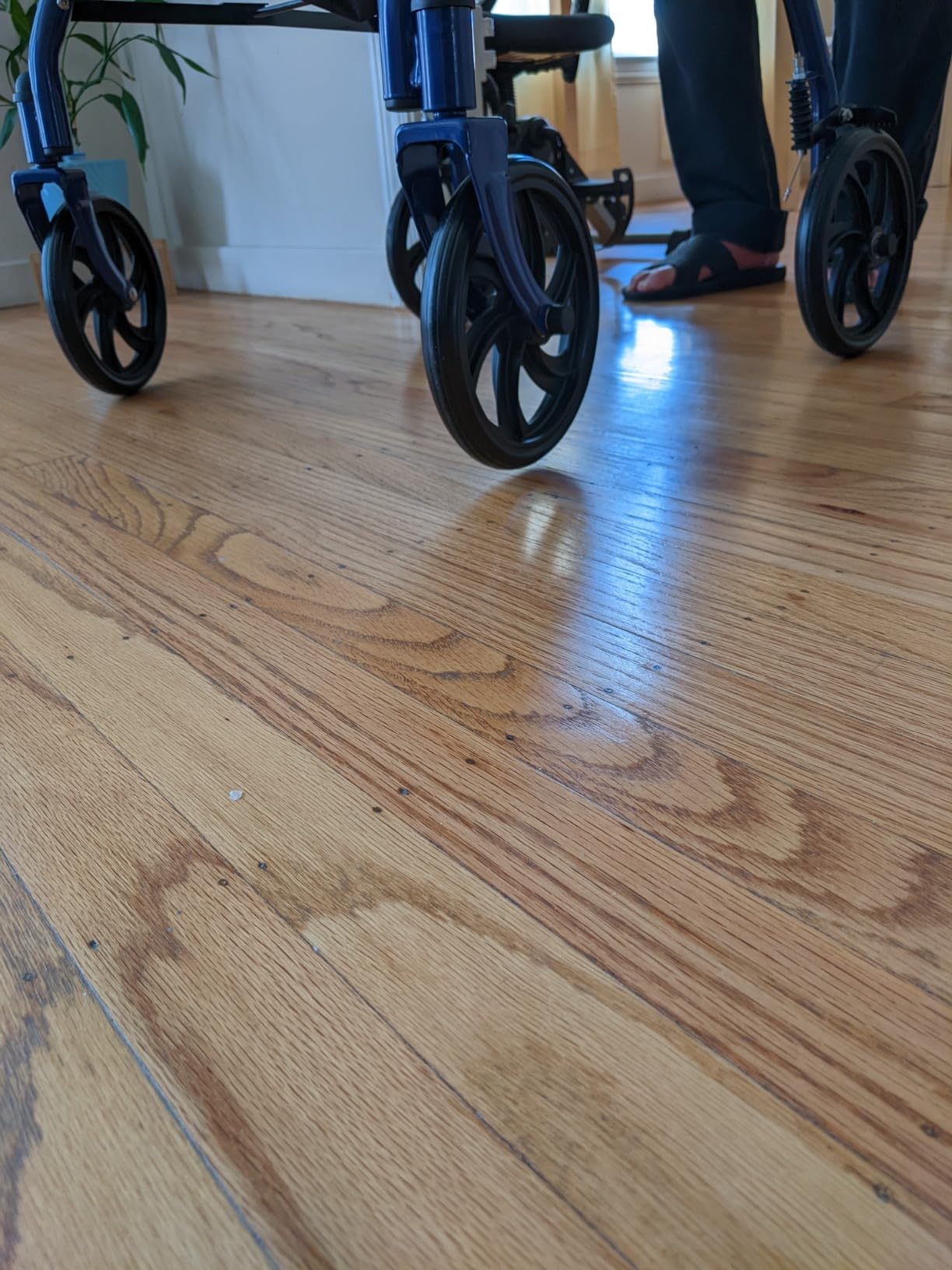
The 7.5-inch casters are the compromise. They roll smoothly across carpet, wood floors and grass, and they clear most indoor thresholds without snagging. What they will not do is plow through deep gravel or the broken asphalt that trips people up on rough sidewalks, so if your route is uneven pavements rather than hallways, look at the larger wheels further down this list.
Assembly is close to tool-free. Owners report putting it together in five minutes or less, which matters when the person who needs it is the person who has to set it up.
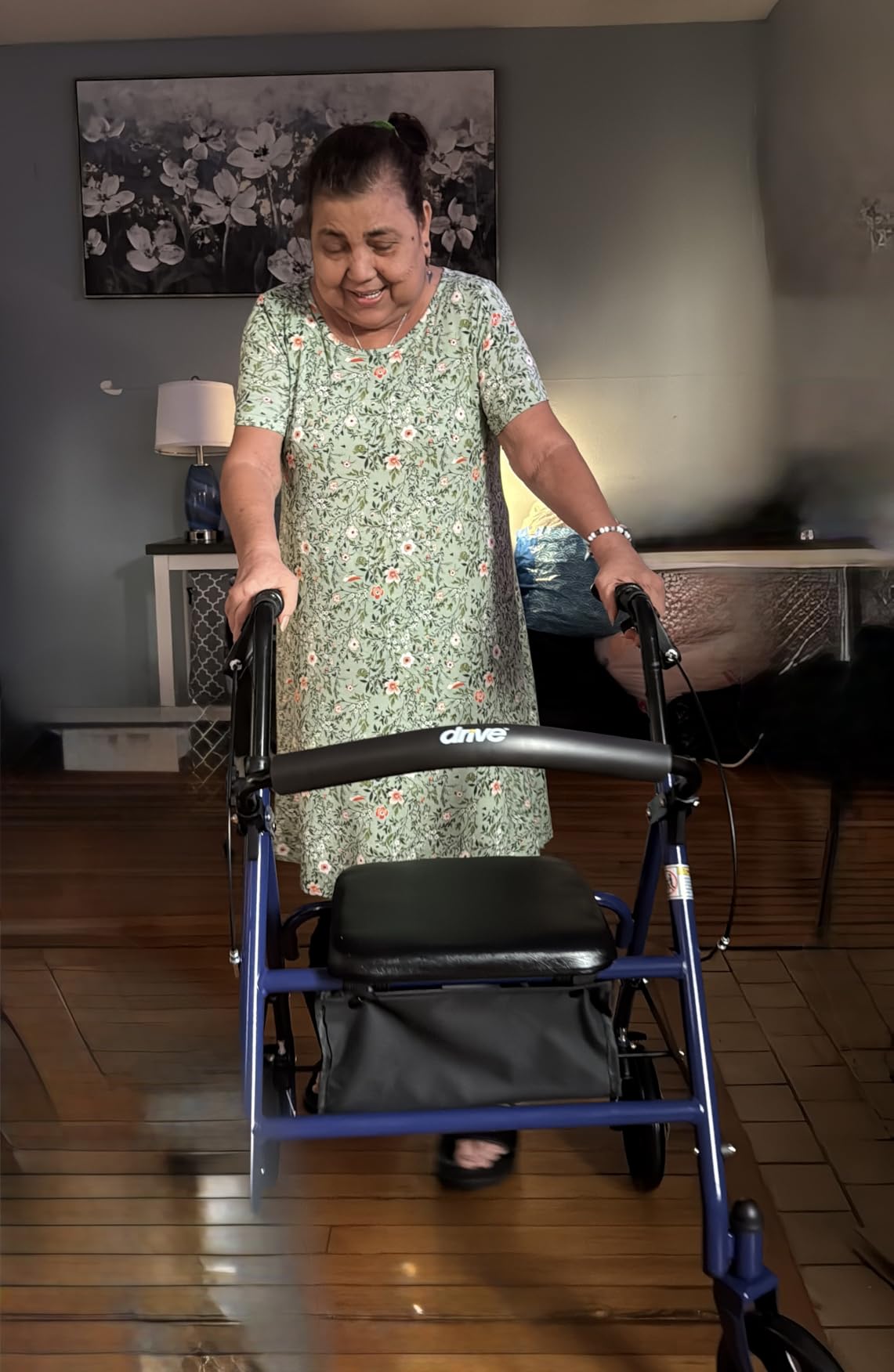
Steel frame versus aluminum: what actually changes
Steel is heavier, and that is the whole argument for aluminum. On this model the difference shows up when a caregiver tries to lift the folded frame into a car. Aluminum also flexes slightly under load, which some users read as a wobble; steel holds its geometry for years. If the rollator will live in one house and be pushed rather than carried, rigidity wins.
Wheel size, brakes and the fold-down backrest
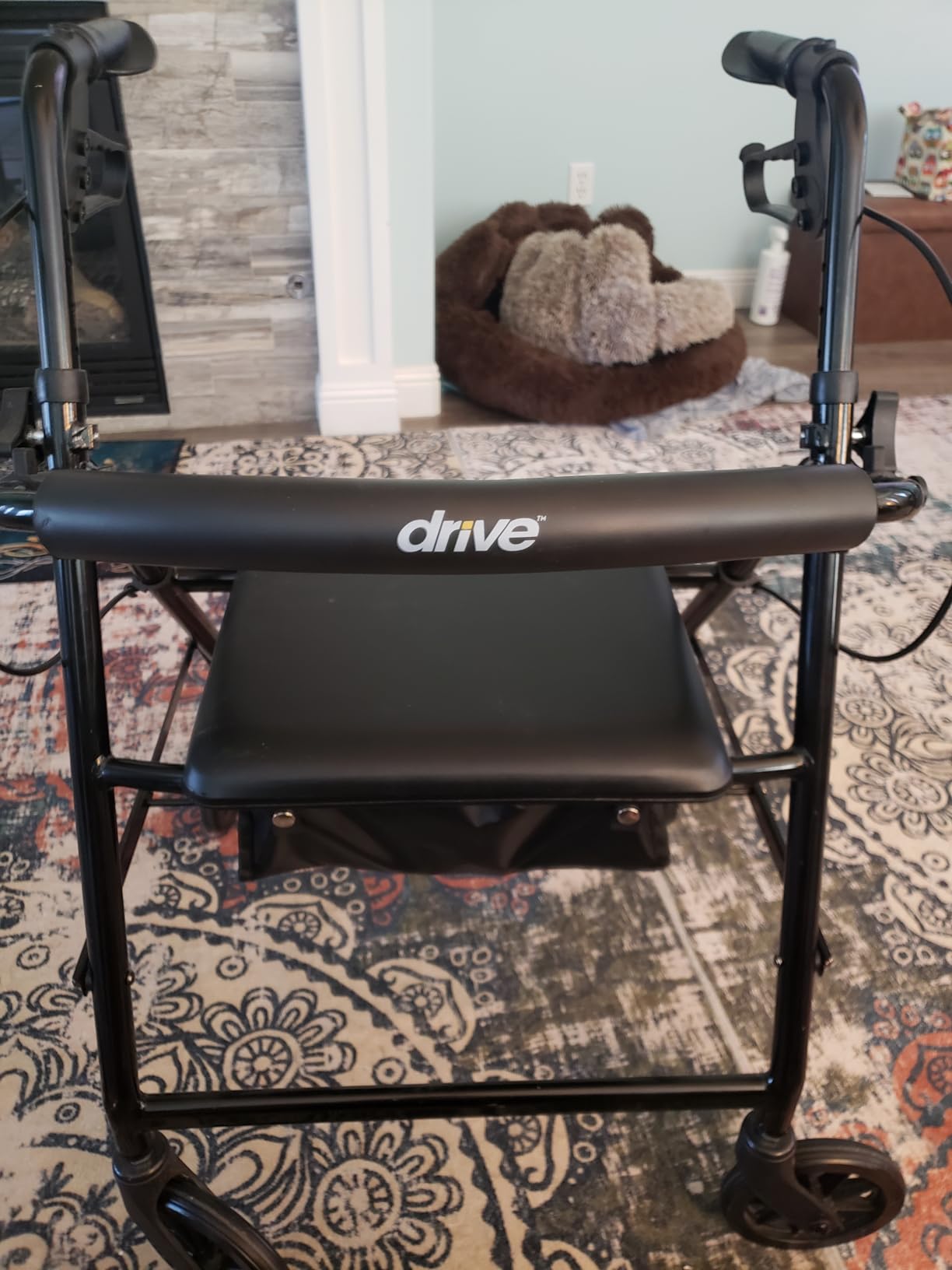
The locking hand brake is a squeeze-to-brake, push-to-lock design, and the loop shape is visible enough that a weak hand can find it. The backrest is a foam-covered tube that folds down when you fold the frame. Owners are consistent about it: fine for leaning back for a minute, not a chair for a long rest at a crowded event.
Who should buy this and who should not
Buy it if the rollator will be used mostly indoors and on decent sidewalks, the user is heavier or simply leans hard on the frame, and someone in the household can assist with car loading. Skip it if lifting 20 pounds is a genuine problem, or if rest breaks are long and frequent enough that a thin backrest will show up as hip and back discomfort after a few weeks.
2. Drive Medical Aluminum Rollator – The Lightest All-Round Pick and the Easiest to Load
Drive Medical Aluminum Rollator Walker, Padded Seat, 6-Inch Wheels, Blue
Aluminum frame
13 lb
300 lb capacity
6-inch wheels
14-inch low-profile seat
+ Pros
- Light enough for one person to lift into a car
- 4.7 star average across more than 7600 reviews
- Low-profile 14-inch seat clears tight doorways
- Arrives nearly assembled with only handles to fit
- Folds one-handed and stands upright when folded
- Cons
- 300 lb ceiling is low for a lighter frame
- No hands-free parking lock so the brakes are held squeezed
- Brake cables can catch on walls at the lowest handle setting
Among the aluminum frames in our set, this one carries the strongest rating, and the reason is not a single feature. It is that nothing about it is bad. At 13 pounds it is the kind of frame a spouse or an adult child can lift into a trunk without recruiting help, and that one property changes how often a person actually uses their rollator.
The 14-inch low-profile seat width is the other quiet advantage. Standard domestic doorways and most apartment hallways are narrower than people assume, and a narrow seat is the difference between a rollator that gets used in the apartment and one that lives folded in the hallway.
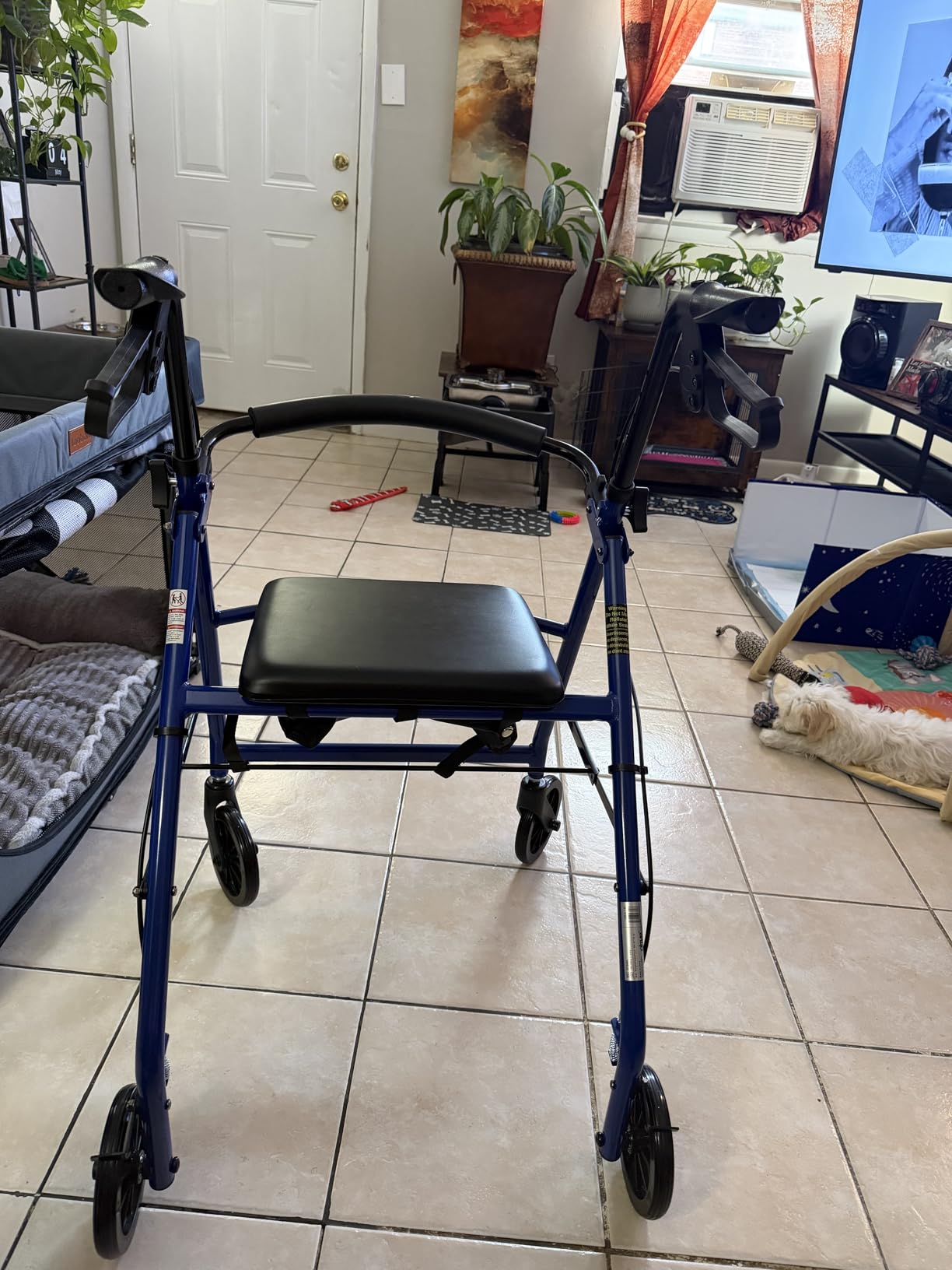
Owners repeatedly describe it as the best value they have found rather than the best rollator, and that framing is accurate. It does not have the largest wheels, the widest seat, or a hands-free brake lock. It just has very few weak points, and 82 percent of its reviews are five star.
The 300 lb limit and why the frame is built that way
The 300 lb rating is a direct consequence of the aluminum construction, not a quality judgement. Aluminum frame rollators in this class consistently top out between 250 and 300 pounds because the material has a lower load tolerance than steel. If the user is above that range, the extra pound of weight is worth paying to move up to a steel or reinforced frame.
Brake behaviour and cable slack on the lowest setting
There is no hands-free parking lock on this model, which means the brakes are held by keeping the levers squeezed. Owners who sit down often enough to find this annoying tend to move up to a 3-mode brake model. Separately, on the lowest handle setting the brake cables protrude enough that some users report catching them on walls while turning in tight spaces. Setting the handles a notch higher avoids it.
Where it beats everything else here
Short car trips, small apartments, smooth indoor floors, and users who are under 300 pounds. It is also the model I would hand to someone who has never used a rollator before, because it is light, narrow, forgiving and cheap to replace if it gets scuffed up.
3. VOCIC Z21 All Terrain Rollator – Built for Broken Pavement and Long Rest Breaks
VOCIC Z21 Rollator Walker for Seniors with Seat, 8″ All Terrain, 350 LBS
8-inch all-terrain tires
1.6-inch thick seat
350 lb capacity
3-mode brakes
22 lb frame
+ Pros
- 8-inch puncture-proof textured tires with rotating front wheels
- Thick waterproof seat that relieves hip pressure
- 3-mode brakes that are easy to grip for weaker hands
- Reflective strips on the wheels and bags for night visibility
- Cons
- Around 22 lb
- heavier than the aluminum models
- Sold in one configuration with limited sizing for very short users
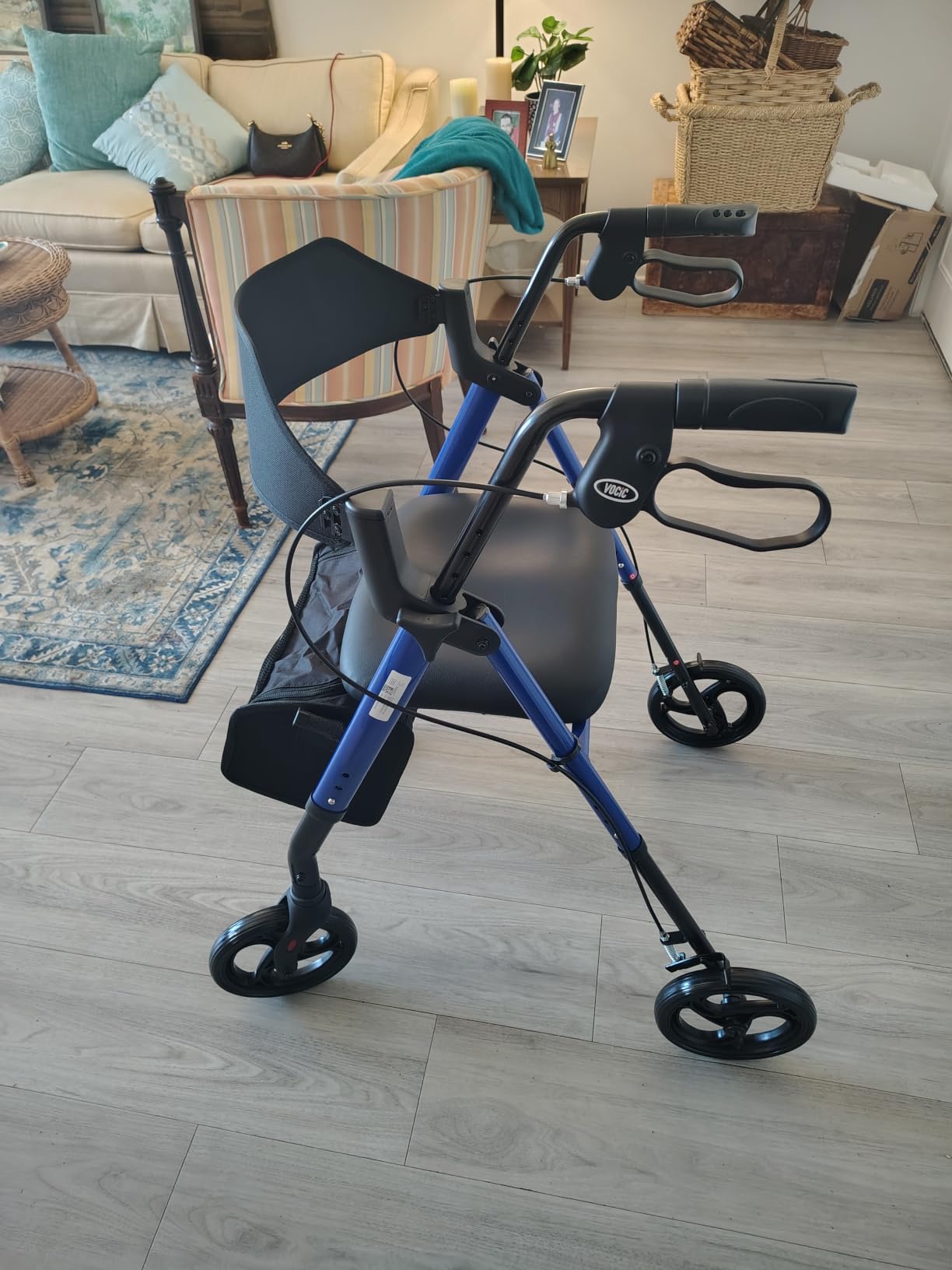
The 8-inch wheels are the headline, and for good reason. Small casters tear up on sidewalks and stall in cracks, which is the single most common terrain complaint in owner discussions. The textured, puncture-proof tires on this model are built for the parking lots, uneven pavement and grass strips that make a short errand a real outing.
The seat is the second headline, and it is the feature owners thank it for. At 1.6 inches thick and waterproof, it is roughly double the padding of a basic rollator seat, which matters because seat comfort rather than frame strength is what tends to fail first in long-term ownership.
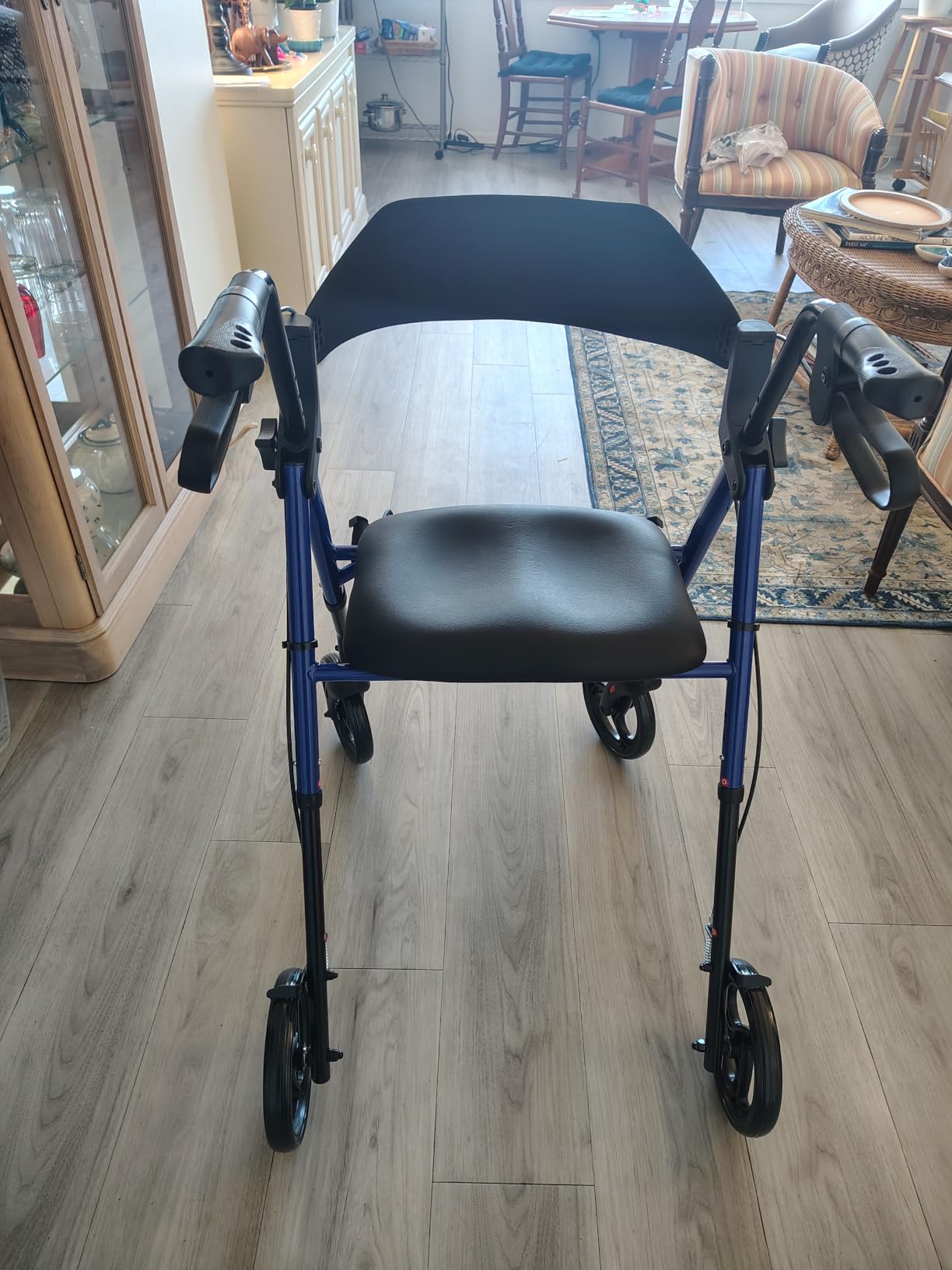
Brakes get a lot of attention here. The 3-mode system gives free rolling, deceleration and a locked state, and the 3-level seat height adjustment lets you set the seat rather than only the handles. A recommended user height of 4 foot 11 inches to 6 foot 3 inches covers most adults.
Why 8-inch wheels change the walking experience
Wheel diameter is not about speed. It is about what happens when a front caster meets a defect in the pavement. On a 6-inch wheel, a raised crack stops the rollator dead and tips the user forward. On 8 inches, the same crack is an event rather than a hazard. Users who switched up a size report the change as the difference between walking outside and staying indoors on bad-weather days.
The 3-mode brake and weak-hand grip
Each brake gives three distinct settings rather than two. The deceleration mode slows the rollator as you release, which matters on a slope. The lock mode is what you engage before sitting down. For arthritic hands this design is a real improvement, and it is the type of detail that rarely appears on a spec sheet for cheaper models.
Who accepts the 22 lb trade-off
Choose this if the route outside is rough, rest breaks are long and frequent, or the user has reduced hand grip. Do not choose it if car loading is a daily task done by a small caregiver, because at roughly 22 pounds it is one of the heavier frames in this roundup and there are lighter options that handle smooth ground well.
4. Drive Medical Nitro Euro-Style Rollator – The Top Rated for Curbs and Tight Corners
Drive Medical RTL10266 Nitro Euro-Style 4-Wheel Rollator with Seat, Red
10-inch front casters
17.5 lb
One-hand fold with lock
Push-button handles
+ Pros
- Best rating in this roundup at 4.8 stars with 89 percent five-star ratings
- 10-inch casters glide over curbs and rough ground
- Push-button handle height and tool-free backrest adjustment
- One-hand fold with a locking mechanism that holds it closed
- Cons
- The most expensive model we tested
- Higher cost and weight than entry-level aluminum rollators
This is the best-rated rollator in our set, and the rating is not close. Nearly 6,800 reviews at 4.8 stars with 89 percent five-star is the sort of consistency you rarely see in a category where people are buying medical equipment and expecting disappointment.
The 10-inch front casters are the mechanical explanation. They lift over curbs and tree roots without a jolt, and the rear wheels follow tightly enough that the frame pivots well around furniture and in tight corners. Maneuverability is where the premium shows up every single day.
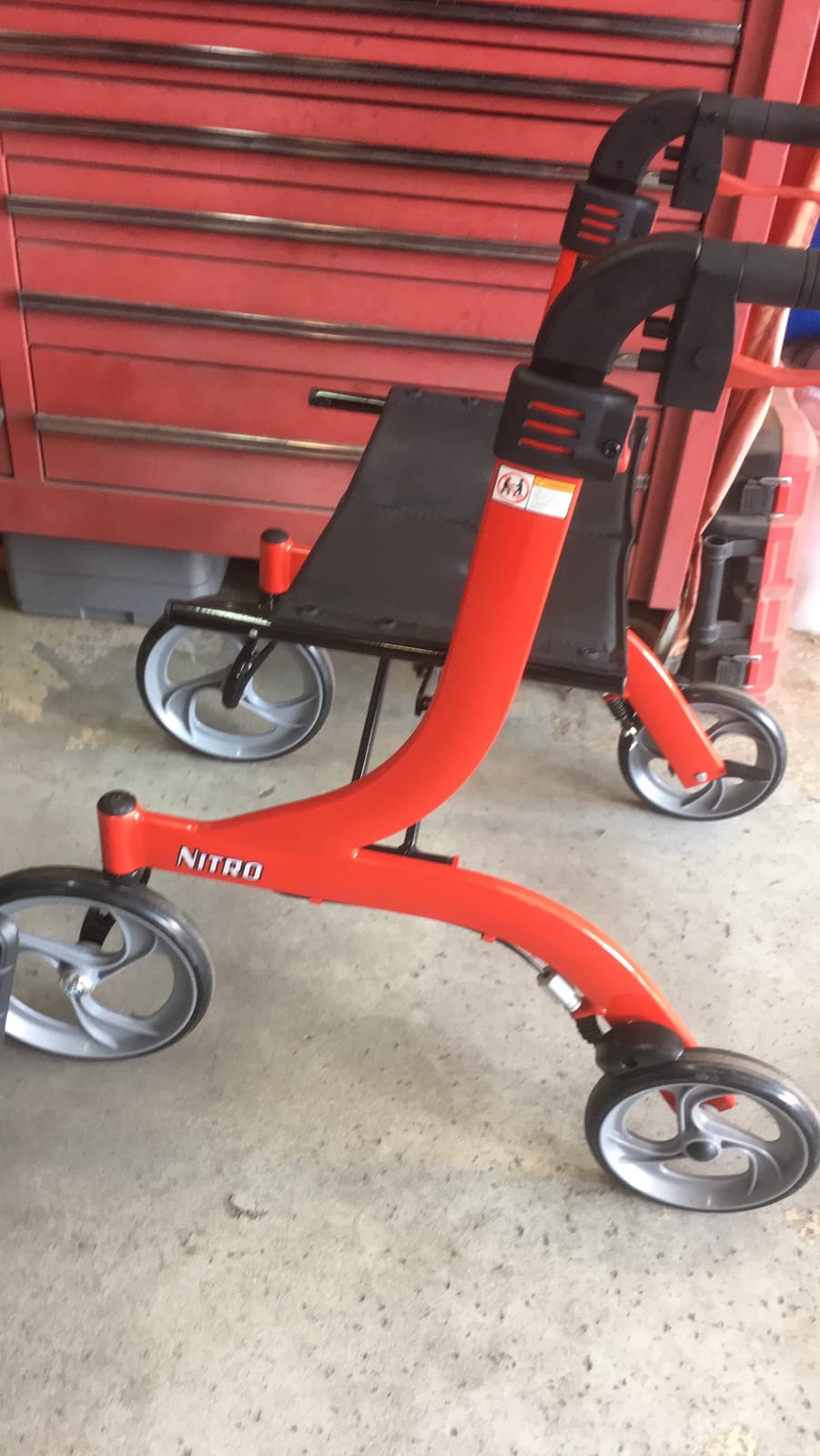
The euro-style frame is also a design choice as much as a mechanical one. Owners who bought it frequently say they chose it because it does not look like clinical equipment, and that matters more than it sounds when someone is resisting the idea of using a walking aid at all.

Adjustment mechanisms that take the guesswork out
Push-button handle height means you press and slide rather than fishing for a lever with stiff fingers. The backrest adjusts with a tool-free thumb screw, so it can be repositioned for a taller user without a screwdriver. Both of these sound minor until you are setting a rollator up for someone with limited hand strength.
The fold that stays folded
The one-hand fold uses a locking mechanism underneath the seat that holds the frame closed. That detail is the difference between a rollator that fits in a trunk and one that springs open every time you lift it. The removable zippered bag keeps a purse or wallet from bouncing loose on the frame.
Who should pay the premium
This suits users who are confident, active outdoors, and doing curbs and uneven ground on a regular basis, and who will be bothered by a clinical-looking frame. It is a harder sell for indoor-only use on smooth floors, where the extra capability is simply never used.
5. Medline Steel Rollator – The Workhorse Rated to 350 Pounds
Medline Steel Rollator Walker with Seat, Burgundy, 350 lb. Weight Capacity, 6” Wheels, Foldable, Adjustable Handles, Rolling Walker for Seniors, Walker for Mobility Impaired
350 lb steel frame
16.5 lb unit weight
12 x 12 inch padded seat
6-inch wheels
31-35 inch handles
+ Pros
- Steel frame rated to 350 lb for heavier users
- Ergonomic loop brakes designed to be easy on fragile hands
- 12 x 12 inch padded seat and backrest with storage
- Handle height adjusts through a 4 inch range
- Cons
- Steel construction makes it heavier than aluminum equivalents
- 12 x 12 inch seat is small next to wide-seat models
With 350 pounds of rated capacity on a steel frame, this is the practical answer for a user who is heavier than the 300-pound ceiling that aluminum models hit. It stays the most reviewed steel rollator in the category at more than 25,000 reviews, and the 4.5 star average reflects a product with no real gimmick and no real weakness.
The brake handles are the detail seniors notice first. The loop style sits naturally inside a closed hand, and the push-up-to-brake, push-down-to-lock action means the user never has to look down to find the lever. Buyers with arthritic hands single this out repeatedly as a reason the model works for them.
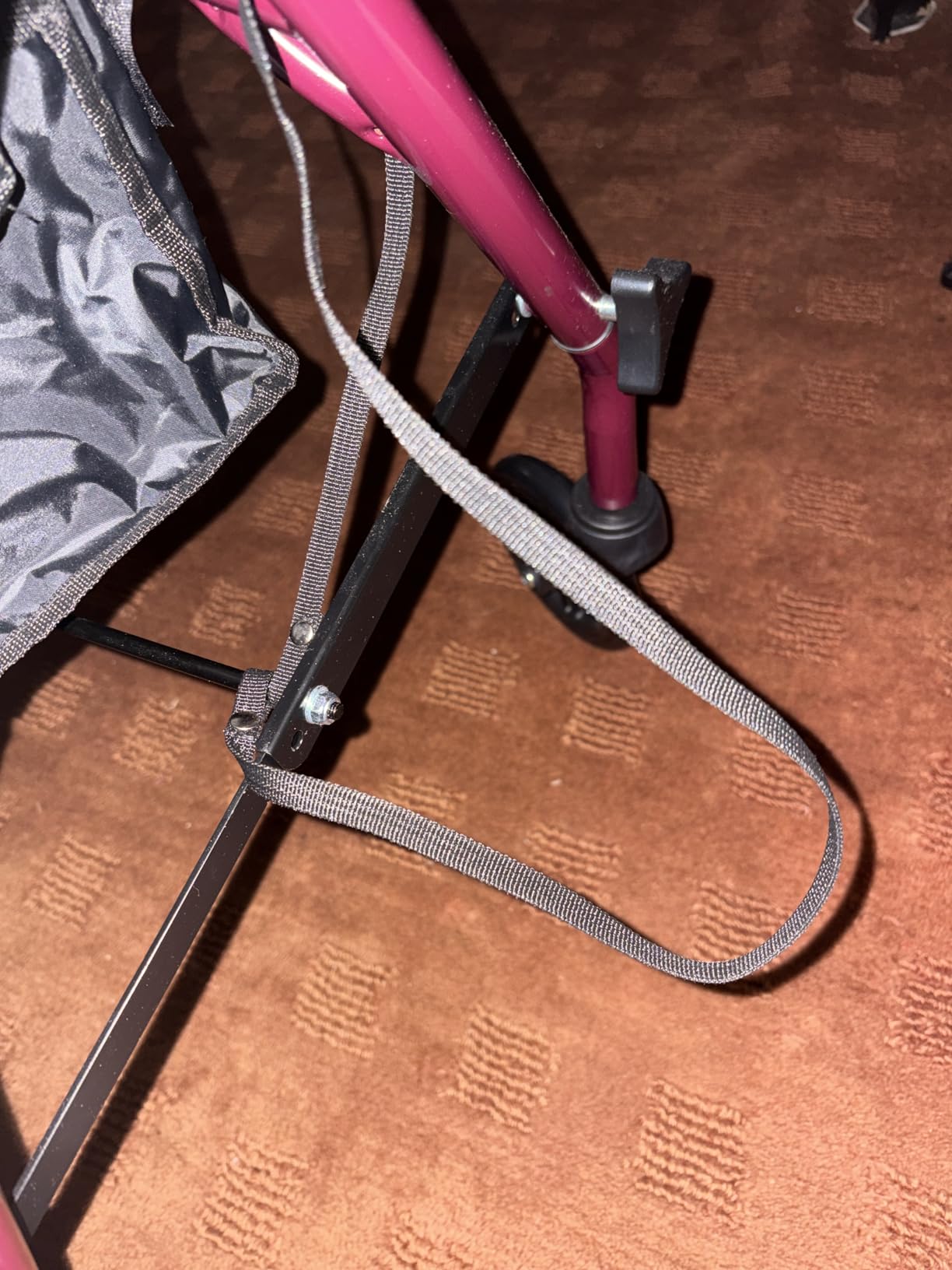
At 16.5 pounds it is a full three pounds lighter than the comparable steel model at the top of this list, and the 31 to 35 inch handle range covers a lot of adults. The padded seat and backrest are basic but adequate for a rest of a few minutes rather than a long sit.
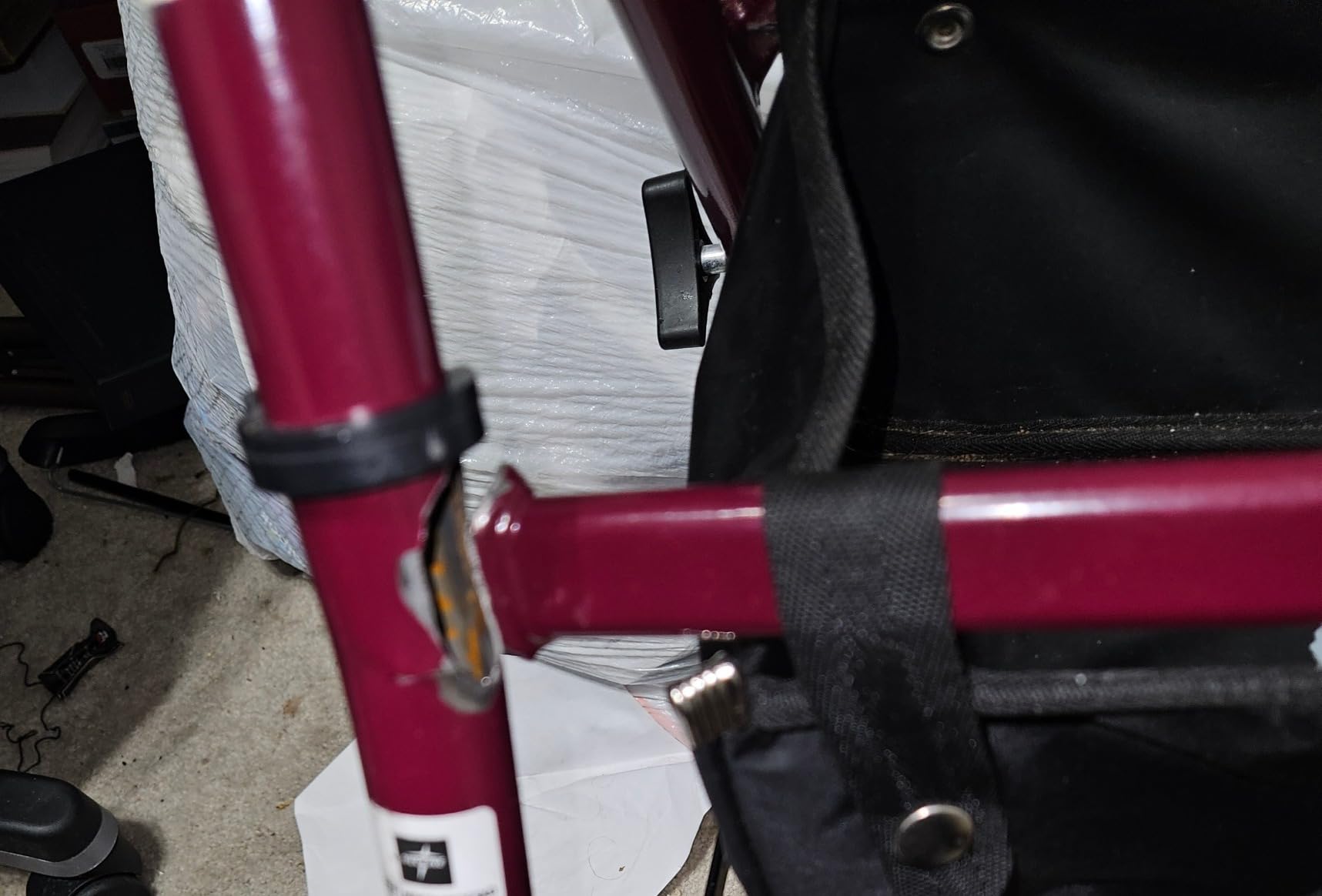
What 350 pounds of capacity really buys
Rated capacity is a frame limit, not a comfort target. A rollator loaded near its maximum will feel less stable and can bottom out on the folding mechanism, so the useful rule is to buy a frame rated meaningfully above the user weight. At 350 pounds this model covers users who need a steel frame without crossing into the reinforced heavy-duty category.
Six-inch wheels and where they fall short
These wheels are the budget end of the scale. They are smooth on carpet, hardwood, and short runs of decent sidewalk, and they are what keeps the weight down. On cracked asphalt, gravel or parking-lot seams, expect the same catching and stalling that smaller wheels produce on any model.
Who this is the right pick for
A user above 300 pounds, or anyone who prefers a rigid frame over a light one. It is a good fit for indoor and neighborhood use with a caregiver who can assist with loading. It is not the choice for heavy-duty outdoor terrain or for a user who needs a wide seat to sit comfortably for extended periods.
6. HOMLAND Rollator with 16 Inch Extra-Wide Seat – Built for Wider Bodies and Shorter Users
HOMLAND Foldable Rollator Walker with Seat for Seniors, 16″ Enlarged Seat
16 x 12 inch seat
22-inch frame
Fits 4 ft 7 in to 6 ft 6 in
8-inch wheels
Lifetime frame warranty
+ Pros
- Extra-wide 16 x 12 inch seat with 1.6 inch cushioning
- Tri-angle frame geometry reduces wobble and flex
- Widest height adjustment range we found
- covering 4 ft 7 in to 6 ft 6 in
- Pinch-proof folding mechanism protects fingers
- Cons
- 20.4 lb is heavy for car loading
- A 22-inch wide frame is awkward in tight indoor spaces
Two numbers define this model: a 16 by 12 inch seat and a height range that starts at 4 foot 7 inches. That lower bound is the widest we found across the whole roundup, and it matters because a rollator sized for a 5 foot 5 inch user can leave a 4 foot 9 inch user unable to plant their feet when they sit down.
The 22-inch frame width and the 1.6 inch cushion are the bariatric-leaning features without the extreme weight of a true heavy-duty steel frame. The reinforced tri-angle geometry and dual front supports were added specifically to cut the wobble that wide frames usually develop.
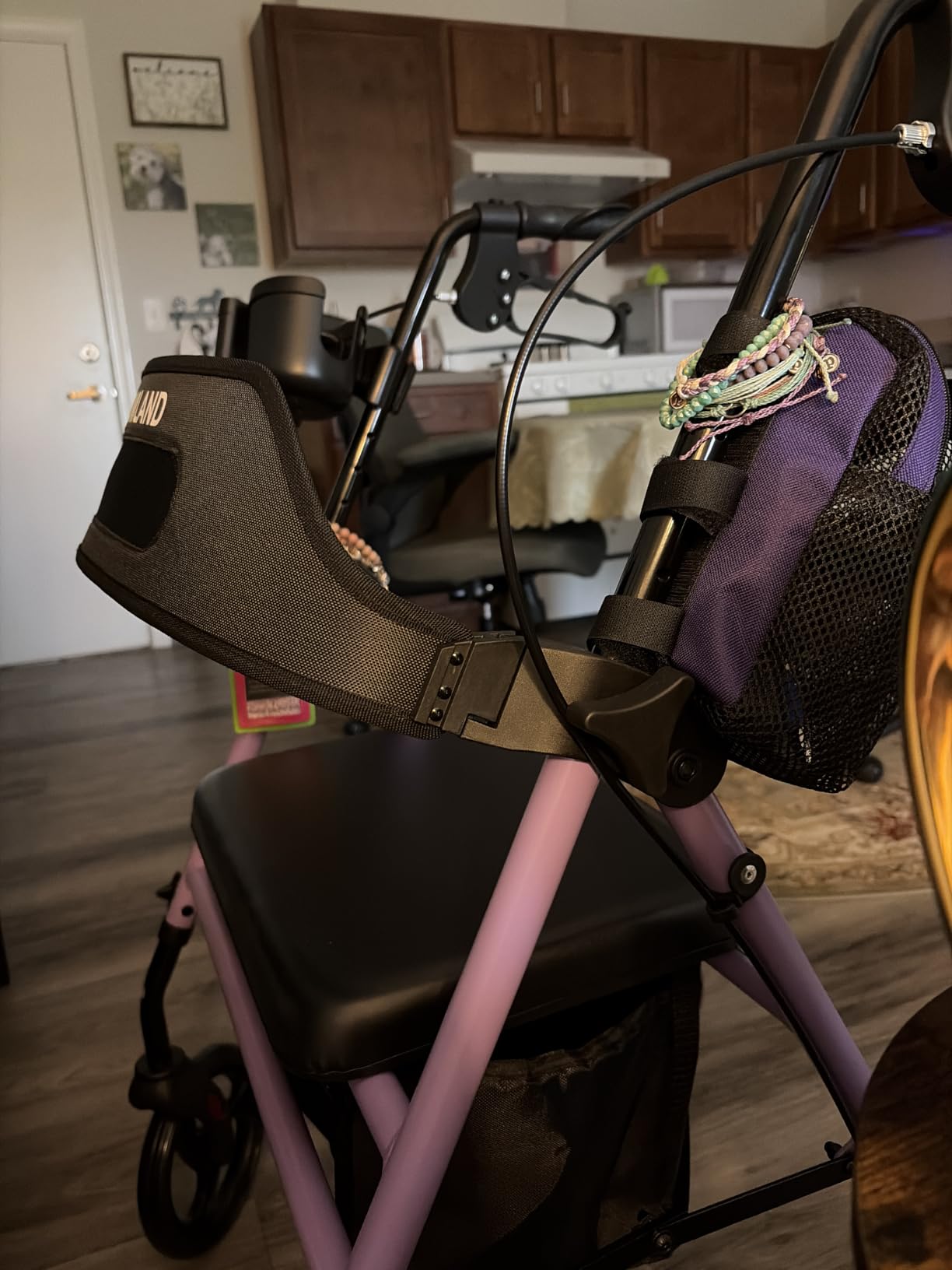
The lifetime warranty on the metal frame is unusual in this price bracket and is backed by US-based support, which matters more than it sounds when something needs replacing at month ten.
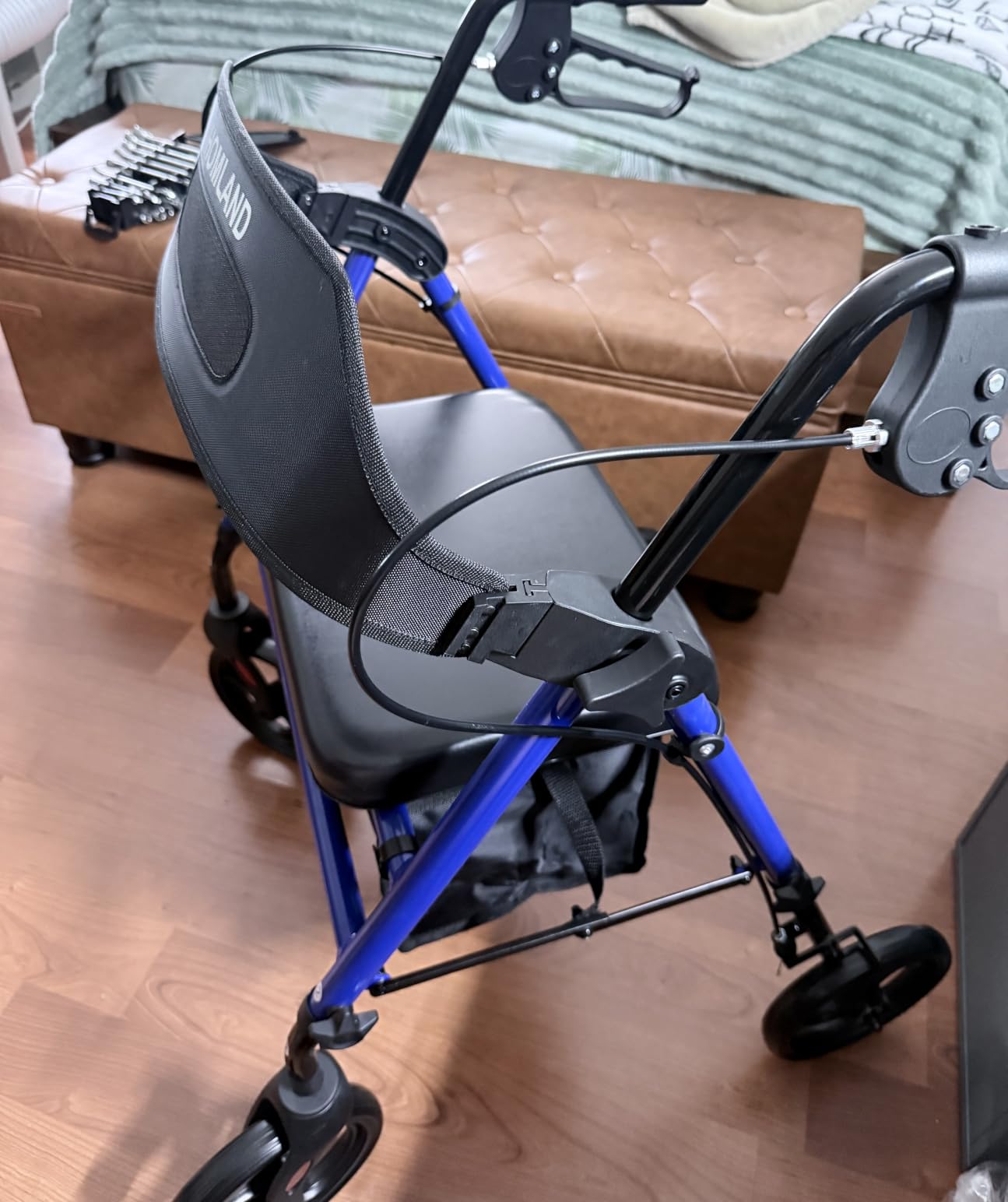
Seat width as a comfort and safety issue
A narrow seat is not just uncomfortable, it changes how a user sits. On a 12 by 12 inch seat, a larger user sits with their weight forward and their back against nothing. On a 16 by 12 inch seat they sit back into the frame, take weight through the backrest, and can stay for a longer rest. For anyone who tires quickly, seat width is a comfort feature with a safety dimension.
The 8-inch wheels and the height range
The 8-inch puncture-proof wheels clear standard thresholds better than 7-inch casters, which is a meaningful upgrade for anyone whose home has a raised front sill. The five-level handle and three-level seat adjustment covering 4 foot 7 inches through 6 foot 6 inches is the widest range in this group and covers nearly every adult, including petite users who are usually squeezed out.
The cost of width
At 22 inches across, this frame will not slip past every interior doorway, and users in small apartments should measure first. The 20.4 pound weight also puts it among the heavier options. Both are reasonable prices for a wide seat and a very broad fit range, but they are not free.
7. Medline Premium Empower Rollator – The Chair-Style Seat for Long Sits
Medline Premium Empower Rollator Walker with Seat, Folding Rolling Walker with 8-inch Wheels, Silver
Memory foam seat
Flip-down backrest and armrests
8-inch wheels
Seat-latch step-in
+ Pros
- Extra-wide memory foam seat with armrests for long rests
- Reversible backrest lets a companion push while the user faces forward
- Seat latch lifts the seat to reach counters and sinks
- 8-inch rubber wheels roll quietly and do not pick up outdoor dirt
- Cons
- Heaviest and most awkward to lift when folded
- Rear stance is nearly 27 inches wide so measure doorways
- Seat latch release is stiff at first
This is the closest thing in the roundup to an actual chair, and that is its entire argument. The extra-wide memory foam cushion, the armrests, and the flip-down backrest mean a user can sit through a long wait, a long appointment, or a family event without the hip and lower-back ache that a basic sling-style seat produces after ten minutes.
The seat-latch step-in is the feature that surprises people. Lift the seat and the storage bag slides forward, and the user can walk up to a counter, a sink, or a table inside the frame. For anyone whose day involves standing at a counter, that removes a specific and exhausting problem.
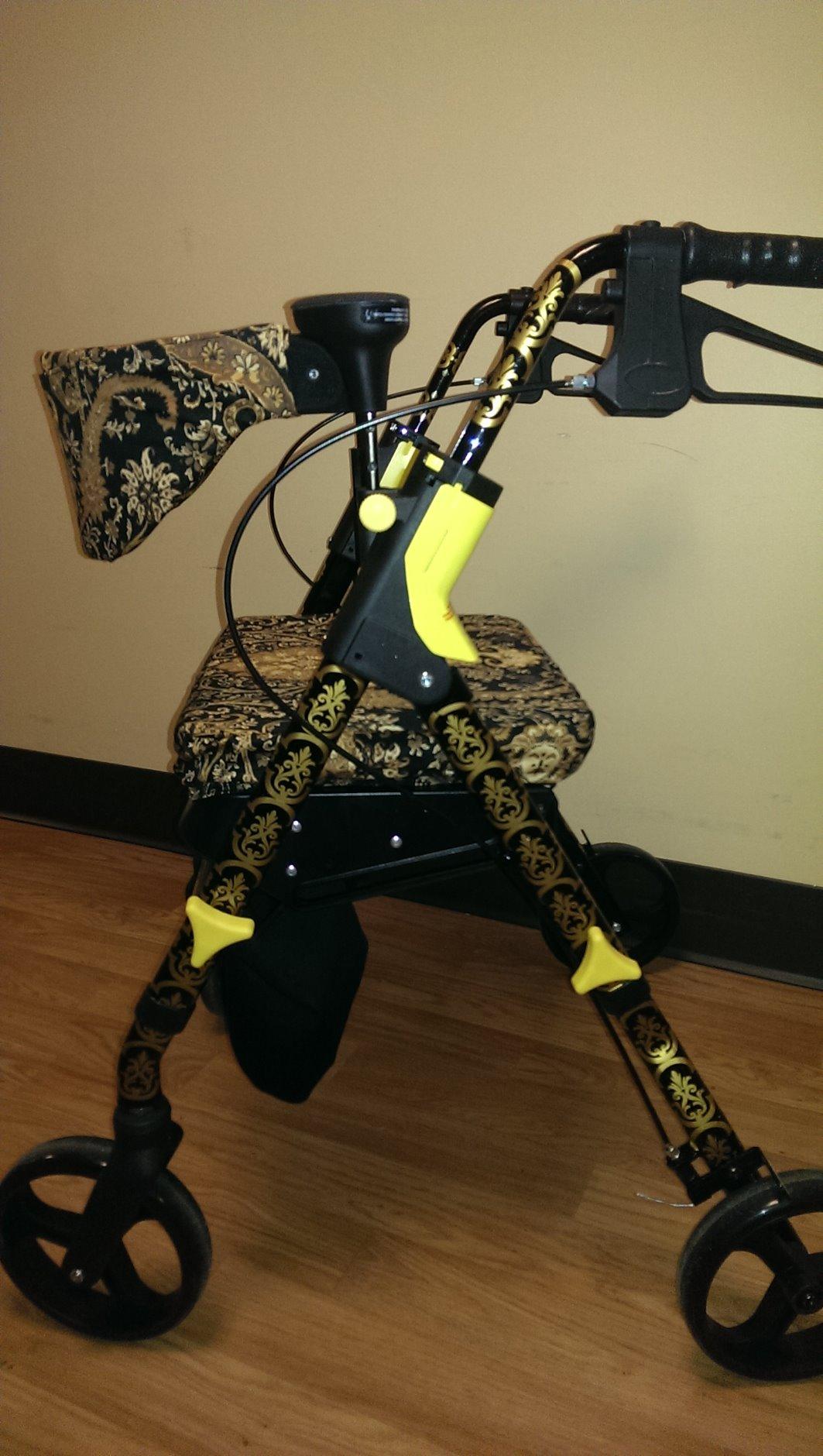
The reversible backrest answers the question of what happens when the user tires in the middle of a street and needs to be pushed rather than push. Flip the backrest and a companion can push the rollator with the seated user facing forward.
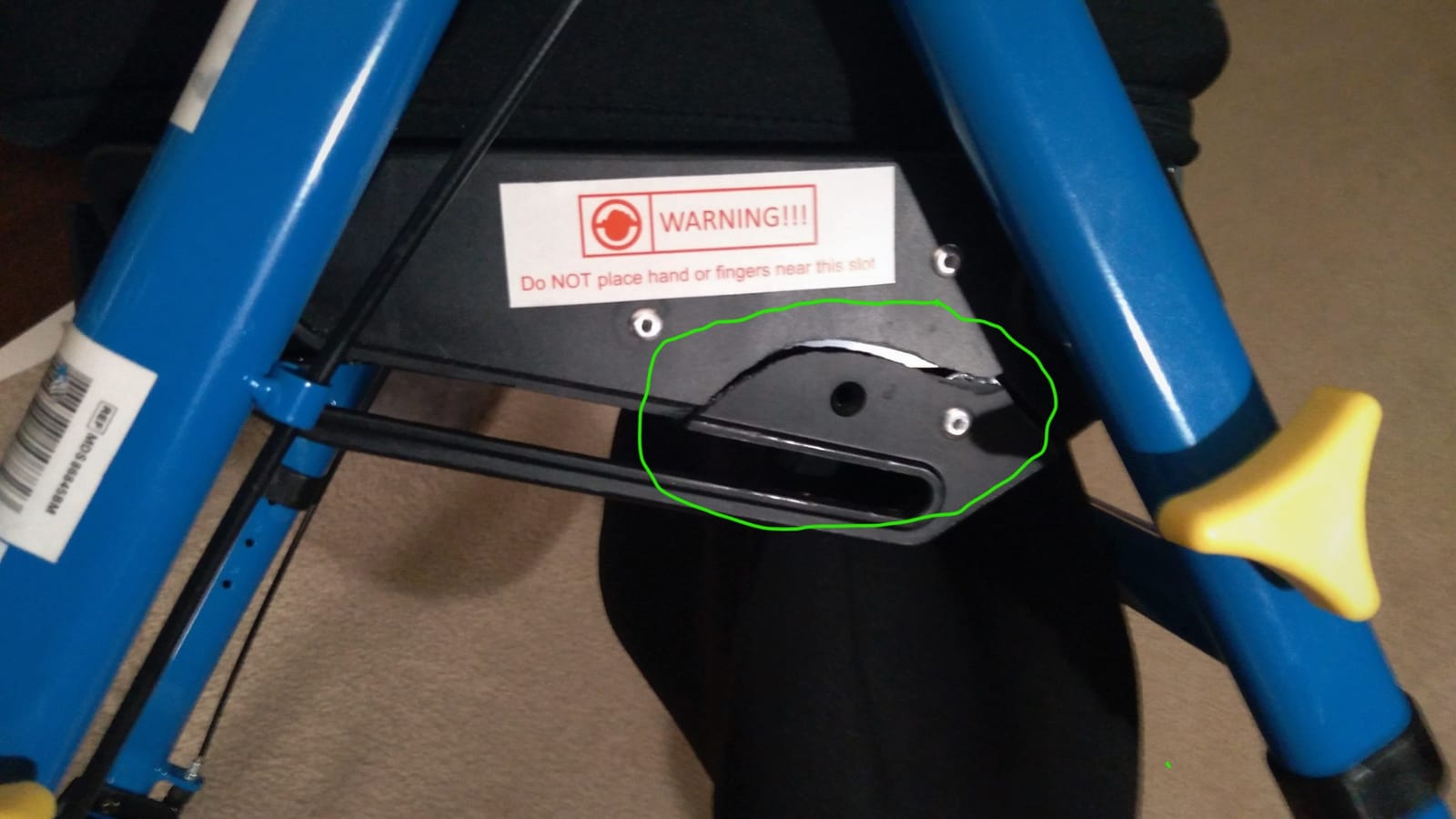
Why the armrests matter more than they look
Armrests give a user something to push down on when standing up and something to hold when sitting down. On a plain sling seat, the only leverage for standing is the seat edge itself, which is exactly where hip and knee strength is weakest. The armrests transfer that effort to the frame.
Honest drawbacks: bulk, width and a stiff latch
This is the heaviest and most awkward model here, and the rear wheel stance sits just under 27 inches wide. Users in narrow hallways should measure before ordering. The seat latch needs a deliberate push to release, which makes the first few folds awkward, and the cup holder is sized for a coffee cup rather than a sports bottle.
Who should choose it
Pick this if rest breaks are long, the user is often tired while out in public, or standing at counters is part of the daily routine. Skip it if car loading is a solo task for a small caregiver, or if the home has doorways narrower than 27 inches.
8. PLANET WALK Super Lightweight Rollator – Thirteen Pounds and a Modern Look
PLANET WALK Super Lightweight Rollator Walker for Seniors, Foldable Rolling Walker with Seat and 8″ Rubber Wheels for All Terrain, Unique Design Aluminium Frame Sturdy Walkers for Traveling – Blue
13 lb aluminum frame
18.5-inch wide seat
8-inch rubber wheels
Folds one-handed
Detachable frame
+ Pros
- Exceptionally light at 13 lb
- roughly half of most competitors
- Stylish design that owners say makes them feel less like a patient
- 18.5-inch seat gives feet room and avoids a cramped feel
- Detachable frame and handles reduce the folded size for trunks
- Cons
- Seat sits high so shorter users may not reach the floor
- Untreaded wheels can slide when braked on smooth floors
- Backrest is soft with limited support
Thirteen pounds is roughly half the weight of most of this roundup, and buyers who came from 15 to 21 pound rollators describe the difference as life-changing for car loading. It is the model most likely to be lifted into a trunk by a single person without a second pair of hands.
The design is a deliberate choice too. Owners across ages say the modern styling makes them feel less like a patient, and in a category where appearance is one of the biggest adoption barriers, that is not a cosmetic detail.
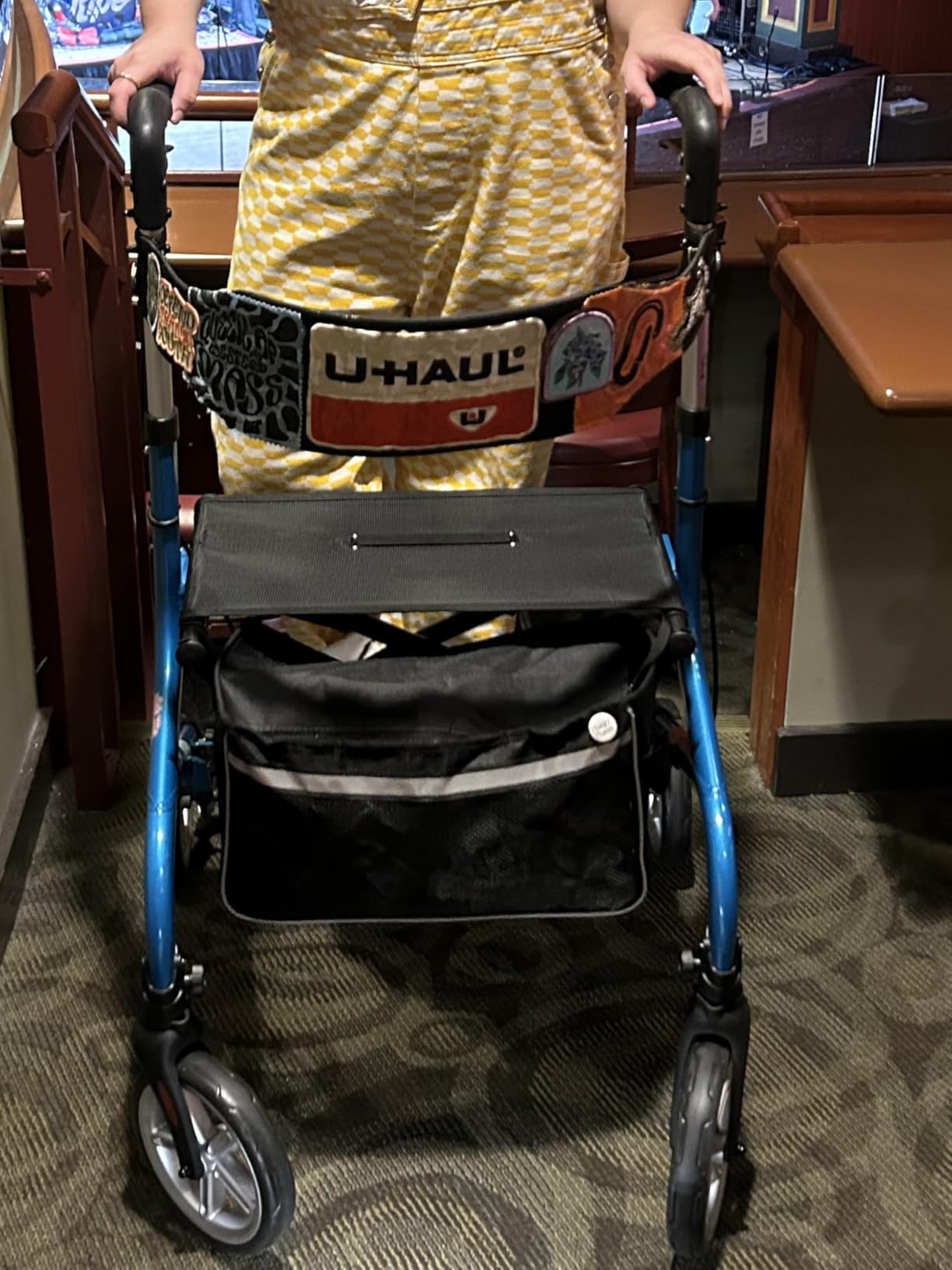
The 18.5-inch seat is unusually wide for a frame this light, which means feet reach the floor and knees have room to angle. The 8-inch rubber wheels roll well over carpet, garden paths and moderately rough ground.
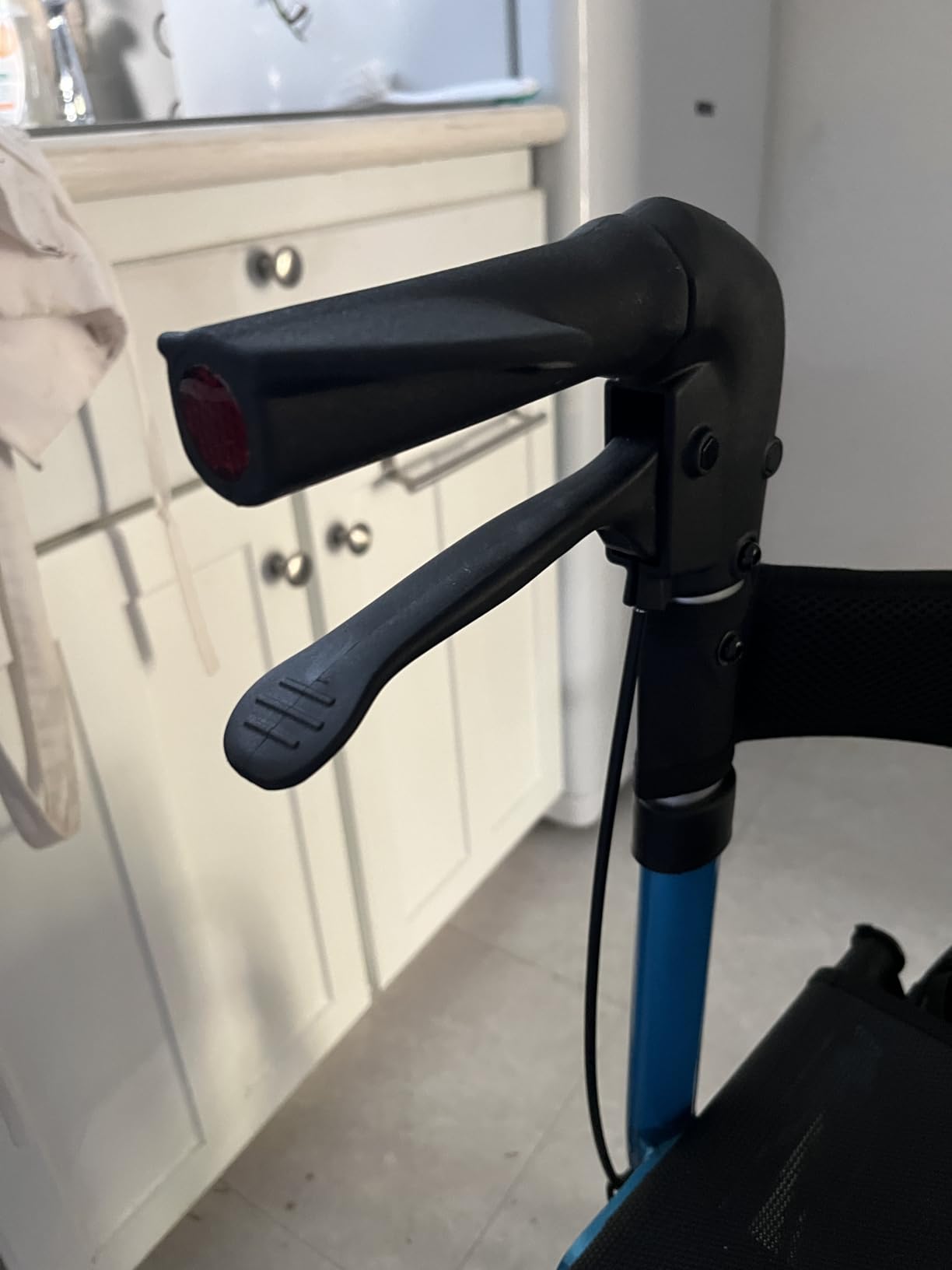
The seat height problem for shorter users
This is the one complaint that comes up repeatedly. Users around 5 foot 2 inches and below report their feet barely touch the floor, which is a genuine functional problem rather than a preference, because you cannot stand up from a seat you cannot push off. If the user is short, check the seat height before committing to this frame.
Wheel tread, backrest support and the brakes
The rubber wheels have no tread pattern, so on smooth indoor floors the brakes can still slide a little under load. The backrest is soft and offers limited support when the user leans back, and the seat itself is not padded, which limits rest breaks to short pauses. The detachable frame is what saves it on the car, reducing the folded profile further.
Who this suits
Good for a user who travels alone, loads their own rollator, and wants something that does not look like medical equipment. Less suitable for a shorter user, a heavier user, or anyone who plans to sit for extended periods on it.
9. MAXWALK 12 Inch All Terrain Rollator – The Biggest Wheels in the Roundup
MAXWALK Rollator Walker for Seniors with Seat, 12″ All Terrain Wheels, Gold
12-inch front and 10-inch rear wheels
Routed brake cables
20.3 lb aluminum frame
18-month warranty
+ Pros
- Largest wheels we found for gravel
- grass and broken pavement
- Anti-skid tread improves grip when braking
- Brake cables routed through the frame to avoid tangling and tripping
- Padded seat and backrest with cup and cane holders
- Cons
- 20.3 lb is heavy for loading
- A 30.7-inch open footprint is tight for small doorways
- Handle range fits users 5 ft to 6.5 ft only
If the question is what rolls over the worst ground, this is the answer. Twelve-inch front wheels and ten-inch rear wheels with a non-slip tread pattern handle gravel, grass, concrete and genuinely bumpy roads better than anything else in the roundup, and the difference in confidence on a rough path is immediate.
The routed brake cables are the detail that shows actual design thinking. On most rollators, the cables run loose along the frame and can catch on the user, snag underfoot, or be clipped by a doorway. Running them through the frame removes that class of problem entirely.
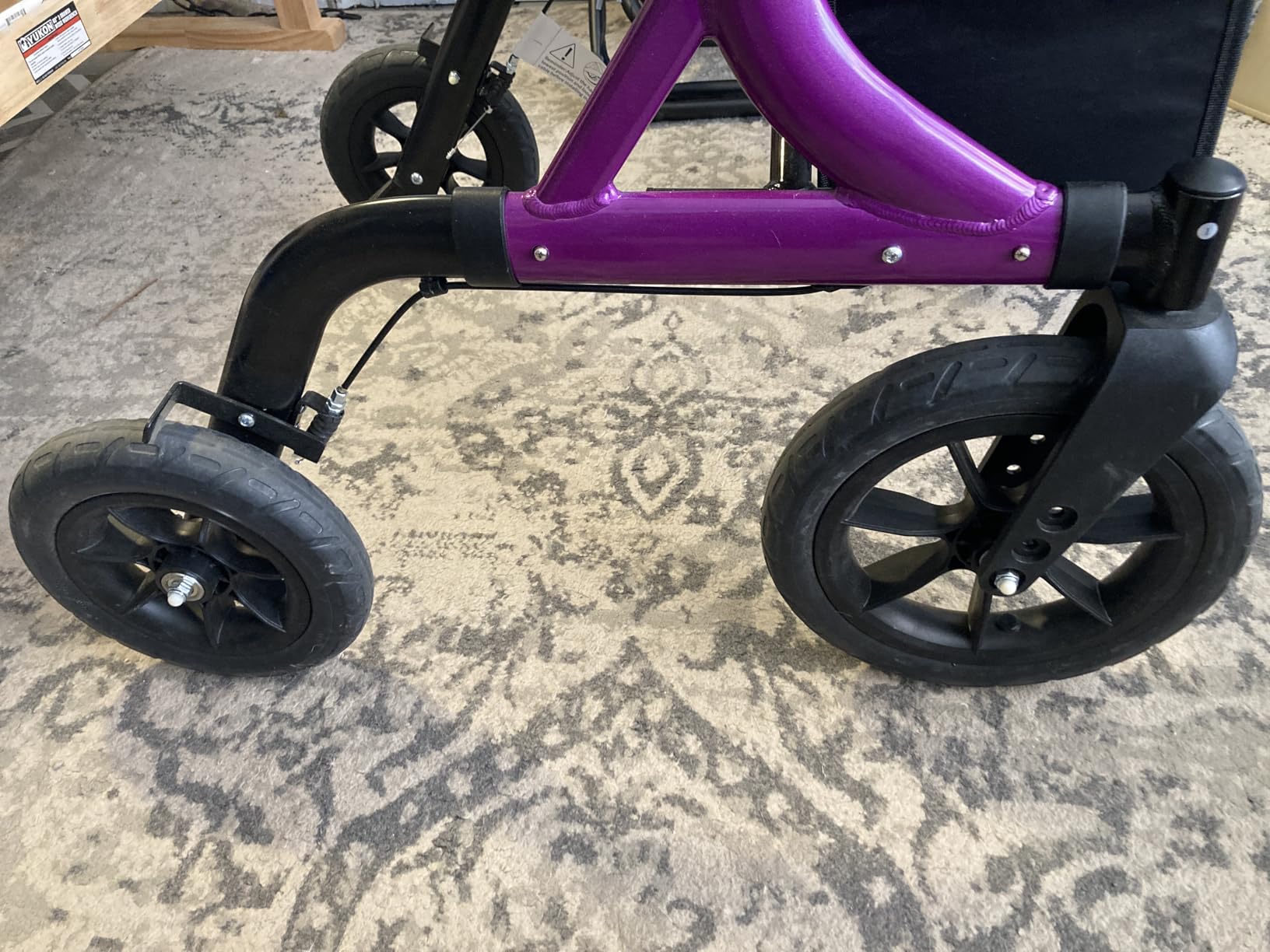
Warranty is a real 18 months with lifetime support behind it, which is longer than most competitors in this list offer and longer than many people actually use their rollator before replacing it.
What 12-inch wheels buy you on a gravel path
Bigger wheels do two things. They roll over obstacles that would stop a small caster, and they keep the frame moving when the surface breaks loose under the tire. On a path that is flat concrete one day and loose gravel the next, that is the difference between a walk and an obstacle course. The trade-off is the 20.3 pound weight and a 30.7-inch open footprint that is genuinely wide.
Handle range and who it excludes
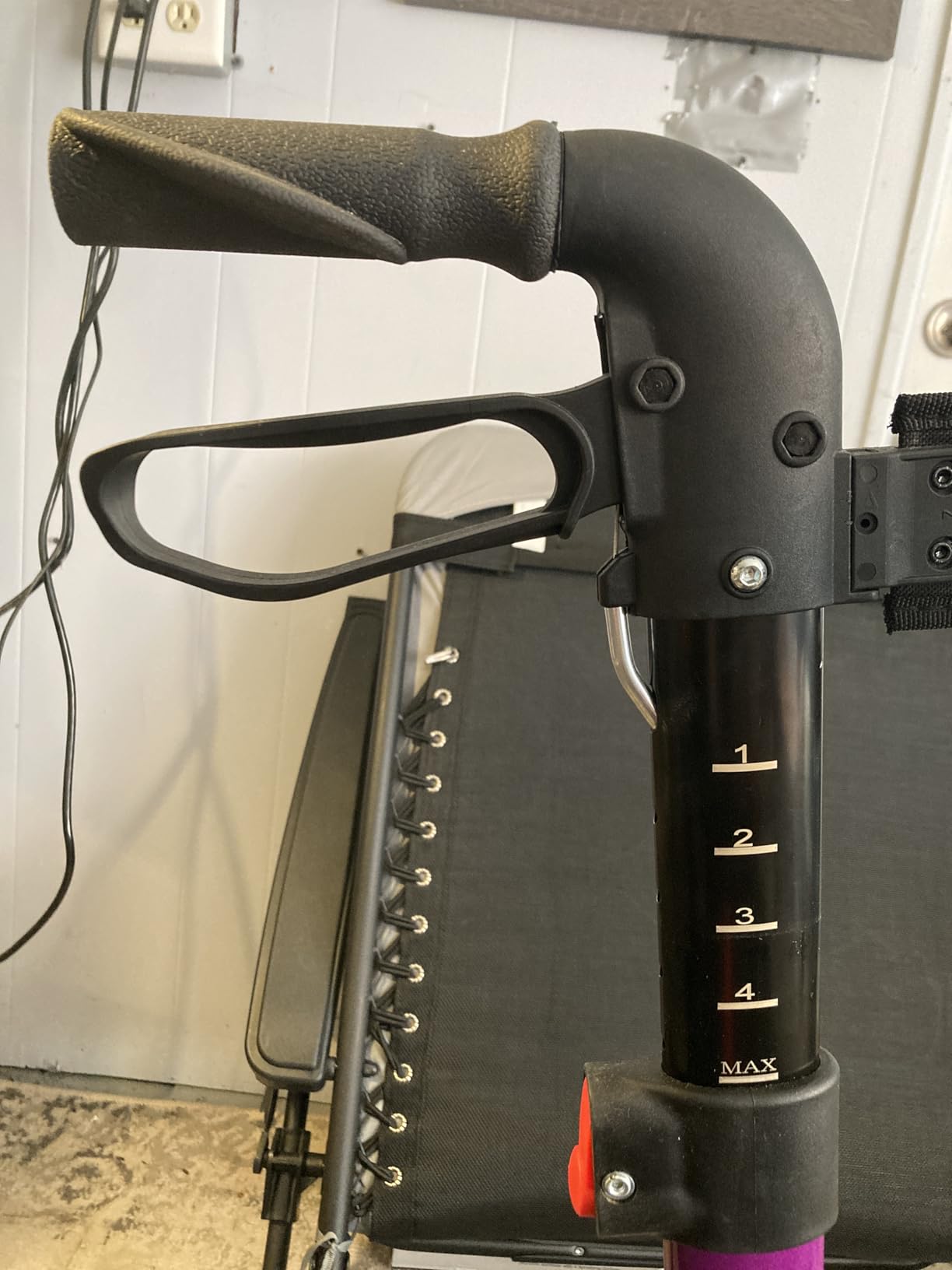
The five-level handle adjustment runs from 33.5 to 37.4 inches, which suits users between 5 feet and 6 feet 6 inches. Anyone shorter or taller needs a different adjustment range, and it is worth checking the user’s height against the spec before ordering. The removable cup holder and cane holder are practical additions for a user carrying a cane.
Who should buy the big-wheel model
Users who walk on gravel paths, uneven park trails, and rural or suburban routes with rough shoulders. Not ideal for a small apartment, a sedan trunk, or a user outside the 5 to 6.5 foot range. The height check is the first thing to do with this one.
10. Stander Space Saver Rollator – Folds Down to Ten by Eleven Inches
Stander Space Saver Rollator, Lightweight Folding Rolling Walker with Seat for Seniors & Adults, 4-Wheel Mobility Aid with 6-inch Wheels, Locking Brakes & Padded Seat with Backrest, Cobalt Blue
Folds to 10 x 11 inch footprint
Arrives pre-assembled
14.5 lb aluminum frame
18.5 x 6 inch perch seat
250 lb capacity
+ Pros
- Smallest folded footprint we found
- at 10 x 11 inches
- Arrives fully assembled with nothing to set up
- Light 14.5 lb aluminum frame
- Handles adjust from 33 to 36 inches with padding
- Cons
- Perch seat is only 18.5 x 6 inches and meant for short rests not long sitting
- 250 lb rated capacity suits lighter users only
- 6-inch wheels struggle on rough ground
This is the travel answer. The patented folding design collapses the frame into a 10 by 11 inch footprint, which is roughly the size of a carry-on case and small enough for a cruise cabin, an overhead bin, or the trunk of a very small car. No other model here comes close on packed size.
It also arrives fully assembled. There is no frame to bolt together, no handle to fit, and no instructions to misread, which matters enormously when the rollator is being shipped directly to an older adult who will not be assembling anything.
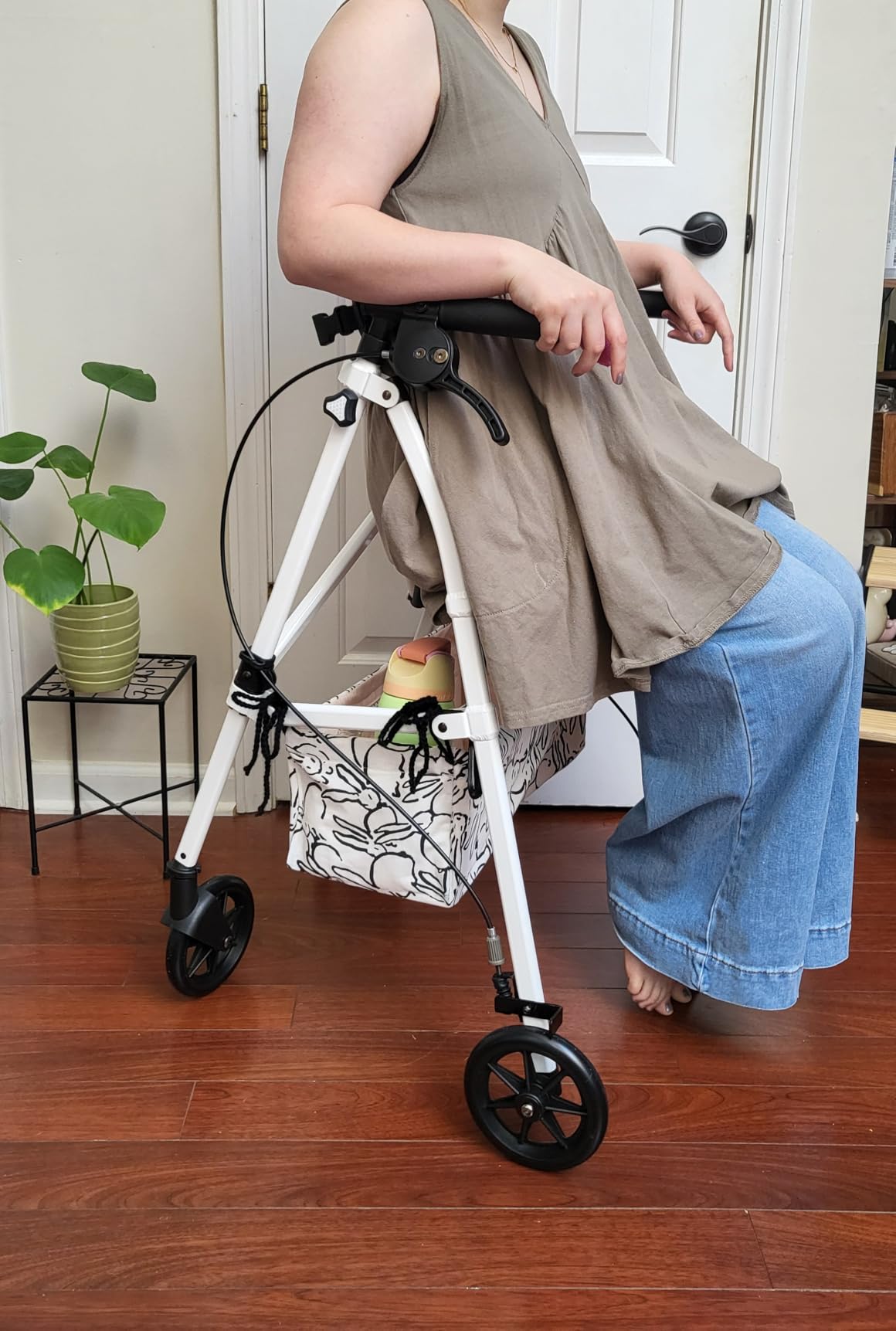
The 14.5-pound aluminum frame and padded handles adjustable from 33 to 36 inches keep it comfortable for a wrist-height fit, and the rear locking brakes control the rollator on both indoor and outdoor surfaces.
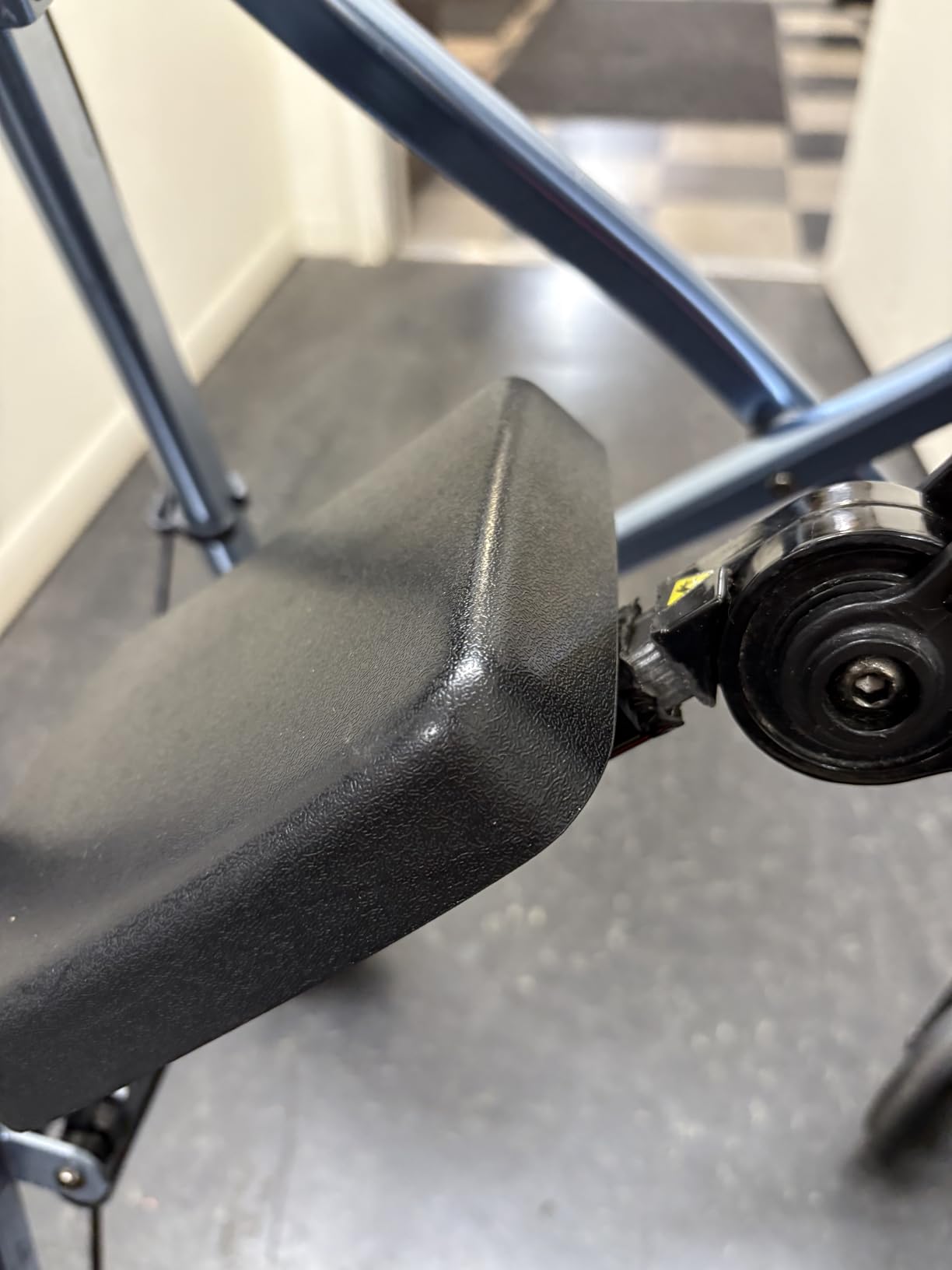
Perch seat: what it is and what it is not
The 18.5 by 6 inch seat is a perch, not a chair. It is a padded bar with a back strap, rated to 250 pounds, and it is designed for a thirty-second rest while you wait rather than for sitting through a long event. Buyers who expected a full seat are the ones who return these. If you need somewhere to sit for twenty minutes, look at the chair-style model instead.
Where travel rules actually apply
For air travel, a rollator generally travels as a mobility aid, but a compact fold removes arguments at the gate. For cruise lines, cabin storage is the practical constraint and a 10 by 11 inch footprint fits beside a suitcase where a 30-inch frame does not. Confirm the specific carrier policy before you fly.
The 250 lb rating and the small wheels
The 250-pound rating suits lighter users, and the 6-inch wheels are the smallest in this roundup, so it is limited on rough ground by design. For a user under 250 pounds who mostly walks on smooth surfaces and travels often, that is exactly the right set of limitations.
11. FlyingJoy Foldable Rollator – The One That Rolls Into the Trunk Instead of Being Lifted
Foldable Rollator Walkers for Seniors with Seat,4 Wheel Rolling Walker
17.64 lb frame
Folds one-handed in 3 seconds
25.6-inch width
8-inch airless tires
Modular replaceable parts
+ Pros
- Weighs about as much as a carry-on and rolls into the trunk on its wheels
- 3-second one-handed fold
- 25.6-inch width passes standard doorways and elevators
- 8-inch puncture-resistant shock-absorbing tires
- Modular design lets individual worn parts be replaced
- Cons
- Not recommended for deep sand
- thick mud or sharp objects
- Heavier than ultra-lightweight competitors
- Replacement parts may not always be readily available
The defining feature is not the fold itself but what happens after it. Most rollators have to be lifted into a car. This one folds in three seconds and then rolls on its own wheels into the trunk, which is a meaningful difference for a user who cannot lift 18 pounds over a trunk lip.
Buyers make the carry-on comparison themselves, and it is accurate. A 25.6-inch width passes through standard doorways, bathrooms, elevators, and restaurant aisles, which places it among the more universally compatible frames in this roundup despite carrying 8-inch wheels.
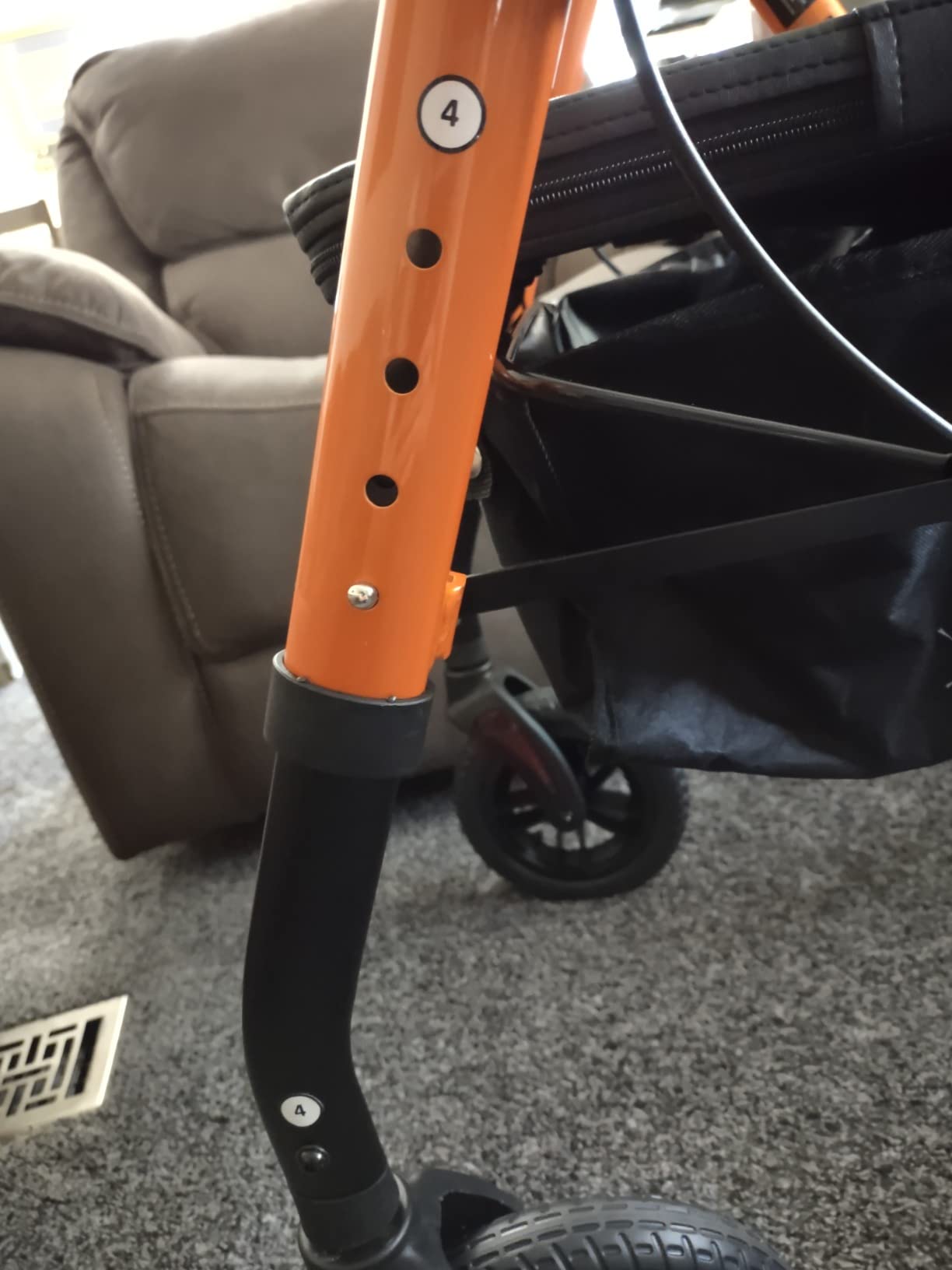
The modular design matters more than it sounds. Instead of discarding a whole rollator because one part wears out, individual components can be replaced. In a category where owners report going through several models over a lifetime, that changes the economics of ownership.
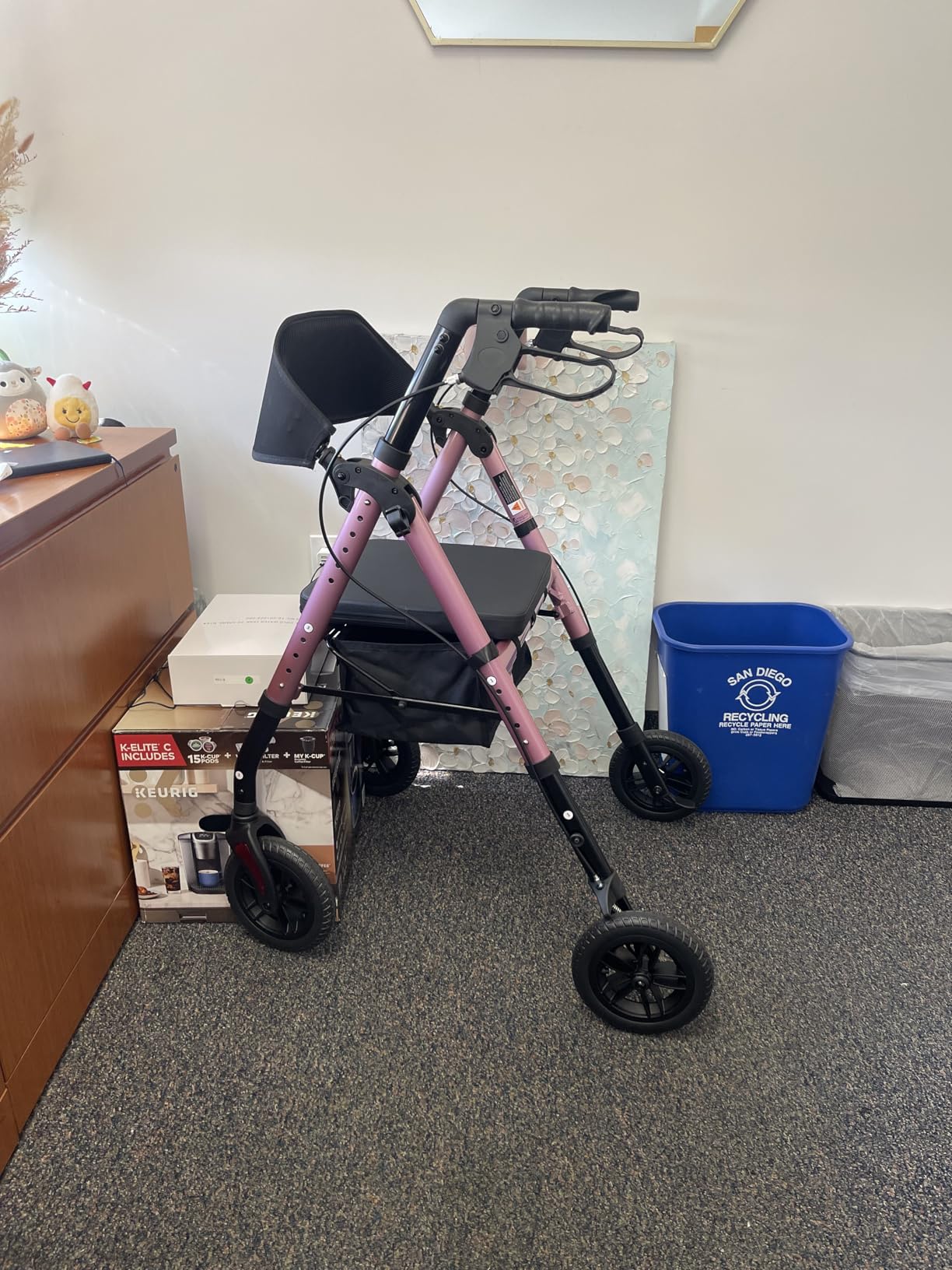
Airless tires: what they fix and what they do not
The 8-inch airless all-terrain tires never go flat and absorb shocks well on pavement, carpet, grass and gravel. The manufacturer does caution against deep sand, thick mud, and sharp objects, so treat the all-terrain label as covering hard-surface paths rather than beach and mud terrain. The 360-degree turning front wheels keep it manageable despite the tire width.
Independent handle and seat adjustment
Handles adjust from 32.7 to 40.2 inches and the seat from 19.9 to 22.6 inches, which covers users from 5 foot 3 inches to 6 foot 2 inches. Adjusting the seat separately from the handles is unusual at this weight class and lets you set the resting height to match the user rather than to the frame.
Who it suits
A user who drives themselves, loads their own rollator, and needs a frame that clears ordinary doorways without a fight. It is not for very short users, very heavy users, or terrain involving deep sand and mud.
12. Medline Aluminum Rollator – The Lightweight Model With a Handle Shape to Know About
Medline Aluminum Rollator Walker with Seat, Purple, 250 lb. Weight Capacity, Lightweight, 6” Wheels, Foldable, Adjustable Handles, Rolling Walker for Seniors
14 lb aluminum frame
250 lb capacity
12 x 12 inch padded seat
31-35 inch handles
6-inch wheels
+ Pros
- Light 14 lb aluminum frame that is easy to lift and fold into a car
- Stable with the brakes locked and no sliding when seated
- Padded seat and backrest buyers find comfortable for short rests
- Under-seat pouch keeps a purse off the user's hands
- Cons
- Paddle-shaped handles can catch on jacket pockets when standing
- which some buyers call a fall risk
- 250 lb capacity is lower than most competing models
- Small storage bag with short straps can unhook when loaded
At 14 pounds with a 250-pound rating, this is the lightweight end of the range, and buyers around the 200 to 210 pound mark describe it as comfortably solid. It is the version of the aluminum rollator that stays out of the way in a small apartment and goes in the car without an argument.
The under-seat pouch is the feature that comes up most often in reviews. Carrying a purse or shopping items in the pouch rather than in a hand keeps both hands free on the brakes and the frame, and that single change reduces a real fall risk.
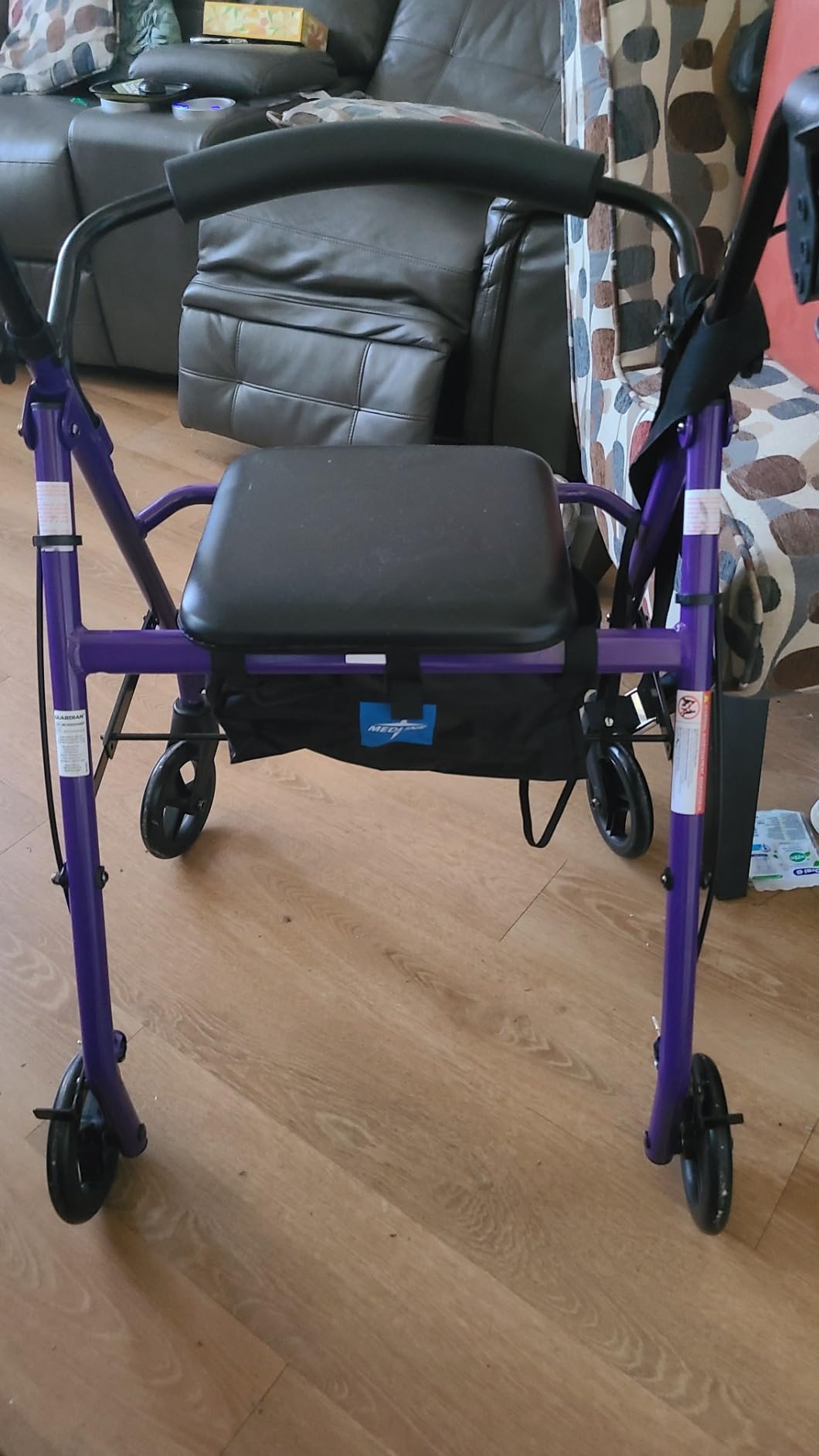
Brake behavior is stable. Owners report that when the brakes are locked there is no sliding when sitting down, which is the single most important brake property on this list of recommendations.
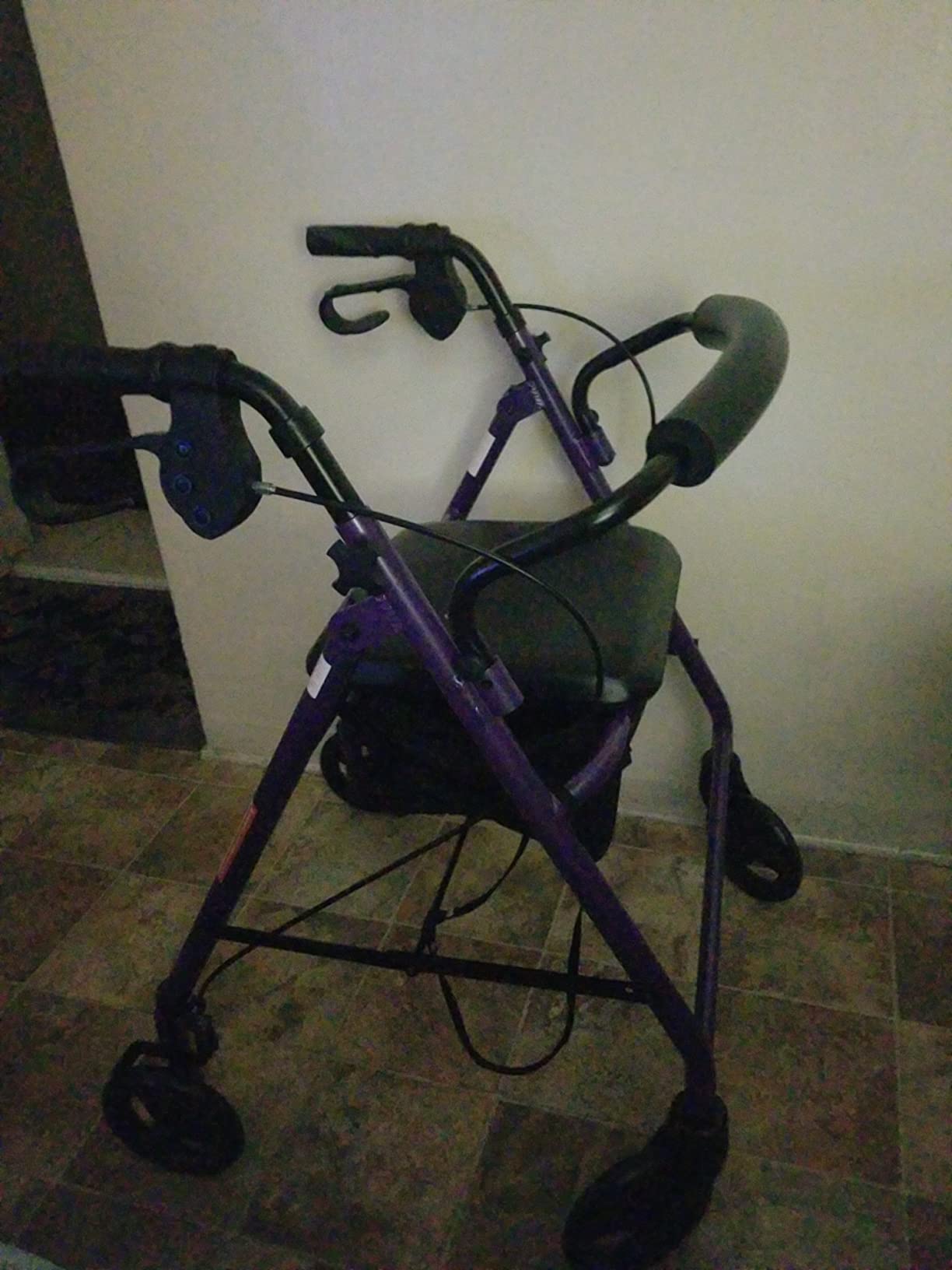
The handle snag problem deserves attention
The paddle-shaped brake handles can catch the pocket of a jacket or hoodie as a user stands up, and several buyers describe this as a fall risk rather than a nuisance. It is worth checking whether the user wears outer garments with deep pockets. Models with loop-style handles avoid it.
Where the light frame shows its limits
The 250-pound rating is the lowest weight-class capacity here alongside the travel model, and the 6-inch wheels give a rougher ride on textured pavers and concrete than on carpet or hardwood. The storage bag is small and its short straps can unhook when loaded, so keep heavy items off it. Owners have also reported screws loosening after several months, which is a reason to check the frame hardware periodically.
Who should buy this
A lighter user, primarily indoors, on carpet and hardwood, who wants the lightest practical option and does not need a wide seat or large wheels. It is a strong value pick for a single-person household where the user manages the frame themselves.
How to Choose a Rollator With a Seat Without Buying Twice
Almost every avoidable return in this category traces back to a spec that was read on the box and never tested against the user’s actual body, weight, and route. Here is the order to think about it.
Weight capacity, and why you stay under the limit
Rated capacity is a frame limit rather than a comfort target. Buy a frame rated comfortably above the user weight, not exactly at it, because a frame loaded to its maximum feels less stable and can eventually deform at the folding joints. For most adults the practical ladder is: below 250 pounds favors travel frames, 250 to 300 pounds covers standard aluminum, 300 to 350 pounds calls for steel or reinforced geometry, and above 350 pounds needs a dedicated heavy-duty frame with a much wider seat.
Wheel size matched to the terrain you actually walk on
Six-inch wheels are for carpet, hardwood, and short runs of good sidewalk. Seven and seven and a half inch wheels add a little threshold clearance. Eight-inch wheels handle cracked pavement, grass, and gravel. Twelve-inch wheels are for rough paths and rural routes. Buying large wheels for a smooth apartment hallway costs you weight and width for capability you will never use.
Brake force and arthritic hands
This is the hidden dealbreaker. A rollator is controlled by a moving frame, so a user who cannot squeeze the levers hard enough does not have a rollator, they have an obstacle. Loop-style handles fit a closed hand and require less force than paddle shapes. A 3-mode system with a genuine deceleration setting helps on slopes. Test the brake by walking at normal speed and stopping without leaning backward.
Seat height, seat width, and padding
Seat height decides whether the user can stand back up, and a seat that is too low is far more limiting than one that is slightly high. Width decides whether the user can lean back or has to perch forward on the front edge. Padding decides whether a ten-minute rest leaves the user feeling better or feeling worse. Basic seats are 12 by 12 inches and unpadded or lightly padded; a chair-style memory foam seat is a different category of product.
Frame weight, folding, and getting it into a car
Under 15 pounds means one person can load it. Fifteen to 19 pounds means an average caregiver can help. Over 20 pounds means two people or a ramp. Folding style also matters: a side-to-side fold that stands upright when closed is much easier to manage than one that has to be laid flat and lifted.
A four-step at-home fit check
Stand next to the rollator and measure the distance from your wrist crease straight down to the floor. That number is your ideal handle height, and the handle should sit there with your elbow bent about 15 degrees. Sit on the seat and check that your feet plant flat on the floor with your knees at roughly a right angle. Squeeze both brakes and push the rollator forward; if it rolls, the lock is not set. Finally, fold it and load it, because a rollator you cannot get in the car is a rollator that stays at home.
Rollator Safety Rules That Prevent Most Falls
Lock the brakes before you sit down, every time, not just when you are tired. A rollator seat without locked brakes is a chair with wheels, and this single habit accounts for a large share of rollator-related injuries.
Never use a rollator on stairs. If stairs are unavoidable, use a handrail and have another person assist. The wheel geometry that makes a rollator stable on the ground makes it dangerous on a step.
Never let anyone push you while you sit on the seat unless the rollator is specifically designed for it. Sitting facing backward while being pushed is the configuration that produces the worst injuries. The one model in this roundup with a reversible backrest is the exception, and its manufacturer supports that specific use.
And do not treat the rollator as a wheelchair replacement. If someone cannot walk safely at all, a transport chair or a wheelchair is the correct device, and a physical therapist can tell you which one fits.
Frequently Asked Questions
Does Medicare pay for a rollator walker with seat?
Original Medicare Part B covers a rollator as durable medical equipment when a doctor documents that it is medically necessary, and you purchase it from a supplier that bills Medicare directly. You pay your deductible and 20 percent coinsurance on the Medicare-approved amount. A prescription is required for the payment to go through, which is the step most people get stuck on.
What is the ideal height for a rollator walker?
The ideal handle height sits level with the wrist crease when you stand upright beside the rollator, with your elbow bent about 15 degrees. To find it at home, measure straight down from your wrist crease to the floor and set the handles to that number. Seat height should leave your feet flat on the floor with knees near a right angle so you can stand back up.
What rollator walker has a seat for a heavy person?
Look for a steel or reinforced frame rated to 350 pounds or more, combined with a seat at least 16 inches wide. Models with a tri-angle reinforced frame and a 1.6-inch cushion are the most common answer in this category. Check the doorway width against the overall frame width before ordering, because heavy-duty frames are often 22 to 27 inches across.
Which is safer, a rollator or a walker?
For someone who can walk but tires quickly or has balance concerns, a rollator is safer because four wheels and a seat provide a rest option and better stability. A standard pickup walker is safer for someone who cannot lift weight off the ground, because it lets the user push through the frame. A physical therapist can determine which fits a specific person.
What is better than a rollator?
It depends on the problem. A three-wheel rollator has no seat but turns far more easily in tight indoor spaces. An upright rollator adds forearm support for users with back or wrist pain. A rollator-transport chair combination can be pushed as well as self-propelled, which is useful when the user tires mid-journey. A transport chair or wheelchair is better when the user cannot walk safely at all.
Which Rollator With a Seat Fits Your Situation
There is no single best rollator with seat for every senior, and anyone who tells you otherwise is selling something. Match the frame to the person instead. Our Editor’s Choice, the Drive Medical Steel Rollator with 7.5 Inch Wheels, is the default recommendation of this roundup: if the rollator stays mostly indoors on smooth floors and the user leans hard on the frame, it is the sturdiest and most proven choice of the twelve we reviewed, rated 4.6 stars across more than 51,000 reviews. If the user is under 300 pounds and car loading is a solo job, the Drive Medical Aluminum Rollator is the strongest all-round alternative, rated 4.7 stars across more than 7600 reviews.
If the route is gravel and broken sidewalk, go with wheel diameter before anything else. The VOCIC Z21 covers most rough terrain with 8-inch tires and a thick padded seat, and the MAXWALK covers the worst ground with 12-inch wheels. If rest breaks are long and the user is tired while out, the chair-style memory foam seat is worth more than any other feature on this list.
If the rollator has to travel, folded size decides it. The Stander Space Saver collapses to 10 by 11 inches and arrives assembled, and the FlyingJoy folds in three seconds and rolls into the trunk on its own wheels. If the user is short or wide, check seat height and width before anything else, because that is where a wrong purchase gets returned.
Whatever you choose, test the fit at home before committing to a longer ownership relationship, and check the frame hardware and brakes every few months. Owners in online communities frequently describe going through several rollators over a lifetime, and the single thing that separates the models they keep from the ones they replace is not the frame, it is the seat. Pick the seat the user will actually sit in.
Use the buttons above to check the current details for each model, and talk to a physical or occupational therapist if there is any doubt about whether a rollator is the right device.