
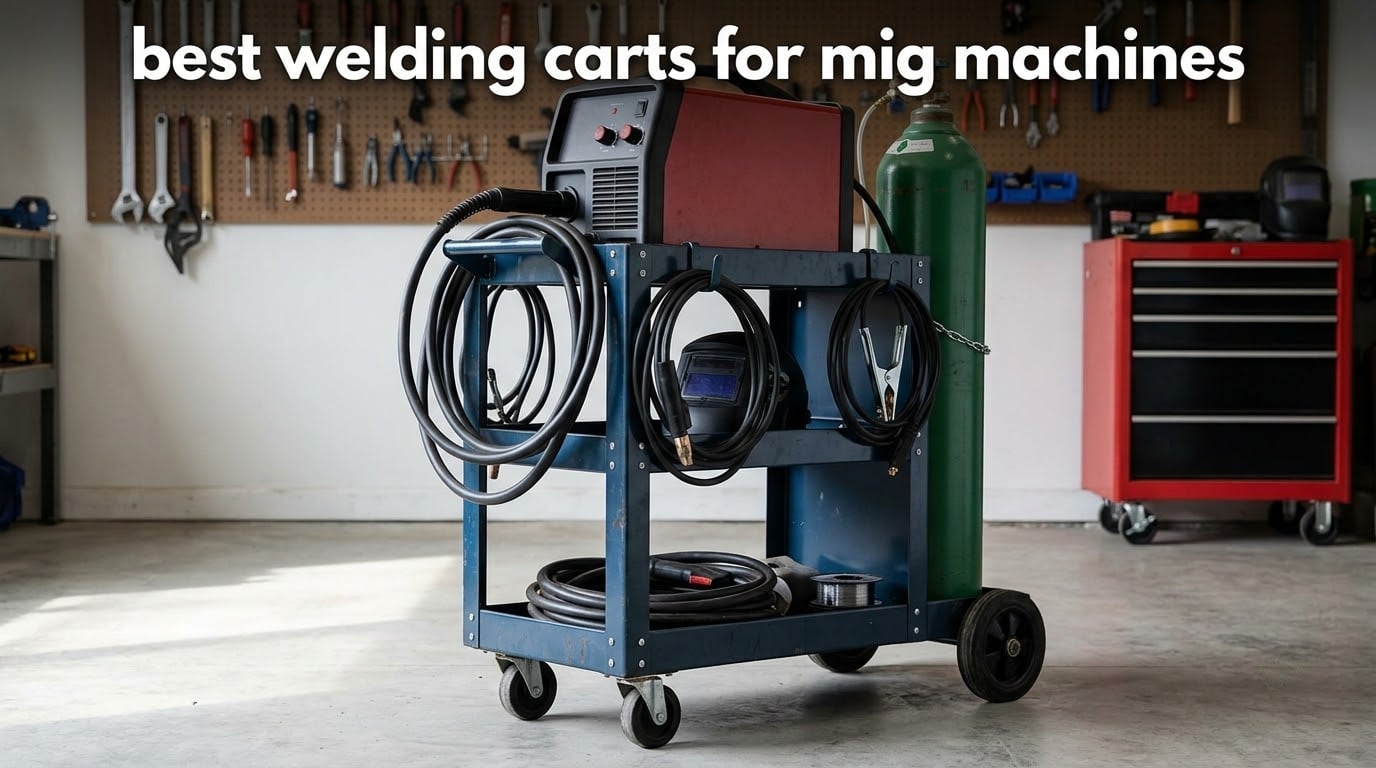
A welder cart is the difference between one trip to the truck and five. Own a decent one for a few months and carrying a machine across the garage by yourself starts to feel like a punishment. After putting eight carts side by side and reading years of owner reports, my answer to the question of the best welding carts for MIG machines comes down to three: the VEVOR 3-Tier for load rating and value, the YESWELDER 2-Tier for anyone who wants consumables in drawers instead of a pile, and the Weldpro 3-Tier for oversized machines and an oversized bottom tray.
How I picked was straightforward but not fast. I compared rated static load against the weight of a typical machine plus a full shielding gas cylinder, checked cylinder cradle dimensions against 7 inch and 9 inch bottles, looked hard at caster diameter and whether the rear wheels swivel, and read owner reports about what broke after six months rather than what a spec sheet promises. Then I weighed all of that against what welders actually say on forum threads, which is where the useful detail lives: undersized front casters, top-heavy loads once a bottle is full, and machines that rub against the bottle bracket.
One thing I want to get out of the way early, because experienced hands on welding forums repeat it more than any retailer does: most welders carry far less than a drawer count implies. Multiple people describe keeping two tip sizes, a spool of wire and a pair of gloves, and little else. If you are torn between a bare two-tier frame and a cabinet cart, storage is usually the last thing that should decide it.
The other thing worth naming up front is that you may not need a cart at all. Serious shops argue for a lift table or a bench on castors instead, and I cover that argument properly further down rather than pretending it is wrong.
Our Top 3 Welding Carts for MIG Machines
Three carts stood out once I started adding up rated load against real machine weights. The VEVOR wins on capacity per dollar and the sheer size of its review base, the Weldpro holds the strongest rating with a build that does not flex, and the YESWELDER is the one I keep recommending to people who want drawers without a cabinet you cannot open with a machine on top.
VEVOR 3-Tier Welding Cart
- 400 lb static load rating
- Three tiers plus side brackets
- Twin cylinder slots with safety chains

Weldpro 3-Tier Heavy Duty Cart
- 400 lb static capacity
- Oversized bottom tray
- Chains for bottles up to 125 CF

YESWELDER 2-Tier Cart with 4 Drawers
- Four smooth-sliding drawers
- Dual cylinder slots
- 245 lb capacity
Comparing the Best Welding Carts for MIG Machines in 2026
Every cart below is listed with the numbers that actually decide a purchase: rated load, how many shelves you get, how the bottle is held, and how the wheels are arranged. Static load is the useful figure, but check the dynamic rating too since a rolling cart is a dynamic load by definition.
| Product | Details | |
|---|---|---|
| VEVOR 3-Tier Welding Cart |
|
Check Latest Price |
| Weldpro 3-Tier Heavy Duty Welding Cart |
|
Check Latest Price |
| YESWELDER 2-Tier Cart with 4 Drawers |
|
Check Latest Price |
 Lincoln Electric K2275-3 Welding Cart Lincoln Electric K2275-3 Welding Cart |
|
Check Latest Price |
 Eastwood 350 lb Three Shelf Welding Cart Eastwood 350 lb Three Shelf Welding Cart |
|
Check Latest Price |
 Klutch 2-Tier Welding Cart with Cabinet Klutch 2-Tier Welding Cart with Cabinet |
|
Check Latest Price |
 JEGS Steel Welding Cart with Drawers JEGS Steel Welding Cart with Drawers |
|
Check Latest Price |
 RCIACRHT Heavy Duty Rolling Welder Cart RCIACRHT Heavy Duty Rolling Welder Cart |
|
Check Latest Price |
1. VEVOR 3-Tier Welding Cart – Best Overall Load Rating and Value
VEVOR Welding Cart, 3-Tier Welder Cart Heavy Duty 400 LBS Weight Capacity
400 lb static and 370 lb dynamic
Three tiers plus adjustable top shelf
Two cylinder slots with safety chains
+ Pros
- 400 lb static rating is more than most machines plus a full bottle need
- Three tiers plus four side brackets give real storage
- Adjustable inclined top shelf steadies a tall machine
- Large 7 inch rear casters roll over shop debris
- Backed by the deepest review base we found
- Cons
- Flat pack assembly can run an hour or longer
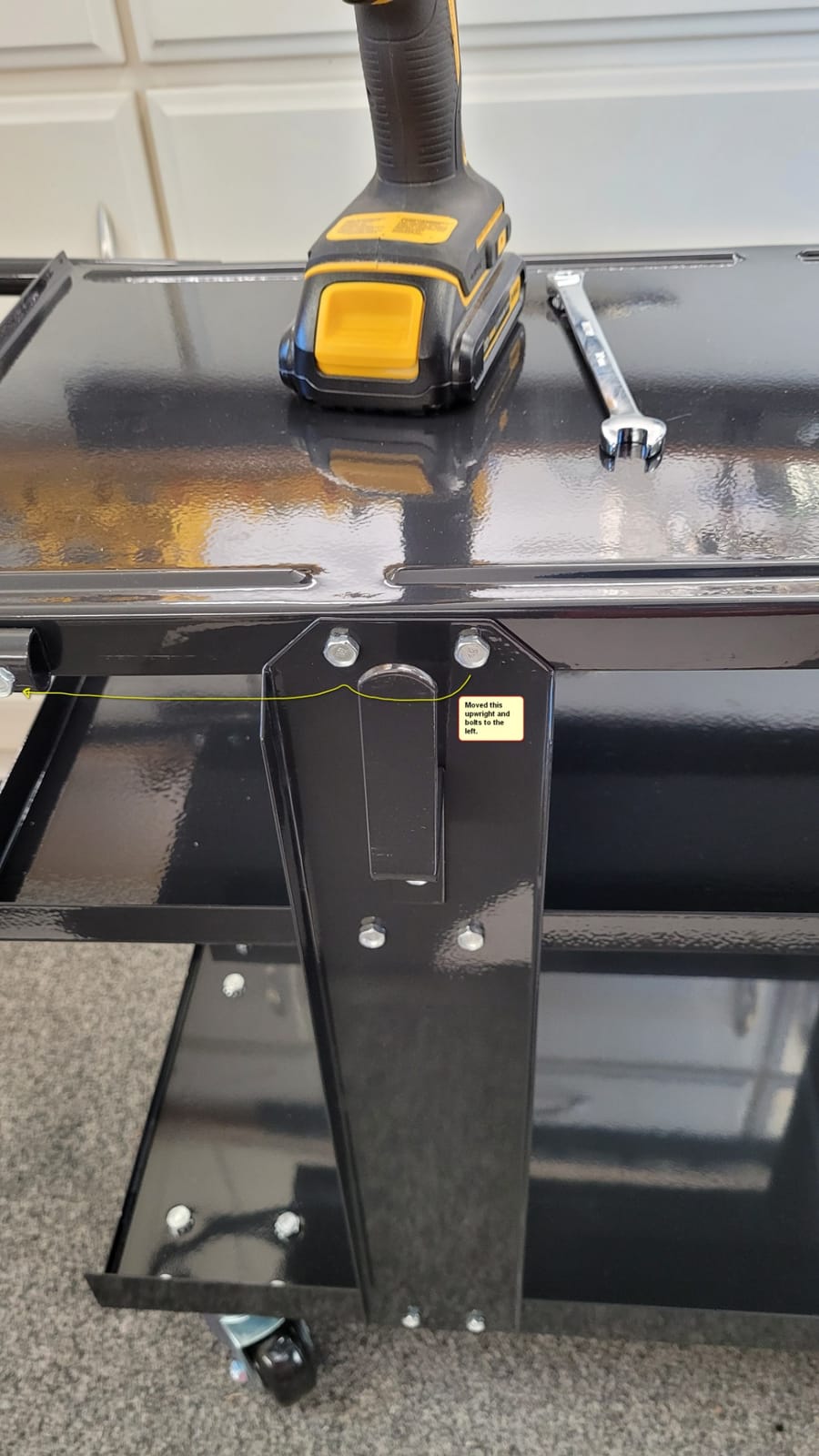
- All Phillips hardware strips if you rush it with a driver
- Top shelf bolts do not line up for the slanted position
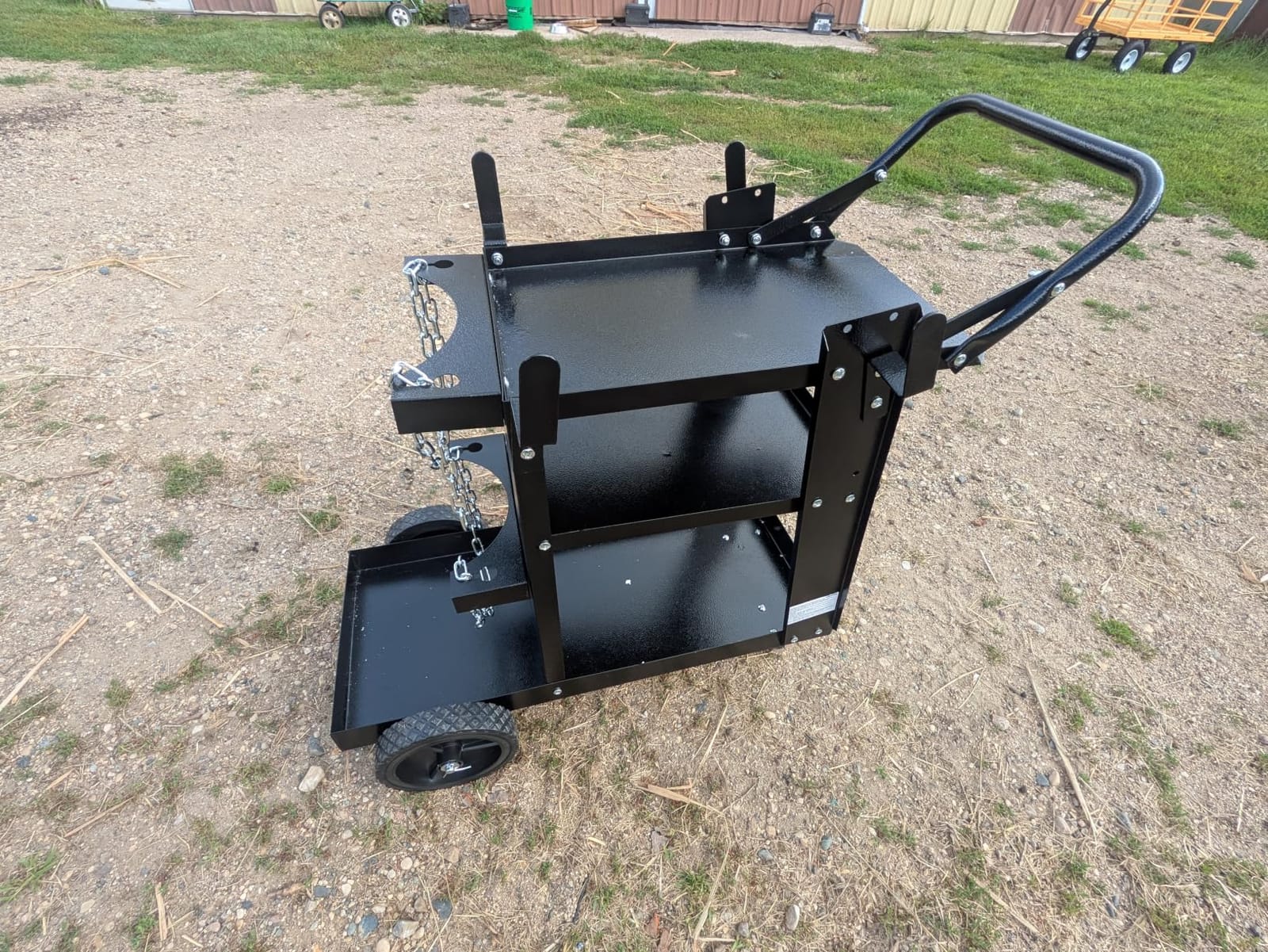
This is the cart I put on the floor of every garage I work in. At 28 inches deep by 11.4 inches wide it is narrower than most three-tier designs, which matters more than it sounds when you are working around a parked truck, and the 400 lb static rating leaves real headroom above a typical MIG machine plus a full bottle.
It weighs only 23.2 lb empty, so moving it around a shop is a one-person job, and the caster layout is unusual in a good way: two 2.9 inch swivel casters at the front for turning on a dime, and 7 inch rear casters that climb thresholds and roll over cord and grit without the cart juddering.
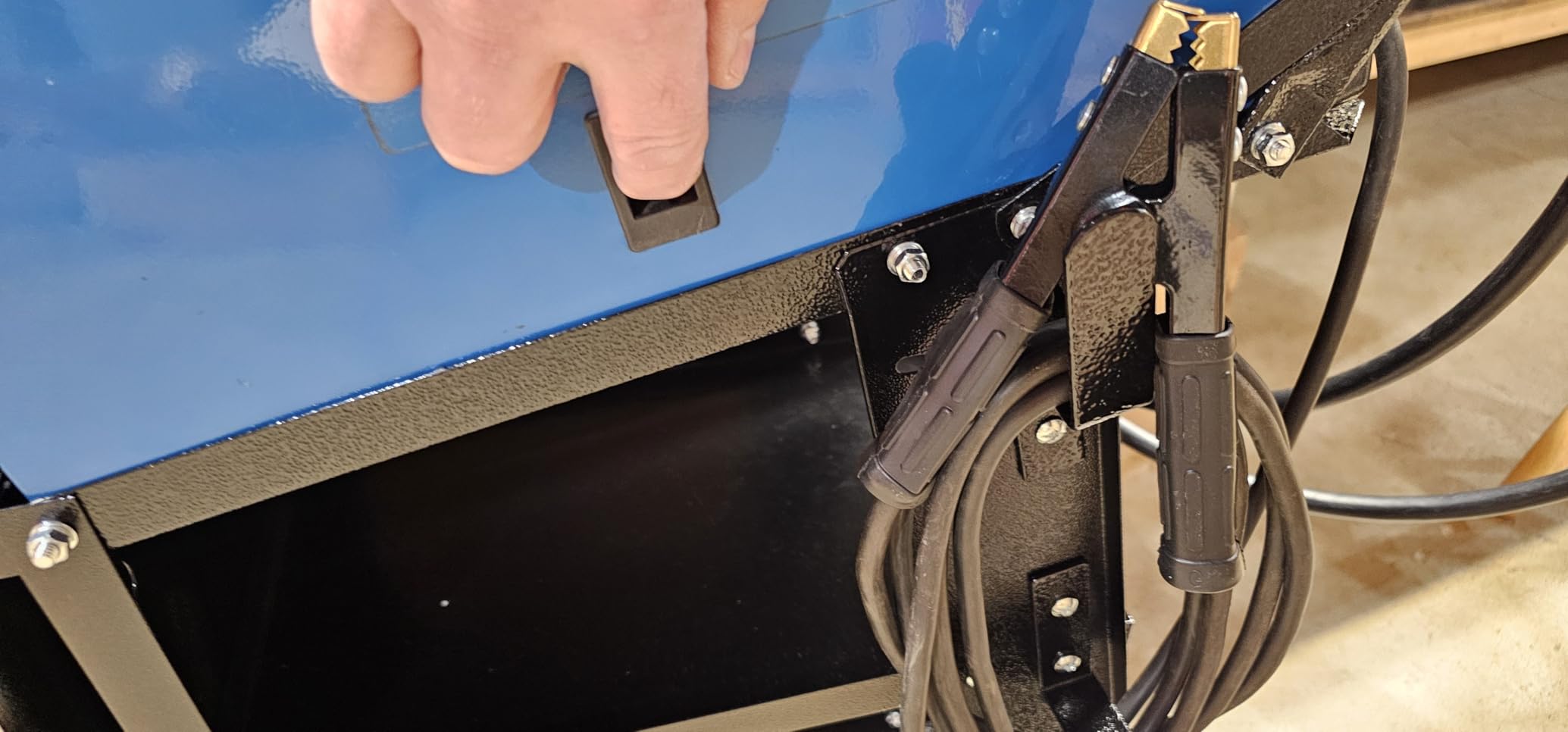
Load Capacity Math That Actually Matters
A 250A shop machine in the 250 to 300 lb range plus a full shielding gas cylinder pushes you past 550 lb of payload before you add a single box of wire. That is why a 400 lb static rating on this cart is a comfortable number for a mid-size machine but is genuinely tight for a large 300A unit with a full bottle.
Reviewers consistently load this cart with a mid-size inverter welder, a full bottle and a shelf of consumables without complaint, and report it rolls smoothly even loaded. If your machine is a true 300 lb shop unit, look at the taller three-tier designs with bigger bottom decks instead.
Cylinder Cradle, Chains and the Rear Tray Layout
The cylinder storage is the part that sets this cart apart from bare frames. There are two gas cylinder slots and two stainless steel safety chains, so you can run a shielding gas bottle and an oxygen or acetylene bottle side by side for TIG work, or leave one slot empty and use the wide lower tray for longer material.
The lower tray measures 28 by 11.4 inches while the upper and middle trays are 11 by 18.1 inches, giving you a narrow top and a wide bottom on purpose: the machine sits high and compact, the heavy awkward stuff sits low where it helps stability rather than hurting it.
One common owner mod is a rubber mat on the lower tray so the bottle does not slide or scuff the paint when you roll across a rough floor.
Assembly Reality and the Hardware
Be honest about assembly. This arrives as a flat pack with 40 nuts, 38 bolts, spring pins and washers, and owners report anywhere from an hour to several hours. The instructions are serviceable but not always clear, and the sequence matters more than it should.
More importantly, every fastener is Phillips head, and a recurring complaint is bolts and nuts that strip or shear when tightened with a power driver. Hand tightening or the lowest setting on a driver is the advice that keeps this from becoming a frustrating afternoon.
Where It Falls Short on Machine Fitment
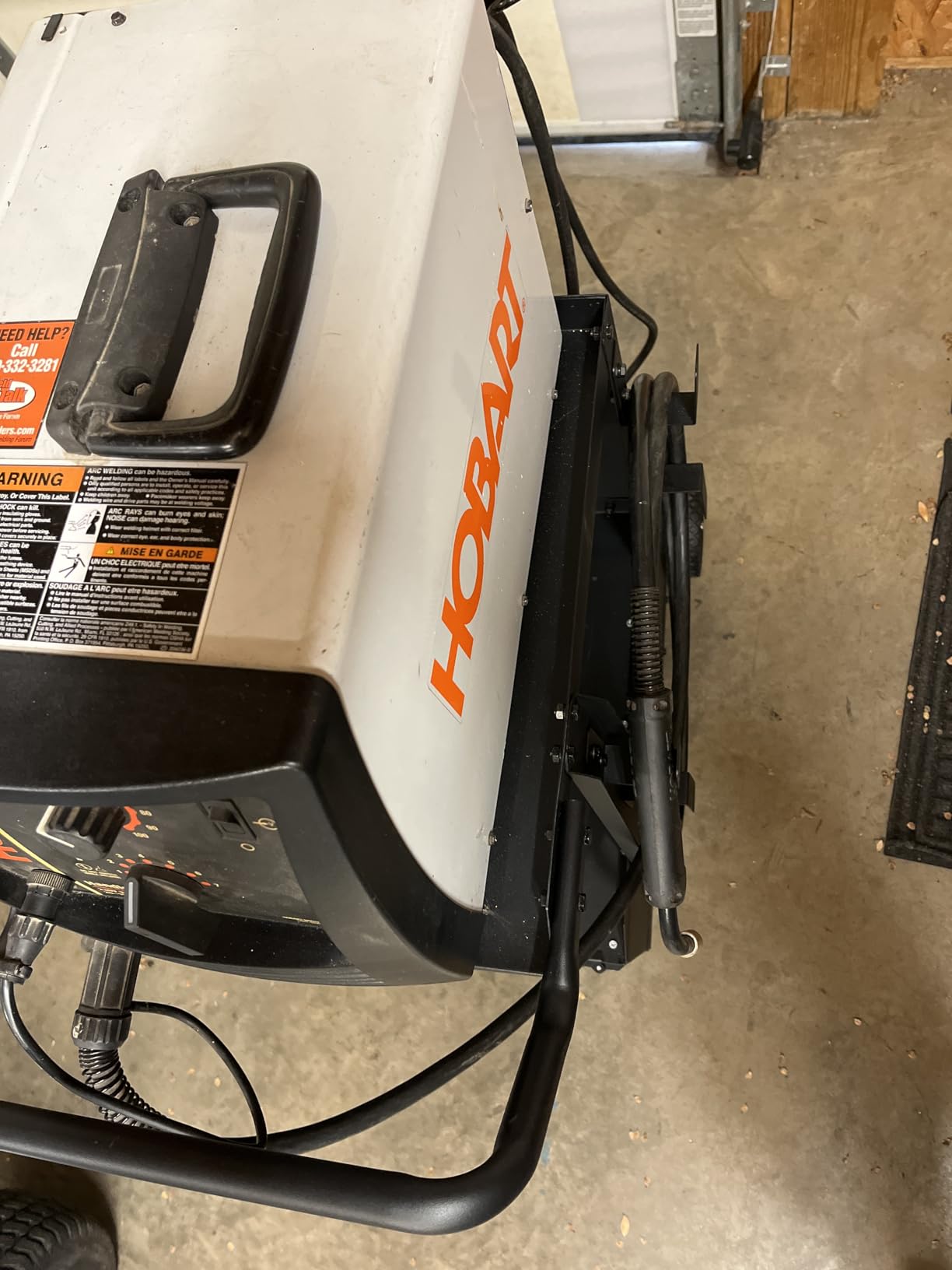
Several buyers report the top shelf lip, handle and support strut interfering with the side door of larger MIG welders, so they removed the handle or ran the shelf level. The shelf bolt holes also do not line up for the slanted position shown in the photos, which means you either drill or accept a level top.
None of that is disqualifying, but if you own a tall Lincoln or Miller 140 style machine and open its side panel often, check that clearance before you commit. It is also worth noting the drawers on some variants have no positive hold, so a bump can open them.
2. YESWELDER 2-Tier Cart with 4 Drawers – Best for Organized Consumables
YESWELDER 2-Tier Welding Cart with 4 Drawers and Dual Cylinder Slots
245 lb capacity
Four smooth sliding drawers
Dual cylinder slots for bottles up to 10 inch
+ Pros
- Four drawers genuinely declutter a bench
- Handles a gravel driveway without complaint
- Side hooks for cables
- tape and cords
- Rust resistant paint on a steel plate frame
- Dual cylinder slots with straps and chains
- Cons
- Top tray is narrow and only takes compact welders
- Many bolts in the assembly and imperfect instructions
- Included screws strip under power tools
This is the one I recommend when someone tells me their garage is a mess and the welder is part of why. Four smooth-sliding drawers on a 245 lb rated frame change how a shop functions, because the consumables stop living in a pile behind the machine and start living in labelled compartments that you can actually reach.
At 27.8 inches deep by 11.02 inches wide it is close to the same footprint as the VEVOR, but the 27.17 inch overall height gives noticeably more vertical room. Owners report it carrying a welder plus a full 50 lb CO2 bottle without complaint, and one reviewer mentions rolling it over a gravel driveway.
Drawer Depth Is the Feature That Earns Its Keep
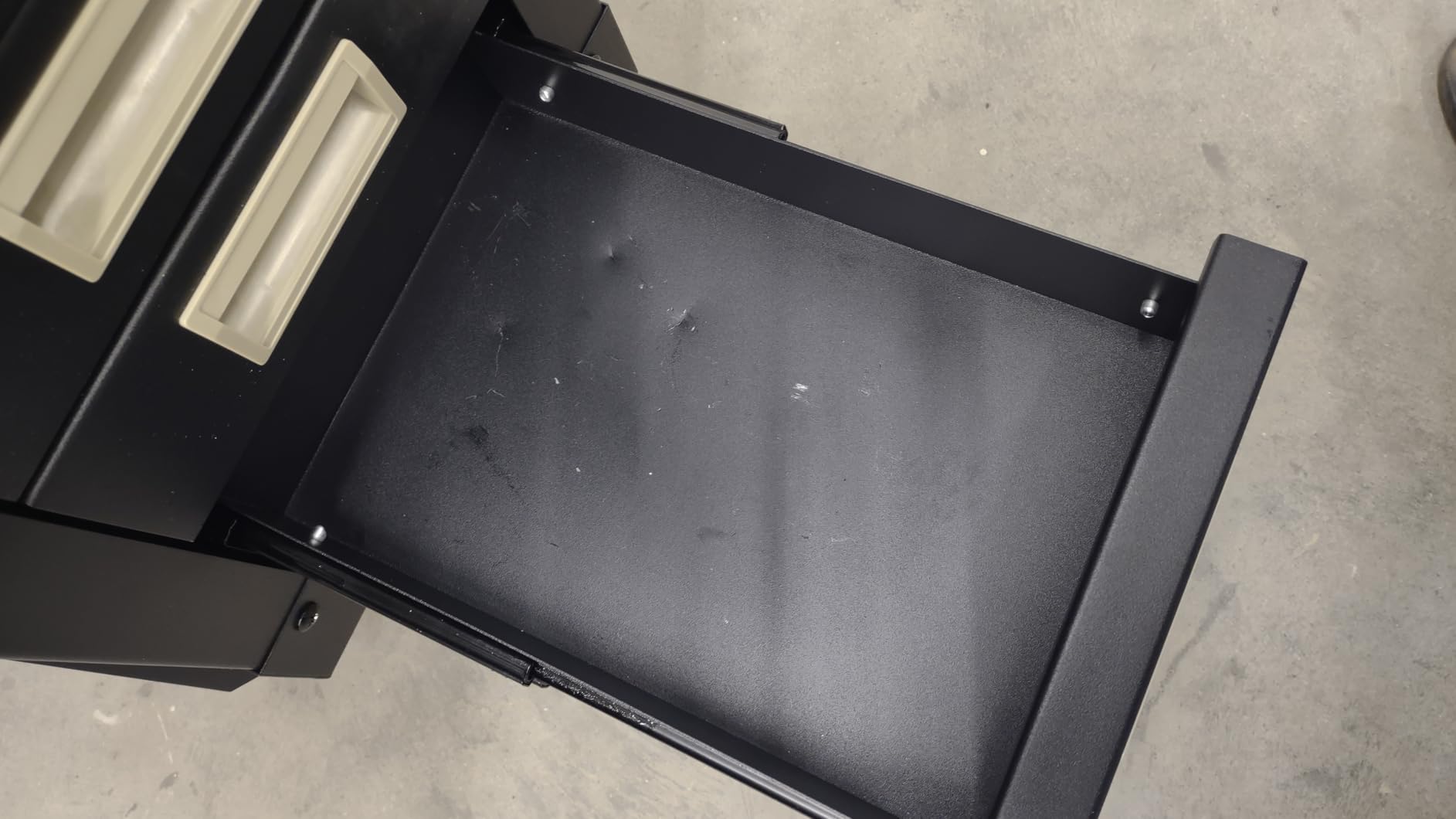
Each drawer measures 11.22 by 8 inches, and the frames run smoothly according to owners. That is enough for tip holders, nozzles, contact tips in a small parts tin, pliers, magnets, gloves and a coil of safety wire, which in practice covers nearly everything a MIG setup needs on a given day.
Welding forum users make a fair point about cabinet carts and rod storage: most people work with one or two cup sizes almost all the time, so a deep drawer that holds a dozen spare tips is nicer than a tall cabinet that mostly stores air. This cart takes the sensible version of that trade.
Top Deck Width and the Machine Fitment Catch
The top layer is 11.3 by 17.7 inches with a maximum placement width of 10.6 inches, and that is the honest limit of this cart. Owners are clear that larger Miller models simply will not sit on it, and that a full size bottle can be a tight squeeze in the rear cutouts even though the slots are specified for cylinders up to 10 inches.
So if your machine is a compact inverter in the 140 class or smaller, this is a great fit. If you are running a 180 or 210 with a tall handle and a fat body, measure the top deck first, because no amount of capacity rating will compensate for a machine that overhangs the tray.
Build Quality and the Fastener Problem
The frame is specially customized steel plate with a rust resistant paint finish, and the cylinder slots are reinforced with stainless steel chains on a 29.5 inch chain length. That is a sensible layout for the money.
The recurring complaint is hardware. The included screws and nuts are soft and will strip if driven with power tools, and a few buyers call the metal thin. Assembly also involves a lot of bolts and roughly an hour, with instructions that can leave you removing and refitting screws to get the build order right.
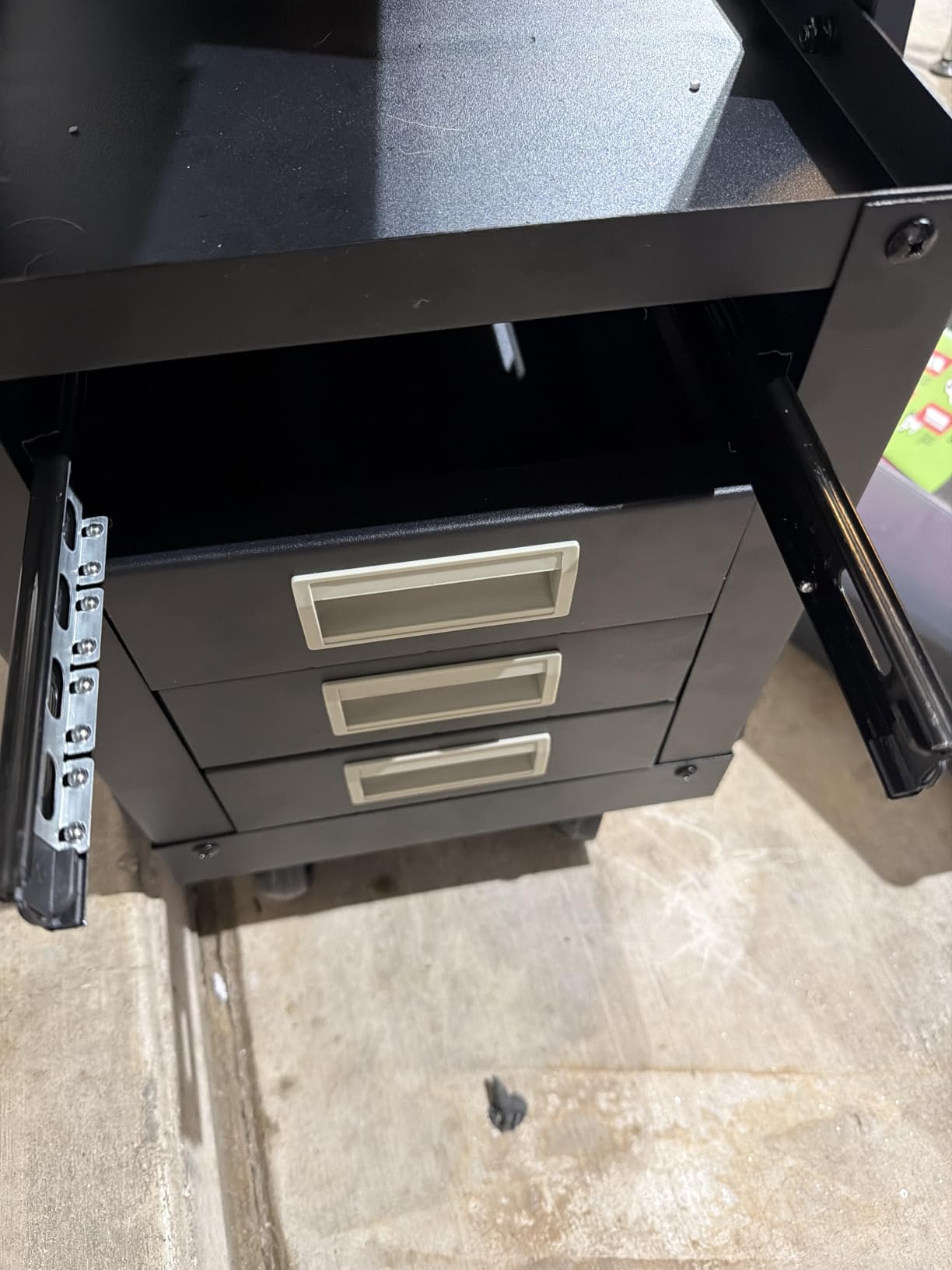
Two smaller details worth knowing: the side hooks are genuinely useful for tape measures, cords and leads, and the drawers have no latch, so over bumps they can fly open. If you work on rough surfaces, a small latch or a rubber mat on each drawer is a five minute fix.
3. Weldpro 3-Tier Heavy Duty Welding Cart – Best for Oversized Machines
Weldpro 3-Tier Heavy Duty Welding Cart, Welder Cart for MIG/TIG Welder & Plasma Cutter, 400Lbs Capacity Rolling Welding Trolley with 360°Swivel Wheels & Safety Chains
400 lb static load capacity
Oversized 33.1 inch bottom tray
Chains secure bottles up to 125 CF
+ Pros
- Strongest rating in this group at 4.4 stars
- Thickened steel plate resists deformation and wobble
- Assembles in 15 to 20 minutes
- Upper and middle trays take most standard welders
- Swivel front wheels make tight spaces workable
- Cons
- A 40.5 inch footprint eats shop floor space
- Cylinder rack and hooks are tuned to Weldpro machines
- Rear wheels are fixed so tight turns pivot on the rear axle
This is the strongest built cart of the eight, and it earns that on the spec sheet and in the reviews. At 4.4 stars with only 4 percent one-star feedback, it has the best aggregate rating of the group, and owners single out build thickness, load stability and wobble free rolling across both concrete and gravel.
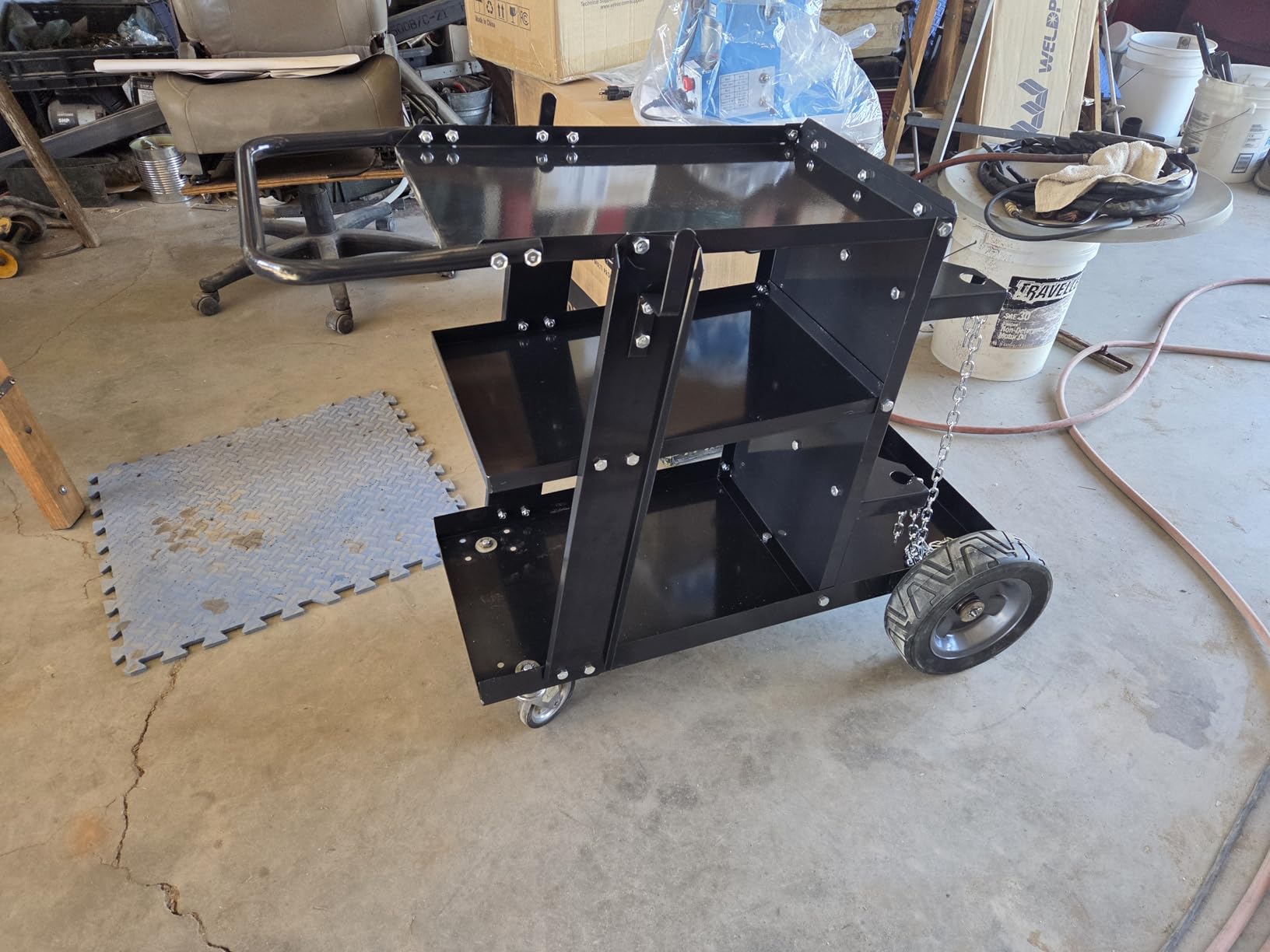
Where it differs from the VEVOR is size. At 40.5 inches long by 13.3 inches wide, it is a long cart, and that length buys you an enlarged bottom tray measuring 33.1 by 13.8 inches. That tray is where a large 250A machine, a plasma cutter, helmets and a full bottle can all live at once without the stack getting top-heavy.
The 400 Pound Rating and a Realistic Load Plan
The rating is a 400 lb static load capacity on a thickened steel plate frame with an anti rust textured finish, and reviewers report no deformation and no wobble even fully loaded. That is the quiet difference between this cart and the lighter frames: the plates do not flex, so the machine does not buzz while you weld.
The realistic plan is still to think in static terms for a moment. A 200A machine plus a full bottle and consumables is a comfortable load here. Pair it with a plasma cutter as well and you are at the edge, which is exactly why the bottom tray is oversized: distribute the weight low and across the length rather than stacking it.
Footprint: The Price of That Oversized Tray
Be clear-eyed about the 40.5 inch length. In a one-car garage that is a real commitment, and forum discussion about welding carts repeatedly turns on the same lesson: bigger is not always better in a small space. Owners of large custom carts report they simply became stationary obstacles.
The upper and middle trays are 20.9 by 13 inches, which is generous enough for most standard welders, so you are not forced to use the whole length for the machine. The length is optional space for the things you would otherwise put on a shelf.
Caster Layout and Why the Rear Wheels Are Fixed
Two 360 degree swivel universal wheels at the front plus two heavy duty fixed rear wheels give smooth travel and predictable tracking, and the 15 to 20 minute assembly estimate with basic tools is the shortest in this roundup by some margin.
The trade-off is that the rear wheels do not swivel, so very tight turns still pivot on the rear axle. In a normal shop layout that never becomes an issue. In a cramped single bay where you have to crab the cart into position, it is worth thinking about.
Brand Specific Geometry
Two safety chains hold gas cylinders up to 125 CF, and four side mounted metal brackets plus dual side hooks keep torches, pliers, cables and tape measures within reach. Note that the layout is custom tailored to Weldpro machines in the MMA75, 160GD, 200GD, CUT40H, 40NH and 416GD range, so if you run one of those, this is close to a purpose built fit.
If you run a Lincoln, Miller or Hobart machine, the geometry still works, but you are not getting the tailored bolt pattern benefit that the Lincoln cart in this roundup offers.
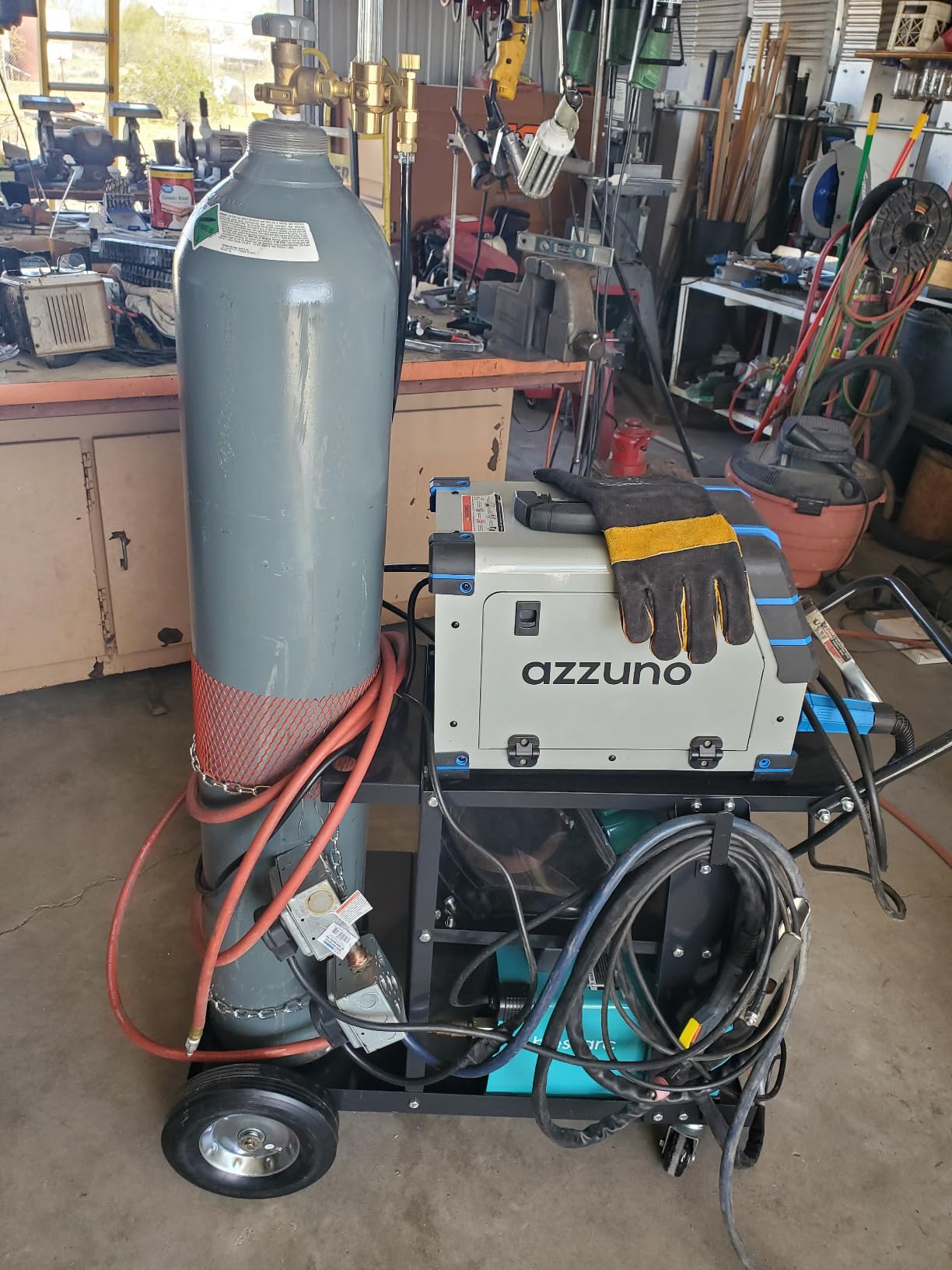
4. Lincoln Electric K2275-3 – Best Fit for Lincoln Wire Feed and MIG Machines
Lincoln Electric Welding Cart K2275-3, Easy Transport for Welder, 80 Cu Ft Gas Cylinder, Weld Cables and Accessories, Dual Tier with Angled Top Shelf, Two Wheels, Heavy Duty Steel, Black, 14
Holds an 80 cu ft gas cylinder
Angled top shelf for control access
14 inch W by 21 inch H by 28 inch D
+ Pros
- Mounting holes line up with the bolt pattern on many Lincoln welders
- Angled shelf keeps controls reachable while seated
- Handles 40 cu ft and larger argon and CO2 bottles
- Simple assembly for someone with basic tools
- Established brand with in house design and lifetime technical support
- Cons
- Compact top platform rubs against larger machines
- Cylinder can contact the welder even with the bracket forward
- Wheels struggled with a heavy TIG machine
This is the only name brand cart in the group, and it scores 4.4 stars with 64 percent five-star feedback. If you run a Lincoln wire feed or MIG machine, this is the pick, because the mounting holes are drilled to line up with the bolt pattern on many Lincoln welders so the machine can actually be bolted down instead of just sitting there.
It is listed as compatible with Lincoln Electric 140HD, 180HD and LE31MP machines. The frame is heavy duty steel with an angled top shelf for control access, a lower tool tray, a sturdy handle and a cable wrap hook, and it measures 14 inches wide by 21 inches high by 28 inches deep at 24.8 lb.
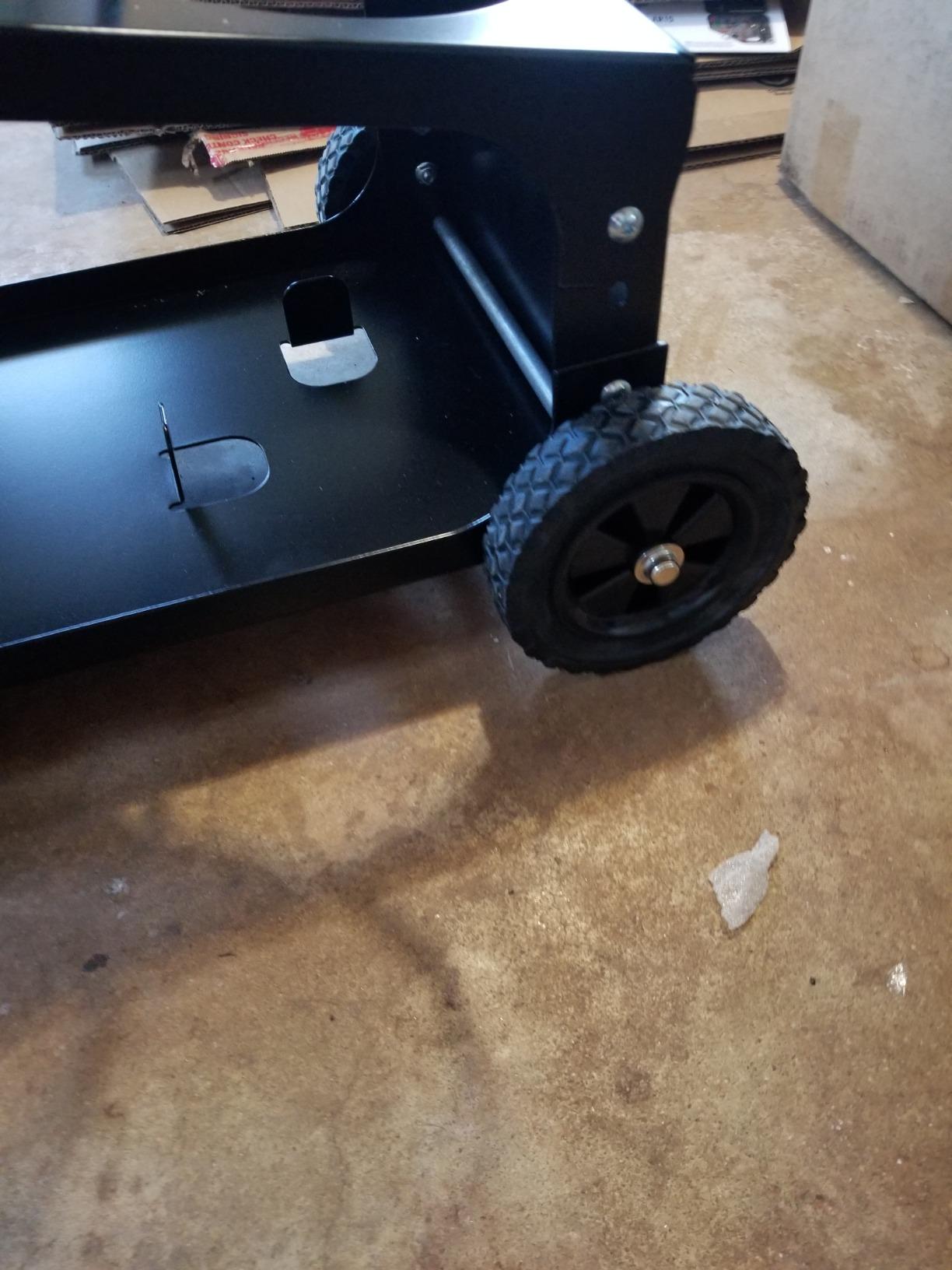
The Angled Top Shelf Is Not Just Styling
That angle is functional. It tilts the control panel toward you so you can read and adjust amperage, wire feed and voltage without crouching over the machine or, as some buyers complain about flat carts, bending down awkwardly. On a cart you roll to the work, that is a genuine daily comfort difference rather than a gimmick.
The two-tier arrangement also gives you a real lower tool tray, which is more useful for the actual handful of consumables most people carry than a bank of drawers ever is.
Cylinder Clearance and Where It Gets Tight
On the plus side, the cylinder bay is specified to hold an 80 cu ft gas cylinder, and owners confirm it takes 40 cu ft bottles and larger argon and CO2 sizes. That is a genuinely generous bottle accommodation for a compact 14 inch wide cart.
The catch is geometry. Owners report a 20.5 inch long Miller Multimatic 215 rubbing against the gas bottle, and that the cylinder can still contact the welder even with the bracket adjusted forward, requiring shimming. If you own a long, large-bodied machine, the fit is tight by design.
Wheels, Hooks and the Instructions
Two wheels move the cart around a shop or job site, but reviewers report they struggled to move a heavy TIG welder while lighter plasma cutters roll fine. If your machine is a substantial TIG unit, treat the wheels as a weak point rather than assume the 4.4 rating covers it.
There is no separate cable wrap hook on some configurations, so cords get wound around the handle, and the instructions are minimal enough that one reviewer reported incorrect fasteners and a crooked, uneven platform. Budget an extra twenty minutes and check the platform is flat before you tighten anything.
Some buyers also wish the cart were taller to avoid bending down for adjustments, which is the same deck height complaint that shows up across premium carts in general. If you are tall and work standing, check the 21 inch height against your bench setup before ordering.
5. Eastwood 350 lb Three Shelf Welding Cart – Best for Carrying a Welder and Plasma Cutter Together
Eastwood Welding Cart for MIG Welder | MIG TIG Plasma Table Durable Carts with 350 Lbs Weight Capacity 3 Shelves Cable and Gas Bottle & Accessory Storage
350 lb maximum weight capacity
Top shelf sized for MIG135, 250, 175 or TIG-200
Bottom shelf for a Versa-Cut plasma cutter
+ Pros
- Designed to carry a welder and a plasma cutter on one cart
- Three shelves separate machine
- cutter and consumables
- Integrated TIG rod holder stores six tubes
- In house design with lifetime technical support
- Two side hooks keep cables off the floor
- Cons
- Wide layout takes more floor space than two tier carts
- Gas bottle mount is limited to 125 CF cylinders
- No drawers for small consumables
Eastwood built this one around a specific claim: their welders plus their Versa-Cut plasma cutter on the same cart, within a 350 lb maximum weight capacity. If you cut and weld, that is a pairing most competitors simply do not try to serve, and it is why this cart makes the shortlist.
It rates 4.2 stars across 173 reviews, and 10 percent one-star feedback is the second highest in this roundup, which is worth taking seriously. The complaints are consistent though: bulk, the 125 CF bottle limit, and no drawers.
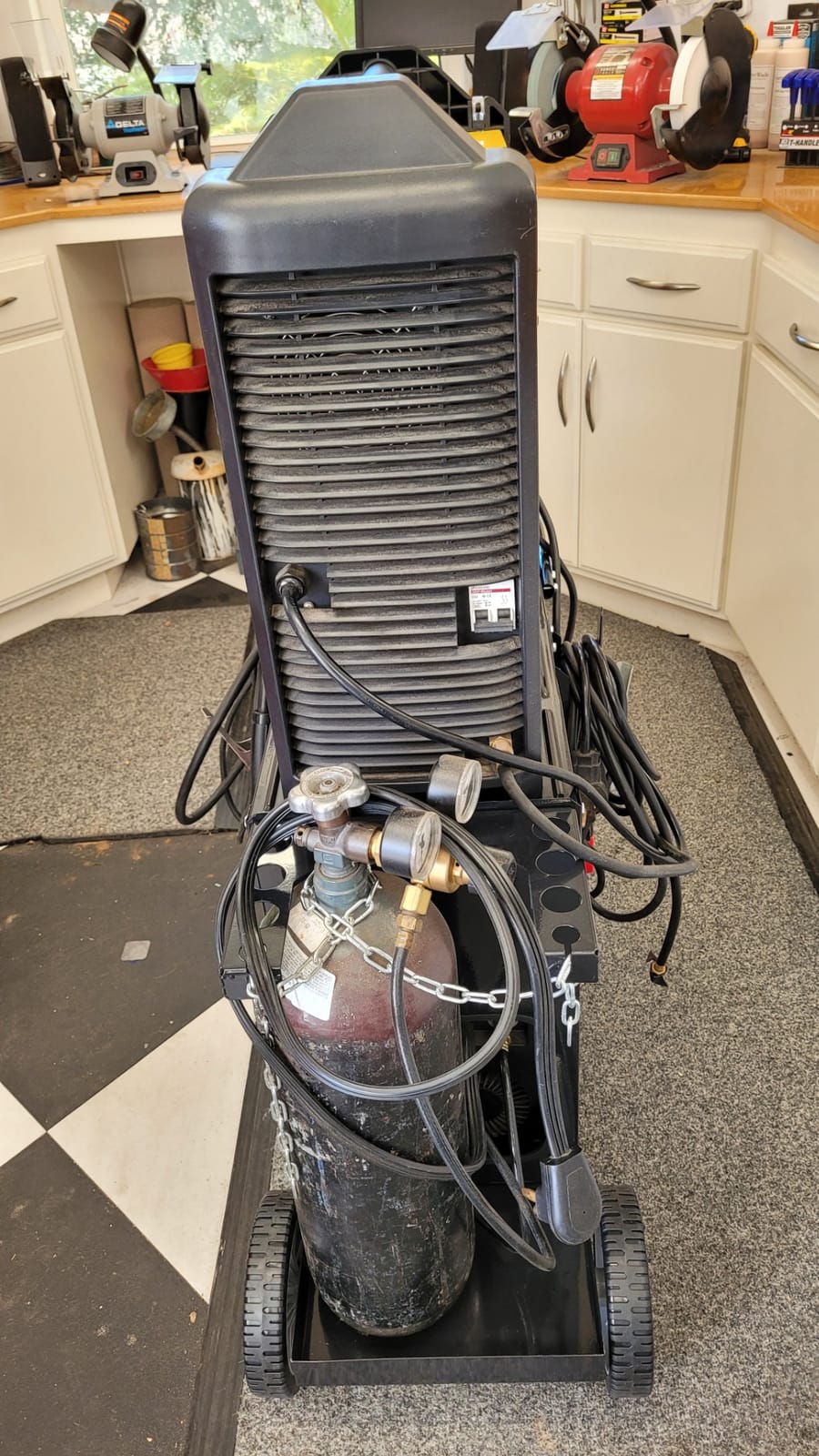
Three Shelves and a Planned Division of Labour
The layout is deliberately assigned. The top shelf is sized to hold the Mig135, Mig250, Mig175 or the Tig-200 welder. The middle shelf is for accessories. The bottom shelf takes the Versa-Cut plasma cutter. Nothing about that is accidental, and it means you are not inventing a stacking scheme after the fact.
At 36 lb empty the cart is heavier than the VEVOR but far lighter than the drawer-heavy JEGS unit, so it is still manageable to reposition when the job moves.
The TIG Rod Holder Is the Detail That Surprises People
Built into the gas bottle mount is a TIG rod holder that stores up to six tubes of filler rod, and two side hooks handle cable storage. That rod holder is the feature owners mention most, because it puts the filler rod in the same place as the gas rather than on a wall rack across the shop.
It also neatly answers a forum concern about TIG users: cabinet-style carts typically cannot store 36 inch TIG rod, but six tubes of standard length covers the overwhelming majority of work.
The 125 CF Bottle Limit and the Warranty
Eastwood is explicit that this cart is intended for a 125 CF gas bottle and that larger bottles are not recommended. If you run 250 CF cylinders, this is the wrong cart, and that is a hard compatibility constraint rather than a preference.
On the plus side it is one of the few in this group with a published warranty story: a 1-year limited warranty, a 90-day return window and a 100 percent satisfaction guarantee, backed by lifetime technical support from the brand. It is also rated for indoor use only, so it is a shop cart rather than a job site cart.
6. Klutch 2-Tier Welding Cart with Locking Cabinet – Best for Small Shops and Shared Storage
Klutch 2-Tier Welding Cart with Cabinet, 100-Lb., 31.5in.L x 16.1in.W
Locking cabinet 19.5 in L by 14 in W by 12 in H
One bottle rack up to 7 inch diameter
31.5 in L by 16.1 in W footprint
+ Pros
- Locking cabinet secures consumables when the shop is unattended
- Four cable wrap sets reduce trip hazards
- Compact footprint suits small shop spaces
- Powder coated steel built for garage use
- Integrated rack moves welder and gas as one unit
- Cons
- 100 lb capacity is the lowest in this roundup
- Rack holds a single bottle up to 7 inch diameter
- 38.25 inch height means leaning to reach shelves
The lockable cabinet is the reason this cart is here. Nothing else in this roundup secures your consumables when the shop is unattended, and on forum threads about shared shops and shops with kids around, that is a recurring priority rather than a nice to have.
It rates 4.3 stars across 130 reviews with 62 percent five-star and only 4 percent one-star, and the compact 31.5 by 16.1 inch footprint is consistently praised by people working in tight spaces.
The 100 Pound Rating Is the Whole Story
This is the single most important spec on this cart, and it is why it is not the general recommendation. A 100 lb capacity means one small machine and consumables. It cannot take a welder plus a plasma cutter, and owners are clear about that limit.
That is not a flaw so much as a design boundary. If you run a compact 140 class inverter and one bottle, 100 lb is adequate with room to spare. If you run anything larger, you will exceed it quickly, and the fix is not a different cart, it is one of the 400 lb options in this roundup.
Cabinet Interior and What Actually Fits
The locking cabinet interior measures 19.5 inches long by 14 inches wide by 12 inches high, with an 11.5 by 10.25 inch door opening. That is a real working volume for tips, nozzles, contact tips, pliers, magnets and a coil of wire, and the door keeps it all contained and secure.
The top shelf measures 18.75 by 13.75 inches for a welder or plasma cutter, and the middle shelf is 19.5 by 13.75 inches with 15.25 inches of clearance beneath. Note the door opening width, because long items that fit on the shelf will not always pass through the door.
Cylinder Rack, Cable Wraps and Height
The built in cylinder rack holds one shielding gas bottle up to 7 inches in diameter, which is a hard limit. If you run 9 inch bottles, this cart will not do the job, and you should read that diameter number as a fit or no fit spec rather than a preference.
Four cable wrap sets keep welding cables, power cords and leads off the floor, and no other cart in this roundup includes that many. Caster-wise it has two 2 inch front swivel casters and two 6 inch rear wheels, and at 43.2 lb it is a substantial 38.25 inch tall unit, so the middle shelf means leaning over rather than looking in.
7. JEGS Steel Welding Cart with Drawers – Best for Drawer-Heavy Shops
Steel Welding Cart with Drawers (33 1/2 in. L x 18 1/2 in. W x 33 in. H)
350 lb weight capacity
Three smooth gliding drawers
Larger welder platform plus lower cabinet bin
+ Pros
- Only cart here with three full size smooth gliding drawers
- 350 lb rating takes a MIG or TIG machine or a plasma cutter
- Larger platform plus a lower cabinet bin for bulk storage
- Built in hose and cable hooks and a gas cylinder platform
- Swivel casters make it easy to roll the table around
- Cons
- Heaviest unit in the group at 86.1 lb
- Page dimensions do not match the stated cart size
- 30 day manufacturer warranty is short
This is the storage-first cart. If your bench is currently a pile of tips, nozzles and gloves next to the machine, the three deep smooth-gliding drawers here are the feature that will change how your shop works, and no other cart in this roundup offers three full size drawers.
It rates 4.2 stars across 117 reviews with 63 percent five-star feedback, and 11 percent one-star is tied for the highest negative share here. The reason is not the drawers, it is the mass.
What the Drawers Add That Shelves Do Not
A shelf holds things. A drawer holds things in order, in the dark, with a pull handle, which is why drawer carts show up so often in forum recommendations. The three drawers here have genuinely deep drawer depth, and buyers single that out as the reason the layout works for a working shop rather than a display.
Combined with a larger welding cabinet platform and a lower cabinet bin for bulk storage, you end up with a cart that can function as a small parts centre rather than a machine stand. Welding hose and cable hooks are built in, and there is a gas cylinder platform rather than a cradle.
86 Pounds Empty and What That Means
At 86.1 lb this is by far the heaviest unit we reviewed, and it changes the calculus completely. Getting it into position needs two people or a ramp, and moving it mid job is a chore rather than a shrug.
That weight is also the stability argument in reverse. A heavy chassis resists tipping when you roll it over a threshold with a full bottle aboard, which matters once you add payload. Just know that the safety comes from mass you have to wrestle into the shop once.
Warranty and a Listing Detail Worth Noting
The manufacturer warranty is 30 days, which is short next to the 1-year coverage on the Eastwood cart and thin against what a name brand usually offers. If the weld seams or casters are going to give you trouble, that window is when you will find out.
One more practical note: the listed item dimensions of 14 by 14 by 8.75 inches do not match the stated cart size of 33.5 by 18.5 by 33 inches, so use the cart dimensions and ignore the item dimensions when checking your door clearance.
8. RCIACRHT Heavy Duty Rolling Welder Cart – Best Vertical Clearance on a Budget
RCARTICH Welding Cart,Heavy Duty Rolling Welder Cart with 360 Swivel Wheels,Large Size Welder Cart for MIG MMA TIG Welding Machine and Plasma Cutter Tank
400 lb static and 350 lb dynamic capacity
37.4 inch overall height
31 inch L by 14.4 inch W footprint
+ Pros
- Tall 37.4 inch frame gives more vertical clearance than most carts
- Two rear safety chains hold a full bottle securely
- Bottom storage box on roller slides for caps and gloves
- Top shelf
- middle partition and box take a welder plus a plasma cutter
- Cons
- Lowest rating in the group at 4.0 stars
- Minimal instructions and out of box quality reports
- Top shelf bent during handle adjustment on a high use area
The reason this cart is here is vertical space. At 37.4 inches tall it gives more clearance under the top frame than anything else in this roundup, and that matters for tall machines with tall handles or a raised control panel, or for anyone who does not want to crouch to make adjustments.
It rates 4.0 stars across 120 reviews, the lowest in the group, with 53 percent five-star. That number is worth reading as expectation setting rather than a rejection, because the complaints are consistent and fixable: thin metal, bent panels out of the box, stripped hardware and minimal instructions.
Capacity and the Storage Box Layout
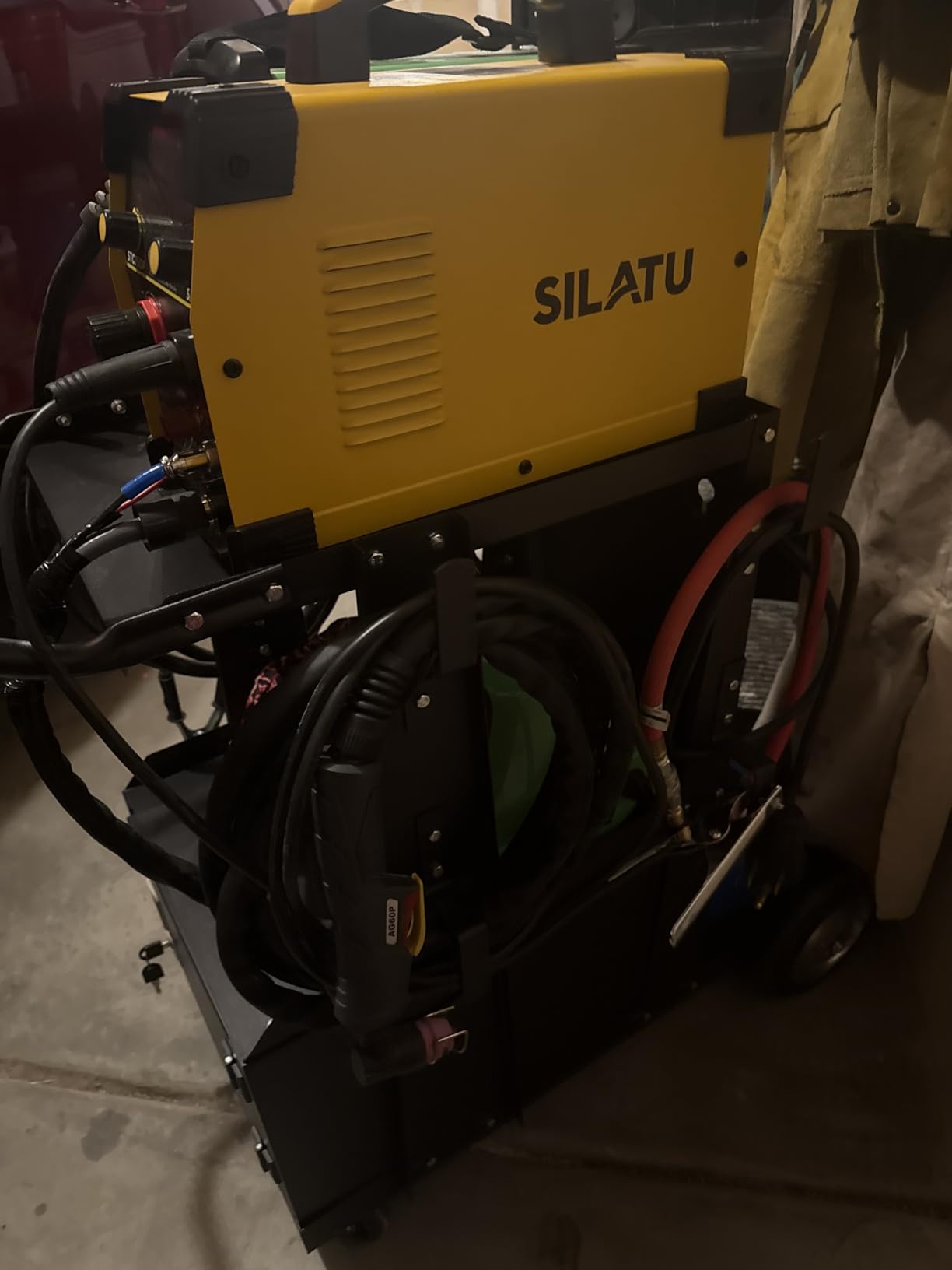
Rated capacity is 400 lb static and 350 lb dynamic, which sits alongside the two leaders in this roundup. The layout uses a top frame of 14 by 19 inches, a middle partition of 14 by 19.5 inches, and a bottom storage box measuring 10.2 by 10.2 by 19.5 inches on roller slides.
Reviewers say the top shelf, middle partition and box can carry a MIG welder plus a plasma cutter, and the bottom box takes welding caps, gloves and rods. Four side metal brackets hold torches and pliers, and the matte paint coating is for scratch and rust resistance.
Cylinder Security and Wheel Durability
Two stainless steel safety chains at the rear prevent cylinder slippage, and they are described as holding a full bottle securely. The wheel arrangement is two 360 degree rotating front wheels plus two heavy duty 6 inch directional rear wheels, which is a good pattern for shop floors.
The recurring weakness is the base 6 inch rear wheels wearing quickly under a full bottle, and some buyers already plan to swap in casters. If you are loading this heavily, budget for a caster upgrade rather than discovering the problem at the worst moment.
Quality Control Is the Real Weakness
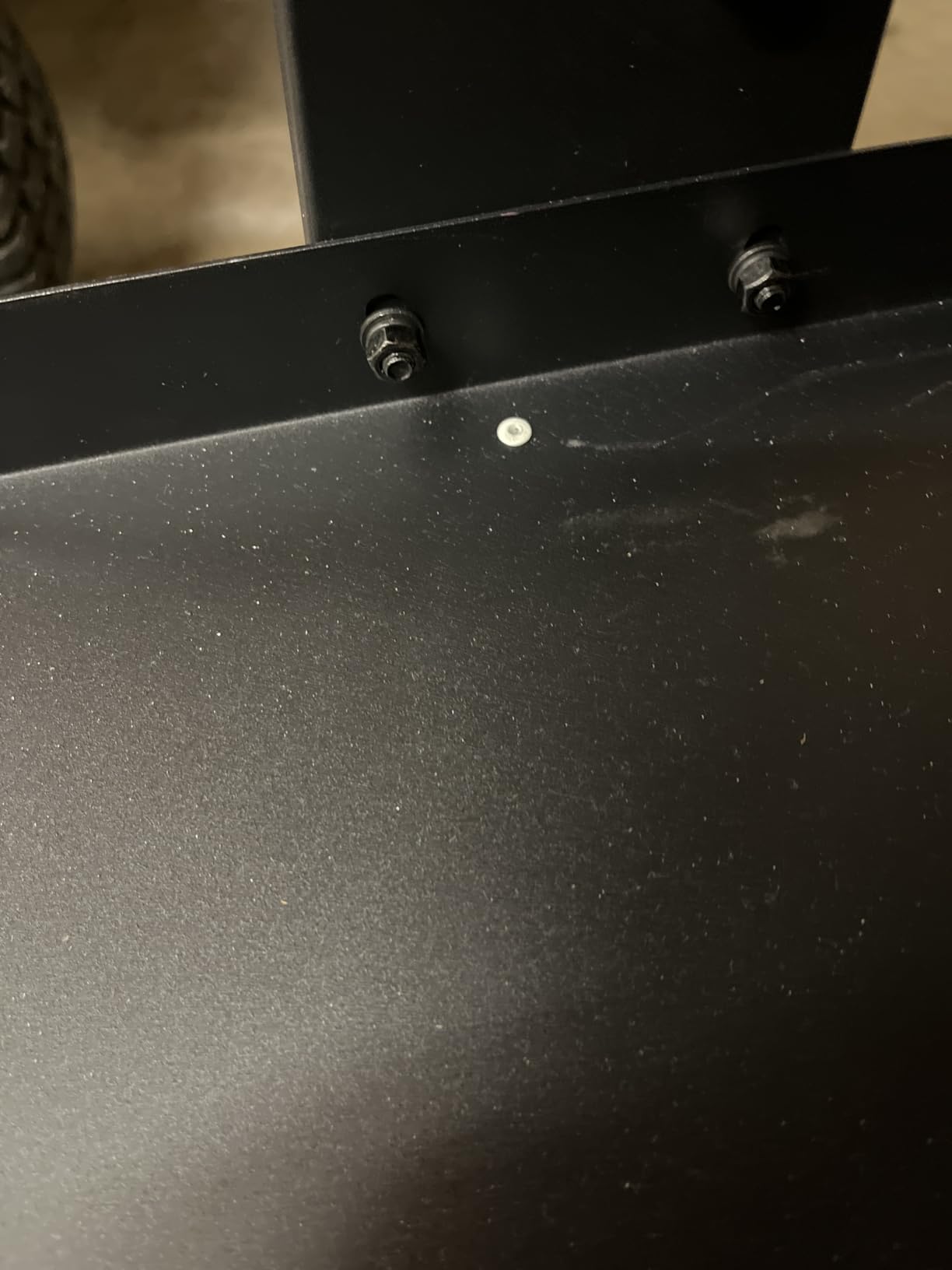
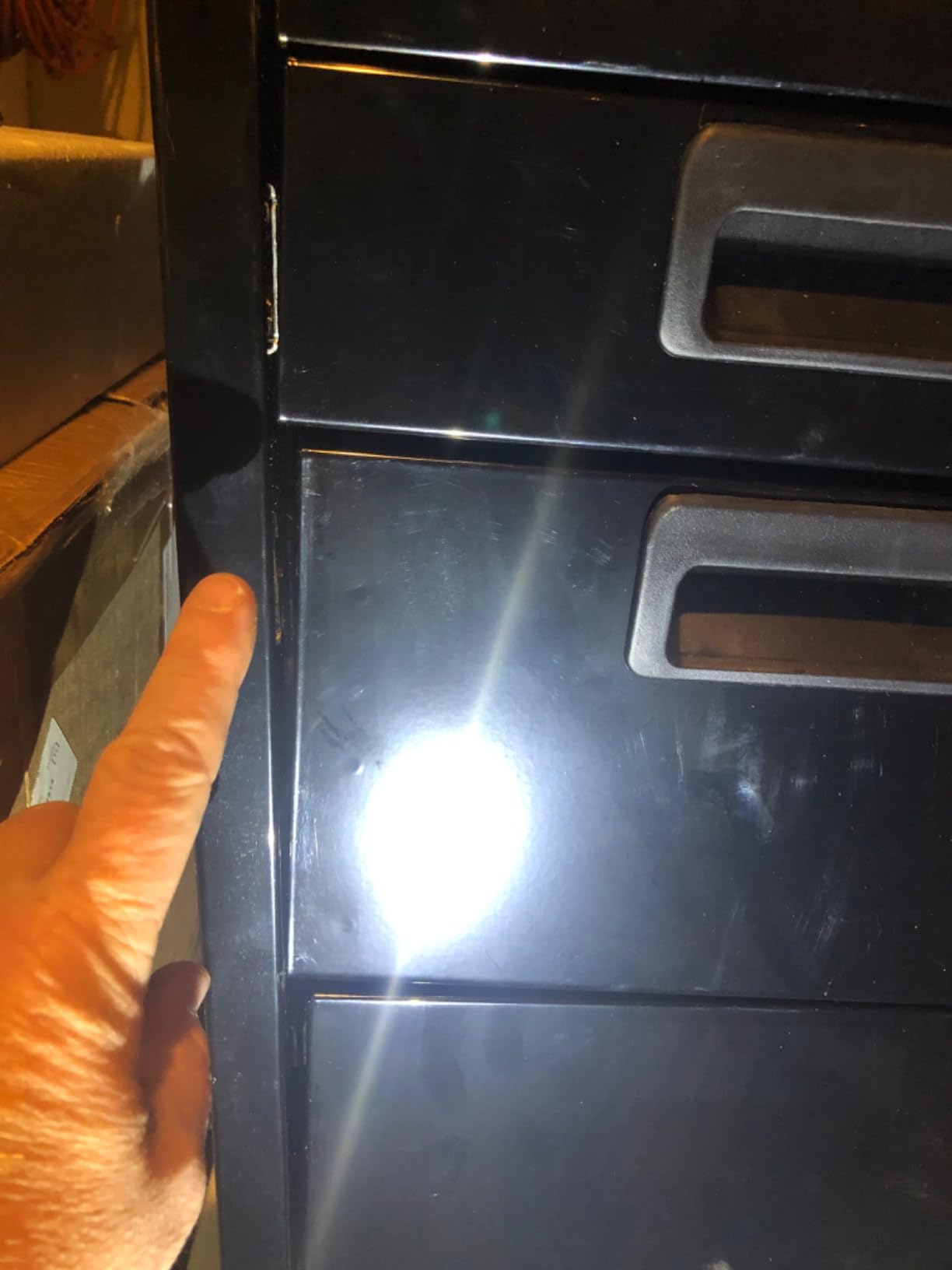
Multiple buyers reported units arriving with bent or scratched panels, a smashed corner and a door that would not close, and others had bolts and nuts strip during normal tightening. One buyer also reported the top shelf bending during handle adjustment in a high use area.
The handle and top tray front can be configured to your preference, which is genuinely useful, but inspect the panels and hardware before you start. Many of these owners still recommend it as a budget option, and the roomy vertical frame is a real advantage that cheaper alternatives in this category do not offer.
What Makes a Good Welding Cart?
A good welding cart has six things going for it: a load rating comfortably above your machine plus a full shielding gas cylinder; a cylinder cradle sized for the 7 inch or 9 inch bottle you actually use; rated swivel or locking casters that roll over concrete and thresholds; a steel top plate thick enough not to flex; storage for the handful of consumables you genuinely carry; and a footprint that fits through your door and leaves you room to work around it.
That is the short version. Everything below unpacks each of those six, plus the two things most shopping guides skip entirely, which are cylinder placement safety and whether you need a cart at all.
How to Pick the Right Welding Cart for Your Machine
Load Capacity: Rating Against Real Payload, Not Hope
Load capacity is the first number to check and the most commonly oversold. A 400 lb static rating sounds enormous until you do the addition: a 250A shop machine in the 250 to 300 lb range, plus a full shielding gas cylinder, plus a shelf of wire and consumables, puts you past 550 lb of payload before the cart has contributed anything.
The practical rule is to compare the cart rating against machine weight plus a full bottle, not against machine weight alone. A compact 140 class inverter at roughly 60 lb plus a full bottle is comfortably within a 100 lb rating, which is exactly why the Klutch cart works for small machines and fails for anything larger. A 200 to 250A machine wants a 350 lb rating minimum, and a 300 lb shop unit on a full bottle wants the 400 lb carts in this roundup.
Also read the dynamic rating where it is published. A rolling cart is a dynamic load by definition, and the gap between static and dynamic on some of these carts is 30 lb, which is not a rounding error when a full bottle is shifting above the axle line.
Cylinder Size Is a Hard Compatibility Constraint
This is the decision that quietly eliminates half the carts you were considering. Small shielding gas bottles run about 7 inches in diameter, larger ones run 9 inches, and the cradle either accepts them or it does not.
The range in this roundup is stark. The Klutch rack holds one bottle up to 7 inches in diameter and nothing more. The Eastwood mount is specified for a 125 CF bottle with larger sizes explicitly not recommended. The YESWELDER slots accept cylinders up to 10 inches, and the VEVOR offers two slots with two chains so you can carry shielding gas and an oxygen or acetylene bottle together for TIG work.
Measure your bottle before you order, and if you might add a second machine later, buy the dual slot cart now. Retrofitting a second cradle to a single slot frame is more work than choosing correctly the first time.
Casters: Where Small Front Wheels Cause Complaints
The most repeated mechanical complaint about welding carts in owner reports is not the frame, it is the casters. Specifically, small front casters and fixed rear wheels.
Look at two numbers. First, diameter: the VEVOR pairs 2.9 inch front swivel casters with 7 inch rear casters, and the Eastwood, Klutch and RCIACRHT designs all use 6 inch rear wheels. Larger rear wheels climb thresholds, roll over cord and grit, and keep the load level. Second, whether the rear wheels swivel. Swivel front casters plus fixed rear wheels track predictably but still pivot on the rear axle in a very tight turn, which matters in a single-bay garage.
Locked casters are the feature people want and few carts actually deliver. Owners report drawers flying open over bumps and rough surfaces, and on carts without a positive latch the fix is a small latch or a rubber mat.
Deck Height: Can You Still Stand Up to Adjust the Machine?
Premium cart reviews raise deck height more often than you would expect, and the complaint is consistent: a machine mounted too low means you cannot stand up straight to make adjustments after you have adjusted the machine once.
Heights across this group range from 21 inches on the Lincoln K2275-3 up to 38.25 inches on the Klutch and 37.4 inches on the RCIACRHT. Taller is not automatically better, since a very tall cart means leaning over the middle shelf, but if you are tall and work standing, check the deck height against your bench setup before you commit. The Lincoln angled top shelf is the interesting middle path, tilting the control panel toward you so you do not have to crouch at all.
Storage: You Need Far Less Than the Drawer Count Suggests
Here is the honest limit on drawer-heavy carts, and it comes straight from the consensus in welding forum discussions: most welders carry far fewer consumables than a cabinet cart implies.
The recurring picture is a couple of tip sizes, a spool of wire, a pair of gloves, a few contact tips in a tin, and a nozzle or two. One user keeps the day filler rod in a piece of muffler pipe welded to a plate and the rest in a zip bag under the hood. Another was told that most welders use only one or two cup sizes the vast majority of the time.
That is why a two-tier frame with a top shelf and a wide bottom tray is a legitimate answer rather than a compromise, and it is why the VEVOR and Weldpro three-tier layouts outpace a four-drawer cabinet for many people. Buy drawers for organisation, not for capacity you will never fill.
Footprint and Shop Fit
The Weldpro is 40.5 inches long. The VEVOR is 28 inches deep by 11.4 inches wide. The Klutch is 31.5 by 16.1 inches. Those numbers determine whether the cart lives in your shop or becomes furniture, and the forum consensus is unambiguous that people who bought oversized custom carts regret it.
Check three things: the depth against your garage door width, the width against a one-car bay with a vehicle parked in it, and the turning circle with a full bottle loaded. A cart you have to drag sideways to reposition is a cart you will stop moving, and a cart you stop moving is a very expensive shelf.
Build Quality and Brand Reputation
Brand matters here more than in most tool categories because the failure mode is a bent tray in year two rather than a dead battery. The name brands in this category, Eastwood, Lincoln Electric and Klutch, all publish warranty terms: the Eastwood cart carries a 1-year limited warranty, a 90-day return window and a 100 percent satisfaction guarantee with lifetime technical support. The JEGS cart in this roundup carries 30 days.
On the value tier, build quality variation is the real risk, and the reports are consistent: soft Phillips hardware that strips under a power driver, thin steel plate, panels arriving bent or scratched, and minimal instructions. None of that makes a budget cart wrong, but it makes hand tightening the hardware and inspecting the panels before assembly the standard operating procedure.
Cylinder Placement and the Arc-Through-the-Bottle Question
This is the safety point almost no shopping guide makes, and it comes from a detailed critique of a premium welding trolley design discussed at length on MIG welding forums.
The hazard: when the shielding gas bottle sits directly beside the work surface, a ground clamp that slips off the work can arc into the cylinder. A shielding gas cylinder is a pressure vessel, and arcing near one is how people get seriously hurt in a shop that otherwise feels safe.
The geometry matters more than the safety gear. Cylinders should be chained or strapped to the cart so they cannot tip, and they should be positioned so the working side of the cart stays clear. Several carts in this roundup place the bottle at the rear, behind the machine, which is better than beside it, but a rear-mounted bottle still blocks access to that side of the cart and forces you to work around it.
If your shop has the floor space, wall-mounted swing-out gantries and welding booms keep the bottle entirely outside the work envelope, and scissor-lift tables solve a related problem by raising the machine instead of carrying it. Those are the setups welders in that thread preferred once they understood the geometry, and it is worth knowing they exist before you commit floor space to a cart.
Do You Even Need a Welding Cart?
Honest answer: sometimes no, and experienced welders say so plainly. On the same forum threads that recommend carts, several people argue the opposite position, and their recommendation is to keep the machine on a shelf or on a bench on castors, keep a conventional tool chest at your back, and keep very little consumables with the machine at all.
That approach is genuinely better in a few situations. A lift table lets you raise the machine to working height without crouching. A fixed bench never becomes an obstacle because it never moves. And if you have a dedicated machine station already, a cart is redundant weight you have to move.
A cart earns its place when you move between jobs, when the machine and gas have to travel together, and when you want consumables travelling with the machine so setup and teardown is one trip instead of five. If none of that describes your situation, the lift table or bench argument is the stronger one and you should follow it.
Modifications That Fix a Welder Cart
Welding cart forums reach a near unanimous conclusion: most people buy a commercial cart and then modify it. The mods are cheap and they address the complaints above directly.
Cylinder retention is the first one. A rubber mat or a purpose-made mat under the bottle stops it sliding and stops it scuffing the paint, which is the single most commonly repeated mod in owner reports. Adding a second strap or chain where only one is supplied is the natural companion to that.
Caster upgrades are the second. Owners running carts with 6 inch base rear wheels under a full bottle report rapid wear and plan to swap in better casters, and swapping casters on most of these carts is a bolt-out, bolt-in job. The same applies to the small front casters that generate the most complaints.
Rubber matting on the top tray stops a machine sliding during transport, and adding side hooks or a torch lead hanger is a fifteen minute addition that most carts need. One build-versus-buy note worth keeping: the DIY maths in forum threads involves a bandsaw, a shear, a press, casters and ten or more hours, which is why most people end up buying and modifying instead of building from square tubing.
Frequently Asked Questions
What makes a good welding cart?
A good welding cart needs a load rating above your machine plus a full shielding gas cylinder, a cylinder cradle that fits your 7 inch or 9 inch bottle, rated swivel casters large enough to roll over concrete and thresholds, a steel top plate that does not flex, storage for the consumables you actually carry, and a footprint that fits through your door.
How much weight can a welding cart hold?
Carts in this roundup range from a 100 lb static rating on the Klutch two-tier cabinet up to 400 lb static on the VEVOR, Weldpro and RCIACRHT designs, with the VEVOR also publishing a 370 lb dynamic figure. Judge the rating against machine weight plus a full cylinder, not machine weight alone, because a 250A shop machine and a full bottle can already exceed 550 lb of payload.
What size gas bottle fits a welding cart?
It depends entirely on the cradle. The Klutch rack holds one bottle up to 7 inches in diameter, the Eastwood mount is specified for 125 CF cylinders with larger bottles not recommended, and the YESWELDER slots accept cylinders up to 10 inches. The VEVOR offers two slots with two chains, so you can carry shielding gas and an oxygen or acetylene bottle at once. Measure your bottle before ordering.
Do I need a welding cart for my MIG welder?
You need one if you move between jobs, if the machine and gas have to travel together, or if you want consumables to travel with the machine. Experienced welders on welding forums often argue against them, recommending the machine stay on a shelf or a bench on castors with a conventional tool chest at your back. A lift table is the better answer when your machine stays in one station.
What type of casters should a welding cart have?
Swivel front casters paired with larger fixed rear wheels is the most common pattern and the best compromise. The VEVOR pairs 2.9 inch front swivel casters with 7 inch rear casters, while the Eastwood, Klutch and RCIACRHT designs use 6 inch rear wheels. Larger rear wheels roll over thresholds and shop debris, and owners most often complain about undersized front casters and fixed rear wheels that pivot on the axle in tight turns.
Are welding carts worth it?
For anyone moving a machine and gas between jobs, yes, because a loaded cart replaces several trips and keeps cylinders off the ground and upright. The counter argument from experienced welders is that most people carry far fewer consumables than a drawer cart implies, so the storage-heavy designs are often overbuilt. A three-tier frame with side brackets suits most people better than a four-drawer cabinet.
Should a welding cart store the shielding gas cylinder, or is it safer to store cylinders separately?
A cart with a chained or strapped cradle is safer than cylinders standing loose, and the carts here all include two stainless steel safety chains or an equivalent rack. The real hazard is placement, not storage: on MIG welding forums a ground clamp that slips from the work surface into a bottle sitting beside it is described as an arc-through-the-cylinder risk, so keep the working side of the cart clear or use a wall-mounted swing-out gantry that puts the bottle outside the work envelope.
Which Welding Cart Fits Your Setup
If you want one answer, take the VEVOR 3-Tier. A 400 lb static rating, three shelves, four side brackets, twin cylinder slots with chains and the deepest review base in this roundup make it the safest default for a garage welder in 2026.
If you run a Lincoln wire feed or MIG machine, the Lincoln Electric K2275-3 is worth the premium because the mounting holes line up with the bolt pattern and the angled shelf keeps your controls in reach. If you cut as well as weld and want one cart to carry both machines, the Eastwood three-shelf cart is built for exactly that within 350 lbs, provided your bottle is 125 CF or smaller.
If your shop is small, the Klutch cart with its locking cabinet and four cable wrap sets is the compact choice, but measure your bottle first because the rack stops at 7 inches and the 100 lb rating rules out a second machine. If you want drawers more than you want portability, the JEGS cart gives you three full size drawers at the cost of 86.1 lb and a short warranty. If you need vertical clearance under the top frame, the RCIACRHT at 37.4 inches tall is the one, with the understanding that you inspect the panels before you assemble it.
Whichever you pick, check the cylinder cradle diameter, add a rubber mat under the bottle, and keep the working side of the cart clear. Those three habits matter more than any spec on the page.