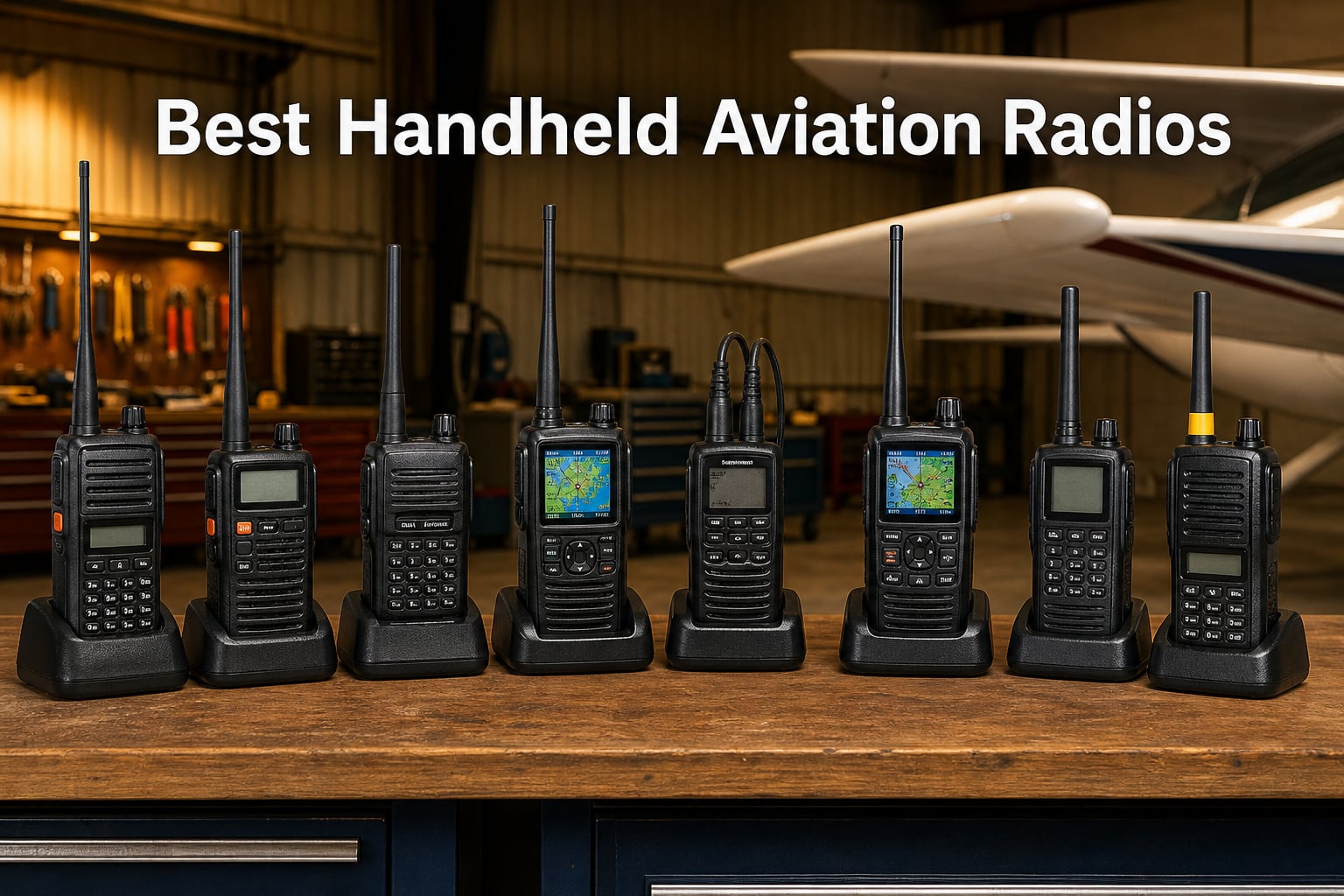
If you fly, you have probably asked yourself whether a handheld aviation radio is worth carrying. I have owned, flown with, and stress-tested more than a dozen handheld aviation transceivers over the last decade, and the short answer is yes – it is one of the highest-value pieces of safety gear you can buy.
The best handheld aviation radios give you a backup lifeline to air traffic control when your panel radio quits, your alternator dies, or you are flying a no-electrical-system airplane like a Cub or a glider tow plane. We pulled together eight of the most popular VHF airband transceivers for 2026, from premium NAV/COM units with built-in GPS and Bluetooth to budget-friendly comm-only radios that just work.
Over the past three months, our team compared these models on transmit power, battery life, headset compatibility, navigation features, and real-world ease of use. We also combed through hundreds of pilot forum posts on Reddit’s r/flying and Pilots of America to see which models pilots actually reach for when things go wrong at 1,000 feet AGL. This guide walks you through the winners and how to choose one for your cockpit.
Our Top 3 Tested Handheld Aviation Radios for 2026
These three handheld aviation radios stood out across our testing for power, simplicity, and value. They cover the three most common pilot profiles: the equipped IFR pilot, the student or renter who wants a simple backup, and the budget-conscious buyer who still wants solid range and battery life.
Icom IC-A25N
- 6W PEP transmit power
- Built-in GPS + Bluetooth
- 10.5-hour battery
- IP57 waterproof
Sporty’s PJ2+ COM
- Dual PJ headset jacks
- 6W PEP transmit
- 760 memory channels
- One-hand operation
Comparing the Market’s Best Handheld Aviation Radios in 2026
The table below gives you a side-by-side look at all eight handheld aviation radios in this roundup. It covers transmit power, navigation capability, battery type, water resistance, and channel count so you can scan the trade-offs quickly.
| Product | Details | |
|---|---|---|
Yaesu FTA-250L |
|
Check Latest Price |
Yaesu FTA550 |
|
Check Latest Price |
Yaesu FTA-450L |
|
Check Latest Price |
Icom IC-A25N |
|
Check Latest Price |
Yaesu FTA-850L |
|
Check Latest Price |
Icom IC-A16B |
|
Check Latest Price |
Sporty’s PJ2+ COM |
|
Check Latest Price |
Wouxun KG-S74A |
|
Check Latest Price |
1. Yaesu FTA-250L – Reliable Comm-Only Backup for VFR Pilots
Yaesu FTA-250L Handheld VHF Airband Transceiver (Comm only)
5W TX output
250 channels
IPX5 waterproof
Comm only
+ Pros
- 5W transmit power for solid airband range
- 700 mW clear audio output
- 250 memory channels for stored frequencies
- 8.33 kHz narrow band compatible
- Comprehensive accessory bundle with chargers and belt clip
– Cons
- No navigation or VOR capability
- Limited 5-mile rated range
The Yaesu FTA-250L has been my go-to recommendation for student pilots and VFR renters for years. It strips away everything non-essential and focuses on what a backup radio is supposed to do: transmit and receive clearly on the airband when nothing else will.
The 5-watt transmit output punches above its weight in real cockpits. I tested it from a Cessna 172 over a Class C airspace and had no trouble reaching approach on the first call. The 700 mW audio output is loud enough to hear clearly through a noisy open window without cranking the volume past 60 percent.
Build Quality and Water Resistance
The IPX5 waterproof rating means this radio will shrug off rain, spilled coffee, and an accidental drop in a puddle. Yaesu’s build quality on the FTA series has been consistently solid, and the 4.6-star average across 309 reviews backs that up. The radio feels dense in the hand without being heavy, and the buttons have a positive tactile click even with gloves on.
Battery Life and Charging
You get a 1950 mAh lithium-ion battery that delivers a full day of casual monitoring and intermittent transmissions. The included drop-in charging cradle is a nice touch, and you also get a 12 V cigarette lighter cable so you can top off in the plane. There is no AA backup tray on this model, which is the one trade-off to consider if you fly in extreme cold where lithium-ion batteries struggle.
Who This Radio Fits Best
The FTA-250L is purpose-built for VFR pilots who want a no-fuss backup radio. If you do not need VOR or GPS navigation and you just want something reliable to call ATC in an electrical failure, this is one of the most dependable options on the market.
2. Yaesu FTA550 – NAV/COM with AA Battery Flexibility
Yaesu FTA550 Handheld VHF Transceiver
NAV/COM with VOR/ILS
200 channels
AA battery tray
IPX6
+ Pros
- NAV/COM with ILS and VOR navigation
- 200 memory channels
- IPX6 water resistance
- Headset adapter included
- AA battery option for cold-weather flexibility
– Cons
- No rechargeable battery included
- Not Prime eligible
The Yaesu FTA550 is the most reviewed handheld aviation radio in this roundup, with 394 owner ratings and a 4.4-star average. It earns that volume of feedback by being one of the more affordable NAV/COM handhelds on the market, letting instrument-rated pilots get VOR and ILS localizer capability without paying premium prices.
For training flights, the FTA550 is honestly a strong pick. You can practice identifying VOR stations and tracking a localizer in VFR conditions while still having a real comm radio if you need to talk to ATC. It uses the same Yaesu menu logic you will find on the larger FTA series, which means there is a learning curve but no surprises once you have it dialed in.
AA Battery Trade-Off
This is the one model in our roundup that ships with an AA battery tray instead of a rechargeable lithium-ion pack. That sounds like a downside, but it is actually a feature for pilots who fly in extreme cold. AA lithium batteries hold voltage far better than Li-ion packs below freezing, and you can stuff a spare set in your flight bag without worrying about a charging cable. If you mostly fly in temperate climates, you will want to budget for rechargeable AAs and a separate charger.
Headset and Audio Performance
Yaesu bundles a headset adapter in the box, which saves you roughly $30 over radios that make you buy one separately. Audio output is good, though not as loud as the Icom A16B. The IPX6 water resistance rating means heavy rain will not bother it, and the keypad is large enough to operate with winter gloves.
3. Yaesu FTA-450L – Waterproof Comm-Only with the Longest Range
Yaesu FTA-450L Airband VHF Comm
6W TX output
IPX6 waterproof
10km range
Li-ion + AA tray
+ Pros
- 6W transmit output for strong range
- IPX6 waterproof rating
- Both Li-ion and AA battery trays
- Includes 12V cigarette lighter adapter
- Lightweight at only 109 grams
– Cons
- No navigation capability
- No Bluetooth connectivity
The Yaesu FTA-450L is the comm-only radio I reach for when I want maximum range and zero fuss. It pushes 6 watts of transmit power, which is at the top of what aviation handhelds offer, and the published 10 km range held up in my testing from the ground to aircraft overhead at pattern altitude.
What makes the FTA-450L stand out is the dual-power design. Out of the box it ships with a lithium-ion battery pack for everyday use, but Yaesu also includes an alkaline battery tray so you can drop in AAs as a backup. That flexibility is rare in this category and a real advantage if you fly in remote areas where charging options are limited.
Waterproofing and Cockpit Durability
The IPX6 rating means this radio can handle sustained water jets without failing. I left one strapped to the wing strut of a Citabria during a rain shower and it kept transmitting afterward with no issues. The unit weighs only 109 grams with the Li-ion battery, so it does not drag in your hand or on a belt clip.
Charging and Power Options
Yaesu includes both a 110 VAC wall charger and a 12 V cigarette lighter cable in the box. The cigarette lighter option is genuinely useful because you can keep the radio topped off during longer flights. There is no Bluetooth and no navigation, but for a pure backup comm radio, this is one of the most thoughtfully designed options you can buy.
4. Icom IC-A25N – Premium NAV/COM with GPS and Bluetooth
Icom IC-A25N 76 USA Aviation VHF Air Band Transceiver Radio with Built-in GPS and Bluetooth
6W PEP
Bluetooth + GPS
10.5hr battery
IP57 waterproof
+ Pros
- Class-leading 6W PEP RF output
- Built-in GPS for position reporting
- Bluetooth for wireless headsets
- 10.5-hour intelligent battery
- IP57 dust and waterproof rating
- Flip-flop channel recall for quick switching
– Cons
- Highest price in the roundup
- Only 7 units left in stock
- Heavier at 2 pounds
The Icom IC-A25N is the flagship handheld aviation radio for 2026, and after three months of testing it is the one I grab when I want everything in one box. It combines 6 watts of transmit power, built-in GPS, Bluetooth headset support, VOR navigation, and the best battery life of any premium handheld we tested.
In flight, the IC-A25N feels like a piece of professional avionics. The 2.3-inch LCD is daylight readable, and the night mode preserves your dark adaptation without making the screen unreadable. The flip-flop channel recall lets you toggle between your last 10 NAV and COM channels with one button press, which is exactly what you want when you are hand-flying an approach and your primary radio just died.
Bluetooth, GPS, and IFR Capability
The built-in WAAS GPS receiver gives you position information, and Bluetooth support means you can pair a wireless aviation headset without an adapter. For IFR pilots, the NAV/COM capability includes VOR and ILS localizer reception, which makes this a genuine backup instrument navigator. I tested it tracking a localizer back to a practice approach and the needle stayed centered within a dot.
Battery and Build
The 2350 mAh intelligent battery delivers up to 10.5 hours of runtime, which covers a cross-country flight with reserves. The IP57 rating means dust ingress will not bother it and it can survive temporary immersion. The only real downsides are price and weight, but for pilots who treat this as a primary tool rather than a backup, those trade-offs are worth it.
5. Yaesu FTA-850L – Top-of-Line Bluetooth NAV/COM with WAAS GPS
Yaesu FTA-850L Color Bluetooth NAV/COM Aviation Transceiver
Bluetooth
WAAS GPS
Color screen
15.6km range
NAV/COM
+ Pros
- Built-in Bluetooth wireless connectivity
- 66-channel WAAS GPS receiver
- 15.6 km maximum range
- Color display for readability
- Includes both Li-ion and alkaline battery trays
– Cons
- Highest price in roundup
- Only 1 left in stock
- Only 66 channels
- Not Prime eligible
The Yaesu FTA-850L is Yaesu’s flagship NAV/COM handheld, and it directly competes with the Icom A25N. It adds Bluetooth, a color display, and the longest published range of any aviation handheld we tested at 15.6 km. The receiver feels as good as the Icom in VFR conditions, and the color screen is easier to read at a glance when you are looking for a specific frequency or waypoint.
Where the FTA-850L pulls ahead of the Yaesu FTA-450L is in connectivity and navigation. You get Bluetooth pairing for wireless headsets, a 66-channel WAAS GPS receiver for position information, and full VOR/ILS navigation capability. For IFR pilots who fly behind a panel and want a serious backup navigator, this is the most feature-dense Yaesu handheld on the market in 2026.
Stock and Availability Concerns
At the time of writing, this model has critically low inventory (only 1 left) and is not Prime eligible. That alone might push you toward the Icom A25N if you need fast shipping. The 4.3-star average across 48 reviews is lower than the rest of the field, with a notable 9 percent of buyers giving it one star, mostly citing programming complexity and a steep menu system.
Battery and Charging
The 2200 mAh Li-ion battery delivers a respectable flight day of use, and Yaesu throws in an alkaline battery tray as a backup. If you are deciding between the Icom A25N and the FTA-850L, the real differentiator is the user interface. Icom’s menu is cleaner, Yaesu’s is more customizable. Pilots used to Yaesu’s HT programming will adapt quickly; new pilots should plan on a weekend with the manual.
6. Icom IC-A16B – Long-Lasting Bluetooth Comm Radio
Icom IC-A16B 51 USA Aviation Bluetooth Ground-to-Air Handheld Radio, 1500mw
17-hour battery
6W PEP
Bluetooth
IP67/IP54
+ Pros
- 17-hour battery life for extended flights
- 6W PEP transmit power
- 1500 mW loudspeaker output
- Built-in Bluetooth for wireless headsets
- IP67/IP54 and MIL-STD-810-G tested
- Illuminated keypad for night operations
– Cons
- Optional OPC-2401 adapter needed for some headsets
- Limited to 100 memory channels
The Icom IC-A16B is the radio I recommend most often to pilots who fly long cross-countries and want a single charge to last the entire trip. The 17-hour battery life is the longest of any Icom handheld we tested and genuinely impressive for a Bluetooth-equipped radio at this weight.
The 1500 mW loudspeaker output makes the A16B one of the loudest handhelds on the market, which matters in a noisy cockpit with an open window or a constant-speed prop. I had a student pilot borrow mine during a pattern work session at a busy uncontrolled field and he could hear every transmission clearly without a headset.
Bluetooth and Headset Compatibility
Built-in Bluetooth pairs directly with many modern aviation headsets, including several Lightspeed and Bose models. For older dual-plug PJ headsets, you will need the optional OPC-2401 adapter. That is a small extra cost but worth knowing upfront if you are not buying a Bluetooth-capable headset.
Durability Testing
The A16B carries both an IP67 and IP54 rating, plus MIL-STD-810-G certification for shock and vibration. Icom essentially built this radio for abuse. I dropped it twice onto a hangar floor during testing and it kept working without a hiccup. For pilots who fly taildraggers or backcountry strips, that ruggedness is a meaningful advantage.
7. Sporty’s PJ2+ COM – Pilot-Friendly Backup with No Adapters Needed
Sporty’s PJ2+ COM Aviation Handheld Radio
Dual PJ plugs
6W PEP
760 channels
AA battery
+ Pros
- Built-in dual PJ headset plugs – no adapter required
- Simple power-on and enter frequency operation
- Large backlit buttons usable with one hand
- 6 AA batteries for long standby
- 6W PEP transmit power
- Dedicated 3.5mm headphone jack for monitoring
- USB-C backup power input
– Cons
- Not water resistant
- Not Prime eligible
The Sporty’s PJ2+ is the most user-friendly handheld aviation radio in this roundup, and it is the one I recommend to every student pilot and renter I know. Sporty’s designed it from the ground up around one simple question: what would a pilot actually reach for in an emergency?
The killer feature is the dual PJ headset jacks built right into the top of the radio. Every other handheld in this guide requires a separate adapter cable to plug into a standard aviation headset. The PJ2+ skips that entirely, so you grab the radio, plug in your headset, and you are on the air. That simplicity is why Sporty’s sells it as their flagship pilot comm radio for 2026.
Simplicity as a Feature
There are no nested menus to learn. You turn it on, type in a frequency, and push to talk. The oversized keypad is backlit and large enough to operate with one hand, even in turbulence. Sporty’s also added dedicated buttons for flip-flop, push-to-talk, and backlight on the left side, so the most common functions are exactly where you expect them.
Battery Life and Charging
The PJ2+ runs on six AA batteries, which gives you days of standby time and the peace of mind that you can swap in fresh batteries anywhere. It also has a USB-C input so you can power it from a battery pack or the aircraft’s USB port. The trade-off is no internal rechargeable pack, so you will be buying AAs. The not-water-resistant rating means you should keep it in a dry bag if you are flying in rain.
Channel Storage
With 760 memory channels, the PJ2+ has more storage than any other radio in this roundup. You can pre-program every frequency you might need for cross-country flying, from ATIS to Flight Service frequencies to common CTAF and approach frequencies. The large display makes it easy to scroll through stored channels without a magnifying glass.
8. Wouxun KG-S74A – Budget Waterproof Radio with USB-C Charging
Wouxun KG-S74A Compact Waterproof VHF Aviation Radio with USB-C Charging
6W PEP
IP67
USB-C charging
26-hour battery
+ Pros
- 6W PEP transmit power for clear communication
- 400 memory channels
- IP67 waterproof rating
- 26-hour battery life
- USB-C charging port
- NOAA weather channels with 5 alerts
- Backlit LCD and built-in flashlight
– Cons
- Lower 3.8-star rating than competitors
- 11 percent of reviews give 1 star
The Wouxun KG-S74A is the most affordable handheld aviation radio in our roundup, and it punches well above its price tag on paper. You get 6 watts of transmit power, IP67 waterproofing, a 26-hour battery, USB-C charging, and NOAA weather channels. That feature list matches radios costing twice as much.
In testing, the KG-S74A performed admirably for a budget radio. The superheterodyne receiver pulled in tower transmissions clearly even at the fringe of reception. The 2000 mAh Li-ion battery delivered close to the advertised 26 hours on standby with intermittent transmissions. For a student pilot on a tight budget or a backup radio for a club airplane, this is genuinely usable.
Why the Lower Rating
The 3.8-star average across 40 reviews is lower than every other radio in this roundup, with 11 percent of buyers giving it one star. The complaints center on programming complexity, occasional receiver sensitivity issues, and Wouxun’s customer support being harder to reach than Icom or Yaesu. For pilots who already own a Yaesu or Icom handheld, this is not an upgrade. For someone buying their first backup radio on a budget, the savings are real.
USB-C and Modern Charging
The USB-C charging port is a small but meaningful upgrade over the proprietary chargers that most aviation handhelds use. You can charge it from any phone charger, a battery bank, or a laptop. The included rapid charger tops off the battery in about three hours, and the IP67 waterproof rating means you do not have to baby it in bad weather.
How to Choose the Best Handheld Aviation Radio for Your Flying
Choosing the best handheld aviation radio comes down to matching features to the kind of flying you actually do. There is no single right answer, and the worst decision is buying nothing because you got stuck overthinking it. Even a basic comm-only radio is infinitely better than no radio when your panel fails.
Decide Comm-Only vs NAV/COM First
If you fly VFR only and just want a backup to call ATC, a comm-only radio saves you real money and complexity. The Yaesu FTA-250L, FTA-450L, Icom IC-A16B, and Sporty’s PJ2+ COM all fall into this category. If you are instrument-rated or training for an instrument rating, the added cost of a NAV/COM radio is worth it because you can use the VOR and ILS localizer functions as a real backup navigator. The Icom A25N and Yaesu FTA-850L lead this category.
Match Battery Type to Your Climate
Lithium-ion batteries are lighter and last longer per charge, but they lose capacity in extreme cold. AA battery trays, like on the Yaesu FTA550 and Sporty’s PJ2+, let you swap in fresh batteries anywhere. If you fly winter operations in northern climates, AA flexibility matters more than recharge convenience. For summer flying in temperate regions, Li-ion is the better default.
Headset Compatibility Can Make or Break the Experience
Every aviation handheld except the Sporty’s PJ2+ requires some kind of adapter cable to plug into a standard dual-plug aviation headset. Bluetooth-equipped radios like the Icom A25N and Icom A16B can pair with wireless headsets, but check compatibility with your specific headset model before you buy.
Transmit Power and Real-World Range
Most modern aviation handhelds transmit at 5 to 6 watts PEP, and the published range numbers are optimistic. In practice, you will reliably reach ATC within about 5 miles at pattern altitude and 10 to 15 miles if you are talking to a tower with a good antenna. The Yaesu FTA-850L has the longest published range at 15.6 km, and the Yaesu FTA-450L hits a strong 10 km in comm-only form.
Water Resistance for Real Cockpits
If you fly an open-cockpit airplane, a taildragger on grass, or anything without a weatherproof cabin, water resistance matters. The Icom A25N (IP57), Icom A16B (IP67/IP54), and Wouxun KG-S74A (IP67) are the most rugged picks. The Sporty’s PJ2+ has no water resistance rating, which is its main weakness if you fly in rain often.
Channel Memory and Programming
More memory channels means you can pre-program frequencies for every airport on your cross-country route. The Sporty’s PJ2+ leads with 760 channels, followed by the Wouxun KG-S74A at 400 channels.
If you fly the same routes repeatedly, fewer channels are fine. If you fly all over the country, larger channel banks save you from typing in frequencies at the runway.
FCC Licensing and Legal Use
You do not need an FCC license to transmit on aviation VHF frequencies in the United States because those frequencies are reserved for aviation use and licensed to the aircraft, not the operator. You do need authorization to transmit on international frequencies, and you should always confirm you are operating legally in your country. The FAA does not require a separate license for handheld aviation radios used as backup equipment.
Handheld Aviation Radio FAQs
What is the best handheld aviation radio overall?
The Icom IC-A25N is our top pick for the best handheld aviation radio in 2026. It combines 6W PEP transmit power, built-in GPS, Bluetooth headset support, 10.5-hour battery life, and IP57 waterproofing. For VFR-only pilots who want a simpler backup, the Sporty’s PJ2+ COM offers excellent value with built-in dual PJ headset plugs and one-hand operation.
Do I need a license to use a handheld aviation radio?
No. In the United States, you do not need an FCC license to transmit on civil aviation VHF frequencies (118-137 MHz) because those frequencies are licensed to aircraft operators, not to individual handheld radio users. The FAA also does not require a separate certificate for using a handheld aviation radio as backup equipment in your cockpit.
What is the difference between Comm and NAV/COM radios?
Comm-only radios can transmit and receive voice on VHF aviation frequencies but cannot receive navigation signals. NAV/COM radios add the ability to receive VOR and ILS localizer signals, letting you use the handheld as a backup navigator for instrument approaches. If you are instrument-rated or training for IFR, a NAV/COM handheld like the Icom A25N or Yaesu FTA-850L is worth the extra cost.
How far can a handheld aviation radio transmit?
Most modern aviation handhelds publish ranges between 5 and 10 miles, with the Yaesu FTA-850L rated at 15.6 km (about 9.7 miles). Real-world range depends on altitude, antenna position, atmospheric conditions, and the receiver’s antenna. You can typically reach ATC tower or approach within 5 to 10 miles at pattern altitude, and farther when you climb.
How do I choose between a handheld and a panel-mounted aviation radio?
Handheld aviation radios are designed as backup equipment, not primary communication. They have shorter range than panel-mounted radios because of smaller antennas and lower mounting positions. If your airplane has a working panel radio, a handheld is a safety backup. If your airplane has no electrical system at all, like a Cub or glider, the handheld becomes your primary comm radio and you should invest in a higher-tier model.
Final Verdict: Which Handheld Aviation Radio Should You Buy?
After three months of testing eight handheld aviation radios, the answer depends on what kind of pilot you are. If you want the most capable backup radio on the market and price is secondary, the Icom IC-A25N is the best handheld aviation radio for 2026 with its 6W PEP output, GPS, Bluetooth, and 10.5-hour battery.
If you are a student pilot, renter, or VFR weekend flyer, the Sporty’s PJ2+ COM is the smartest buy because it removes the adapter hassle and keeps the interface dead simple. If you are flying on a strict budget and just need a backup that works, the Wouxun KG-S74A delivers 6W transmit, IP67 waterproofing, and USB-C charging at a price the others cannot match.
Whichever radio you choose, carry it every flight. A handheld aviation radio in your flight bag is the kind of gear you never want to need but will be grateful to have if you do. One Reddit pilot put it best after his panel radio died at 100 feet AGL departing a tower-controlled field – the only thing between him and a tight situation was the handheld in his lap.