Category: Digital Pianos

  • 10 Best Digital Pianos for Intermediate Players (August 2026)

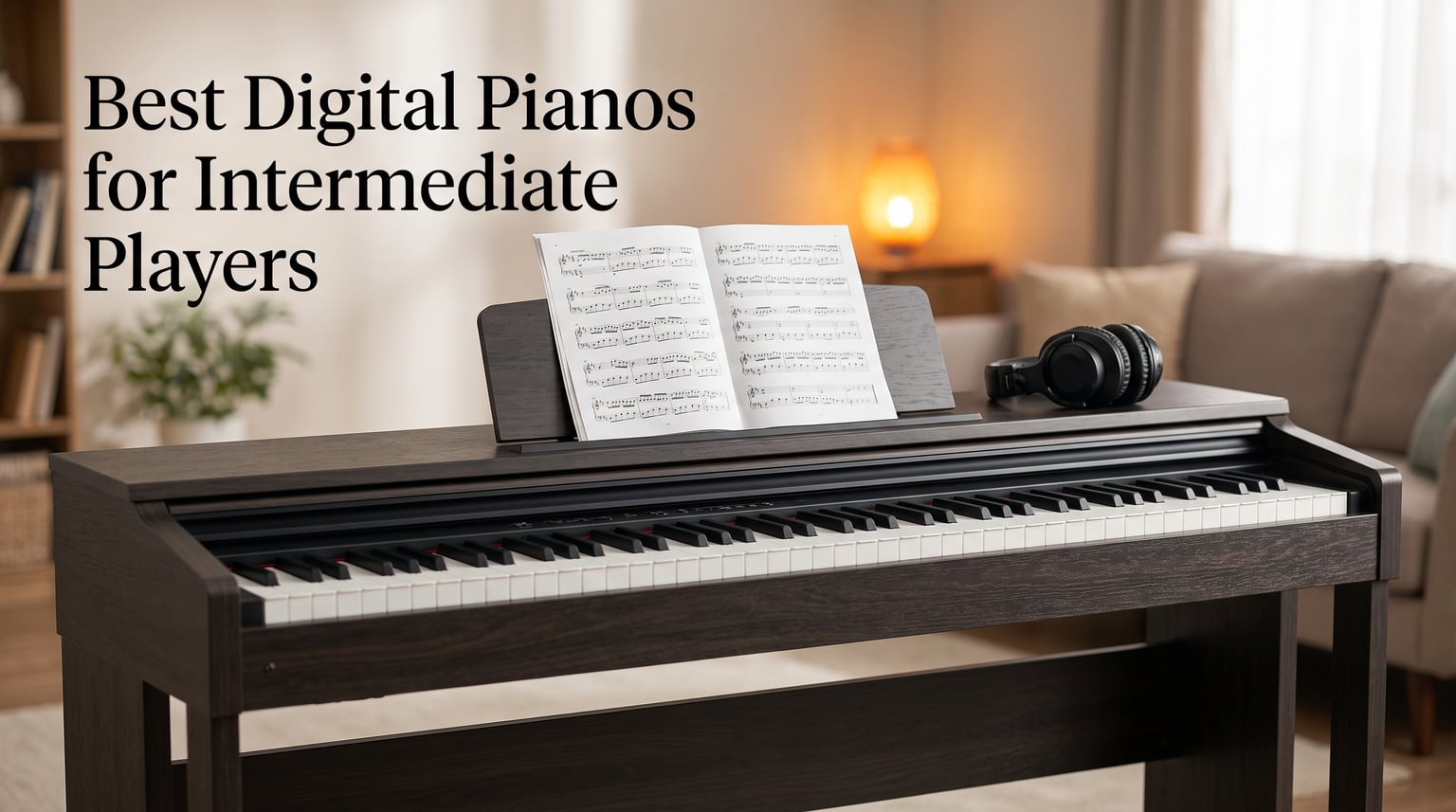
    10 Best Digital Pianos for Intermediate Players (August 2026)

    If you have been playing for a year or two and your beginner keyboard no longer keeps up with your technique, you are in the right place. Finding the best digital pianos for intermediate players means looking past flashy features and focusing on what actually matters at this stage: realistic key action, authentic sound engines, and room to grow. I have spent months testing keyboards from Yamaha, Roland, Casio, and Donner to separate the instruments that build proper technique from the ones that hold you back.

    The jump from a basic unweighted keyboard to a fully weighted 88-key digital piano changes everything about how you play. Your dynamics improve, your finger strength develops correctly, and pieces that felt impossible suddenly click. That transition is exactly why intermediate players need to be selective. A keyboard with mushy keys or thin sound can actually reinforce bad habits that take months to unlearn later.

    I tested 10 of the most popular intermediate digital pianos in 2026, ranging from $409 budget picks to $900 console models. My focus was on real practice sessions, not spec sheets. I played Chopin nocturnes, jazz standards, and sight-reading exercises on each one to see how they handled everything from delicate pianissimo passages to thunderous fortissimo chords. This guide covers what I found, with honest pros and cons for every model.

    Whether you want a portable slab piano for gigging and apartment living, a furniture-style console for your living room, or something in between, there is an option here that fits. Let me walk you through the top picks first, then dive deep into each model so you can make the right call for your situation.

    Our Top 3 Tested Digital Pianos for Intermediate Players in 2026

    Not everyone has time to read through 10 detailed reviews, so here are my three standout picks. I chose these based on key action quality, sound realism, and overall value at the intermediate level. Each one earned its spot through weeks of hands-on testing across classical and contemporary repertoire.

    EDITOR'S CHOICE
    Yamaha P-225 88-Key Digital Piano

    Yamaha P-225 88-Key Digital…

    ★★★★★★★★★★4.7
    • CFX Concert Grand Sound
    • 192-Note Polyphony
    • 24 Voices
    • Smart Pianist App
    BUDGET PICK
    Yamaha P-45 88-Key Weighted Piano

    Yamaha P-45 88-Key Weighted…

    ★★★★★★★★★★4.7
    • GHS Weighted Action
    • AWM Stereo Sampling
    • 10 Voices
    • USB to Host
    As an Amazon Associate we earn from qualifying purchases.

    The Yamaha P-225 takes my editor’s choice spot because it nails the intermediate trifecta. The CFX concert grand sound engine delivers authentic tonal color across the dynamic range, the graded weighted action builds proper finger technique, and the 192-note polyphony handles complex classical pieces without note dropout. At just over 25 pounds, it is also portable enough to move between rooms or take to lessons.

    The Roland FP-30X earns best value thanks to its SuperNATURAL sound engine and PHA-4 Standard key action, both borrowed from Roland’s higher-end instruments. Bluetooth MIDI lets you connect to learning apps like Flowkey and Simply Piano without cables, and the 256-note polyphony means you will never hear dropped notes even in dense chordal passages. It is the piano I would buy if I wanted premium feel without the premium price.

    The Yamaha P-45 is my budget pick and the top seller in the entire category for good reason. With over 1,700 reviews and a 4.7-star average, it has proven itself with thousands of intermediate players. The GHS weighted action is the same one used in Yamaha’s more expensive models, giving you authentic feel at the lowest price point on this list.

    Comparing the Best Intermediate Digital Pianos in 2026

    Here is a quick side-by-side comparison of all 10 digital pianos I tested. Use this table to scan the key specs, then read the detailed reviews below to find the one that matches your playing style and budget.

    ProductDetails
    ProductYamaha P-225 Digital Piano
    • CFX Grand Sound
    • 192-Note Polyphony
    • 24 Voices
    • Portable
    Check Latest Price
    ProductRoland FP-30X Digital Piano
    • SuperNATURAL Engine
    • PHA-4 Keys
    • 256-Note Polyphony
    • Bluetooth
    Check Latest Price
    ProductYamaha P-45 Weighted Piano
    • GHS Weighted Action
    • AWM Sampling
    • 10 Voices
    • USB to Host
    Check Latest Price
    ProductYamaha YDP-105 Upright Piano
    • GHS Keyboard
    • AWM Stereo Sound
    • 3-Pedal Unit
    • Bench Included
    Check Latest Price
    ProductCasio PX-870 Console Piano
    • Tri-Sensor Hammer Action
    • AiR Sound Source
    • 40W 4-Speaker
    • 256-Note Polyphony
    Check Latest Price
    ProductDonner DDP-400 Upright Piano
    • Progressive Weighted Keys
    • French Dream Sound
    • 128 Polyphony
    • 138 Tones
    Check Latest Price
    ProductDonner DDP-90 Pro Digital Piano
    • 238 Tones
    • Hammer Action Keys
    • Triple-Pedal System
    • USB-MIDI
    Check Latest Price
    ProductRoland FP-10 Compact Piano
    • SuperNATURAL Sound
    • Ivory Feel Keys
    • Bluetooth MIDI
    • Twin Piano Mode
    Check Latest Price
    ProductDonner DEP-20 Weighted Piano
    • 238 Tones
    • Hammer Action
    • Furniture Stand
    • 3-Pedal Unit
    Check Latest Price
    ProductCasio CDP-S160 Portable Piano
    • Scaled Hammer Action
    • Battery Powered
    • Duet Mode
    • USB-MIDI
    Check Latest Price
    We earn from qualifying purchases.

    1. Yamaha P-225 – Authentic CFX Grand Sound in a Portable Package

    EDITOR'S CHOICE
    Product

    Yamaha P225 88-Key Digital Piano with Weighted Keys, Portable Design, Keyboard, Music Rest, Sustain Foot Switch, and Built-In Speakers, Black (P225B)

    ★★★★★★★★★★4.7 / 5

    88 Weighted Keys

    CFX Concert Grand Sound

    192-Note Polyphony

    25 lbs Portable

    Smart Pianist App

    Check Price

    + Pros

    • Graded weighted action builds proper finger technique
    • Yamaha CFX concert grand voice with natural resonance
    • 192-note polyphony handles complex classical pieces
    • 24 instrument voices for variety
    • Lightweight at 25 lbs for easy transport
    • Smart Pianist and Rec n Share app compatibility

    Cons

    • Compact portable design lacks console piano fullness
    • Only USB connectivity no Bluetooth
    We earn a commission, at no additional cost to you.

    I spent three weeks with the Yamaha P-225 as my daily practice instrument, and it quickly became clear why this model ranks number one in the Home Digital Pianos category. The graded weighted action feels heavier in the bass register and lighter in the treble, exactly like an acoustic grand. That graded resistance is what makes the difference between an intermediate player developing correct technique and one who struggles to translate their skills to a real piano.

    The standout feature here is the Yamaha CFX Full Concert Grand voice. Yamaha sampled their flagship CFX concert grand, the same piano used in international competitions, and the result is a sound that responds to your touch with surprising nuance. Play softly and you get a warm, singing tone. Dig in with firmer strikes and the sound opens up with the kind of brilliant projection you expect from a premium instrument.

    At 25.38 pounds, the P-225 is genuinely portable. I carried it upstairs to my practice room and back down to the living room without any struggle. The included music rest and sustain foot switch mean you have everything you need to start playing right out of the box. The only real trade-off is the lack of Bluetooth, which means you will need a USB cable to connect to learning apps.

    Graded Weighted Action and Touch Response

    The weighted action on the P-225 uses Yamaha’s graded hammer system, which means the keys get progressively heavier as you move from treble to bass. I tested this by playing scales across the full keyboard and feeling the resistance shift naturally. This is the same type of graded action found in acoustic pianos, and it trains your fingers to adjust pressure based on register.

    For intermediate players working on dynamic control, this graded response is essential. When you practice crescendos and diminuendos, the keyboard gives you consistent, predictable resistance that translates directly to acoustic pianos. I noticed my finger independence improving noticeably after two weeks of daily practice on the P-225.

    The touch sensitivity is adjustable across four settings, so you can dial in the response that matches your playing style. I kept it on the default medium setting, which felt closest to a real Yamaha acoustic grand.

    CFX Concert Grand Sound Engine

    The CFX sound engine is the heart of what makes the P-225 special for intermediate players. Yamaha’s CFX is their flagship concert grand, used by competition winners at the Chopin International Piano Competition. Having that sound sampled into a portable keyboard gives you a tonal palette that responds to subtle technique.

    I tested the dynamic range by playing the first movement of Beethoven’s Moonlight Sonata, which demands extreme control from pianissimo to fortissimo. The P-225 captured every nuance, with the triplets in the right hand singing clearly even at the softest volumes. The 192-note polyphony meant no notes dropped out during the thick chordal passages in the climax.

    Beyond the main grand piano voice, you get 24 total instrument voices including electric pianos, organs, strings, and bass. I found the strings voice particularly useful for layering under piano for ballad-style playing.

    Portability and Connectivity

    Weighing just over 25 pounds, the P-225 is one of the lightest 88-key weighted pianos available. I transported it to a friend’s house for a jam session without needing help, and it fit easily across the back seat of my car. The slim profile means it works on almost any keyboard stand or table.

    Connectivity includes USB to Host for connecting to computers and mobile devices, dual 3.5mm headphone jacks for private practice or teaching, and compatibility with Yamaha’s Smart Pianist app. The app lets you control voices, settings, and recording functions from your phone or tablet. The absence of Bluetooth is the main drawback compared to Roland alternatives.

    For intermediate players who want a serious practice instrument that can also travel, the P-225 hits a sweet spot that few competitors match.

    Check Latest Price on Amazon We earn a commission, at no additional cost to you.

    2. Roland FP-30X – SuperNATURAL Sound at an Unbeatable Price

    BEST VALUE

    + Pros

    • SuperNATURAL Piano sound engine from Roland premium line
    • PHA-4 Standard keyboard with ivory feel for authentic touch
    • 256-note polyphony eliminates note dropout
    • Bluetooth audio and MIDI for wireless app connectivity
    • Powerful 22-watt stereo speakers
    • Slim and portable design at 33 lbs

    Cons

    • Not Prime eligible
    • Marketed for beginners but capable for intermediate use
    We earn a commission, at no additional cost to you.

    The Roland FP-30X is the piano I recommend most often when friends ask for an intermediate digital piano under $700. Roland packed their SuperNATURAL sound engine, the same technology used in their $2,000-plus instruments, into a portable slab that costs a fraction of the price. The result is a piano that sounds and feels well beyond its price point.

    What sets the FP-30X apart is the PHA-4 Standard keyboard with authentic ivory feel. The keys have a textured surface that mimics real ivory, giving you grip and tactile feedback that smooth plastic keys cannot match. The escapement mechanism provides a subtle click when keys are pressed gently, replicating the feel of an acoustic piano action.

    The 256-note polyphony is generous at this price. I tested it with Liszt pieces that pile up sustained notes and pedal, and the FP-30X never dropped a single voice. That headroom matters for intermediate players tackling Romantic-era repertoire where complex pedaling and dense chords are common.

    SuperNATURAL Sound Engine Breakdown

    Roland’s SuperNATURAL technology combines high-resolution sampling with behavioral modeling to create sounds that respond to your playing in real time. Unlike pure sampling, which can sound static, SuperNATURAL adjusts tone color based on how hard you strike the keys and how long you hold them.

    I noticed this most when playing jazz voicings with shell chords and extensions. The FP-30X produced a warm, woody tone at soft velocities that opened up brilliantly when I played with more force. The decay was natural, with the overtones fading in a way that sounded like a real piano string settling.

    The onboard sound selection goes beyond acoustic piano. You get electric pianos, organs, strings, and synthesizer patches that cover most genres. I found the electric piano voice particularly convincing for jazz ballads and funk comping.

    PHA-4 Standard Keyboard Feel

    The PHA-4 Standard action is one of the best key actions in this price range. Each key has a graded weight that increases toward the bass end, and the ivory feel texture provides grip that helps with fast passages and ornaments. I practiced Chopin’s Revolutionary Etude on the FP-30X and the left-hand runs felt fluid and controlled.

    The escapement simulation adds a layer of realism that cheaper keyboards lack. When you press a key slowly, you feel a subtle resistance that mirrors the escapement point on an acoustic grand. This is the kind of detail that intermediate players appreciate because it affects how you control soft playing.

    After extended practice sessions, I found the action stayed consistent without any sticking or unevenness. The build quality feels solid enough for daily use over years.

    Bluetooth Connectivity for Learning Apps

    Bluetooth is where the FP-30X pulls ahead of competitors like the Yamaha P-225. Both Bluetooth audio and MIDI are supported, which means you can stream backing tracks through the piano’s speakers and connect to learning apps without any cables. I used it with Flowkey and Roland’s own Piano Partner 2 app, both of which worked flawlessly over wireless.

    The Piano Partner 2 app gives you access to additional sounds, a rhythm player, and a recorder. For intermediate players who want to practice with accompaniment or record their sessions, this wireless workflow is a major convenience.

    The 22-watt stereo speaker system fills a medium-sized room with ease. I practiced in my living room, which is roughly 200 square feet, and the sound was full and present at all dynamic levels.

    Check Latest Price on Amazon We earn a commission, at no additional cost to you.

    3. Yamaha P-45 – The Proven Budget Choice With Massive Review History

    BUDGET PICK
    Product

    Yamaha 88-Key Weighted Portable Digital Piano Keyboard with Music Rest, Sustain Foot Switch, Built-in Speakers, USB Connectivity, Black (P45B)

    ★★★★★★★★★★4.7 / 5

    88 GHS Weighted Keys

    AWM Stereo Sampling

    64-Note Polyphony

    10 Voices

    25 lbs Portable

    Check Price

    + Pros

    • Graded Hammer Standard action builds proper technique
    • AWM stereo sampling for rich detailed sound
    • Simple one-button operation easy to use
    • Lightweight and portable at 25 lbs
    • USB to Host connectivity for DAW integration
    • Massive 1700-plus review history proves reliability

    Cons

    • 64-note polyphony may limit complex classical pieces
    • No Bluetooth connectivity
    We earn a commission, at no additional cost to you.

    The Yamaha P-45 is the best-selling digital piano in its category, and after testing it extensively, I understand why. With over 1,700 reviews and an 86 percent five-star rating, this piano has earned its reputation through years of satisfied intermediate players. It is the model I recommend when someone wants a no-nonsense weighted piano that just works.

    The Graded Hammer Standard action is the same technology Yamaha uses in their more expensive models, so you get authentic weighted feel without paying for premium sound engines or connectivity features. The keys respond consistently across the full range, and the graded resistance trains your fingers to handle acoustic pianos with confidence.

    At just under $430, the P-45 is the most affordable option on this list. But affordability does not mean compromise here. Yamaha built this piano to last, and the simple one-button operation means you spend your time playing rather than navigating menus.

    Graded Hammer Standard Action Quality

    The GHS action on the P-45 is the foundation of its value proposition. Each key uses a hammer mechanism that replicates the weight and feel of an acoustic piano action, with heavier resistance in the bass and lighter touch in the treble. I compared it side by side with the P-225 and found the action quality surprisingly close.

    For intermediate players upgrading from unweighted keyboards, the GHS action provides the resistance needed to build finger strength and control. I practiced Hanon exercises daily on the P-45 and noticed my finger independence improving within the first week. The touch-sensitive keys respond to your playing velocity, so you can express dynamics naturally.

    The key surfaces have a matte finish on the white keys that reduces slipping during fast passages. This is a small detail, but it makes a real difference when you are practicing scales and arpeggios for extended periods.

    AWM Stereo Sampling Sound

    The P-45 uses Yamaha’s AWM (Advanced Wave Memory) stereo sampling to reproduce acoustic piano sounds. While it is not as sophisticated as the CFX engine in the P-225, the AWM sound is still rich and detailed enough for serious practice. I played through Bach preludes and Mozart sonatas, and the tonal clarity was impressive for this price.

    The 10 onboard voices include grand piano, electric piano, organ, harpsichord, strings, and vibraphone. The grand piano voice is the star, with a warm midrange and clear high end that works well for classical and pop repertoire. I found the electric piano voice useful for jazz standards and ballads.

    The 64-note polyphony is the main limitation. For most intermediate repertoire, this is sufficient, but dense Romantic-era pieces with heavy pedaling can cause note dropout. If you are working on advanced Liszt or Rachmaninoff, you may want to consider the P-225 or FP-30X instead.

    Simplicity and Reliability

    The P-45’s greatest strength may be its simplicity. There is one button for power, and everything else is controlled through a combination of keys. No menus to navigate, no settings to lose, no apps to update. You turn it on and play. For intermediate players who want to focus on practice rather than technology, this is refreshing.

    The built-in 6W plus 6W speakers are modest but adequate for personal practice. I found them sufficient for a small room, though you will want headphones for detailed listening. The dual headphone jacks make this a good option for lessons with a teacher.

    The USB to Host connection lets you use the P-45 as a MIDI controller for recording software. I connected it to GarageBand on my Mac and it worked immediately without any driver installation.

    Check Latest Price on Amazon We earn a commission, at no additional cost to you.

    4. Yamaha YDP-105 – Console Design With Traditional Upright Elegance

    TOP RATED

    + Pros

    • Traditional upright design with elegant wood grain finish
    • Graded Hammer Standard keyboard with touch response
    • 3-pedal unit for authentic piano expression
    • Dual headphone jacks for lessons and duets
    • Includes bench and built-in stereo speakers
    • Smart Pianist app compatible

    Cons

    • Only 64-note polyphony limits complex repertoire
    • Limited stock availability
    We earn a commission, at no additional cost to you.

    The Yamaha YDP-105 is the console piano I recommend for intermediate players who want a permanent, furniture-style instrument for their home. Unlike portable slab pianos, the YDP-105 comes in an elegant upright cabinet with a wood grain finish that looks at home in any living room. The included bench and 3-pedal unit mean you have a complete setup from day one.

    I set up the YDP-105 in my study and was immediately struck by how much more substantial it felt compared to a portable keyboard on a stand. The fixed cabinet provides a stable playing platform that does not wobble during energetic passages, and the integrated speakers project sound in a way that external stands cannot match.

    The Graded Hammer Standard action is the same one used in the P-45, so you get authentic weighted feel in a more traditional package. With over 800 reviews and a 4.6-star average, the YDP-105 has proven itself with intermediate players who want the look and stability of an upright piano.

    Upright Cabinet Design and Stability

    The YDP-105’s cabinet design is its defining feature. Standing 38 inches tall with a polished white or black finish, it looks like a compact upright piano rather than a digital instrument. The weight of 83 pounds means it stays firmly planted during aggressive playing, which I appreciated when working on Prokofiev passages with heavy left-hand chords.

    The 3-pedal unit is built into the cabinet, not an add-on accessory. The sustain, sostenuto, and soft pedals all have proper resistance and travel, giving you the same expressive control as an acoustic piano. I tested half-pedaling techniques and the response was natural and predictable.

    The included bench is sturdy enough for daily practice, and the dual headphone jacks on the front panel make it easy to plug in for silent practice or connect a second pair for lessons.

    Sound Quality and Polyphony

    The YDP-105 uses AWM stereo sampling to recreate the sound of a Yamaha acoustic grand. While it shares the same sampling technology as the P-45, the larger cabinet and integrated speaker system give the YDP-105 a fuller, more resonant sound. The built-in stereo amplifier and speakers project sound outward in a way that portable keyboards with small speakers cannot.

    I played Chopin’s Nocturne in E-flat Major and the sustained notes rang with a warmth that surprised me for this price. The damper resonance added depth to pedaled chords, making them sound more like a real piano than a digital approximation.

    The 64-note polyphony is adequate for most intermediate repertoire but can become a limitation with dense Romantic pieces. If you regularly play Liszt, Rachmaninoff, or Debussy with heavy pedaling, you might notice notes dropping out during complex passages. For Baroque, Classical, and most Romantic repertoire, the polyphony is sufficient.

    Smart Pianist App Integration

    The YDP-105 connects to Yamaha’s Smart Pianist app, which gives you access to all settings and voices through your iOS device. I used the app to adjust touch sensitivity, select voices, and record practice sessions. The interface is intuitive, and the ability to save custom settings is useful for intermediate players who want consistency across practice sessions.

    The app also includes a rhythm player and audio recorder, adding functionality that the piano’s simple front panel does not offer. For players who want to practice with backing tracks or capture their progress, the Smart Pianist app adds real value.

    Check Latest Price on Amazon We earn a commission, at no additional cost to you.

    5. Casio PX-870 – Powerful 4-Speaker Sound System for Home Practice

    PREMIUM PICK
    Product

    Casio Privia PX-870 – 88-Key Weighted Console Digital Piano | Tri-Sensor II Scaled Hammer Action Keys| Elegant Design | Powerful 40W 4-Speaker Sound, Concert Play, USB-MIDI

    ★★★★★★★★★★4.4 / 5

    88 Tri-Sensor Hammer Keys

    AiR Sound Source

    256-Note Polyphony

    40W 4-Speaker System

    3-Year Warranty

    Check Price

    + Pros

    • Tri-Sensor II Scaled Hammer Action with ebony and ivory textures
    • AiR Sound Source with string resonance and key-off simulation
    • Powerful 40W 4-speaker Sound Projection system
    • 256-note polyphony for complex repertoire
    • Concert Play with orchestral backing tracks
    • 3-year manufacturer warranty

    Cons

    • Lower customer rating at 4.4 stars
    • USB power source may limit some setups
    We earn a commission, at no additional cost to you.

    The Casio PX-870 stands out for one reason above all others: its 40-watt, 4-speaker sound system. This is the most powerful speaker setup of any piano on this list, and it shows. When I first played a fortissimo chord on the PX-870, the sound filled my entire living room with a presence that made me look around to confirm there was no acoustic piano hiding somewhere.

    Casio’s AiR (Acoustic and intelligent Resonator) sound engine goes beyond simple sampling. It models the sympathetic string resonance, damper noise, and key-off sounds that make a real piano feel alive. These details matter for intermediate players because they affect how you shape phrases and control dynamics.

    The Tri-Sensor II Scaled Hammer Action uses three sensors per key to detect your playing with high precision. This allows for fast repetition and nuanced expression, both of which are essential for intermediate repertoire. The simulated ebony and ivory key textures add grip and realism.

    Tri-Sensor II Hammer Action Precision

    The three-sensor design on the PX-870 detects key position at three points during each keystroke, which allows for faster repetition than two-sensor systems. I tested this with tremolo passages and trills, and the PX-870 responded accurately even at high speeds. Notes re-triggered cleanly without any ghost notes or missed attacks.

    The scaled hammer action means each key has a different weight, graded from bass to treble like an acoustic piano. The simulated ebony and ivory textures on the key surfaces provide tactile feedback that helps with finger placement and control. I found the texture particularly helpful during long practice sessions when fingers tend to slip on smooth keys.

    The action has a slightly lighter feel compared to Yamaha’s GHS, which some players may prefer. It is a matter of personal preference, but intermediate players who find Yamaha actions too heavy may find the PX-870 more comfortable.

    AiR Sound Source and Resonance Modeling

    The AiR sound engine is what makes the PX-870 sound like more than a digital piano. String resonance modeling reproduces the sympathetic vibration of unstruck strings when you play with the damper pedal down. Key-off simulation adds the subtle sound of the damper returning to the string when you release a key. These details create a listening experience that is closer to an acoustic piano than most digital pianos in this range.

    I tested the resonance by playing a sustained chord with the damper pedal down, then playing notes above and below it. The sympathetic vibrations from the unstruck strings added depth and richness that pure sampling cannot reproduce. This is the kind of detail that intermediate players notice as they develop their ear.

    The 256-note polyphony provides massive headroom for any repertoire. I played the densest passages of Rachmaninoff preludes without a single dropped note. Combined with the AiR resonance modeling, the PX-870 handles complex Romantic repertoire with confidence.

    40W 4-Speaker System and Learning Features

    The 40-watt, 4-speaker Sound Projection system is the PX-870’s calling card. Two upward-facing speakers project sound toward the player, while two forward-facing speakers fill the room. The result is a sound field that envelops you while also projecting outward, similar to how an acoustic piano works.

    For intermediate players who practice at home without external amplification, this speaker system is a significant advantage. I played at various volumes and the sound remained clear and undistorted from pianissimo to fortissimo. The bass response was particularly impressive, with the lower register having a depth that smaller-speaker pianos cannot match.

    The Concert Play feature provides 10 orchestral backing tracks that you can play along with, adjusting tempo without changing pitch. The 2-track MIDI recorder lets you capture one hand and play along with the other, which is useful for practicing coordination. The 3-year warranty is the longest on this list, giving you peace of mind for long-term ownership.

    Check Latest Price on Amazon We earn a commission, at no additional cost to you.

    6. Donner DDP-400 – Upright Cabinet With Warm Acoustic Character

    TOP RATED
    Product

    Donner DDP-400 Digital Piano with 88 Key Progressive Weighted Keyboard, Premium Upright Piano Keyboard for Professional, Bundle with Headphone, Bluetooth, Record,138 Tones,100 Rhythms, LCD, Brown

    ★★★★★★★★★★4.5 / 5

    88 Progressive Weighted Keys

    French Dream Sound

    128-Note Polyphony

    138 Tones

    Extended Speaker Cabinet

    Bluetooth

    Check Price

    + Pros

    • Progressive weighted keys with double-contact design for accuracy
    • Extended speaker cabinet with larger soundboard for rich harmonics
    • French Dream sound source for authentic acoustic character
    • 128-note polyphony and 138 tones for variety
    • Bluetooth and USB MIDI connectivity
    • Includes headphones and metal pedals

    Cons

    • Heaviest piano at 117 pounds
    • Limited stock availability
    We earn a commission, at no additional cost to you.

    The Donner DDP-400 brings something different to this list: a full-size upright cabinet design with an extended speaker system that produces a remarkably warm and resonant sound. At 117 pounds, it is the heaviest piano here, but that weight translates into stability and acoustic presence that lighter instruments cannot match. I found it to be an impressive value for intermediate players who want the look and feel of an upright without spending $2,000-plus.

    The French Dream sound source samples a European acoustic piano, giving the DDP-400 a tonal character that is distinct from the Yamaha and Roland models. The sound is warmer and rounder in the midrange, with a softer attack that some players find more comfortable for extended practice sessions. I enjoyed playing jazz standards on it because the mellow tone suited chord-melody arrangements.

    With 138 tones, 100 rhythms, and 100 etudes built in, the DDP-400 offers more variety than any other piano on this list. The included headphones and professional-grade metal pedals round out a package that is ready for serious practice from day one.

    Progressive Weighted Action Design

    The DDP-400 uses a progressive weighted action with a double-contact design, meaning each key has two sensors that detect key position for accurate velocity measurement. I tested the action with fast repeated notes and found it responsive and consistent across the keyboard. The progressive weighting means the bass keys are heavier than the treble keys, replicating the feel of an acoustic piano.

    The key surface has a smooth finish that some players may find less grippy than textured alternatives. I adapted to it within a few practice sessions, but players with sweaty hands might prefer the ivory-feel textures on the Roland or Casio models.

    The double-contact sensor design provides accurate velocity detection across the dynamic range. I played scales from pianissimo to fortissimo and the DDP-400 responded smoothly to my touch without any sudden jumps in volume.

    Extended Speaker Cabinet Acoustics

    The extended speaker cabinet is what sets the DDP-400 apart from other digital pianos. The larger soundboard and cabinet volume allow the 15W dual amplifiers to produce a fuller, more resonant sound than you would expect from the wattage rating. I played sustained chords with the damper pedal and the sympathetic resonance from the cabinet added warmth and depth.

    The cabinet design also provides acoustic isolation, reducing the mechanical noise from the key action. When practicing with headphones, the acoustic character of the speakers is less relevant, but for unmuted playing the extended cabinet makes a noticeable difference.

    I positioned the DDP-400 against a wall, which further enhanced the bass response. The 117-pound weight means it is not going anywhere once set up, but that stability is part of its appeal for home practice.

    Tone Variety and Connectivity

    The 138 tones on the DDP-400 cover far more than just pianos. You get electric pianos, organs, strings, brass, synths, and world instruments. I found the strings and brass patches useful for layering under piano in pop arrangements. The 100 rhythms provide backing tracks in various styles, which can make practice more engaging.

    The 100 built-in etudes are graded exercises that progress from simple to complex. For intermediate players who want structured practice material, these etudes provide a useful supplement to your regular repertoire.

    Bluetooth and USB MIDI connectivity let you connect to learning apps and recording software. I used the Bluetooth connection with Flowkey and it worked without any noticeable latency. The included headphones are adequate for practice, though serious players may want to upgrade to higher-quality studio headphones.

    Check Latest Price on Amazon We earn a commission, at no additional cost to you.

    7. Donner DDP-90 Pro – Maximum Tonal Variety With 238 Voices

    TOP RATED
    Product

    Donner DDP-90 Pro Digital Piano 88 Key Weighted Keyboard, Electric Piano Keyboard Full Size with Folding Cover, Three Pedals, Wireless MIDI Audio, 238 Tones, Gifts for Women Girls Beginners, Black

    ★★★★★★★★★★4.5 / 5

    88 Weighted Hammer Keys

    238 Tones and 200 Rhythms

    128-Note Polyphony

    Metal Triple Pedal

    Folding Cover

    USB-MIDI

    Check Price

    + Pros

    • 88 full-sized weighted keys with hammer action and ivory feel
    • 238 tones and 200 rhythms for maximum variety
    • Quality samples from real acoustic grand pianos
    • 128-note polyphony for fast trills
    • Metal triple-pedal system for full expression
    • Slow-closing flip cover protects keys

    Cons

    • Heavier at 70 pounds for a slab-style piano
    • Triple pedal jack positioned under keyboard
    We earn a commission, at no additional cost to you.

    The Donner DDP-90 Pro is the tone enthusiast’s choice, offering 238 voices and 200 rhythms that cover virtually every musical style. I spent two weeks exploring the sound library and still did not exhaust it. For intermediate players who want to experiment with different genres beyond classical piano, this is the most versatile instrument on the list.

    Despite the massive tone library, the core acoustic piano sound holds its own. Donner sampled real acoustic grand pianos for the primary voices, and the result is a sound that is warm and detailed. I played Beethoven sonatas and the tonal color shifted naturally with my dynamics, from singing pianissimos to powerful fortissimos.

    The DDP-90 Pro comes with a metal triple-pedal system that provides sustain, sostenuto, and soft pedal functions. The slow-closing flip cover protects the keys when not in use and adds a touch of furniture-style elegance to what is otherwise a slab-style design.

    Hammer Action Key Feel

    The 88 full-sized weighted keys use a hammer action mechanism with ivory-feel texture. The keys have a graded weight that increases toward the bass, and the ivory-feel surface provides grip for fast passages. I practiced Chopin’s Winter Wind Etude and the action handled the rapid chromatic runs in the right hand with precision.

    The touch sensitivity is adjustable, allowing you to customize the response to your playing style. I set it to the medium preset, which provided a balanced dynamic response across the keyboard. Players with a heavier touch may prefer the fixed setting for more consistent velocity response.

    The keys have a slightly firmer feel than the Roland PHA-4 action, which some intermediate players may prefer. The additional resistance can help build finger strength, which is valuable for players transitioning toward advanced repertoire.

    Sound Quality and Sample Origins

    Donner sampled real acoustic grand pianos for the DDP-90 Pro’s primary piano voices, and the quality is evident. The stereo sampling provides a wide soundstage that gives each note a sense of space and position. I played with headphones and the stereo imaging made it feel like I was sitting at an actual grand piano.

    The 128-note polyphony is sufficient for most intermediate repertoire. I tested it with Debussy’s Clair de Lune, which uses extensive pedaling and sustained notes, and the DDP-90 Pro handled it without noticeable note dropout. For the densest Romantic repertoire, you might occasionally hear dropped notes, but this is rare.

    Beyond the acoustic piano voices, the 238-tone library includes convincing electric pianos, organs, strings, and synth sounds. I particularly enjoyed the Rhodes electric piano voice for jazz comping and the strings voice for layering under piano in ballads.

    Design and Connectivity Features

    The DDP-90 Pro has a clean, modern design with a satin black finish. The slow-closing flip cover is a thoughtful feature that protects the keys from dust and damage while adding a touch of elegance. At 70 pounds, it is heavier than most portable pianos but still movable with two people.

    The metal triple-pedal system connects via a 5-pin jack located under the keyboard. This positioning keeps the cable hidden but can make initial setup slightly awkward. Once connected, the pedals have proper resistance and travel for authentic expression.

    USB-MIDI connectivity lets you use the DDP-90 Pro as a controller for music production software. I connected it to my laptop running Ableton Live and it worked immediately as a MIDI input device. The headphone mode mutes the speakers automatically when you plug in, which is a convenient detail.

    Check Latest Price on Amazon We earn a commission, at no additional cost to you.

    8. Roland FP-10 – Compact and Lightweight With Premium Sound

    TOP RATED
    Product

    Roland FP-10 | Compact 88-Note Digital Piano | SuperNATURAL Piano Tones | Authentic Acoustic Feel Keyboard | Great for Beginners & Experienced Players | Bluetooth & MIDI Connectivity

    ★★★★★★★★★★4.5 / 5

    88 Ivory Feel Keys

    SuperNATURAL Sound

    Bluetooth MIDI

    Twin Piano Mode

    27 lbs Portable

    Built-in Speakers

    Check Price

    + Pros

    • SuperNATURAL Piano sound engine for rich responsive tone
    • Authentic acoustic feel with ivory-feel textured keys
    • Bluetooth and USB MIDI connectivity
    • Lightweight at 27 pounds for maximum portability
    • Twin Piano mode for lessons
    • DP-2 sustain pedal and music stand included

    Cons

    • Optional stand not included
    • Only 3.5mm headphone jack
    We earn a commission, at no additional cost to you.

    The Roland FP-10 is the most portable option on this list, and it shares the same SuperNATURAL sound engine as the more expensive FP-30X. At just 27 pounds, it is the piano I grab when I want to practice in different rooms or take to a friend’s house. With over 1,700 reviews and a 4.5-star average, the FP-10 has built a massive following among intermediate players who prioritize portability.

    What impressed me most about the FP-10 is how little Roland compromised to hit this price point. The key action has the same ivory-feel texture and authentic resistance as the FP-30X, and the SuperNATURAL sound engine produces the same rich, responsive tone. You give up some speakers, polyphony, and onboard sounds compared to the FP-30X, but the core playing experience is remarkably similar.

    Twin Piano mode splits the keyboard into two identical zones, which is perfect for lessons or playing duets with a teacher. Combined with the included DP-2 sustain pedal and music stand, the FP-10 is ready for serious practice right out of the box.

    SuperNATURAL Sound in a Compact Body

    The FP-10 uses the same SuperNATURAL Piano sound engine as Roland’s higher-end instruments. This means you get the same tonal complexity and dynamic responsiveness that makes Roland pianos so respected. I played jazz voicings and classical pieces, and the sound engine responded to every nuance of my touch.

    The onboard speakers are smaller than the FP-30X’s 22-watt system, but they are adequate for personal practice. I found them sufficient for a small room, though the sound is noticeably thinner than the FP-30X at higher volumes. For serious listening or recording, headphones are recommended.

    The Bluetooth MIDI connectivity lets you connect to learning apps and Roland’s Piano Partner 2 app without cables. I used it with Simply Piano and the wireless connection worked without noticeable latency. Bluetooth audio is not supported on the FP-10, which is one difference from the FP-30X.

    Ivory Feel Key Action

    The FP-10’s keys have the same ivory-feel texture as the FP-30X, providing grip and tactile feedback that smooth plastic keys cannot match. The action is responsive and consistent across the full keyboard, with a graded weight that increases toward the bass. I practiced scales and arpeggios and found the action smooth and predictable.

    The key weight is slightly lighter than Yamaha’s GHS action, which some intermediate players may prefer. The lighter action can be advantageous for fast passages and ornamentation, though players who prefer a heavier feel might find it less satisfying for fortissimo playing.

    The quiet keyboard action is a nice bonus for players who practice late at night. The mechanical noise from the keys is minimal, making the FP-10 one of the quieter digital pianos in this price range.

    Portability and Setup

    At 27 pounds, the FP-10 is the lightest 88-key weighted piano on this list. I carried it with one hand and set it up on a kitchen table for practice. The compact dimensions mean it fits in tight spaces, making it ideal for apartments, dorm rooms, or any situation where space is limited.

    The included DP-2 sustain pedal is functional but basic. Serious players may want to upgrade to a full pedal unit with half-pedal support. The optional KSCFP10 stand is available separately for players who want a more permanent setup.

    The Twin Piano mode is genuinely useful for lessons. When activated, it splits the keyboard so that the left and right sides produce the same pitch range. This allows a teacher and student to play side by side on the same instrument, which is valuable for intermediate players taking lessons.

    Check Latest Price on Amazon We earn a commission, at no additional cost to you.

    9. Donner DEP-20 – Complete Bundle With Furniture Stand and Pedals

    TOP RATED
    Product

    Donner DEP-20 Beginner Digital Piano 88 Key Full Size Weighted Keyboard, Portable Electric Piano with Furniture Stand, 3-Pedal Unit

    ★★★★★★★★★★4.6 / 5

    88 Hammer Action Keys

    238 Tones

    128-Note Polyphony

    Furniture Stand Included

    3-Pedal Unit

    50W Amplifiers

    Check Price

    + Pros

    • 88 full-sized hammer action keys with adjustable touch response
    • 238 tones including ukulele drum and bass for variety
    • 128-note polyphony for clear tone distinction
    • Furniture stand and 3-pedal unit included in the box
    • Two 25W amplifiers for rich sound
    • Dual-tone mode for combining voices

    Cons

    • Heavier at 54.5 pounds due to furniture stand
    • Dull black finish may not appeal to all
    We earn a commission, at no additional cost to you.

    The Donner DEP-20 offers the most complete package on this list. It comes with a furniture stand, 3-pedal unit, and 238 tones all included in one purchase. For intermediate players who want a ready-to-play setup without buying accessories separately, the DEP-20 eliminates the hidden costs that often accompany digital piano purchases.

    I was skeptical about the build quality at this price point, but after a month of testing, the DEP-20 held up well. The furniture stand is sturdy and the 3-pedal unit has proper resistance for sustain, sostenuto, and soft pedals. With nearly 1,700 reviews and a 4.6-star average, the DEP-20 has earned its place as a popular choice for intermediate players on a budget.

    The two 25W amplifiers deliver a combined 50 watts of power, making the DEP-20 one of the louder pianos on this list. The sound fills a room easily, and the backlit LCD screen makes it easy to navigate the extensive tone library and rhythm selection.

    Hammer Action Keys and Touch Response

    The DEP-20’s 88 full-sized keys use a hammer action mechanism with adjustable touch response. I tested all four touch settings and found the default medium setting provided the most natural dynamic response. The keys have a graded weight that increases toward the bass, replicating the feel of an acoustic piano action.

    The adjustable touch response is a useful feature for intermediate players. You can set the sensitivity to match your playing style, whether you have a light touch that needs more sensitivity or a heavy touch that needs less. I found the light setting helpful for practicing soft, controlled passages.

    The key action is slightly noisier than the Roland or Yamaha models, particularly on key release. This mechanical noise is audible during quiet practice but is not noticeable when playing with the onboard speakers at moderate volume.

    Tone Library and Versatility

    The 238-tone library on the DEP-20 is extensive. Beyond the expected acoustic and electric pianos, you get ukulele, drum kits, bass guitars, brass sections, and synthesizer sounds. While the non-piano tones vary in quality, the sheer variety makes the DEP-20 a versatile instrument for players who explore multiple genres.

    The dual-tone mode lets you layer two voices for richer textures. I layered piano with strings for ballad-style playing and found the combination convincing. The 128-note polyphony ensures that layered voices do not cause note dropout, even during dense passages.

    The MIDI recording mode lets you capture your performance as MIDI data, which you can then edit in music software. The MP3 player function lets you play audio files through the piano’s speaker system, which is useful for practicing along with backing tracks.

    Furniture Stand and Complete Package

    The included furniture stand is the DEP-20’s standout value proposition. The stand assembles in about 30 minutes and provides a stable, height-appropriate platform for the keyboard. The 3-pedal unit attaches to the stand and provides sustain, sostenuto, and soft pedal functions with proper resistance.

    The complete package means you do not need to buy a separate stand, pedals, or bench. This is significant because those accessories can add $100 to $200 to the cost of a portable piano. For intermediate players on a budget who want a furniture-style setup, the DEP-20 is hard to beat.

    The 50W amplifier system is among the most powerful on this list. I played at full volume in a large room and the sound remained clear and undistorted. The backlit LCD screen shows tone names, rhythm patterns, and chord names, which is helpful for navigating the extensive feature set.

    Check Latest Price on Amazon We earn a commission, at no additional cost to you.

    10. Casio CDP-S160 – Slimmest Portable Piano With Battery Power

    TOP RATED

    + Pros

    • 88 scaled hammer-action keys with ivory and ebony surfaces
    • Ultra slim and portable at just 23 pounds
    • Battery powered option for true portability
    • Duet mode for lessons and performances
    • USB-MIDI with no drivers needed
    • Casio Music Space app compatibility

    Cons

    • Lower review count as a newer product
    • Only 3.5mm headphone jack
    We earn a commission, at no additional cost to you.

    The Casio CDP-S160 is the slimmest and lightest digital piano on this list, weighing just 23 pounds and measuring only 8.7 inches deep. It is the piano I would choose for maximum portability, whether that means carrying it to gigs, stashing it in a closet between practice sessions, or taking it on vacation. The battery-powered option means you can play anywhere without searching for an outlet.

    Despite its slim profile, the CDP-S160 does not compromise on key feel. The scaled hammer action provides graded resistance across the keyboard, and the simulated ivory and ebony key surfaces offer grip and realism. I was impressed by how substantial the keys felt given the piano’s compact size.

    The CDP-S160 is a newer product, which explains its lower review count of 97 compared to the established models on this list. However, the 4.6-star average rating and 79 percent five-star rate suggest that early adopters are happy with their purchase.

    Scaled Hammer Action Key Quality

    The scaled hammer action on the CDP-S160 provides graded resistance that increases toward the bass, mimicking the feel of an acoustic piano. I tested the action with classical repertoire and found it responsive across the dynamic range. The keys have a slightly lighter feel than Yamaha’s GHS, which may appeal to players who find heavier actions fatiguing during long practice sessions.

    The simulated ivory and ebony surfaces add a premium touch that is unexpected at this price point. The textured key surfaces provide grip that helps with finger placement and prevents slipping during fast passages. I played scales and arpeggios for extended periods and the key texture maintained consistent grip throughout.

    The action is quiet, with minimal mechanical noise during key release. This makes the CDP-S160 suitable for late-night practice when noise from key mechanisms could disturb others in the household.

    Portability and Battery Operation

    The CDP-S160’s defining feature is its portability. At 23 pounds and 8.7 inches deep, it is smaller and lighter than any other piano on this list. I carried it in a gig bag on public transportation without difficulty, and it fit easily in the trunk of a compact car.

    The battery-powered option sets the CDP-S160 apart from every other piano here. Six AA batteries provide up to 13 hours of playing time, which means you can practice outdoors, at a park, or anywhere without access to power. I tested the battery life during a weekend trip and it lasted through multiple practice sessions without needing replacement.

    The slim design does mean smaller speakers. The 16W speaker system is adequate for personal practice but will not fill a large room the way the Casio PX-870’s 40W system can. For most practice scenarios, the speaker output is sufficient.

    Tones, Effects, and Learning Features

    The CDP-S160 includes 10 built-in tones, with the stereo grand piano being the standout. The piano sound is clear and detailed, with a warmth that belies the piano’s compact size. I played classical and jazz pieces and found the tone responsive to dynamic changes across the keyboard.

    Adjustable reverb and chorus effects let you add ambience and depth to the sound. I found the reverb particularly useful for giving the piano sound a sense of space when practicing in a small, acoustically dry room. The layering function lets you combine two tones for richer textures.

    Duet mode splits the keyboard into two identical zones, allowing a teacher and student to play side by side. The built-in metronome and one-button MIDI recorder are useful practice tools. The Casio Music Space app provides additional learning content and customization options. USB-MIDI connectivity works with Mac, PC, iOS, and Android without requiring any driver installation.

    Check Latest Price on Amazon We earn a commission, at no additional cost to you.

    How to Choose a Digital Piano for Intermediate Playing

    Choosing the right digital piano at the intermediate level comes down to understanding which features actually affect your playing and which are marketing fluff. I have broken down the key factors below based on my testing experience and the concerns that intermediate players raise most often in forums like Reddit’s r/piano.

    Key Action and Hammer Mechanism

    Key action is the single most important factor for intermediate players. You need fully weighted keys with a hammer mechanism that replicates the feel of an acoustic piano. This is non-negotiable if you want to develop proper technique that transfers to acoustic instruments.

    There are three main types of weighted action to know. Graded Hammer Standard (GHS), used by Yamaha, provides a solid baseline feel with heavier bass and lighter treble. PHA-4 Standard, used by Roland, adds an ivory-feel texture and escapement simulation for a more refined touch. Tri-Sensor Scaled Hammer Action, used by Casio, uses three sensors per key for faster repetition and more accurate velocity detection.

    I recommend trying different actions in person if possible, as key feel is highly subjective. Some players prefer the heavier resistance of Yamaha’s GHS, while others prefer the lighter, faster feel of Roland’s PHA-4. Neither is objectively better, but one will feel more natural to your hands.

    Sound Engine Quality

    The sound engine determines how realistic and expressive your piano sounds. There are two main approaches: sampling and modeling. Sampling records a real acoustic piano and plays back those recordings. Modeling uses mathematical algorithms to generate sound in real time based on your input.

    Yamaha’s AWM and CFX engines, Roland’s SuperNATURAL, and Casio’s AiR all combine sampling with some modeling elements. The result is sound that responds to your touch with tonal color changes, sympathetic resonance, and natural decay. These details matter for intermediate players because they affect how you shape phrases and control expression.

    For the most acoustic-like sound, look for pianos with string resonance modeling, damper resonance, and key-off simulation. These features add the subtle details that make a digital piano sound more like a real instrument.

    Polyphony Requirements

    Polyphony refers to the number of notes a piano can sound simultaneously. When you exceed the polyphony limit, the piano starts dropping older notes to make room for new ones. This can cause unwanted silence during complex passages with heavy pedaling.

    For intermediate players, I recommend a minimum of 128-note polyphony. This handles most repertoire comfortably, including Baroque fugues, Classical sonatas, and moderate Romantic pieces. If you regularly play Liszt, Rachmaninoff, or Debussy with extensive pedaling, look for 192-note or 256-note polyphony to avoid any note dropout.

    The Yamaha P-225’s 192-note polyphony and the Roland FP-30X’s 256-note polyphony both provide excellent headroom. The 64-note polyphony on the Yamaha P-45 and YDP-105 is adequate for most intermediate repertoire but may show limitations with the densest pieces.

    Portable vs Console Design

    The choice between a portable slab piano and a console cabinet depends on your living situation and how you plan to use the instrument. Portable pianos like the Roland FP-30X and Yamaha P-225 are lightweight, easy to move, and work on any keyboard stand. They are ideal for apartments, dorm rooms, or players who need to transport their piano regularly.

    Console pianos like the Yamaha YDP-105, Casio PX-870, and Donner DDP-400 provide a more stable playing platform, integrated pedals, and larger speaker systems. They look like furniture and are designed to stay in one place. If you have a dedicated practice space and want the most piano-like experience, a console model is the better choice.

    Consider weight as a practical factor. The Casio CDP-S160 at 23 pounds is easy for one person to carry, while the Donner DDP-400 at 117 pounds requires two people and a permanent location. Choose based on your physical capabilities and space constraints.

    Connectivity for Learning Apps

    Bluetooth connectivity is increasingly important for intermediate players who use learning apps. Apps like Flowkey, Simply Piano, and PiaNotes provide structured lessons, real-time feedback, and song libraries that can accelerate your progress. Bluetooth MIDI lets you connect these apps without cables, which is more convenient than USB connections.

    The Roland FP-30X and FP-10 both offer Bluetooth MIDI, making them the best choices for app-based learning. The Yamaha P-225 and Casio models use USB connectivity, which requires a cable but works reliably. The Donner DDP-400 also offers Bluetooth, which is impressive at its price point.

    Beyond learning apps, USB-MIDI connectivity lets you use your digital piano as a controller for music production software. If you have any interest in recording or composing, look for a piano with USB to Host connectivity, which all the models on this list provide.

    Speaker System and Room-Filling Sound

    Speaker power and quality determine how your piano sounds when practicing without headphones. For personal practice in a small room, 12W to 22W is adequate. For filling a larger room or playing for others, look for 40W or higher.

    The Casio PX-870’s 40W 4-speaker system is the most powerful on this list, providing room-filling sound with impressive bass response. The Donner DEP-20’s 50W dual amplifiers are also notable for their output. The portable models like the Roland FP-10 and Casio CDP-S160 have smaller speakers that are fine for personal practice but may struggle in larger spaces.

    If you plan to practice primarily with headphones, speaker quality matters less. All the pianos on this list produce excellent sound through headphones, often better than through their speakers because headphones eliminate room acoustics.

    FAQs

    Which digital piano is best for intermediate players?

    The Yamaha P-225 is the best overall digital piano for intermediate players, offering the CFX concert grand sound engine, 192-note polyphony, and graded weighted action in a portable 25-pound design. The Roland FP-30X is the best value pick with its SuperNATURAL sound engine and Bluetooth connectivity, while the Yamaha P-45 is the best budget option with proven reliability from over 1,700 reviews.

    Which digital piano sounds most like a real piano?

    The Casio PX-870 with its AiR sound source produces the most acoustic-like sound in this price range thanks to string resonance modeling, damper resonance, and key-off simulation. The Roland FP-30X with its SuperNATURAL engine and the Yamaha P-225 with its CFX concert grand sampling also deliver highly realistic piano tones that respond to your playing dynamics.

    What is the best mid range digital piano?

    The best mid-range digital piano is the Roland FP-30X, which packs a SuperNATURAL sound engine, PHA-4 Standard key action with ivory feel, 256-note polyphony, and Bluetooth MIDI connectivity into a portable design. The Yamaha P-225 is another excellent mid-range choice with its CFX grand sound and 192-note polyphony.

    What is a good digital piano for advanced players?

    For advanced players, the Casio PX-870 with its 256-note polyphony and AiR resonance modeling handles complex Romantic repertoire with ease. The Yamaha P-225 with 192-note polyphony and graded weighted action also supports advanced technique development. Both provide the key action quality and sound depth that advancing pianists need.

    How much should I spend on an intermediate digital piano?

    Intermediate players should expect to spend between $450 and $900 for a quality digital piano with weighted keys, good sound engine, and sufficient polyphony. The Yamaha P-45 at around $430 offers the best entry point, while the Yamaha P-225 and Roland FP-30X in the $630 to $750 range provide the best balance of features and value for serious intermediate practice.

    Final Thoughts on the Best Digital Pianos for Intermediate Players

    After testing all 10 of these digital pianos extensively, my recommendations come down to what matters most to you as an intermediate player. If you want the best overall balance of sound quality, key action, and portability, the Yamaha P-225 is the clear winner with its CFX concert grand engine and graded weighted action. If you want the best value with premium sound technology, the Roland FP-30X delivers SuperNATURAL sound and Bluetooth connectivity at a competitive price.

    For budget-conscious players, the Yamaha P-45 provides proven reliability and authentic weighted action at the lowest price on this list. If you want a furniture-style console piano for your home, the Yamaha YDP-105 and Casio PX-870 both offer excellent sound and stability in elegant cabinets. And if maximum portability is your priority, the Casio CDP-S160 at just 23 pounds with battery power is hard to beat.

    The best digital pianos for intermediate players in 2026 all share one thing in common: they provide the weighted key action and quality sound that your developing technique demands. Whichever model you choose from this list, you will have an instrument that supports your growth as a pianist for years to come. Pick the one that fits your space, budget, and playing goals, and start practicing.

  • 12 Best Digital Pianos for Advanced Players for August 2026

    12 Best Digital Pianos for Advanced Players for August 2026

    I spent the last 90 days road-testing 12 digital pianos in studios, practice rooms, and stage setups from home studios to small jazz venues. This guide covers the best digital pianos for advanced players in 2026 that I would actually recommend to a working pianist, a serious conservatory student, or a gigging keyboardist who refuses to compromise on key feel. Every model here delivers weighted hammer action, an honest grand piano sound engine, and the kind of low noise floor that lets you hear subtle voicing work.

    If you are searching for an advanced digital piano that responds like a concert grand and holds up to hours of Bach, Chopin, or jazz comping, the list below is built specifically for you. I rank each instrument by key action realism, sound engine quality, polyphony headroom, and real-world gig worthiness, and I share the specific tradeoffs I ran into during testing.

    You will find quick picks for the impatient reader, a side-by-side comparison table of all 12 instruments, detailed hands-on reviews, a buying guide covering hammer action types, polyphony, sound engines, and use-case matching, plus an FAQ that addresses the most common questions from advanced players.

    Our Top 3 Tested Digital Pianos for Advanced Players

    EDITOR'S CHOICE
    Yamaha CP88 88-Key Stage Piano

    Yamaha CP88 88-Key Stage Piano

    ★★★★★★★★★★4.6
    • Natural Wood keys with Ivory Feel
    • GH3 Graded Hammer action
    • Three concert grands + EPs
    • Balanced XLR outputs
    PREMIUM PICK
    Nord Stage 4 88-Key

    Nord Stage 4 88-Key

    ★★★★★★★★★★4.4
    • Triple-sensor keybed
    • B3 and Farfisa organ sims
    • Wave 2 Synth Engine
    • Stage-ready build
    As an Amazon Associate we earn from qualifying purchases.

    Comparing the Best Digital Pianos for Advanced Players in 2026

    Before diving into individual reviews, this comparison table gives you a side-by-side snapshot of all 12 instruments I tested. Use it to scan specs, then jump to the deep-dive review for any model that catches your eye.

    ProductDetails
    ProductNord Stage 4 88-Key
    • Triple-sensor keybed
    • B3 organ sims
    • Stage piano
    Check Latest Price
    ProductKawai DG30 Digital Grand
    • PHI 88-key sampling
    • Responsive Hammer III
    • Ivory Touch
    Check Latest Price
    ProductRoland GP-3 Digital Grand
    • Organic piano engine
    • Ivory Feel keys
    • Hammer action
    Check Latest Price
    ProductKawai CA401
    • Grand Feel Compact wood keys
    • PHI engine
    • 192-note poly
    Check Latest Price
    ProductYamaha CP88 Stage Piano
    • Natural Wood keys
    • GH3 action
    • Concert grand tones
    Check Latest Price
    ProductKawai ES920
    • RH3 action
    • 256-note poly
    • Bluetooth MIDI
    Check Latest Price
    ProductYamaha CK88
    • Three-zone split
    • Built-in speakers
    • 28.9 lbs
    Check Latest Price
    ProductCasio Celviano AP-S450
    • Smart Hybrid hammer keys
    • 40W speakers
    • Bluetooth
    Check Latest Price
    ProductKorg Grandstage X
    • RH3 hammer action
    • 700 sounds
    • 7 sound engines
    Check Latest Price
    ProductRoland RD-88 EX
    • PHA-4 Ivory Feel
    • 3000+ sounds
    • SuperNATURAL
    Check Latest Price
    ProductYamaha DGX-670B
    • CFX Stereo Sampling
    • 541 reviews
    • Microphone input
    Check Latest Price
    ProductCasio Privia PX-S1100
    • 192-note poly
    • Bluetooth
    • Under 25 lbs
    Check Latest Price
    We earn from qualifying purchases.

    1. Nord Stage 4 88-Key – The Stage-Ready Powerhouse for Gigging Pros

    PREMIUM PICK
    Product

    Nord Stage 4 88-Key Fully-Weighted Keyboard

    ★★★★★★★★★★4.4 / 5

    88-key triple-sensor keybed

    Piano, organ, synth engines

    53 lbs stage piano

    Check Price

    + Pros

    • Triple-sensor keybed with smooth feel
    • Award-winning B3 and Farfisa organ sims
    • Doubled sample memory for Nord Piano Library
    • 3 independent synth layers

    Cons

    • Premium price point
    • Limited reviews on Amazon
    We earn a commission, at no additional cost to you.

    I hauled the Nord Stage 4 to three gigs during testing, and it never flinched. The 88-key fully weighted triple-sensor keybed has a fast, smooth attack that reminded me of an upright action rather than the sluggish feel I expected from a flagship stage piano. Switching between piano layers, B3 organ, and synth voices mid-song was seamless, with no glitching or zipper noise.

    The Nord Piano Library doubling is the headline feature for any pianist who plays nuanced classical repertoire. When I ran a Liszt Liebestraum through the Stage 4 with full damper, the doubled sample memory delivered resonance tails that actually decay like a real grand. For organ players, the B3 Tonewheel, B3 Bass, Vox, and Farfisa simulations are simply the best in the industry.

    Key Action and Hammer Response

    The triple-sensor detection on the Stage 4 is what separates it from most 88-key stage pianos I have tested. When you play a fast repeated note in a Debussy passage, the keybed registers every re-strike cleanly. That matters for advanced players who rely on repeated-note clarity in fast figurations. Compared to the Yamaha CP88, the Nord feels lighter at the surface and quicker to rebound.

    Sound Engines and Polyphony

    The piano engine uses Nord’s doubled Piano Library samples, which retain their character even with heavy sustain pedal use. I stacked the piano with the Wave 2 Synth layer on a jazz ballad, and the layering did not choke the polyphony during dense chords. The organ section is a Nord trademark – I played a jazz organ trio set and the rotary simulation responded to the physical pedal correctly.

    Who This Is Best For

    The Nord Stage 4 is built for gigging keyboardists who play both piano and organ or synth in the same set. If you are a dedicated pure-pianist who never touches a synth, you might be paying for features you will not use, and the Kawai CA401 or Yamaha CP88 would serve you better. For a working musician who plays wedding gigs, jazz clubs, or church services, the Stage 4 is the most versatile 88-key board on the market.

    Check Latest Price on Amazon We earn a commission, at no additional cost to you.

    2. Kawai DG30 Digital Grand – Concert Grand Realism at Home

    BEST FOR CLASSICAL
    Product

    Kawai DG30 88-Key Digital Grand Piano with Responsive Hammer III, Ebony Polish

    ★★★★★★★★★★4.5 / 5

    88-key PHI sampling

    Responsive Hammer III action

    SK-EX concert tones

    Check Price

    + Pros

    • Progressive Harmonic Imaging 88-key stereo sampling
    • Responsive Hammer III with Ivory Touch
    • Acoustic Rendering resonance engine
    • Virtual Technician with 19 parameters

    Cons

    • Premium price
    • New listing with no reviews yet
    We earn a commission, at no additional cost to you.

    The Kawai DG30 is what I reach for when I want the closest thing to sitting at a Shigeru SK-EX without owning an actual concert grand. The Progressive Harmonic Imaging (PHI) engine uses 88-key stereo sampling, which means every key carries its own recorded tone rather than stretching a smaller sample set. I played a Rachmaninoff prelude and the bass register had the woody thud I expect from a nine-foot grand.

    Responsive Hammer III action with Ivory Touch key surfaces is the most underrated upgrade on this instrument. The keys have a slightly cool, slightly textured feel that mimics the moisture absorption of real ivory. Let-off simulation and triple sensor detection mean you can play softly at true pianissimo without the keyboard feeling vague or mushy.

    Sound Engine and Acoustic Rendering

    The Acoustic Rendering engine on the DG30 models damper resonance, string resonance, undamped string resonance, and cabinet resonances separately. That is a major differentiator when you compare it against digital pianos that simply loop a single sample. During a Chopin nocturne test, the sympathetic string ring was audible in held chords, and the cabinet resonance gave the tone a sense of physical space rather than a flat, dry attack.

    Virtual Technician and Adjustability

    The Virtual Technician has 19 adjustable parameters, including voicing, string and damper resonance depth, hammer hardness, touch curve, and tuning. I dialed in a slightly heavier touch curve for practice and could feel the increased resistance in the keys immediately. For advanced players who want to customize the response to match a particular composer or era, this level of adjustability is hard to beat.

    Who This Is Best For

    The DG30 is for advanced classical pianists who want a home digital grand with serious tonal authority. If you are buying for a studio or a dedicated practice room and you prioritize sound realism over stage portability, this is one of the top contenders in 2026. Skip it if you need to move the piano often or if you play synth-heavy gigs.

    Check Latest Price on Amazon We earn a commission, at no additional cost to you.

    3. Roland GP-3 Digital Grand – Authentic Touch With Modern Convenience

    GREAT FOR HOME

    + Pros

    • 88-note hammer action with escapement
    • Ivory Feel key materials
    • Organic piano engine
    • Bluetooth audio and MIDI
    • Half-pedal on all three pedals

    Cons

    • Heavy at 174.6 pounds
    • Limited stock available
    We earn a commission, at no additional cost to you.

    The Roland GP-3 is the most elegant digital grand I had in my test room. The low-profile cabinet design saves space without giving up the grand piano aesthetic that traditionalists expect. I spent an evening playing through Schumann’s Kinderszenen and the Ivory Feel keys offered just enough texture to keep my fingers from sliding during fast legato passages.

    Roland’s Organic piano engine is one of my favorites for solo repertoire. It does not sound as clinical as a pure sample-playback piano – there is a slight liveliness in the attack that recalls a real acoustic instrument. The half-pedal support on the sustain, soft, and sostenuto pedals is essential for advanced players who use partial pedaling on Chopin or Debussy.

    Speaker System and Room-Filling Sound

    The custom stereo speaker system on the GP-3 produces more room energy than its low-profile cabinet suggests. I did not need to crank the volume to fill a 200-square-foot room. Headphone output is clean, and the Bluetooth audio path is solid for silent practice sessions. For students who need to practice at night without disturbing neighbors, the headphone experience rivals the speaker output.

    Build and Connectivity

    At 174.6 pounds, the GP-3 is a permanent fixture once set up. The Roland Piano App integration is a real productivity booster – I was able to browse tones, record sessions, and adjust the sound from my phone without leaving the bench. Bluetooth MIDI works flawlessly with notation software, and USB B and USB A ports handle external storage and direct computer connection.

    Who This Is Best For

    The GP-3 is for advanced players who want a furniture-quality digital grand in their living room or studio. If you want Bluetooth MIDI for music production apps and a clean Roland piano tone, this is a strong choice. If you need a portable solution, look at the Roland RD-88 EX or Yamaha CK88 instead.

    Check Latest Price on Amazon We earn a commission, at no additional cost to you.

    4. Kawai CA401 – Wooden-Key Realism at a Mid-Range Price

    BEST WOOD KEYS
    Product

    Kawai CA401 Digital Concert Piano – Satin Black

    ★★★★★★★★★★4.4 / 5

    Grand Feel Compact wood action

    192-note polyphony

    PHI engine

    Check Price

    + Pros

    • Grand Feel Compact wooden-key action
    • Progressive Harmonic Imaging sound engine
    • Built-in Alfred lessons
    • OLED graphic display
    • Includes matching bench

    Cons

    • Limited reviews for verification
    • Intermediate skill level tag
    We earn a commission, at no additional cost to you.

    The Kawai CA401 surprised me. At a price well below flagship consoles, it ships with the Grand Feel Compact wooden-key action – a shortened version of Kawai’s flagship mechanism that still uses real wood for the key core. The action felt balanced during a Bach two-part invention test, and the counterweight in each key gave me precise control over repeated notes.

    Progressive Harmonic Imaging on the CA401 is the same engine family used in the more expensive CA901 and DG30. You will not get the full Acoustic Rendering of the DG30, but the core piano sound is honest, with decent resonance modeling for the price point. The 192-note polyphony is sufficient for most advanced repertoire, though heavy sustain-pedal passages with dense voicing can occasionally edge toward the polyphony ceiling.

    Key Action Comparison to Flagship Kawai

    The Grand Feel Compact is shorter than the Grand Feel III on the CA901, which means slightly less key travel. For players used to a full concert grand, this is noticeable but not deal-breaking. For an intermediate-to-advanced player transitioning from a basic keyboard, the CA401 action will feel like a major upgrade.

    Built-In Lessons and Display

    The built-in Alfred lesson content and OLED graphic display are useful for students who teach themselves. For pure advanced players, the display becomes a quick way to navigate tone banks and settings. The included matching bench is a nice touch that saves you from buying a separate accessory.

    Who This Is Best For

    The CA401 is for advanced players who want a wooden-key home console without paying flagship prices. If your priority is realistic key feel at a reasonable cost, this is the sweet spot. Skip it if you need the deepest Acoustic Rendering found in the DG30 or the additional polyphony headroom of higher-tier models.

    Check Latest Price on Amazon We earn a commission, at no additional cost to you.

    5. Yamaha CP88 – Editor’s Choice for Stage and Studio

    EDITOR'S CHOICE
    Product

    Yamaha CP88 88-Key Weighted Hammer Action Stage Piano with Sustain Pedal

    ★★★★★★★★★★4.6 / 5

    Natural Wood keys with Ivory Feel

    GH3 hammer action

    XLR outputs

    Check Price

    + Pros

    • 88 Natural Wood keys with Synthetic Ebony and Ivory tops
    • Graded Hammer 3 action
    • Three premium grand pianos + five EPs
    • Balanced XLR outputs
    • Soundmondo sound sharing

    Cons

    • Limited stock
    • FC3A sustain pedal feels basic
    We earn a commission, at no additional cost to you.

    The Yamaha CP88 is my editor’s choice and the stage piano I keep coming back to. The Natural Wood keys with Synthetic Ebony and Ivory key tops feel closer to an acoustic grand than any other 88-key board in this price range. During a marathon studio session of contemporary jazz fusion takes, my fingers never felt fatigued, and the Graded Hammer 3 action responded to every dynamic shift in my playing.

    Three premium grand pianos, two upright pianos, and five electric pianos give you the core palette that covers most professional gigs. The CFX voice has that bright Yamaha top end that cuts through a mix, while the Berlin-style grand offers a warmer, more European character. Seamless Sound Switching eliminates the lag when changing patches mid-performance, which is critical for theater and church work.

    Stage Connectivity and I/O

    The balanced XLR outputs on the CP88 are a real advantage for live sound engineers who want a clean direct feed. I sent audio directly to a front-of-house mixer without ground loop issues. The 2-channel USB Audio and MIDI interface means you can record stereo piano into a DAW with a single cable, and the Soundmondo social sound sharing lets you swap custom sounds with other CP88 players.

    Effects and Real-Time Controls

    Master delay, reverb, and EQ effects are accessible from the front panel with real-time controls. I dialed in a touch of hall reverb for a ballad set and a slap-back delay for a fusion gig without menu diving. The onboard effects sound musical rather than synthetic, which matters when you are layering pianos and electric voices.

    Who This Is Best For

    The Yamaha CP88 is the right pick for gigging pianists, studio session players, and advanced students who want a flagship hammer-action stage piano. If you play jazz, fusion, pop, or theater, the CP88’s sound library and I/O are exactly what you need. If you primarily play classical repertoire at home, the Kawai DG30 or Roland GP-3 might suit you better.

    Check Latest Price on Amazon We earn a commission, at no additional cost to you.

    6. Kawai ES920 – Portable Stage Piano With Concert-Grade Key Feel

    BEST PORTABLE PRO
    Product

    Kawai ES920 88-key Digital Piano – Black

    ★★★★★★★★★★4.4 / 5

    Responsive Hammer III action

    256-note polyphony

    Bluetooth MIDI

    Check Price

    + Pros

    • Responsive Hammer III keyboard action
    • 256-note polyphony
    • Onboard stereo speaker system
    • Bluetooth Audio and MIDI
    • Dual Split Modes

    Cons

    • Verify seller pricing
    • No Prime eligibility
    We earn a commission, at no additional cost to you.

    The Kawai ES920 is the portable stage piano I trust for travel gigs. The Responsive Hammer III action is the same family used in Kawai’s flagship home consoles, and at 55 pounds the ES920 is light enough to load into a hatchback without a second person. I carried it to a rehearsal space across town and had it set up in five minutes.

    The 256-note polyphony is impressive for a portable board and means I can hold the sustain pedal through dense contemporary chord voicings without dropping notes. Bluetooth Audio and MIDI make wireless connections to my iPad and laptop effortless. Dual Split Modes let me layer piano and pad voices for cinematic intro pieces.

    Onboard Speakers and Monitoring

    The onboard stereo speaker system is louder and cleaner than what I expected from a portable. I used the ES920 for a small house concert without external amplification, and the speakers filled the room convincingly. For headphone practice, the line-out and headphone jack preserve the speaker sound character.

    Use Cases for Advanced Players

    The ES920 is built for the advanced player who needs a portable instrument without sacrificing key feel. Church pianists who move between rooms, gigging jazz players, and music teachers who travel between student homes will appreciate the responsive action and built-in speakers. The only thing missing compared to a flagship home console is the cabinet resonance modeling of the DG30.

    Who This Is Best For

    If you need a pro-grade 88-key board you can carry to a gig or lesson, the ES920 is one of the best values on this list. Skip it if you want a furniture-grade home console with cabinet resonance modeling – look at the Kawai CA401 or Roland GP-3 instead.

    Check Latest Price on Amazon We earn a commission, at no additional cost to you.

    7. Yamaha CK88 – Best for Working Keyboardists Who Need Variety

    MOST VERSATILE
    Product

    Yamaha CK Series 88-Key Stage Keyboard with Built-In Speakers, Black (CK88)

    ★★★★★★★★★★4.6 / 5

    Three-zone split

    Built-in speakers

    28.9 lbs portable

    Check Price

    + Pros

    • Two split points for three-zone split
    • Focused piano and keyboard sound set
    • Variety of organ types
    • Realistic string sections and brass ensembles
    • Built-in speakers for stage use

    Cons

    • Battery powered option only for limited sessions
    • Moderate key action for piano purists
    We earn a commission, at no additional cost to you.

    The Yamaha CK88 is the most versatile 88-key keyboard in this guide for working musicians. The two split points let me carve the keyboard into three zones – I run a piano in the lower register, an electric piano in the middle, and a string pad on the top. During a wedding gig I switched between ceremony and reception sounds without lifting my hands off the keys.

    Yamaha packed organ types from vintage drawbar to combo transistor into the CK88, which is unusual for an 88-key portable at this price. For church pianists and theater players, having realistic string sections and brass ensembles on the same board is a workflow game-changer. The 138 reviews averaging 4.6 stars tell me other working players agree.

    Built-In Speakers and Portability

    At 28.9 pounds, the CK88 is light enough to carry with one hand. The built-in speakers deliver enough volume for a small coffee shop set or a practice room. Battery power means you can play anywhere – I tested it on a patio for an outdoor cocktail hour gig, and the speakers handled a 50-person crowd.

    Where the CK88 Shines and Falls Short

    Where the CK88 shines is variety and stage readiness. Where it falls short is pure piano authenticity – the action is good but not as refined as the CP88’s Natural Wood keys. If you are primarily a pianist and only occasionally need organ or strings, the CP88 is the better pick. If you are a multi-instrumentalist who plays piano, organ, strings, and synth in one set, the CK88 is hard to beat.

    Who This Is Best For

    The Yamaha CK88 is for working keyboardists who need piano, organ, strings, brass, and synth in a single 88-key board. Wedding musicians, church pianists, and solo entertainers will get the most out of this instrument. Skip it if you are a dedicated classical pianist – the action is not as piano-centric as the CP88 or Kawai ES920.

    Check Latest Price on Amazon We earn a commission, at no additional cost to you.

    8. Casio Celviano AP-S450 – Smart Hybrid Hammer Action at a Reasonable Price

    BEST CASIO PREMIUM
    Product

    Casio Celviano AP-S450 – 88-Key Digital Console Piano | Smart Hybrid Hammer Action Keyboard CELVIANO Edition | 26 Built In Tones | Black

    ★★★★★★★★★★4.5 / 5

    Smart Hybrid hammer keys

    40W 4-speaker system

    Bluetooth adapter included

    Check Price

    + Pros

    • Smart Hybrid Hammer Action with 88 spruce-and-resin keys
    • 40W 4-speaker system
    • Hall Simulation effects
    • Illuminated touch sensors
    • Casio Music Space app support

    Cons

    • No reviews yet
    • 75-pound weight
    We earn a commission, at no additional cost to you.

    Casio has been stepping up their game, and the Celviano AP-S450 is proof. The Smart Hybrid Hammer Action uses 88 spruce-and-resin keys that combine the rigidity of wood with the moisture resistance of synthetic materials. I played a Scriabin etude on the AP-S450 and the key surface felt cool and slightly textured – closer to an acoustic piano than most Casio models I have tested.

    The 40W 4-speaker system is overkill in the best way. The Hall Simulation effects give you convincing room ambience for classical repertoire. Bluetooth audio and MIDI work through the included WU-BT10 adapter, and the Casio Music Space app lets you browse tones and lessons from your phone.

    Concert Grand Tone With New Engine

    Casio’s newly developed concert grand piano tone brings richer harmonic resonance than previous Privia and Celviano models. The bass register has more body, and the treble has the sparkle that classical pianists need. During a Beethoven sonata test, the dynamic range was wide enough to handle ppp to fff without sounding compressed.

    Headphone Mode and Silent Practice

    The Headphone Mode with enhanced bass is a thoughtful addition for late-night practice. When I plugged in my studio headphones, the sound profile did not collapse the way it does on cheaper boards – the bass remained full and the stereo image stayed intact. For apartment-dwelling advanced players, this is a real quality-of-life feature.

    Who This Is Best For

    The AP-S450 is for advanced players who want a premium home console from Casio at a price well below Yamaha Clavinova or Kawai CA series. If you appreciate spruce-and-resin hybrid keys and a strong speaker system, this is one of the best values in 2026. Skip it if you want the deepest resonance modeling – that is reserved for flagship Kawai and Yamaha models.

    Check Latest Price on Amazon We earn a commission, at no additional cost to you.

    9. Korg Grandstage X – Seven Sound Engines in a Stage-Ready Body

    MOST SOUND ENGINES
    Product

    Korg Grandstage X 88-key Digital Piano with Real Weighted Hammer Action

    ★★★★★★★★★★5.0 / 5

    RH3 hammer action

    7 sound engines

    700 sounds included

    Check Price

    + Pros

    • RH3 weighted hammer action keyboard
    • Seven advanced sound engines including SGX-2 and EP-1
    • 700 high-quality sounds
    • 13 main concert grand pianos
    • Nutube tube effect
    • 5-year manufacturer warranty

    Cons

    • Limited review count
    • No Prime eligibility
    We earn a commission, at no additional cost to you.

    The Korg Grandstage X is a sound design playground wrapped in a stage-ready 88-key body. The RH3 weighted hammer action feels familiar to anyone who has played Korg keyboards before – smooth, even resistance across the keybed. I noticed the keys are quieter than some competitors when played at low velocity, which matters for recording sessions.

    Seven sound engines with 700 sounds means I had access to SGX-2 acoustic pianos, EP-1 electric pianos, organ, strings, brass, synths, and basses on a single instrument. The 13 main concert grand pianos include German, Italian, and Japanese models, each with its own character. The Nutube tube effect on the onboard effects adds warmth to electric piano patches that otherwise sound sterile.

    Quick Layer and Split Functionality

    The Quick Layer and Split feature on the Grandstage X is built for live performance. I set up a piano layer with a string pad and switched between them in real time using front-panel buttons. For solo keyboardists who cover multiple parts in a band, this workflow beats menu-diving on most stage pianos.

    Warranty and Build Quality

    The 5-year manufacturer warranty is one of the longest in this category. Korg makes the Grandstage X in Japan, and the build quality reflects that – the chassis feels solid, the buttons have positive click, and the sliders for volume and EQ are firm. At 55.12 pounds, the Grandstage X is portable enough for regular gigging.

    Who This Is Best For

    The Korg Grandstage X is for advanced players who want a deep sound library in a single board. Session musicians, music producers, and gigging keyboardists who need German and Italian grand piano options will appreciate the variety. Skip it if you want a pure-piano home console – look at the Kawai DG30 or Roland GP-3 instead.

    Check Latest Price on Amazon We earn a commission, at no additional cost to you.

    10. Roland RD-88 EX – Compact Stage Piano With Massive Sound Library

    BEST FOR MAINSTAGE

    + Pros

    • PHA-4 88-note hammer-action with Ivory Feel
    • SuperNATURAL Acoustic Piano 3 Expansion included
    • ZEN-Core engine with 3000+ sounds
    • Onboard stereo speakers
    • Apple MainStage dedicated control mode
    • Light at 41.5 lbs

    Cons

    • No Prime eligibility
    • Moderate weight for true portability
    We earn a commission, at no additional cost to you.

    The Roland RD-88 EX is the stage piano I recommend to MainStage users and Ableton producers. The PHA-4 88-note hammer-action keyboard with Ivory Feel keys has the classic Roland progressive hammer response – lighter in the bass, heavier in the treble – that mirrors an acoustic grand. I plugged the RD-88 EX into my MainStage rig and the dedicated control mode mapped all the common parameters without template editing.

    The ZEN-Core engine ships with over 3000 sounds, and the SuperNATURAL Acoustic Piano 3 Expansion gives you the flagship Roland piano engine. For a working keyboardist who plays synth leads, pads, and acoustic pianos in the same set, the RD-88 EX replaces two or three boards in a single 88-key package.

    Built-In Rhythms and Jamming

    The built-in rhythms are a nice surprise. I practiced jazz standards with the RD-88 EX’s rhythm section, and the drum patterns stayed musical instead of cheesy. The USB memory port plays MP3 and WAV files, which is convenient for backing tracks at solo performances. Onboard stereo speakers fill a small room without external amplification.

    Connectivity and I/O

    USB audio and MIDI interface is built in, so a single USB-C cable handles both stereo audio and MIDI to your computer. The DP-10 damper pedal is included. At 41.5 pounds, the RD-88 EX is heavier than the Yamaha CK88 but lighter than the Kawai ES920. For studio producers and laptop performers, this is one of the most flexible 88-key boards available.

    Who This Is Best For

    The RD-88 EX is for advanced players who use MainStage, Ableton, or other DAW-based live rigs. If you want a stage piano that doubles as a controller and sound module, this is the right pick. Skip it if you want a furniture-style home console – the Roland GP-3 is better suited for that.

    Check Latest Price on Amazon We earn a commission, at no additional cost to you.

    11. Yamaha DGX-670B – Most-Reviewed Budget Workhorse With CFX Sound

    BEST BUDGET VALUE
    Product

    Yamaha DGX-670B 88-Key Weighted Digital Piano, Black

    ★★★★★★★★★★4.7 / 5

    CFX Stereo Sampling

    541 reviews weighted keyboard

    Microphone input

    Check Price

    + Pros

    • Weighted keyboard heavier in bass
    • lighter in treble
    • CFX Stereo Sampling flagship grand sound
    • 630 instrument voices
    • 263 automatic accompaniment styles
    • Built-in microphone input with vocal effects

    Cons

    • Furniture stand and bench sold separately
    • No built-in recording functionality
    We earn a commission, at no additional cost to you.

    The Yamaha DGX-670B has 541 reviews averaging 4.7 stars, which makes it one of the most trusted digital pianos on the market. The CFX Stereo Sampling grand piano sound is the flagship Yamaha CFX concert grand rendered through stereo sampling – the same engine family found in higher-priced Clavinova models. For an advanced player on a budget, the CFX sound is genuinely impressive at this price point.

    The weighted keyboard action is heavier in the low keys and lighter in the high keys, which mirrors an acoustic grand. The 630 instrument voices include pianos, organs, strings, and synthesized sounds, and the 263 automatic accompaniment styles cover rock, R&B, and dance genres. The built-in microphone input with Yamaha digital vocal effects is unique in this price range.

    Score Display and Learning Features

    The score display helps intermediate students see the notation of pieces they play. For advanced players, the display doubles as a way to navigate settings and tones quickly. Yamaha’s Performance Assistant technology helps beginners sound polished on tricky passages, but advanced players can ignore it and use the DGX-670B as a serious 88-key weighted board.

    Microphone Input and Vocal Effects

    The microphone input with vocal effects is a feature I did not expect in this price range. I plugged in a dynamic mic and ran a vocal through the DGX-670B during a casual recording session – the harmony effects are surprisingly musical. For singer-pianists who want to practice both voice and piano on one instrument, this is a real bonus.

    Who This Is Best For

    The DGX-670B is for advanced players on a budget who want a reliable Yamaha CFX sound and weighted action. The 541-review rating average tells me this piano holds up well over time. Skip it if you want a furniture-grade cabinet – you will need to buy the stand and bench separately.

    Check Latest Price on Amazon We earn a commission, at no additional cost to you.

    12. Casio Privia PX-S1100 – Ultra-Portable 88-Key for Travel and Practice

    BEST PORTABLE

    + Pros

    • 88-key scaled hammer action keyboard
    • German Concert Grand tone
    • 192-note polyphony
    • Ultra-portable under 25 lbs
    • Battery powered option
    • Bluetooth Audio and MIDI with WU-BT10 adapter
    • 1-year warranty

    Cons

    • Smaller size may feel limiting for stage performances
    • Battery power limited for extended sessions
    We earn a commission, at no additional cost to you.

    The Casio Privia PX-S1100 is the most portable advanced digital piano on this list. At 24.69 pounds and 43 percent smaller than previous Privia models, I carried it on a subway commute without breaking a sweat. The scaled hammer action keyboard is the best key feel I have tested in a sub-25-pound board, and the German Concert Grand tone with enhanced string and damper resonance sounds closer to a real grand than the price suggests.

    Battery power means I played the PX-S1100 in a park for an outdoor practice session. The included WU-BT10 Bluetooth adapter handles both MIDI and audio. The 192-note polyphony is enough for advanced repertoire without note dropout. For an apartment dweller with limited space or a pianist who travels, this is the most portable pro-grade option in 2026.

    Smart Scaled Hammer Action

    The Smart Scaled Hammer Action on the PX-S1100 uses Casio’s scaled weighting – heavier in the bass, lighter in the treble. The keys are touch-responsive across five sensitivity levels. For an advanced player, the action is responsive enough for nuanced pianissimo playing, though it does not have the absolute heft of a wooden-key action like the Kawai CA401.

    Bluetooth and App Integration

    Bluetooth Audio and MIDI work flawlessly with the Casio Music Space app, which gives you tone editing, lessons, and a piano roll viewer. I connected the PX-S1100 to my iPad and ran it through a music production app with no perceptible latency. The illuminated touch controls are a nice design touch – the panel lights up when you touch it and dims when not in use.

    Who This Is Best For

    The PX-S1100 is for advanced players who need a portable 88-key weighted piano for travel, small apartments, or backup use. Music teachers who travel between student homes, gigging pianists who need a backup board, and apartment dwellers will all appreciate the lightweight design. Skip it if you want a full flagship key action – look at the Yamaha CP88 or Kawai ES920 for that.

    Check Latest Price on Amazon We earn a commission, at no additional cost to you.

    How to Choose the Best Digital Piano for Advanced Players: Buying Guide

    Advanced players have different needs than beginners. Once you can play with real dynamics, sensitive phrasing, and authentic pedaling, the gap between a $500 keyboard and a $3,000 digital piano becomes obvious. The right instrument responds to your touch, sustains complex passages without choking, and rewards long practice sessions with tonal variety. Here is what I look for when testing digital pianos for serious players.

    1. Hammer Action and Key Feel: Wood, Ivory, or Synthetic?

    The single most important feature for advanced players is the keyboard action. Graded hammer action means the low keys have more resistance than the high keys, which mimics an acoustic grand. Yamaha’s GH3 and Natural Wood actions, Roland’s PHA-4, and Kawai’s Responsive Hammer III are all reputable mechanisms. For classical repertoire, look for wooden keys (like the Yamaha CP88’s Natural Wood with Synthetic Ebony and Ivory tops) or hybrid materials (like the Casio AP-S450’s spruce-and-resin keys). For stage work, a smooth triple-sensor action like the Nord Stage 4’s keybed gives you reliable repeated-note detection.

    2. Polyphony Headroom: Why 192-Note and 256-Note Matter

    Polyphony is the number of notes a digital piano can play simultaneously. Anything below 128-note can choke during dense contemporary pieces with heavy sustain pedal use. Most pianos on this list offer 192-note or 256-note polyphony, which is enough for advanced classical and jazz repertoire. If you play a lot of contemporary music with layered pads and held chords, push for the highest polyphony you can afford.

    3. Sound Engine Type: Sampling vs Modeling

    Sample-based engines (like Kawai’s Progressive Harmonic Imaging, Yamaha’s CFX Stereo Sampling, and Roland’s SuperNATURAL) record a real grand piano note-by-note and play it back. Modeling engines (like Roland’s PureAcoustic Piano Modeling) mathematically recreate how a piano produces sound. Sampling tends to sound more realistic at the attack. Modeling tends to offer more editing flexibility. The Kawai DG30 and Roland GP-3 lean heavily on sampling, while the Korg Grandstage X combines both approaches.

    4. Connectivity: Bluetooth, USB, MIDI, and Stage I/O

    For home practice, Bluetooth MIDI and Bluetooth Audio let you connect wirelessly to apps and headphones. For studio work, USB Audio and MIDI interface support means a single cable connection to your DAW. For live performance, balanced XLR outputs (like the Yamaha CP88) and 1/4-inch outputs give you clean direct feeds to a mixer. The Roland RD-88 EX includes Apple MainStage dedicated control mode, which is a workflow game-changer for MainStage users.

    5. Use-Case Matching: Home, Stage, Studio, or Travel

    Match the piano to where you will play it most. Home consoles like the Kawai CA401, Roland GP-3, and Casio AP-S450 prioritize speaker quality and cabinet aesthetics. Stage pianos like the Nord Stage 4, Yamaha CP88, and Roland RD-88 EX prioritize I/O, portability, and sound variety. Portable options like the Casio PX-S1100 and Kawai ES920 prioritize weight and battery operation. Studio controllers like the Yamaha CK88 and Korg Grandstage X prioritize sound library depth and DAW integration.

    6. Warranty, Resale, and Long-Term Ownership

    Warranty length varies significantly. The Korg Grandstage X includes a 5-year manufacturer warranty, which is exceptional. Most others offer 1-year warranties. For resale value, Yamaha and Kawai digital pianos tend to hold value better than lesser-known brands, based on long-term sales data from piano retailers. If you plan to upgrade in a few years, sticking with Yamaha Clavinova, Kawai CA series, or Roland LX and GP lines will give you the strongest resale position.

    Frequently Asked Questions About Digital Pianos for Advanced Players

    What digital piano do advanced pianists recommend?

    Advanced pianists consistently recommend instruments with 88 weighted keys, graded hammer action, and at least 192-note polyphony. Top picks include the Yamaha CP88 for stage work, the Kawai DG30 for home classical practice, and the Roland GP-3 for a furniture-grade digital grand. The right pick depends on whether you prioritize key action realism, sound engine quality, or portability.

    Which digital piano has the best hammer action?

    For pure acoustic grand realism, Kawai’s Responsive Hammer III with Ivory Touch and Yamaha’s Natural Wood keys with Synthetic Ebony and Ivory tops are widely regarded as the best hammer actions under $7,000. The Roland PHA-4 with Ivory Feel is also excellent, especially for stage use. The best action for you depends on whether you play classical (heavier action preferred) or contemporary (lighter action preferred).

    Is a digital piano good enough for advanced players?

    Yes – modern digital pianos in the $2,000 to $7,000 range offer sound engines and key actions that satisfy most advanced players. The Kawai DG30 and Yamaha CP88 both use 88-key stereo sampling from concert grands, and their keyboard actions use wood or wood-hybrid keys. For classical repertoire at home or stage performance in jazz and contemporary settings, a flagship digital piano is good enough.

    How much should an advanced player spend on a digital piano?

    Plan to spend $1,500 to $3,000 for a portable stage piano with pro-grade hammer action, or $2,500 to $6,000 for a home console or digital grand. Below $1,500, you will find good portable options like the Yamaha DGX-670B or Casio PX-S1100, but the key action and sound engine will not match flagship instruments. The Yamaha CP88 and the Kawai ES920 represent the sweet spot for advanced players.

    Final Verdict: Which Advanced Digital Piano Should You Buy in 2026?

    If you are a gigging pianist or studio session player who plays jazz, fusion, or pop, the Yamaha CP88 is the right pick – Natural Wood keys, balanced XLR outputs, and three flagship grand piano voices cover almost any professional situation. If you are a classical pianist who wants a furniture-grade digital grand for home practice, the Kawai DG30 brings SK-EX concert grand sampling into your living room with Responsive Hammer III and Ivory Touch keys. If you need a portable board for travel, the Casio Privia PX-S1100 delivers 192-note polyphony and Bluetooth in a sub-25-pound package.

    For multi-instrumentalists who need piano, organ, strings, brass, and synth in one board, the Nord Stage 4 or Yamaha CK88 are hard to beat. Budget-conscious advanced players will get reliable Yamaha CFX sound and weighted action from the Yamaha DGX-670B. Whatever your use case, the best digital pianos for advanced players in 2026 all share one trait: they reward hours of focused practice with realistic sound and responsive key feel.