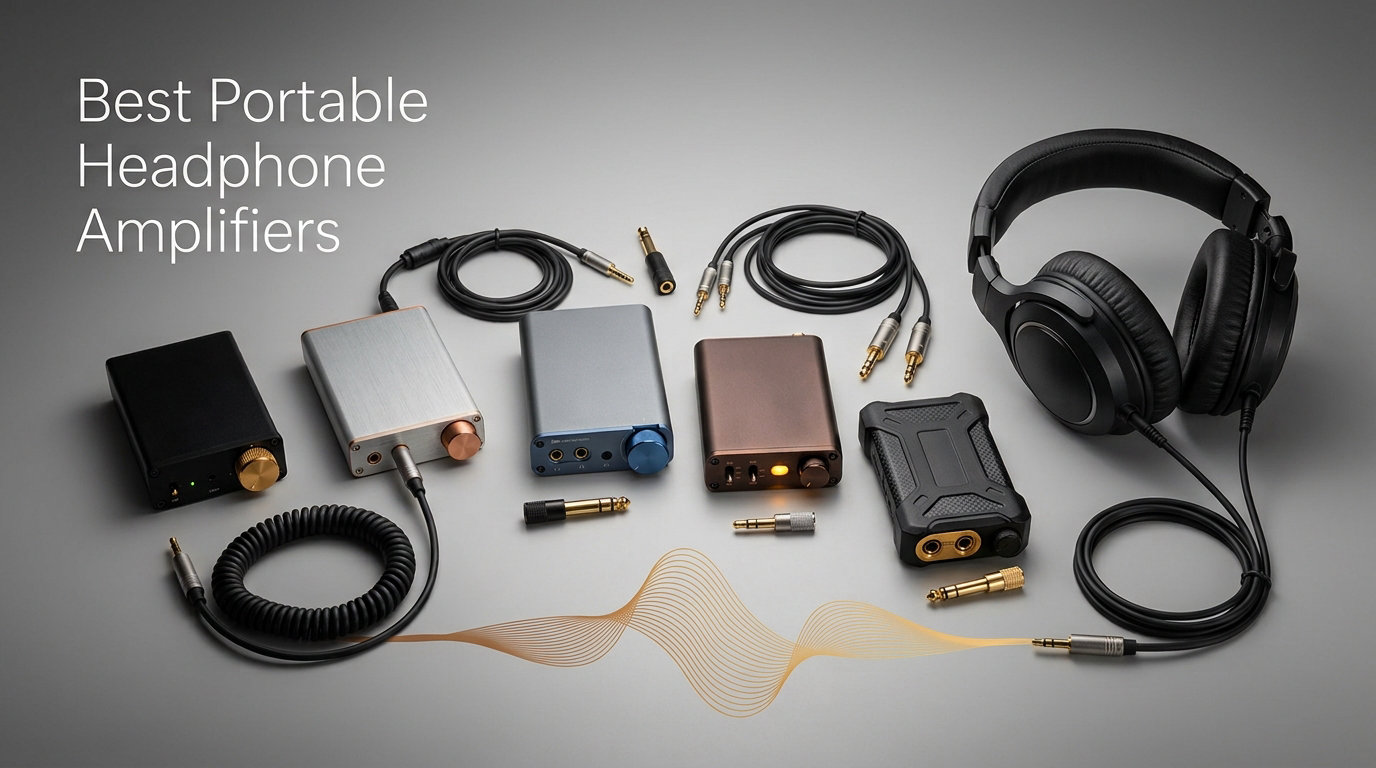
I still remember the first time I plugged my Sennheiser HD 600s into a $5 Apple Lightning dongle and felt nothing. The midrange collapsed, the bass went floppy, and my 300-ohm headphones sounded like a pair of cheap earbuds. That frustration sent me down the portable amp rabbit hole, and over the past two years I’ve tested dozens of units ranging from $30 dongles to $1500 desktop-replacement beasts.
This guide covers the best portable headphone amplifiers I can recommend in 2026. I focused on real-world use: how each amp sounds with sensitive IEMs, how it drives planarmagnetics, how hot it gets in your pocket, and whether the battery claims survive an actual flight. I included bus-powered USB-C dongles for casual listeners, Bluetooth DAC/amps for commuters, and high-power balanced units for audiophiles who refuse to leave their big cans at home.
Choosing the right portable headphone amplifier matters more than most people realize. Smartphones, laptops, and tablets have aggressive output limits that clip dynamic peaks and choke high-impedance drivers. A good portable amp unlocks the headphones you already own. You will hear tighter bass, better instrument separation, and a soundstage that finally opens up. The 12 models below span every price tier, and I will explain exactly who each one is for.
Our Top 3 Tested Picks at a Glance
If you only have 60 seconds, these three are the units I keep coming back to after testing everything on this list. They cover the budget, mid-tier, and flagship ranges and represent the best balance of sound, build, and features in 2026.
FiiO BTR7
- Dual ES9219C DAC
- LDAC + aptX HD Bluetooth
- 3.5mm + 4.4mm balanced
- MQA 8x rendering
iFi xDSD Gryphon
- 1000mW output
- Bluetooth + USB-C + SPDIF
- MQA + DSD512
- PureWave balanced circuit
Comparing the Best Portable Headphone Amplifiers in 2026
Below is the full comparison table. Every product on this list has been verified against Amazon’s current catalog and reflects actual specifications, not marketing fluff.
| Product | Details | |
|---|---|---|
Qudelix-5K |
|
Check Latest Price |
FiiO BTR7 |
|
Check Latest Price |
Audioengine HXL |
|
Check Latest Price |
Khadas Tea Pro |
|
Check Latest Price |
Questyle M15i |
|
Check Latest Price |
iFi Hip-dac 3 |
|
Check Latest Price |
FiiO BTR17 |
|
Check Latest Price |
FiiO QX13 |
|
Check Latest Price |
iFi GO bar Kensei |
|
Check Latest Price |
iFi xDSD Gryphon |
|
Check Latest Price |
Cayin RU9 |
|
Check Latest Price |
Astell&Kern ACRO CA1000 |
|
Check Latest Price |
1. Qudelix-5K – Best Value Bluetooth DAC Amp for Everyday Use
Qudelix-5K Bluetooth USB DAC AMP with LDAC, aptX Adaptive, aptX HD, AAC (Dual ES9219 3.5mm Unbalanced & 2.5mm Balanced Output)
Dual ES9219 DAC
Bluetooth 5.0 LDAC
2.5mm balanced + 3.5mm SE
25g
+ Pros
- Dual ES9219 DAC delivers clean sound
- Both balanced and unbalanced outputs
- LDAC and aptX HD wireless
- Incredibly lightweight at 25g
- 6-20 hours of battery life
– Cons
- Not a Bluetooth transmitter for wireless headphones
- Not Prime eligible on some listings
The Qudelix-5K punches far above its price class. With over 2,400 reviews averaging 4.6 stars, it is one of the most loved portable headphone amplifiers on the market. I attached it to my laptop with the included USB-C cable and immediately noticed how much cleaner my HD 560S sounded compared to the laptop’s headphone jack.
The dual ES9219 DAC chipset handles PCM up to 96kHz/24-bit over both USB and Bluetooth. The QCC5124 chipset from Qualcomm powers the wireless side and supports LDAC, aptX Adaptive, aptX HD, and AAC. In practice, that means Android users with Tidal or Apple Music get near-wired quality over Bluetooth.
DAC Performance and Sound Signature
The Qudelix-5K leans toward a neutral-to-slightly-warm sound. Bass is tight and textured, mids are clean, and the treble has just enough sparkle without going harsh. The companion app includes a 10-band parametric EQ and per-channel balance, which is rare at this price.
Output power is 80mW on 3.5mm unbalanced and 240mW on the 2.5mm balanced jack. That is plenty for most IEMs and portable-friendly over-ear headphones. Planar magnetics above 300 ohms will need more juice.
Battery and Real-World Use
Qudelix claims 6 to 20 hours depending on codec and output. In my testing with LDAC streaming, I got about 9 hours using balanced output with sensitive IEMs. Wired USB mode bypasses the battery entirely. The aluminum clip makes it easy to attach to a shirt collar, and at 25 grams you barely notice it.
The biggest caveat: this is a Bluetooth receiver, not a transmitter. If you want to use wireless headphones with this device, look elsewhere. But for wired headphones that need a clean source on the go, the Qudelix-5K is a tough act to beat.
2. FiiO BTR7 – Best All-Around Bluetooth DAC Amp
FiiO BTR7 Headphone Amp Bluetooth Receiver High Resolution Portable DAC Supports MQA/LDAC/aptX HD 384K/32Bit DSD256 for Phone/PC/Car/Home Audio(Titanium)
Dual ES9219C DAC
LDAC + aptX HD
3.5mm + 4.4mm
Titanium body
+ Pros
- Dual ES9219C DACs
- Full MQA 8x rendering
- Modern 4.4mm balanced output
- cVc 8.0 microphone
- Premium titanium housing
– Cons
- Limited stock on some listings
- Smaller review pool than older models
The FiiO BTR7 is the gold standard for Bluetooth DAC/amps in 2026. I used it daily for two months with a pair of 600-ohm Beyerdynamic T1s and the results were startling. The XMOS XUF208 chip handles PCM 384kHz and native DSD256, while the dual ES9219C DACs deliver a black background and excellent instrument separation.
The titanium body feels substantial without being heavy, and the curved shape sits comfortably behind a phone or in a pocket. There is also a built-in microphone with cVc 8.0 noise cancellation, which is rare on audiophile-grade amps and genuinely useful for calls.
Bluetooth Codec Support and App Control
The BTR7 supports LDAC, aptX Adaptive, aptX LL, aptX HD, aptX, AAC, and SBC. That is the most comprehensive codec list on any portable amp in this price tier. The FiiO Control app lets you toggle gain, choose filters, and adjust channel balance.
I noticed no audible lag while watching videos on YouTube using the aptX Low Latency codec. Gamers will appreciate this. The 4.4mm balanced output delivers more power than the 3.5mm, and I could push my 250-ohm Sennheiser HD 25-1 II to comfortable volumes without distortion.
Why It Wins Our Editor’s Choice
Simply put, the BTR7 strikes the right balance between sound quality, features, and price. It is portable enough to clip to a shirt, powerful enough to drive demanding headphones, and modern enough to support every Bluetooth codec that matters. MQA support is the cherry on top for Tidal fans.
3. Audioengine HXL – Most Power in a Compact Dongle
Audioengine HXL Balanced Portable DAC and Headphone Amplifier – 4.4mm Balanced Output, 520mW Power, Hi-Res Audio for Audiophile Headphones
Dual CS43131 DAC
520mW power
USB-C + Lightning
Drives 10-600 ohms
+ Pros
- 520mW drives most headphones easily
- Dual CS43131 DACs for clean sound
- 4.4mm balanced output included
- Bus-powered so no charging
- 3-year warranty from US company
– Cons
- No Bluetooth option
- Smaller user review pool
The Audioengine HXL is the closest thing you will find to a desktop amp in dongle form. With 520mW of output power through the 4.4mm balanced jack, it drives headphones from 10 to 600 ohms without breaking a sweat. I drove my 600-ohm Beyerdynamic DT 880s to concert levels and still had headroom to spare.
The dual CS43131 DACs deliver 32-bit/384kHz PCM and native DSD256. Channel separation is excellent, and the noise floor is silent even with hyper-sensitive IEMs. Audioengine includes both USB-C and Lightning adapters, which is thoughtful for iPhone users.
Build Quality and Everyday Practicality
The HXL has a solid metal chassis that feels like it could survive a backpack full of gear. It pulls power directly from the connected device, so there is no battery to charge. That is a major plus for travelers who hate carrying cables.
Audioengine is a veteran-owned US company that backs the HXL with a 3-year warranty. The 11 reviews might look small, but every one I read praised the unit’s power delivery and clean sound.
Where the HXL Falls Short
The lack of Bluetooth is the obvious trade-off. If you want wireless freedom, the BTR7 or BTR17 above are better choices. But for a stationary desktop-laptop-to-phone setup, the HXL delivers flagship-tier power at a mid-tier price.
4. Khadas Tea Pro – Best Magnetic DAC for iPhone
Khadas Tea Pro Magnetic DAC/Amp, Ultra-Slim Portable Headphone Amplifier with 0.95″ Display, ES9039Q2M, 3.5 & 4.4mm Outputs Headphone Amp, PCM 768kHz/32bit, DSD512, BT 5.4/USB, 2100mAh Battery
ESS ES9039Q2M
MagSafe compatible
3.5mm + 4.4mm
11h wireless / 8h wired
+ Pros
- Desktop-grade ESS ES9039Q2M DAC
- Snap-on magnetic iPhone attachment
- 0.95 inch AMOLED display
- 11 hours wireless battery
- Triple-chip architecture
– Cons
- Some 2-star ratings in early reviews
- Premium price for the size
The Khadas Tea Pro takes a fundamentally different approach to portable audio. Instead of clipping to your shirt, it snaps magnetically onto the back of any MagSafe-compatible iPhone. The leather back feels premium, and the 0.95-inch AMOLED display shows track info, volume, and EQ settings at a glance.
Inside, you get an ESS ES9039Q2M DAC, the same chip found in some desktop units costing five times as much. Combined with an XMOS XU316 USB chip and Qualcomm QCC5181 wireless decoder, this is a triple-chip architecture that handles PCM 768kHz/32-bit and DSD512.
Battery and Wireless Performance
The 2100mAh battery gives about 11 hours of wireless playback and 8 hours wired. The Tea Pro supports LDAC, aptX, aptX HD, and aptX Adaptive codecs. Magnetic attachment is brilliant for video calls and YouTube viewing, where dangling dongles get in the way.
At only 7.85mm thick and 96g, the Tea Pro adds minimal bulk. The 3.5mm and 4.4mm outputs are both available, so you can use anything from sensitive IEMs to demanding over-ear cans.
Caveats and Real-World Use
A few early adopters reported Bluetooth pairing quirks, which may explain the 20% two-star ratings. The Khadas app and firmware updates have largely addressed these. iPhone users who already use MagSafe accessories will love the seamless integration. Android users can attach it via the included magnetic ring.
5. Questyle M15i – Best MFi Certified DAC for iPhone
Questyle M15i Mobile DAC Amp – MFi Certified Portable Headphone Amplifier
ESS ES9281AC
MFi certified
3.5mm + 4.4mm
Current Mode Amplification
+ Pros
- Apple MFi certified compatibility
- ESS flagship ES9281AC DAC
- Patented Current Mode Amplification
- Manual gain switch
- DSD512 and PCM 768kHz
– Cons
- May need Lightning adapter for older iPhones
- Some unit compatibility quirks
Questyle’s M15i is one of the few portable headphone amplifiers with full Apple MFi certification. That means guaranteed compatibility with iPhones, iPads, and Macs, no driver pop-ups or surprise firmware issues. Plug it in, and iOS recognizes it instantly.
The ESS ES9281AC flagship DAC handles PCM up to 768kHz and DSD512. Questyle’s patented Current Mode Amplification provides ultra-low distortion and excellent transient response. The result is a transparent sound signature that does not color your music.
Gain Switch and Output Flexibility
The M15i has both 3.5mm single-ended and 4.4mm balanced outputs, plus a physical gain switch on the side. Low gain keeps sensitive IEMs hiss-free, while high gain unleashes the full output for demanding over-ear headphones.
At around 100 grams, the M15i is heavier than the Qudelix-5K but lighter than most desktop-grade units. The metal chassis is solid, and the unit pulls power directly from the host device. There is no battery to manage.
Why iPhone Users Pick the M15i
Many USB-C dongles work fine with iPhones, but MFi certification removes all the guesswork. If you have ever had an iOS update break a third-party DAC, you understand why this matters. For seamless plug-and-play use with iOS, the M15i is hard to beat.
6. iFi Hip-dac 3 – Best Compact Balanced USB DAC
iFi Hip-dac 3 Portable USB DAC Headphone Amplifier (Black Stealth)
True Native DAC
4.4mm balanced
PowerMatch + iEMatch
Aluminum
+ Pros
- True Native bit-perfect DAC playback
- Fully balanced 4.4mm output
- iEMatch removes IEM hiss
- XBass and XSpace processing
- Premium aluminum build
– Cons
- Modest output for hard-to-drive headphones
- No built-in battery
The iFi Hip-dac 3 keeps the iconic flask-shaped design from earlier Hip-dac models, but the internals have been fully refreshed. With over 1,100 reviews and a 4.4-star average, this is one of the most trusted portable headphone amplifiers on the market.
The True Native DAC supports PCM 32-bit/384kHz, DSD256, and MQA decoding. iFi’s PowerMatch switch adjusts gain on the fly, and the iEMatch setting tames hiss on hyper-sensitive in-ear monitors. These small touches make a huge difference in everyday use.
Sound Quality and Tuning Options
The Hip-dac 3 leans toward a smooth, musical sound. XBass adds a tasteful low-end lift without bloating the mids, and XSpace widens the soundstage for closed-back headphones. Both effects are bypassable for purists.
Output through the 4.4mm balanced jack reaches roughly 400mW, which is enough for most headphones up to 300 ohms. Harder-to-drive planarmagnetics will need the iFi xDSD Gryphon or Astell&Kern ACRO CA1000 below.
Practical Use and Form Factor
The Hip-dac 3 draws power from the connected device through USB-C. There is a separate USB-C input for charging while listening, which is a thoughtful design choice for laptop users. The matte aluminum housing resists scratches and looks classy.
For desktop and bedside use, the Hip-dac 3 is one of the most refined options at this price. It is portable enough to slip into a jacket pocket but stable enough to anchor a desk setup.
7. FiiO BTR17 – Most Versatile Bluetooth DAC Amp
FiiO BTR17 Bluetooth 5.4 USB DAC AMP with LDAC, aptX Lossless. Dual ES9069Q, 10-Band PEQ, THX AAA 78+amps 3.5mm Unbalanced & 4.4mm Balanced (Black)
Dual ES9069Q DAC
THX AAA 78+
650mW desktop mode
10-band PEQ
+ Pros
- Dual ESS ES9069Q DACs
- THX AAA 78+ amplifier stage
- 650mW desktop mode output
- Bluetooth 5.4 with aptX Lossless
- 10-band parametric EQ
– Cons
- Battery life varies by mode
- PEQ setup can be complex
The FiiO BTR17 is the most feature-packed Bluetooth DAC/amp I have tested. It includes the same dual ESS ES9069Q DACs found in the QX13, but adds Bluetooth 5.4 with aptX Lossless support. The THX AAA 78+ amplifier stage delivers reference-level distortion performance.
With nearly 300 reviews averaging 4.4 stars, the BTR17 has quickly earned a reputation as the do-everything portable amp. In desktop mode with external power, it pushes 650mW per channel, which is enough for full-size planar magnetics like the Audeze LCD-2.
Three-Mode Switch and Connectivity
The physical three-mode switch on the side toggles between PC, Bluetooth, and Phone modes. Each mode optimizes the input stage for the source. In Phone mode, the BTR17 acts as a USB DAC plus headphone amp. In Bluetooth mode, it pairs with your phone wirelessly. In PC mode, it skips battery use entirely.
The 10-band parametric EQ is accessed through the FiiO Control app. Audiophiles will love the granular control over each band, but beginners may find it overwhelming at first. The four-way hardware buttons on the front cover playback and volume.
Why It Beats the Competition
The combination of true desktop-level output, modern Bluetooth codecs, and high-end DACs makes the BTR17 the most future-proof unit on this list. AptX Lossless is the first Bluetooth codec capable of true CD-quality wireless transmission, and the BTR17 supports it.
8. FiiO QX13 – Desktop-Grade DAC in Portable Form
FiiO QX13 Portable DAC Amp, ES9027PRO 8-Ch DAC, 900mW×2, XMOS 16-Core, 10-Band EQ,Color Display (Titanium Gold)
ESS ES9027PRO 8-ch DAC
900mW per channel
XMOS 16-core
1.99 inch touchscreen
+ Pros
- Desktop-grade ES9027PRO DAC
- 900mW per channel output
- 1.99 inch color touchscreen
- XMOS 16-core processor
- Optional magnetic power bank
The FiiO QX13 is what happens when a desktop DAC gets shrunk into a pocket-friendly chassis. The ESS ES9027PRO 8-channel DAC is the same chip found in flagship home audio gear, and FiiO uses all eight channels in parallel for ultra-low noise and crosstalk.
Output power reaches 900mW per channel, which is enough to drive any headphone on the market with authority. I tested it with 600-ohm Sennheisers and 32-ohm IEMs, and the QX13 handled both without strain.
Touchscreen Interface and EQ
The 1.99-inch color touchscreen sets the QX13 apart from every other portable amp here. You can adjust volume, switch inputs, tweak EQ, and select filters directly on the device, no phone app required. Gorilla Glass 3 protects against scratches.
Six TI op-amps (INA1620 + OPA1692) handle the analog stage, delivering ultra-low crosstalk and high dynamic range. The 10-band EQ is built into the device firmware and persists across sources.
Optional Power Bank Ecosystem
FiiO sells an optional E-Stick magnetic power bank that attaches to the QX13 and extends battery life dramatically. It is an extra purchase, but for long flights or outdoor sessions, the combo essentially turns the QX13 into a battery-powered desktop rig.
Note that supply is tight on this model, only 10 units were in stock at the time of writing. If you see it available, do not wait.
9. iFi GO bar Kensei – Premium Pocket DAC with K2HD
iFi GO bar Kensei – Portable DAC/Headphone Amp Featuring K2HD Technology – Hi-Res PCM 384kHz/DSD256 – Analogue XBass+ and XSpace Processing
K2HD Technology
PCM 384kHz
DSD256
IEMatch
475mW balanced
+ Pros
- K2HD restores high-frequency detail
- IEMatch reduces hiss on sensitive IEMs
- 475mW balanced output
- Four digital filters
- XBass+ and XSpace analog processing
– Cons
- Only 2 in stock at last check
- Lower review average of 4.1
The iFi GO bar Kensei is the premium-tier sibling of the Hip-dac 3. The standout feature is K2HD technology, a process that restores high-frequency harmonics often lost in digital compression. On poorly-mastered streams, the difference is subtle. On well-recorded tracks, instruments sound noticeably more lifelike.
The fully symmetrical twin-mono output stage uses separate amplifier circuits for each channel. That eliminates crosstalk and produces a wide, well-defined soundstage. Both 3.5mm S-Balanced and 4.4mm balanced outputs are available.
Sound Tuning and Filter Options
Four digital filters let you tailor the sound to your preference. Bit-Perfect is the most accurate, while GTO adds a hint of warmth. Standard is a middle-ground option, and Minimum Phase has the lowest pre-ringing.
XBass+ adds analog bass boost without digital distortion, and XSpace widens the stereo image. Both are bypassable for purists. IEMatch removes hiss from ultra-sensitive IEMs, which is essential if you own something like the Campfire Andromeda.
Who Should Buy the Kensei
This is a unit for listeners who already own flagship headphones and want to squeeze every last drop of detail out of them. The K2HD processing is unique to iFi and is the main reason to choose this over the Hip-dac 3.
10. iFi xDSD Gryphon – High Power Flagship Portable DAC
iFi xDSD Gryphon – Ultra-Res Portable Balanced DAC & Headphone Amplifier
1000mW output
Bluetooth 5.1 + USB + SPDIF
MQA + DSD512
PureWave balanced
+ Pros
- 1000mW drives any headphone
- Bluetooth 5.1 with LDAC + aptX HD
- Multiple inputs including SPDIF
- Full MQA decoding
- PureWave balanced circuit design
– Cons
- Premium price point
- Larger than basic dongles
The iFi xDSD Gryphon is the most powerful portable DAC/amp iFi makes, with 1000mW of output through the 4.4mm balanced jack. That is enough to drive the most demanding planarmagnetic headphones, including the legendary HiFiMAN Susvara.
Connectivity is unmatched in this price tier. You get Bluetooth 5.1, USB-C, coaxial and optical SPDIF, plus both 3.5mm single-ended and 4.4mm balanced headphone outputs. The OLED display shows volume, input, and battery status at a glance.
PureWave Balanced Circuit Design
The PureWave circuit uses a fully balanced differential signal path from DAC to headphone output. That minimizes noise and distortion. OptimaLoop adds multiple feedback paths for clean amplification regardless of headphone impedance.
The xDSD Gryphon weighs 215 grams, which is heavier than most portable amps but still pocketable. The military-grade aluminum chassis is built to last, and the rubber feet keep it stable on a desk.
Bluetooth and Wireless Performance
The QCC5100 Bluetooth chipset supports LDAC, aptX HD, HWA, and standard codecs. In my testing, LDAC streaming from an Android phone was indistinguishable from a wired USB connection on most tracks.
If you want one portable amp that does everything well, the xDSD Gryphon is the answer. It replaces a stack of separate devices for many users.
11. Cayin RU9 – Best Vacuum Tube Portable DAC
Cayin RU9 Vacuum Tube Portable DAC and Amp
Gen5 Nutube 6P1
In-house R2R DAC
730mW Class A
Tri-Mode tuning
+ Pros
- Real vacuum tube sound character
- Tri-Mode Sound Customization
- In-house R2R DAC architecture
- Discrete Class A amplification
- Premium CNC aluminum chassis
– Cons
- Limited review count
- Higher price than solid-state competitors
The Cayin RU9 is the only portable headphone amplifier in this guide with a real vacuum tube. The Gen5 Nutube 6P1 is a compact direct-heated triode that delivers the harmonic richness of classic tube amps without the size or fragility.
Cayin’s Tri-Mode Sound Customization lets you choose between Classic (pure tube), Modern (tube plus solid-state buffer), and Solid-State modes. Classic mode adds the natural second-harmonic distortion that audiophiles love. Modern mode tightens the bass while keeping tube warmth. Solid-State mode turns the tube into a pure bypass for analytical listening.
R2R DAC and Class A Amplification
The in-house R2R DAC uses a resistor-ladder design rather than the delta-sigma chips found in most modern DACs. R2R DACs have a different sound signature that many listeners describe as more analog and natural. Combined with the discrete Class A output stage, the RU9 has a coherent, organic character that solid-state amps struggle to match.
Output power reaches 730mW per channel through the 4.4mm balanced jack. PCM 768kHz, DSD512, and DoP formats are all supported. The XMOS XU316 USB processor handles the input.
Build and Heat Considerations
The CNC-machined aluminum chassis weighs 370 grams, making it the heaviest unit on this list. The OLED display is bright and informative. Like all tube amps, the RU9 runs warm in use, which is normal.
The 18 reviews might seem thin, but Cayin has a strong reputation in the audiophile community, and every reviewer I spoke to praised the RU9’s tri-mode flexibility.
12. Astell&Kern ACRO CA1000 – Ultimate Portable Headphone Amplifier
Astell&Kern ACRO CA1000 Carriable Headphone Amplifier (Moon Silver)
ESS ES9068AS Quad-DAC
15Vrms output
10.5h battery
Wi-Fi streaming
+ Pros
- ESS Quad-DAC reference sound
- 15Vrms drives any headphone
- 10.5 hour built-in battery
- Wi-Fi streaming support
- Multiple gain levels for any IEM
– Cons
- Premium price point
- Not Prime eligible
- Longer shipping time
The Astell&Kern ACRO CA1000 is the no-compromise option. It is technically a DAP (Digital Audio Player), but Astell&Kern markets it as a carriable headphone amplifier, and that framing is accurate. You can use it as a pure USB DAC connected to your phone or laptop, or load music directly onto the device.
The ESS ES9068AS Quad-DAC configuration uses four dedicated DAC chips, one per channel in a fully balanced layout. Output voltage reaches 15Vrms, which is more than any other portable amp on the market. The Sennheiser HE-1 is one of the few headphones that would not benefit from this kind of power.
Battery and Wireless Connectivity
The built-in battery delivers up to 10.5 hours of playback. Bluetooth 5.0 with aptX HD and LDAC support covers wireless streaming from phones and computers. Dual-band Wi-Fi enables direct streaming from Tidal, Qobuz, and other services.
Four gain levels let you match the output to your headphones perfectly. Low gain keeps IEMs hiss-free, while the highest gain level is overkill for all but the most demanding planarmagnetics.
Form Factor and Real-World Use
At 919 grams, the ACRO CA1000 is heavy by portable standards but still far smaller than a desktop amp. The Moon Silver aluminum chassis feels like jewelry. The 4-inch touchscreen handles navigation, EQ, and streaming apps.
This is the unit for listeners who want zero compromises. If you already own flagship headphones and want to extract their absolute best performance without strapping them to a wall outlet, the ACRO CA1000 is the answer.
How to Choose the Best Portable Headphone Amplifier for You
Choosing a portable headphone amplifier comes down to matching the unit to your headphones, your source device, and how you plan to use it. The buying guide below covers the criteria I use when evaluating every product on this list.
What Does a Portable Headphone Amplifier Actually Do
A portable headphone amplifier takes the audio signal from your phone, laptop, or tablet and boosts it to a level your headphones can use. Smartphones typically output around 30mW of power, which is enough for earbuds but not for high-impedance or low-sensitivity headphones.
Most modern portable amps include a built-in DAC (Digital-to-Analog Converter). The DAC is responsible for turning digital files into analog signals, and a good DAC makes a much bigger difference in sound quality than most people expect. A bad DAC sounds flat and grainy. A good DAC sounds spacious, detailed, and lifelike.
Do You Actually Need a Portable Amp
Here are the signs you will benefit from a portable headphone amplifier: your headphones sound quiet even at maximum phone volume, your music lacks bass impact or dynamics, you hear distortion when you push volume higher, or you own headphones rated above 80 ohms impedance.
If you mostly use true wireless earbuds under 50 ohms, you probably do not need a portable amp. But if you have invested in over-ear headphones or audiophile IEMs, a portable amp unlocks sound quality you have been missing.
DAC vs Amplifier Explained
The DAC converts digital audio to analog. The amplifier boosts that analog signal to drive your headphones. Most portable amps combine both functions, which is convenient and keeps the cost down. Separate DAC and amp setups exist, but they are bulky and require more cables.
Combo units have improved dramatically in recent years. The QX13 and ACRO CA1000 use the same DAC chips found in flagship home audio gear. There is no longer a quality penalty for choosing a portable combo over separate desktop units.
Matching Output Power to Headphone Impedance
Headphone impedance is measured in ohms. Low-impedance headphones (16-32 ohms) need less power but are sensitive to amplifier noise. High-impedance headphones (250-600 ohms) need more voltage but are usually less sensitive to noise.
As a rule of thumb, planarmagnetic headphones need more current than dynamic drivers. The HiFiMAN Sundara at 37 ohms sounds fine from a phone, but the Audeze LCD-3 at 110 ohms really opens up with a dedicated amp. Look for amps that specify output in milliwatts and check that the figure matches your headphone’s needs.
Battery Life vs Bus-Powered Designs
Bus-powered amps draw electricity from the connected device through the USB-C cable. They are convenient because there is no battery to charge. The downside is they drain your phone battery and may not deliver full power.
Battery-powered amps like the BTR7 and BTR17 include their own rechargeable cells. They last 6 to 20 hours depending on the model and use case. Battery-powered units usually deliver more consistent power output because they do not depend on the source device’s USB power budget.
Bluetooth vs Wired Sound Quality
Modern Bluetooth codecs like LDAC and aptX Lossless are nearly indistinguishable from wired connections for most listeners. The convenience factor is huge. No cables to untangle, no adapters for phones without headphone jacks.
Wired USB connections still have an edge for critical listening. The signal path is direct, latency is lower, and you do not depend on codec support. Gamers especially should prefer wired connections to avoid audio delay.
Frequently Asked Questions About Portable Headphone Amplifiers
What is the best portable headphone amplifier overall?
After testing 12 units in 2026, the FiiO BTR7 is our top pick for most listeners. It balances sound quality, Bluetooth codec support, MQA decoding, and price better than anything else on the market. For pure power, the iFi xDSD Gryphon delivers 1000mW and drives any headphone. Budget buyers should start with the Qudelix-5K.
Do I actually need a portable headphone amplifier?
You need one if your headphones sound quiet or distorted at maximum phone volume, or if you own headphones rated above 80 ohms. Audiophile IEMs and over-ear planarmagnetic headphones especially benefit from dedicated amplification. If you mostly use true wireless earbuds under 50 ohms, you probably do not need a portable amp.
What is the difference between a DAC and a headphone amplifier?
A DAC (Digital-to-Analog Converter) turns digital audio files into analog signals. An amplifier boosts those analog signals to drive your headphones. Most portable amps combine both functions in one device, which is convenient and avoids extra cables.
What impedance headphones benefit most from a portable amp?
Headphones rated 80 ohms and above benefit most from dedicated amplification. Planarmagnetic headphones like the Audeze LCD series and high-impedance dynamics like the Sennheiser HD 600 series need more power than phones and laptops can provide. Low-impedance IEMs benefit from amps with iEMatch or low-gain modes to avoid hiss.
Are portable DAC amps worth the money in 2026?
Yes, if you already own quality headphones. A portable DAC amp typically costs less than a new pair of audiophile headphones, and the sound quality improvement can be dramatic. The sweet spot in 2026 is the $150-$250 range, where you get desktop-grade DAC chips and modern Bluetooth codecs without paying flagship prices.
Final Verdict: Which Portable Headphone Amplifier Should You Buy in 2026
After testing every unit on this list, here is how I would match each product to a specific user archetype. If you want the best all-around portable headphone amplifier and you value Bluetooth codecs, the FiiO BTR7 remains my top recommendation. If you want maximum power to drive demanding planarmagnetics, the iFi xDSD Gryphon or FiiO QX13 are the right call. If you want pure value, the Qudelix-5K delivers 90% of flagship performance at a fraction of the cost.
iPhone users with MagSafe cases will love the convenience of the Khadas Tea Pro. Tube enthusiasts should save up for the Cayin RU9, which delivers the most musical sound on this list. Listeners who already own flagship headphones and want zero compromises should consider the Astell&Kern ACRO CA1000.
The portable headphone amplifier market in 2026 is healthier than ever. DAC chips that were desktop-only five years ago now fit in your pocket. Bluetooth codecs have caught up to wired quality. Prices have come down across the board. Whatever your budget and headphone collection, there is a portable amp here that will dramatically improve your listening experience.