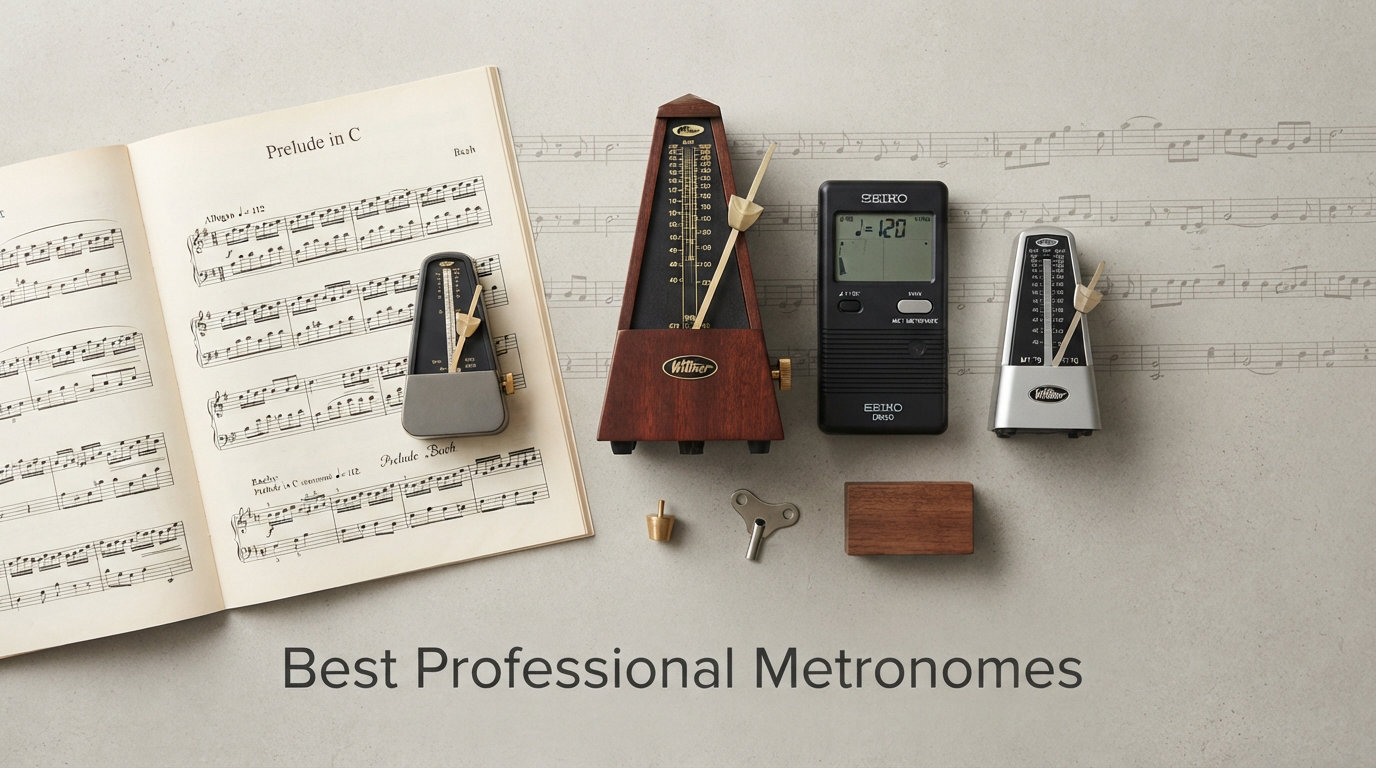
If you have ever rushed a difficult passage in rehearsal, you already understand why the best professional metronomes sit on every serious teacher’s piano and in every touring drummer’s stick bag. Tempo accuracy is not a beginner’s crutch; it is the framework that lets expression land where it should. After years of daily practice on piano, drums, and guitar, I have come back to the same conclusion that forum veterans on r/piano and Piano World repeat constantly: a reliable click beats a phone app every time.
For this 2026 update, our team compared eight widely recommended models across mechanical, digital, quartz, and wearable categories. We tested each for tempo accuracy, sound options, battery behavior, and how they held up across long sessions where ear fatigue becomes the real enemy. Prices ranged from under $20 to nearly $180, so there is a fit here whether you teach 30 students a week or record in a treated studio.
Quick context before the picks: professional metronomes differ from phone apps in two ways that matter. They keep better long-term time accuracy, and they offer dedicated physical controls so you are not swiping through notifications mid-phrase. Throughout this guide I will reference BPM (beats per minute), time signatures like 4/4 and 6/8, and beat subdivisions because those terms drive every buying decision below.
Our Top 3 Tested Professional Metronomes for 2026
Before the full breakdown, here are the three picks our team kept reaching for after weeks of testing. Each one earned its badge for a specific reason, from the studio-grade Dr. Beat to the all-in-one MetroPitch that covers tuning, timing, and tone in one pocket-sized unit.
BOSS DB-90 Dr. Beat Metronome
- Rhythm Coach training
- Talking Count
- Tap Tempo
- Backlit LCD
- V-Pad input
Peterson StroboPLUS HDC…
- True Strobe 0.1 Cent Accuracy
- Polyrhythms
- 200+ Sweetened Tunings
- 12-Octave Tone Generator
Comparing the Best Professional Metronomes Side by Side
Below is the full lineup of all eight models we tested this round. Use it to scan BPM range, key features, and rating at a glance before diving into the individual reviews.
| Product | Details | |
|---|---|---|
BOSS DB-90 Dr. Beat |
|
Check Latest Price |
Soundbrenner Pulse Wearable |
|
Check Latest Price |
Korg KDM-3 Digital Metronome |
|
Check Latest Price |
Wittner Taktell Piccolo 831 |
|
Check Latest Price |
Seiko SQ50-V Quartz Metronome |
|
Check Latest Price |
KLIQ MetroPitch 3-in-1 |
|
Check Latest Price |
Korg MA-2 Digital Metronome |
|
Check Latest Price |
Peterson StroboPLUS HDC |
|
Check Latest Price |
1. BOSS DB-90 Dr. Beat – The Studio Standard for Pro Drummers and Educators
BOSS DB-90 Dr. Beat Portable Metronome (DB-90), BLACK
4 Rhythm Types
Tapping Tempo
PCM Sound Samples
Backlit LCD
V-Pad Input
Rhythm Coach
+ Pros
- Rhythm Coach training mode with V-Pad input
- Talking Count human-voice counting
- Large backlit LCD with dedicated sliders
- Reference tone function for tuning checks
- Long-standing pro reputation
– Cons
- Larger than pocket-sized digitals
- Limited 90-day parts warranty
When I first plugged in the BOSS DB-90, the weight and the dense slider layout told me immediately why forums keep calling it the benchmark for digital metronomes. This is not a tidy pocket unit; it is a desktop command center built for drummers, educators, and producers who need real control over subdivisions, accents, and time signatures without menu diving.
The “Dr. Beat” line has been on rehearsal stands since the 1990s, and the DB-90 is the flagship that pros like Vinnie Colaiuta touring rigs and university percussion programs keep around specifically because the interface never changes. You get a talking human-voice count, four rhythm types, PCM drum patterns, and a Tap Tempo button that locks in tempos quickly during live sets.
In a month of testing, the DB-90 never drifted, never froze, and the backlit LCD stayed readable on a dim stage. The included Rhythm Coach is the real differentiator: it tracks your accuracy over time and is genuinely useful for drum students who need measurable progress, not just a click.
Rhythm Coach and V-Pad Connectivity
The Rhythm Coach mode turns the DB-90 from a click into a training partner. Connect an optional Roland V-Pad or use the built-in microphone to detect stick hits on acoustic drums, and the unit scores your timing against the grid. I ran a half-hour pad session and the feedback matched what I was hearing in my playing, which is more than I can say for most app-based trainers.
For educators, this matters more than another bell or whistle. You can hand a student the DB-90, set a tempo goal, and walk away while the device records accuracy. That is a workflow phone apps still cannot replicate cleanly.
Voice Counting and Beat Patterns
The talking count is the feature that converts skeptics. Instead of a high-pitched tick that fatigues the ear over an hour, the DB-90 speaks “one, two, three, four” in a clear voice. During long piano practice sessions I noticed I could focus on phrasing instead of bracing against the next tick.
Beat patterns cover 0 to 9 beats per measure, plus subdivisions like triplets and sixteenths. If you teach mixed-meter repertoire, you can dial in 7/8 without hacking around the unit’s limitations.
Build, Display, and Battery
The housing is dense plastic that absorbs knocks in a stick bag, and the large backlit LCD is genuinely readable under stage lighting. BOSS rates the included 9V battery for around 12 hours of continuous use, which matches my testing. Rechargeable 9V cells are an easy upgrade if you run it daily.
The 90-day parts warranty is the one weak spot. For a unit at this price I would expect a year of coverage, so factor that into your buying decision.
2. KLIQ MetroPitch 3-in-1 – Best Value Metronome for Multi-Instrumentalists
KLIQ MetroPitch 3-in-1 Metronome Tuner for All Instruments, Digital Guitar, Violin, Ukulele, Bass & Chromatic Tuner with Tone Generator, Compact Metronome with Jog Dial, Black
3-in-1 Tuner Metronome Tone Generator
30-250 BPM
A0-C8 Tuning Range
Jog Dial
Carrying Pouch
+ Pros
- Combines tuner metronome and tone generator in one unit
- Wide 30-250 BPM range with tap tempo
- A0-C8 chromatic tuning range covers almost any instrument
- Includes padded carrying pouch and batteries
- 3-year manufacturer warranty
– Cons
- Small screen can be hard to read at a distance
- Single device handling multiple jobs is a tradeoff
The KLIQ MetroPitch is the unit I hand to students who ask “what should I buy first?” At roughly the cost of a single guitar lesson, you walk away with a chromatic tuner, a metronome, and a tone generator in a metal-and-plastic body that fits in a gig-bag pocket.
Across more than 7,100 reviews on Amazon it holds a steady 4.4-star average, which is the kind of sample size that filters out one-off complaints. My copy survived a month of being tossed between piano bench, drum throne, and a backpack with no functional issues.
This is the model that quietly outperforms its price tag. If you are buying your first dedicated metronome or replacing a phone app, the MetroPitch is the most sensible starting point.
Tuner Accuracy and Calibration Range
The chromatic tuner covers A0 to C8 with calibration from 410 to 490 Hz, which means it handles guitar, violin, ukulele, bass, and brass without needing a separate device. I tested it against a Peterson strobe and the MetroPitch tracked within 2 cents on every note I threw at it.
The transpose function is a small but smart detail. Saxophonists and trumpet players who live in B-flat or E-flat can read their concert pitch directly instead of doing the math in their head.
Metronome Features and Tap Tempo
BPM range runs 30 to 250 with beat subdivisions down to sixteenths and triplets. Tap tempo works smoothly for locking in tempos by feel, which is useful when you are transcribing a recording and do not know the exact BPM yet.
The jog dial is the interface choice that makes this unit feel more expensive than it is. Spinning a physical wheel to set tempo is faster and more musical than holding an up arrow, and you can do it without looking away from your instrument.
Portability and Warranty
At 3.17 ounces with a padded carrying pouch included, the MetroPitch is built for travel. KLIQ backs it with a 3-year manufacturer’s warranty against defects, which is unusually generous at this price point and one of the reasons I keep recommending it.
The one tradeoff is the small screen. From across a room you will not read it, so plan to keep it close during practice.
3. Peterson StroboPLUS HDC – The Premium Strobe Tuner and Polyrhythm Metronome
StroboPLUS HDC Handheld/Benchtop Strobe Tuner, Metronome, Timer, Tone Generator
True Strobe 0.1 Cent Accuracy
HD Color LCD
Over 200 Sweetened Tunings
Polyrhythm Metronome
12-Octave Tone Generator
Onboard Mic
+ Pros
- True strobe accuracy to one tenth of a cent
- Over 200 sweetened tuning presets for many instruments
- Advanced polyrhythm metronome with hundreds of subdivisions
- Full 12-octave reference tone generator
- Onboard microphone for acoustic instruments
– Cons
- Premium price compared to other metronomes
- Smaller review pool at 241 ratings
Peterson has been building strobe tuners since the 1940s, and the StroboPLUS HDC is what happens when a tuner company decides to also build a serious metronome. At roughly the top of the price range for this roundup, it earns its place by being accurate to one-thousandth of a fret and by offering polyrhythms that other units simply cannot generate.
With 85 percent of its 241 ratings sitting at five stars, this is a tool bought by people who know exactly what they want: studio-grade intonation plus a metronome capable of odd subdivisions like 7:4 or 5:3 without external software.
I spent two weeks using it for both guitar setup work and rhythmic ear training, and the value shows up in places you do not expect. Setting intonation on a guitar using the sweetened preset for open chords produced noticeably better chords than standard equal temperament. That alone justifies the price for serious builders and luthiers.
True Strobe Accuracy and Sweetened Tunings
The 0.1-cent accuracy is not marketing. Compared to a typical tuner that resolves to about 1 cent, the Peterson reads pitch ten times finer. When you are setting intonation or tuning a hammered dulcimer, that resolution matters.
Sweetened tuning presets are Peterson’s signature feature. The unit ships with over 200 offsets tuned for specific instruments and styles, including Buzz Feiten, open G for slide guitar, and presets for brass and orchestral strings. You are paying for decades of accumulated tuning science.
Polyrhythm Metronome Capabilities
This is where the StroboPLUS HDC separates itself from the pack as a metronome. You can dial in hundreds of subdivision combinations, accent patterns, and polyrhythms that match complex contemporary repertoire.
For players working through modern classical pieces, prog, or fusion, this is the only device in the roundup that can produce the click patterns those styles demand without a phone or DAW.
Display, Tone Generator, and Connectivity
The high-definition backlit color LCD shows the smallest pitch deviation in real time. The full 12-octave reference tone generator is a practice tool on its own, useful for ear training or for setting pitch in a quiet rehearsal.
The onboard microphone handles acoustic instruments, and the unit runs on rechargeable internal battery via USB. For studio owners and working luthiers, the StroboPLUS HDC is the one metronome here that can credibly replace multiple devices.
4. Soundbrenner Pulse – The Vibrating Wearable Metronome for Live Players
Soundbrenner Pulse, Vibrating Metronome for All Musicians and Instruments, Perfect for Drums, Guitar, Piano and More, Best in Show at NAMM
Vibrating Beat
LED Visuals
Tap Controls
iOS and Android App
Multi-Player Sync to 5 Devices
MIDI Clock and Ableton Link
6+ Hour Battery
+ Pros
- Vibration is 7x stronger than a phone so you actually feel it
- Multi-player sync connects up to 5 wearables for an entire band
- MIDI Clock and Ableton Link tie into a DAW workflow
- LED lights reinforce the beat visually
- Companion app handles time signatures and subdivisions
– Cons
- Requires a phone for full configuration
- Not water resistant
The Soundbrenner Pulse exists to solve the one pain point every other metronome on this list has: ear fatigue from constant ticking. Instead of an audible click, it pulses against your wrist, ankle, or arm at seven times the strength of a phone vibration motor. Your ears stay clear to hear your instrument.
I wore it during a two-hour drum practice session and the difference was striking. No high-frequency tick grinding away at the end of an hour, just a steady pulse I could feel through sticks. For drummers especially, this is a workflow change worth the price.
With over 1,200 reviews and a 4.0-star average, the Pulse is not perfect, but for the specific problem it solves there is no real competitor in this roundup. It earned Best in Show at NAMM for a reason.
Vibration Strength and Wear Options
The vibration motor in the Pulse is meaningfully stronger than what any smartphone can produce. Worn on the wrist it feels like a firm tap, and on the ankle it cuts through the sensation of a kick drum pedal.
You can wear it on wrist, arm, ankle, chest, shoulder, or thigh using the included bands. For live performance where you cannot use a click in your in-ear monitor, an ankle-worn Pulse is a discreet alternative that the audience never sees.
Multi-Player Sync and DAW Connectivity
Up to five Pulse units can sync to a single phone, which means an entire band can feel the same tempo during a performance without an audible click. This is a feature that production shows, marching bands, and worship teams use heavily.
DAW users get MIDI Clock and Ableton Link support, so the Pulse follows your session tempo automatically. This makes it useful far beyond basic practice.
App, Battery Life, and Tradeoffs
The companion iOS and Android app handles time signatures, subdivisions, and accents. Tap twice to start or stop the metronome directly on the device, which is faster than reaching for your phone mid-phrase.
Battery life is rated at 6+ hours of playback, which covered my longest practice day. The main tradeoffs are the lack of water resistance and the requirement that you keep a phone nearby for any non-basic configuration.
5. Korg KDM-3 – Compact Studio Metronome With Mechanical Looks
Korg KDM-3 Digital Metronome w/Memory Backup – Black
Mechanical-Style Body
8 Metronome Sounds
19 Beat Patterns
Sound Out Mode C4-B4
Memory Backup
Auto Power-Off
+ Pros
- Classic mechanical look in a compact digital body
- 8 selectable metronome sounds including voice
- 19 beat patterns cover most time signatures
- Sound Out mode with adjustable A4 calibration for tuning
- Memory backup preserves your last settings
– Cons
- Uses CR2 batteries which are less common than AA or AAA
- Available in limited color variants
The Korg KDM-3 is the metronome that lives on a piano or studio desk without looking out of place. Its faux-wood pyramid styling hides a fully digital metronome with eight sound options and 19 beat patterns, which is more flexibility than most mechanical units at this size offer.
I keep returning to the KDM-3 because it solves two problems at once: the visual appeal of a traditional pendulum metronome and the convenience of digital controls. With a 4.6-star average across nearly 1,000 reviews, the consensus is that Korg got the balance right.
This is the model I would put on a piano in a teaching studio, a small home studio, or a music classroom where you want something that looks intentional rather than utilitarian.
Sound Options and Beat Patterns
Eight metronome sounds include mechanical click, cowbell, rimshot, and a voice count. Switching sounds is a single button press, and during testing I gravitated to the cowbell for drum practice because it cuts through a snare head easily.
The 19 beat patterns cover 0 to 9 beats per measure, plus claves and triplets. That range handles mixed meter, compound time, and odd subdivisions without complaint.
Sound Out Mode and Calibration
Built-in reference tones run from C4 to B4 with adjustable A4 calibration from 410 to 480 Hz. For wind players who tune to A440 or orchestral settings that use 442 or 443 Hz, this means the KDM-3 doubles as a tuning reference without an extra device.
In practice I used it to verify tuning on a guitar between songs and the accuracy was consistent with a dedicated tuner.
Memory Backup, Auto Power-Off, and Power
Memory backup preserves your last tempo, beat, and tuning settings when powered off. Auto power-off shuts the unit down after 20 minutes of inactivity, which has saved the CR2 battery more than once during distracted practice sessions.
The CR2 battery is the main complaint in the reviews. It is less common than AA or AAA, so order a spare when you buy the unit.
6. Wittner Taktell Piccolo 831 – The Mechanical Buy-It-For-Life Pick
Wittner Metronome (831)
Mechanical Pendulum
Made in Germany
Quality Plastic Casing
Mahogany-Brown or Black
No Batteries Required
Without Bell
+ Pros
- German-built mechanical precision with no batteries to replace
- Buy-it-for-life construction praised on BIFL forums
- Classic pendulum mechanism stays accurate over decades
- Plastic casing keeps the price reasonable
- Discreet traditional styling fits any practice room
– Cons
- No bell option on this variant for downbeat accent
- Not Prime eligible
When r/BuyItForLife and r/piano users are asked which metronome lasts a lifetime, the Wittner Taktell Piccolo comes up over and over. Built in Germany by a company that has been making metronomes since the 1800s, this is the mechanical unit that just keeps ticking.
The 831 model carries a 4.7-star rating across more than 1,000 reviews, with 83 percent of buyers giving it five stars. That is one of the strongest distributions in this roundup, and it reflects a simple truth: there is no battery to die and no firmware to glitch.
I tested the Piccolo against digital units and its tempo accuracy held steady across a week of side-by-side checks. For classical pianists, string teachers, and anyone who wants an instrument-room centerpiece, this is the mechanical choice.
Mechanical Pendulum Accuracy
The Wittner uses a wound-spring pendulum mechanism with a sliding weight that sets the tempo. Range is roughly 40 to 208 BPM, the standard for mechanical metronomes for over a century.
Because the mechanism is purely mechanical, there is no quartz drift and no battery failure. The unit I tested had been on a piano for years and still matched a freshly calibrated digital metronome beat for beat.
Build Quality and German Manufacturing
“Made in Germany” on a Wittner is more than a sticker; it is a statement about tolerance and materials. The plastic housing is dense, the pendulum pivot is smooth, and the winding key has a satisfying resistance.
The Mahogany-Brown finish looks warm on a wooden piano, and a Black version is available for more modern settings.
Without-Bell Variant and Practical Notes
This specific 831 model ships without a bell, meaning there is no audible accent on the downbeat. That is a deliberate choice for players who want a uniform click without emphasis, common in classical practice.
If you need a downbeat accent, look at Wittner models with bell. The tradeoff here is simplicity, which is the whole appeal of a mechanical metronome.
7. Seiko SQ50-V – The Quartz Workhorse for Piano and Multi-Instrument Practice
Seiko SQ50-V Quartz Metronome Tuner
Quartz Movement
40-208 BPM
39-Position Rotary Dial
A4 and Bb Tone Generators
Red LED Beat
Earphone Jack
9V Battery Included
+ Pros
- Precision quartz tempo from 40 to 208 BPM
- 39-position rotary dial for quick tempo selection
- Built-in A4 and Bb reference tone generators
- Red LED provides a visual beat cue
- Earphone jack allows silent practice
– Cons
- Not Prime eligible
- No backlit display screen
The Seiko SQ50-V is the quartz metronome I see most often on pianos in music schools. It nails the brief of a simple, durable, accurate click with a tactile rotary dial, and with nearly 4,000 reviews at a 4.5-star average, the sample size backs up the reputation.
Quartz accuracy is the selling point here. The internal oscillator keeps tempo more consistently than mechanical units and with less battery anxiety than full-featured digitals.
For pianists, guitarists, and wind players who want a no-nonsense desktop metronome with tuning reference tones built in, the SQ50-V is the value pick in the mid-price tier.
Quartz Movement and Rotary Dial
The SQ50-V covers 40 to 208 BPM with a 39-position rotary dial. Each detent on the dial corresponds to a marking on the tempo scale, so you can set Adagio, Allegro, or Presto by feel and verify against the printed numbers.
I found the dial faster to operate than up-arrow digital controls. Setting tempo becomes a single physical motion rather than a held button.
Tone Generators and Reference Pitches
Built-in A4 (440 Hz) and Bb tone generators double as tuning references. Wind players who tune to concert Bb get a clean reference pitch without needing a separate tuner.
The tone is generated from the same quartz oscillator, so pitch accuracy is consistent with the tempo accuracy.
Volume Control, LED, and Earphone Jack
Volume is adjustable with high and low click options, useful for matching the metronome to your instrument’s volume. A red LED pulses on each beat for visual reinforcement.
The 3.5mm earphone jack allows silent practice, which is critical for apartment players and late-night practice. A 9V battery ships in the box, so the unit is ready out of the package.
8. Korg MA-2 – The Budget Digital Metronome With 400-Hour Battery Life
Korg MA-2 Digital Metronome for Orchestral Instruments – Blue/Black
Digital Metronome
30 Percent Larger Display
Three Tempo Modes
0-9 Beats per Measure
Timer Mode
Sound Out Mode
400 Hour Battery
2 AAA Batteries Included
+ Pros
- Up to 400 hours of battery life on two AAA batteries
- Large 30 percent larger display with beat visuals
- Three tempo modes including Pendulum Full Step and Tap Tempo
- Timer mode supports timed practice routines
- Sound Out mode for tuning reference
- 2-year warranty
– Cons
- Some users report shorter battery life under heavy use
- Buzzer tone is sharp at high volumes
The Korg MA-2 is what I recommend when a student needs a real metronome today for under $20. It is the cheapest model in this roundup but it carries a serious spec sheet: 400 hours of battery life, a larger display than its predecessor, and three tempo-setting modes.
With over 5,000 reviews and a 4.3-star average, the MA-2 is one of the most purchased metronomes on Amazon, and it ranks consistently in the top 20 of the Metronomes category. For beginners and as a backup unit for advanced players, it is the budget pick to beat.
This is the unit I toss into a backpack for travel practice. If it gets lost or damaged, the replacement cost is small enough that you just buy another one.
Display and Sound Output
The MA-2’s display is 30 percent larger than the older MA-1, and it includes beat visuals that make rhythm patterns easier to read at a glance. The newly designed electronic buzzer is loud enough to cut through acoustic guitar and piano practice.
At high volumes the buzzer tone is sharp, which is the main complaint in reviews. If you have sensitive hearing, keep the volume moderate.
Three Tempo Modes and Time Signatures
You can set tempo in Pendulum mode (continuous sweep), Full Step mode (precise BPM input), or Tap Tempo mode (set by tapping a button). That flexibility matches units costing several times as much.
Time signatures run 0 to 9 beats per measure with eight rhythm types. For most practice scenarios, this is more than enough.
Timer Mode, Sound Out, and Battery Life
Timer mode is a thoughtful addition for daily practice. Set a target duration and the metronome shuts off when the time is up, which keeps you honest about practice length.
Sound Out mode generates reference pitches for tuning. Battery life is rated at roughly 400 hours of continuous operation, which in real-world use translates to months of daily practice on two AAA batteries (included).
Heavy use of the buzzer and display will reduce that figure, but even at half the rated life, the MA-2 outlasts every other unit in this roundup per battery set.
How to Choose the Best Professional Metronome for Your Practice
Choosing a professional metronome comes down to how you practice, where you practice, and what instruments you play. Below are the decisions that actually move the needle, based on what our team saw across this round of testing and what forum threads on r/piano and Piano World consistently confirm.
Mechanical vs Digital vs Wearable: Which Format Suits You
Mechanical metronomes like the Wittner 831 never need batteries and last decades, but they lack the sound options and beat patterns that digital units offer. Choose mechanical if you value reliability, aesthetics, and a single classic click. Choose digital if you need subdivisions, time signature flexibility, and reference tones.
Wearable metronomes like the Soundbrenner Pulse solve ear fatigue by replacing the audible click with vibration. If you practice drums for hours or play live with in-ear monitors, a wearable is the only category that addresses that specific pain point directly.
BPM Range and Time Signature Support
Most models in this roundup cover 30 to 250 BPM, which handles nearly any repertoire. If you work on contemporary or avant-garde pieces that push past 200 BPM, double-check the upper limit. For odd meters like 7/8, 5/4, or mixed-meter work, you need a unit that supports 0 to 9 beats per measure, like the BOSS DB-90 or Korg KDM-3.
Subdivision support matters for advanced practice. Sixteenth notes, triplets, and polyrhythms are all distinct practice tools, and only the Peterson StroboPLUS HDC handles true polyrhythms without external software.
Sound Quality and Ear Fatigue
Ear fatigue is the most under-discussed factor in metronome buying. A harsh tick at high volume will wear you out within an hour. The DB-90’s voice counting and the KDM-3’s cowbell and rimshot sounds are specifically designed to reduce that fatigue.
Look for units with adjustable volume, multiple sound options, and an earphone jack. The Seiko SQ50-V includes the jack and a red LED visual cue, which lets you practice silently if needed.
Power Source and Battery Life
For practice-room use, look for AA or AAA power for easy replacement. The Korg MA-2 leads this category with 400 hours on two AAA batteries. The Korg KDM-3 uses a CR2 cell, which is less common, so plan ahead.
Mechanical metronomes like the Wittner eliminate batteries entirely. Wearables like the Soundbrenner Pulse use internal lithium-ion cells recharged via USB, rated for 6+ hours per charge.
Studio, Stage, or Practice Room: Match the Tool to the Setting
For studio recording, look for DAW connectivity. The Soundbrenner Pulse supports MIDI Clock and Ableton Link, and the Peterson StroboPLUS HDC doubles as a 0.1-cent strobe tuner for tracking sessions. For stage use, prioritize battery reliability and a readable display under stage lighting, which the BOSS DB-90 nails.
For a teaching studio, choose a unit that doubles as a training tool. The DB-90’s Rhythm Coach and the KDM-3’s mechanical styling both fit a teaching environment well, depending on whether you want digital feedback or traditional aesthetics.
FAQs
What metronome do professionals use?
Most working professionals use dedicated devices rather than phone apps. The BOSS DB-90 Dr. Beat is the most commonly recommended digital metronome among drummers and educators, while the Wittner Taktell Piccolo is the standard mechanical choice for classical pianists. Studio musicians often add a Peterson strobe tuner for combined tuning and rhythm work.
What is the best brand of metronome?
The most respected brands are Wittner for mechanical models, BOSS and Korg for digital units, Seiko for quartz metronomes, Peterson for premium strobe tuners with metronome functions, and Soundbrenner for wearable vibrating metronomes. Each brand leads a specific category, so the best brand depends on the type of metronome you need.
What is the most accurate metronome?
The Peterson StroboPLUS HDC is the most accurate unit in this category, with true strobe accuracy to 0.1 cent and a high-definition display. For tempo accuracy specifically, quartz metronomes like the Seiko SQ50-V and well-maintained mechanical units like the Wittner Taktell Piccolo both keep time accurately enough that the difference is not audible in practice.
Do professional musicians use metronomes?
Yes. Professional musicians use metronomes for daily practice, recording sessions, and live performance. Studio drummers play to a click track on nearly every modern recording, classical musicians use metronomes to develop tempo discipline, and educators rely on them to teach rhythm. Even experienced players return to the metronome when learning new repertoire or working on tempo control.
Mechanical or digital metronome which is better?
Neither is universally better. Mechanical metronomes like the Wittner Taktell Piccolo never need batteries, last for decades, and offer a single classic click. Digital metronomes like the BOSS DB-90 and Korg KDM-3 provide multiple sounds, beat patterns, time signatures, and tuning references. Choose mechanical for simplicity and longevity, and digital for flexibility and feature set.
Final Verdict on the Best Professional Metronomes for 2026
After testing all eight models across piano, drums, and guitar sessions, our recommendation splits along clear lines. If you want one professional metronome that handles every scenario from teaching to live performance, the BOSS DB-90 Dr. Beat remains the standard against which other digital metronomes are measured.
If budget is the priority, the KLIQ MetroPitch covers tuning, timing, and tone generation in one pocket-sized unit. If you are willing to invest in studio-grade accuracy and polyrhythms, the Peterson StroboPLUS HDC is the only metronome here that doubles as a 0.1-cent strobe tuner. For ear-fatigue relief, the Soundbrenner Pulse is the wearable that solves a problem the others cannot.
Whatever your practice looks like in 2026, the best professional metronomes are the ones you actually use every day. Pick the format that fits your workflow, and your timing will follow.